 Скачать презентацию Software Testing Software engineering processes Course objectives
4930c1ef326d621a6bf1021699cf03e7.ppt
- Количество слайдов: 55



Software Testing Software engineering processes
Course objectives • Become familiar with the software engineering processes • Have an image of the main software life cycles • Place the testing processes into the right place • Describe few classes of software projects and their specifics
References • I. Sommerwille, Software Engineering, 8 th edition, Addison Wesley, 2006 (chapter 4) • G. Everett, R. Mc. Leod: Software Testing Across the Entire Software Development Life Cycle, Wiley&Sons , 2007 (chapter 2) • C. Kaner, J. Falk, H. Q. Nguyen: Testing computer software, Second edition, Wiley & Sons, 1999 (chapter 3) • K. Benk, C. Andress: Extreme Programming Explained. Embrace Change. 2 nd edition, Addison-Wesley Professional, 2004 • S. Mc. Connell, Rapid Development: Taming Wild Software Schedules, Microsoft Press, 1996
Software projects • There a potpourri of software projects • No single structure or process that optimally applies to the requirements and environments for all sorts of projects • The discipline and the art of managing projects makes the project success • What makes the software projects different? Software Project Management 4
Software Engineering • What is software engineering? – is an engineering discipline that is concerned with all aspects of software production from the early stages of system specification to maintaining the system after it has gone into use. [Sommerville, Software engineering, 8 th edition, 2007] – is the application of a systematic, disciplined, quantifiable approach to the development, operation, and maintenance of software[IEEE, "Guide to the Software Engineering Body of Knowledge" (February 6, 2004)] Software Project Management 5
Typical Phases in Software • • • Requirement analysis and Specification Design Implementation Testing Maintenance Life cycle: – Establishes the order these activities are performed – Establishes the criteria for moving from one phase to the other Software Project Management 6
Software specification • The process of establishing what services are required and the constraints on the system’s operation and development. • Requirements engineering process – Feasibility study; – Requirements elicitation and analysis; – Requirements specification; – Requirements validation. Software Project Management 7
Requirements Validation • Showing that the requirements define what the customer wants • Checks: – – – Validity checks compared to stakeholder needs Consistency checks related to possible conflicts Completeness checks related to the coverage Realism checks ensuring that they could be implemented Verifiability proved by the potential of writing acceptance tests • Techniques: – Reviews – Prototyping – Test case generation Software Project Management 8
Software design • The process of converting the system specification into an executable system. • Software design – Describes software structure that realises the specification; – Describes data which is part of the system – Describes interfaces between the system components – Describes the algorithms Software Project Management 9
Design process activities • Chapter 4, 10, 11, 12 Sommerville • Architectural design: sub-systems identified and documented • Abstract specification: abstract specification of the services and services constraints per sub system • Interface design: Unambiguously describes how the subsystems interact • Component design: allocation of services per components • Data structure design: data structures used in implementation being detailed • Algorithm design: algorithms being detailed Software Project Management 10
Programming and debugging • Translating a design into a program and removing errors from that program. • Programming is a personal activity - there is no generic programming process. • Programmers carry out some program testing to discover faults in the program and remove these faults in the debugging process. Software Project Management 11
Software testing • Verification and validation (V & V) is intended to show that a system conforms to its specification and meets the requirements of the system customer. • Involves checking and review processes, system testing and acceptance testing. • System testing involves executing the system with test cases that are derived from the specification of the real data to be processed by the system. • Acceptance testing involves executing tests intended to asses the way the customer requirements were implemented. Software Project Management 12
Software evolution • Software is inherently flexible and can change. • As requirements change through changing business circumstances, the software that supports the business must also evolve and change. • Although there has been a demarcation between development and evolution (maintenance) this is increasingly irrelevant as fewer and fewer systems are completely new. Software Project Management 13
Life cycle choices • Life-cycle: a particular way of performing activities related to different software project’s phases • Main idea: keep the focus to the goal • Possible goals: – – – – Improve development speed Improve quality Improve project tracking and control Improve client relations Minimize overhead Minimize risks Support software evolution Software Project Management 14
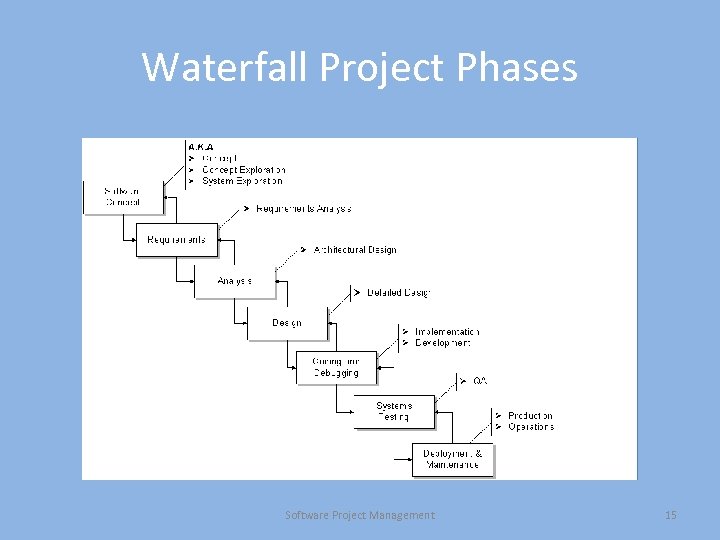
Waterfall Project Phases Software Project Management 15
Waterfall • First applied software model • Basis for many other models • Orderly progress from initial concept to system testing and maintenance • Review at each phase end. Return to previous phase if no acceptance. • Document driven Software Project Management 16
Waterfall • Phases are discontinuous: do not overlap • Suitable for stable product definitions and technologies • Find errors at early stages • Minimizes planning overhead • Suitable even for un-experienced teams Software Project Management 17
Waterfall Drawbacks • Risks not explicitly addressed • The product is not visible until final stages • The stability of requirements is not a valid assumption in software development • Discovering missing features at the end of the cycle is very expensive • Lack of flexibility • Costly • Longer schedules Software Project Management 18
Waterfall testing • Testing at the end of the lifecycle • No interaction between testing activities and the development activities • Consequence: keep the testing and development departments separate • Software testing is considered as being a destructive process • Programmers should not test their own programs • Programming organizations should not test their own programs.
V-Model 20
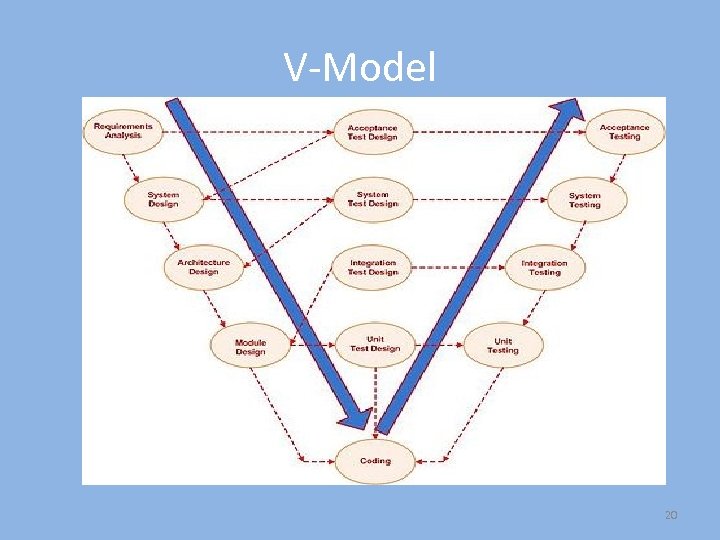
V-Model testing • Start testing activities early in the lifecycle • Clearly defines four kind of testing activities and their chaining: – Unit testing – Integration testing – System testing – Acceptance testing • Testing plans affects the development plans
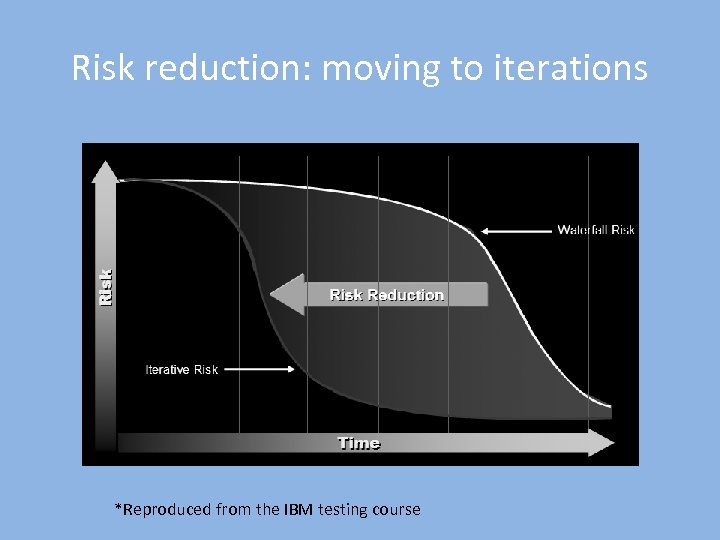
Risk reduction: moving to iterations *Reproduced from the IBM testing course
Spiral models
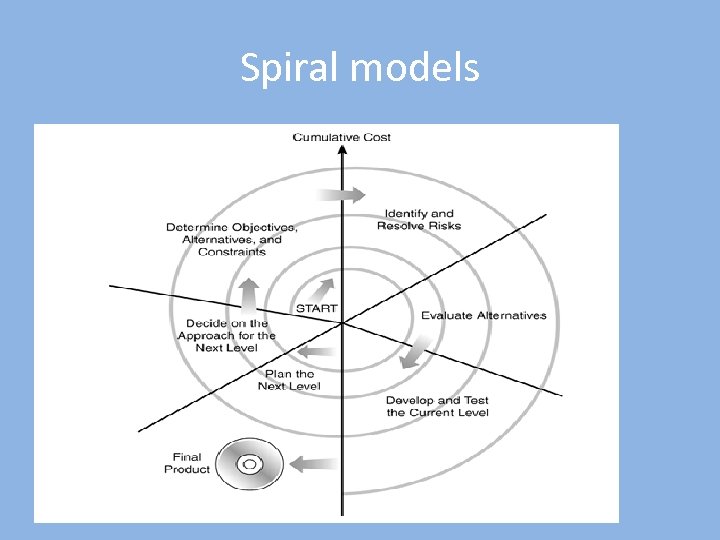
Spiral • Boehm 1988 (http: //www. computer. org/portal/cms_docs_computer/ homepage/misc/Boehm/r 5061. pdf) • First major iterative model: planning spread across iterations • Enhance waterfall by early risk identifications • Process is represented as a spiral rather than as a sequence of activities with backtracking. • Each loop in the spiral represents a phase in the process. • Each spiral iteration consists in a major risk elimination. • No fixed phases such as specification or design - loops in the spiral are chosen depending on what is required. • The last spiral iteration may be a waterfall cycle Software Project Management 24
Spiral • The result of each iteration are more refined prototypes until the released version • Advantages: – Early addressing of risks: as costs increases the risk decreases – The management control is at least as much as in the waterfall case, improved by the existence of checkpoints at the end of each spiral iteration • Disadvantages – Rather complicated to manage – Can be difficult to define milestones to indicate if you are ready to move to the next iteration Software Project Management 25
RUP phase model Software Project Management 27
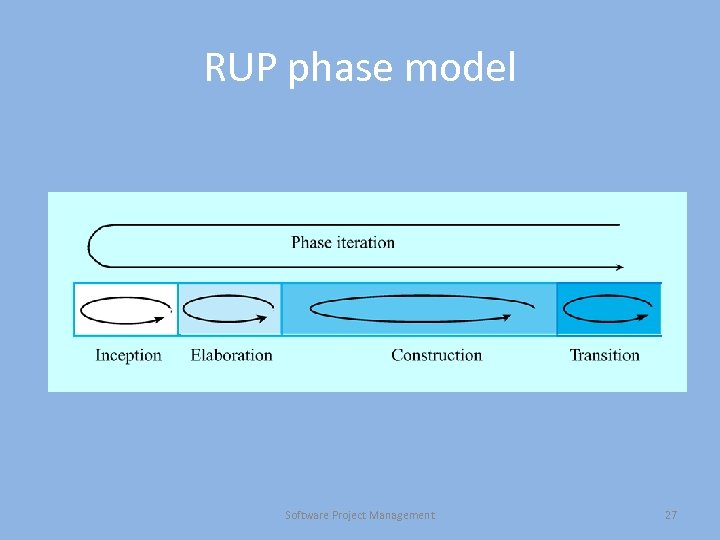
RUP phases • Inception - Define the project scope, gain agreement on project objectives, baseline the product Vision • Elaboration - Address key technical risks, produce an evolutionary prototype, baseline the Architecture • Construction - Iteratively and incrementally develop an operationaly complete product • Transition - Deliver the product into the live enduser environment Software Project Management 28
RUP good practice for business driven development • Adapt The Process – More processes is not necessarily better • Balance Competing Stakeholder Priorities - Manage often conflicting requirements • Collaborate Across Teams - Proper team organization and the setting up of effective collaborative environments. • Demonstrate Value Iteratively - Develop software iteratively • Elevate Level Of Abstraction - Use component-based architectures • Focus Continuously On Quality - Verify software quality Software Project Management 29
Practices and Anti-patterns • Practices: – Ensure team ownership of quality for the product. – Test early and continuously in step with integration of demonstrable capabilities. – Incrementally build test automation. • Anti-patterns (compare this with the V-model) – To peer-review all artifacts and complete all unit testing before integration testing. – To conduct in-depth peer-review of all intermediate artifacts, which is counter productive because it delays application testing and hence identification of major issues.
RUP disciplines • • Business Modeling: business processes modeled as business cases Requirements: identification of actors and the development of system use cases Analysis & Design: a design model is created using architectural models, component models, object models and sequence models Implementation: The components are implemented and structured into subsystems • Test: iterative process carried out in conjunction with the implementation. System testing is performed after implementation • • Deployment: a release is created, distributed and installed on users’ systems Configuration & Change Management: controls change to, and maintains the integrity of, a project’s artifacts. Project Management: Provide a framework for managing software intensive projects. Provide practical guidelines for planning, staffing, executing, and monitoring projects. Environment: Focuses on the activities and tools necessary to configure the process for a project
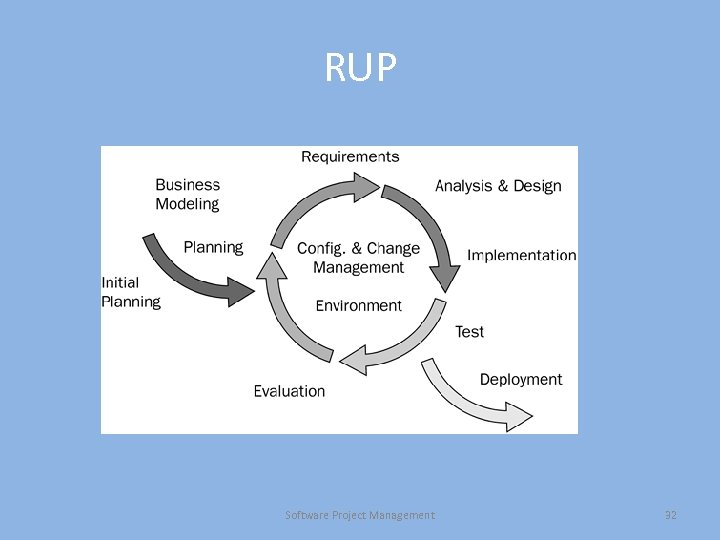
RUP Software Project Management 32
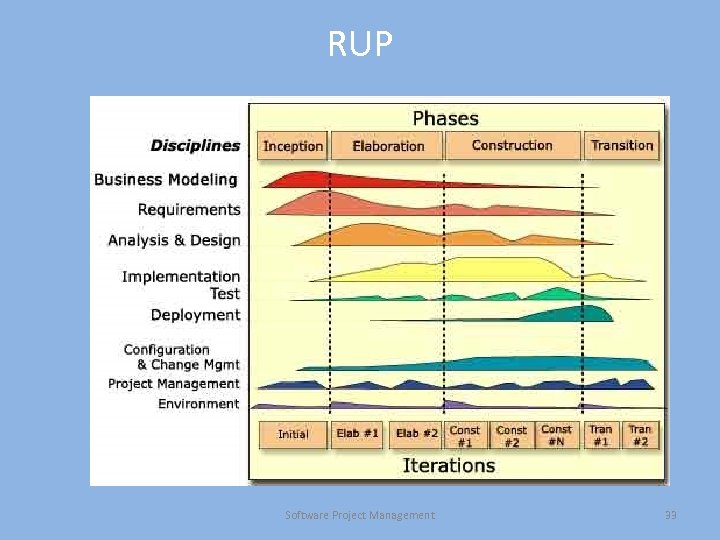
RUP Software Project Management 33
RUP-Test Discipline • Finding and documenting defects in software • Generally advising about the perceived software quality • Proving the validity of the assumptions made in design and requirement specifications through concrete demonstration • Verifying the software product functions as designed • Validating that the requirements have been implemented appropriately • Focuses primarily on the evaluation or assessment of quality realized through a number of core practices • Acts in many respects as a service provider to the other disciplines
Agile Development • • • Customer centered: www. agilemanifesto. org Extreme Programming XP SCRUM Highly iterative Adapts to requirements changes Focus on team communication Good for small/skilled teams Pair programming Refactoring Test driven development Active customer involvement May not scale for large projects Software Project Management 35
Manifesto for Agile Software Development We are uncovering better ways of developing software by doing it and helping others do it. Through this work we have come to value: Individuals and interactions over processes and tools Working software over comprehensive documentation Customer collaboration over contract negotiation Responding to change over following a plan That is, while there is value in the items on the right, we value the items on the left more.
Kent Beck’s assumptions • If code reviews are good, we'll review code all the time (pair programming). • If testing is good, everybody will test all the time (unit testing), even the customers (functional testing). • If design is good, we'll make it part of everybody's daily business (refactoring). • If simplicity is good, we'll always leave the system with the simplest design that supports its current functionality (the simplest thing that could possibly work). • If architecture is important, everybody will work defining and refining the architecture all the time (metaphor). • If integration testing is important, then we'll integrate and test several times a day (continuous integration). • If short iterations are good, we'll make the iterations really, really short— seconds and minutes and hours, not weeks and months and years (the Planning Game). Software Project Management 37
XP Promises(Beck) • • • To programmers: – They will be able to work on things that really matter, every day. – They won't have to face scary situations alone. – They will be able to do everything in their power to make their system successful. – They will make decisions that they can make best, and they won't make decisions they aren't best qualified to make. To customers and managers: – They will get the most possible value out of every programming week. – Every few weeks they will be able to see concrete progress on goals they care about. – They will be able to change the direction of the project in the middle of development without incurring exorbitant costs. In short, XP: – reduce project risk, – improve responsiveness to business changes, – improve productivity throughout the life of a system, – add fun to building software in teams Software Project Management 38
XP phases • Architectural Spike, where a prototype is created to validate the primary concerns of an iteration: reduces risk • Release planning phase, where the customer writes stories, the programmers estimate them, and the customer chooses the order in which stories will be developed; • Iteration phase, where the customer writes tests and answers questions, while the programmers program. Versions are generated at few weeks. • Release phase, where the Programmers install the software, and the Customer (hopefully) accepts the result. Software Project Management 39
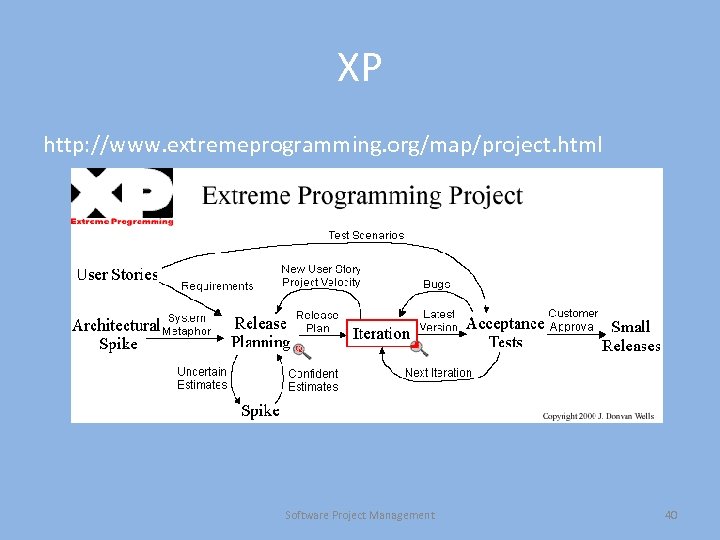
XP http: //www. extremeprogramming. org/map/project. html Software Project Management 40
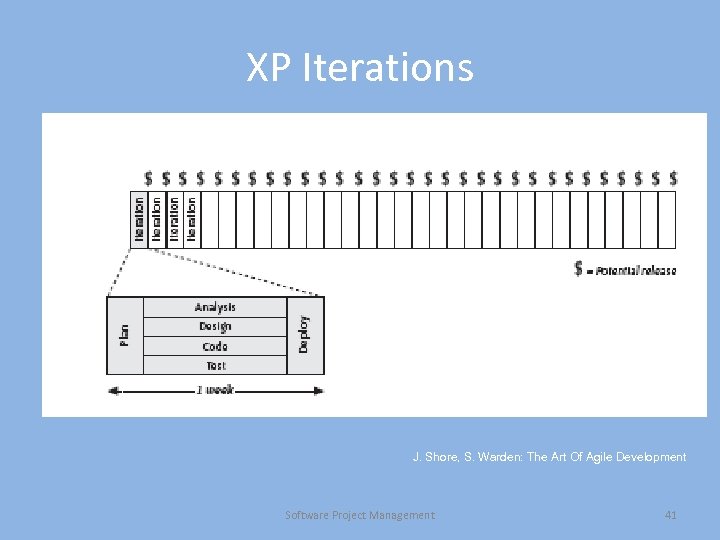
XP Iterations J. Shore, S. Warden: The Art Of Agile Development Software Project Management 41
XP testing • Test early. This principle states that you must not wait with testing until the entire system is assembled. Instead, run test cases as soon as a unit is implemented, and assemble your system out of carefully tested units. • Test first. Write test cases before implementing the unit. This is useful because test cases can serve as specifications. “Any program feature without an automated test simply doesn't exist. ”(K. Beck) • Test often. At the minimum, run your tests with each release of the system. Better yet, run your tests with every change. • Have others test. Always have someone independent test your program, and be open to criticism • Mostly perform Unit tests and Acceptance testing • Agile vs RUP: http: //www. agiledata. org/essays/rup. html
SCRUM • SCRUM: eight players rugby team with different roles acting together for a specific goal • Agile methodology • Iteration based: 1 -4 weeks iterations (Sprints) • Small teams: 7 -9 people • SCRUM: practices and roles • http: //www. infoq. com/minibooks/scrum-xp-from -the-trenches Software Project Management 43
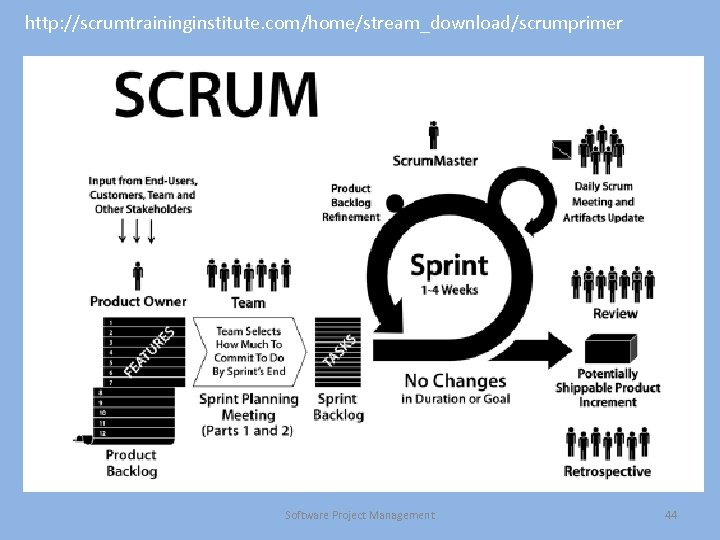
http: //scrumtraininginstitute. com/home/stream_download/scrumprimer Software Project Management 44
SCRUM Roles • Product Owner: business representative – – identifying product features translating these into a prioritized list deciding which should be at the top of the list for the next Sprint continually re-prioritizing and refining the list. • Team: programmers, architects, testers, etc – builds the product that the Product Owner indicates – “cross-functional” – it includes all the expertise necessary to deliver the potentially shippable product each Sprint – “self-organizing” with a very high degree of autonomy and accountability • Scrum Master – – helps the product group learn and apply Scrum to achieve business value help the Team and Product Owner be successful cannot be the same with the product owner he/she is not the leader of the team • The Scrum Master is NOT the project manager! Software Project Management 45
Product backlog • Product vision: product owner building the product backlog – customer features but also technical tasks – user stories or use cases – continuously updated by the Product Owner – items having a business value estimate helping maximizing the ROI • Release Backlog: the subset of the Product Backlog that is intended for the current release Software Project Management 46
Sprint backlog • • • Creating the current sprint plan from the product backlog Sprint planning meeting part one: Product Owner the Team and the Scrum Master – Focuses on what are the PO priorities – Provides the team with insight about the goal and the context of the sprint – Establishes what a done item mean (e. g. coded to standards, reviewed, implemented with unit test-driven development (TDD), tested with 100 percent test automation, integrated, and documented) Sprint planning meeting part two: the Team – focuses on detailed task planning for how to implement the items that the Team decides to take on – the Team selects the items from the Product Backlog they commit to complete by the end of the Sprint, starting at the top of the Product Backlog It is updated every day with the remaining time for each task Sprint Burndown chart: estimate of how much work (measured in person hours) remains until the Team’s tasks are finished. It is a downward sloping graph that is on a trajectory to reach “zero effort remaining” by the last day of the Sprint Software Project Management 47
Daily Scrum • Short (15 minutes or less) meeting that happens every workday at an appointed time. • Everyone on the Team attends. • To keep it brief, it is recommended that everyone remain standing. • It is the Team’s opportunity to synchronize their work and report to each other on obstacles. • No management involved. • Each member of the Team reports three (and only three) things to the other members of the Team: – what they were able to get done since the last meeting; – what they are planning to finish by the next meeting; – any blocks or impediments that are in their way. Software Project Management 48
Sprint review After the Sprint ends; The Team and the Product Owner review the Sprint; An “inspect and adapt” activity for the product; Product Owner learns what is going on with the product and with the Team; • The Team learns what is going on with the Product Owner and the market; • Attended by: Product Owner, Team members, and Scrum Master, plus customers, stakeholders, experts, executives, and anyone else interested. • • Software Project Management 49
Sprint retrospective • Inspect and adapt regarding the process. • It’s the main mechanism for taking the visibility that Scrum provides into areas of potential improvement, and turning it into results. • It’s an opportunity for the Team to discuss what’s working and what’s not working, and agree on changes to try. • The Team and Scrum Master will attend, and the Product Owner is welcome but not required to attend. Software Project Management 50
Release sprint • Final sprint to complete the release • Integrate some elements, polish, etc • Sign of some development weakness as ideally at the end of each sprint the product should be good enough for use Software Project Management 51
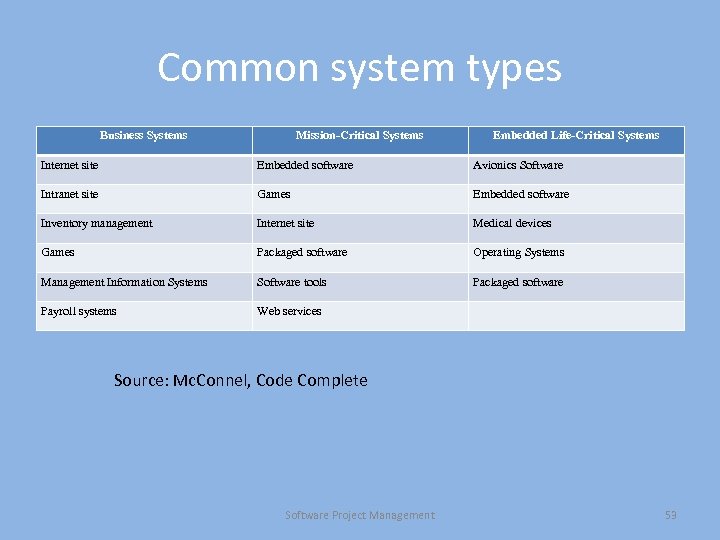
Common system types Business Systems Mission-Critical Systems Embedded Life-Critical Systems Internet site Embedded software Avionics Software Intranet site Games Embedded software Inventory management Internet site Medical devices Games Packaged software Operating Systems Management Information Systems Software tools Packaged software Payroll systems Web services Source: Mc. Connel, Code Complete Software Project Management 53
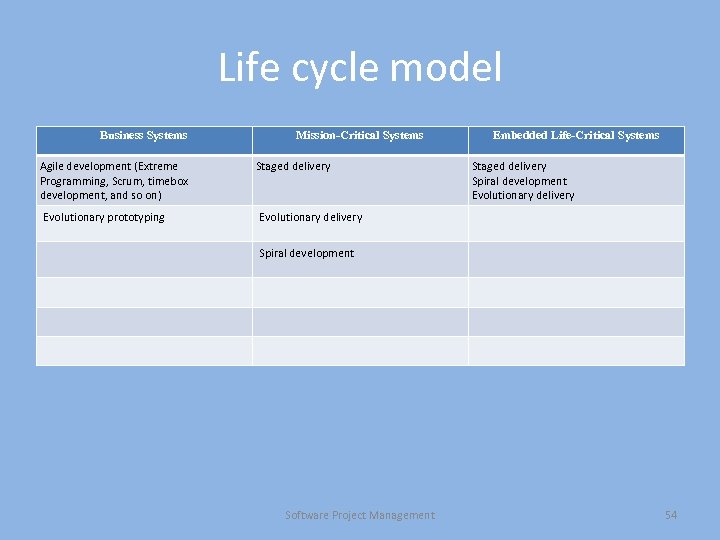
Life cycle model Business Systems Mission-Critical Systems Agile development (Extreme Programming, Scrum, timebox development, and so on) Staged delivery Evolutionary prototyping Embedded Life-Critical Systems Staged delivery Spiral development Evolutionary delivery Spiral development Software Project Management 54
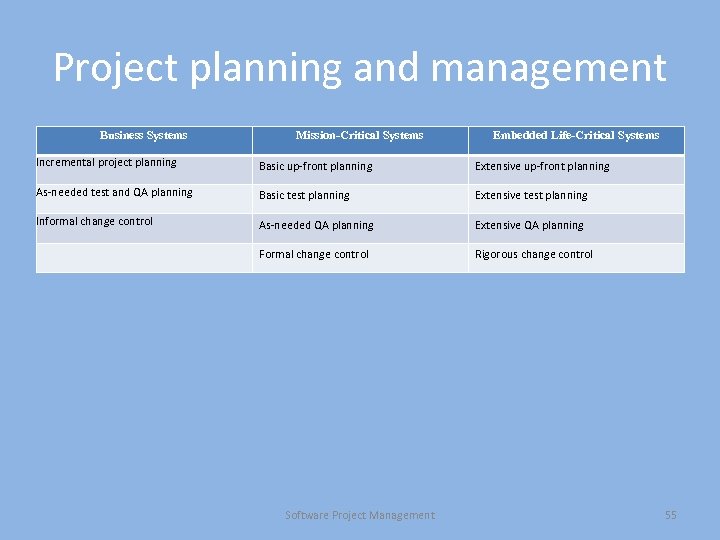
Project planning and management Business Systems Mission-Critical Systems Embedded Life-Critical Systems Incremental project planning Basic up-front planning Extensive up-front planning As-needed test and QA planning Basic test planning Extensive test planning Informal change control As-needed QA planning Extensive QA planning Formal change control Rigorous change control Software Project Management 55
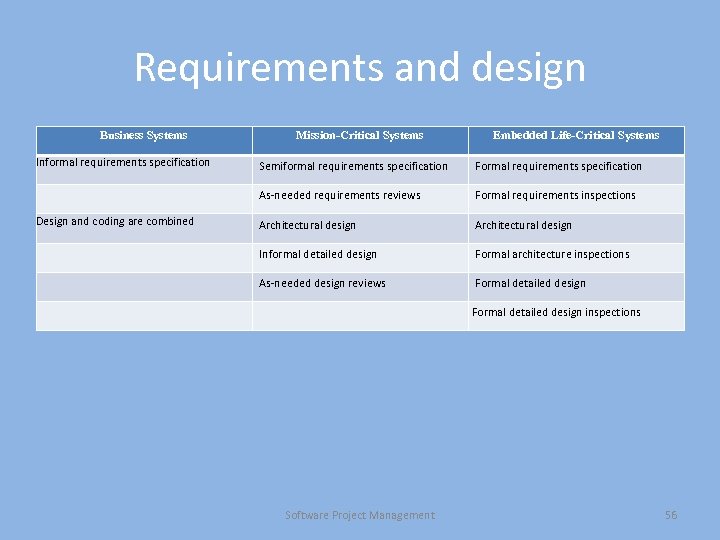
Requirements and design Business Systems Informal requirements specification Mission-Critical Systems Embedded Life-Critical Systems Formal requirements specification As-needed requirements reviews Design and coding are combined Semiformal requirements specification Formal requirements inspections Architectural design Informal detailed design Formal architecture inspections As-needed design reviews Formal detailed design inspections Software Project Management 56
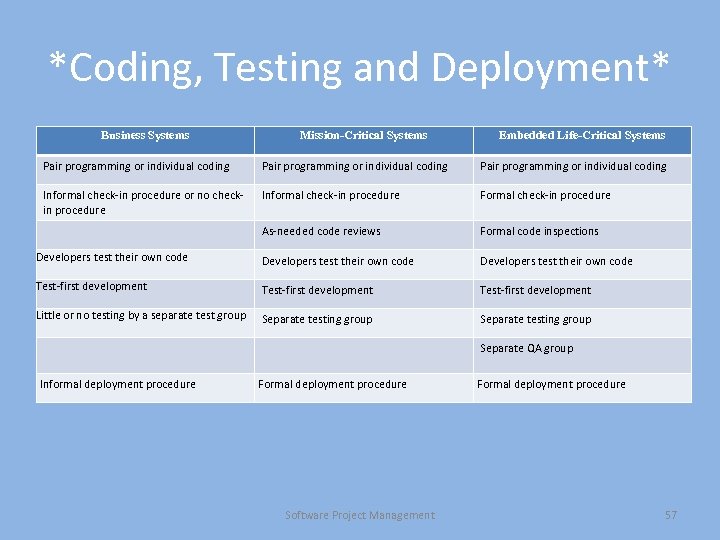
*Coding, Testing and Deployment* Business Systems Mission-Critical Systems Embedded Life-Critical Systems Pair programming or individual coding Informal check-in procedure or no checkin procedure Informal check-in procedure Formal check-in procedure As-needed code reviews Formal code inspections Developers test their own code Test-first development Little or no testing by a separate test group Separate testing group Separate QA group Informal deployment procedure Formal deployment procedure Software Project Management Formal deployment procedure 57
Скачать презентацию Software Testing Software engineering processes Course objectives
4930c1ef326d621a6bf1021699cf03e7.ppt