 Скачать презентацию Software Testing Prof Dr Holger Schlingloff Humboldt-Universität zu
8a37b6c28777bd4090b5c257f2952a9f.ppt
- Количество слайдов: 29




Software Testing Prof. Dr. Holger Schlingloff Humboldt-Universität zu Berlin and Fraunhofer Institute of Computer Architecture and Software Technology FIRST
Outline of this Lecture Series • • • 2006/11/24: Introduction, Definitions, Examples 2006/11/25 -1: Functional testing 2006/11/25 -2: Structural testing 2006/11/26 -1: Model-based test generation 2006/11/26 -2: Specification-based test generation • Next week: Your turn!
Outline of This Lecture § Functional versus structural testing § Functional testing - Unit testing - (Integration and systems testing) afternoon?
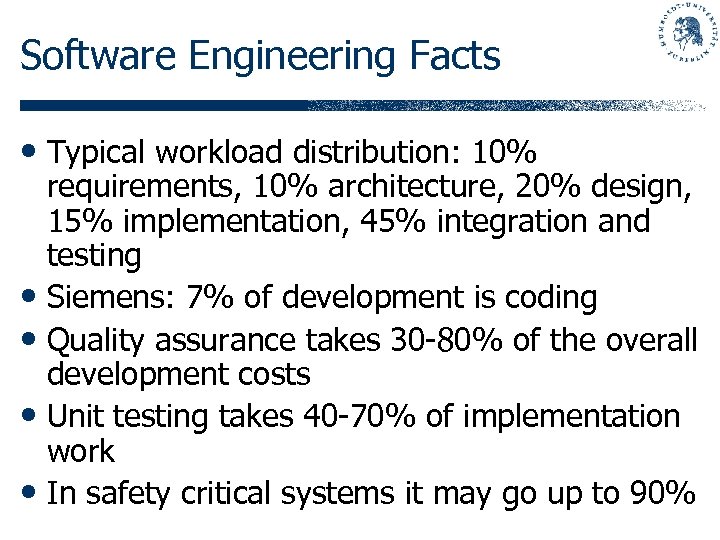
Software Engineering Facts • Typical workload distribution: 10% requirements, 10% architecture, 20% design, 15% implementation, 45% integration and testing • Siemens: 7% of development is coding • Quality assurance takes 30 -80% of the overall development costs • Unit testing takes 40 -70% of implementation work • In safety critical systems it may go up to 90%
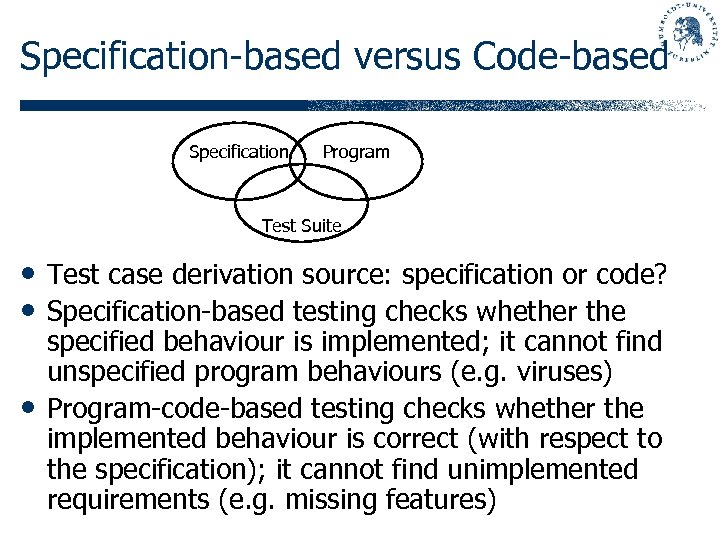
Specification-based versus Code-based Specification Program Test Suite • Test case derivation source: specification or code? • Specification-based testing checks whether the • specified behaviour is implemented; it cannot find unspecified program behaviours (e. g. viruses) Program-code-based testing checks whether the implemented behaviour is correct (with respect to the specification); it cannot find unimplemented requirements (e. g. missing features)
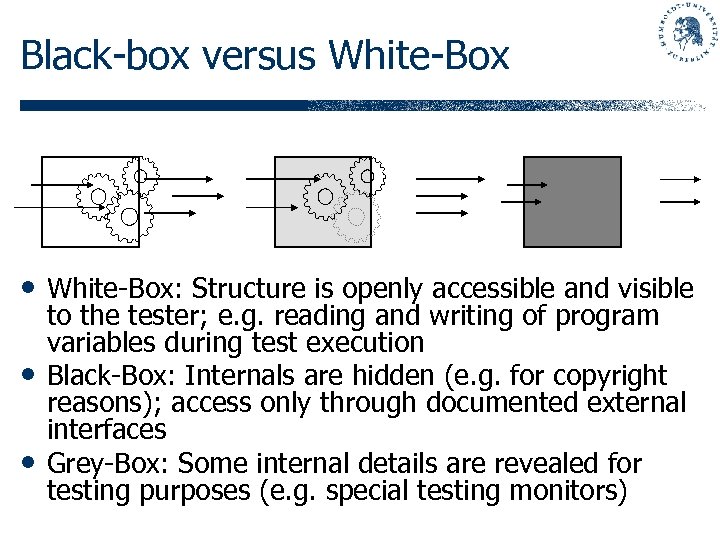
Black-box versus White-Box • White-Box: Structure is openly accessible and visible • • to the tester; e. g. reading and writing of program variables during test execution Black-Box: Internals are hidden (e. g. for copyright reasons); access only through documented external interfaces Grey-Box: Some internal details are revealed for testing purposes (e. g. special testing monitors)
Functional versus Structural Testing • Focus on § “functional”: performed function, i. e. actions or activities of the SUT, “what” (external view) - e. g. relation between input and output values § “structural”: designed structure, i. e. components or implementation, “how” (internal view) • - e. g. data and data types or algorithmic idea Often used synonymously: § functional test – black-box-test – specificationbased test § structural test – white-box-test – code-based test
Code-based quality assessment • Review, audit, walk through § four-eyes principle § audit rules, Fagan inspection § software metrics, coding rules, quality manuals • Verification § model checking, automated theorem proving § static analysis • Unit testing

Outline of This Lecture § Functional versus structural testing § Functional testing - Unit testing - Test case selection
Unit Testing • Often considered “the” testing § first analytical step after coding § first execution of actual system parts § often done by programmer herself • The SUT consists of: § procedures, functions (in imperative languages) § modules, units, classes, interfaces (in oo programs) § blocks (in model-based development) • Same or similar development environment as for SUT itself (compiler, linker, platform, …)
Unit Testing Methodology • Each unit is tested independently of all the others § no external influences or disturbances § fault localisation is usually no problem § nesting is allowed, poses additional difficulties • Unit is linked with testing program § setting of SUT environment (variables) by testing program § invocation of SUT functions with appropriate parameters § evaluation of result by comparison of variables
Unit Testing Goals • Exhibition of faults in the program text wrong calculations, wrong operations incorrect output values, incorrect parameter treatment missing paths, missing cases, missing exception handling duplicate cases, spurious outputs, redundant code wrong loops, wrong boundary values, wrong pointer arithmetic § timing and synchronisation problems (difficult!) § incorrect (error) messages § § § • Non-functional properties (efficiency, usability) are of secondary importance
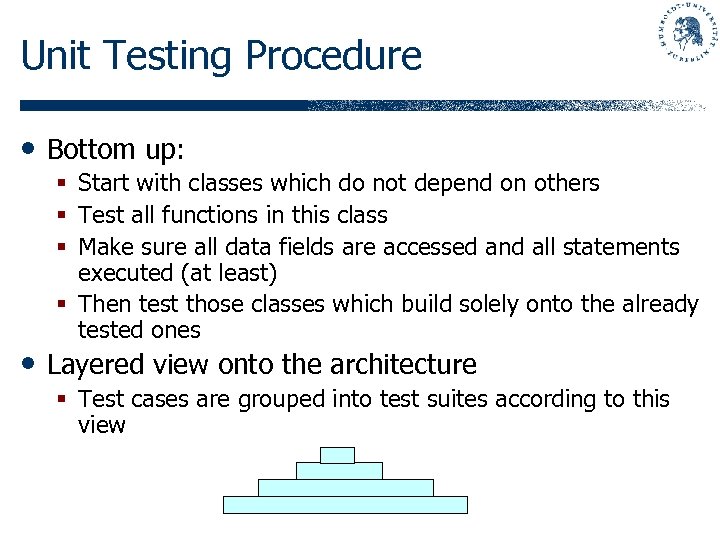
Unit Testing Procedure • Bottom up: § Start with classes which do not depend on others § Test all functions in this class § Make sure all data fields are accessed and all statements executed (at least) § Then test those classes which build solely onto the already tested ones • Layered view onto the architecture § Test cases are grouped into test suites according to this view
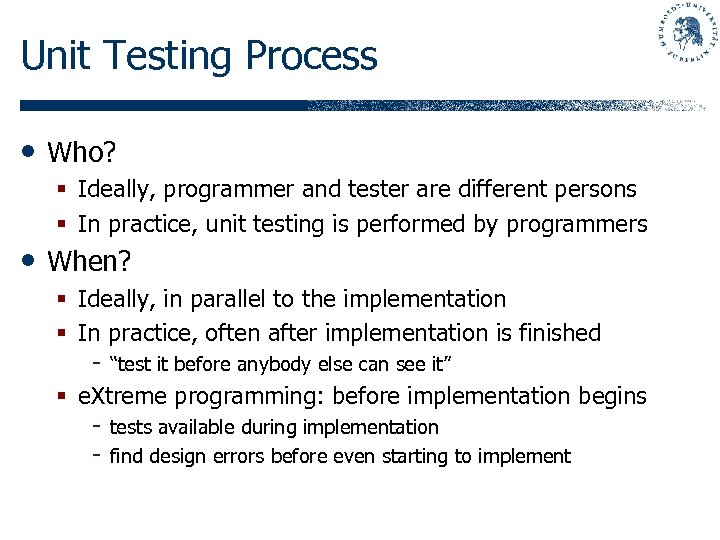
Unit Testing Process • Who? § Ideally, programmer and tester are different persons § In practice, unit testing is performed by programmers • When? § Ideally, in parallel to the implementation § In practice, often after implementation is finished - “test it before anybody else can see it” § e. Xtreme programming: before implementation begins - tests available during implementation - find design errors before even starting to implement
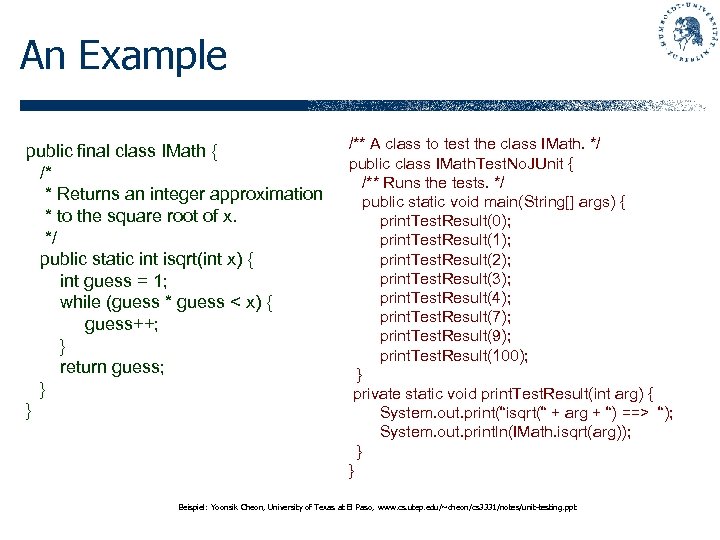
An Example public final class IMath { /* * Returns an integer approximation * to the square root of x. */ public static int isqrt(int x) { int guess = 1; while (guess * guess < x) { guess++; } return guess; } } /** A class to test the class IMath. */ public class IMath. Test. No. JUnit { /** Runs the tests. */ public static void main(String[] args) { print. Test. Result(0); print. Test. Result(1); print. Test. Result(2); print. Test. Result(3); print. Test. Result(4); print. Test. Result(7); print. Test. Result(9); print. Test. Result(100); } private static void print. Test. Result(int arg) { System. out. print(“isqrt(“ + arg + “) ==> “); System. out. println(IMath. isqrt(arg)); } } Beispiel: Yoonsik Cheon, University of Texas at El Paso, www. cs. utep. edu/~cheon/cs 3331/notes/unit-testing. ppt
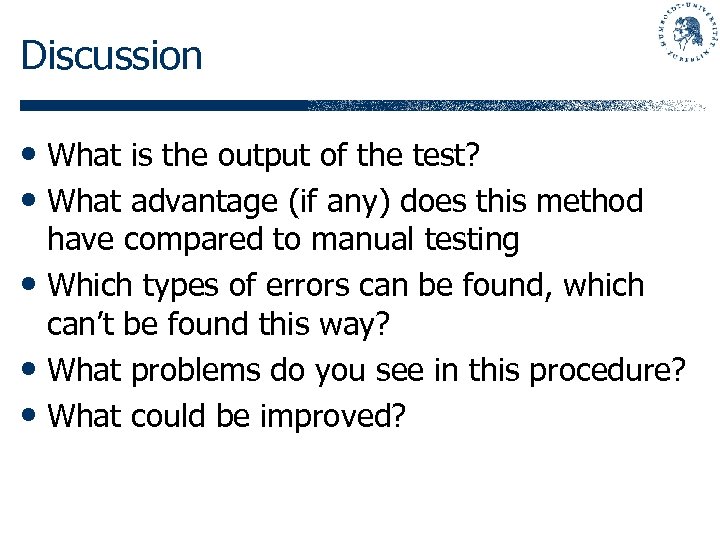
Discussion • What is the output of the test? • What advantage (if any) does this method have compared to manual testing • Which types of errors can be found, which can’t be found this way? • What problems do you see in this procedure? • What could be improved?
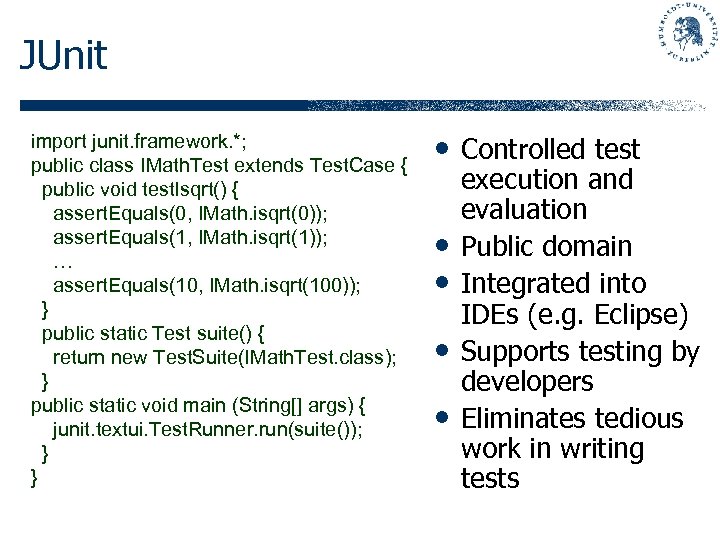
JUnit import junit. framework. *; public class IMath. Test extends Test. Case { public void test. Isqrt() { assert. Equals(0, IMath. isqrt(0)); assert. Equals(1, IMath. isqrt(1)); … assert. Equals(10, IMath. isqrt(100)); } public static Test suite() { return new Test. Suite(IMath. Test. class); } public static void main (String[] args) { junit. textui. Test. Runner. run(suite()); } } • Controlled test • • execution and evaluation Public domain Integrated into IDEs (e. g. Eclipse) Supports testing by developers Eliminates tedious work in writing tests
JUnit Criticism • Advantages § automated, repeatable test execution § test suites linked to program code, for each class a test class § full flexibility e. g. for test data import, access to internal (public) § automated evaluation of assertions § possibility to test exception handling § integration with IDE • Disadvantages § No test case selection § No test oracle
Unit Test Criticism • Writing Unit Test Cases is a work which is closely related to the implementation and to the code, often done by implementers § “programmers know their code best”, but also tend to overlook their own errors (no redundancy) § “why bother with a specification if the code is available”, but also the user perspective may be lost § “unit tests can help in debugging”, but they may not demonstrate the correctness of the SUT § “background information available”, but undocumented assumptions may also have other impacts as well
How to Select Test Cases? • For complexity reasons it is not possible to test all possible inputs to a program § 32 -bit integer 1010 values § (month, day, year) 12*31*700=260. 000 combinations • Test selection problem: given an upper size to the test suite, which subset of all possible test cases has the highest error-uncovering probability? § equivalence classes § boundary values § decision tables
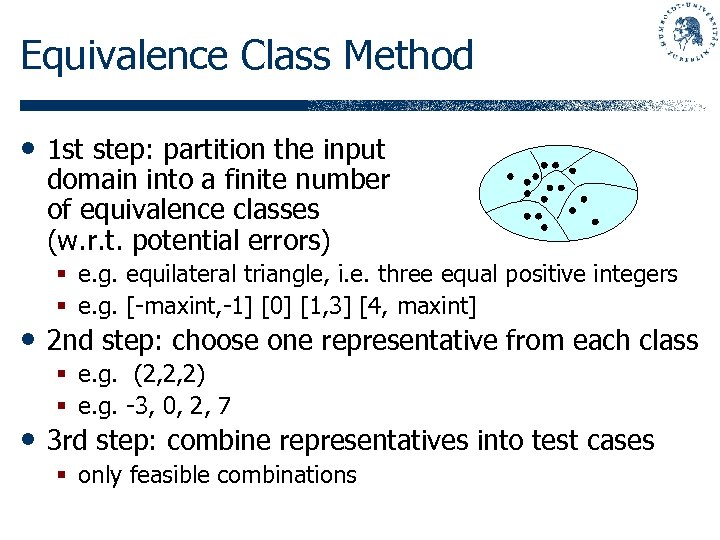
Equivalence Class Method • 1 st step: partition the input domain into a finite number of equivalence classes (w. r. t. potential errors) § e. g. equilateral triangle, i. e. three equal positive integers § e. g. [-maxint, -1] [0] [1, 3] [4, maxint] • 2 nd step: choose one representative from each class § e. g. (2, 2, 2) § e. g. -3, 0, 2, 7 • 3 rd step: combine representatives into test cases § only feasible combinations
How to build equivalence classes • Look at the domains for input and output • For each parameter there are valid and invalid classes § enumerations: contained / not contained § different computation paths: for each path a valid, plus one invalid class § outputs which are calculated differently: one class for each case § input preconditions: one valid and one invalid class for each input • Split a class if you have reasons to assume that the elements are treated differently
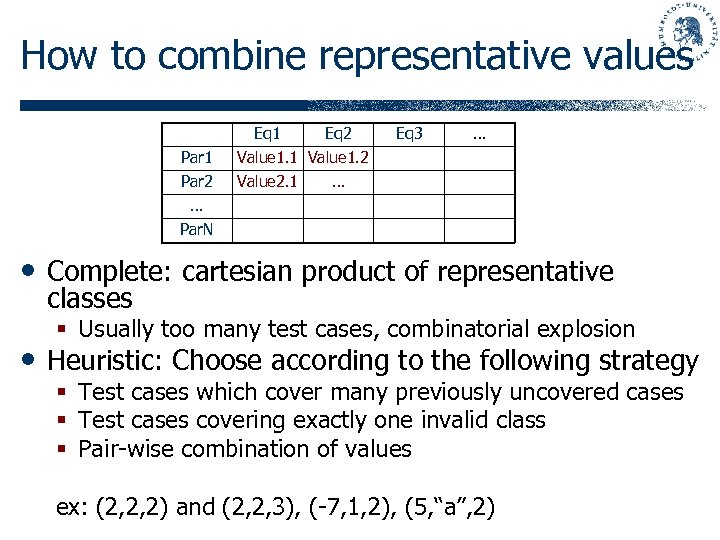
How to combine representative values Eq 1 Eq 2 Par 1 Value 2. 1 … Value 1. 1 Value 1. 2 Par 2 … Eq 3 … Par. N • Complete: cartesian product of representative classes § Usually too many test cases, combinatorial explosion • Heuristic: Choose according to the following strategy § Test cases which cover many previously uncovered cases § Test cases covering exactly one invalid class § Pair-wise combination of values ex: (2, 2, 2) and (2, 2, 3), (-7, 1, 2), (5, “a”, 2)
Example public final class IMath { public static int idiv (int x, y) { /* Returns the integer quotient of the two input values */ … } } • Which are the test cases arising by the equivalence class method? • Which important cases are not covered?
Discussion • Pro § systematic procedure § reasonable number of test cases § well-suited for “small” functions with pre- and postconditions • Con § selection of test cases by heuristics § interaction between parameter values neglected § with complex parameter sets many equivalence classes
Improvements • Boundary value analysis • Decision table methods § Classification tree method
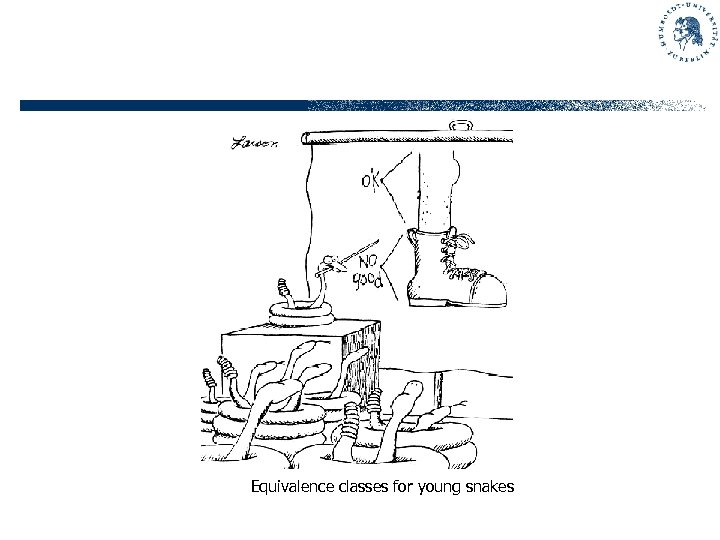
Equivalence classes for young snakes
Скачать презентацию Software Testing Prof Dr Holger Schlingloff Humboldt-Universität zu
8a37b6c28777bd4090b5c257f2952a9f.ppt