


 Скачать презентацию Software Security Comp Sci 725 Cryptography and Steganography
9bac65be55badb7911361a0e49c07bca.ppt
- Количество слайдов: 35
 Software Security Comp. Sci 725 Cryptography and Steganography (Handout 11) August 2009 Clark Thomborson University of Auckland
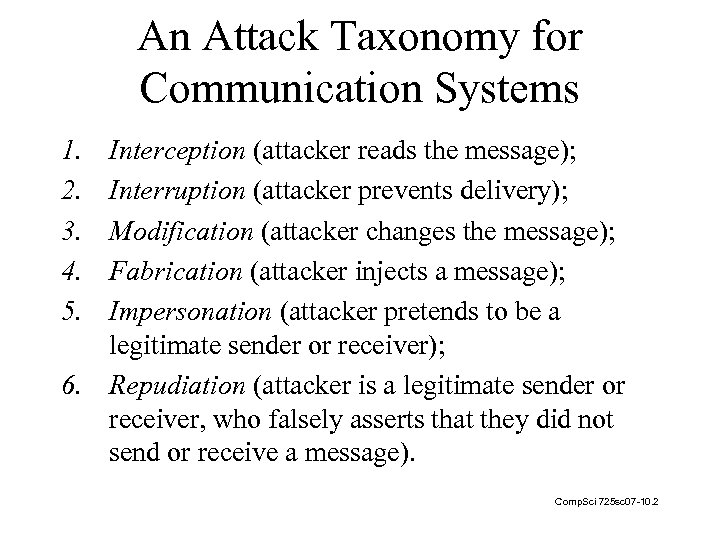 An Attack Taxonomy for Communication Systems 1. 2. 3. 4. 5. Interception (attacker reads the message); Interruption (attacker prevents delivery); Modification (attacker changes the message); Fabrication (attacker injects a message); Impersonation (attacker pretends to be a legitimate sender or receiver); 6. Repudiation (attacker is a legitimate sender or receiver, who falsely asserts that they did not send or receive a message). Comp. Sci 725 sc 07 -10. 2
![Analysing a Security Requirement • “Suppose a sender [Alice] wants to send a message](https://present5.com/presentation/9bac65be55badb7911361a0e49c07bca/image-3.jpg "Analysing a Security Requirement • “Suppose a sender [Alice] wants to send a message") Analysing a Security Requirement • “Suppose a sender [Alice] wants to send a message to a receiver [Bob]. Moreover, [Alice] wants to send the message securely: [Alice] wants to make sure an eavesdropper [Trudy] cannot read the message. ” (Schneier, Applied Cryptography, 2 nd edition, 1996) • Exercise 1. Draw a picture of this scenario. • Exercise 2. Discuss Alice’s security requirements, using the terminology developed in COMPSCI 725. Comp. Sci 725 sc 07 -10. 3
Analysing a Security Requirement • “Suppose a sender [Alice] wants to send a message to a receiver [Bob]. Moreover, [Alice] wants to send the message securely: [Alice] wants to make sure an eavesdropper [Trudy] cannot read the message. ” (Schneier, Applied Cryptography, 2 nd edition, 1996) • Exercise 1. Draw a picture of this scenario. • Exercise 2. Discuss Alice’s security requirements, using the terminology developed in COMPSCI 725. Comp. Sci 725 sc 07 -10. 3
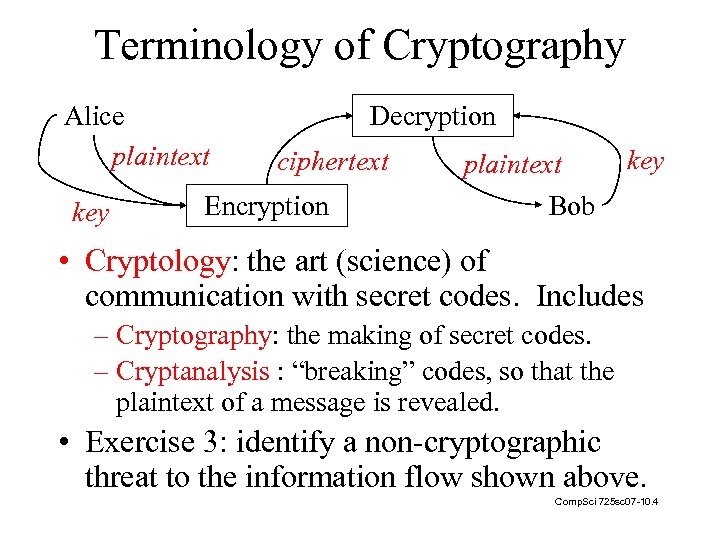 Terminology of Cryptography Alice plaintext key Decryption ciphertext Encryption plaintext Bob key • Cryptology: the art (science) of communication with secret codes. Includes – Cryptography: the making of secret codes. – Cryptanalysis : “breaking” codes, so that the plaintext of a message is revealed. • Exercise 3: identify a non-cryptographic threat to the information flow shown above. Comp. Sci 725 sc 07 -10. 4
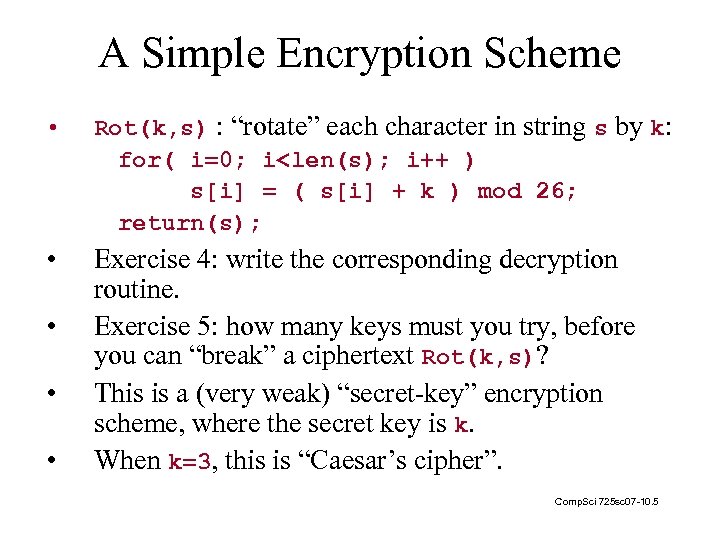 A Simple Encryption Scheme • Rot(k, s) : “rotate” each character in string s by k: for( i=0; i
 Symmetric and Public-Key Encryption • If the decryption key kd can be computed from the encryption key ke, then the algorithm is called “symmetric”. • Question: is Rot(ke, s) a symmetric cipher? • If the decryption key kd cannot be computed (in a reasonable amount of time) from the encryption key ke, then the algorithm is called “asymmetric” or “publickey”. Comp. Sci 725 sc 07 -10. 6
 One-Time Pads • If our secret key K is as long as our plaintext message P, when both are written as binary bitstrings, then we can easily compute the bitwise exclusive-or K P. • This encoding is “provably secure”, if we never re-use the key. – Provably secure = The most efficient way to compute P, given K P, is to try all possible keys K. • It is often impractical to establish long secret keys. • Reference: Stamp, Information Security, pp. 18 -19. • Warning: Security may be breached if an attacker knows that an encrypted message has been sent! – Traffic analysis: if a burst of messages is sent from the Pentagon… – Steganography is the art of sending imperceptible messages. Comp. Sci 725 sc 07 -10. 7
 Stream Ciphers • We can encrypt an arbitrarily long bitstring P if we know how to generate an arbitrarilylong “keystring” S from our secret key K. • The encryption is the bitwise exclusive-or S P. • Decryption is the same function as encryption, because S ( S P ) = P. • RC 4 is a stream cipher used in SSL. • Reference: Stamp, pp. 36 -37. Comp. Sci 725 sc 07 -10. 8
 Block Ciphers • We can encrypt an arbitrarily long bitstring P by breaking it up into blocks P 0, P 1, P 2, …, of some convenient size (e. g. 256 bits), then encrypting each block separately. • You must vary the encryption at least slightly for each block, otherwise the attacker can easily discover i, j : Pi = Pj. • A common method for varying the block encryptions is “cipher block chaining” (CBC). – Each plaintext block is XOR-ed with the ciphertext from the previous block, before being encrypted. • Reference: Stamp, pp. 50 -51. • Common block ciphers: DES, 3 DES, AES. Comp. Sci 725 sc 07 -10. 9
 Message Integrity • So far, we have considered only interception attacks. • The Message Authentication Code (MAC) is the last ciphertext block from a CBC-mode block cipher. – Changing any message bit will change the MAC. – Unless you know the secret key, you can’t compute a MAC from the plaintext. • Sending a plaintext message, plus its MAC, will ensure message integrity to anyone who knows the (shared) secret key. • This defends against modification and fabrication! • Note: changing a bit in an encrypted message will make it unreadable, but there’s no general-purpose algorithm to determine “readability”. • Keyed hashes (HMACs) are another approach. – SHA-1 and MD 5 are used in SSL. • Reference: Stamp, pp. 54 -55 and 93 -94. Comp. Sci 725 sc 07 -10. 10
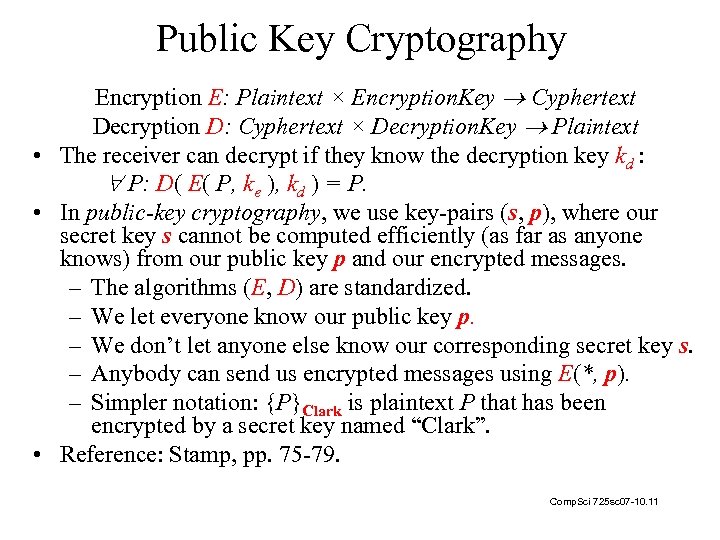 Public Key Cryptography Encryption E: Plaintext × Encryption. Key Cyphertext Decryption D: Cyphertext × Decryption. Key Plaintext • The receiver can decrypt if they know the decryption key kd : P: D( E( P, ke ), kd ) = P. • In public-key cryptography, we use key-pairs (s, p), where our secret key s cannot be computed efficiently (as far as anyone knows) from our public key p and our encrypted messages. – The algorithms (E, D) are standardized. – We let everyone know our public key p. – We don’t let anyone else know our corresponding secret key s. – Anybody can send us encrypted messages using E(*, p). – Simpler notation: {P}Clark is plaintext P that has been encrypted by a secret key named “Clark”. • Reference: Stamp, pp. 75 -79. Comp. Sci 725 sc 07 -10. 11
 Authentication in PK Cryptography • We can use our secret key s to encrypt a message which everyone can decrypt using our public key p. – E(P, s) is a “signed message”. Simpler notation: [P]Clark – Only people who know the secret key named “Clark” can create this signature. – Anyone who knows the public key for “Clark” can validate this signature. – This defends against impersonation and repudiation attacks! • We may have many public/private key pairs: – For our email, – For our bank account (our partner knows this private key too), – For our workgroup (shared with other members), … • A “public key infrastructure” (PKI) will help us discover other people’s public keys (p 1, p 2, …), if we know the names of these keys and where they were registered. – A registry database is called a “certificate authority” (CA). – Warning: someone might register a key under your name! Comp. Sci 725 sc 07 -10. 12
![A Simple Cryptographic Protocol RA [B, “Bob”]CA {SK}B, {P}SK Alice Bob 1. Alice sends](https://present5.com/presentation/9bac65be55badb7911361a0e49c07bca/image-13.jpg "A Simple Cryptographic Protocol RA [B, “Bob”]CA {SK}B, {P}SK Alice Bob 1. Alice sends") A Simple Cryptographic Protocol RA [B, “Bob”]CA {SK}B, {P}SK Alice Bob 1. Alice sends a service request RA to Bob. 2. Bob replies with his digital certificate. • • Bob’s certificate contains Bob’s public key B and Bob’s name. This certificate was signed by a Certificate Authority, using a public key CA which Alice already knows. 3. Alice creates a symmetric key SK. This is a “session key”. • • Alice sends SK to Bob, encrypted with public key B. Alice and Bob will use SK to encrypt their plaintext messages. Comp. Sci 725 sc 07 -10. 13
A Simple Cryptographic Protocol RA [B, “Bob”]CA {SK}B, {P}SK Alice Bob 1. Alice sends a service request RA to Bob. 2. Bob replies with his digital certificate. • • Bob’s certificate contains Bob’s public key B and Bob’s name. This certificate was signed by a Certificate Authority, using a public key CA which Alice already knows. 3. Alice creates a symmetric key SK. This is a “session key”. • • Alice sends SK to Bob, encrypted with public key B. Alice and Bob will use SK to encrypt their plaintext messages. Comp. Sci 725 sc 07 -10. 13
![Protocol Analysis RA RA [T, “Trudy”]CA [B, “Bob”]CA {SK}T, {P}SK {SK}B, {P}SK Trudy: acting](https://present5.com/presentation/9bac65be55badb7911361a0e49c07bca/image-14.jpg "Protocol Analysis RA RA [T, “Trudy”]CA [B, “Bob”]CA {SK}T, {P}SK {SK}B, {P}SK Trudy: acting") Protocol Analysis RA RA [T, “Trudy”]CA [B, “Bob”]CA {SK}T, {P}SK {SK}B, {P}SK Trudy: acting as Alice to Bob, Alice Bob and as Bob to Alice • How can Alice detect that Trudy is “in the middle”? • What does your web-browser do, when it receives a digital certificate that says “Trudy” instead of “Bob”? • Trudy’s certificate might be [T, “Bob”]CA’ • If you follow a URL to “https: //www. bankofamerica. org”, your browser might form an SSL connection with a Nigerian website which spoofs the website of a legitimate bank! • Have you ever inspected an SSL certificate? Comp. Sci 725 sc 07 -10. 14
Protocol Analysis RA RA [T, “Trudy”]CA [B, “Bob”]CA {SK}T, {P}SK {SK}B, {P}SK Trudy: acting as Alice to Bob, Alice Bob and as Bob to Alice • How can Alice detect that Trudy is “in the middle”? • What does your web-browser do, when it receives a digital certificate that says “Trudy” instead of “Bob”? • Trudy’s certificate might be [T, “Bob”]CA’ • If you follow a URL to “https: //www. bankofamerica. org”, your browser might form an SSL connection with a Nigerian website which spoofs the website of a legitimate bank! • Have you ever inspected an SSL certificate? Comp. Sci 725 sc 07 -10. 14
 Attacks on Cryptographic Protocols • A ciphertext may be broken by… – Discovering the “restricted” algorithm (if the algorithm doesn’t require a key). – Discovering the key by non-cryptographic means (bribery, theft, ‘just asking’). – Discovering the key by “brute-force search” (through all possible keys). – Discovering the key by cryptanalysis based on other information, such as known pairs of (plaintext, ciphertext). • The weakest point in the system may not be its cryptography! – See Ferguson & Schneier, Practical Cryptography, 2003. – For example: you should consider what identification was required, when a CA accepted a key, before you accept any public key from that CA as a “proof of identity”. Comp. Sci 725 sc 07 -10. 15
 Limitations and Usage of PKI • If a Certificate Authority is offline, or if you can’t be bothered to wait for a response, you will use the public keys stored in your local computer. – Warning: a public key may be revoked at any time, e. g. if someone reports their key was stolen. • Key Continuity Management is an alternative to PKI. – The first time someone presents a key, you decide whether or not to accept it. – When someone presents a key that you have previously accepted, it’s probably ok. – If someone presents a changed key, you should think carefully before accepting! – This idea was introduced in SSH, in 1996. It was named, and identified as a general design principle, by Peter Gutmann (http: //www. cs. auckland. ac. nz/~pgut 001/). – Reference: Simson Garfinkel, in http: //www. simson. net/thesis/pki 3. pdf Comp. Sci 725 sc 07 -10. 16
 Identification and Authentication • You can authenticate your identity to a local machine by – what you have (e. g. a smart card), – what you know (e. g. a password), – what you “are” (e. g. your thumbprint or handwriting) • After you have authenticated yourself locally, then you can use cryptographic protocols to… – … authenticate your outgoing messages (if others know your public key); – … verify the integrity of your incoming messages (if you know your correspondents’ public keys); – … send confidential messages to other people (if you know their public keys). – Warning: you (and others) must trust the operations of your local machine! We’ll return to this subject… Comp. Sci 725 sc 07 -10. 17
 Watermarking, Tamper-Proofing and Obfuscation – Tools for Software Protection Christian Collberg & Clark Thomborson IEEE Transactions on Software Engineering 28: 8, 735 -746, August 2002 Comp. Sci 725 sc 07 -10.
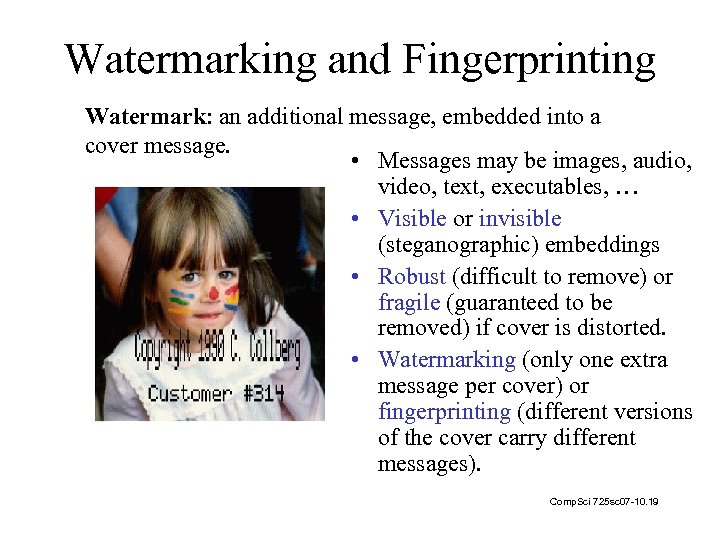 Watermarking and Fingerprinting Watermark: an additional message, embedded into a cover message. • Messages may be images, audio, video, text, executables, … • Visible or invisible (steganographic) embeddings • Robust (difficult to remove) or fragile (guaranteed to be removed) if cover is distorted. • Watermarking (only one extra message per cover) or fingerprinting (different versions of the cover carry different messages). Comp. Sci 725 sc 07 -10. 19
 Our Desiderata for (Robust, Invisible) SW Watermarks • Watermarks should be stealthy -- difficult for an adversary to locate. • Watermarks should be resilient to attack -resisting attempts at removal even if they are located. • Watermarks should have a high data-rate -- so that we can store a meaningful message without significantly increasing the size of the object. Comp. Sci 725 sc 07 -10. 20
 Attacks on Watermarks • Subtractive attacks: remove the watermark (WM) without damaging the cover. • Additive attacks: add a new WM without revealing “which WM was added first”. • Distortive attacks: modify the WM without damaging the cover. • Collusive attacks: examine two fingerprinted objects, or a watermarked object and its unwatermarked cover; find the differences; construct a new object without a recognisable mark. Comp. Sci 725 sc 07 -10. 21
 Defenses for Robust Software Watermarks • Obfuscation: we can modify the software, so that a reverse engineer will have great difficulty figuring out how to reproduce the cover without also reproducing the WM. • Tamperproofing: we can add integrity-checking code that (almost always) renders it unusable if the object is modified. Comp. Sci 725 sc 07 -10. 22
 Classification of Software Watermarks • Static code watermarks are stored in the section of the executable that contains instructions. • Static data watermarks are stored in other sections of the executable. Dynamic data watermarks are stored in a program’s execution state. Such watermarks are resilient to distortive (obfuscation) attacks. Comp. Sci 725 sc 07 -10. 23
 Dynamic Watermarks • Easter Eggs are revealed to any end-user who types a special input sequence. • Execution Trace Watermarks are carried (steganographically) in the instruction execution sequence of a program, when it is given a special input. Data Structure Watermarks are built (steganographically) by a program, when it is given a special input sequence (possibly null). Comp. Sci 725 sc 07 -10. 24
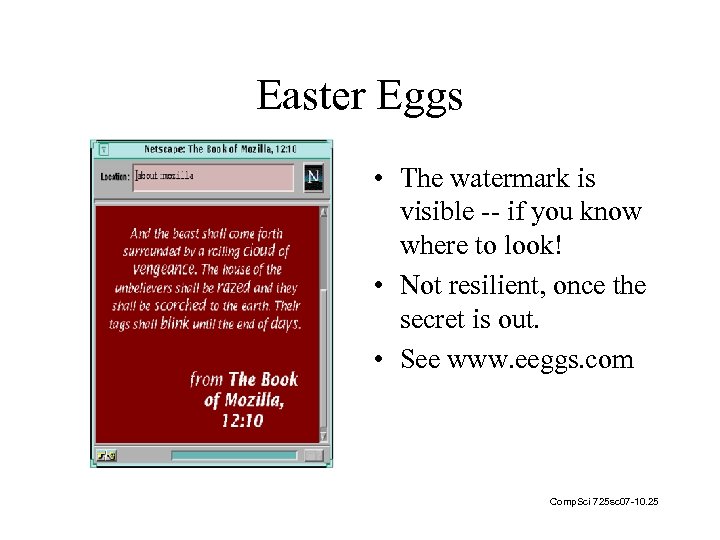 Easter Eggs • The watermark is visible -- if you know where to look! • Not resilient, once the secret is out. • See www. eeggs. com Comp. Sci 725 sc 07 -10. 25
 Goals for Dynamic Datastructure Watermarks • Stealth. Our WM should “look like” other structures created by the cover (search trees, hash tables, etc. ) • Resiliency. Our WM should have some properties that can be checked, stealthily and quickly at runtime, by tamperproofing code (triangulated graphs, biconnectivity, …) • Data Rate. We would like to encode 100 -bit WMs, or 1000 -bit fingerprints, in a few KB of data structure. Our fingerprints may be 1000 -bit integers that are products of two primes. Comp. Sci 725 sc 07 -10. 26
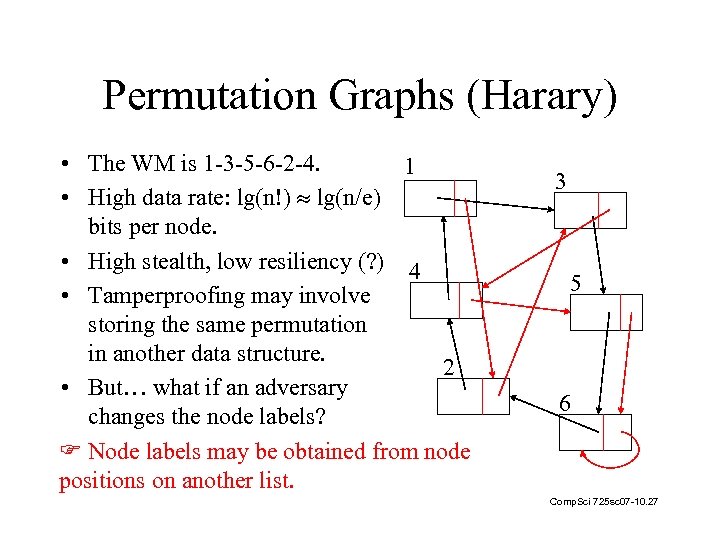 Permutation Graphs (Harary) • The WM is 1 -3 -5 -6 -2 -4. 1 • High data rate: lg(n!) lg(n/e) bits per node. • High stealth, low resiliency (? ) 4 • Tamperproofing may involve storing the same permutation in another data structure. 2 • But… what if an adversary changes the node labels? Node labels may be obtained from node positions on another list. 3 5 6 Comp. Sci 725 sc 07 -10. 27
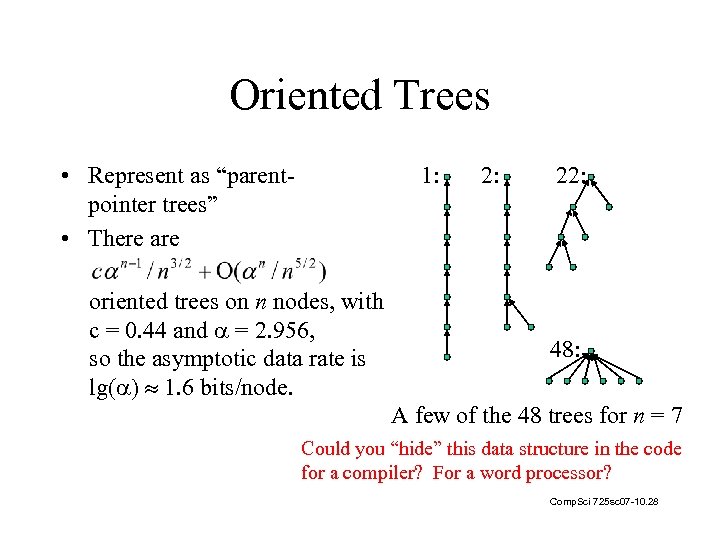 Oriented Trees • Represent as “parentpointer trees” • There are 1: oriented trees on n nodes, with c = 0. 44 and = 2. 956, so the asymptotic data rate is lg( ) 1. 6 bits/node. 2: 22: 48: A few of the 48 trees for n = 7 Could you “hide” this data structure in the code for a compiler? For a word processor? Comp. Sci 725 sc 07 -10. 28
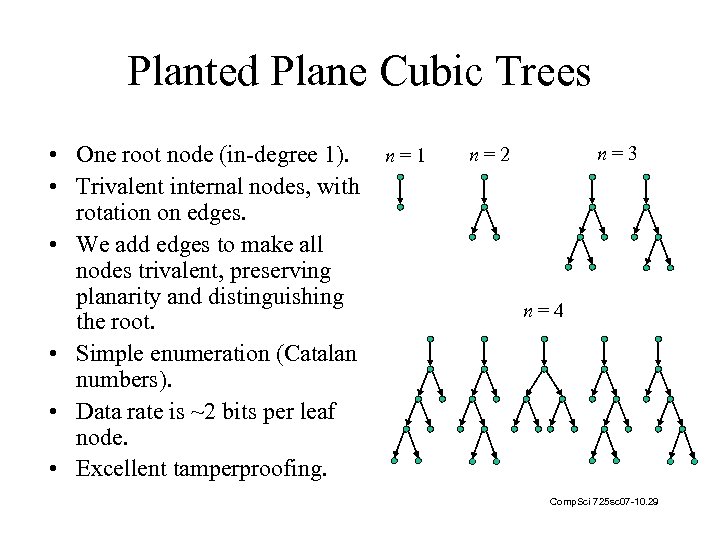 Planted Plane Cubic Trees • One root node (in-degree 1). • Trivalent internal nodes, with rotation on edges. • We add edges to make all nodes trivalent, preserving planarity and distinguishing the root. • Simple enumeration (Catalan numbers). • Data rate is ~2 bits per leaf node. • Excellent tamperproofing. n=1 n=3 n=2 n=4 Comp. Sci 725 sc 07 -10. 29
 Open Problems in Watermarking • We can easily build a “recogniser” program to find the WM and therefore demonstrate ownership… but can we release this recogniser to the public without compromising our watermarks? • Can we design a “partial recogniser” that preserves resiliency, even though it reveals the location of some part of our WM? Comp. Sci 725 sc 07 -10. 30
 State of the Art in SW Watermarking • Davidson and Myhrvold (1996) encode a static watermark by rearranging the basic blocks of a code. – Venkatesan et al. (2001) add arcs to the control-flow graph. • The first dynamic data structure watermarks were published by us (POPL’ 99), with further development: – – – http: //www. cs. arizona. edu/sandmark/ (2000 - ) Palsberg et al. (ACSAC’ 00) Charles He (MSc 2002) Collberg et al (WG’ 03) Thomborson et al (AISW’ 04) • Jasvir Nagra, a Ph. D student under my supervision, is implementing execution-trace watermarks (IHW’ 04) Comp. Sci 725 sc 07 -10. 31
 Software Obfuscation • Many authors, websites and even a few commercial products offer “automatic obfuscation” as a defense against reverse engineering. • Existing products generally operate at the lexical level of software, for example by removing or scrambling the names of identifiers. • We were the first (in 1997) to use “opaque predicates” to obfuscate the control structure of software. Comp. Sci 725 sc 07 -10. 32
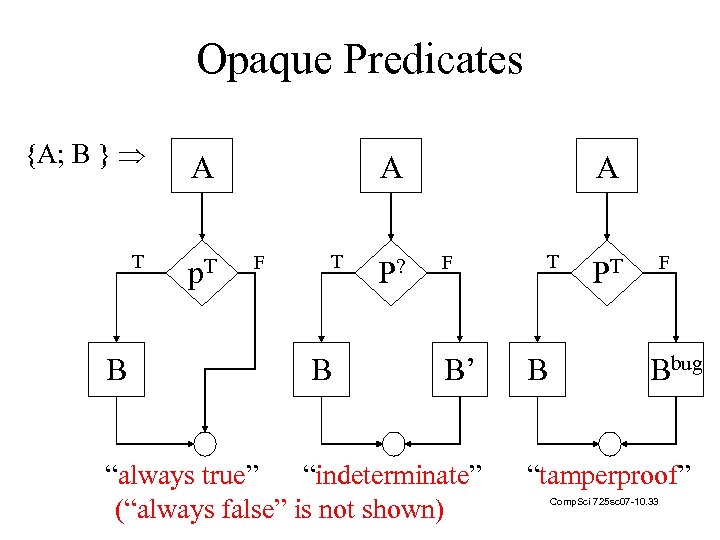 Opaque Predicates {A; B } T B A p. T A F T B P? A F B’ “always true” “indeterminate” (“always false” is not shown) T B PT F Bbug “tamperproof” Comp. Sci 725 sc 07 -10. 33
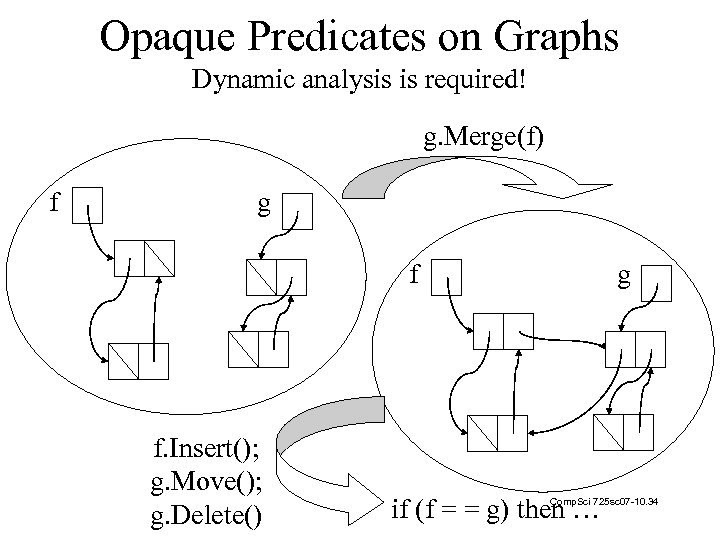 Opaque Predicates on Graphs Dynamic analysis is required! g. Merge(f) f g f f. Insert(); g. Move(); g. Delete() g if (f = = g) then … Comp. Sci 725 sc 07 -10. 34
 Conclusion • New art in software obfuscation can make it more difficult for pirates to defeat standard tamperproofing mechanisms, or to engage in other forms of reverse engineering. • New art in software watermarking can embed “ownership marks” in software, that will be very difficult for anyone to remove. • More R&D is required before robust obfuscating and watermarking tools are easy to use and readily available to software developers. Comp. Sci 725 sc 07 -10. 35