


 Скачать презентацию Software Requirements Engineering CS 708 Dr Ghulam Ahmad
3d7a3cc0a15fd42de22bb4856339d1fc.ppt
- Количество слайдов: 36
 Software Requirements Engineering (CS 708) Dr. Ghulam Ahmad Farrukh 1
 Introduction • Requirements form the basis for all software products • Requirements engineering is the process, which enables us to systematically determine the requirements for a software product 2
 Software Requirements Lecture # 1 3
 Requirement • Something required, something wanted or needed – Webster’s dictionary • There is a huge difference between wanted and needed and it should be kept in mind all the time 4
 Software Requirements - 1 • A complete description of what the software system will do without describing how it will do it is represented by the software requirements 5
 Software Requirements - 2 • Software requirements are complete specification of the desired external behavior of the software system to be built • They also represent External behavior of the system 6
 Software Requirements - 3 • Software requirements may be: – Abstract statements of services and/or constraints – Detailed mathematical functions 7
 Software Requirements - 4 • Software requirements may be: – Part of the bid of contract – The contract itself – Part of the technical document, which describes a product 8
 IEEE Definition • A condition or capability that must be met or possessed by a system. . . to satisfy a contract, standard, specification, or other formally imposed document – IEEE Std 729 9
 Sources of Requirements • Stakeholders – People affected in some way by the system • Documents • Existing system • Domain/business area 10
 Levels of Software Requirements • Stakeholders describe requirements at different levels of detail – “What versus How” – “One person’s floor is another person’s ceiling” 11
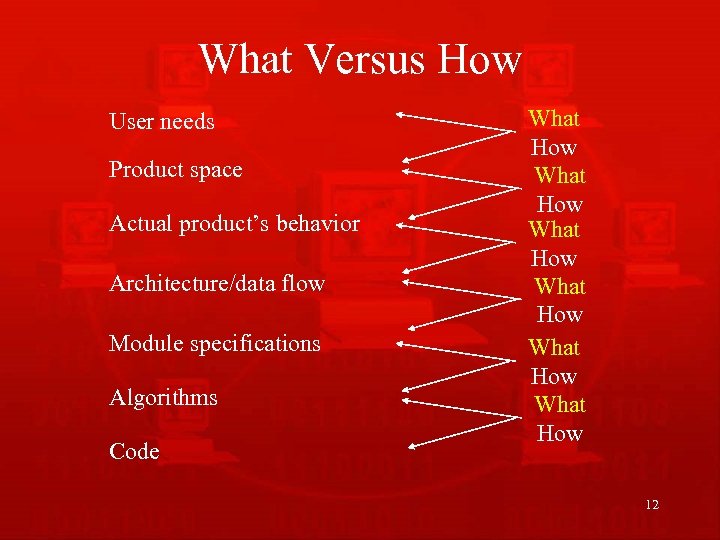 What Versus How User needs Product space Actual product’s behavior Architecture/data flow Module specifications Algorithms Code What How What How 12
 Importance of Software Requirements • The hardest single part of building a software system is deciding what to build. . . No other part of the work so cripples the resulting system if done wrong. No other part is difficult to rectify later – Fred Brooks 13
 Examples of Requirements - 1 • The system shall maintain records of all payments made to employees on accounts of salaries, bonuses, travel/daily allowances, medical allowances, etc. 14
 Examples of Requirements - 2 • The system shall interface with the central computer to send daily sales and inventory data from every retail store 15
 Examples of Requirements - 3 • The system shall maintain records of all library materials including books, serials, newspapers and magazines, video and audio tapes, reports, collections of transparencies, CDROMs, DVDs, etc. 16
 Examples of Requirements - 4 • The system shall allow users to search for an item by title, author, or by International Standard Book Number • The system’s user interface shall be implemented using a web browser 17
 Examples of Requirements - 5 • The system shall support at least twenty transactions per second • The system facilities which are available to public users shall be demonstrable in ten minutes or less 18
 Kinds of Software Requirements 19
 Kinds of Software Requirements • • • Functional requirements Non-functional requirements Domain requirements Inverse requirements Design and implementation constraints 20
 Functional Requirements 21
 Functional Requirements - 1 • Statements describing what the system does • Functionality of the system 22
 Functional Requirements - 2 • Statements of services the system should provide – Reaction to particular inputs – Behavior in particular situations 23
 Functional Requirements - 3 • Sequencing and parallelism are also captured by functional requirements • Abnormal behavior is also documented as functional requirements in the form of exception handling 24
 Functional Requirements - 4 • Functional requirements should be complete and consistent • Customers and developers usually focus all their attention on functional requirements 25
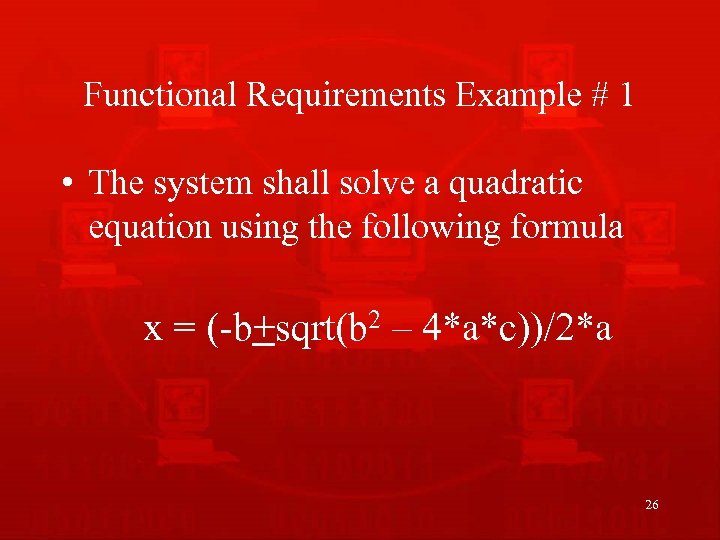 Functional Requirements Example # 1 • The system shall solve a quadratic equation using the following formula x = (-b+sqrt(b 2 – 4*a*c))/2*a 26
 Functional Requirements Example # 2 • The user shall be able to search either the entire database of patients or select a subset from it (admitted patients, or patients with asthma, etc. ) 27
 Functional Requirements Example # 3 • The system shall provide appropriate viewers for the user to read documents in the document store 28
 Functional Requirements Example # 4 • Every order shall be allocated a unique identifier (ORDER_ID) which the user shall use to access that order 29
 Functional Requirements Example # 5 • The system shall allow customers to return non-perishable items within fifteen days of the purchase. A customer must present the original sale receipt to return an item 30
 Comments on Examples • Notice the level of detail in different requirements described above. Some are very detailed compared to others 31
 Comments on Examples • Notice the ambiguity in the requirement, which uses the term ‘appropriate viewers’ • This requirement does not mention the formats of documents and types of viewers, which can be used 32
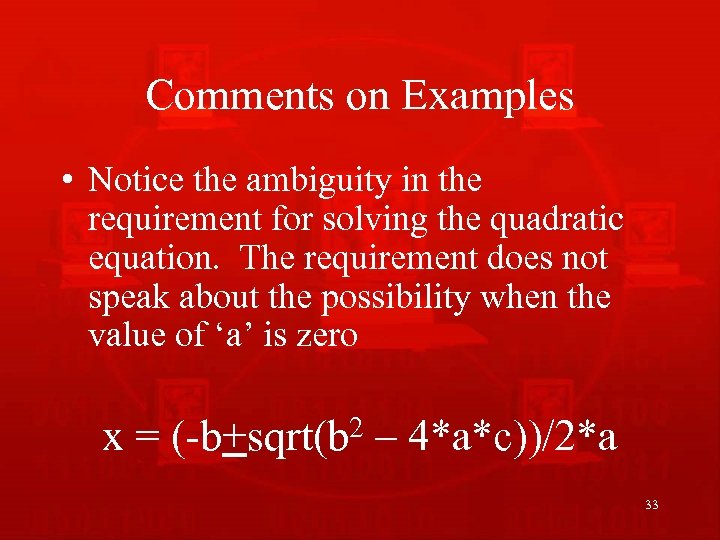 Comments on Examples • Notice the ambiguity in the requirement for solving the quadratic equation. The requirement does not speak about the possibility when the value of ‘a’ is zero x = (-b+sqrt(b 2 – 4*a*c))/2*a 33
 Comments on Examples • Incomplete and ambiguous requirements are open to multiple interpretations and assumptions • This can lead to the development of poor quality, or faulty, software products 34
 Summary • Requirements form the basis of all software engineering projects • Functional requirements capture the behavioral aspects/functions of the proposed automated system • Functional requirements are the backbone of all software products 35
 References • ‘Requirements Engineering: Processes and Techniques’ by G. Kotonya and I. Sommerville, John Wiley & Sons, 1998 • Software Requirements: Objects, Functions, and States by A. Davis, PH, 1993 • Software Engineering 6 th Edition, by I. Sommerville, 2000 • Software Engineering 5 th Edition, by R. Pressman 36