


 Скачать презентацию Software Requirements Analysis and Specification Requirements 1
90df715317c11beea7c1687827c6cbe0.ppt
- Количество слайдов: 40
 Software Requirements Analysis and Specification Requirements 1
 Requirement Capturing Requirement Using Structured Processes
 How do you find requirements? • Interview users • Examine value chain activities • Do “ethnographic” studies: Observations (Intuit: “follow-me-homes”) Embedded field studies “Longitudinal” research In-depth interviews
 Requirements Work-Products – Use Case Model Captures functional requirements Consists of: Actors (humans, external systems) hierarchy Use Cases Extends vs. Uses Use Case Diagram – context model UML Notation Drives all activity - starting with analysis Drives acceptance tests
 Selected Structured Requirements Work-Products • • Problem statement Business case Storyboard Use cases Scenarios Nonfunctional requirements Prioritized requirements Acceptance Plan
 Use Cases Approach Traditional approach for fn specs – specify each function Use cases is a newer technique for specifying behavior (functionality) I. e. focuses on functional specs only Though primarily for specification, can be used in analysis and elicitation Can be used to specify business or org behavior also, though we will focus on sw Well suited for interactive systems Requirements 6
 Use Cases Basics A use captures a contract between a user and system about behavior Basically a textual form; diagrams are mostly to support Also useful in requirements elicitation as users like and understand the story telling form and react to it easily Requirements 7
 Basics. . Actor: a person or a system that interacts with the proposed system to achieve a goal Eg. User of an ATM (goal: get money); data entry operator; (goal: Perform transaction) Actor is a logical entity, so receiver and sender actors are different (even if the same person) Actors can be people or systems Primary actor: The main actor who initiates a UC is to satisfy his goals The actual execution may be done by a system or another person on behalf of the Primary actor Requirements 8
 Basics. . A UC is a collection of many such scenarios A scenario may employ other use cases in a step I. e. a sub-goal of a UC goal may be performed by another UC I. e. UCs can be organized hierarchically Requirements 9
 Basics. . Scenario: a set of actions performed to achieve a goal under some conditions Actions specified as a sequence of steps A step is a logically complete action performed either by the actor or the system Main success scenario – when things go normally and the goal is achieved Alternate scenarios: When things go wrong and goals cannot be achieved Requirements 10
 Basics… UCs specify functionality by describing interactions between actors and system Focuses on external behavior UCs are primarily textual UC diagrams show UCs, actors, and dependencies They provide an overview Story like description easy to understand by both users and analysts They do not form the complete SRS, only the functionality part Requirements 11
 Example Use Case 1: Buy stocks Primary Actor: Purchaser Goals of Stakeholders: Purchaser: wants to buy stocks Company: wants full transaction info Precondition: User already has an account Requirements 12
 Example … Main Success Scenario 1. 2. 3. 4. 5. 6. User selects to buy stocks System gets name of web site from user for trading Establishes connection User browses and buys stocks System intercepts responses from the site and updates user portfolio System shows user new portfolio standing Requirements 13
 Example… Alternatives 2 a: System gives err msg, asks for new suggestion for site, gives option to cancel 3 a: Web failure. 1 -Sys reports failure to user, backs up to previous step. 2 -User exits or tries again 4 a: Computer crashes 4 b: web site does not ack purchase 5 a: web site does not return needed info Requirements 14
 Example 2 Use Case 2: Buy a product Primary actor: buyer/customer Goal: purchase some product Precondition: Customer is already logged in Requirements 15
 Example 2… Main Scenario 1. 2. 3. 4. 5. 6. 7. 8. Customer browses and selects items Customer goes to checkout Customer fills shipping options System presents full pricing info Customer fills credit card info System authorizes purchase System confirms sale System sends confirming email Requirements 16
 Example 2… Alternatives 6 a: Credit card authorization fails Allows customer to reenter info 3 a: Regular customer System displays last 4 digits of credit card no Asks customer to OK it or change it Moves to step 6 Requirements 17
 Example – An auction site Use Case 1: Put an item up for auction Primary Actor: Seller Precondition: Seller has logged in Main Success Scenario: Seller posts an item (its category, description, picture, etc. ) for auction System shows past prices of similar items to seller System specifies the starting bid price and a date when auction will close System accepts the item and posts it Exception Scenarios: -- 2 a) There are no past items of this category * System tells the seller this situation Requirements 18
 Example – auction site. . Use Case 2: Make a bid Primary Actor: Buyer Precondition: The buyer has logged in Main Success Scenario: Buyer searches or browses and selects some item System shows the rating of the seller, the starting bid, the current bids, and the highest bid; asks buyer to make a bid Buyer specifies bid price, max bid price, and increment Systems accepts the bid; Blocks funds in bidders account System updates the bid price of other bidders where needed, and updates the records for the item Requirements 19
 Example –auction site. . Use Case 3: Complete auction of an item Primary Actor: Auction System Precondition: The last date for bidding has been reached Main Success Scenario: Select highest bidder; send email to selected bidder and seller informing final bid price; send email to other bidders also Debit bidder’s account and credit seller’s account Transfer from seller’s account commission amount to organization’s account Remove item from the site; update records Exception Scenarios: None Requirements 20
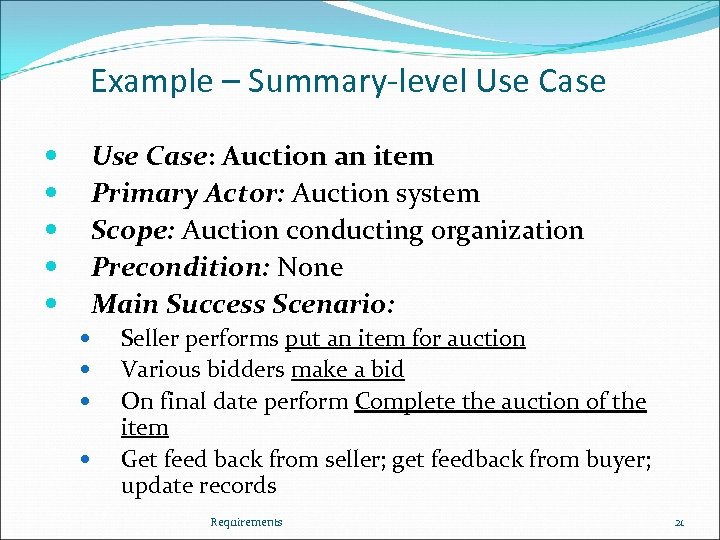 Example – Summary-level Use Case: Auction an item Primary Actor: Auction system Scope: Auction conducting organization Precondition: None Main Success Scenario: Seller performs put an item for auction Various bidders make a bid On final date perform Complete the auction of the item Get feed back from seller; get feedback from buyer; update records Requirements 21
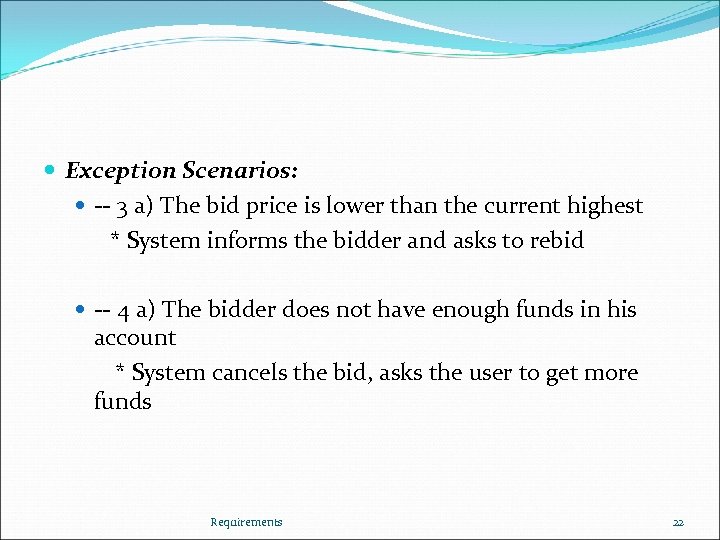 Exception Scenarios: -- 3 a) The bid price is lower than the current highest * System informs the bidder and asks to rebid -- 4 a) The bidder does not have enough funds in his account * System cancels the bid, asks the user to get more funds Requirements 22
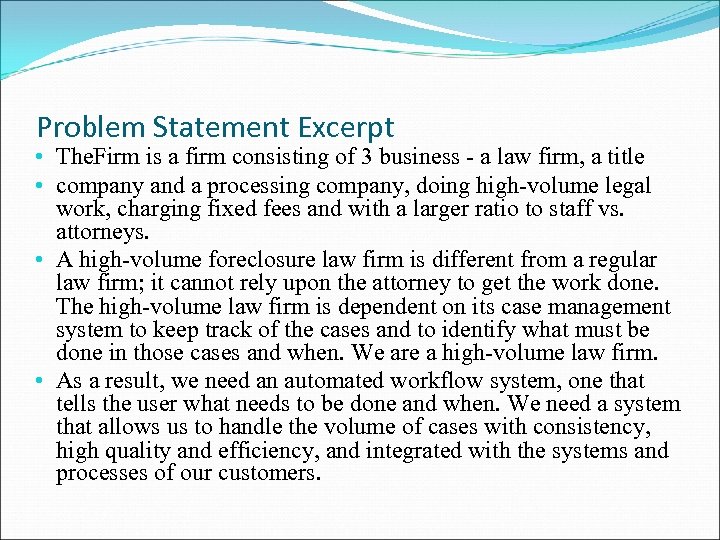 Problem Statement Excerpt • The. Firm is a firm consisting of 3 business - a law firm, a title • company and a processing company, doing high-volume legal work, charging fixed fees and with a larger ratio to staff vs. attorneys. • A high-volume foreclosure law firm is different from a regular law firm; it cannot rely upon the attorney to get the work done. The high-volume law firm is dependent on its case management system to keep track of the cases and to identify what must be done in those cases and when. We are a high-volume law firm. • As a result, we need an automated workflow system, one that tells the user what needs to be done and when. We need a system that allows us to handle the volume of cases with consistency, high quality and efficiency, and integrated with the systems and processes of our customers.
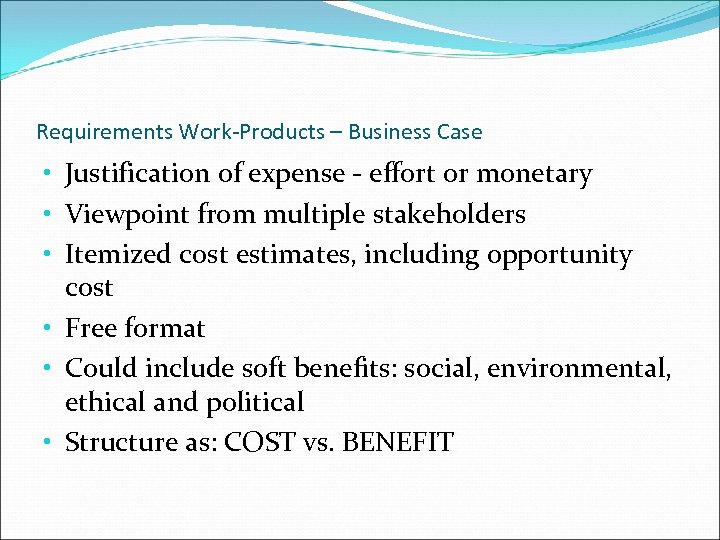 Requirements Work-Products – Business Case • Justification of expense - effort or monetary • Viewpoint from multiple stakeholders • Itemized cost estimates, including opportunity cost • Free format • Could include soft benefits: social, environmental, ethical and political • Structure as: COST vs. BENEFIT
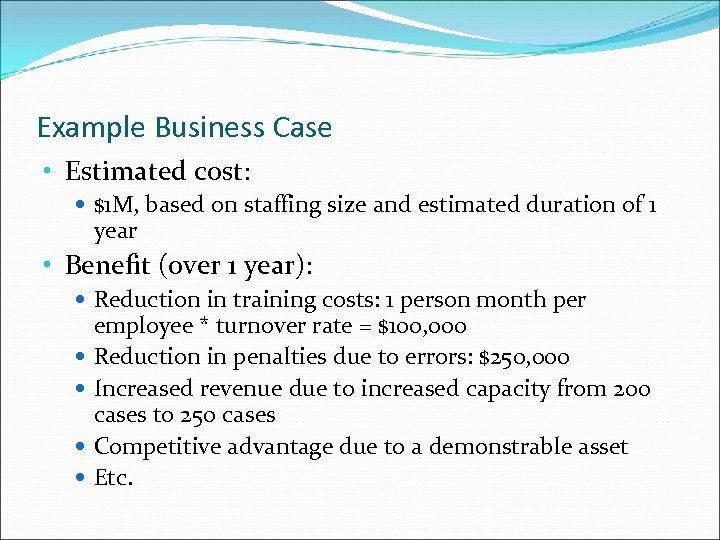 Example Business Case • Estimated cost: $1 M, based on staffing size and estimated duration of 1 year • Benefit (over 1 year): Reduction in training costs: 1 person month per employee * turnover rate = $100, 000 Reduction in penalties due to errors: $250, 000 Increased revenue due to increased capacity from 200 cases to 250 cases Competitive advantage due to a demonstrable asset Etc.
 Requirements Work-Products - Storyboard Narrative Of how the organization would work using the system, OR Of how the organization currently works
 • Content Requirements Work-Products – Problem Statement • Business domain, goals, objectives, stakeholders What are we trying to accomplish, for whom, and why Not focused on solution • How: Written with customer, before the project begins Shared, incomplete, consensus achieved • Format: Free format text with sections such as: Objectives, Success Criteria, Itemized requirements, Stakeholders etc.
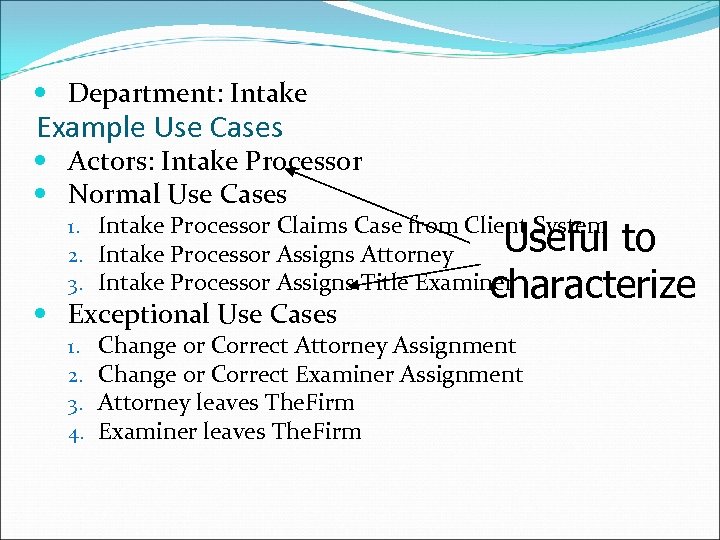 Department: Intake Example Use Cases Actors: Intake Processor Normal Use Cases 1. Intake Processor Claims Case from Client System 2. Intake Processor Assigns Attorney 3. Intake Processor Assigns Title Examiner Exceptional Use Cases 1. 2. 3. 4. Useful to characterize Change or Correct Attorney Assignment Change or Correct Examiner Assignment Attorney leaves The. Firm Examiner leaves The. Firm
 Use Case Diagram • Shows “context” of system System boundary Actors Use case names Relationships
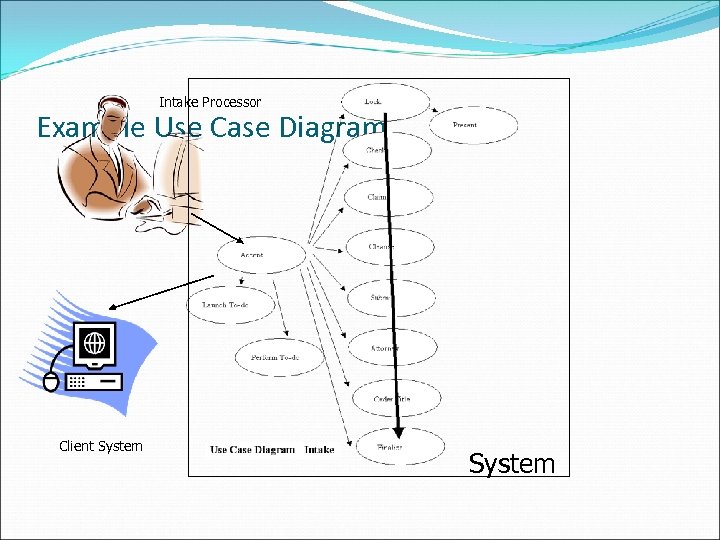 Intake Processor Example Use Case Diagram Client System
 Requirements Work Products: Scenarios • • AKA Flow Used to refine a Use Case One path through a Use Case Happy Path Unhappy paths Assumptions Outcome
 Example Scenarios Use Case: Intake Processor Claims Case from Client System Primary scenario (or Happy Path) Case is successfully claimed Alternate scenarios: Client system has invalid request Duplicate case is launched Case is incorrectly launched
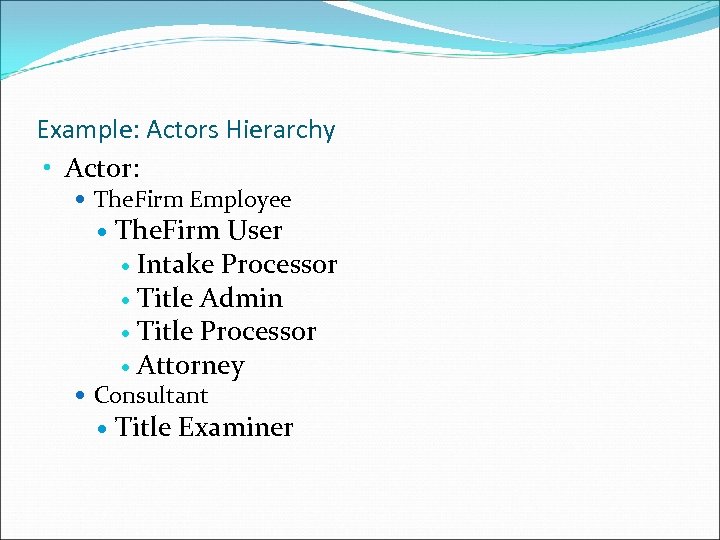 Example: Actors Hierarchy • Actor: The. Firm Employee The. Firm User Intake Processor Title Admin Title Processor Attorney Consultant Title Examiner
 Requirements with Use Cases UCs specify functional requirements Other req identified separately A complete SRS will contain the use cases plus the other requirements Note – for system requirements it is important to identify UCs for which the system itself may be the actor Requirements 34
 Developing Use Cases UCs form a good medium for brainstorming and discussions Hence can be used in elicitation and problem analysis also UCs can be developed in a stepwise refinement manner Many levels possible, but four naturally emerge Requirements 35
 Developing… Actors and goals Prepare an actor-goal list Provide a brief overview of the UC This defines the scope of the system Completeness can also be evaluated Main Success Scenarios For each UC, expand main scenario This will provide the normal behavior of the system Can be reviewed to ensure that interests of all stakeholders and actors is met Requirements 36
 Developing… Failure conditions List possible failure conditions for UCs For each step, identify how it may fail This step uncovers special situations Failure handling Perhaps the hardest part Specify system behavior for the failure conditions New business rules and actors may emerge Requirements 37
 Developing. . The multiple levels can drive analysis by starting from top and adding details as analysis proceeds UCs should be specified at a level of detail that is sufficient For writing, use good technical writing rules Use simple grammar Clearly specify all parts of the UC When needed combine steps or split steps Requirements 38
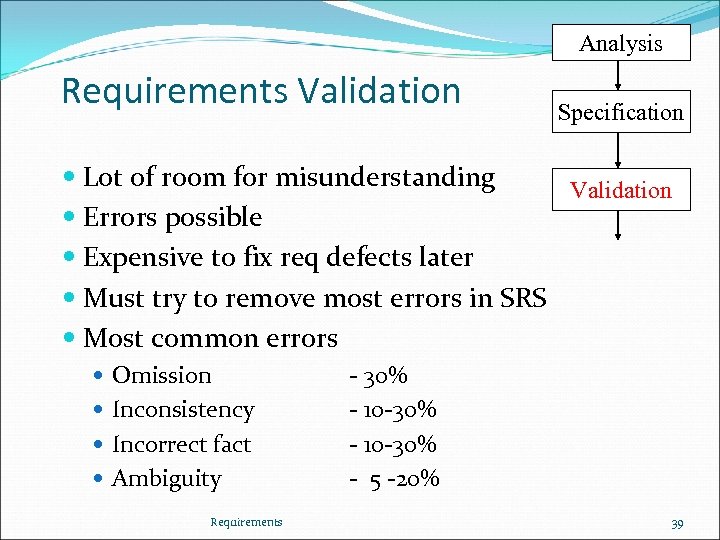 Analysis Requirements Validation Specification Lot of room for misunderstanding Validation Errors possible Expensive to fix req defects later Must try to remove most errors in SRS Most common errors Omission Inconsistency Incorrect fact Ambiguity Requirements - 30% - 10 -30% - 5 -20% 39
 Requirements Review SRS reviewed by a group of people Group: author, client, user, dev team rep. Must include client and a user Process – standard inspection process Effectiveness - can catch 40 -80% of req. errors Requirements 40