


 Скачать презентацию Software Quality Five Views of Software Quality
209d31c778cafed8de51beef445df55a.ppt
- Количество слайдов: 36
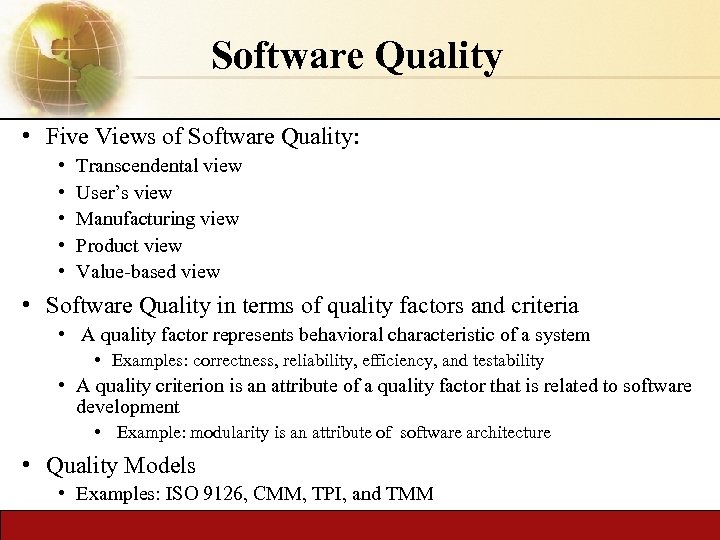 Software Quality • Five Views of Software Quality: • • • Transcendental view User’s view Manufacturing view Product view Value-based view • Software Quality in terms of quality factors and criteria • A quality factor represents behavioral characteristic of a system • Examples: correctness, reliability, efficiency, and testability • A quality criterion is an attribute of a quality factor that is related to software development • Example: modularity is an attribute of software architecture • Quality Models • Examples: ISO 9126, CMM, TPI, and TMM
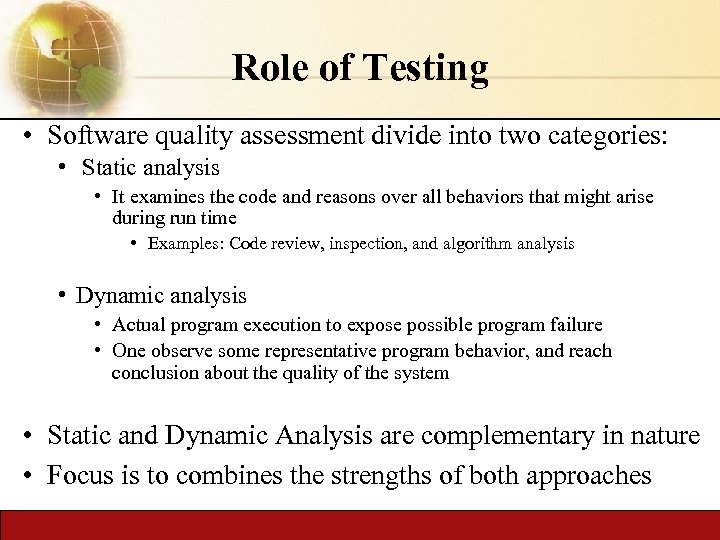 Role of Testing • Software quality assessment divide into two categories: • Static analysis • It examines the code and reasons over all behaviors that might arise during run time • Examples: Code review, inspection, and algorithm analysis • Dynamic analysis • Actual program execution to expose possible program failure • One observe some representative program behavior, and reach conclusion about the quality of the system • Static and Dynamic Analysis are complementary in nature • Focus is to combines the strengths of both approaches
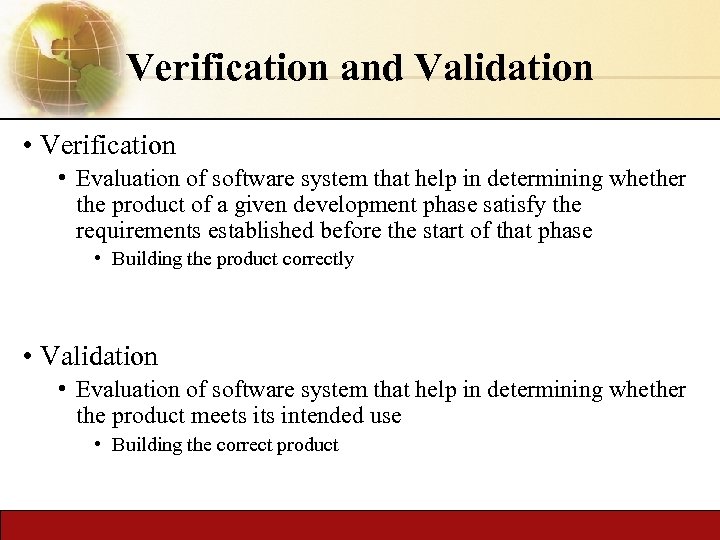 Verification and Validation • Verification • Evaluation of software system that help in determining whether the product of a given development phase satisfy the requirements established before the start of that phase • Building the product correctly • Validation • Evaluation of software system that help in determining whether the product meets intended use • Building the correct product
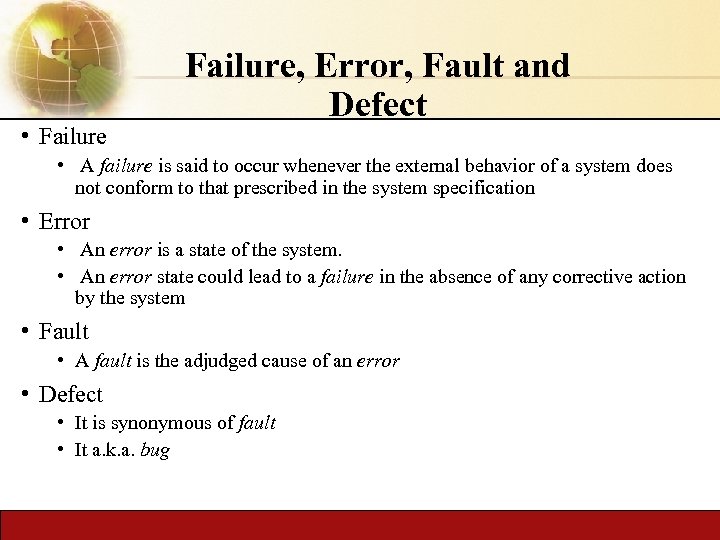 • Failure, Error, Fault and Defect • A failure is said to occur whenever the external behavior of a system does not conform to that prescribed in the system specification • Error • An error is a state of the system. • An error state could lead to a failure in the absence of any corrective action by the system • Fault • A fault is the adjudged cause of an error • Defect • It is synonymous of fault • It a. k. a. bug
 The Notion of Software Reliability • It is defined as the probability of failure-free operation of a software system for a specified time in a specified environment • It can be estimated via random testing • Test data must be drawn from the input distribution to closely resemble the future usage of the system • Future usage pattern of a system is described in a form called operational profile
 Testing Definition and objectives • Testing is the process of executing a program with intention of finding errors • Software testing is a formal process carried out by a specialized testing team in which a software unit, several integrated software units or an entire software package are examined by running the programs on a computer. • All the associated tests are performed according to approved test procedures on approved test cases.
 The Objectives of Testing • Direct objectives • To identify and reveal as many errors as possible in the tested software. • To bring the tested software, after correction of the identified errors and retesting, to an acceptable level of quality. • To perform the required tests efficiently and effectively, within budgetary and scheduling limitations. • Indirect objective • To compile a record of software errors for use in error prevention (by corrective and preventive actions).
 The Objectives of Testing • It does work • It does not work • Reduce the risk of failures • Reduce the cost of testing
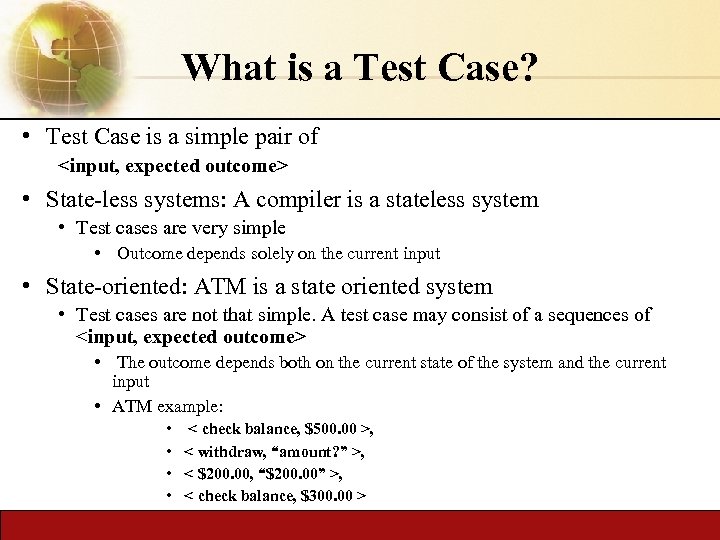 What is a Test Case? • Test Case is a simple pair of
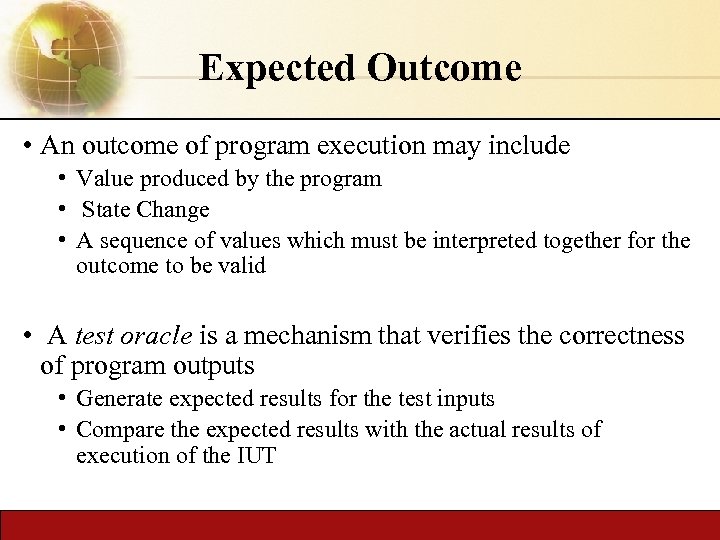 Expected Outcome • An outcome of program execution may include • Value produced by the program • State Change • A sequence of values which must be interpreted together for the outcome to be valid • A test oracle is a mechanism that verifies the correctness of program outputs • Generate expected results for the test inputs • Compare the expected results with the actual results of execution of the IUT
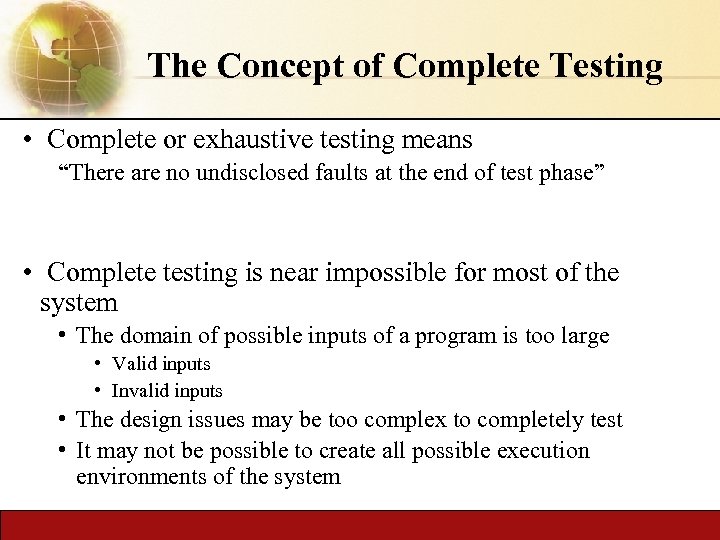 The Concept of Complete Testing • Complete or exhaustive testing means “There are no undisclosed faults at the end of test phase” • Complete testing is near impossible for most of the system • The domain of possible inputs of a program is too large • Valid inputs • Invalid inputs • The design issues may be too complex to completely test • It may not be possible to create all possible execution environments of the system
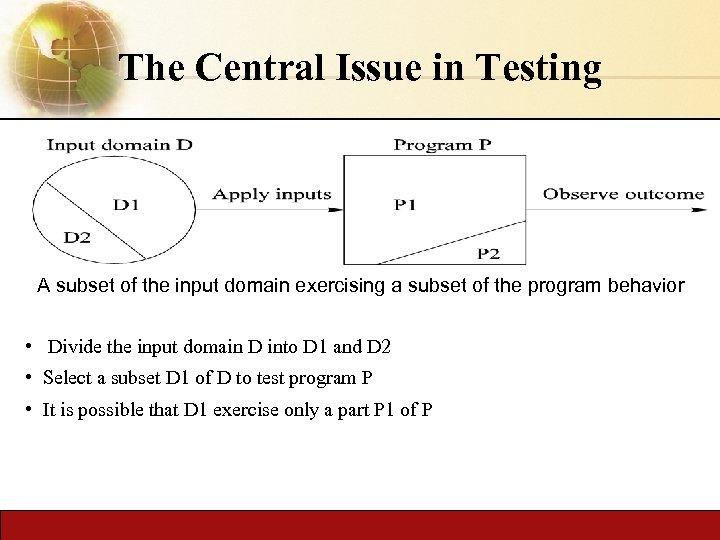 The Central Issue in Testing A subset of the input domain exercising a subset of the program behavior • Divide the input domain D into D 1 and D 2 • Select a subset D 1 of D to test program P • It is possible that D 1 exercise only a part P 1 of P
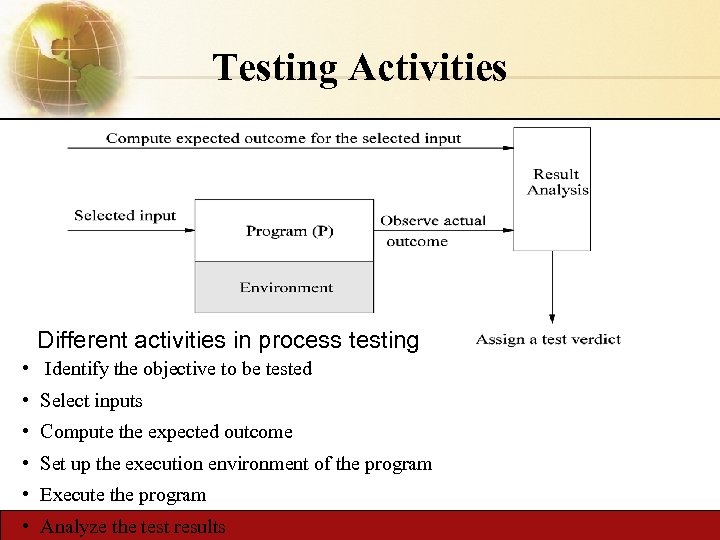 Testing Activities Different activities in process testing • Identify the objective to be tested • Select inputs • Compute the expected outcome • Set up the execution environment of the program • Execute the program • Analyze the test results
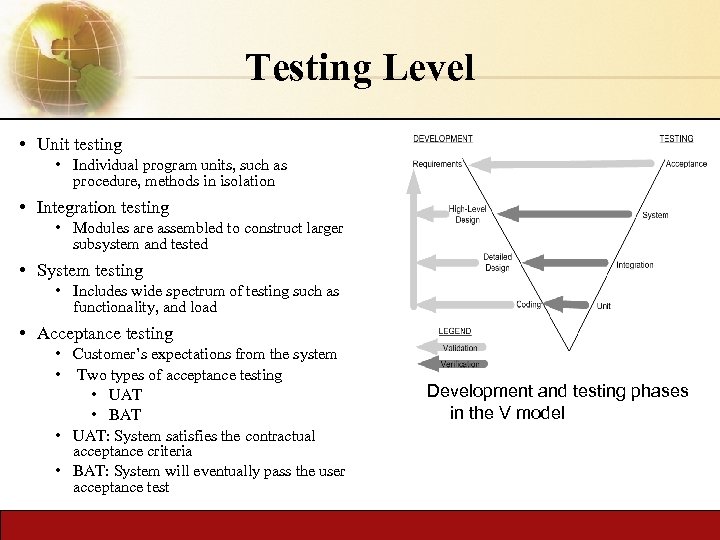 Testing Level • Unit testing • Individual program units, such as procedure, methods in isolation • Integration testing • Modules are assembled to construct larger subsystem and tested • System testing • Includes wide spectrum of testing such as functionality, and load • Acceptance testing • Customer’s expectations from the system • Two types of acceptance testing • UAT • BAT • UAT: System satisfies the contractual acceptance criteria • BAT: System will eventually pass the user acceptance test Development and testing phases in the V model
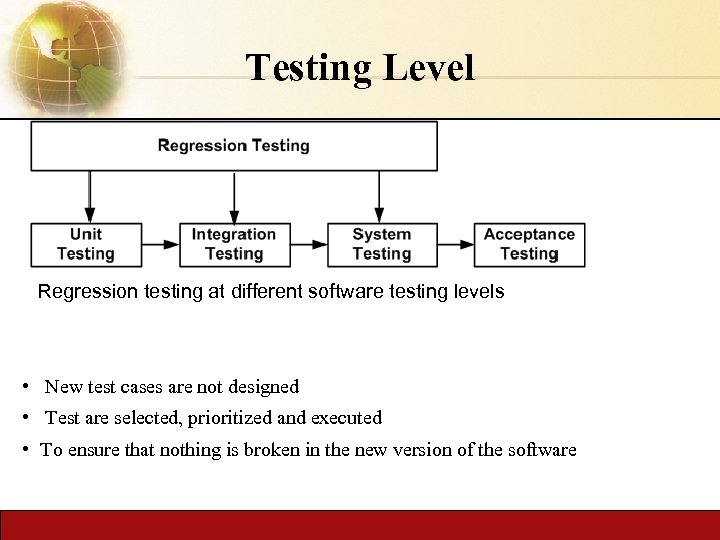 Testing Level Regression testing at different software testing levels • New test cases are not designed • Test are selected, prioritized and executed • To ensure that nothing is broken in the new version of the software
 Software testing strategies • Incremental testing strategies: • Bottom-up testing • Top-down testing • Big bang testing
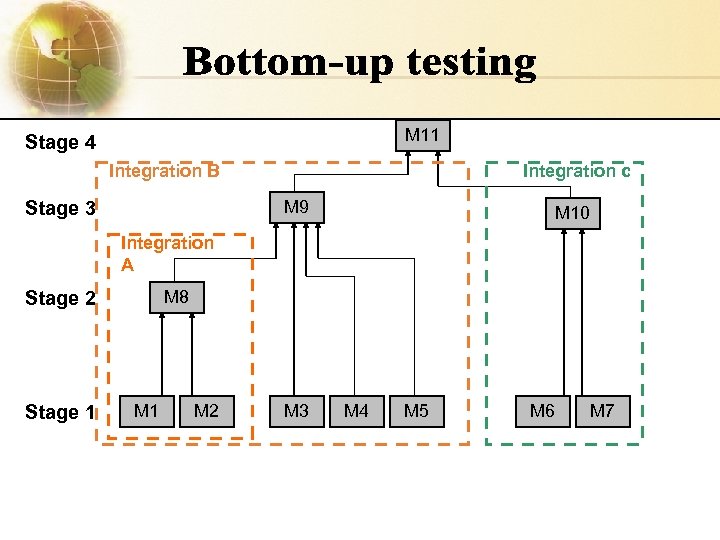 M 11 Stage 4 Integration B Integration c M 9 Stage 3 M 10 Integration A M 8 Stage 2 Stage 1 M 2 M 3 M 4 M 5 M 6 M 7
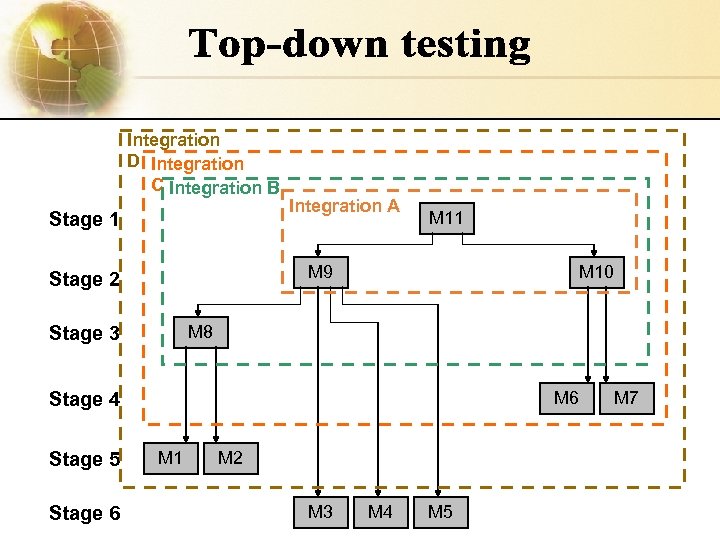 Integration D Integration C Integration B Stage 1 Integration A M 11 M 9 Stage 2 M 10 M 8 Stage 3 M 6 Stage 4 Stage 5 Stage 6 M 1 M 2 M 3 M 4 M 5 M 7
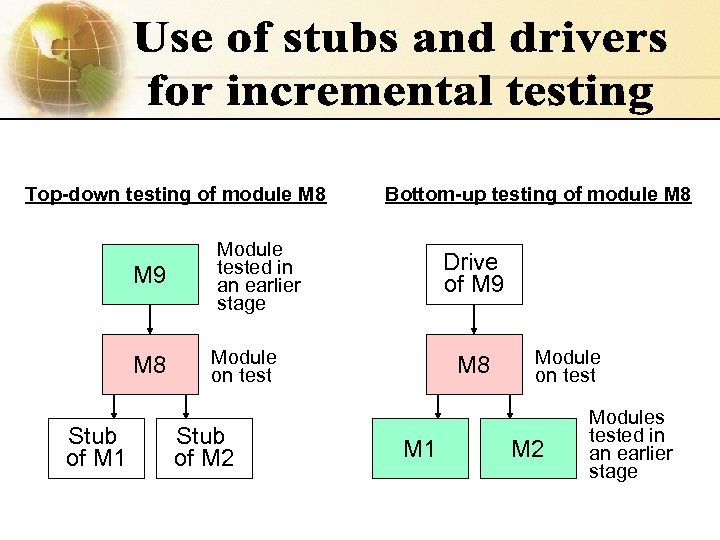 Top-down testing of module M 8 M 9 Stub of M 1 Module tested in an earlier stage M 8 Bottom-up testing of module M 8 Module on test Stub of M 2 Drive of M 9 M 8 M 1 Module on test M 2 Modules tested in an earlier stage
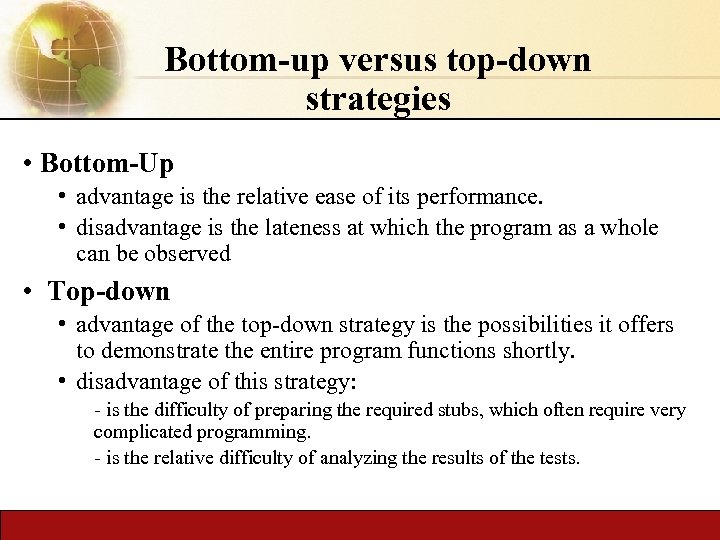 Bottom-up versus top-down strategies • Bottom-Up • advantage is the relative ease of its performance. • disadvantage is the lateness at which the program as a whole can be observed • Top-down • advantage of the top-down strategy is the possibilities it offers to demonstrate the entire program functions shortly. • disadvantage of this strategy: - is the difficulty of preparing the required stubs, which often require very complicated programming. - is the relative difficulty of analyzing the results of the tests.
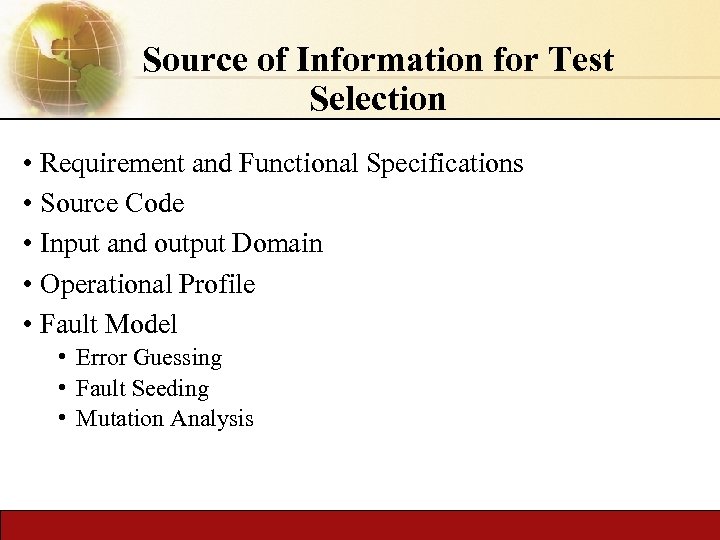 Source of Information for Test Selection • Requirement and Functional Specifications • Source Code • Input and output Domain • Operational Profile • Fault Model • Error Guessing • Fault Seeding • Mutation Analysis
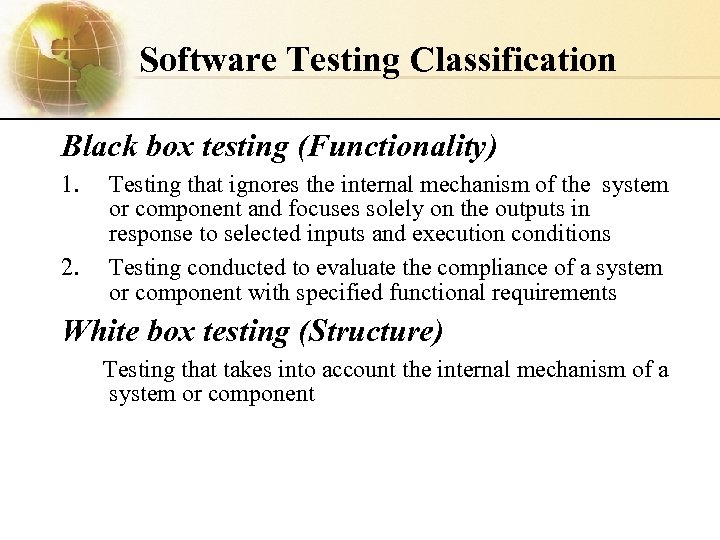 Software Testing Classification Black box testing (Functionality) 1. 2. Testing that ignores the internal mechanism of the system or component and focuses solely on the outputs in response to selected inputs and execution conditions Testing conducted to evaluate the compliance of a system or component with specified functional requirements White box testing (Structure) Testing that takes into account the internal mechanism of a system or component
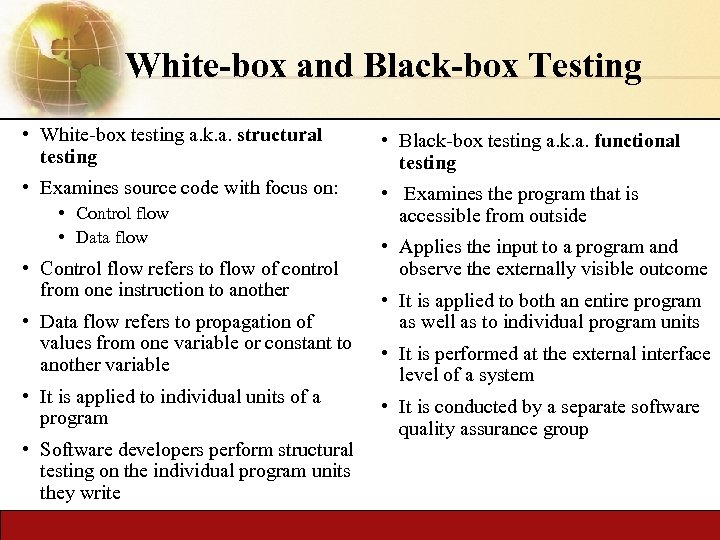 White-box and Black-box Testing • White-box testing a. k. a. structural testing • Black-box testing a. k. a. functional testing • Examines source code with focus on: • Examines the program that is accessible from outside • Control flow • Data flow • Control flow refers to flow of control from one instruction to another • Data flow refers to propagation of values from one variable or constant to another variable • It is applied to individual units of a program • Software developers perform structural testing on the individual program units they write • Applies the input to a program and observe the externally visible outcome • It is applied to both an entire program as well as to individual program units • It is performed at the external interface level of a system • It is conducted by a separate software quality assurance group
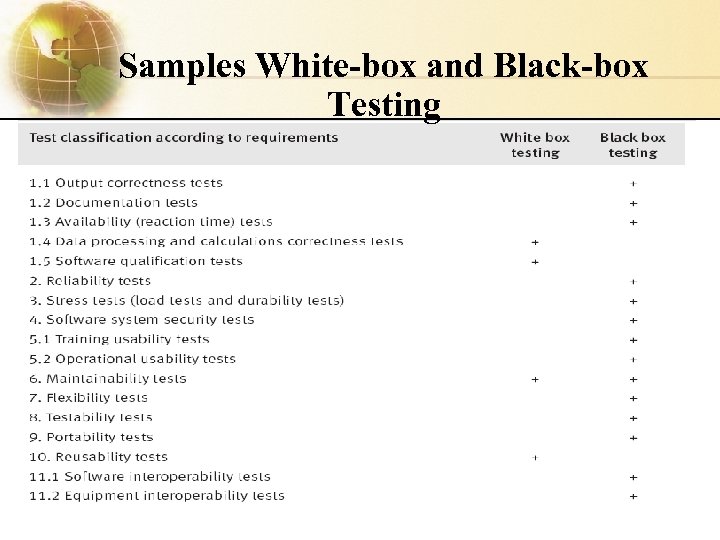 Samples White-box and Black-box Testing
 Path coverage of a test is measured by the percentage of all possible program paths included in planned testing. Line coverage of a test is measured by the percentage of program code lines included in planned testing.
 Adv. & Disadv. Of White box Testing Advantages: * Direct determination of software correctness as expressed in the processing paths, including algorithms. * Allows performance of line coverage follow up. * Ascertains quality of coding work and its adherence to coding standards. Disadvantages : * The vast resources utilized, much above those required for black box testing of the same software package. * The inability to test software performance in terms of availability (response time), reliability, load durability, etc.
 A black box method aimed at increasing the efficiency of testing and, at the same time, improving coverage of potential error conditions.
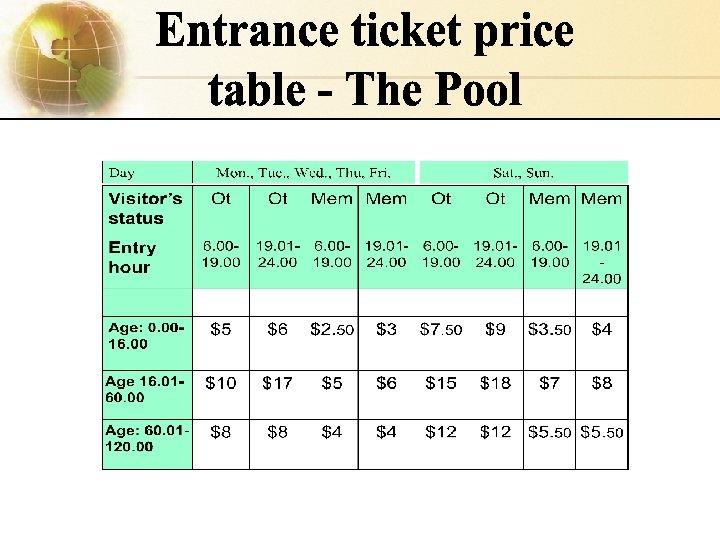
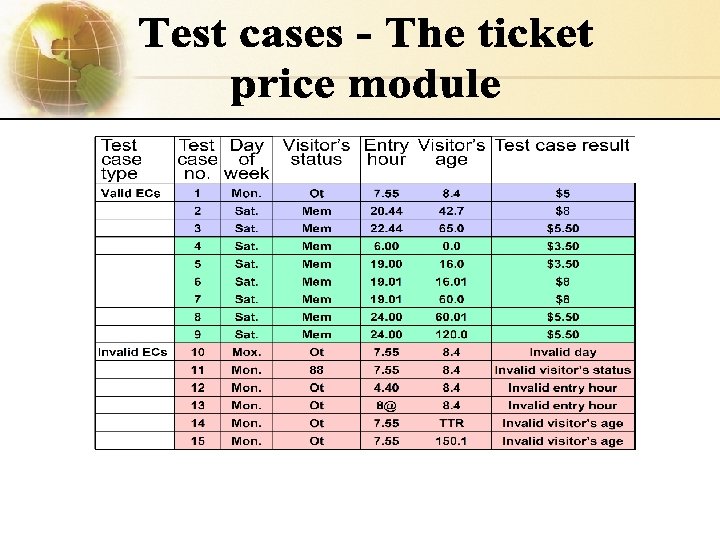
 • An equivalence class (EC) is a set of input variable values that produce the same output results or that are processed identically. • EC boundaries are defined by a single numeric or alphabetic value, a group of numeric or alphabetic values, a range of values, and so on. • An EC that contains only valid states is defined as a "valid EC, " whereas an EC that contains only invalid states is defined as the "invalid EC. " • In cases where a program's input is provided by several variables, valid and invalid ECs should be defined for each variable.
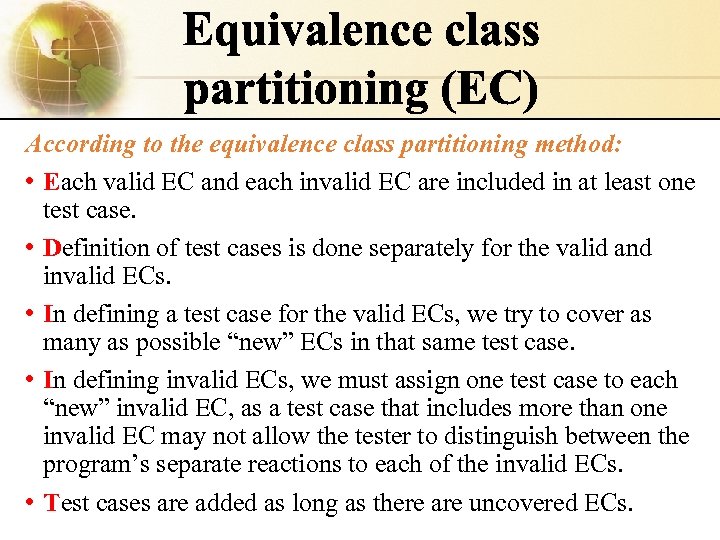 According to the equivalence class partitioning method: • Each valid EC and each invalid EC are included in at least one test case. • Definition of test cases is done separately for the valid and invalid ECs. • In defining a test case for the valid ECs, we try to cover as many as possible “new” ECs in that same test case. • In defining invalid ECs, we must assign one test case to each “new” invalid EC, as a test case that includes more than one invalid EC may not allow the tester to distinguish between the program’s separate reactions to each of the invalid ECs. • Test cases are added as long as there are uncovered ECs.
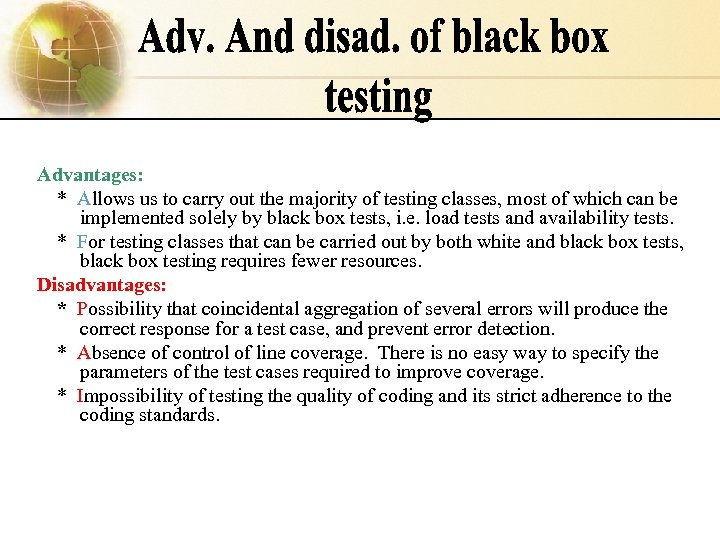 Advantages: * Allows us to carry out the majority of testing classes, most of which can be implemented solely by black box tests, i. e. load tests and availability tests. * For testing classes that can be carried out by both white and black box tests, black box testing requires fewer resources. Disadvantages: * Possibility that coincidental aggregation of several errors will produce the correct response for a test case, and prevent error detection. * Absence of control of line coverage. There is no easy way to specify the parameters of the test cases required to improve coverage. * Impossibility of testing the quality of coding and its strict adherence to the coding standards.
 Test Planning and Design • The purpose is to get ready and organized for test execution • A test plan provides a: • Framework: A set of ideas, facts or circumstances within which the tests will be conducted • Scope: The domain or extent of the test activities • • Details of resource needed Effort required Schedule of activities Budget • Test objectives are identified from different sources • Each test case is designed as a combination of modular test components called test steps • Test steps are combined together to create more complex tests
 Monitoring and Measuring Test Execution • Metrics for monitoring test execution • Metrics for monitoring defects • Test case effectiveness metrics • Measure the “defect revealing ability” of the test suite • Use the metric to improve the test design process • Test-effort effectiveness metrics • Number of defects found by the customers that were not found by the test engineers
 Test Tools and Automation • Increased productivity of the testers • The test cases to be automated are well defined • Better coverage of regression testing • Reduced durations of the testing phases • Reduced cost of software maintenance • Increased effectiveness of test cases • Test tools and an infrastructure are in place • The test automation professionals have prior successful experience in automation • Adequate budget have been allocation for the procurement of software tools
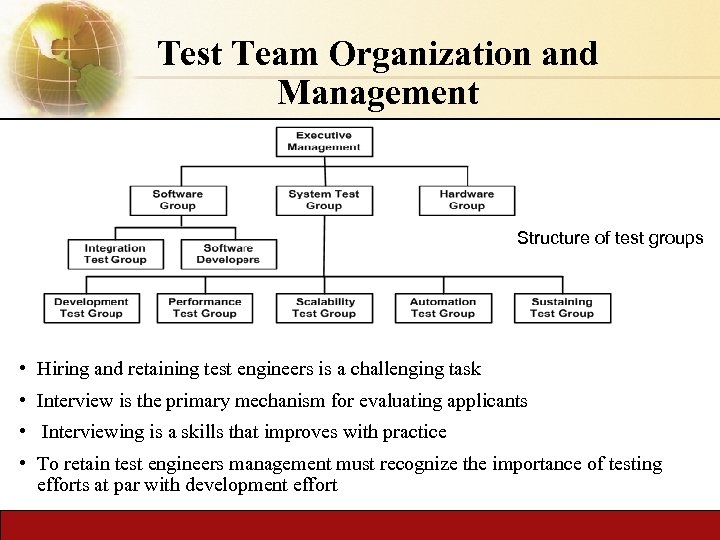 Test Team Organization and Management Structure of test groups • Hiring and retaining test engineers is a challenging task • Interview is the primary mechanism for evaluating applicants • Interviewing is a skills that improves with practice • To retain test engineers management must recognize the importance of testing efforts at par with development effort