


 Скачать презентацию Software Productivity Research an Artemis company SOFTWARE QUALITY
09a7ab5fe6ea1985cbe75ffa49862efc.ppt
- Количество слайдов: 83
 Software Productivity Research an Artemis company SOFTWARE QUALITY IN 2000: WHAT WORKS AND WHAT DOESN’T Capers Jones, Chief Scientist One New England Executive Park Burlington, Massachusetts 01803 781. 273. 0140 Fax: 781. 273. 5176 http: //www. spr. com Copyright © 2000 by SPR. All Rights Reserved. January 5, 2000
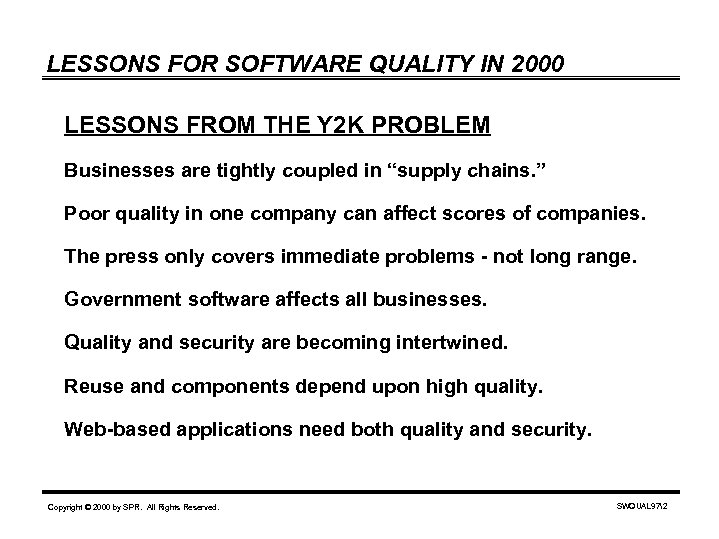 LESSONS FOR SOFTWARE QUALITY IN 2000 LESSONS FROM THE Y 2 K PROBLEM Businesses are tightly coupled in “supply chains. ” Poor quality in one company can affect scores of companies. The press only covers immediate problems - not long range. Government software affects all businesses. Quality and security are becoming intertwined. Reuse and components depend upon high quality. Web-based applications need both quality and security. Copyright © 2000 by SPR. All Rights Reserved. SWQUAL 972
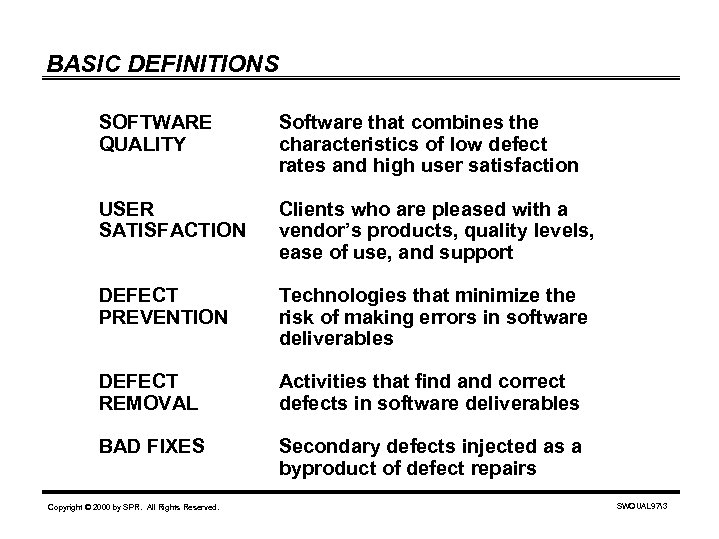 BASIC DEFINITIONS SOFTWARE QUALITY Software that combines the characteristics of low defect rates and high user satisfaction USER SATISFACTION Clients who are pleased with a vendor’s products, quality levels, ease of use, and support DEFECT PREVENTION Technologies that minimize the risk of making errors in software deliverables DEFECT REMOVAL Activities that find and correct defects in software deliverables BAD FIXES Secondary defects injected as a byproduct of defect repairs Copyright © 2000 by SPR. All Rights Reserved. SWQUAL 973
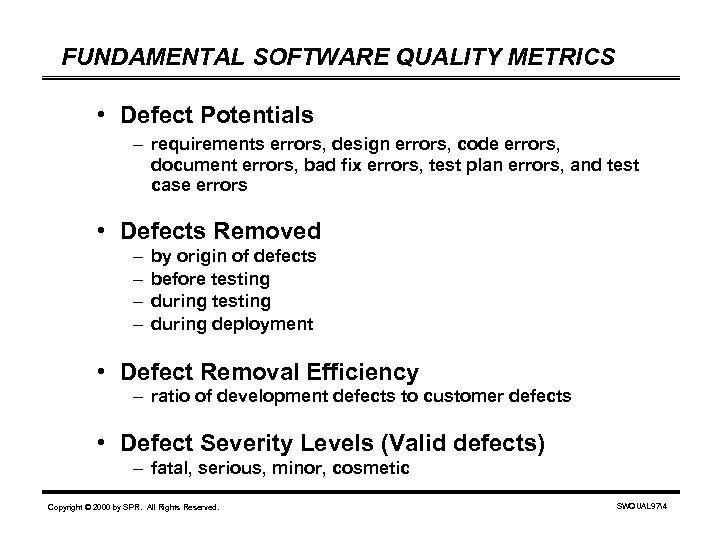 FUNDAMENTAL SOFTWARE QUALITY METRICS • Defect Potentials – requirements errors, design errors, code errors, document errors, bad fix errors, test plan errors, and test case errors • Defects Removed – – by origin of defects before testing during deployment • Defect Removal Efficiency – ratio of development defects to customer defects • Defect Severity Levels (Valid defects) – fatal, serious, minor, cosmetic Copyright © 2000 by SPR. All Rights Reserved. SWQUAL 974
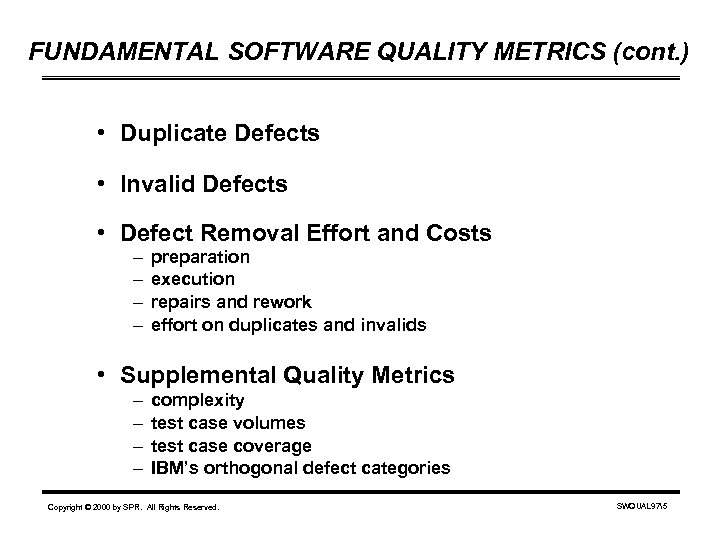 FUNDAMENTAL SOFTWARE QUALITY METRICS (cont. ) • Duplicate Defects • Invalid Defects • Defect Removal Effort and Costs – – preparation execution repairs and rework effort on duplicates and invalids • Supplemental Quality Metrics – – complexity test case volumes test case coverage IBM’s orthogonal defect categories Copyright © 2000 by SPR. All Rights Reserved. SWQUAL 975
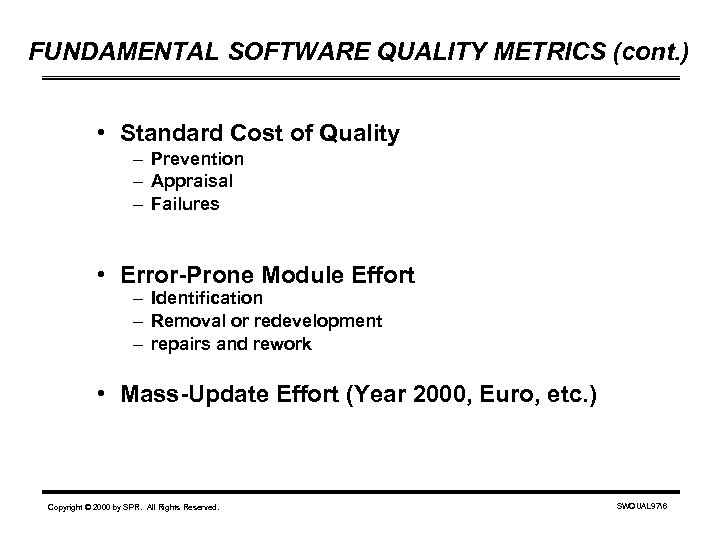 FUNDAMENTAL SOFTWARE QUALITY METRICS (cont. ) • Standard Cost of Quality – Prevention – Appraisal – Failures • Error-Prone Module Effort – Identification – Removal or redevelopment – repairs and rework • Mass-Update Effort (Year 2000, Euro, etc. ) Copyright © 2000 by SPR. All Rights Reserved. SWQUAL 976
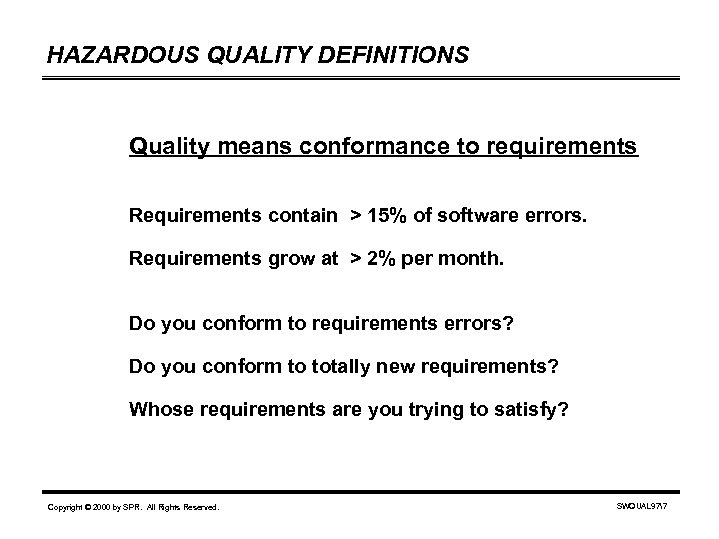 HAZARDOUS QUALITY DEFINITIONS Quality means conformance to requirements Requirements contain > 15% of software errors. Requirements grow at > 2% per month. Do you conform to requirements errors? Do you conform to totally new requirements? Whose requirements are you trying to satisfy? Copyright © 2000 by SPR. All Rights Reserved. SWQUAL 977
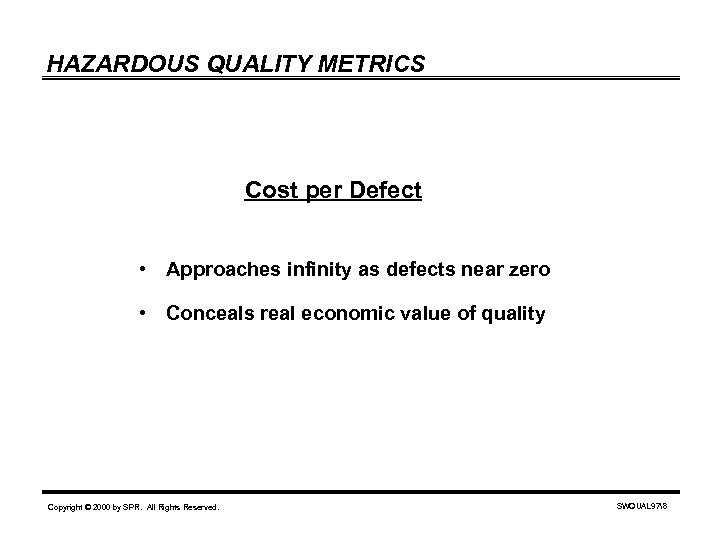 HAZARDOUS QUALITY METRICS Cost per Defect • Approaches infinity as defects near zero • Conceals real economic value of quality Copyright © 2000 by SPR. All Rights Reserved. SWQUAL 978
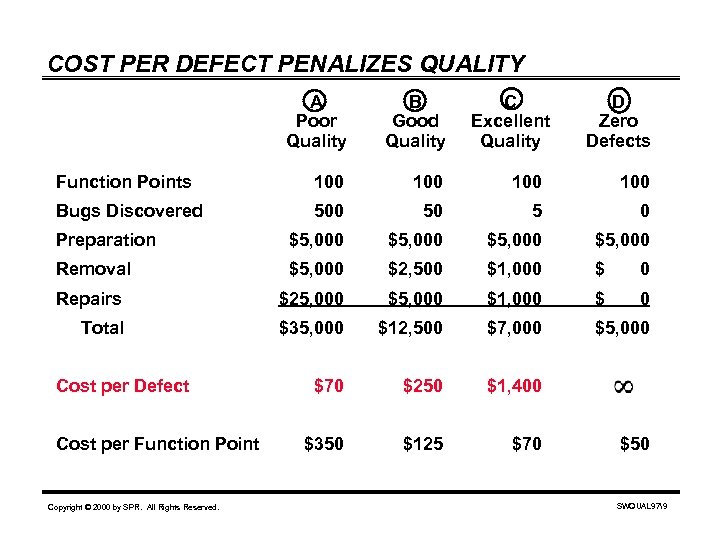 COST PER DEFECT PENALIZES QUALITY A Poor Quality B Good Quality Function Points 100 100 Bugs Discovered 500 50 5 0 Preparation $5, 000 Removal $5, 000 $2, 500 $1, 000 $ 0 Repairs $25, 000 $1, 000 $ 0 Total $35, 000 $12, 500 $7, 000 $5, 000 $70 $250 $1, 400 $350 $125 $70 Cost per Defect Cost per Function Point Copyright © 2000 by SPR. All Rights Reserved. C Excellent Quality D Zero Defects $50 SWQUAL 979
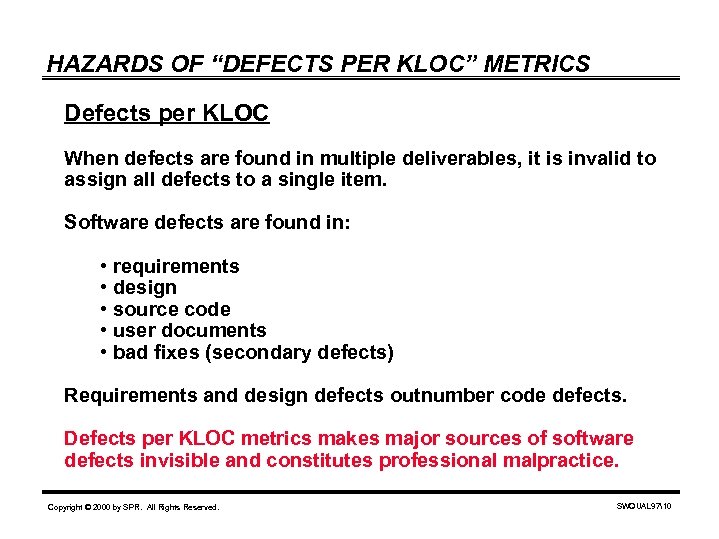 HAZARDS OF “DEFECTS PER KLOC” METRICS Defects per KLOC When defects are found in multiple deliverables, it is invalid to assign all defects to a single item. Software defects are found in: • requirements • design • source code • user documents • bad fixes (secondary defects) Requirements and design defects outnumber code defects. Defects per KLOC metrics makes major sources of software defects invisible and constitutes professional malpractice. Copyright © 2000 by SPR. All Rights Reserved. SWQUAL 9710
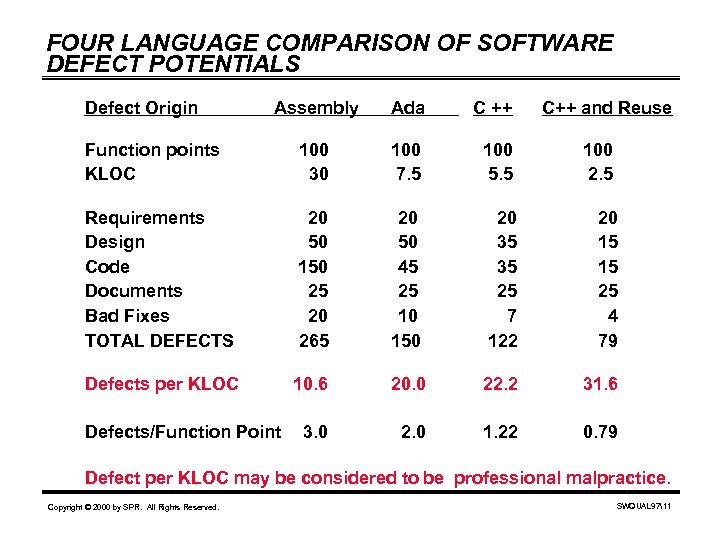 FOUR LANGUAGE COMPARISON OF SOFTWARE DEFECT POTENTIALS Defect Origin Assembly Ada C ++ Function points KLOC 100 30 100 7. 5 100 5. 5 100 2. 5 Requirements Design Code Documents Bad Fixes TOTAL DEFECTS 20 50 150 25 20 265 20 50 45 25 10 150 20 35 35 25 7 122 20 15 15 25 4 79 Defects per KLOC 10. 6 20. 0 22. 2 31. 6 3. 0 2. 0 1. 22 0. 79 Defects/Function Point C++ and Reuse Defect per KLOC may be considered to be professional malpractice. Copyright © 2000 by SPR. All Rights Reserved. SWQUAL 9711
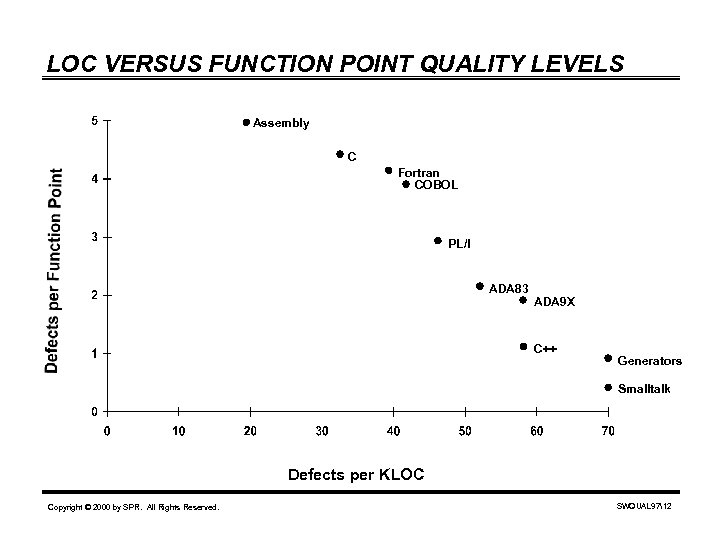 LOC VERSUS FUNCTION POINT QUALITY LEVELS Assembly C Fortran COBOL PL/I ADA 83 ADA 9 X C++ Generators Smalltalk Defects per KLOC Copyright © 2000 by SPR. All Rights Reserved. SWQUAL 9712
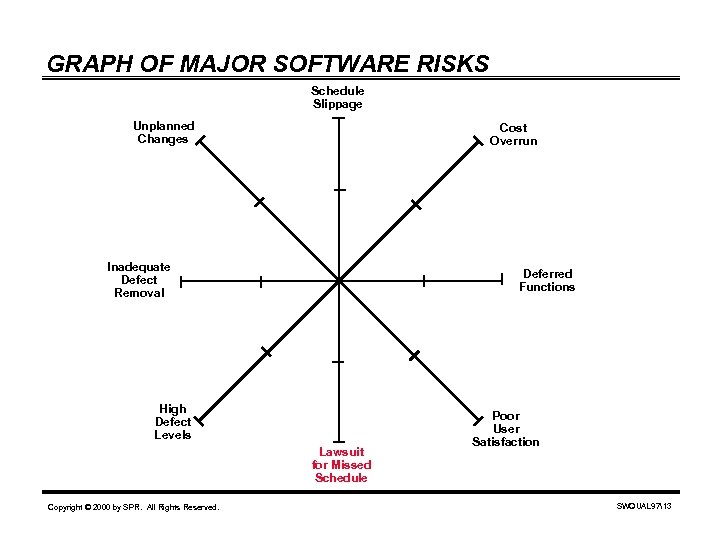 GRAPH OF MAJOR SOFTWARE RISKS Schedule Slippage Unplanned Changes Cost Overrun Inadequate Defect Removal Deferred Functions High Defect Levels Lawsuit for Missed Schedule Copyright © 2000 by SPR. All Rights Reserved. Poor User Satisfaction SWQUAL 9713
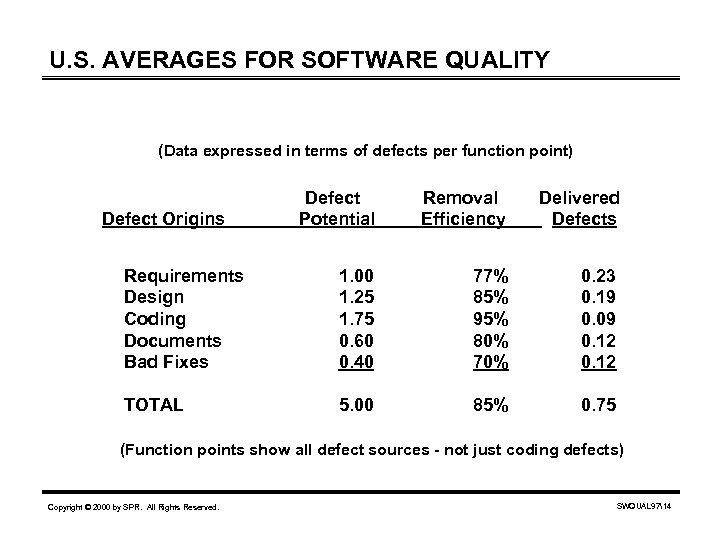 U. S. AVERAGES FOR SOFTWARE QUALITY (Data expressed in terms of defects per function point) Defect Potential Removal Efficiency Delivered Defects Requirements Design Coding Documents Bad Fixes 1. 00 1. 25 1. 75 0. 60 0. 40 77% 85% 95% 80% 70% 0. 23 0. 19 0. 09 0. 12 TOTAL 5. 00 85% 0. 75 Defect Origins (Function points show all defect sources - not just coding defects) Copyright © 2000 by SPR. All Rights Reserved. SWQUAL 9714
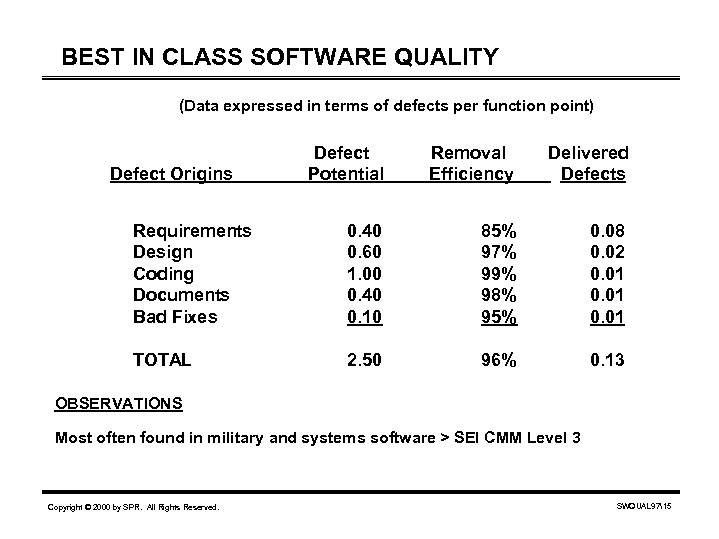 BEST IN CLASS SOFTWARE QUALITY (Data expressed in terms of defects per function point) Defect Potential Removal Efficiency Delivered Defects Requirements Design Coding Documents Bad Fixes 0. 40 0. 60 1. 00 0. 40 0. 10 85% 97% 99% 98% 95% 0. 08 0. 02 0. 01 TOTAL 2. 50 96% 0. 13 Defect Origins OBSERVATIONS Most often found in military and systems software > SEI CMM Level 3 Copyright © 2000 by SPR. All Rights Reserved. SWQUAL 9715
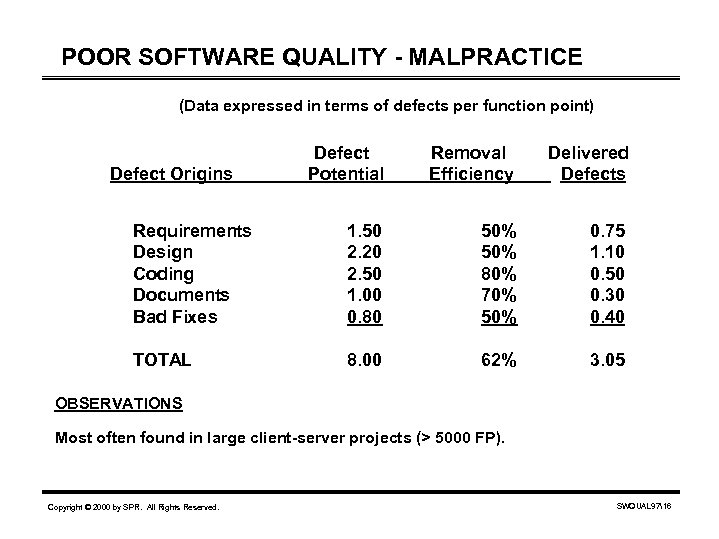 POOR SOFTWARE QUALITY - MALPRACTICE (Data expressed in terms of defects per function point) Defect Potential Removal Efficiency Delivered Defects Requirements Design Coding Documents Bad Fixes 1. 50 2. 20 2. 50 1. 00 0. 80 50% 80% 70% 50% 0. 75 1. 10 0. 50 0. 30 0. 40 TOTAL 8. 00 62% 3. 05 Defect Origins OBSERVATIONS Most often found in large client-server projects (> 5000 FP). Copyright © 2000 by SPR. All Rights Reserved. SWQUAL 9716
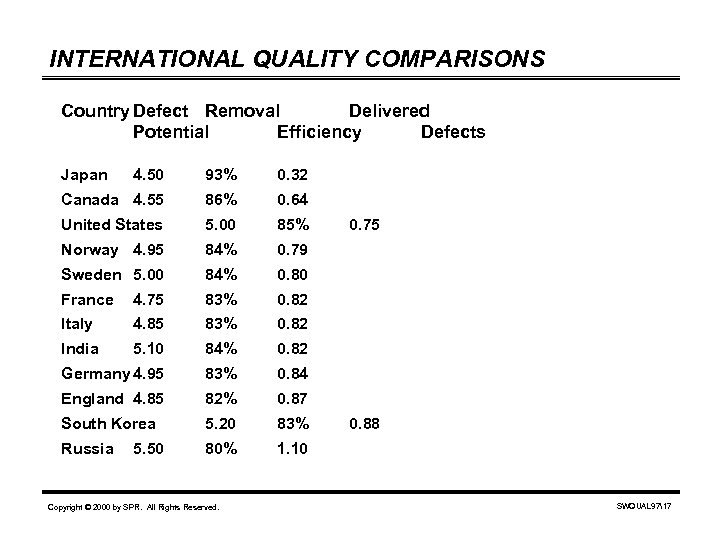 INTERNATIONAL QUALITY COMPARISONS Country Defect Removal Delivered Potential Efficiency Defects Japan 4. 50 93% 0. 32 Canada 4. 55 86% 0. 64 United States 5. 00 85% Norway 4. 95 84% 0. 79 Sweden 5. 00 84% 0. 80 France 4. 75 83% 0. 82 Italy 4. 85 83% 0. 82 India 5. 10 84% 0. 82 Germany 4. 95 83% 0. 84 England 4. 85 82% 0. 87 South Korea 5. 20 83% Russia 80% 1. 10 5. 50 Copyright © 2000 by SPR. All Rights Reserved. 0. 75 0. 88 SWQUAL 9717
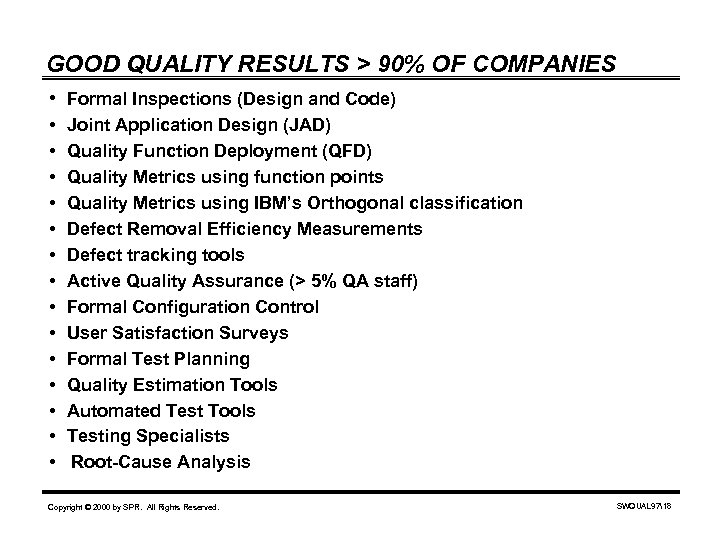 GOOD QUALITY RESULTS > 90% OF COMPANIES • Formal Inspections (Design and Code) • • • • Joint Application Design (JAD) Quality Function Deployment (QFD) Quality Metrics using function points Quality Metrics using IBM’s Orthogonal classification Defect Removal Efficiency Measurements Defect tracking tools Active Quality Assurance (> 5% QA staff) Formal Configuration Control User Satisfaction Surveys Formal Test Planning Quality Estimation Tools Automated Test Tools Testing Specialists Root-Cause Analysis Copyright © 2000 by SPR. All Rights Reserved. SWQUAL 9718
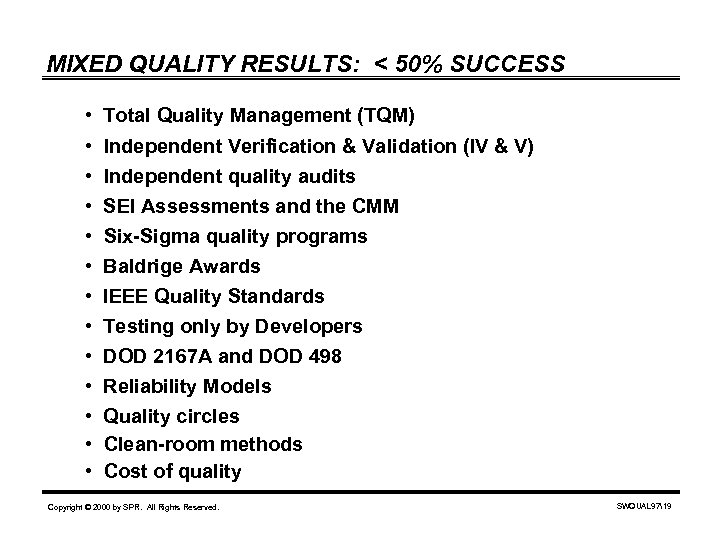 MIXED QUALITY RESULTS: < 50% SUCCESS • Total Quality Management (TQM) • • • Independent Verification & Validation (IV & V) Independent quality audits SEI Assessments and the CMM Six-Sigma quality programs Baldrige Awards IEEE Quality Standards Testing only by Developers DOD 2167 A and DOD 498 Reliability Models Quality circles Clean-room methods Cost of quality Copyright © 2000 by SPR. All Rights Reserved. SWQUAL 9719
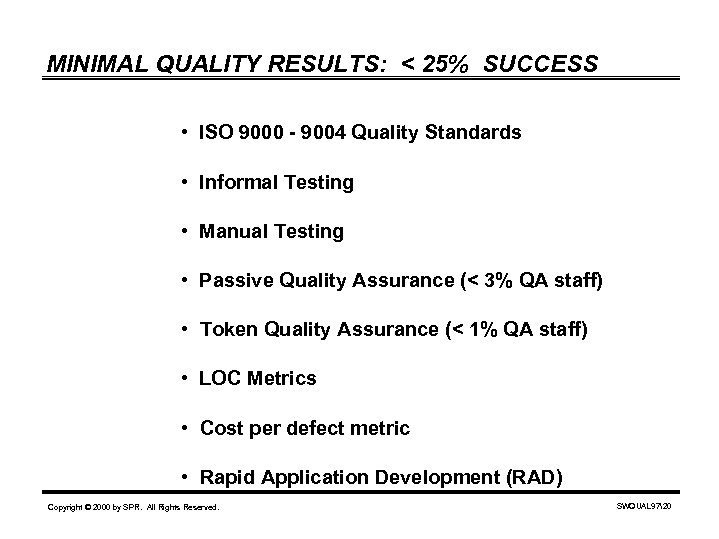 MINIMAL QUALITY RESULTS: < 25% SUCCESS • ISO 9000 - 9004 Quality Standards • Informal Testing • Manual Testing • Passive Quality Assurance (< 3% QA staff) • Token Quality Assurance (< 1% QA staff) • LOC Metrics • Cost per defect metric • Rapid Application Development (RAD) Copyright © 2000 by SPR. All Rights Reserved. SWQUAL 9720
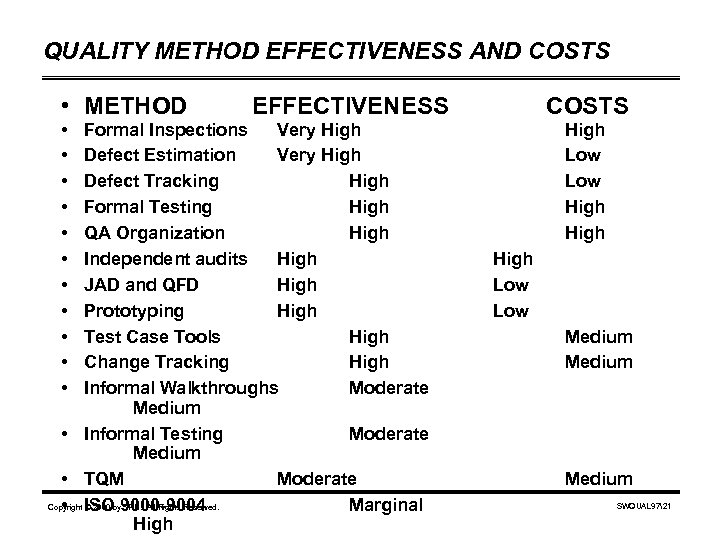 QUALITY METHOD EFFECTIVENESS AND COSTS • METHOD • • • EFFECTIVENESS Formal Inspections Very High Defect Estimation Very High Defect Tracking High Formal Testing High QA Organization High Independent audits High JAD and QFD High Prototyping High Test Case Tools High Change Tracking High Informal Walkthroughs Moderate Medium • Informal Testing Moderate Medium • TQM Moderate Copyright ISO 9000 -9004 • © 2000 by SPR. All Rights Reserved. Marginal High COSTS High Low High Low Medium SWQUAL 9721
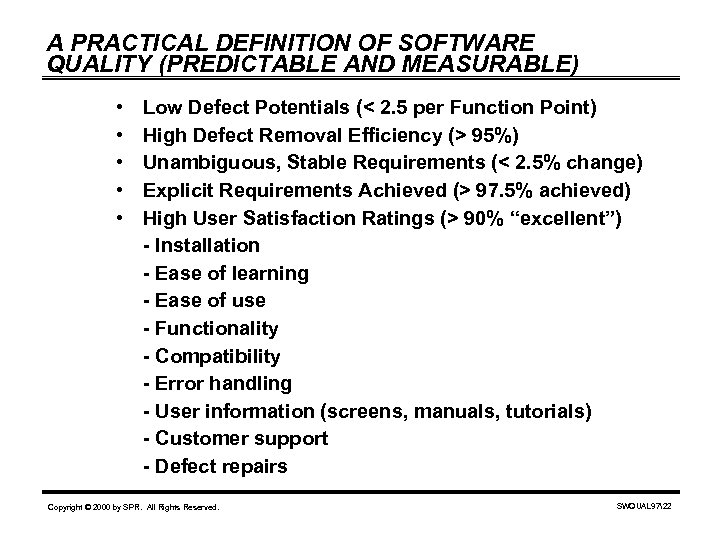 A PRACTICAL DEFINITION OF SOFTWARE QUALITY (PREDICTABLE AND MEASURABLE) • • • Low Defect Potentials (< 2. 5 per Function Point) High Defect Removal Efficiency (> 95%) Unambiguous, Stable Requirements (< 2. 5% change) Explicit Requirements Achieved (> 97. 5% achieved) High User Satisfaction Ratings (> 90% “excellent”) - Installation - Ease of learning - Ease of use - Functionality - Compatibility - Error handling - User information (screens, manuals, tutorials) - Customer support - Defect repairs Copyright © 2000 by SPR. All Rights Reserved. SWQUAL 9722
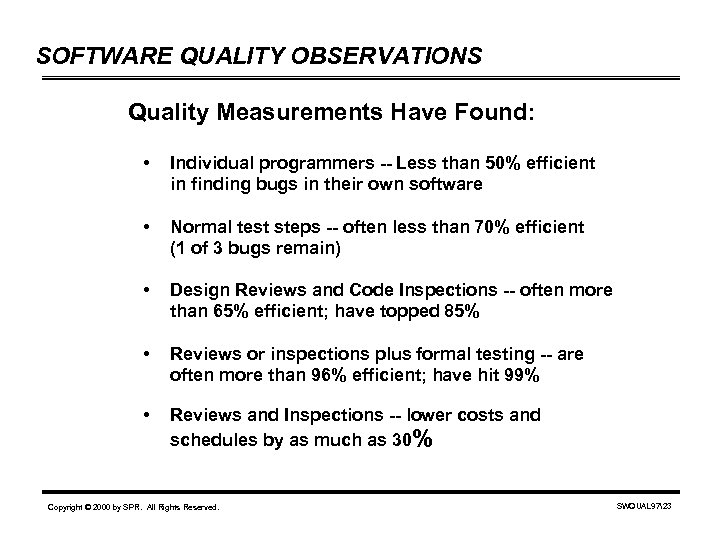 SOFTWARE QUALITY OBSERVATIONS Quality Measurements Have Found: • Individual programmers -- Less than 50% efficient in finding bugs in their own software • Normal test steps -- often less than 70% efficient (1 of 3 bugs remain) • Design Reviews and Code Inspections -- often more than 65% efficient; have topped 85% • Reviews or inspections plus formal testing -- are often more than 96% efficient; have hit 99% • Reviews and Inspections -- lower costs and schedules by as much as 30% Copyright © 2000 by SPR. All Rights Reserved. SWQUAL 9723
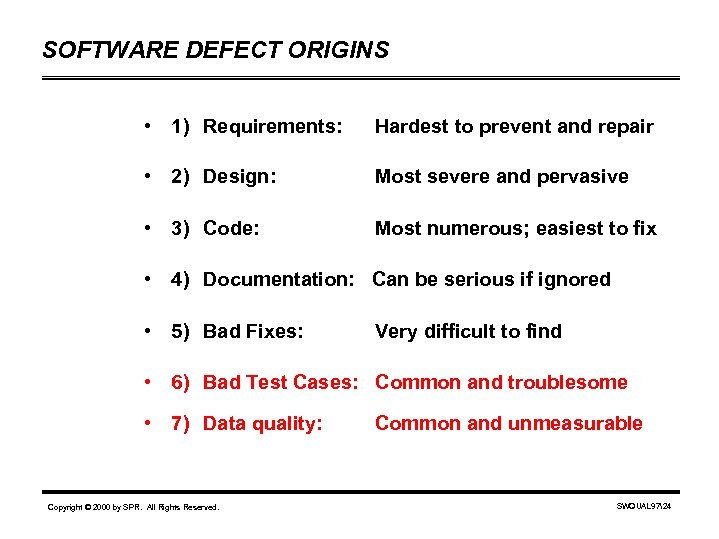 SOFTWARE DEFECT ORIGINS • 1) Requirements: Hardest to prevent and repair • 2) Design: Most severe and pervasive • 3) Code: Most numerous; easiest to fix • 4) Documentation: Can be serious if ignored • 5) Bad Fixes: Very difficult to find • 6) Bad Test Cases: Common and troublesome • 7) Data quality: Copyright © 2000 by SPR. All Rights Reserved. Common and unmeasurable SWQUAL 9724
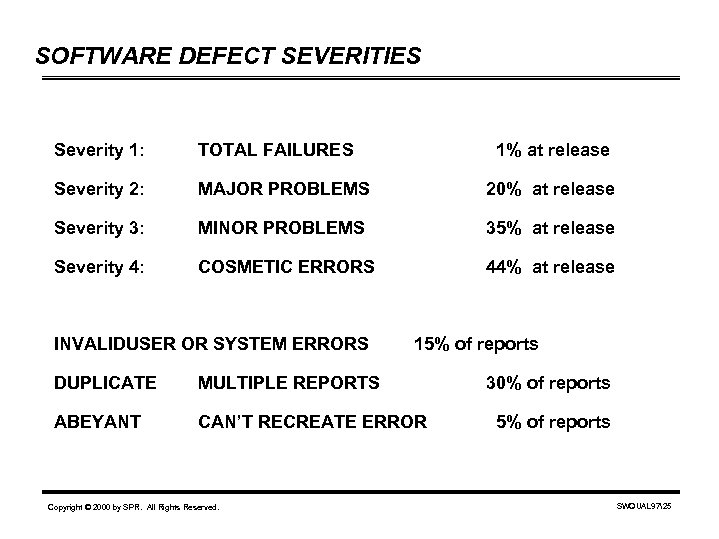 SOFTWARE DEFECT SEVERITIES Severity 1: TOTAL FAILURES Severity 2: MAJOR PROBLEMS 20% at release Severity 3: MINOR PROBLEMS 35% at release Severity 4: COSMETIC ERRORS 44% at release INVALIDUSER OR SYSTEM ERRORS 1% at release 15% of reports DUPLICATE MULTIPLE REPORTS ABEYANT CAN’T RECREATE ERROR Copyright © 2000 by SPR. All Rights Reserved. 30% of reports 5% of reports SWQUAL 9725
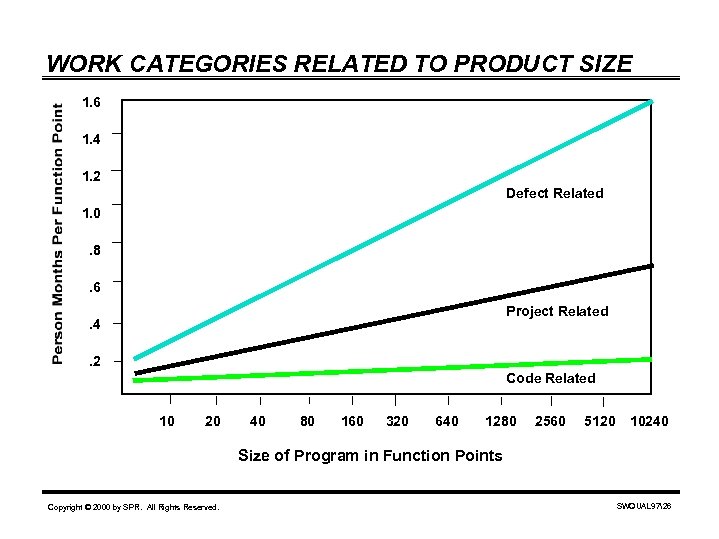 WORK CATEGORIES RELATED TO PRODUCT SIZE 1. 6 1. 4 1. 2 Defect Related 1. 0. 8. 6 Project Related . 4. 2 Code Related 10 20 40 80 160 320 640 1280 2560 5120 10240 Size of Program in Function Points Copyright © 2000 by SPR. All Rights Reserved. SWQUAL 9726
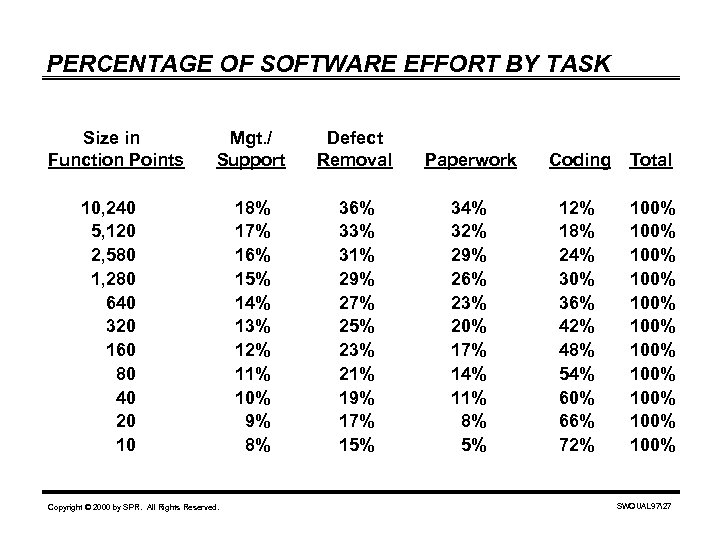 PERCENTAGE OF SOFTWARE EFFORT BY TASK Size in Function Points Mgt. / Support Defect Removal Paperwork Coding Total 18% 17% 16% 15% 14% 13% 12% 11% 10% 9% 8% 36% 33% 31% 29% 27% 25% 23% 21% 19% 17% 15% 34% 32% 29% 26% 23% 20% 17% 14% 11% 8% 5% 12% 18% 24% 30% 36% 42% 48% 54% 60% 66% 72% 100% 100% 100% 10, 240 5, 120 2, 580 1, 280 640 320 160 80 40 20 10 Copyright © 2000 by SPR. All Rights Reserved. SWQUAL 9727
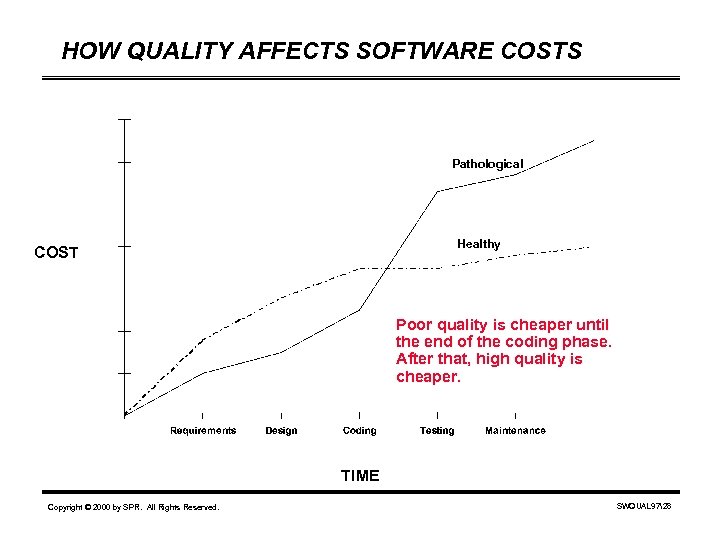 HOW QUALITY AFFECTS SOFTWARE COSTS Pathological Healthy COST Poor quality is cheaper until the end of the coding phase. After that, high quality is cheaper. TIME Copyright © 2000 by SPR. All Rights Reserved. SWQUAL 9728
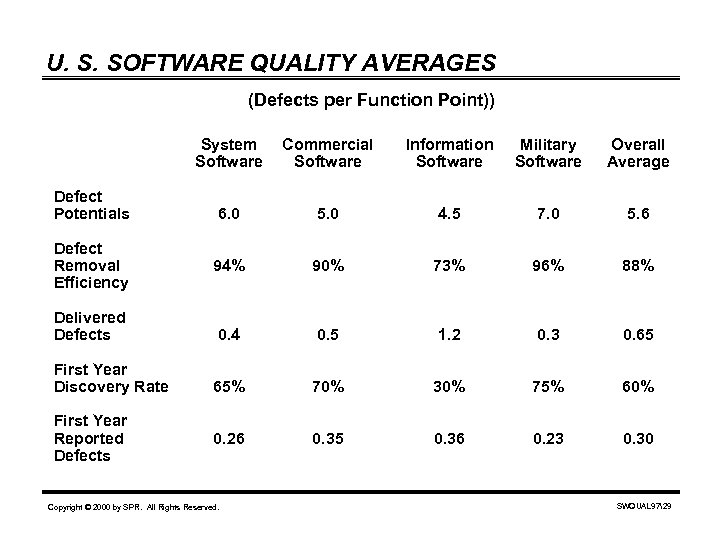 U. S. SOFTWARE QUALITY AVERAGES (Defects per Function Point)) System Software Defect Potentials Defect Removal Efficiency Delivered Defects First Year Discovery Rate First Year Reported Defects Commercial Software Information Software Military Software Overall Average 6. 0 5. 0 4. 5 7. 0 5. 6 94% 90% 73% 96% 88% 0. 4 0. 5 1. 2 0. 3 0. 65 65% 70% 30% 75% 60% 0. 26 0. 35 0. 36 0. 23 0. 30 Copyright © 2000 by SPR. All Rights Reserved. SWQUAL 9729
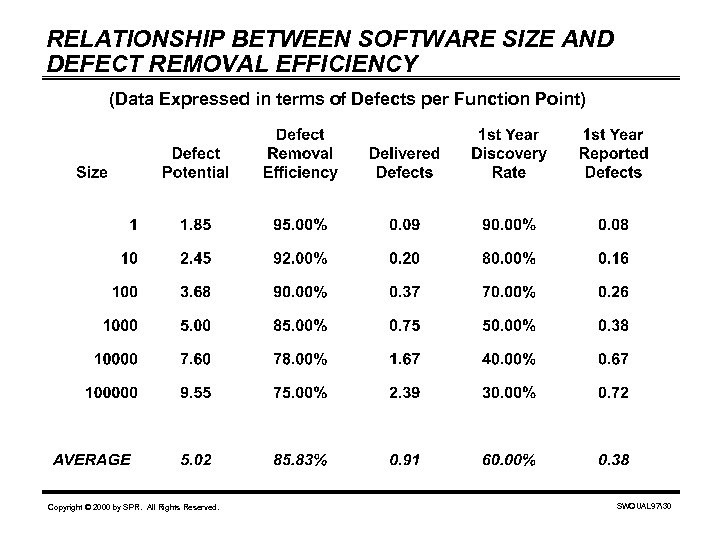 RELATIONSHIP BETWEEN SOFTWARE SIZE AND DEFECT REMOVAL EFFICIENCY (Data Expressed in terms of Defects per Function Point) Copyright © 2000 by SPR. All Rights Reserved. SWQUAL 9730
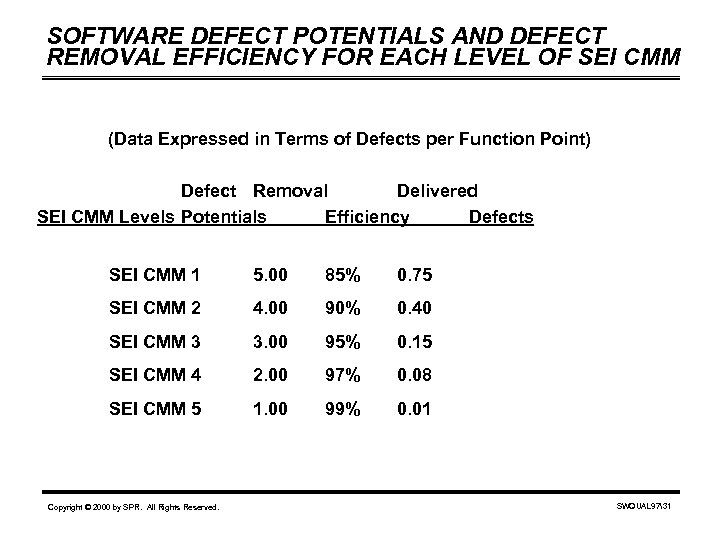 SOFTWARE DEFECT POTENTIALS AND DEFECT REMOVAL EFFICIENCY FOR EACH LEVEL OF SEI CMM (Data Expressed in Terms of Defects per Function Point) Defect Removal Delivered SEI CMM Levels Potentials Efficiency Defects SEI CMM 1 5. 00 85% 0. 75 SEI CMM 2 4. 00 90% 0. 40 SEI CMM 3 3. 00 95% 0. 15 SEI CMM 4 2. 00 97% 0. 08 SEI CMM 5 1. 00 99% 0. 01 Copyright © 2000 by SPR. All Rights Reserved. SWQUAL 9731
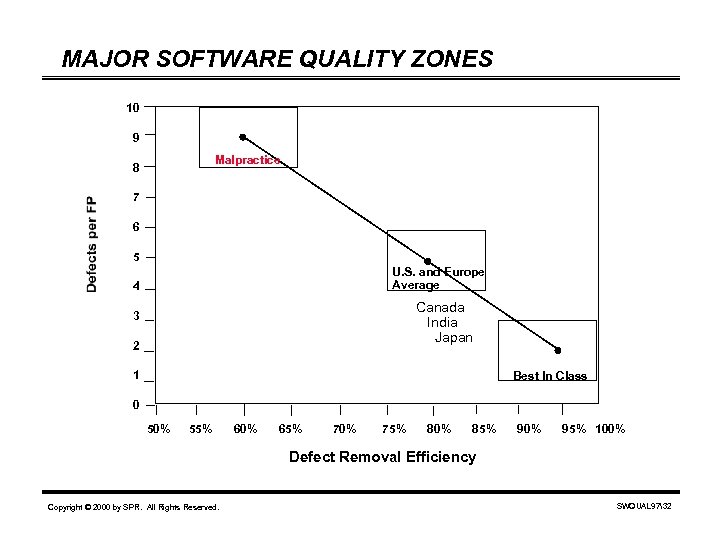 MAJOR SOFTWARE QUALITY ZONES 10 9 Malpractice 8 7 6 5 U. S. and Europe Average 4 Canada India Japan 3 2 1 Best In Class 0 50% 55% 60% 65% 70% 75% 80% 85% 90% 95% 100% Defect Removal Efficiency Copyright © 2000 by SPR. All Rights Reserved. SWQUAL 9732
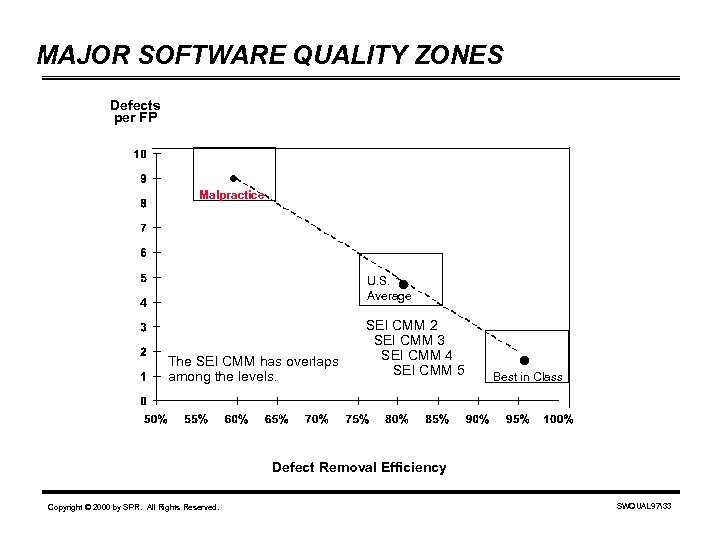 MAJOR SOFTWARE QUALITY ZONES Defects per FP . Malpractice U. S. Average The SEI CMM has overlaps among the levels. SEI CMM 2 SEI CMM 3 SEI CMM 4 SEI CMM 5 Best in Class Defect Removal Efficiency Copyright © 2000 by SPR. All Rights Reserved. SWQUAL 9733
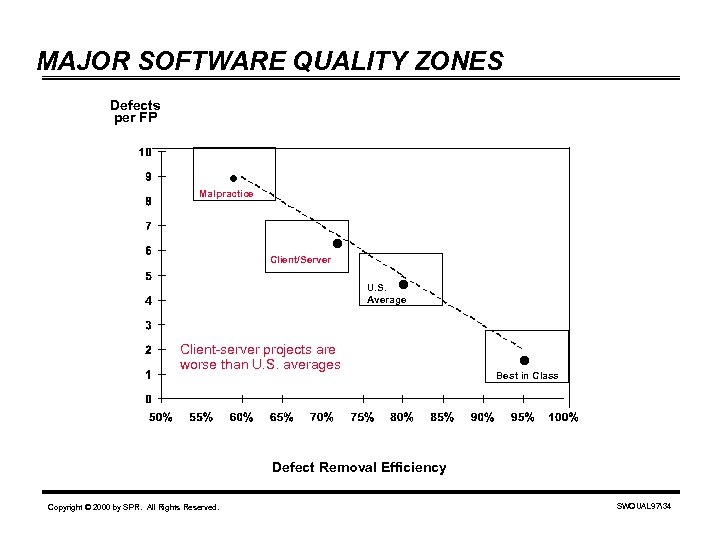 MAJOR SOFTWARE QUALITY ZONES Defects per FP . Malpractice Client/Server U. S. Average Client-server projects are worse than U. S. averages Best in Class Defect Removal Efficiency Copyright © 2000 by SPR. All Rights Reserved. SWQUAL 9734
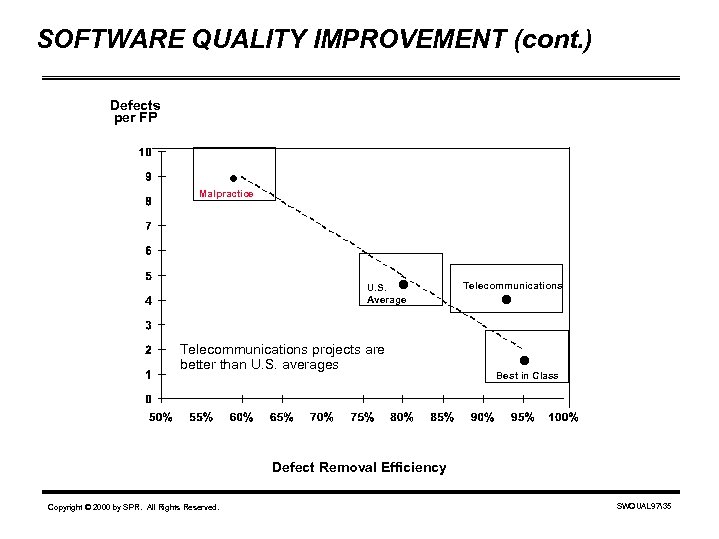 SOFTWARE QUALITY IMPROVEMENT (cont. ) Defects per FP . Malpractice U. S. Average Telecommunications projects are better than U. S. averages Telecommunications Best in Class Defect Removal Efficiency Copyright © 2000 by SPR. All Rights Reserved. SWQUAL 9735
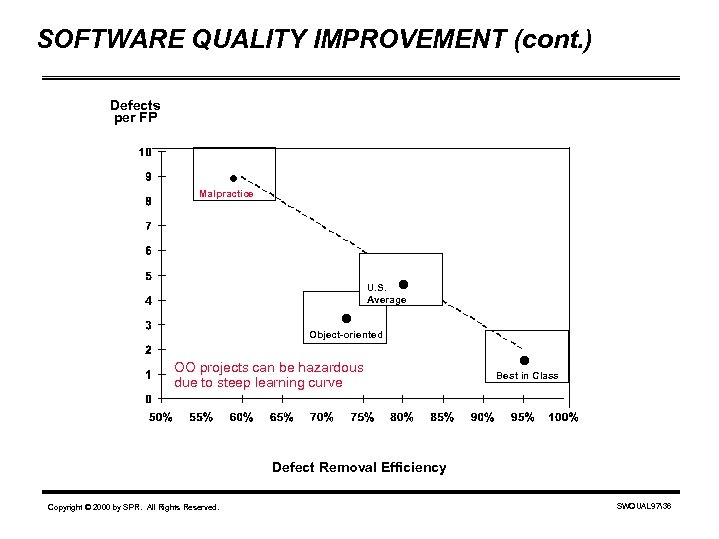 SOFTWARE QUALITY IMPROVEMENT (cont. ) Defects per FP . Malpractice U. S. Average Object-oriented OO projects can be hazardous due to steep learning curve Best in Class Defect Removal Efficiency Copyright © 2000 by SPR. All Rights Reserved. SWQUAL 9736
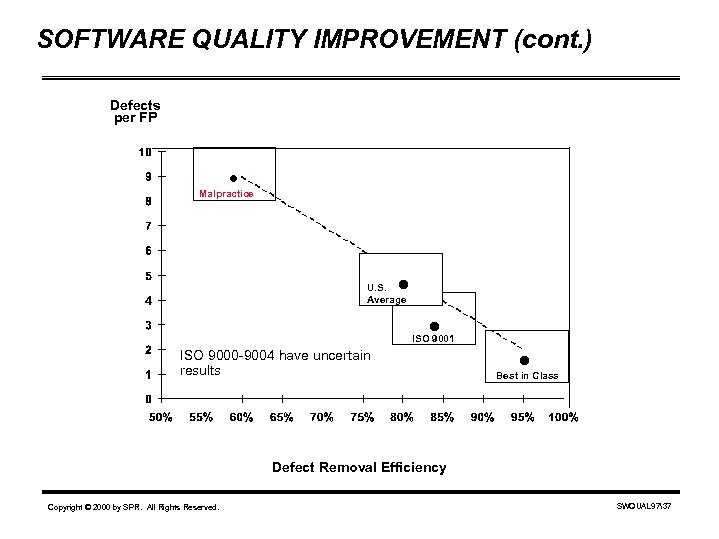 SOFTWARE QUALITY IMPROVEMENT (cont. ) Defects per FP . Malpractice U. S. Average ISO 9001 ISO 9000 -9004 have uncertain results Best in Class Defect Removal Efficiency Copyright © 2000 by SPR. All Rights Reserved. SWQUAL 9737
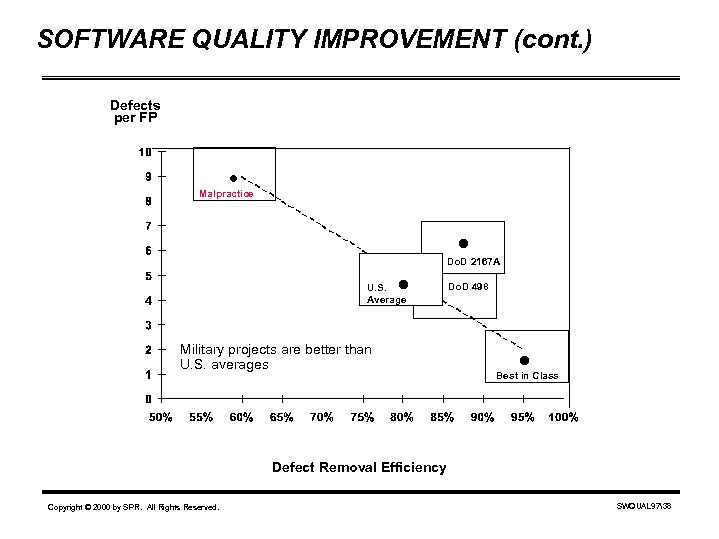 SOFTWARE QUALITY IMPROVEMENT (cont. ) Defects per FP . Malpractice U. S. Average Military projects are better than U. S. averages Do. D 2167 A Do. D 498 Best in Class Defect Removal Efficiency Copyright © 2000 by SPR. All Rights Reserved. SWQUAL 9738
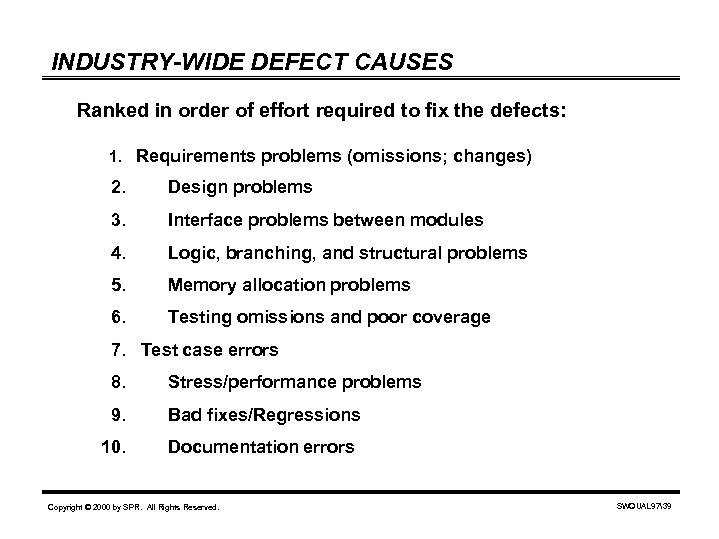 INDUSTRY-WIDE DEFECT CAUSES Ranked in order of effort required to fix the defects: 1. Requirements problems (omissions; changes) 2. Design problems 3. Interface problems between modules 4. Logic, branching, and structural problems 5. Memory allocation problems 6. Testing omissions and poor coverage 7. Test case errors 8. Stress/performance problems 9. Bad fixes/Regressions 10. Documentation errors Copyright © 2000 by SPR. All Rights Reserved. SWQUAL 9739
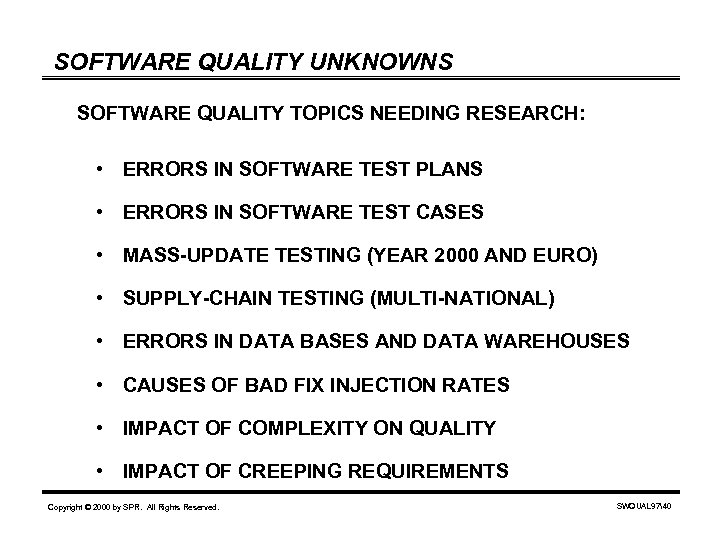 SOFTWARE QUALITY UNKNOWNS SOFTWARE QUALITY TOPICS NEEDING RESEARCH: • ERRORS IN SOFTWARE TEST PLANS • ERRORS IN SOFTWARE TEST CASES • MASS-UPDATE TESTING (YEAR 2000 AND EURO) • SUPPLY-CHAIN TESTING (MULTI-NATIONAL) • ERRORS IN DATA BASES AND DATA WAREHOUSES • CAUSES OF BAD FIX INJECTION RATES • IMPACT OF COMPLEXITY ON QUALITY • IMPACT OF CREEPING REQUIREMENTS Copyright © 2000 by SPR. All Rights Reserved. SWQUAL 9740
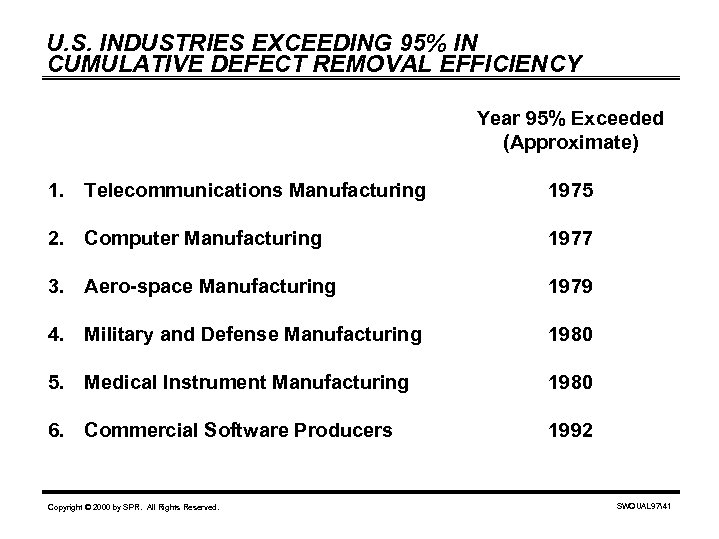 U. S. INDUSTRIES EXCEEDING 95% IN CUMULATIVE DEFECT REMOVAL EFFICIENCY Year 95% Exceeded (Approximate) 1. Telecommunications Manufacturing 1975 2. Computer Manufacturing 1977 3. Aero-space Manufacturing 1979 4. Military and Defense Manufacturing 1980 5. Medical Instrument Manufacturing 1980 6. Commercial Software Producers 1992 Copyright © 2000 by SPR. All Rights Reserved. SWQUAL 9741
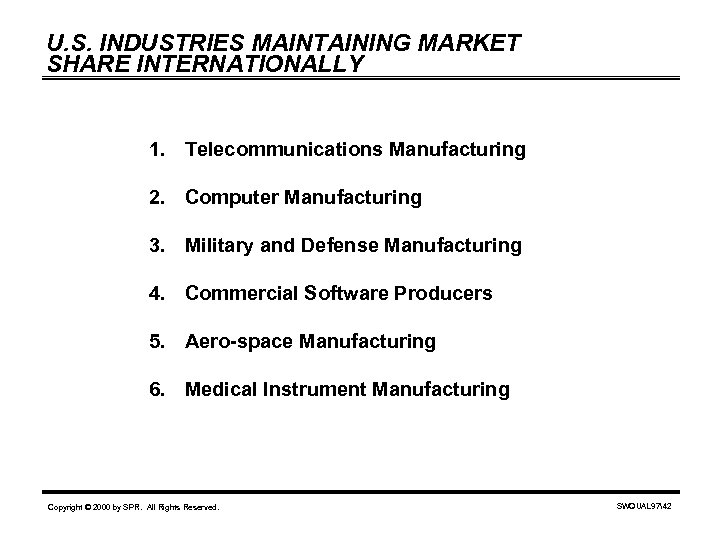 U. S. INDUSTRIES MAINTAINING MARKET SHARE INTERNATIONALLY 1. Telecommunications Manufacturing 2. Computer Manufacturing 3. Military and Defense Manufacturing 4. Commercial Software Producers 5. Aero-space Manufacturing 6. Medical Instrument Manufacturing Copyright © 2000 by SPR. All Rights Reserved. SWQUAL 9742
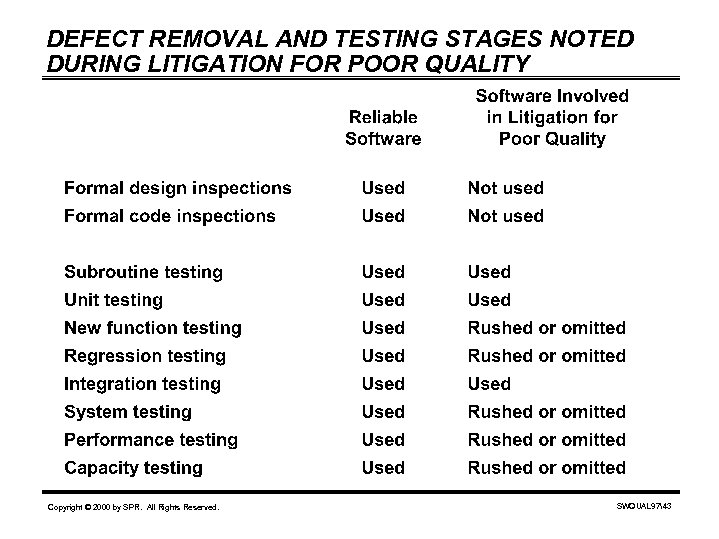 DEFECT REMOVAL AND TESTING STAGES NOTED DURING LITIGATION FOR POOR QUALITY Copyright © 2000 by SPR. All Rights Reserved. SWQUAL 9743
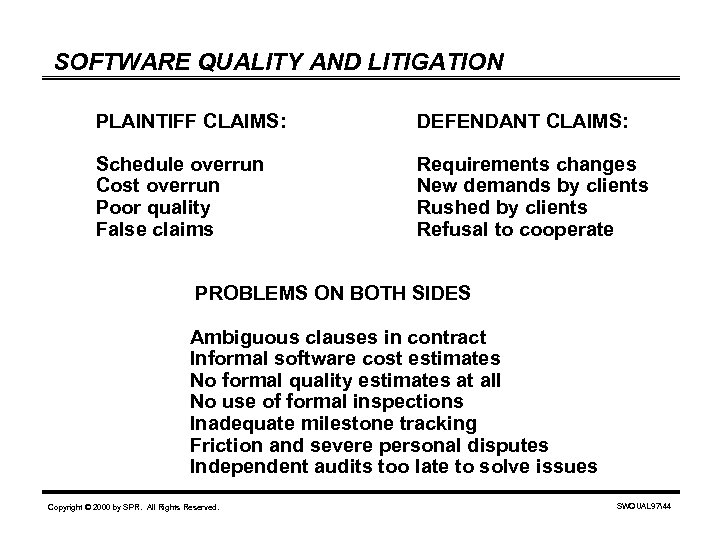 SOFTWARE QUALITY AND LITIGATION PLAINTIFF CLAIMS: DEFENDANT CLAIMS: Schedule overrun Cost overrun Poor quality False claims Requirements changes New demands by clients Rushed by clients Refusal to cooperate PROBLEMS ON BOTH SIDES Ambiguous clauses in contract Informal software cost estimates No formal quality estimates at all No use of formal inspections Inadequate milestone tracking Friction and severe personal disputes Independent audits too late to solve issues Copyright © 2000 by SPR. All Rights Reserved. SWQUAL 9744
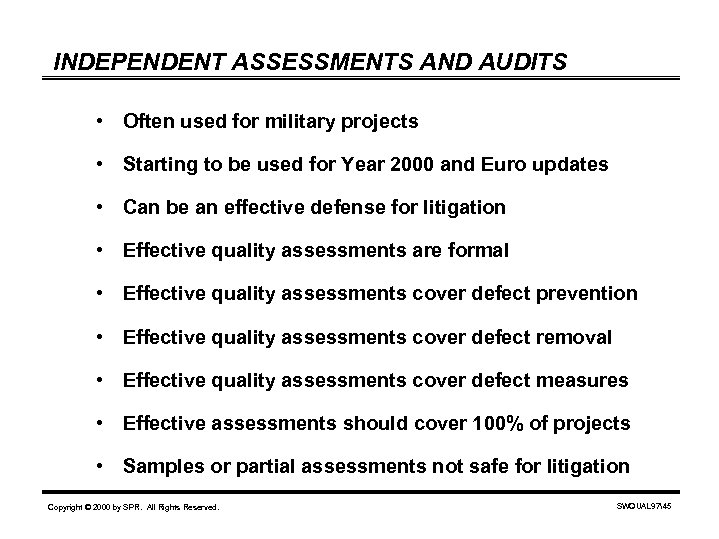 INDEPENDENT ASSESSMENTS AND AUDITS • Often used for military projects • Starting to be used for Year 2000 and Euro updates • Can be an effective defense for litigation • Effective quality assessments are formal • Effective quality assessments cover defect prevention • Effective quality assessments cover defect removal • Effective quality assessments cover defect measures • Effective assessments should cover 100% of projects • Samples or partial assessments not safe for litigation Copyright © 2000 by SPR. All Rights Reserved. SWQUAL 9745
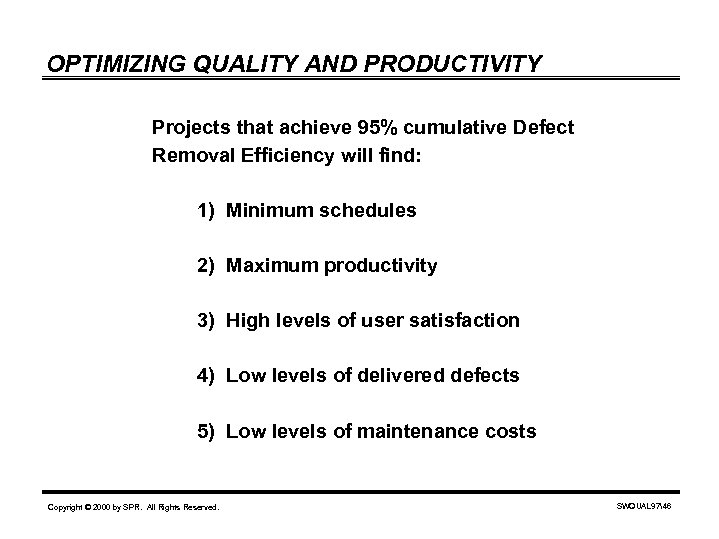 OPTIMIZING QUALITY AND PRODUCTIVITY Projects that achieve 95% cumulative Defect Removal Efficiency will find: 1) Minimum schedules 2) Maximum productivity 3) High levels of user satisfaction 4) Low levels of delivered defects 5) Low levels of maintenance costs Copyright © 2000 by SPR. All Rights Reserved. SWQUAL 9746
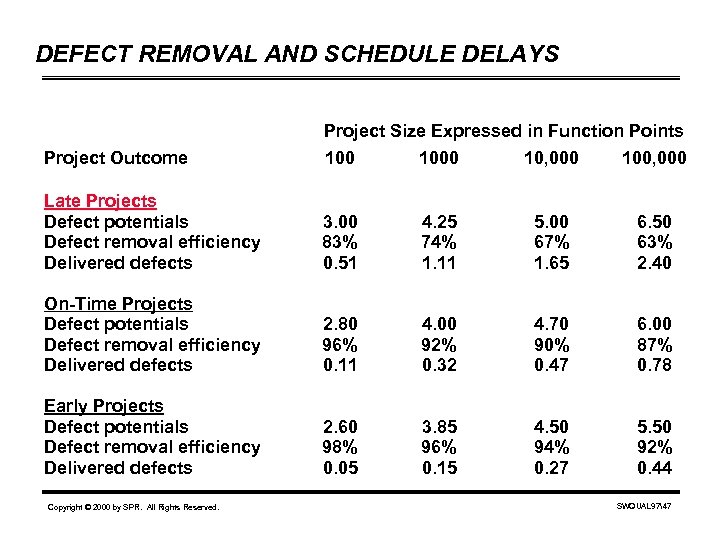 DEFECT REMOVAL AND SCHEDULE DELAYS Project Size Expressed in Function Points Project Outcome 1000 10, 000 100, 000 Late Projects Defect potentials Defect removal efficiency Delivered defects 3. 00 83% 0. 51 4. 25 74% 1. 11 5. 00 67% 1. 65 6. 50 63% 2. 40 On-Time Projects Defect potentials Defect removal efficiency Delivered defects 2. 80 96% 0. 11 4. 00 92% 0. 32 4. 70 90% 0. 47 6. 00 87% 0. 78 Early Projects Defect potentials Defect removal efficiency Delivered defects 2. 60 98% 0. 05 3. 85 96% 0. 15 4. 50 94% 0. 27 5. 50 92% 0. 44 Copyright © 2000 by SPR. All Rights Reserved. SWQUAL 9747
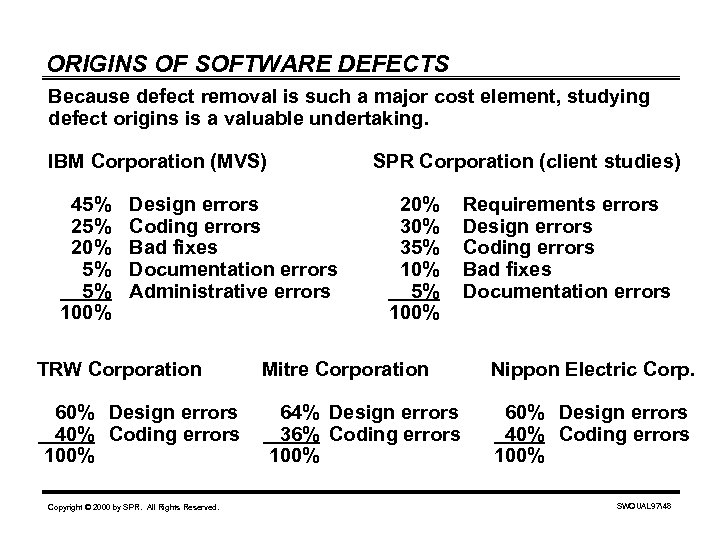 ORIGINS OF SOFTWARE DEFECTS Because defect removal is such a major cost element, studying defect origins is a valuable undertaking. IBM Corporation (MVS) 45% 20% 5% 5% 100% SPR Corporation (client studies) Design errors Coding errors Bad fixes Documentation errors Administrative errors TRW Corporation 60% Design errors 40% Coding errors 100% Copyright © 2000 by SPR. All Rights Reserved. 20% 35% 10% 5% 100% Mitre Corporation 64% Design errors 36% Coding errors 100% Requirements errors Design errors Coding errors Bad fixes Documentation errors Nippon Electric Corp. 60% Design errors 40% Coding errors 100% SWQUAL 9748
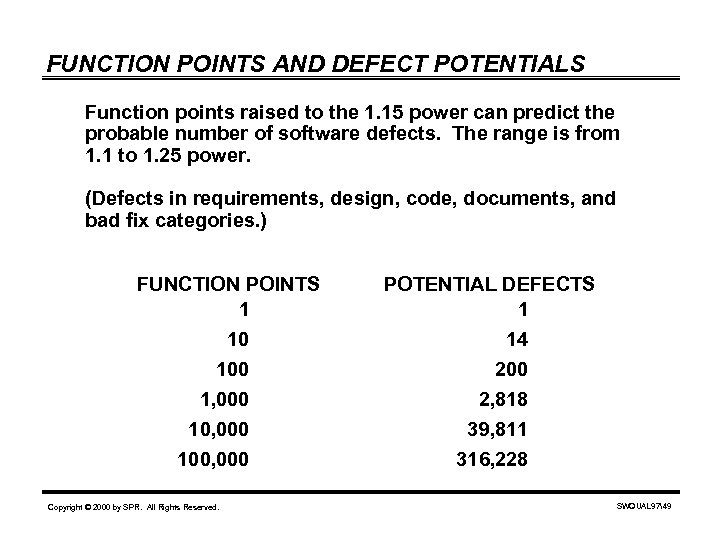 FUNCTION POINTS AND DEFECT POTENTIALS Function points raised to the 1. 15 power can predict the probable number of software defects. The range is from 1. 1 to 1. 25 power. (Defects in requirements, design, code, documents, and bad fix categories. ) FUNCTION POINTS 1 10 100 1, 000 100, 000 Copyright © 2000 by SPR. All Rights Reserved. POTENTIAL DEFECTS 1 14 200 2, 818 39, 811 316, 228 SWQUAL 9749
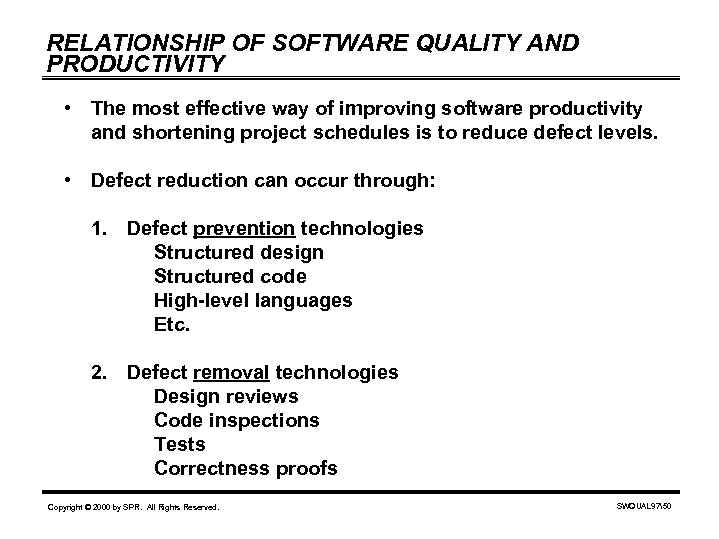 RELATIONSHIP OF SOFTWARE QUALITY AND PRODUCTIVITY • The most effective way of improving software productivity and shortening project schedules is to reduce defect levels. • Defect reduction can occur through: 1. Defect prevention technologies Structured design Structured code High-level languages Etc. 2. Defect removal technologies Design reviews Code inspections Tests Correctness proofs Copyright © 2000 by SPR. All Rights Reserved. SWQUAL 9750
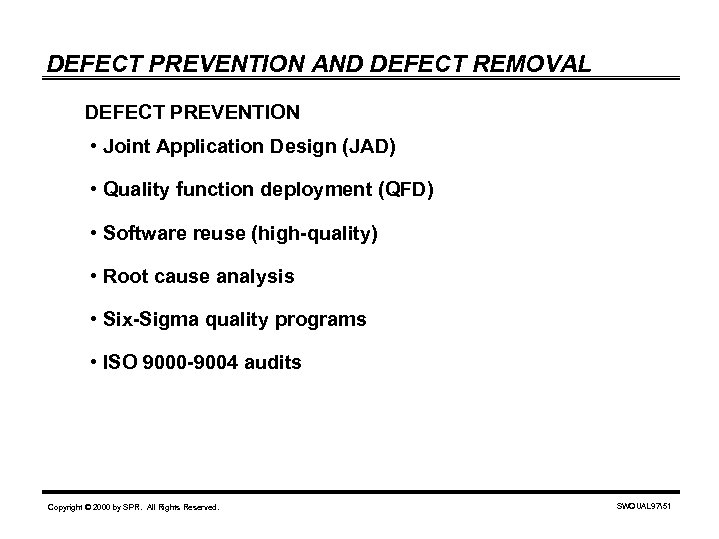 DEFECT PREVENTION AND DEFECT REMOVAL DEFECT PREVENTION • Joint Application Design (JAD) • Quality function deployment (QFD) • Software reuse (high-quality) • Root cause analysis • Six-Sigma quality programs • ISO 9000 -9004 audits Copyright © 2000 by SPR. All Rights Reserved. SWQUAL 9751
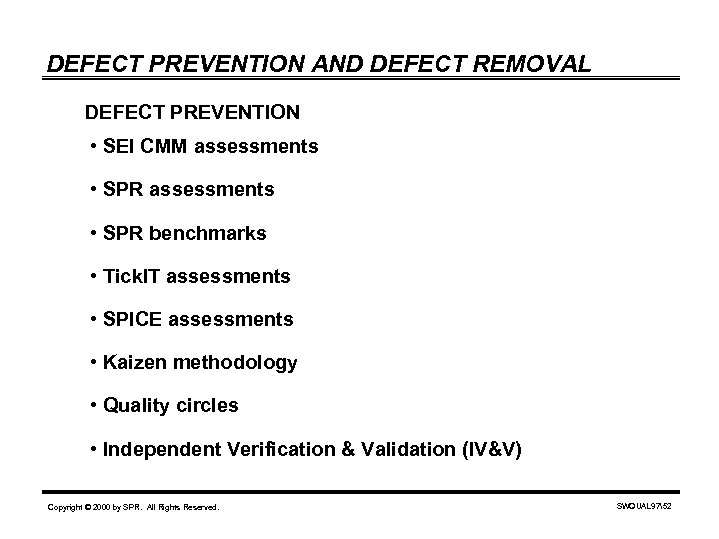 DEFECT PREVENTION AND DEFECT REMOVAL DEFECT PREVENTION • SEI CMM assessments • SPR benchmarks • Tick. IT assessments • SPICE assessments • Kaizen methodology • Quality circles • Independent Verification & Validation (IV&V) Copyright © 2000 by SPR. All Rights Reserved. SWQUAL 9752
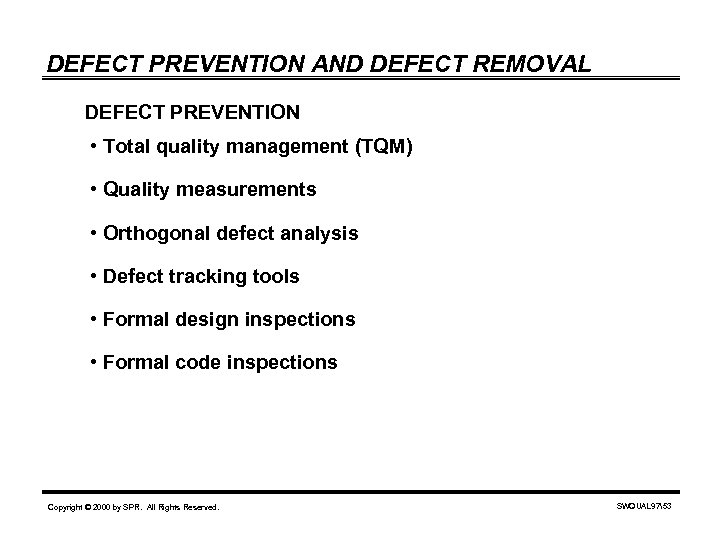 DEFECT PREVENTION AND DEFECT REMOVAL DEFECT PREVENTION • Total quality management (TQM) • Quality measurements • Orthogonal defect analysis • Defect tracking tools • Formal design inspections • Formal code inspections Copyright © 2000 by SPR. All Rights Reserved. SWQUAL 9753
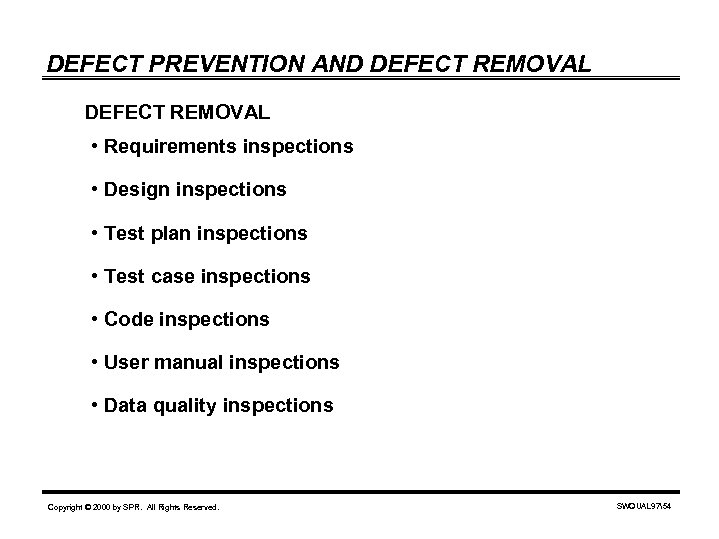 DEFECT PREVENTION AND DEFECT REMOVAL • Requirements inspections • Design inspections • Test plan inspections • Test case inspections • Code inspections • User manual inspections • Data quality inspections Copyright © 2000 by SPR. All Rights Reserved. SWQUAL 9754
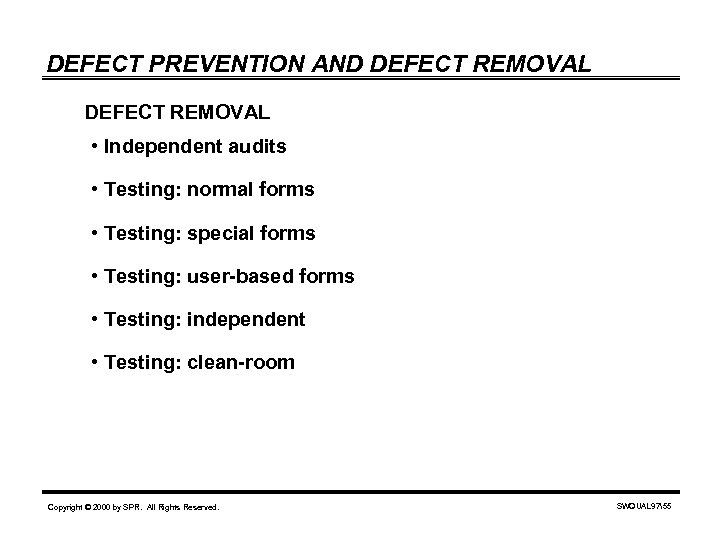 DEFECT PREVENTION AND DEFECT REMOVAL • Independent audits • Testing: normal forms • Testing: special forms • Testing: user-based forms • Testing: independent • Testing: clean-room Copyright © 2000 by SPR. All Rights Reserved. SWQUAL 9755
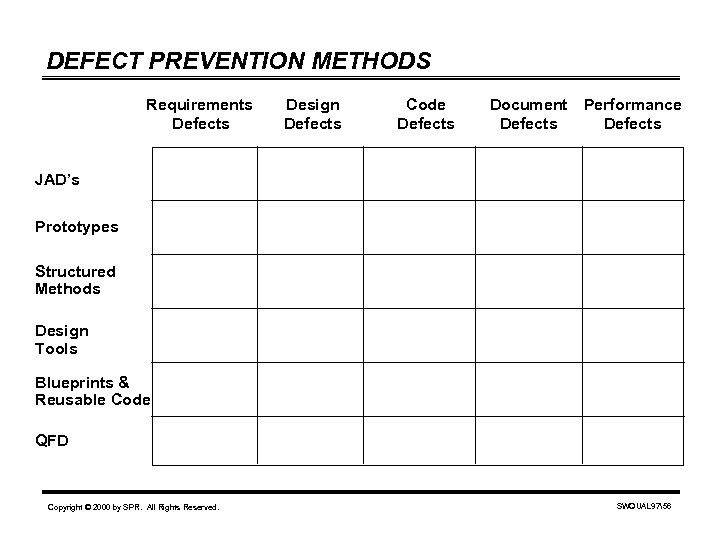 DEFECT PREVENTION METHODS Requirements Defects Design Defects Code Defects Document Defects Performance Defects JAD’s Prototypes Structured Methods Design Tools Blueprints & Reusable Code QFD Copyright © 2000 by SPR. All Rights Reserved. SWQUAL 9756
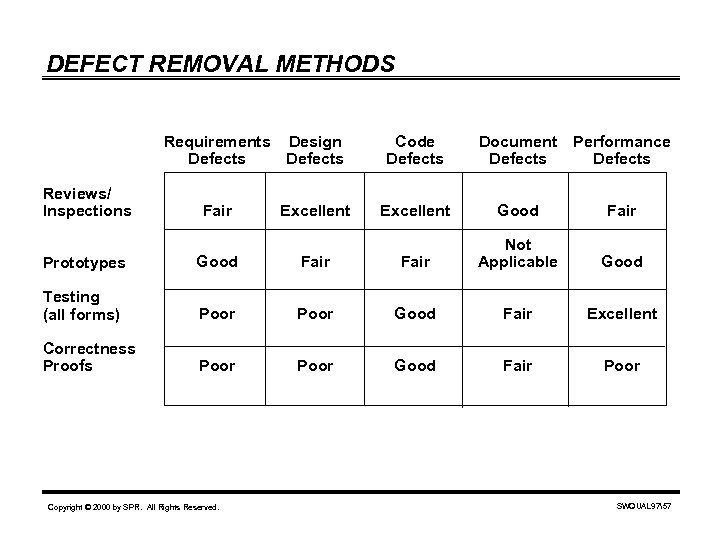 DEFECT REMOVAL METHODS Requirements Design Defects Reviews/ Inspections Fair Excellent Code Defects Document Defects Performance Defects Excellent Good Fair Good Prototypes Good Fair Not Applicable Testing (all forms) Poor Good Fair Excellent Correctness Proofs Poor Good Fair Poor Copyright © 2000 by SPR. All Rights Reserved. SWQUAL 9757
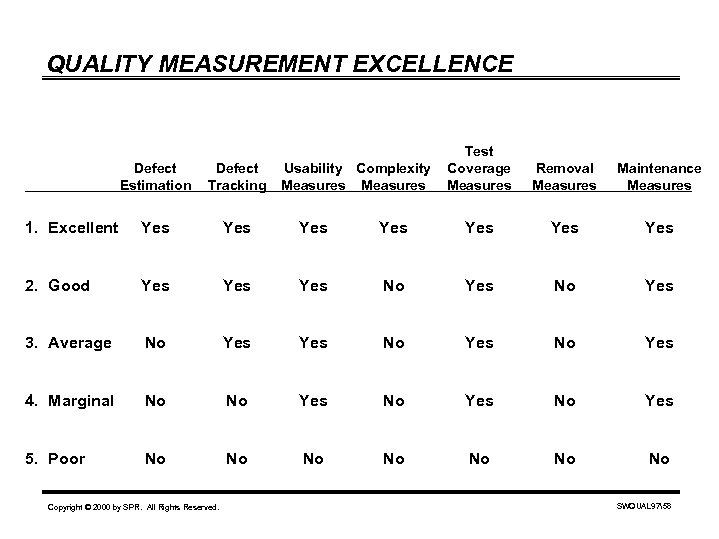 QUALITY MEASUREMENT EXCELLENCE Removal Measures Maintenance Measures Defect Estimation Defect Tracking 1. Excellent Yes Yes 2. Good Yes Yes No Yes 3. Average No Yes 4. Marginal No No Yes 5. Poor No No Copyright © 2000 by SPR. All Rights Reserved. Usability Complexity Measures Test Coverage Measures SWQUAL 9758
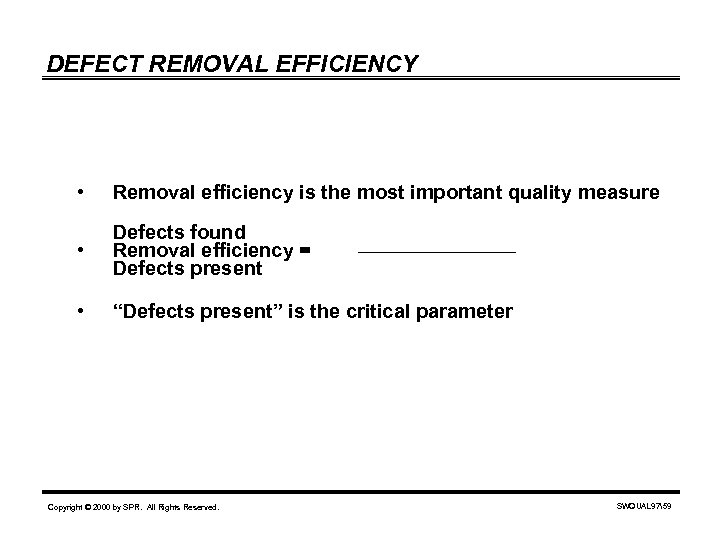 DEFECT REMOVAL EFFICIENCY • Removal efficiency is the most important quality measure • Defects found Removal efficiency = Defects present • “Defects present” is the critical parameter Copyright © 2000 by SPR. All Rights Reserved. SWQUAL 9759
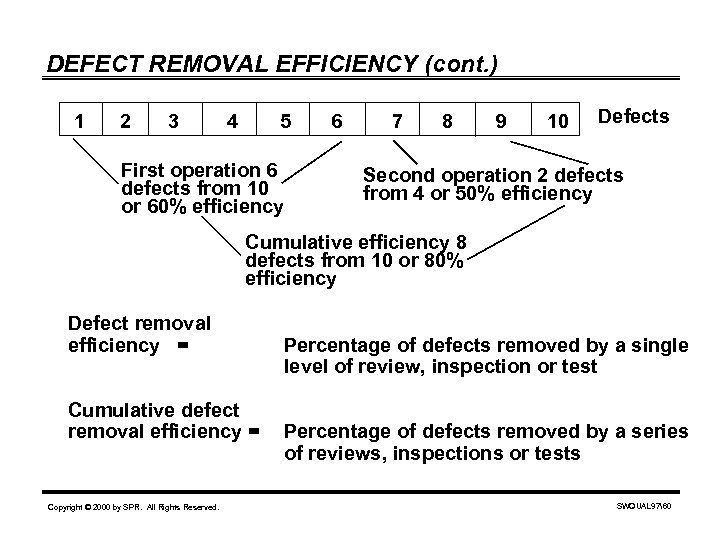 DEFECT REMOVAL EFFICIENCY (cont. ) 1 2 3 4 5 First operation 6 defects from 10 or 60% efficiency 6 7 8 9 10 Defects Second operation 2 defects from 4 or 50% efficiency Cumulative efficiency 8 defects from 10 or 80% efficiency Defect removal efficiency = Cumulative defect removal efficiency = Copyright © 2000 by SPR. All Rights Reserved. Percentage of defects removed by a single level of review, inspection or test Percentage of defects removed by a series of reviews, inspections or tests SWQUAL 9760
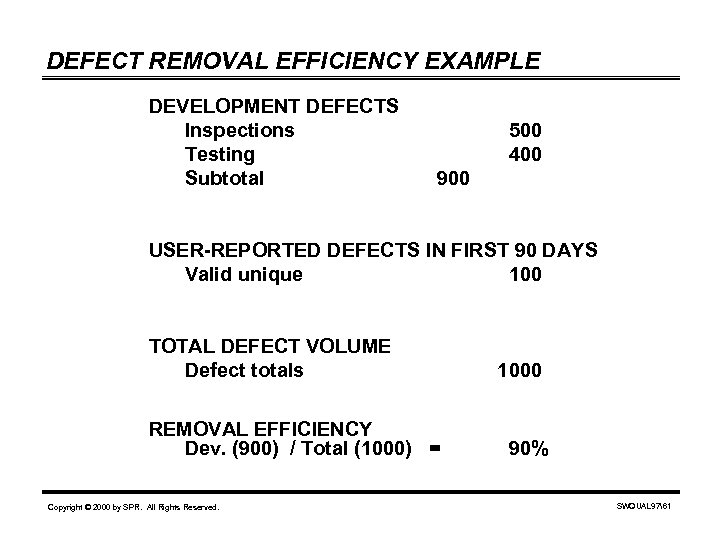 DEFECT REMOVAL EFFICIENCY EXAMPLE DEVELOPMENT DEFECTS Inspections Testing Subtotal 500 400 900 USER-REPORTED DEFECTS IN FIRST 90 DAYS Valid unique 100 TOTAL DEFECT VOLUME Defect totals REMOVAL EFFICIENCY Dev. (900) / Total (1000) = Copyright © 2000 by SPR. All Rights Reserved. 1000 90% SWQUAL 9761
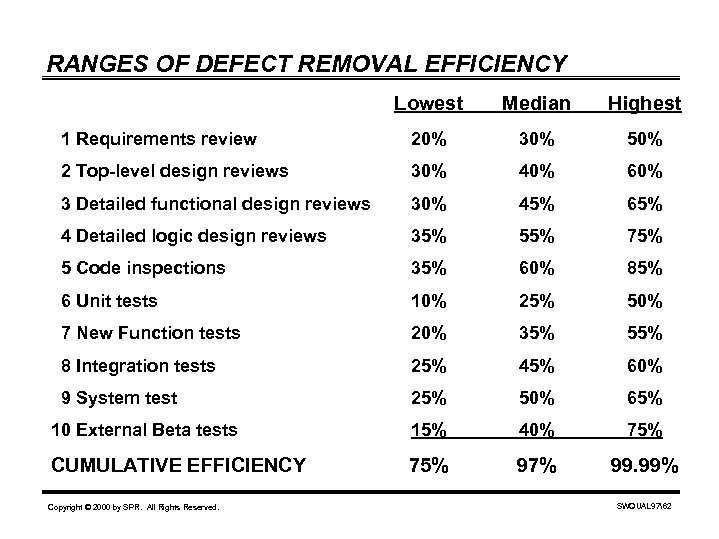 RANGES OF DEFECT REMOVAL EFFICIENCY Lowest Median Highest 1 Requirements review 20% 30% 50% 2 Top-level design reviews 30% 40% 60% 3 Detailed functional design reviews 30% 45% 65% 4 Detailed logic design reviews 35% 55% 75% 5 Code inspections 35% 60% 85% 6 Unit tests 10% 25% 50% 7 New Function tests 20% 35% 55% 8 Integration tests 25% 45% 60% 9 System test 25% 50% 65% 10 External Beta tests 15% 40% 75% CUMULATIVE EFFICIENCY 75% 97% 99. 99% Copyright © 2000 by SPR. All Rights Reserved. SWQUAL 9762
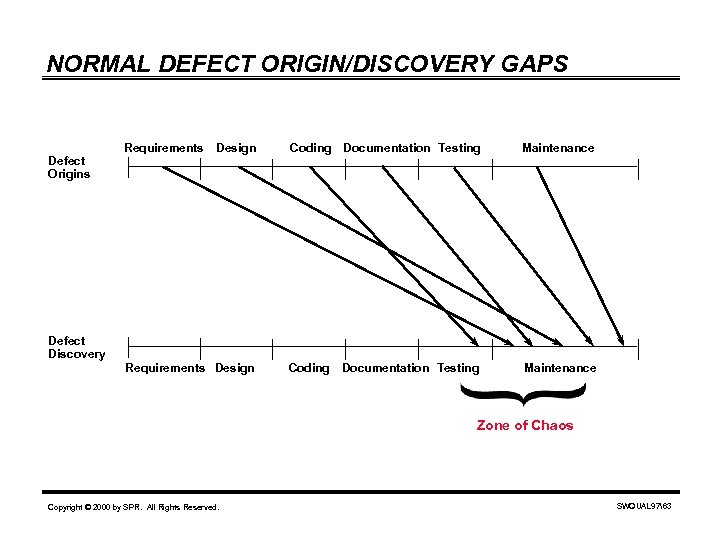 NORMAL DEFECT ORIGIN/DISCOVERY GAPS Requirements Design Coding Documentation Testing Maintenance Requirements Design Defect Origins Coding Documentation Testing Maintenance Defect Discovery Zone of Chaos Copyright © 2000 by SPR. All Rights Reserved. SWQUAL 9763
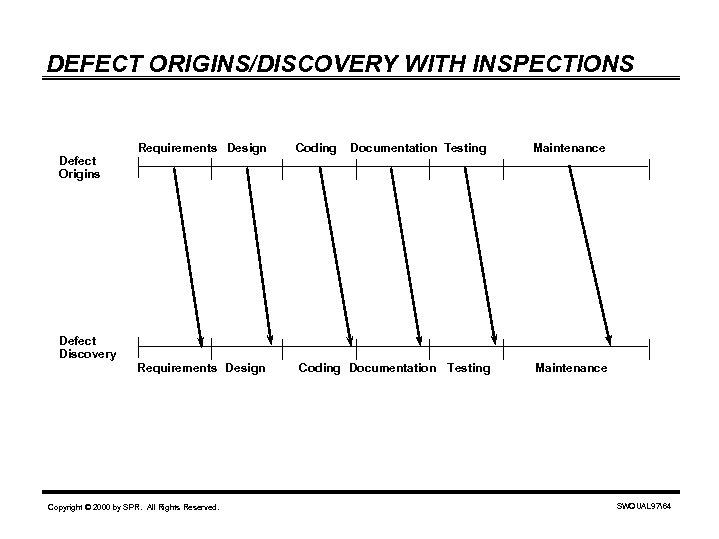 DEFECT ORIGINS/DISCOVERY WITH INSPECTIONS Defect Origins Requirements Design Coding Documentation Testing Maintenance Defect Discovery Requirements Design Copyright © 2000 by SPR. All Rights Reserved. Coding Documentation Testing Maintenance SWQUAL 9764
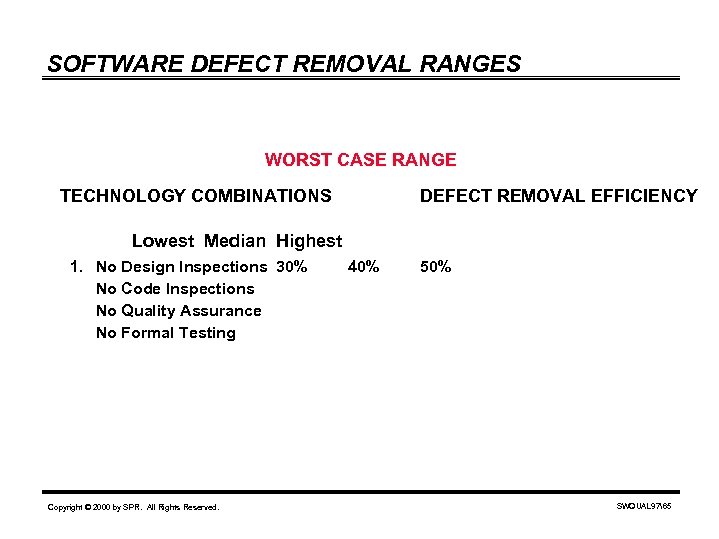 SOFTWARE DEFECT REMOVAL RANGES WORST CASE RANGE TECHNOLOGY COMBINATIONS DEFECT REMOVAL EFFICIENCY Lowest Median Highest 1. No Design Inspections 30% No Code Inspections No Quality Assurance No Formal Testing Copyright © 2000 by SPR. All Rights Reserved. 40% 50% SWQUAL 9765
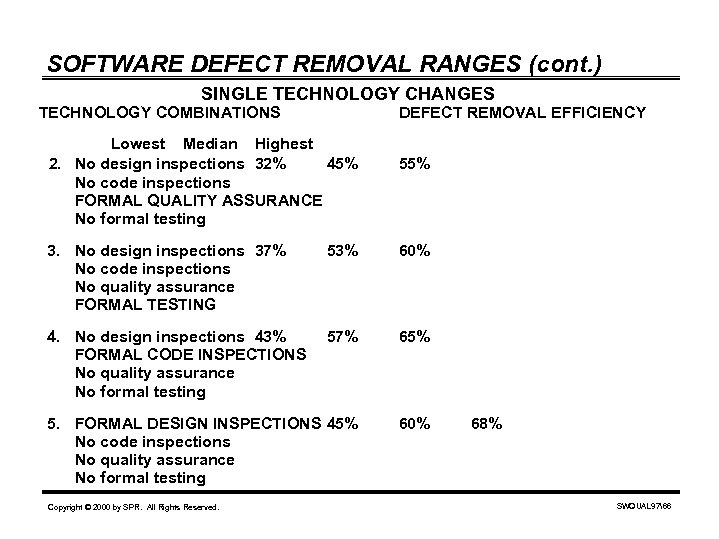 SOFTWARE DEFECT REMOVAL RANGES (cont. ) SINGLE TECHNOLOGY CHANGES TECHNOLOGY COMBINATIONS DEFECT REMOVAL EFFICIENCY Lowest Median Highest 2. No design inspections 32% 45% No code inspections FORMAL QUALITY ASSURANCE No formal testing 55% 3. No design inspections 37% No code inspections No quality assurance FORMAL TESTING 53% 60% 4. No design inspections 43% FORMAL CODE INSPECTIONS No quality assurance No formal testing 57% 65% 5. FORMAL DESIGN INSPECTIONS 45% No code inspections No quality assurance No formal testing 60% Copyright © 2000 by SPR. All Rights Reserved. 68% SWQUAL 9766
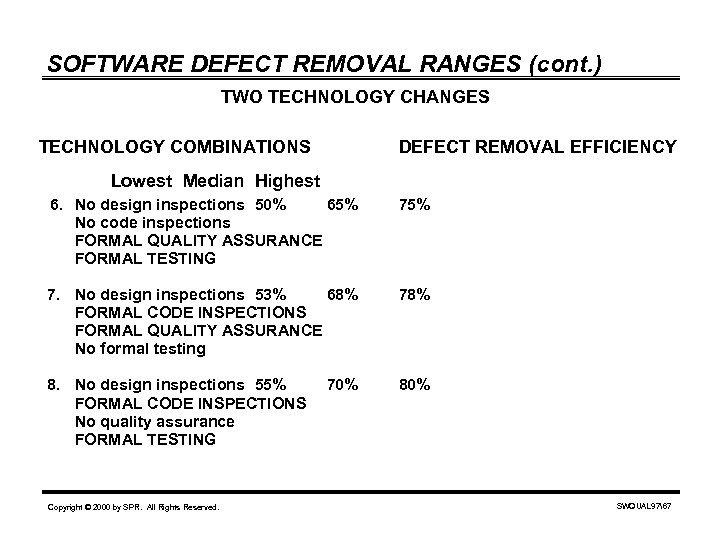 SOFTWARE DEFECT REMOVAL RANGES (cont. ) TWO TECHNOLOGY CHANGES TECHNOLOGY COMBINATIONS DEFECT REMOVAL EFFICIENCY Lowest Median Highest 6. No design inspections 50% 65% No code inspections FORMAL QUALITY ASSURANCE FORMAL TESTING 75% 7. No design inspections 53% 68% FORMAL CODE INSPECTIONS FORMAL QUALITY ASSURANCE No formal testing 78% 8. No design inspections 55% FORMAL CODE INSPECTIONS No quality assurance FORMAL TESTING 80% Copyright © 2000 by SPR. All Rights Reserved. 70% SWQUAL 9767
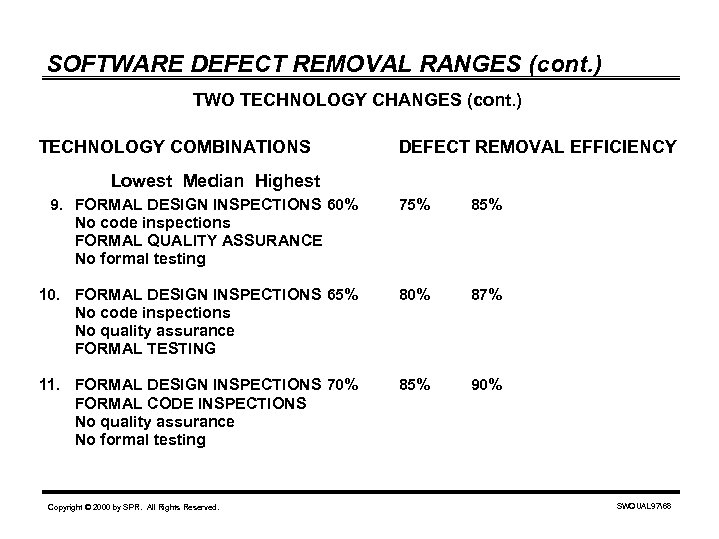 SOFTWARE DEFECT REMOVAL RANGES (cont. ) TWO TECHNOLOGY CHANGES (cont. ) TECHNOLOGY COMBINATIONS DEFECT REMOVAL EFFICIENCY Lowest Median Highest 9. FORMAL DESIGN INSPECTIONS 60% No code inspections FORMAL QUALITY ASSURANCE No formal testing 75% 85% 10. FORMAL DESIGN INSPECTIONS 65% No code inspections No quality assurance FORMAL TESTING 80% 87% 11. FORMAL DESIGN INSPECTIONS 70% FORMAL CODE INSPECTIONS No quality assurance No formal testing 85% 90% Copyright © 2000 by SPR. All Rights Reserved. SWQUAL 9768
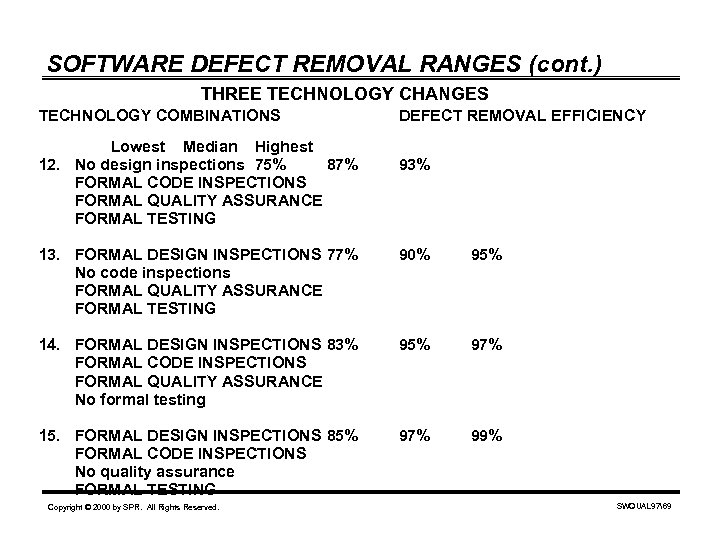 SOFTWARE DEFECT REMOVAL RANGES (cont. ) THREE TECHNOLOGY CHANGES TECHNOLOGY COMBINATIONS Lowest Median Highest 12. No design inspections 75% 87% FORMAL CODE INSPECTIONS FORMAL QUALITY ASSURANCE FORMAL TESTING DEFECT REMOVAL EFFICIENCY 93% 13. FORMAL DESIGN INSPECTIONS 77% No code inspections FORMAL QUALITY ASSURANCE FORMAL TESTING 90% 95% 14. FORMAL DESIGN INSPECTIONS 83% FORMAL CODE INSPECTIONS FORMAL QUALITY ASSURANCE No formal testing 95% 97% 15. FORMAL DESIGN INSPECTIONS 85% FORMAL CODE INSPECTIONS No quality assurance FORMAL TESTING 97% 99% Copyright © 2000 by SPR. All Rights Reserved. SWQUAL 9769
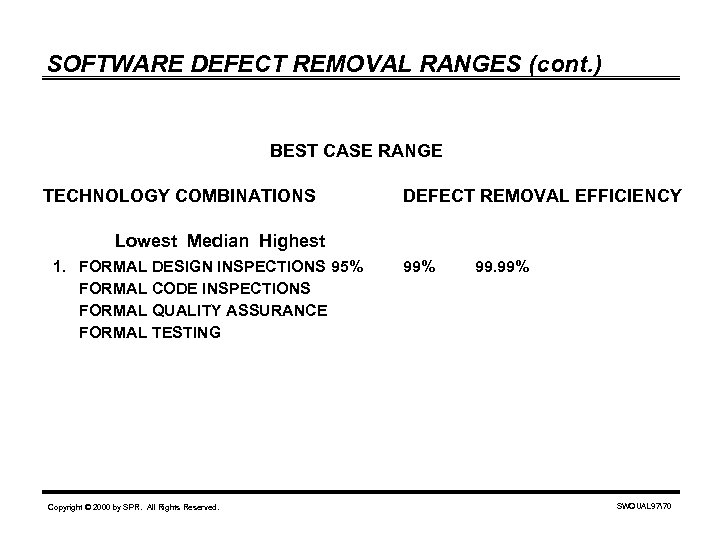 SOFTWARE DEFECT REMOVAL RANGES (cont. ) BEST CASE RANGE TECHNOLOGY COMBINATIONS DEFECT REMOVAL EFFICIENCY Lowest Median Highest 1. FORMAL DESIGN INSPECTIONS 95% FORMAL CODE INSPECTIONS FORMAL QUALITY ASSURANCE FORMAL TESTING Copyright © 2000 by SPR. All Rights Reserved. 99% 99. 99% SWQUAL 9770
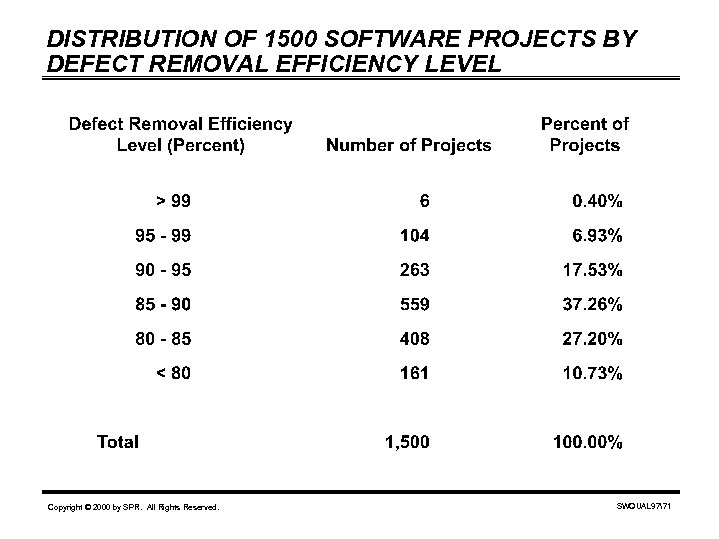 DISTRIBUTION OF 1500 SOFTWARE PROJECTS BY DEFECT REMOVAL EFFICIENCY LEVEL Copyright © 2000 by SPR. All Rights Reserved. SWQUAL 9771
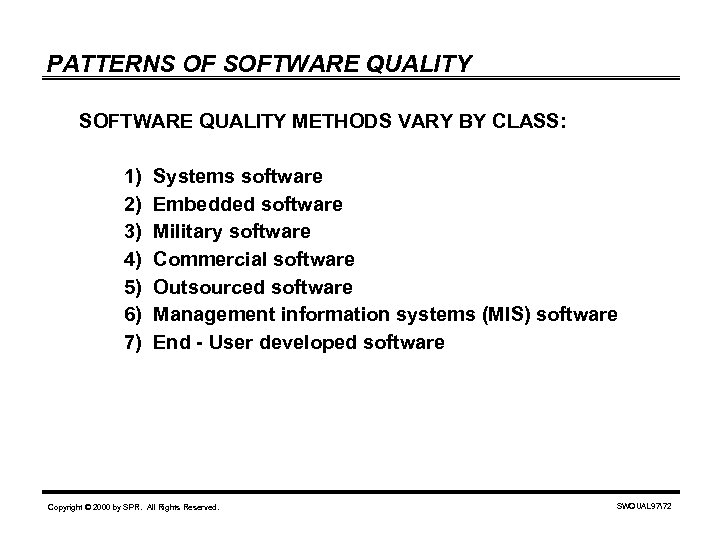 PATTERNS OF SOFTWARE QUALITY METHODS VARY BY CLASS: 1) 2) 3) 4) 5) 6) 7) Systems software Embedded software Military software Commercial software Outsourced software Management information systems (MIS) software End - User developed software Copyright © 2000 by SPR. All Rights Reserved. SWQUAL 9772
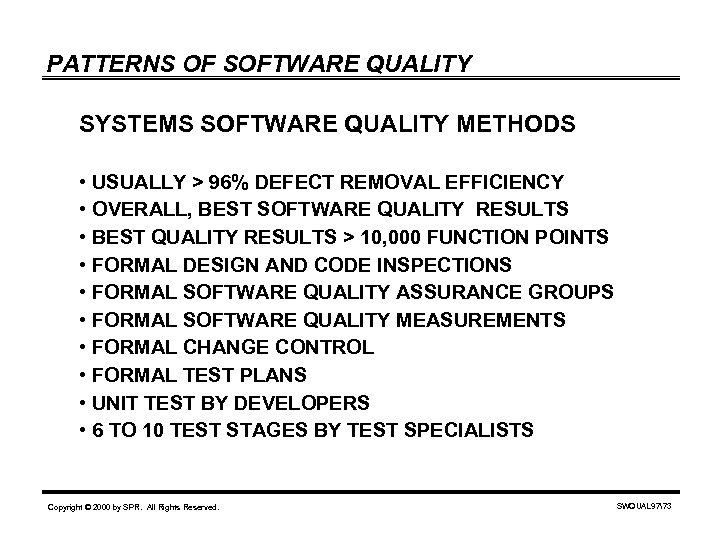 PATTERNS OF SOFTWARE QUALITY SYSTEMS SOFTWARE QUALITY METHODS • USUALLY > 96% DEFECT REMOVAL EFFICIENCY • OVERALL, BEST SOFTWARE QUALITY RESULTS • BEST QUALITY RESULTS > 10, 000 FUNCTION POINTS • FORMAL DESIGN AND CODE INSPECTIONS • FORMAL SOFTWARE QUALITY ASSURANCE GROUPS • FORMAL SOFTWARE QUALITY MEASUREMENTS • FORMAL CHANGE CONTROL • FORMAL TEST PLANS • UNIT TEST BY DEVELOPERS • 6 TO 10 TEST STAGES BY TEST SPECIALISTS Copyright © 2000 by SPR. All Rights Reserved. SWQUAL 9773
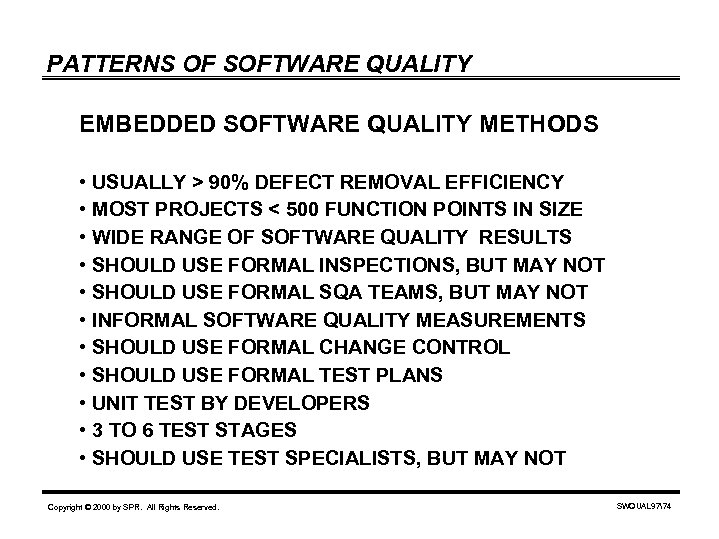 PATTERNS OF SOFTWARE QUALITY EMBEDDED SOFTWARE QUALITY METHODS • USUALLY > 90% DEFECT REMOVAL EFFICIENCY • MOST PROJECTS < 500 FUNCTION POINTS IN SIZE • WIDE RANGE OF SOFTWARE QUALITY RESULTS • SHOULD USE FORMAL INSPECTIONS, BUT MAY NOT • SHOULD USE FORMAL SQA TEAMS, BUT MAY NOT • INFORMAL SOFTWARE QUALITY MEASUREMENTS • SHOULD USE FORMAL CHANGE CONTROL • SHOULD USE FORMAL TEST PLANS • UNIT TEST BY DEVELOPERS • 3 TO 6 TEST STAGES • SHOULD USE TEST SPECIALISTS, BUT MAY NOT Copyright © 2000 by SPR. All Rights Reserved. SWQUAL 9774
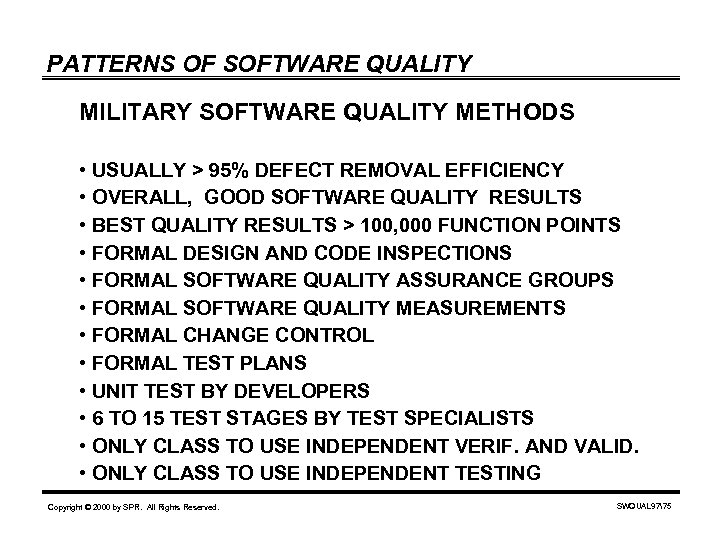 PATTERNS OF SOFTWARE QUALITY MILITARY SOFTWARE QUALITY METHODS • USUALLY > 95% DEFECT REMOVAL EFFICIENCY • OVERALL, GOOD SOFTWARE QUALITY RESULTS • BEST QUALITY RESULTS > 100, 000 FUNCTION POINTS • FORMAL DESIGN AND CODE INSPECTIONS • FORMAL SOFTWARE QUALITY ASSURANCE GROUPS • FORMAL SOFTWARE QUALITY MEASUREMENTS • FORMAL CHANGE CONTROL • FORMAL TEST PLANS • UNIT TEST BY DEVELOPERS • 6 TO 15 TEST STAGES BY TEST SPECIALISTS • ONLY CLASS TO USE INDEPENDENT VERIF. AND VALID. • ONLY CLASS TO USE INDEPENDENT TESTING Copyright © 2000 by SPR. All Rights Reserved. SWQUAL 9775
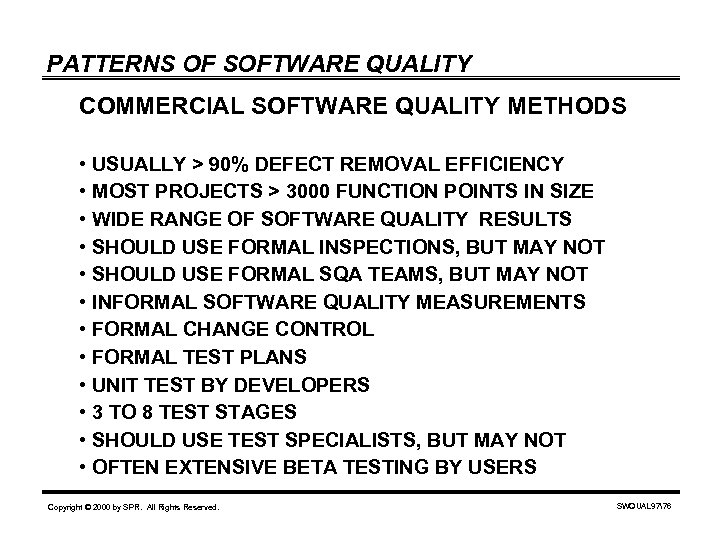 PATTERNS OF SOFTWARE QUALITY COMMERCIAL SOFTWARE QUALITY METHODS • USUALLY > 90% DEFECT REMOVAL EFFICIENCY • MOST PROJECTS > 3000 FUNCTION POINTS IN SIZE • WIDE RANGE OF SOFTWARE QUALITY RESULTS • SHOULD USE FORMAL INSPECTIONS, BUT MAY NOT • SHOULD USE FORMAL SQA TEAMS, BUT MAY NOT • INFORMAL SOFTWARE QUALITY MEASUREMENTS • FORMAL CHANGE CONTROL • FORMAL TEST PLANS • UNIT TEST BY DEVELOPERS • 3 TO 8 TEST STAGES • SHOULD USE TEST SPECIALISTS, BUT MAY NOT • OFTEN EXTENSIVE BETA TESTING BY USERS Copyright © 2000 by SPR. All Rights Reserved. SWQUAL 9776
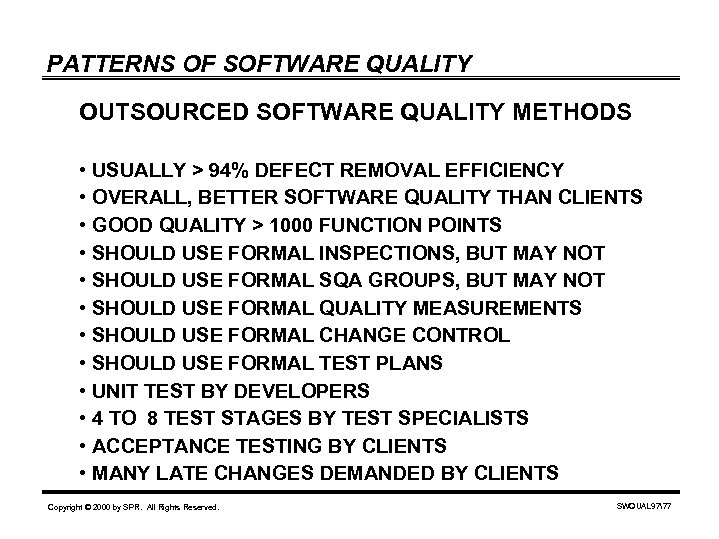 PATTERNS OF SOFTWARE QUALITY OUTSOURCED SOFTWARE QUALITY METHODS • USUALLY > 94% DEFECT REMOVAL EFFICIENCY • OVERALL, BETTER SOFTWARE QUALITY THAN CLIENTS • GOOD QUALITY > 1000 FUNCTION POINTS • SHOULD USE FORMAL INSPECTIONS, BUT MAY NOT • SHOULD USE FORMAL SQA GROUPS, BUT MAY NOT • SHOULD USE FORMAL QUALITY MEASUREMENTS • SHOULD USE FORMAL CHANGE CONTROL • SHOULD USE FORMAL TEST PLANS • UNIT TEST BY DEVELOPERS • 4 TO 8 TEST STAGES BY TEST SPECIALISTS • ACCEPTANCE TESTING BY CLIENTS • MANY LATE CHANGES DEMANDED BY CLIENTS Copyright © 2000 by SPR. All Rights Reserved. SWQUAL 9777
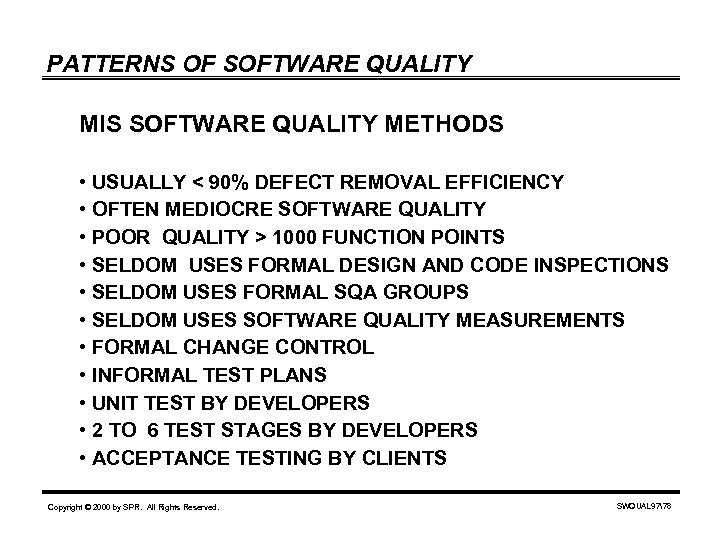 PATTERNS OF SOFTWARE QUALITY MIS SOFTWARE QUALITY METHODS • USUALLY < 90% DEFECT REMOVAL EFFICIENCY • OFTEN MEDIOCRE SOFTWARE QUALITY • POOR QUALITY > 1000 FUNCTION POINTS • SELDOM USES FORMAL DESIGN AND CODE INSPECTIONS • SELDOM USES FORMAL SQA GROUPS • SELDOM USES SOFTWARE QUALITY MEASUREMENTS • FORMAL CHANGE CONTROL • INFORMAL TEST PLANS • UNIT TEST BY DEVELOPERS • 2 TO 6 TEST STAGES BY DEVELOPERS • ACCEPTANCE TESTING BY CLIENTS Copyright © 2000 by SPR. All Rights Reserved. SWQUAL 9778
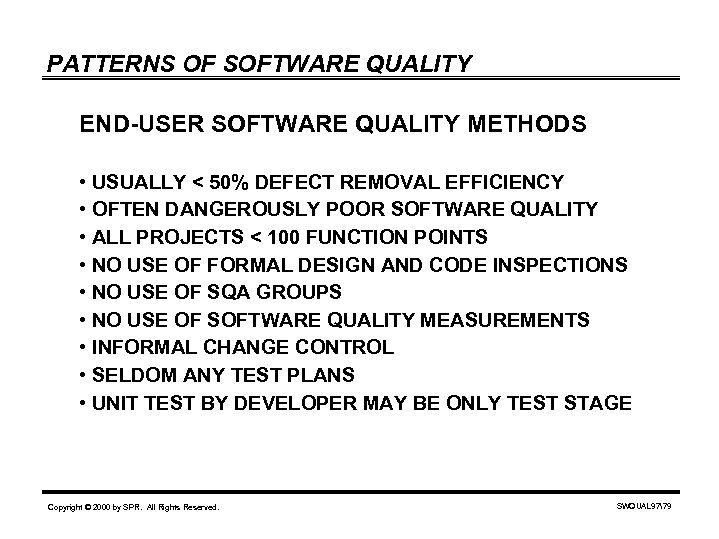 PATTERNS OF SOFTWARE QUALITY END-USER SOFTWARE QUALITY METHODS • USUALLY < 50% DEFECT REMOVAL EFFICIENCY • OFTEN DANGEROUSLY POOR SOFTWARE QUALITY • ALL PROJECTS < 100 FUNCTION POINTS • NO USE OF FORMAL DESIGN AND CODE INSPECTIONS • NO USE OF SQA GROUPS • NO USE OF SOFTWARE QUALITY MEASUREMENTS • INFORMAL CHANGE CONTROL • SELDOM ANY TEST PLANS • UNIT TEST BY DEVELOPER MAY BE ONLY TEST STAGE Copyright © 2000 by SPR. All Rights Reserved. SWQUAL 9779
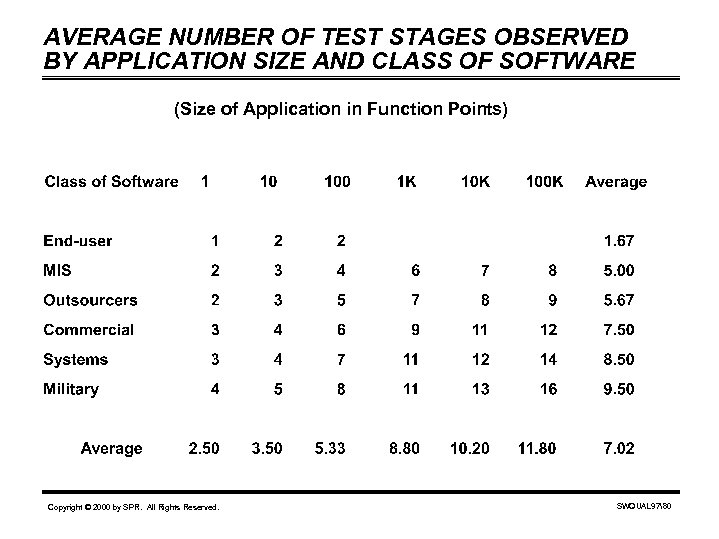 AVERAGE NUMBER OF TEST STAGES OBSERVED BY APPLICATION SIZE AND CLASS OF SOFTWARE (Size of Application in Function Points) Copyright © 2000 by SPR. All Rights Reserved. SWQUAL 9780
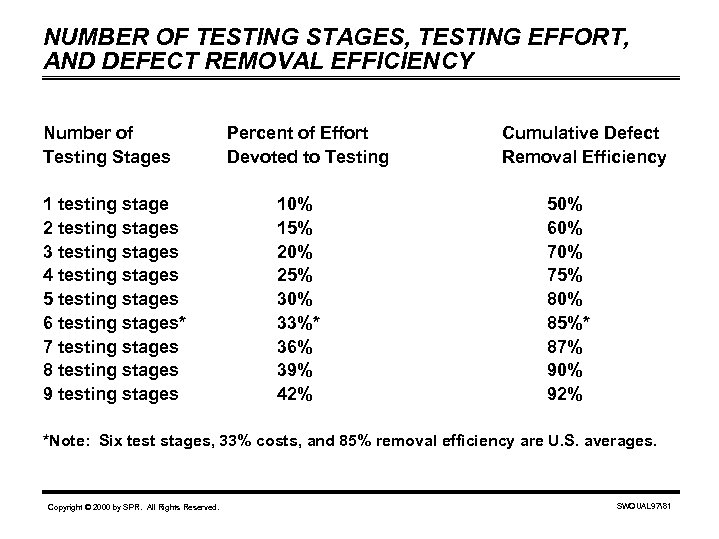 NUMBER OF TESTING STAGES, TESTING EFFORT, AND DEFECT REMOVAL EFFICIENCY Number of Testing Stages 1 testing stage 2 testing stages 3 testing stages 4 testing stages 5 testing stages 6 testing stages* 7 testing stages 8 testing stages 9 testing stages Percent of Effort Devoted to Testing 10% 15% 20% 25% 30% 33%* 36% 39% 42% Cumulative Defect Removal Efficiency 50% 60% 75% 80% 85%* 87% 90% 92% *Note: Six test stages, 33% costs, and 85% removal efficiency are U. S. averages. Copyright © 2000 by SPR. All Rights Reserved. SWQUAL 9781
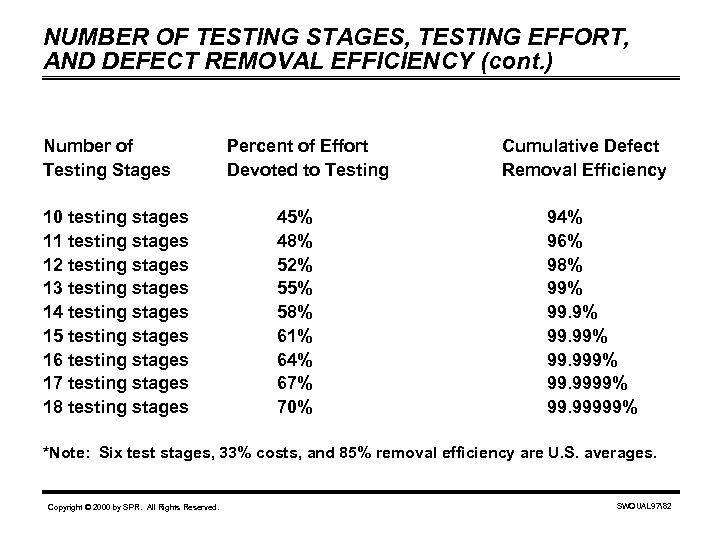 NUMBER OF TESTING STAGES, TESTING EFFORT, AND DEFECT REMOVAL EFFICIENCY (cont. ) Number of Testing Stages 10 testing stages 11 testing stages 12 testing stages 13 testing stages 14 testing stages 15 testing stages 16 testing stages 17 testing stages 18 testing stages Percent of Effort Devoted to Testing 45% 48% 52% 55% 58% 61% 64% 67% 70% Cumulative Defect Removal Efficiency 94% 96% 98% 99. 9% 99. 999% 99. 99999% *Note: Six test stages, 33% costs, and 85% removal efficiency are U. S. averages. Copyright © 2000 by SPR. All Rights Reserved. SWQUAL 9782
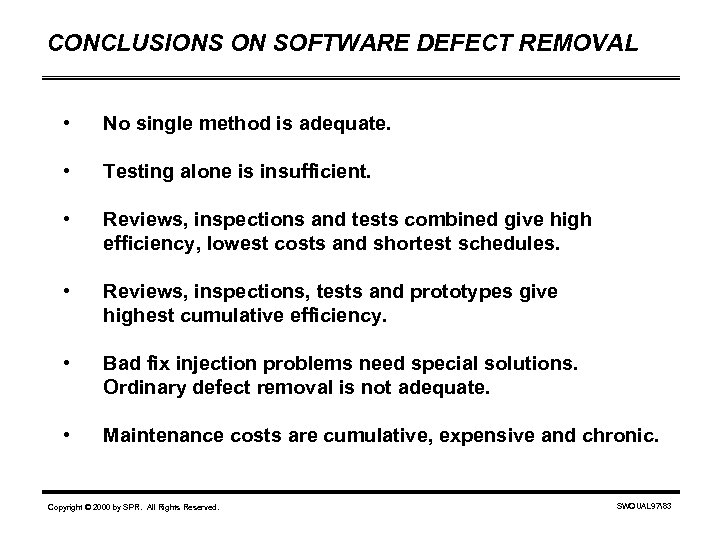 CONCLUSIONS ON SOFTWARE DEFECT REMOVAL • No single method is adequate. • Testing alone is insufficient. • Reviews, inspections and tests combined give high efficiency, lowest costs and shortest schedules. • Reviews, inspections, tests and prototypes give highest cumulative efficiency. • Bad fix injection problems need special solutions. Ordinary defect removal is not adequate. • Maintenance costs are cumulative, expensive and chronic. Copyright © 2000 by SPR. All Rights Reserved. SWQUAL 9783