


 Скачать презентацию Software Maintenance and Evolution Overview Jeff Offutt SWE
116318688b26b7a54b06ab2aaba5cb79.ppt
- Количество слайдов: 46
 Software Maintenance and Evolution Overview Jeff Offutt SWE 437 George Mason University 2008 Thanks to Ian Sommerville, Susan Eisenbach, Jeff Lei, Hausi A. Müller, Oscar Nierstrasz, and Hiern Variava
 Software Maintenance “When the transition from development to evolution is not seamless, the process of changing the software after delivery is often called software maintenance” – Sommerville, 2004 • Modifying a program after it has been put into use • Maintenance does not normally involve major changes to the system’s architecture • Changes are implemented by modifying existing components and adding new components to the system • Maintenance requires program understanding SWE 437 - Software Testing and Maintenance © Jeff Offutt 2
 Importance of Maintenance • Organizations have huge investments in their software systems they are critical business assets • To maintain the value of these assets to the business, they must be changed and updated • The majority of the software budget in large companies is devoted to modifying existing software rather than developing new software SWE 437 - Software Testing and Maintenance © Jeff Offutt 3
 What is Software Maintenance ? • “A program that is used undergoes continual change or it becomes progressively less useful” – Manny Lehman • Software maintenance is the modification of a software product after delivery to correct faults, to improve performance or other attributes, or to adapt the product to a changed environment. – IEEE definition 1983 • Average system takes 1 -2 years to write and is in operation 5 -6 years – Most software development is maintenance SWE 437 - Software Testing and Maintenance © Jeff Offutt 4
 Software Changes are Inevitable • We cannot avoid changing software – – – New requirements emerge when the software is used The business environment changes Faults must be repaired New computers and equipment is added to the system The performance or reliability of the system may have to be improved • Software is tightly coupled with the environment – When software is installed in an environment it changes that environment and therefore changes the software requirements • A key problem for organizations is implementing and managing change to their existing software systems SWE 437 - Software Testing and Maintenance © Jeff Offutt 5
 Management Myths • Myth: We already have a book that’s full of standards and procedures for building software, won’t that provide my people with everything they need to know? – Reality: The book of standards may very well exist, but is it used? In many cases, the answer to the following questions is “no” • Are software practitioners aware of its existence? • Does it reflect modern software engineering practice? • Is it complete? • Is it streamlined to improve time to delivery while still maintaining a focus on quality? • Myth: If we get behind schedule, we can add more programmers and catch up – Reality: Software development is not a mechanistic process like manufacturing. In the words of Brooks: “adding people to a late software project makes it later” • Myth: If I decide to outsource the software project to a third party, I can just relax and let that firm build it – Reality: If an organization does not understand how to manage and control software projects internally, it will invariably struggle when it outsources software projects SWE 437 - Software Testing and Maintenance © Jeff Offutt 6
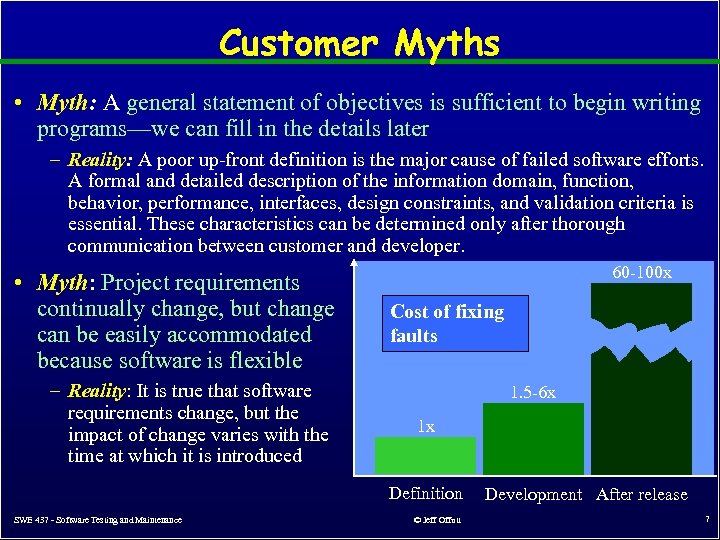 Customer Myths • Myth: A general statement of objectives is sufficient to begin writing programs—we can fill in the details later – Reality: A poor up-front definition is the major cause of failed software efforts. A formal and detailed description of the information domain, function, behavior, performance, interfaces, design constraints, and validation criteria is essential. These characteristics can be determined only after thorough communication between customer and developer. • Myth: Project requirements continually change, but change can be easily accommodated because software is flexible – Reality: It is true that software requirements change, but the impact of change varies with the time at which it is introduced 60 -100 x Cost of fixing faults 1. 5 -6 x 1 x Definition SWE 437 - Software Testing and Maintenance © Jeff Offutt Development After release 7
 Practitioner’s Myths • Myth: Once we write the program and get it to work, our job is done – Reality: Someone once said that “the sooner you begin ‘writing code’, the longer it'll take you to get done. ” Industry data indicate that between 60 and 80 percent of all effort expended on software will be expended after it is delivered to the customer for the first time. • Myth: Until I get the program “running” I have no way of assessing its quality – Reality: One of the most effective software quality assurance mechanisms can be applied from the inception of a project—the formal technical review. Software reviews are more effective than testing for finding certain classes of software defects. • Myth: The only deliverable work product for a successful project is the working program – Reality: A working program is only one part of a software configuration that includes many elements. Documentation provides a foundation for successful engineering and, more important, guidance for software support. • Myth: Software engineering will make us create voluminous and unnecessary documentation and will invariably slow us down – Reality: Software engineering is not about creating documents. It is about creating quality. Better quality leads to reduced rework. And reduced rework results in faster delivery times. SWE 437 - Software Testing and Maintenance © Jeff Offutt 8
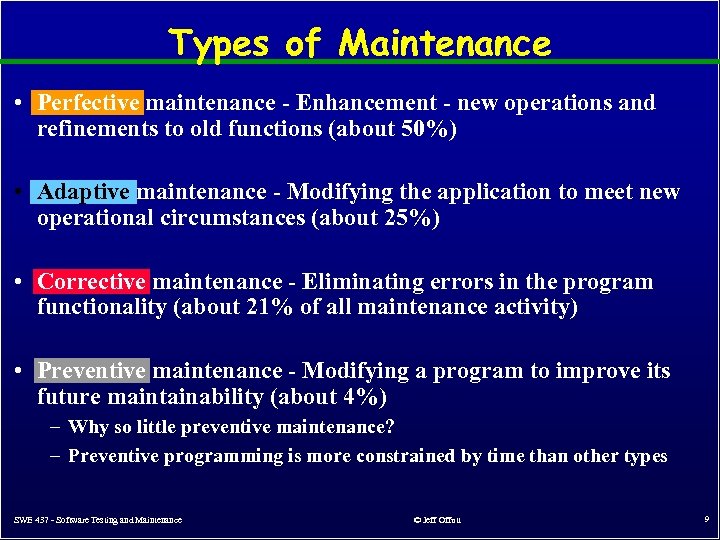 Types of Maintenance • Perfective maintenance - Enhancement - new operations and refinements to old functions (about 50%) • Adaptive maintenance - Modifying the application to meet new operational circumstances (about 25%) • Corrective maintenance - Eliminating errors in the program functionality (about 21% of all maintenance activity) • Preventive maintenance - Modifying a program to improve its future maintainability (about 4%) – Why so little preventive maintenance? – Preventive programming is more constrained by time than other types SWE 437 - Software Testing and Maintenance © Jeff Offutt 9
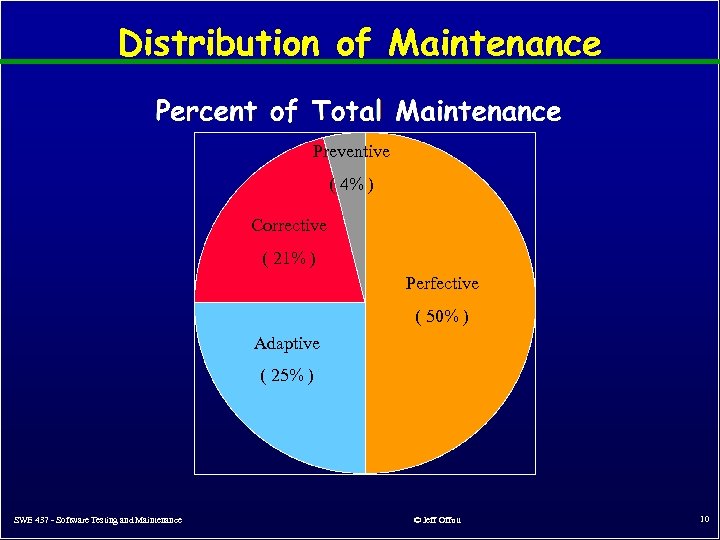 Distribution of Maintenance Preventive ( 4% ) Corrective ( 21% ) Perfective ( 50% ) Adaptive ( 25% ) SWE 437 - Software Testing and Maintenance © Jeff Offutt 10
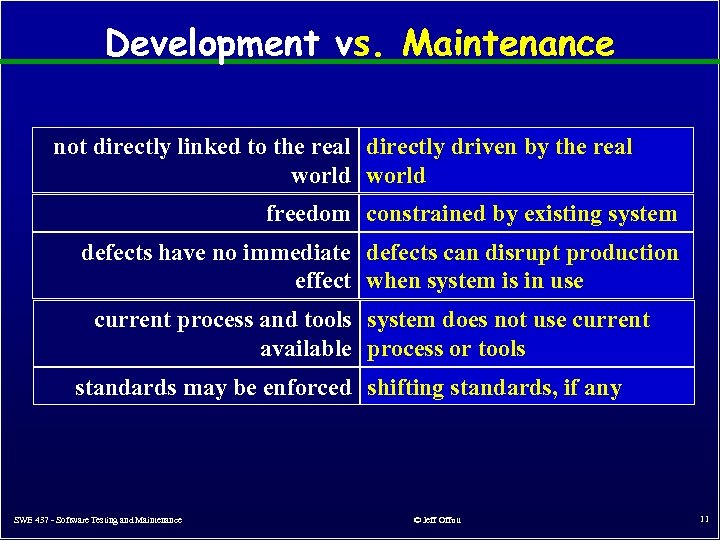 Development vs. Maintenance not directly linked to the real directly driven by the real world freedom constrained by existing system defects have no immediate defects can disrupt production effect when system is in use current process and tools system does not use current available process or tools standards may be enforced shifting standards, if any SWE 437 - Software Testing and Maintenance © Jeff Offutt 11
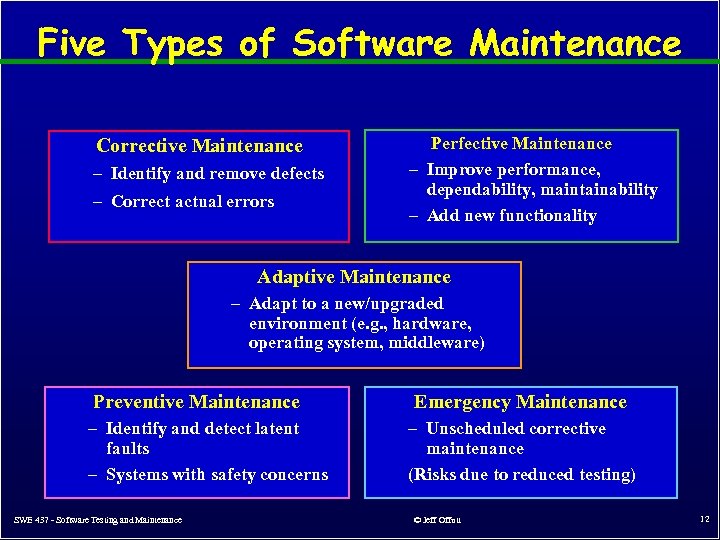 Five Types of Software Maintenance Corrective Maintenance – Identify and remove defects – Correct actual errors Perfective Maintenance – Improve performance, dependability, maintainability – Add new functionality Adaptive Maintenance – Adapt to a new/upgraded environment (e. g. , hardware, operating system, middleware) Preventive Maintenance – Identify and detect latent faults – Systems with safety concerns SWE 437 - Software Testing and Maintenance Emergency Maintenance – Unscheduled corrective maintenance (Risks due to reduced testing) © Jeff Offutt 12
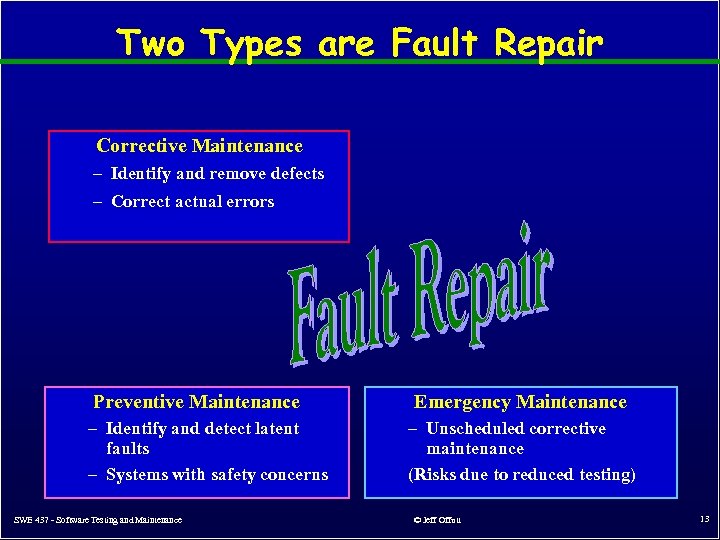 Two Types are Fault Repair Corrective Maintenance – Identify and remove defects – Correct actual errors Preventive Maintenance – Identify and detect latent faults – Systems with safety concerns SWE 437 - Software Testing and Maintenance Emergency Maintenance – Unscheduled corrective maintenance (Risks due to reduced testing) © Jeff Offutt 13
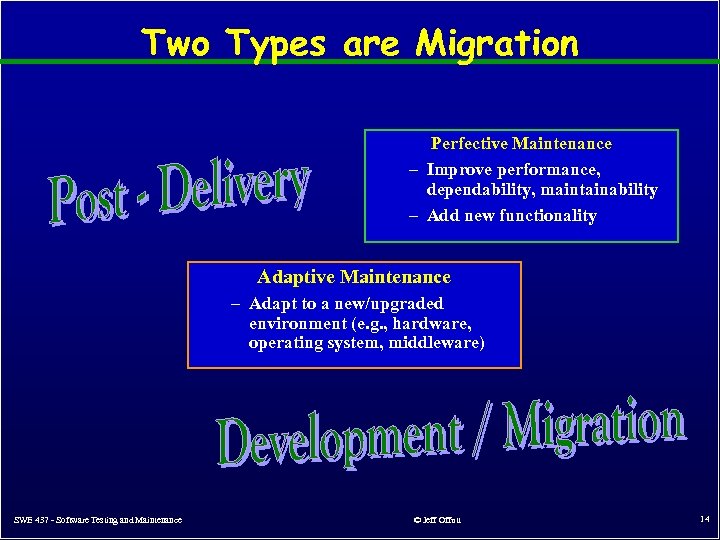 Two Types are Migration Perfective Maintenance – Improve performance, dependability, maintainability – Add new functionality Adaptive Maintenance – Adapt to a new/upgraded environment (e. g. , hardware, operating system, middleware) SWE 437 - Software Testing and Maintenance © Jeff Offutt 14
 Software Maintenance Problems • Most computer systems are difficult and expensive to maintain • Software changes are poorly designed and implemented • The repair and enhancement of software often injects new faults that must later be repaired SWE 437 - Software Testing and Maintenance © Jeff Offutt 15
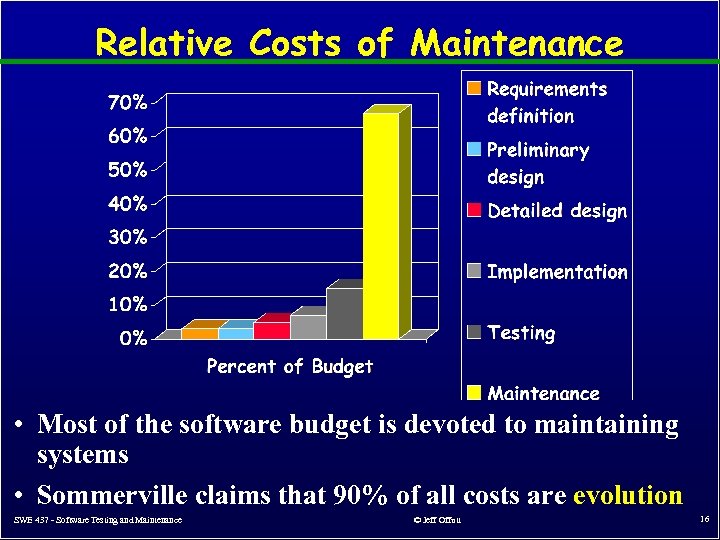 Relative Costs of Maintenance • Most of the software budget is devoted to maintaining systems • Sommerville claims that 90% of all costs are evolution SWE 437 - Software Testing and Maintenance © Jeff Offutt 16
 Maintenance Costs • Usually greater than development costs (2 – 100 times depending on the application) • Affected by both technical and non-technical factors • Increases as software is maintained – Maintenance corrupts the software structure, making further maintenance more difficult • Aging software can have high support costs (old languages, compilers etc. ) SWE 437 - Software Testing and Maintenance © Jeff Offutt 17
 Maintenance Cost Factors • Team stability – Maintenance costs are reduced if the same staff stay involved • Contractual responsibility – If the developers of a system may have no contractual responsibility for maintenance, there is no incentive to design for future change • Staff skills – Maintenance staff are often inexperienced and have limited domain knowledge • Program age and structure – As programs age, their structure is degraded and they become harder to understand change SWE 437 - Software Testing and Maintenance © Jeff Offutt 18
 Technical Aspects of Maintenance • • • SWE 437 - Software Testing and Maintenance Maintainability Impact Analysis Ripple Effect Traceability Legacy systems © Jeff Offutt 19
 Maintainability The ease with which a software system or component can be modified to correct faults, improve performance, or other attributes, or adapt to a changed environment [IEEE 90] SWE 437 - Software Testing and Maintenance © Jeff Offutt 20
 What Affects Maintainability ? • Application age : Older programs were probably worse written and have probably been patched more • Size : Measured in KLOC, number of input/output files • Programming language : Newer languages are supposed to yield more maintainable code than older languages • Processing environment : Files harder to maintain than databases, real-time harder than non-real-time • Analysis and design methodologies : Well designed software is supposed to be easier to maintain • Formatting and documentation : Well written source is easier to understand modify SWE 437 - Software Testing and Maintenance © Jeff Offutt 21
 What Affects Maintainability … ? • Modularization : Small reasonably self contained pieces of code should be easier to maintain – Motivating factor behind OO — data abstraction, information hiding, inheritance, etc. • Documentation generation : Maintenance of documentation is as expensive as maintenance of code • End-user involvement : Some researchers believe when end users are more involved maintenance is less needed • Maintenance management : Scheduling and the attitudes of management to affects productivity SWE 437 - Software Testing and Maintenance © Jeff Offutt 22
 Impact Analysis Helps to determine the cost of making a change • Translate the change from requirements to implementation to decide if it is viable or should be rejected • Determine the origin of the change and suggest solutions • All solutions be investigated to determine they can be applied to all software components • Make a decision on the best implementation route or to make no change SWE 437 - Software Testing and Maintenance © Jeff Offutt 23
 Ripple Effect Changes in one software location can impact other components • Ripple effects cannot be determined fully using static analysis of the source • Therefore dynamic analysis must be used – We have to run the program to understand … • Impact analysis is needed : – To ensure that the change has been correctly and consistently bounded – To identify all objects impacted by changes in the primary sector SWE 437 - Software Testing and Maintenance © Jeff Offutt 24
 Traceability The degree to which a relationship can be established between two or more products of the development process, especially products having a predecessor successor or master subordinate relationship to one another (IEEE 91) • Traceability provides semantic links for impact analysis • Some types of traceability links are very hard to determine SWE 437 - Software Testing and Maintenance © Jeff Offutt 25
 Legacy Systems A software system that is still in use but the development team is no longer active • A legacy system is a piece of software that : – Has been inherited – Is still valuable (or essential) • Very hard to change ! You can’t throw it away, but you can’t change it either ! SWE 437 - Software Testing and Maintenance © Jeff Offutt 26
 Legacy Systems • Typical characteristics of legacy systems : – – – – Very old and large Has been heavily modified Based on old technology No documentation available No original developers available Often support very large quantities of live data The software is often at the core of the business and replacing it would be a major expense • Maintenance has often become almost impossible • Dealing with legacy systems is hard but some options exist. . . SWE 437 - Software Testing and Maintenance © Jeff Offutt 27
 Legacy System Options • Keep using the old system, possibly subcontracting the maintenance • Replace software with a package • Re-implement from scratch • Discard software and discontinue • Freeze maintenance and bring in new system • Encapsulate the old system in a new external “wrapper” interface – “web-enabled legacy system” is one of the latest buzzwords – Patriot web is a classic example • Reverse engineer the legacy system and develop new software SWE 437 - Software Testing and Maintenance © Jeff Offutt 28
 Maintenance Terminology (Perfective) • Reverse engineering : The process of transforming from source to a more abstract version of the product – Used forward engineering new systems and maintenance – 60% of maintenance time spent understanding code • Restructuring : The process of transforming a product to another product at the same level of abstraction – Improving the structure and documentation – Changing variable definitions and scope • Design Recovery : A particular type of reverse engineering where a design for the system (with a connection to real-world requirements) is created • Re-engineering : Reverse engineering followed by forward engineering adhering to good practice SWE 437 - Software Testing and Maintenance © Jeff Offutt 29
 Software Reverse Engineering • A two-step process 1. 2. Information extraction Information abstraction • A three-step process 1. 2. 3. Information gathering Knowledge organization Information navigation, analysis, and presentation • Analyzing subject system – to identify its current components and their dependencies – to extract and create system abstractions and design information • The subject system is not altered; however, additional knowledge about the system is produced SWE 437 - Software Testing and Maintenance © Jeff Offutt 30
 Software Reverse Engineering. . . • Feedback loops in life cycle models (e. g. , waterfall or spiral model) are opportunities for reverse engineering • Related terms – – – Abstraction and composition Design recovery and concept assignment Re-documentation Inverse engineering Static and dynamic analysis Summarizing resource flows and software structures Change and impact analysis Maintainability analysis Migration analysis Portfolio analysis Economic analysis SWE 437 - Software Testing and Maintenance © Jeff Offutt 31
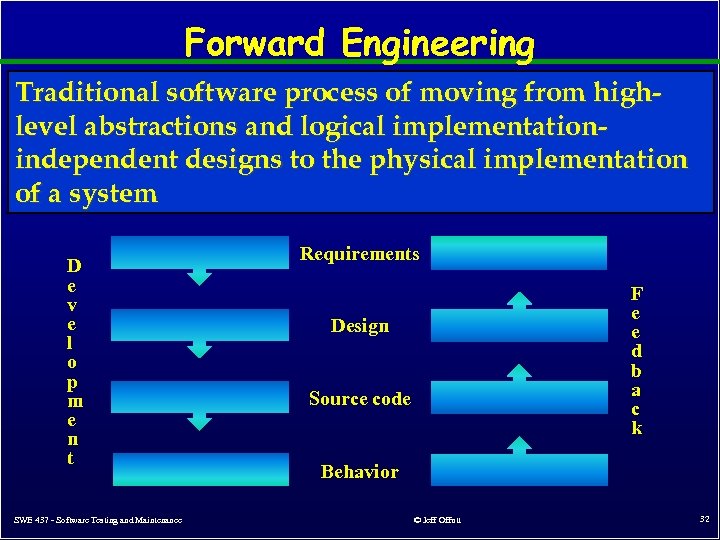 Forward Engineering Traditional software process of moving from highlevel abstractions and logical implementationindependent designs to the physical implementation of a system D e v e l o p m e n t SWE 437 - Software Testing and Maintenance Requirements F e e d b a c k Design Source code Behavior © Jeff Offutt 32
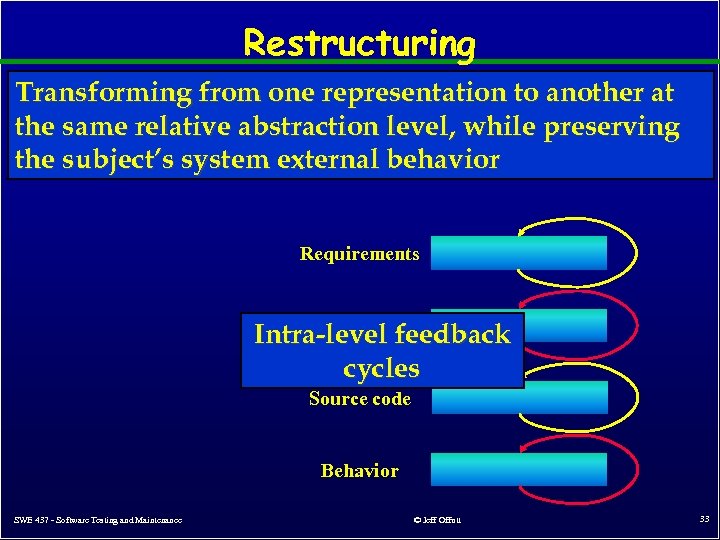 Restructuring Transforming from one representation to another at the same relative abstraction level, while preserving the subject’s system external behavior Requirements Design Intra-level feedback cycles Source code Behavior SWE 437 - Software Testing and Maintenance © Jeff Offutt 33
 Reengineering Categories • • Automatic restructuring Automatic transformation Semi-automatic transformation Design recovery and reimplementation Code reverse engineering and forward engineering Data reverse engineering and schema migration Migration of legacy systems to modern platforms SWE 437 - Software Testing and Maintenance © Jeff Offutt 34
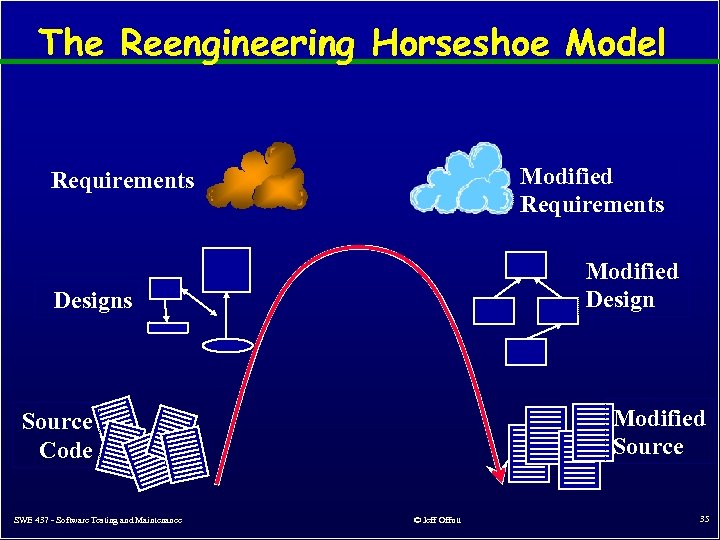 The Reengineering Horseshoe Model Modified Requirements Modified Designs Modified Source Code SWE 437 - Software Testing and Maintenance © Jeff Offutt 35
 Reengineering Categories. . . • Automatic restructuring – To obtain more readable source code – Enforce coding standards • Automatic transformation – – To obtain better source code Web-enabling of source code Simplify control flow (e. g. , dead code, gotos) Refactoring and re-modularizing • Semi-automatic transformation – To obtain better engineered system (e. g. , re-architect code and data) – Semi-automatic construction of structural, functional, and behavioral abstractions – Re-architecting or re-implementing the subject system from these abstractions SWE 437 - Software Testing and Maintenance © Jeff Offutt 36
 !! Reality Check !! Sorry to say, but … All of the previous information comes from publications in the 1990 s … Based on knowledge from the 1980 s … When our software was “single-building size” ! How out-of-date is this information for building integrated collections of continuously evolving cities ? ? (that is … 2008) SWE 437 - Software Testing and Maintenance © Jeff Offutt Very !! 37
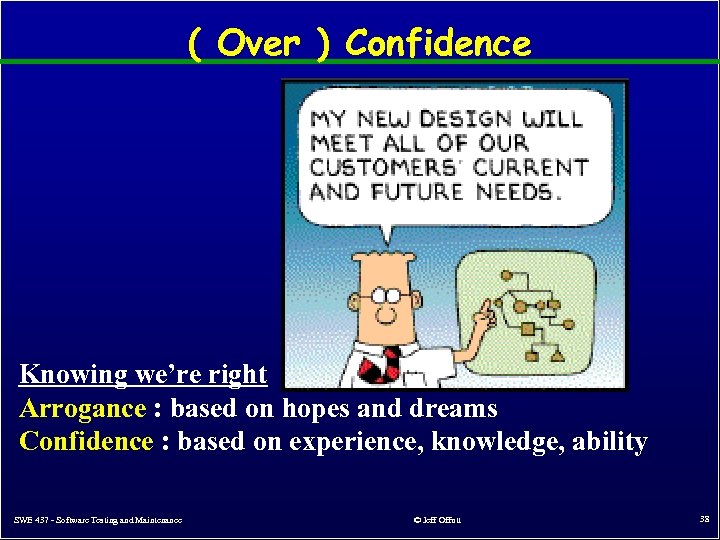 ( Over ) Confidence Knowing we’re right Arrogance : based on hopes and dreams Confidence : based on experience, knowledge, ability SWE 437 - Software Testing and Maintenance © Jeff Offutt 38
 Maintenance & Evolution • Software Maintenance – consists of the activities required to keep a software system operational and responsive after it is accepted and placed into production • Software Evolution – a continuous change from a lesser, simpler, or worse state to a higher or better state SWE 437 - Software Testing and Maintenance © Jeff Offutt 39
 Premise for 2000 s • Like death and taxes, software evolution is inevitable • Unfortunately, software evolution is still poorly understood and supported • We need techniques and tools to facilitate graceful software evolution SWE 437 - Software Testing and Maintenance © Jeff Offutt 40
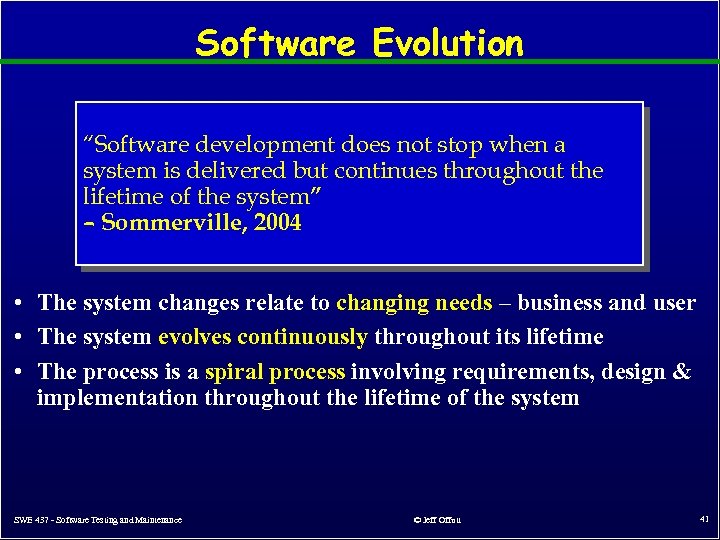 Software Evolution “Software development does not stop when a system is delivered but continues throughout the lifetime of the system” – Sommerville, 2004 • The system changes relate to changing needs – business and user • The system evolves continuously throughout its lifetime • The process is a spiral process involving requirements, design & implementation throughout the lifetime of the system SWE 437 - Software Testing and Maintenance © Jeff Offutt 41
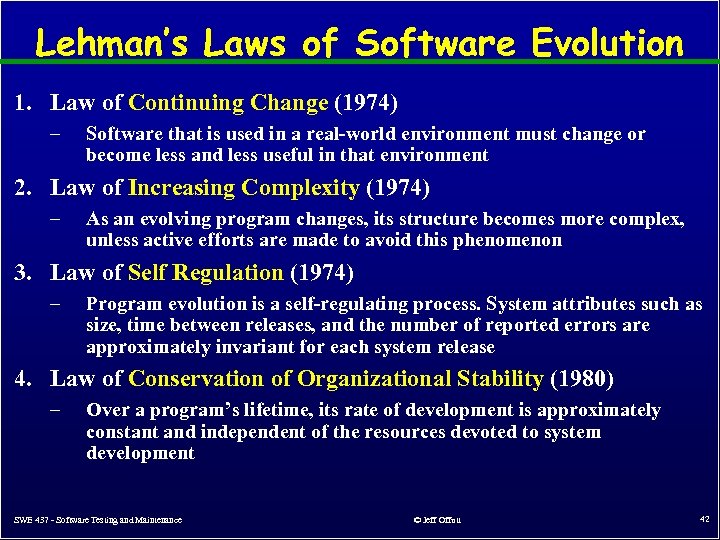 Lehman’s Laws of Software Evolution 1. Law of Continuing Change (1974) – Software that is used in a real-world environment must change or become less and less useful in that environment 2. Law of Increasing Complexity (1974) – As an evolving program changes, its structure becomes more complex, unless active efforts are made to avoid this phenomenon 3. Law of Self Regulation (1974) – Program evolution is a self-regulating process. System attributes such as size, time between releases, and the number of reported errors are approximately invariant for each system release 4. Law of Conservation of Organizational Stability (1980) – Over a program’s lifetime, its rate of development is approximately constant and independent of the resources devoted to system development SWE 437 - Software Testing and Maintenance © Jeff Offutt 42
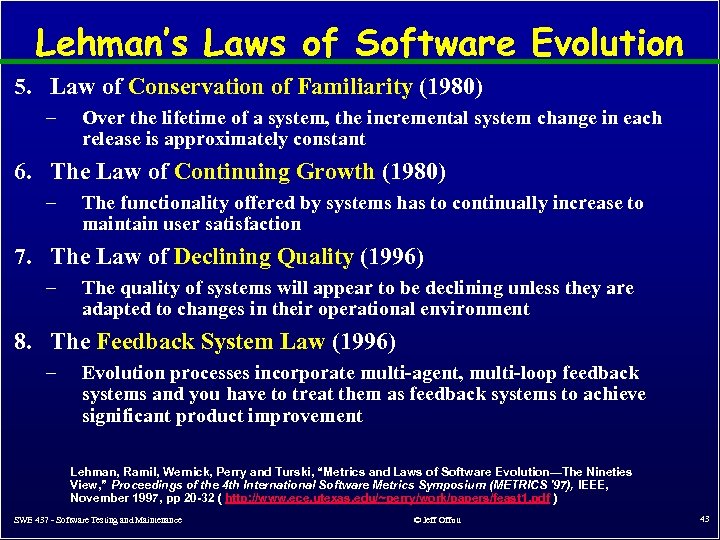 Lehman’s Laws of Software Evolution 5. Law of Conservation of Familiarity (1980) – Over the lifetime of a system, the incremental system change in each release is approximately constant 6. The Law of Continuing Growth (1980) – The functionality offered by systems has to continually increase to maintain user satisfaction 7. The Law of Declining Quality (1996) – The quality of systems will appear to be declining unless they are adapted to changes in their operational environment 8. The Feedback System Law (1996) – Evolution processes incorporate multi-agent, multi-loop feedback systems and you have to treat them as feedback systems to achieve significant product improvement Lehman, Ramil, Wernick, Perry and Turski, “Metrics and Laws of Software Evolution—The Nineties View, ” Proceedings of the 4 th International Software Metrics Symposium (METRICS '97), IEEE, November 1997, pp 20 -32 ( http: //www. ece. utexas. edu/~perry/work/papers/feast 1. pdf ) SWE 437 - Software Testing and Maintenance © Jeff Offutt 43
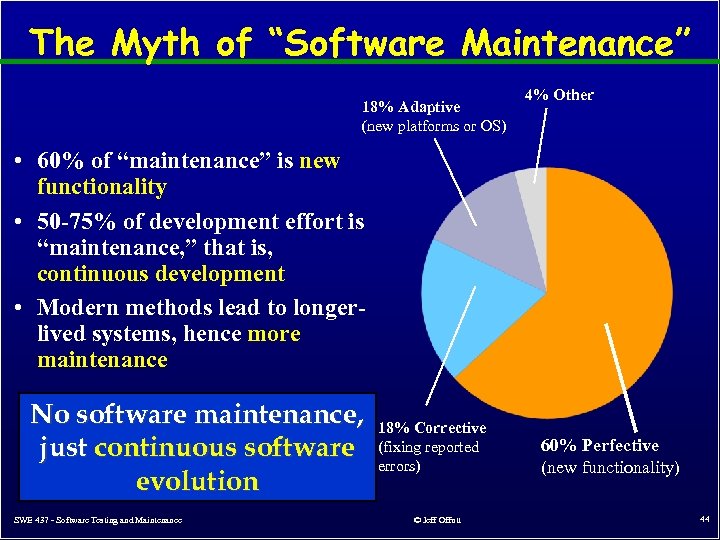 The Myth of “Software Maintenance” 18% Adaptive (new platforms or OS) 4% Other • 60% of “maintenance” is new functionality • 50 -75% of development effort is “maintenance, ” that is, continuous development • Modern methods lead to longerlived systems, hence more maintenance No software maintenance, just continuous software evolution SWE 437 - Software Testing and Maintenance 18% Corrective (fixing reported errors) © Jeff Offutt 60% Perfective (new functionality) 44
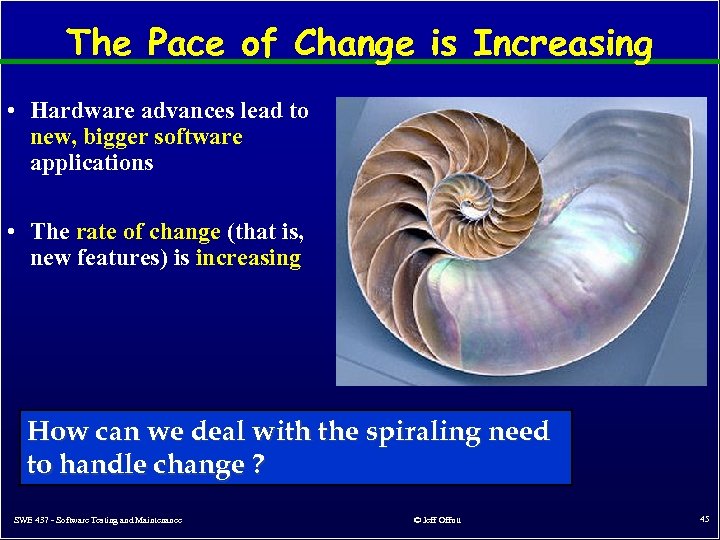 The Pace of Change is Increasing • Hardware advances lead to new, bigger software applications • The rate of change (that is, new features) is increasing How can we deal with the spiraling need to handle change ? SWE 437 - Software Testing and Maintenance © Jeff Offutt 45
 SWE 437 We will discuss specific ways to deal with this problem over the next few weeks