


 Скачать презентацию Software Engineering Chapter 1 Introduction Ku-Yaw Chang canseco mail
4bdb17238693ab62c8afca673df5b70d.ppt
- Количество слайдов: 34
 Software Engineering Chapter 1 Introduction Ku-Yaw Chang canseco@mail. dyu. edu. tw Assistant Professor Department of Computer Science and Information Engineering Da-Yeh University Ku-Yaw Chang Software Engineering
 Objectives Understand what software engineering is and why it is important Know the answers to key questions that provide an introduction to software engineering Understand some ethical and professional issues that are important for software engineers Ku-Yaw Chang Software Engineering 2
 Preamble Software engineering n n The economies of all developed nations are dependent on software More and more systems are software controlled Software engineering is concerned with theories, methods and tools for professional software development Expenditure on software represents a significant fraction of GNP in all developed countries Ku-Yaw Chang Software Engineering 3
 Preamble Software cost n Often dominate computer system costs The costs of software on a PC are often greater than the hardware cost n Software costs more to maintain than it does to develop For systems with a long life, maintenance costs may be several times development costs Software engineering is concerned with costeffective software development. Ku-Yaw Chang Software Engineering 4
 Contents 1. 1 FAQs about software engineering 1. 2 Professional and ethical responsibility 1. 3 Exercises Ku-Yaw Chang Software Engineering 5
 1. 1 FAQs about software engineering 1. What is software? 2. What is software engineering? 3. What is the difference between software engineering and computer science? 4. What is the difference between software engineering and system engineering? 5. What is a software process? 6. What is a software process model? Ku-Yaw Chang Software Engineering 6
 1. 1 FAQs about software engineering 7. What are the costs of software engineering? 8. What are software engineering methods? 9. What is CASE (Computer-Aided Software Engineering)? 10. What are the attributes of good software? 11. What are the key challenges facing software engineering? Ku-Yaw Chang Software Engineering 7
 1. 1. 1 What is software? Computer programs and associated documentation such as requirements, design models and user manuals. Software products may be developed for a particular customer or may be developed for a general market. Software products may be n n Generic - developed to be sold to a range of different customers e. g. PC software such as Excel or Word. Customized (Bespoke) - developed for a single customer according to their specification. New software can be created by developing new programs, configuring generic software systems or reusing existing software. FAQs Ku-Yaw Chang Software Engineering 8
 1. 1. 2 What is software engineering? An engineering discipline that is concerned with all aspects of software production from the early stages of system specification to maintaining the system after it has gone into use. n Engineering discipline Apply theories, methods and tools to discover solutions Work to organizational and financial constraints n All aspects of software production Technical processes Project management Developments of tools, methods and theories FAQs Ku-Yaw Chang Software Engineering 9
 1. 1. 3 What is the difference between software engineering and computer science? Computer science n Be concerned with theories and methods that underlie computers and software systems Software engineering n Be concerned with the practical problems of producing software Ø Computer science theories are still insufficient to act as a complete underpinning for software engineering (unlike e. g. physics and electrical engineering). FAQs Ku-Yaw Chang Software Engineering 10
 1. 1. 4 What is the difference between software engineering and system engineering? System engineering n Be concerned with all aspects of computer-based systems development including hardware, software and process engineering Software engineering n Be concerned with developing the software infrastructure, control, applications and databases in the system. part of system engineering Ø System engineers are involved in system specification, architectural design, integration and deployment. FAQs Ku-Yaw Chang Software Engineering 11
 1. 1. 5 What is a software process? A set of activities and associated results that produce a software product Generic activities in all software processes are: n n Specification - what the system should do and its development constraints Development - production of the software system Validation - checking that the software is what the customer wants Evolution - changing the software in response to changing demands FAQs Ku-Yaw Chang Software Engineering 12
 1. 1. 6 What is a software process model? A simplified representation of a software process, presented from a specific perspective Examples of process perspectives are n Workflow perspective Sequence of activities; human actions n Dataflow perspective A set of activities carrying out data transformation By people or computers n Role/action perspective Who does what Generic process models n n n Waterfall approach Iterative development Component-based software engineering (CBSE) FAQs Ku-Yaw Chang Software Engineering 13
 1. 1. 7 What are the costs of software engineering? Roughly 60% of costs are development costs, 40% are testing costs. n For custom software, evolution costs often exceed development costs. Costs vary depending on the type of system being developed and the requirements of system attributes such as performance and system reliability. Distribution of costs depends on the development model that is used. Ku-Yaw Chang Software Engineering 14
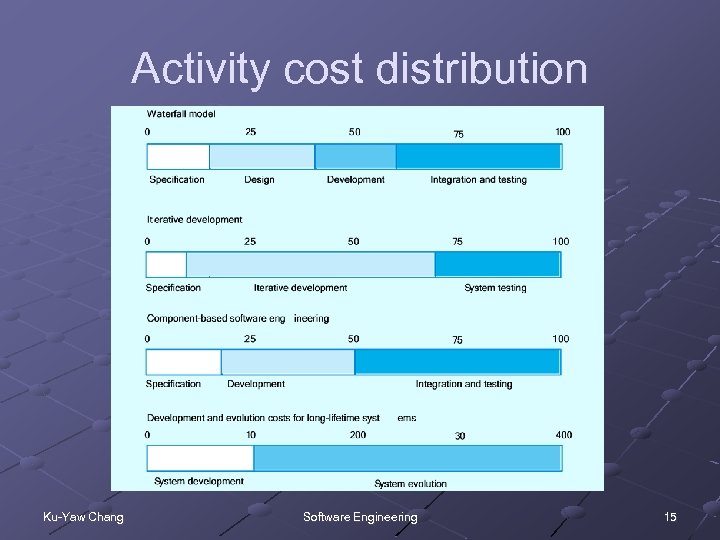 Activity cost distribution Ku-Yaw Chang Software Engineering 15
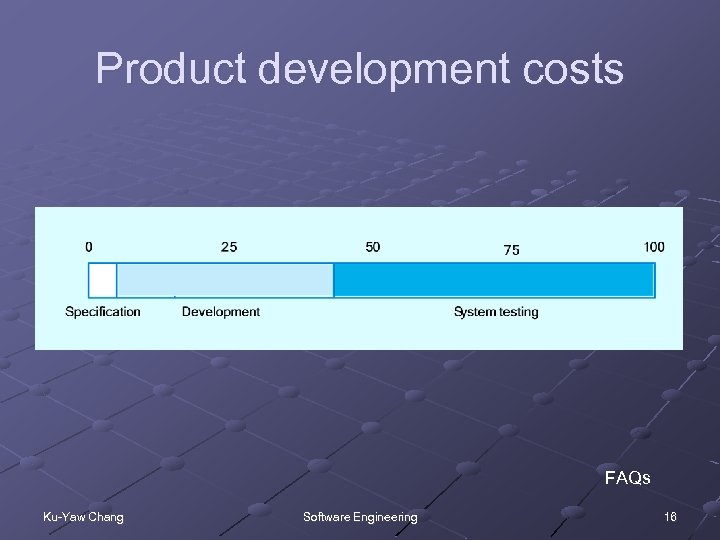 Product development costs FAQs Ku-Yaw Chang Software Engineering 16
 1. 1. 8 What are software engineering methods? Structured approaches to software development n To facilitate the production of high-quality software in a costeffective way Examples n Function-Oriented Structured Analysis (De. Marco, 1978) JSD (Jackson, 1983) n Object-Oriented Unified Approach built around the Unified Modeling Language (UML) n Integrating Booch (Booch, 1994) and Rmbaugh (Rambaugh, 1991) No ideal method n Different methods are applicable to different areas OO methods are not suitable for real-time requirements Ku-Yaw Chang Software Engineering 17
 1. 1. 8 What are software engineering methods? Method components n Model descriptions Descriptions of graphical models which should be produced e. g. object models, data-flow models n Rules Constraints applied to system models e. g. Entity must have a unique name. n Recommendations Advice on good design practice e. g. No more than seven sub-objects associated with it. n Process guidance What activities to follow e. g. Document attributes before defining the operations. FAQs Ku-Yaw Chang Software Engineering 18
 1. 1. 9 What is CASE? CASE: Computer Aided Software Engineering n n Software systems that are intended to provide automated support for software process activities Often used for method support Upper-CASE n Tools to support the early process activities of requirements and design Lower-CASE n Tools to support later activities such as programming, debugging and testing FAQs Ku-Yaw Chang Software Engineering 19
 1. 1. 10 What are the attributes of good software? Software products n n Services (functional) Other attributes reflecting its quality (non-functional) e. g. response time, understandability of the code A special set of attributes depends on its application A banking system must be secure An interactive game must be responsive A telephone switching system must be reliable Ku-Yaw Chang Software Engineering 20
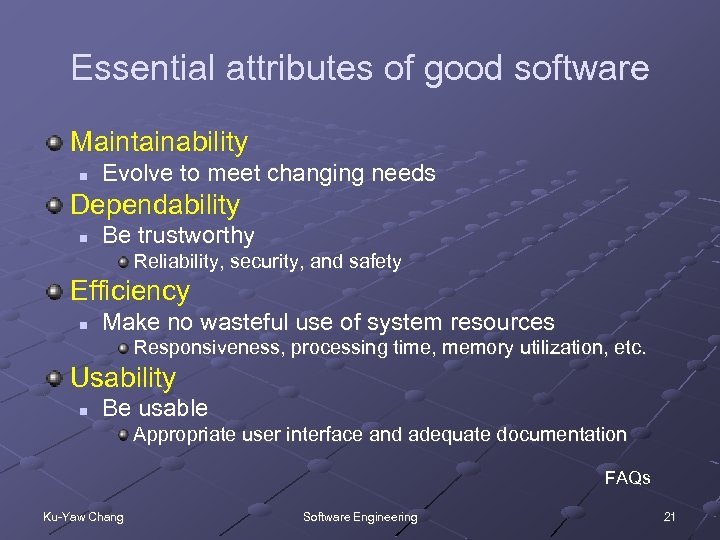 Essential attributes of good software Maintainability n Evolve to meet changing needs Dependability n Be trustworthy Reliability, security, and safety Efficiency n Make no wasteful use of system resources Responsiveness, processing time, memory utilization, etc. Usability n Be usable Appropriate user interface and adequate documentation FAQs Ku-Yaw Chang Software Engineering 21
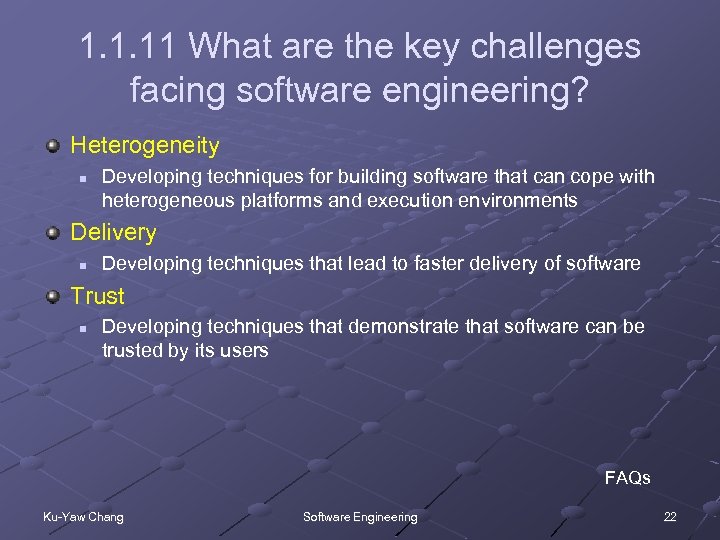 1. 1. 11 What are the key challenges facing software engineering? Heterogeneity n Developing techniques for building software that can cope with heterogeneous platforms and execution environments Delivery n Developing techniques that lead to faster delivery of software Trust n Developing techniques that demonstrate that software can be trusted by its users FAQs Ku-Yaw Chang Software Engineering 22
 Contents 1. 1 FAQs about software engineering 1. 2 Professional and ethical responsibility 1. 3 Exercises Ku-Yaw Chang Software Engineering 23
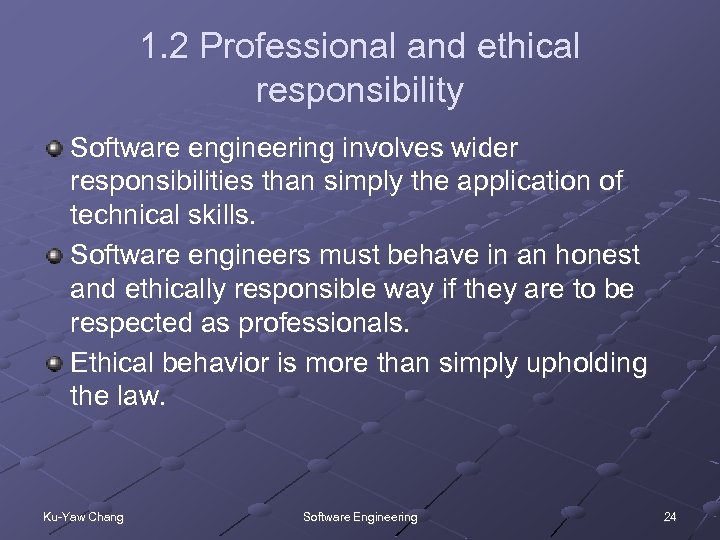 1. 2 Professional and ethical responsibility Software engineering involves wider responsibilities than simply the application of technical skills. Software engineers must behave in an honest and ethically responsible way if they are to be respected as professionals. Ethical behavior is more than simply upholding the law. Ku-Yaw Chang Software Engineering 24
 Issues of professional responsibility (I) Confidentiality n Engineers should normally respect the confidentiality of their employers or clients irrespective of whether or not a formal confidentiality agreement has been signed. Competence n Engineers should not misrepresent their level of competence. They should not knowingly accept work which is outside their competence. Ku-Yaw Chang Software Engineering 25
 Issues of professional responsibility (II) Intellectual property rights n Engineers should be aware of local laws governing the use of intellectual property such as patents, copyright, etc. They should be careful to ensure that the intellectual property of employers and clients is protected. Computer misuse n Software engineers should not use their technical skills to misuse other people’s computers. Computer misuse ranges from relatively trivial (game playing on an employer’s machine, say) to extremely serious (dissemination of viruses). Ku-Yaw Chang Software Engineering 26
 Code of Ethics The professional societies have cooperated to produce a code of ethical practice. n n n ACM IEEE (Institute of Electrical and Electronic Engineers) British Computer Society Members of these organizations sign up to the code of practice when they join. The Code contains eight Principles related to the behavior of and decisions made by professional software engineers, including practitioners, educators, managers, supervisors and policy makers, as well as trainees and students of the profession. Ku-Yaw Chang Software Engineering 27
 Eight principles (I) PUBLIC n Software engineers shall act consistently with the public interest. CLIENT AND EMPLOYER n Software engineers shall act in a manner that is in the best interests of their client and employer consistent with the public interest. PRODUCT n Software engineers shall ensure that their products and related modifications meet the highest professional standards possible. Ku-Yaw Chang Software Engineering 28
 Eight principles (II) JUDGMENT n Software engineers shall maintain integrity and independence in their professional judgment. MANAGEMENT n Software engineering managers and leaders shall subscribe to and promote an ethical approach to the management of software development and maintenance. PROFESSION n Software engineers shall advance the integrity and reputation of the profession consistent with the public interest. Ku-Yaw Chang Software Engineering 29
 Eight principles (III) COLLEAGUES n Software engineers shall be fair to and supportive of their colleagues. SELF n Software engineers shall participate in lifelong learning regarding the practice of their profession and shall promote an ethical approach to the practice of the profession. Ku-Yaw Chang Software Engineering 30
 Ethical dilemmas Disagreement in principle with the policies of senior management. Your employer acts in an unethical way and releases a safety-critical system without finishing the testing of the system. Participation in the development of military weapons systems or nuclear systems. Ku-Yaw Chang Software Engineering 31
 Contents 1. 1 FAQs about software engineering 1. 2 Professional and ethical responsibility 1. 3 Exercises Ku-Yaw Chang Software Engineering 32
 1. 3 Exercises 1. 6 1. 7 1. 8 Ku-Yaw Chang Software Engineering 33
 The End Ku-Yaw Chang Software Engineering