


 Скачать презентацию Software Engineering An Oxymoron in Your Organization Some
93d392b20251bad42e4262695b426bad.ppt
- Количество слайдов: 72
 Software Engineering An Oxymoron in Your Organization? Some Observations… from Jonathan Kern June 15, 2000 Copyright (c) 2000. Together. Soft Corp. All Rights Reserved.
 Topics The State of Software Development Mini-Survey of the Current Attendees A Look at How Things Get Engineered Concrete & Steel Software A Better Way Feature-Driven Development FDD Details Planning/Reporting Samples Extensions to UML to Support FDD June 15, 2000 Copyright (c) 2000. Together. Soft Corp. All Rights Reserved. 2
 Goals Raise awareness Foster consensus that there is a problem Outline some solutions Treat Software Engineering for real Encourage growth Developer Management Higher Education Spur action June 15, 2000 Copyright (c) 2000. Together. Soft Corp. All Rights Reserved. 3
 Current State, Ugh (i) Some organizations are 10 (even 600) times more productive than others(1) Most Software Projects Fail Some definitions for Failure: Missed schedule Missed functionality Missed budget Too fragile for usage demands Defect rates too high once in production (1) Steve Mc. Connell, After the Gold Rush. Redmond, WA. Microsoft Press, 1999. June 15, 2000 Copyright (c) 2000. Together. Soft Corp. All Rights Reserved. 4
 Ugh (ii) In 1995, only 16% of software projects were expected to finish on time and on budget. (1) Projects completed by the largest US organizations have only 42% of originally proposed functions. (1) An estimated 53% of projects will cost nearly 190% of their original estimates. (1) In large companies, only 9% of projects will be completed on time and on budget. (1) Standish Group International Report, “Chaos”, as reported in March ‘ 95 Open Computing. Copyright 1995 SPC. June 15, 2000 Copyright (c) 2000. Together. Soft Corp. All Rights Reserved. 5
 Ugh (iii) Canceled projects—$81 billion loss to US in 1995(1) Average MIS— 1 year late, 100% over budget(2) (1) Standish Group International Report, “Chaos”, as reported in March ‘ 95 Open Computing. Copyright 1995 SPC. (2) Capers Jones, Applied Software Measurement, Mc. Graw-Hill, 1991. June 15, 2000 Copyright (c) 2000. Together. Soft Corp. All Rights Reserved. 6
 Engineering vs. Science(1)… Scientists: Learn what is true How to test hypotheses How to extend knowledge Engineers: Learn what is true Learn what is useful Learn how to apply well-understood knowledge to solve practical problems (1) Steve Mc. Connell, After the Gold Rush. Redmond, WA. Microsoft Press, 1999. June 15, 2000 Copyright (c) 2000. Together. Soft Corp. All Rights Reserved. 7
 Ad Hoc Survey (i) [and some answers from UML World attendees via unscientific show of hands] How Many have a SWE Degree? [0] How many of you practice Software Engineering? ~10% Think of the last year’s projects 3+ months, or Project team size >= 5 Percent Successful Projects 1% 100%, __ >75%, __ >50%, __ <25%, __ 0% June 15, 2000 Copyright (c) 2000. Together. Soft Corp. All Rights Reserved. 8
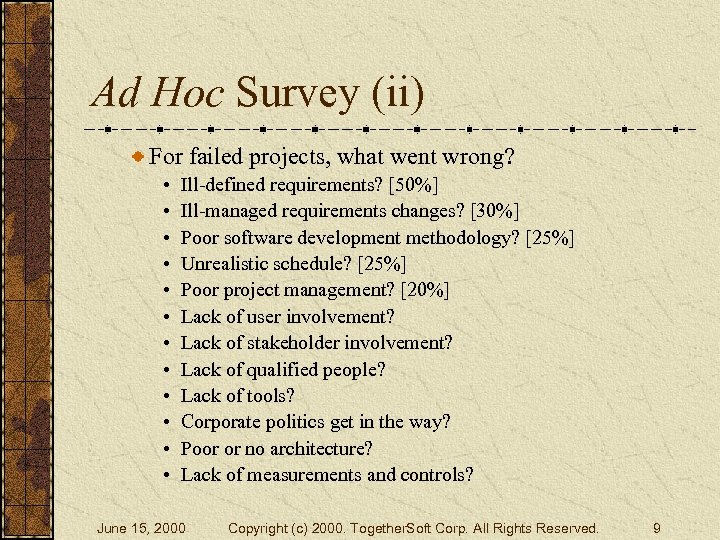 Ad Hoc Survey (ii) For failed projects, what went wrong? • • • Ill-defined requirements? [50%] Ill-managed requirements changes? [30%] Poor software development methodology? [25%] Unrealistic schedule? [25%] Poor project management? [20%] Lack of user involvement? Lack of stakeholder involvement? Lack of qualified people? Lack of tools? Corporate politics get in the way? Poor or no architecture? Lack of measurements and controls? June 15, 2000 Copyright (c) 2000. Together. Soft Corp. All Rights Reserved. 9
 Is this How It Should Be? Why do we allow this to happen? Would you like your next
 Current Practices are Broke! We can do better! We must do it better! We should employ engineering methods Everyone can enjoy random success, but one is advised not to build a career on it! -- Bicknell, 1993 June 15, 2000 Copyright (c) 2000. Together. Soft Corp. All Rights Reserved. 11
 The Core Triad for Success People Process Technology People + Process + Technology Process is no substitute for synaptic activity You still need to think and use common sense And a lot of that is not a book or course-learning exercise. It takes street smarts. That’s where mentoring and consulting come in and add significant value June 15, 2000 Copyright (c) 2000. Together. Soft Corp. All Rights Reserved. 12
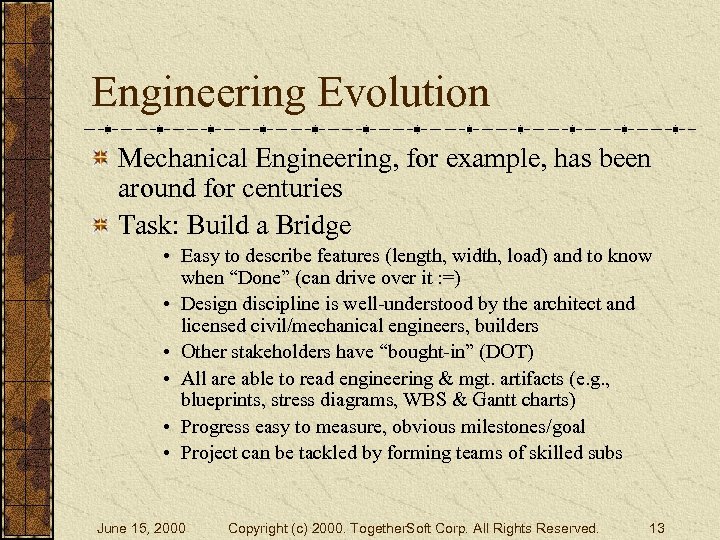 Engineering Evolution Mechanical Engineering, for example, has been around for centuries Task: Build a Bridge • Easy to describe features (length, width, load) and to know when “Done” (can drive over it : =) • Design discipline is well-understood by the architect and licensed civil/mechanical engineers, builders • Other stakeholders have “bought-in” (DOT) • All are able to read engineering & mgt. artifacts (e. g. , blueprints, stress diagrams, WBS & Gantt charts) • Progress easy to measure, obvious milestones/goal • Project can be tackled by forming teams of skilled subs June 15, 2000 Copyright (c) 2000. Together. Soft Corp. All Rights Reserved. 13
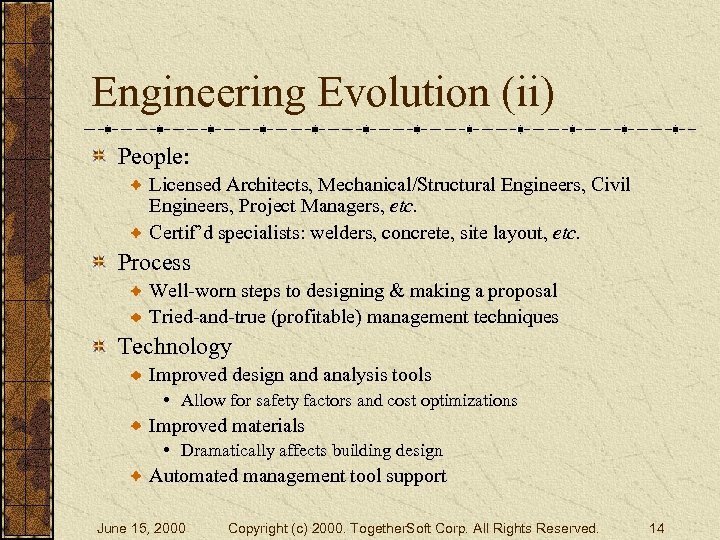 Engineering Evolution (ii) People: Licensed Architects, Mechanical/Structural Engineers, Civil Engineers, Project Managers, etc. Certif’d specialists: welders, concrete, site layout, etc. Process Well-worn steps to designing & making a proposal Tried-and-true (profitable) management techniques Technology Improved design and analysis tools • Allow for safety factors and cost optimizations Improved materials • Dramatically affects building design Automated management tool support June 15, 2000 Copyright (c) 2000. Together. Soft Corp. All Rights Reserved. 14
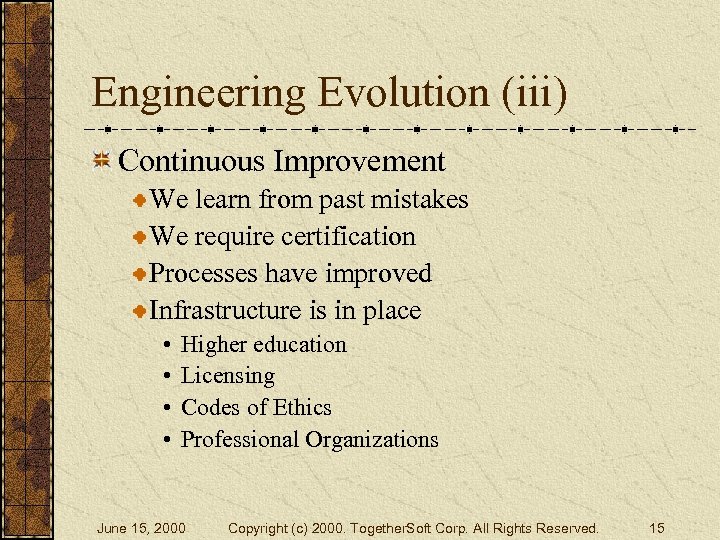 Engineering Evolution (iii) Continuous Improvement We learn from past mistakes We require certification Processes have improved Infrastructure is in place • • Higher education Licensing Codes of Ethics Professional Organizations June 15, 2000 Copyright (c) 2000. Together. Soft Corp. All Rights Reserved. 15
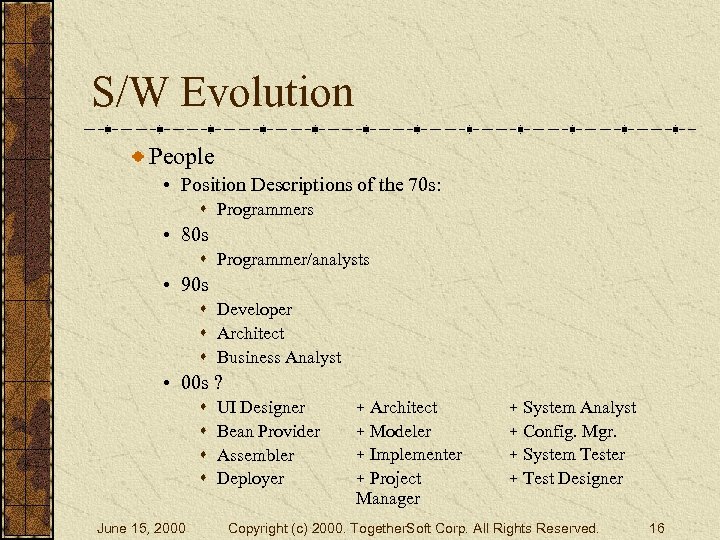 S/W Evolution People • Position Descriptions of the 70 s: s Programmers • 80 s s Programmer/analysts • 90 s s Developer s Architect s Business Analyst • 00 s ? s s June 15, 2000 UI Designer Bean Provider Assembler Deployer + Architect + Modeler + Implementer + Project Manager + System Analyst + Config. Mgr. + System Tester + Test Designer Copyright (c) 2000. Together. Soft Corp. All Rights Reserved. 16
 Software Evolution (ii) Processes Ad Hoc Waterfall Spiral Incremental Iterative RAD/JAD Unified Process Extreme Programming (XP) Feature-Driven Development June 15, 2000 Copyright (c) 2000. Together. Soft Corp. All Rights Reserved. 17
 Software Evolution (iii) Technology Languages: Assembler , Procedural, Structured, Object-Oriented 3 GL/4 GL/CASE Life Cycle Tools • • Requirements, Architecting, Building, Testing Configuration Management/Version Control Round-trip Engineering (manual steps) Simultaneous round-trip tools Modeling: • Structured, DFD, • Coad, OMT, Booch, • UML June 15, 2000 Copyright (c) 2000. Together. Soft Corp. All Rights Reserved. 18
 Software Evolution (iv) Still facing same problems as the last 25+ years Ill-defined requirements Demanding schedules Fast-moving technology Fast-moving business needs Large-scale projects Not much widespread improvement But there is hope… June 15, 2000 Copyright (c) 2000. Together. Soft Corp. All Rights Reserved. 19
 Differences Between Software & Hardware Engineering Primary difference is that it is indeed “soft” S/W is viewed as being more changeable But is it really? Users demand much more flexibility in S/W Spectrum of cost: point solution generic/flexible($$$) We haven’t reached the level of H/W standards Not many real software “Integrated Circuits” to allow quick buildup of system functionality Components still not widespread • Except for UI components Patterns/models not as accepted as engineering/arch. blueprints No “Component. Depot” -- yet June 15, 2000 Copyright (c) 2000. Together. Soft Corp. All Rights Reserved. 20
 Some Fundamental Issues Software is very complex today Hard for one to understand it all Difficult to express in terms all stakeholders understand Business drivers add pressure Shrinking business cycle Competition increasing Ever rising user expectations “Soft” Requirements A common threat to schedule, budget, success Too much change can cause failure June 15, 2000 Copyright (c) 2000. Together. Soft Corp. All Rights Reserved. 21
 Fundamental Issues (ii) Flexibility and resilience to change is key Ability to adapt to sudden market changes Design is solid enough that change does not impact the core design in a destabilizing way Willingness to re-architect as required Most projects are unpredictable Lack of knowing where and what to measure Lack of yardsticks to gauge progress Requirements creep is common Scrap and rework is common Interminably 90% done June 15, 2000 Copyright (c) 2000. Together. Soft Corp. All Rights Reserved. 22
 Fundamental Issues (iii) Lack of quality people results in failure …in spite of best processes and tools! Managing people is difficult Major change is organizationally difficult Reusing software artifacts is rare s s s s June 15, 2000 Architectures/Designs/Models Estimating processes Team processes Planning & Tracking procedures and reports Software construction & management Reviews, testing etc. Copyright (c) 2000. Together. Soft Corp. All Rights Reserved. 23
 What do we Fix? Common Problems Today Requirements unclear Requirements changes cause disruption Poor quality, maintenance nightmares Late breakage Delaying risk mitigation Performance woes Non-repeatable processes Poor architecture Lack of testing June 15, 2000 Blown schedules Built the wrong thing Filled an outdated need Outright abrupt cancellation Doesn’t deliver ROI Staff is a revolving door Copyright (c) 2000. Together. Soft Corp. All Rights Reserved. 24
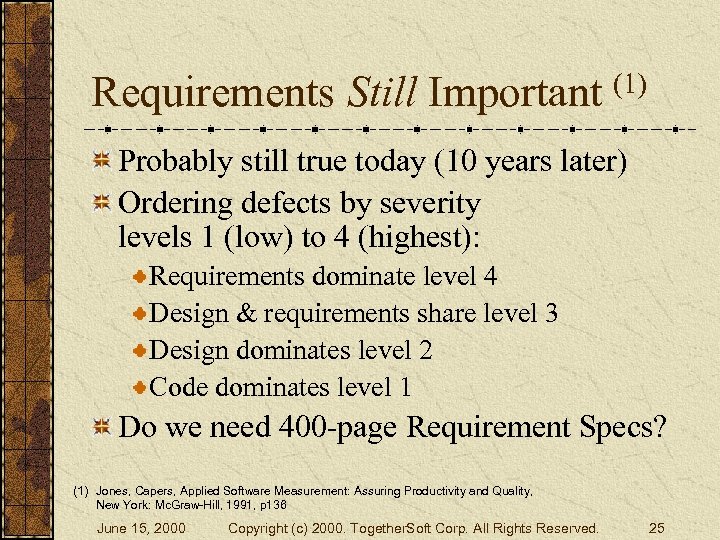 Requirements Still Important (1) Probably still true today (10 years later) Ordering defects by severity levels 1 (low) to 4 (highest): Requirements dominate level 4 Design & requirements share level 3 Design dominates level 2 Code dominates level 1 Do we need 400 -page Requirement Specs? (1) Jones, Capers, Applied Software Measurement: Assuring Productivity and Quality, New York: Mc. Graw-Hill, 1991, p 136 June 15, 2000 Copyright (c) 2000. Together. Soft Corp. All Rights Reserved. 25
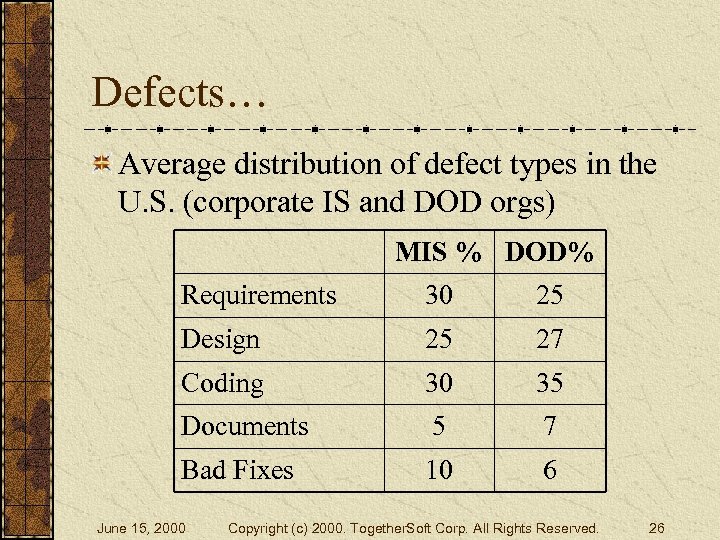 Defects… Average distribution of defect types in the U. S. (corporate IS and DOD orgs) MIS % DOD% Requirements 30 25 Design 25 27 Coding 30 35 Documents 5 7 Bad Fixes 10 6 June 15, 2000 Copyright (c) 2000. Together. Soft Corp. All Rights Reserved. 26
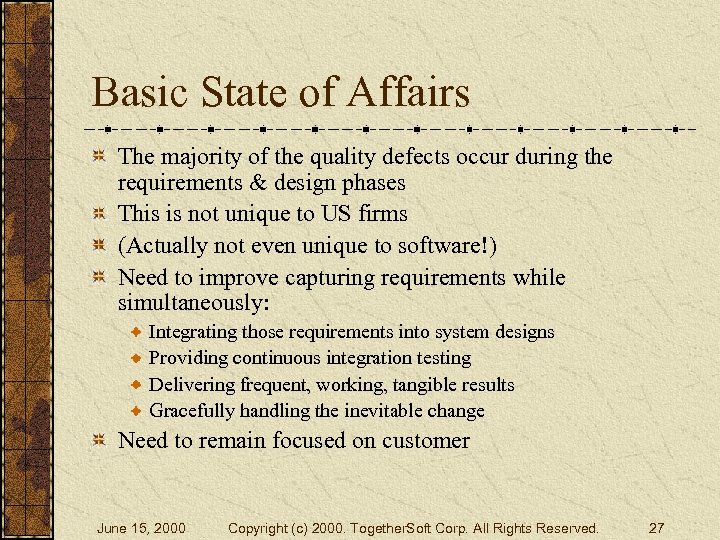 Basic State of Affairs The majority of the quality defects occur during the requirements & design phases This is not unique to US firms (Actually not even unique to software!) Need to improve capturing requirements while simultaneously: Integrating those requirements into system designs Providing continuous integration testing Delivering frequent, working, tangible results Gracefully handling the inevitable change Need to remain focused on customer June 15, 2000 Copyright (c) 2000. Together. Soft Corp. All Rights Reserved. 27
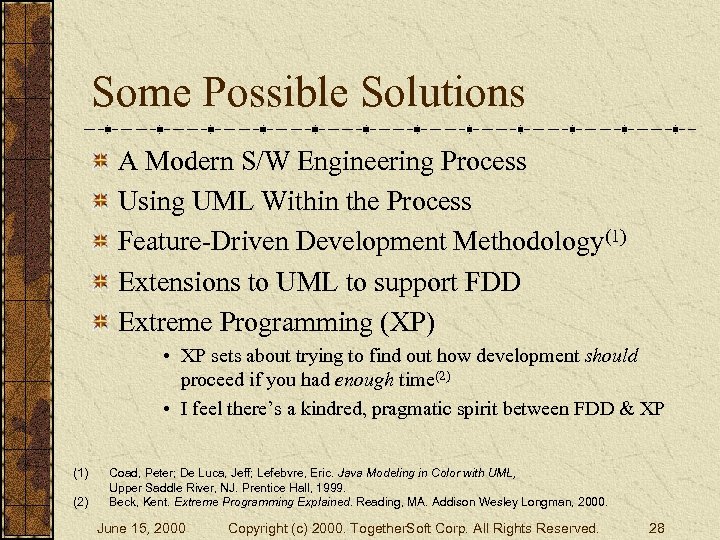 Some Possible Solutions A Modern S/W Engineering Process Using UML Within the Process Feature-Driven Development Methodology(1) Extensions to UML to support FDD Extreme Programming (XP) • XP sets about trying to find out how development should proceed if you had enough time(2) • I feel there’s a kindred, pragmatic spirit between FDD & XP (1) (2) Coad, Peter; De Luca, Jeff; Lefebvre, Eric. Java Modeling in Color with UML, Upper Saddle River, NJ. Prentice Hall, 1999. Beck, Kent. Extreme Programming Explained. Reading, MA. Addison Wesley Longman, 2000. June 15, 2000 Copyright (c) 2000. Together. Soft Corp. All Rights Reserved. 28
 Putting Engineering into Software Development Applications need to be architected and designed, not just “built” Hardware/construction engineering uses Processes/Process Improvement Tools (but no silver bullets) Standards Highly Skilled, licensed/certified People Employs System Integration concepts Things aren’t just “built” with no planning Just because you have a hammer, everything isn’t a nail! June 15, 2000 Copyright (c) 2000. Together. Soft Corp. All Rights Reserved. 29
 Putting Engineering into S/W (ii) Software engineering should be no different than hardware engineering Habits of Successful Projects Employ an iterative process Use requirements-driven approach Do up-front visual architecting/design Perform continuous integration, use metrics & QA Work with frequent, tangible artifacts (running code) Have solid team support and communication June 15, 2000 Copyright (c) 2000. Together. Soft Corp. All Rights Reserved. 30
 Putting Engineering into S/W(iii) Successful Project Habits (cont’d) Use tools to automate tasks Are able to reuse items Have quality people • Management • Development • Specialists Have good scheduling (realistic, accurate) Frequent, positive involvement with stakeholders Progress reporting Requirements well understood (at least over time) June 15, 2000 Copyright (c) 2000. Together. Soft Corp. All Rights Reserved. 31
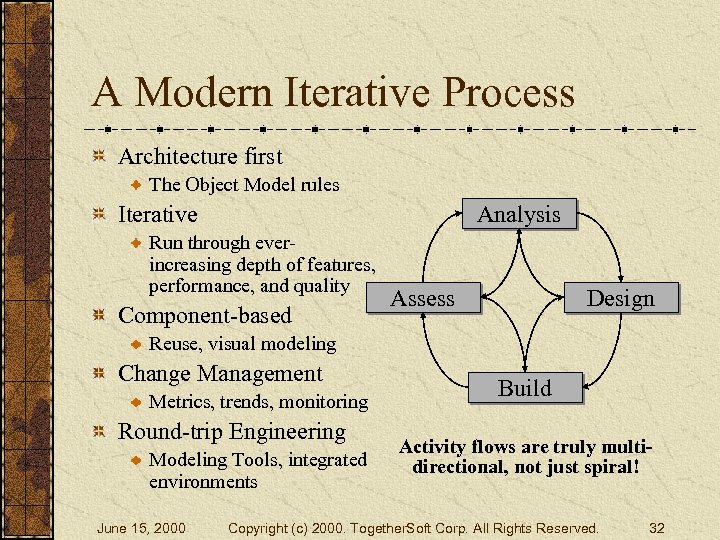 A Modern Iterative Process Architecture first The Object Model rules Iterative Analysis Run through everincreasing depth of features, performance, and quality Component-based Assess Design Reuse, visual modeling Change Management Metrics, trends, monitoring Round-trip Engineering Modeling Tools, integrated environments June 15, 2000 Build Activity flows are truly multidirectional, not just spiral! Copyright (c) 2000. Together. Soft Corp. All Rights Reserved. 32
 Process (ii) Strive for: Frequent results stemming from architecture-centric approach where the model is the code Architecture driven by client requirements Strong team that communicates through graphical artifacts, code, and working prototypes to avoid miscommunication Improved process and measurable, automated quality control (testing, audits, metrics) Quality at every turn June 15, 2000 Copyright (c) 2000. Together. Soft Corp. All Rights Reserved. 33
 Process (iii) Avoid both extremes: “Analysis Paralysis” • Too many paper studies • Too few tangible, working baselines • Too many business analysts Getting hordes coding too soon • Chaotic design decisions “on the fly”by non-architects • Prolific solo coders get too far ahead with poor direction • Continuous hacking, scrap, and rework, is a symptom Always ask: “Am I moving the project ahead or the completion date back by doing this? ” June 15, 2000 Copyright (c) 2000. Together. Soft Corp. All Rights Reserved. 34
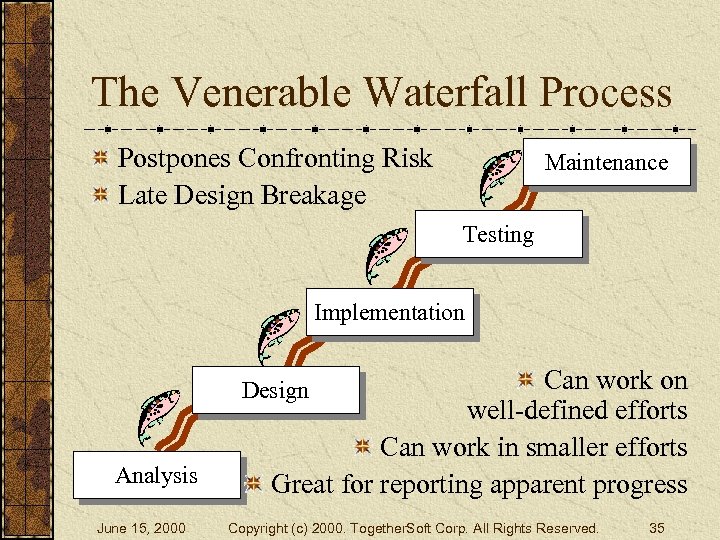 The Venerable Waterfall Process Postpones Confronting Risk Late Design Breakage Maintenance Testing Implementation Can work on well-defined efforts Can work in smaller efforts Great for reporting apparent progress Design Analysis June 15, 2000 Copyright (c) 2000. Together. Soft Corp. All Rights Reserved. 35
 A Solution Feature-Driven Development Client-centric Architecture-centric Repeatable process Pragmatic, livable methodology Great for developers Great for managers Great for the application! June 15, 2000 Copyright (c) 2000. Together. Soft Corp. All Rights Reserved. 36
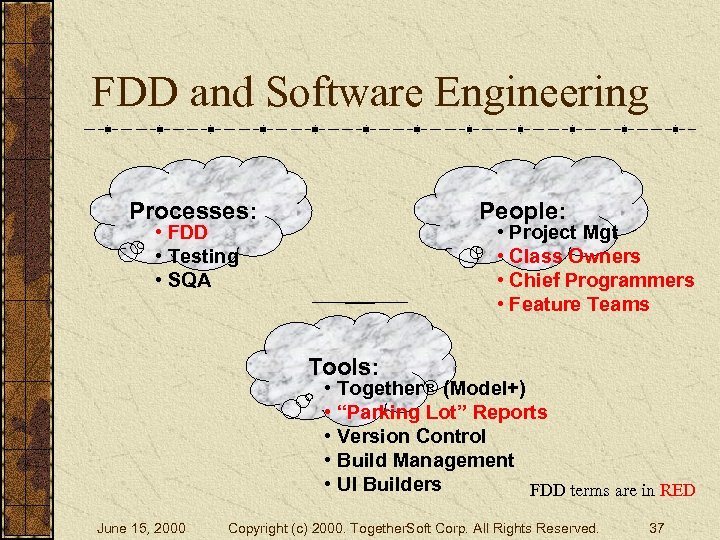 FDD and Software Engineering Processes: People: • FDD • Testing • SQA • Project Mgt • Class Owners • Chief Programmers • Feature Teams Tools: • Together® (Model+) • “Parking Lot” Reports • Version Control • Build Management • UI Builders FDD terms are in RED June 15, 2000 Copyright (c) 2000. Together. Soft Corp. All Rights Reserved. 37
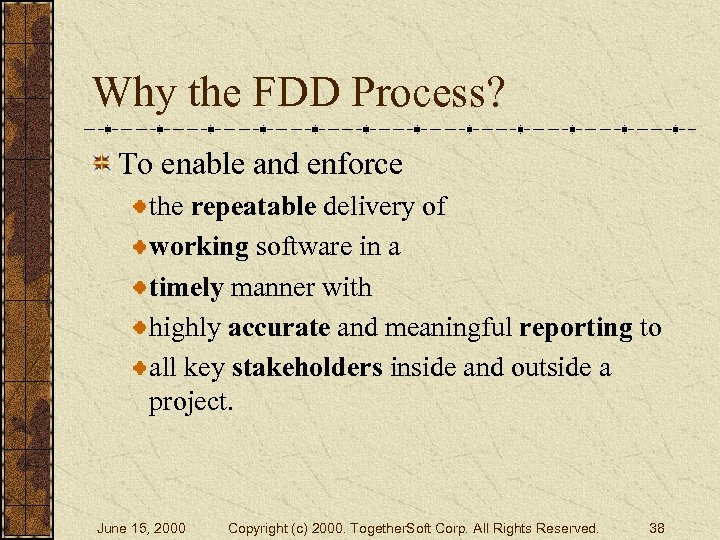 Why the FDD Process? To enable and enforce the repeatable delivery of working software in a timely manner with highly accurate and meaningful reporting to all key stakeholders inside and outside a project. June 15, 2000 Copyright (c) 2000. Together. Soft Corp. All Rights Reserved. 38
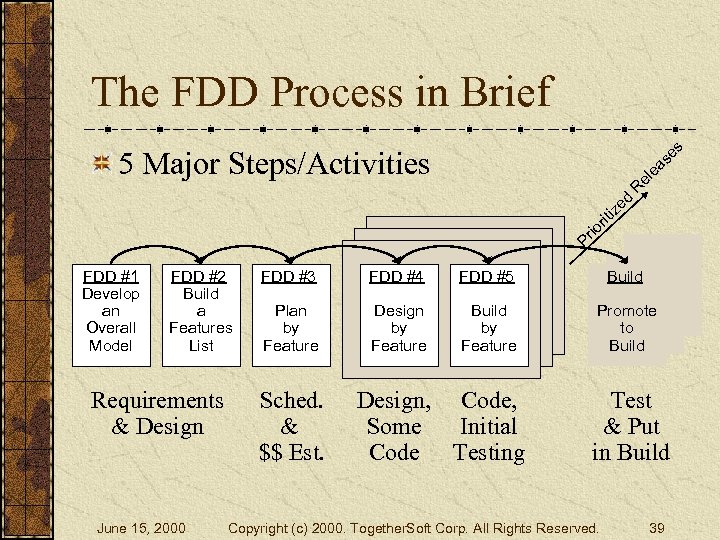 The FDD Process in Brief Pr io rit iz ed R el ea se s 5 Major Steps/Activities FDD #1 Develop an Overall Model FDD #2 Build a Features List Requirements & Design June 15, 2000 FDD #3 FDD #4 FDD #5 Build Plan by Feature Design by Feature Build by Feature Promote to Build Sched. & $$ Est. Design, Code, Some Initial Code Testing Test & Put in Build Copyright (c) 2000. Together. Soft Corp. All Rights Reserved. 39
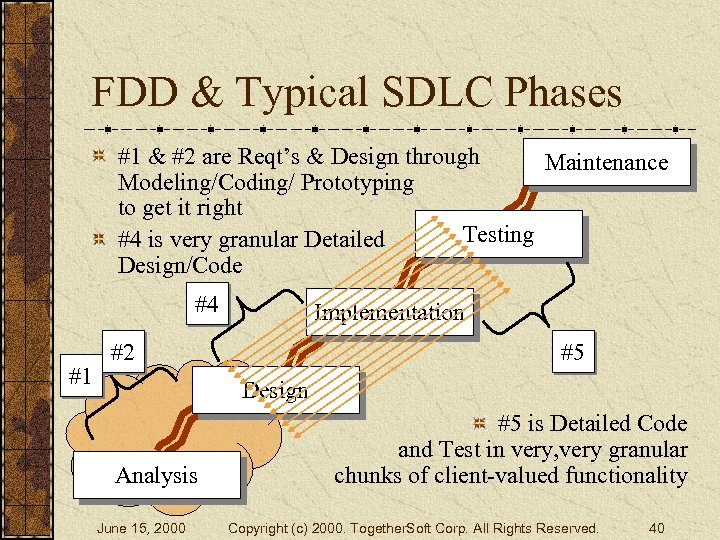 FDD & Typical SDLC Phases #1 & #2 are Reqt’s & Design through Maintenance Modeling/Coding/ Prototyping to get it right Testing #4 is very granular Detailed Design/Code #4 #1 Implementation #2 #5 Design Analysis June 15, 2000 #5 is Detailed Code and Test in very, very granular chunks of client-valued functionality Copyright (c) 2000. Together. Soft Corp. All Rights Reserved. 40
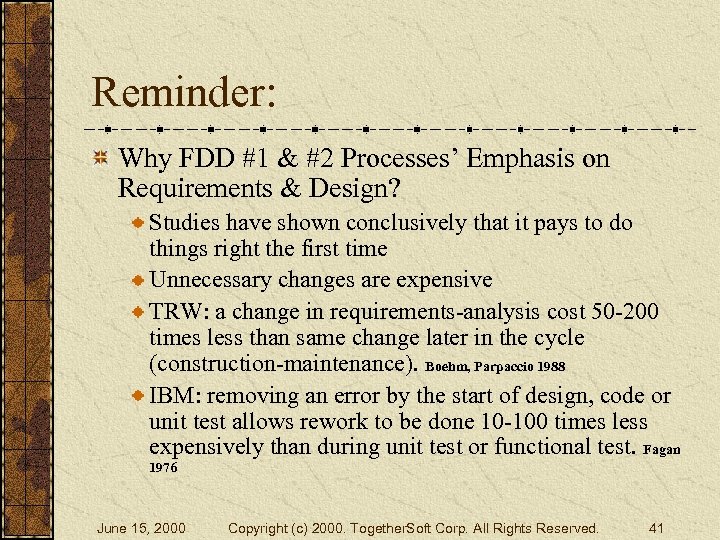 Reminder: Why FDD #1 & #2 Processes’ Emphasis on Requirements & Design? Studies have shown conclusively that it pays to do things right the first time Unnecessary changes are expensive TRW: a change in requirements-analysis cost 50 -200 times less than same change later in the cycle (construction-maintenance). Boehm, Parpaccio 1988 IBM: removing an error by the start of design, code or unit test allows rework to be done 10 -100 times less expensively than during unit test or functional test. Fagan 1976 June 15, 2000 Copyright (c) 2000. Together. Soft Corp. All Rights Reserved. 41
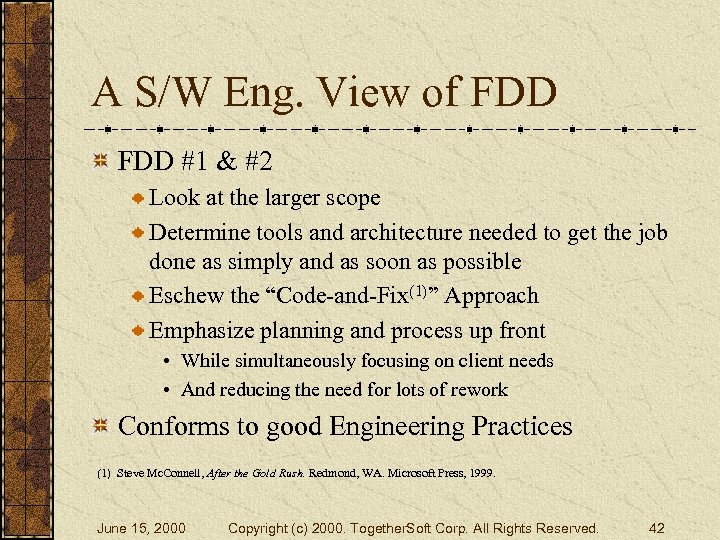 A S/W Eng. View of FDD #1 & #2 Look at the larger scope Determine tools and architecture needed to get the job done as simply and as soon as possible Eschew the “Code-and-Fix(1)” Approach Emphasize planning and process up front • While simultaneously focusing on client needs • And reducing the need for lots of rework Conforms to good Engineering Practices (1) Steve Mc. Connell, After the Gold Rush. Redmond, WA. Microsoft Press, 1999. June 15, 2000 Copyright (c) 2000. Together. Soft Corp. All Rights Reserved. 42
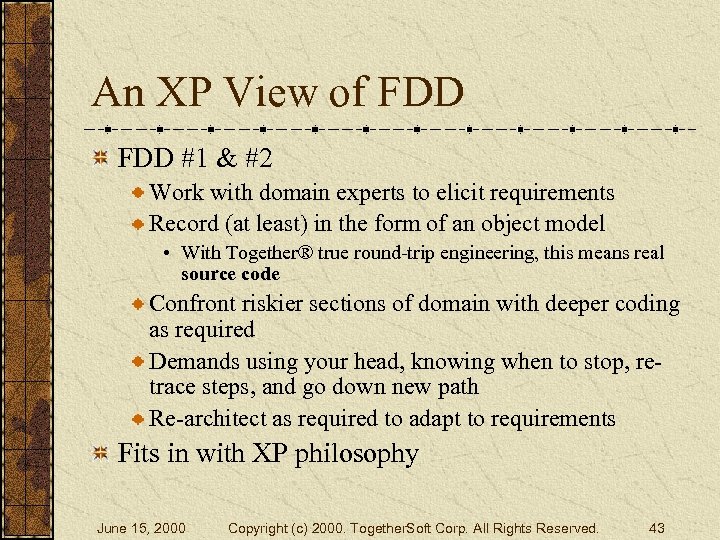 An XP View of FDD #1 & #2 Work with domain experts to elicit requirements Record (at least) in the form of an object model • With Together® true round-trip engineering, this means real source code Confront riskier sections of domain with deeper coding as required Demands using your head, knowing when to stop, retrace steps, and go down new path Re-architect as required to adapt to requirements Fits in with XP philosophy June 15, 2000 Copyright (c) 2000. Together. Soft Corp. All Rights Reserved. 43
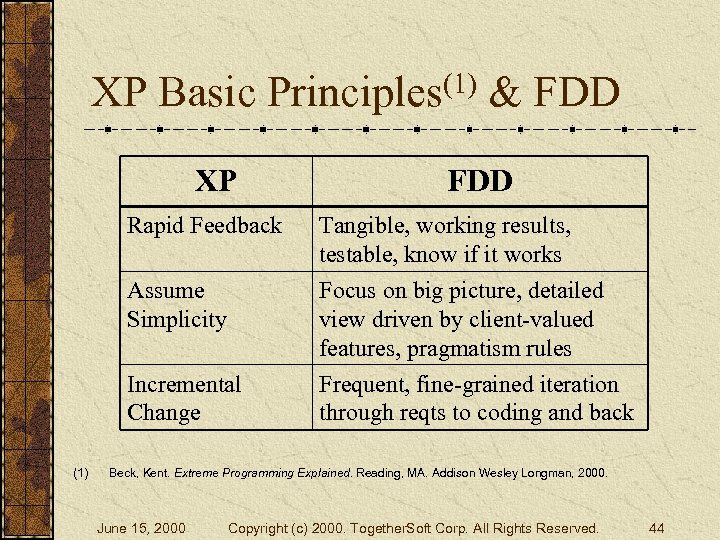 XP Basic Principles(1) & FDD XP FDD Rapid Feedback Assume Simplicity Focus on big picture, detailed view driven by client-valued features, pragmatism rules Incremental Change (1) Tangible, working results, testable, know if it works Frequent, fine-grained iteration through reqts to coding and back Beck, Kent. Extreme Programming Explained. Reading, MA. Addison Wesley Longman, 2000. June 15, 2000 Copyright (c) 2000. Together. Soft Corp. All Rights Reserved. 44
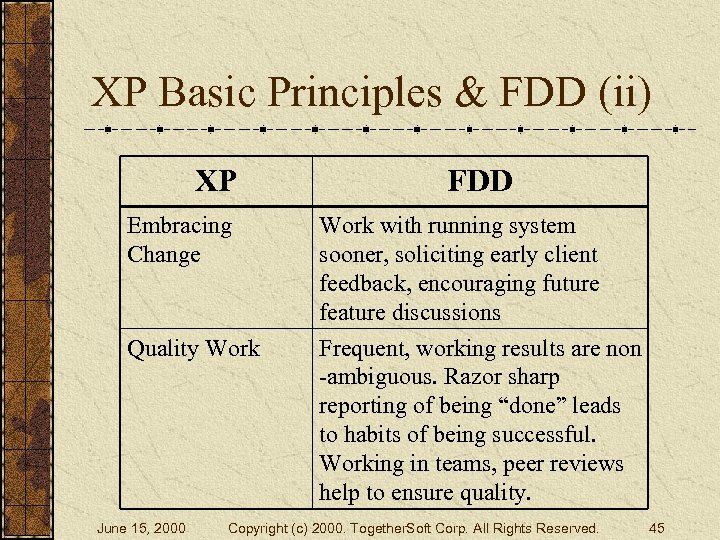 XP Basic Principles & FDD (ii) XP FDD Embracing Change Work with running system sooner, soliciting early client feedback, encouraging future feature discussions Quality Work Frequent, working results are non -ambiguous. Razor sharp reporting of being “done” leads to habits of being successful. Working in teams, peer reviews help to ensure quality. June 15, 2000 Copyright (c) 2000. Together. Soft Corp. All Rights Reserved. 45
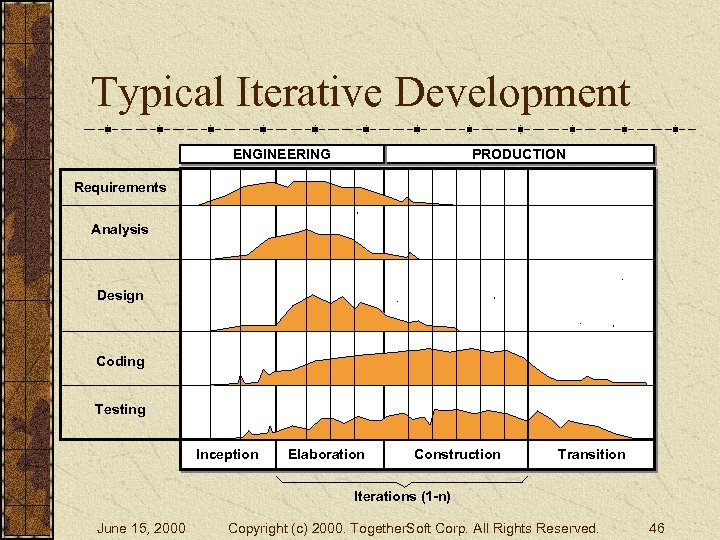 Typical Iterative Development ENGINEERING PRODUCTION Requirements Analysis Design Coding Testing Inception Elaboration Construction Transition Iterations (1 -n) June 15, 2000 Copyright (c) 2000. Together. Soft Corp. All Rights Reserved. 46
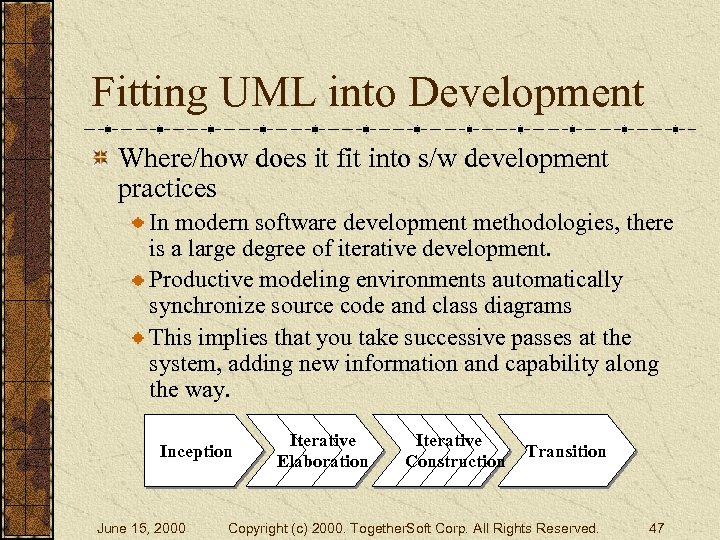 Fitting UML into Development Where/how does it fit into s/w development practices In modern software development methodologies, there is a large degree of iterative development. Productive modeling environments automatically synchronize source code and class diagrams This implies that you take successive passes at the system, adding new information and capability along the way. Inception June 15, 2000 Iterative Elaboration Iterative Construction Transition Copyright (c) 2000. Together. Soft Corp. All Rights Reserved. 47
 The Utility of UML Helps to promote standard communication But does not supplant human contact! Class Diagrams are very useful Sequence and Activity help with dynamics Use Cases Useful if your organization has meaningful way to apply them—no silver bullet Can be replaced by other means of capturing features/requirements June 15, 2000 Copyright (c) 2000. Together. Soft Corp. All Rights Reserved. 48
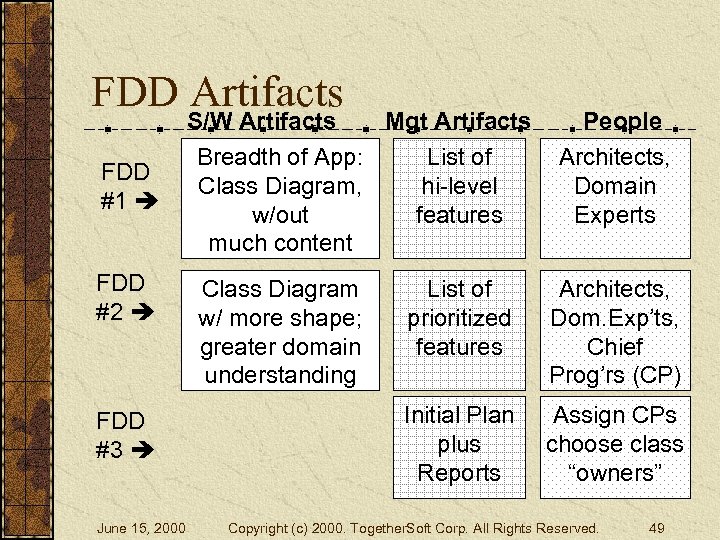 FDD Artifacts S/W Artifacts FDD #1 FDD #2 FDD #3 June 15, 2000 Mgt Artifacts People Breadth of App: Class Diagram, w/out much content List of hi-level features Architects, Domain Experts Class Diagram w/ more shape; greater domain understanding List of prioritized features Architects, Dom. Exp’ts, Chief Prog’rs (CP) Initial Plan plus Reports Assign CPs choose class “owners” Copyright (c) 2000. Together. Soft Corp. All Rights Reserved. 49
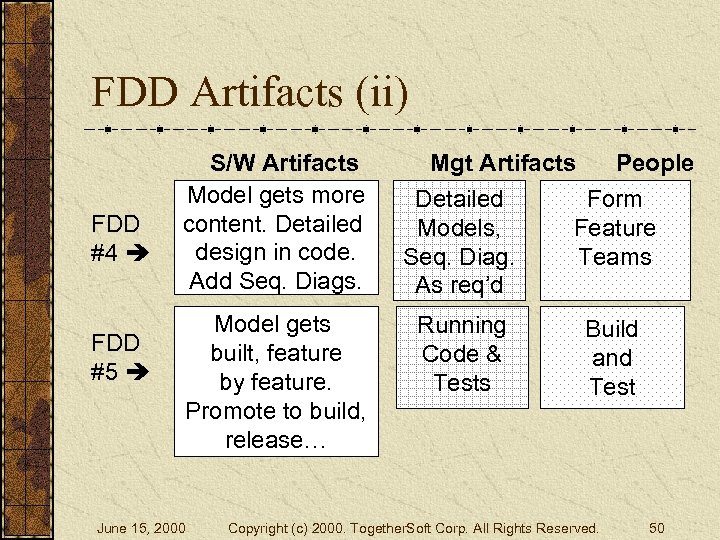 FDD Artifacts (ii) FDD #4 FDD #5 S/W Artifacts Model gets more content. Detailed design in code. Add Seq. Diags. Model gets built, feature by feature. Promote to build, release… June 15, 2000 Mgt Artifacts People Detailed Form Models, Feature Seq. Diag. Teams As req’d Running Code & Tests Build and Test Copyright (c) 2000. Together. Soft Corp. All Rights Reserved. 50
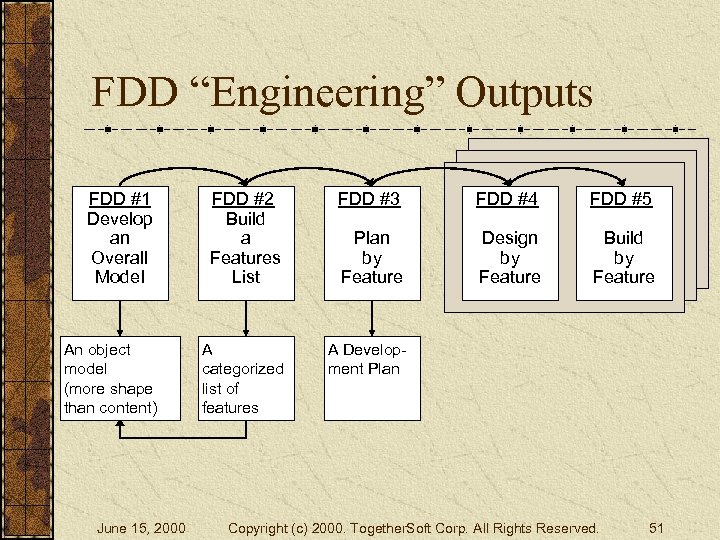 FDD “Engineering” Outputs FDD #1 Develop an Overall Model FDD #2 Build a Features List FDD #3 FDD #4 FDD #5 Plan by Feature Design by Feature Build by Feature An object model (more shape than content) A categorized list of features A Development Plan June 15, 2000 Copyright (c) 2000. Together. Soft Corp. All Rights Reserved. 51
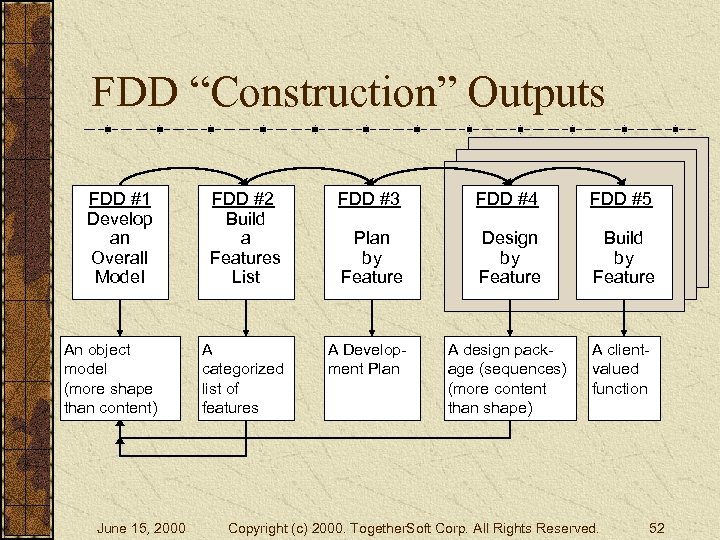 FDD “Construction” Outputs FDD #1 Develop an Overall Model FDD #2 Build a Features List FDD #3 FDD #4 FDD #5 Plan by Feature Design by Feature Build by Feature An object model (more shape than content) A categorized list of features A Development Plan A design package (sequences) (more content than shape) A clientvalued function June 15, 2000 Copyright (c) 2000. Together. Soft Corp. All Rights Reserved. 52
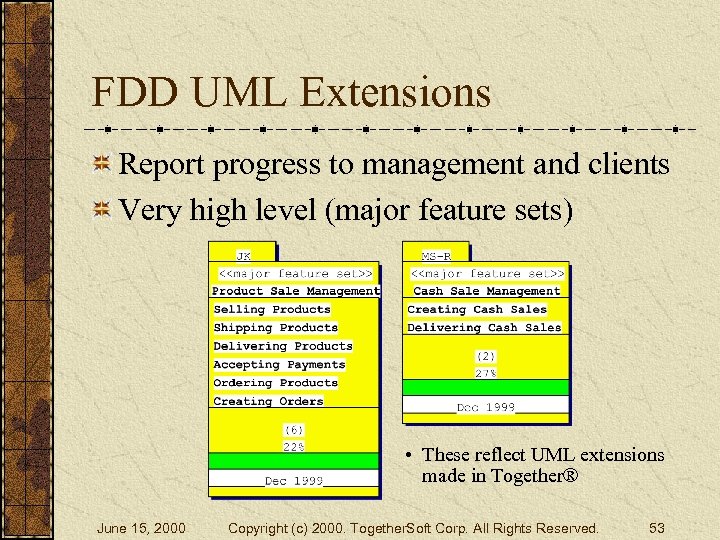 FDD UML Extensions Report progress to management and clients Very high level (major feature sets) • These reflect UML extensions made in Together® June 15, 2000 Copyright (c) 2000. Together. Soft Corp. All Rights Reserved. 53
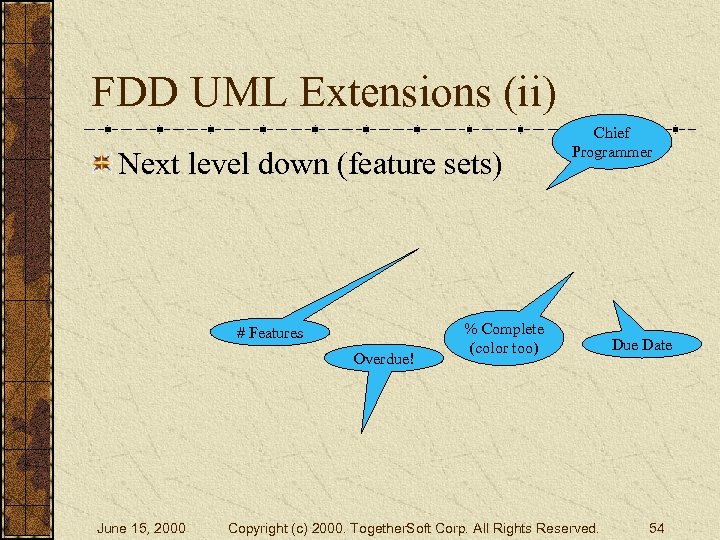 FDD UML Extensions (ii) Next level down (feature sets) # Features Overdue! June 15, 2000 Chief Programmer % Complete (color too) Copyright (c) 2000. Together. Soft Corp. All Rights Reserved. Due Date 54
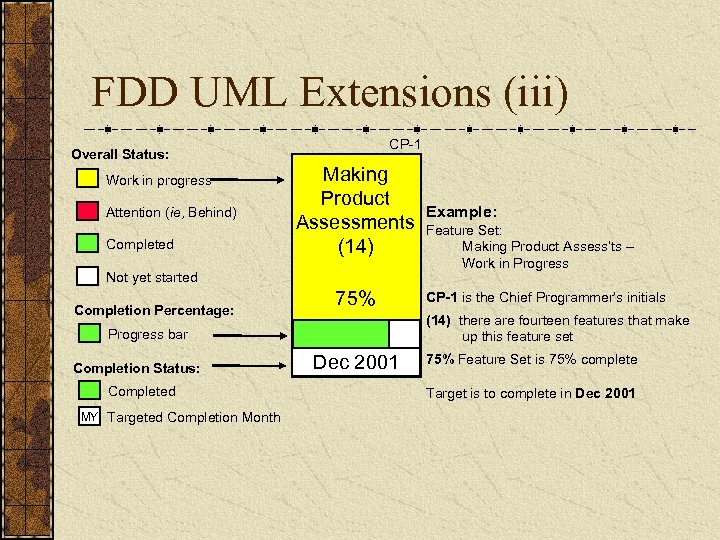 FDD UML Extensions (iii) CP-1 Overall Status: Work in progress Attention (ie, Behind) Completed Making Product Assessments (14) Not yet started Completion Percentage: 75% Completed MY Targeted Completion Month Feature Set: Making Product Assess’ts – Work in Progress CP-1 is the Chief Programmer’s initials (14) there are fourteen features that make up this feature set Progress bar Completion Status: Example: Dec 2001 75% Feature Set is 75% complete Target is to complete in Dec 2001
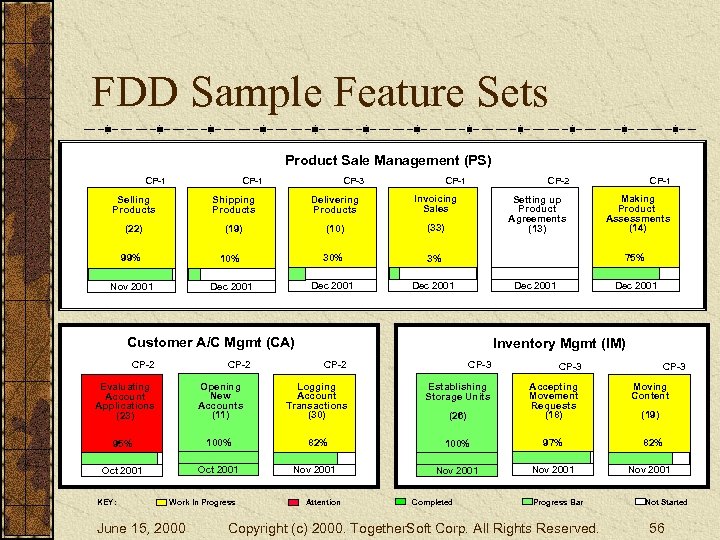 FDD Sample Feature Sets Product Sale Management (PS) CP-1 CP-3 CP-1 Selling Products Shipping Products Delivering Products Invoicing Sales (22) (19) (10) (33) 99% 10% 3% Nov 2001 Dec 2001 CP-2 Dec 2001 Setting up Product Agreements (13) CP-2 Dec 2001 Inventory Mgmt (IM) CP-2 CP-3 Opening New Accounts (11) Logging Account Transactions (30) Establishing Storage Units (26) Accepting Movement Requests (18) 95% 100% 82% 100% 97% Oct 2001 Nov 2001 Work In Progress June 15, 2000 Nov 2001 Attention Completed CP-3 Evaluating Account Applications (23) KEY: Making Product Assessments (14) 75% Customer A/C Mgmt (CA) CP-2 CP-1 Progress Bar Copyright (c) 2000. Together. Soft Corp. All Rights Reserved. Moving Content (19) 82% Nov 2001 Not Started 56
 Milestones “Milestones must be concrete, specific, measurableevents defined with a knife-edge sharpness” “A programmer will rarely lie about milestone progress, if the milestone is so sharp he can’t deceive himself” “Getting the status is hard since subordinate managers have every reason not to share it” Fred Brooks June 15, 2000 Copyright (c) 2000. Together. Soft Corp. All Rights Reserved. 57
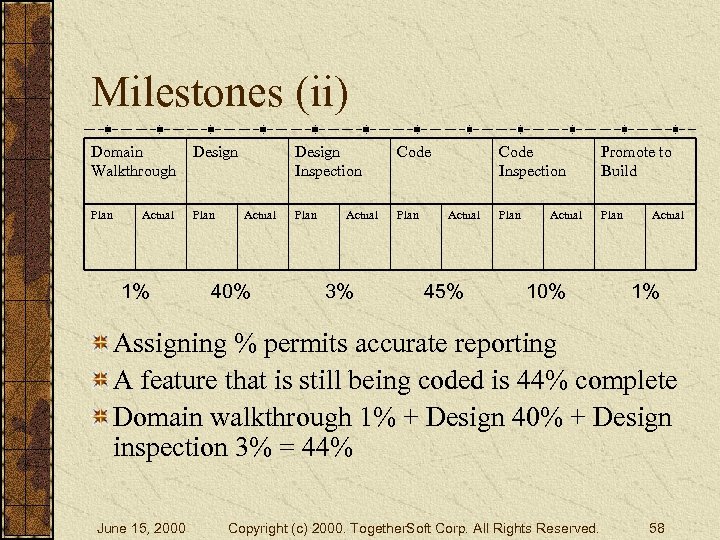 Milestones (ii) Domain Walkthrough Design Plan Actual 1% Design Inspection Actual 40% Code Plan Actual 3% Code Inspection Actual 45% Promote to Build Plan Actual 10% Actual 1% Assigning % permits accurate reporting A feature that is still being coded is 44% complete Domain walkthrough 1% + Design 40% + Design inspection 3% = 44% June 15, 2000 Copyright (c) 2000. Together. Soft Corp. All Rights Reserved. 58
 Milestones (iv) The Plan and Actual dates are completion dates An entry in the actual column for a milestone signifies that milestone has been achieved This triggers the percentage calculations for that feature, its feature set and so on Intervals aren’t recorded – but they could be June 15, 2000 Copyright (c) 2000. Together. Soft Corp. All Rights Reserved. 59
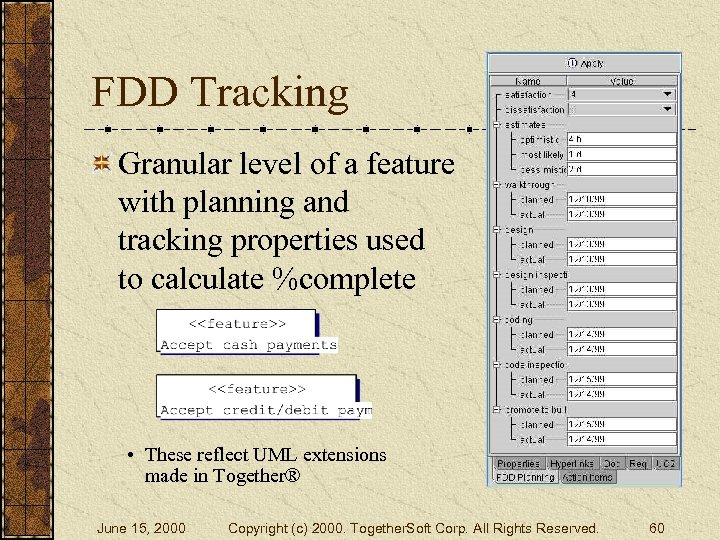 FDD Tracking Granular level of a feature with planning and tracking properties used to calculate %complete • These reflect UML extensions made in Together® June 15, 2000 Copyright (c) 2000. Together. Soft Corp. All Rights Reserved. 60
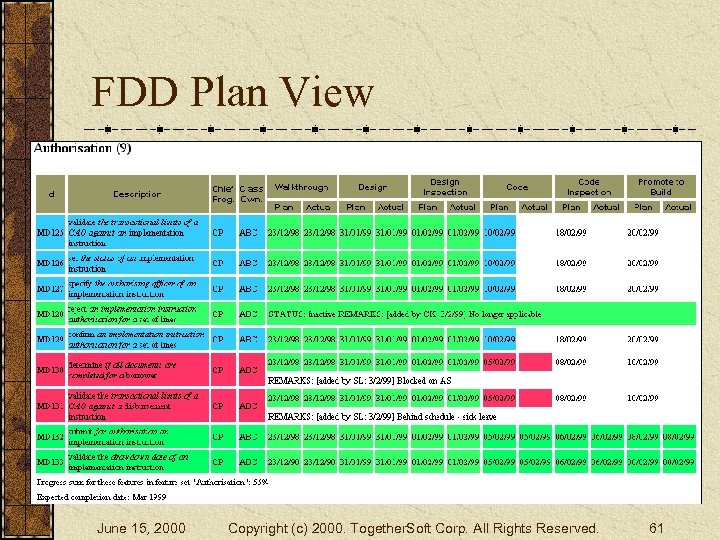 FDD Plan View June 15, 2000 Copyright (c) 2000. Together. Soft Corp. All Rights Reserved. 61
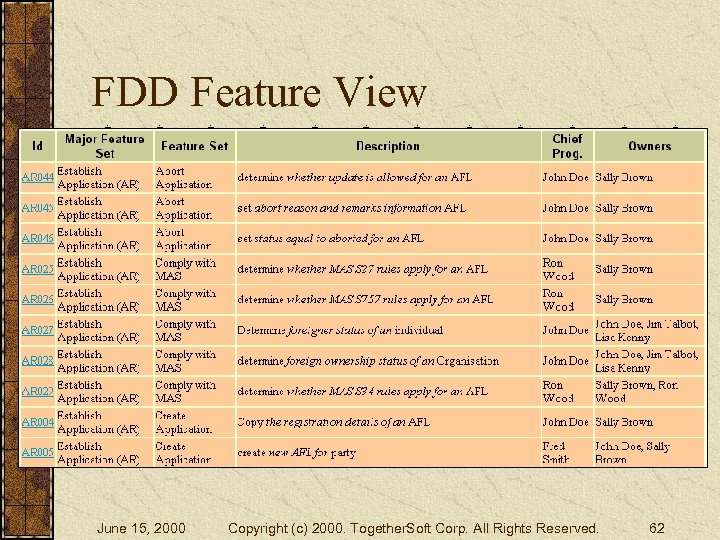 FDD Feature View June 15, 2000 Copyright (c) 2000. Together. Soft Corp. All Rights Reserved. 62
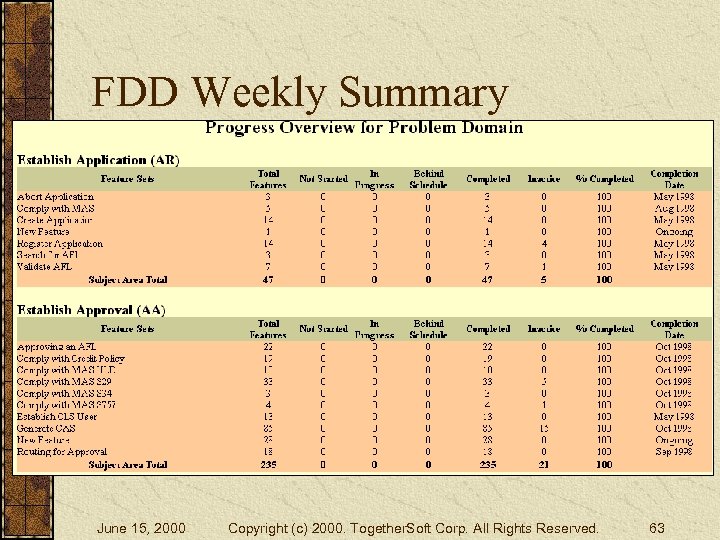 FDD Weekly Summary June 15, 2000 Copyright (c) 2000. Together. Soft Corp. All Rights Reserved. 63
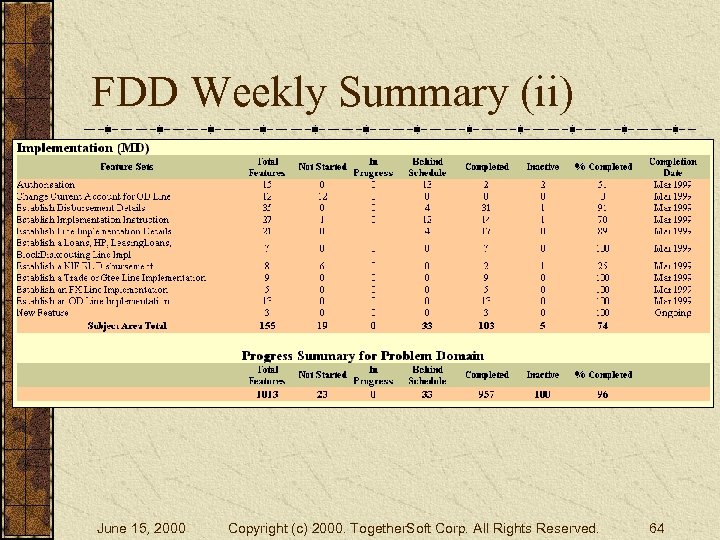 FDD Weekly Summary (ii) June 15, 2000 Copyright (c) 2000. Together. Soft Corp. All Rights Reserved. 64
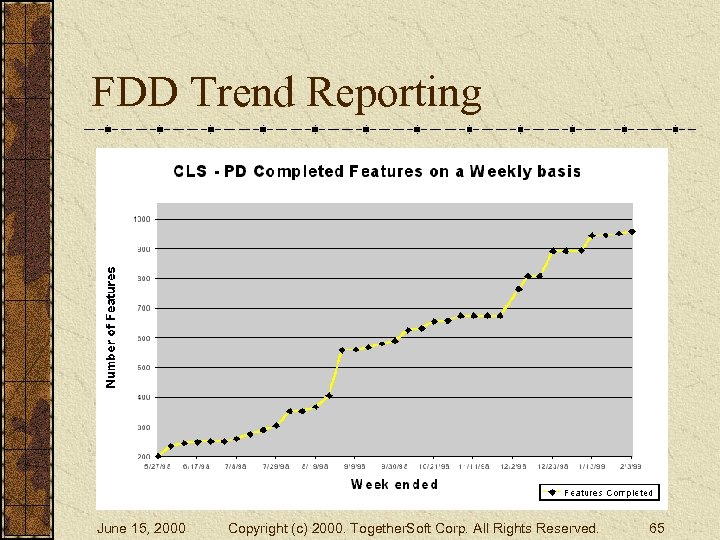 FDD Trend Reporting June 15, 2000 Copyright (c) 2000. Together. Soft Corp. All Rights Reserved. 65
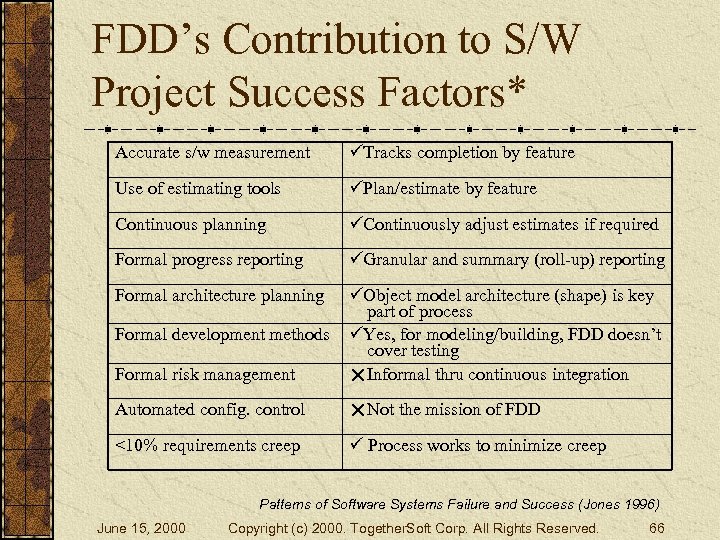 FDD’s Contribution to S/W Project Success Factors* Accurate s/w measurement Tracks completion by feature Use of estimating tools Plan/estimate by feature Continuous planning Continuously adjust estimates if required Formal progress reporting Granular and summary (roll-up) reporting Formal architecture planning Formal risk management Object model architecture (shape) is key part of process Yes, for modeling/building, FDD doesn’t cover testing Informal thru continuous integration Automated config. control Not the mission of FDD <10% requirements creep Process works to minimize creep Formal development methods Patterns of Software Systems Failure and Success (Jones 1996) June 15, 2000 Copyright (c) 2000. Together. Soft Corp. All Rights Reserved. 66
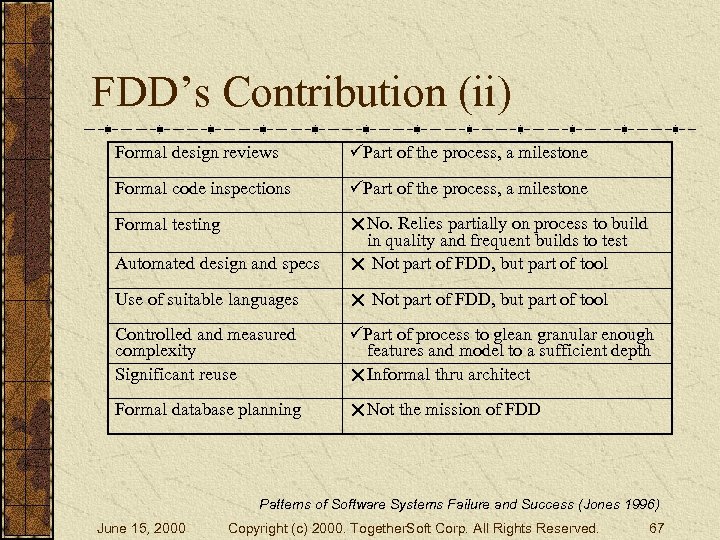 FDD’s Contribution (ii) Formal design reviews Part of the process, a milestone Formal code inspections Part of the process, a milestone Formal testing Automated design and specs No. Relies partially on process to build in quality and frequent builds to test Not part of FDD, but part of tool Use of suitable languages Not part of FDD, but part of tool Controlled and measured complexity Significant reuse Part of process to glean granular enough features and model to a sufficient depth Informal thru architect Formal database planning Not the mission of FDD Patterns of Software Systems Failure and Success (Jones 1996) June 15, 2000 Copyright (c) 2000. Together. Soft Corp. All Rights Reserved. 67
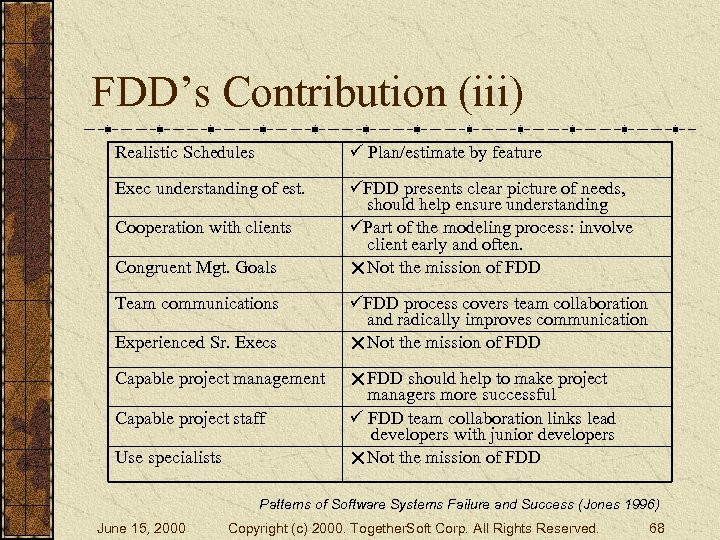 FDD’s Contribution (iii) Realistic Schedules Plan/estimate by feature Exec understanding of est. FDD presents clear picture of needs, should help ensure understanding Part of the modeling process: involve client early and often. Not the mission of FDD Cooperation with clients Congruent Mgt. Goals Team communications Experienced Sr. Execs Capable project management Capable project staff Use specialists FDD process covers team collaboration and radically improves communication Not the mission of FDD should help to make project managers more successful FDD team collaboration links lead developers with junior developers Not the mission of FDD Patterns of Software Systems Failure and Success (Jones 1996) June 15, 2000 Copyright (c) 2000. Together. Soft Corp. All Rights Reserved. 68
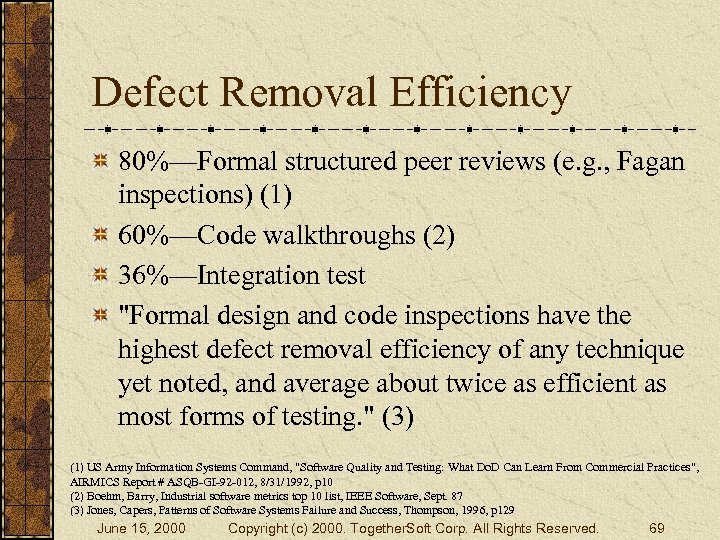 Defect Removal Efficiency 80%—Formal structured peer reviews (e. g. , Fagan inspections) (1) 60%—Code walkthroughs (2) 36%—Integration test "Formal design and code inspections have the highest defect removal efficiency of any technique yet noted, and average about twice as efficient as most forms of testing. " (3) (1) US Army Information Systems Command, "Software Quality and Testing: What Do. D Can Learn From Commercial Practices", AIRMICS Report # ASQB-GI-92 -012, 8/31/1992, p 10 (2) Boehm, Barry, Industrial software metrics top 10 list, IEEE Software, Sept. 87 (3) Jones, Capers, Patterns of Software Systems Failure and Success, Thompson, 1996, p 129 June 15, 2000 Copyright (c) 2000. Together. Soft Corp. All Rights Reserved. 69
 Additional Topics for Discussion The Worth of Quality Inspections Code reviews Audits Test real system continuously Metrics – have to measure your projects June 15, 2000 Copyright (c) 2000. Together. Soft Corp. All Rights Reserved. 70
 Summary Most Software Development lacks engineering rigor today There are pockets of success, some even repeatable – we need more New processes exist (e. g. , FDD) to help achieve success Able to extend UML to support FDD June 15, 2000 Copyright (c) 2000. Together. Soft Corp. All Rights Reserved. 71
 Further Info Coad, De Luca, Lefebvre. Java Modeling in Color with UML. Upper Saddle River, NJ. Prentice Hall, 1999. Royce, Walker. Software Project Management. Mc. Connell , Steve. After the Gold Rush. Redmond, WA. Microsoft Press, 1999. Jones, Capers. Applied Software Measurement. Mc. Graw. Hill, 1991. Beck, Kent. Extreme Programming Explained. Reading, MA. Addison Wesley Longman, 2000. Many other assorted articles Contact: Jon Kern (jk@Together. Soft. com) June 15, 2000 Copyright (c) 2000. Together. Soft Corp. All Rights Reserved. 72