


 Скачать презентацию Software Engineering A Practitioner s Approach 6 e Chapter 7
2987c25b5601c567be954a5570201d22.ppt
- Количество слайдов: 14
 Software Engineering: A Practitioner’s Approach, 6/e Chapter 7 Requirements Engineering copyright © 1996, 2001, 2005 R. S. Pressman & Associates, Inc. For University Use Only May be reproduced ONLY for student use at the university level when used in conjunction with Software Engineering: A Practitioner's Approach. Any other reproduction or use is expressly prohibited. These courseware materials are to be used in conjunction with Software Engineering: A Practitioner’s Approach, 6/e and are provided with permission by R. S. Pressman & Associates, Inc. , copyright © 1996, 2001, 2005 1
 A Bridge to Design & Construction n n “The hardest single part of building a S/W system is deciding what to build. No part of the work so cripples the resulting system if done wrong. No part is more difficult to rectify later. ” Fred Brooks. Requirement Engineering (RE) is S. E. Action that begins during the communication activity and continues into the modeling activity. Every task defined for comprehensive RE must be performed rigorously. It is essential that the S/W team make a real effort to understand the req. of a problem before the team attempts to solve the problem. The journey across the bridge takes us above the project, allowing the S/W team to examine the context of the S/W to be performed; the specific needs that design and construction must address; the priorities that guide the order in which work is to be completed; and the information, functions, and behaviors that will have a profound impact on the resultant design. These courseware materials are to be used in conjunction with Software Engineering: A Practitioner’s Approach, 6/e and are provided with permission by R. S. Pressman & Associates, Inc. , copyright © 1996, 2001, 2005 2
 Requirements Engineering-I n n RE provides the appropriate mechanisms for understanding what the customer wants, analyzing need, assessing feasibility, negotiating a reasonable solution, specifying the solution unambiguously, validating the specification, and managing the requirements as they are transformed into an operational system. The RE process is accomplished through the execution of seven distinct functions: n n Inception, elicitation, elaboration, negotiation, specification, validation, and management. Inception—ask a set of questions that establish … n n n basic understanding of the problem the people who want a solution the nature of the solution that is desired, and the effectiveness of preliminary communication and collaboration between the customer and the developer “The seeds of major S/W disasters are usually sown in the first three month of commencing the S/W project. ” Capers Jones These courseware materials are to be used in conjunction with Software Engineering: A Practitioner’s Approach, 6/e and are provided with permission by R. S. Pressman & Associates, Inc. , copyright © 1996, 2001, 2005 3
 n Elicitation n n Elicit requirements from all stakeholders (customer, users, etc. ) Why requirement elicitation is difficult? n n Problem of Scope: The boundary of the system is ill-defined. Problems of Understanding: The customer/users are not sure of what us needed. They may have a poor understanding of the capabilities and limitations of their computing environment, don’t have a full understanding of the problem domain. Problems of Volatility: The requirements change over time. Elaboration n n Create an analysis model that identifies data, function and behavioral requirements. It is driven by the creation and refinement of user scenarios that describe how the end-user will act with the system. These courseware materials are to be used in conjunction with Software Engineering: A Practitioner’s Approach, 6/e and are provided with permission by R. S. Pressman & Associates, Inc. , copyright © 1996, 2001, 2005 4
 n Negotiation n n n It is relatively common for different customers or users to propose conflicting requirements, arguing that their version “is for our special needs. ” The RE must reconcile these conflicts through a process of negotiation. Customers, users, and other stakeholders are asked to rank requirements and then discuss conflicts in priority. Risks in each requirement are identified analyzed. Agree on a deliverable system that is realistic for developers and customers. Specification n Can be any one (or more) of the following: n n n A written document A set of models A formal mathematical A collection of user scenarios (use-cases) A prototype It is the final work produced by the RE. It is serves as the foundation for subsequent S. E. activities. These courseware materials are to be used in conjunction with Software Engineering: A Practitioner’s Approach, 6/e and are provided with permission by R. S. Pressman & Associates, Inc. , copyright © 1996, 2001, 2005 5
 n Validation n A review mechanism that looks for n n n Requirements Validation Checklist: n n n Errors in content or interpretation Areas where clarification may be required Missing information Inconsistencies (a major problem when large products or systems are engineered) Conflicting or unrealistic (unachievable) requirements. Are requirements stated clearly, can they be misinterpreted? Is the source (person, document) of the requirement identified? Has the final statement of the req. been examined by or against the original source? Is the req. bounded in a quantitative terms? What other requirements related to this req. ? Requirements management n Set of activities that help the project team identify, control, and track reqs and changes to reqs at any time as the project proceeds. These courseware materials are to be used in conjunction with Software Engineering: A Practitioner’s Approach, 6/e and are provided with permission by R. S. Pressman & Associates, Inc. , copyright © 1996, 2001, 2005 6
 Inception Identify stakeholders n n “who else do you think I should talk to? ”; create a list of people who will contribute input a reqs are elicited. The list will grow as stakeholders are contacted. Recognize multiple points of view n n n Each of the constituencies (Marketing groups, Managers, End-users, S. E. ) will contribute information to the R. E. process. R. E. is to categorize the stakeholder information including inconsistent and conflicting reqs in a way that will allow decision makers to choose an internally consistent set of reqs for the system. Work toward collaboration n n R. E. is to identify areas of commonality and areas of conflict or inconsistency. Stakeholders collaborate by providing their view of reqs. The first questions n n n Who is behind the request for this work? Who will use the solution? What will be the economic benefit of a successful solution? Is there another source for the solution that you need? “It is better to know some of the questions than all of the answers. ” James Thurber These courseware materials are to be used in conjunction with Software Engineering: A Practitioner’s Approach, 6/e and are provided with permission by R. S. Pressman & Associates, Inc. , copyright © 1996, 2001, 2005 7
 Eliciting Requirements Collaborative Reqs Gathering: n Meetings are conducted and attended by both software engineers and customers. n Rules for preparation and participation are established. n An agenda is suggested that is formal to cover all important points. n A "facilitator" (can be a customer, a developer, or an outsider) controls the meeting. n A "definition mechanism" (can be work sheets, flip charts, or wall stickers or an electronic bulletin board, chat room or virtual forum) is used. n The goal is: n to identify the problem n propose elements of the solution n negotiate different approaches, and n specify a preliminary set of solution requirements These courseware materials are to be used in conjunction with Software Engineering: A Practitioner’s Approach, 6/e and are provided with permission by R. S. Pressman & Associates, Inc. , copyright © 1996, 2001, 2005 8
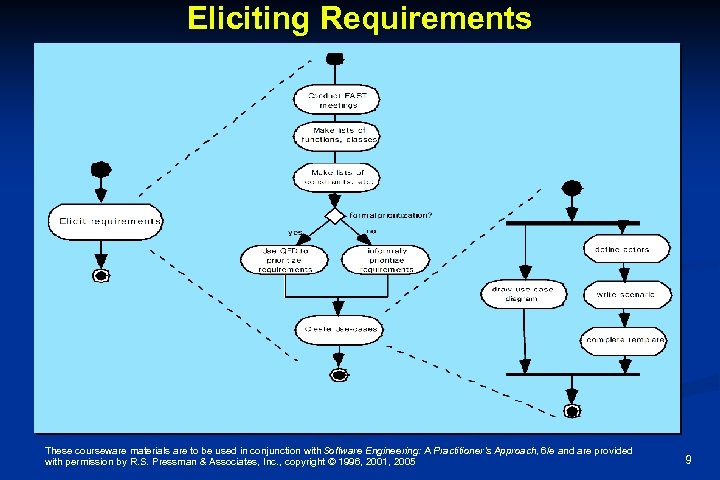 Eliciting Requirements These courseware materials are to be used in conjunction with Software Engineering: A Practitioner’s Approach, 6/e and are provided with permission by R. S. Pressman & Associates, Inc. , copyright © 1996, 2001, 2005 9
 Quality Function Deployment n n Function deployment determines the “value” (as perceived by the customer) of each function required of the system Information deployment identifies data objects and events Task deployment examines the behavior of the system Value analysis determines the relative priority of requirements These courseware materials are to be used in conjunction with Software Engineering: A Practitioner’s Approach, 6/e and are provided with permission by R. S. Pressman & Associates, Inc. , copyright © 1996, 2001, 2005 10
 Elicitation Work Products n n n n a statement of need and feasibility. a bounded statement of scope for the system or product. a list of customers, users, and other stakeholders who participated in requirements elicitation a description of the system’s technical environment. a list of requirements (preferably organized by function) and the domain constraints that apply to each. a set of usage scenarios that provide insight into the use of the system or product under different operating conditions. any prototypes developed to better define requirements These courseware materials are to be used in conjunction with Software Engineering: A Practitioner’s Approach, 6/e and are provided with permission by R. S. Pressman & Associates, Inc. , copyright © 1996, 2001, 2005 11
 Negotiating Requirements n Identify the key stakeholders n n Determine each of the stakeholders “win conditions” n n These are the people who will be involved in the negotiation Win conditions are not always obvious Negotiate n Work toward a set of requirements that lead to “win-win” These courseware materials are to be used in conjunction with Software Engineering: A Practitioner’s Approach, 6/e and are provided with permission by R. S. Pressman & Associates, Inc. , copyright © 1996, 2001, 2005 12
 Validating Requirements-I n n n Is each requirement consistent with the overall objective for the system/product? Have all requirements been specified at the proper level of abstraction? That is, do some requirements provide a level of technical detail that is inappropriate at this stage? Is the requirement really necessary or does it represent an add-on feature that may not be essential to the objective of the system? Is each requirement bounded and unambiguous? Does each requirement have attribution? That is, is a source (generally, a specific individual) noted for each requirement? Do any requirements conflict with other requirements? These courseware materials are to be used in conjunction with Software Engineering: A Practitioner’s Approach, 6/e and are provided with permission by R. S. Pressman & Associates, Inc. , copyright © 1996, 2001, 2005 13
 Validating Requirements-II n n n Is each requirement achievable in the technical environment that will house the system or product? Is each requirement testable, once implemented? Does the requirements model properly reflect the information, function and behavior of the system to be built. Has the requirements model been “partitioned” in a way that exposes progressively more detailed information about the system. Have requirements patterns been used to simplify the requirements model. Have all patterns been properly validated? Are all patterns consistent with customer requirements? These courseware materials are to be used in conjunction with Software Engineering: A Practitioner’s Approach, 6/e and are provided with permission by R. S. Pressman & Associates, Inc. , copyright © 1996, 2001, 2005 14