


 Скачать презентацию Software Developers Conference New York City New York
19e8e58ed58f162159b94104d666f70c.ppt
- Количество слайдов: 74
 Software Developers Conference New York City, New York March 31, 2004
 Welcome and Today’s Agenda • Welcome and Opening Remarks • Data Strategy Update • Common Origination Disbursement (COD) Update • Break • Front End Business Integration (FEBI) Update • Common Services for Borrowers (CSB) Update • Panel of Experts/ Q and A • Schedule Update and Wrap-up Next Conference: August 19 -20, 2004 Marriott Crystal Gateway Arlington, VA
 Data Strategy Update
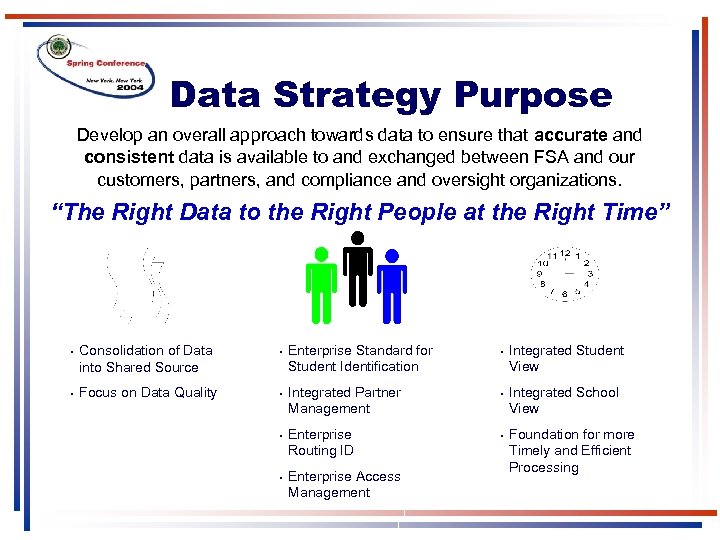 Data Strategy Purpose Develop an overall approach towards data to ensure that accurate and consistent data is available to and exchanged between FSA and our customers, partners, and compliance and oversight organizations. “The Right Data to the Right People at the Right Time” § § Consolidation of Data into Shared Source Focus on Data Quality § § Enterprise Standard for Student Identification Integrated Partner Management Enterprise Routing ID Enterprise Access Management § § § Integrated Student View Integrated School View Foundation for more Timely and Efficient Processing
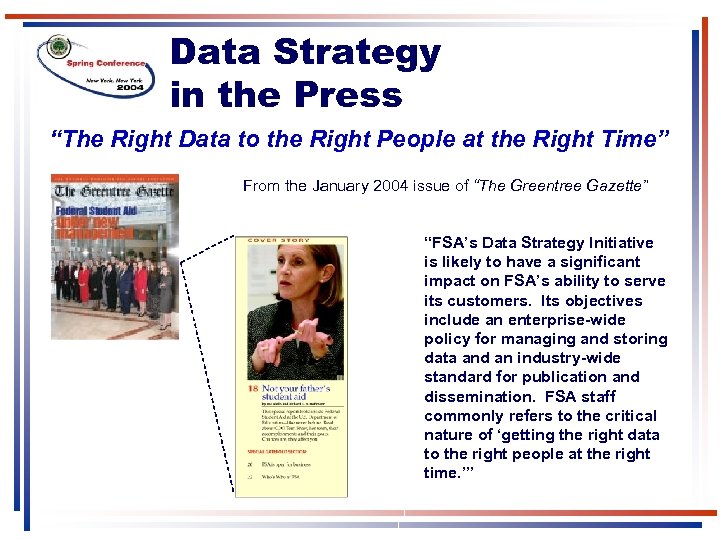 Data Strategy in the Press “The Right Data to the Right People at the Right Time” From the January 2004 issue of “The Greentree Gazette” “FSA’s Data Strategy Initiative is likely to have a significant impact on FSA’s ability to serve its customers. Its objectives include an enterprise-wide policy for managing and storing data and an industry-wide standard for publication and dissemination. FSA staff commonly refers to the critical nature of ‘getting the right data to the right people at the right time. ’”
 Data Strategy Key Findings To Date The Data Strategy teams have confirmed several key findings: § Data should be organized by business process, not by system. § Providing data access to business experts is the key component of improving the enterprises’ ability to make informed business decisions. § Verified that using a Matching Algorithm with SSN, First Name, Last Name, and DOB is the most flexible and tolerant way to identify customers. § Need to develop a single Enterprise solution for all Trading Partner Identification and Access. § “As-Is” Data Flow Discussions have facilitated a broader understanding of End-to-End Business Processes across all FSA program areas.
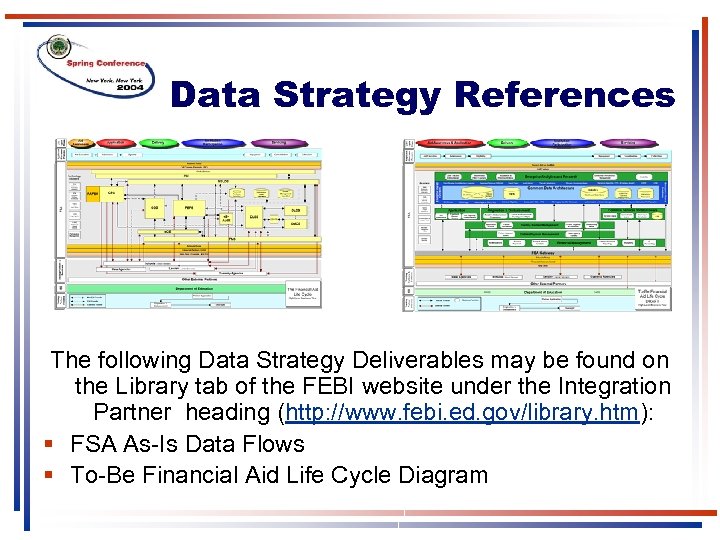 Data Strategy References The following Data Strategy Deliverables may be found on the Library tab of the FEBI website under the Integration Partner heading (http: //www. febi. ed. gov/library. htm): § FSA As-Is Data Flows § To-Be Financial Aid Life Cycle Diagram
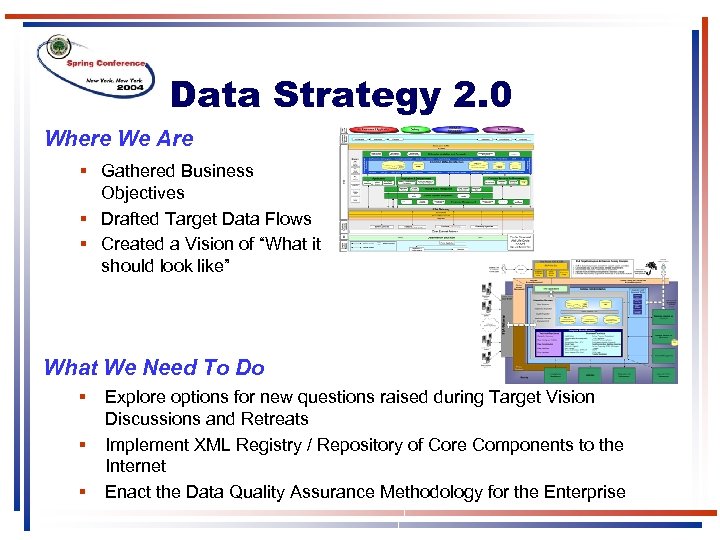 Data Strategy 2. 0 Where We Are § Gathered Business Objectives § Drafted Target Data Flows § Created a Vision of “What it should look like” What We Need To Do § § § Explore options for new questions raised during Target Vision Discussions and Retreats Implement XML Registry / Repository of Core Components to the Internet Enact the Data Quality Assurance Methodology for the Enterprise
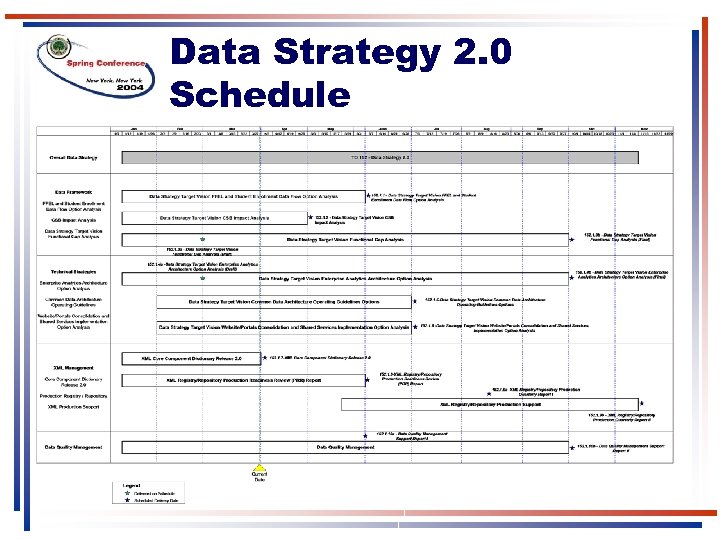 Data Strategy 2. 0 Schedule
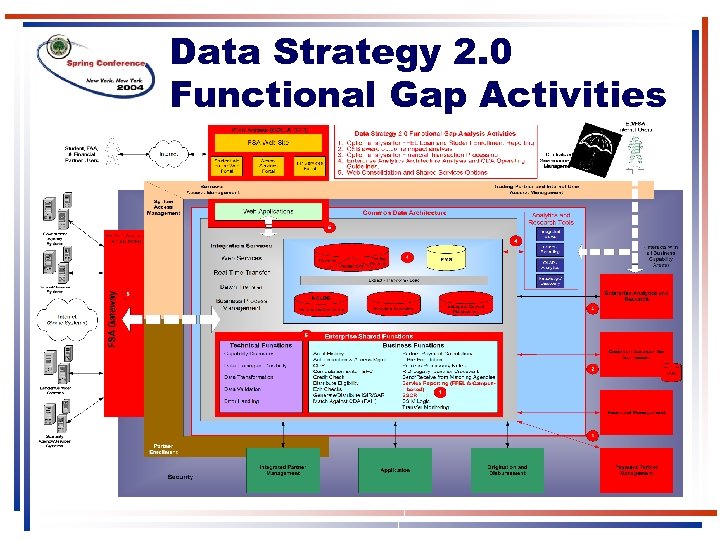 Data Strategy 2. 0 Functional Gap Activities
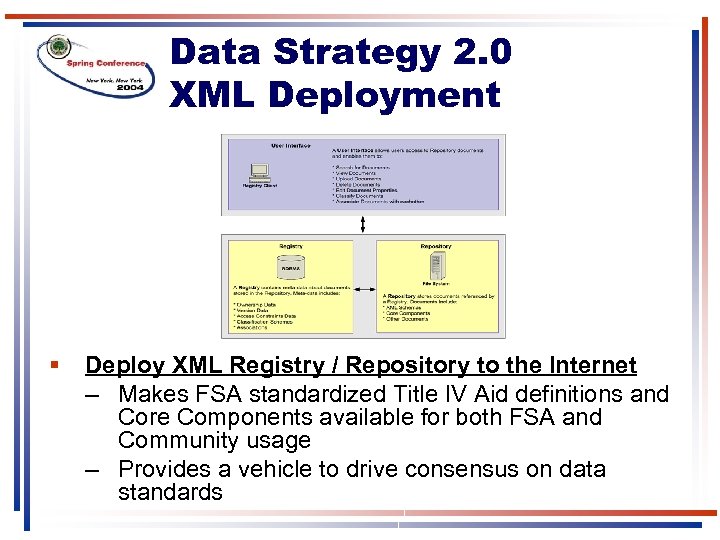 Data Strategy 2. 0 XML Deployment § Deploy XML Registry / Repository to the Internet – Makes FSA standardized Title IV Aid definitions and Core Components available for both FSA and Community usage – Provides a vehicle to drive consensus on data standards
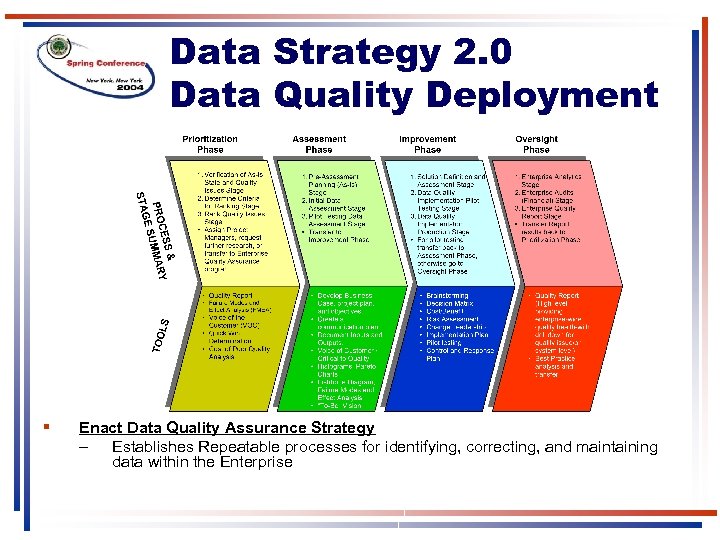 Data Strategy 2. 0 Data Quality Deployment § Enact Data Quality Assurance Strategy – Establishes Repeatable processes for identifying, correcting, and maintaining data within the Enterprise
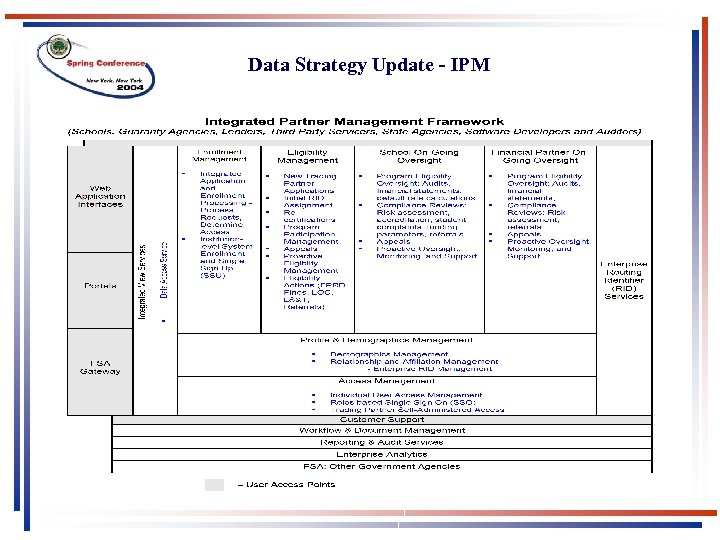
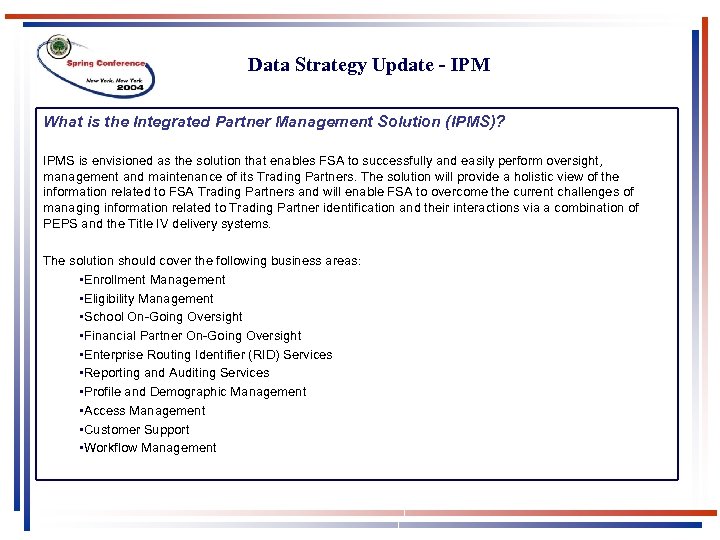 Data Strategy Update - IPM What is the Integrated Partner Management Solution (IPMS)? IPMS is envisioned as the solution that enables FSA to successfully and easily perform oversight, management and maintenance of its Trading Partners. The solution will provide a holistic view of the information related to FSA Trading Partners and will enable FSA to overcome the current challenges of managing information related to Trading Partner identification and their interactions via a combination of PEPS and the Title IV delivery systems. The solution should cover the following business areas: • Enrollment Management • Eligibility Management • School On-Going Oversight • Financial Partner On-Going Oversight • Enterprise Routing Identifier (RID) Services • Reporting and Auditing Services • Profile and Demographic Management • Access Management • Customer Support • Workflow Management
 Data Strategy Update - IPM
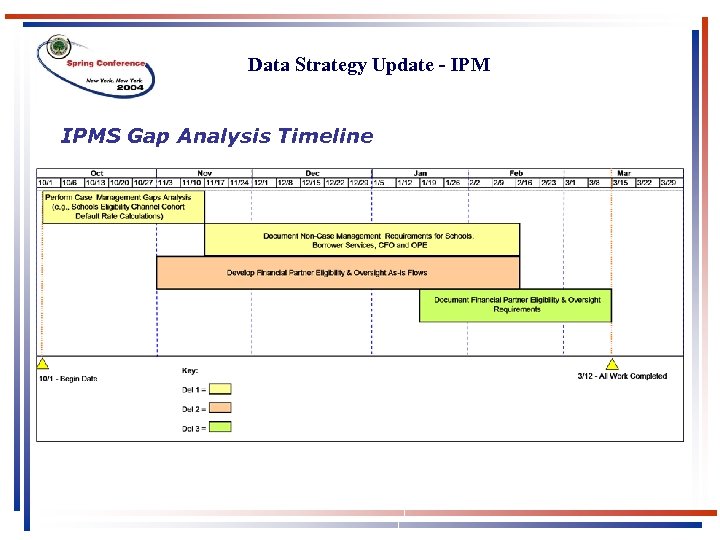 Data Strategy Update - IPMS Gap Analysis Timeline
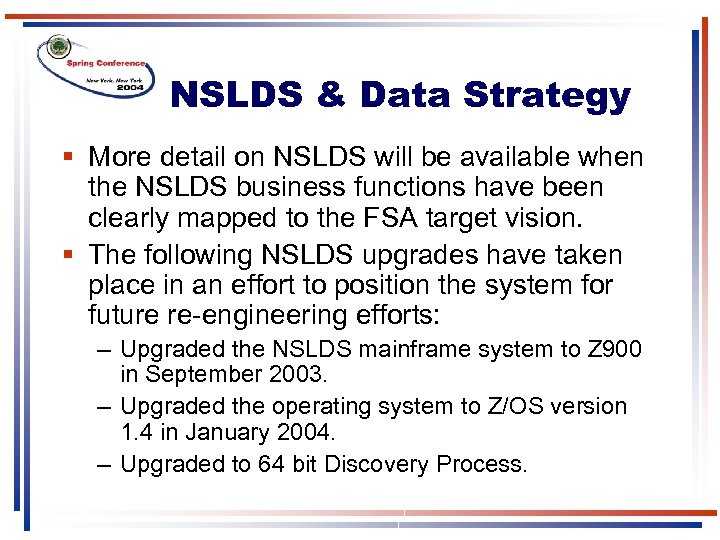 NSLDS & Data Strategy § More detail on NSLDS will be available when the NSLDS business functions have been clearly mapped to the FSA target vision. § The following NSLDS upgrades have taken place in an effort to position the system for future re-engineering efforts: – Upgraded the NSLDS mainframe system to Z 900 in September 2003. – Upgraded the operating system to Z/OS version 1. 4 in January 2004. – Upgraded to 64 bit Discovery Process.
 NSLDS Update § NSLDS announced a new operations and maintenance contractor effective as of March 8, 2004. § The contractor is Applied Engineering Management (AEM), a small business located in Virginia.
 NSLDS Update Consolidation Loans & the Aggregate Calculation § Working with the community through NCHELP. – FFEL community to provide further breakdown of Consolidation Loans – NSLDS to capture Outstanding Principal Balance at time of loan closure or payoff.
 NSLDS Updates Other NSLDS initiatives § To collect data on Total & Permanent Disability Loans § To continue efforts to monitor reasonableness of data reported in summary on ED Forms to the loan level detail reported on NSLDS
 Thank You! Keith Wilson Keith. Wilson@ed. gov 202 -377 -3591
 COD Update
 In this session… § 2004 -2005 Processing Changes § School Testing § Software Developer Feedback
 2004 -2005 Processing Changes
 Summary of 2004 -2005 Processing Changes Pell Grant and Direct Loan Changes § Extended Full Participant deadline to 2005 -2006. § Enhanced Message Class Options for Full Participants. § Increased variable field length on the SAIG Transmission Header.
 Summary of 2004 -2005 Processing Changes Pell Grant Changes § Verification Initiatives – CPS Verification Indicator tag added to Common Record Response – Highest CPS Transaction Number tag added to Common Record Response – Pell Verification Status Report § Pell POP Report (Future Release)
 Summary of 2004 -2005 Processing Changes Pell Grant Changes cont. § Data elements no longer required for Pell Grant processing: – – Academic Calendar Code Payment Methodology Code Weeks of instructional time used to calculate payment Weeks of instructional time in program’s definition of award year – Credit/Clock hours used to calculate payment – Credit/Clock hours in this student’s program of study’s academic year
 Summary of 2004 -2005 Processing Changes Direct Loan Changes § Anticipated disbursement information required when establishing Direct Loan awards. § Automatic recalculation of anticipated disbursements when Award Amount is decreased. § Automatic reduction of anticipated disbursements to allow loan inactivation. § Pennies will not be processed in the Direct Loan Program.
 Summary of 2004 -2005 Processing Changes COD Web Site Changes § Enhanced CPS applicant data search functionality. § Person Information pages allow filtering by award year. § Award Amount Disbursed and Award Amount Approved added to Person Information pages. § Batch Search screens allow filtering by Award Type and Doc Type. § Batch Detail Information page split to display information submitted to COD and information returned by COD.
 Summary of 2004 -2005 Processing Changes COD Web Site Changes § Promissory note search by SSN, MPN ID, or First Name and Date of Birth. § School Summary Financial Information screen reflects information contained in the Direct Loan School Account Statement. § Enhanced disbursement functionality to allow creation of multiple anticipated disbursements when originating an award. § Ability to select Award Year and Program for web navigation. § GAPS Debit Date added to Cash Activity Screen.
 2004 -2005 Processing Changes Update § COD will no longer be instituting the following functionality for the 2004 -2005 award year: – Campus-Based processing – School Report Options via the COD web site § Campus-Based – Due to feedback on the proposed Campus-Based functionality for the 2004 -2005 award year, enhancements to Campus-Based functionality are now being explored. The implementation of Campus-Based processing has been postponed pending further discussion of Campus-Based design requirements. § School Report Options – COD will not be providing enhanced School Report Options. Current COD processing will continue to allow for the selection of limited report delivery, sort, and format options via the web and by contacting Customer Service.
 2004 -2005 Update Current School Report Options Pell Reports § The following reports can be requested via the Pell Data Request link on the COD web site and will be delivered in fixed-length file format via the school’s SAIG mailbox: – – ESOA MRR Pell Reconciliation YTD § The following reports can be viewed on the COD web site in PDF or comma-delimited format by clicking on the Services tab: – Pending Disbursement List Report – Funded Disbursement List Report
 2004 -2005 Update Current School Report Options Direct Loan Reports § The following reports can be displayed on the COD web site by clicking on the Services tab. These reports are automatically sent to the schools SAIG mailbox: – – – 30 Day Warning Report Pending Disbursement List Report Funded Disbursement List Report Duplicate Student Borrower SSN/DOB/Name Change Report § Format and delivery options for the above reports can be modified by accessing the Report Selection link on the School Summary Information Screen. § Format and delivery modifications for the SSN/DOB/Name Change Report must be made by contacting Customer Service.
 XML Schema Processing Original Namespace Convention § For the launch of the 2004 -2005 award year, COD had planned to continue to return the latest XML Schema version, 2. 0 d, in Common Record response documents for all award years. § The XML Schema contains the validation rules of the Common Record document, and also contains specific version information in the “Namespace” attribute. § XML Schema validation is normally performed throughout development and testing of a system to verify system XML output. Typically, XML Schema validation is not performed during production processing. § Since Schema validation is not performed during production, the Namespace attribute should not be edited during production processing. Therefore, updates to the XML Schema Namespace should not influence production processing.
 XML Schema Processing Original Namespace Convention § Prior to the release of the 2004 -2005 award year, COD learned that some vendors were editing the value in the Namespace attribute during production processing. § As a result, some vendors would have had to update their 2003 -2004 award year software in order to continue processing 2003 -2004 responses returned in 2. 0 d. § Therefore, COD has implemented a temporary workaround to enable those vendors to continue processing for the 2003 -2004 award year.
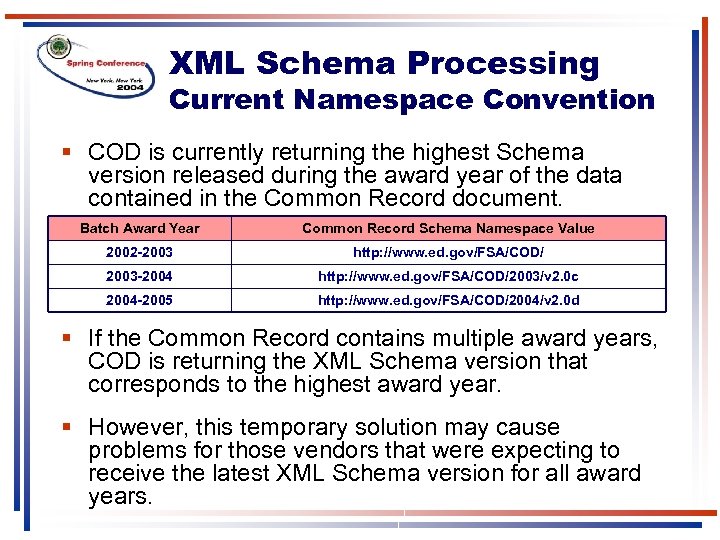 XML Schema Processing Current Namespace Convention § COD is currently returning the highest Schema version released during the award year of the data contained in the Common Record document. Batch Award Year Common Record Schema Namespace Value 2002 -2003 http: //www. ed. gov/FSA/COD/ 2003 -2004 http: //www. ed. gov/FSA/COD/2003/v 2. 0 c 2004 -2005 http: //www. ed. gov/FSA/COD/2004/v 2. 0 d § If the Common Record contains multiple award years, COD is returning the XML Schema version that corresponds to the highest award year. § However, this temporary solution may cause problems for those vendors that were expecting to receive the latest XML Schema version for all award years.
 XML Schema Processing Proposed Namespace Solution § For the 2005 -2006 release, COD is considering returning response documents in the XML Schema version submitted to COD. i. e. “Echo-ing” back what was submitted to COD. § For system-generated responses, COD will return Common Record documents in the latest version of the XML Schema. § This solution will accommodate vendors that are editing on the Namespace value regardless of the value they were expecting to receive. § However, the best method is to not edit the Namespace value.
 School Testing
 COD School Testing § Purpose: – Provide schools, Third-party Servicers, and software vendors an opportunity to test business processes and system software in a low-volume, controlled test environment thereby enabling simpler, faster, and less costly issue identification and resolution – Ease the transmission of production data – Reduce the risk of production problems § School Testing Documentation: – School Testing Guide – Test Cases for both Full and Phase-In Participants – COD 2004 -2005 Technical Reference available on IFAP and FSA Download
 Communicating about School Testing… § COD has increased communication about School Testing to the community using the following forums: – – IFAP COD Processing Updates Web Messages Conference Presentations § The School Testing Bulletin Board has been discontinued due to lack of community interest.
 2003 -2004 Lessons Learned § Based on school and vendor feedback, the following enhancements were made to the 2004 -2005 School Testing Guide in the COD Technical Reference: – Detailed Routing ID explanation – Detailed explanation of ISIR files – Further clarification of the fields contained in the Sign-up Document
 2003 -2004 Lessons Learned § COD is currently investigating whether or not it is possible to provide sample Pell origination files and acknowledgement files, and Direct Loan origination and acknowledgement files. § COD is unable to provide a year round testing environment with testing scenarios. § COD will allow for additional unstructured testing after the COD testing window has closed.
 COD Unstructured Testing § COD is offering unstructured testing to a limited number of 2004 -2005 COD School Testing participants. § Participants interested in unstructured testing must participate in, and complete Phase II test cases prior to participating in unstructured testing.
 COD Unstructured Testing § What can be done in Unstructured Testing? – Update person data, – Updates to awards and award amounts, – Send batches and receive acknowledgements and responses in proper format (Common Record or Fixedlength flat files). § What are the limitations of Unstructured Testing? – – Unknown result expected by school, Unable to provide system-generated responses, Cannot provide COD “testing” web site access, Cannot provide COD reports.
 2004 -2005 COD School Testing Timeline Phase Dates Sign-up Dec. 1, 2003 – May 1, 2004 Phase I-Manual Verification Testing Jan. 1, 2004 – May 31, 2004 Phase II-Structured Application Testing Mid-March 2004 - June 30, 2004 Unstructured Testing Mid-March 2004 - June 30, 2004
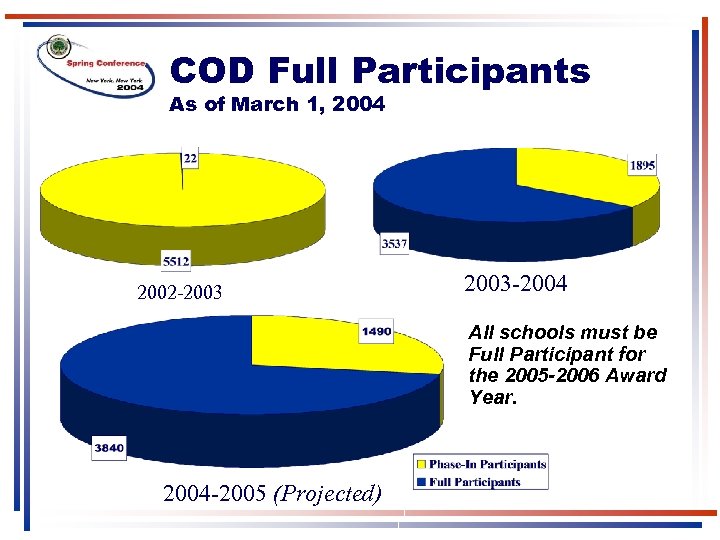 COD Full Participants As of March 1, 2004 2002 -2003 -2004 All schools must be Full Participant for the 2005 -2006 Award Year. 2004 -2005 (Projected)
 Software Developer Feedback
 Contact Us!! § Email: CODSupport@acs-inc. com § Call the COD School Relations Center – 1 -800 -4 -PGRANT for Pell Grants – 1 -800 -848 -0978 for Direct Loans § COD Web Site (www. cod. ed. gov)
 Overview of FEBIFront End Business Integration March 31, 2004
 Agenda § § § FEBI Objectives Approach to FEBI Accomplishments Market Research FEBI Procurement Timeline Next Steps
 FEBI Objectives § Create a student-centric business model that supports the needs of the end-toend business process § Align products and services across the Front End assure that they effectively and efficiently serve customer needs § Integrate student/applicant customer service capability, including the capturing of customer service data such that we can improve our products and services § Share services across the enterprise such as imaging and fulfillment § Operationalize ways to use technology to simplify the application process and customer experience (e. g. , warm transfer capability between customer interaction centers, web services, and identity management) § Streamline and simplify of the application and origination and disbursement delivery systems including reusable components that support FSA data strategy § Effectively provide technical help desk services § Simplify processes for business partners (improve interfaces with institutions and other FSA systems such that schools can provide aid on our behalf) § Establish performance measures that ensure demonstrable outcomes
 Approach to FEBI § Identify front end business processes § Understand interdependencies between this initiative and other integration activities in FSA § Conduct market research § Develop Vision and Target State § Develop acquisition strategy § Release Statement of Objectives
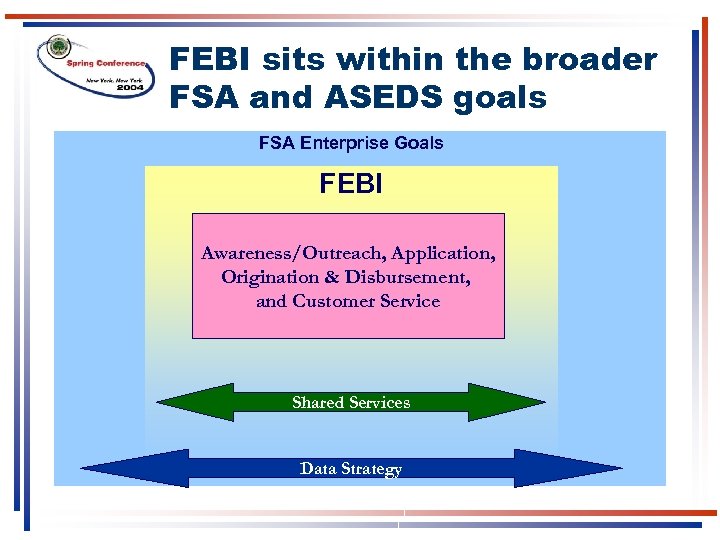 FEBI sits within the broader FSA and ASEDS goals FSA Enterprise Goals FEBI Awareness/Outreach, Application, Origination & Disbursement, and Customer Service Shared Services Data Strategy
 FEBI Accomplishments § Defined FE business processes § Identified activities associated with the FE – Focused on shared services and shared data § Synced up with Data Strategy efforts – Validated common data between Awareness/Application and Origination/Disbursement § Refined FEBI objectives § Developed FEBI market research strategy § Conducted market research sessions and developed learnings/best practices matrix § Released draft Statement of Objectives to vendor community as ongoing market research
 Market Research § Defined MR Objectives in the areas of Business Process, Performance, and Technology for: – Application, Origination, and Disbursement – Customer Service – Shared Services § Developed profiles for 51 organizations: 33 providers, 18 users, 41 commercial sector companies and 27 organizations that operate in commercial and/or government § Developed a prioritization formula and refined weights until a usable dispersion of company scores was achieved § Of the 21 organizations we contacted, we are able to conduct interviews with 13 § Conducted MR Sessions § Documented MR Learnings
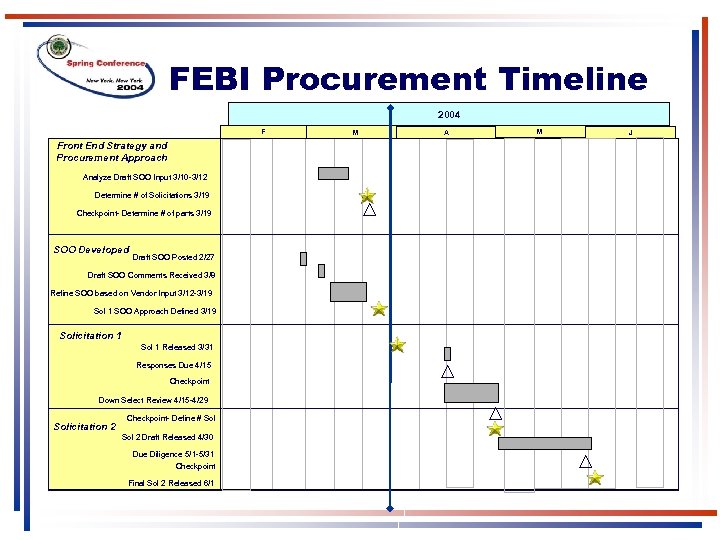 FEBI Procurement Timeline 2004 F Front End Strategy and Procurement Approach Analyze Draft SOO Input 3/10 -3/12 Determine # of Solicitations 3/19 Checkpoint- Determine # of parts 3/19 SOO Developed Draft SOO Posted 2/27 Draft SOO Comments Received 3/8 Refine SOO based on Vendor Input 3/12 -3/19 Sol 1 SOO Approach Defined 3/19 Solicitation 1 Sol 1 Released 3/31 Responses Due 4/15 Checkpoint Down Select Review 4/15 -4/29 Solicitation 2 Checkpoint- Define # Sol 2 Draft Released 4/30 Due Diligence 5/1 -5/31 Checkpoint Final Sol 2 Released 6/1 M A M J
 Next Steps § Solicitation 1 – Release 3/31/04 § Solicitation 2 – Release on or about 6/1/04 § Award – 9/30/04
 Thank You! Michele Brown michele. brown@ed. gov 202 -377 -3703
 - CSB Common Services for Borrowers Dwight Vigna Acting Director, Direct Loan Servicing System
 Common Services for Borrowers (CSB) Agenda § CSB Overview § CSB – An innovative contract method § Implementation Approach § Benefits to Schools § Summary
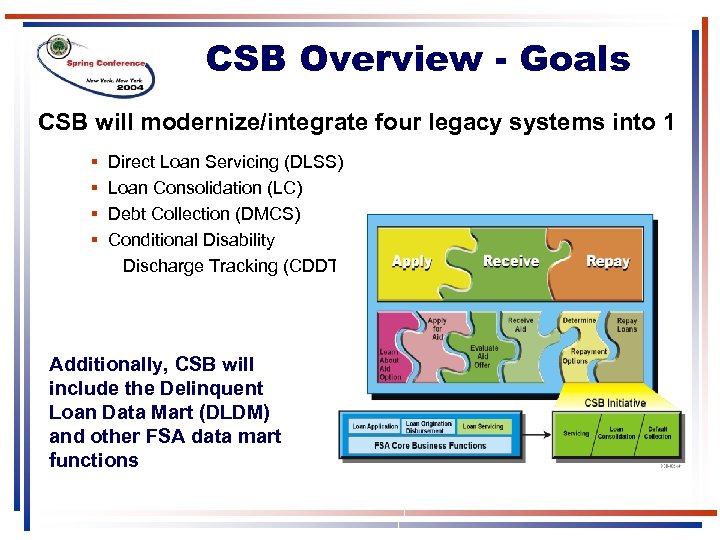 CSB Overview - Goals CSB will modernize/integrate four legacy systems into 1 § § Direct Loan Servicing (DLSS) Loan Consolidation (LC) Debt Collection (DMCS) Conditional Disability Discharge Tracking (CDDTS) Additionally, CSB will include the Delinquent Loan Data Mart (DLDM) and other FSA data mart functions
 CSB Overview - Goals § Integration will achieve the following: – Reduce Delinquency and Default • Performance based pricing • Incentive based and – Improve Customer Service and Increase Self-Servicing • Additional Web access • Improved IVR functionality • Reengineered communications – Integrate Systems and Data • Less data redundancy and associated errors • Improved auditability – Create Adaptability and Flexibility in the CSB System – Reduce Cost – Achieve Contracting Goals
 CSB Contract Approach § A “performance-based” contract – Focus on expected results/outcomes – Comply with statute and regulations – More flexibility for contractor – Reduction in Reconciliation and System Balancing Point – Reduce Staffing at Call Centers, Other Locations – Reduce Infrastructure • Consolidates 6 call centers into 1 Virtual Service Center • Consolidates 6 inbound mailrooms into 1 • Consolidates 7 fulfillment (print and mail) centers into 4 • Consolidates 3 lockboxes into 1 § Independent Government Cost Estimate: - $1 Billion in savings to taxpayers -
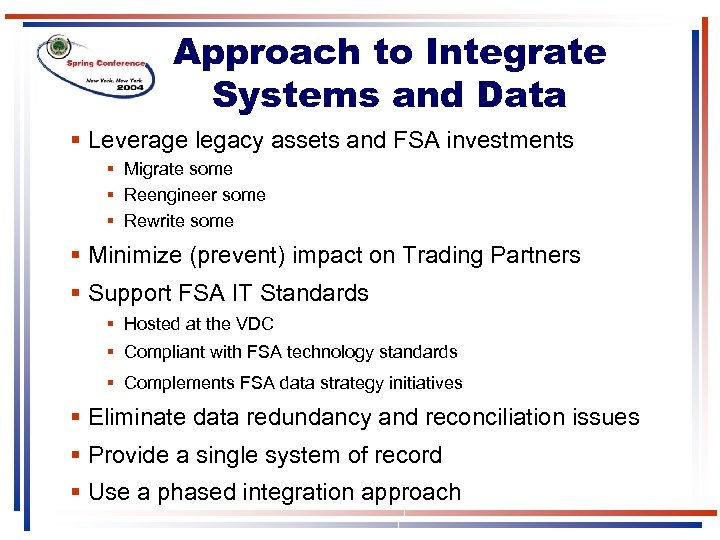 Approach to Integrate Systems and Data § Leverage legacy assets and FSA investments § Migrate some § Reengineer some § Rewrite some § Minimize (prevent) impact on Trading Partners § Support FSA IT Standards § Hosted at the VDC § Compliant with FSA technology standards § Complements FSA data strategy initiatives § Eliminate data redundancy and reconciliation issues § Provide a single system of record § Use a phased integration approach
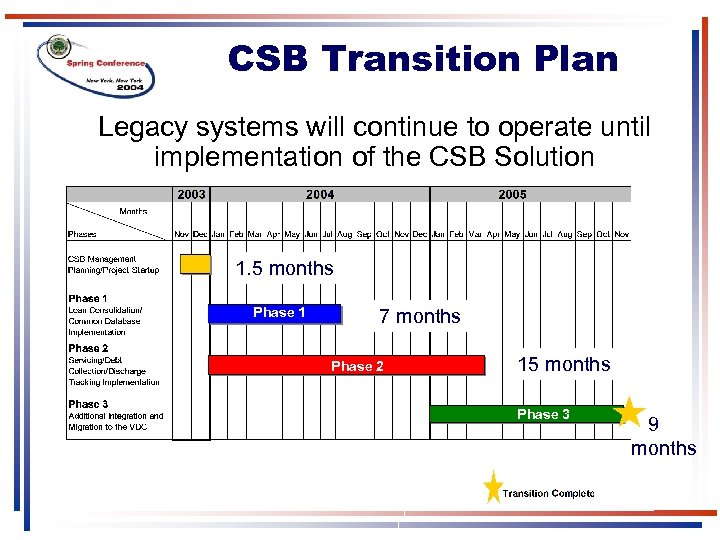 CSB Transition Plan Legacy systems will continue to operate until implementation of the CSB Solution 1. 5 months Phase 1 7 months Phase 2 15 months Phase 3 9 months
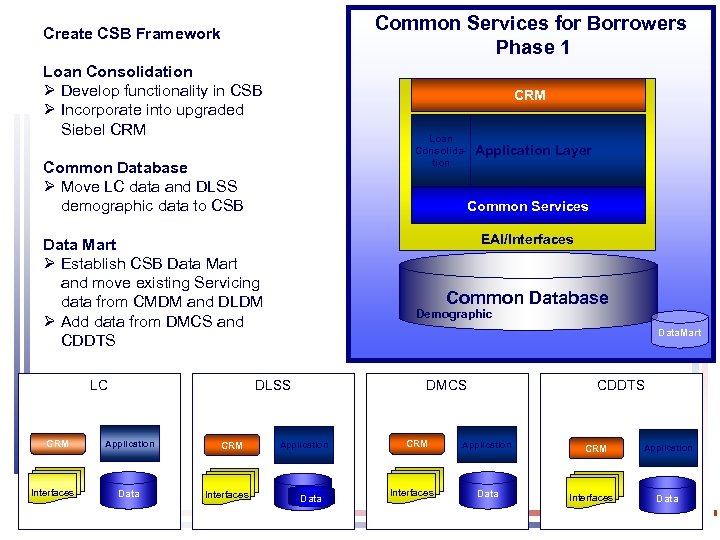 Common Services for Borrowers Phase 1 Create CSB Framework Loan Consolidation Ø Develop functionality in CSB Ø Incorporate into upgraded Siebel CRM Loan Consolidation Common Database Ø Move LC data and DLSS demographic data to CSB Common Services EAI/Interfaces Data Mart Ø Establish CSB Data Mart and move existing Servicing data from CMDM and DLDM Ø Add data from DMCS and CDDTS LC CRM Interfaces Common Demographic | Demographic Data CRM Interfaces Database Data. Mart DLSS Application Layer DMCS Application Data CRM Interfaces CDDTS Application Data CRM Interfaces Application Data
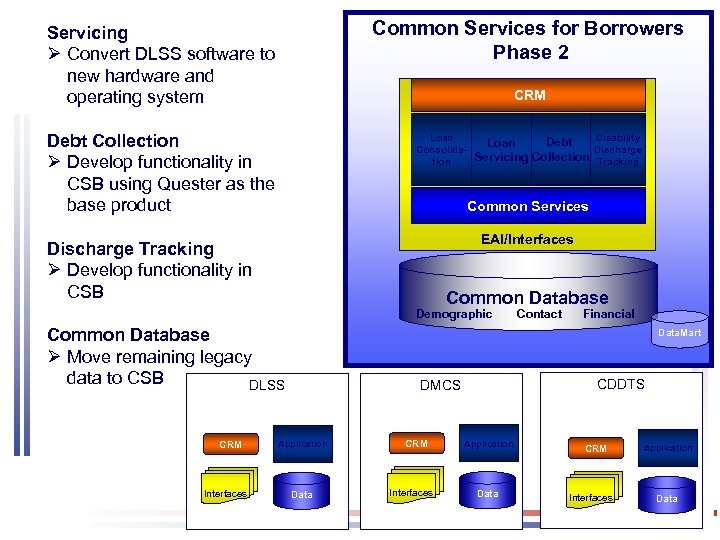 Common Services for Borrowers Phase 2 Servicing Ø Convert DLSS software to new hardware and operating system CRM Debt Collection Ø Develop functionality in CSB using Quester as the base product Disability Loan Debt Loan Consolida- Application Layer Discharge Servicing Collection Tracking tion Common Services EAI/Interfaces Discharge Tracking Ø Develop functionality in CSB Common Demographic | Database Demographic Contact Financial Common Database Ø Move remaining legacy data to CSB DLSS CRM Interfaces Data. Mart CDDTS DMCS Application Data CRM Interfaces Application Data
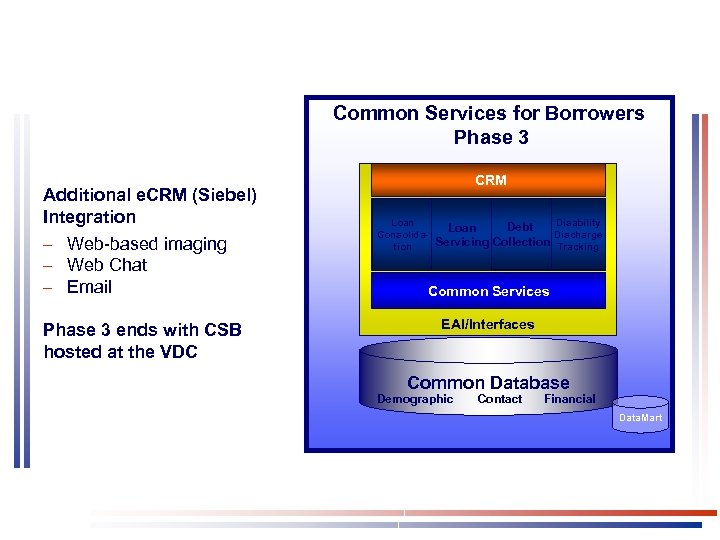 Common Services for Borrowers Phase 3 Additional e. CRM (Siebel) Integration – Web-based imaging – Web Chat – Email Phase 3 ends with CSB hosted at the VDC CRM Disability Loan Debt Loan Consolida- Application Layer Discharge Servicing Collection Tracking tion Common Services EAI/Interfaces Common Demographic | Database Demographic Contact Financial Data. Mart
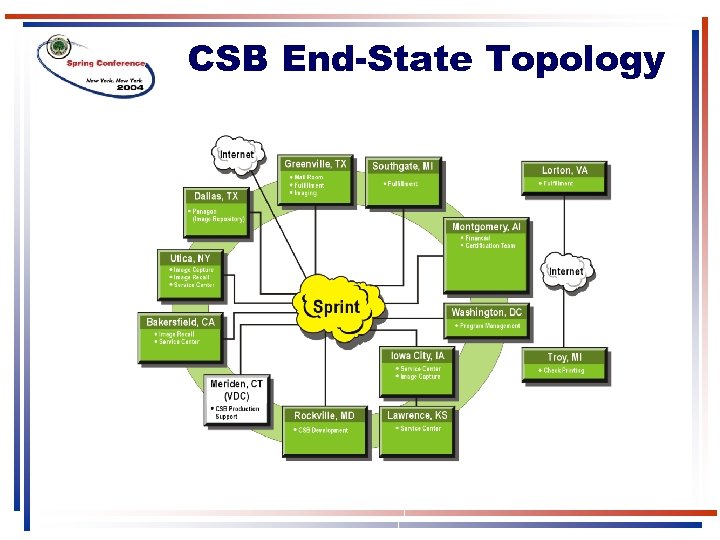 CSB End-State Topology
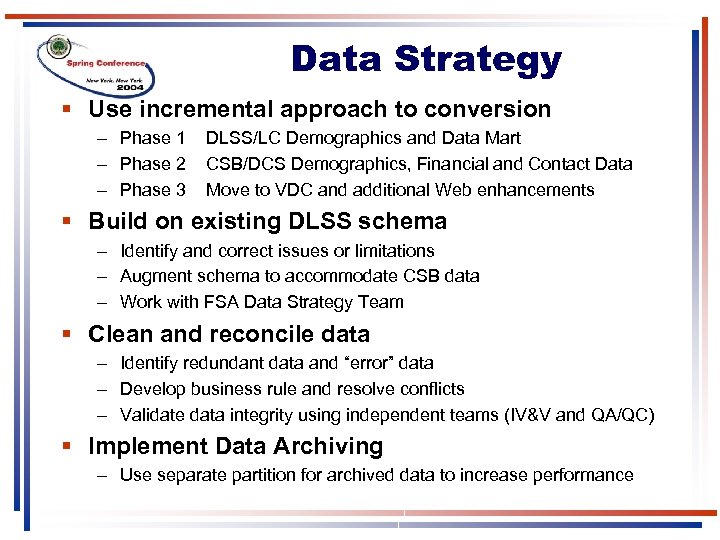 Data Strategy § Use incremental approach to conversion – Phase 1 – Phase 2 – Phase 3 DLSS/LC Demographics and Data Mart CSB/DCS Demographics, Financial and Contact Data Move to VDC and additional Web enhancements § Build on existing DLSS schema – Identify and correct issues or limitations – Augment schema to accommodate CSB data – Work with FSA Data Strategy Team § Clean and reconcile data – Identify redundant data and “error” data – Develop business rule and resolve conflicts – Validate data integrity using independent teams (IV&V and QA/QC) § Implement Data Archiving – Use separate partition for archived data to increase performance
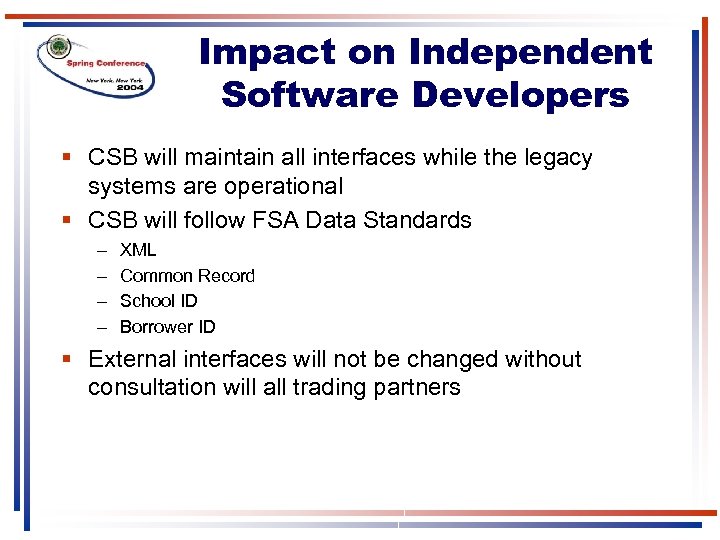 Impact on Independent Software Developers § CSB will maintain all interfaces while the legacy systems are operational § CSB will follow FSA Data Standards – – XML Common Record School ID Borrower ID § External interfaces will not be changed without consultation will all trading partners
 Summary § CSB integrates processes, data and systems for Servicing, Consolidation, Collections, and Disability Discharge § CSB Contract Team comprised of familiar faces that have been supporting FSA for a combined total of over 30 years § CSB Solution supports FSA’s Performance Objectives and IT Standards § CSB is a Performance-based contract which helps ensure optimum results § CSB saves taxpayers money
 Questions? ? ? Thank You! Dan Hayward Dan. Hayward@ed. gov 202 -377 -3207
 Questions and Answers
 Thank You! Jerry Schubert Jerry. Schubert@ed. gov 202 -377 -3009