


 Скачать презентацию Software Design and Architecture Nour El Kadri Summer
3cfdafee889a6b95d970d269f505cfff.ppt
- Количество слайдов: 26
 Software Design and Architecture Nour El Kadri Summer 2005 Architecture SEG 3202 1
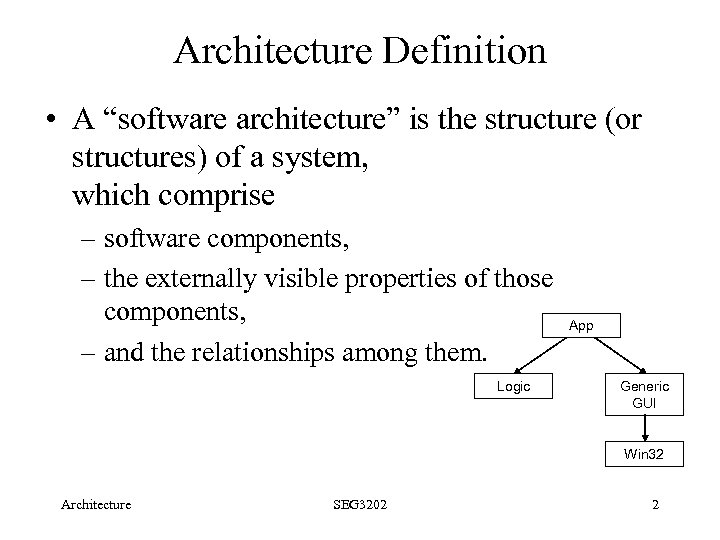 Architecture Definition • A “software architecture” is the structure (or structures) of a system, which comprise – software components, – the externally visible properties of those components, – and the relationships among them. Logic App Generic GUI Win 32 Architecture SEG 3202 2
 Components & Structures • Architecture defines “components” – an abstraction – suppresses details not pertinent to its interactions with other components • An architecture comprises more than one structure • modular structure (calls/uses) • process structure (invokes, communicates with, synchronises with) • physical structure (libraries, DLL’s, processors) • inheritance structures (inherits) • … Architecture SEG 3202 3
 In Practice • Divide into two levels: – System-Level Architecture – Programming-Level Design [User Interface – Sometimes also referred to as “design” (or even “architecture”) – Different topic. Not covered in this course. ] Architecture SEG 3202 4
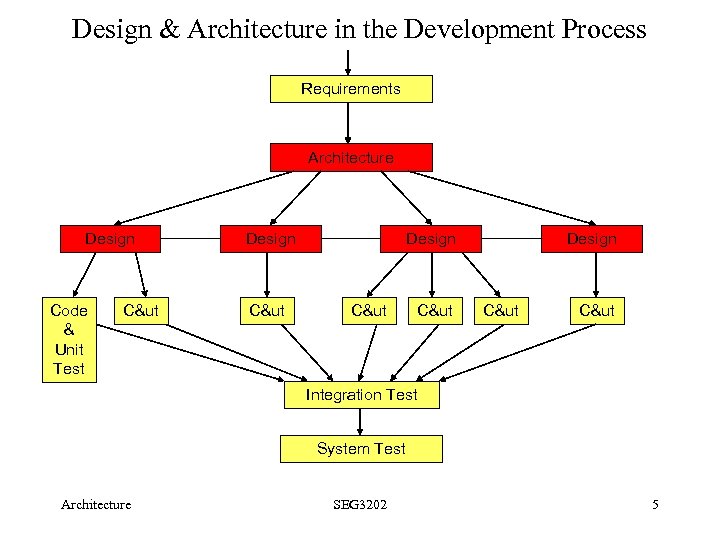 Design & Architecture in the Development Process Requirements Architecture Design Code & Unit Test C&ut Design C&ut Integration Test System Test Architecture SEG 3202 5
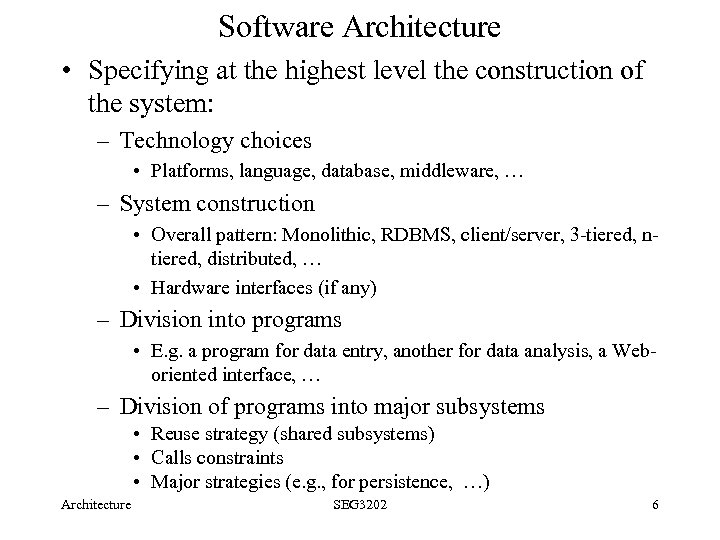 Software Architecture • Specifying at the highest level the construction of the system: – Technology choices • Platforms, language, database, middleware, … – System construction • Overall pattern: Monolithic, RDBMS, client/server, 3 -tiered, ntiered, distributed, … • Hardware interfaces (if any) – Division into programs • E. g. a program for data entry, another for data analysis, a Weboriented interface, … – Division of programs into major subsystems • Reuse strategy (shared subsystems) • Calls constraints • Major strategies (e. g. , for persistence, …) Architecture SEG 3202 6
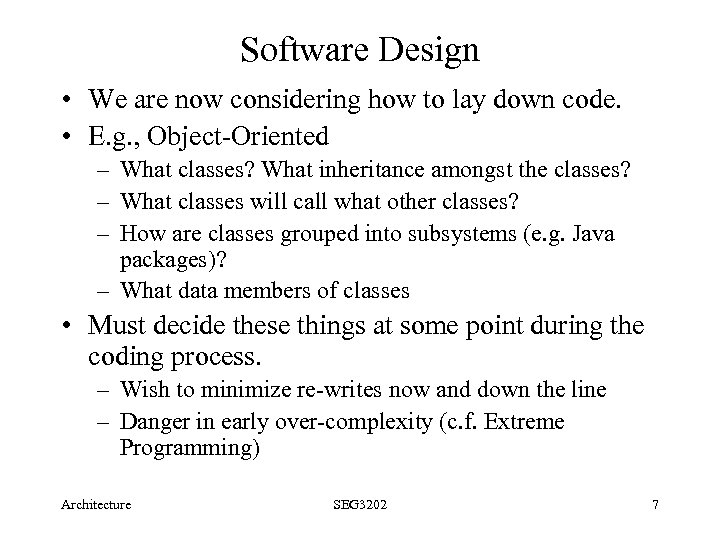 Software Design • We are now considering how to lay down code. • E. g. , Object-Oriented – What classes? What inheritance amongst the classes? – What classes will call what other classes? – How are classes grouped into subsystems (e. g. Java packages)? – What data members of classes • Must decide these things at some point during the coding process. – Wish to minimize re-writes now and down the line – Danger in early over-complexity (c. f. Extreme Programming) Architecture SEG 3202 7
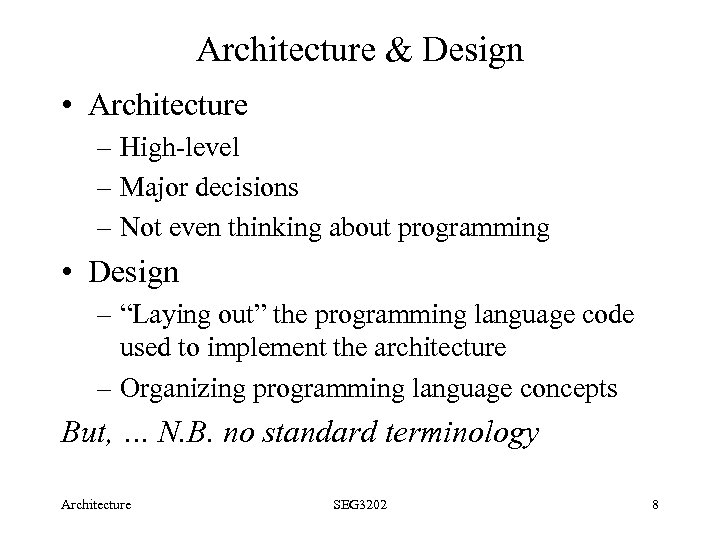 Architecture & Design • Architecture – High-level – Major decisions – Not even thinking about programming • Design – “Laying out” the programming language code used to implement the architecture – Organizing programming language concepts But, … N. B. no standard terminology Architecture SEG 3202 8
 Documentation of an Architecture • Golden Rule of Software Development: – If it’s not reviewable (written down), it doesn’t exist. • Architectures sometime suffer from over-elaborate documentation – Unnecessary. Simply document your decisions. – Most systems don’t deserve elaborate architectural documentation • Dealing with unknowns – Indicate they are unknown for the present – Cycle back later and add new decisions taken – But beware of costs of postponing decisions • Must religiously keep architecture document up-to-date – Very hard to do in practice: takes effort – Therefore keep it simple as possible (but no simpler) Architecture SEG 3202 9
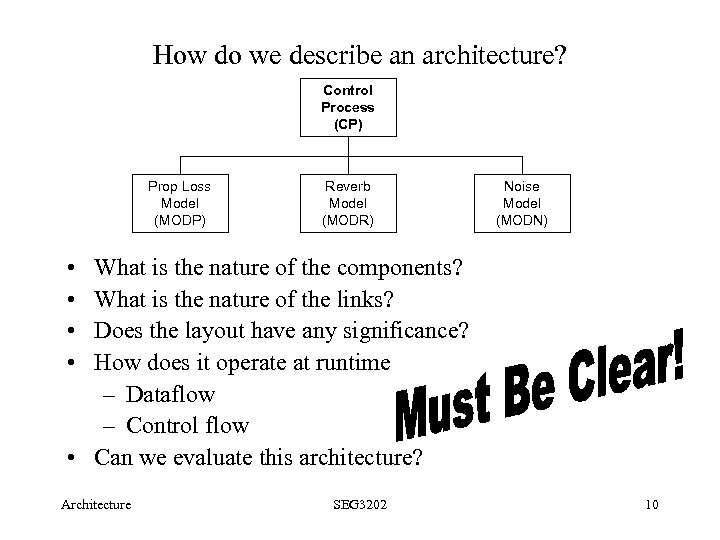 How do we describe an architecture? Control Process (CP) Prop Loss Model (MODP) Reverb Model (MODR) Noise Model (MODN) • • What is the nature of the components? What is the nature of the links? Does the layout have any significance? How does it operate at runtime – Dataflow – Control flow • Can we evaluate this architecture? Architecture SEG 3202 10
 Two Main Architectural Structures • Modular structure – Purely static – Disappears at run-time • Structures that survive through execution – E. g. , pipes, processes, networks, objects, … • Both views need to be considered (not the same) Architecture SEG 3202 11
 The Essence of the Architecture Document • Imagine after the system has been built attempting to describe as cogently and in as compact a form as possible how the system has been put together. • Be utterly clear • you only have an hour in which to do it. • your target audience is knowledgeable professionals in the field, but unfamiliar with the domain. • They will wish to evaluate your choices Architecture SEG 3202 12
 Documentation of a Design • UML (Unified Modeling Language) – Expresses OO design using diagrammatic notation – Complete UML for a typical system is very large. – A selection must be made for presentation • • Choose the most illuminating parts Simplify w. r. t. the actual code Divide into small sections (< 1 page) Add written text to describe the whys and wherefores. • Danger of UML and code getting out of synch over time – Automated tools to keep the two in-synch • E. g. , Rational Rose – Problem with these tools: • • Not literate Don’t work as well as we would want, cumbersome to use Eliding detail is difficult, simplifying (lying) is difficult Selection of parts for presentation is primitive • Strive to explain (in writing) your choices to another programmer Architecture SEG 3202 13
 Documentation • Architecture – Informal diagrams – Written explanations – Bullet points • Design – Formal UML – Reflects and in-synch with program structure – Simplify and divide into small chunks for presentation – Add written explanations. Architecture SEG 3202 14
 The Waterfall Model • Requirements → Architecture → Design → Code → Test – Variations: Spiral, prototyping, … • All will have architecture and design artefacts • Dave Parnas: “A Rational Design Process: How and when to fake it” – Not important that the steps are followed in this order – Only important that after the fact, there are documents that make it appear as though the process was followed in that order. Architecture SEG 3202 15
 Documentation In Practice • As much requirements as you can manage without getting bogged down. • As much architecture as you can manage without getting bogged down • Some design • Some code • More design • More code • Refine architecture • Fix requirements • … Architecture SEG 3202 16
 Why is architecture important? • Manifests early design decision – most difficult to get correct and hardest to change – defines constraints on the implementation – inhibits or enables quality attributes • Defines a work-breakdown structure – organization (especially important for long-distance development) – estimation • A vehicle for stakeholder communication – an architecture is the earliest artefact that enables the priorities among competing concerns to be analysed • Reviewable – architectural errors are vastly more expensive to fix once a system has been coded – Can serve as a basis for training new developers – As an indication of progress Architecture SEG 3202 17
 Why is design important? • When dealing with ~100 s of packages and ~1000 s of classes, coders lose sight of the forest for the trees. – Leads to designs that are muddled and inconsistent • Buggy, requiring constant re-work • Long learning curve for new developers • Hard to fix bugs – Long time to debug, lots of code to fix, introduce new bugs • Hard to change – Lots of time to figure out how to change, lots of code to change, introduce lots of new bugs • Higher-level design descriptions lead to better designs – Can grasp the design at its essence and in its entirety – Can review and correct early • Can be used to leverage the skills and experience of better designers across many developers Architecture SEG 3202 18
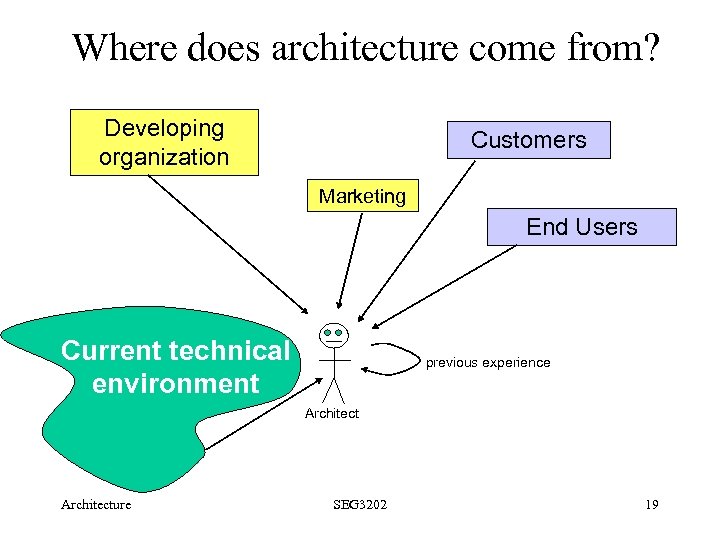 Where does architecture come from? Developing organization Customers Marketing End Users Current technical environment previous experience Architecture SEG 3202 19
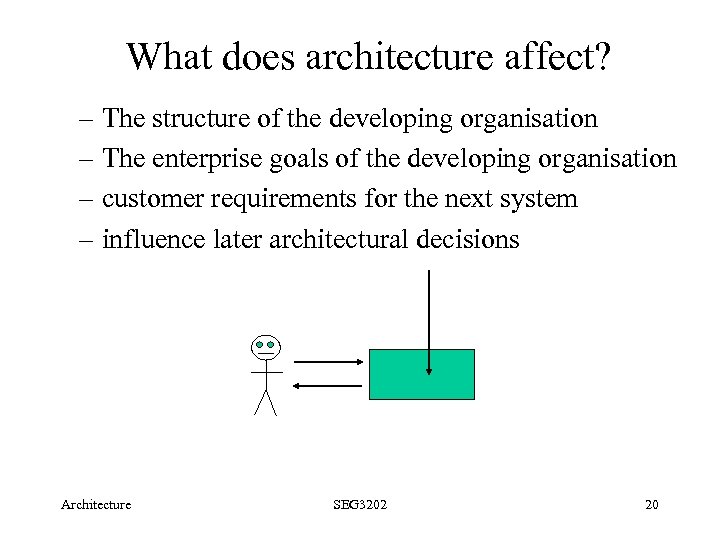 What does architecture affect? – The structure of the developing organisation – The enterprise goals of the developing organisation – customer requirements for the next system – influence later architectural decisions Architecture SEG 3202 20
 Architecture process steps • • • create the business case understand the requirements create the architecture represent and communicate the architecture evaluate the architecture implement based on the architecture – ensuring conformance • enhance/maintain based on the architecture – ensuring conformance Architecture SEG 3202 21
 Functionality & Quality Attributes • Functionality usually takes 1 st place during development. • Systems are more frequently re-designed not because they are functionally deficient, but rather because – – – They are difficult to maintain Difficult to port Won’t scale Too slow Too insecure Not fault tolerant Architecture SEG 3202 22
 System Qualities • Observable via execution – Performance – Security – Availability • Reliability = mttf = mean time to failure • Availability = mttf/(mttf + time to repair) – Functionality – Usability • Not observable via execution – – – Modifiability Portability Reusability Integrability Testability Architecture SEG 3202 23
 Business Qualities – Time-to-market – Cost – Projected lifetime – Target market – Rollout schedule – Use of legacy systems Architecture SEG 3202 24
 Architectural Qualities • • Conceptual integrity Correctness Completeness Buildability – Completed by available team in a timely manner Architecture SEG 3202 25
 Architectural Means of Achieving Quality • Two questions – What structure shall I employ to • • Assign workers Derive a work breakdown Exploit pre-packaged components Plan for modification – What structure shall I employ so that the system, at runtime, fulfills its behavioral and quality attributes. Architecture SEG 3202 26