


 Скачать презентацию Software Cost and Schedule Estimation Dr Harry R
d7d22491e2650df60ed9db8ea107a36e.ppt
- Количество слайдов: 26
 Software Cost and Schedule Estimation Dr. Harry R. Erwin University of Sunderland
 The Problems • Predicting software cost • Predicting software schedule • Controlling software risk
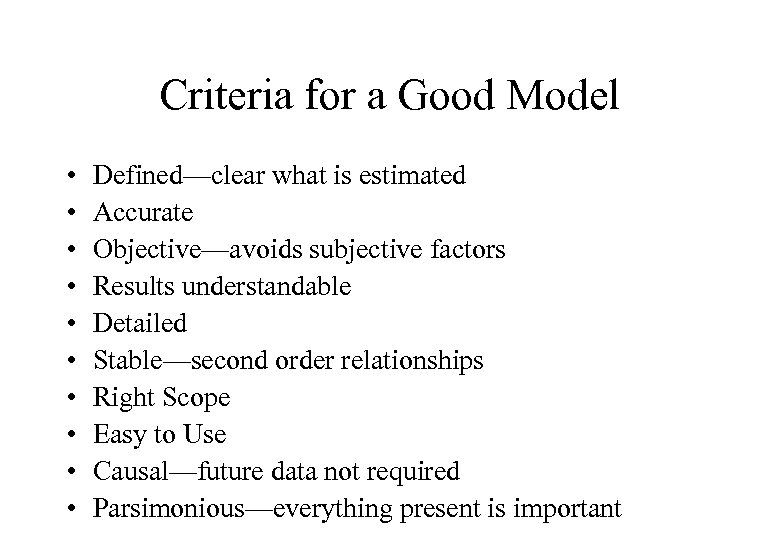 Criteria for a Good Model • • • Defined—clear what is estimated Accurate Objective—avoids subjective factors Results understandable Detailed Stable—second order relationships Right Scope Easy to Use Causal—future data not required Parsimonious—everything present is important
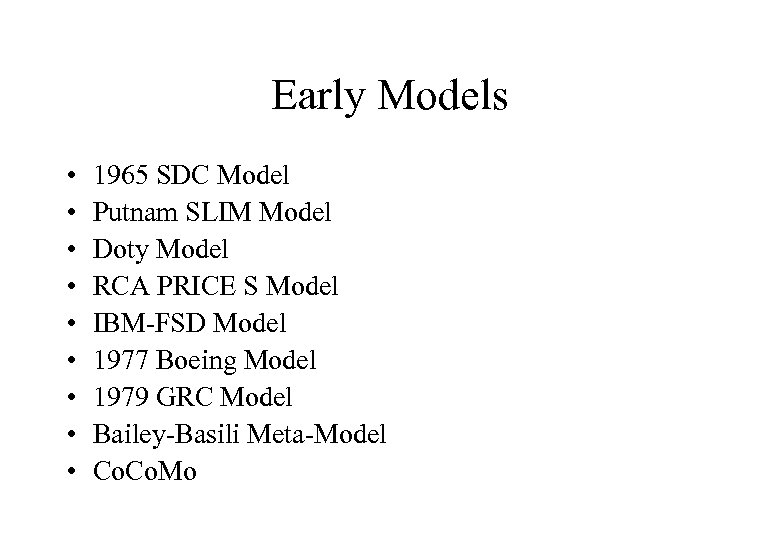 Early Models • • • 1965 SDC Model Putnam SLIM Model Doty Model RCA PRICE S Model IBM-FSD Model 1977 Boeing Model 1979 GRC Model Bailey-Basili Meta-Model Co. Mo
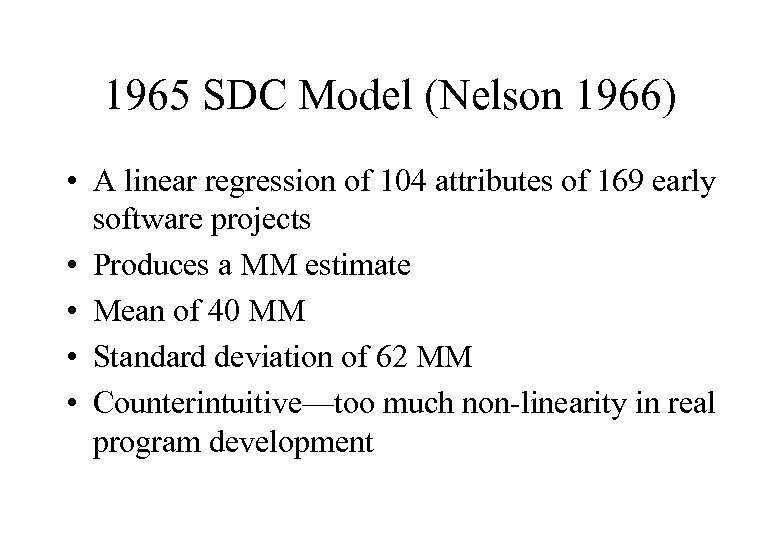 1965 SDC Model (Nelson 1966) • A linear regression of 104 attributes of 169 early software projects • Produces a MM estimate • Mean of 40 MM • Standard deviation of 62 MM • Counterintuitive—too much non-linearity in real program development
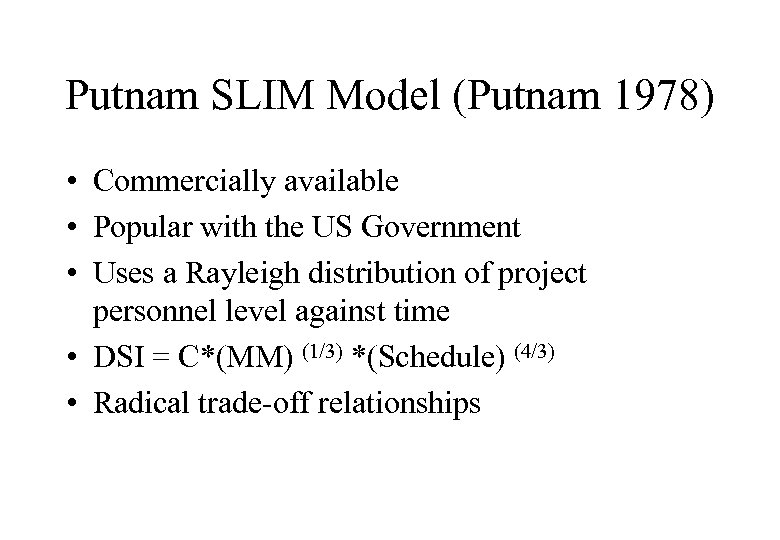 Putnam SLIM Model (Putnam 1978) • Commercially available • Popular with the US Government • Uses a Rayleigh distribution of project personnel level against time • DSI = C*(MM) (1/3) *(Schedule) (4/3) • Radical trade-off relationships
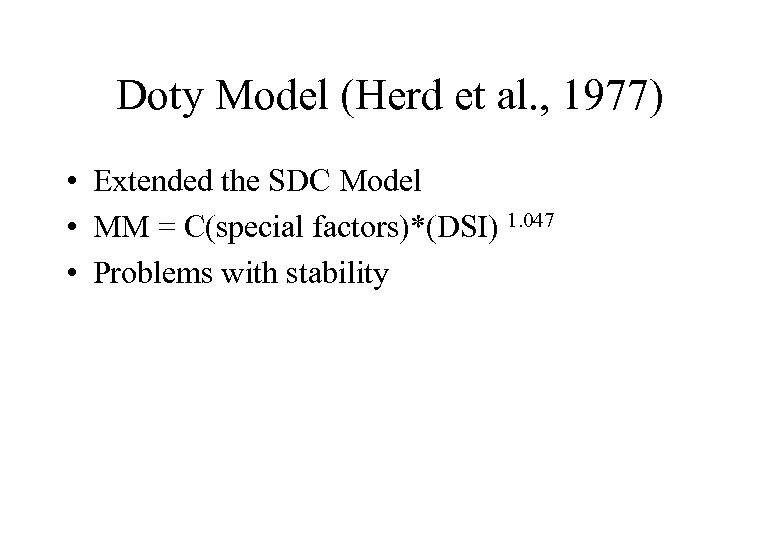 Doty Model (Herd et al. , 1977) • Extended the SDC Model • MM = C(special factors)*(DSI) 1. 047 • Problems with stability
 RCA PRICE S Model (Freiman. Park, 1979) • Commercially available • Aerospace applications • Similar to Co. Mo (see below)
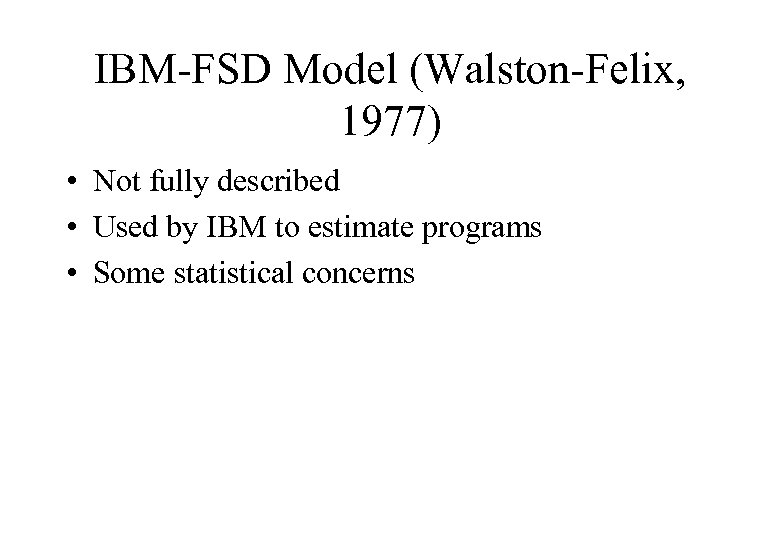 IBM-FSD Model (Walston-Felix, 1977) • Not fully described • Used by IBM to estimate programs • Some statistical concerns
 1977 Boeing Model (Black et al. , 1977) • Similar to Co. Mo, but simpler • Out of use • Poor estimates
 1979 GRC Model (Carriere. Thibodeau, 1979) • Limited information available • Obvious typos and mistakes
 Bailey-Basili Meta-Model (Bailey. Basili, 1981) • Rigorous statistical analysis of factors and size. • Not much experience
 Co. Mo • Waterfall Model • Can be adapted to other models • Estimates: – – – – Requirements analysis Product design Programming Test planning Verification and validation Project office CM and QA Documentation
 Where to Find Co. Mo • http: //sunset. usc. edu/index. html • Or do a Google search on Barry Boehm.
 Nature of Estimates • Man Months (or Person Months), defined as 152 man-hours of direct-charged labor • Schedule in months (requirements complete to acceptance) • Well-managed program
 Input Data • Delivered source instructions (DSI) • Various scale factors: – Experience – Process maturity – Required reliability – Complexity – Developmental constraints
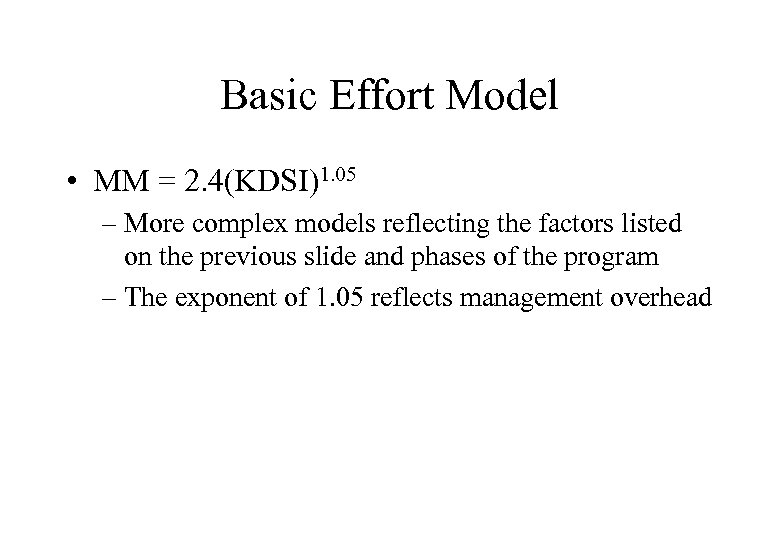 Basic Effort Model • MM = 2. 4(KDSI)1. 05 – More complex models reflecting the factors listed on the previous slide and phases of the program – The exponent of 1. 05 reflects management overhead
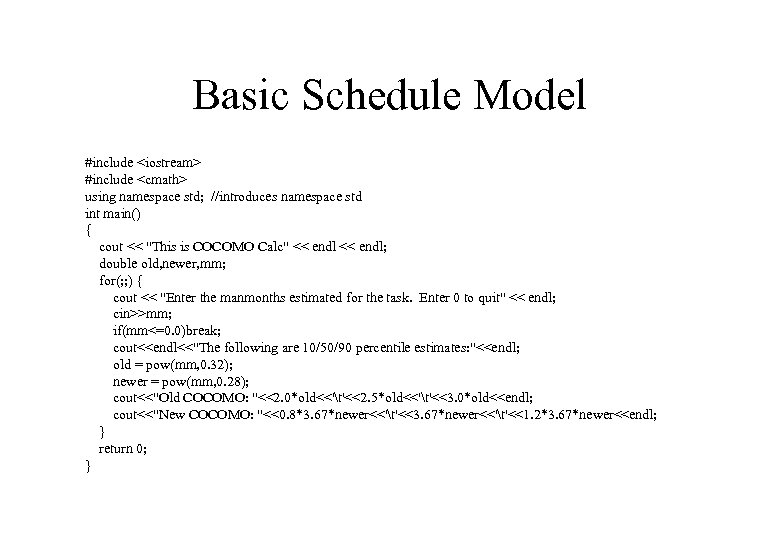 Basic Schedule Model #include
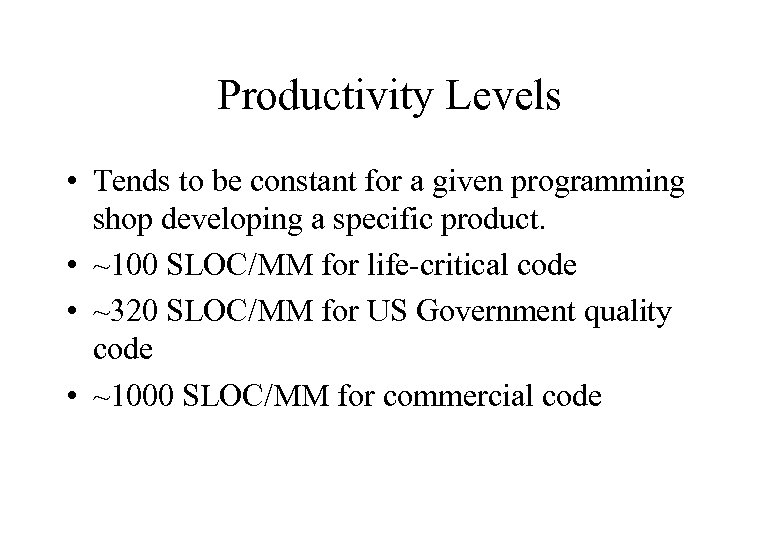 Productivity Levels • Tends to be constant for a given programming shop developing a specific product. • ~100 SLOC/MM for life-critical code • ~320 SLOC/MM for US Government quality code • ~1000 SLOC/MM for commercial code
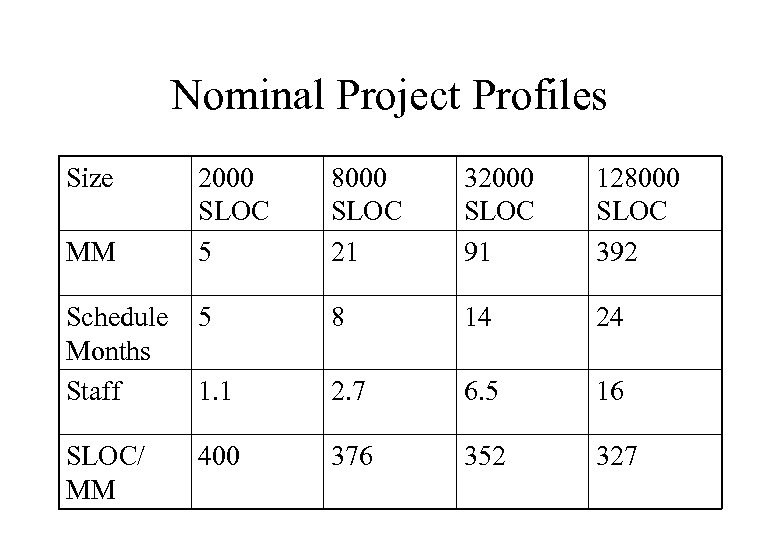 Nominal Project Profiles Size 2000 SLOC 5 8000 SLOC 21 32000 SLOC 91 128000 SLOC 392 Schedule Months Staff 5 8 14 24 1. 1 2. 7 6. 5 16 SLOC/ MM 400 376 352 327 MM
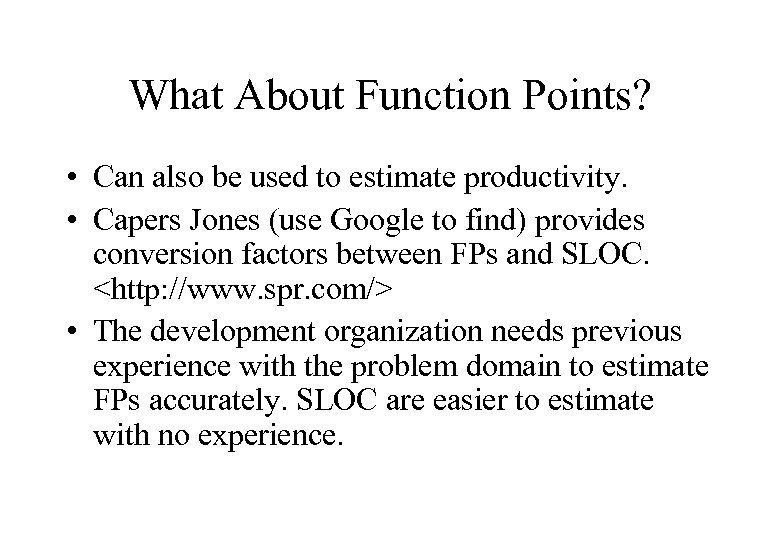 What About Function Points? • Can also be used to estimate productivity. • Capers Jones (use Google to find) provides conversion factors between FPs and SLOC.
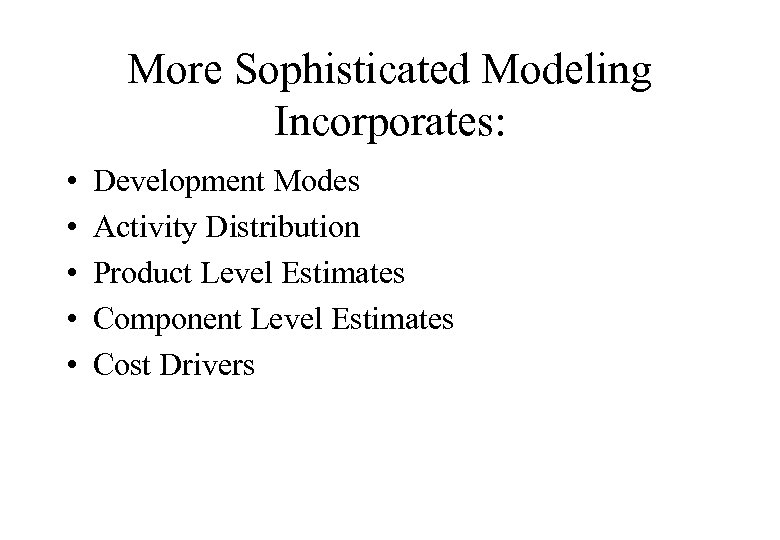 More Sophisticated Modeling Incorporates: • • • Development Modes Activity Distribution Product Level Estimates Component Level Estimates Cost Drivers
 Risk Analysis • A risk is a vulnerability that is actually likely to happen and will result in some significant effect • Standard software development risks: – Cost – Schedule (covaries with cost) – Technical (opposes cost) • Approach: – Identify them – Track them – Spend money to control them (Spiral Model)
 Spiral Model • Defines early development activities to buy down risk • Maintains the interest of stakeholders • Takes longer and costs more • Ends with a standard Waterfall
 Effects of Parallelism • Without parallelism, you do a critical path analysis. • With parallelism, statistical factors affect which task completes first. • With several parallel tasks of equal length, the mean schedule is about one standard deviation beyond that length. • Use Monte Carlo to study this.
 Conclusions • Experience shows that seat-of-the-pants estimates of cost and schedule are only about 75% of the actuals. This amount of error is enough to get a manager fired in many companies. • Lack of hands-on experience is associated with massive cost overruns. • Technical risks are associated with massive cost overruns. • Do your estimates carefully! • Keep them up-to-date! • Manage to them!