 Скачать презентацию Software Agents and Aglets CSE 300 Kimble Cheron
9c4f5049aff16b1963d653e5d1a3a3ad.ppt
- Количество слайдов: 94



Software Agents and Aglets CSE 300 Kimble Cheron, Professor Steven A. Demurjian, and Mitch Saba Computer Science & Engineering Department The University of Connecticut 191 Auditorium Road, Box U-155 Storrs, CT 06269 -3155 steve@engr. uconn. edu http: //www. engr. uconn. edu/~stev e (860) 486 - 4818 Agent-1. 1
Overview of Presentation m CSE 300 m m m Introduction q Reasons for Agent Creation q Defining Agents q Researchers Involved in Agent Development Technical Overview q Basic Agent Anatomy q Agent Implementation (Aglets) q Aglet Environment q Aglet Methods Distributed Computing q Role of Agents in Distributed Computing q Future Evolution of Intelligent Agent Entities Conclusions and Future Research Agent-1. 2
Introduction m CSE 300 Age of Technology q Personal PC as Common as Television q Personal Tasks Performed Using Computers Ø Ø Ø Ø Postal Operations (Electronic Mail) Banking and Financial Operations (Electronic Banking) Shopping News Retrieval Stock Information Updates Communication Others Agent-1. 3
Reasons for Agent Creation m CSE 300 m m Majority of Above Tasks Executed Based on Direct Manipulation q Nothing Occurs Unless Mouse, Keypad, Touchpad is Used q Event-Oriented Interactions with End-Users q Majority are Computer Illiterate q Depend on Software to Perform Tasks q Not Limited to Personal Computers, Embedded Systems Require Operators The Software Agent is the Key to Providing a Delegated Approach to Direct Manipulation Agent-1. 4
Reasons for Agent Creation m Potential Reduction of Network Load Movement of Code to Remote Location q Voluminous Data Remains Locally Resident Addressing Network Latency Issues q Communication of Decision “Instantaneous” and “Simultaneously” q Real-Time Notification Issue: Eliminate Delays Encapsulate Protocols q Change Protocol, Change Agent q Reactive to Evolution Asynchronous, Autonomous, and Heterogeneous q Nature of Today’s Computing Platforms q Dynamically Reactive to Change q Potential for Fault-Tolerance and Robustness q CSE 300 m m m Agent-1. 5
Defining Agents m CSE 300 m Agent Implementation q Personal Assistance q Networks q Databases q Operating Systems q Other Equipment (Medical Equipment) Agent Functions q Find and Filter Information q Customize Views of Information q Automate Work q Delegate Work Back to Computer Agent-1. 6
Perspectives for Definition m CSE 300 m m Two Perspectives for Defining Agent q User q System User Perspective of an Agent q A Software Agent is the Broker for the User q Program that Allow User’s to Delegate Work to Them q Perform Work for User as Directed System Perspective of an Agent q An Agent is a Software Object that is Situated Within a Working Environment and Possesses the Mandatory Agent Properties Agent-1. 7
Agent Properties m Mandatory Properties (Can Be Classifications) q Reactive: Ø Senses Changes in the Environment and Acts According to Those Changes CSE 300 q Autonomous: Ø Autonomously Control Own State/Behavior Ø Has Control Over its Own Actions q Goal-driven: Ø Proactive to Specific User Goals q Temporarily Continuous: Ø Constantly Executing in Runtime Environment Agent-1. 8
Agent Classification m CSE 300 m m Communicative: q Communicate with Other Agents, Systems, and People Learning: q An Agent Learns Based on Prior Experience or Behavior Mobile: q Able to Transport Itself from One System to Another Flexible: q Actions Occur on the Fly, Not Scripted Character: q An Agent Has Personality and an Emotional State Agent-1. 9
Stationary vs. Mobile Agents m m CSE 300 m Stationary Agent: Limited to Single Node Definition of Mobile Agent q An Application Capable of Migrating Across Network to Accomplish Required Tasks Mobile Agents are Being Used for Diverse Technologies Mentioned in Introduction Slide q Agents are Able to Interact with Objects in a Different System Ø Retrieving Stock Quotes From the Internet on a Real Time Basis Ø Implementing Push and Pull Paradigms Ø Electronic Marketplace and Commerce Ø Etc. . . Agent-1. 10
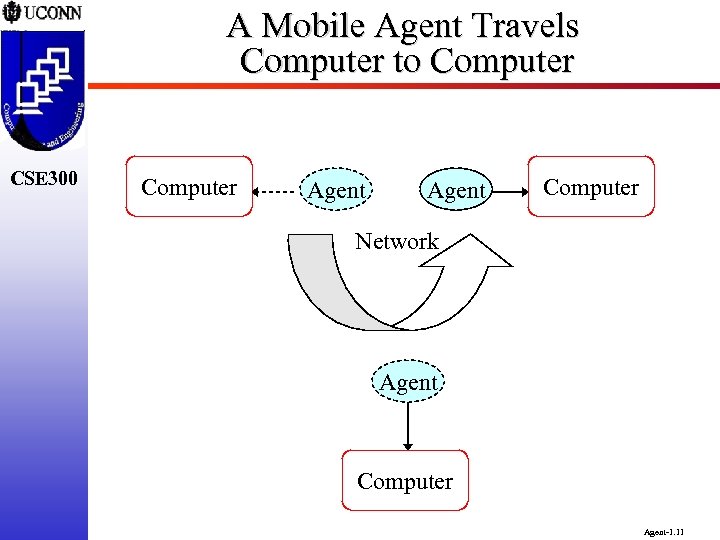
A Mobile Agent Travels Computer to Computer CSE 300 Computer Agent Computer Network Agent Computer Agent-1. 11
Researchers Involved in Agent Development m Known Groups and People Responsible q Government Agencies Ø Rock Island Army Arsenal CSE 300 q Academic Institutions Ø Carnegie Melon University Ø Massachusetts Institute of Technology Ø Stanford University Ø University of Maryland Baltimore County q Computer Industry Companies Ø IBM Ø Microsoft Agent-1. 12
Technical Overview m CSE 300 Basic Agent Anatomy q An Agent is an Object Which Has Properties Similar to Object Oriented Classes q The Agent’s Attributes are Similar to Instance Variables Ø Assist the Agent in Traveling, Communication, and Recognition q Each Agent (Stationary/Mobile) has Five Properties Ø State Ø Implementation Ø Interface Ø Identifier Ø Principals Agent-1. 13
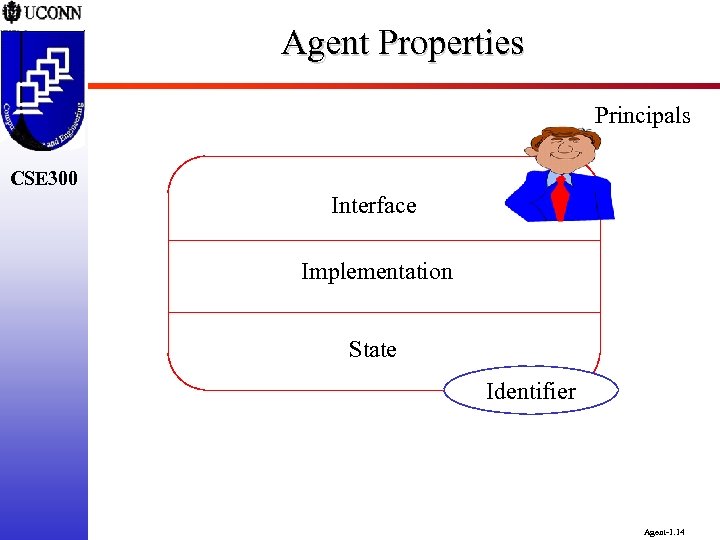
Agent Properties Principals CSE 300 Interface Implementation State Identifier Agent-1. 14
Properties: State m CSE 300 m m State Implementation Interface Identifier Principals Definition (Analogous to Activation Record) q Contains All Contents and Values of the Agent’s Runtime State and Object State Agent Traveling q State Contains All the Information Required to Resume Execution After Traveling Language Dependencies q Implementation Language Determines If an Agent Only Uses its Instance Variables to Resume Execution q Saving the Execution State at Runtime is Not Java Compliant Ø Java Agents Require the Object State to Resume Execution Agent-1. 15
Properties: Implementation m CSE 300 m State Implementation Interface Identifier Principals Definition q The Code Used to Execute an Agent on Any Location (Location Independent) Agent Traveling q An Agent Can Travel With its Code q Code on Demand Ø An Agent Can Retrieve its Code After Reaching its Destination m Language Dependencies q A Common Language Must Be Used Ø To Allow Agent to Travel and Execute on a Different Host Ø Usually a Platform Independent Scripting Language is Used for Implementation Agent-1. 16
Properties: Interface m CSE 300 m State Implementation Interface Identifier Principals Definition q Entity Used for Agent-to-Agent Communication or Agent-to-System Communication Two Styles of Communication Interfaces q Allows Others Access to an Agent’s Methods q Messaging Interface Ø Allows Agents to Use a Language for Communication m Messaging Interface Language q Knowledge Query and Manipulation Language (KQML) Ø Provides Point to Point Messaging Between Agents Agent-1. 17
Properties: Identifier m CSE 300 m State Implementation Interface Identifier Principals Definition q Required Entity Used for Recognition and Locating Traveling Agents Each Agent Has its Own Unique Identifier q An Identifier is Globally Unique and Immutable Ø Combination of Principals’ Identities and a Serial Number m Identifier Functions q Used for Directory Services q To Refer to a Specific Agent Instance Agent-1. 18
Properties: Principals m CSE 300 m State Implementation Interface Identifier Principals Definition q Entity Used by the System to Authenticate Access to an Agent Two Main Principals q Manufacturer (Developer of Agent) Ø The Manufacturer is the Principal Responsible for Creating the Agent q Owner (User or Agent) Ø Responsible for the Legal and Moral Way in Which the Agent Will Behave (Behavior) Agent-1. 19
Agent Environment m CSE 300 m Place q Basic Environment in Which an Agent Executes q Provides the Operating System for the Agent q Cannot Execute Agents q Conceptually Similar to Runtime Environment, Virtual Memory Management, Activation Rcds. Construction of a Place: Four Concepts q Engine q Resources q Location q Principals Agent-1. 20
Engine m CSE 300 m m Engine Resources Location Principals Description q Supplies the Energy to the Place and the Agent to Function q Provides a Link for Places and Agents to Networks and Other Resources Provided by a Host Hierarchical Structure of the Engine q Host, Engines, Places, and Agents q A Host May Hold Many Engines q Engines Can Hold Many Places q Places May House Many Agents Places are Given Names Because an Engine May House Several Places Agent-1. 21
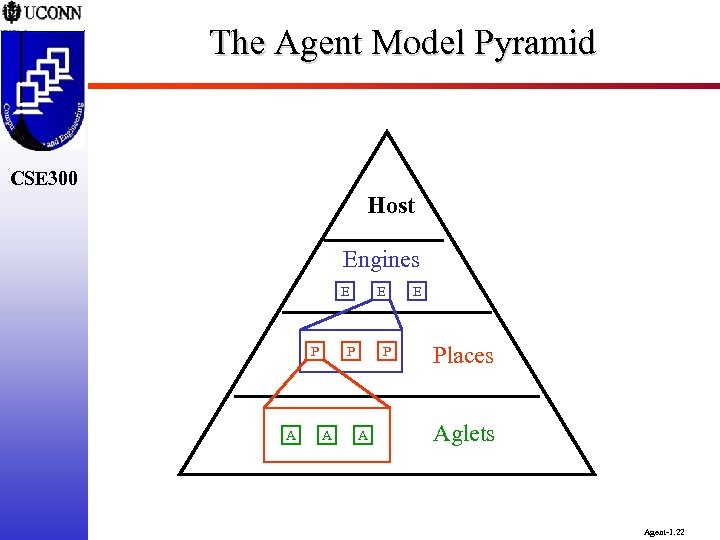
The Agent Model Pyramid CSE 300 Host Engines E P A P A E Places Aglets Agent-1. 22
Resources m Engine Resources Location Principals Description q Services Provided by the Host Ø Networks Ø Processors and Memory Ø Disk Ø Databases Ø Other Hardware and Software Services CSE 300 m Controlled Access to Resources q Provided to the Agent by the Engine and Place Agent-1. 23
Location m CSE 300 m m Engine Resources Location Principals Description q Address of the Executing Agent Construction of Location: Combination of q The Name of a Place in Which It Executes q The Network Address of the Engine in Which the Place Resides Typical Written Location q The Port of the Engine With a Place Name Attribute and an Internet Protocol (IP) Address Agent-1. 24
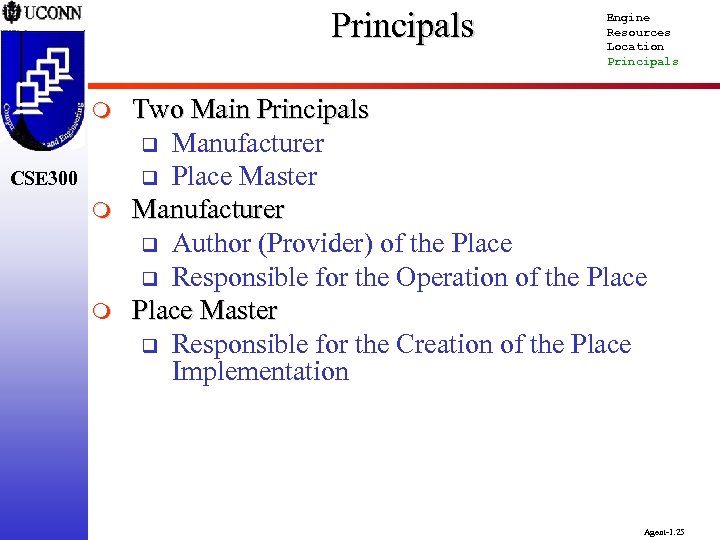
Principals m CSE 300 m m Engine Resources Location Principals Two Main Principals q Manufacturer q Place Master Manufacturer q Author (Provider) of the Place q Responsible for the Operation of the Place Master q Responsible for the Creation of the Place Implementation Agent-1. 25
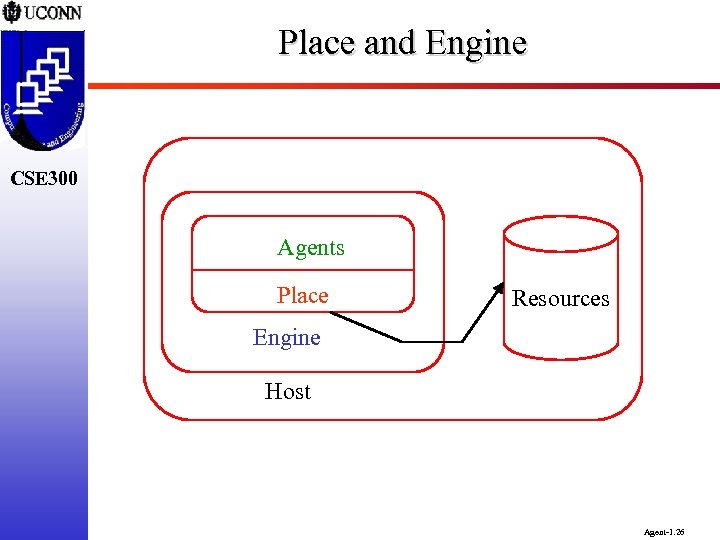
Place and Engine CSE 300 Agents Place Resources Engine Host Agent-1. 26
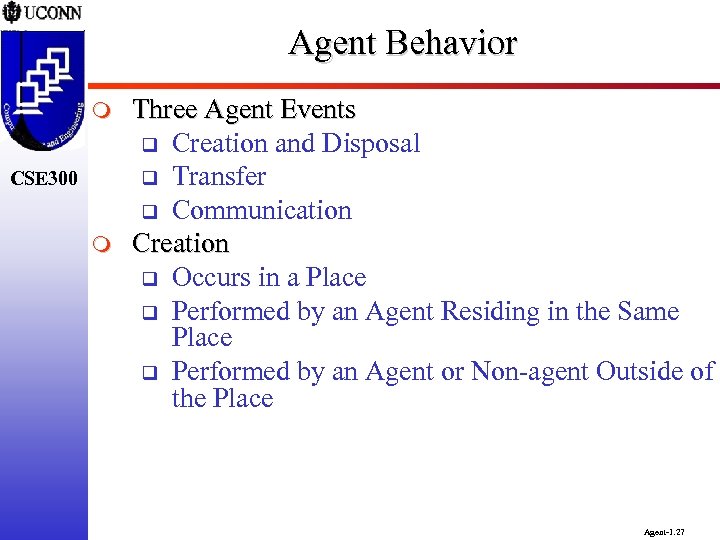
Agent Behavior m CSE 300 m Three Agent Events q Creation and Disposal q Transfer q Communication Creation q Occurs in a Place q Performed by an Agent Residing in the Same Place q Performed by an Agent or Non-agent Outside of the Place Agent-1. 27
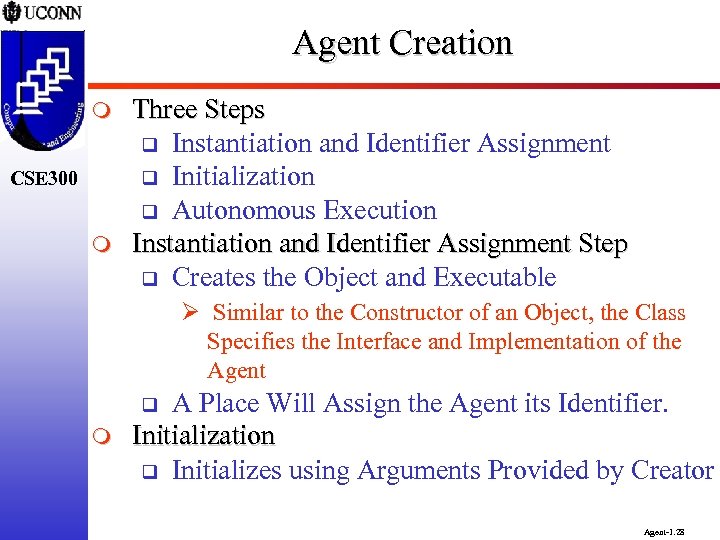
Agent Creation m CSE 300 m Three Steps q Instantiation and Identifier Assignment q Initialization q Autonomous Execution Instantiation and Identifier Assignment Step q Creates the Object and Executable Ø Similar to the Constructor of an Object, the Class Specifies the Interface and Implementation of the Agent A Place Will Assign the Agent its Identifier. Initialization q Initializes using Arguments Provided by Creator q m Agent-1. 28
Agent Creation Completion Guarantees the Agent Has Been Correctly Installed in the Place Autonomous Execution q The Agent Starts Execution After Installation q Executes Independently of Other Agents in the Place Disposal q Performed in a Place q Accomplished by an Agent Itself, a System, Another Agent in the Place, or an Agent or Non -agent Outside of the Place q m CSE 300 m Agent-1. 29
Agent Disposal m CSE 300 m Reasons for Disposal q Lifetime Has Expired q Security Rules Have Been Violated q Not in Use q System is Going Offline (Shutdown) Disposal Steps q An Agent is Allowed to Complete All Current Tasks q Execution of the Agent is Suspended by the Place Agent-1. 30
Agent Travel m CSE 300 m Definition q Agent is Dispatched From its Origin and Received by the Specified Destination q Performed by an Agent Itself, Another Agent in the Same Place, or an Agent or Non-agent System Outside of the Place q Origin Place and Destination Manage Travel Management q Origin Place Contacts Destination Place Ø Return Failure Indication to Agent If No Contact q Destination Place Response Ø Fulfill Travel Request Ø Return Failure Indication to Origin Agent-1. 31
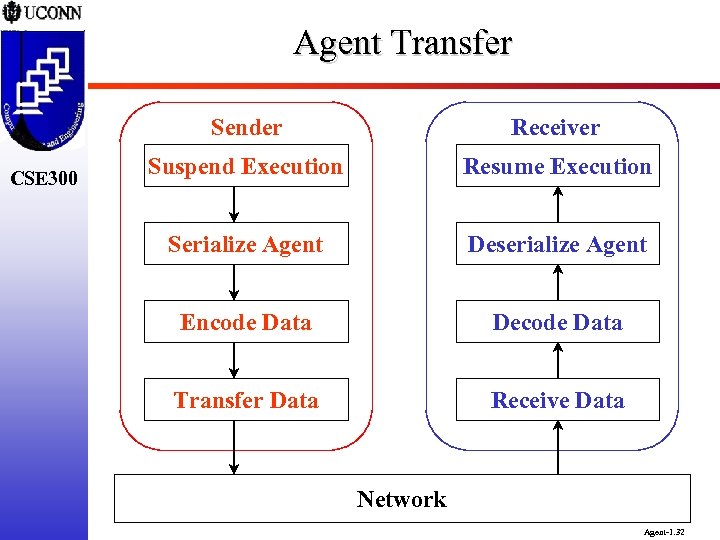
Agent Transfer Sender CSE 300 Receiver Suspend Execution Resume Execution Serialize Agent Deserialize Agent Encode Data Decode Data Transfer Data Receive Data Network Agent-1. 32
Dispatching an Agent m CSE 300 m Process q Destination Must Be Known Prior to Departure q Agent Notifies the Destination Agent System It Would Like to Depart q An API is Used for Communication for Departure q Destination Agent System (Engine) Process Request for Departure Destination Agent System (Engine) Response q Suspend the Agent q Serialize the Agent’s Data q Determine the Transport Protocol for the Agent q Transport the Agent-1. 33
Receiving an Agent m CSE 300 m Process q Receiving Engine Determines to Accept or Reject and Agent From the Sending Host q Sender Must Authenticate Itself to the Receiving Engine Tasks q Receive the Agent q Decode its Data Information q Deserialize the Agent Ø Sets New Instantiation for the Agent q Resume Agent Execution Agent-1. 34
Agent Class Transfer m CSE 300 m Three Methods: Dependent upon the Location of the Class q Class at Destination q Class at Origin q Code-on-Demand Class at Destination q Contained in the Engine’s Class Cache or the Local File System Ø No Need to Transfer Class q Transferred Agent Must Contain the Full Class Name and Discriminator Ø May Have Information that Describes the Location of the Class Definition Agent-1. 35
Agent Class Transfer Methods m CSE 300 Class at Origin q Transported With the Agent’s State to the Destination Engine q State May Transferred More Than Once Ø Can Lead to Increased Network Traffic and Wasted Network Bandwidth m m Code-on-Demand q Class is Made Available by a Server q Destination Engine Receives Class on a Codeon-Demand Basis q Destination Address Must Perform an Additional Network Connection Agent Can Carry Classes on Transfer or by a Per. Request Basis Agent-1. 36
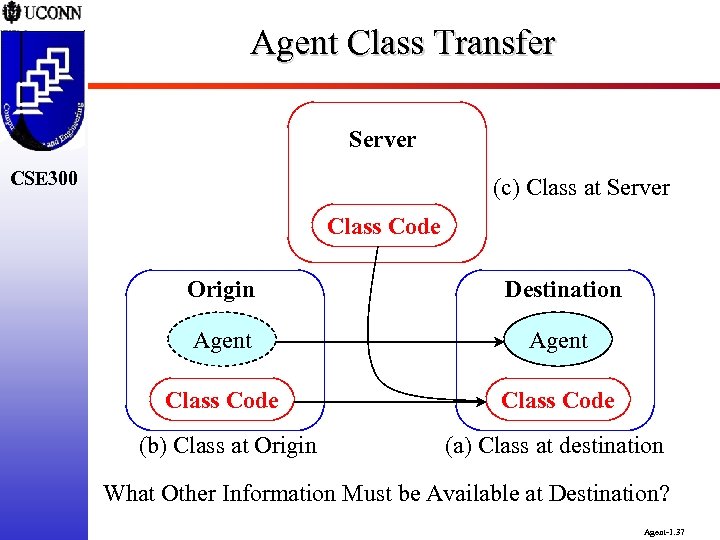
Agent Class Transfer Server CSE 300 (c) Class at Server Class Code Origin Destination Agent Class Code (b) Class at Origin (a) Class at destination What Other Information Must be Available at Destination? Agent-1. 37
Communication m Properties of Messaging Communication q Point-to-Point Messaging Ø One-to-One Type Messaging CSE 300 q Broadcast Messaging Ø One-to-Many Type Messaging, Useful in Multiagent Systems q Intra-Place Communication Ø Communication With an Agent in the Same Place q Inter-Place and Inter-Engine Ø Communication With an Agent in a Different Place q q Agents Can Send Messages to Other Agents Can Invoke the Methods of Other Agents If Authorized Agent-1. 38
Interagent Communication m CSE 300 m m Three Inter-Agent Communication Schemes q Now-Type Messaging q Future-Type Messaging q One-way-Type Messaging Intra-Place, Inter-Place, and Inter-Engine Communication Agent Messaging Paradigms q Peer-to-Peer: Dedicated Communication q Broadcast: Multi-Agent Environment Agent-1. 39
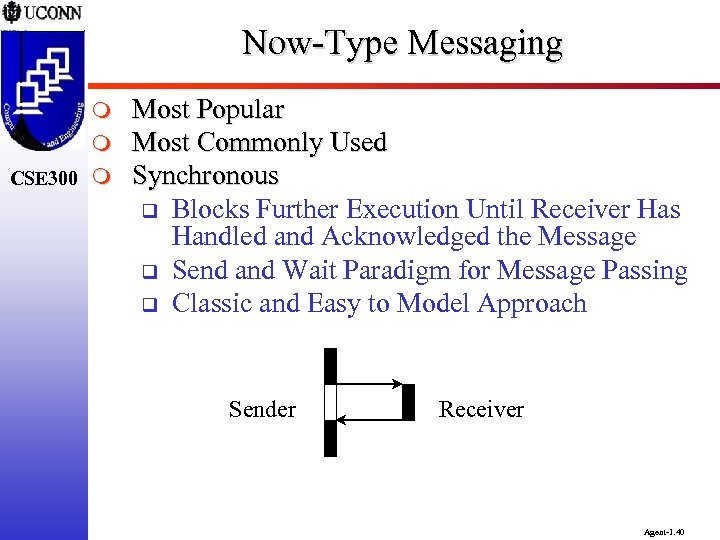
Now-Type Messaging m m CSE 300 m Most Popular Most Commonly Used Synchronous q Blocks Further Execution Until Receiver Has Handled and Acknowledged the Message q Send and Wait Paradigm for Message Passing q Classic and Easy to Model Approach Sender Receiver Agent-1. 40
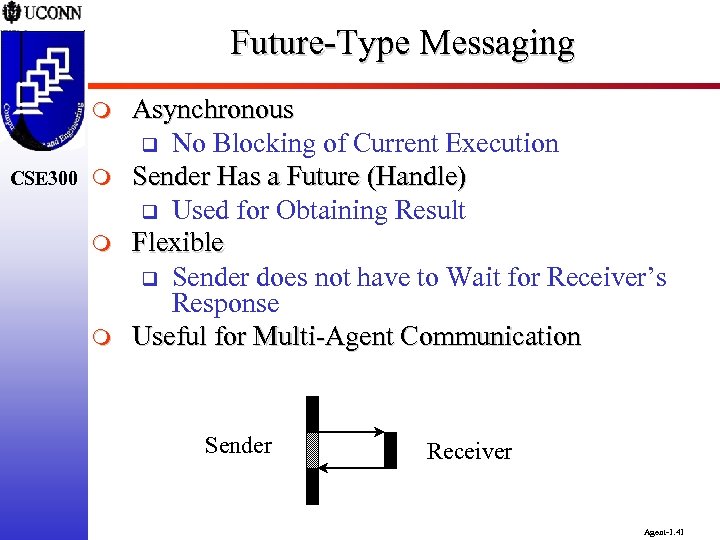
Future-Type Messaging m CSE 300 m m m Asynchronous q No Blocking of Current Execution Sender Has a Future (Handle) q Used for Obtaining Result Flexible q Sender does not have to Wait for Receiver’s Response Useful for Multi-Agent Communication Sender Receiver Agent-1. 41
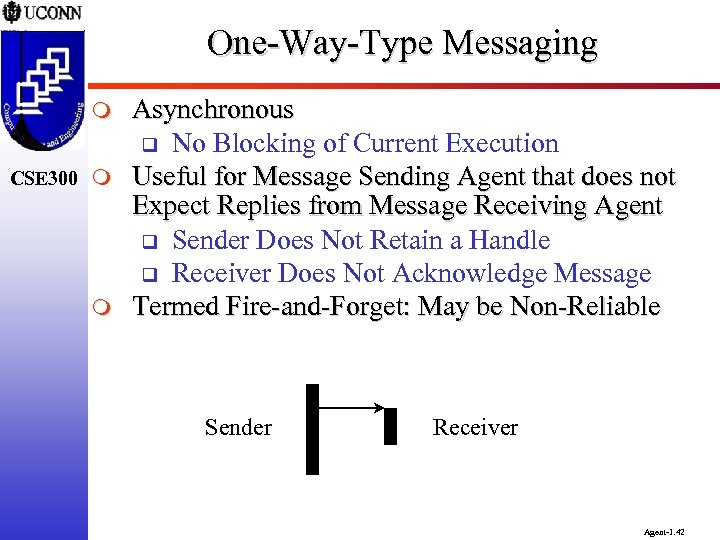
One-Way-Type Messaging m CSE 300 m m Asynchronous q No Blocking of Current Execution Useful for Message Sending Agent that does not Expect Replies from Message Receiving Agent q Sender Does Not Retain a Handle q Receiver Does Not Acknowledge Message Termed Fire-and-Forget: May be Non-Reliable Sender Receiver Agent-1. 42
Agent Implementation (Aglets) m CSE 300 m m Origins q Named for the Combination of the Two Terms of Agent and Applet Definitions q Applet: A “Lightweight Application” q “Aglet”: A “Lightweight Agent” Differences q Aglet Ø Carries It’s State Ø Movement From One Host to the Next q Applet Ø Only Carries It’s Class Files Along Ø Movement Based on a Server Client Network Agent-1. 43
Implementation Language m CSE 300 m Implementation Language q Java Was Chosen Due to the Benefits Provides Towards Agent Construction q Movement to Java Worldwide Benefits of Java q Platform Independence q Secure Execution q Dynamic Class Loading q Multithread Programming q Object Serialization q Reflection Agent-1. 44
Agent Characteristics of Java: Benefits m CSE 300 m m Platform Independent q Allows an Agent to Travel and Execute on Any Type of Computer Secure Execution q Eliminates the Option of Programs Accessing Private Objects that They Do Not Have Authorization to Use q The Environment Makes its Safe to Host an Unknown Agent Dynamic Class Loading q Allows Agents to Execute Independently q Agents Do Not Have to Be Created During the Main Program Execution Agent-1. 45
Agent Characteristics of Java: Benefits m CSE 300 m m Multithread Programming q Agents Execute Independently of other Agents q Agents can Communicate with Other Agents Object Serialization q During Transportation the Agent’s Data (and Code) is Serialized and Then Deserialize Reflection q Assists Agents in Finding Out Information About Other Agents and Themselves q Types of Object Information Ø Methods, Constructors of Loaded Classes, and Fields Ø Meta-Data on Active Classes that can be Queried Agent-1. 46
Agent Characteristics of Java: Drawbacks m Inadequate Support for Resource Control q Denial of Service Ø Agent Will Loop and Waste Processor Cycles or Memory Resources CSE 300 m No Protection of References q Objects are Allowed Access to the Public Methods of a Java Object q A Proxy Provides Protection of References and Location Transparency Ø Object Inserted Between Caller and Callee Agent-1. 47
Drawbacks m CSE 300 m No Object Ownership of References q An Agent’s Execution Thread May Be Deleted q An Agent Object Can Not Be Voided No Support for Preservation and Resumption of Execution State q Java Does Not Allow Retrieval of the Full Execution State of an Object q Agent Relies on Internal Attribute Values and External Events to Direct its Behavior Agent-1. 48
Aglet Environment m CSE 300 m IBM Aglets Workbench q Assists in Bringing Mobile Agents to Life q Implemented in Java IBM Aglets Workbench Operation q Based on the Java Programming Language System q Aglets Framework Ø Provides the Mobile-agent-specific Components of the Workbench q Introduces the Notion of an Aglet Ø A Mobile (Agile) Agent Written in Java and Named After its Framework Base Class Agent-1. 49
Aglet API m CSE 300 m m Four Basic Elements q Aglet q Proxy q Context q Identifier Aglet q Mobile Agent that Moves Across the Network q Responds to Messages q Runs on its Own Thread of Execution Proxy q Shield that Protects the Aglet From Direct Access to its Methods q Can Have Remote Access to the Aglet (Hides Aglet’s Real Location) Agent-1. 50
Aglet API: Elements m CSE 300 Context q Basically the Same As a Place q Houses the Engines Ø Engines House the Aglets Addressed in the Same Manner As a Place Identifier q Element of the Aglet q Each Aglet Has It’s Own Unique Identifier q Required Entity Used for Recognition and Locating Traveling Agents q m Agent-1. 51
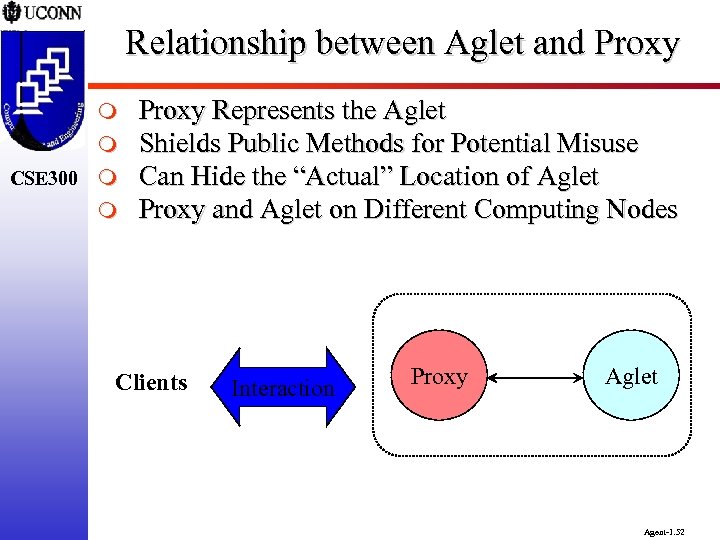
Relationship between Aglet and Proxy m m CSE 300 m m Proxy Represents the Aglet Shields Public Methods for Potential Misuse Can Hide the “Actual” Location of Aglet Proxy and Aglet on Different Computing Nodes Clients Interaction Proxy Aglet Agent-1. 52
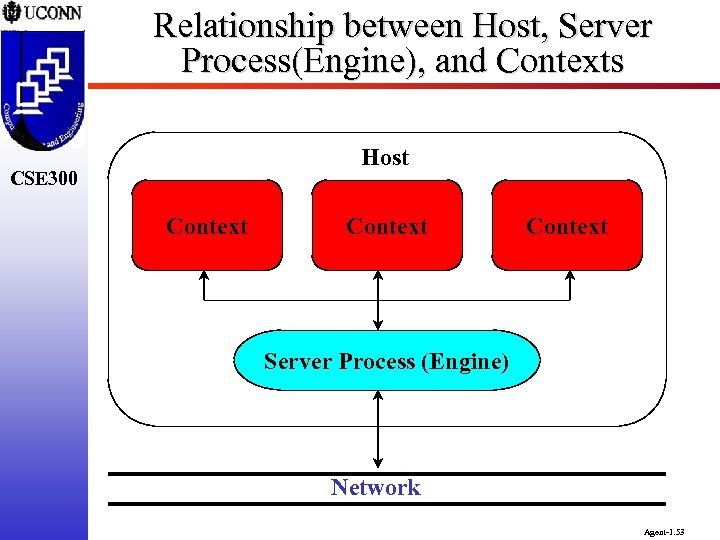
Relationship between Host, Server Process(Engine), and Contexts Host CSE 300 Context Server Process (Engine) Network Agent-1. 53
Aglet: Operations m CSE 300 m Six Basic Operations q Creation q Cloning q Dispatching q Retraction q Activation and Deactivation q Disposal Creation q Initializes a New Aglet q Assigns Aglet an Identifier Agent-1. 54
Basic Operations m CSE 300 Cloning q Produce an Identical Copy of an Aglet (itself) q Differences Between Clone and Original Aglet Ø Identifier Ø Place of Execution m m Dispatching q Aglet is Transported (Pushed) From One Context to Another Retraction q Concept that Returns an Aglet Back to its Original Context q Original Context Pulls Back the Aglet From the Current Context Agent-1. 55
Basic Operations m CSE 300 m m m Deactivation and Activation q Deactivation Must Occur Before Activation q Deactivation Halts the Execution of an Aglet q Activation Starts Execution of an Aglet q Activation Must Occur to Restore the Aglet Disposal q Stops Execution of an Aglet q Removes an Aglet From its Current Context Classification of Six Basic Aglet Operations q Classified as the Life Cycle of an Aglet Observation of Six Basic Aglet Operations q Context Functions Just Like a Place Agent-1. 56
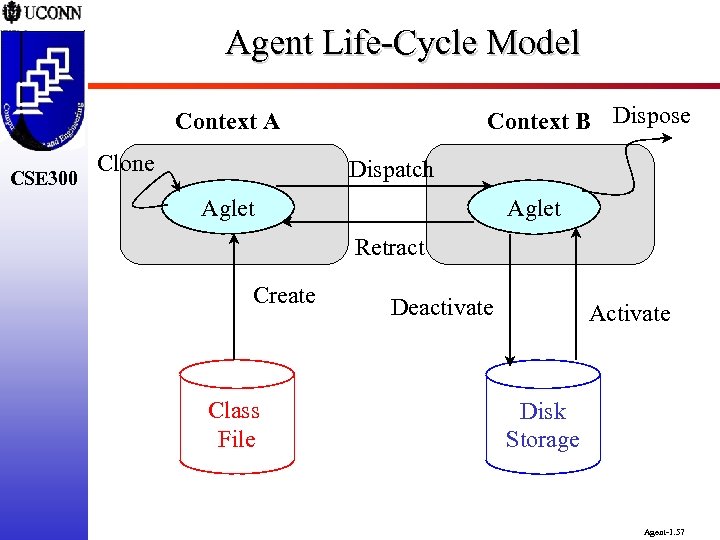
Agent Life-Cycle Model Context B Dispose Context A CSE 300 Clone Dispatch Aglet Retract Create Class File Deactivate Activate Disk Storage Agent-1. 57
Aglet Methods m CSE 300 m m Aglet Programming Model q Similar to the Java Event Model q Event Based q Listeners Used to Perform Event Actions Three Event Model Listeners q Clone Listener q Mobility Listener q Persistence Listener Actions q Listen for the Event They are Named After q Listeners Can Be Customized to Perform Specific Actions When the Listener Event Occurs Agent-1. 58
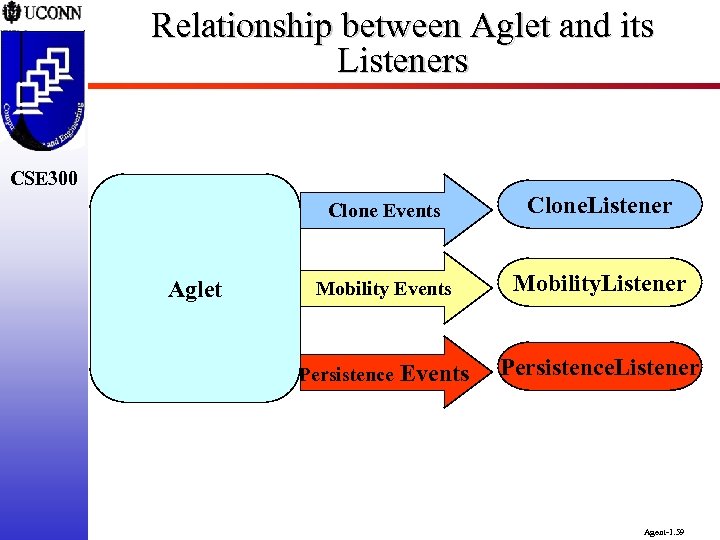
Relationship between Aglet and its Listeners CSE 300 Clone Events Aglet Clone. Listener Mobility Events Mobility. Listener Persistence Events Persistence. Listener Agent-1. 59
Event Model Listeners m CSE 300 m m Clone Listener q Listens for Cloning Events q Actions Can Be Customized to Occur Before, During, or After the Cloning Mobility Listener q Listens for Mobility Events q Actions Can Be Customized to Occur When an Aglet is About to Be Dispatched, Retracted, or Arrives in a New Context Persistence Listener q Listens for Persistence Events q Actions Can Be Customized to Occur When an Aglet is About to Be Deactivated or Has Been Activated Agent-1. 60
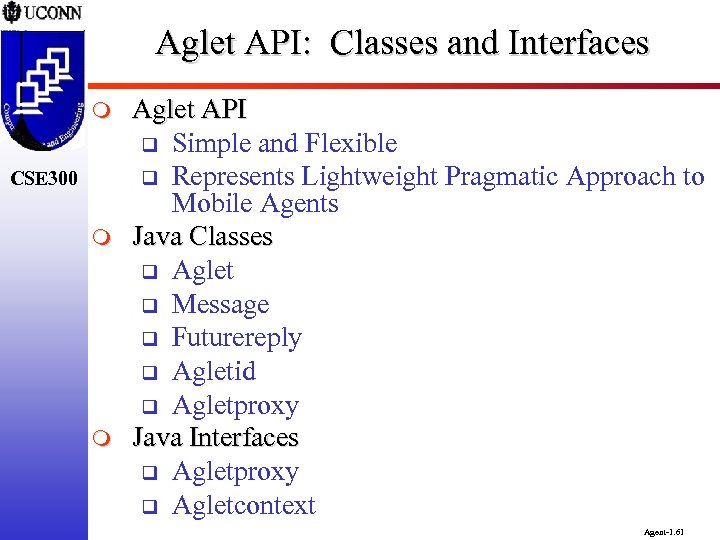
Aglet API: Classes and Interfaces m CSE 300 m m Aglet API q Simple and Flexible q Represents Lightweight Pragmatic Approach to Mobile Agents Java Classes q Aglet q Message q Futurereply q Agletid q Agletproxy Java Interfaces q Agletproxy q Agletcontext Agent-1. 61
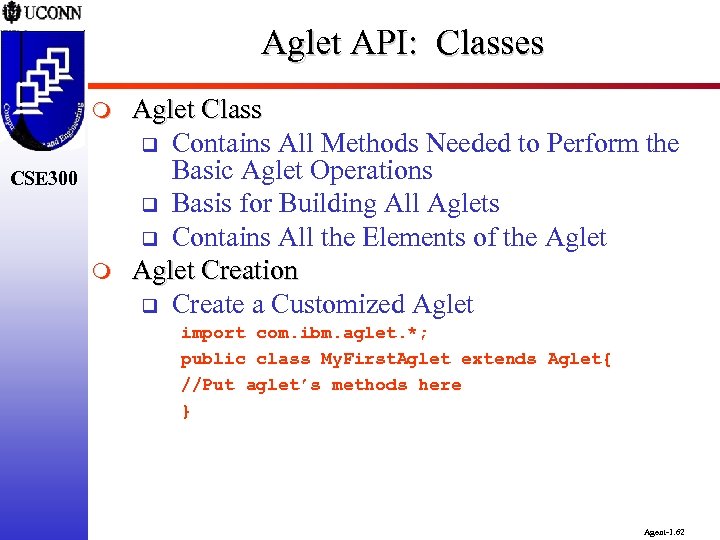
Aglet API: Classes m CSE 300 m Aglet Class q Contains All Methods Needed to Perform the Basic Aglet Operations q Basis for Building All Aglets q Contains All the Elements of the Aglet Creation q Create a Customized Aglet import com. ibm. aglet. *; public class My. First. Aglet extends Aglet{ //Put aglet’s methods here } Agent-1. 62
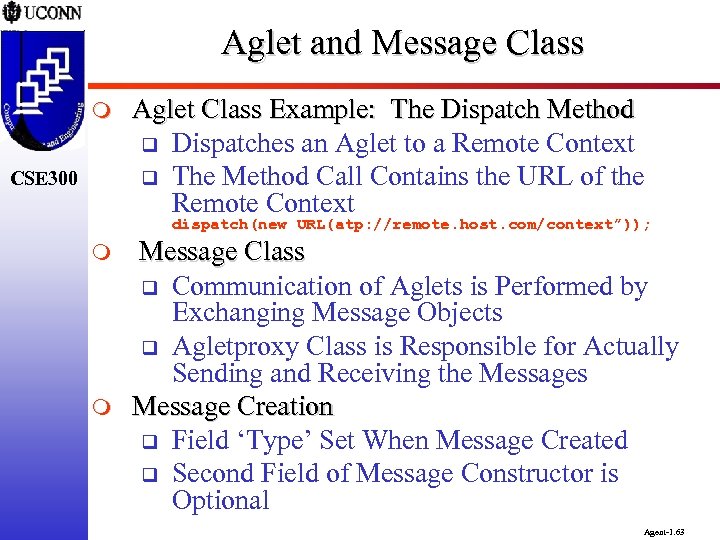
Aglet and Message Class m CSE 300 Aglet Class Example: The Dispatch Method q Dispatches an Aglet to a Remote Context q The Method Call Contains the URL of the Remote Context dispatch(new URL(atp: //remote. host. com/context”)); m m Message Class q Communication of Aglets is Performed by Exchanging Message Objects q Agletproxy Class is Responsible for Actually Sending and Receiving the Messages Message Creation q Field ‘Type’ Set When Message Created q Second Field of Message Constructor is Optional Agent-1. 63
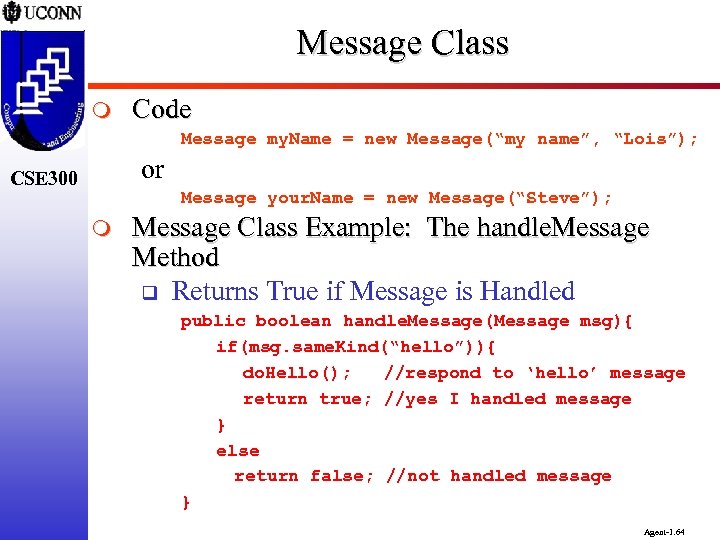
Message Class m Code Message my. Name = new Message(“my name”, “Lois”); or CSE 300 Message your. Name = new Message(“Steve”); m Message Class Example: The handle. Message Method q Returns True if Message is Handled public boolean handle. Message(Message msg){ if(msg. same. Kind(“hello”)){ do. Hello(); //respond to ‘hello’ message return true; //yes I handled message } else return false; //not handled message } Agent-1. 64
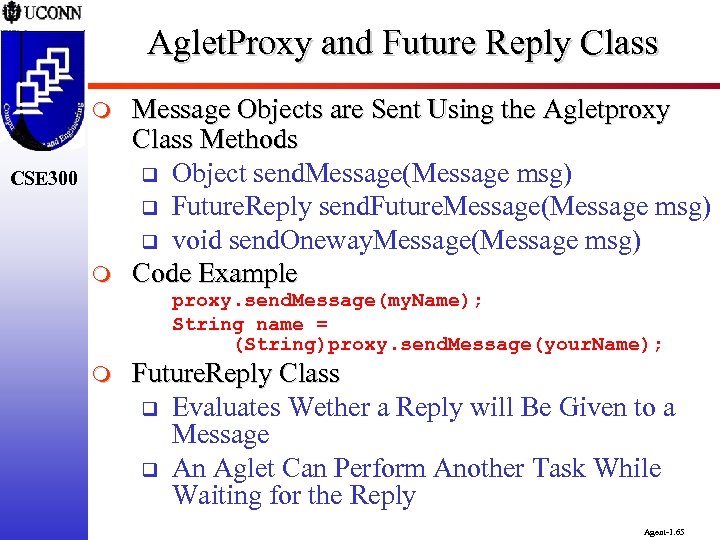
Aglet. Proxy and Future Reply Class m CSE 300 m Message Objects are Sent Using the Agletproxy Class Methods q Object send. Message(Message msg) q Future. Reply send. Future. Message(Message msg) q void send. Oneway. Message(Message msg) Code Example proxy. send. Message(my. Name); String name = (String)proxy. send. Message(your. Name); m Future. Reply Class q Evaluates Wether a Reply will Be Given to a Message q An Aglet Can Perform Another Task While Waiting for the Reply Agent-1. 65
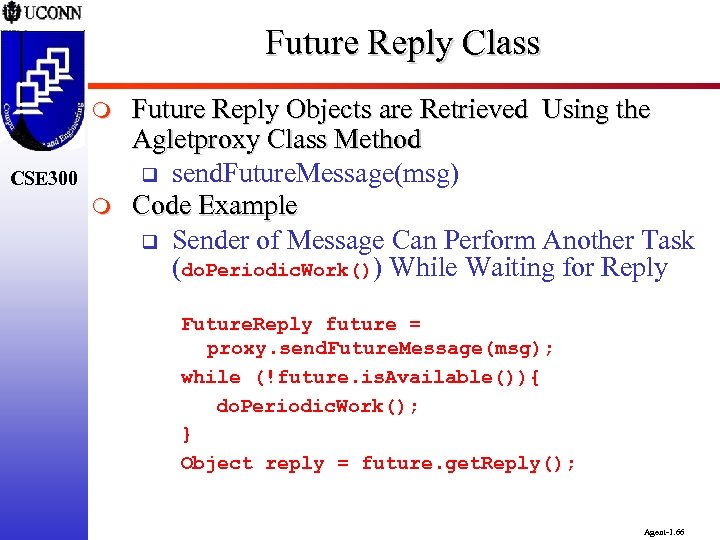
Future Reply Class m CSE 300 m Future Reply Objects are Retrieved Using the Agletproxy Class Method q send. Future. Message(msg) Code Example q Sender of Message Can Perform Another Task (do. Periodic. Work()) While Waiting for Reply Future. Reply future = proxy. send. Future. Message(msg); while (!future. is. Available()){ do. Periodic. Work(); } Object reply = future. get. Reply(); Agent-1. 66
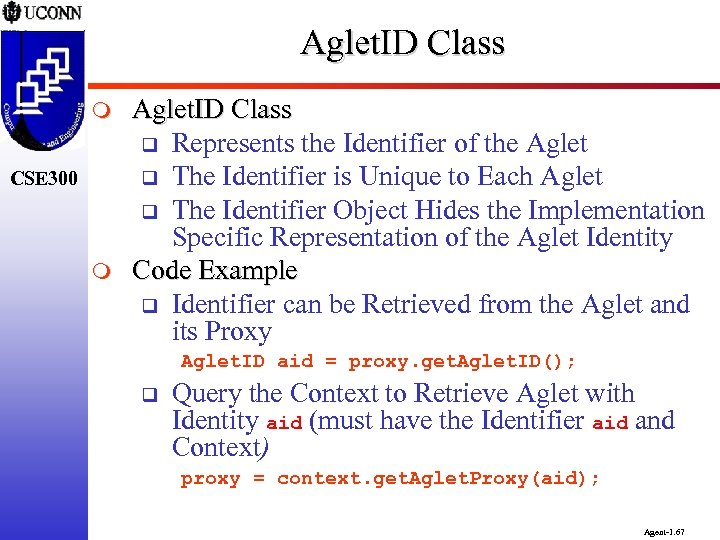
Aglet. ID Class m CSE 300 m Aglet. ID Class q Represents the Identifier of the Aglet q The Identifier is Unique to Each Aglet q The Identifier Object Hides the Implementation Specific Representation of the Aglet Identity Code Example q Identifier can be Retrieved from the Aglet and its Proxy Aglet. ID aid = proxy. get. Aglet. ID(); q Query the Context to Retrieve Aglet with Identity aid (must have the Identifier aid and Context) proxy = context. get. Aglet. Proxy(aid); Agent-1. 67
Aglet API: Interfaces m CSE 300 m Agletproxy Interface q The Handle of the Aglet q Provides the Method of Communication Between Aglets Aglet Handle Design Benefits q Used by Another Aglet that is Attempting to Communicate With that Aglet q Provides the Aglet With Protection From Nonauthorized Access q Can Provide a Remote Location for the Aglet Agent-1. 68
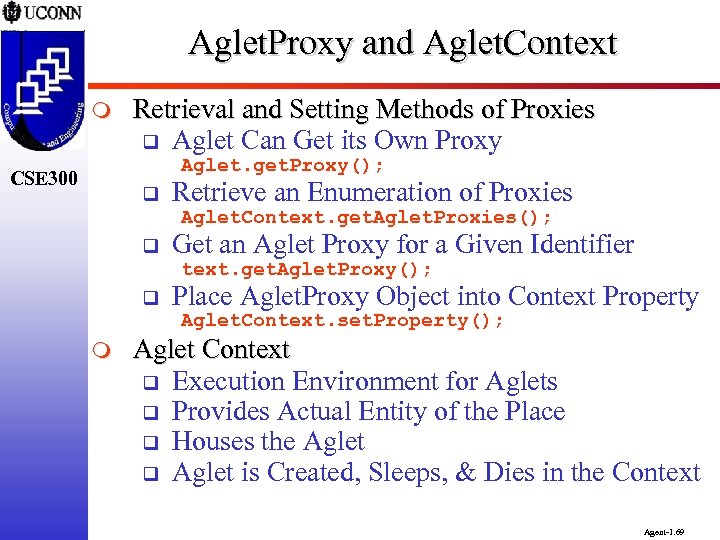
Aglet. Proxy and Aglet. Context m Retrieval and Setting Methods of Proxies q Aglet Can Get its Own Proxy Aglet. get. Proxy(); CSE 300 q Retrieve an Enumeration of Proxies Aglet. Context. get. Aglet. Proxies(); q Get an Aglet Proxy for a Given Identifier text. get. Aglet. Proxy(); q Place Aglet. Proxy Object into Context Property Aglet. Context. set. Property(); m Aglet Context q Execution Environment for Aglets q Provides Actual Entity of the Place q Houses the Aglet q Aglet is Created, Sleeps, & Dies in the Context Agent-1. 69
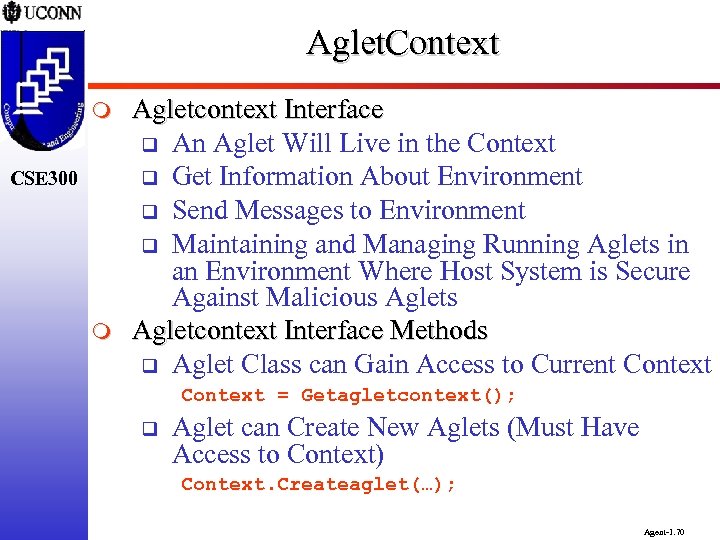
Aglet. Context m CSE 300 m Agletcontext Interface q An Aglet Will Live in the Context q Get Information About Environment q Send Messages to Environment q Maintaining and Managing Running Aglets in an Environment Where Host System is Secure Against Malicious Agletcontext Interface Methods q Aglet Class can Gain Access to Current Context = Getagletcontext(); q Aglet can Create New Aglets (Must Have Access to Context) Context. Createaglet(…); Agent-1. 70
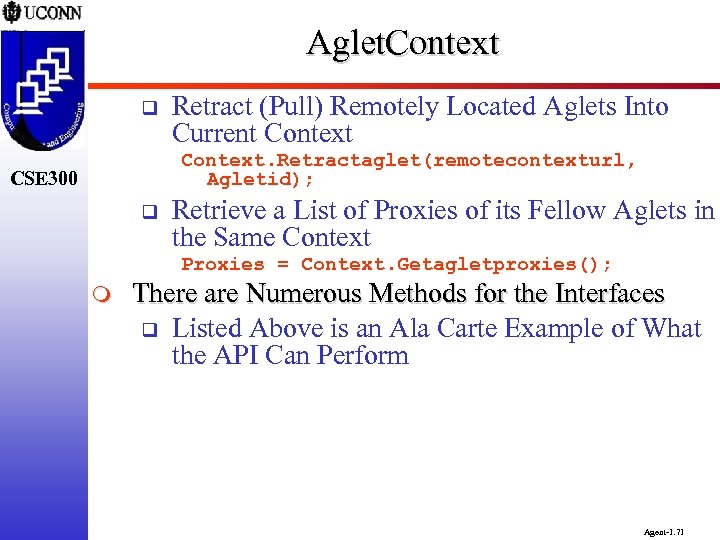
Aglet. Context q Retract (Pull) Remotely Located Aglets Into Current Context. Retractaglet(remotecontexturl, Agletid); CSE 300 q Retrieve a List of Proxies of its Fellow Aglets in the Same Context Proxies = Context. Getagletproxies(); m There are Numerous Methods for the Interfaces q Listed Above is an Ala Carte Example of What the API Can Perform Agent-1. 71
Aglet. Context m CSE 300 Aglet Example: Remote File Update q Premise: Large Multiple Remote Files that Must be Updated by Word Replacement q One Solution: Move Files to Central Server, Perform Update, and Move Files Back q Another Solution: An Aglet that Updates Files by Replacing All Occurrences of One Specified Word in the Files With Another Specified Word q Distributes the Load of Updates to Multiple Servers q We’re Moving “Code” Rather Than Files Agent-1. 72
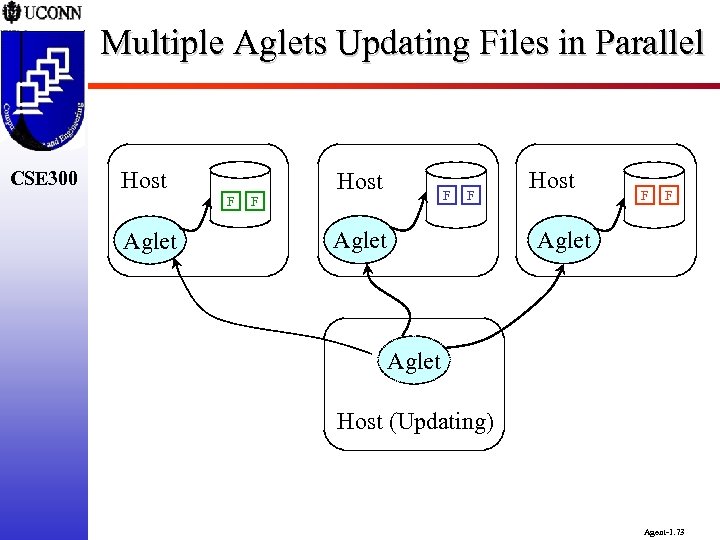
Multiple Aglets Updating Files in Parallel CSE 300 Host F Aglet F Host F F Aglet Host (Updating) Agent-1. 73
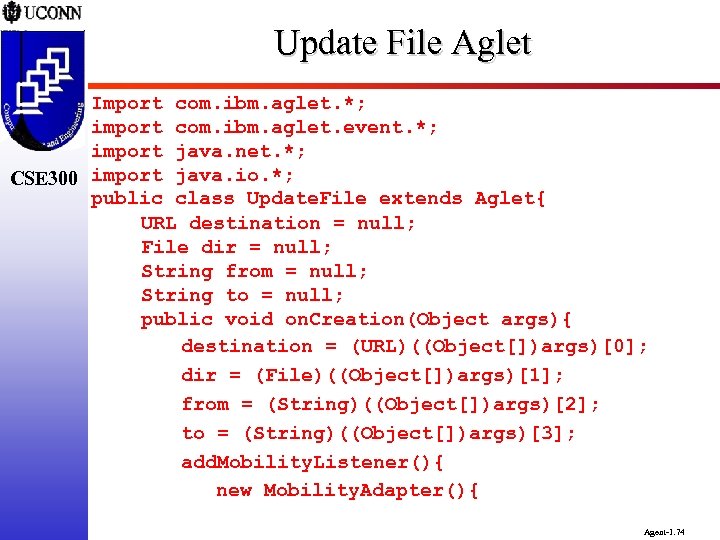
Update File Aglet Import com. ibm. aglet. *; import com. ibm. aglet. event. *; import java. net. *; CSE 300 import java. io. *; public class Update. File extends Aglet{ URL destination = null; File dir = null; String from = null; String to = null; public void on. Creation(Object args){ destination = (URL)((Object[])args)[0]; dir = (File)((Object[])args)[1]; from = (String)((Object[])args)[2]; to = (String)((Object[])args)[3]; add. Mobility. Listener(){ new Mobility. Adapter(){ Agent-1. 74
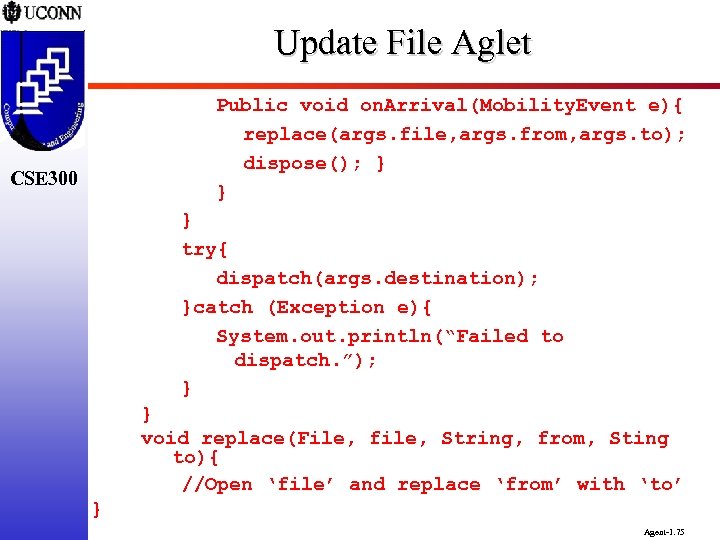
Update File Aglet Public void on. Arrival(Mobility. Event e){ replace(args. file, args. from, args. to); dispose(); } } CSE 300 } try{ dispatch(args. destination); }catch (Exception e){ System. out. println(“Failed to dispatch. ”); } } void replace(File, file, String, from, Sting to){ //Open ‘file’ and replace ‘from’ with ‘to’ } Agent-1. 75
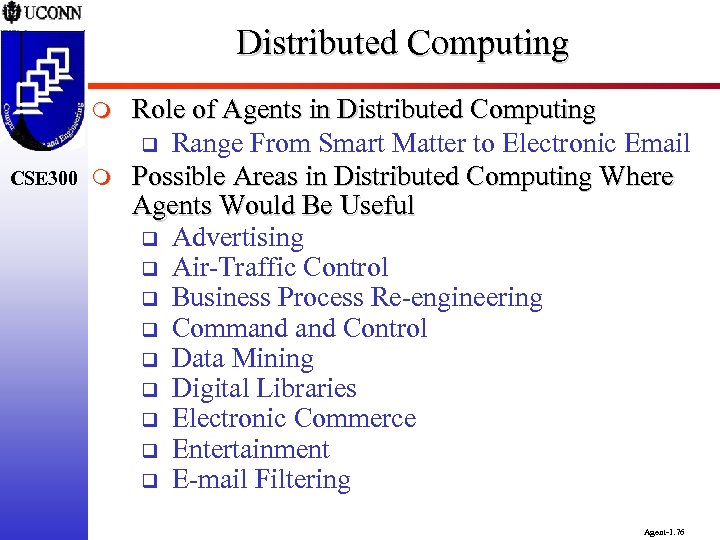
Distributed Computing m CSE 300 m Role of Agents in Distributed Computing q Range From Smart Matter to Electronic Email Possible Areas in Distributed Computing Where Agents Would Be Useful q Advertising q Air-Traffic Control q Business Process Re-engineering q Command Control q Data Mining q Digital Libraries q Electronic Commerce q Entertainment q E-mail Filtering Agent-1. 76
Role of Agents: Areas of Interest q q CSE 300 q q q q q Education Information Retrieval/Management News Retrieval Network Management Personal Digital Assistants (PDAS) Secure Brokering Smart Matter Smart Databases Scheduling/Diary Management Workflow Management Numerous Other Areas that are Being Researched and Developed Agent-1. 77
Role of Agents: Abilities m CSE 300 m Why Agents? q Abilities are Productive for Increasing the Quality of Distributed Computing Agent Abilities q Collect Data From Numerous Places q Searching and Filtering Information q Monitoring q Target Information Dissemination q Agent-to-Agent Negotiation q Perform Parallel Computations q Barter q Enhance Telecommunication Network Services q Controller for Smart Matter q Enhance Entertainment Agent-1. 78
Data Collection, Search, and Monitor m CSE 300 m m Collect Data From Numerous Places q An Agent on a Network Could Retrieve Data From Numerous Computer Stations q One Application that May Be Useful Would Be a Software Registration Agent Searching and Filtering Information q Discards Useless Information q Saves an Immense Amount of Time Monitoring q Monitor Certain Information Specified by User q Retrieve Information Specified by User Requests Agent-1. 79
Real Time, Communication, Computation, and Bartering m Target Information Dissemination q Real Time Information Being Retrieved Ø News, Stock Quotes, Advertisements, and Software Updates for Venders CSE 300 Information Specified by User Negotiate Between One Another (Agent-to-agent) q Agents Communicate With Other Agents Perform Parallel Computations q Agents Communicate With One Another q Agents Share Information Barter q Agents Assume the Place of the User q Agent Negotiates the Deal q m m m Agent-1. 80
Telecommunications, Controller, and Entertainment m CSE 300 m m m Enhance Telecommunication Network Services q Store Information of Services q Provide User With Authorized Services Controller for Smart Matter q Monitor Equipment q Inform User of State of Equipment Enhance Entertainment q Agent-to-Agent Communication Between Players q User Programmed Strategic Agent The Information Above is Not Conclusive of All the Different Abilities of Mobile Agents (Endless) Agent-1. 81
Future Evolution of Intelligent Agent Entities m m CSE 300 m m m m m Software Registration Agent Search and Filter Engines Monitor/Supply Info. on Real Time Basis Real Time Advertisement User Filter for Unwanted Information Real Time Work Environment Update Pleasure/business Travel Agent Parallel Processing Network Service Administrator Monitor Physical Aspects of Embedded Systems Computer Gaming Pawn Agent-1. 82
Possibilities of Intelligent Agent Entities m CSE 300 m List of Future Evolution of Intelligent Agent Entities Inconclusive q With the Advancement of Technology and a Need for a Faster Result, the Possibilities of Implementations of Mobile Agents are Vast Software Registration Agent q Retrieve Registration Numbers for Certain Software Applications q Data Would Be Used to Determine If a Computer System Had Unique Software Applications Agent-1. 83
Search, Filter, and Monitor m Search and Filter Engines q Email Applications: Ø A User Could Filter Mail Based on a Certain Keyword and Not Receive Junk Mail CSE 300 q q Provide a More Extensive Search for a User Use Numerous Resources Return Specific Items for the User Search or Filter While the User is Performing Another Activity Agent-1. 84
Real Time Possibilities m CSE 300 m Monitor and Supply Information on Real Time Basis q Provide News on a Real Time Basis q Monitor News Based on Certain Information q Retrieve the News that the User Requests q Used for Stocks, Shopping (Checking If an Item Goes on Sale), and Even Weather q The Amount of Possibilities is Endless Real Time Advertisement q Advertisers Find a Way to Capitalize on Every New Software Invention Available Ø Companies May Send Advertisements Along With the Information Being Received Like News Agent-1. 85
Real Time Possibilities m CSE 300 m User Filter for Unwanted Information q User May Want to Filter Out Certain Information Being Received q Agent Application Required to Filter Out Unwanted Advertisements Real Time Work Environment Update q Schedule a Meeting Ø Each of the Employee’s Agents Would Work Together to Schedule the Meeting for all Employees q Update Team Members on New Developments of a Project Ø Each Agent Would Update the Other Agents and Then Return the Information to the Worker Agent-1. 86
Work and Travel m CSE 300 Pleasure/Business Travel Agent q User’s Own Personal Shopper, Broker, or Travel Agent q Electronic Commerce Ø Shop/Haggle for a User on Any Type of Goods q Search Criteria Given by a User Ø Where to Go on Vacation and What Price for Airline Tickets Ø What Stocks to Buy or Sell q User Tells Agent to Make a Deal or Not Ø Once Agent Retrieves All the Information. q Agent Could then Finalize the Deal for the User Ø Vacation Reservations are made, or Merchandise is Purchased Agent-1. 87
Network Services and Monitoring m CSE 300 m Network Service Administrator q Agent Responsible for the User Configuration q Agents Supplies the Host With User Privileges to Services q Could Be Used for Cable Systems or Network Providers Monitor of Physical Aspects of Embedded Systems q Monitor Temperature, Speed, or Other Physical Characteristics q Inform User of a Malfunction q Assume the Position of Smart Matter q Provide a More Efficient Way to Monitor Physical Aspects of Embedded Systems Agent-1. 88
Computer Gaming m CSE 300 Computer Gaming Pawn q Perform All the Battling for the User q User Could Program the Agent to Function Accordingly Ø Strategic Moves q Numerous Network Game Possibilities Ø Gambling, Role Playing, and Strategy Games q Agent-to-Agent Communication Used to Provide Enhance Online Gaming Possibilities Agent-1. 89
Conclusion and Future m CSE 300 Conclusion q Agent Concepts Barely Five Years q Agents Seem to be the Up and Coming Technology of the Future q The Possibilities and Capabilities of Agents are Endless Ø The Mobile Agent Alone Has Not Been Covered in Research Extensively q Aglets Have a Chance of Being the Building Blocks of Front Running Technology Ø As Long As Java Proves to Be a Secure Language q Standardization Issues Must be Addressed for Different Agent Systems to Interact! Agent-1. 90
Conclusion and Future m CSE 300 m Future Uses q Everyday People are Finding New Uses for Agents q Provide Users With Assistance q Provide Users With More Free Time q Agents Most Likely, Will Become an Everyday Occurrence in Applications q Assist Users and Do Work on Their Behalf are Agents the Future of Today’s and Tomorrow’s Applications? Agent-1. 91
Future Research m CSE 300 m Another Facet of Agents is the Intelligent Agent q Mobile Agents are Used for Intelligent Agents q Researchers are Trying to Implement an Agent With Artificial Intelligence Current Developing Applications q IBM is Developing a Memory Agent Application Ø Used to Detect Breast Cancer q q IBM Claims the Agent Learns Based on Previous Input Uses a Learning Algorithm to Predict the Numbers for Detection Agent-1. 92
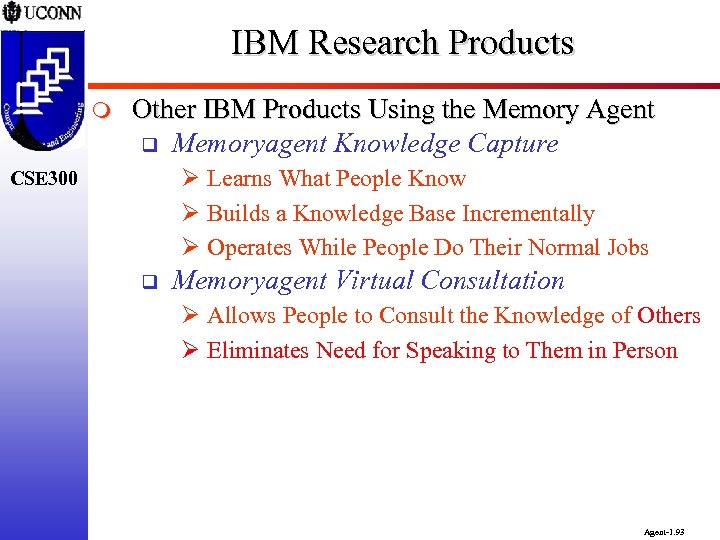
IBM Research Products m Other IBM Products Using the Memory Agent q Memoryagent Knowledge Capture Ø Learns What People Know Ø Builds a Knowledge Base Incrementally Ø Operates While People Do Their Normal Jobs CSE 300 q Memoryagent Virtual Consultation Ø Allows People to Consult the Knowledge of Others Ø Eliminates Need for Speaking to Them in Person Agent-1. 93
![References [1]: Danny B. Lange and Mitsuru Oshima, “Programming and Deploying Java Mobile Agents](https://present5.com/presentation/9c4f5049aff16b1963d653e5d1a3a3ad/image-94.jpg "References [1]: Danny B. Lange and Mitsuru Oshima, “Programming and Deploying Java Mobile Agents")
References [1]: Danny B. Lange and Mitsuru Oshima, “Programming and Deploying Java Mobile Agents with Aglets”, Addison Wesley Longman, Reading MA, 1998. CSE 300 [2]: http: //www. javaworld. com/javaworld/jw-04 -1997/jw-04 -agents. html [3]: http: //www. msci. memphis. edu/~franklin/Agent. Prog. html [4]: http: //www. javaworld. com/javaworld/jw-04 -1997/jw-04 -hood. html [5]: http: //www. trl. ibm. co. jp/aglets/JAAPI-whitepaper. html [6]: http: //luckyspc. lboro. ac. uk/Docs/Papers/Mesela 97. html [7]: http: //www. javaworld. com/javaworld/jw-05 -1997/jw-05 -hood. html [8]: http: //www. trl. ibm. co. jp/aglets/whitepaper. htm [9]: http: //www. networking. ibm. com/iaghome. html#new Agent-1. 94
Скачать презентацию Software Agents and Aglets CSE 300 Kimble Cheron
9c4f5049aff16b1963d653e5d1a3a3ad.ppt