 Скачать презентацию Softcopy Banding Visibility Assessment Osman Arslan Prof
3623331f40652fc4176d3e3e323e6465.ppt
- Количество слайдов: 36



Softcopy Banding Visibility Assessment * Osman Arslan Prof. Zygmunt Pizlo Prof. Jan P. Allebach *This research was supported by Hewlett Packard Company.
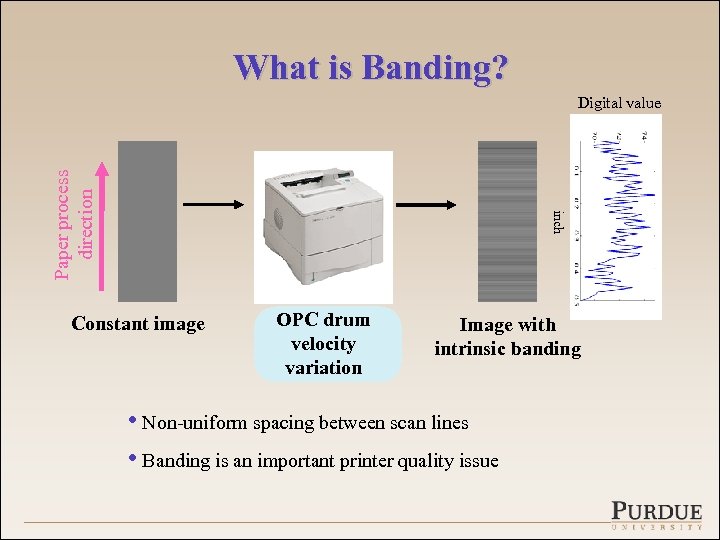
What is Banding? inch Paper process direction Digital value Constant image OPC drum velocity variation Image with intrinsic banding • Non-uniform spacing between scan lines • Banding is an important printer quality issue
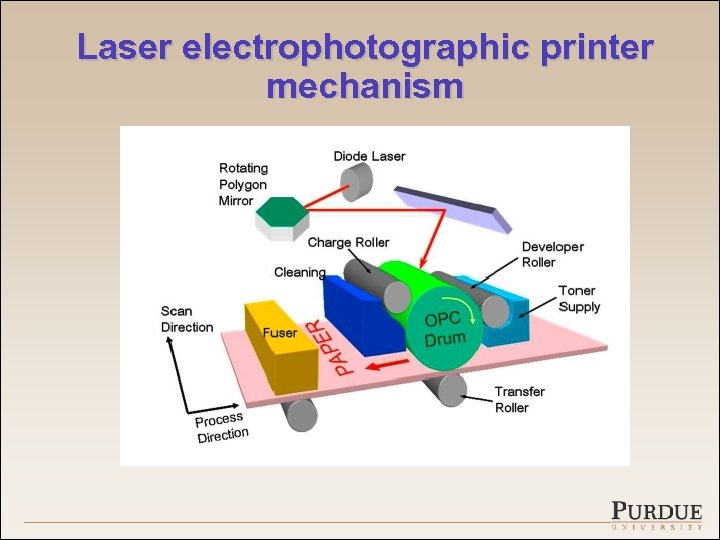
Laser electrophotographic printer mechanism
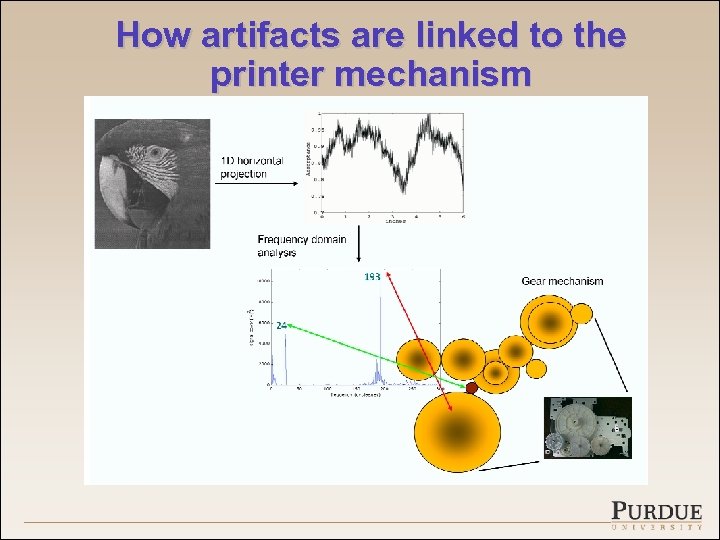
How artifacts are linked to the printer mechanism
Overview • Purpose: To investigate the visibility of banding for different printers by conducting psychophysical banding visibility assessment experiments. • We developed a softcopy environment to conduct various banding assessment experiments. w The hardcopy print is reproduced on the monitor. w This is done based on an appearance match.
Outline • • Background for banding assessment. Development of the softcopy environment. w Background for appearance match methods. w Appearance match experiments. • • Banding simulation techniques. Banding visibility assessment experiments. w Banding matching experiment. w Banding discrimination experiment. w Banding detection experiment. w Cross-platform experiment. • Conclusion and discussion.
Past Studies on Banding • Banding was categorized under the macro-uniformity image quality attribute by Dalal et al. (1998). • The highest weight was given to banding by Rasmussen et al. (2001) while defining the objectionability function of overall macro-uniformity. • Briggs et al. (2000) proposed a method to characterize banding of inkjet printers. • Cui et al. measured the visibility and objectionability threshold of inkjet banding. • • Kane et al. presented metrics for quantification of banding Several researchers developed methodologies to reduce banding (Lin et al (2000), Chen et al (2003), Ewe et al (2002)).
Why Softcopy Environment? • Because w It saves time and the cost. w It is easier to change the visibility of artifacts by modifying the parameters. w It gives us the ability to simulate banding at lower amplitudes than the actual printer banding amplitude to investigate the banding detection threshold.
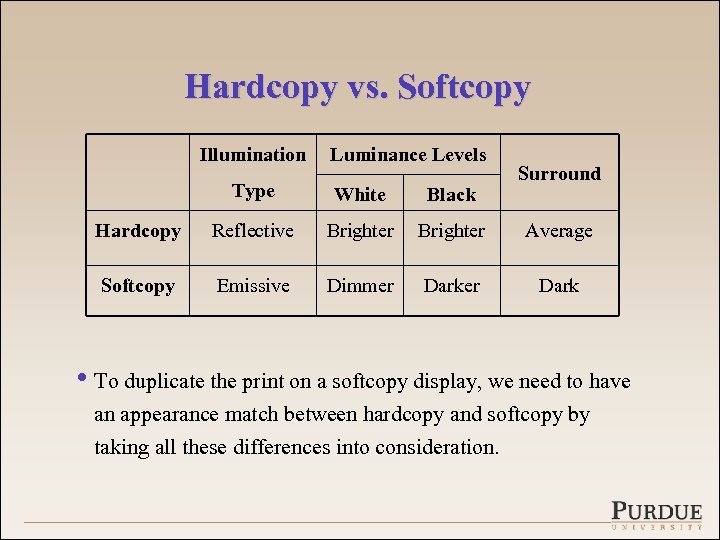
Hardcopy vs. Softcopy Illumination Luminance Levels Surround Type White Black Hardcopy Reflective Brighter Average Softcopy Emissive Dimmer Dark • To duplicate the print on a softcopy display, we need to have an appearance match between hardcopy and softcopy by taking all these differences into consideration.
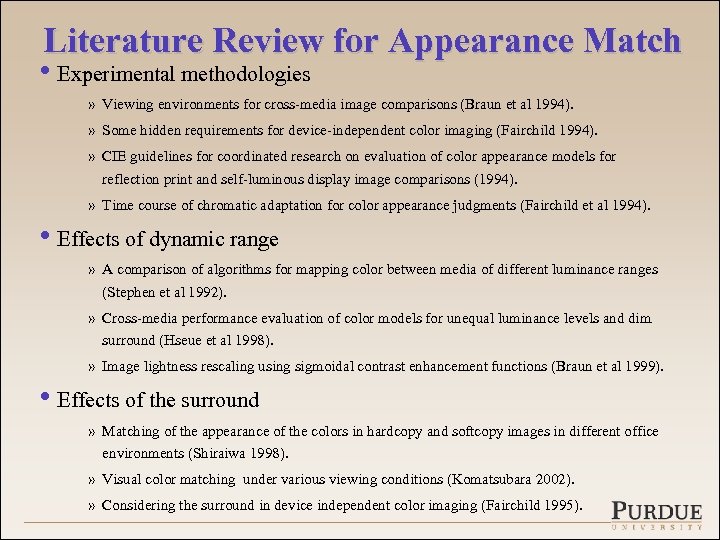
Literature Review for Appearance Match • Experimental methodologies » Viewing environments for cross-media image comparisons (Braun et al 1994). » Some hidden requirements for device-independent color imaging (Fairchild 1994). » CIE guidelines for coordinated research on evaluation of color appearance models for reflection print and self-luminous display image comparisons (1994). » Time course of chromatic adaptation for color appearance judgments (Fairchild et al 1994). • Effects of dynamic range » A comparison of algorithms for mapping color between media of different luminance ranges (Stephen et al 1992). » Cross-media performance evaluation of color models for unequal luminance levels and dim surround (Hseue et al 1998). » Image lightness rescaling using sigmoidal contrast enhancement functions (Braun et al 1999). • Effects of the surround » Matching of the appearance of the colors in hardcopy and softcopy images in different office environments (Shiraiwa 1998). » Visual color matching under various viewing conditions (Komatsubara 2002). » Considering the surround in device independent color imaging (Fairchild 1995).
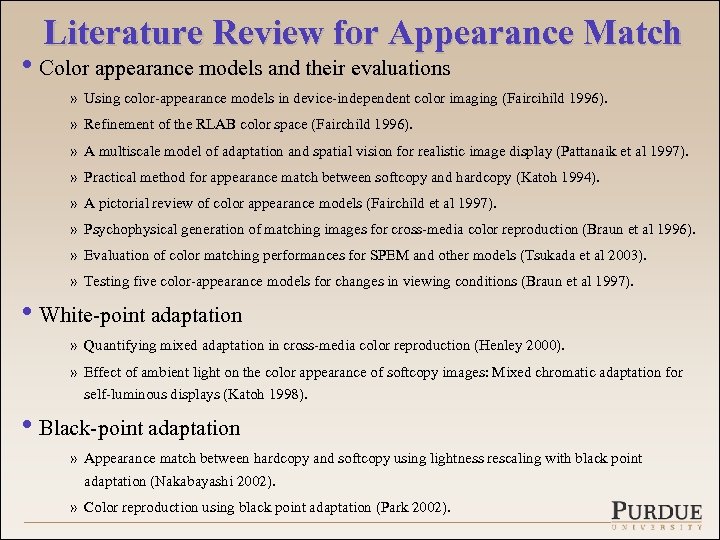
Literature Review for Appearance Match • Color appearance models and their evaluations » Using color-appearance models in device-independent color imaging (Faircihild 1996). » Refinement of the RLAB color space (Fairchild 1996). » A multiscale model of adaptation and spatial vision for realistic image display (Pattanaik et al 1997). » Practical method for appearance match between softcopy and hardcopy (Katoh 1994). » A pictorial review of color appearance models (Fairchild et al 1997). » Psychophysical generation of matching images for cross-media color reproduction (Braun et al 1996). » Evaluation of color matching performances for SPEM and other models (Tsukada et al 2003). » Testing five color-appearance models for changes in viewing conditions (Braun et al 1997). • White-point adaptation » Quantifying mixed adaptation in cross-media color reproduction (Henley 2000). » Effect of ambient light on the color appearance of softcopy images: Mixed chromatic adaptation for self-luminous displays (Katoh 1998). • Black-point adaptation » Appearance match between hardcopy and softcopy using lightness rescaling with black point adaptation (Nakabayashi 2002). » Color reproduction using black point adaptation (Park 2002).
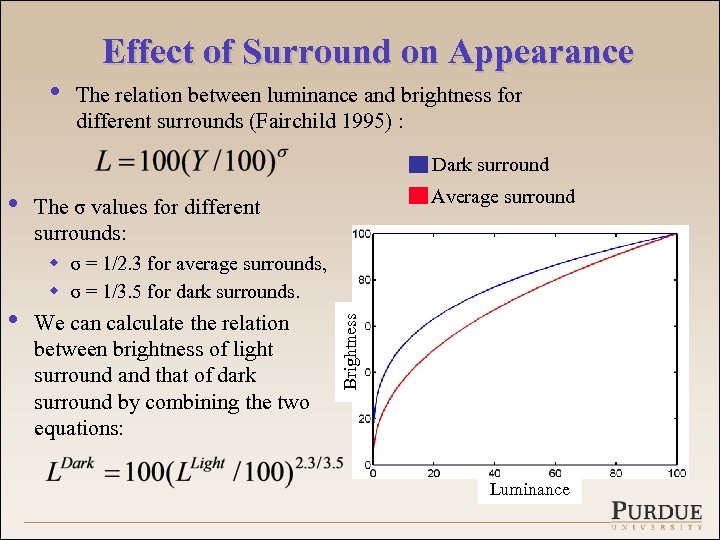
• Effect of Surround on Appearance The relation between luminance and brightness for different surrounds (Fairchild 1995) : Dark surround • Average surround The σ values for different surrounds: w σ = 1/2. 3 for average surrounds, w σ = 1/3. 5 for dark surrounds. We can calculate the relation between brightness of light surround and that of dark surround by combining the two equations: Brightness • Luminance
Our Approach • We conducted two appearance match (AM) experiments between hardcopy and softcopy. w Experiment # 1 : Same surround, different dynamic ranges w Experiment # 2 : Different surround, different dynamic ranges. • We will use these results to duplicate the print on the monitor.
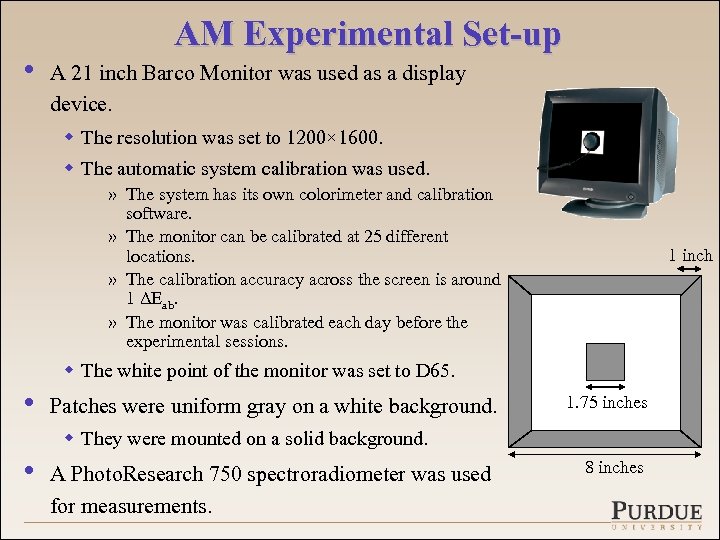
• AM Experimental Set-up A 21 inch Barco Monitor was used as a display device. w The resolution was set to 1200× 1600. w The automatic system calibration was used. » The system has its own colorimeter and calibration software. » The monitor can be calibrated at 25 different locations. » The calibration accuracy across the screen is around 1 ΔEab. » The monitor was calibrated each day before the experimental sessions. 1 inch w The white point of the monitor was set to D 65. • Patches were uniform gray on a white background. 1. 75 inches w They were mounted on a solid background. • A Photo. Research 750 spectroradiometer was used for measurements. 8 inches
AM Experimental Procedure • The memory matching technique was used. w The subjects first memorized the brightness of the hardcopy patch and then adjusted the brightness of the patch on the monitor to yield an appearance match. • Before observing each patch, subjects adapted to an 18% gray background for one minute. • Patches with 8 different gray levels were shown in random order as the stimuli.
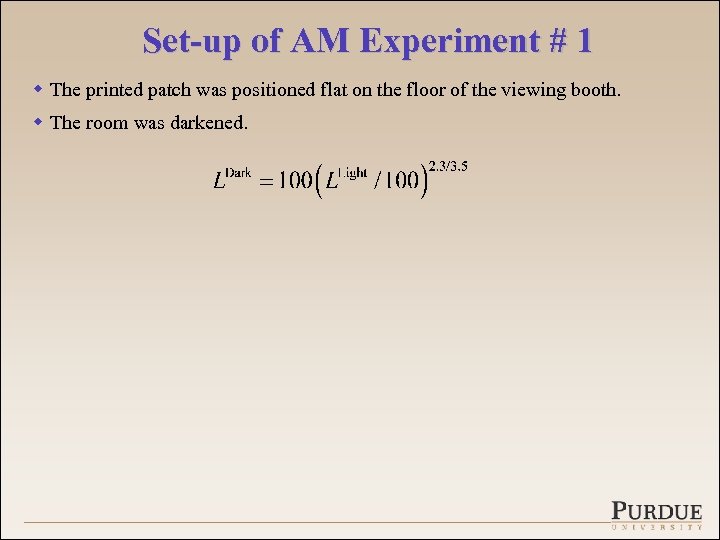
Set-up of AM Experiment # 1 w The printed patch was positioned flat on the floor of the viewing booth. w The room was darkened.
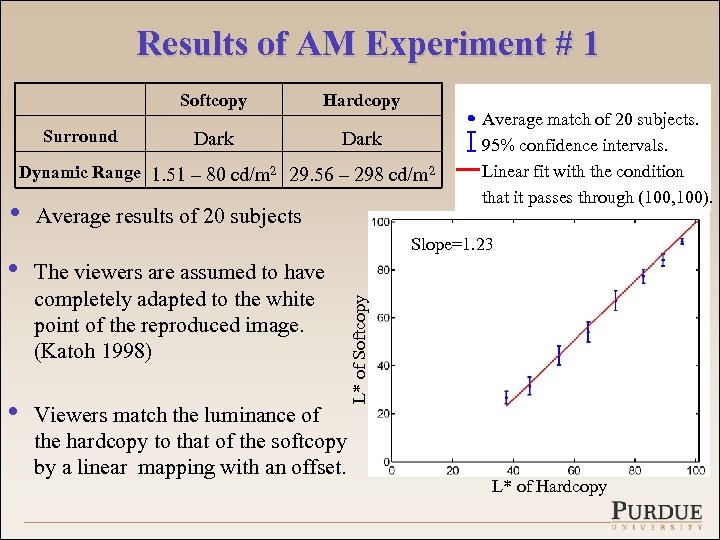
Results of AM Experiment # 1 Softcopy Surround Hardcopy Dark Dynamic Range 1. 51 – 80 cd/m 2 29. 56 – 298 cd/m 2 Average results of 20 subjects Slope=1. 23 • The viewers are assumed to have completely adapted to the white point of the reproduced image. (Katoh 1998) • Viewers match the luminance of the hardcopy to that of the softcopy by a linear mapping with an offset. L* of Softcopy • Average match of 20 subjects. 95% confidence intervals. Linear fit with the condition that it passes through (100, 100). L* of Hardcopy
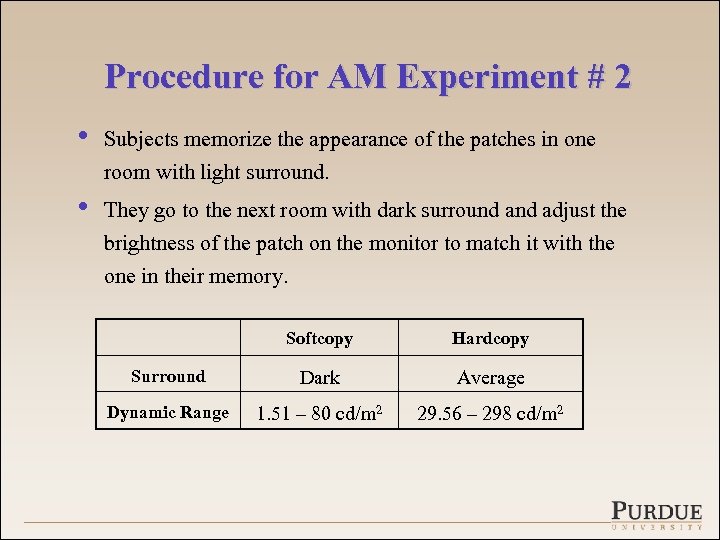
Procedure for AM Experiment # 2 • Subjects memorize the appearance of the patches in one room with light surround. • They go to the next room with dark surround adjust the brightness of the patch on the monitor to match it with the one in their memory. Softcopy Hardcopy Surround Dark Average Dynamic Range 1. 51 – 80 cd/m 2 29. 56 – 298 cd/m 2
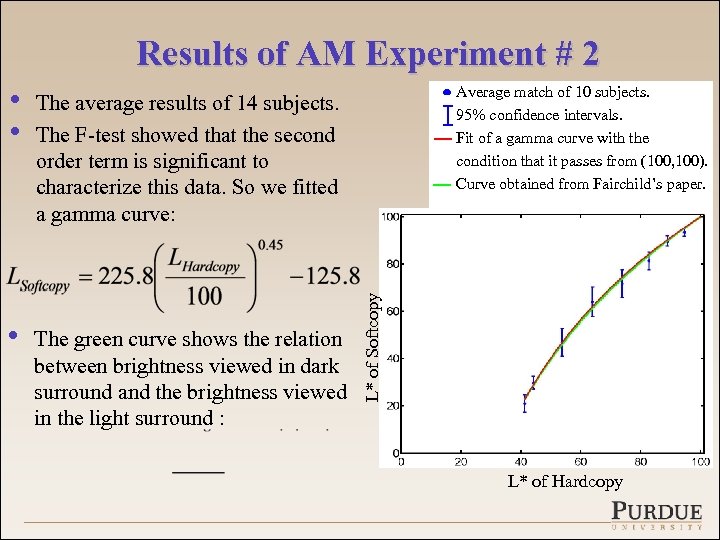
Results of AM Experiment # 2 The average results of 14 subjects. The F-test showed that the second order term is significant to characterize this data. So we fitted a gamma curve: • The green curve shows the relation between brightness viewed in dark surround and the brightness viewed in the light surround : Average match of 10 subjects. 95% confidence intervals. Fit of a gamma curve with the condition that it passes from (100, 100). Curve obtained from Fairchild’s paper. L* of Softcopy • • L* of Hardcopy
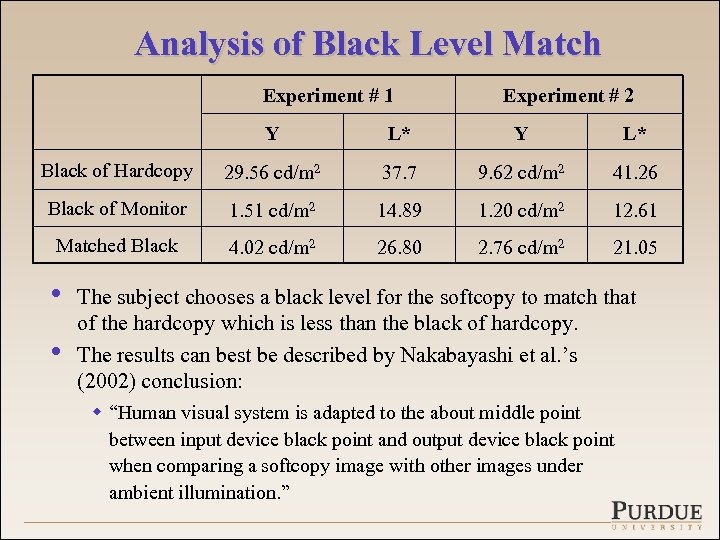
Analysis of Black Level Match Experiment # 1 Experiment # 2 Y L* Black of Hardcopy 29. 56 cd/m 2 37. 7 9. 62 cd/m 2 41. 26 Black of Monitor 1. 51 cd/m 2 14. 89 1. 20 cd/m 2 12. 61 Matched Black 4. 02 cd/m 2 26. 80 2. 76 cd/m 2 21. 05 • • The subject chooses a black level for the softcopy to match that of the hardcopy which is less than the black of hardcopy. The results can best be described by Nakabayashi et al. ’s (2002) conclusion: w “Human visual system is adapted to the about middle point between input device black point and output device black point when comparing a softcopy image with other images under ambient illumination. ”
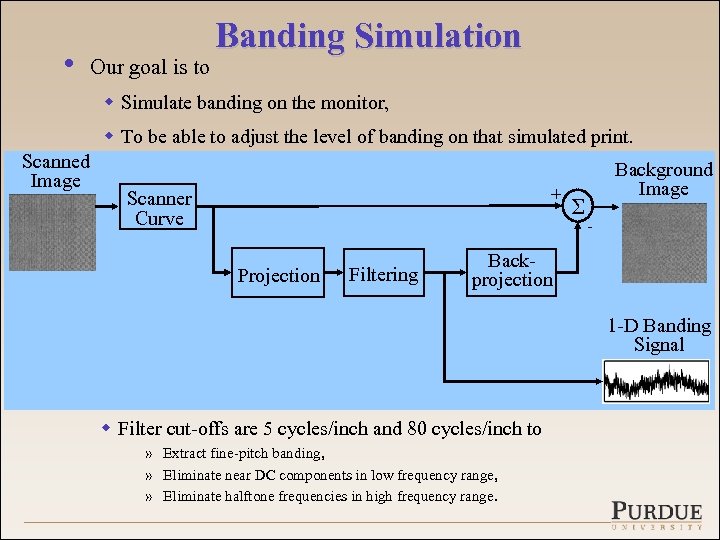
• Our goal is to Banding Simulation w Simulate banding on the monitor, w To be able to adjust the level of banding on that simulated print. Scanned Image + Scanner Curve Projection Filtering Σ Background Image - Backprojection 1 -D Banding Signal w Filter cut-offs are 5 cycles/inch and 80 cycles/inch to » Extract fine-pitch banding, » Eliminate near DC components in low frequency range, » Eliminate halftone frequencies in high frequency range.
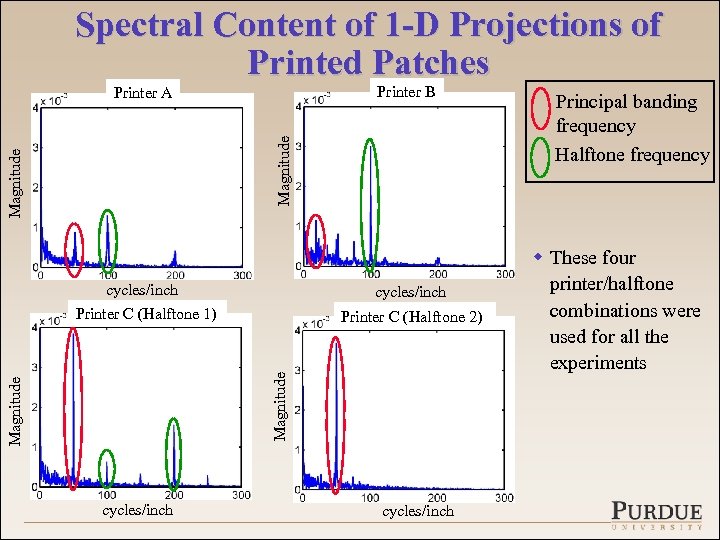
Spectral Content of 1 -D Projections of Printed Patches Printer B Magnitude Printer A cycles/inch Printer C (Halftone 1) cycles/inch Magnitude Printer C (Halftone 2) cycles/inch Principal banding frequency Halftone frequency w These four printer/halftone combinations were used for all the experiments
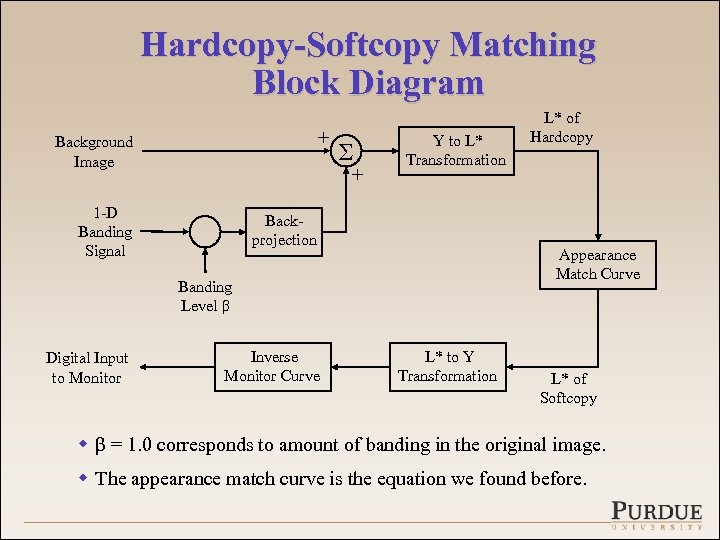
Hardcopy-Softcopy Matching Block Diagram + Background Image Σ + 1 -D Banding Signal Y to L* Transformation Backprojection Appearance Match Curve Banding Level β Digital Input to Monitor Inverse Monitor Curve L* of Hardcopy L* to Y Transformation L* of Softcopy w β = 1. 0 corresponds to amount of banding in the original image. w The appearance match curve is the equation we found before.
Set-up for Banding Visibility Assessment Experiments • • • Same system as the AM experiments was used. • Probit Analysis (PA) was used to analyze the data. Experiments were self-paced. Method of constant stimuli was used in the psychophysical experiments. w PA fits a cumulative Gaussian function to the constant stimuli data, and estimates the mean and standard deviation of this function.
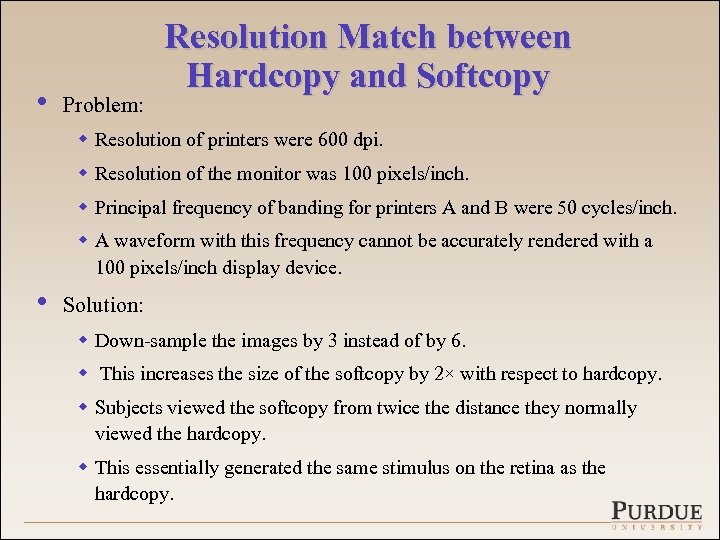
• Problem: Resolution Match between Hardcopy and Softcopy w Resolution of printers were 600 dpi. w Resolution of the monitor was 100 pixels/inch. w Principal frequency of banding for printers A and B were 50 cycles/inch. w A waveform with this frequency cannot be accurately rendered with a 100 pixels/inch display device. • Solution: w Down-sample the images by 3 instead of by 6. w This increases the size of the softcopy by 2× with respect to hardcopy. w Subjects viewed the softcopy from twice the distance they normally viewed the hardcopy. w This essentially generated the same stimulus on the retina as the hardcopy.
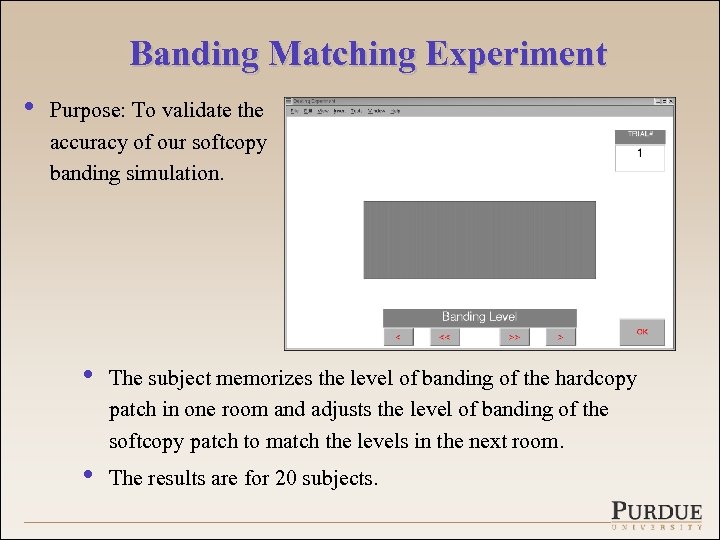
Banding Matching Experiment • Purpose: To validate the accuracy of our softcopy banding simulation. • The subject memorizes the level of banding of the hardcopy patch in one room and adjusts the level of banding of the softcopy patch to match the levels in the next room. • The results are for 20 subjects.
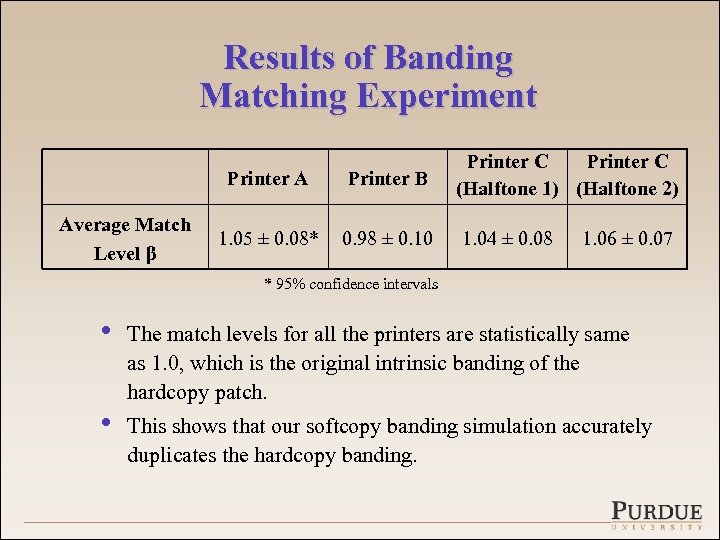
Results of Banding Matching Experiment Printer A Average Match Level β Printer B Printer C (Halftone 1) (Halftone 2) 1. 05 ± 0. 08* 0. 98 ± 0. 10 1. 04 ± 0. 08 1. 06 ± 0. 07 * 95% confidence intervals • • The match levels for all the printers are statistically same as 1. 0, which is the original intrinsic banding of the hardcopy patch. This shows that our softcopy banding simulation accurately duplicates the hardcopy banding.
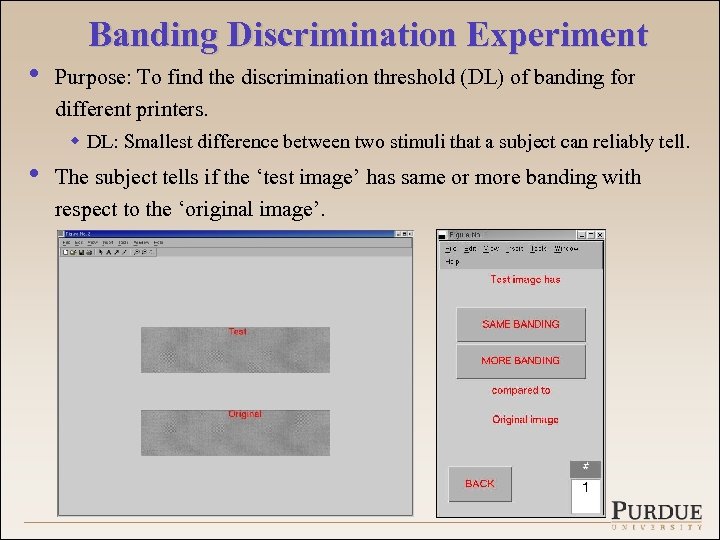
• Banding Discrimination Experiment Purpose: To find the discrimination threshold (DL) of banding for different printers. w DL: Smallest difference between two stimuli that a subject can reliably tell. • The subject tells if the ‘test image’ has same or more banding with respect to the ‘original image’.
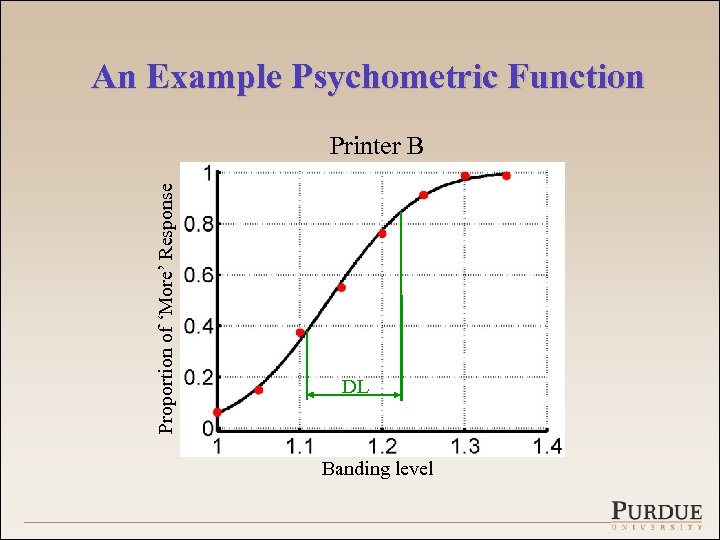
An Example Psychometric Function Proportion of ‘More’ Response Printer B DL Banding level
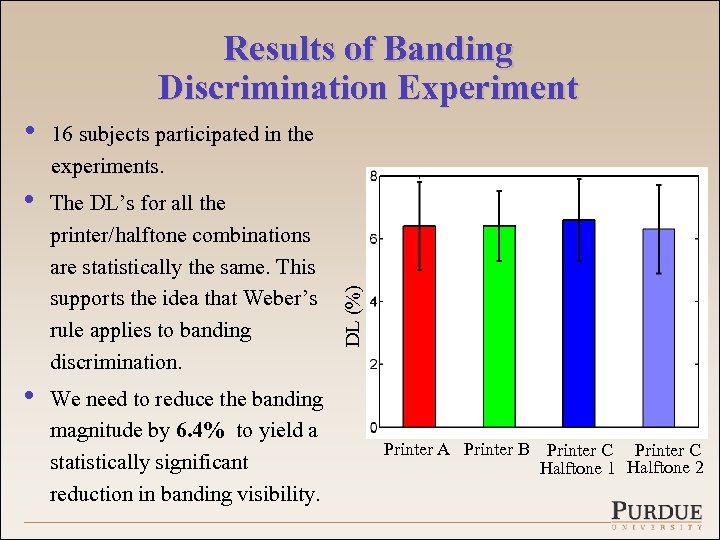
Results of Banding Discrimination Experiment 16 subjects participated in the experiments. • The DL’s for all the printer/halftone combinations are statistically the same. This supports the idea that Weber’s rule applies to banding discrimination. • We need to reduce the banding magnitude by 6. 4% to yield a statistically significant reduction in banding visibility. DL (%) • Printer A Printer B Printer C Halftone 1 Halftone 2
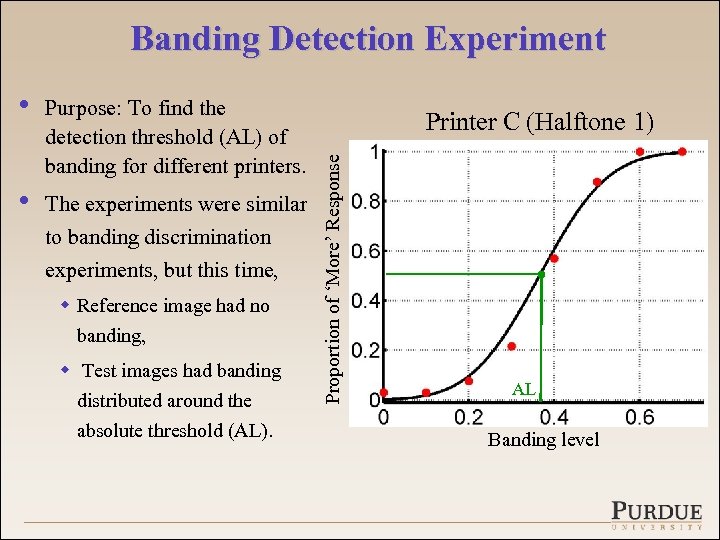
Banding Detection Experiment Purpose: To find the detection threshold (AL) of banding for different printers. • The experiments were similar to banding discrimination experiments, but this time, w Reference image had no banding, w Test images had banding distributed around the absolute threshold (AL). Printer C (Halftone 1) Proportion of ‘More’ Response • AL Banding level
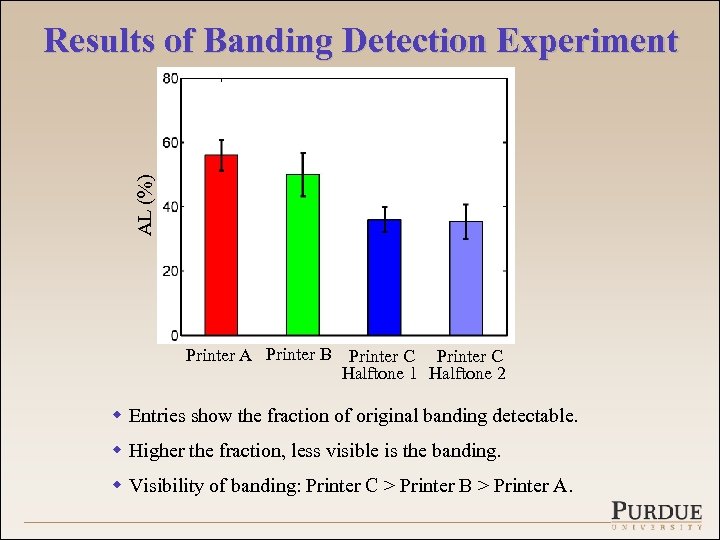
AL (%) Results of Banding Detection Experiment Printer A Printer B Printer C Halftone 1 Halftone 2 w Entries show the fraction of original banding detectable. w Higher the fraction, less visible is the banding. w Visibility of banding: Printer C > Printer B > Printer A.
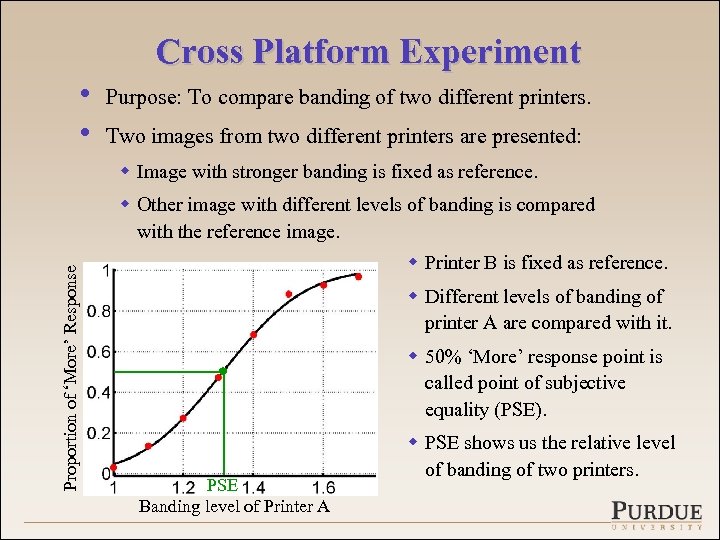
Cross Platform Experiment • • Purpose: To compare banding of two different printers. Two images from two different printers are presented: w Image with stronger banding is fixed as reference. Proportion of ‘More’ Response w Other image with different levels of banding is compared with the reference image. w Printer B is fixed as reference. w Different levels of banding of printer A are compared with it. w 50% ‘More’ response point is called point of subjective equality (PSE). PSE Banding level of Printer A w PSE shows us the relative level of banding of two printers.
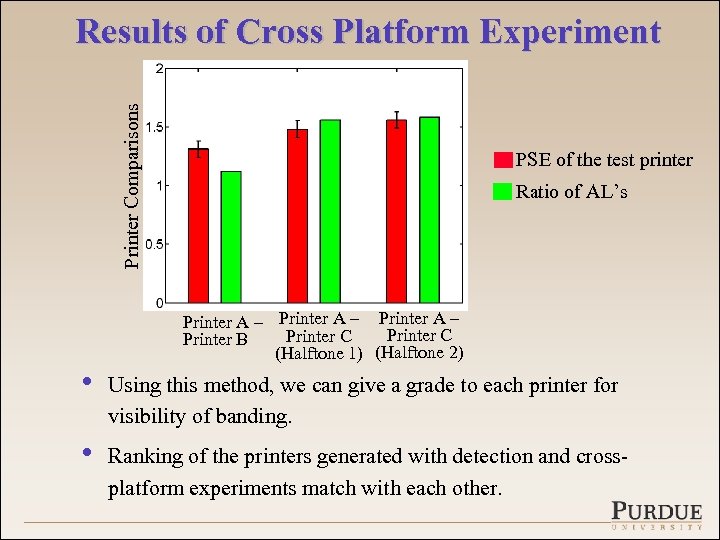
Printer Comparisons Results of Cross Platform Experiment PSE of the test printer Ratio of AL’s Printer A – Printer C Printer B (Halftone 1) (Halftone 2) • Using this method, we can give a grade to each printer for visibility of banding. • Ranking of the printers generated with detection and crossplatform experiments match with each other.
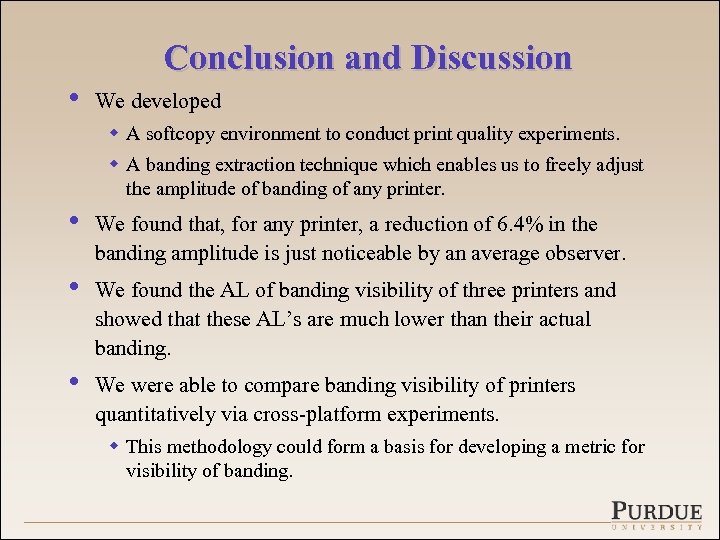
• Conclusion and Discussion We developed w A softcopy environment to conduct print quality experiments. w A banding extraction technique which enables us to freely adjust the amplitude of banding of any printer. • We found that, for any printer, a reduction of 6. 4% in the banding amplitude is just noticeable by an average observer. • We found the AL of banding visibility of three printers and showed that these AL’s are much lower than their actual banding. • We were able to compare banding visibility of printers quantitatively via cross-platform experiments. w This methodology could form a basis for developing a metric for visibility of banding.
Thanks for your attention!
Скачать презентацию Softcopy Banding Visibility Assessment Osman Arslan Prof
3623331f40652fc4176d3e3e323e6465.ppt