


 Скачать презентацию SOFT COMPUTING IN THE SMART COCKPIT A Workshop
30282ebfe38ae4e20c7e433cd96011fc.ppt
- Количество слайдов: 95
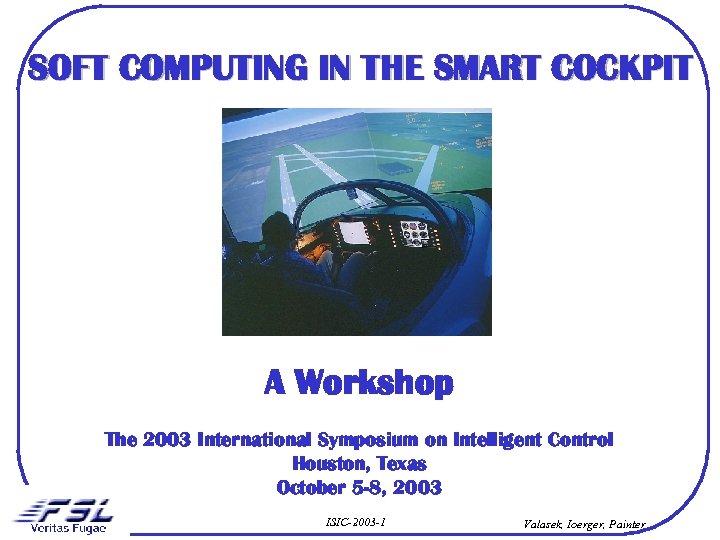 SOFT COMPUTING IN THE SMART COCKPIT A Workshop The 2003 International Symposium on Intelligent Control Houston, Texas October 5 -8, 2003 ISIC-2003 -1 Valasek, Ioerger, Painter
 INSTRUCTORS Dr. John Valasek - Assoc. Professor, Aero. Eng. , Texas A&M. valasek@aero. tamu. edu 979 845 -1685. Dr. Tom Ioerger - Assoc. Professor, Cptr. Sci. , Texas A&M. ioerger@cs. tamu. edu 979 845 -0161. Dr. John Painter - Professor, EE, Aero. , Cptr. Sci. (Ret. ), TAMU altair@tca. net ISIC-2003 -2 979 696 -0429. Valasek, Ioerger, Painter
 COURSE OUTLINE SECTION I • Introduction To The Smart Cockpit And Free Flight • Free Flight Functionality • Architecture: Aircraft & Simulator, Software & Hardware SECTION II • Artificial Intelligence In The Cockpit • Intelligent Computing Techniques • Software Agents: The Key To Smart Cockpit Software SECTION III • Real Time Flight Simulation: The Basics • Real Time Flight Simulation For Free Flight SECTION IV • Selected Research Results • Conclusion: Summing It Up ISIC-2003 -3 Valasek, Ioerger, Painter
 SMART COCKPIT COMPUTING - WHAT IS IT? • COCKPIT FUNCTIONAL INTEGRATION VIA SOFTWARE Helping the Pilot Visualize, Understand, and Fly. Helping the Airplane Automate Nominal Flying Tasks. Helping Air Traffic Control With Transition to “Free Flight. ” • VIEWING AVIATION AS A SOFTWARE PROBLEM. Reducing Pilot Task Load Via Automation. Increasing General Aviation (GA) Pilot Performance in Weather. Increasing GA Weather Access to Un-Instrumented Airports. Increasing Flight Safety With - Automatic Collision Avoidance. - Automatic Weather Avoidance. - Automatic Terrain Avoidance. - All Three at the Same Time. ISIC-2003 -4 Valasek, Ioerger, Painter
 SMART COCKPIT COMPUTING - WHY IS IT? • HAVE YOU FLOWN, LATELY? Major City Airports are Traffic Saturated. Air Travel is Geared to Using Major Cities. Only 715 Airports are Weather Instrumented. The Answer is Not More Jumbo Jets. • WHY NOT FLIGHT-ENABLE THE MEDICALLY QUALIFIED? There are 5, 400 Public Airports. Flying Can Become a Public Utility. Computing Technology Can Satisfy the Major Requirements. - Inexpensive Airport Weather Instrumentation. - GA Aircraft Relative Affordability. - GA Pilot Weather Proficiency Increased. - GA Pilot Training Affordability. ISIC-2003 -5 Valasek, Ioerger, Painter
 IS THE SMART COCKPIT JUST FOR GA? • TECHNIQUES APPLY TO AIR TRANSPORT AS WELL AS GA. Improves Situational Awareness and Multi-Tasking. Reduces Pilot Work-Load. Works for the Pilot, Not Vice-Versa. Works for the Pilot, But Doesn’t Replace Him. • BUY THIS TECHNOLOGY “BY THE YARD. ” Software Architecture is Modular - by Function. Some Functions Require Additional Cockpit Instrumentation. Implement Functions as You Can Afford Them. Augmentable Functionality is the “Name of the Game. ” ISIC-2003 -6 Valasek, Ioerger, Painter
 SMART COCKPIT COMPUTING - WHERE IS IT? • AT THE CROSS-ROADS OF MULTI-DISCIPLINES. Flight Control & Air Traffic Management. Intelligent Control & Soft Computing. AI & Software Agents. Human Factors & User Interface Design. • IN THE HANDS OF MULTIPLE AGENCIES. Government - NASA Langley Research Center (SATS). Academia - Aeronautical Engineering, Computer Science, Etc. Industry - Avionics Companies (FMS, GPS, etc. ). ISIC-2003 -7 Valasek, Ioerger, Painter
 SATS - THE PROGRAM Small Aircraft Transportation System • FIVE-YEAR DEMONSTRATION GOALS (2001 -2005) Technology and Operational Capability: 1. Higher Volume @ Non-ILS Airports 2. Decreased Landing Minimums (Weather). 3. Increased Single-Pilot/Mission Safety/Reliability. 4. Integration of SATS Traffic With NAS. • THE OPERATIONAL/TECHNOLOGY KEYS. Increasing Cockpit Technology Increases Operational Capability. “Self-Controlled Airspace” (SCA) for Smaller Airports. Increasing “Usable” Airports by 750% (4, 685 + 715 = 5, 400). ATC-Acceptable Procedural/Spatial Interface and Hand-off. ISIC-2003 -8 Valasek, Ioerger, Painter
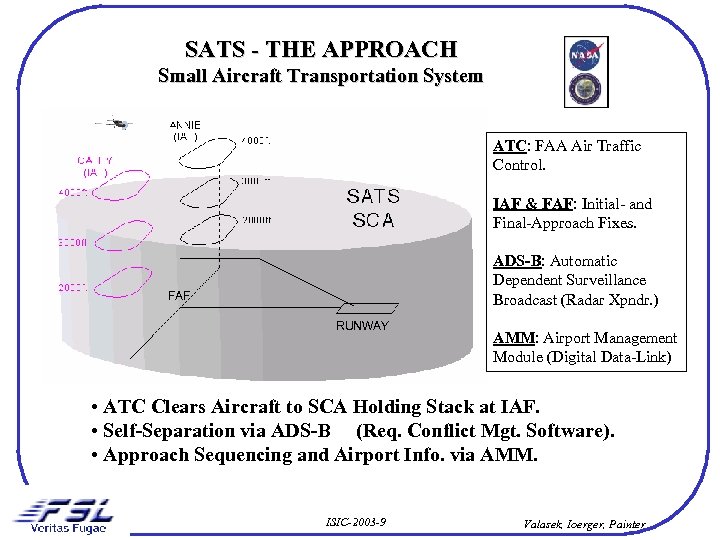 SATS - THE APPROACH Small Aircraft Transportation System ATC: FAA Air Traffic Control. IAF & FAF: Initial- and Final-Approach Fixes. ADS-B: Automatic Dependent Surveillance Broadcast (Radar Xpndr. ) FAF RUNWAY AMM: Airport Management Module (Digital Data-Link) • ATC Clears Aircraft to SCA Holding Stack at IAF. • Self-Separation via ADS-B (Req. Conflict Mgt. Software). • Approach Sequencing and Airport Info. via AMM. ISIC-2003 -9 Valasek, Ioerger, Painter
 SMART COCKPIT RESEARCH - DOING IT • REQUIRES A FIXED-BASE FLIGHT SIMULATOR. General-Purpose Cockpit. Realistic Controls. - Stick, Rudder, Throttles, Flaps, Trim, Gear, Brakes. - It Must be Realistic to Fly. General Purpose Panel Displays. - Touch-Screen LCDs Are Good (for Research/Development). Forward-Projection Screen System. - At Least 90 -degrees Wide. - 160 -degrees is Better (Wrap-Around, 3 -Screen). • THE SIMULATOR IS A SOFTWARE DEVELOPMENT TOOL. Software Modules Developed in MATLAB® - Ported to C++. Software Modules Integrated in the Flight Simulator Computers. Software Functionality Validated/Corrected by Pilots Flying It. ISIC-2003 -10 Valasek, Ioerger, Painter
 FREE FLIGHT - WHAT IS IT? • A MOVING TARGET. Its Specification is Not Yet Stable. Ideal Agreed, but Details Disagreed. Players: FAA, NASA, Aviation Industry. • THE ORIGINAL IDEAL 1 “Freedom of Choice” … of IFR Routes (RTCA - 1995). Pilot Selection of Trajectory … in Real Time. “Max/Max” Solution for Safety/Efficiency. • THE PROBLEM. Requires New Air/Ground Operations and Technology. 1 Control Applications and Challenges in Air Traffic Management, by Joseph W. Jackson and Steven M. Green, Proceedings of the American Control Conference, June, 1998, pp. 1772 -1788. ISIC-2003 -11 Valasek, Ioerger, Painter
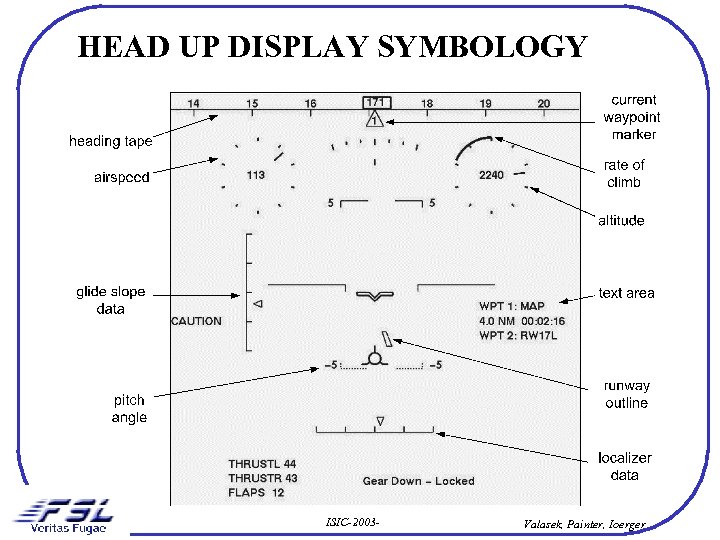
 FREE-FLIGHT - COCKPIT FUNCTIONALITY • VOICE RADIO. • NAVIGATION • PANEL INSTRUMENTS • SITUATION DISPLAY - Global Positioning System (GPS). - Flat LCD With Touch-Screen. (Moving Map Reqs. Nav. Data Base). • AVOIDANCE FUNCTIONS: Collision - On Situation Display (Reqs. ADS-B Beacon Add-on). Weather On Situation Display (Reqs. A/G Digital Data Link). Terrain - On Situation Display (Reqs. Nav. Data Base). • HEAD-UP DISPLAY (HUD) - For Eyes Out of the Cockpit. - Instrument and Approach Displays. • APPROACH AIDS: - GPS, ILS, and/or SATS. - On HUD and/or Situation Display. • PILOT ADVISOR - On HUD and/or Situation Display. (Req. Flight Mode Interpreter) ISIC-2003 -12 Valasek, Ioerger, Painter
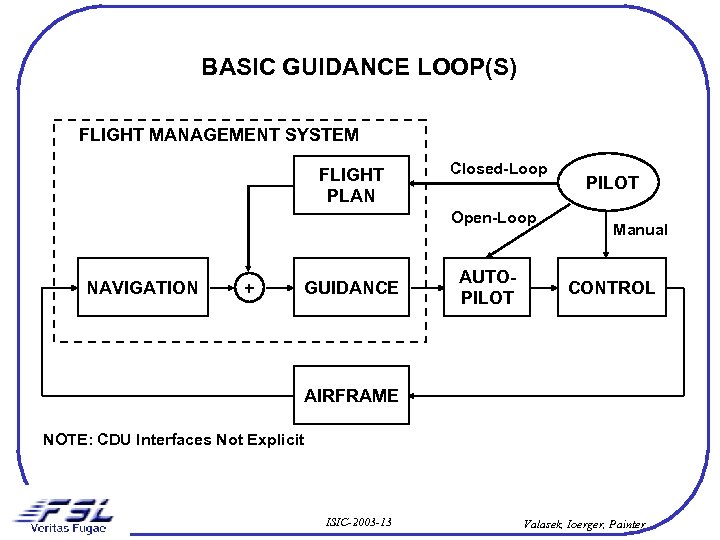 BASIC GUIDANCE LOOP(S) FLIGHT MANAGEMENT SYSTEM FLIGHT PLAN Closed-Loop Open-Loop NAVIGATION + GUIDANCE AUTOPILOT Manual CONTROL AIRFRAME NOTE: CDU Interfaces Not Explicit ISIC-2003 -13 Valasek, Ioerger, Painter
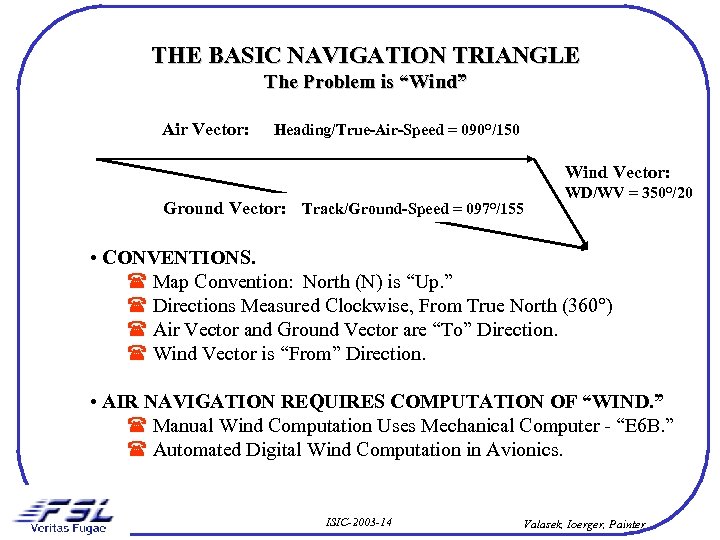 THE BASIC NAVIGATION TRIANGLE The Problem is “Wind” Air Vector: Heading/True-Air-Speed = 090°/150 Wind Vector: Ground Vector: Track/Ground-Speed = 097°/155 WD/WV = 350°/20 • CONVENTIONS. Map Convention: North (N) is “Up. ” Directions Measured Clockwise, From True North (360°) Air Vector and Ground Vector are “To” Direction. Wind Vector is “From” Direction. • AIR NAVIGATION REQUIRES COMPUTATION OF “WIND. ” Manual Wind Computation Uses Mechanical Computer - “E 6 B. ” Automated Digital Wind Computation in Avionics. ISIC-2003 -14 Valasek, Ioerger, Painter
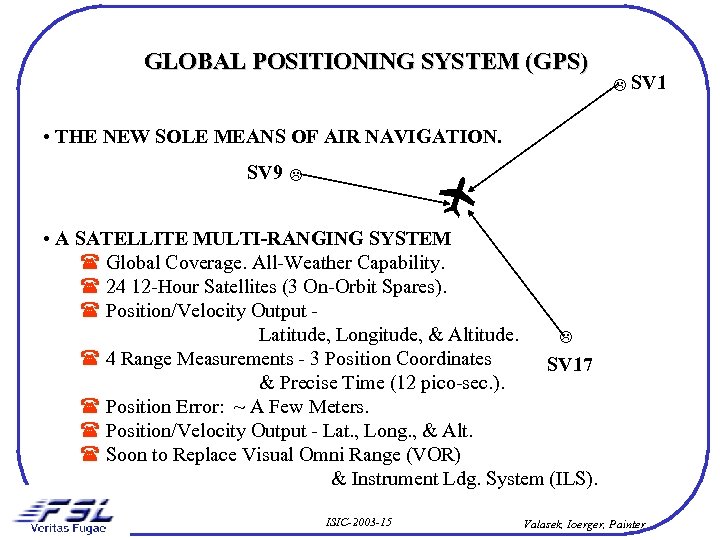 GLOBAL POSITIONING SYSTEM (GPS) SV 1 • THE NEW SOLE MEANS OF AIR NAVIGATION. SV 9 • A SATELLITE MULTI-RANGING SYSTEM Global Coverage. All-Weather Capability. 24 12 -Hour Satellites (3 On-Orbit Spares). Position/Velocity Output Latitude, Longitude, & Altitude. 4 Range Measurements - 3 Position Coordinates SV 17 & Precise Time (12 pico-sec. ). Position Error: ~ A Few Meters. Position/Velocity Output - Lat. , Long. , & Alt. Soon to Replace Visual Omni Range (VOR) & Instrument Ldg. System (ILS). ISIC-2003 -15 Valasek, Ioerger, Painter
 NAVIGATION/GUIDANCE FUNCTION Manual Flying • BASIC NAVIGATION FUNCTION. GPS - Time, Position (LAT, LNG, ALT), Velocity (TRK, GS, ROC). Wind Computing - A/C Data Input (MAG HDG/VAR, IAS, TEMP). Guidance (Pilot Computed) - Waypoint HDG, ETE, ETA. • AUGMENTED NAVIGATION FUNCTON. Navigation Data Base (Waypoint Location Data). Guidance Computing - Adds Altitude (AGL) and Approach NAV. • HIGH-LEVEL NAVIGATION FUNCTION. Flight Plan Driven - Requires Pilot Entry of Flight Plan. Guidance Computing - Adds Waypoint Maneuver Alerts (Turn, Climb). ISIC-2003 -16 Valasek, Ioerger, Painter
 NAVIGATION/GUIDANCE FUNCTION Autopilot Flying • AUTOPILOT (A/P) FUNCTION. Autopilot Drives A/C Control Surfaces (Servo). - Ailerons, Elevator, Rudder, Throttle (Optional). Autopilot Inputs - HDG, ALT, IAS (Optional). Inputs Manually by Pilot, or Computer-Generated. • FLIGHT MANAGEMENT SYSTEM (FMS) FUNCTION. Automates Guidance for High-Level NAV. Computes and Issues Guidance Commands to Autopilot. Simultaneous Automatic Navigation and Maneuver. Automates All Flight Phases, Including Approach/Landing. • NAVIGATION/GUIDANCE FUNCTIONAL HIERARCHY. Manual Flying Autopilot FMS ISIC-2003 -17 Valasek, Ioerger, Painter
 COCKPIT DISPLAYS, BY FUNCTION • THE PILOT’S VIRTUAL WORLD. It’s All About Situational Awareness. The Pilot “Reckons” His Situation in 4 D Space-Time. Build a 4 D Mental Image … Using 2 D Displays. • DISPLAY DIFFERENTIATION AND TYPING. “Internal” Situation - The Airplane (Trad. Gauges & Switches “External” Situation - The Flight. Long-Term - Relatively Static (Trad. Maps & Books). Short-Term - Very Dynamic (Traditionally, Gauges). Internal and Short-Term External Display Commonalities. Two Different Genre of Display. ISIC-2003 -18 Valasek, Ioerger, Painter
 COCKPIT DISPLAY - GUIDANCE & NAV • DISPLAYS TAILORED TO TEMPORAL INFO I/O NEEDS. • INFORMATION OUT, ONLY. Long-Term - Navigation (ex. - Moving Map on Panel Display). Short-Term - Guidance/Control (ex. - A/C Dynamics on HUD). Continuously Functioning, Disparate Displays. • INFO INPUT AND OUTPUT - Flight and/or System Management. Long-Term - Flight Planning (ex. - One mode of Panel MFD). Short-Term - System Management (ex. - A/P, FMS Modes). Sequentially Functioning, Multi-Function Display (MFD). I/O Displays Called “Control/Display Unit” (CDU) ISIC-2003 -19 Valasek, Ioerger, Painter
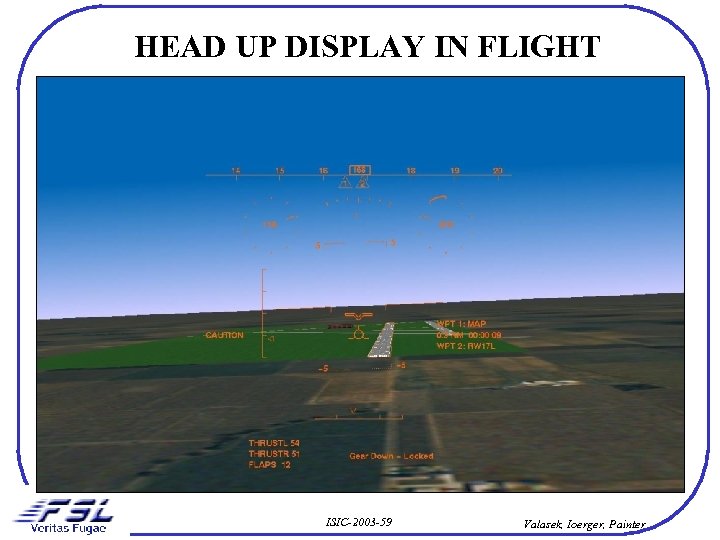
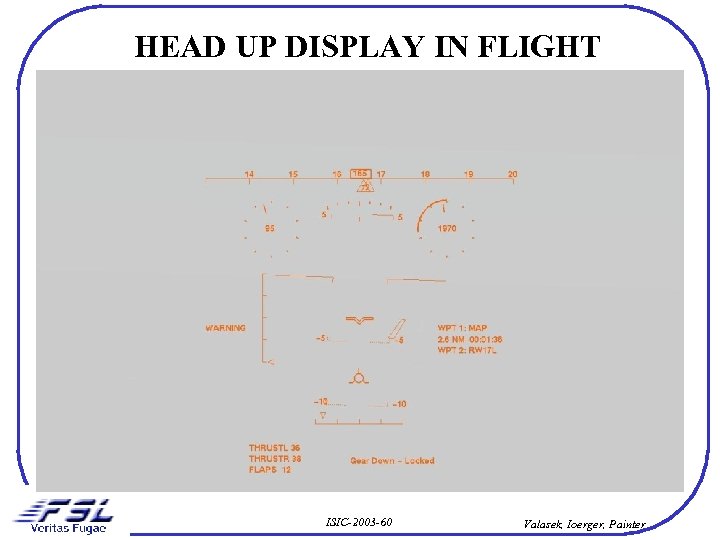
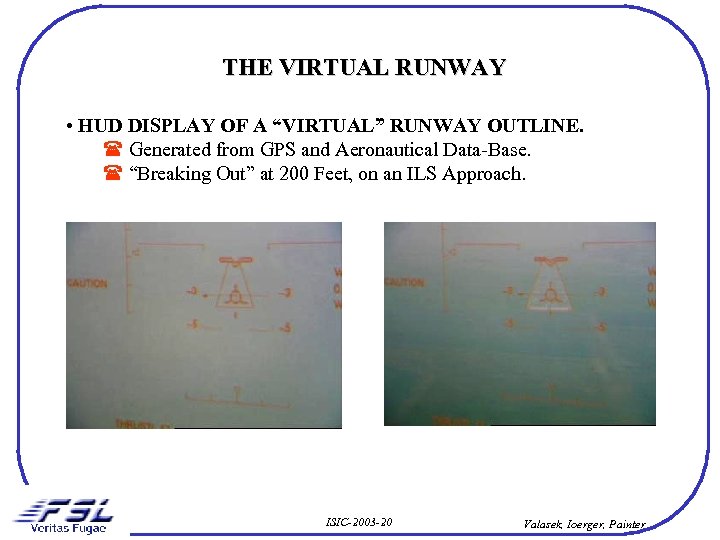 THE VIRTUAL RUNWAY • HUD DISPLAY OF A “VIRTUAL” RUNWAY OUTLINE. Generated from GPS and Aeronautical Data-Base. “Breaking Out” at 200 Feet, on an ILS Approach. ISIC-2003 -20 Valasek, Ioerger, Painter
 HAZARD AVOIDANCE FUNCTION • HAZARDS TO FLIGHT. Severe Weather - (ex. - Thunderstorms). Conflicting Air Traffic - (ex. - VFR Collisions). Controlled Flight Into Terrain - (ex. - Mountain Flying). • FREE FLIGHT HAZARD AVOIDANCE REQUIREMENTS. Cockpit Acquisition of Hazard Data - (Digital Radio Data). Cockpit Computation of Avoidance Trajectories - (Guidance). Cockpit Display of Hazard/Avoidance Imagery - (Map). • FINER POINTS. Cockpit Trajectory-Balancing Between Multiple Hazards. Automated Negotiation Between Aircraft and Air Traffic Control. ISIC-2003 -21 Valasek, Ioerger, Painter
 COCKPIT DISPLAY - HAZARD AVOIDANCE • THREE HAZARDS OF DIFFERING TEMPORALITY. Terrain - Long-Term (No Dynamics). Weather - Long- to Medium-Term - (Dynamics Not A/C-Scale). Traffic - Medium- to Short-Term - (Dynamics A/C-Scale). • DISPLAY CHOICES. All Three Situations Require Info-Out, Only, Display. Imagery of All Three Hazards Can Overlay Moving Map (NAV). Long-Term Guidance Vectors Can Also Overlay Moving Map. Display “Clutter” is a Human Factors Issue, Here. Short-Term Steering Commands on A/C Dynamics Display (HUD). ISIC-2003 -22 Valasek, Ioerger, Painter
 SOFTWARE ARCHITECTURE Form Follows Function • BUILDING A DEVELOPMENT TOOL AND ENVIRONMENT. When You’re Up to Your Armpits in Alligators … ? … Remember, the Goal is a Research Tool. Don’t be a Slave to Current Cockpit Avionics. This Problem is Like GPS … 90% Software. • HOW TO LAY OUT THE SOFTWARE ARCHITECTURE. Modularize, Modularize !! Structure the Whole, Function by Function. Go for Independent, Communicating, Software Modules. - “Independence” as in Task Independence, not Data Independence. - Hence, “Communicating” Modules (AI’s “Message-Passing”). Let the Computing Hardware Take Care of Itself. Think About Project Management and Configuration Control. ISIC-2003 -23 Valasek, Ioerger, Painter
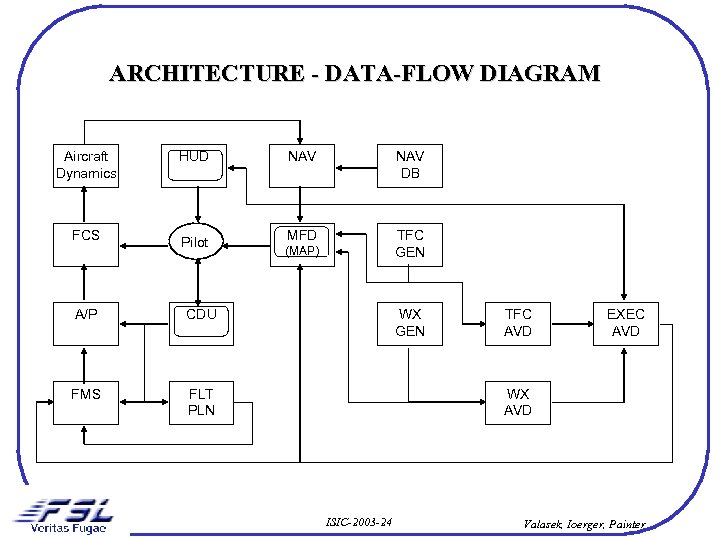 ARCHITECTURE - DATA-FLOW DIAGRAM Aircraft Dynamics HUD FCS Pilot A/P NAV DB MFD TFC GEN (MAP) CDU FMS NAV WX GEN FLT PLN TFC AVD EXEC AVD WX AVD ISIC-2003 -24 Valasek, Ioerger, Painter
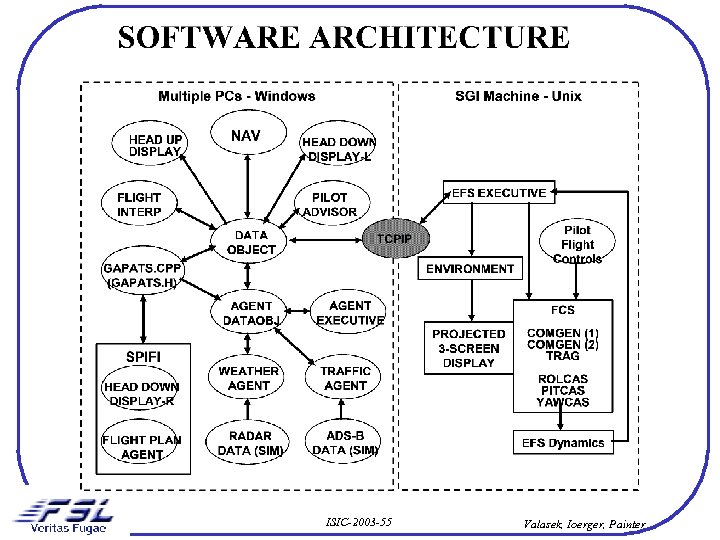
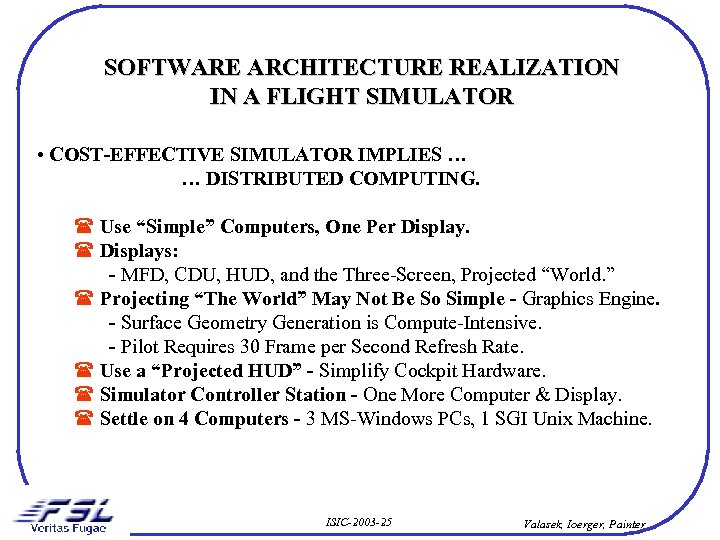 SOFTWARE ARCHITECTURE REALIZATION IN A FLIGHT SIMULATOR • COST-EFFECTIVE SIMULATOR IMPLIES … … DISTRIBUTED COMPUTING. Use “Simple” Computers, One Per Displays: - MFD, CDU, HUD, and the Three-Screen, Projected “World. ” Projecting “The World” May Not Be So Simple - Graphics Engine. - Surface Geometry Generation is Compute-Intensive. - Pilot Requires 30 Frame per Second Refresh Rate. Use a “Projected HUD” - Simplify Cockpit Hardware. Simulator Controller Station - One More Computer & Display. Settle on 4 Computers - 3 MS-Windows PCs, 1 SGI Unix Machine. ISIC-2003 -25 Valasek, Ioerger, Painter
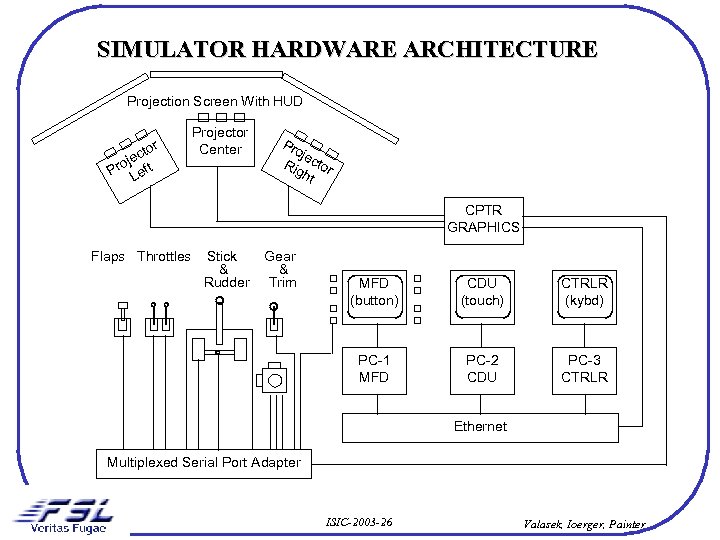 SIMULATOR HARDWARE ARCHITECTURE Projection Screen With HUD tor ec roj ft P Le Projector Center Pro je Rig ctor ht CPTR GRAPHICS Flaps Throttles Stick & Rudder Gear & Trim MFD (button) CDU (touch) CTRLR (kybd) PC-1 MFD PC-2 CDU PC-3 CTRLR Ethernet Multiplexed Serial Port Adapter ISIC-2003 -26 Valasek, Ioerger, Painter
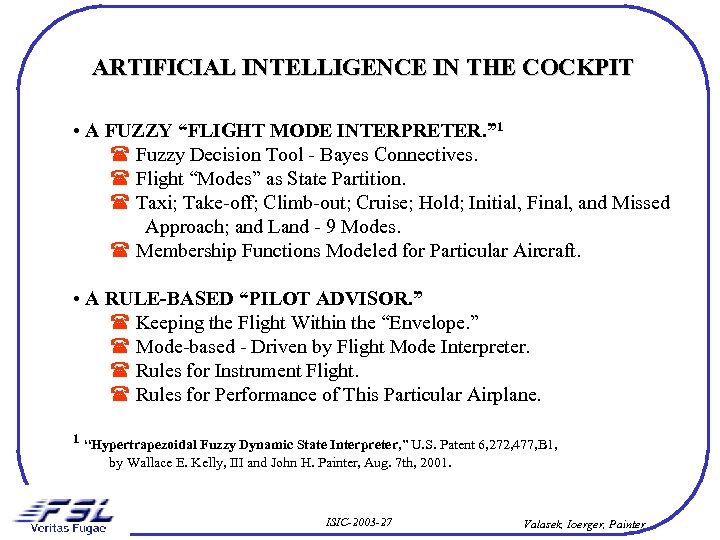 ARTIFICIAL INTELLIGENCE IN THE COCKPIT • A FUZZY “FLIGHT MODE INTERPRETER. ” 1 Fuzzy Decision Tool - Bayes Connectives. Flight “Modes” as State Partition. Taxi; Take-off; Climb-out; Cruise; Hold; Initial, Final, and Missed Approach; and Land - 9 Modes. Membership Functions Modeled for Particular Aircraft. • A RULE-BASED “PILOT ADVISOR. ” Keeping the Flight Within the “Envelope. ” Mode-based - Driven by Flight Mode Interpreter. Rules for Instrument Flight. Rules for Performance of This Particular Airplane. 1 “Hypertrapezoidal Fuzzy Dynamic State Interpreter, ” U. S. Patent 6, 272, 477, B 1, by Wallace E. Kelly, III and John H. Painter, Aug. 7 th, 2001. ISIC-2003 -27 Valasek, Ioerger, Painter
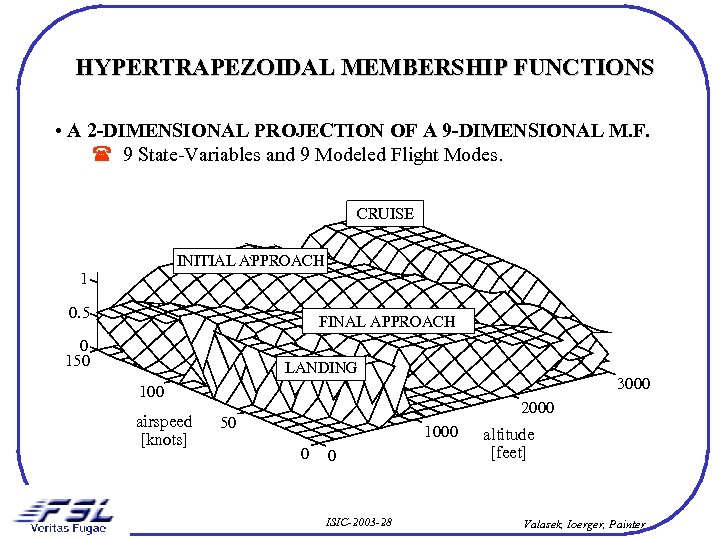 HYPERTRAPEZOIDAL MEMBERSHIP FUNCTIONS • A 2 -DIMENSIONAL PROJECTION OF A 9 -DIMENSIONAL M. F. 9 State-Variables and 9 Modeled Flight Modes. CRUISE INITIAL APPROACH ` 1 0. 5 FINAL APPROACH 0 150 LANDING 3000 100 airspeed [knots] 2000 50 1000 0 0 ISIC-2003 -28 altitude [feet] Valasek, Ioerger, Painter
 FUZZY LOGIC - OTHER COCKPIT APPLICATIONS • AUTOMATING DISPLAY CALL-UP AND FORMATTING. Mode-Driven, With Pilot Over-ride. • BLENDING MULTIPLE GUIDANCE TRAJECTORIES. (A Fuzzy Executive Guidance Agent. ) Multiple Hazard-Avoidance Trajectories. Example: Nominal Flight Plan versus Weather and/or Traffic. Define Spatial Trajectory-Risk Functions. Normalize the Set of Evaluated Risks (0 -1). Prioritize Individual Avoidance Trajectory Generators. Minimize Highest Risk, First, Then Lower Risks - Sequence. ISIC-2003 -29 Valasek, Ioerger, Painter
 COURSE OUTLINE SECTION I • Introduction To The Smart Cockpit And Free Flight • Free Flight Functionality • Architecture: Aircraft & Simulator, Software & Hardware SECTION II • Artificial Intelligence In The Cockpit • Intelligent Computing Techniques • Software Agents: The Key To Smart Cockpit Software SECTION III • Real Time Flight Simulation: The Basics • Real Time Flight Simulation For Free Flight SECTION IV • Selected Research Results • Conclusion: Summing It Up ISIC-2003 -30 Valasek, Ioerger, Painter
 Intelligent Computing Techniques ! Software Engineering ? Object-oriented programming ! Data communications: TCP/IP ? Modular design ? Message Passing ! Intelligent Agents ? model complex decision-making/protocols ? simulate autonomous behavior ISIC-2003 -31 Valasek, Ioerger, Painter
 Data Communications ! TCP/IP enables modularization & scalability (>1 machine) ! example: connect independent flight dynamics engines to common server ! typically 10 MB/s ! pass text strings (e. g. set/get state vars) ! buffering, blocking ISIC-2003 -32 Valasek, Ioerger, Painter
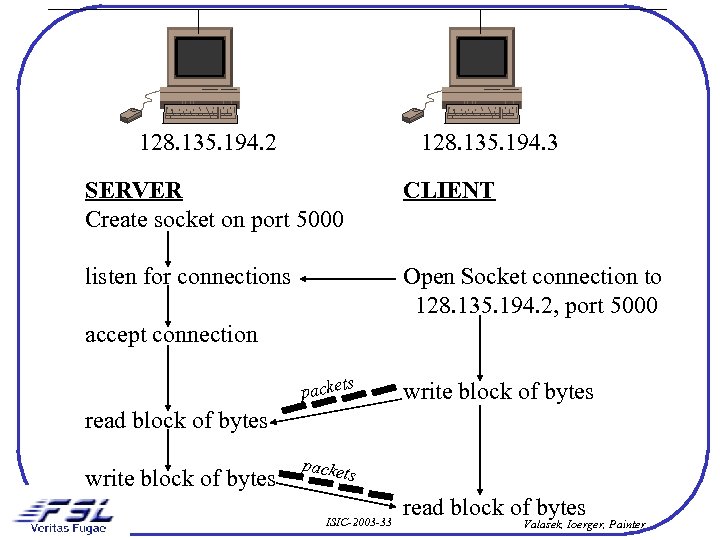 128. 135. 194. 2 128. 135. 194. 3 SERVER Create socket on port 5000 CLIENT listen for connections Open Socket connection to 128. 135. 194. 2, port 5000 accept connection s packet write block of bytes read block of bytes write block of bytes packet s ISIC-2003 -33 read block of bytes Valasek, Ioerger, Painter
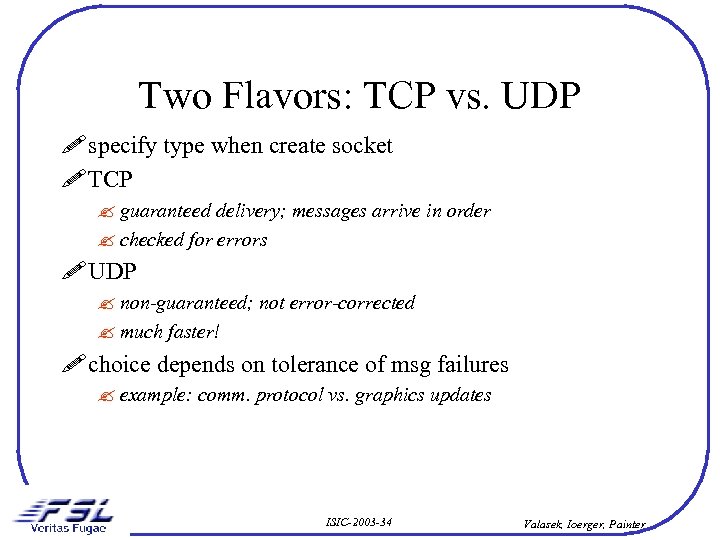 Two Flavors: TCP vs. UDP ! specify type when create socket ! TCP ? guaranteed delivery; messages arrive in order ? checked for errors ! UDP ? non-guaranteed; not error-corrected ? much faster! ! choice depends on tolerance of msg failures ? example: comm. protocol vs. graphics updates ISIC-2003 -34 Valasek, Ioerger, Painter
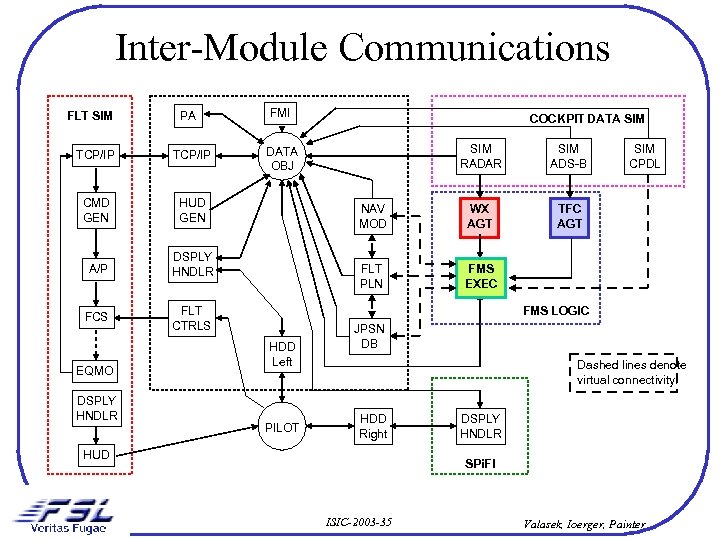 Inter-Module Communications FLT SIM PA TCP/IP CMD GEN DSPLY HNDLR SIM ADS-B WX AGT TFC AGT FLT PLN FLT CTRLS EQMO SIM RADAR NAV MOD DSPLY HNDLR FCS COCKPIT DATA SIM FMS EXEC DATA OBJ HUD GEN A/P FMI SIM CPDL FMS LOGIC HDD Left PILOT JPSN DB Dashed lines denote virtual connectivity. HDD Right HUD DSPLY HNDLR SPi. FI ISIC-2003 -35 Valasek, Ioerger, Painter
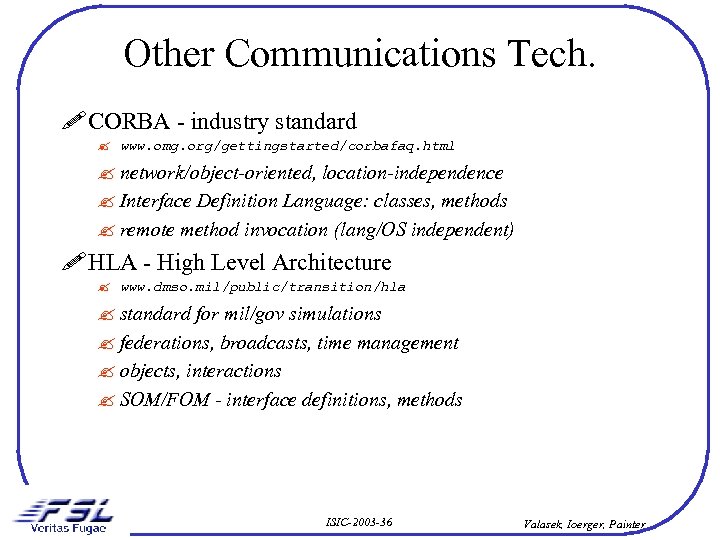 Other Communications Tech. ! CORBA - industry standard ? www. omg. org/gettingstarted/corbafaq. html ? network/object-oriented, location-independence ? Interface Definition Language: classes, methods ? remote method invocation (lang/OS independent) ! HLA - High Level Architecture ? www. dmso. mil/public/transition/hla ? standard for mil/gov simulations ? federations, broadcasts, time management ? objects, interactions ? SOM/FOM - interface definitions, methods ISIC-2003 -36 Valasek, Ioerger, Painter
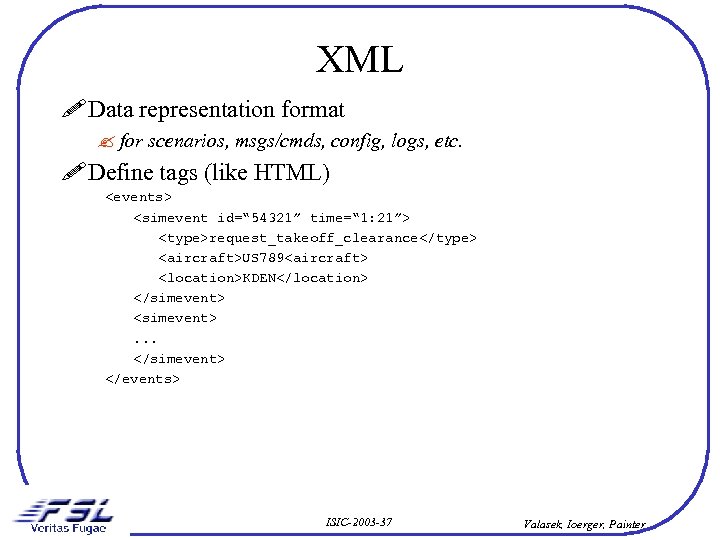 XML ! Data representation format ? for scenarios, msgs/cmds, config, logs, etc. ! Define tags (like HTML)
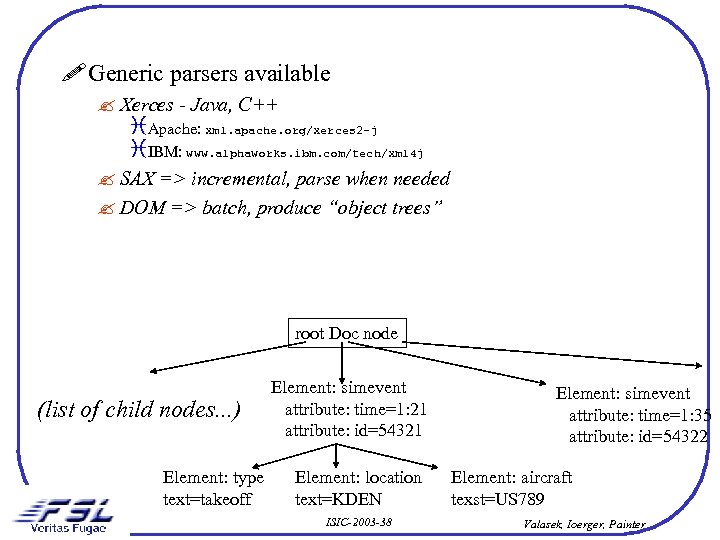 ! Generic parsers available ? Xerces - Java, C++ i. Apache: xml. apache. org/xerces 2 -j i. IBM: www. alphaworks. ibm. com/tech/xml 4 j ? SAX => incremental, parse when needed ? DOM => batch, produce “object trees” root Doc node (list of child nodes. . . ) Element: type text=takeoff Element: simevent attribute: time=1: 21 attribute: id=54321 Element: location text=KDEN ISIC-2003 -38 Element: simevent attribute: time=1: 35 attribute: id=54322 Element: aircraft texst=US 789 Valasek, Ioerger, Painter
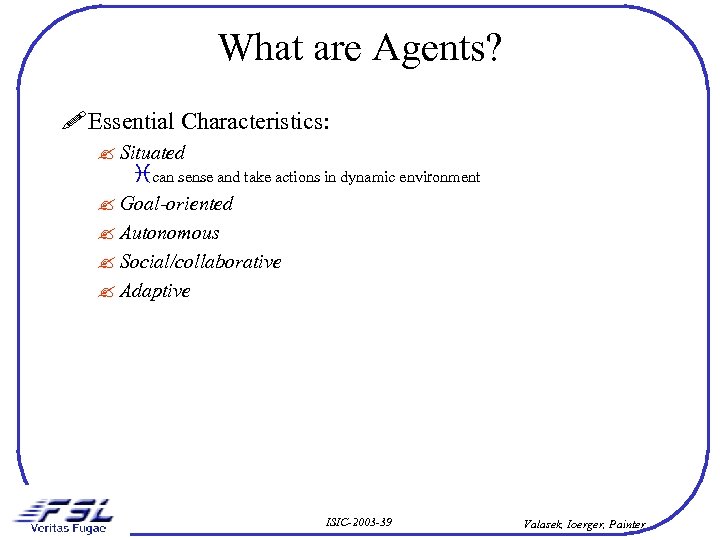 What are Agents? ! Essential Characteristics: ? Situated ican sense and take actions in dynamic environment ? Goal-oriented ? Autonomous ? Social/collaborative ? Adaptive ISIC-2003 -39 Valasek, Ioerger, Painter
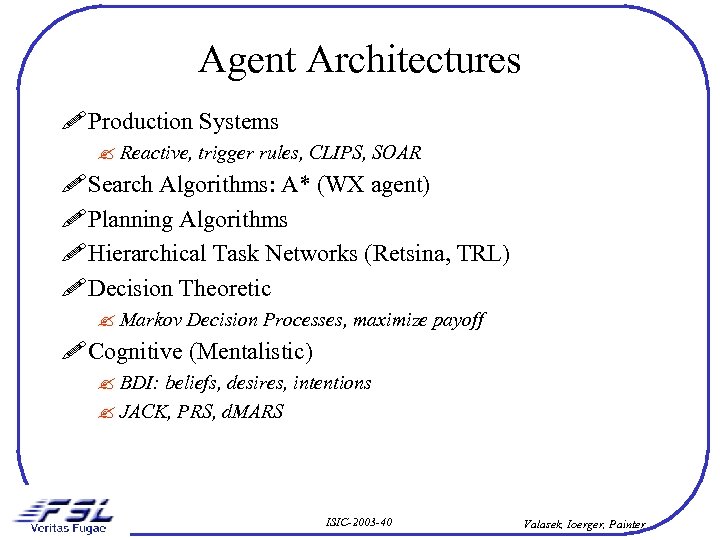 Agent Architectures ! Production Systems ? Reactive, trigger rules, CLIPS, SOAR ! Search Algorithms: A* (WX agent) ! Planning Algorithms ! Hierarchical Task Networks (Retsina, TRL) ! Decision Theoretic ? Markov Decision Processes, maximize payoff ! Cognitive (Mentalistic) ? BDI: beliefs, desires, intentions ? JACK, PRS, d. MARS ISIC-2003 -40 Valasek, Ioerger, Painter
 Roles for Agents in Aviation ! Simulate other aircraft, controllers ! In cockpit: planning flight path, managing fuel, maintaining stability of flight, monitoring traffic or weather conflicts… ! On ground (TRACON, ARTCC): planning trajectories, resolving conflicts, approach metering, handling emergencies, coordination with ground ops, airlines, etc. ISIC-2003 -41 Valasek, Ioerger, Painter
 Collaboration Models ! Teamwork ? ? Hierarchical vs. distributed (command vs. consensus) Key concepts: roles and responsibilities Shared plans: implicit coordination, synchronization Theoretical basis: Joint Intentions ! Negotiation protocols ? Distributed Constraint Satisfaction ? Share justifications and beliefs to determine compromise ? Monotonic Concession Protocol ! Auctions ? Bids based on marginal utility ? Contract networks ISIC-2003 -42 Valasek, Ioerger, Painter
 Role of Simulated “Mental Attitudes” ! Intent – transmit more than position/vector ? Desire to avoid weather, flight plan, will be turning north, descending due to turbulence, reason for deviation… ! Beliefs ? shared info (weather, congestion, aircraft emergencies) ? common picture of situation ? common knowledge: STAR’s, fixes, active runways, traffic patterns ? manage uncertainty ISIC-2003 -43 Valasek, Ioerger, Painter
 Concepts for Development of Multi. Agents for Free Flight ! Strategic (trajectory planning/management) vs. Tactical (avoidance maneuvers) ! Actionable decisions: ? Alter flight path: heading, altitude, speed ! Factors: weather, terrain, traffic ! Constraints: fuel, speed/alt range ! Preferences: time, fuel cost, comfort ISIC-2003 -44 Valasek, Ioerger, Painter
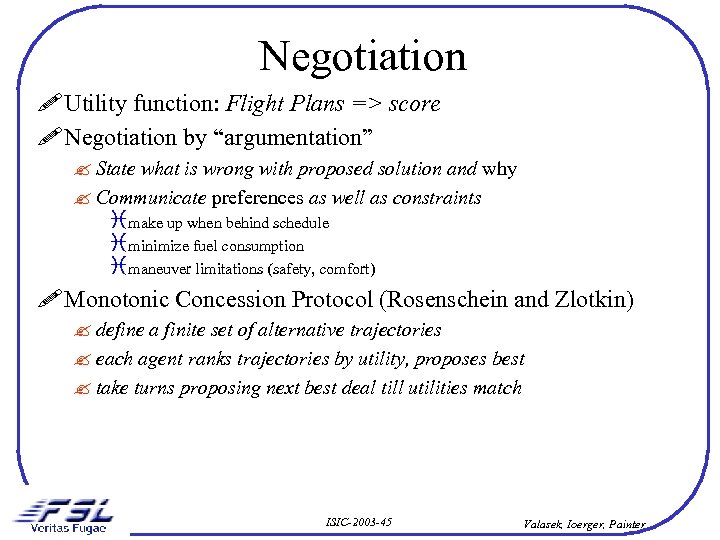 Negotiation ! Utility function: Flight Plans => score ! Negotiation by “argumentation” ? State what is wrong with proposed solution and why ? Communicate preferences as well as constraints imake up when behind schedule iminimize fuel consumption imaneuver limitations (safety, comfort) ! Monotonic Concession Protocol (Rosenschein and Zlotkin) ? define a finite set of alternative trajectories ? each agent ranks trajectories by utility, proposes best ? take turns proposing next best deal till utilities match ISIC-2003 -45 Valasek, Ioerger, Painter
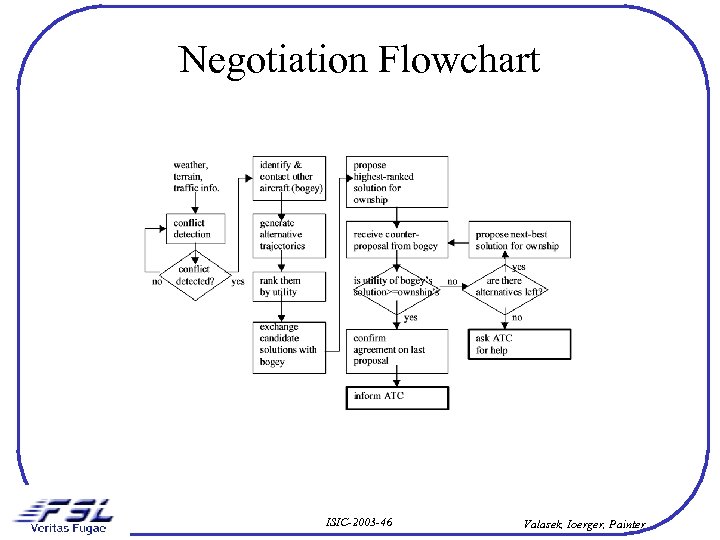 Negotiation Flowchart ISIC-2003 -46 Valasek, Ioerger, Painter
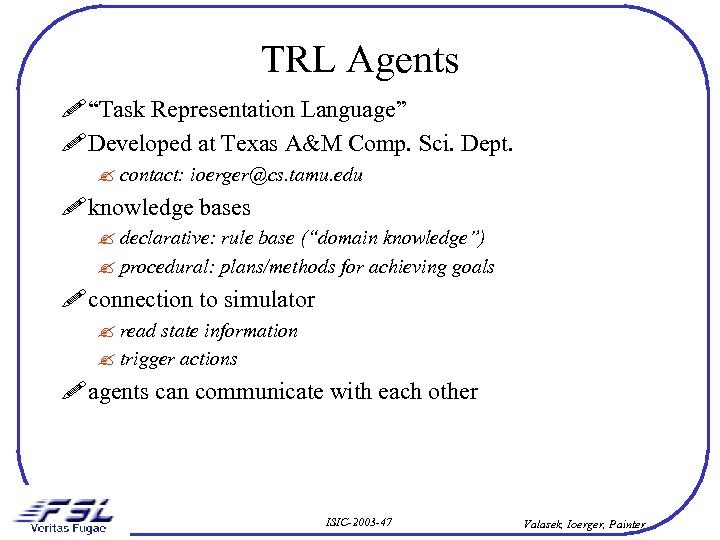 TRL Agents ! “Task Representation Language” ! Developed at Texas A&M Comp. Sci. Dept. ? contact: ioerger@cs. tamu. edu ! knowledge bases ? declarative: rule base (“domain knowledge”) ? procedural: plans/methods for achieving goals ! connection to simulator ? read state information ? trigger actions ! agents can communicate with each other ISIC-2003 -47 Valasek, Ioerger, Painter
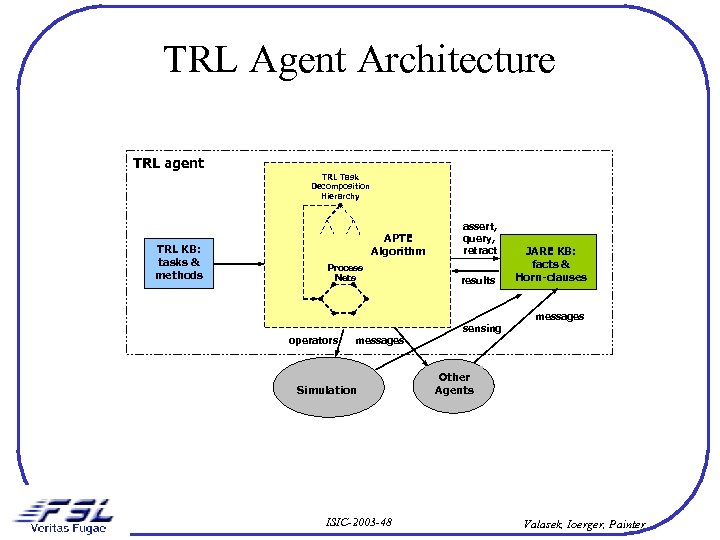 TRL Agent Architecture TRL agent TRL Task Decomposition Hierarchy TRL KB: tasks & methods APTE Algorithm Process Nets operators messages Simulation ISIC-2003 -48 assert, query, retract results sensing JARE KB: facts & Horn-clauses messages Other Agents Valasek, Ioerger, Painter
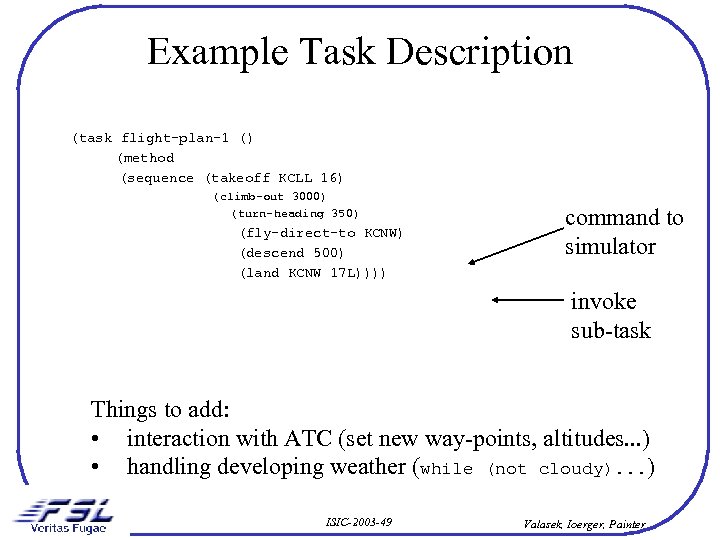 Example Task Description (task flight-plan-1 () (method (sequence (takeoff KCLL 16) (climb-out 3000) (turn-heading 350) (fly-direct-to KCNW) (descend 500) (land KCNW 17 L)))) command to simulator invoke sub-task Things to add: • interaction with ATC (set new way-points, altitudes. . . ) • handling developing weather (while (not cloudy). . . ) ISIC-2003 -49 Valasek, Ioerger, Painter
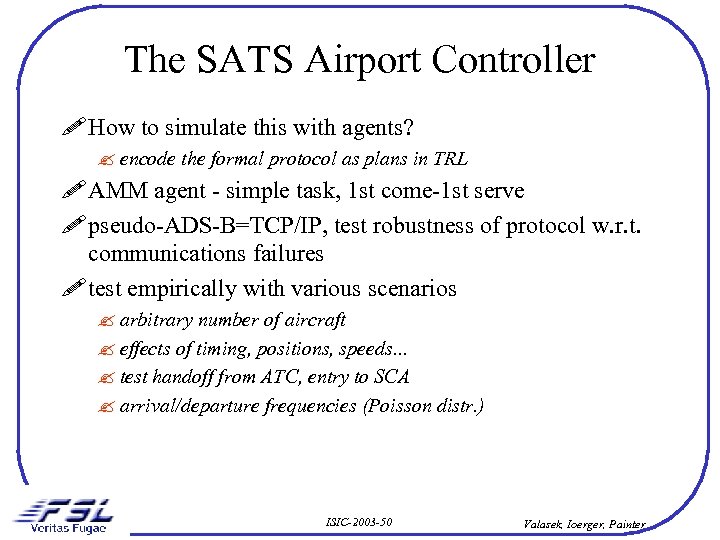 The SATS Airport Controller ! How to simulate this with agents? ? encode the formal protocol as plans in TRL ! AMM agent - simple task, 1 st come-1 st serve ! pseudo-ADS-B=TCP/IP, test robustness of protocol w. r. t. communications failures ! test empirically with various scenarios ? arbitrary number of aircraft ? effects of timing, positions, speeds. . . ? test handoff from ATC, entry to SCA ? arrival/departure frequencies (Poisson distr. ) ISIC-2003 -50 Valasek, Ioerger, Painter
 COURSE OUTLINE SECTION I • Introduction To The Smart Cockpit And Free Flight • Free Flight Functionality • Architecture: Aircraft & Simulator, Software & Hardware SECTION II • Artificial Intelligence In The Cockpit • Intelligent Computing Techniques • Software Agents: The Key To Smart Cockpit Software SECTION III • Real Time Flight Simulation: The Basics • Real Time Flight Simulation For Free Flight SECTION IV • Selected Research Results • Conclusion: Summing It Up ISIC-2003 -51 Valasek, Ioerger, Painter
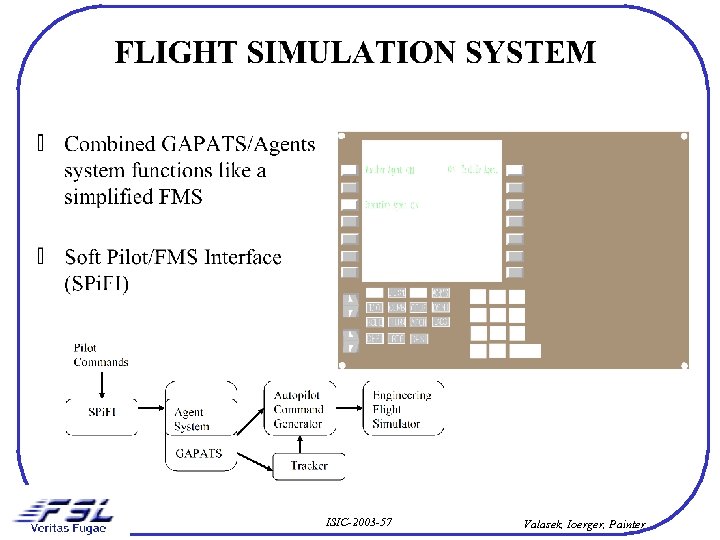
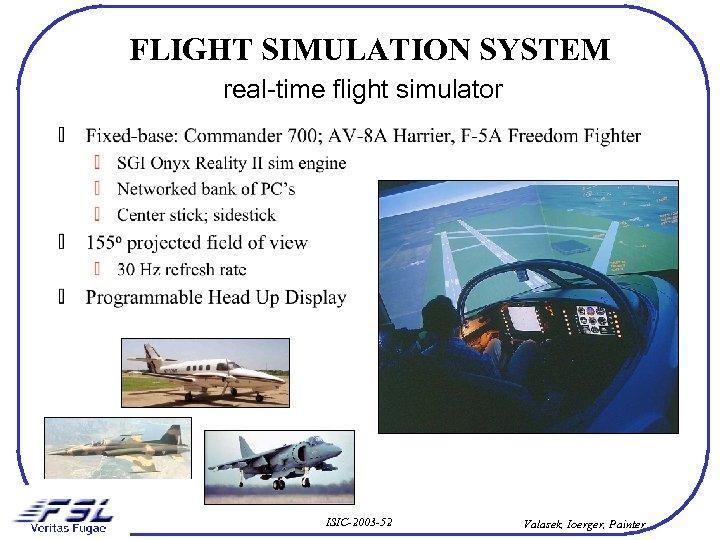 FLIGHT SIMULATION SYSTEM real-time flight simulator ISIC-2003 -52 Valasek, Ioerger, Painter
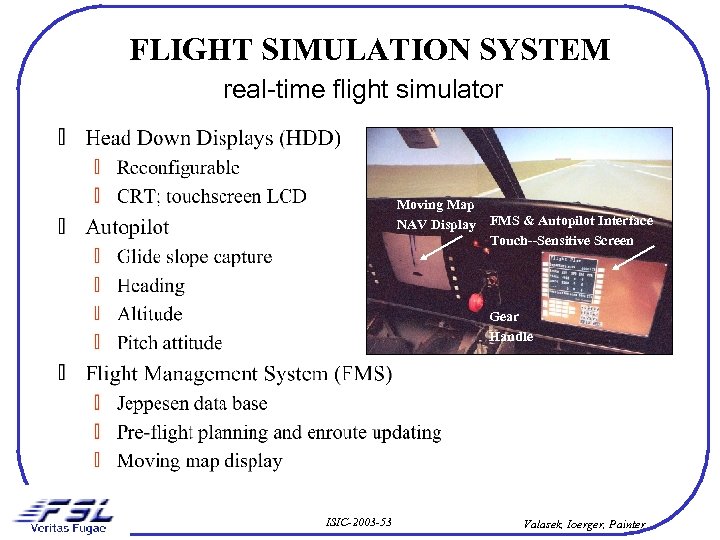 FLIGHT SIMULATION SYSTEM real-time flight simulator Moving Map NAV Display FMS & Autopilot Interface Touch--Sensitive Screen Gear Handle ISIC-2003 -53 Valasek, Ioerger, Painter
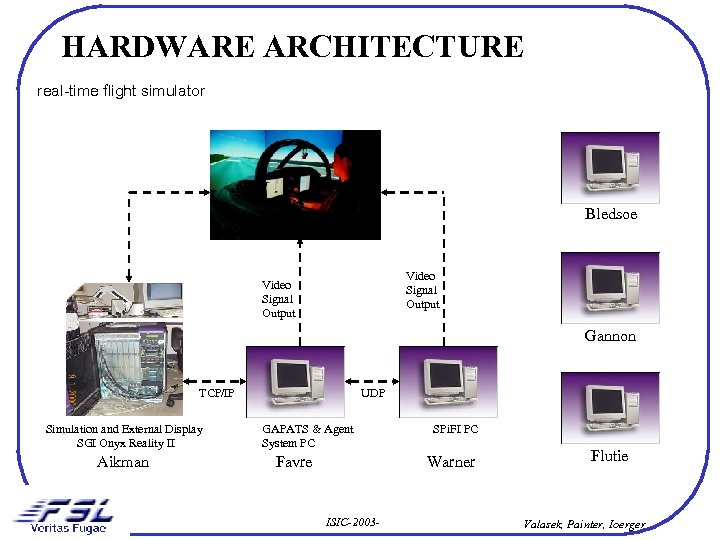 HARDWARE ARCHITECTURE real-time flight simulator Bledsoe Video Signal Output Gannon TCP/IP Simulation and External Display SGI Onyx Reality II Aikman UDP GAPATS & Agent System PC Favre SPi. FI PC Warner ISIC-2003 - Flutie Valasek, Painter, Ioerger
 ISIC-2003 -55 Valasek, Ioerger, Painter
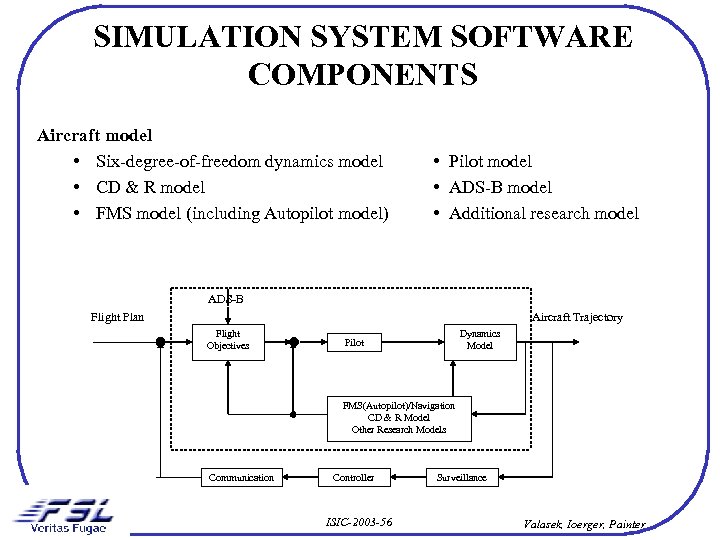 SIMULATION SYSTEM SOFTWARE COMPONENTS Aircraft model • Six-degree-of-freedom dynamics model • CD & R model • FMS model (including Autopilot model) • Pilot model • ADS-B model • Additional research model ADS-B Flight Plan Aircraft Trajectory Flight Objectives Dynamics Model Pilot FMS(Autopilot)/Navigation CD & R Model Other Research Models Communication Controller ISIC-2003 -56 Surveillance Valasek, Ioerger, Painter
 ISIC-2003 -57 Valasek, Ioerger, Painter
 HEAD UP DISPLAY SYMBOLOGY ISIC-2003 - Valasek, Painter, Ioerger
 HEAD UP DISPLAY IN FLIGHT ISIC-2003 -59 Valasek, Ioerger, Painter
 HEAD UP DISPLAY IN FLIGHT ISIC-2003 -60 Valasek, Ioerger, Painter
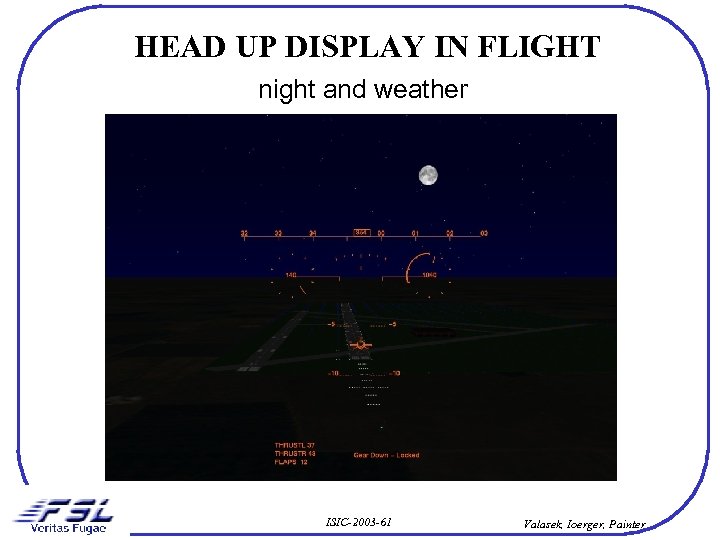 HEAD UP DISPLAY IN FLIGHT night and weather ISIC-2003 -61 Valasek, Ioerger, Painter
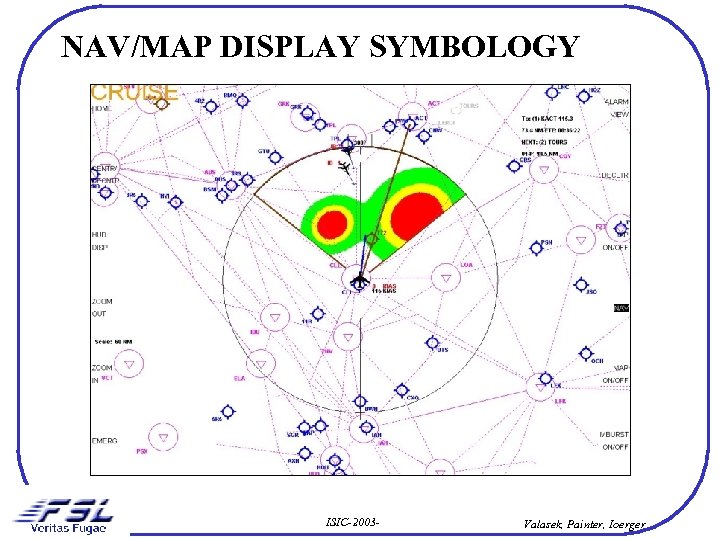 NAV/MAP DISPLAY SYMBOLOGY ISIC-2003 - Valasek, Painter, Ioerger
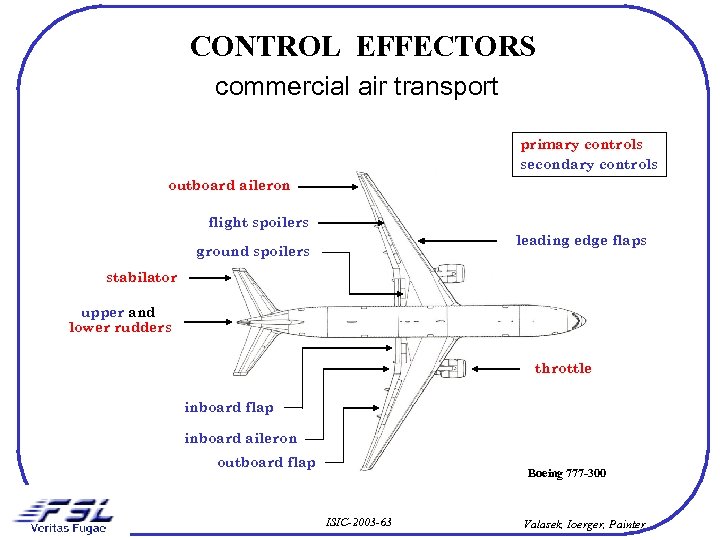 CONTROL EFFECTORS commercial air transport primary controls secondary controls outboard aileron flight spoilers leading edge flaps ground spoilers stabilator upper and lower rudders throttle inboard flap inboard aileron outboard flap Boeing 777 -300 ISIC-2003 -63 Valasek, Ioerger, Painter
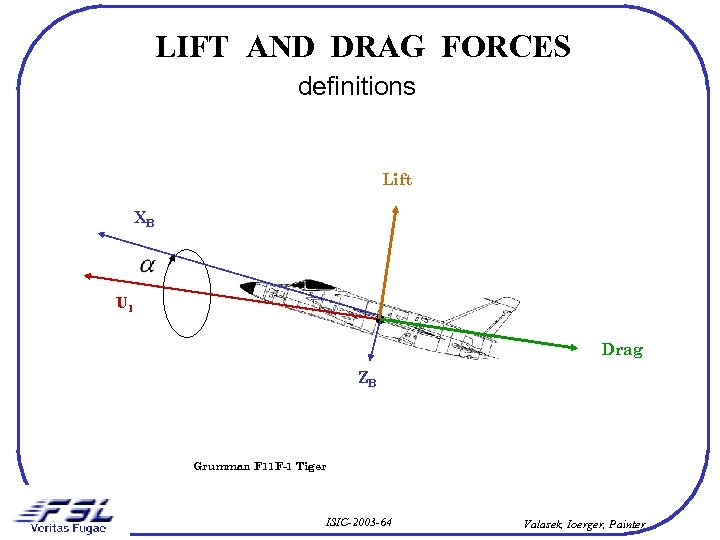 LIFT AND DRAG FORCES definitions Lift XB U 1 Drag ZB Grumman F 11 F-1 Tiger ISIC-2003 -64 Valasek, Ioerger, Painter
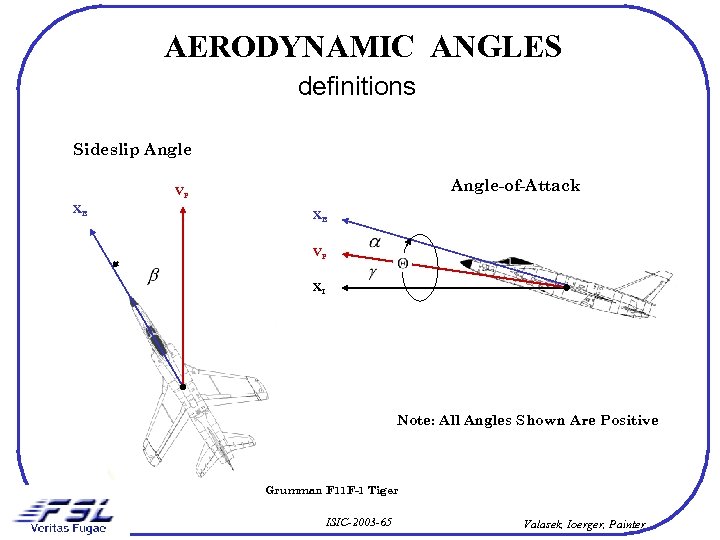 AERODYNAMIC ANGLES definitions Sideslip Angle-of-Attack VP XB XB VP XI Note: All Angles Shown Are Positive Grumman F 11 F-1 Tiger ISIC-2003 -65 Valasek, Ioerger, Painter
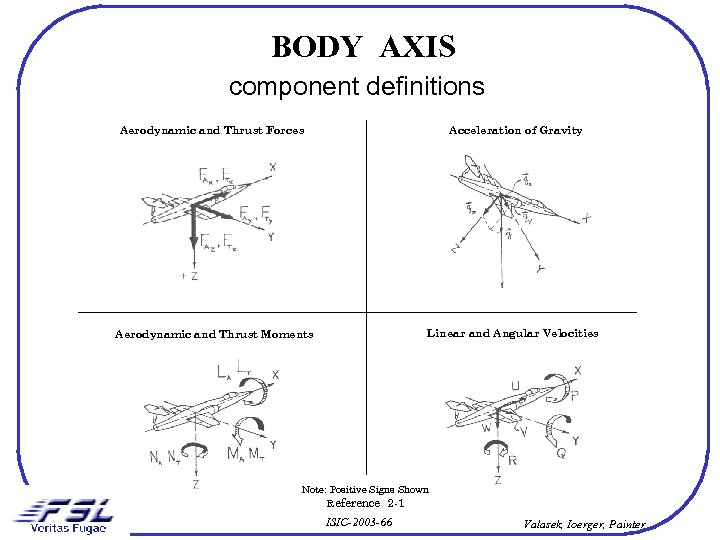 BODY AXIS component definitions Aerodynamic and Thrust Forces Acceleration of Gravity Aerodynamic and Thrust Moments Linear and Angular Velocities Note: Positive Signs Shown Reference 2 -1 ISIC-2003 -66 Valasek, Ioerger, Painter
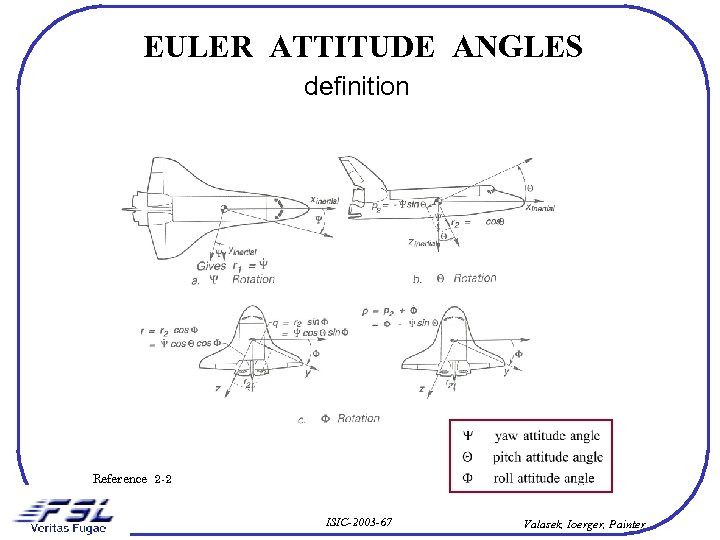 EULER ATTITUDE ANGLES definition Reference 2 -2 ISIC-2003 -67 Valasek, Ioerger, Painter
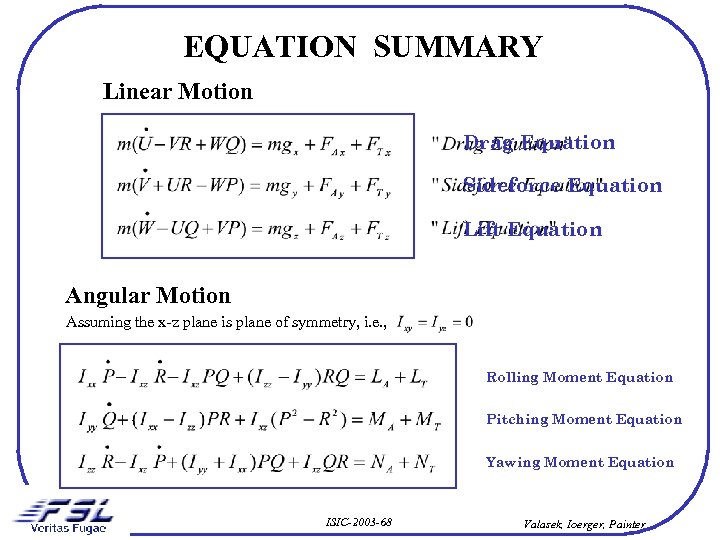 EQUATION SUMMARY Linear Motion Drag Equation Sideforce Equation Lift Equation Angular Motion Assuming the x-z plane is plane of symmetry, i. e. , Rolling Moment Equation Pitching Moment Equation Yawing Moment Equation ISIC-2003 -68 Valasek, Ioerger, Painter
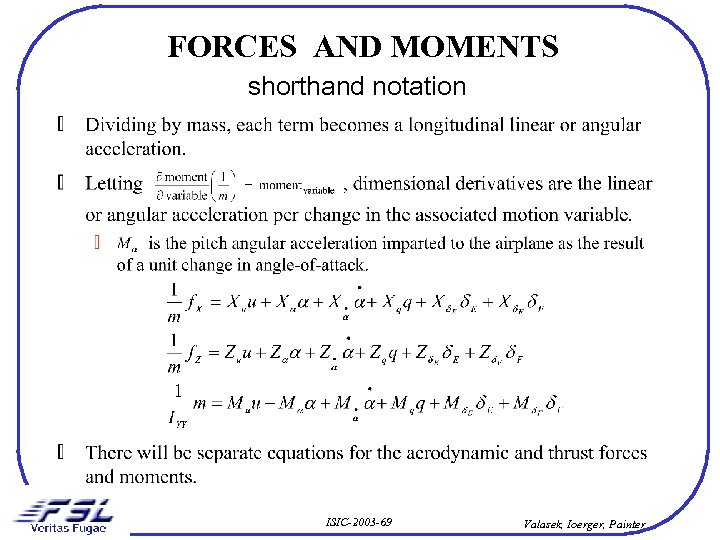 FORCES AND MOMENTS shorthand notation ISIC-2003 -69 Valasek, Ioerger, Painter
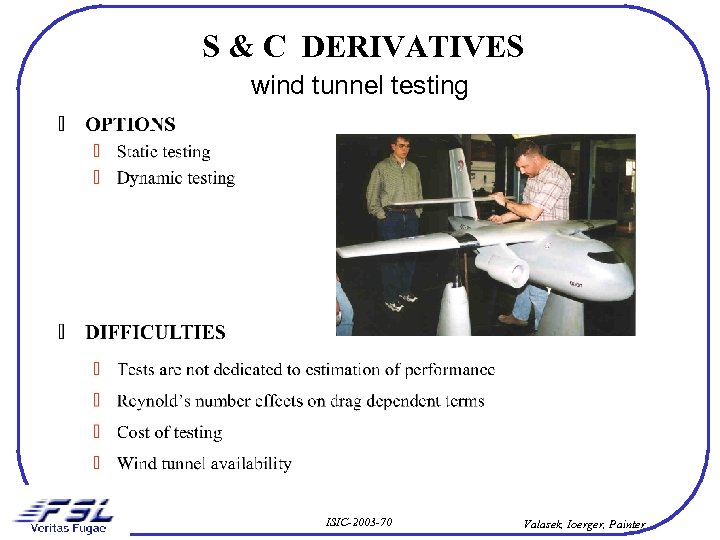 S & C DERIVATIVES wind tunnel testing ISIC-2003 -70 Valasek, Ioerger, Painter
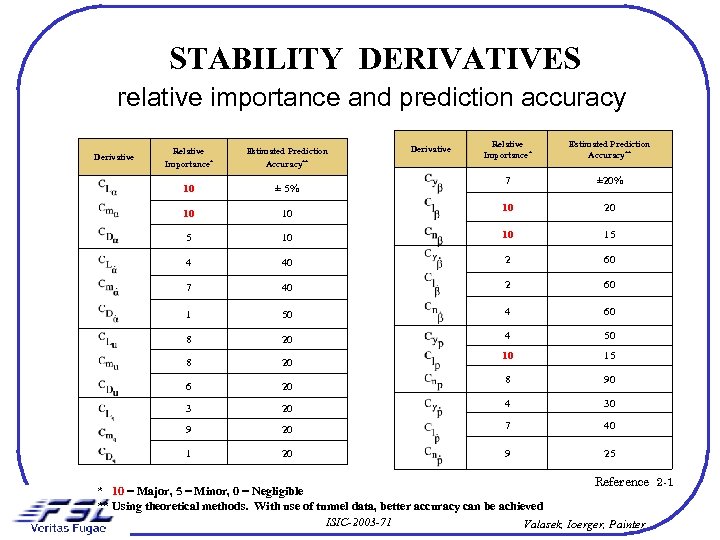 STABILITY DERIVATIVES relative importance and prediction accuracy Relative Importance* Estimated Prediction Accuracy** 7 ± 20% 10 10 20 5 10 10 15 4 40 2 60 7 40 2 60 1 50 4 60 8 20 4 50 8 20 10 15 6 20 8 90 3 20 4 30 9 20 7 40 1 20 9 25 Estimated Prediction Accuracy** 10 ± 5% 10 Derivative Relative Importance* Derivative Reference 2 -1 * 10 = Major, 5 = Minor, 0 = Negligible ** Using theoretical methods. With use of tunnel data, better accuracy can be achieved ISIC-2003 -71 Valasek, Ioerger, Painter
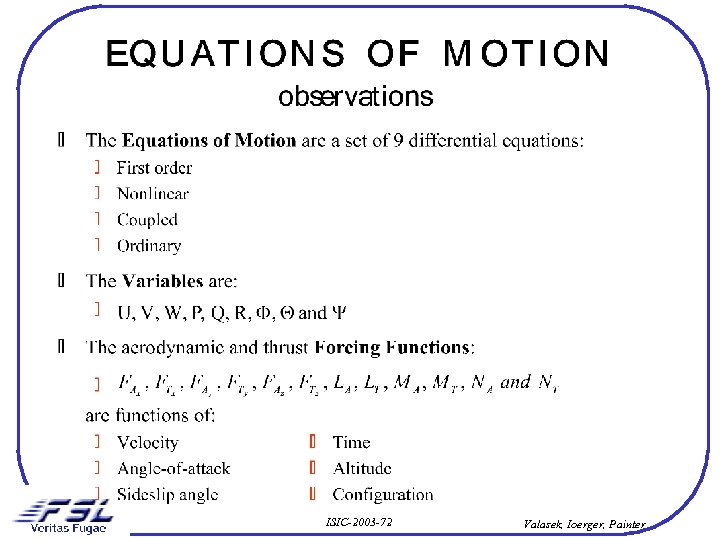 ISIC-2003 -72 Valasek, Ioerger, Painter
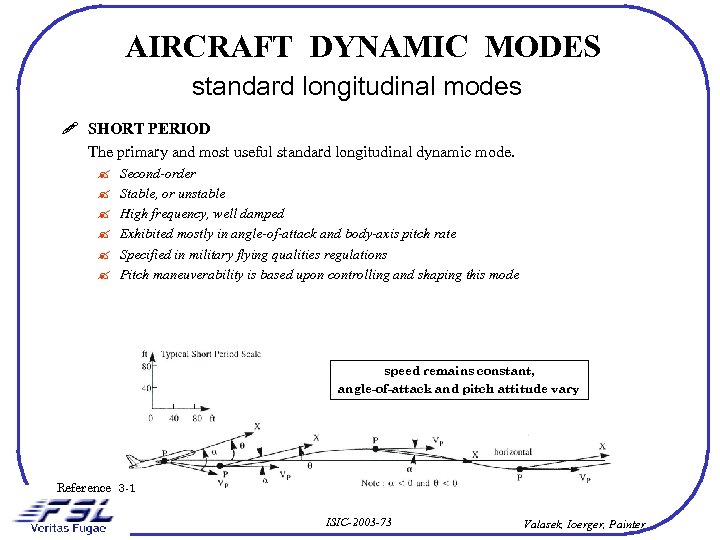 AIRCRAFT DYNAMIC MODES standard longitudinal modes ! SHORT PERIOD The primary and most useful standard longitudinal dynamic mode. ? ? ? Second-order Stable, or unstable High frequency, well damped Exhibited mostly in angle-of-attack and body-axis pitch rate Specified in military flying qualities regulations Pitch maneuverability is based upon controlling and shaping this mode speed remains constant, angle-of-attack and pitch attitude vary Reference 3 -1 ISIC-2003 -73 Valasek, Ioerger, Painter
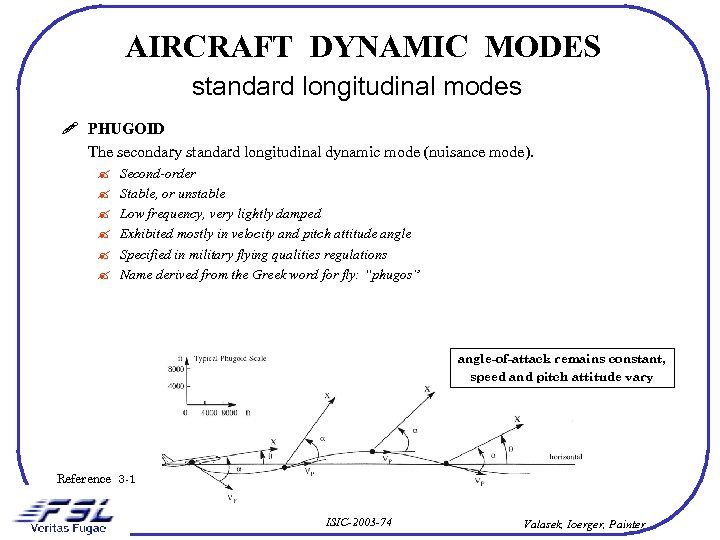 AIRCRAFT DYNAMIC MODES standard longitudinal modes ! PHUGOID The secondary standard longitudinal dynamic mode (nuisance mode). ? ? ? Second-order Stable, or unstable Low frequency, very lightly damped Exhibited mostly in velocity and pitch attitude angle Specified in military flying qualities regulations Name derived from the Greek word for fly: “phugos” angle-of-attack remains constant, speed and pitch attitude vary Reference 3 -1 ISIC-2003 -74 Valasek, Ioerger, Painter
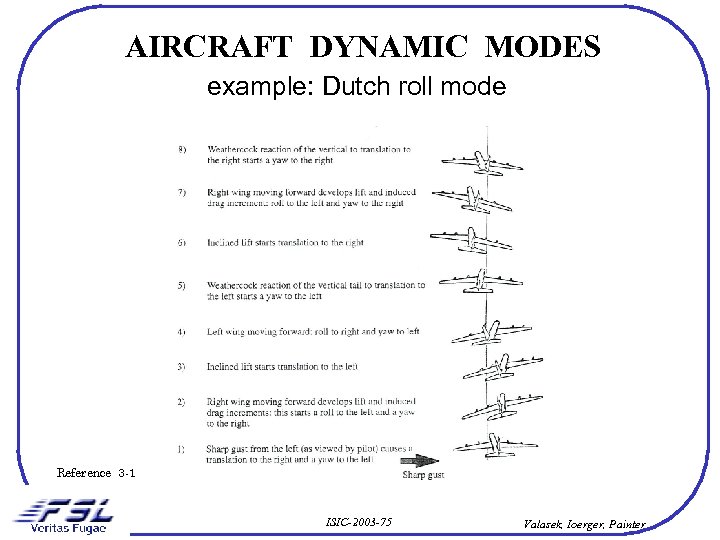 AIRCRAFT DYNAMIC MODES example: Dutch roll mode Reference 3 -1 ISIC-2003 -75 Valasek, Ioerger, Painter
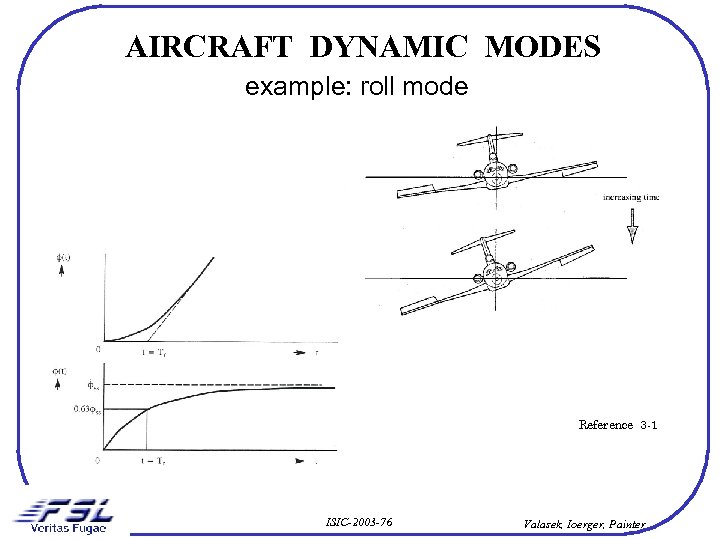 AIRCRAFT DYNAMIC MODES example: roll mode Reference 3 -1 ISIC-2003 -76 Valasek, Ioerger, Painter
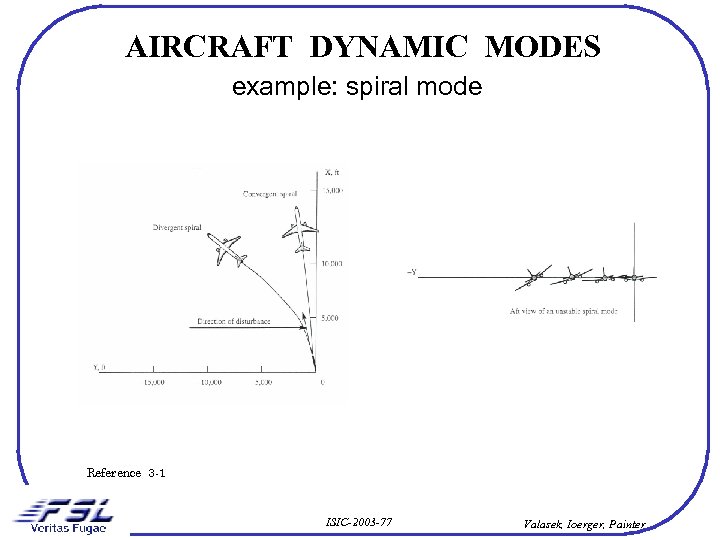 AIRCRAFT DYNAMIC MODES example: spiral mode Reference 3 -1 ISIC-2003 -77 Valasek, Ioerger, Painter
 FLIGHT CONTROL PROBLEM statement The aircraft flight control design problem is to develop and implement an algorithm that closes the loop between the sensors and actuators, such that the aircraft accomplishes its mission, as dictated in the requirements and mission specification, with flying qualities deemed acceptable to the pilot. ISIC-2003 -78 Valasek, Ioerger, Painter
 FLIGHT CONTROLLER DESIGN methodology ! REQUIREMENTS DEFINITION ? Based on intended mission and aircraft class imilitary: specified entirely by Department of Defense; usually non-negotiable icivilian: specified jointly between customer and manufacturer; negotiable ? Design iterations imply tradeoffs in requirements ihow do requirements translate into assumptions? ! MODELING ? “Goodness” iorigin ivalidity iassumptions iaccuracy isuitability – dynamic order – state-space or frequency domain? ? Refinement ISIC-2003 -79 Valasek, Ioerger, Painter
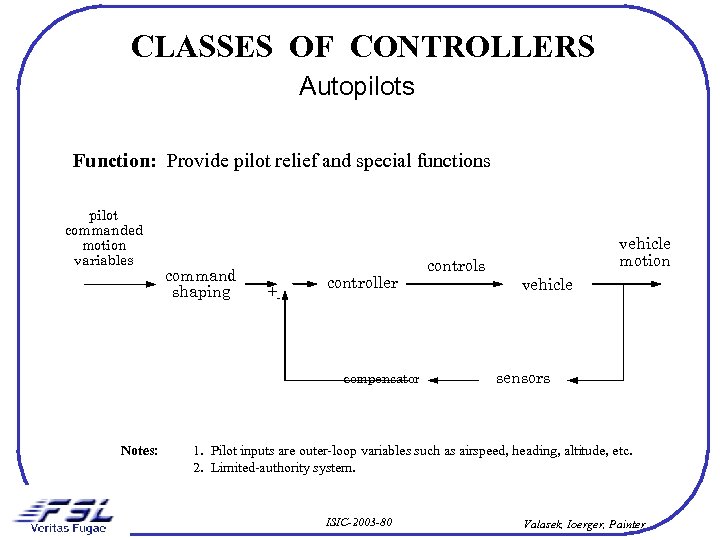 CLASSES OF CONTROLLERS Autopilots Function: Provide pilot relief and special functions pilot commanded motion variables command shaping +- controller compensator Notes: controls vehicle motion vehicle sensors 1. Pilot inputs are outer-loop variables such as airspeed, heading, altitude, etc. 2. Limited-authority system. ISIC-2003 -80 Valasek, Ioerger, Painter
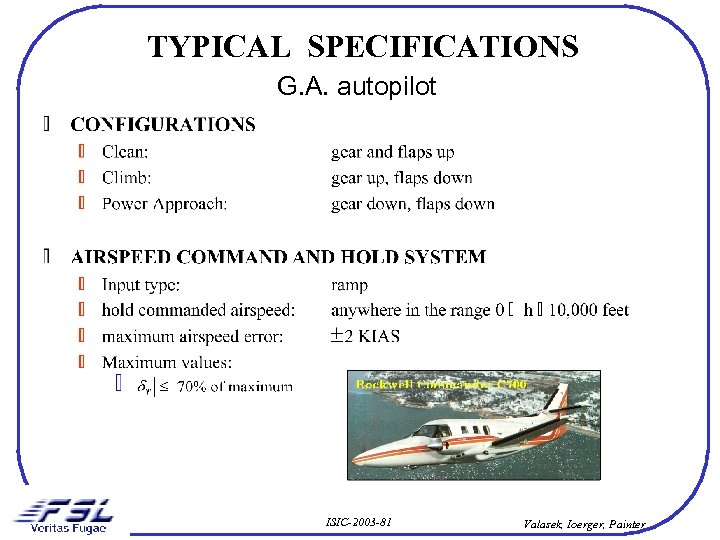 TYPICAL SPECIFICATIONS G. A. autopilot ISIC-2003 -81 Valasek, Ioerger, Painter
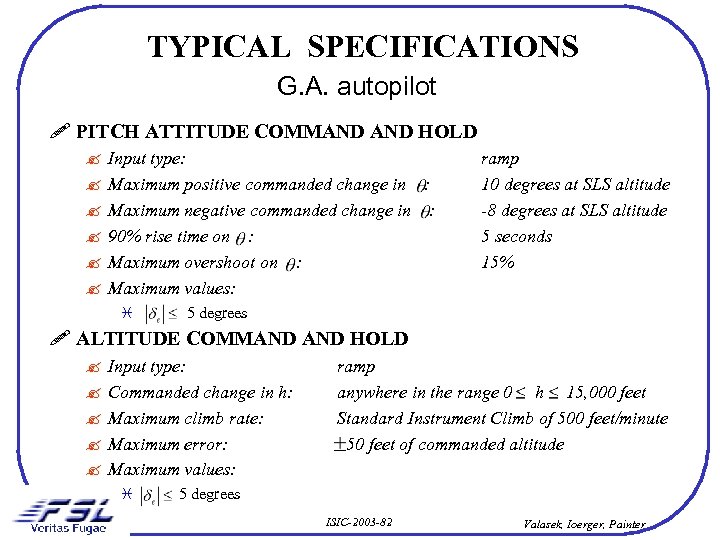 TYPICAL SPECIFICATIONS G. A. autopilot ! PITCH ATTITUDE COMMAND HOLD ? ? ? Input type: Maximum positive commanded change in : Maximum negative commanded change in : 90% rise time on : Maximum overshoot on : Maximum values: i ramp 10 degrees at SLS altitude -8 degrees at SLS altitude 5 seconds 15% 5 degrees ! ALTITUDE COMMAND HOLD ? ? ? Input type: Commanded change in h: Maximum climb rate: Maximum error: Maximum values: i ramp anywhere in the range 0 h 15, 000 feet Standard Instrument Climb of 500 feet/minute 50 feet of commanded altitude 5 degrees ISIC-2003 -82 Valasek, Ioerger, Painter
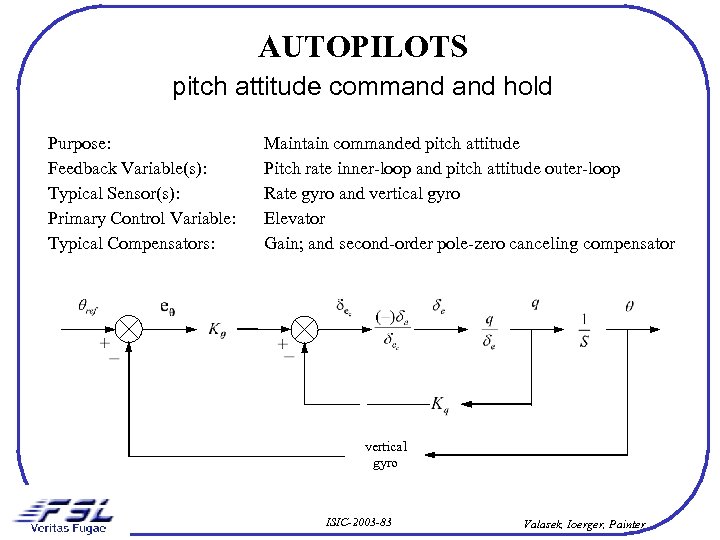 AUTOPILOTS pitch attitude command hold Purpose: Feedback Variable(s): Typical Sensor(s): Primary Control Variable: Typical Compensators: Maintain commanded pitch attitude Pitch rate inner-loop and pitch attitude outer-loop Rate gyro and vertical gyro Elevator Gain; and second-order pole-zero canceling compensator vertical gyro ISIC-2003 -83 Valasek, Ioerger, Painter
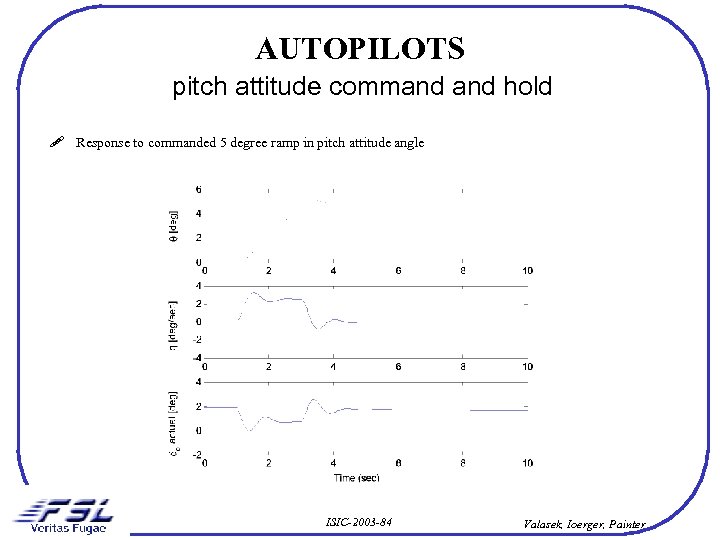 AUTOPILOTS pitch attitude command hold ! Response to commanded 5 degree ramp in pitch attitude angle ISIC-2003 -84 Valasek, Ioerger, Painter
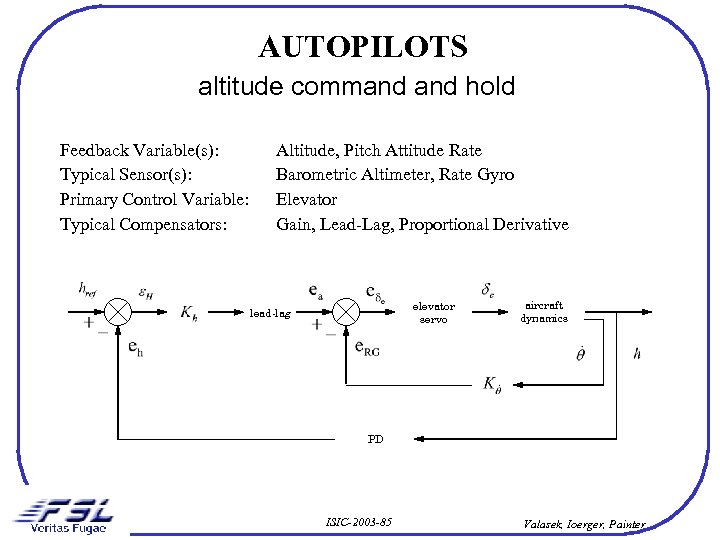 AUTOPILOTS altitude command hold Feedback Variable(s): Typical Sensor(s): Primary Control Variable: Typical Compensators: Altitude, Pitch Attitude Rate Barometric Altimeter, Rate Gyro Elevator Gain, Lead-Lag, Proportional Derivative elevator servo lead-lag aircraft dynamics PD ISIC-2003 -85 Valasek, Ioerger, Painter
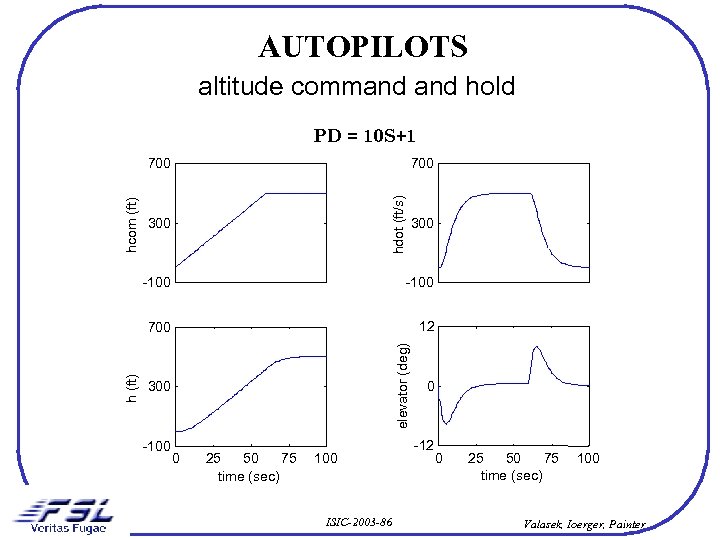 AUTOPILOTS altitude command hold PD = 10 S+1 700 hdot (ft/s) hcom (ft) 700 300 12 elevator (deg) -100 700 h (ft) -100 300 -100 0 25 50 75 time (sec) 100 ISIC-2003 -86 0 -12 0 25 50 75 time (sec) 100 Valasek, Ioerger, Painter
 IMPLEMENTATION trim Case 1: Operation about a Single Trim Condition The following controller modes operate about a single trim condition: Yaw Damper Pitch Damper Roll Damper Wing Leveler Heading Hold Velocity Hold Operational Procedure: The pilot establishes the desired trim condition and engages the mode. If he wishes to change the trim condition, he disengages the mode, establishes the new trim condition, and re-engages the mode. ISIC-2003 -87 Valasek, Ioerger, Painter
 IMPLEMENTATION trim Case 2 Automatic Transition between Two Trim Conditions Flight controllers that require an automatic transition between two trim conditions include: Velocity Command Rate of Climb Command Glide Slope Capture and Tracking Turn Rate Control Operating Procedures: The flight control system must be able to automatically handle trim changes as well as changes in the vehicle’s open-loop dynamics. ISIC-2003 -88 Valasek, Ioerger, Painter
 COURSE OUTLINE SECTION I • Introduction To The Smart Cockpit And Free Flight • Free Flight Functionality • Architecture: Aircraft & Simulator, Software & Hardware SECTION II • Artificial Intelligence In The Cockpit • Intelligent Computing Techniques • Software Agents: The Key To Smart Cockpit Software SECTION III • Real Time Flight Simulation: The Basics • Real Time Flight Simulation For Free Flight SECTION IV • Selected Research Results • Conclusion: Summing It Up ISIC-2003 -89 Valasek, Ioerger, Painter
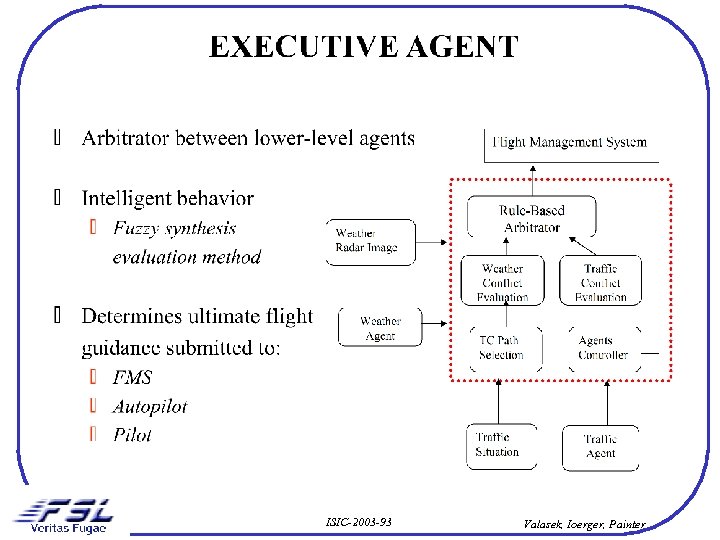
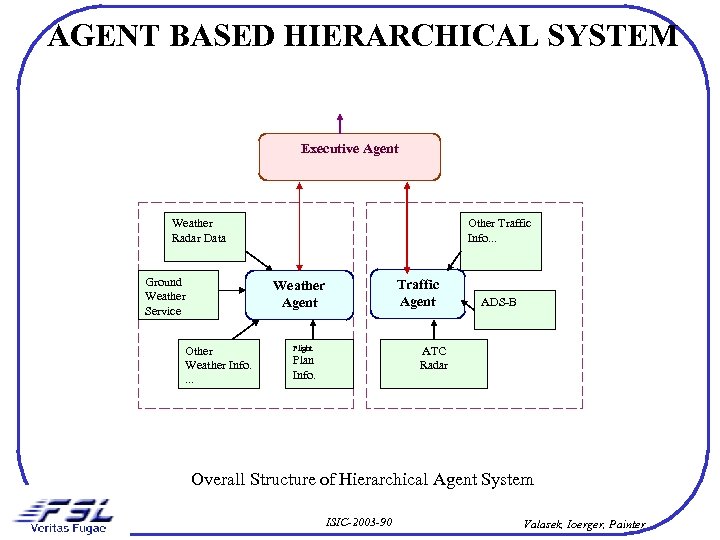 AGENT BASED HIERARCHICAL SYSTEM Executive Agent Other Traffic Info. . . Weather Radar Data Ground Weather Service Traffic Agent Weather Agent Other Weather Info. . Flight ADS-B ATC Radar Plan Info. Overall Structure of Hierarchical Agent System ISIC-2003 -90 Valasek, Ioerger, Painter
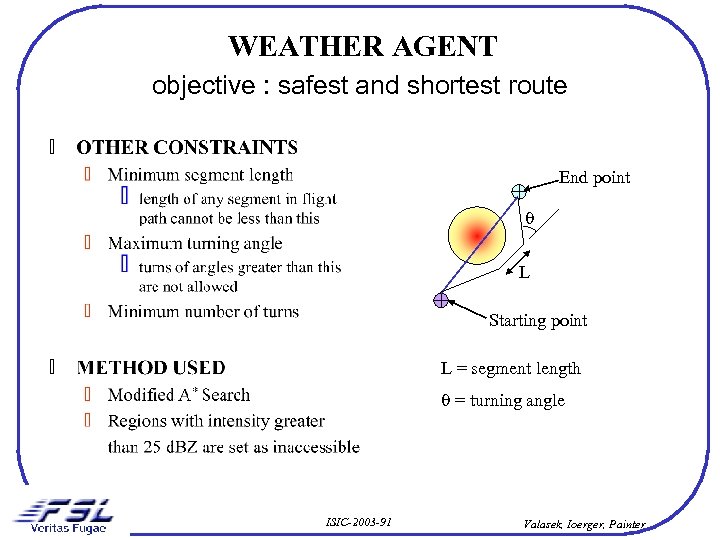 WEATHER AGENT objective : safest and shortest route End point L Starting point L = segment length = turning angle ISIC-2003 -91 Valasek, Ioerger, Painter
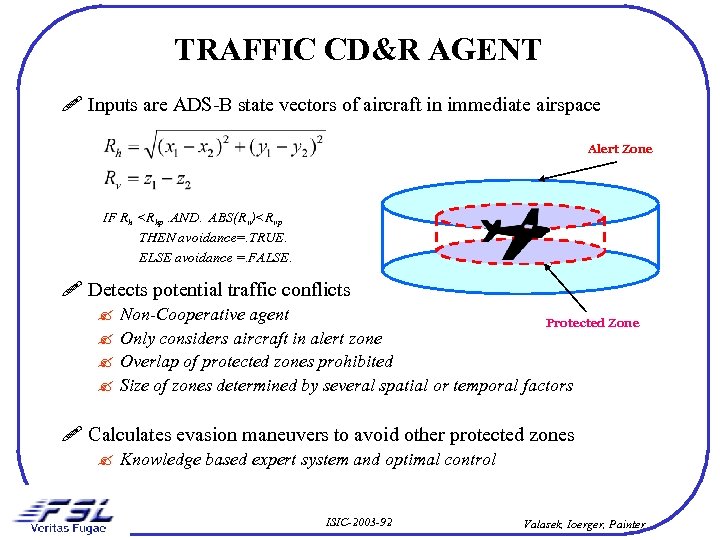 TRAFFIC CD&R AGENT ! Inputs are ADS-B state vectors of aircraft in immediate airspace Alert Zone IF Rh
 ISIC-2003 -93 Valasek, Ioerger, Painter
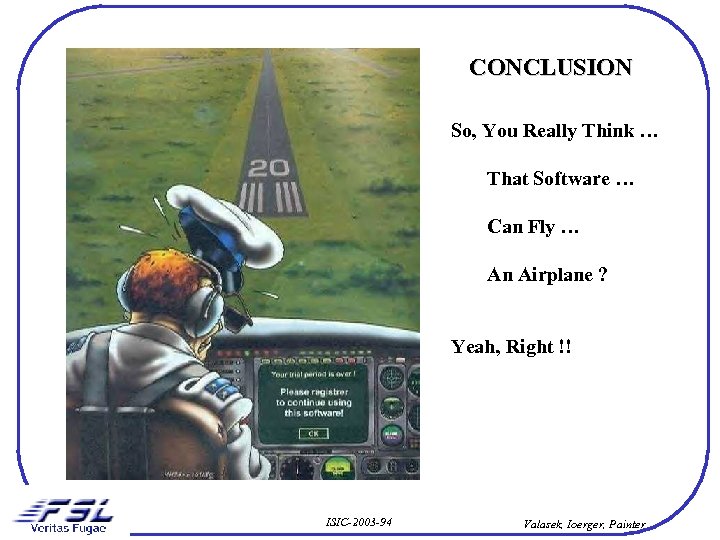 CONCLUSION So, You Really Think … That Software … Can Fly … An Airplane ? Yeah, Right !! ISIC-2003 -94 Valasek, Ioerger, Painter
 FLIGHT SIMULATION LAB points of contact ! Director John Valasek, Ph. D. Aerospace Engineering Department Texas A&M University 3141 TAMU College Station, TX 77843 -3141 Thomas R. Ioerger, Ph. D. Computer Science Department Texas A&M University 3112 TAMU College Station, TX 77843 -3112 (979) 845 -1685 valasek@aero. tamu. edu (979) 845 -0161 ioerger@cs. tamu. edu ! FSL Web Page ! Web Page ? http: //flutie. tamu. edu/~fsl ? http: //faculty. cs. tamu. edu/ioerger/ ISIC-2003 -95 Valasek, Ioerger, Painter