 Скачать презентацию SOFIA On the Pathway toward Habitable Worlds R
9fd2849fd2a4b88264deb27af9df3ec7.ppt
- Количество слайдов: 23



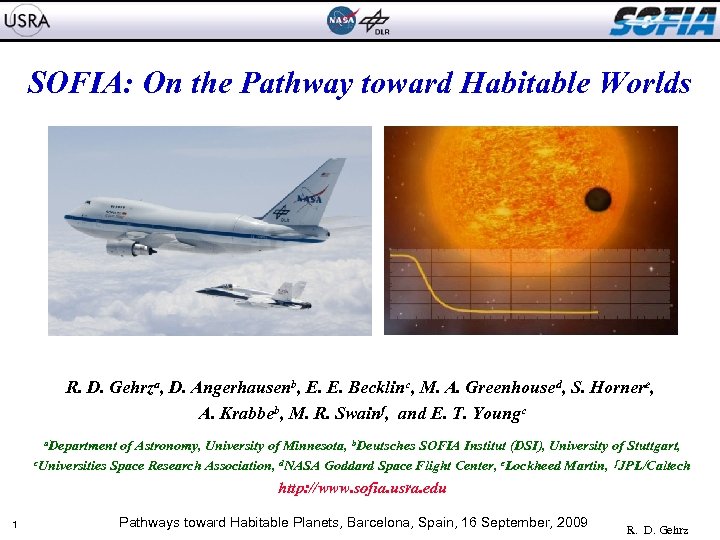
SOFIA: On the Pathway toward Habitable Worlds R. D. Gehrza, D. Angerhausenb, E. E. Becklinc, M. A. Greenhoused, S. Hornere, A. Krabbeb, M. R. Swainf, and E. T. Youngc a. Department of Astronomy, University of Minnesota, b. Deutsches SOFIA Institut (DSI), University of Stuttgart, c. Universities Space Research Association, d. NASA Goddard Space Flight Center, e. Lockheed Martin, f. JPL/Caltech http: //www. sofia. usra. edu 1 Pathways toward Habitable Planets, Barcelona, Spain, 16 September, 2009 R. D. Gehrz
Outline • SOFIA Description and Status Report • SOFIA Performance Specifications • SOFIA Studies of Extrasolar Planetary Systems • Summary and Conclusions 2 Pathways toward Habitable Planets, Barcelona, Spain, 16 September, 2009 R. D. Gehrz
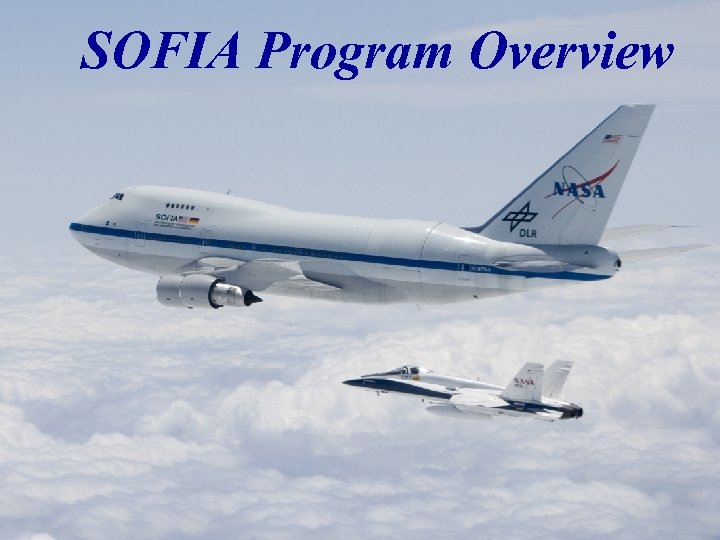
SOFIA Program Overview 3 Pathways toward Habitable Planets, Barcelona, Spain, 16 September, 2009 R. D. Gehrz
SOFIA Overview • 2. 5 m telescope in a modified Boeing 747 SP aircraft – Imaging and spectroscopy from 0. 3 m to 1. 6 mm – Emphasizes the obscured IR (30 -300 m) • Operational Altitude – 39, 000 to 45, 000 feet (12 to 14 km) – Above > 99. 8% of obscuring water vapor; Transmission > 80% • Joint Program between the US (80%) and Germany (20%) – – – 4 First Light in 2010 20 year design lifetime –can respond to changing technology Science Operations: NASA Ames Research Center, Moffett Field, CA Flight Operations: Dryden Aircraft Operations Facility, Palmdale, CA Deployments to the Southern Hemisphere and elsewhere >120 8 -10 hour flights per year Pathways toward Habitable Planets, Barcelona, Spain, 16 September, 2009 R. D. Gehrz
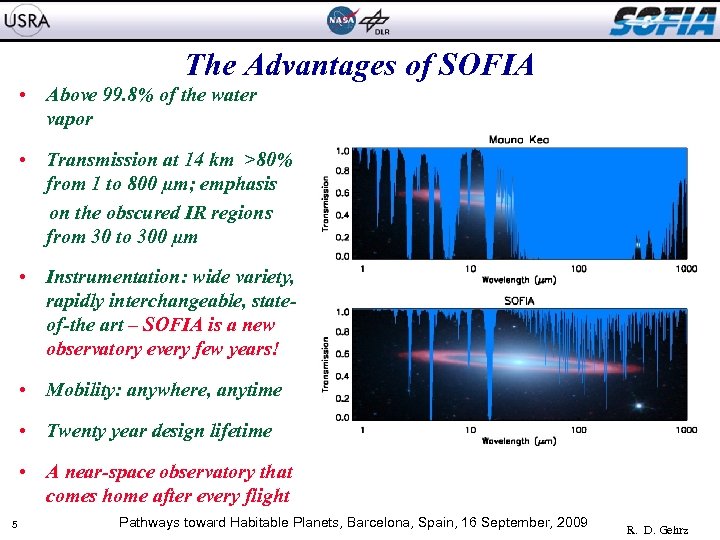
The Advantages of SOFIA • Above 99. 8% of the water vapor • Transmission at 14 km >80% from 1 to 800 µm; emphasis on the obscured IR regions from 30 to 300 µm • Instrumentation: wide variety, rapidly interchangeable, stateof-the art – SOFIA is a new observatory every few years! • Mobility: anywhere, anytime • Twenty year design lifetime • A near-space observatory that comes home after every flight 5 Pathways toward Habitable Planets, Barcelona, Spain, 16 September, 2009 R. D. Gehrz
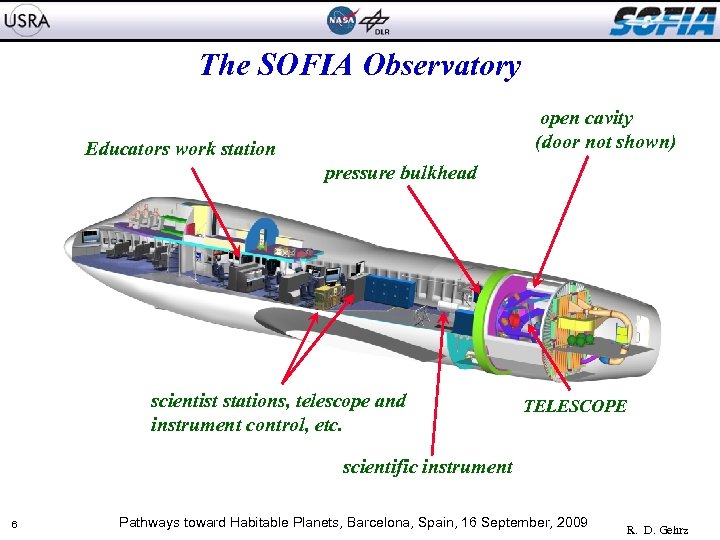
The SOFIA Observatory open cavity (door not shown) Educators work station pressure bulkhead scientist stations, telescope and instrument control, etc. TELESCOPE scientific instrument 6 Pathways toward Habitable Planets, Barcelona, Spain, 16 September, 2009 R. D. Gehrz
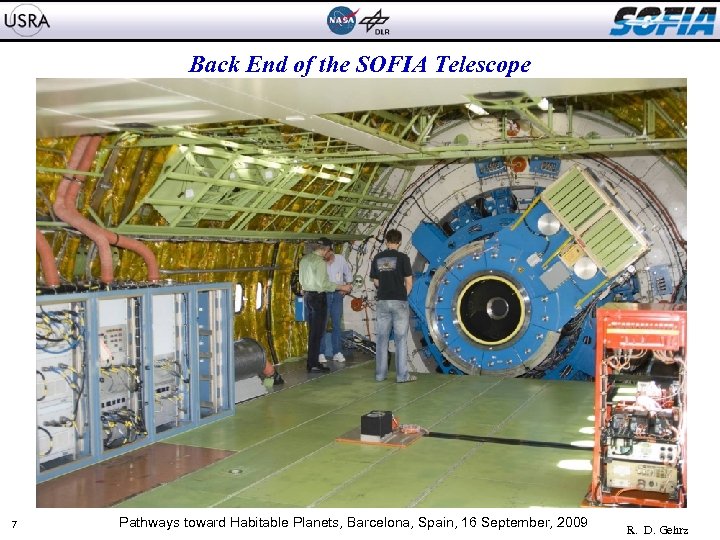
Back End of the SOFIA Telescope 7 Pathways toward Habitable Planets, Barcelona, Spain, 16 September, 2009 R. D. Gehrz
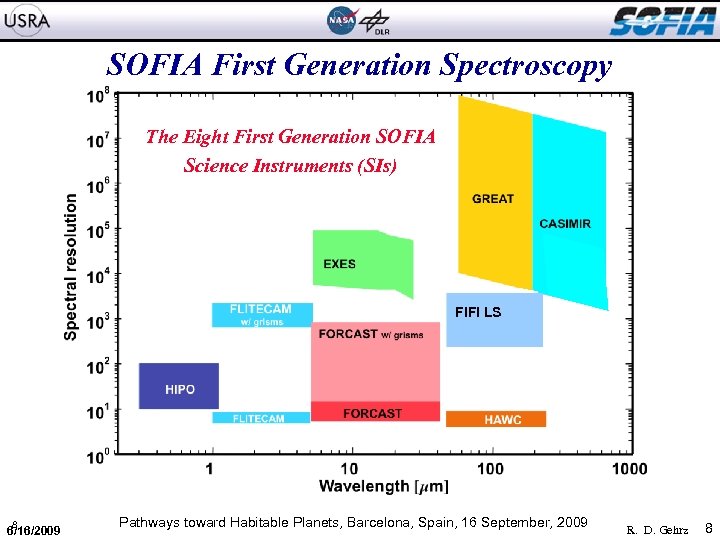
SOFIA First Generation Spectroscopy The Eight First Generation SOFIA Science Instruments (SIs) FIFI LS 8 6/16/2009 Pathways toward Habitable Planets, Barcelona, Spain, 16 September, 2009 R. D. Gehrz 8
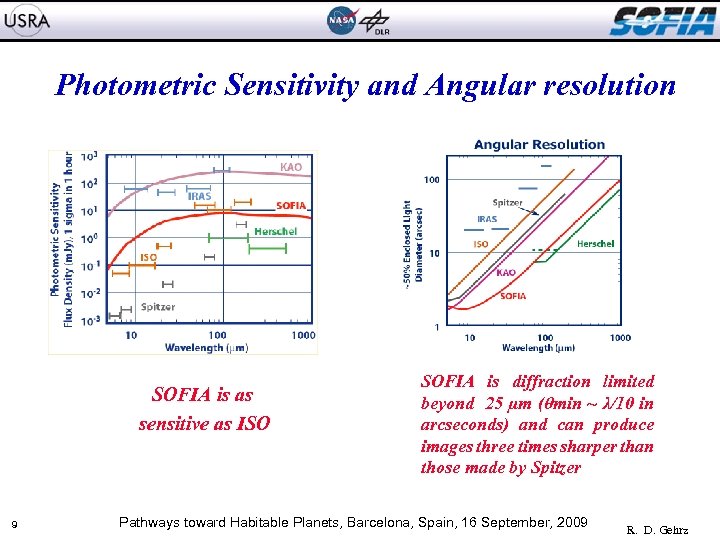
Photometric Sensitivity and Angular resolution SOFIA is as sensitive as ISO 9 SOFIA is diffraction limited beyond 25 µm (θmin ~ λ/10 in arcseconds) and can produce images three times sharper than those made by Spitzer Pathways toward Habitable Planets, Barcelona, Spain, 16 September, 2009 R. D. Gehrz
Early General Observer and Instrumentation Development Opportunities • Early Basic Science for GOs in 2010 with FORCAST and GREAT – Draft call was released in Jan 2009 – Final call to be released in December 2009 – Longer period (~15 Flights) • General Observer (GO) Science: First Call for proposals in late 2010 – 20 flights per year until full science operations begin in 2014 • Next Call for New Instruments in FY 2011 – One new instrument or instrument upgrade per year – New calls every three years – Funding for new instruments is ~$10 M/yr 10 Pathways toward Habitable Planets, Barcelona, Spain, 16 September, 2009 R. D. Gehrz
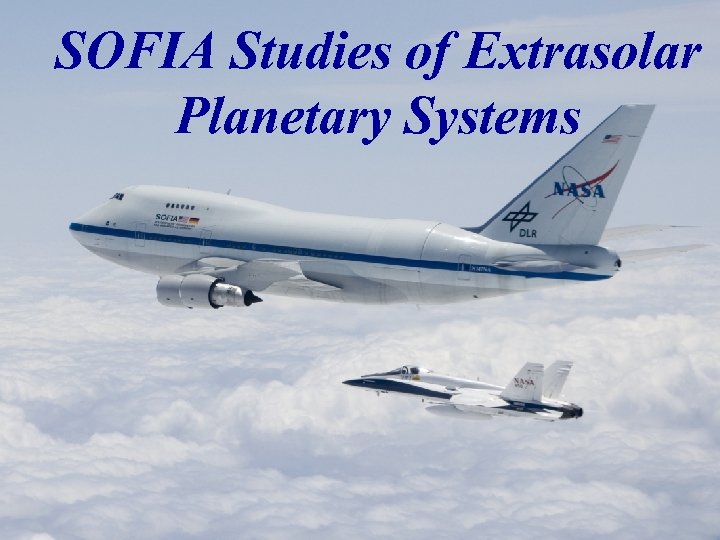
SOFIA Studies of Extrasolar Planetary Systems 11 Pathways toward Habitable Planets, Barcelona, Spain, 16 September, 2009 R. D. Gehrz
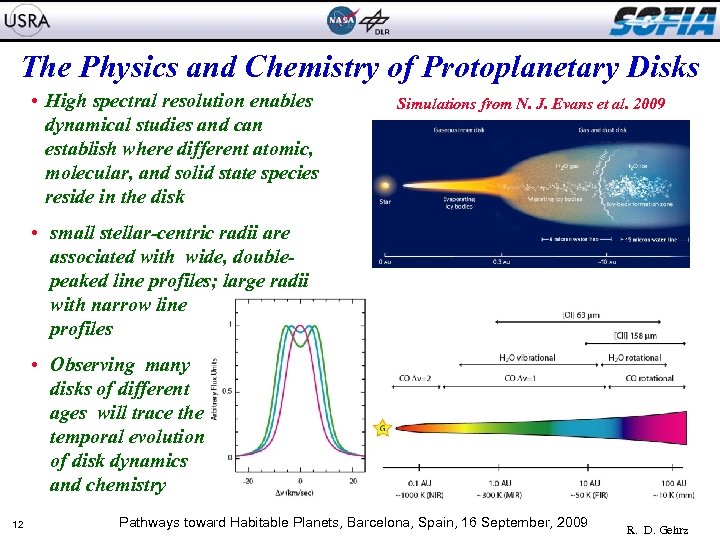
The Physics and Chemistry of Protoplanetary Disks • High spectral resolution enables dynamical studies and can establish where different atomic, molecular, and solid state species reside in the disk Simulations from N. J. Evans et al. 2009 • small stellar-centric radii are associated with wide, doublepeaked line profiles; large radii with narrow line profiles • Observing many disks of different ages will trace the temporal evolution of disk dynamics and chemistry 12 Pathways toward Habitable Planets, Barcelona, Spain, 16 September, 2009 R. D. Gehrz
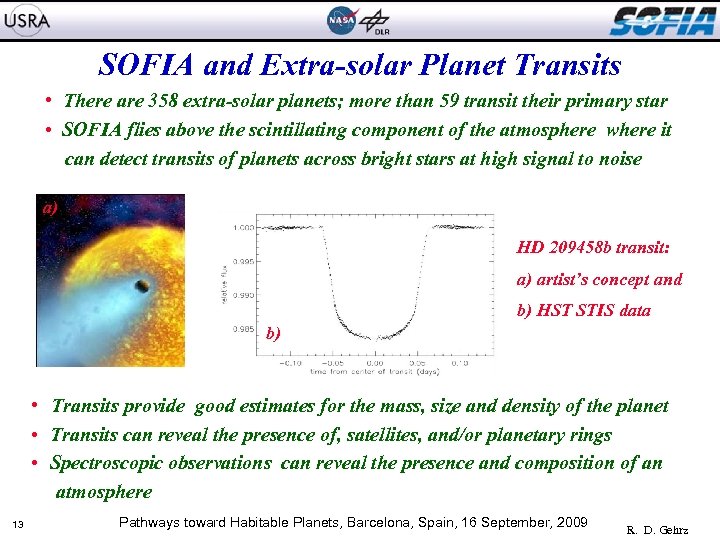
SOFIA and Extra-solar Planet Transits • There are 358 extra-solar planets; more than 59 transit their primary star • SOFIA flies above the scintillating component of the atmosphere where it can detect transits of planets across bright stars at high signal to noise a) HD 209458 b transit: a) artist’s concept and b) HST STIS data b) • Transits provide good estimates for the mass, size and density of the planet • Transits can reveal the presence of, satellites, and/or planetary rings • Spectroscopic observations can reveal the presence and composition of an atmosphere 13 Pathways toward Habitable Planets, Barcelona, Spain, 16 September, 2009 R. D. Gehrz
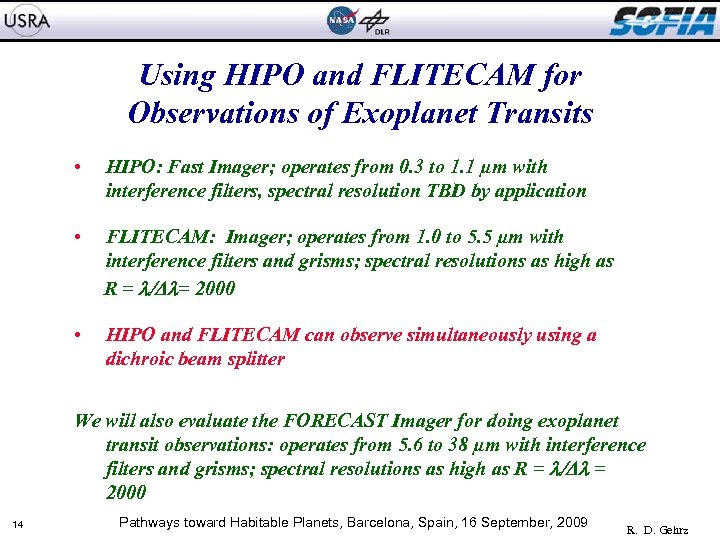
Using HIPO and FLITECAM for Observations of Exoplanet Transits • HIPO: Fast Imager; operates from 0. 3 to 1. 1 µm with interference filters, spectral resolution TBD by application • FLITECAM: Imager; operates from 1. 0 to 5. 5 µm with interference filters and grisms; spectral resolutions as high as R = l/Dl= 2000 • HIPO and FLITECAM can observe simultaneously using a dichroic beam splitter We will also evaluate the FORECAST Imager for doing exoplanet transit observations: operates from 5. 6 to 38 µm with interference filters and grisms; spectral resolutions as high as R = l/Dl = 2000 14 Pathways toward Habitable Planets, Barcelona, Spain, 16 September, 2009 R. D. Gehrz
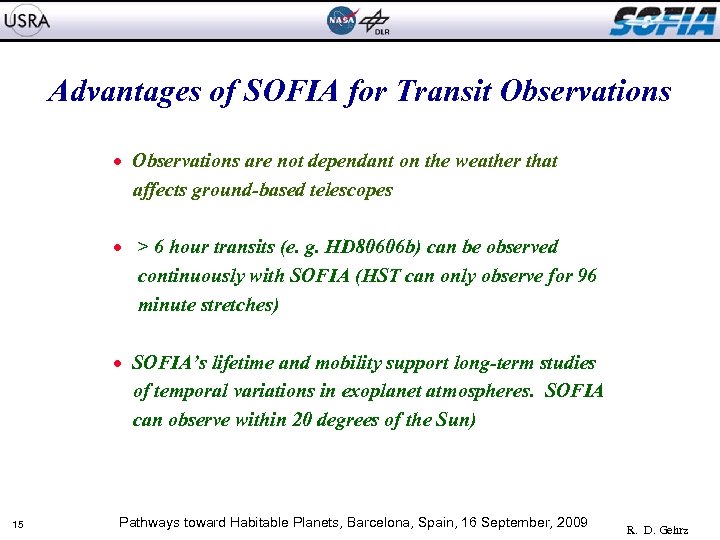
Advantages of SOFIA for Transit Observations · Observations are not dependant on the weather that affects ground-based telescopes · > 6 hour transits (e. g. HD 80606 b) can be observed continuously with SOFIA (HST can only observe for 96 minute stretches) · SOFIA’s lifetime and mobility support long-term studies of temporal variations in exoplanet atmospheres. SOFIA can observe within 20 degrees of the Sun) 15 Pathways toward Habitable Planets, Barcelona, Spain, 16 September, 2009 R. D. Gehrz
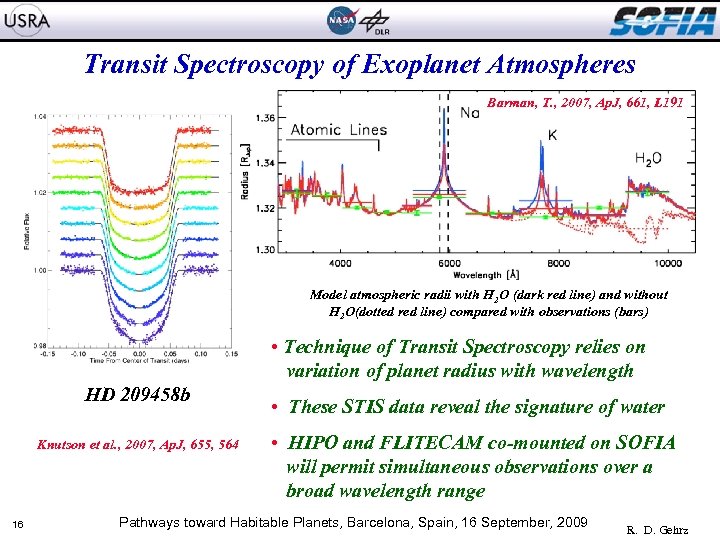
Transit Spectroscopy of Exoplanet Atmospheres Barman, T. , 2007, Ap. J, 661, L 191 Model atmospheric radii with H 2 O (dark red line) and without H 2 O(dotted red line) compared with observations (bars) • Technique of Transit Spectroscopy relies on variation of planet radius with wavelength HD 209458 b Knutson et al. , 2007, Ap. J, 655, 564 16 • These STIS data reveal the signature of water • HIPO and FLITECAM co-mounted on SOFIA will permit simultaneous observations over a broad wavelength range Pathways toward Habitable Planets, Barcelona, Spain, 16 September, 2009 R. D. Gehrz
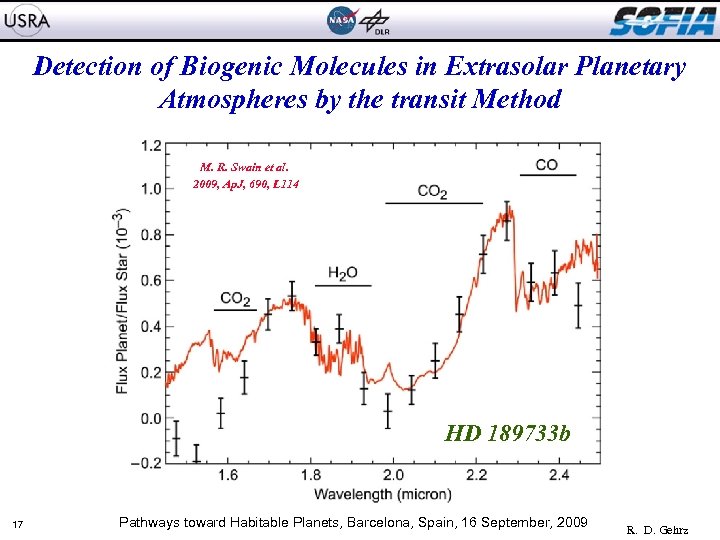
Detection of Biogenic Molecules in Extrasolar Planetary Atmospheres by the transit Method M. R. Swain et al. 2009, Ap. J, 690, L 114 HD 189733 b 17 Pathways toward Habitable Planets, Barcelona, Spain, 16 September, 2009 R. D. Gehrz
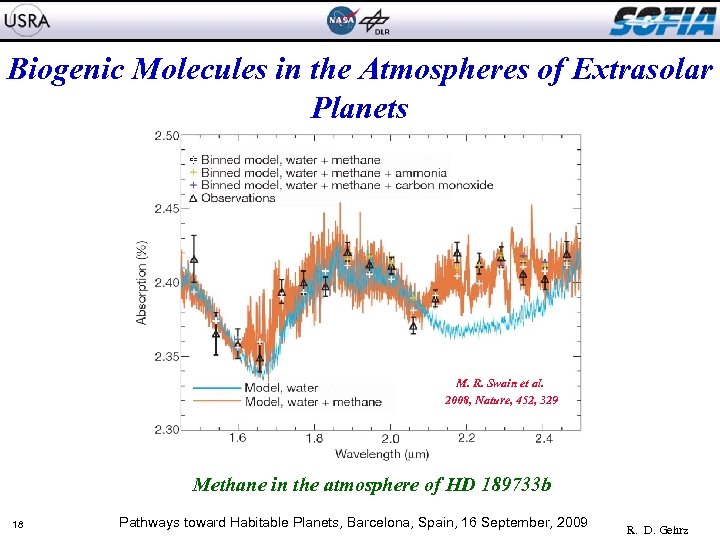
Biogenic Molecules in the Atmospheres of Extrasolar Planets M. R. Swain et al. 2008, Nature, 452, 329 Methane in the atmosphere of HD 189733 b 18 Pathways toward Habitable Planets, Barcelona, Spain, 16 September, 2009 R. D. Gehrz
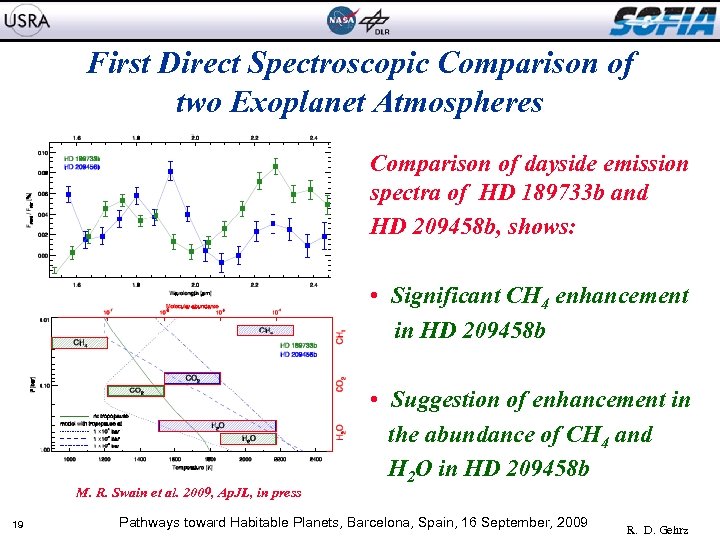
First Direct Spectroscopic Comparison of two Exoplanet Atmospheres Comparison of dayside emission spectra of HD 189733 b and HD 209458 b, shows: • Significant CH 4 enhancement in HD 209458 b M. R. Swain et al. 2009, Ap. JL, in press 19 • Suggestion of enhancement in the abundance of CH 4 and H 2 O in HD 209458 b Pathways toward Habitable Planets, Barcelona, Spain, 16 September, 2009 R. D. Gehrz
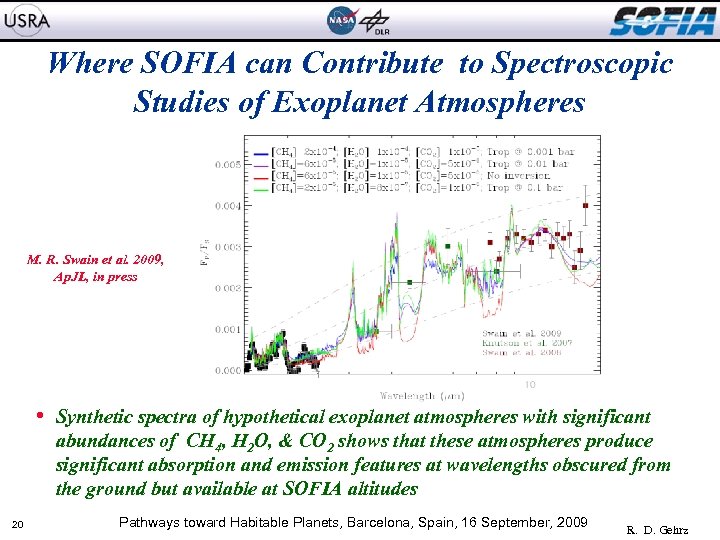
Where SOFIA can Contribute to Spectroscopic Studies of Exoplanet Atmospheres M. R. Swain et al. 2009, Ap. JL, in press • Synthetic spectra of hypothetical exoplanet atmospheres with significant abundances of CH 4, H 2 O, & CO 2 shows that these atmospheres produce significant absorption and emission features at wavelengths obscured from the ground but available at SOFIA altitudes 20 Pathways toward Habitable Planets, Barcelona, Spain, 16 September, 2009 R. D. Gehrz
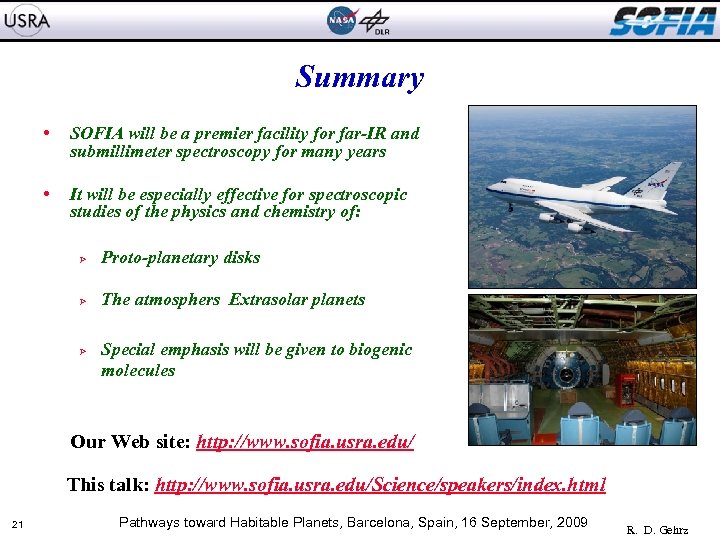
Summary • SOFIA will be a premier facility for far-IR and submillimeter spectroscopy for many years • It will be especially effective for spectroscopic studies of the physics and chemistry of: Ø Proto-planetary disks Ø The atmosphers Extrasolar planets Ø Special emphasis will be given to biogenic molecules Our Web site: http: //www. sofia. usra. edu/ This talk: http: //www. sofia. usra. edu/Science/speakers/index. html 21 Pathways toward Habitable Planets, Barcelona, Spain, 16 September, 2009 R. D. Gehrz
Backup 22 Pathways toward Habitable Planets, Barcelona, Spain, 16 September, 2009 R. D. Gehrz
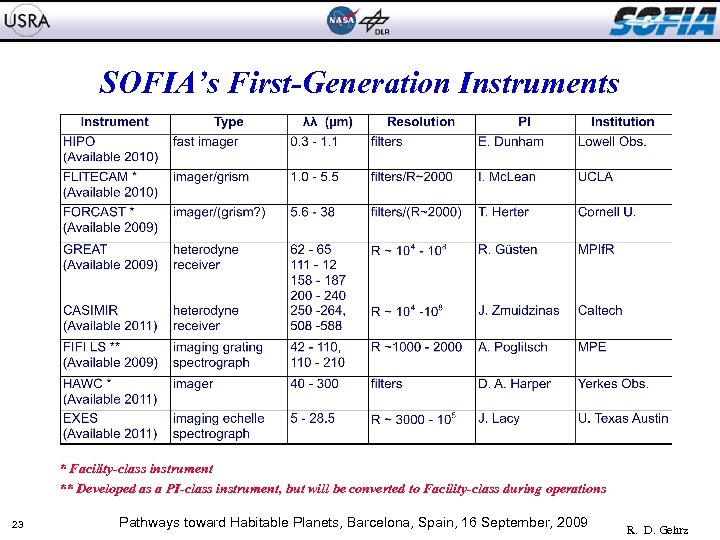
SOFIA’s First-Generation Instruments * Facility-class instrument ** Developed as a PI-class instrument, but will be converted to Facility-class during operations 23 Pathways toward Habitable Planets, Barcelona, Spain, 16 September, 2009 R. D. Gehrz
Скачать презентацию SOFIA On the Pathway toward Habitable Worlds R
9fd2849fd2a4b88264deb27af9df3ec7.ppt