 Скачать презентацию SOES 6047 — Global Climate Cycles SOES 6047
3e14e64637ae1534d68ca076b4dff752.ppt
- Количество слайдов: 34



SOES 6047 - Global Climate Cycles SOES 6047 Global Climate Cycles L 10: Orbital Forcing Introduction Dr. Heiko Pälike heiko@noc. soton. ac. uk Ext. 23638, Rm. 164/34
SOES 6047 - Global Climate Cycles ๏ get an in-depth overview of theory behind astronomical (”Milankovitch”) Earth’s orbital variations ๏ be able to put the terms Eccentricity, Obliquity, Tilt, climatic precession, and insolation into context ๏ Learn about the origin of astronomical frequencies, and what they are ๏ learn where to find resources to get a more in-depth description L 10 Orbital Forcing: Introduction Objectives & learning outcomes 2
SOES 6047 - Global Climate Cycles ๏ Examples of periodicity in Earth Science data ๏ History of “Milankovitch” cycles ๏ The origin of astronomical frequencies ๏ Eccentricity, Obliquity and Climatic precession ๏ longer-term patterns L 10 Orbital Forcing: Introduction Lecture outline 3
SOES 6047 - Global Climate Cycles Berger, A. & Loutre, M. F. , ‘Astronomical forcing through geological time’, Orbital forcing and cyclic sequences (IAS Special Publication), P. L. de Boer & D. G. Smith, eds. (Blackwell Scientific, 1994), vol. 19, 15– 24. Berger, A. , et al. , eds. (1984), Milankovitch and Climate: understanding the response to astronomical forcing, Proceedings of the NATO Advanced Research Workshop on Milankovitch and Climate (1982, Palisades, N. Y), Series C, Mathematical and physical sciences, vol. 126, NATO ASI series (D. Reidel Publishing Company, Dordrecht; Boston, 1984). Two volumes. Croll, J. , Climate and time in their geological relations: a theory of secular changes of the Earth’s climate (Daldy, Tsbister and Co. , London, 1875). de Boer, P. L. & Smith, D. G. , eds. , Orbital forcing and cyclic sequences (IAS Special Publication), vol. 19 (Blackwell Scientific Publications, Oxford, 1994). Gilbert, G. K. (1895), ‘Sedimentary measurement of Cretaceous time’, Journal of Geology III, 121– 127. Hays, J. D. , Imbrie, J. , & Shackleton, N. J. (1976), ‘Variations in the Earth’s orbit: Pacemaker of the Ice Ages’, Science 194, 1121– 1131. House, M. R. & Gale, A. S. , eds. , Orbital forcing timescales and cyclostratigraphy, Geological Society Special publication, vol. 85 (The Geological Society, London, 1995). Imbrie, J. , et al. , ‘The orbital theory of Pleistocene climate: Support from a revised chronology of the marine d 18 O record’, Milankovitch and Climate, Part 1, A. L. Berger et al. , eds. (Reidel Publishing Company, 1984), 269– 305. Krijgsman, W. (2002), ‘The Mediterranean: Mare Nostrum of Earth science’, Earth and Planetary Science Letters 205, 1– 12. Laskar, J. (1999), ‘The limits of Earth orbital calculations for geological time-scale use’, Philos. Trans. R. Soc. London Ser. A 357, 1735– 1759. Laskar, J. , et al. (2004), ‘A long term numerical solution for the insolation quantities of the Earth’, Astron. Astrophys. 428, 261– 285. Astronomical solution available from http: //www. imcce. fr/Equipes/ASD/insola/earth. html (May 2004). Milankovitch, M. , Kanon der Erdbestrahlung und seine Anwendung auf das Eiszeitenproblem, vol. 33 (Royal Serbian Sciences, special publication 132, section of Mathematical and Natural Sciences, Belgrad, 1941). (“Canon of Insolation and Ice Age Problem”, English translation by Israël Program for Scientific Translation and published for the U. S. Department of Commerce and the National Science Foundation, Washington DC, 1969). Pälike, H. , ‘Orbital Variation (Including Milankovitch Cycles)’, Encyclopedia of Geology, R. C. Selley, L. R. M. Cocks, & P. I. R. , eds. (Elsevier, Oxford, 2005), vol. 1, 410– 421. Schwarzacher, W. , Cyclostratigraphy and the Milankovitch theory, Developments in Sedimentology, vol. 52 (Elsevier, Amsterdam, 1993). Shackleton, N. J. , Mc. Cave, I. N. , & Weedon, G. P. , eds. (1999), Astronomical (Milankovitch) calibration of the geological time-scale (9 -10 December 1998, London), Philosophical Transactions of the Royal Society of London Series A - Mathematical Physical and Engineering Sciences, vol. 357, number 1757 (The Royal Society, London, 1999). L 10 Orbital Forcing: Introduction Some references 4
SOES 6047 - Global Climate Cycles Estimate of relative variance of climate over all periods (wavelengths) of variation, from those comparable to the age of the Earth to about one hour. Figure is available for view by searching the reference provided below J Murray Mitchell, Jnr. , (1976) An overview of climatic variability and its causal Mechanisms - Quaternary Research 6, 481 -493 L 10 Orbital Forcing: Introduction Variability of climate on different time scales 5
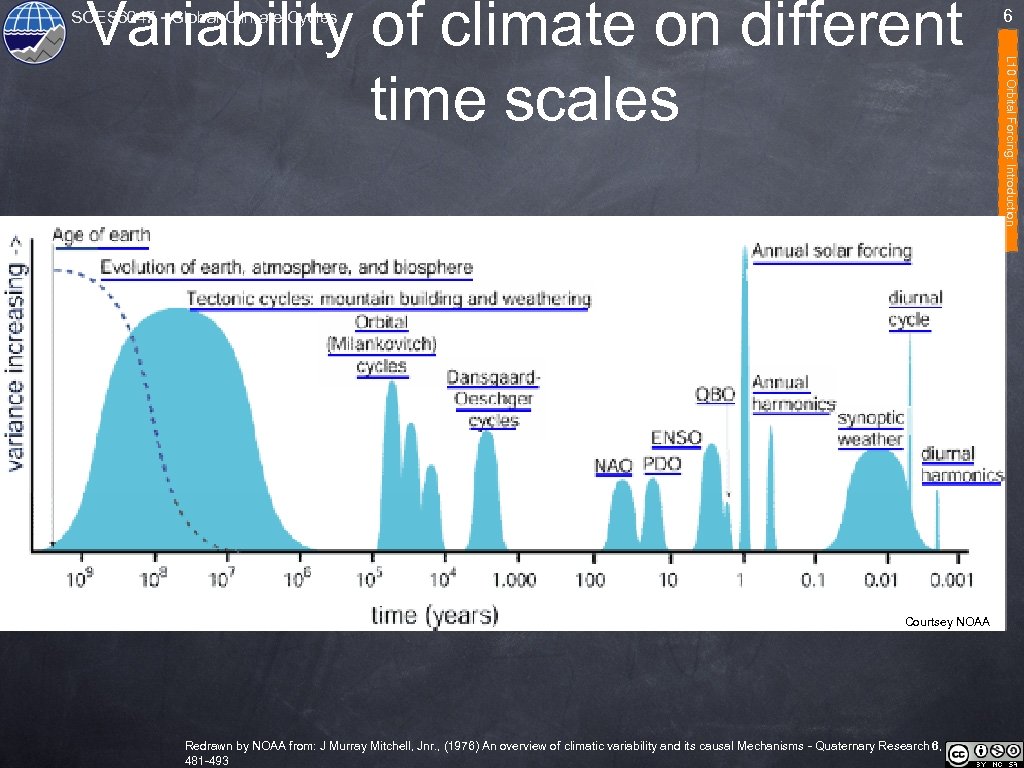
Courtsey NOAA Redrawn by NOAA from: J Murray Mitchell, Jnr. , (1976) An overview of climatic variability and its causal Mechanisms - Quaternary Research 6, 481 -493 6 L 10 Orbital Forcing: Introduction Variability of climate on different time scales SOES 6047 - Global Climate Cycles
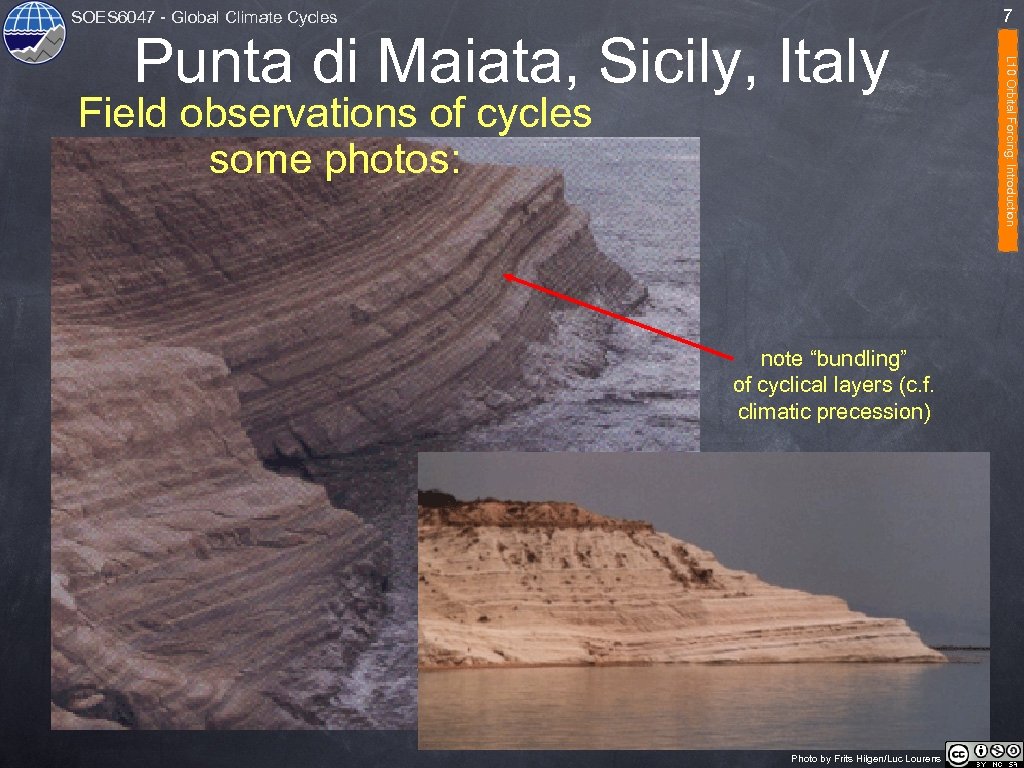
SOES 6047 - Global Climate Cycles Field observations of cycles some photos: note “bundling” of cyclical layers (c. f. climatic precession) Photo by Frits Hilgen/Luc Lourens L 10 Orbital Forcing: Introduction Punta di Maiata, Sicily, Italy 7
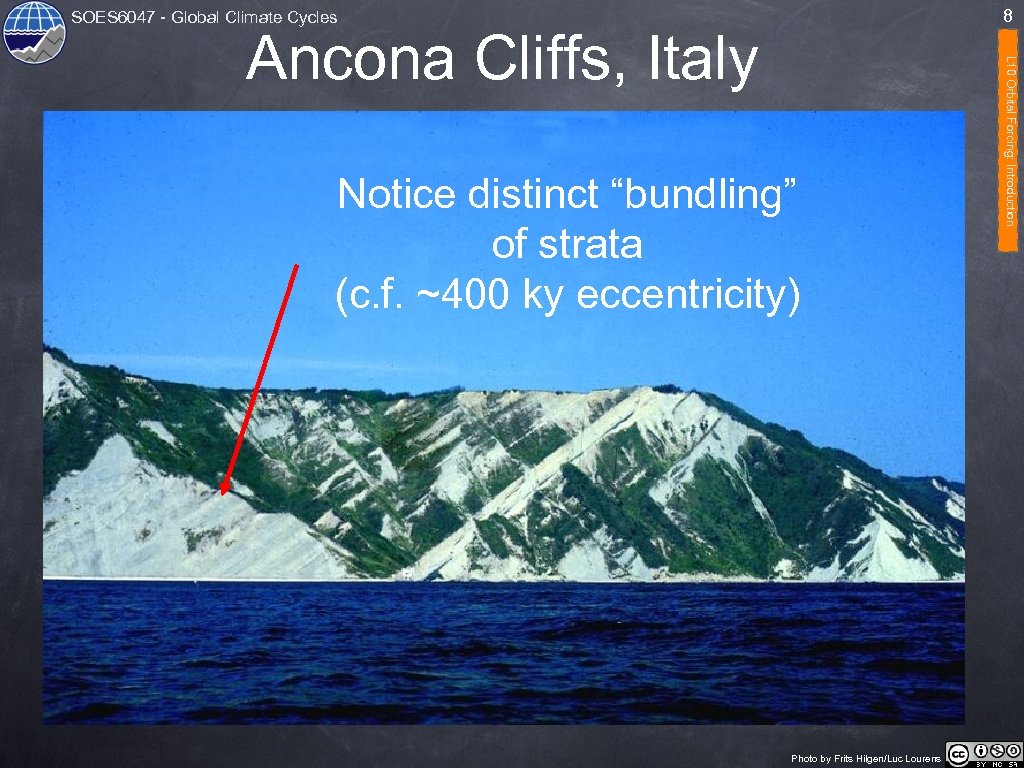
8 SOES 6047 - Global Climate Cycles Notice distinct “bundling” of strata (c. f. ~400 ky eccentricity) Photo by Frits Hilgen/Luc Lourens L 10 Orbital Forcing: Introduction Ancona Cliffs, Italy
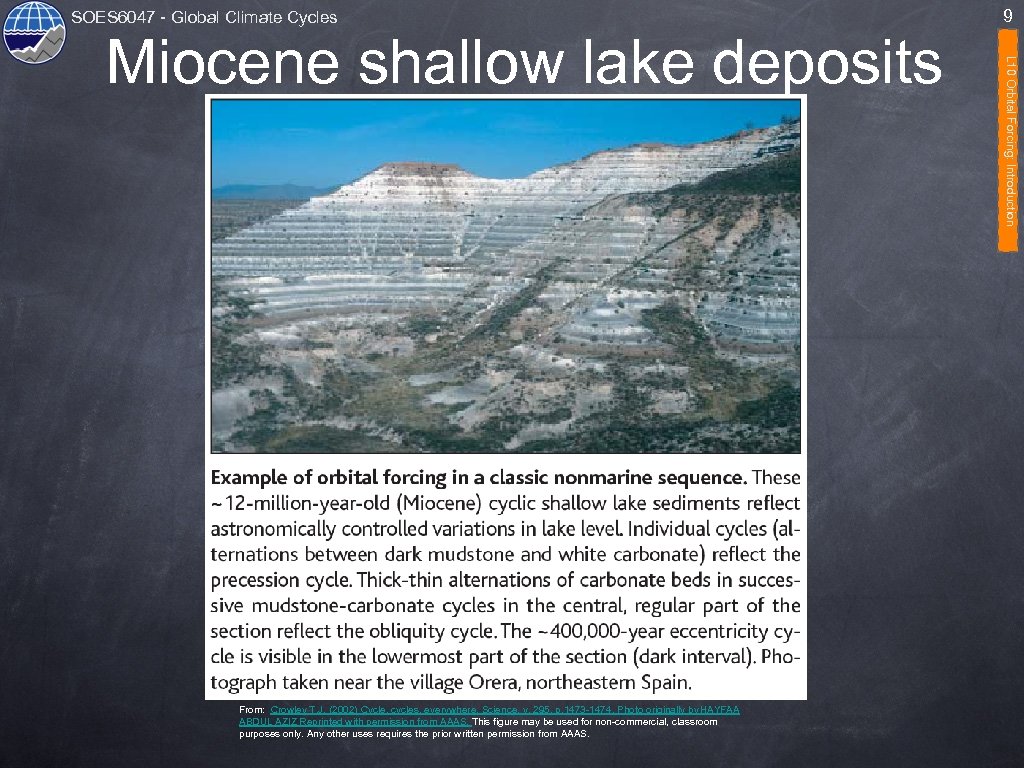
SOES 6047 - Global Climate Cycles From: Crowley T. J, (2002) Cycle, cycles, everywhere. Science, v. 295, p. 1473 -1474. Photo originally by AYFAA H ABDUL AZIZ Reprinted with permission from AAAS. This figure may be used for non-commercial, classroom purposes only. Any other uses requires the prior written permission from AAAS. L 10 Orbital Forcing: Introduction Miocene shallow lake deposits 9
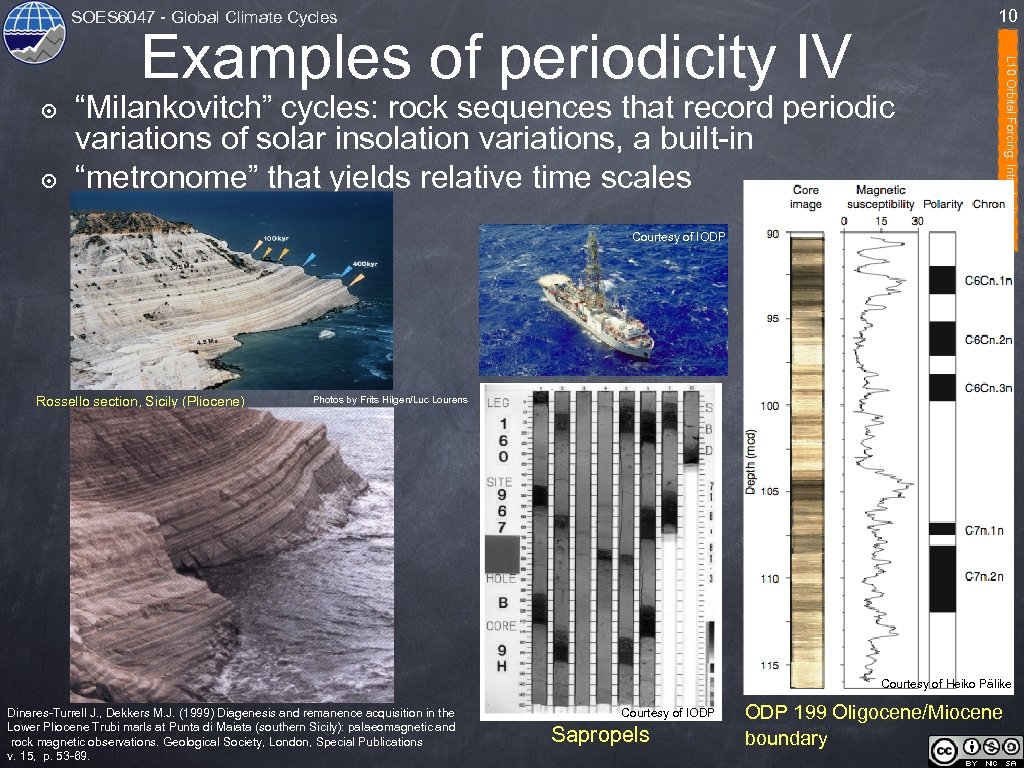
10 SOES 6047 - Global Climate Cycles ๏ “Milankovitch” cycles: rock sequences that record periodic variations of solar insolation variations, a built-in ๏ “metronome” that yields relative time scales L 10 Orbital Forcing: Introduction Examples of periodicity IV Courtesy of IODP Rossello section, Sicily (Pliocene) Photos by Frits Hilgen/Luc Lourens Courtesy of Heiko Pälike Dinares-Turrell J. , Dekkers M. J. (1999) Diagenesis and remanence acquisition in the Lower Pliocene Trubi marls at Punta di Maiata (southern Sicily): palaeomagnetic and rock magnetic observations. Geological Society, London, Special Publications v. 15, p. 53 -69. Courtesy of IODP Sapropels ODP 199 Oligocene/Miocene boundary
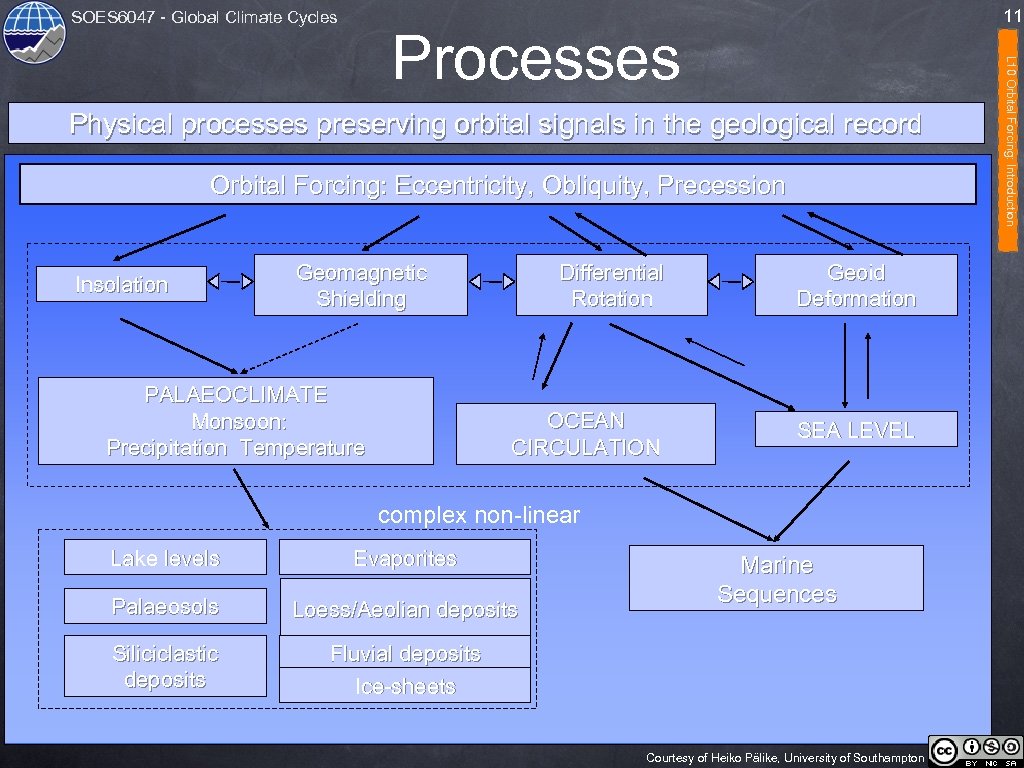
SOES 6047 - Global Climate Cycles 11 Physical processes preserving orbital signals in the geological record Orbital Forcing: Eccentricity, Obliquity, Precession Insolation Geomagnetic Shielding Geoid Deformation OCEAN CIRCULATION PALAEOCLIMATE Monsoon: Precipitation Temperature Differential Rotation SEA LEVEL complex non-linear Lake levels Evaporites Palaeosols Loess/Aeolian deposits Siliciclastic deposits Fluvial deposits Ice-sheets Marine Sequences Courtesy of Heiko Pälike, University of Southampton L 10 Orbital Forcing: Introduction Processes
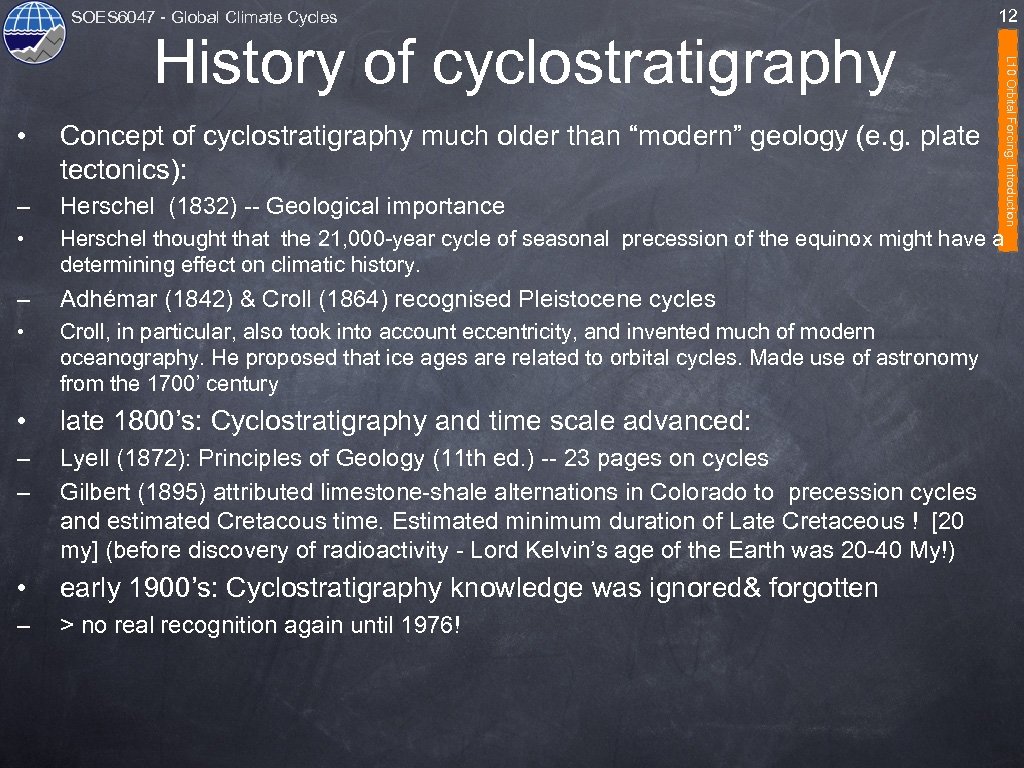
SOES 6047 - Global Climate Cycles L 10 Orbital Forcing: Introduction History of cyclostratigraphy 12 • Concept of cyclostratigraphy much older than “modern” geology (e. g. plate tectonics): – Herschel (1832) -- Geological importance • Herschel thought that the 21, 000 -year cycle of seasonal precession of the equinox might have a determining effect on climatic history. – Adhémar (1842) & Croll (1864) recognised Pleistocene cycles • Croll, in particular, also took into account eccentricity, and invented much of modern oceanography. He proposed that ice ages are related to orbital cycles. Made use of astronomy from the 1700’ century • late 1800’s: Cyclostratigraphy and time scale advanced: – – Lyell (1872): Principles of Geology (11 th ed. ) -- 23 pages on cycles Gilbert (1895) attributed limestone-shale alternations in Colorado to precession cycles and estimated Cretacous time. Estimated minimum duration of Late Cretaceous ! [20 my] (before discovery of radioactivity - Lord Kelvin’s age of the Earth was 20 -40 My!) • early 1900’s: Cyclostratigraphy knowledge was ignored& forgotten – > no real recognition again until 1976!
SOES 6047 - Global Climate Cycles • Milutin Milankovitch (1941) – carried out painstaking calculations of the long curve of the variability of solar insolation (the amount of sunlight) at northern latitudes, in hopes of demonstrating its forcing effect on the ice age cycles. AND: Proposed glacial advances = cool summers, rather than cold winters. – He established: • • • L 10 Orbital Forcing: Introduction History of cyclostratigraphy (II) 13 the 26, 000 -year period of the precession of the equinox, which, when combined with the advance of the perihelion, the point at which the Earth is closest to the Sun (perihelion precession), produces a 21, 000 -year cycle; the 40, 000 -year cycle of variation of the obliquity of the ecliptic (the angle of the Earth's axis), which varies from 22 to 24. 5 degrees; the 90, 000 to 100, 000 -year cycle of variation of the eccentricity of the Earth's elliptical orbit. – Because of his contribution, theory now known as “Milankovitch-cycle theory of climatic history”
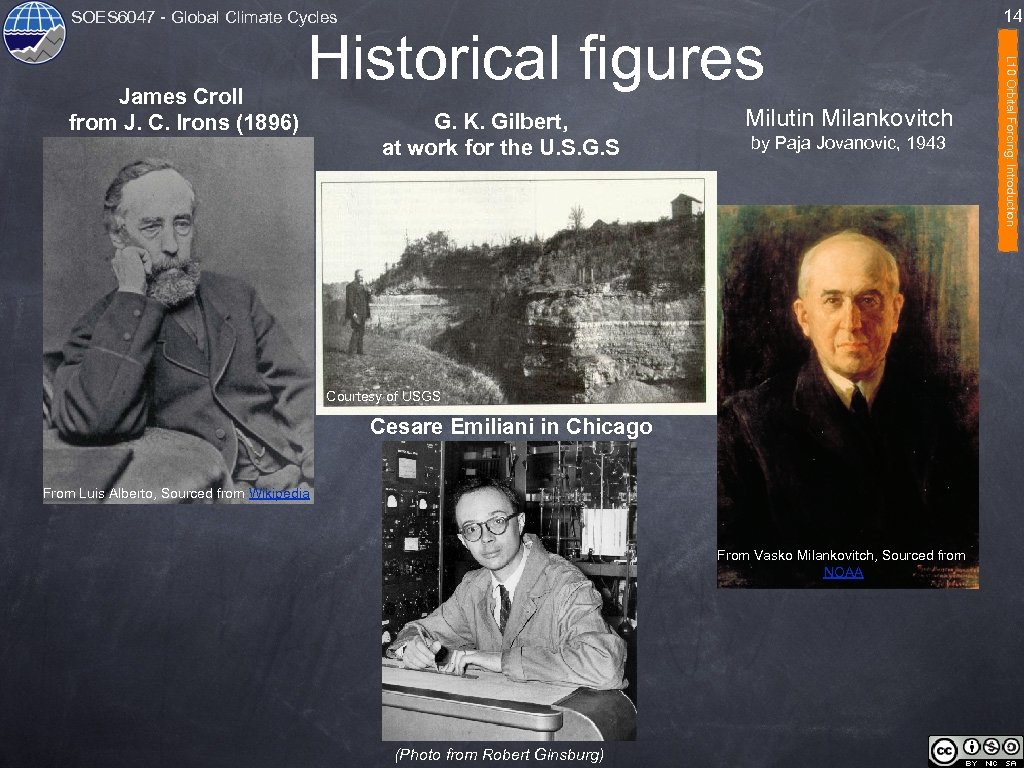
SOES 6047 - Global Climate Cycles G. K. Gilbert, at work for the U. S. G. S Milutin Milankovitch by Paja Jovanovic, 1943 Courtesy of USGS Cesare Emiliani in Chicago From Luis Alberto, Sourced from Wikipedia From Vasko Milankovitch, Sourced from NOAA (Photo from Robert Ginsburg) L 10 Orbital Forcing: Introduction James Croll from J. C. Irons (1896) Historical figures 14
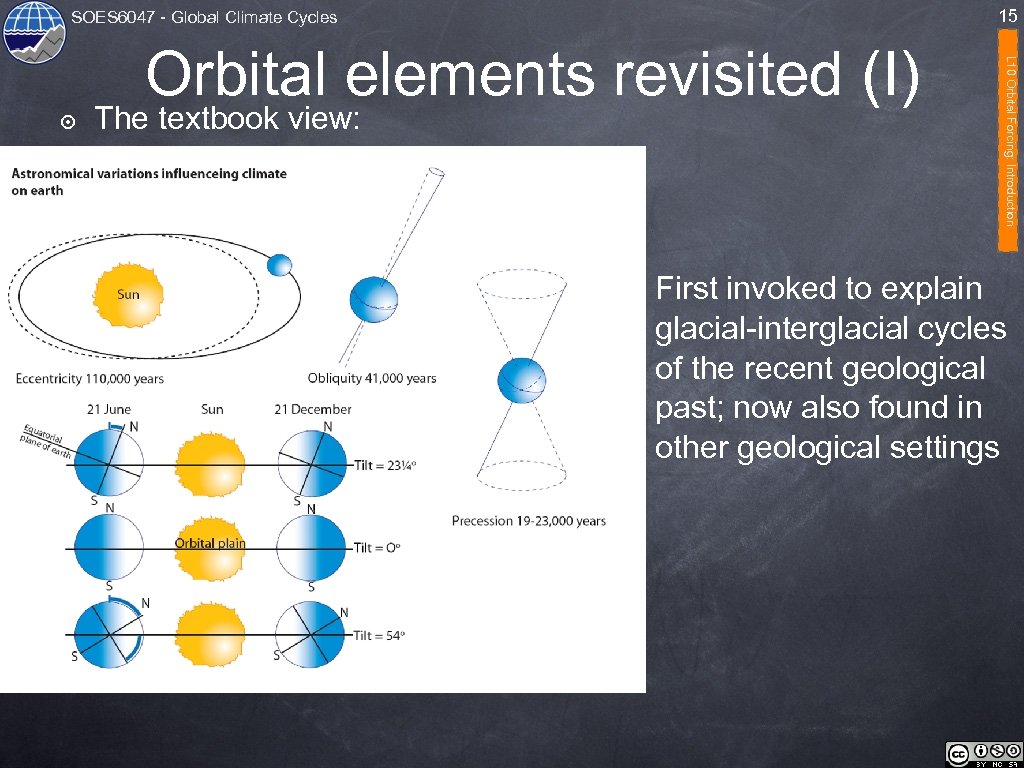
15 SOES 6047 - Global Climate Cycles ๏ The textbook view: L 10 Orbital Forcing: Introduction Orbital elements revisited (I) First invoked to explain glacial-interglacial cycles of the recent geological past; now also found in other geological settings
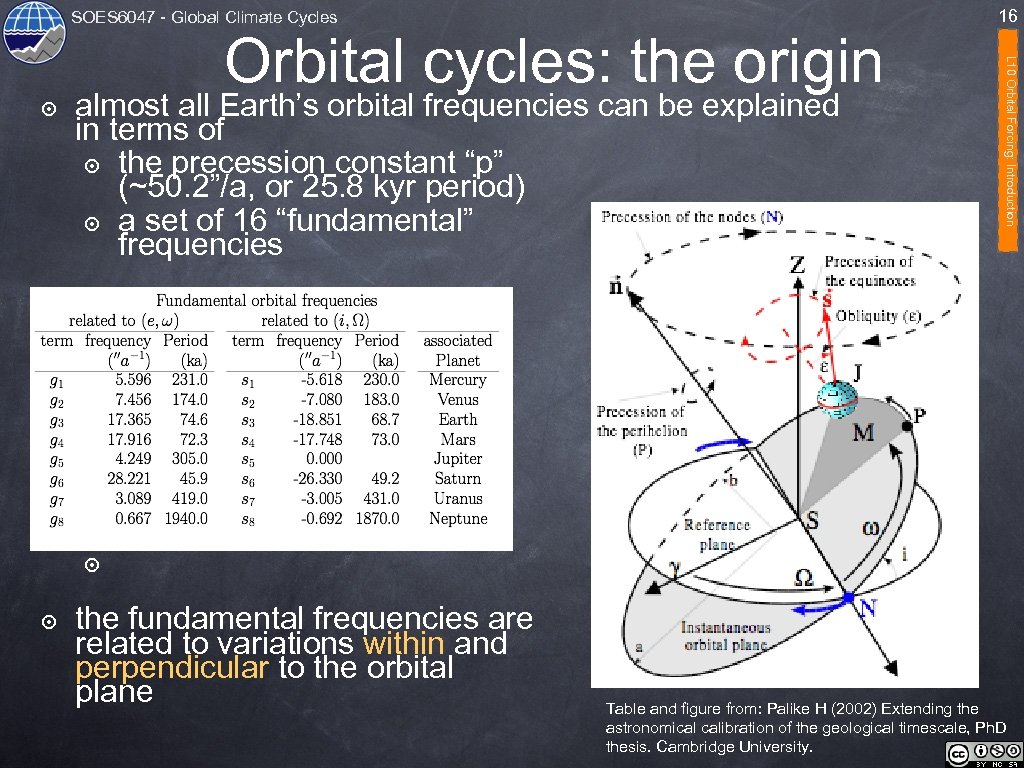
16 SOES 6047 - Global Climate Cycles ๏ almost all Earth’s orbital frequencies can be explained in terms of ๏ the precession constant “p” (~50. 2”/a, or 25. 8 kyr period) ๏ a set of 16 “fundamental” frequencies L 10 Orbital Forcing: Introduction Orbital cycles: the origin ๏ ๏ the fundamental frequencies are related to variations within and perpendicular to the orbital plane Table and figure from: Palike H (2002) Extending the astronomical calibration of the geological timescale, Ph. D thesis. Cambridge University.
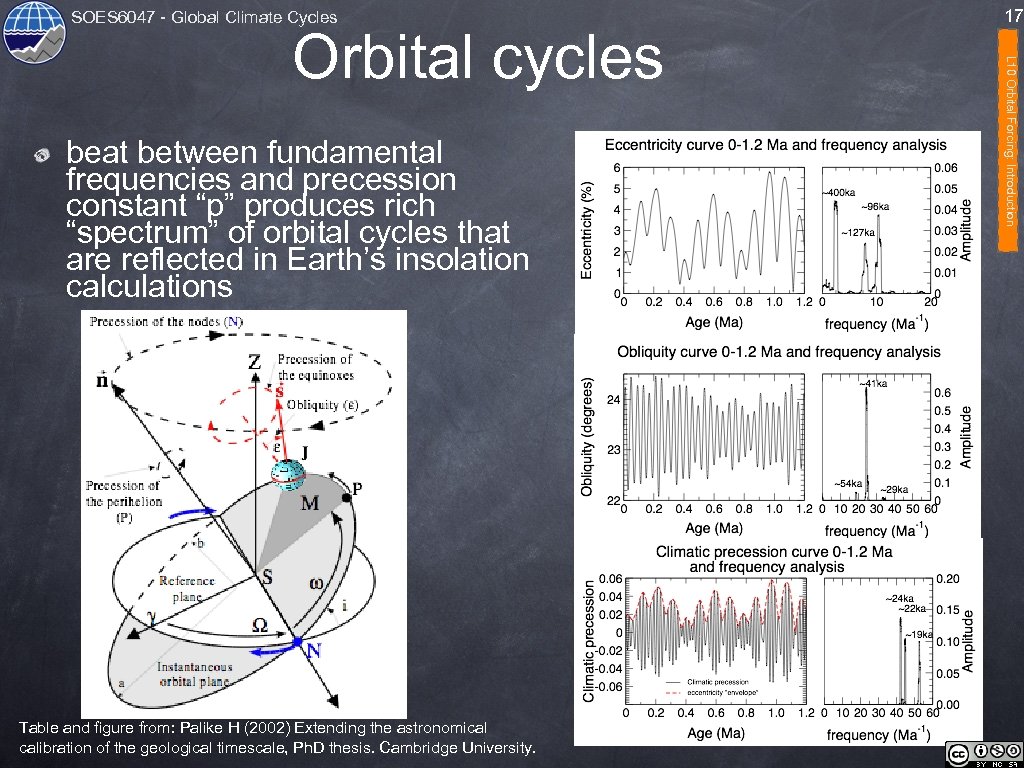
SOES 6047 - Global Climate Cycles beat between fundamental frequencies and precession constant “p” produces rich “spectrum” of orbital cycles that are reflected in Earth’s insolation calculations Table and figure from: Palike H (2002) Extending the astronomical calibration of the geological timescale, Ph. D thesis. Cambridge University. L 10 Orbital Forcing: Introduction Orbital cycles 17
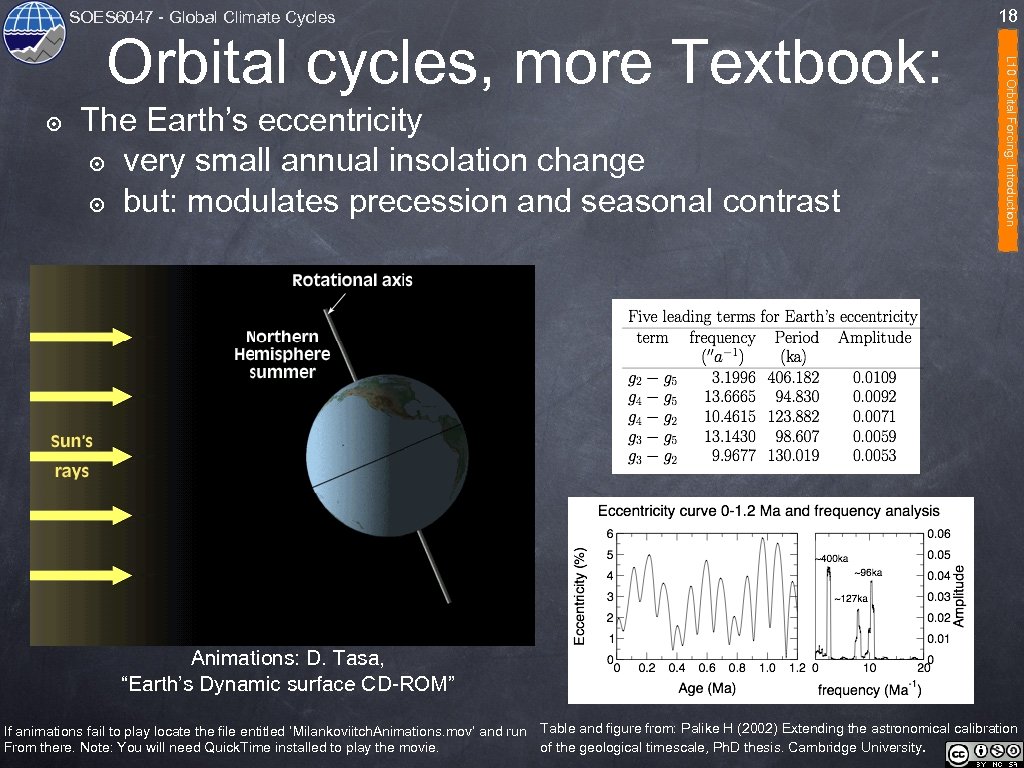
SOES 6047 - Global Climate Cycles ๏ The Earth’s eccentricity ๏ very small annual insolation change ๏ but: modulates precession and seasonal contrast L 10 Orbital Forcing: Introduction Orbital cycles, more Textbook: 18 Animations: D. Tasa, “Earth’s Dynamic surface CD-ROM” If animations fail to play locate the file entitled ‘Milankoviitch. Animations. mov’ and run Table and figure from: Palike H (2002) Extending the astronomical calibration of the geological timescale, Ph. D thesis. Cambridge University. From there. Note: You will need Quick. Time installed to play the movie.
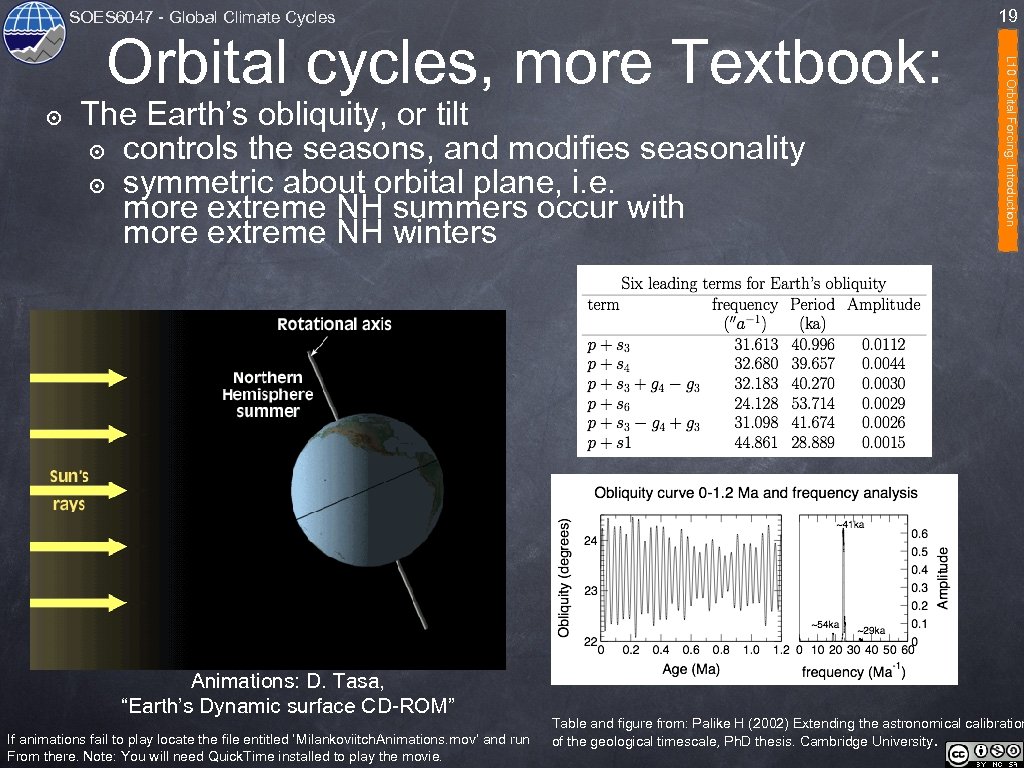
19 SOES 6047 - Global Climate Cycles ๏ The Earth’s obliquity, or tilt ๏ controls the seasons, and modifies seasonality ๏ symmetric about orbital plane, i. e. more extreme NH summers occur with more extreme NH winters Animations: D. Tasa, “Earth’s Dynamic surface CD-ROM” If animations fail to play locate the file entitled ‘Milankoviitch. Animations. mov’ and run From there. Note: You will need Quick. Time installed to play the movie. L 10 Orbital Forcing: Introduction Orbital cycles, more Textbook: Table and figure from: Palike H (2002) Extending the astronomical calibration of the geological timescale, Ph. D thesis. Cambridge University.
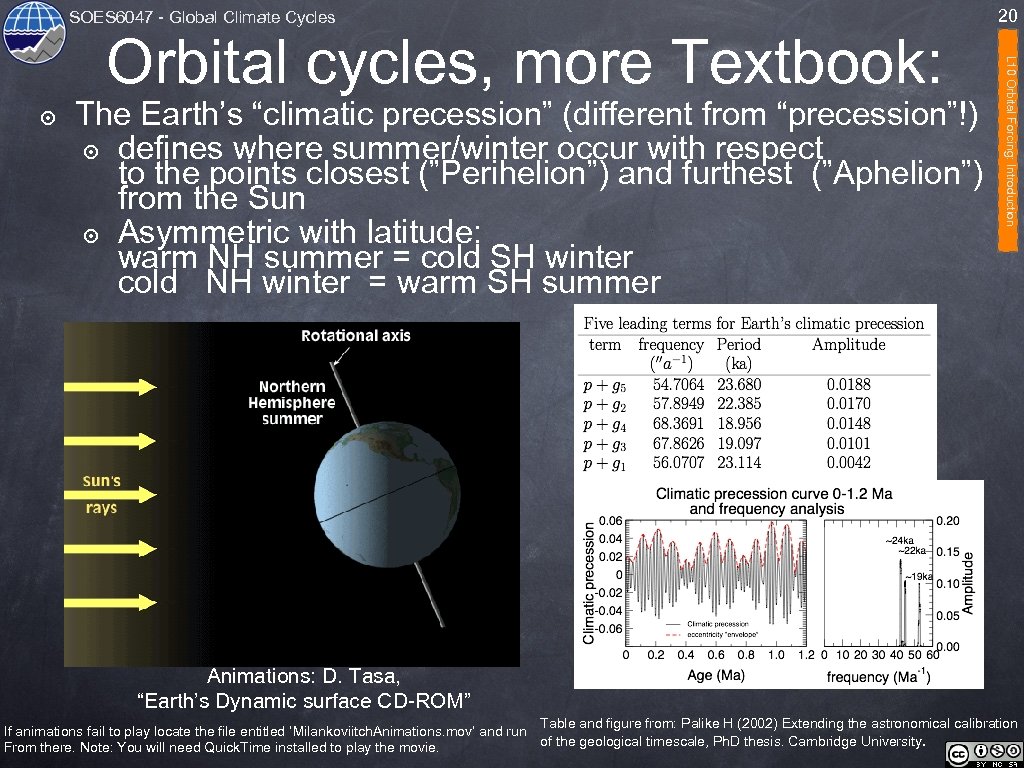
SOES 6047 - Global Climate Cycles ๏ The Earth’s “climatic precession” (different from “precession”!) ๏ defines where summer/winter occur with respect to the points closest (”Perihelion”) and furthest (”Aphelion”) from the Sun ๏ Asymmetric with latitude: warm NH summer = cold SH winter cold NH winter = warm SH summer L 10 Orbital Forcing: Introduction Orbital cycles, more Textbook: 20 Animations: D. Tasa, “Earth’s Dynamic surface CD-ROM” Table and figure from: Palike H (2002) Extending the astronomical calibration If animations fail to play locate the file entitled ‘Milankoviitch. Animations. mov’ and run of the geological timescale, Ph. D thesis. Cambridge University. From there. Note: You will need Quick. Time installed to play the movie.
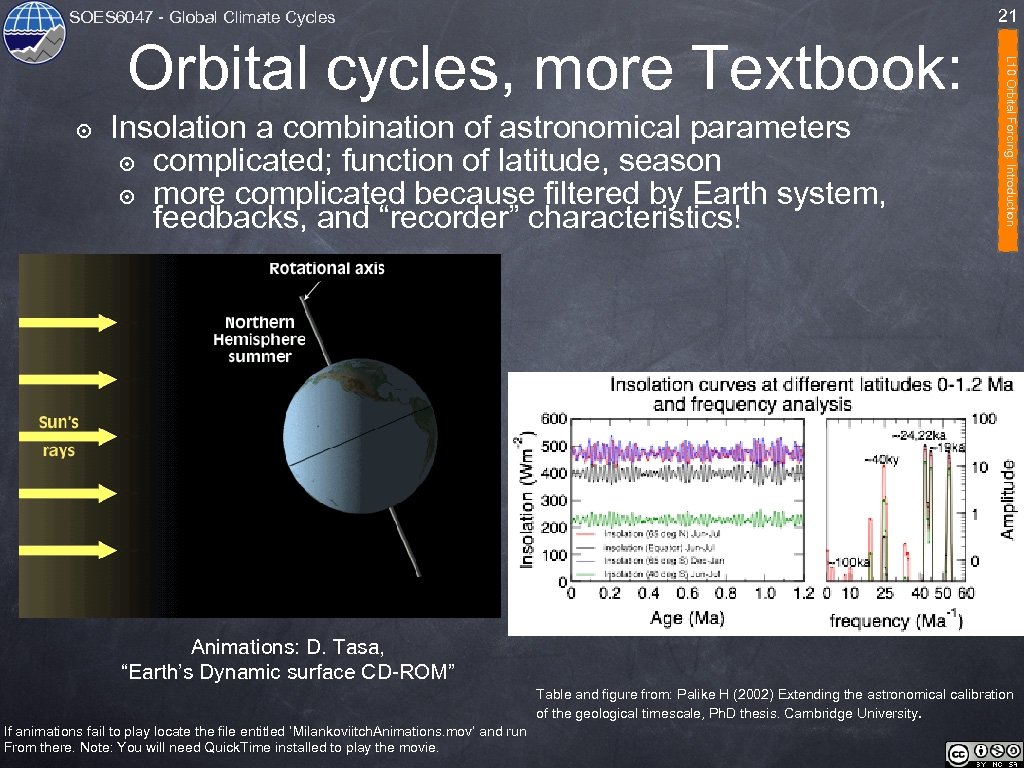
21 SOES 6047 - Global Climate Cycles ๏ Insolation a combination of astronomical parameters ๏ complicated; function of latitude, season ๏ more complicated because filtered by Earth system, feedbacks, and “recorder” characteristics! L 10 Orbital Forcing: Introduction Orbital cycles, more Textbook: Animations: D. Tasa, “Earth’s Dynamic surface CD-ROM” Table and figure from: Palike H (2002) Extending the astronomical calibration of the geological timescale, Ph. D thesis. Cambridge University. If animations fail to play locate the file entitled ‘Milankoviitch. Animations. mov’ and run From there. Note: You will need Quick. Time installed to play the movie.
SOES 6047 - Global Climate Cycles Deviation from the present-day value of the seasonal averaged insolation (i. e. total seasonal insolation divided by the length of the season) over the last 250 ka. Units are W/m 2. (A) Spring; (B) Summer; (C) Autumn; (D) Winter. Averaged insolation is a function of both obliquity (through the total seasonal insolation) and precession (through the length of the season). It also depends very slightly on eccentricity. For figure follow link in reference: Loutre M. F. , Paillard D. , Vimeux F. , Cortijo E. (2004) Does mean annual insolation have the potential to change the climate? Earth and Planetary Science Letters, v. 221, p. 1 -14 (Figures 2 and 5 A, B, C and D) Loutre et al. , 2004, Earth Planet. Sci. Lett. , v. 221, p. 1 -14. L 10 Orbital Forcing: Introduction Insolation considerations 22
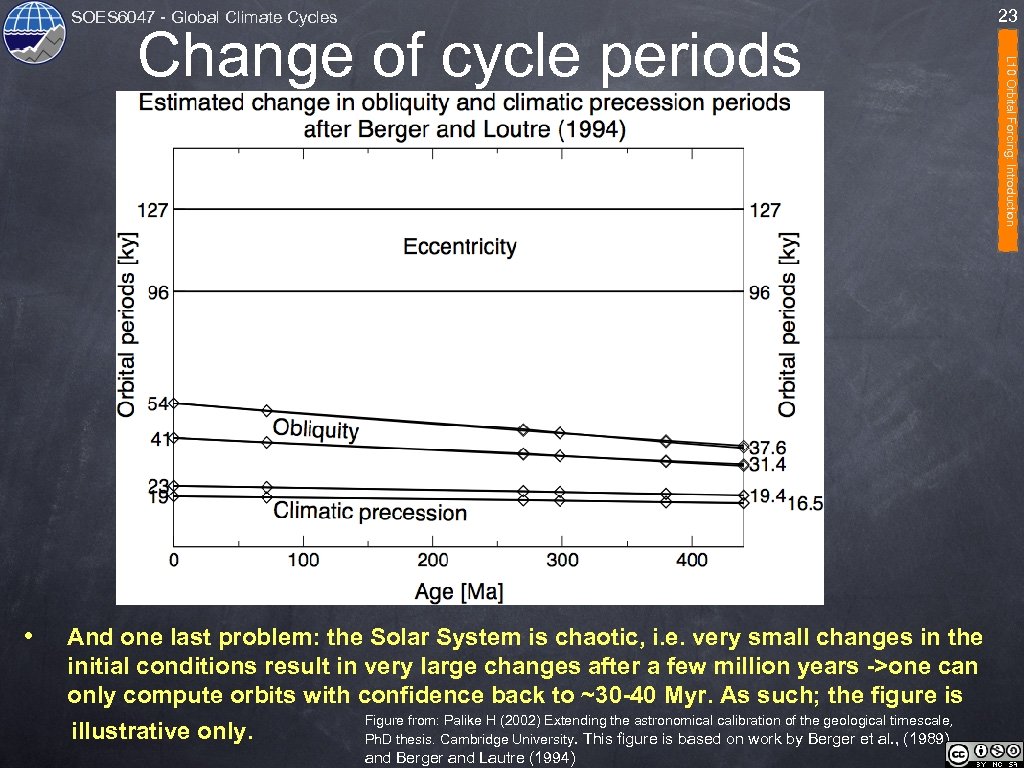
SOES 6047 - Global Climate Cycles • And one last problem: the Solar System is chaotic, i. e. very small changes in the initial conditions result in very large changes after a few million years ->one can only compute orbits with confidence back to ~30 -40 Myr. As such; the figure is Figure from: Palike H (2002) Extending the astronomical calibration of the geological timescale, illustrative only. Ph. D thesis. Cambridge University. This figure is based on work by Berger et al. , (1989) and Berger and Lautre (1994) L 10 Orbital Forcing: Introduction Change of cycle periods 23
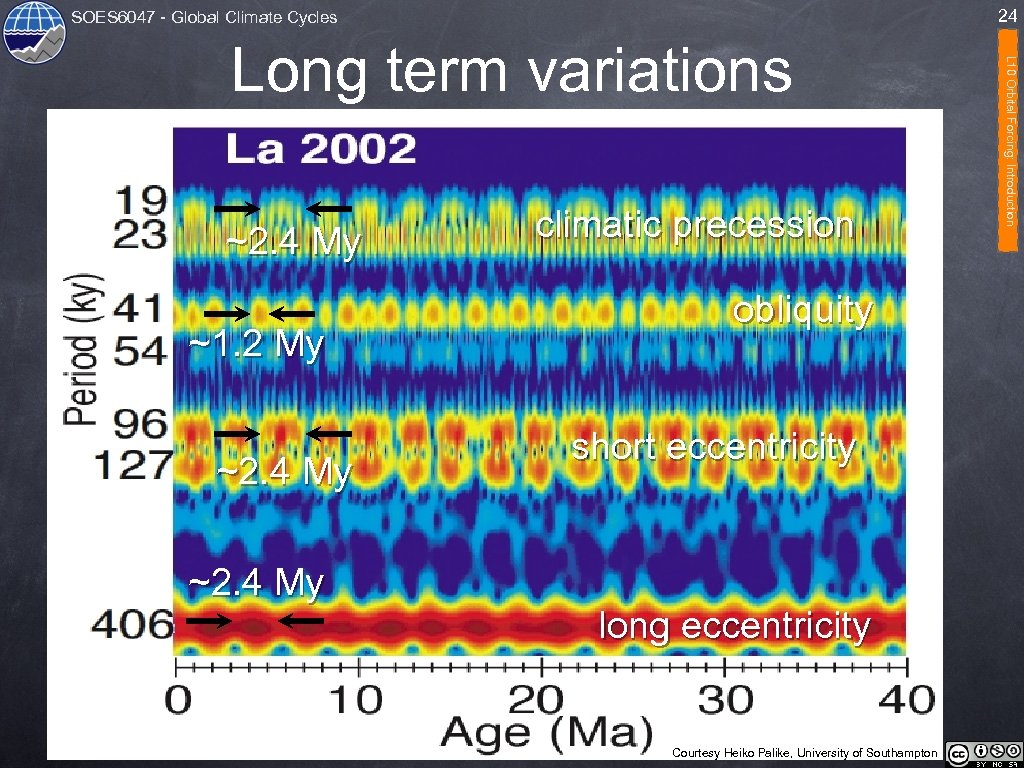
24 SOES 6047 - Global Climate Cycles ~2. 4 My ~1. 2 My ~2. 4 My climatic precession obliquity short eccentricity long eccentricity Courtesy Heiko Palike, University of Southampton L 10 Orbital Forcing: Introduction Long term variations
SOES 6047 - Global Climate Cycles L 10 Orbital Forcing: Introduction History of cyclostratigraphy (III) 25 • What else was required to advance cyclostratigraphy? – Separation into component periods (recognition of Milankovitch frequencies) requires spectral analysis, i. e. computers. – Need high res. data from undisturbed sediments (marine? !) – Need new types of measurements to capture climate signal • 1960’s -> slow rebirth of concepts – Schwarzacher (1964): Spectral analysis of limestone-shale sequence – Emiliani (1966): first stable isotope record of Pleistocene foraminifera in deep-sea cores, suggested a correlation with insolation changes. His records lacked age calibration was short.
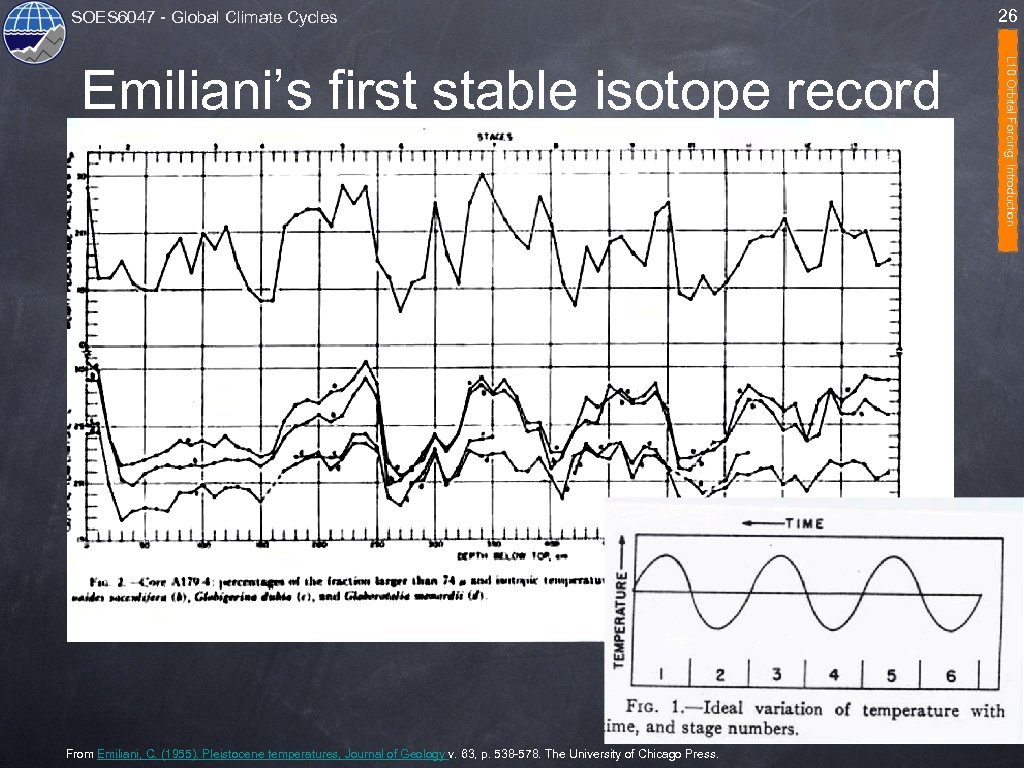
SOES 6047 - Global Climate Cycles From Emiliani, C. (1955). Pleistocene temperatures, Journal of Geology v. 63, p. 538 -578. The University of Chicago Press. L 10 Orbital Forcing: Introduction Emiliani’s first stable isotope record 26
SOES 6047 - Global Climate Cycles • 1976: LANDMARK paper that established modern cyclostratigraphy and climate research – “Pacemaker of the Ice Ages” Hays, Imbrie and Shackleton (1976) – 500 kyr isotope & faunal record from deep sea – Age control from C-14 and ash beds – Result: cyclicity in ice volume & ocean temperature • • Power spectral analysis reveal dominant 41 & 100 ky cycle 19 & 23 ky also present, but less significant – used Milankovitch’s calculations and resulted in age tuning of Pleistocene glacial events L 10 Orbital Forcing: Introduction History of cyclostratigraphy (IV) 27
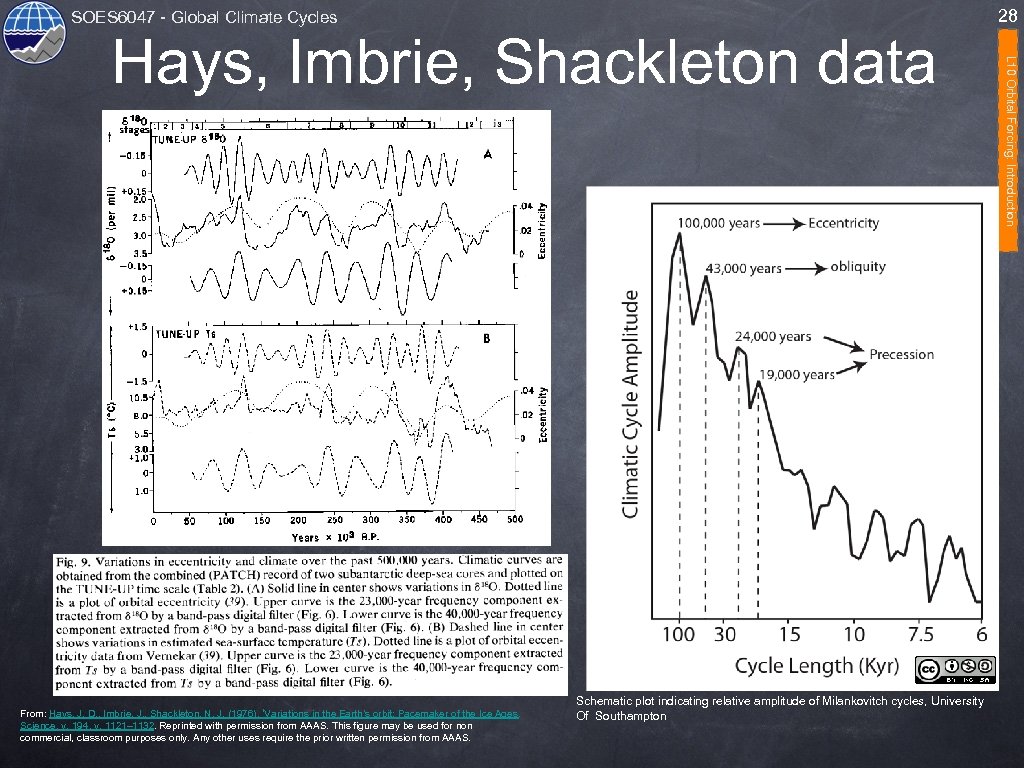
28 SOES 6047 - Global Climate Cycles From: Hays, J. D. , Imbrie, J. , Shackleton, N. J. (1976). ‘Variations in the Earth’s orbit: Pacemaker of the Ice Ages. Science. v. 194, v. 1121– 1132. Reprinted with permission from AAAS. This figure may be used for non commercial, classroom purposes only. Any other uses require the prior written permission from AAAS. Schematic plot indicating relative amplitude of Milankovitch cycles, University Of Southampton L 10 Orbital Forcing: Introduction Hays, Imbrie, Shackleton data
SOES 6047 - Global Climate Cycles • 1980’s-now = Cyclostratigraphy very popular – Milankovitch cycles found in many geological settings – Importance of cyclic climate change in depositional environments recognised – Determination of accumulation rates and discontinuities – Linked sea-level oscillations (Sequences and“Parasequences”) • Age-tuning of Neogene [Hilgen, Shackleton] – – – Age-tuned time scale extended through Oligocene Fine-tuning of spreading rates (magnetic reversals) Improved astronomical model of solar system Recalibration of Ar/Ar dating standards Duration-tuning of other geological periods • “Floating” scaled intervals (Triassic, etc. ) L 10 Orbital Forcing: Introduction Where are we now? 29
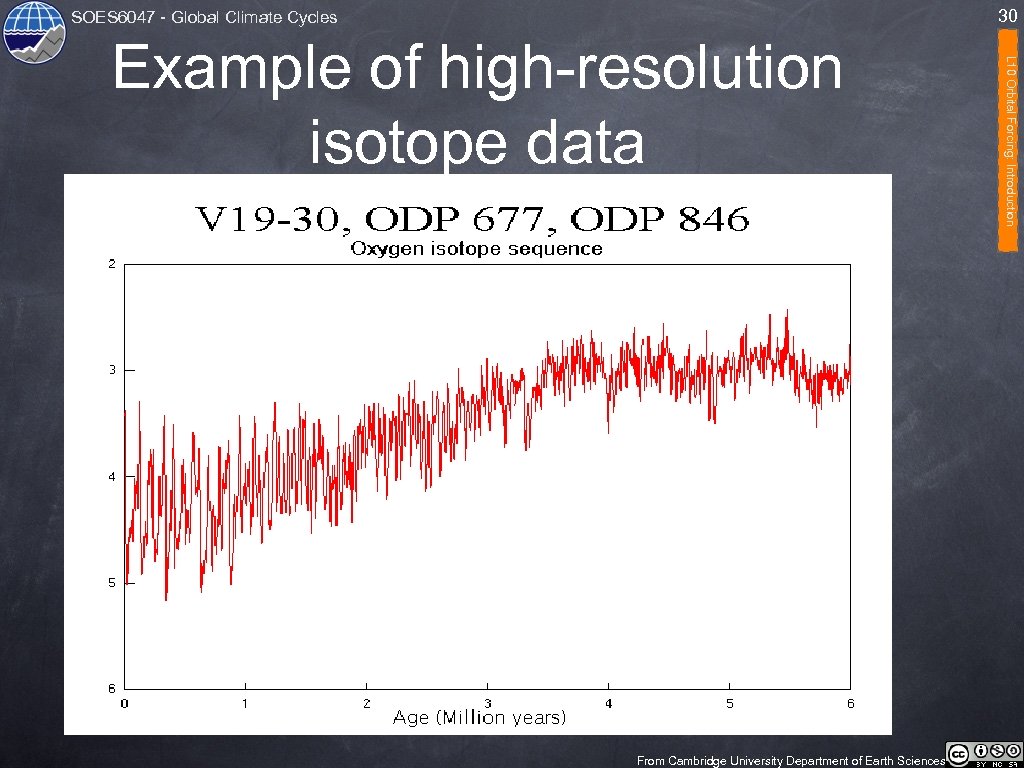
30 SOES 6047 - Global Climate Cycles From Cambridge University Department of Earth Sciences L 10 Orbital Forcing: Introduction Example of high-resolution isotope data
SOES 6047 - Global Climate Cycles • Absolute ages: HAVE to use radiometric dating – BUT: requires presence of right minerals, e. g. potassium-rich Feldspar (e. g. sanidine), to make measurements. These can be found in (rare) volcanic ash-layers – There is a %-error in the ages, i. e. increasing absolute error further in the past. – Questions as to how accurate decay constants and standards are. • Relative ages: wide use of biostratigraphy and magnetostratigraphy. These are calibrated with radiometric ages • Cyclostratigraphy can provide very accurate relative ages, and absolute ages if anchored to the present • More on cyclostratigraphy and time scales in Lect. 3. 1 L 10 Orbital Forcing: Introduction Comparison with other dating methods 31
SOES 6047 - Global Climate Cycles • Important: do NOT need cold winters, but cool summers, so that ice does not melt (Croll vs. Milankovitch) • Cool summers in N. Hemisphere are the important factor (due to asymmetric land distribution) • Ice growth conditions: – small tilt (obliquity) • Minimal summer heat in high latitudes – Climatic precession: • • N. Hemisphere summer = furthest from Sun Cooler summer; but corresponding warmer winters (= situation today!) – High eccentricity • Increase distance from Sun in N. Hemisphere summer L 10 Orbital Forcing: Introduction Orbital control on ice-ages 32
SOES 6047 - Global Climate Cycles 33 ๏ Astronomical forcing potentially complicated, with “rich” spectrum of periodicities on time scales from kyr to Myr ๏ Interaction with climate system still poorly understood, but very useful as relative “Metronome” and dating tool ๏ Potential to interact with large variety of Earth system processes, time constants, and feedbacks ๏ Need geological data to constrain how forcing & filtering works, from time periods representing “extreme” boundary conditions, e. g. recent glacials, but also past “hot-house” and different tectonic configurations L 10 Orbital Forcing: Introduction Key point summary
SOES 6047 - Global Climate Cycles ๏ This resource was created by the University of Southampton and released as an open educational resource through the 'C-change in GEES' project exploring the open licensing of climate change and sustainability resources in the Geography, Earth and Environmental Sciences. The C-change in GEES project was funded by HEFCE as part of the JISC/HE Academy UKOER programme and coordinated by the GEES Subject Centre. ๏ This resource is licensed under the terms of the Attribution-Non-Commercial-Share Alike 2. 0 UK: England & Wales license (http: //creativecommons. org/licenses/by-nc-sa/2. 0/uk/). ๏ However the resource, where specified below, contains other 3 rd party materials under their own licenses. The licenses and attributions are outlined below: ๏ The University of Southampton and the National Oceanography Centre, Southampton and its logos are registered trade marks of the University. The University reserves all rights to these items beyond their inclusion in these CC resources. ๏ The JISC logo, the C-change logo and the logo of the Higher Education Academy Subject Centre for the Geography, Earth and Environmental Sciences are licensed under the terms of the Creative Commons Attribution -non-commercial-No Derivative Works 2. 0 UK England & Wales license. All reproductions must comply with the terms of that license. ๏ All content reproduced from copyrighted material of the American Geophysical Union (AGU) are subject to the terms and conditions as published at: http: //www. agu. org/pubs/authors/usage_permissions. shtml AGU content may be reproduced and modified for non-commercial and classroom use only. Any other use requires the prror written permission from AGU. ๏ All content reproduced from the American Association for the Advancement of Science (AAAS) may be reproduced for non commercial classroom purposes only, any other uses requires the prior written permission from AAAS. L 10 Orbital Forcing: Introduction Copyright statement 34
Скачать презентацию SOES 6047 — Global Climate Cycles SOES 6047
3e14e64637ae1534d68ca076b4dff752.ppt