


 Скачать презентацию SOCY 3700 Selected Overheads for the Final Exam
046f3a139e5137a090bb7b6ef7e5c944.ppt
- Количество слайдов: 39
 SOCY 3700 Selected Overheads for the Final Exam Prof. Backman Spring 2008
 Stages in Field Research • Choosing the site – Start where you are • Getting in – Being accepted – Anonymity • Getting on – With self, “the folk”, conscience and colleagues • Gathering data – Logging – Interviews • Focusing • Analysis • Write up • (Adapted from Lofland)
 Street Corner Society: The Social Structure of an Italian Slum William Foote Whyte, 1943 (third edition, 1981)
 Whyte Bio • Educated middle class upbringing • Loved to write • Attended Swarthmore in suburban Philadelphia • Engaged in some reform activities in college, but engaged even more in writing • Wrote a novel, decided it was lousy because he didn’t have enough to say • Got a Junior Fellowship at Harvard – three years just to hang around and do whatever research took his fancy (sort of)
 The Research Problem • Whyte came to Harvard knowing mainly that he wanted to study slums and somehow improve the world • Social scientific literature was just beginning to appear. He read lots of it • Other folks at Harvard had done similar work and were developing some theoretical ideas about group process – One would not think one would go to a slum to study group process, but in the end that was a big part of what Whyte did • Many of the ideas Whyte when he started his work came to naught – “We set out on the frontiers of our personal knowledge and began exploring beyond those frontiers” (Whyte 1984: 63)
 “Cornerville” • In the usual fashion, Whyte gave his city and neighborhood a psuedonym. Cornerville refers to the slum, now known to be Boston’s North End. He called Boston “Eastern City. ” • At the time (around 1937) Cornerville was suffering the effects of The Great Depression • Predominately Italian in a city whose big politicians were mostly Irish • Many residents spoke only Italian
 Getting In • Wandered around Boston, settled on Cornerville because it “looked like” his vision of a slum • Could observe from the outside, but wanted to observe from the inside • After various failed schemes, introduced to Doc by the social worker in charge of girls’ programs at the local settlement house • Moved into the neighborhood
 Doc • Doc (a psuedonym for Ernest Pecci) is probably the most famous informant in sociology – A pretty good sociologist himself for someone who never had a sociology course • Late 20 s, mostly unemployed guy from the neighborhood • Informal leader of a group of similarly underemployed age mates • Interested in making things better
 Doc and Bill • Doc’s famous response to Whyte’s first rambling description of what Whyte was trying to do in Cornerville: “Do you want to see the high life or the low life? ” • Doc served as Whyte’s sponsor, guide, and “member validator” – Having a sponsor can be a problem in settings with a great deal of conflict, as you may be seen as being on your sponsor’s side – “Member validator”: insider who reviews the sociologist’s analysis from an insider’s point of view
 Getting On • Whyte moved into Cornerville, taking a room with a family • Whyte tried to learn Italian – Though never got proficient, he felt his efforts gave him a great deal of credibility, especially with the older generation • Joined various clubs, becoming secretary of at least one • Hung out with Doc’s gang • Returned regularly to Harvard for baths and brainstorming with other social scientists
 Going Native • When you start to act like and especially to think like the people you are studying, you have gone native – Quite common occurrence – It is difficult to completely go native • Whyte’s efforts to swear like the other guys weren’t successful, partly because they wanted him to be himself – Can get you in trouble • Whyte voted illegally • Whyte almost inadvertently got engaged because he didn’t understand as much of native practice as he thought – The natives aren’t always grateful
![Street Corner Society: Sources Whyte, William F. [1943] 1981. Street Corner Society. 3 rd](https://present5.com/presentation/046f3a139e5137a090bb7b6ef7e5c944/image-12.jpg "Street Corner Society: Sources Whyte, William F. [1943] 1981. Street Corner Society. 3 rd") Street Corner Society: Sources Whyte, William F. [1943] 1981. Street Corner Society. 3 rd ed. Chicago, IL: University of Chicago Press. Whyte, William F. 1984. Learning From the Field: A Guide from Experience. Newbury Park, CA: Sage. Whyte, William F. nd. Various personal and classroom communications.
Street Corner Society: Sources Whyte, William F. [1943] 1981. Street Corner Society. 3 rd ed. Chicago, IL: University of Chicago Press. Whyte, William F. 1984. Learning From the Field: A Guide from Experience. Newbury Park, CA: Sage. Whyte, William F. nd. Various personal and classroom communications.
 Bernard on Unstructured Interviews • H. Russell Bernard – cultural anthropologist from U of Florida, author of a research methods text I have used in advanced research methods courses – As surveys are to sociologists, so unstructured (and semi-structured) interviews are to cultural anthropologists – As a researcher, journal editor, and methods text author, Bernard has been given credit for strengthening the rigor of anthropological research Source: Bernard, H. Russell. 1995. Research Methods in Anthropology: Qualitative and Quantitative Approaches. 2 nd ed. Walnut Creek, CA: Alta. Mira. Mostly Chapter 10, pp. 208 -36.
 Bernard on Unstructured Interviews (2): Continuum of Interview Situations Since the researcher is an outsider, the locals will generally be aware that any contact is likely to involve information gathering • Continuum of situations based on how much the interviewer controls the situation 1. Informal interview – more or less normal conversation - Typical early in research Useful for rapport Useful later for finding topics that might have been overlooked
 Bernard on Unstructured Interviews (3): Continuum of Interview Situations (2) 2. Unstructured interview – not just normal conversation, but with minimal control over the responses of the interviewee 3. Semi-structured – like unstructured but with an interview guide - - Interview guide: written list of topics, probes, etc. intended to be covered in the interview More formal than unstructured 4. Structured – questions (and often answer choices) established ahead of time by the interviewer - For example, standard survey interviews, self-administered questionnaires
 Bernard on Unstructured Interviews (4): Starting the Interview • Assure anonymity • Explain their importance to your understanding • Ask for permission to record the interview and to take notes – The value of the interview much lower if you can’t record or take notes – Even with recorder it helps to take occasional notes
 Bernard on Unstructured Interviews (5): Let the Informant Lead Rule # 1: get an informant on the topic and get out of the way – You pick the topic, interviewee provides the content – In general, it is the interviewee’s ideas you are interested in, not yours • This rule is not always slavishly followed – Interviewee may stray off topic – You may have ideas you want responded to
 Bernard on Unstructured Interviews (6): Probes • Use probes to guide interview • Probe (Bernard definition): stimulating an informant to give more information without injecting yourself so much into the interaction that you get only a reflection of yourself in the data – There are many types of probes – Our textbook definition: a neutral request to clarify an ambiguous answer, to complete an incomplete answer, or to obtain a relevant response (p. 192 in Neuman 2007)
 Bernard on Unstructured Interviews (6): Types of Probes 1 • Silent probe – don’t say anything when the interviewee stops – Difficult to do appropriately – Culturally sensitive since different cultures have different rules about silence • Echo probe – repeat the last thing the interviewee said – Signals that you are interested in what was said without saying why or suggesting what to say
 Bernard on Unstructured Interviews (7): Types of Probes 2 • Uh-huh (neutral) probe – make regular affirmative noises, as one often does in normal conversation to indicate you are still listening and are interested – Keeps the interviewee talking Rule #2: In general, more talking by the respondent is better – Hence, longer responses are better
 Bernard on Unstructured Interviews (8): Types of Probes 3 • The long question probe – instead of keeping a question short and to the point, asking a long roundabout question – You’re modeling the kind of long answer you want to get back – The trick is not to guide the answer as you ask the question
 Bernard on Unstructured Interviews (9): Types of Probes 4 • Probe by leading – ask a leading question as a way of focusing provoking the interviewee – Usually we try not to lead, but sometimes respondents seem to be avoiding a topic or conclusion – Can be used to ask about more specific incidents or about what happens when things don’t work out as expected – Often based on earlier interviews
 Bernard on Unstructured Interviews (10): Types of Probes 5 • Phased assertion (baiting) probe – you take some information that may or may not be true and ask questions as if it were true – For example, “I guess Hilary and Barak are friends again. I wonder why. ” – This is a favorite ploy of gossipmongers
 Bernard on Unstructured Interviews (11): Verbal Respondents; Equipment • Verbal respondents – don’t be afraid to interrupt a long winded respondent who is wandering away from your topic. Try to be graceful about it • Equipment – always make sure that your tape recorder is ready before the interview (fresh tapes and batteries)
 Bernard on Unstructured Interviews (12): Uses of Unstructured Interviews • A primary source of raw data • Preparation for semi-structured interviews • To get info from people unlikely to give more formal interviews • Developing rapport • Studying sensitive topics – E. g. , hot political topics, sexuality, racial prejudice – Conflict: you can get wide range of information from multiple interviewees
 Bivariate Relationships with Integer-level Variables Preliminaries to multiple regression
 Steps in Analysis of Bivariate Relationships Between Integer-level Variables • Look at scatterplot – Dependent variable as the Y (vertical) axis – Independent variable as the X (horizontal) axis • Make best-fit line – Since it is a line, we call it linear regression – Since we have only one independent variable, we call it simple linear regression • Calculate slope (b) • Calculate goodness of fit (r)
 Interpretation of Simple Regression Results Equation: Dependent = intercept + coefficient * independent + error • Coefficient (aka b, beta, or regression coefficient) tells how many units of the dependent variable go with the increase of one unit on the independent variable – Mathematically, the slope
 Interpretation of Simple Regression Results (2) • Correlation coefficient (aka r, Pearson’s r) – a measure of how well the line fits the data, usually interpreted as how strong the relationship is – Measures the “goodness of fit” • The higher the absolute value of r, the better the fit – Ranges between -1 and 1 • Positive coefficient means there is a positive relationship between the two variables (high on the independent goes with high on the dependent) • Negative coefficient means there is a negative relationship between the two variables (high on the independent goes with low on the dependent)
 Interpretation of Simple Regression Results (3) • Intercept – how many units of the dependent variable you would be expected to have with 0 units of the independent – Mathematically, it is where the line crosses the vertical axis • Error – the difference between what was actually measured for the dependent variable for a particular case and the measurement predicted by the equation for the line
 Interpretation of Simple Regression Results (4) • Statistical significance – tests how sure we are that the regression coefficient is not zero OR that the correlation coefficient is not zero – Conventionally we use the 95 percent confidence level – At the 95 percent confidence level, the probability of a false positive is less than 5 percent, usually written as p<. 05
 Interpretation of Simple Regression Results (5) Example Dependent variable: violent crimes per 100, 000 population Independent variable: percent of population 15 and up who are currently divorced Correlation coefficient = 0. 24 There is a positive relationship Regression coefficient = 38. 6 For every additional 1 percent to the percent divorced of the population 15+ there is an increase in the violent crime rate of 39 Intercept = 160 If no one in the population were divorced, there would be 160 violent crimes per 100, 000 The relationship is significant at the p<. 048 level
 Multiple Regression • Multiple regression is multiple because it allows the use of more than one independent variable – This is nice since so much of social life has multiple causes • Multiple regression is probably the most important statistical tool in use in sociology today • There are many similarities between simple regression and multiple regression
 Multiple Regression (2): Similarities with Simple Regression • The key mathematical operation is fitting a line to the data points – The method is the same: choose the line that minimizes the squared distances between the points and the line • Called the method of least squares; the line is sometimes called the least squares line. Sometimes it is called the ordinary least squares (OLS) line • There is a statistic for the overall fit of the line to the data points • Each independent variable gets its own regression coefficient
 Multiple Regression (3): Differences from Simple Regression • Scatterplots are in hyperspace – That is, for each variable, including the dependent, there is another dimension in the graph • They’re really hard to draw! • The goodness of fit statistic doesn’t tell you the direction of the relationships – We use R (not r) as its symbol – Actually, we usually use R 2 – R 2 tells us the proportion of variation in the dependent variable that is accounted for by the independent variables
 Multiple Regression (4): Interpretation of Regression Coefficients • New term: ceteris paribus – all other things being equal • A regression coefficient tells us how much change in the dependent variable is associated with a change of one unit in the coefficient’s independent variable, ceteris paribus
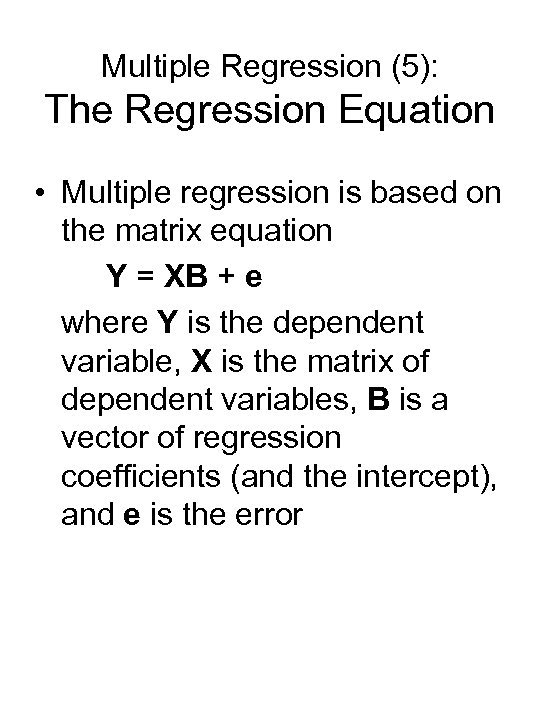 Multiple Regression (5): The Regression Equation • Multiple regression is based on the matrix equation Y = XB + e where Y is the dependent variable, X is the matrix of dependent variables, B is a vector of regression coefficients (and the intercept), and e is the error
 Multiple Regression (6): Varieties of Multiple Regression • Ordinary regression makes certain assumptions about the relations between the independent variables and about the errors – These assumptions are not always met • Ordinary regression is limited to only one dependent variable • There a large number of modifications to ordinary regression that overcome some of its limitations and to loosen the assumptions
 Multiple Regression (7): The General Linear Model • The collection of modifications and extensions to ordinary regression is called the general linear model – The GLM is based on the equation given earlier – It brings together a wide range of statistical methods, some of which had been invented independently • The GLM is a conceptual and methodological breakthrough paralleled in its importance for quantitative social science only by the discovery of sampling theory