


 Скачать презентацию Sociology of continuity Review of some sociological theories
43a6e9b6ee68c33687b84f4c917af25a.ppt
- Количество слайдов: 38
 Sociology of continuity Review of some sociological theories Martti Muukkonen ESA Conference Athens 29 Aug. - 1 Sept. 2017
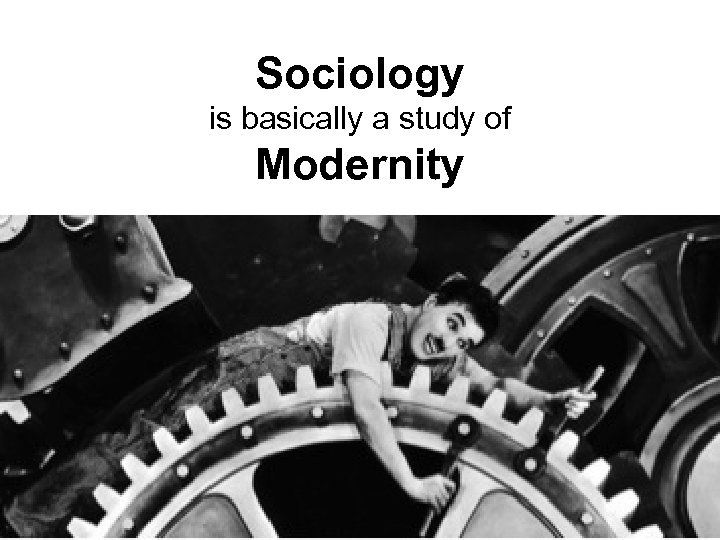 Sociology is basically a study of Modernity
 BUT as the Ecclesiastes says Whatever is has already been, and what will be has been before; and God will call the past to account. (Eccl 3: 15)
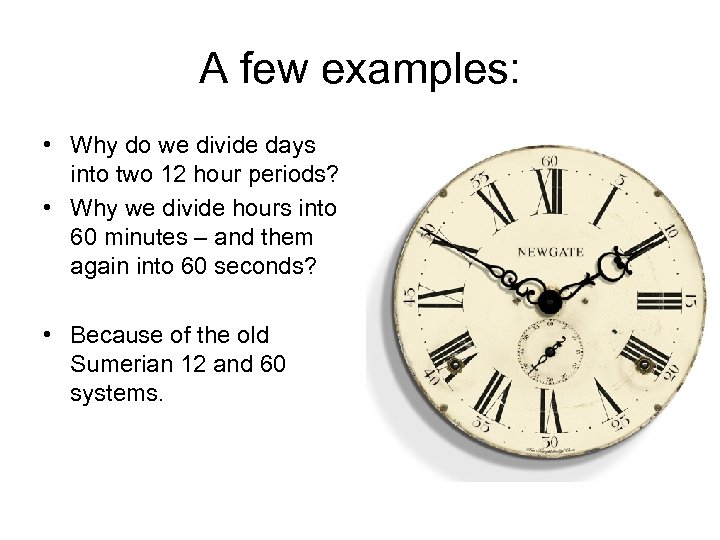 A few examples: • Why do we divide days into two 12 hour periods? • Why we divide hours into 60 minutes – and them again into 60 seconds? • Because of the old Sumerian 12 and 60 systems.
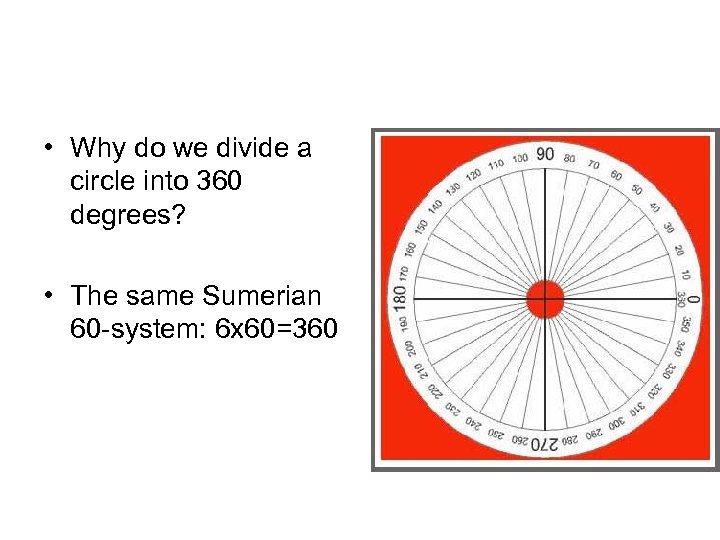 • Why do we divide a circle into 360 degrees? • The same Sumerian 60 -system: 6 x 60=360
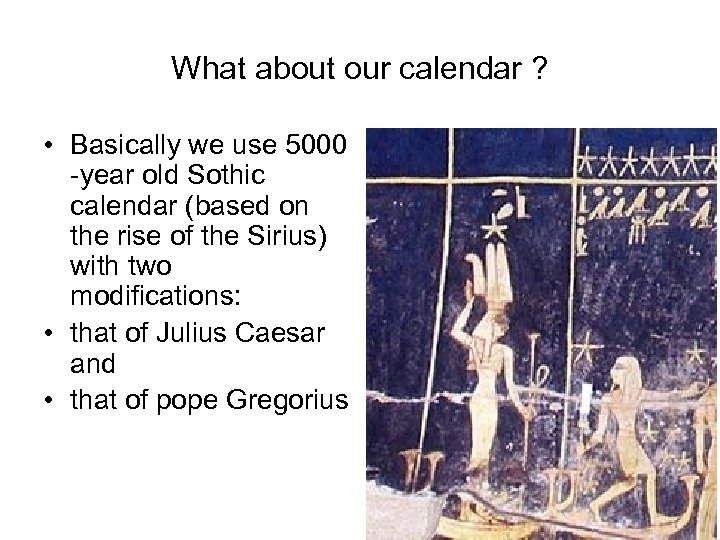 What about our calendar ? • Basically we use 5000 -year old Sothic calendar (based on the rise of the Sirius) with two modifications: • that of Julius Caesar and • that of pope Gregorius
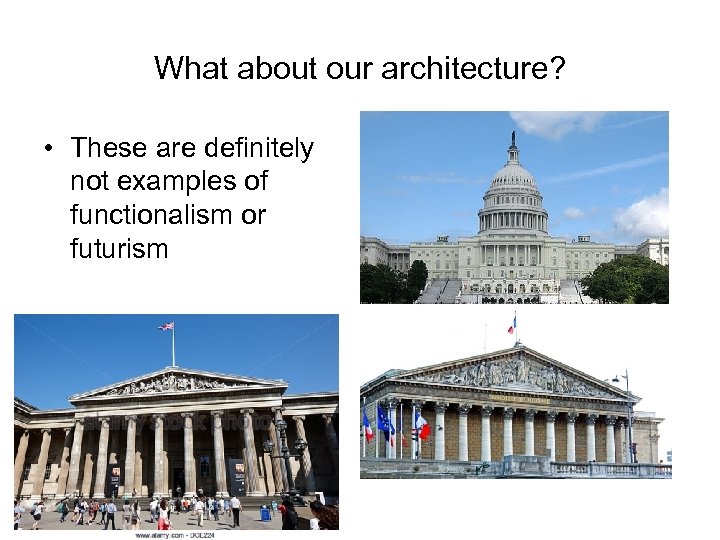 What about our architecture? • These are definitely not examples of functionalism or futurism
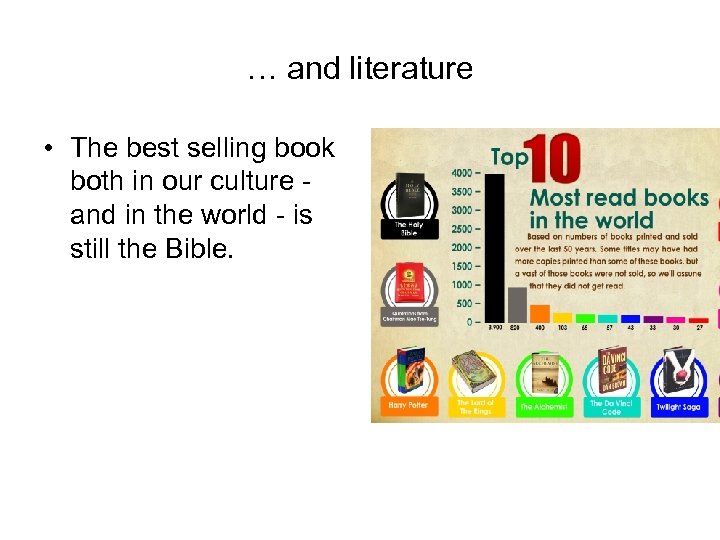 … and literature • The best selling book both in our culture and in the world - is still the Bible.
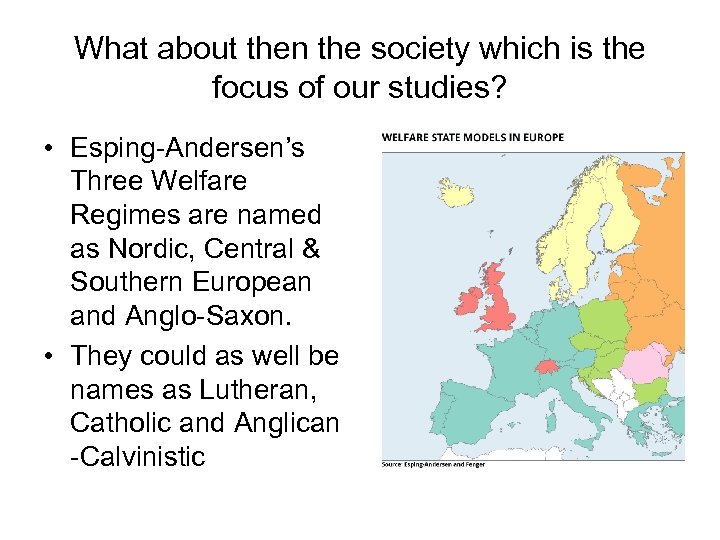 What about then the society which is the focus of our studies? • Esping-Andersen’s Three Welfare Regimes are named as Nordic, Central & Southern European and Anglo-Saxon. • They could as well be names as Lutheran, Catholic and Anglican -Calvinistic
 Social theories of continuity • • David & Arthur: Path Dependency Theory Hannan & Freeman: Hierarchical Inertia Turner & Killian: Emergent Norm Berger & Luckmann: Routinisation of thinking • Neisser: Schema
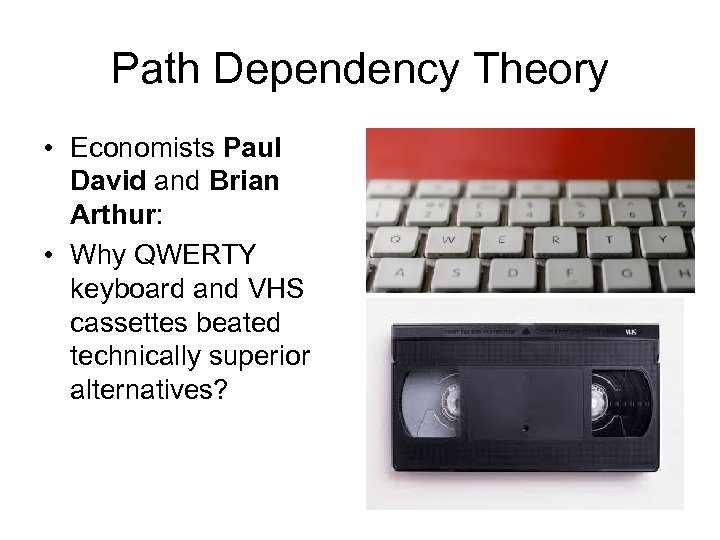 Path Dependency Theory • Economists Paul David and Brian Arthur: • Why QWERTY keyboard and VHS cassettes beated technically superior alternatives?
 Path Dependency Theory • David and Arthur’s main argument is similar to old rhyme of the missing horseshoe nail: “For the want of a nail the shoe was lost, For the want of a shoe the horse was lost, For the want of a horse the rider was lost, For the want of a rider the battle was lost, For the want of a battle the kingdom was lost, And all for the want of a horseshoe-nail. ”
 Path Dependency Theory • Sometimes some solutions become locked-in already in the stage when "individual transactions that are too small to observe, and these 'random' events can accumulate and become magnified by positive feedback so as to determine the eventual outcome. ”
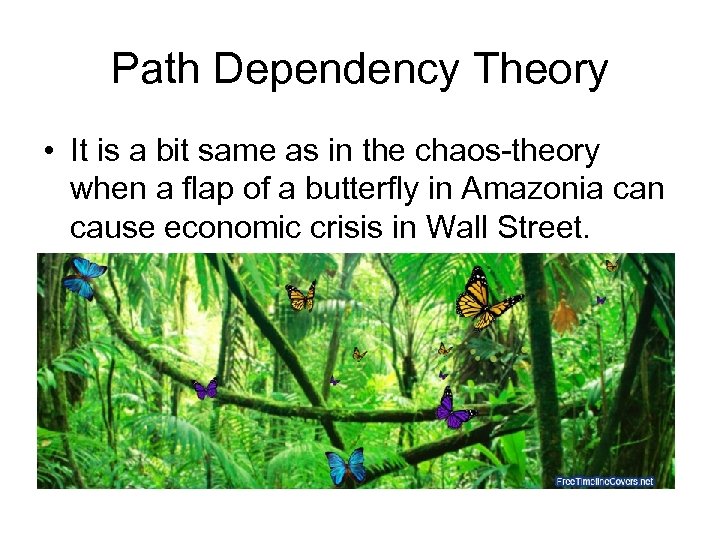 Path Dependency Theory • It is a bit same as in the chaos-theory when a flap of a butterfly in Amazonia can cause economic crisis in Wall Street.
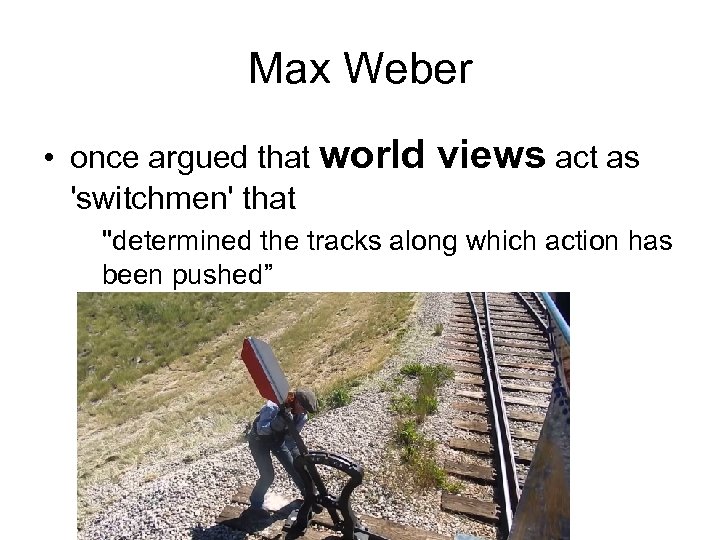 Max Weber • once argued that world 'switchmen' that views act as "determined the tracks along which action has been pushed”
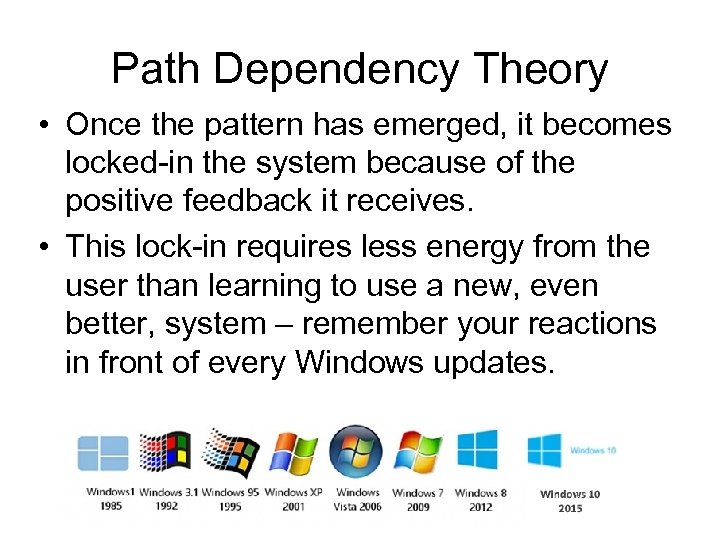 Path Dependency Theory • Once the pattern has emerged, it becomes locked-in the system because of the positive feedback it receives. • This lock-in requires less energy from the user than learning to use a new, even better, system – remember your reactions in front of every Windows updates.
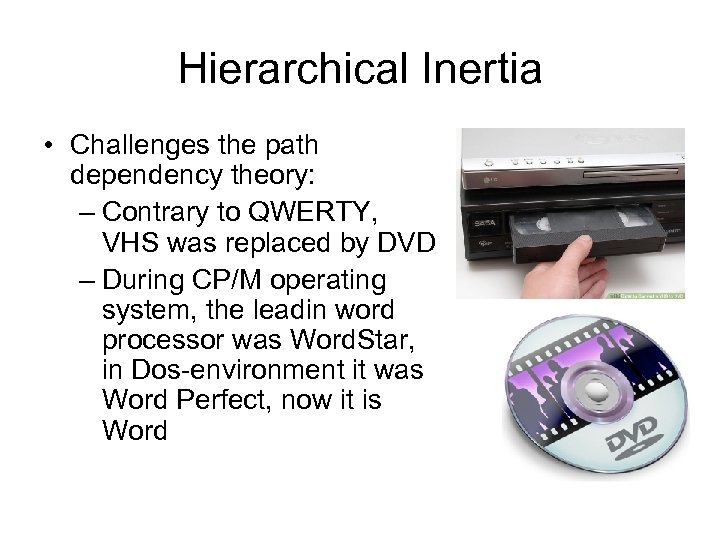 Hierarchical Inertia • Challenges the path dependency theory: – Contrary to QWERTY, VHS was replaced by DVD – During CP/M operating system, the leadin word processor was Word. Star, in Dos-environment it was Word Perfect, now it is Word
 Hierarchical Inertia • Organisation theorists Michael T. Hannan and John Freeman argue that organisations are like species in the nature: there is • competition • niche • hierarchical inertia
 Hierarchical Inertia • Competition means that the organisation is not alone but there are other ones that compete of the same ressources: sponsor money, public funds, people
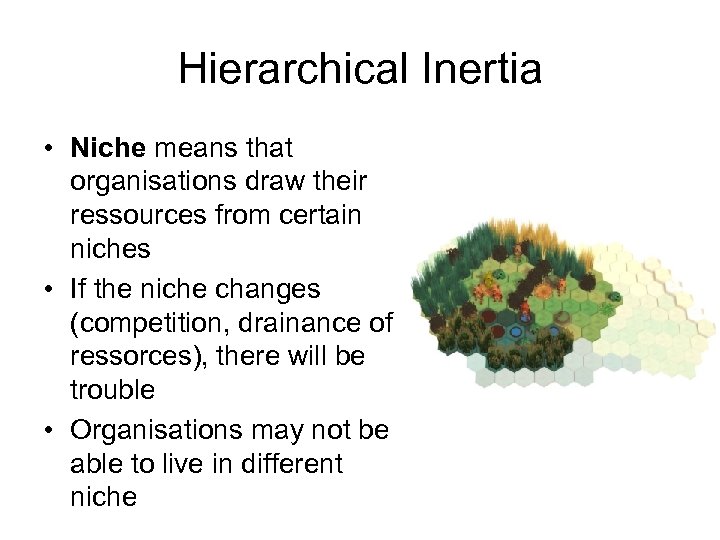 Hierarchical Inertia • Niche means that organisations draw their ressources from certain niches • If the niche changes (competition, drainance of ressorces), there will be trouble • Organisations may not be able to live in different niche
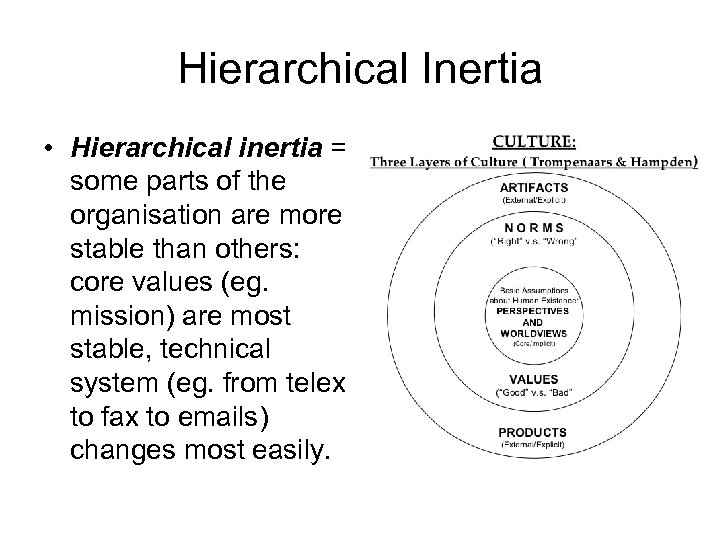 Hierarchical Inertia • Hierarchical inertia = some parts of the organisation are more stable than others: core values (eg. mission) are most stable, technical system (eg. from telex to fax to emails) changes most easily.
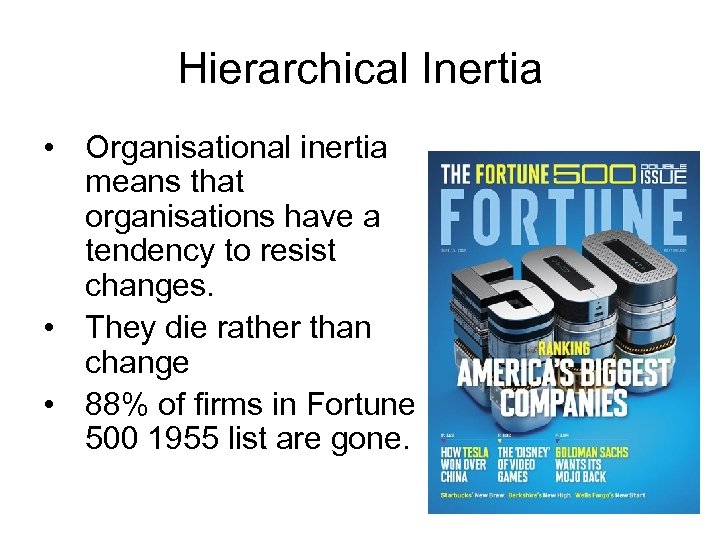 Hierarchical Inertia • Organisational inertia means that organisations have a tendency to resist changes. • They die rather than change • 88% of firms in Fortune 500 1955 list are gone.
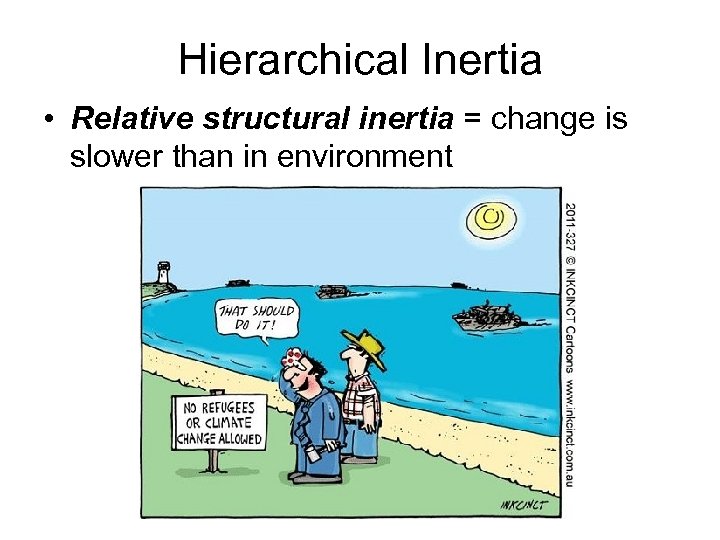 Hierarchical Inertia • Relative structural inertia = change is slower than in environment
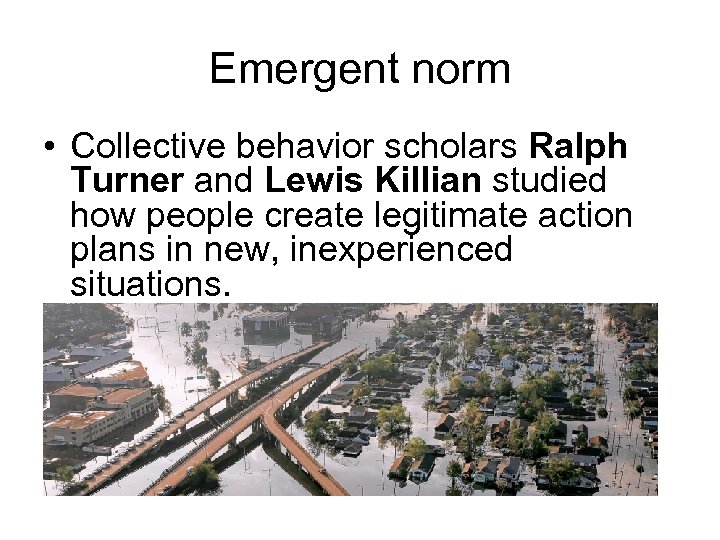 Emergent norm • Collective behavior scholars Ralph Turner and Lewis Killian studied how people create legitimate action plans in new, inexperienced situations.
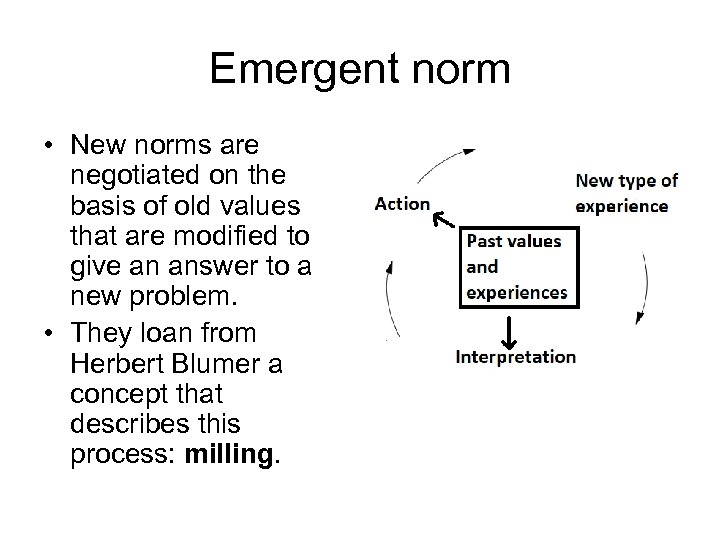 Emergent norm • New norms are negotiated on the basis of old values that are modified to give an answer to a new problem. • They loan from Herbert Blumer a concept that describes this process: milling.
 Emergent norm • Turner and Killian point that in every social group there is – some sort of division of labour – including leadership – some normative order – there must remain some kind of ”we”feeling in order to keep the communication process on
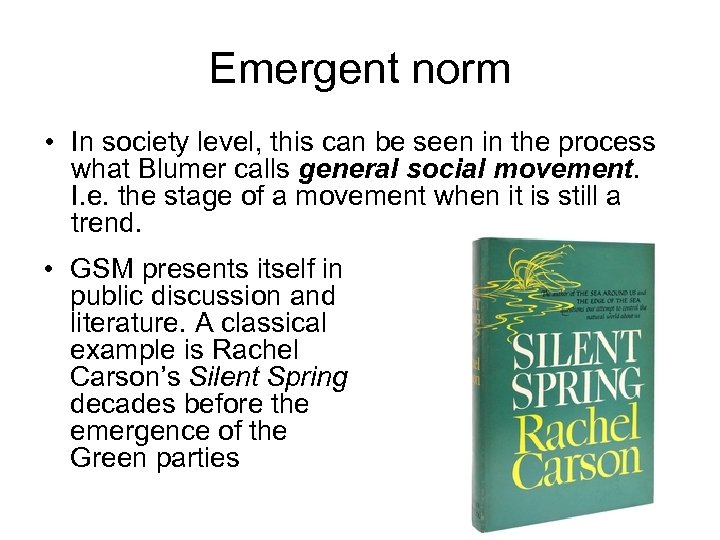 Emergent norm • In society level, this can be seen in the process what Blumer calls general social movement. I. e. the stage of a movement when it is still a trend. • GSM presents itself in public discussion and literature. A classical example is Rachel Carson’s Silent Spring decades before the emergence of the Green parties
 Emergent norm • I have elsewhere argued that the Bible and the Greek classics have served many times as GSM literature – Reformation started from Luther’s finding in Romans – Evangelical Revival started from Bible clubs – American Civil Rights Movement identified black people to Israel in Egypt – Capitalism is much based on idea of competition in Greek literature
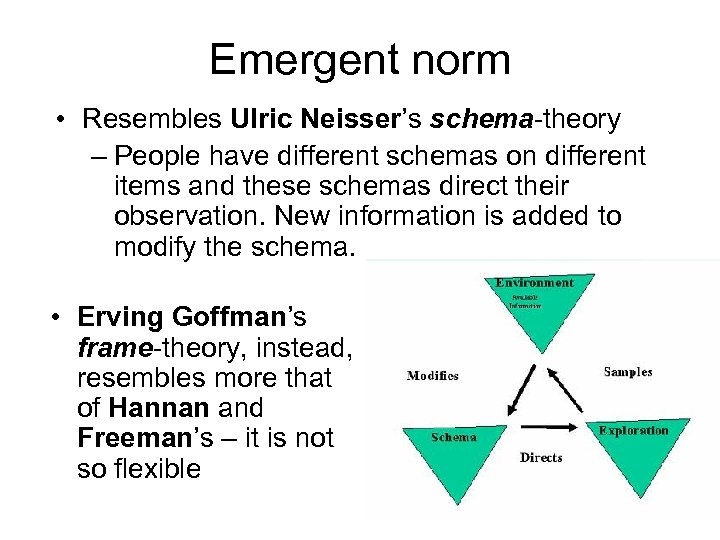 Emergent norm • Resembles Ulric Neisser’s schema-theory – People have different schemas on different items and these schemas direct their observation. New information is added to modify the schema. • Erving Goffman’s frame-theory, instead, resembles more that of Hannan and Freeman’s – it is not so flexible
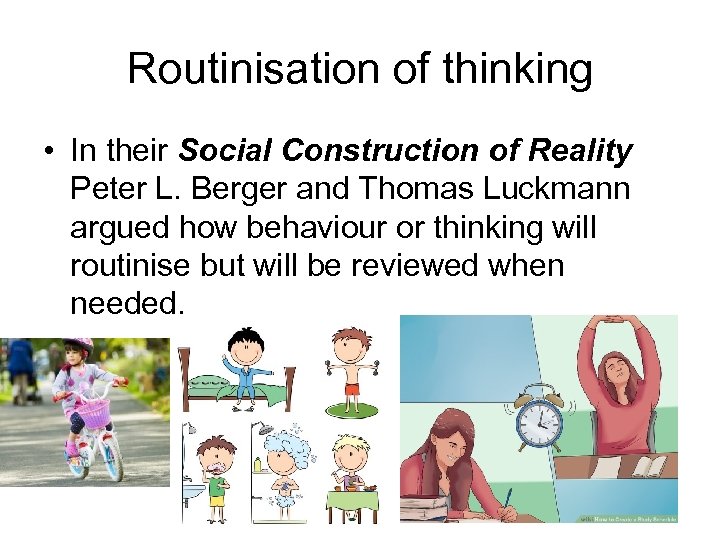 Routinisation of thinking • In their Social Construction of Reality Peter L. Berger and Thomas Luckmann argued how behaviour or thinking will routinise but will be reviewed when needed.
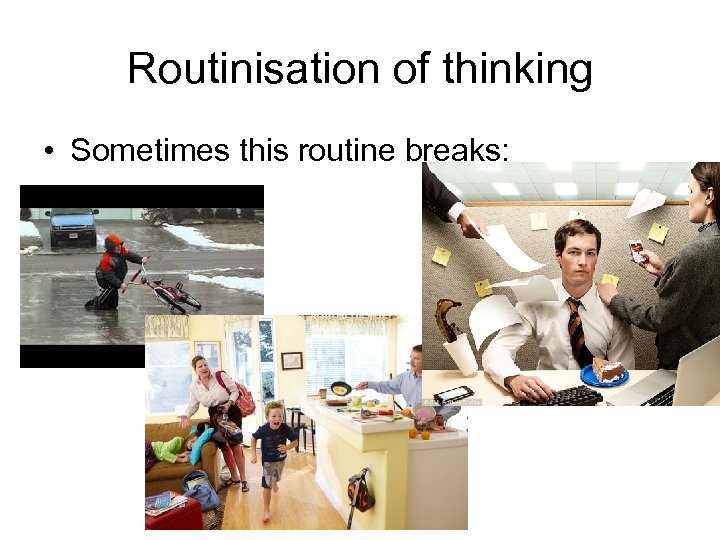 Routinisation of thinking • Sometimes this routine breaks:
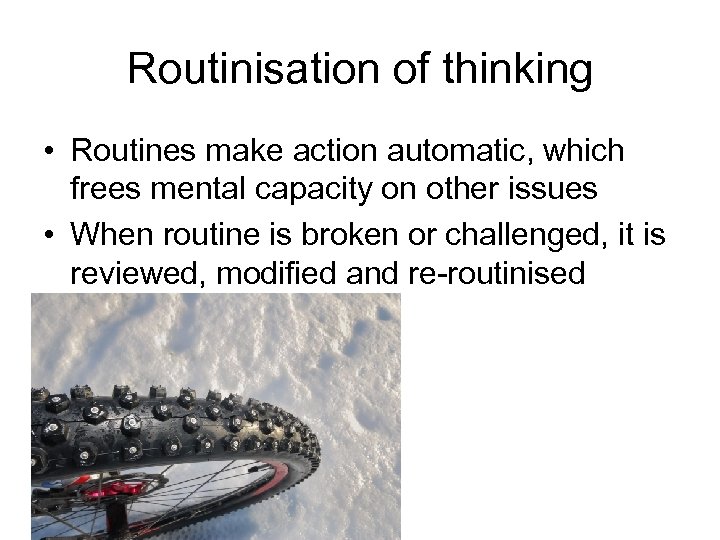 Routinisation of thinking • Routines make action automatic, which frees mental capacity on other issues • When routine is broken or challenged, it is reviewed, modified and re-routinised
 Routinisation of thinking • B & L argue that thinking tends to routinise as well • It is when we take some issues self evident • B & L call the ”store”of these mental models symbolic universe • Symbols are ways to file information, to handle entities
 Routinisation of thinking • Symbols can be persons (king), items (flag) or actions (rituals). • Symbols can form sets and chains that people can see as belonging together • Symbols can be mental constructions like world views, ideologies or beliefs.
 Routinisation of thinking • My argument is that this happens also in social level: cultures routinise • People in different cultures have different vays of thinking – and the way of their thinking is stored in their dominant religions • Clifford Geertz argued that ”religion is a model of the society and a model for the society. ”
 Routinisation of thinking • I have elsewere argued that, e. g. , Gösta Espin-Andersen’s welfare regimes could be named as Lutheran, Catholic and Anglican-Methodist – social policies of various countries reflect so much the basic social ethics of these churches. • Religions function as symbolic universes for cultural values.
 Routinisation of thinking • Routinisation is, however, not just a question of few centuries. • As I mentioned in the beginning, we have some routines that are 5000 years old.
 Thank you for listening • More detailed presentation can be found i this paper: • http: //marttimuukkonen. pp. fi/Muukkonen_ Path_Dependency_and_Hierarchical_Inert ia. pdf