


 Скачать презентацию Socioeconomic Status and Health An overview of the
de5c637e157c6552bff0f3ee57d6727f.ppt
- Количество слайдов: 86
 Socioeconomic Status and Health An overview of the evidence for a connection between wealth and health Ottawa, August, 2006
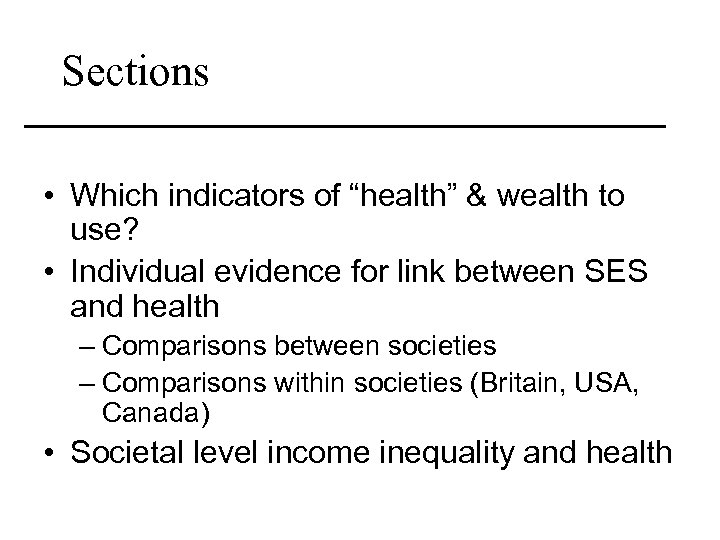 Sections • Which indicators of “health” & wealth to use? • Individual evidence for link between SES and health – Comparisons between societies – Comparisons within societies (Britain, USA, Canada) • Societal level income inequality and health
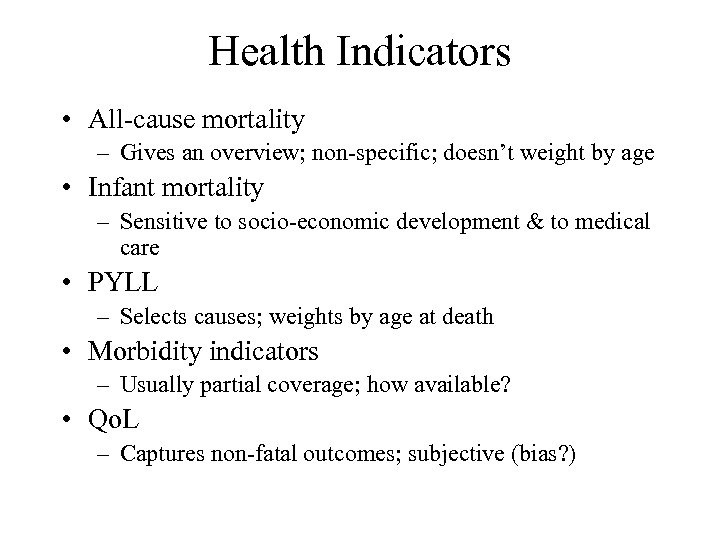 Health Indicators • All-cause mortality – Gives an overview; non-specific; doesn’t weight by age • Infant mortality – Sensitive to socio-economic development & to medical care • PYLL – Selects causes; weights by age at death • Morbidity indicators – Usually partial coverage; how available? • Qo. L – Captures non-fatal outcomes; subjective (bias? )
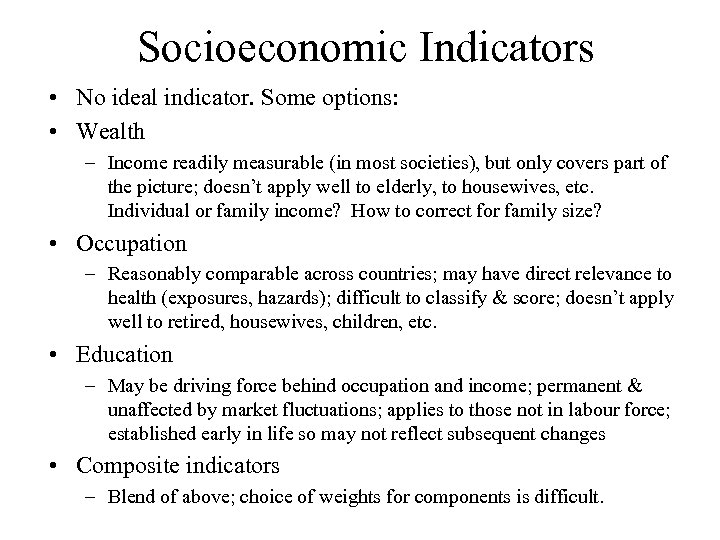 Socioeconomic Indicators • No ideal indicator. Some options: • Wealth – Income readily measurable (in most societies), but only covers part of the picture; doesn’t apply well to elderly, to housewives, etc. Individual or family income? How to correct for family size? • Occupation – Reasonably comparable across countries; may have direct relevance to health (exposures, hazards); difficult to classify & score; doesn’t apply well to retired, housewives, children, etc. • Education – May be driving force behind occupation and income; permanent & unaffected by market fluctuations; applies to those not in labour force; established early in life so may not reflect subsequent changes • Composite indicators – Blend of above; choice of weights for components is difficult.
 1. Socioeconomic Status and Health (1 a) Comparisons Between Societies
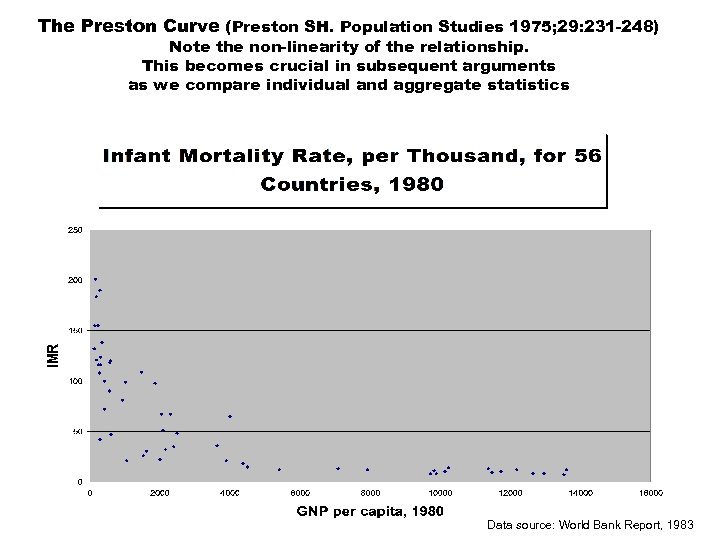 The Preston Curve (Preston SH. Population Studies 1975; 29: 231 -248) Note the non-linearity of the relationship. This becomes crucial in subsequent arguments as we compare individual and aggregate statistics Data source: World Bank Report, 1983
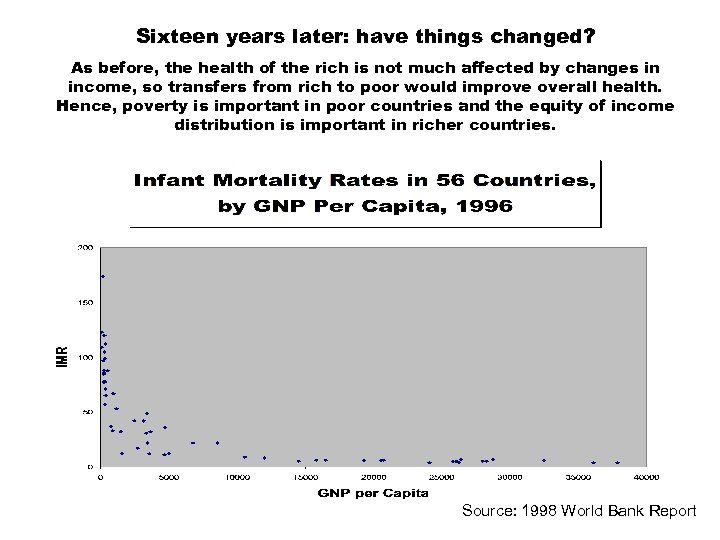 Sixteen years later: have things changed? As before, the health of the rich is not much affected by changes in income, so transfers from rich to poor would improve overall health. Hence, poverty is important in poor countries and the equity of income distribution is important in richer countries. Source: 1998 World Bank Report
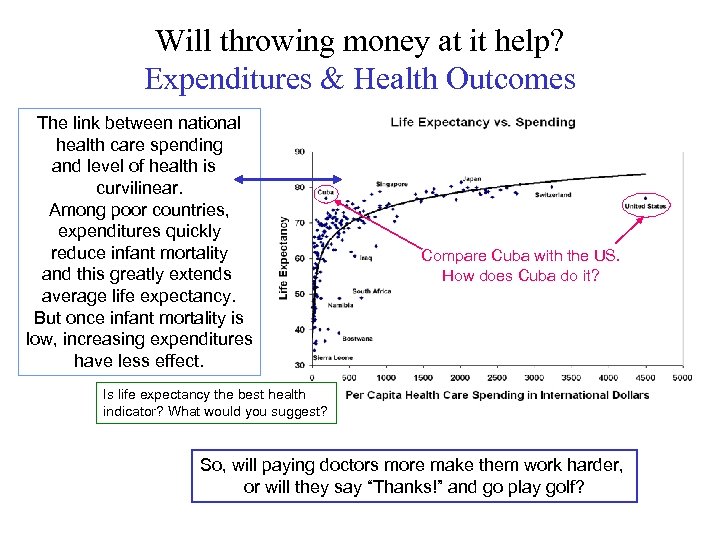 Will throwing money at it help? Expenditures & Health Outcomes The link between national health care spending and level of health is curvilinear. Among poor countries, expenditures quickly reduce infant mortality and this greatly extends average life expectancy. But once infant mortality is low, increasing expenditures have less effect. Compare Cuba with the US. How does Cuba do it? Is life expectancy the best health indicator? What would you suggest? So, will paying doctors more make them work harder, or will they say “Thanks!” and go play golf?
 (1 b) Inequalities Within Societies (i) Data from Britain, where most (ii) of the analyses began. (iii) Consider mortality in ages 15 – 64, (iv) i. e. adult, but premature mortality
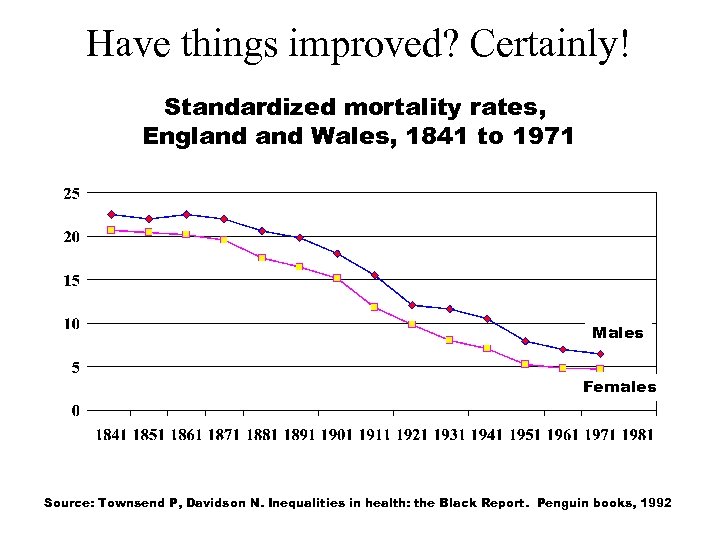 Have things improved? Certainly! Standardized mortality rates, England Wales, 1841 to 1971 Males Females Source: Townsend P, Davidson N. Inequalities in health: the Black Report. Penguin books, 1992
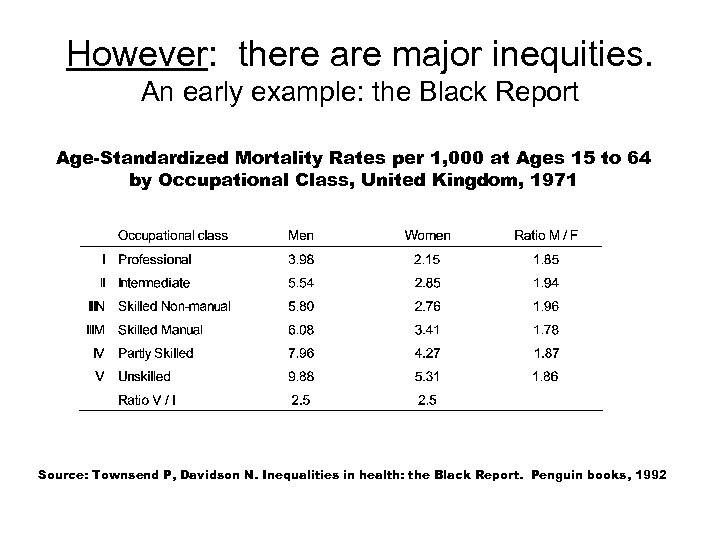 However: there are major inequities. An early example: the Black Report Age-Standardized Mortality Rates per 1, 000 at Ages 15 to 64 by Occupational Class, United Kingdom, 1971 Source: Townsend P, Davidson N. Inequalities in health: the Black Report. Penguin books, 1992
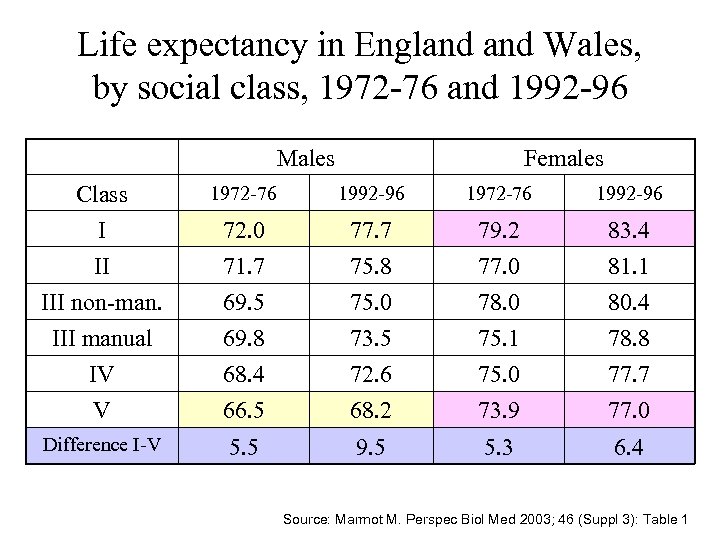 Life expectancy in England Wales, by social class, 1972 -76 and 1992 -96 Males Females Class I 1972 -76 1992 -96 72. 0 77. 7 79. 2 83. 4 II 71. 7 75. 8 77. 0 81. 1 III non-man. 69. 5 75. 0 78. 0 80. 4 III manual 69. 8 73. 5 75. 1 78. 8 IV 68. 4 72. 6 75. 0 77. 7 V 66. 5 68. 2 73. 9 77. 0 Difference I-V 5. 5 9. 5 5. 3 6. 4 Source: Marmot M. Perspec Biol Med 2003; 46 (Suppl 3): Table 1
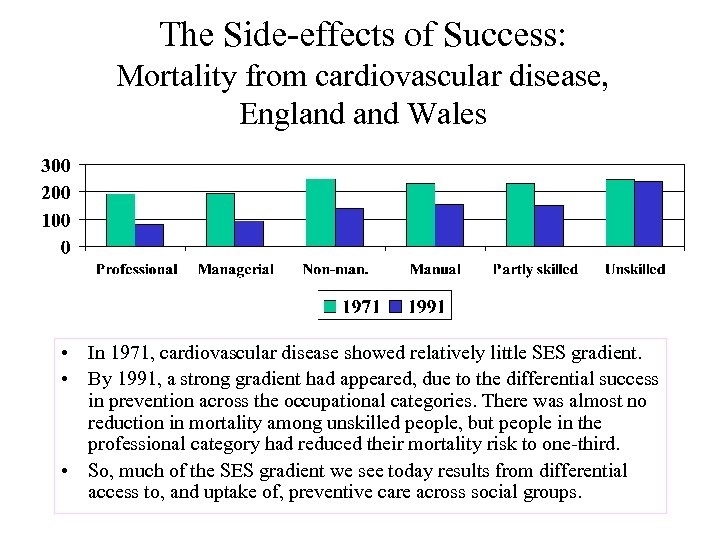 The Side-effects of Success: Mortality from cardiovascular disease, England Wales • In 1971, cardiovascular disease showed relatively little SES gradient. • By 1991, a strong gradient had appeared, due to the differential success in prevention across the occupational categories. There was almost no reduction in mortality among unskilled people, but people in the professional category had reduced their mortality risk to one-third. • So, much of the SES gradient we see today results from differential access to, and uptake of, preventive care across social groups.
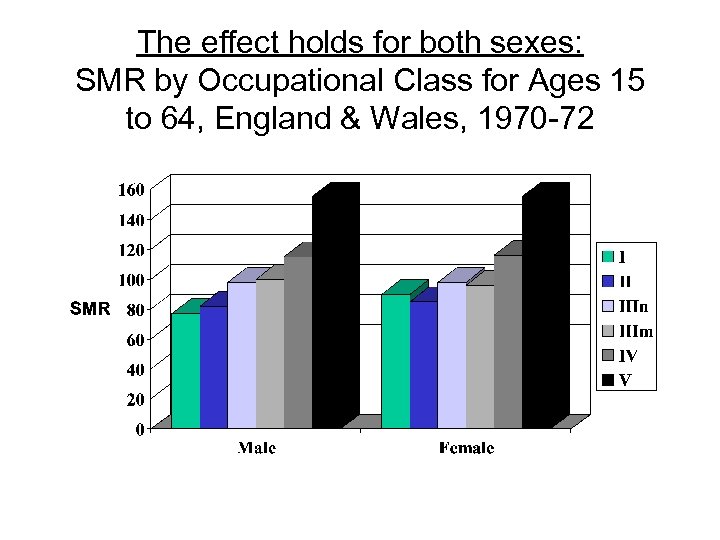 The effect holds for both sexes: SMR by Occupational Class for Ages 15 to 64, England & Wales, 1970 -72
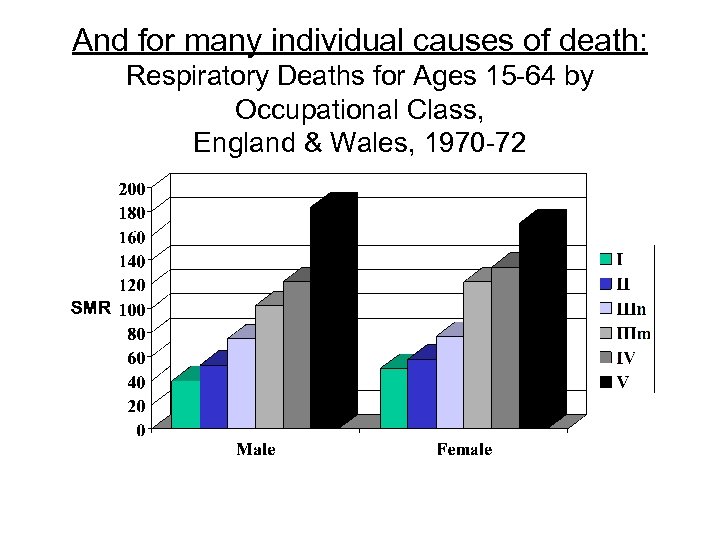 And for many individual causes of death: Respiratory Deaths for Ages 15 -64 by Occupational Class, England & Wales, 1970 -72
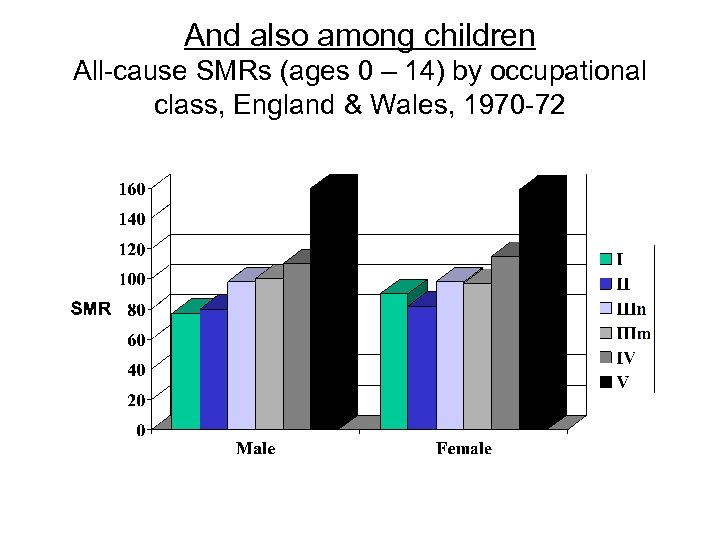 And also among children All-cause SMRs (ages 0 – 14) by occupational class, England & Wales, 1970 -72
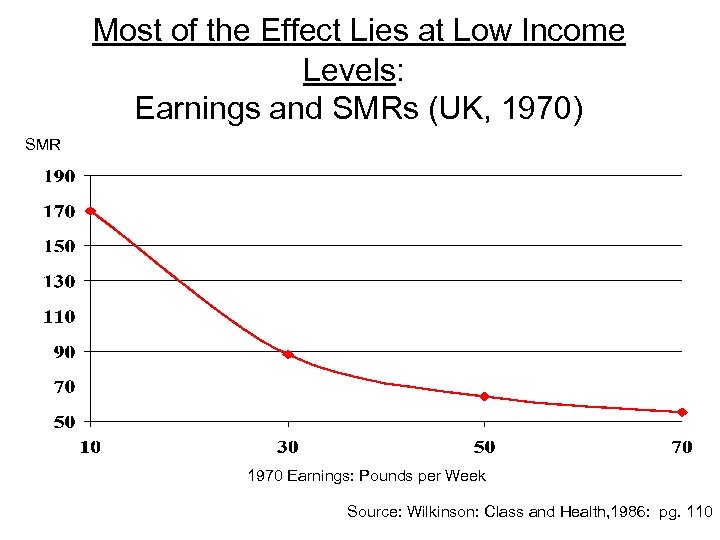 Most of the Effect Lies at Low Income Levels: Earnings and SMRs (UK, 1970) SMR 1970 Earnings: Pounds per Week Source: Wilkinson: Class and Health, 1986: pg. 110
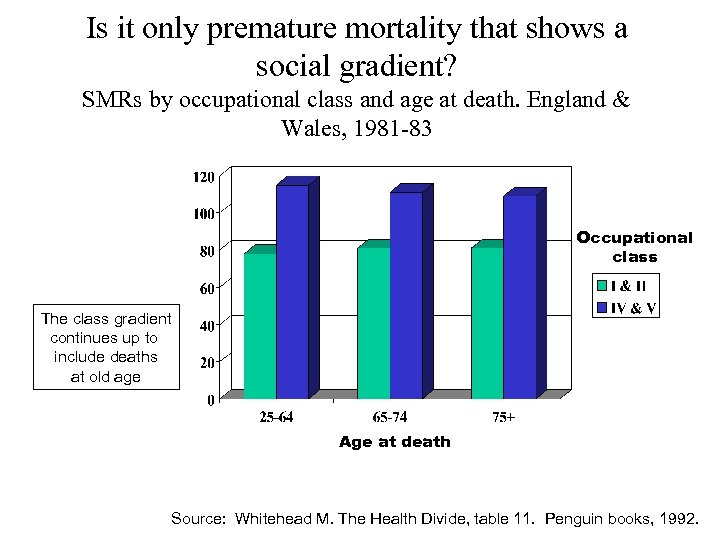 Is it only premature mortality that shows a social gradient? SMRs by occupational class and age at death. England & Wales, 1981 -83 Occupational class The class gradient continues up to include deaths at old age Age at death Source: Whitehead M. The Health Divide, table 11. Penguin books, 1992.
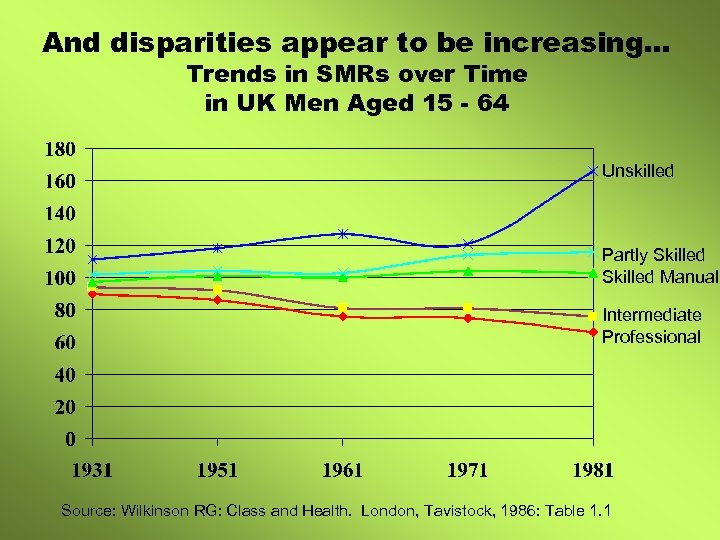 And disparities appear to be increasing… Trends in SMRs over Time in UK Men Aged 15 - 64 Unskilled Partly Skilled Manual Intermediate Professional Source: Wilkinson RG: Class and Health. London, Tavistock, 1986: Table 1. 1
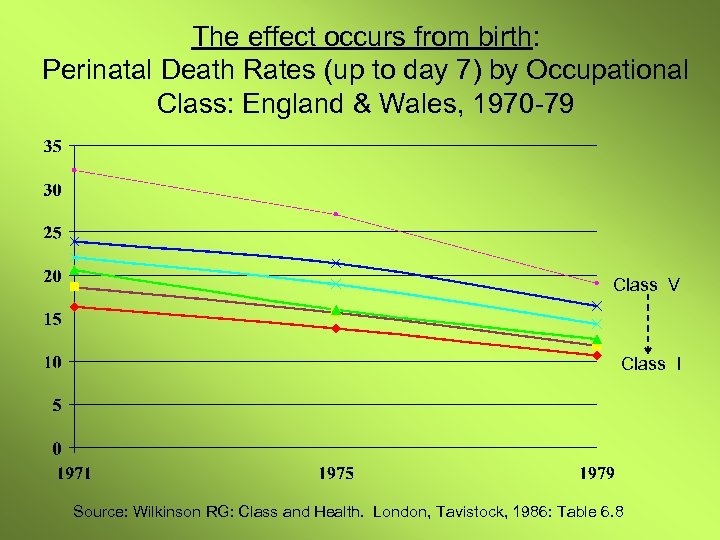 The effect occurs from birth: Perinatal Death Rates (up to day 7) by Occupational Class: England & Wales, 1970 -79 Class V Class I Source: Wilkinson RG: Class and Health. London, Tavistock, 1986: Table 6. 8
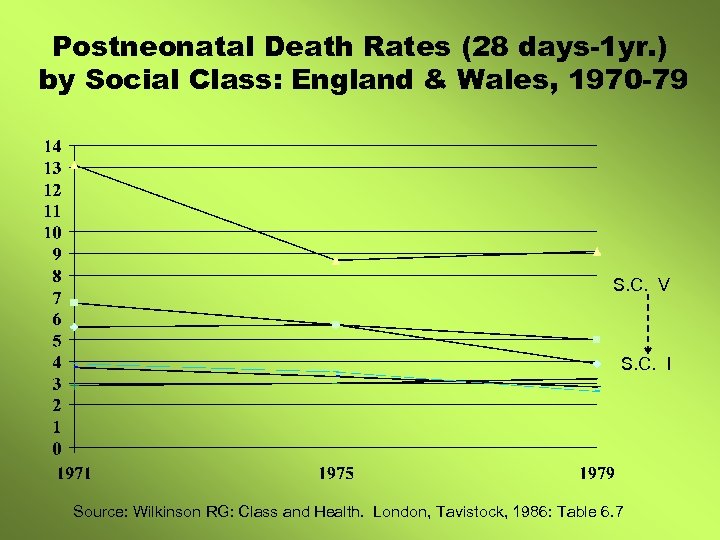 Postneonatal Death Rates (28 days-1 yr. ) by Social Class: England & Wales, 1970 -79 S. C. V S. C. I Source: Wilkinson RG: Class and Health. London, Tavistock, 1986: Table 6. 7
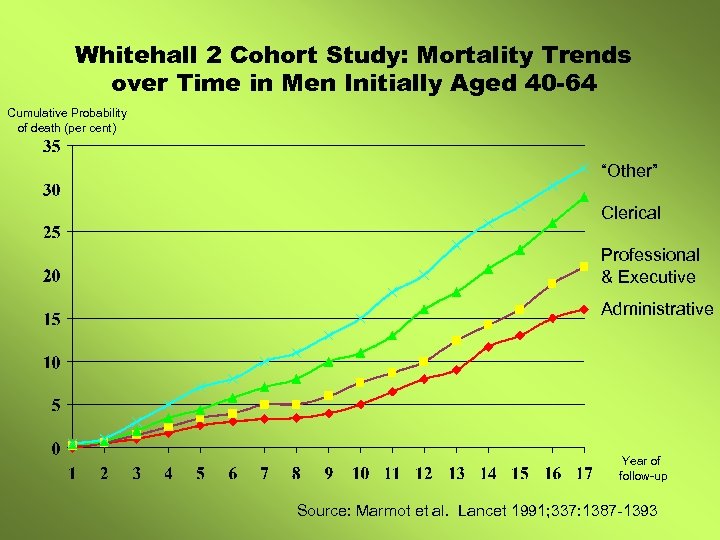 Whitehall 2 Cohort Study: Mortality Trends over Time in Men Initially Aged 40 -64 Cumulative Probability of death (per cent) “Other” Clerical Professional & Executive Administrative Year of follow-up Source: Marmot et al. Lancet 1991; 337: 1387 -1393
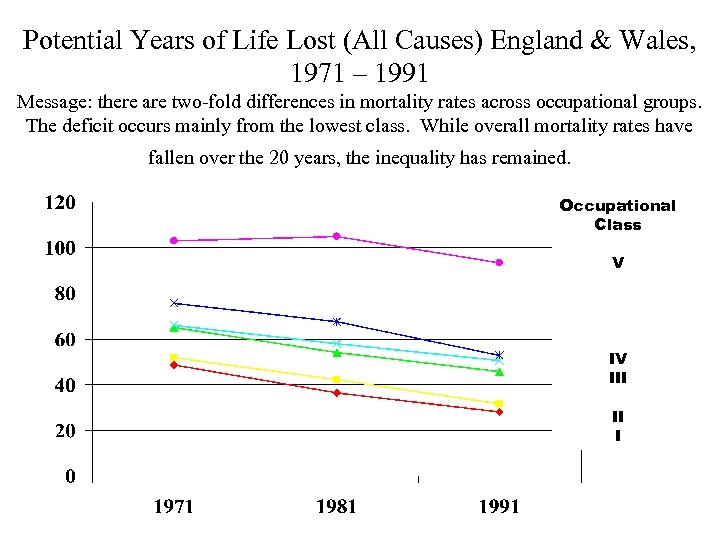 Potential Years of Life Lost (All Causes) England & Wales, 1971 – 1991 Message: there are two-fold differences in mortality rates across occupational groups. The deficit occurs mainly from the lowest class. While overall mortality rates have fallen over the 20 years, the inequality has remained. Occupational Class V IV III II I
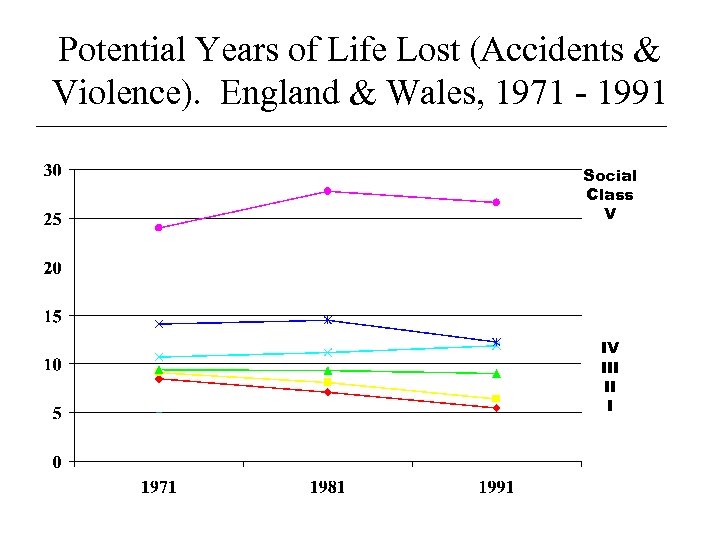 Potential Years of Life Lost (Accidents & Violence). England & Wales, 1971 - 1991 Social Class V IV III II I
 • The Black Report was published in 1980 and, despite government attempts to hide it, produced significant reactions • For example, the British Health Education Council published The Health Divide in 1988. It focused on ‘inequities’ (inequalities perceived as being unfair) • Other countries in Europe began to investigate whether they, too, experienced health disparities. Many countries reported to the WHO that health disparities increased during the 1980 s. • This shifted health disparities up the political agenda • Marmot (2003): “The point I wish to draw out of these figures is that if the life expectancy gap can increase, it can, in principle, decrease. If we think this is a problem worth tackling, the challenge is to understand the reasons for the social gradient in order to do something about it. ”
 (ii) Data from Canada, where Statistics Canada began to take notice in the 1990 s
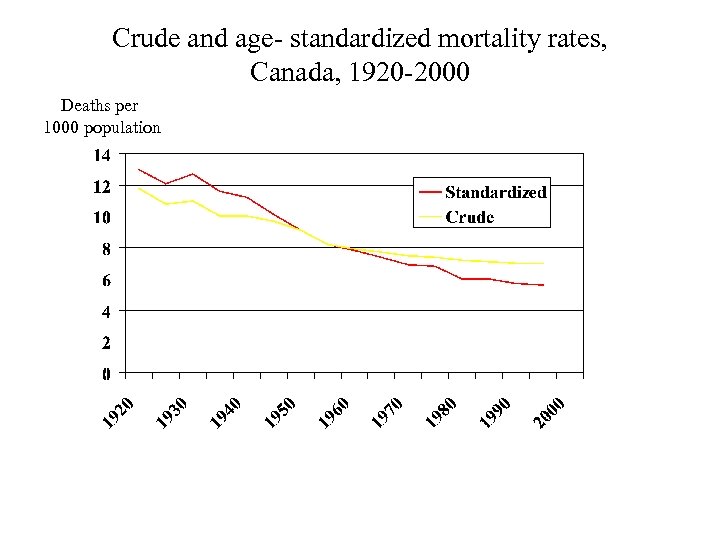 Crude and age- standardized mortality rates, Canada, 1920 -2000 Deaths per 1000 population
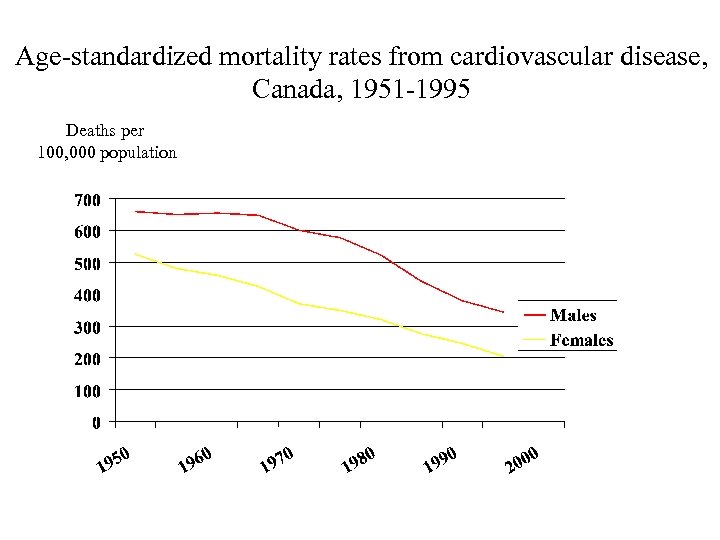 Age-standardized mortality rates from cardiovascular disease, Canada, 1951 -1995 Deaths per 100, 000 population
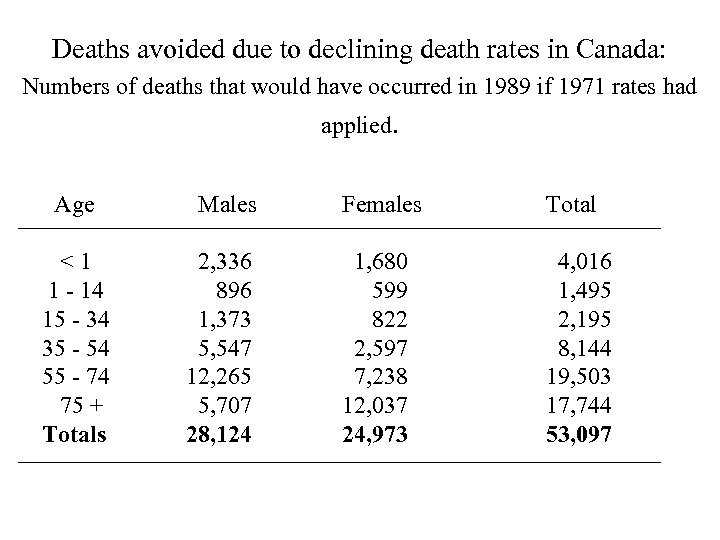 Deaths avoided due to declining death rates in Canada: Numbers of deaths that would have occurred in 1989 if 1971 rates had applied. Age Males Females Total 2, 336 896 1, 373 5, 547 12, 265 5, 707 28, 124 1, 680 599 822 2, 597 7, 238 12, 037 24, 973 4, 016 1, 495 2, 195 8, 144 19, 503 17, 744 53, 097 < 1 1 - 14 15 - 34 35 - 54 55 - 74 75 + Totals
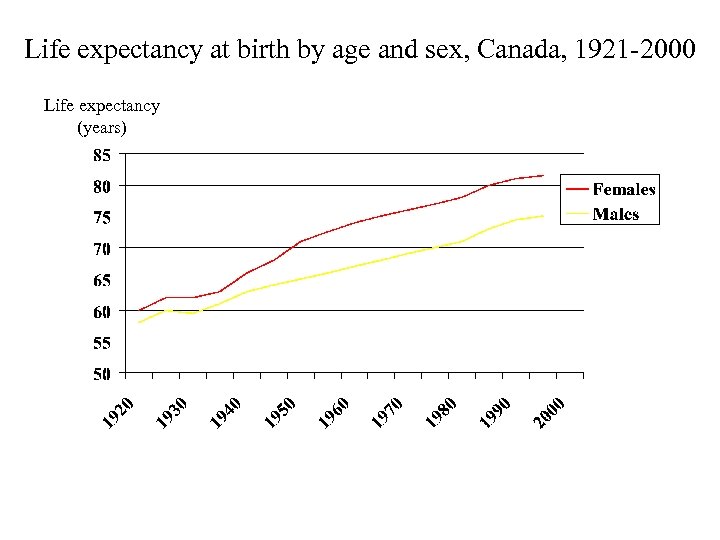 Life expectancy at birth by age and sex, Canada, 1921 -2000 Life expectancy (years)
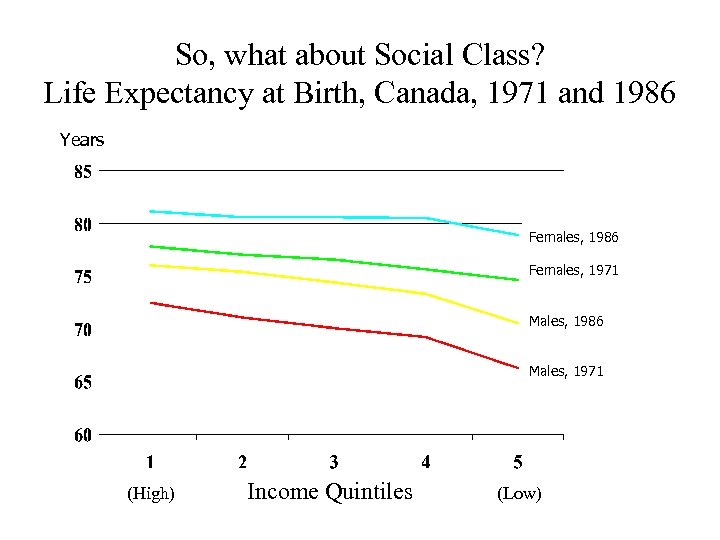 So, what about Social Class? Life Expectancy at Birth, Canada, 1971 and 1986 Years Females, 1986 Females, 1971 Males, 1986 Males, 1971 (High) Income Quintiles (Low)
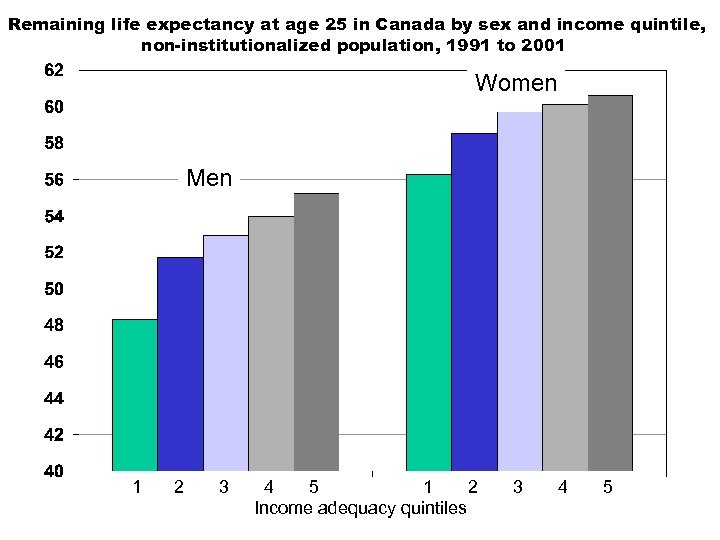 Remaining life expectancy at age 25 in Canada by sex and income quintile, non-institutionalized population, 1991 to 2001 Women Men 1 2 3 4 5 1 2 Income adequacy quintiles 3 4 5
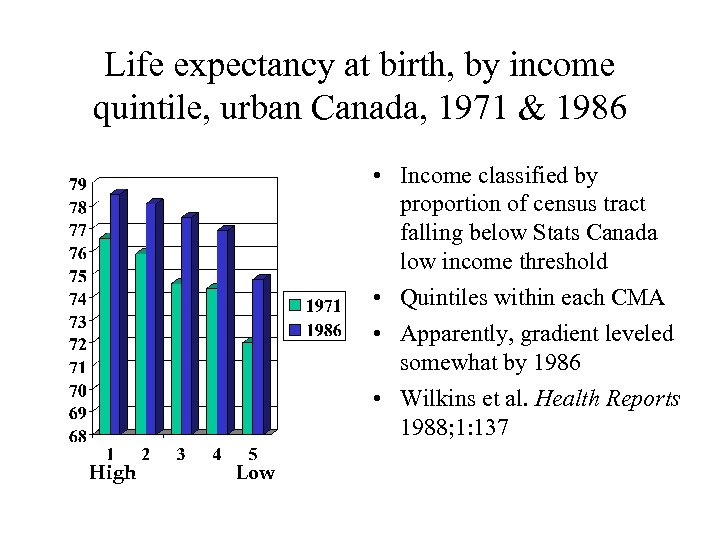 Life expectancy at birth, by income quintile, urban Canada, 1971 & 1986 • Income classified by proportion of census tract falling below Stats Canada low income threshold • Quintiles within each CMA • Apparently, gradient leveled somewhat by 1986 • Wilkins et al. Health Reports 1988; 1: 137 High Low
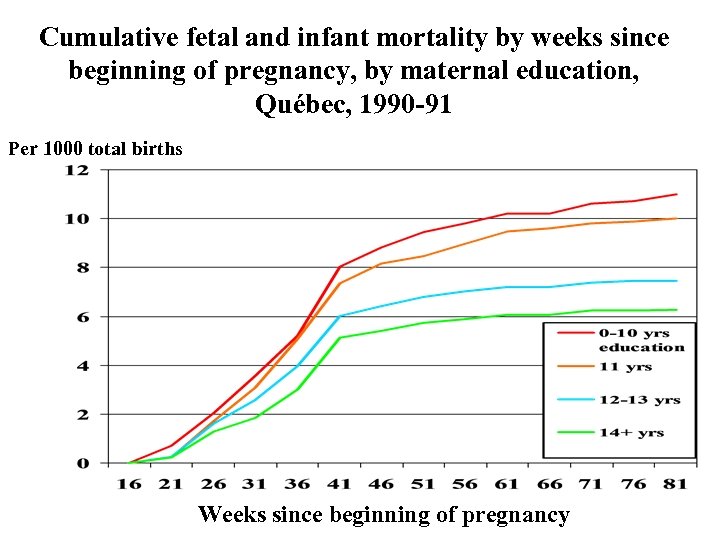 Cumulative fetal and infant mortality by weeks since beginning of pregnancy, by maternal education, Québec, 1990 -91 Per 1000 total births Weeks since beginning of pregnancy
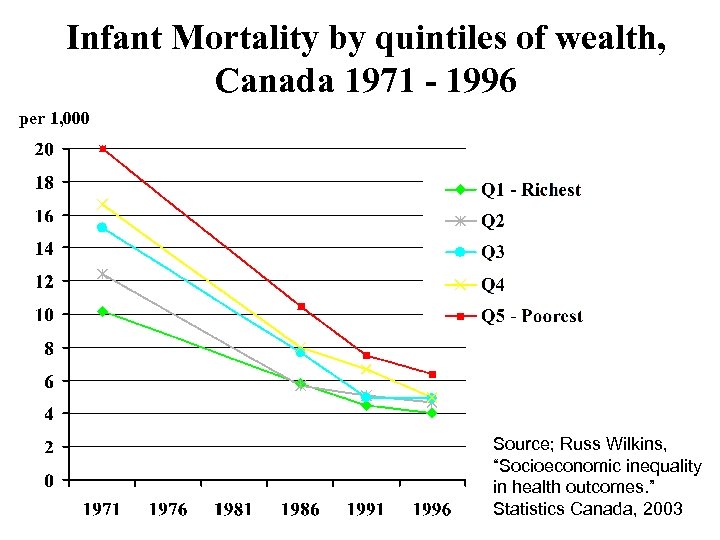 Infant Mortality by quintiles of wealth, Canada 1971 - 1996 per 1, 000 Source; Russ Wilkins, “Socioeconomic inequality in health outcomes. ” Statistics Canada, 2003
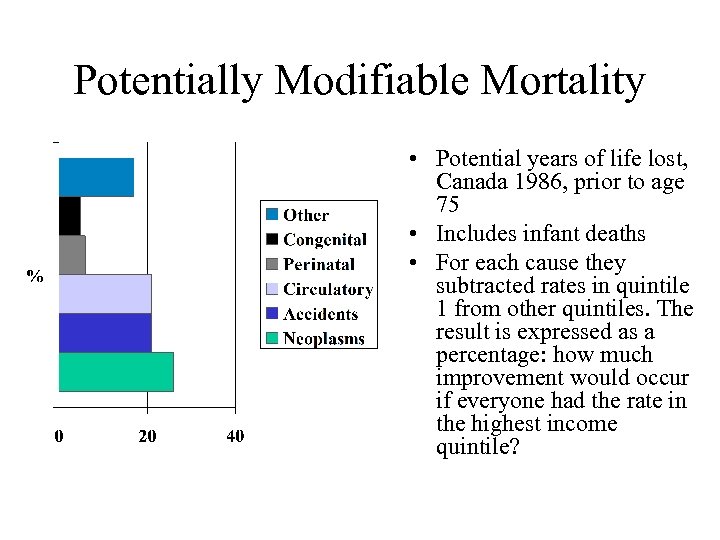 Potentially Modifiable Mortality • Potential years of life lost, Canada 1986, prior to age 75 • Includes infant deaths • For each cause they subtracted rates in quintile 1 from other quintiles. The result is expressed as a percentage: how much improvement would occur if everyone had the rate in the highest income quintile?
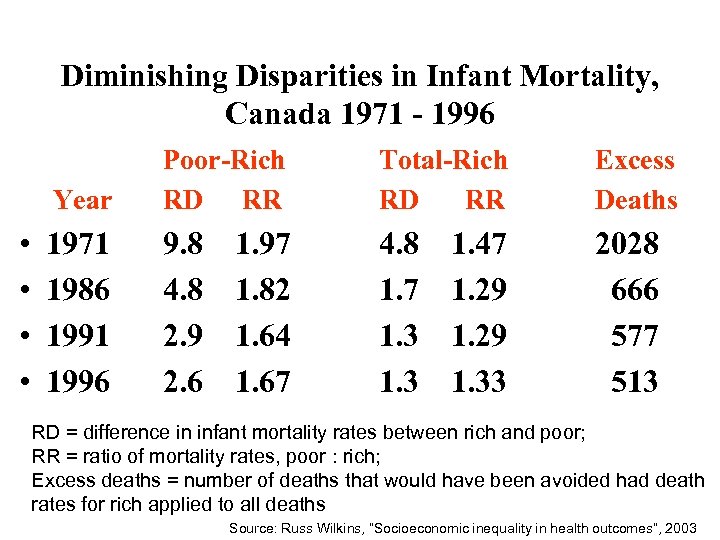 Diminishing Disparities in Infant Mortality, Canada 1971 - 1996 Year • • Poor-Rich RD RR Total-Rich RD RR Excess Deaths 1971 1986 1991 1996 9. 8 4. 8 2. 9 2. 6 4. 8 1. 7 1. 3 2028 666 577 513 1. 97 1. 82 1. 64 1. 67 1. 47 1. 29 1. 33 RD = difference in infant mortality rates between rich and poor; RR = ratio of mortality rates, poor : rich; Excess deaths = number of deaths that would have been avoided had death rates for rich applied to all deaths Source: Russ Wilkins, “Socioeconomic inequality in health outcomes”, 2003
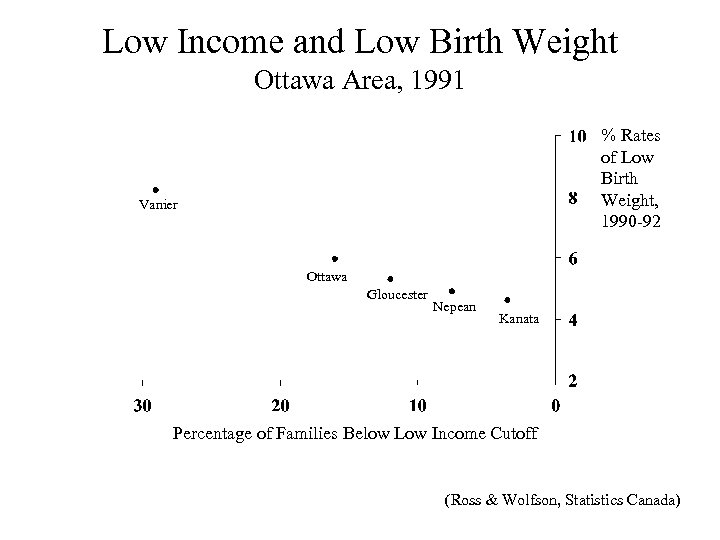 Low Income and Low Birth Weight Ottawa Area, 1991 % Rates of Low Birth Weight, 1990 -92 Vanier Ottawa Gloucester Nepean Kanata Percentage of Families Below Low Income Cutoff (Ross & Wolfson, Statistics Canada)
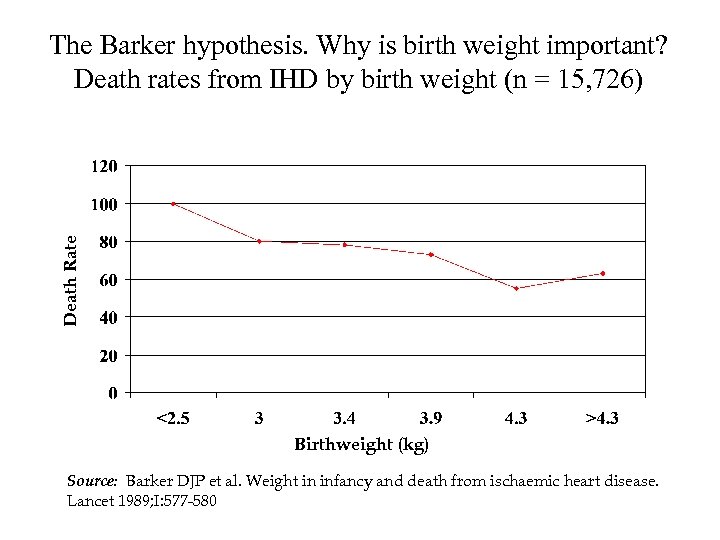 Death Rate The Barker hypothesis. Why is birth weight important? Death rates from IHD by birth weight (n = 15, 726) Birthweight (kg) Source: Barker DJP et al. Weight in infancy and death from ischaemic heart disease. Lancet 1989; I: 577 -580
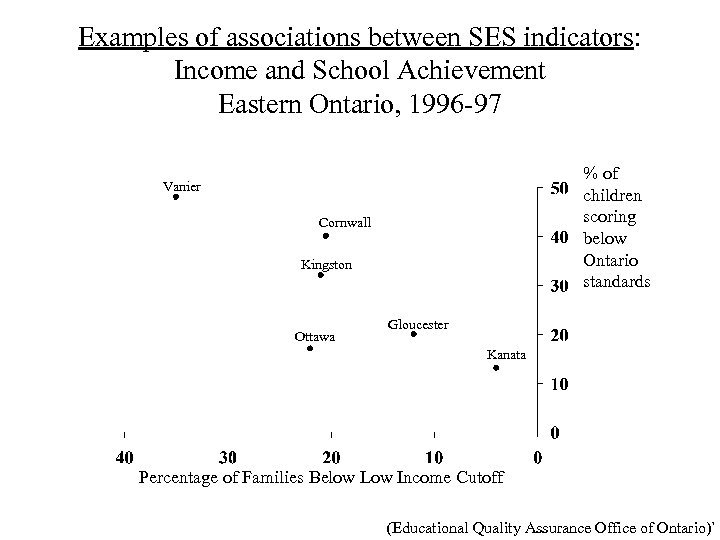 Examples of associations between SES indicators: Income and School Achievement Eastern Ontario, 1996 -97 % of children scoring below Ontario standards Vanier Cornwall Kingston Ottawa Gloucester Kanata Percentage of Families Below Low Income Cutoff (Educational Quality Assurance Office of Ontario)`
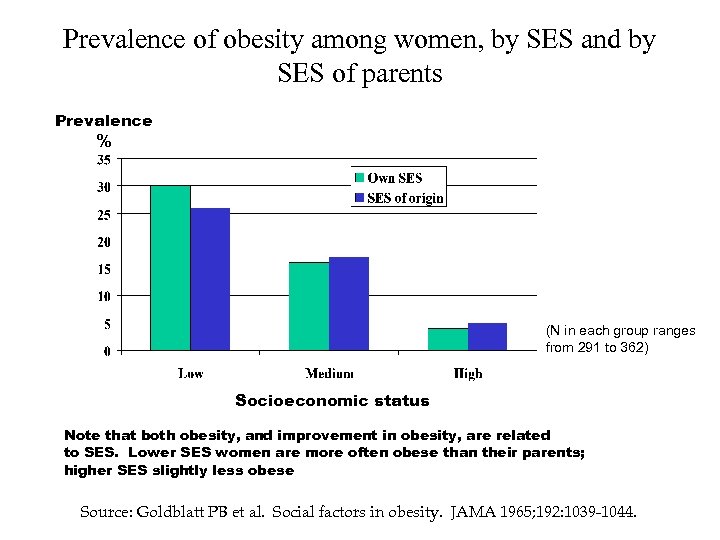 Prevalence of obesity among women, by SES and by SES of parents Prevalence % (N in each group ranges from 291 to 362) Socioeconomic status Note that both obesity, and improvement in obesity, are related to SES. Lower SES women are more often obese than their parents; higher SES slightly less obese Source: Goldblatt PB et al. Social factors in obesity. JAMA 1965; 192: 1039 -1044.
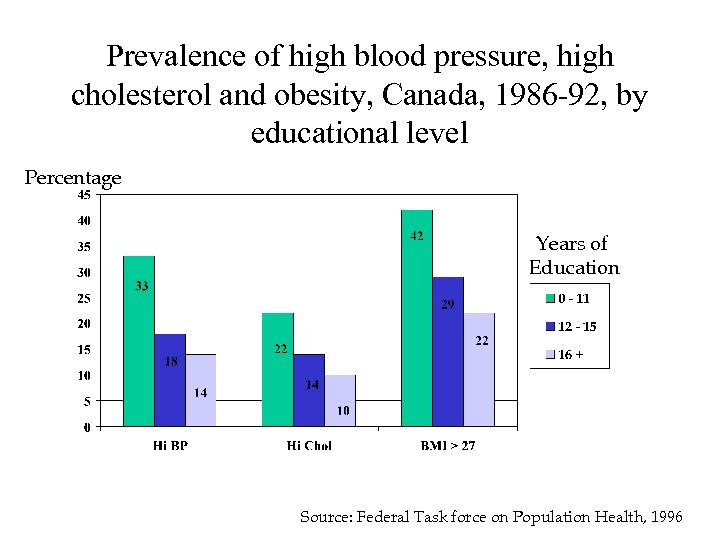 Prevalence of high blood pressure, high cholesterol and obesity, Canada, 1986 -92, by educational level Percentage Years of Education Source: Federal Task force on Population Health, 1996
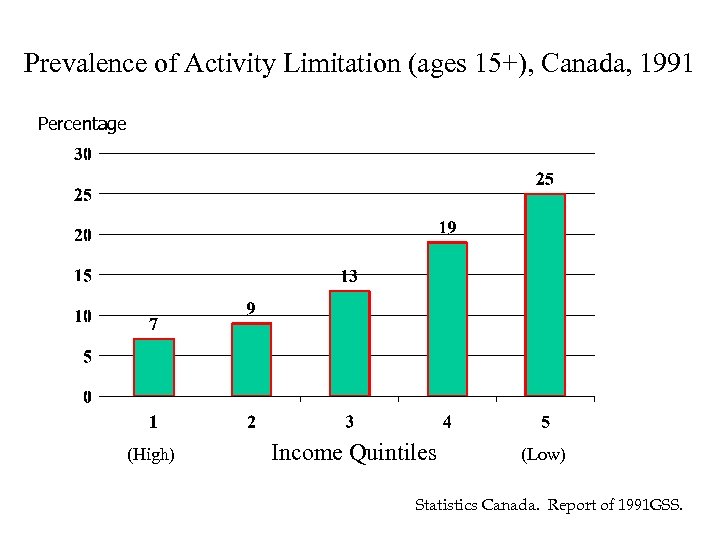 Prevalence of Activity Limitation (ages 15+), Canada, 1991 Percentage (High) Income Quintiles (Low) Statistics Canada. Report of 1991 GSS.
 (iii) U. S. A.
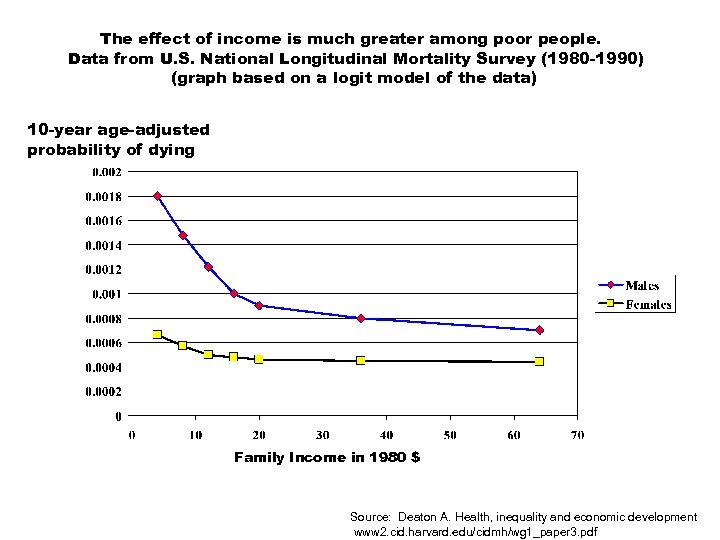 The effect of income is much greater among poor people. Data from U. S. National Longitudinal Mortality Survey (1980 -1990) (graph based on a logit model of the data) 10 -year age-adjusted probability of dying Family Income in 1980 $ Source: Deaton A. Health, inequality and economic development www 2. cid. harvard. edu/cidmh/wg 1_paper 3. pdf
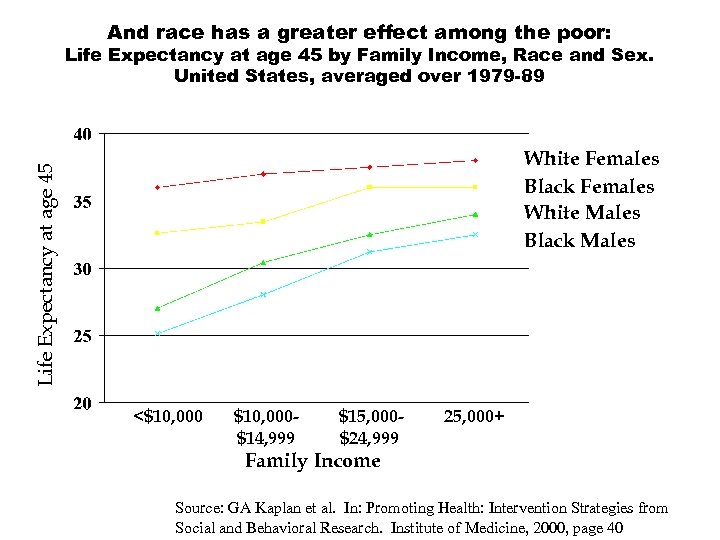 And race has a greater effect among the poor: Life Expectancy at age 45 by Family Income, Race and Sex. United States, averaged over 1979 -89 Life Expectancy at age 45 White Females Black Females White Males Black Males <$10, 000$14, 999 $15, 000$24, 999 25, 000+ Family Income Source: GA Kaplan et al. In: Promoting Health: Intervention Strategies from Social and Behavioral Research. Institute of Medicine, 2000, page 40
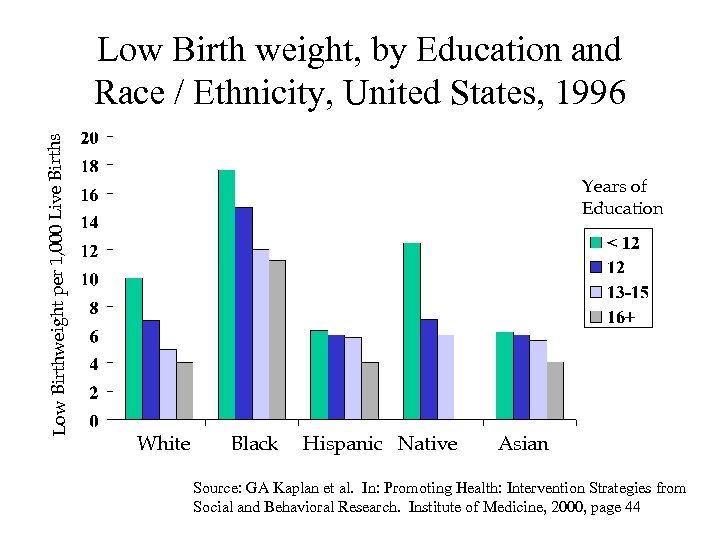 Low Birthweight per 1, 000 Live Births Low Birth weight, by Education and Race / Ethnicity, United States, 1996 Years of Education White Black Hispanic Native Asian Source: GA Kaplan et al. In: Promoting Health: Intervention Strategies from Social and Behavioral Research. Institute of Medicine, 2000, page 44
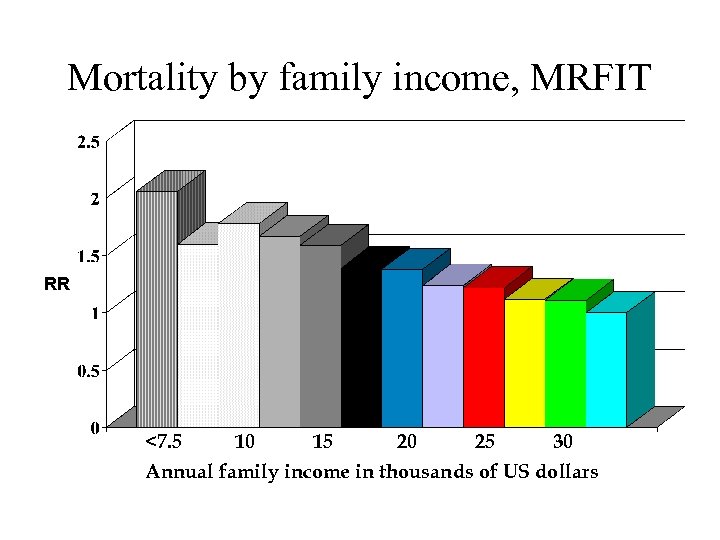 Mortality by family income, MRFIT <7. 5 10 15 20 25 30 Annual family income in thousands of US dollars
 2. Income Inequality and Health Hypothesis since late 1970 s – Rodgers, Flegg and others. Mortality rises with range of incomes (Gini coefficient) seen in societies. The Wilkinson Hypothesis (1990 s): for defined geographical areas, mortality rises with the level of disparity in incomes. Corollary: occupation and education gradients in health do not occur in societies with low income disparities. As countries become wealthier and move through the epidemiologic transition, the leading cause of differences in mortality changes from material deprivation to social disadvantage. Material deprivation provokes poverty and infectious disease; social disadvantage provokes stress and chronic disease.
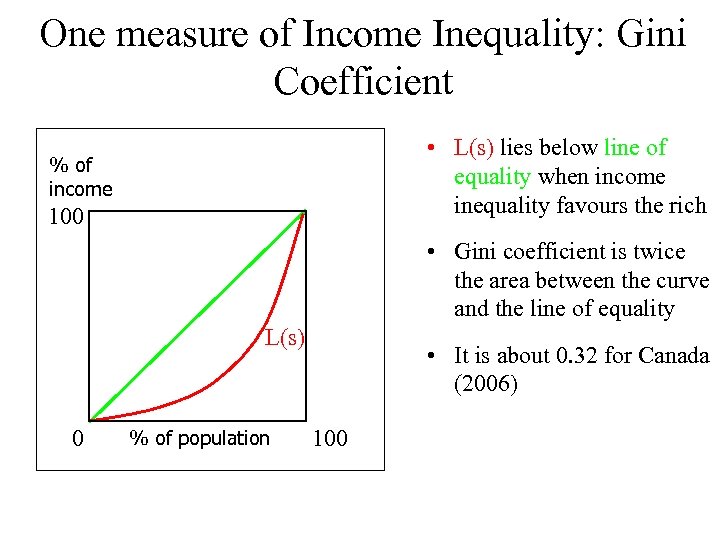 One measure of Income Inequality: Gini Coefficient • L(s) lies below line of equality when income inequality favours the rich % of income 100 • Gini coefficient is twice the area between the curve and the line of equality L(s) 0 % of population • It is about 0. 32 for Canada (2006) 100
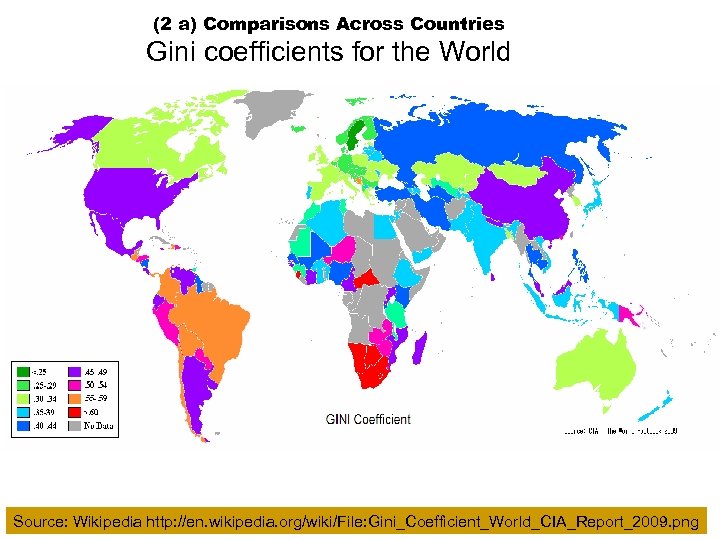 (2 a) Comparisons Across Countries Gini coefficients for the World Source: Wikipedia http: //en. wikipedia. org/wiki/File: Gini_Coefficient_World_CIA_Report_2009. png
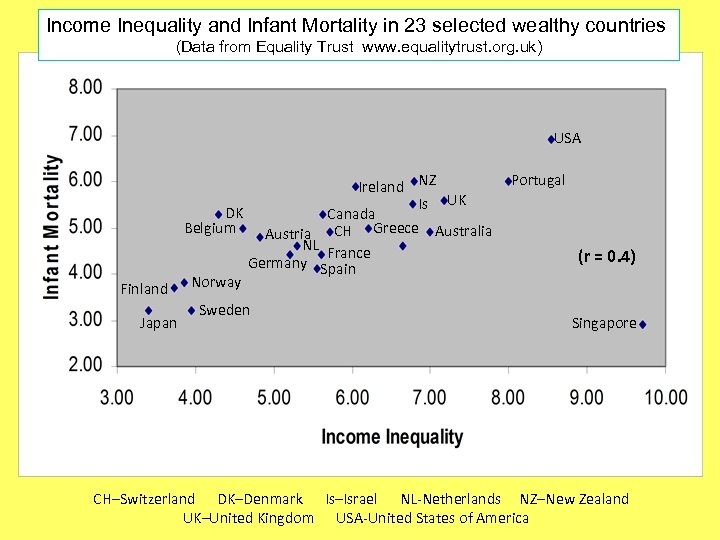 Income Inequality and Infant Mortality in 23 selected wealthy countries (Data from Equality Trust www. equalitytrust. org. uk) USA DK Belgium Finland Japan Norway Ireland NZ Is UK Canada CH Greece Australia Austria NL France Germany Spain Sweden Portugal (r = 0. 4) Singapore CH–Switzerland DK–Denmark Is–Israel NL-Netherlands NZ–New Zealand UK–United Kingdom USA-United States of America
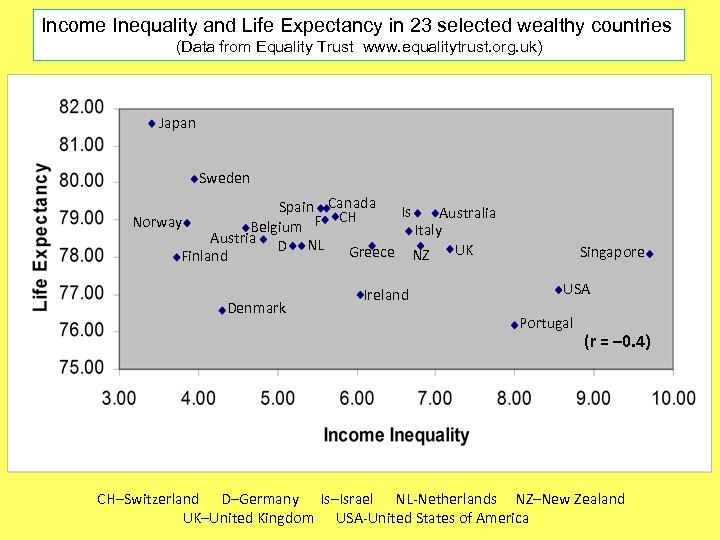 Income Inequality and Life Expectancy in 23 selected wealthy countries (Data from Equality Trust www. equalitytrust. org. uk) Japan Sweden Spain Canada Is Australia CH Norway Belgium F Italy Austria D NL UK Greece NZ Finland Denmark Ireland Singapore USA Portugal (r = – 0. 4) CH–Switzerland D–Germany Is–Israel NL-Netherlands NZ–New Zealand UK–United Kingdom USA-United States of America
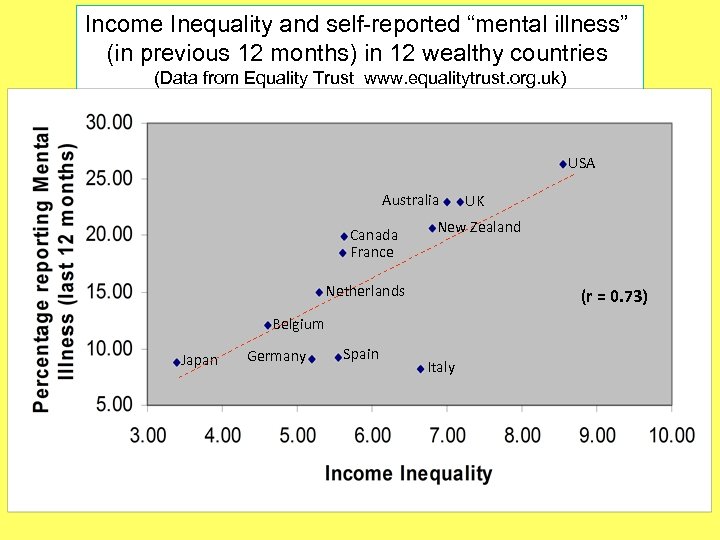 Income Inequality and self-reported “mental illness” (in previous 12 months) in 12 wealthy countries (Data from Equality Trust www. equalitytrust. org. uk) USA Australia Canada France New Zealand Netherlands (r = 0. 73) Belgium Japan Germany Spain UK Italy
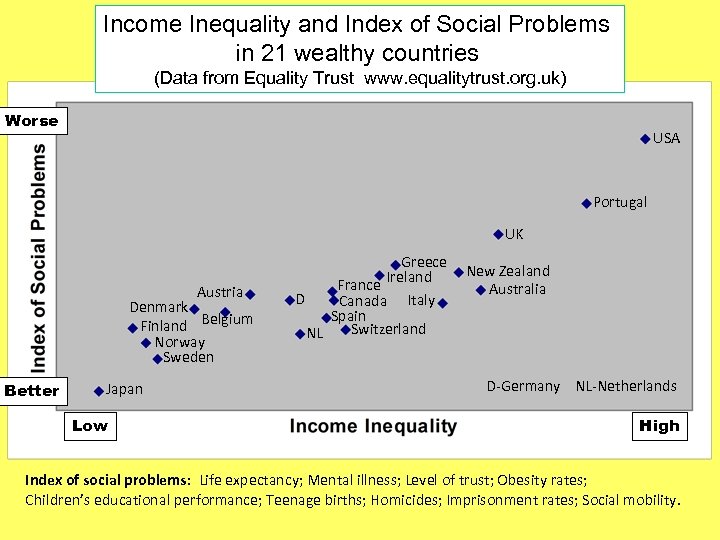 Income Inequality and Index of Social Problems in 21 wealthy countries (Data from Equality Trust www. equalitytrust. org. uk) Worse USA Portugal UK Austria Denmark Finland Belgium Norway Sweden Better Japan Low Greece Ireland France D Canada Italy Spain Switzerland NL New Zealand Australia D-Germany NL-Netherlands High Index of social problems: Life expectancy; Mental illness; Level of trust; Obesity rates; Children’s educational performance; Teenage births; Homicides; Imprisonment rates; Social mobility.
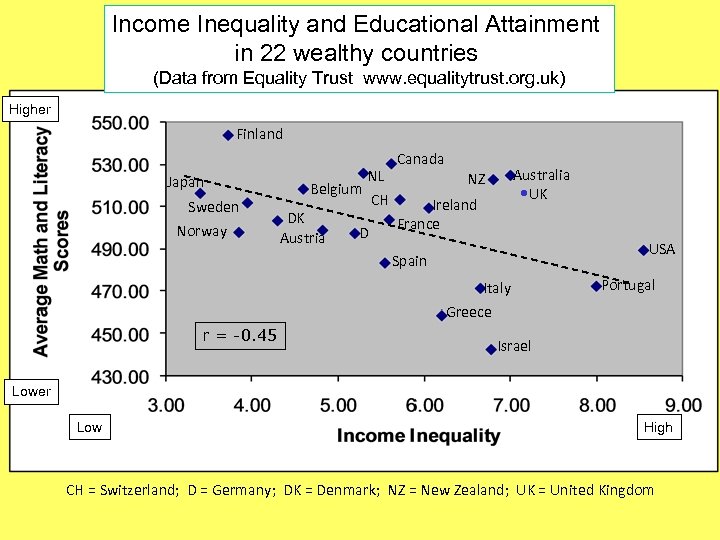 Income Inequality and Educational Attainment in 22 wealthy countries (Data from Equality Trust www. equalitytrust. org. uk) Higher Finland Japan Sweden Norway NL Belgium CH DK Austria D Canada Australia • UK NZ Ireland France USA Spain Italy Portugal Greece r = -0. 45 Israel Lower Low High CH = Switzerland; D = Germany; DK = Denmark; NZ = New Zealand; UK = United Kingdom
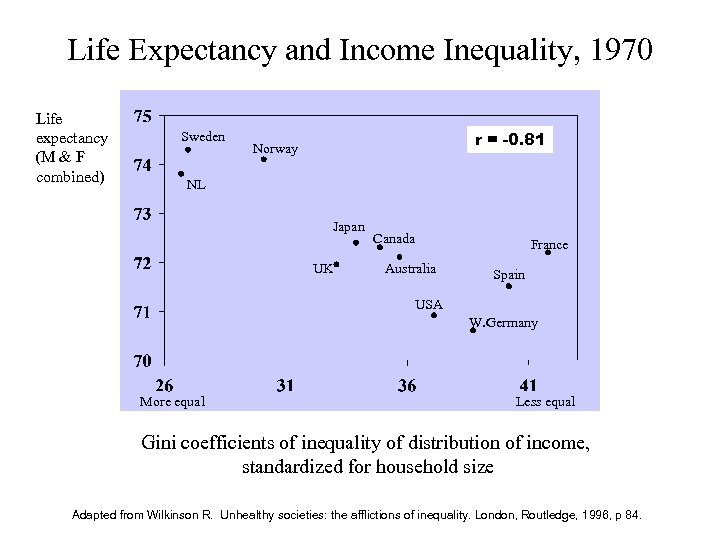 Life Expectancy and Income Inequality, 1970 Life expectancy (M & F combined) Sweden r = -0. 81 Norway NL Japan UK Canada Australia France Spain USA W. Germany More equal Less equal Gini coefficients of inequality of distribution of income, standardized for household size Adapted from Wilkinson R. Unhealthy societies: the afflictions of inequality. London, Routledge, 1996, p 84.
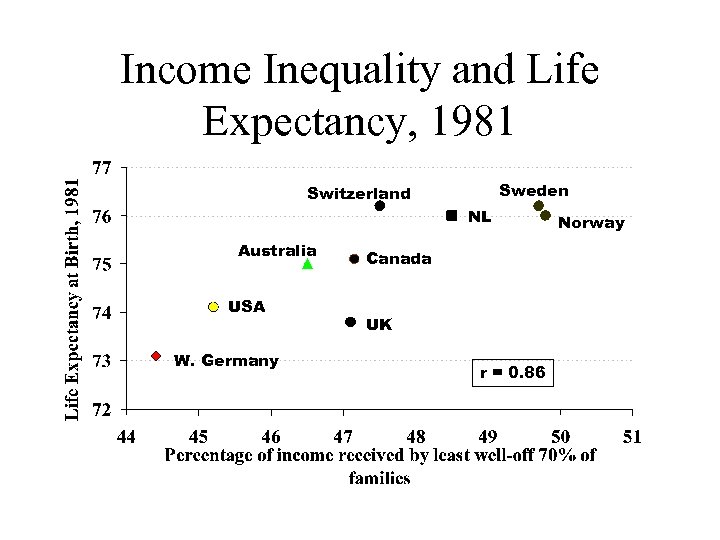 Income Inequality and Life Expectancy, 1981 Sweden Switzerland NL Australia USA W. Germany Canada UK r = 0. 86 Norway
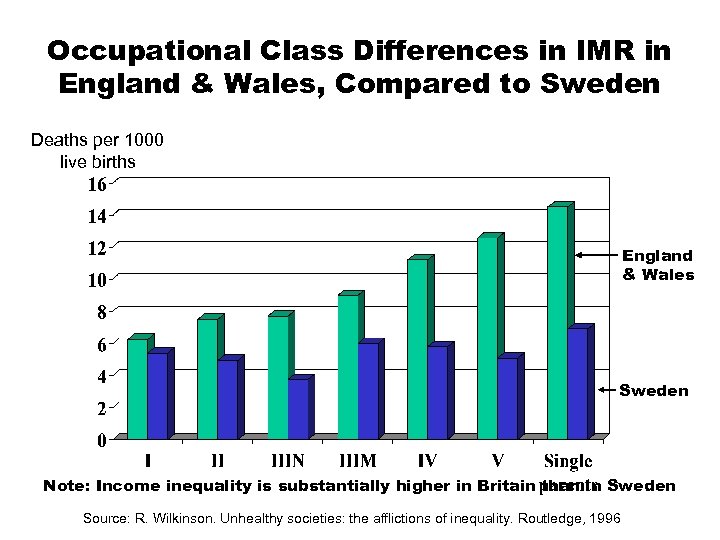 Occupational Class Differences in IMR in England & Wales, Compared to Sweden Deaths per 1000 live births England & Wales Sweden Note: Income inequality is substantially higher in Britain than in Sweden Source: R. Wilkinson. Unhealthy societies: the afflictions of inequality. Routledge, 1996
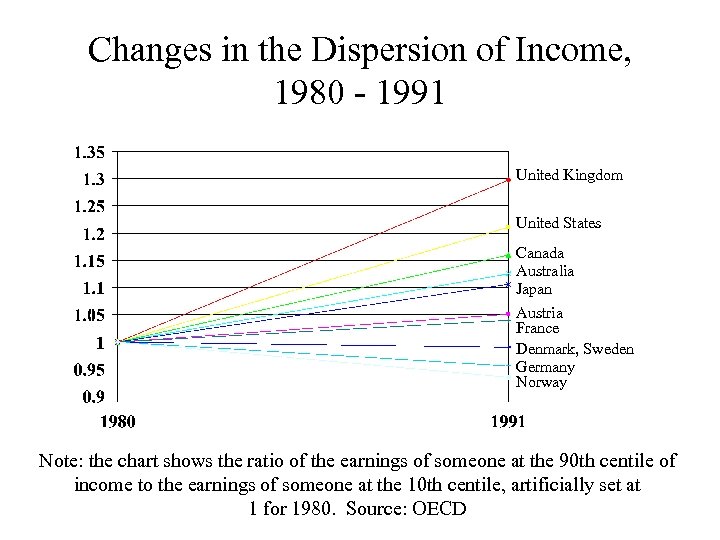 Changes in the Dispersion of Income, 1980 - 1991 United Kingdom United States Canada Australia Japan Austria France Denmark, Sweden Germany Norway Note: the chart shows the ratio of the earnings of someone at the 90 th centile of income to the earnings of someone at the 10 th centile, artificially set at 1 for 1980. Source: OECD
 Some difficulties in nation-level studies • Lack of good quality international data, collected in consistent manner in different countries. E. g. , in some studies Sweden is rated very egalitarian, in others less so than Britain! • Results seem to vary according to era from which data taken • Failures to replicate. Mellor & Milyo found that controlling for education removes effect (for infant mortality). Judge et al found correlation of -0. 17 (n. s. ). Snowdon shows alternatives for most of the Equality Trust graphs that reduce or remove the associations. • General conclusion: income inequality does not appear to drive overall mortality in industrial countries; may do so for infant mortality. This theory may have outlived its usefulness.
 2 (b) Comparisons Within Countries These appear to avoid some of the difficulties in cross-national comparisons: data are usually collected by a single agency (e. g. , Statistics Canada) Income data usually collected via the census (rather than surveys). Correlation usually found; lots of replications. Usually around 0. 7 (i. e. ‘explains’ half of the difference between areas). Wagstaff: “The first point to emerge from these studies is that they all confirm that income inequality is strongly associated with mortality, even after controlling for the average level of community income. ” (Annu Rev Public Health 2000; 21: 554)
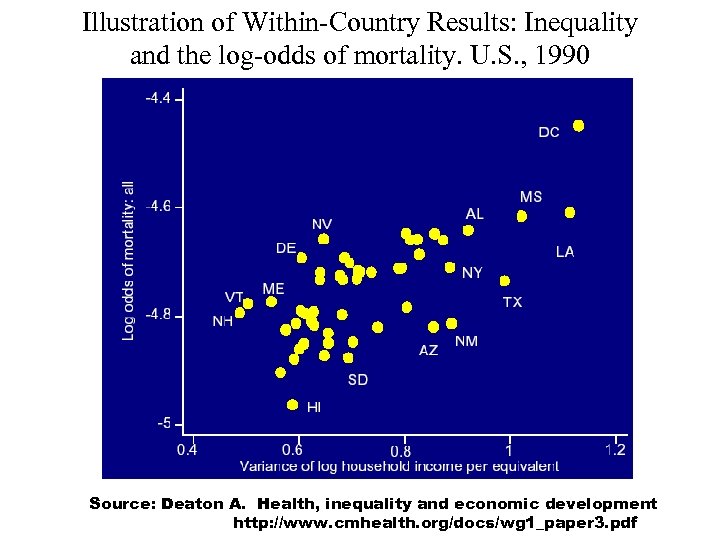 Illustration of Within-Country Results: Inequality and the log-odds of mortality. U. S. , 1990 Source: Deaton A. Health, inequality and economic development http: //www. cmhealth. org/docs/wg 1_paper 3. pdf
 Questions & Concerns • Data are pooled across ethnic (etc) groups: presumably income inequality is a proxy for various other factors. As you focus down onto selected groups the association (not surprisingly? ) is reduced. So, if the effect comes from inequality between groups (e. g. , blacks & whites in the US), is this merely a proxy for race, and does income inequality have no direct effect? • There is an issue of scale – what inequality should we use when analysing individual data (country level, state level, community or neighbourhood level? ) What is the person’s reference point? • Individual-level analyses generally show very modest inequality effects (RR 1. 2, etc) • General conclusion is that health is an increasing, nonlinear function of absolute income • So, there may be no direct effect of income inequality at all, but race, geography, social support services, or …?
 Categories of Explanation (course topic 2) 1. Theories that explain the pattern of relationships between SES and health – cf. the economic literature (e. g. , Wagstaff, below). “What form does it take? ” 2. Theories of mechanisms for the link – e. g. , lifestyles, genetics, access to care. “How does it work? ” 3. Theories on determinants of the relationship – the field of population health. “Why does it arise? ”
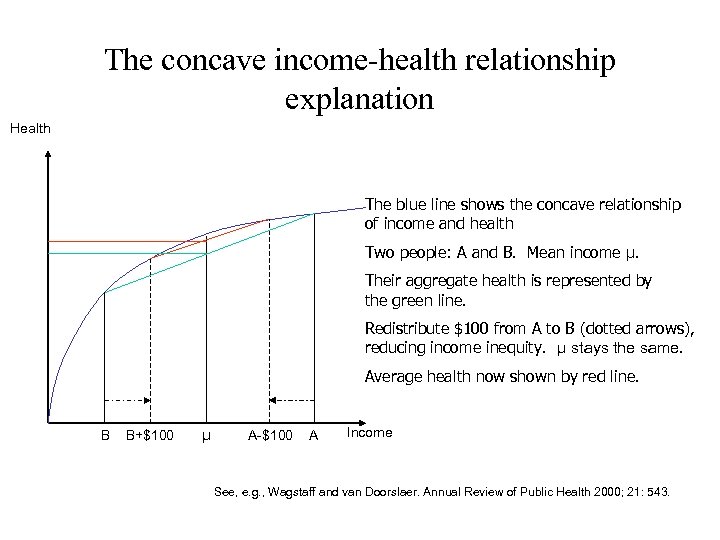 The concave income-health relationship explanation Health The blue line shows the concave relationship of income and health Two people: A and B. Mean income μ. Their aggregate health is represented by the green line. Redistribute $100 from A to B (dotted arrows), reducing income inequity. μ stays the same. Average health now shown by red line. B B+$100 μ A-$100 A Income See, e. g. , Wagstaff and van Doorslaer. Annual Review of Public Health 2000; 21: 543.
 Relative or Absolute Income? • In very poor places, it is logical that there is a minimum income required for basic amenities. • But in richer places does health reflect absolute wealth, or relative? • Marmot, 2003: The GNP in Costa Rica is about $2, 000 person; life expectancy for men is 74 years. Among black men in the U. S. , mean income is around $26, 000 and life expectancy is 66. Adjusting for different buying power brings the Costa Rica figure to about $6, 000 person, still one-quarter of the US figure.
 (continued) • A consistent finding is that within countries or states, individual health is related to individual income, but comparing between states average health is independent of average income, but is negatively related to income inequality. I. e. , it depends on which comparison you are making (within or across places) • Wilkinson noted “Mortality is associated with relative income. Someone with an absolute income that equals half of the US average income might do better to be moderately well off in Greece or Spain than poor in the US” (BMJ 1998; 316: 1611) and “health is powerfully affected by social position” • “Relative inequality in income may correspond to absolute discrimination and social exclusion. ” (Marmot, Perspec Biol Med 2003; 46 (suppl 3): S 17).
 Wagstaff & van Doorslaer’s hypotheses • Economic perspective: what is the main driver in the relationship? – – – Absolute income hypothesis Relative income Deprivation hypothesis Relative position Income inequality • Conclusion: it depends very much whether you are explaining individual health, or community, or population health patterns – Annual Review of Public Health 2000; 21: 543
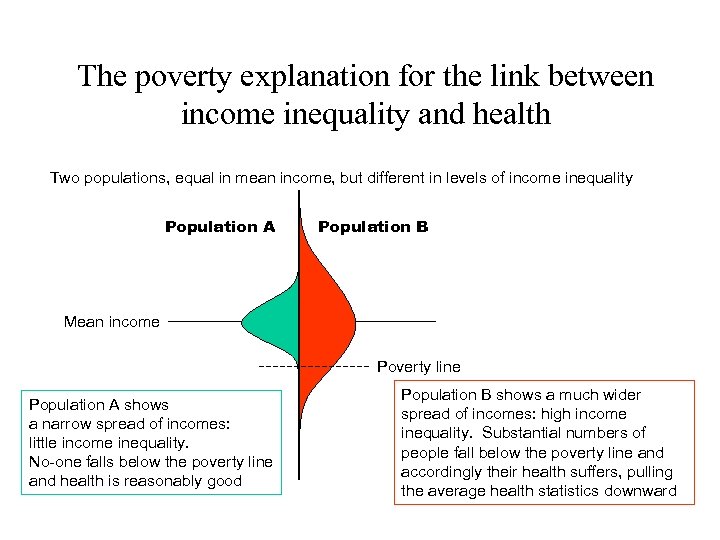 The poverty explanation for the link between income inequality and health Two populations, equal in mean income, but different in levels of income inequality Population A Population B Mean income Poverty line Population A shows a narrow spread of incomes: little income inequality. No-one falls below the poverty line and health is reasonably good Population B shows a much wider spread of incomes: high income inequality. Substantial numbers of people fall below the poverty line and accordingly their health suffers, pulling the average health statistics downward
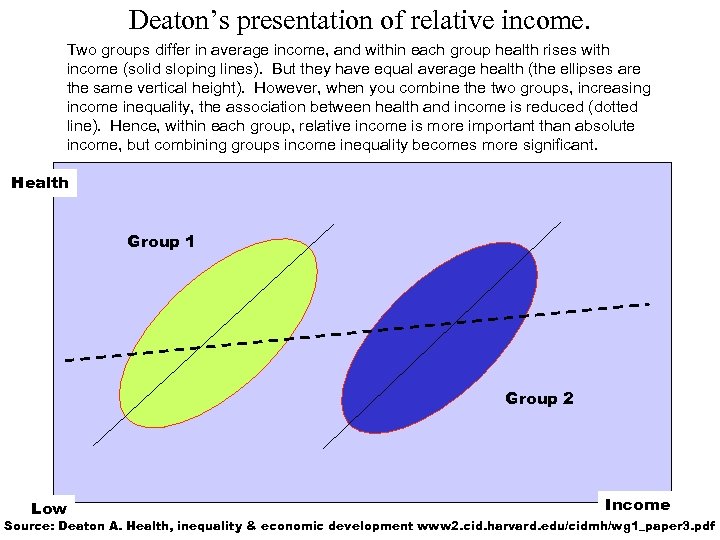 Deaton’s presentation of relative income. Two groups differ in average income, and within each group health rises with income (solid sloping lines). But they have equal average health (the ellipses are the same vertical height). However, when you combine the two groups, increasing income inequality, the association between health and income is reduced (dotted line). Hence, within each group, relative income is more important than absolute income, but combining groups income inequality becomes more significant. Health Group 1 Group 2 Low Income Source: Deaton A. Health, inequality & economic development www 2. cid. harvard. edu/cidmh/wg 1_paper 3. pdf
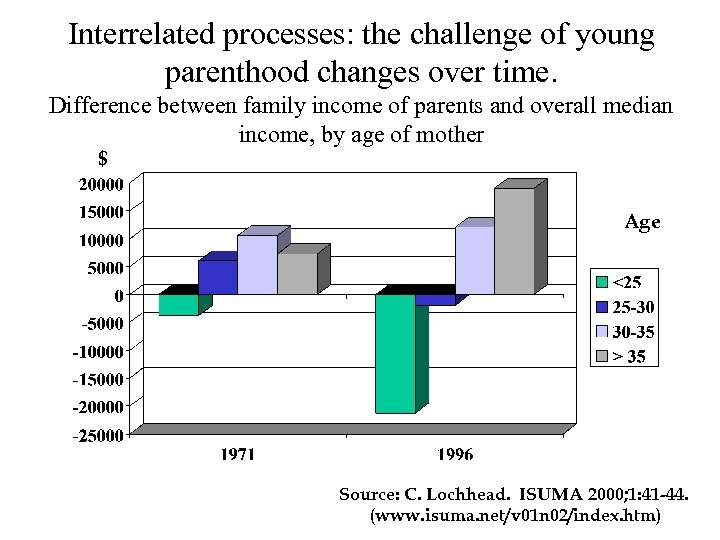 Interrelated processes: the challenge of young parenthood changes over time. Difference between family income of parents and overall median income, by age of mother $ Age Source: C. Lochhead. ISUMA 2000; 1: 41 -44. (www. isuma. net/v 01 n 02/index. htm)
 Is it the indicator of Class? • Goldblatt (1990) compared professional men living in their own home and who had access to a car (SMR = 67) to all men who lacked access to a car and lived in rented accommodation (SMR = 123). This gradient similar to that based on the occupational classification • Other studies (Carstairs; Townsend) used areabased indicators of social and material deprivation. Consistent relationship found with health indicators.
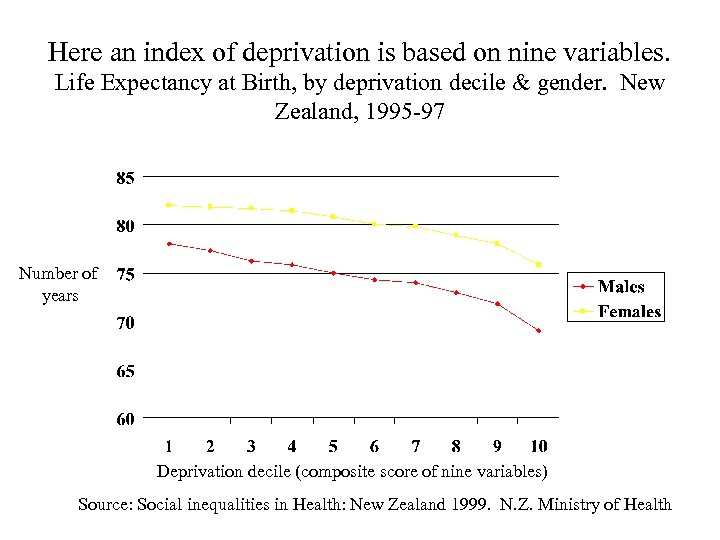 Here an index of deprivation is based on nine variables. Life Expectancy at Birth, by deprivation decile & gender. New Zealand, 1995 -97 Number of years Deprivation decile (composite score of nine variables) Source: Social inequalities in Health: New Zealand 1999. N. Z. Ministry of Health
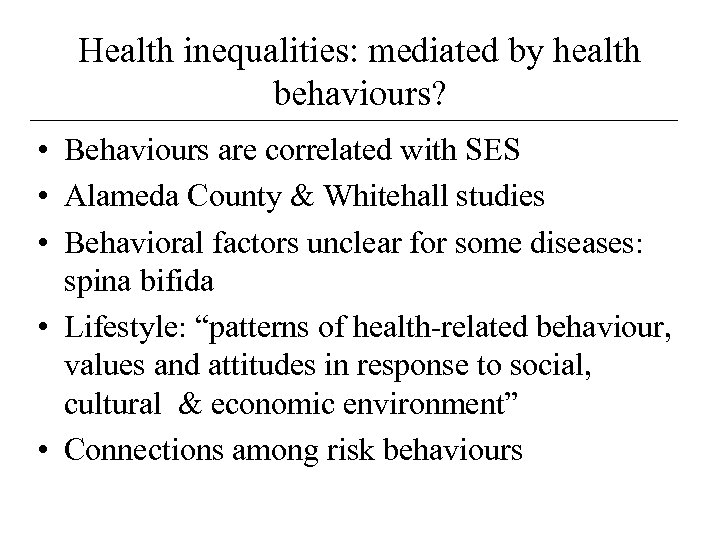 Health inequalities: mediated by health behaviours? • Behaviours are correlated with SES • Alameda County & Whitehall studies • Behavioral factors unclear for some diseases: spina bifida • Lifestyle: “patterns of health-related behaviour, values and attitudes in response to social, cultural & economic environment” • Connections among risk behaviours
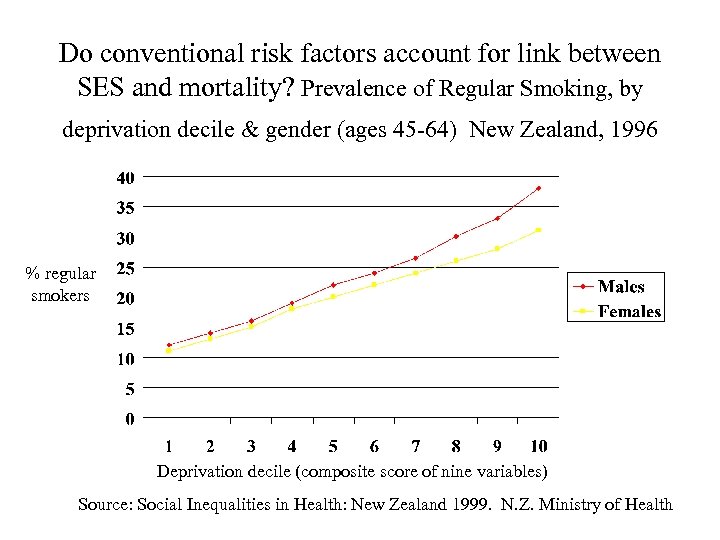 Do conventional risk factors account for link between SES and mortality? Prevalence of Regular Smoking, by deprivation decile & gender (ages 45 -64) New Zealand, 1996 % regular smokers Deprivation decile (composite score of nine variables) Source: Social Inequalities in Health: New Zealand 1999. N. Z. Ministry of Health
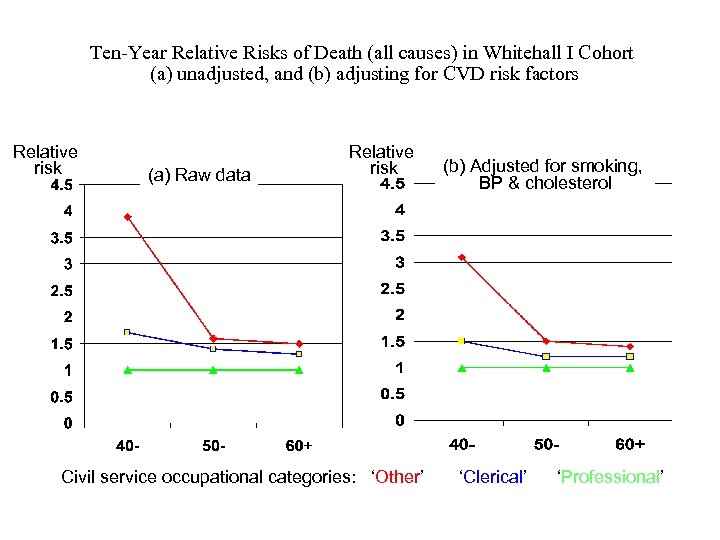 Ten-Year Relative Risks of Death (all causes) in Whitehall I Cohort (a) unadjusted, and (b) adjusting for CVD risk factors Relative risk (a) Raw data Relative risk Civil service occupational categories: ‘Other’ (b) Adjusted for smoking, BP & cholesterol ‘Clerical’ ‘Professional’
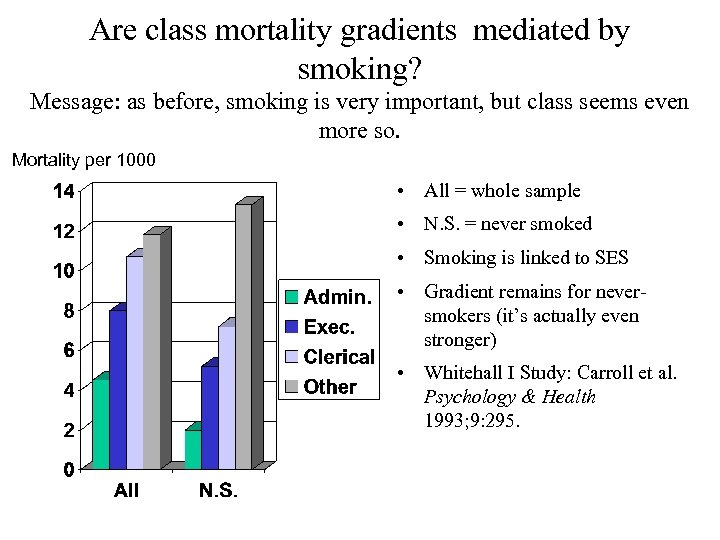 Are class mortality gradients mediated by smoking? Message: as before, smoking is very important, but class seems even more so. Mortality per 1000 • All = whole sample • N. S. = never smoked • Smoking is linked to SES • Gradient remains for neversmokers (it’s actually even stronger) • Whitehall I Study: Carroll et al. Psychology & Health 1993; 9: 295.
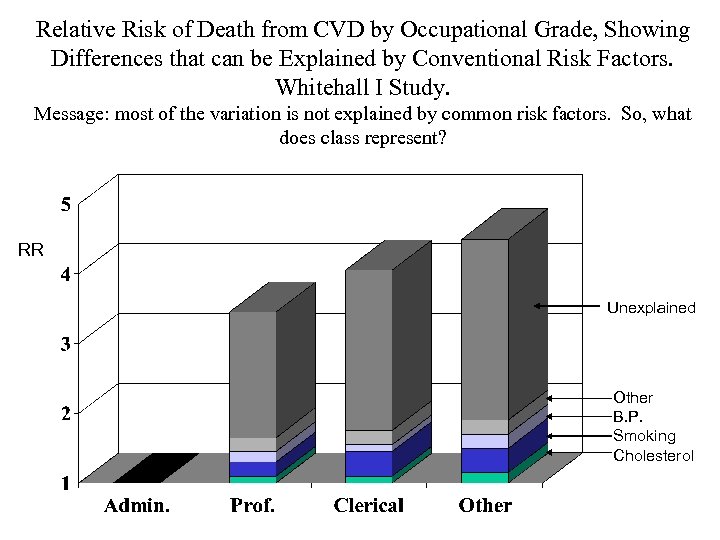 Relative Risk of Death from CVD by Occupational Grade, Showing Differences that can be Explained by Conventional Risk Factors. Whitehall I Study. Message: most of the variation is not explained by common risk factors. So, what does class represent? RR Unexplained Other B. P. Smoking Cholesterol
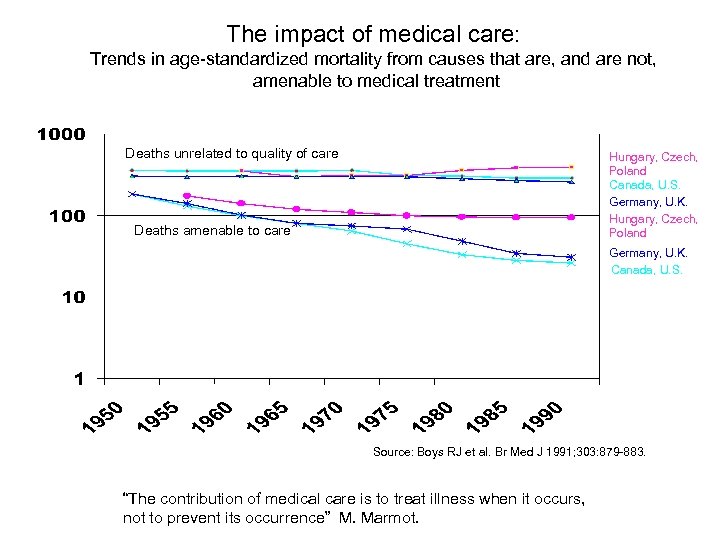 The impact of medical care: Trends in age-standardized mortality from causes that are, and are not, amenable to medical treatment Deaths unrelated to quality of care Hungary, Czech, Poland Canada, U. S. Germany, U. K. Hungary, Czech, Poland Deaths amenable to care Germany, U. K. Canada, U. S. Source: Boys RJ et al. Br Med J 1991; 303: 879 -883. “The contribution of medical care is to treat illness when it occurs, not to prevent its occurrence” M. Marmot.
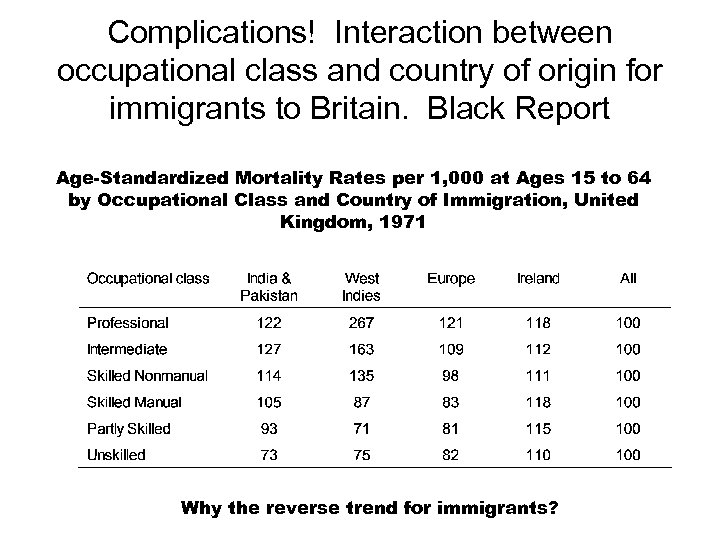 Complications! Interaction between occupational class and country of origin for immigrants to Britain. Black Report Age-Standardized Mortality Rates per 1, 000 at Ages 15 to 64 by Occupational Class and Country of Immigration, United Kingdom, 1971 Why the reverse trend for immigrants?
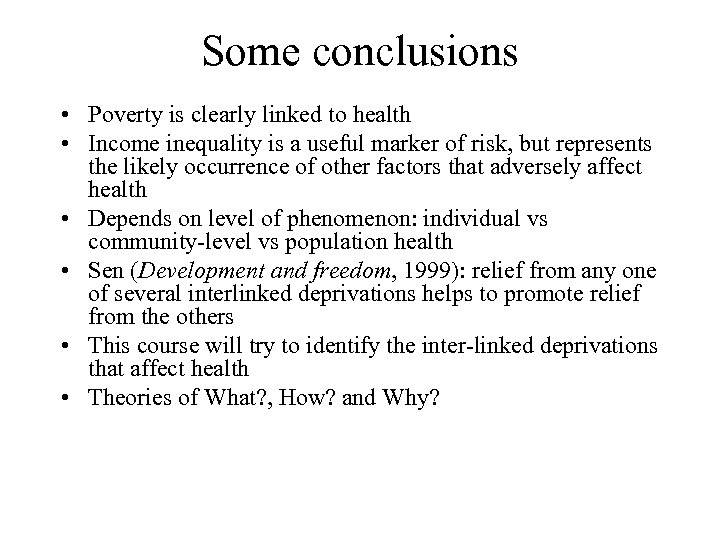 Some conclusions • Poverty is clearly linked to health • Income inequality is a useful marker of risk, but represents the likely occurrence of other factors that adversely affect health • Depends on level of phenomenon: individual vs community-level vs population health • Sen (Development and freedom, 1999): relief from any one of several interlinked deprivations helps to promote relief from the others • This course will try to identify the inter-linked deprivations that affect health • Theories of What? , How? and Why?
 Bits & Pieces
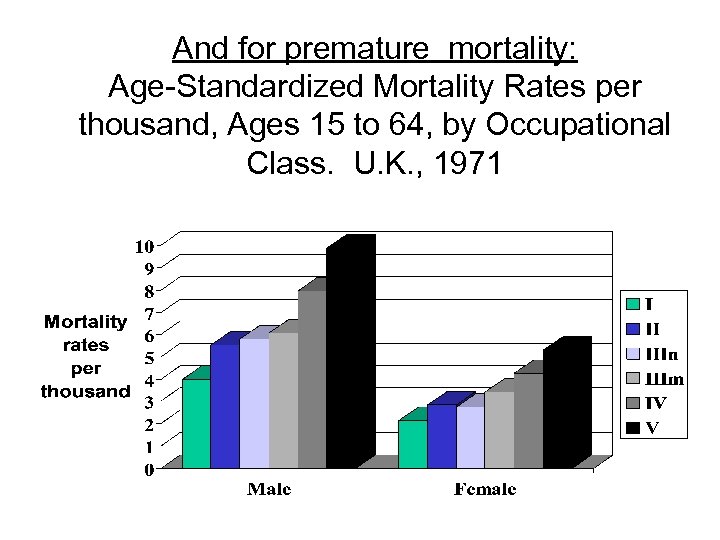 And for premature mortality: Age-Standardized Mortality Rates per thousand, Ages 15 to 64, by Occupational Class. U. K. , 1971
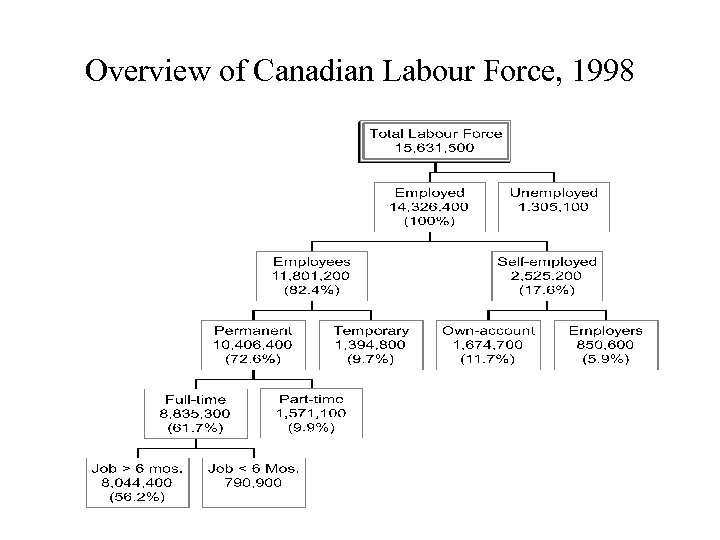 Overview of Canadian Labour Force, 1998
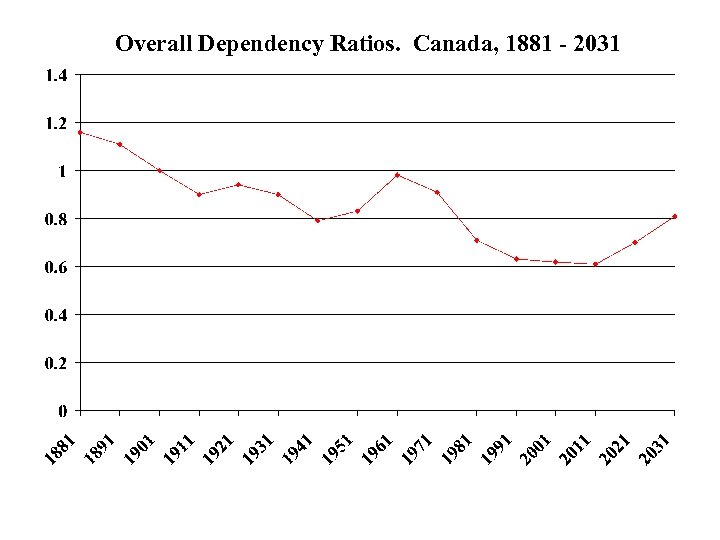 Overall Dependency Ratios. Canada, 1881 - 2031