


 Скачать презентацию Society of Construction Law Oxford Region 23 April
5e5a094328db80fec5253e15f076b979.ppt
- Количество слайдов: 26
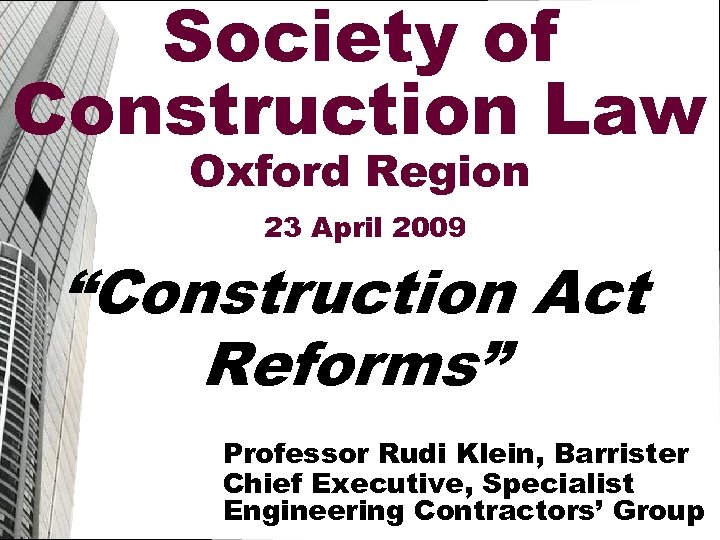
 Society of Construction Law Oxford Region 23 April 2009 “Construction Act Reforms” Professor Rudi Klein, Barrister Chief Executive, Specialist Engineering Contractors’ Group
 How did we get here? • March 2004: Gordon Brown (as Chancellor) announces review of Construction Act against background of continuing payment problems. • Original proposal was for an RRO. • Formal consultations in 2005 & 2007.
 • Draft Construction Contracts Bill published for consultation in July 2008. • Revised Bill receives 1 st Reading in the House of Lords on 4 December 2008 (some changes from original draft)
 “Our amendments…. will create greater certainty and clarity of cash flow for all in the construction supply chain” (emphasis added). Baroness Andrews in 2 nd Reading debate in House of Lords on 17. 12. 2008
 AMENDMENTS TO THE PAYMENT PROVISIONS
 CURRENT WEAKNESSES • S. 110(1)(a) Contracts must have adequate mechanism for determining what payments become due and when • This is essential for operating ss. 111 & 112 (withholding and suspension)
 “The absence of…. a means for resolving deadlock…. renders inadequate the machinery for determining when payments are due”. Lord Macfadyen in Maxi Construction v Merton Rolls [2001] CILL 1784
 CURRENT WEAKNESSES • Likelihood is that majority of contracts do not have an adequate mechanism • Scheme not helpful: there is only a list of what may be included in interim payments together with due dates and final payment dates
 THE CHANGES NEW S. 111 PAYER MUST PAY NOTIFIED SUM ON OR BEFORE THE FINAL DATE FOR PAYMENT
 NOTIFIED SUM • The sum specified in notice issued by: – Payer – Payee, where payer fails to issue notice
 Notices must comply with new s. 110(A) – replacing s. 110(2) requiring payer to issue payment notice
 NOTICE REQUIREMENTS • Contracts to indicate which party to issue notices • Notices to be issued no later than 5 days after payment due date • Amount of sum considered due must be stated together with basic calculation
 PAYER’S FAILURE TO ISSUE NOTICE • Payee can issue notice instead but final date for payment extended from expiry of 5 days • But final date for payment intact if payee issues application before payment due date (provided such application is required/ permitted by contract)
 NOTICE TO PAY LESS • Payer can issue notice of intention to pay less than notified sum • Notice must indicate sum payer considers due on date notice is served and basis of calculation • Must be given no later than the “prescribed period” before date for payment
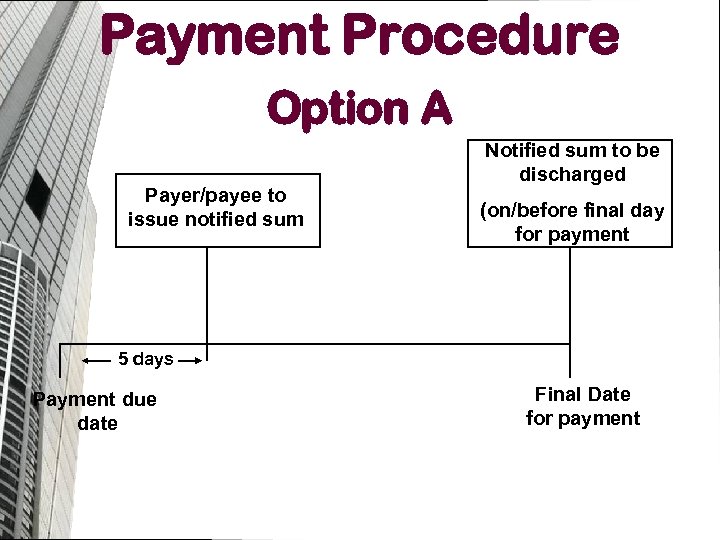 Payment Procedure Option A Payer/payee to issue notified sum Notified sum to be discharged (on/before final day for payment 5 days Payment due date Final Date for payment
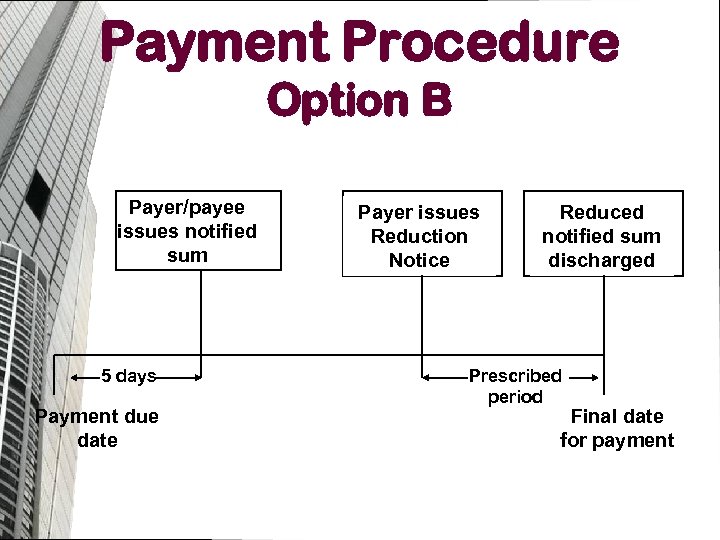 Payment Procedure Option B Payer/payee issues notified sum 5 days Payment due date Payer issues Reduction Notice Reduced notified sum discharged Prescribed period Final date for payment
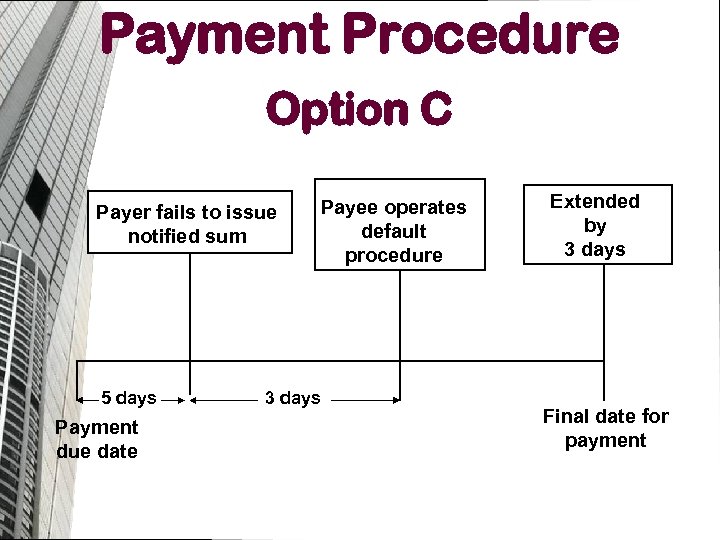 Payment Procedure Option C Payer fails to issue notified sum 5 days Payment due date Payee operates default procedure 3 days Extended by 3 days Final date for payment
 CONDITIONAL PAYMENT PROVISIONS Adequate mechanism requirement not satisfied where payment made conditional on performance of obligations under another contract or decision by any person as to whether such obligations have been performed [New sub-section 110(1)A]
 CONDITIONAL PAYMENT PROVISIONS (2) • Will 110(1)(A) actually outlaw paywhen-certified clauses? • Will 110(1)(A) conflict with current s. 113? • Pay-when-paid exemption in s. 113 not removed
 OTHER CHANGES • No requirement to pay sum due where payee became insolvent after prescribed period and contract permits payer not to pay sum due in this event (prompted by Melville Dundas case) • Improvement to suspension (s. 112) allowing payee to recover reasonable compensation for “costs and expenses reasonably incurred” during suspension • Payee can suspend any or all of his contractual obligations
 AMENDMENTS TO ADJUDICATION PROVISIONS
 S. 107 – REQUIREMENT FOR CONTRACTS TO BE IN WRITING (RJT Consulting Engineers v DM Engineering (2002) BLR 217 • S. 107 repealed: oral or oral/partly written contracts within scope of Act • BUT provisions relating to adjudication (8 “compliance points”) must be in writing to comply with s. 108
 SLIP RULE (New s. 108(3)A) • Contracts must include provisions that adjudicator has power to correct and clerical/ typographical error arising by accident/omission • What about time limits on exercise of power?
 COSTS IN ADJUDICATION (New 108 A) • Agreement allocating “costs relating to the adjudication” ineffective unless made in writing after giving notice of intention to refer the dispute to adjudication • This also refers to the fees and expenses of the adjudicator
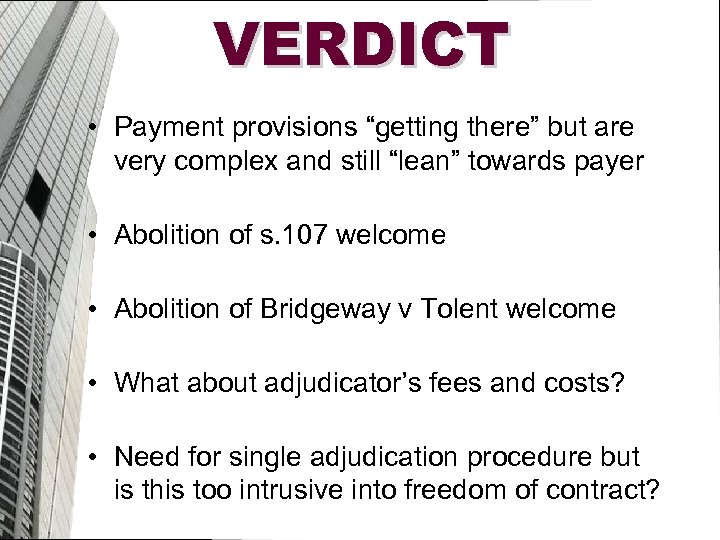 VERDICT • Payment provisions “getting there” but are very complex and still “lean” towards payer • Abolition of s. 107 welcome • Abolition of Bridgeway v Tolent welcome • What about adjudicator’s fees and costs? • Need for single adjudication procedure but is this too intrusive into freedom of contract?
 Society of Construction Law Oxford Region 23 April 2009 “Construction Act Reforms” Professor Rudi Klein, Barrister Chief Executive, Specialist Engineering Contractors’ Group