 Скачать презентацию Social Value Implications of the Public Services Social
0ed19d82f7e0e327246e9d34937d5f41.ppt
- Количество слайдов: 18



Social Value Implications of the Public Services (Social Value) Act 2012 for social enterprises and the third sector Alun Severn BSSEC alun@bssec. org. uk www. bssec. org. uk
Background § Draws on work to support Birmingham City Council’s implementation of the new social value legislation. § Barrow Cadbury-funded project. § Practical lessons reflect BCC context but likely to be more widely applicable. § Why BSSEC is doing this work: • To support ‘do-able’, practical implementation. • Working with biggest LA in England can create opportunities for the sector. • Support SEs and VCOs use the legislation – articulate and demonstrate their social value. • Because sector will be competing with the private sector on SV! 2
About the Act § June 2010 – Private Member’s Bill sponsored by Conservative MP Chris White. § Received Royal Assent March 2012, came fully into force January 2013. What the Act requires public authorities to do… They must consider: How what they propose to procure will improve economic, social and environmental well-being of an area. How, in conducting the process of procurement, they will act to secure that improvement. 3
About the Act – contd § The Act applies to “relevant authorities” – Govt departments, local authorities, NHS Trusts, CCGs, fire & rescue services, police, maintained schools and FE/HE, housing associations. § It applies to: • Service contracts rather than goods per se. • Contracts above EU thresholds. • ‘Pre-procurement’ – i. e. what an authority must do prior to commencing a procurement exercise. 4
About the Act – contd § Social value outcomes in contract specifications must be: • Relevant and proportionate. • Specific, measurable and verifiable. • A clear part of the award criteria. § SV not defined in law. Govt has described it as: • “…the additional benefit that can be created by procuring or commissioning goods and services, above and beyond the benefit of merely the goods and services themselves”. § Public bodies must also consider whether consultation is required – but not a duty to consult. • Govt assumes consultation “digital by default”. 5
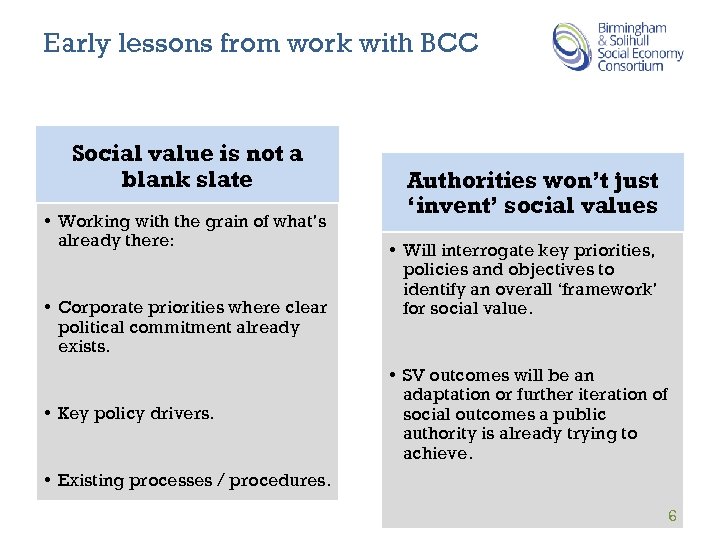
Early lessons from work with BCC Social value is not a blank slate • Working with the grain of what’s already there: • Corporate priorities where clear political commitment already exists. • Key policy drivers. Authorities won’t just ‘invent’ social values • Will interrogate key priorities, policies and objectives to identify an overall ‘framework’ for social value. • SV outcomes will be an adaptation or further iteration of social outcomes a public authority is already trying to achieve. • Existing processes / procedures. 6
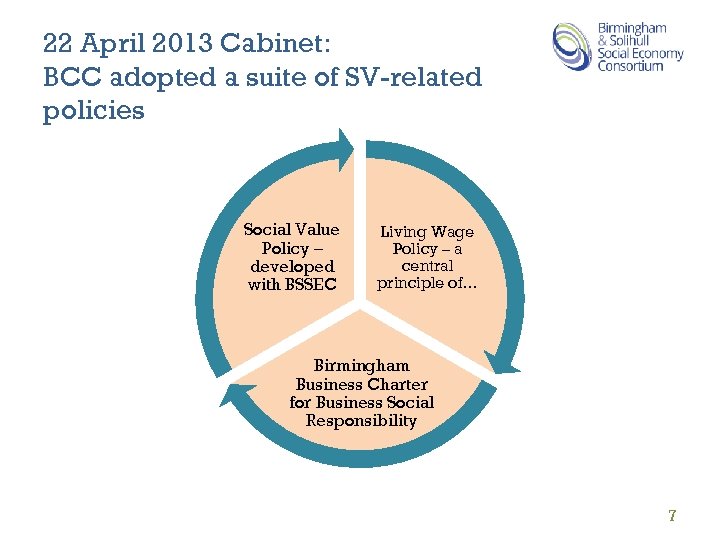
22 April 2013 Cabinet: BCC adopted a suite of SV-related policies Social Value Policy – developed with BSSEC Living Wage Policy – a central principle of… Birmingham Business Charter for Business Social Responsibility 7
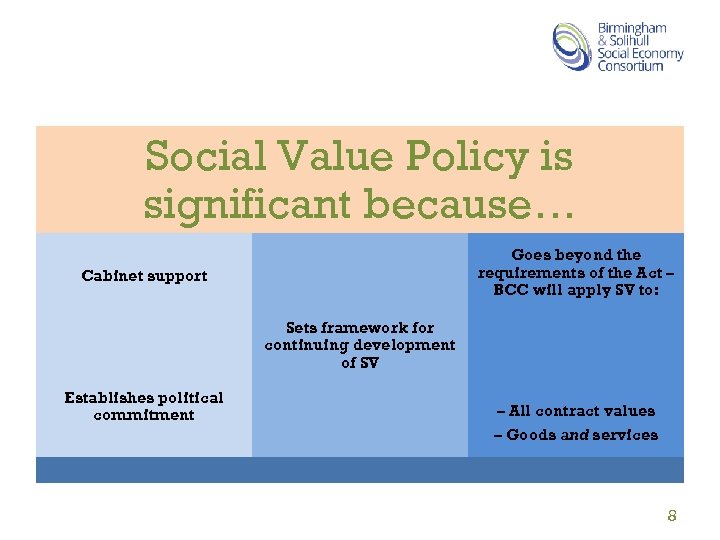
Social Value Policy is significant because… Goes beyond the requirements of the Act – BCC will apply SV to: Cabinet support Sets framework for continuing development of SV Establishes political commitment – All contract values – Goods and services 8
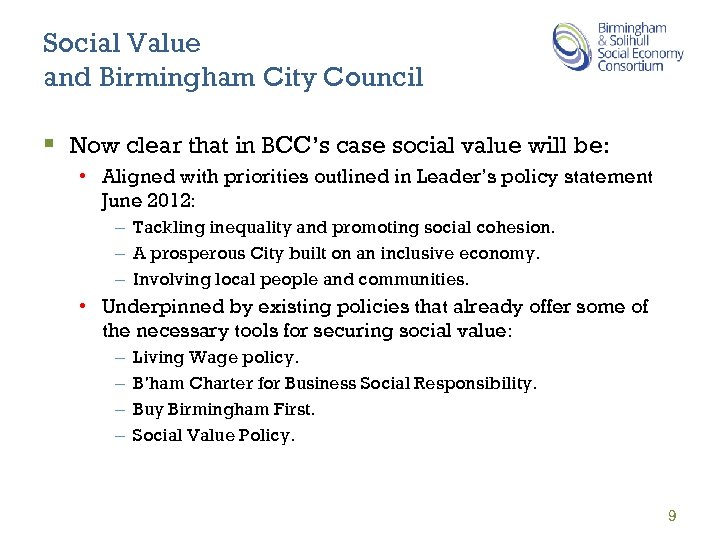
Social Value and Birmingham City Council § Now clear that in BCC’s case social value will be: • Aligned with priorities outlined in Leader’s policy statement June 2012: – Tackling inequality and promoting social cohesion. – A prosperous City built on an inclusive economy. – Involving local people and communities. • Underpinned by existing policies that already offer some of the necessary tools for securing social value: – – Living Wage policy. B’ham Charter for Business Social Responsibility. Buy Birmingham First. Social Value Policy. 9
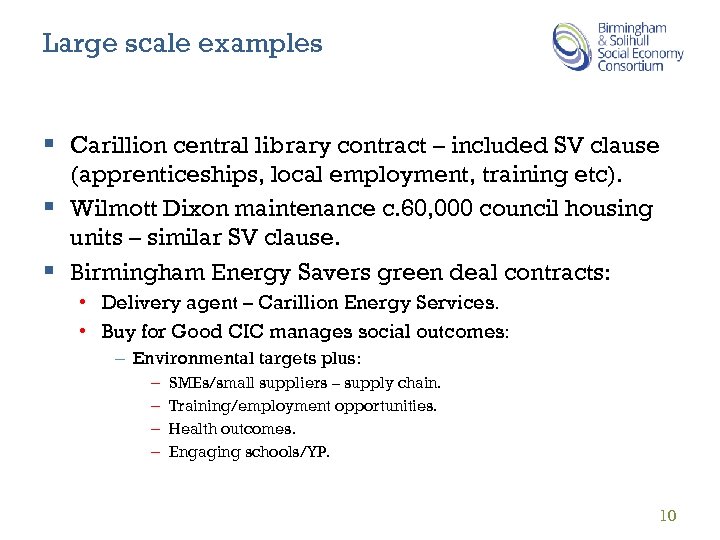
Large scale examples § Carillion central library contract – included SV clause (apprenticeships, local employment, training etc). § Wilmott Dixon maintenance c. 60, 000 council housing units – similar SV clause. § Birmingham Energy Savers green deal contracts: • Delivery agent – Carillion Energy Services. • Buy for Good CIC manages social outcomes: – Environmental targets plus: – – SMEs/small suppliers – supply chain. Training/employment opportunities. Health outcomes. Engaging schools/YP. 10
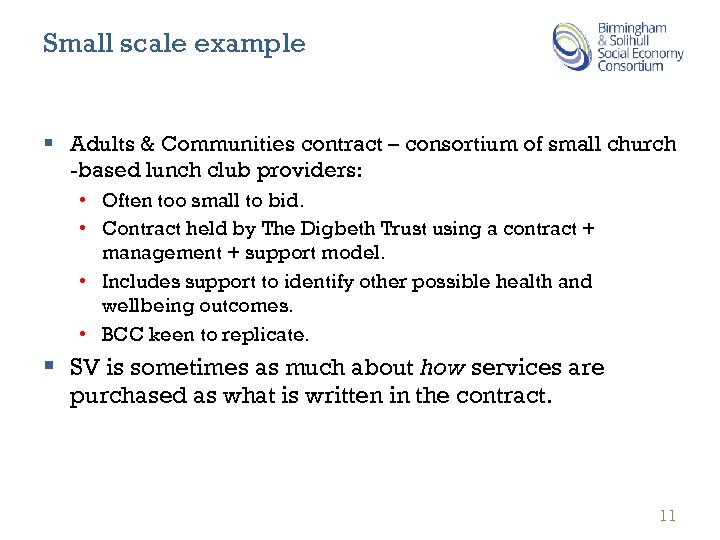
Small scale example § Adults & Communities contract – consortium of small church -based lunch club providers: • Often too small to bid. • Contract held by The Digbeth Trust using a contract + management + support model. • Includes support to identify other possible health and wellbeing outcomes. • BCC keen to replicate. § SV is sometimes as much about how services are purchased as what is written in the contract. 11
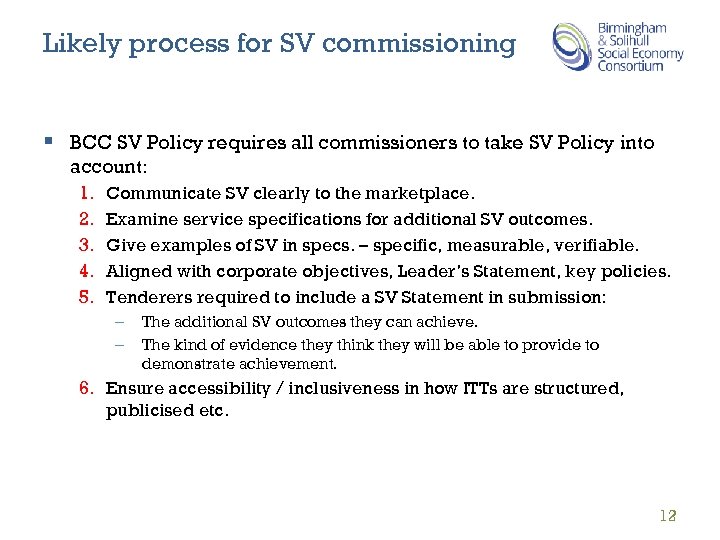
Likely process for SV commissioning § BCC SV Policy requires all commissioners to take SV Policy into account: 1. 2. 3. 4. 5. Communicate SV clearly to the marketplace. Examine service specifications for additional SV outcomes. Give examples of SV in specs. – specific, measurable, verifiable. Aligned with corporate objectives, Leader’s Statement, key policies. Tenderers required to include a SV Statement in submission: – – The additional SV outcomes they can achieve. The kind of evidence they think they will be able to provide to demonstrate achievement. 6. Ensure accessibility / inclusiveness in how ITTs are structured, publicised etc. 12

Implications for SEs & VCOs 1. Act is not about social enterprise/third sector – doesn’t make it possible for contracts to be restricted to them. It applies to all suppliers. 2. Act should offer sector a degree of competitive advantage – but not a monopoly on SV! Opens SV up to competition. 3. Will place a much greater emphasis on: • • • Articulating SV that is relevant to contract, clear and understandable. Monitoring SV. Developing evidence that is clear, easily conveyed and can demonstrate SV has been achieved. 13
‘Evidence’ § Least developed part of the process. § Likely to be a light touch regime: • Nothing that adds to management costs. • Doesn’t seem likely that SROI will be favoured – but SROI does provide a foundation of appropriate evidence. 14

Being prepared… § Review the messages you use to articulate and define the social value you do create. Are they clear, punchy, precise? § Are they: RELEVANT – APPROPRIATE – SPECIFIC – UNDERSTANDABLE? § Look particularly for evidence that helps you define and illustrate the social value deriving from: • Specific services. • Ways of working/delivering that are unique to you (your USPs). • Particular interventions. • Impact and outcomes for specific groups of service-users. § Look for what distinguishes you from other providers – especially private sector. 15
Being prepared… § Assess how robust your evidence is and whether it can be improved. § Are there any sources of evidence you aren’t using fully – e. g. • • • Service user data. User satisfaction surveys. Personal stories. Cost-benefit analyses that demonstrate savings to other services. Volunteer benefits. § If evidence is lacking, think about – • • How, where and what type of evidence you could generate And make plans to do so! 16
Currently working to… § Work continues… • Incorporating SV into BCC’s evolving ‘Service Redesign & Commissioning Toolkit’. • Developing underpinning guidance notes. • Ultimately will work with BCC to produce a SV ‘toolkit’. • Helping BCC Supporting People team to incorporate SV into first round of SP contracts to which it will apply. • Will commission support workshops for SEs and VCOs later this year. 17

Documents & updates Documents and project updates including longer Briefing paper on SV: http: //bssec. org. uk/policy-issues/public-services-and-social-value/ BCC Social Value Policy and links to associated policies, Living wage and Business Charter for Social responsibility: http: //bssec. org. uk/birmingham-city-council-adopts-social-value-policy/ 18
Скачать презентацию Social Value Implications of the Public Services Social
0ed19d82f7e0e327246e9d34937d5f41.ppt