 Скачать презентацию Social Sonar Control Your World Before
7ff0aec6129820416eff772ad15a51c2.ppt
- Количество слайдов: 20




Social Sonar Control Your World. . . Before Your Friends Do!
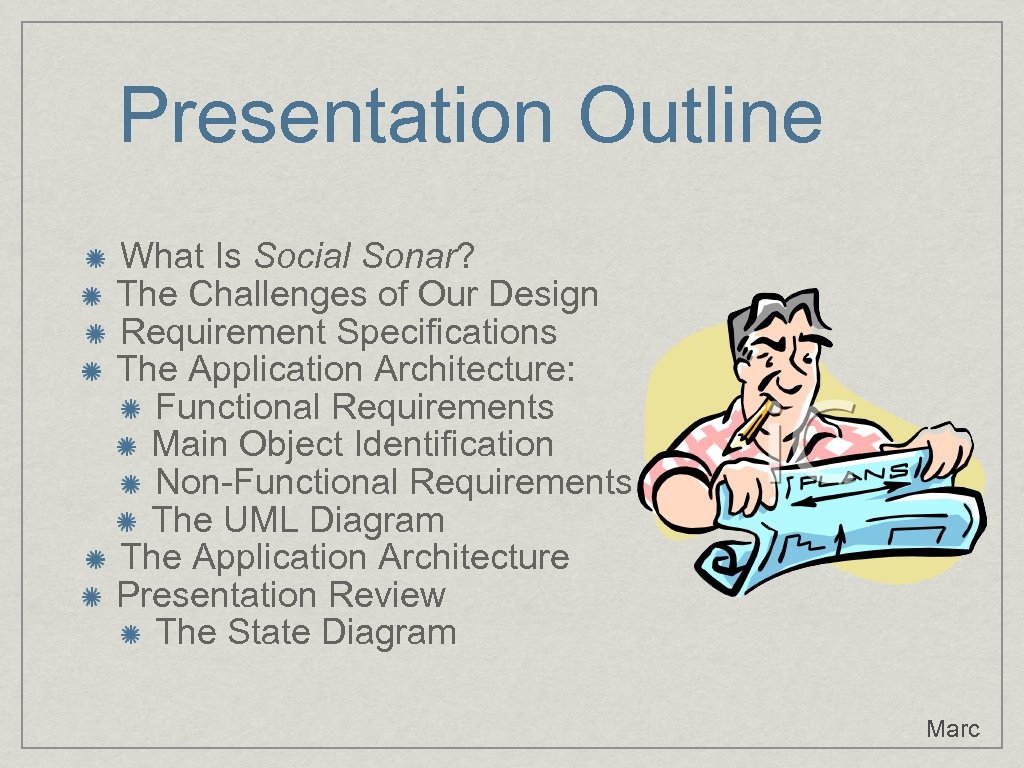
Presentation Outline What Is Social Sonar? The Challenges of Our Design Requirement Specifications The Application Architecture: Functional Requirements Main Object Identification Non-Functional Requirements The UML Diagram The Application Architecture Presentation Review The State Diagram Marc
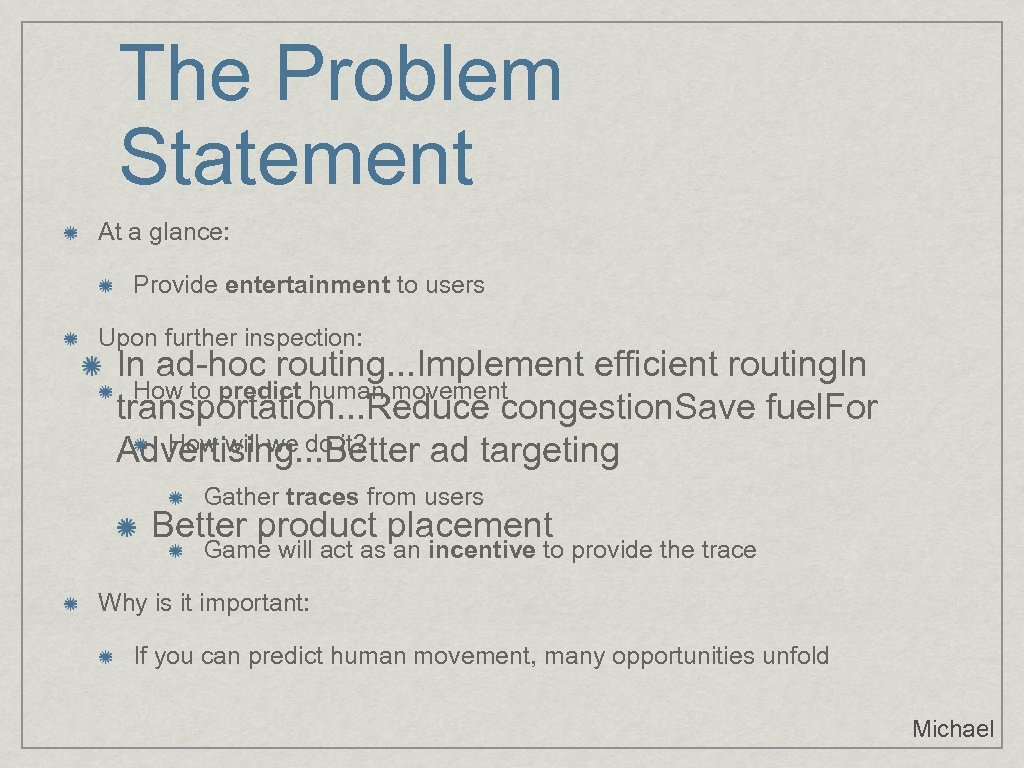
The Problem Statement At a glance: Provide entertainment to users Upon further inspection: In ad-hoc routing. . . Implement efficient routing. In How to predict human movement transportation. . . Reduce congestion. Save fuel. For How will we do it? Advertising. . . Better ad targeting Gather traces from users Better product placement Game will act as an incentive to provide the trace Why is it important: If you can predict human movement, many opportunities unfold Michael
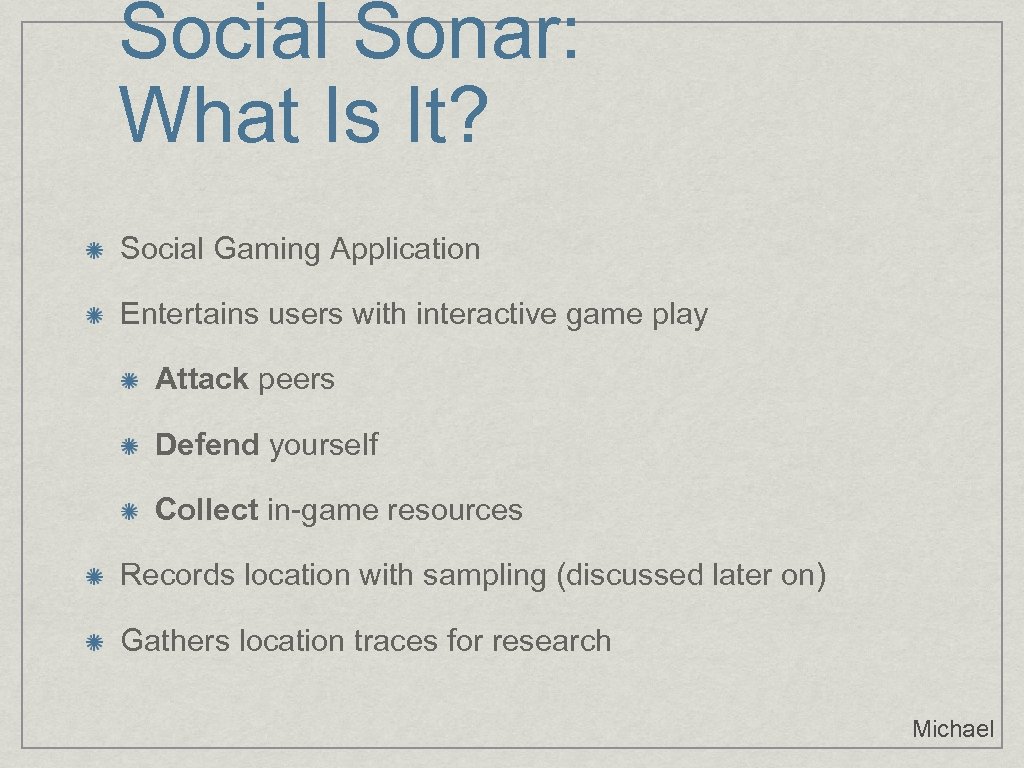
Social Sonar: What Is It? Social Gaming Application Entertains users with interactive game play Attack peers Defend yourself Collect in-game resources Records location with sampling (discussed later on) Gathers location traces for research Michael
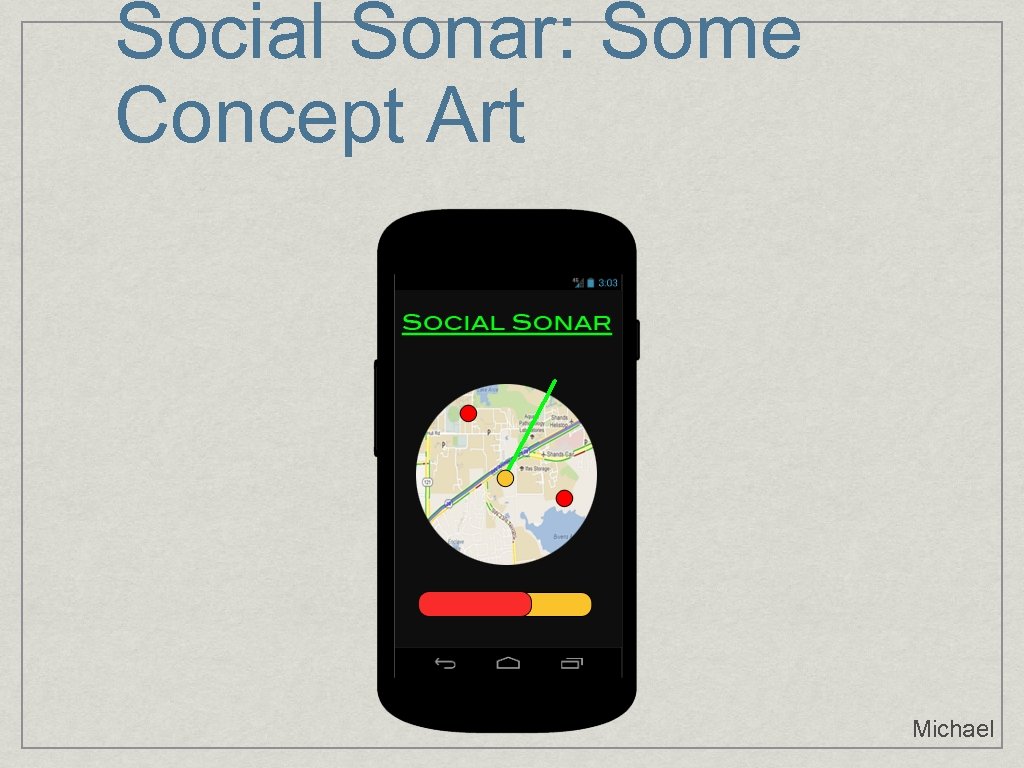
Social Sonar: Some Concept Art Michael
Are There Any Existing Solutions? Cell phone applications NFC based proximity gaming for the Blackberry Geo-proximity alarm Tap War Google’s Ingress; a mobile reality game [Hanke] RFID tags to recognize patient/ medicine information. Some frameworks JCAF; the Java Context Awareness Framework [Bardram] Qualcomm's Gimbal Sathvik
![What Services Will We Provide Location discovery service People discovery service [An, Wang] Geo-fencing](https://present5.com/presentation/7ff0aec6129820416eff772ad15a51c2/image-7.jpg "What Services Will We Provide Location discovery service People discovery service [An, Wang] Geo-fencing")
What Services Will We Provide Location discovery service People discovery service [An, Wang] Geo-fencing Interest sensing An AWARE framework [Bardram] Infrastructure service for research Context aware services [Bardram] Sathvik
Requirement Specifications: Functional Requirements Must find enemies and friends: Requires Google Maps API to plot users’ locations and set a vision radius Must seamlessly detect other users around the active user Must house a database of resources and use them for later purposes such as building fortresses or houses to defend a location Must publish updates to the user in a non-invasive manner: Toast messages for notifications Akshita
Requirement Specifications: Non-Functional Requirements Availability: All times when in range of Wi. Fi Security concerns Resolution, screen form factors Visual aesthetics Support for multiple channels: Wi. Fi, 3 G. The application will prefer Wi. Fi Efficiency: Ensure less battery consumption by minimizing GPS usage Akshita
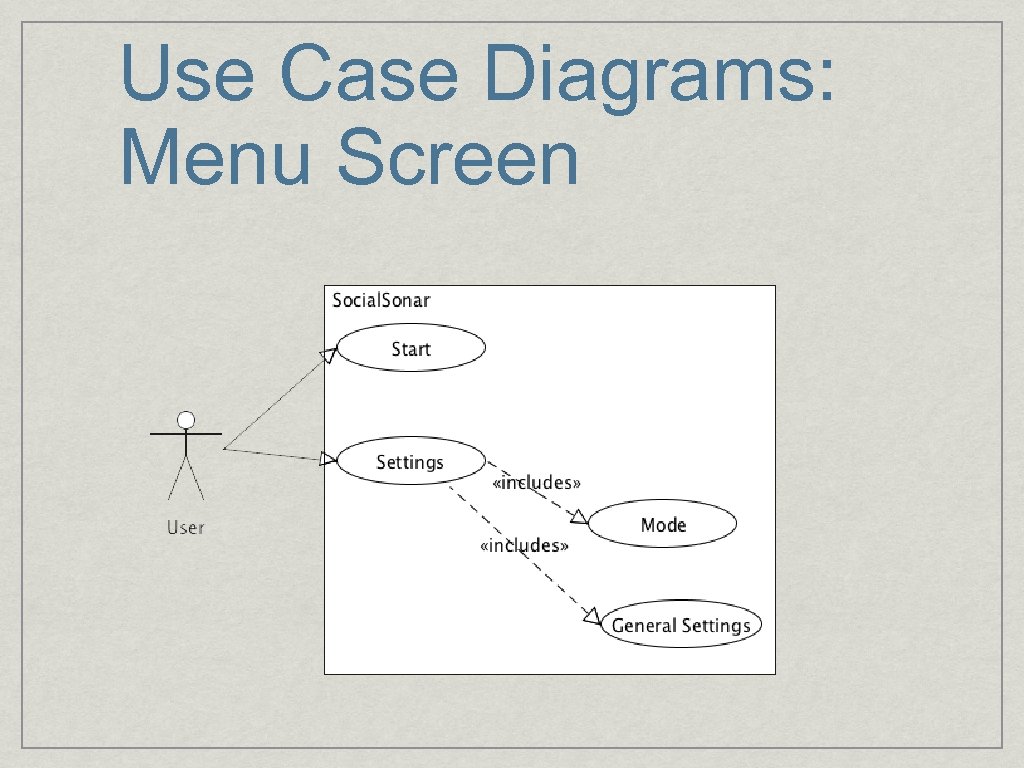
Use Case Diagrams: Menu Screen
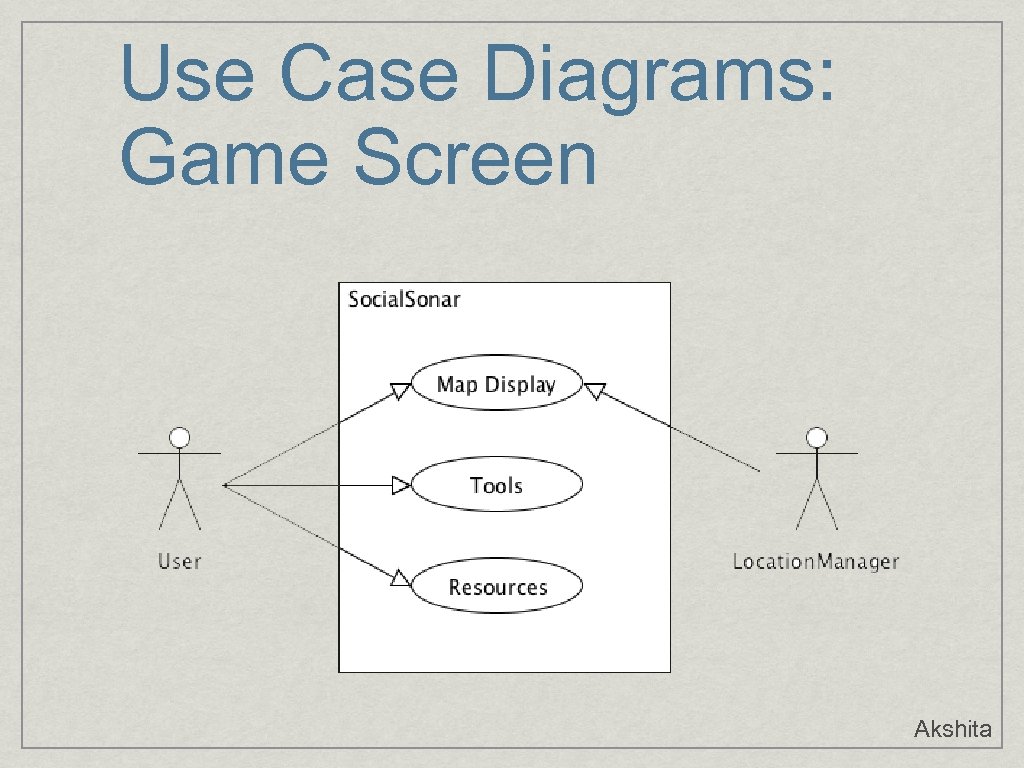
Use Case Diagrams: Game Screen Akshita
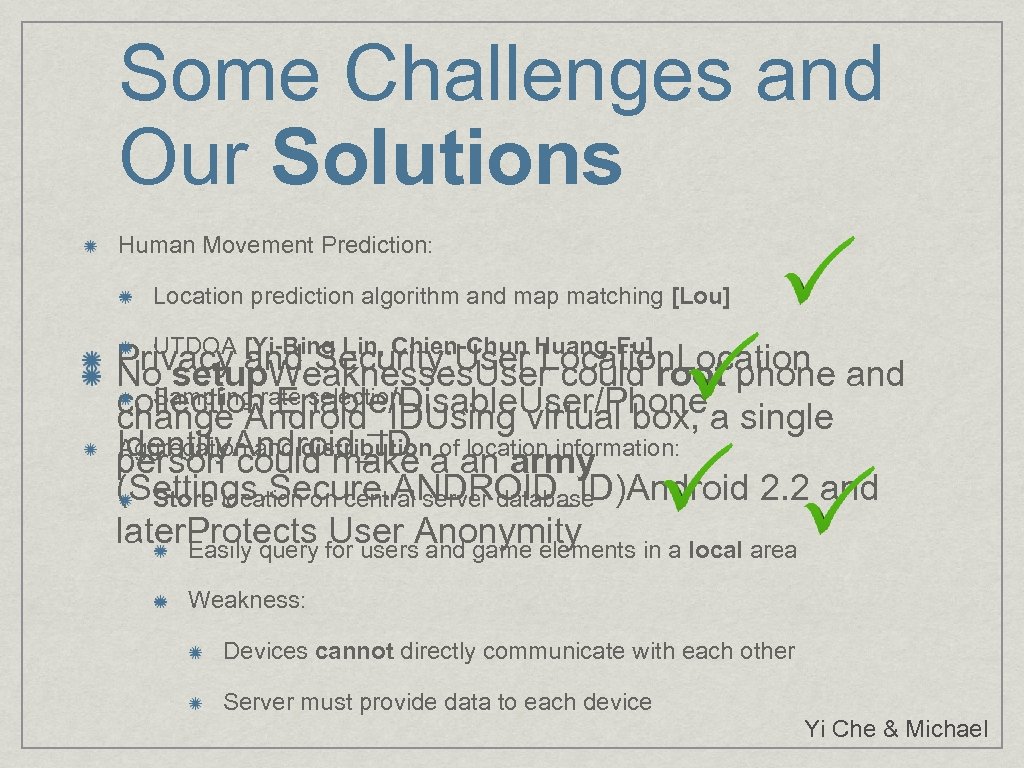
Some Challenges and Our Solutions Human Movement Prediction: Location prediction algorithm and map matching [Lou] UTDOA [Yi-Bing Lin, Chien-Chun Huang-Fu] Privacy and Security: User Location No setup. Weaknesses. User could root phone and Sampling rate selection collection Enable/Disable. User/Phone change Android_IDUsing virtual box, a single Aggregation and distribution of location information: Identity. Android_ID person could make a an army (Settings. Secure. ANDROID_ID)Android 2. 2 and Store location on central server database later. Protects User Anonymity Easily query for users and game elements in a local area Weakness: Devices cannot directly communicate with each other Server must provide data to each device Yi Che & Michael
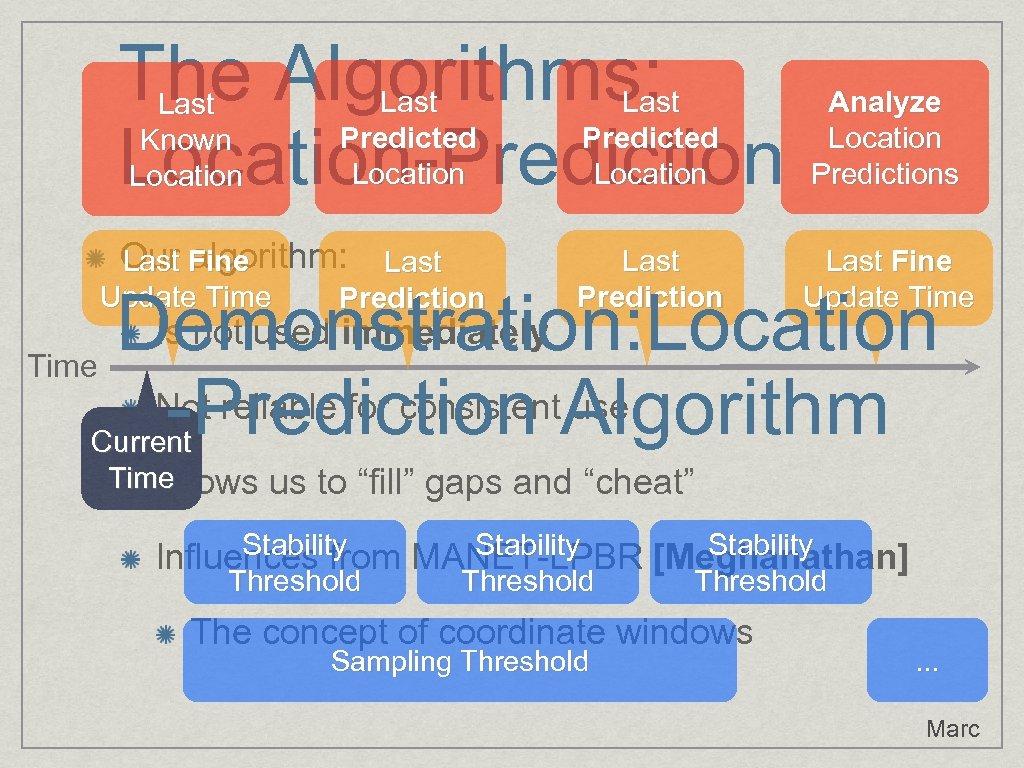
The Algorithms: Location-Prediction Last Known Location Last Predicted Location Our algorithm: Last Fine Last Prediction Last Predicted Location Analyze Location Predictions Last Prediction Last Fine Update Time Is not used immediately Demonstration: Location Time Not reliable for consistent use -Prediction Algorithm Update Time Current Time Allows us to “fill” gaps and “cheat” Stability Influences from MANET-LPBR [Meghanathan] Threshold The concept of coordinate windows Sampling Threshold . . . Marc
Our Design Rationale Sampling rate: Fair balance between accuracy and power consumption User can always switch to “intense mode” Location prediction algorithm: Allows us to “cheat” when obtaining location information Limit the user’s field of vision: Fits theme of our game, and adds an element of balance Sathvik
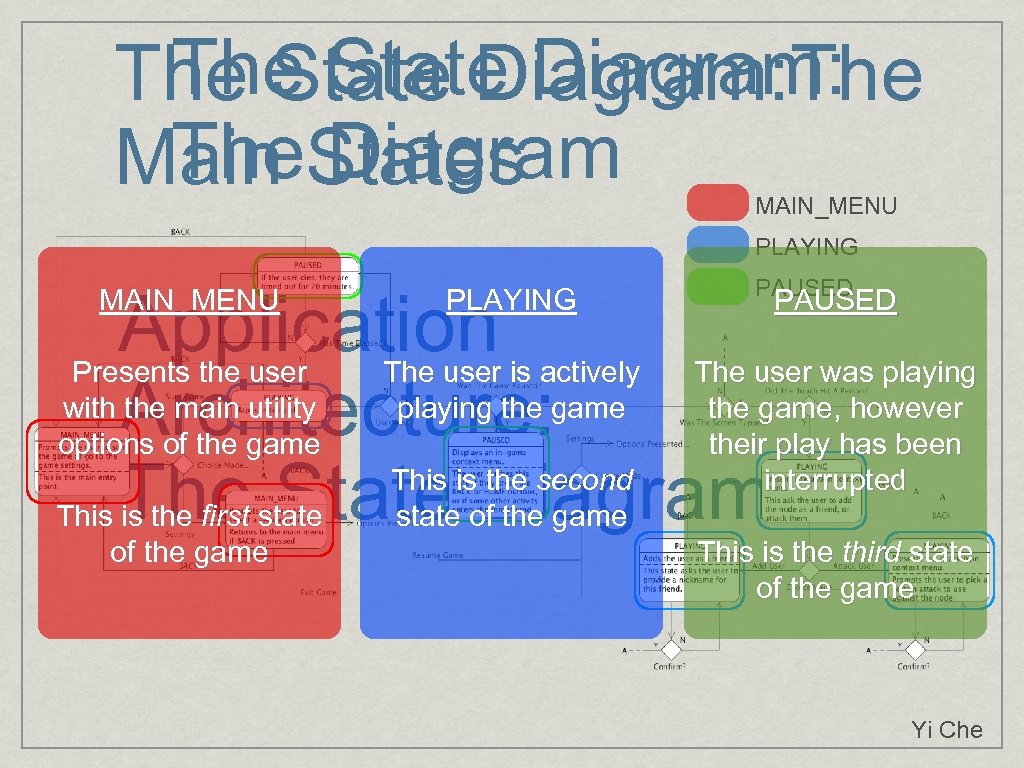
The State Diagram: The Diagram Main States MAIN_MENU PLAYING PAUSED Application Architecture: The State Diagram MAIN_MENU PLAYING Presents the user with the main utility options of the game The user is actively playing the game This is the first state of the game This is the second state of the game PAUSED The user was playing the game, however their play has been interrupted This is the third state of the game Yi Che
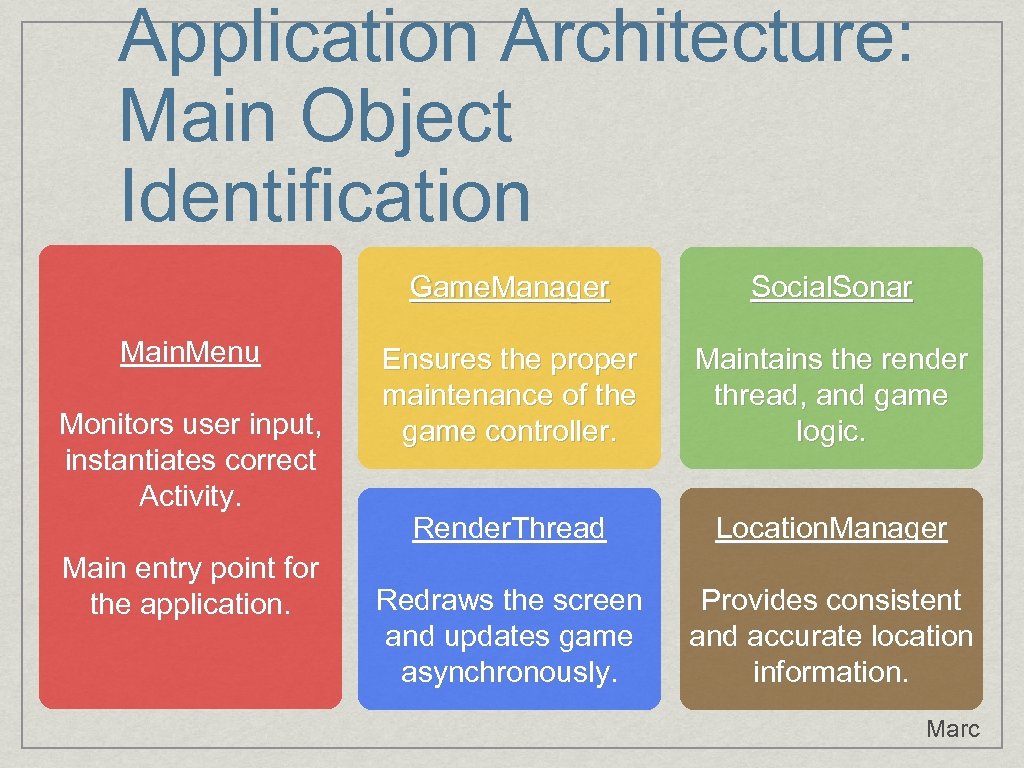
Application Architecture: Main Object Identification Game. Manager Main. Menu Monitors user input, instantiates correct Activity. Main entry point for the application. Social. Sonar Ensures the proper maintenance of the game controller. Maintains the render thread, and game logic. Render. Thread Location. Manager Redraws the screen and updates game asynchronously. Provides consistent and accurate location information. Marc
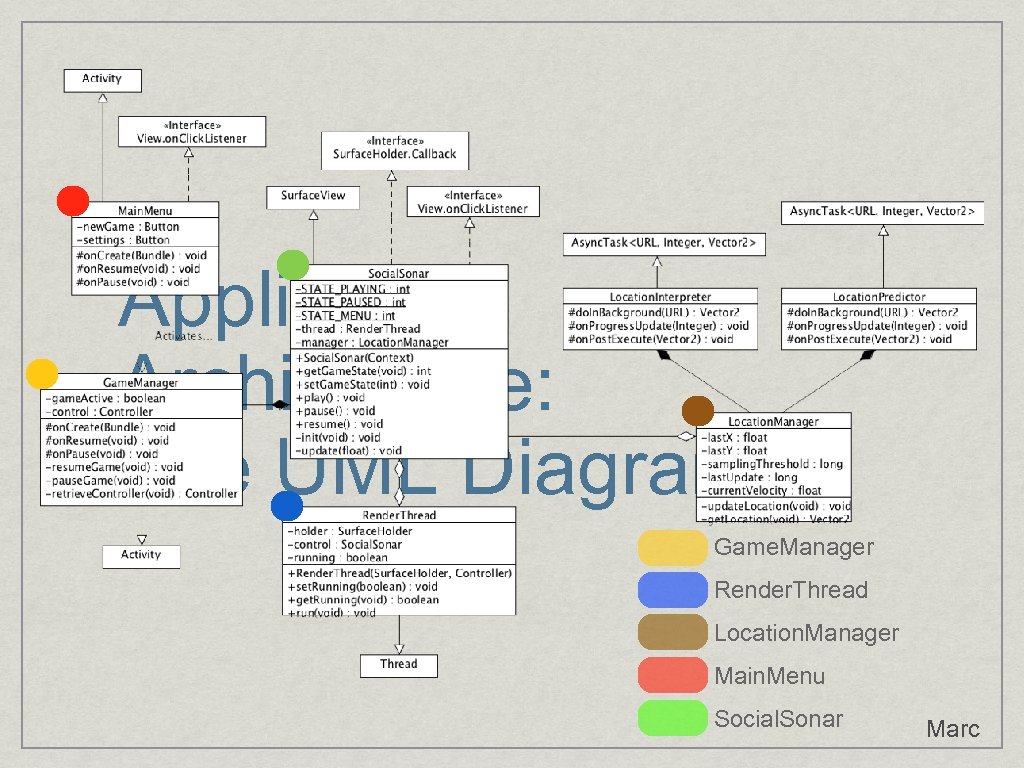
Application Architecture: The UML Diagram Game. Manager Render. Thread Location. Manager Main. Menu Social. Sonar Marc
Presentation Review The Challenges of Our Design What Is Social Sonar? The Application Architecture: Requirement Specifications The use-case diagram Functional Requirements Main Object Identification Non-Functional Requirements The Application Architecture The UML Diagram Presentation Review The State Diagram Marc
Awareness Framework (JCAF) – A Service Infrastructure and Programming Framework for Context-Aware Applications. 2005. Xueli An, Jing Wang. OPT – Online Person Tracking System for Context-awareness in Wireless Personal Network Kumar, Udayan. i. Trust. Ahmed Helmy. 2012. Application. 7 Mar 2013. <http: //128. 227. 176. 22: 8182/i. Trust. html>. (Demo). 2006. Ralph Löwe, Peter Mandl, Michael Bill Schilit, Norman Adams, Roy Want. “Context Aware Computing Applications” Weber. Context Directory: A Context-Aware Service http: //graphics. columbia. edu/courses/mobwear/resources/schilit-mcsa 94. pdf for Mobile Context-Aware Computing Applications Perez, Sarah. "Intelligent, Context-Aware Personal Assistant App “Friday” Makes Its Public by the Example of Google Android. 2012. Yi-Bing Debut. "Tech. Crunch. 12 Jul 2012: n. page. Web. 7 Mar. 2013. Lin, Chien-Chun Huang-Fu, Predicting Human * Stemm, Mark, Paul Gauthier, Daishi Harada, and Randy Katz. "Reducing Power Consumption of Network Interfaces in Hand-Held Devices. " Cite. Seer. X. Berkeley, n. d. Web. 18 Feb 2013. Movement based on Telecom's Handoff in Mobile <http: //citeseerx. ist. psu. edu/viewdoc/summary? doi=10. 1. 1. 39. 8384>. Networks. Agarwal, Yuvraj, Steven Hodges, Ranveer Chandra, et al. Augmenting Network Interfaces to Reduce PC Energy Usage. San Diego: 2009. http: //liny. csie. nctu. edu. tw/document/tmc 11_PHM. pd Sohan, Ripduman, Andrew Moore, et al, and Andrew Rice. Characterizing 10 Gbps Network Interface f. Hanke, John. "Google Launches Ingress, a Energy Consumption. Cambridge: 2010. Worldwide Mobile Alternate Reality Game. " Lou, Yin, Chengyang Zhang, Yu Zheng, et al. "Map-Matching for Low-Sampling-Rate GPS Trajectories. ". Houston: Microsoft Research, 2010. Web. 4 Apr. 2013. <http: //research. microsoft. com/pubs/105051/Map allthingsd. (2012): n. page. Web. 28 Feb. 2013. -Matching for Low-Sampling-Rate GPS Trajectories-camera. Ready. pdf>. <http: //allthingsd. com/20121115/google-launchesingress-a-worldwide-mobile-alternate-reality-game/>. Bibliography

Are there any questions?
Скачать презентацию Social Sonar Control Your World Before
7ff0aec6129820416eff772ad15a51c2.ppt