


 Скачать презентацию Social Science Implementation and Management of a National
1d84beb177c2639a595c6523f09e6e14.ppt
- Количество слайдов: 26
 Social Science: Implementation and Management of a National Initiative- the example of the UK Data Archive Prof K. Schürer Director, UK Data Archive President, CESSDA Project Co-ordinator, EC FP 7/ESFRI PPP 1 st African Digital Curation Conference Pretoria, 12 -13 February, 2008
 UKDA history & overview • • Archive established in 1968 (as ‘Data Bank’) Funded by (then) SSRC to provide a service to UK HE sector Initial focus on government survey data New distributed service established 1 Jan. 2003 – Economic and Social Data Service (ESDS) • Mixed data types and formats – Specialist Qualidata unit and History Data Service • Still predominately funded to provide service for HE/FE sectors – ESRC, JISC, University of Essex – Project funding (EC, JISC, MRC, AHRC, etc. ) • • Since 2005 designated as ‘Place of Deposit’ by TNA C. 60 staff – mixture of staff expertise/skills
 UKDA now runs a family of services • • • ESDS Census Programme Registration Service and Portal History Data Service Hist. Pop Rural Environment and Land Use Data Support Service Nesstar Support Service Plus R&D projects: • STo. RE • De. XT • CESSDA-PPP …
 Specialist data services • • ESDS Government International Longitudinal Qualidata Greater emphasis on: ― ― value-added data and documentation enhanced resource discovery improved delivery services support and training for the secondary use of data for research, learning and teaching ― outreach and promotion
 Data RIs can work • 5, 000+ datasets in the collection • 250+ new datasets are added each year (and new versions) • C. 50, 000 orders for data per year • C. 115, 000 online sessions • C. 48, 000 registered users • C. 17, 000 page hits and C. 950, 000 pdf downloads last year • Gateway to other collections (CESSDA, ICPSR)
 Who produces social science data? • • Government agencies HE/FE sector Private sector Within HE/FE not just ESRC funded – MRC, NERC, AHRC, Wellcome, Leverhulme, Rowntree • Increasing number of large digitisation projects – JISC, NOF • • Increasing tendency for government agencies to contract out survey work to private sector (Nat. Cen) University sector tend not to get Government contracts Devolution Local Government
 Types of data • • • Quant and Quali Surveys Censuses Administrative data Also increasing amounts of ‘non-survey’ type data – – Images Sound Video Mixed media
 Selection guided by ‘use’ & ‘users’ • • • UKDA seeks to identify and acquire material within broad areas Discipline coverage: at the broadest level, data and other electronic resources relating to society, in particular data about individuals or groups of individuals. This includes strategic social science and economic datasets e. g. unemployment statistics, major household surveys. Geographic coverage: data across a broad geographic coverage focusing on the United Kingdom and cross-national datasets but including material from other countries where appropriate and in particular where these provide opportunities for comparative research e. g. European data. Temporal coverage: there are no restrictions on temporal coverage, although pre-1945 accessions are acquired through History Data Service. Time series and panel data: data are sought which create or add to a time series and/or panel survey. Thematic coverage: to create a coherent body of materials relating to a particular discipline or field of enquiry e. g. health.
 But do you need to keep everything? • Curation needs to be informed by selection and appraisal • Resource allocation • Rights issues / technical issues • Short term vs long term • Aggregative value • Need to estimate what are the costs of NOT preserving something
 ESRC award holders • Have been required to offer data for access/curation for over 20 years (more recent MRC) • Some reluctance • Need to work with carrots and sticks • Move to data management life-cycle approach • Move to self-archiving
 Preservation in outline w Standard directory structure for complete dataset w w Everything in one place Consistent structure makes precisely locating information easy Makes caching of specific information types simple Allows future migration to other systems and formats easier w Data and documentation stored in portable format w Ability to freely and intelligently read on many platforms w Easier conversion to required format w Easier migration to new portable format
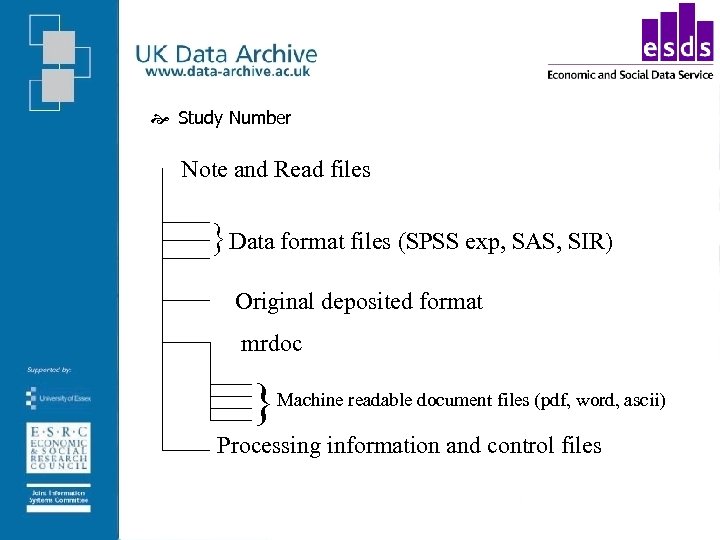 Study Number Note and Read files }Data format files (SPSS exp, SAS, SIR) Original deposited format mrdoc } Machine readable document files (pdf, word, ascii) Processing information and control files
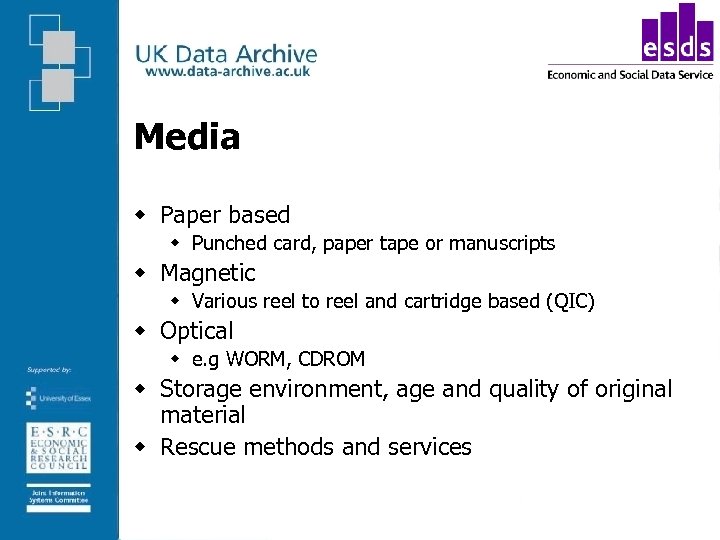 Media w Paper based w Punched card, paper tape or manuscripts w Magnetic w Various reel to reel and cartridge based (QIC) w Optical w e. g WORM, CDROM w Storage environment, age and quality of original material w Rescue methods and services
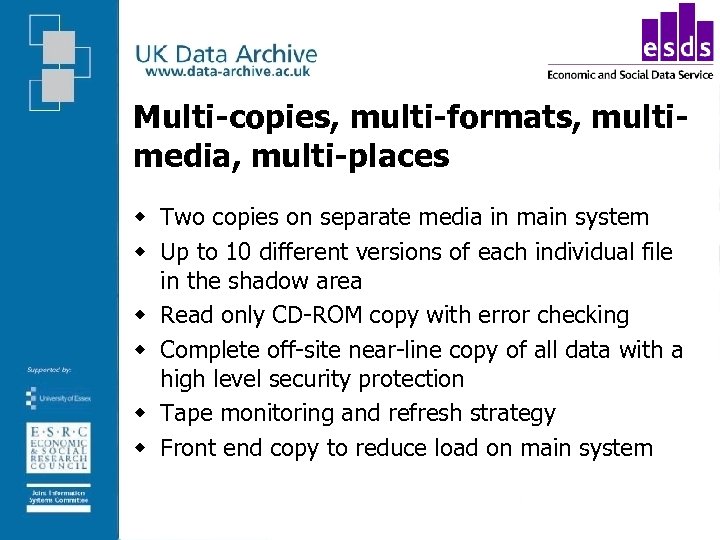 Multi-copies, multi-formats, multimedia, multi-places w Two copies on separate media in main system w Up to 10 different versions of each individual file in the shadow area w Read only CD-ROM copy with error checking w Complete off-site near-line copy of all data with a high level security protection w Tape monitoring and refresh strategy w Front end copy to reduce load on main system
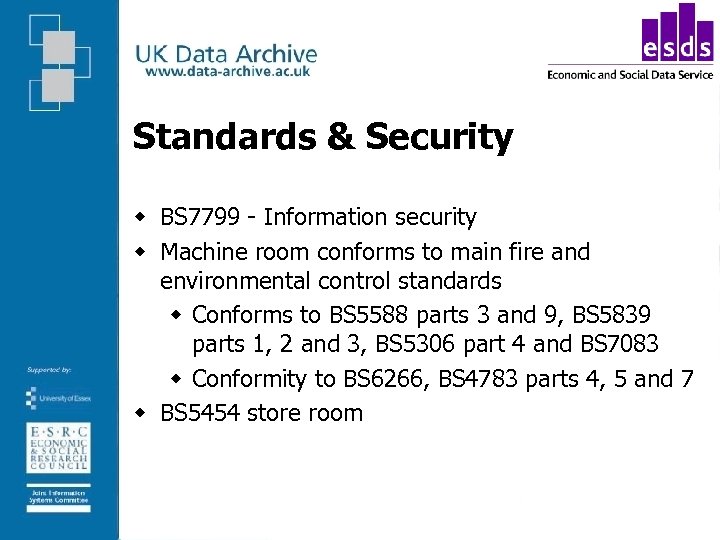 Standards & Security w BS 7799 - Information security w Machine room conforms to main fire and environmental control standards w Conforms to BS 5588 parts 3 and 9, BS 5839 parts 1, 2 and 3, BS 5306 part 4 and BS 7083 w Conformity to BS 6266, BS 4783 parts 4, 5 and 7 w BS 5454 store room
 But – curation and long-term preservation should not (cannot? ) happen in isolation
 Challenges • Legal issues – Move toward greater openness and transparency – Freedom of Information Act, 2000 – Yet greater concerns with confidentiality (Data Protection Act, 1994) – Statistics Act (approved researcher status) • Data issues – Confidentiality – secure data service – Ethical issues (REC’s) – ‘grey’ data/publications (research outputs)
 Challenges #2 • Technical issues – – e-Science and data grid Institutional repositories ‘Self-archiving’ (UKDA-Store) Facebook/google generation • Political issues – RCUK, OECD statements on research outputs • Resource issues – Who pays?
 General Aims of the CESSDA Research Infrastructure PPP • The focus of this project will be a major upgrade of the CESSDA RI to ensure that European Social Science and Humanities (SSH) researchers have access to, and gain support for, data resources they require to conduct research of the highest quality, irrespective of the location of either researcher or data within the European Research Area (ERA). • The project will also improve the CESSDA RI so that member organisations are able to transcend the limitations of their national resources through the creation of a common platform, mission and stronger form of integration in which expertise is genuinely pooled, shared and applied in a co-ordinated pan-European experience. • This project will facilitate the delivery of a fully-integrated data archive infrastructure for the SSH, allowing seamless, permanent access to as many data holdings across Europe as possible.
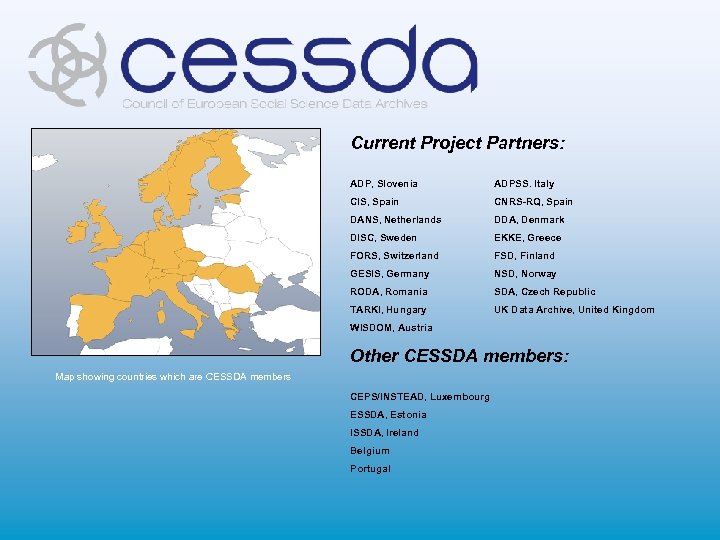 Current Project Partners: ADP, Slovenia ADPSS. Italy CIS, Spain CNRS-RQ, Spain DANS, Netherlands DDA, Denmark DISC, Sweden EKKE, Greece FORS, Switzerland FSD, Finland GESIS, Germany NSD, Norway RODA, Romania SDA, Czech Republic TARKI, Hungary UK Data Archive, United Kingdom WISDOM, Austria Other CESSDA members: Map showing countries which are CESSDA members CEPS/INSTEAD, Luxembourg ESSDA, Estonia ISSDA, Ireland Belgium Portugal
 Europe Associated • LSZDA (Latvian Databank of Social Sciences) • Academy of Sciences, Riga. DBSR (Bank of Social Data) • Institute of Sociology, Academy of Sciences Russian Sociological Data Archive, • Social Science Data Archive at REGLO Slovak Archive of Social Data • Archive of the Institute for Sociology at the Slovak Academy of Sciences • Archive of Sociological Data, Warsaw • Rudjer Boskovic Institute, University of Zagreb • University of Belgrade, Serbia • Institute of Sociology of the National Academy of Sciences of Ukraine • Kyiv National Taras Shevchenko University, Ukraine • KIIS (Kiev International Institute of Sociology), Databank • CPIJM, Centre for Political Studies and Public Opinion Research, • University of Ss. Cyril and Methodius, North America • ICPSR, Inter-university Consortium for Political and Social Research, Michigan, USA • SSHRC, Canada Australia • ASSDA, Australian Social Science Data Archive, Canberra Partners:
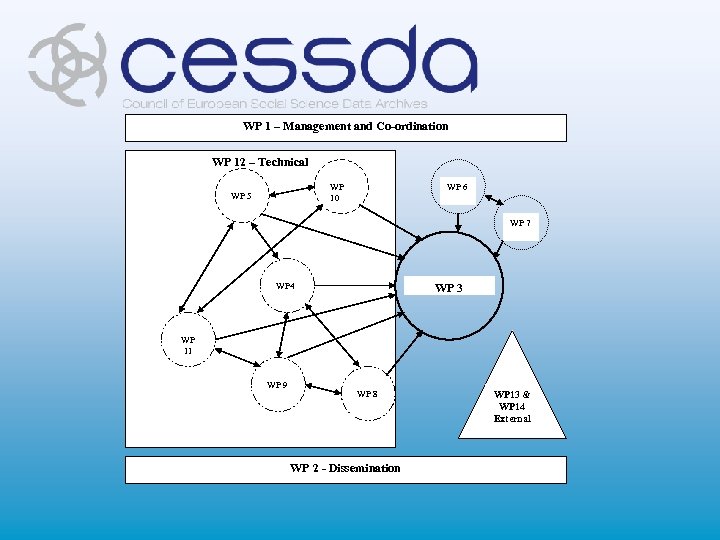
 Work Package Descriptions and their Beneficiaries • WP 1: Management and Co-ordination (UKDA) • WP 2: Dissemination Management (UKDA) • WP 3: Defining the Strategic, Financial, Governance and Legal Framework (UKDA) • WP 4: Controlled Vocabularies (FSD)
 Work Package Descriptions and their Beneficiaries • WP 5: Developing the CESSDA RI onestop-shop Portal (NSD) • WP 6: Strengthening the CESSDA RI (RODA) • WP 7: Widening the CESSDA RI (GESIS)
 Work Package Descriptions and their Beneficiaries • WP 9: Deepening the CESSDA RI by building an infrastructure for content harmonisation and conversion (GESIS) • WP 10: Data collection, dissemination and access issues (CNRS -RQ) • WP 11: Investigating the potential of grid technologies (UKDA) • WP 12: Technical Support for the Preparatory Phase (NSD)
 WP 1 – Management and Co-ordination WP 12 – Technical WP 10 WP 5 WP 6 WP 7 WP 4 WP 3 WP 11 WP 9 WP 8 WP 2 - Dissemination WP 13 & WP 14 External
 Thank you