 Скачать презентацию Social responsibility in Lithuanian companies from the viewpoint
50f56d2f9072b7a0cb7466b86554a7b3.ppt
- Количество слайдов: 20



Social responsibility in Lithuanian companies from the viewpoint of integrity RAMINTA PUČĖTAITĖ, VILNIUS UNIVERSITY INTERNATIONAL CONFERENCE „FAIR AND LEARNING BUSINESS“, SEPTEMBER 23, 2010, KAUNAS
THE AIM OF THE PILOT STUDY Explore the situation of implementing corporate social responsibility from the viewpoint of integrity in Lithuanian companies.
Conceptual background: (corporate) social responsibility • Corporate social responsibility is an organizational activity • • that exceeds legal regulations and encompasses not only business-specific economic goals but also social and environmental aspects which contribute to sustainable development (Mc. Williams and Siegel, 2001; Schoemaker et al. , 2006). Corporate social responsibility encompasses politics and practices (cf. Kleinrichert, 2008). Politics is important to strategic orientation, direction setting and rational distribution of resources. Practices are important in respect to realization of commitments made by companies to different stakeholders. Practices involve SR management tools such as SR statement/code of conduct, SR training, SR officer/committee, hotline, auditing etc.
Normative voluntarily accepted regulations – tools for social responsibility The Global Compact The Millennium Goals Global Reporting Initiative SA 8000, ISO 14000, EMAS, ISO 26000 Not speaking about house-made social responsibility statements.
Reality of organizations’ practice. . . Normative standards and rules are treated only formally (Elliot and Schroth 2002) employees are not educated in company’s values (Trevino and Weaver 2003) no enforcement elements to ethics programmes, codes of conduct used as window dressing . . . speaks of lack of integrity
Integrity defined A value resulting from adherence to the OUGHT TO VALUES IS FACTS organizationally institutionalised standards which are set by public expectations to a certain social role which an individual or a company fulfills (Vasiljevienė 2000; Kaptein and Wempe 2002). In philosophical terms, it is coherence between ought to and is. In sociological terms: values and facts. In organizational terms: public relations, advertising and real practice, product/service quality etc.
Why lack of integrity is dangerous Possible results: skepticism and cynicism (particularly in a postsocialist region), even nihilism, opportunistic behaviour (Enron, World. com and others), lost public trust in good business (Mc. Murrian and Rustogi 2004). Hence, to gain the benefits of social responsibility…
Organizations should MANAGE INTEGRITY Integrity management is understood as a systemic institutionalised value management process that involves setting the standards of decision-making and behaviour, reflection and self-governance, auditing and corrective measures (Waters, 1988; Waxenberger, 2001; Vasiljevienė, 2004). BECAUSE it can contribute to effectiveness of SR tools and SR practices: help to meet stakeholders’ expectations, earn their respect and the reputation of good corporate citizen which, in the long run, can result in business competitiveness (Fuentes-Garcia et al. , 2008).
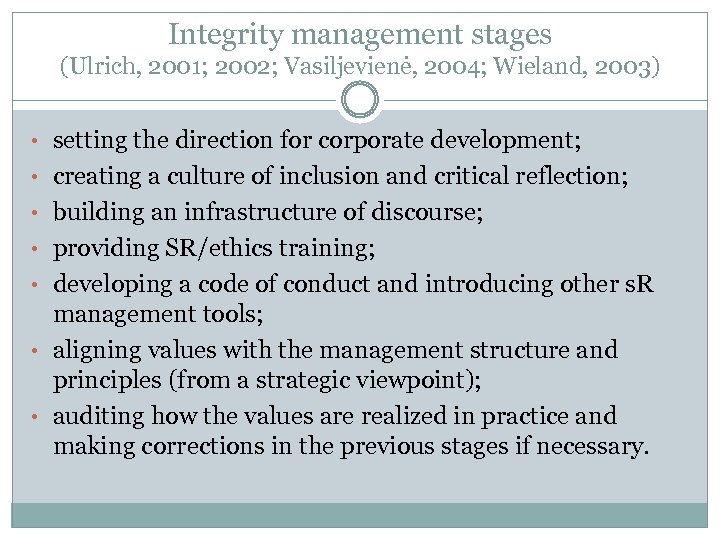
Integrity management stages (Ulrich, 2001; 2002; Vasiljevienė, 2004; Wieland, 2003) • setting the direction for corporate development; • creating a culture of inclusion and critical reflection; • building an infrastructure of discourse; • providing SR/ethics training; • developing a code of conduct and introducing other s. R management tools; • aligning values with the management structure and principles (from a strategic viewpoint); • auditing how the values are realized in practice and making corrections in the previous stages if necessary.
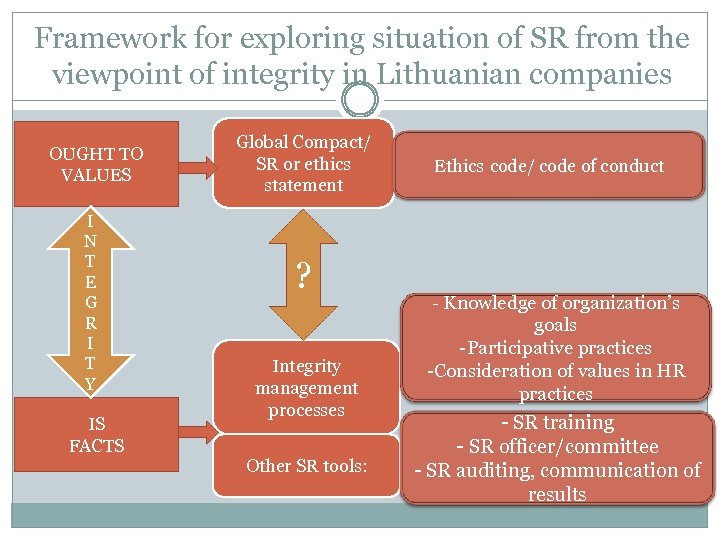
Framework for exploring situation of SR from the viewpoint of integrity in Lithuanian companies OUGHT TO VALUES I N T E G R I T Y IS FACTS Global Compact/ SR or ethics statement ? Integrity management processes Other SR tools: Ethics code/ code of conduct - Knowledge of organization’s goals -Participative practices -Consideration of values in HR practices - SR training - SR officer/committee - SR auditing, communication of results
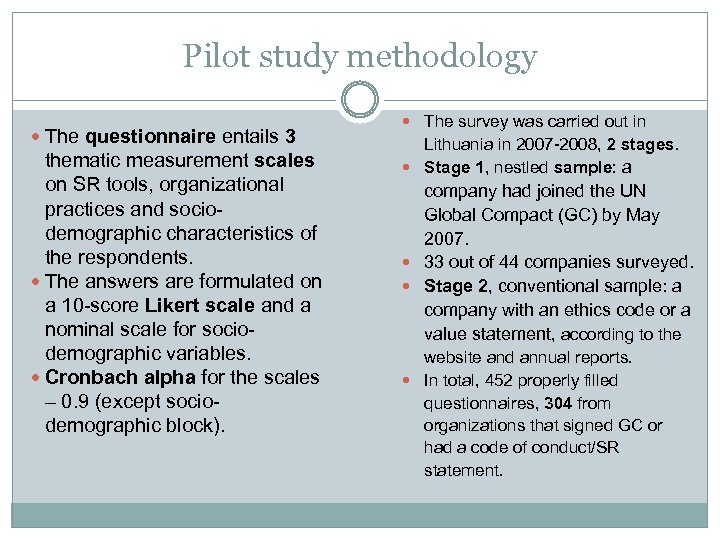
Pilot study methodology The questionnaire entails 3 thematic measurement scales on SR tools, organizational practices and sociodemographic characteristics of the respondents. The answers are formulated on a 10 -score Likert scale and a nominal scale for sociodemographic variables. Cronbach alpha for the scales – 0. 9 (except sociodemographic block). The survey was carried out in Lithuania in 2007 -2008, 2 stages. Stage 1, nestled sample: a company had joined the UN Global Compact (GC) by May 2007. 33 out of 44 companies surveyed. Stage 2, conventional sample: a company with an ethics code or a value statement, according to the website and annual reports. In total, 452 properly filled questionnaires, 304 from organizations that signed GC or had a code of conduct/SR statement.
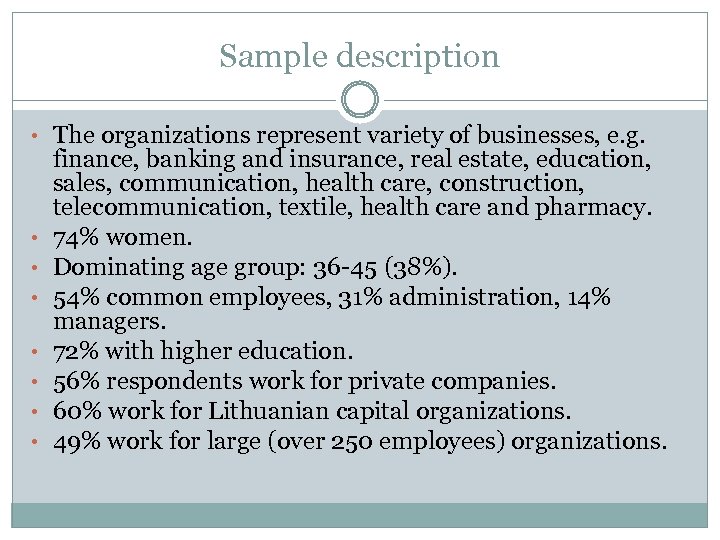
Sample description • The organizations represent variety of businesses, e. g. • • finance, banking and insurance, real estate, education, sales, communication, health care, construction, telecommunication, textile, health care and pharmacy. 74% women. Dominating age group: 36 -45 (38%). 54% common employees, 31% administration, 14% managers. 72% with higher education. 56% respondents work for private companies. 60% work for Lithuanian capital organizations. 49% work for large (over 250 employees) organizations.
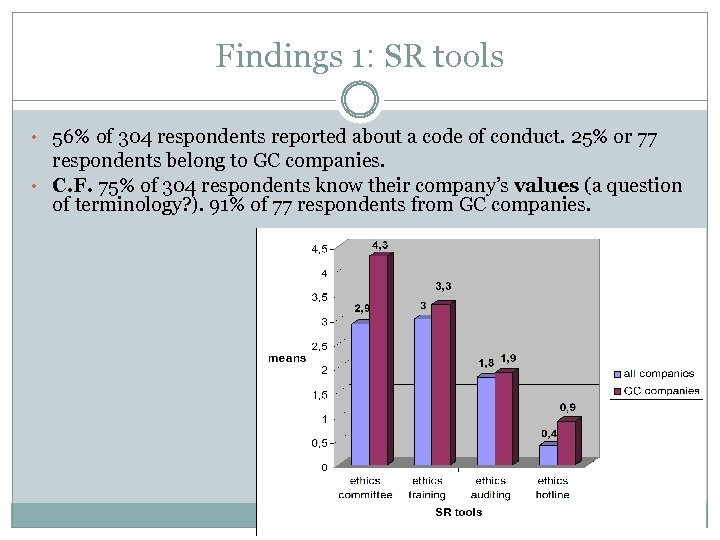
Findings 1: SR tools • 56% of 304 respondents reported about a code of conduct. 25% or 77 respondents belong to GC companies. • C. F. 75% of 304 respondents know their company’s values (a question of terminology? ). 91% of 77 respondents from GC companies.
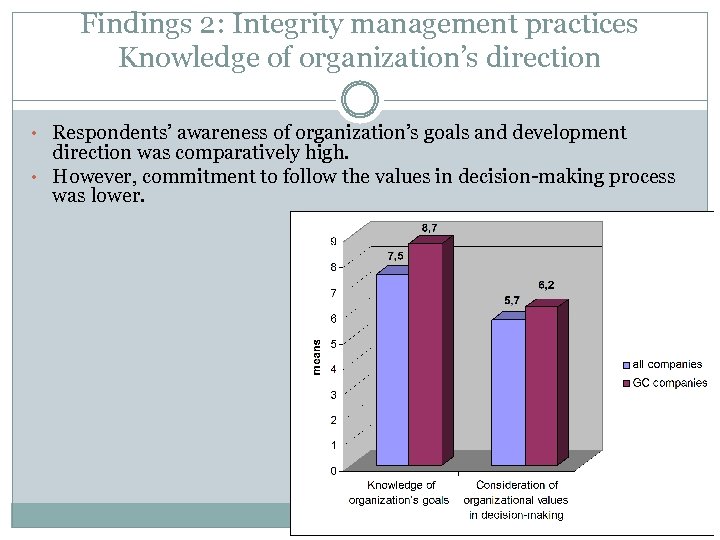
Findings 2: Integrity management practices Knowledge of organization’s direction • Respondents’ awareness of organization’s goals and development direction was comparatively high. • However, commitment to follow the values in decision-making process was lower.
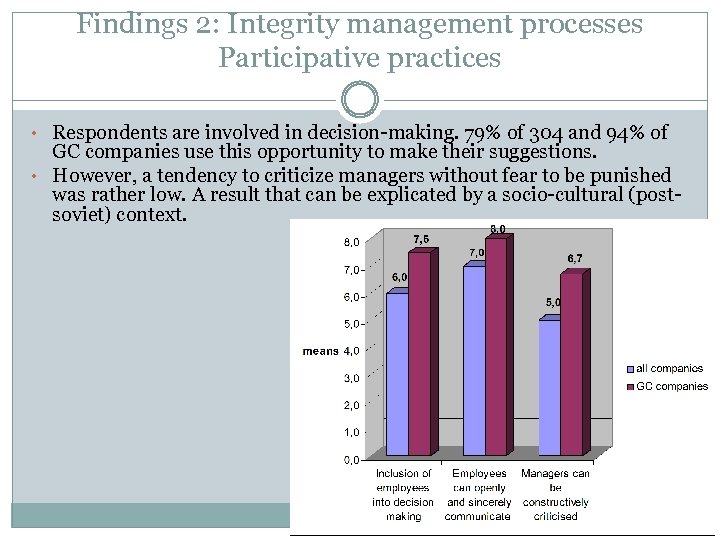
Findings 2: Integrity management processes Participative practices • Respondents are involved in decision-making. 79% of 304 and 94% of GC companies use this opportunity to make their suggestions. • However, a tendency to criticize managers without fear to be punished was rather low. A result that can be explicated by a socio-cultural (postsoviet) context.
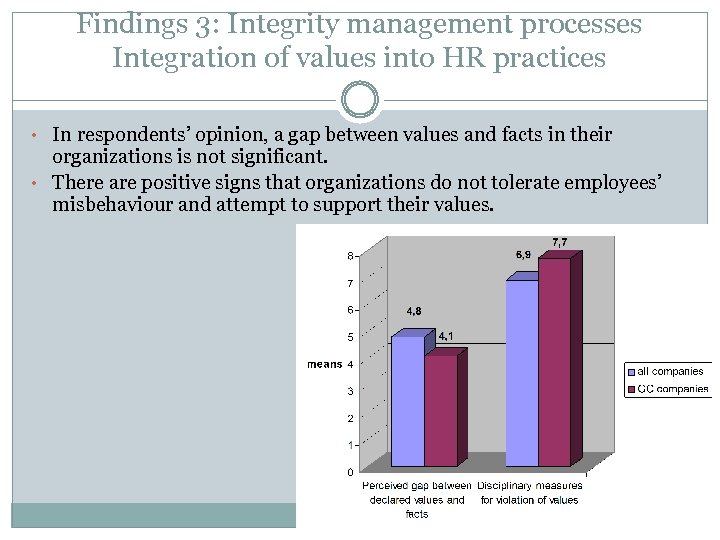
Findings 3: Integrity management processes Integration of values into HR practices • In respondents’ opinion, a gap between values and facts in their organizations is not significant. • There are positive signs that organizations do not tolerate employees’ misbehaviour and attempt to support their values.
Discussion 1 • Participation in SR initiatives, UNDP conferences and seminars • • can have a positive effect on integrity management. Potentially, development of SR tools can also be expected. Lack of perceived SR tools in the surveyed organizations implies lack of organizational attention to SR strategy. This means that not all stakeholders’ interests and not all fields of potential risks have been considered in organizations’ practice. On the other hand, organizational practices imply a much higher degree of integrity and advance in implementing SR. From a managerial viewpoint, this tendency could be considered as an advantage (we are doing it!), yet, may become threatening in economic decline when values and GC promises tend to be forgotten.
Discussion 2: managerial implications • If signing GC was prompted just by a director’s good- willingness and personal beliefs without reflection on organization’s philosophy, good intentions and practices may decrease in hard times. • The research findings imply that most of the represented organizations need to pay more attention to developing culture of discussion where a decision is based not on authority but the best argument (Habermas, 1984). • Developing such a culture demands training to employees and managers to communicate and receive criticism. This task could be tackled by internal training programmes.
Discussion 3: research limitations • The research focuses on socio-ethical issues of SR and does not consider the environmental dimension. It can be explained by the purpose of the research, i. e. to identify general tendencies of integrity management in SR field. Further research should include environmental perspective. • The paper does not consider socio-demographic characteristics. Possibly, large or foreign-capital organizations would show better results because of a different level of SR development in other European countries.
THANK YOU FOR YOUR ATTENTION!
Скачать презентацию Social responsibility in Lithuanian companies from the viewpoint
50f56d2f9072b7a0cb7466b86554a7b3.ppt