


 Скачать презентацию Social Psychology of Work Dr Craig Jackson Senior
b94c007dbc689e6ed0c30ecfec8bb822.ppt
- Количество слайдов: 57
 Social Psychology of Work Dr. Craig Jackson Senior Lecturer in Health Psychology Faculty of Health UCE Birmingham
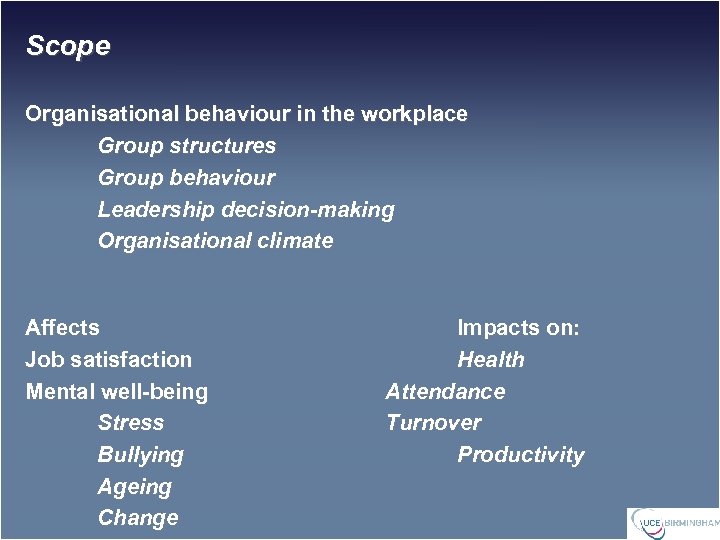 Scope Organisational behaviour in the workplace Group structures Group behaviour Leadership decision-making Organisational climate Affects Job satisfaction Mental well-being Stress Bullying Ageing Change Impacts on: Health Attendance Turnover Productivity
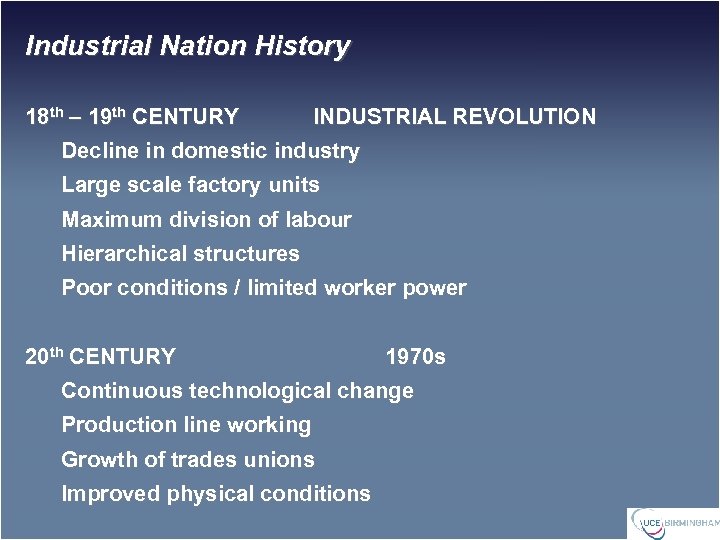 Industrial Nation History 18 th – 19 th CENTURY INDUSTRIAL REVOLUTION Decline in domestic industry Large scale factory units Maximum division of labour Hierarchical structures Poor conditions / limited worker power 20 th CENTURY 1970 s Continuous technological change Production line working Growth of trades unions Improved physical conditions
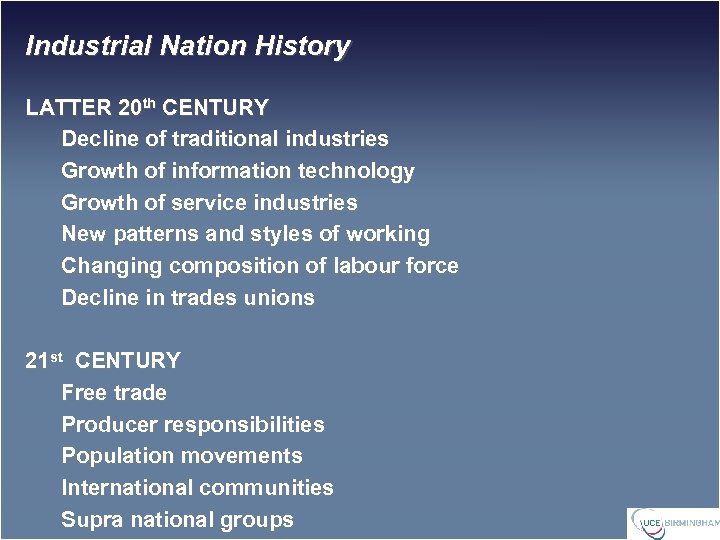 Industrial Nation History LATTER 20 th CENTURY Decline of traditional industries Growth of information technology Growth of service industries New patterns and styles of working Changing composition of labour force Decline in trades unions 21 st CENTURY Free trade Producer responsibilities Population movements International communities Supra national groups
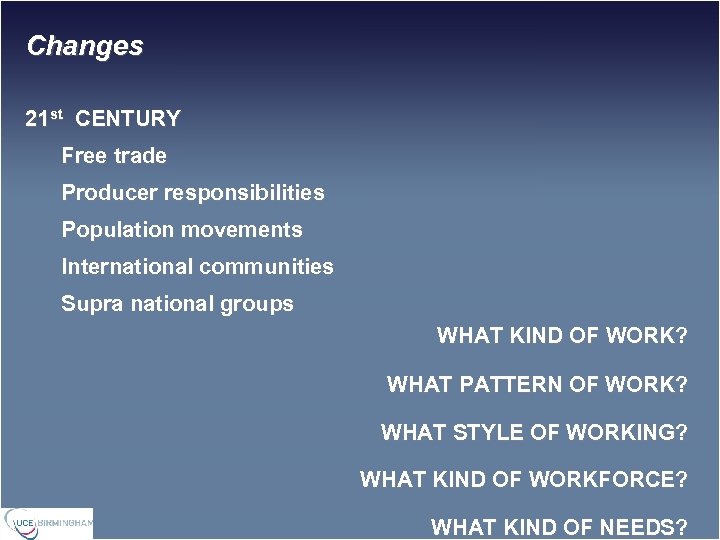 Changes 21 st CENTURY Free trade Producer responsibilities Population movements International communities Supra national groups WHAT KIND OF WORK? WHAT PATTERN OF WORK? WHAT STYLE OF WORKING? WHAT KIND OF WORKFORCE? WHAT KIND OF NEEDS?
 What Kind of Work ? NON-MANUAL KNOWLEDGE-BASED SERVICE WORK
 What Pattern of Work? 24 HOUR SOCIETY IRREGULAR HOURS NEW TECHNOLOGY CASUALISATION / SHORT-TERM CONTRACTS OUTSOURCING HOME WORKING
 What Kind of Work. Force? EDUCATED NON-UNIONISED HIGH PERCENTAGE OF WOMEN MULTI-CULTURAL AGEING REQUIREMENT FOR JOB SATISFACTION
 Traditions of Work Psychology 1. Relationship between the person and the job (Motivation / Satisfaction) 2. Interactions between individuals and groups within organizations
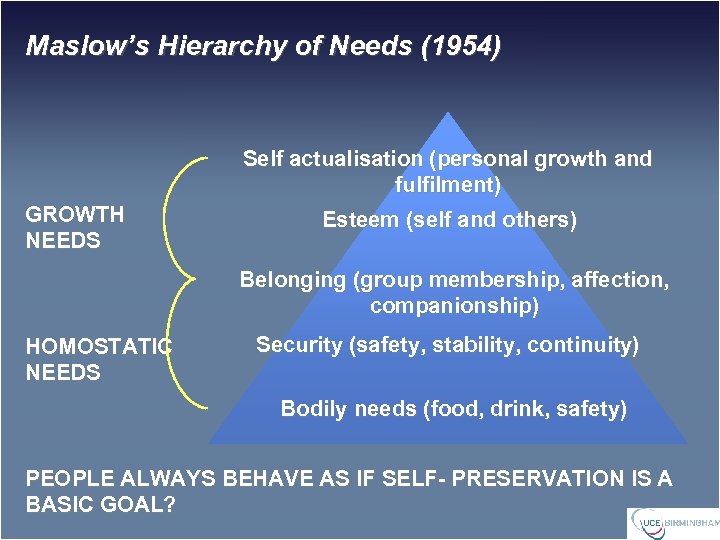 Maslow’s Hierarchy of Needs (1954) Self actualisation (personal growth and fulfilment) GROWTH NEEDS Esteem (self and others) Belonging (group membership, affection, companionship) HOMOSTATIC NEEDS Security (safety, stability, continuity) Bodily needs (food, drink, safety) PEOPLE ALWAYS BEHAVE AS IF SELF- PRESERVATION IS A BASIC GOAL?
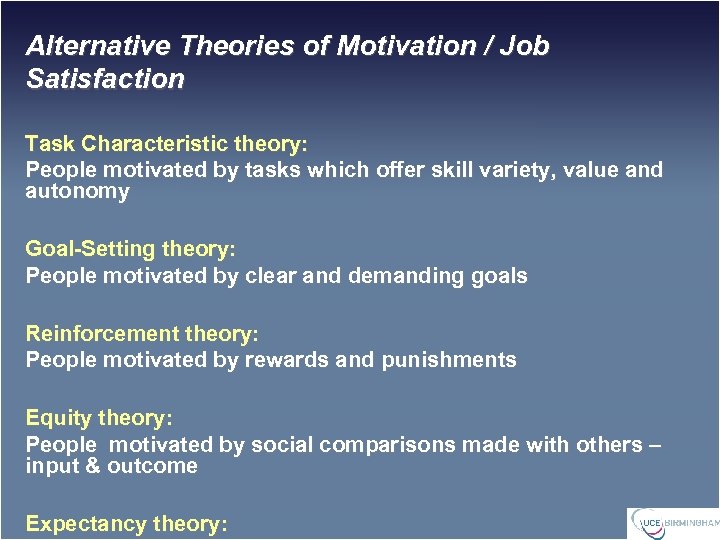 Alternative Theories of Motivation / Job Satisfaction Task Characteristic theory: People motivated by tasks which offer skill variety, value and autonomy Goal-Setting theory: People motivated by clear and demanding goals Reinforcement theory: People motivated by rewards and punishments Equity theory: People motivated by social comparisons made with others – input & outcome Expectancy theory:
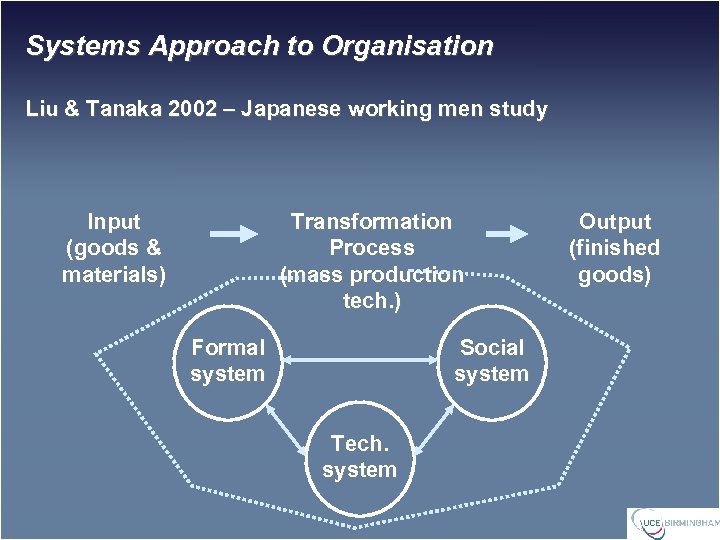 Systems Approach to Organisation Liu & Tanaka 2002 – Japanese working men study Input (goods & materials) Transformation Process (mass production tech. ) Formal system Social system Tech. system Output (finished goods)
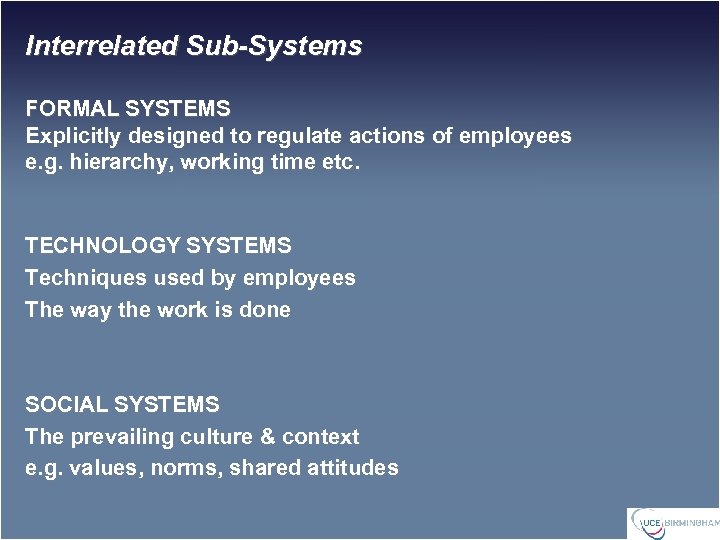 Interrelated Sub-Systems FORMAL SYSTEMS Explicitly designed to regulate actions of employees e. g. hierarchy, working time etc. TECHNOLOGY SYSTEMS Techniques used by employees The way the work is done SOCIAL SYSTEMS The prevailing culture & context e. g. values, norms, shared attitudes
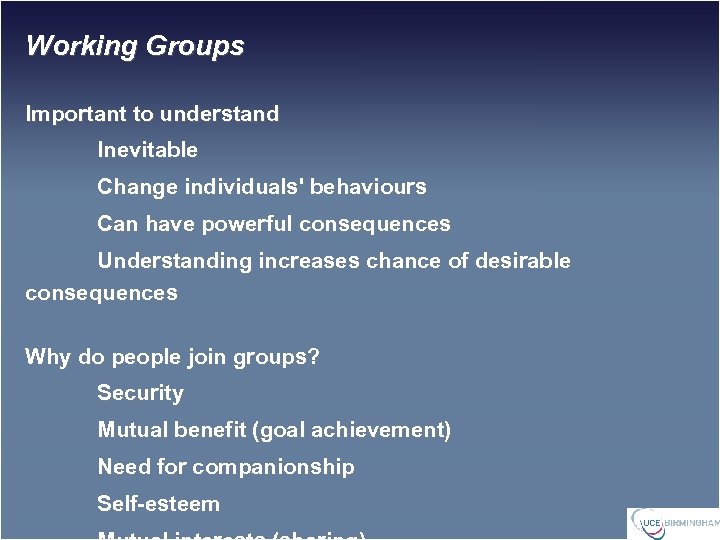 Working Groups Important to understand Inevitable Change individuals' behaviours Can have powerful consequences Understanding increases chance of desirable consequences Why do people join groups? Security Mutual benefit (goal achievement) Need for companionship Self-esteem
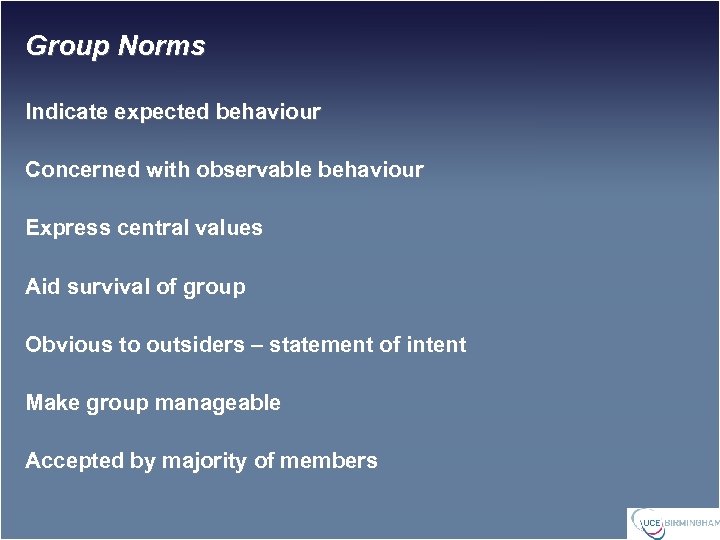 Group Norms Indicate expected behaviour Concerned with observable behaviour Express central values Aid survival of group Obvious to outsiders – statement of intent Make group manageable Accepted by majority of members
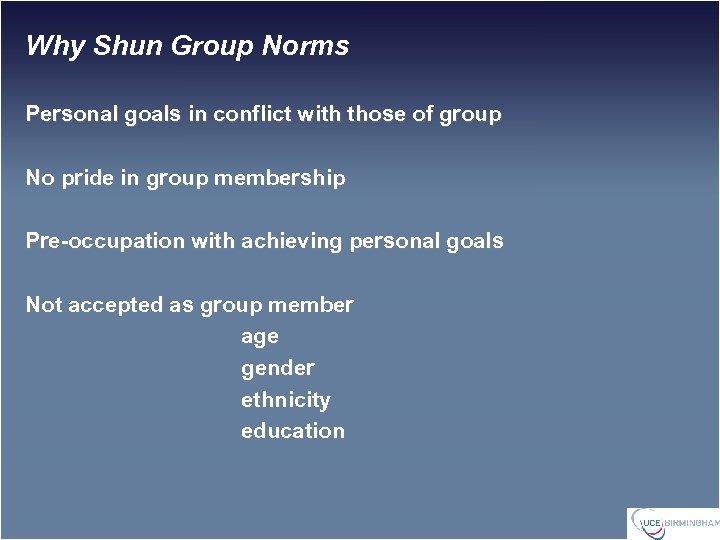 Why Shun Group Norms Personal goals in conflict with those of group No pride in group membership Pre-occupation with achieving personal goals Not accepted as group member age gender ethnicity education
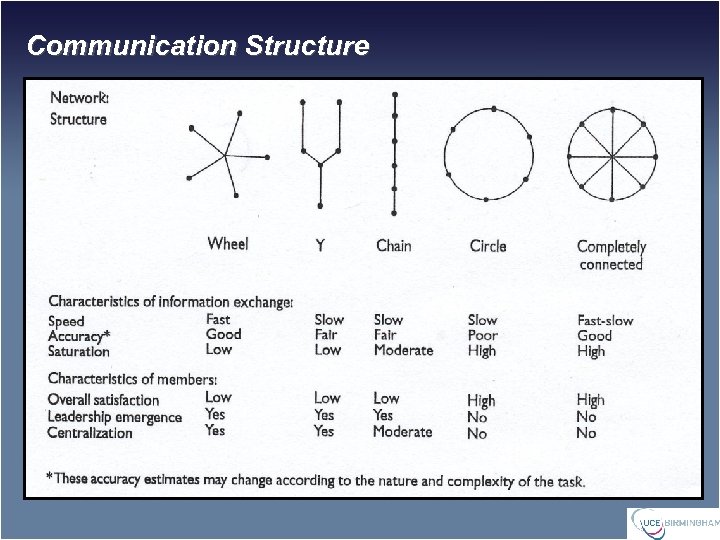 Communication Structure
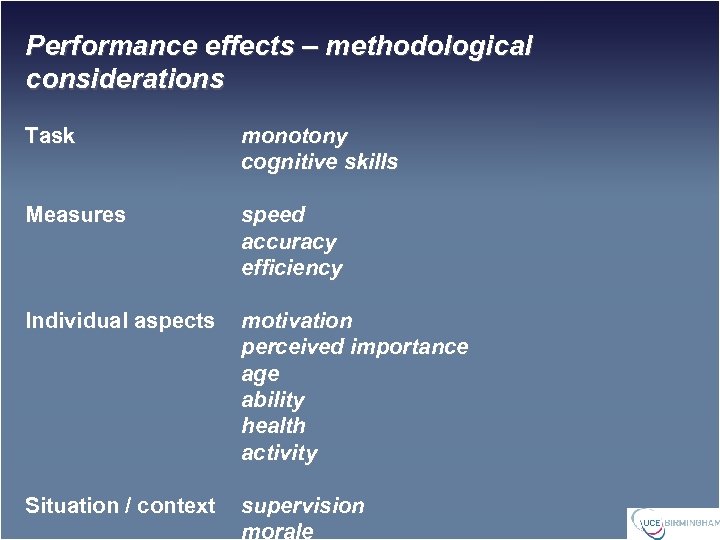 Performance effects – methodological considerations Task monotony cognitive skills Measures speed accuracy efficiency Individual aspects motivation perceived importance age ability health activity Situation / context supervision morale
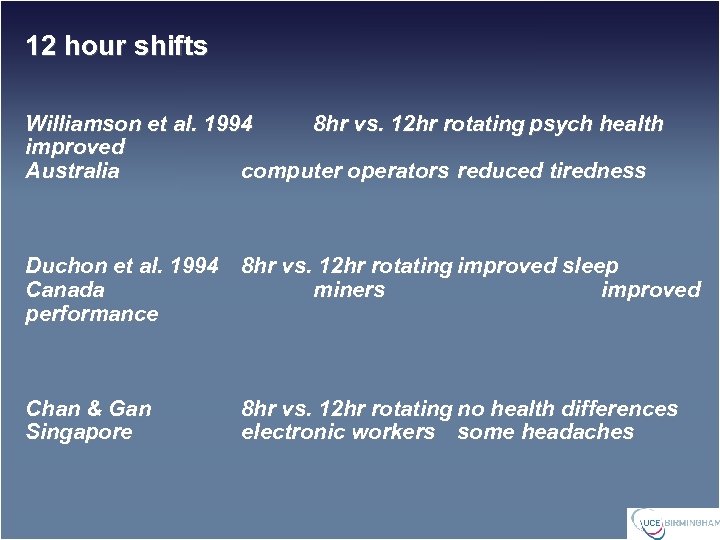 12 hour shifts Williamson et al. 1994 8 hr vs. 12 hr rotating psych health improved Australia computer operators reduced tiredness Duchon et al. 1994 Canada performance 8 hr vs. 12 hr rotating improved sleep miners improved Chan & Gan Singapore 8 hr vs. 12 hr rotating no health differences electronic workers some headaches
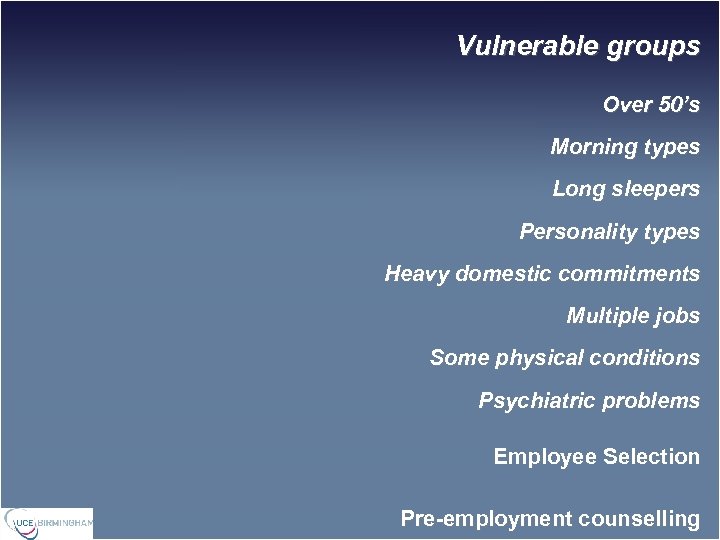 Vulnerable groups Over 50’s Morning types Long sleepers Personality types Heavy domestic commitments Multiple jobs Some physical conditions Psychiatric problems Employee Selection Pre-employment counselling
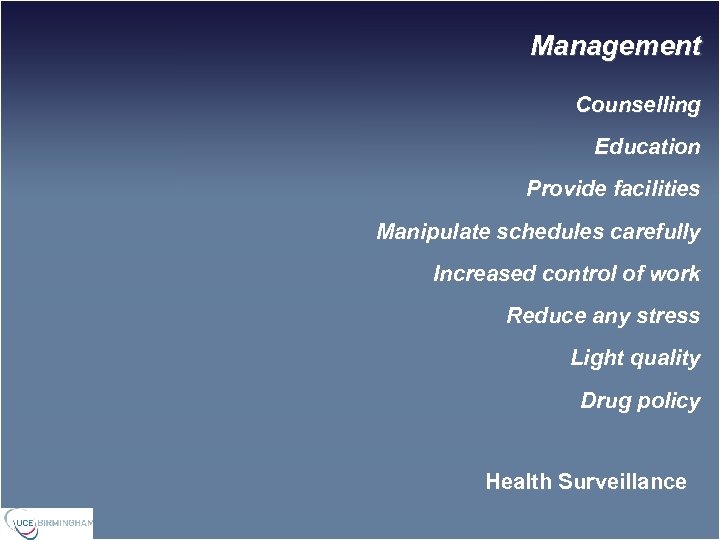 Management Counselling Education Provide facilities Manipulate schedules carefully Increased control of work Reduce any stress Light quality Drug policy Health Surveillance
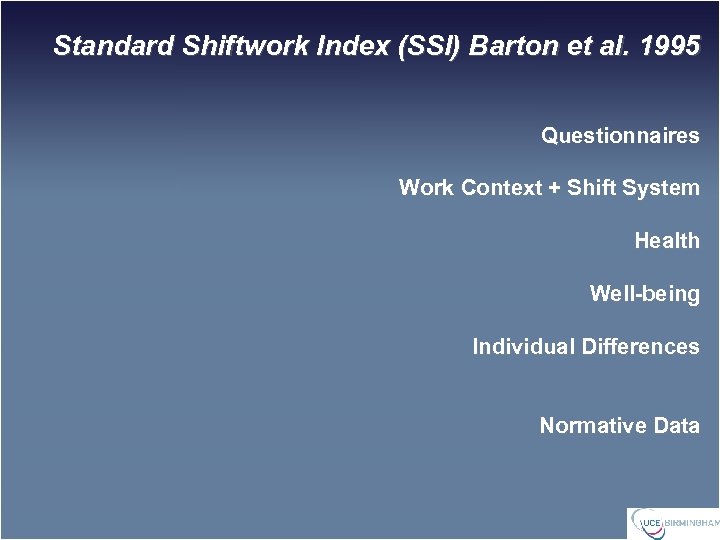 Standard Shiftwork Index (SSI) Barton et al. 1995 Questionnaires Work Context + Shift System Health Well-being Individual Differences Normative Data
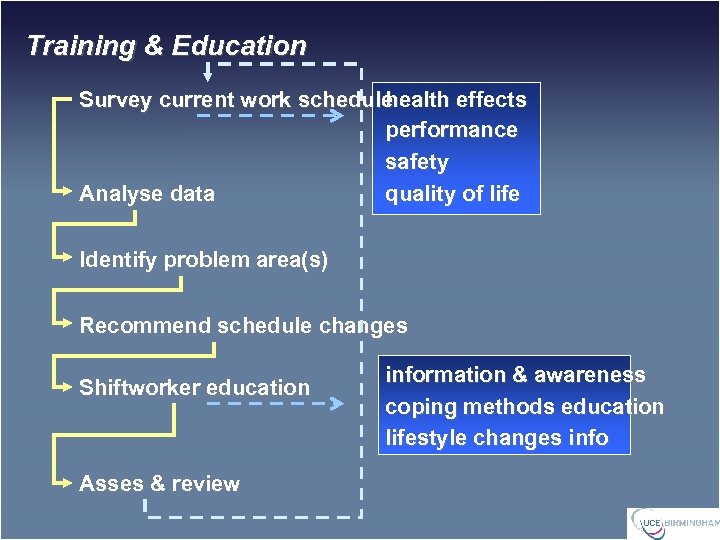 Training & Education health effects Survey current work schedule performance safety quality of life Analyse data Identify problem area(s) Recommend schedule changes Shiftworker education Asses & review information & awareness coping methods education lifestyle changes info
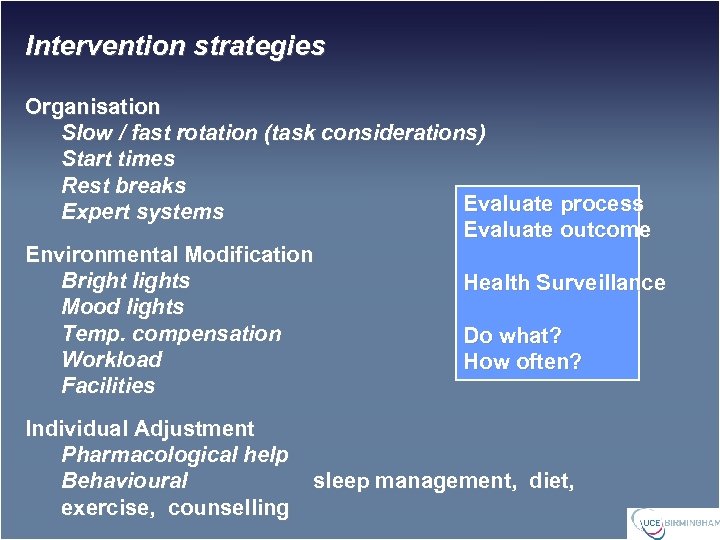 Intervention strategies Organisation Slow / fast rotation (task considerations) Start times Rest breaks Evaluate process Expert systems Evaluate outcome Environmental Modification Bright lights Health Surveillance Mood lights Temp. compensation Do what? Workload How often? Facilities Individual Adjustment Pharmacological help Behavioural exercise, counselling sleep management, diet,
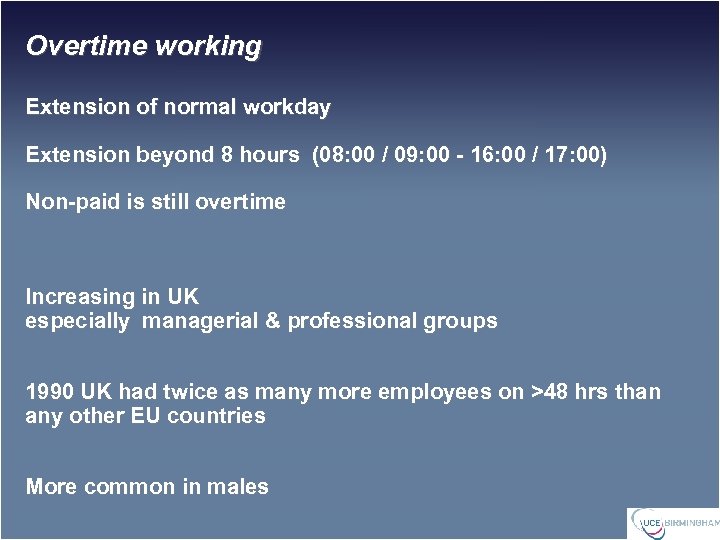 Overtime working Extension of normal workday Extension beyond 8 hours (08: 00 / 09: 00 - 16: 00 / 17: 00) Non-paid is still overtime Increasing in UK especially managerial & professional groups 1990 UK had twice as many more employees on >48 hrs than any other EU countries More common in males
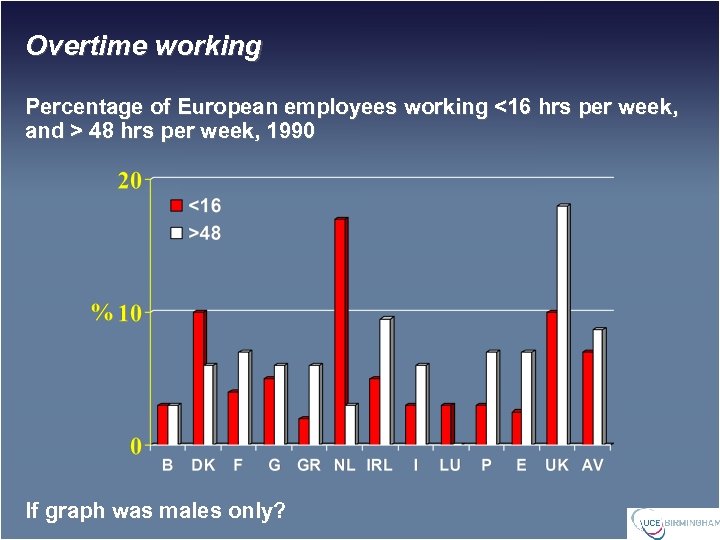 Overtime working Percentage of European employees working <16 hrs per week, and > 48 hrs per week, 1990 If graph was males only?
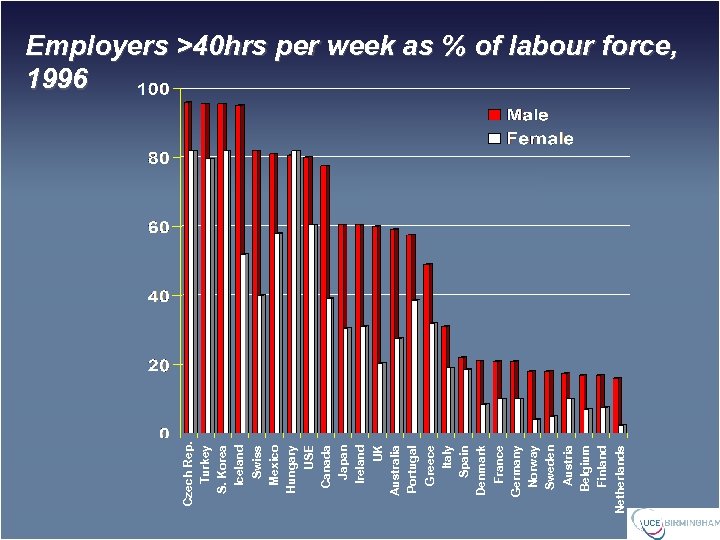 Czech Rep. Turkey S. Korea Iceland Swiss Mexico Hungary USE Canada Japan Ireland UK Australia Portugal Greece Italy Spain Denmark France Germany Norway Sweden Austria Belgium Finland Netherlands Employers >40 hrs per week as % of labour force, 1996
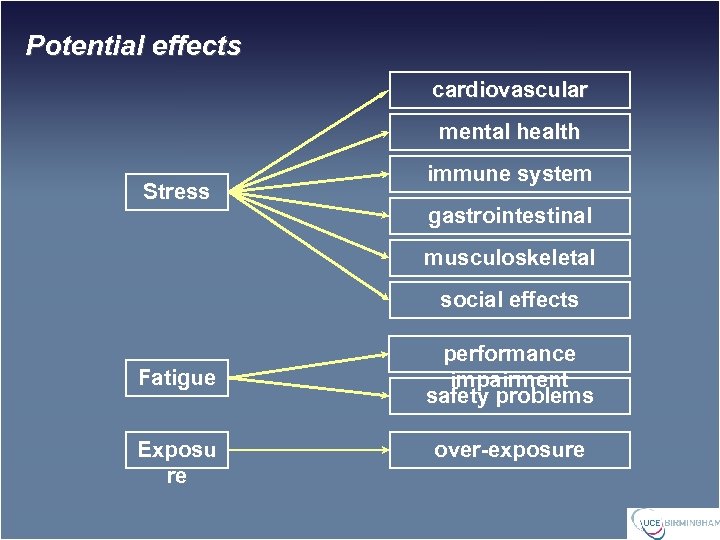 Potential effects cardiovascular mental health Stress immune system gastrointestinal musculoskeletal social effects Fatigue Exposu re performance impairment safety problems over-exposure
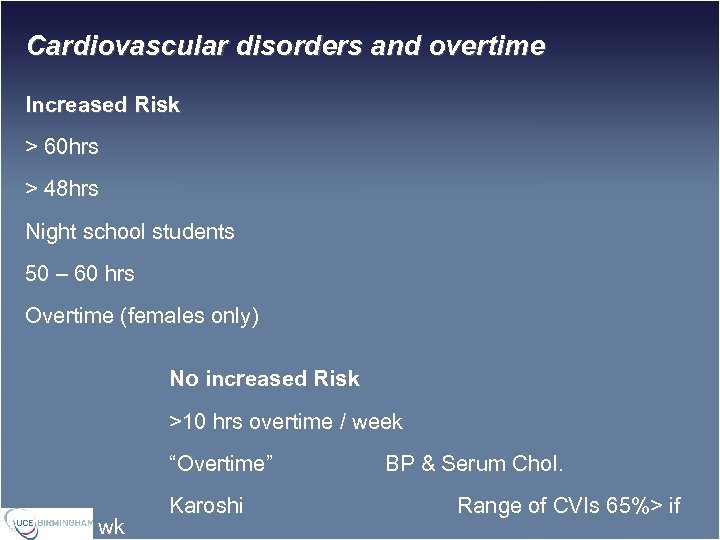 Cardiovascular disorders and overtime Increased Risk > 60 hrs > 48 hrs Night school students 50 – 60 hrs Overtime (females only) No increased Risk >10 hrs overtime / week “Overtime” 60 hrs / wk Karoshi BP & Serum Chol. Range of CVIs 65%> if
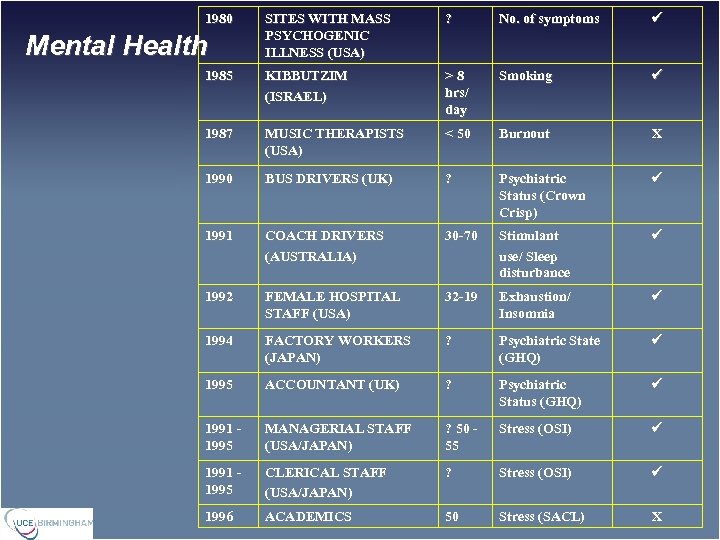 SITES WITH MASS PSYCHOGENIC ILLNESS (USA) ? No. of symptoms 1985 KIBBUTZIM (ISRAEL) >8 hrs/ day Smoking 1987 MUSIC THERAPISTS (USA) < 50 Burnout X 1990 BUS DRIVERS (UK) ? Psychiatric Status (Crown Crisp) 1991 COACH DRIVERS (AUSTRALIA) 30 -70 Stimulant use/ Sleep disturbance 1992 FEMALE HOSPITAL STAFF (USA) 32 -19 Exhaustion/ Insomnia 1994 FACTORY WORKERS (JAPAN) ? Psychiatric State (GHQ) 1995 ACCOUNTANT (UK) ? Psychiatric Status (GHQ) 1991 1995 MANAGERIAL STAFF (USA/JAPAN) ? 50 55 Stress (OSI) 1991 1995 CLERICAL STAFF (USA/JAPAN) ? Stress (OSI) 1996 ACADEMICS 50 Stress (SACL) X 1980 Mental Health
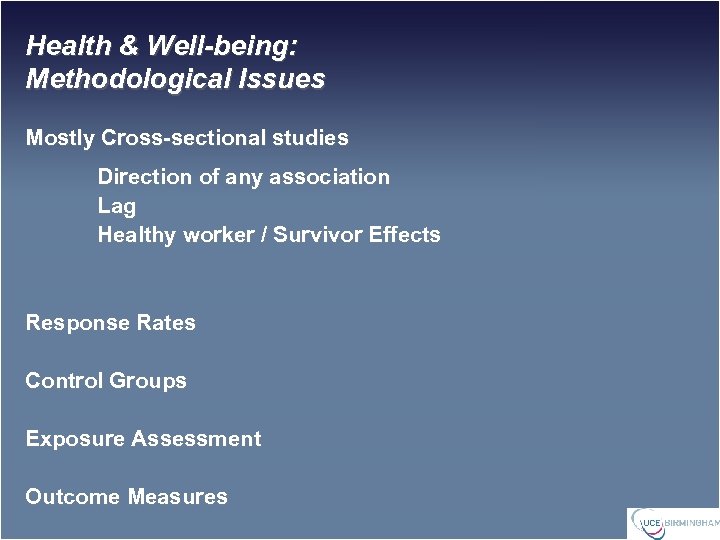 Health & Well-being: Methodological Issues Mostly Cross-sectional studies Direction of any association Lag Healthy worker / Survivor Effects Response Rates Control Groups Exposure Assessment Outcome Measures
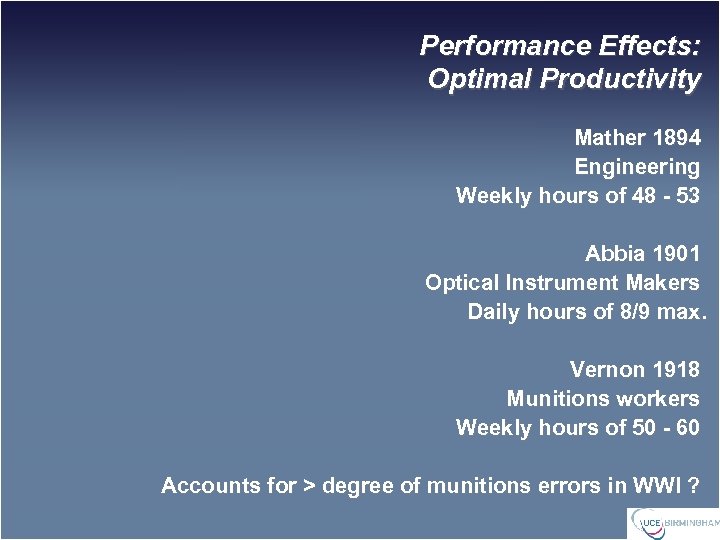 Performance Effects: Optimal Productivity Mather 1894 Engineering Weekly hours of 48 - 53 Abbia 1901 Optical Instrument Makers Daily hours of 8/9 max. Vernon 1918 Munitions workers Weekly hours of 50 - 60 Accounts for > degree of munitions errors in WWI ?
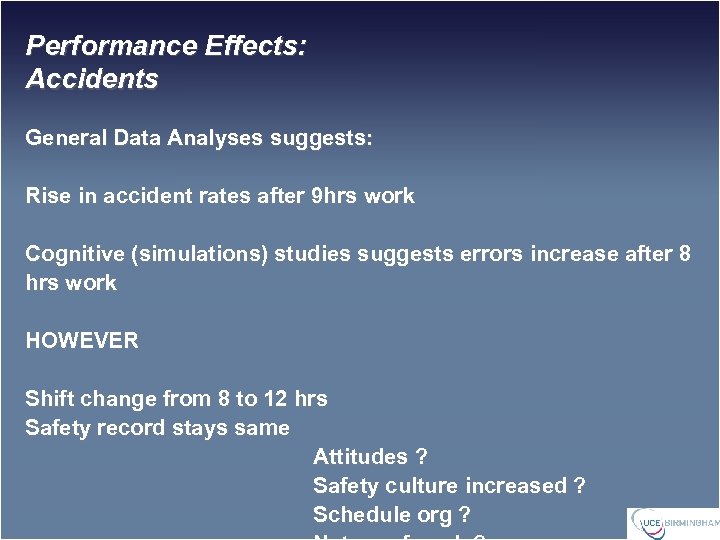 Performance Effects: Accidents General Data Analyses suggests: Rise in accident rates after 9 hrs work Cognitive (simulations) studies suggests errors increase after 8 hrs work HOWEVER Shift change from 8 to 12 hrs Safety record stays same Attitudes ? Safety culture increased ? Schedule org ?
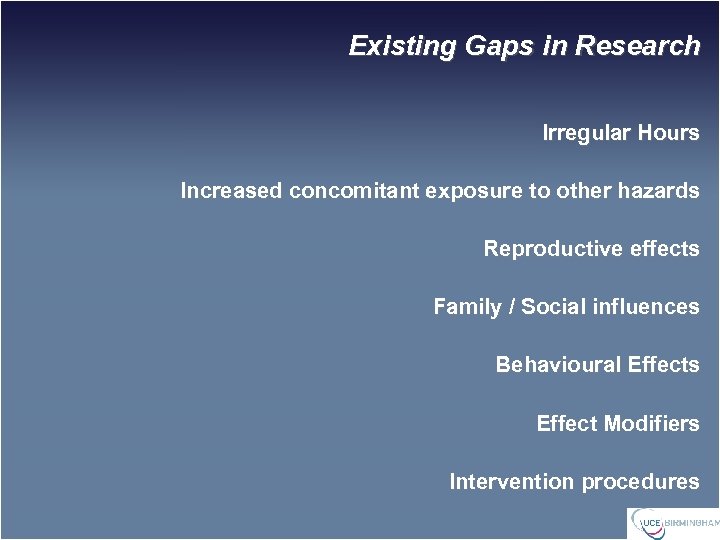 Existing Gaps in Research Irregular Hours Increased concomitant exposure to other hazards Reproductive effects Family / Social influences Behavioural Effects Effect Modifiers Intervention procedures
 Performance at work Dilemmas Working Hours Shiftwork Mental Distress Dr. Craig Jackson Senior Lecturer in Health Psychology Faculty of Health & Community Care University of Central England
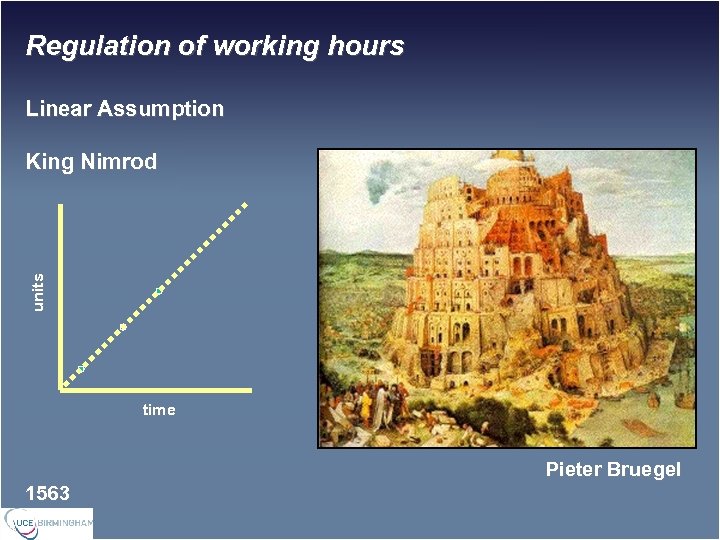 Regulation of working hours Linear Assumption units King Nimrod time Pieter Bruegel 1563
 Regulation of working hours Linear Assumption remained 1800 – 1900 12 hour days & 6 day weeks Thomas Paine 1737 - 1809 Age of Reason Rights of Man Annie Besant 1847 – 1933 Reformist movement Society Fabian Sciety Secular “Fruits of philosophy” “The Link” “White slavery in London” 1889
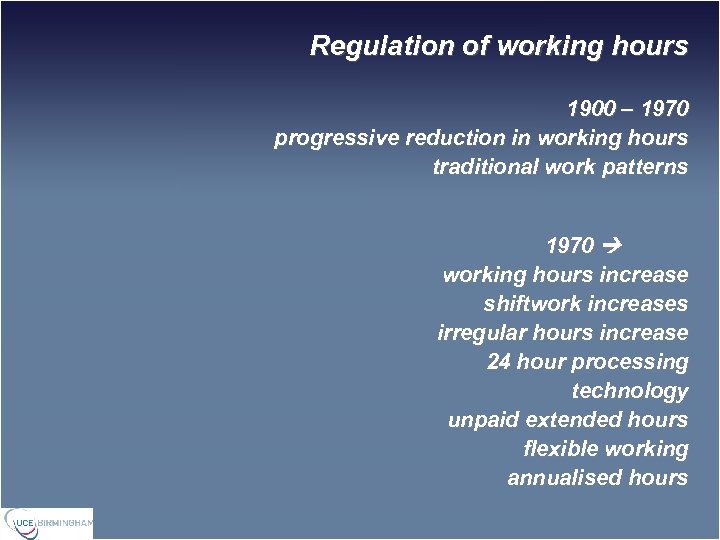 Regulation of working hours 1900 – 1970 progressive reduction in working hours traditional work patterns 1970 working hours increase shiftwork increases irregular hours increase 24 hour processing technology unpaid extended hours flexible working annualised hours
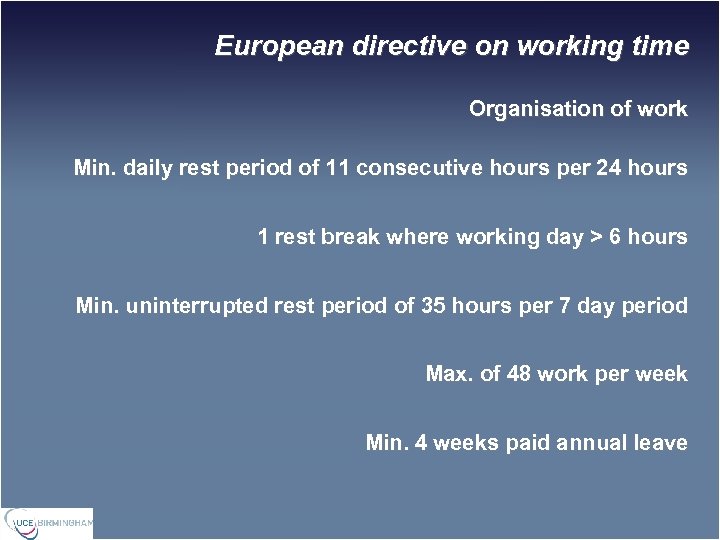 European directive on working time Organisation of work Min. daily rest period of 11 consecutive hours per 24 hours 1 rest break where working day > 6 hours Min. uninterrupted rest period of 35 hours per 7 day period Max. of 48 work per week Min. 4 weeks paid annual leave
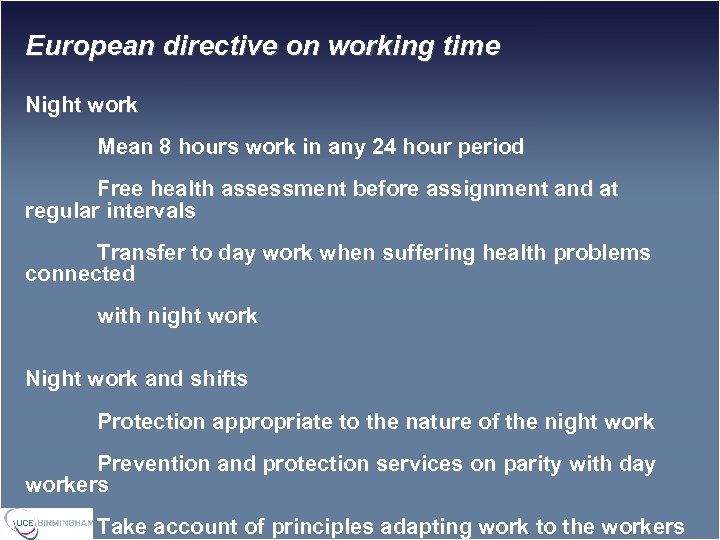 European directive on working time Night work Mean 8 hours work in any 24 hour period Free health assessment before assignment and at regular intervals Transfer to day work when suffering health problems connected with night work Night work and shifts Protection appropriate to the nature of the night work Prevention and protection services on parity with day workers Take account of principles adapting work to the workers
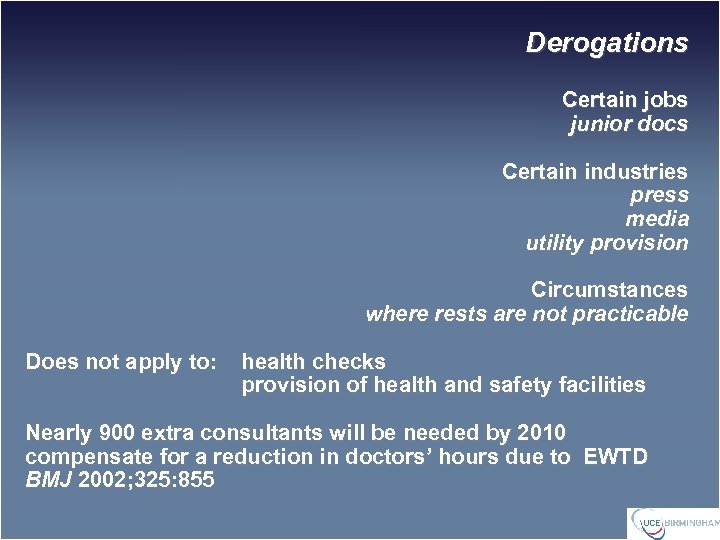 Derogations Certain jobs junior docs Certain industries press media utility provision Circumstances where rests are not practicable Does not apply to: health checks provision of health and safety facilities Nearly 900 extra consultants will be needed by 2010 compensate for a reduction in doctors’ hours due to EWTD BMJ 2002; 325: 855
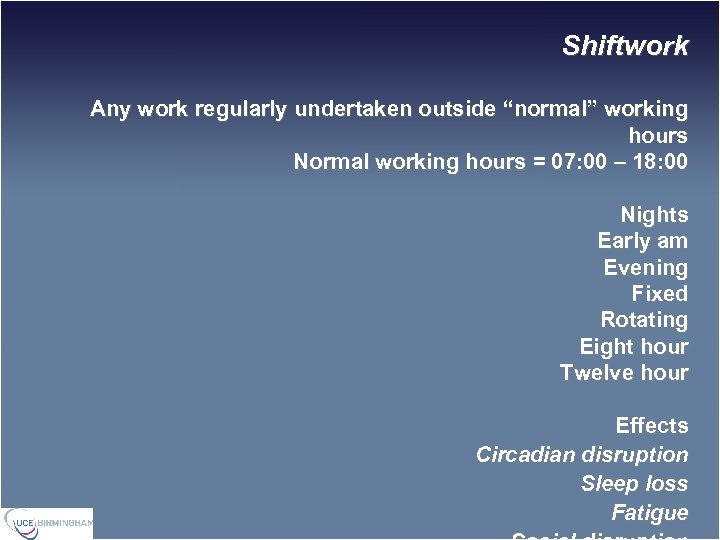 Shiftwork Any work regularly undertaken outside “normal” working hours Normal working hours = 07: 00 – 18: 00 Nights Early am Evening Fixed Rotating Eight hour Twelve hour Effects Circadian disruption Sleep loss Fatigue
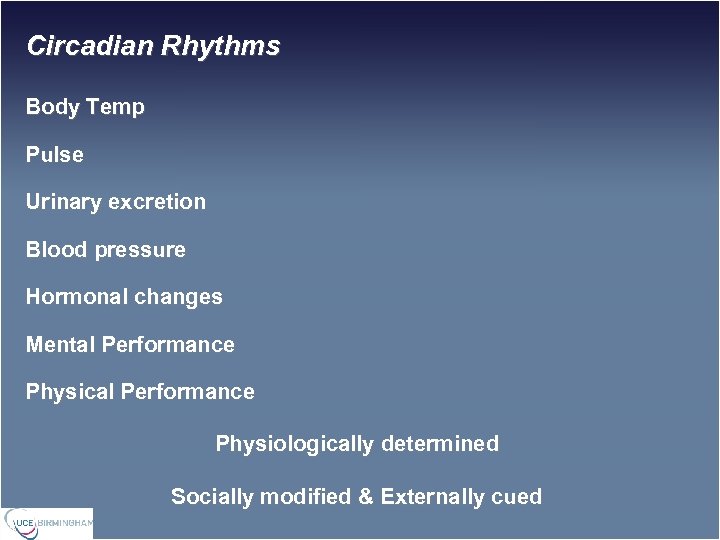 Circadian Rhythms Body Temp Pulse Urinary excretion Blood pressure Hormonal changes Mental Performance Physical Performance Physiologically determined Socially modified & Externally cued
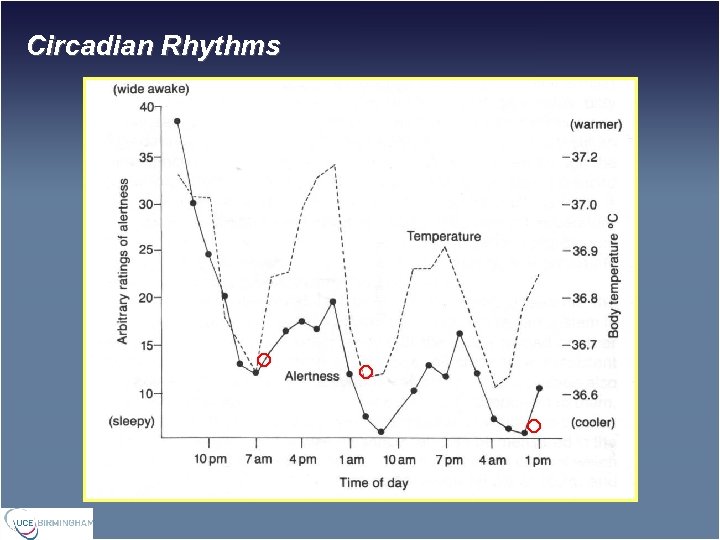 Circadian Rhythms
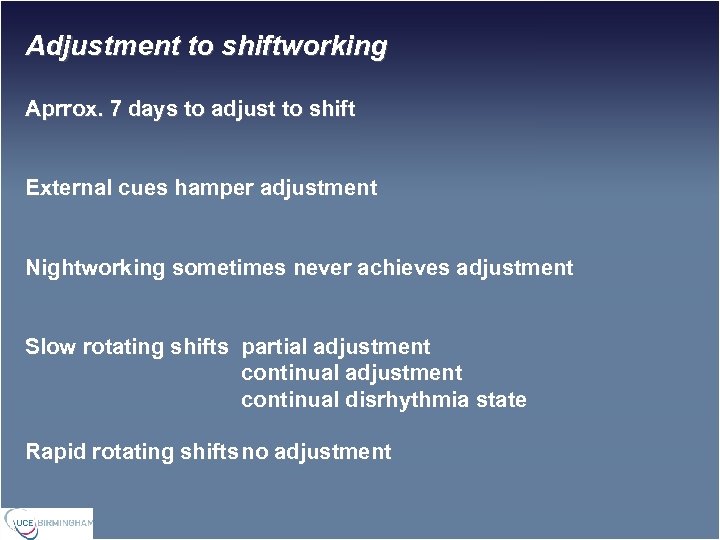 Adjustment to shiftworking Aprrox. 7 days to adjust to shift External cues hamper adjustment Nightworking sometimes never achieves adjustment Slow rotating shifts partial adjustment continual disrhythmia state Rapid rotating shifts no adjustment
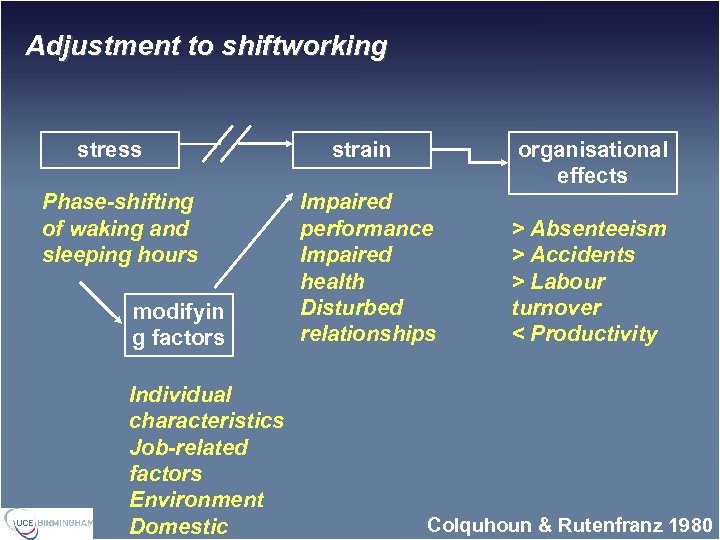 Adjustment to shiftworking stress Phase-shifting of waking and sleeping hours modifyin g factors Individual characteristics Job-related factors Environment Domestic strain organisational effects Impaired performance Impaired health Disturbed relationships > Absenteeism > Accidents > Labour turnover < Productivity Colquhoun & Rutenfranz 1980
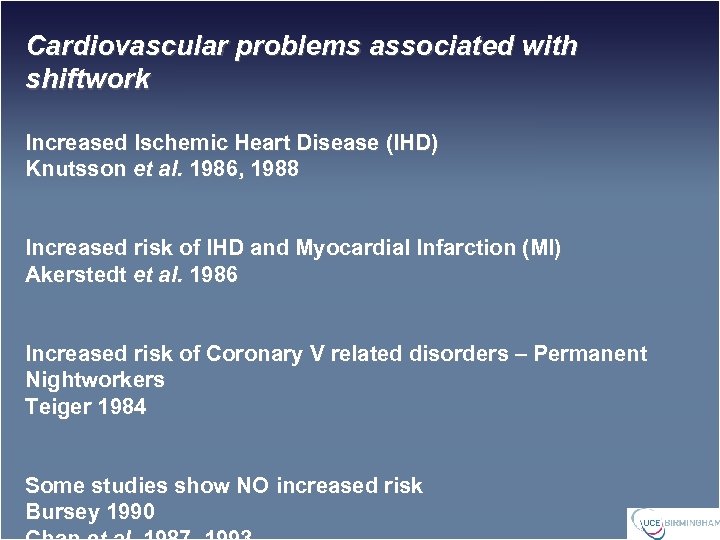 Cardiovascular problems associated with shiftwork Increased Ischemic Heart Disease (IHD) Knutsson et al. 1986, 1988 Increased risk of IHD and Myocardial Infarction (MI) Akerstedt et al. 1986 Increased risk of Coronary V related disorders – Permanent Nightworkers Teiger 1984 Some studies show NO increased risk Bursey 1990
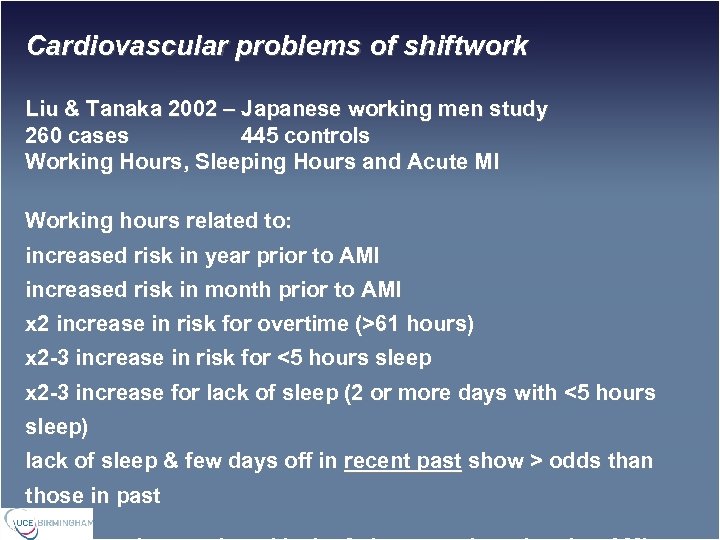 Cardiovascular problems of shiftwork Liu & Tanaka 2002 – Japanese working men study 260 cases 445 controls Working Hours, Sleeping Hours and Acute MI Working hours related to: increased risk in year prior to AMI increased risk in month prior to AMI x 2 increase in risk for overtime (>61 hours) x 2 -3 increase in risk for <5 hours sleep x 2 -3 increase for lack of sleep (2 or more days with <5 hours sleep) lack of sleep & few days off in recent past show > odds than those in past
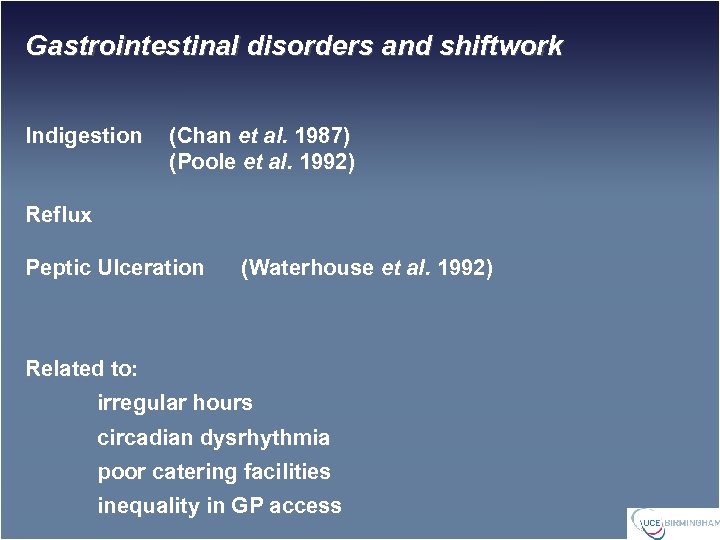 Gastrointestinal disorders and shiftwork Indigestion (Chan et al. 1987) (Poole et al. 1992) Reflux Peptic Ulceration (Waterhouse et al. 1992) Related to: irregular hours circadian dysrhythmia poor catering facilities inequality in GP access
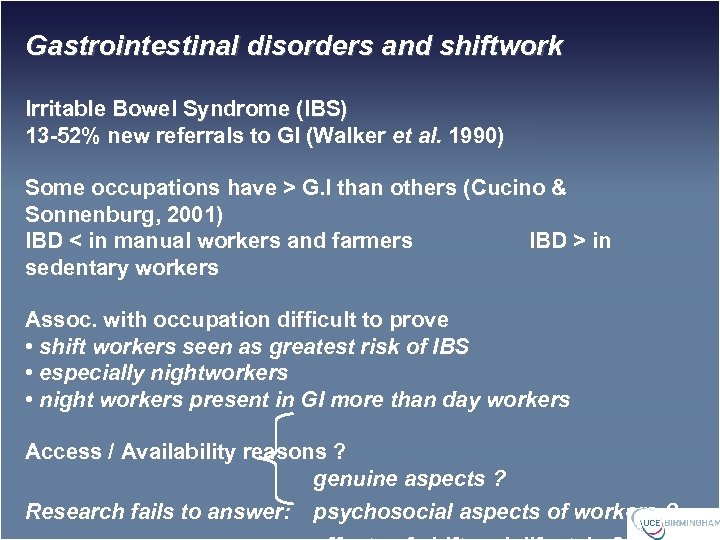 Gastrointestinal disorders and shiftwork Irritable Bowel Syndrome (IBS) 13 -52% new referrals to GI (Walker et al. 1990) Some occupations have > G. I than others (Cucino & Sonnenburg, 2001) IBD < in manual workers and farmers IBD > in sedentary workers Assoc. with occupation difficult to prove • shift workers seen as greatest risk of IBS • especially nightworkers • night workers present in GI more than day workers Access / Availability reasons ? genuine aspects ? Research fails to answer: psychosocial aspects of workers ?
 Mental health problems and shiftwork Increased stress Alcohol consumption Neuroticism Review by Cole et al. 1990 OM
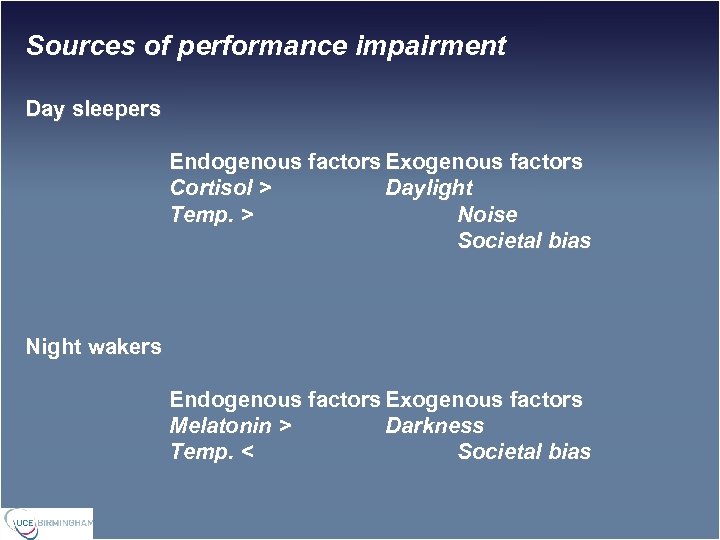 Sources of performance impairment Day sleepers Endogenous factors Exogenous factors Cortisol > Daylight Temp. > Noise Societal bias Night wakers Endogenous factors Exogenous factors Melatonin > Darkness Temp. < Societal bias
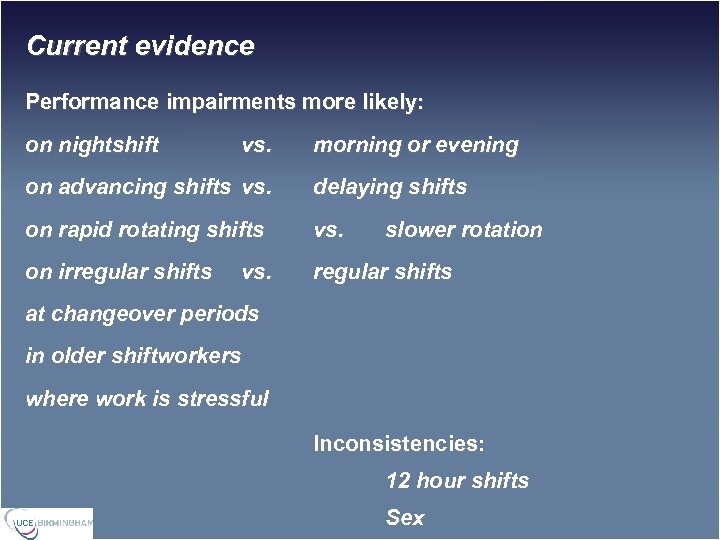 Current evidence Performance impairments more likely: on nightshift vs. morning or evening on advancing shifts vs. delaying shifts on rapid rotating shifts vs. on irregular shifts vs. slower rotation at changeover periods in older shiftworkers where work is stressful Inconsistencies: 12 hour shifts Sex
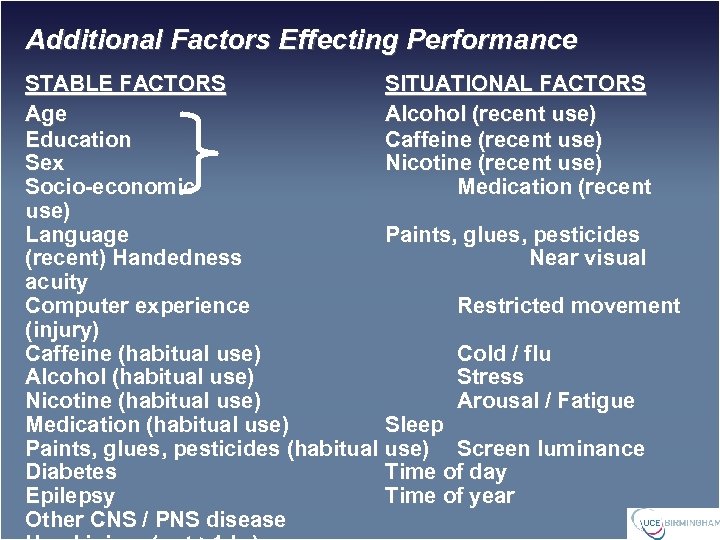 Additional Factors Effecting Performance STABLE FACTORS SITUATIONAL FACTORS Age Alcohol (recent use) Education Caffeine (recent use) Sex Nicotine (recent use) Socio-economic Medication (recent use) Language Paints, glues, pesticides (recent) Handedness Near visual acuity Computer experience Restricted movement (injury) Caffeine (habitual use) Cold / flu Alcohol (habitual use) Stress Nicotine (habitual use) Arousal / Fatigue Medication (habitual use) Sleep Paints, glues, pesticides (habitual use) Screen luminance Diabetes Time of day Epilepsy Time of year Other CNS / PNS disease
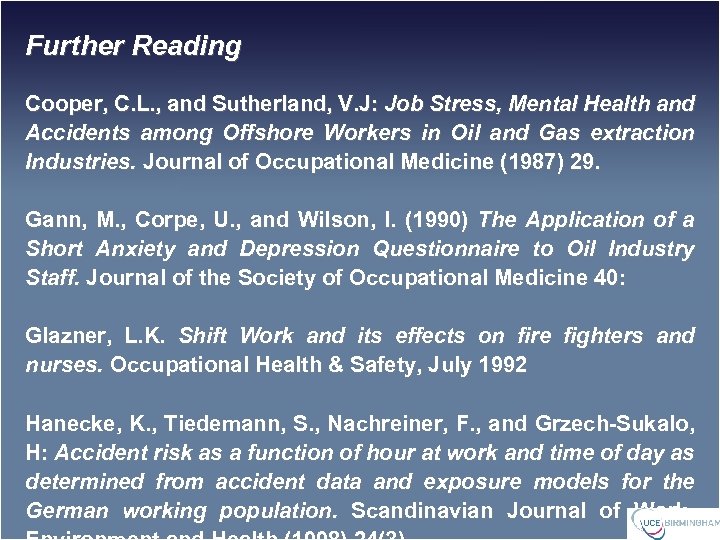 Further Reading Cooper, C. L. , and Sutherland, V. J: Job Stress, Mental Health and Accidents among Offshore Workers in Oil and Gas extraction Industries. Journal of Occupational Medicine (1987) 29. Gann, M. , Corpe, U. , and Wilson, I. (1990) The Application of a Short Anxiety and Depression Questionnaire to Oil Industry Staff. Journal of the Society of Occupational Medicine 40: Glazner, L. K. Shift Work and its effects on fire fighters and nurses. Occupational Health & Safety, July 1992 Hanecke, K. , Tiedemann, S. , Nachreiner, F. , and Grzech-Sukalo, H: Accident risk as a function of hour at work and time of day as determined from accident data and exposure models for the German working population. Scandinavian Journal of Work,
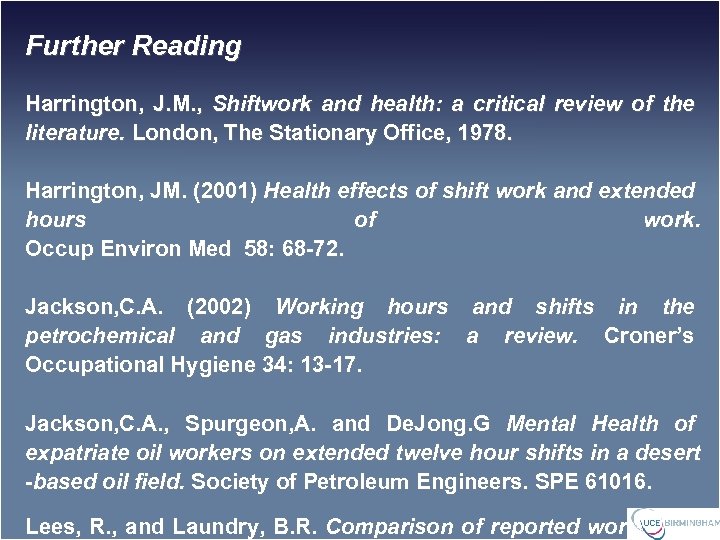 Further Reading Harrington, J. M. , Shiftwork and health: a critical review of the literature. London, The Stationary Office, 1978. Harrington, JM. (2001) Health effects of shift work and extended hours of work. Occup Environ Med 58: 68 -72. Jackson, C. A. (2002) Working hours and shifts in the petrochemical and gas industries: a review. Croner’s Occupational Hygiene 34: 13 -17. Jackson, C. A. , Spurgeon, A. and De. Jong. G Mental Health of expatriate oil workers on extended twelve hour shifts in a desert -based oil field. Society of Petroleum Engineers. SPE 61016. Lees, R. , and Laundry, B. R. Comparison of reported workplace
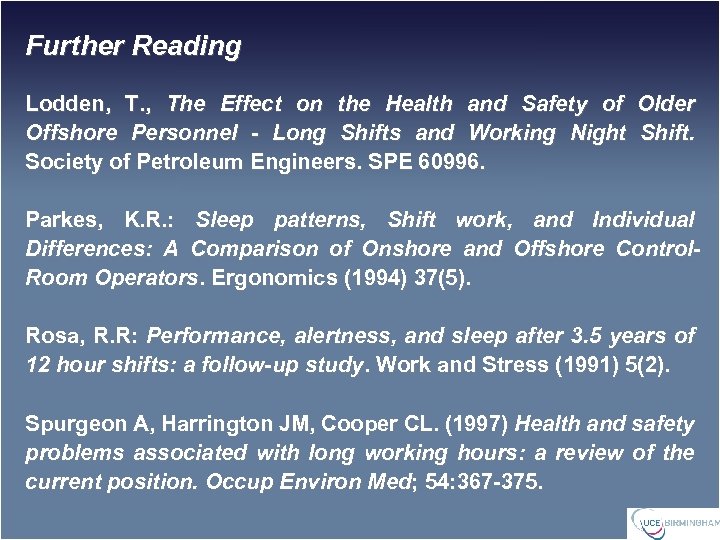 Further Reading Lodden, T. , The Effect on the Health and Safety of Older Offshore Personnel - Long Shifts and Working Night Shift. Society of Petroleum Engineers. SPE 60996. Parkes, K. R. : Sleep patterns, Shift work, and Individual Differences: A Comparison of Onshore and Offshore Control. Room Operators. Ergonomics (1994) 37(5). Rosa, R. R: Performance, alertness, and sleep after 3. 5 years of 12 hour shifts: a follow-up study. Work and Stress (1991) 5(2). Spurgeon A, Harrington JM, Cooper CL. (1997) Health and safety problems associated with long working hours: a review of the current position. Occup Environ Med; 54: 367 -375.