 Скачать презентацию Social-Psychological Banuazizi Two approaches social-structural
0b0ff1d2c4b081c850f8b3ff6d51f0c9.ppt
- Количество слайдов: 24



Social-Psychological Banuazizi
Two approaches • • social-structural factors cultural values, beliefs, orientations Modernization theory united the two elements Soc processes marked by modern attitudes – empathy, personal efficacy, rationality, flexibility
Interest in soc psych (and religion) • Iran revolution • persistence of "primordial" groups” • achievement of Confucian economies
3 roots • Psych-analytic theory and "modal personality" idea • Mainstream behaviourism – attitudes clue to social action • concerns in failed development
Soc-psych CAUSAL theory • Mc. Clelland's "achieving society” • Soc-psych intervening variable • Nat identity > personal insecurity > pol development "failure" (PYE) • Mod pressures > lack of empathy > pol dev insts failure (LERNER)
Soc-Psych dependent variable • Lack of studies despite behaviourism claim that environment shapes action • Inkeles & Smith argued – Dispositions arise from ‘modern' experiences. These in turn mediate continuing success of modernization
![Inkeles • [294] Exposure to large scale modernizing institutions lead to “syndrome of psych](https://present5.com/presentation/0b0ff1d2c4b081c850f8b3ff6d51f0c9/image-7.jpg "Inkeles • [294] Exposure to large scale modernizing institutions lead to “syndrome of psych")
Inkeles • [294] Exposure to large scale modernizing institutions lead to “syndrome of psych modernity” • Individuals prone to this influence beyond childhood • underlying dimensions transcend ethnic, cultural and national differences.
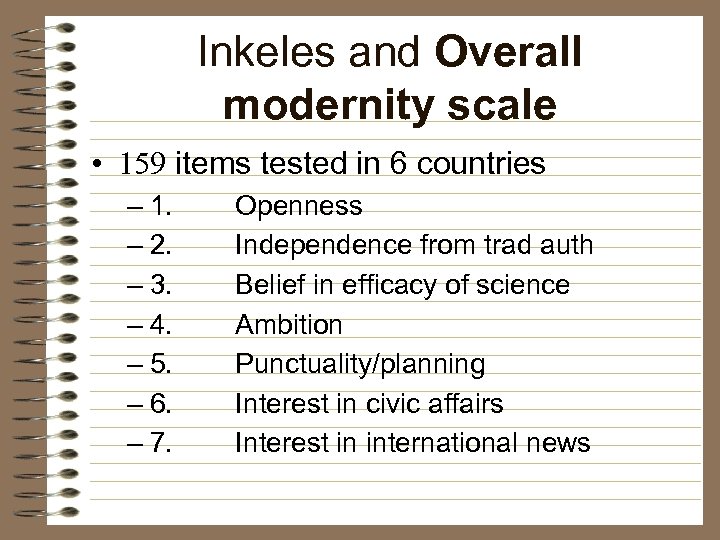
Inkeles and Overall modernity scale • 159 items tested in 6 countries – 1. – 2. – 3. – 4. – 5. – 6. – 7. Openness Independence from trad auth Belief in efficacy of science Ambition Punctuality/planning Interest in civic affairs Interest in international news
Modernity? • Factor analysis found all bearing on a single point: – Could be "modernity” – Could be that definitions are tautological • ten background factors accounted for variance in OM scores
OM Score factors • Top three were – Formal education – Exposure to media – Occupational experience • Is modernity a state of mind or behaviour congruent with demands of modern society?
Inductive reason • Induce from these three propositions: – Exposure to modern insts creates modernity – Individuals can "modernize" after puberty – Ethnicity, nationalism, culture transcended • In other words: modernity can be manipulated and thus lead to pol dev
Problem • traditional Socio Economic Status variables could explain all but 1% of the variance in behaviour studied by Inkeles • we still need an explanation at the national level for differences in overall political development • religion?
Further research • Need to do “cross-national” and longitudinal studies • Still stuck with difficulty of confirming influence of a mediating factor
Tradition-Modernity • Original assumption was that traditions were temporary impediments • Modernity derived from theory • Tradition derived from residual negative attributes • See Talcott Parson’s pattern variables
Parsons
![Tradition • Conservative • Impetus for change from outside – [typically the west] •](https://present5.com/presentation/0b0ff1d2c4b081c850f8b3ff6d51f0c9/image-16.jpg "Tradition • Conservative • Impetus for change from outside – [typically the west] •")
Tradition • Conservative • Impetus for change from outside – [typically the west] • Resilience and meaning of trad got more attention in 1970 s • But psychology slower to change – Inkeles talking about passivity etc.
Corrective reaction • Traditional ideologies (expressed in ethnic or religious movements) seen as more of a challenge to incumbent regimes than secular ideology • Tradition demands activity too – Islamic codes of personal conduct – fundamentalist regimes – Islamicizing public policies [Taliban? ]
Resurgence of Islam • Extremist anachronisms? • Appeal to disoriented losers? ! • But too much diversity under the “fundamentalist” umbrella • Iran a puzzle for modernization theory – large army and security forces toppled – growth rates too high? – Reactionary backlash?
Iranian politics • Fuelled by – uneven growth – urban-rural tensions – labour aristocracy – perceived dependence on US – Shah’s contempt for Islamic culture – autocratic/repressive rule
Iranian politics • Anti-Shah forces – Shiite ulama • • involved in opposition movements tied to bazaari community financial & pol independence from the state control of network of mosques -- allowed criticism • But others rode theocratic coattails
Islamic factions • Radical – young intelligentsia • Militant – ulama, petty-b, dispossessed • Liberal – “contest” appealed to non-violent middle class • Traditionalist – protest from old middle class strata
Analysis • Islam adapted by group interests • Leadership • Ideological mobilization tool
Conclusions • Economic structural change not necessarily linked to secularism in – political insts – attitudes & values • Islam appeal linked to dislocations & inequalities • Traditional actors are powerful not passive – cf ultra right in Israel – Catholic Church in Poland
Conclusions • Absolutist politics after Iranian revolution – explained in terms of desire for power – not necessarily an aspect of Islam • Dialogue between tradition and modernity silenced in Iran, this time by tradition!
Скачать презентацию Social-Psychological Banuazizi Two approaches social-structural
0b0ff1d2c4b081c850f8b3ff6d51f0c9.ppt