 Скачать презентацию Social philosophy the subject matter and the structure
SOCIAL PHILOSOPHY.ppt
- Количество слайдов: 23



Social philosophy: the subject matter and the structure
1. 2. 3. 4. The specific character of social philosophy. Social being and social consciousness. Philosophical meaning of the concept of society. Society as a system. Social system’s structure and its basic elements. Historical periodization of social development: formational, civilization, axial and wave approaches.
1. 2. 3. 4. 5. 6. 7. BASIC LITERATURE: BORCHERT Donald M. Encyclopedia Of Philosophy, Gacl. , 2006 HARRISON-BARBET A. Mastering Philosophy. – PALGRAVE, 2001. PARKINSON G. Routledge History of Philosophy: 10 Volume Set. – Routledge, 2003 PHILOSOPHY: The Power of Ideas, by Barnett D. , Moore B. N. , Bruder K. – California, London, Toronto, 1996 PHILOSOPHY: The Quest for Truth By Louis P. Pojman Publisher: Oxford University Press, 2005 REAL PHILOSOPHY: An Anthology of the Universal Search for Meaning /Ed. By J. Needleman, D. Appelbaum, London, 1990 SPIRKIN ALEXANDER Fundamentals of Philosophy. -M. : Progress Publishers, 1990. - P. 267, 298 -303 ADDITIONAL LITERATURE: 1. PHILOSOPHY and CHOICE. Selected Reading from Around the World /Ed. by Kit R. Christensen. – Lnd. , Toronto: Mayfield Publishing Company, 1999 2. THEORIES of MODERNITY and POSTMODERNITY /Ed. By Bryan S. Turner. – Lnd. : SAGE Publications, 1991 1. 2. 3. 4. 5. 6. BASIC PRIMARY SOURCES: KOZLOVSKI P. : Postmodernism Culture, Moscow: Republic, 1997, MARCUSE HERBERT One-Dimensional Man (Boston: Beacon, 1964) ORTEGA y GASSET Revolt of the Masses FRANK S. The Spiritual Basis of the Society. Moscow: Mir. Rogers K. (1995) SPENGLER O. The Decline of the West (Oxford Paperbacks) by Oswald Spengler, Helmut Werner, Arthur Helps and Charles Francis Atkinson. Paperback. -Febr. 14, 1991. - P. 76 -79. TOYNBEE ARTHUR A Study of history. London: Oxford University Press, 1961. - P. 123 -125
The basic questions of social philosophy: What is primary: social life or social consciousness? Ø Is there any definite connection between economical, political and social relations? Ø Are there any laws and regularities to which the many-sided, complicated and contradictory historical process is subjected or do blind contingency and chaos dominate? Ø What are the motive forces of this progressive process? Ø
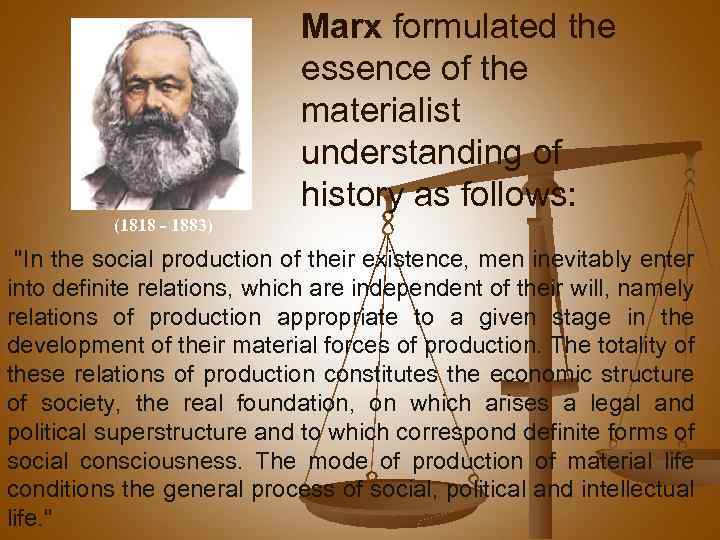
Marx formulated the essence of the materialist understanding of history as follows: (1818 - 1883) "In the social production of their existence, men inevitably enter into definite relations, which are independent of their will, namely relations of production appropriate to a given stage in the development of their material forces of production. The totality of these relations of production constitutes the economic structure of society, the real foundation, on which arises a legal and political superstructure and to which correspond definite forms of social consciousness. The mode of production of material life conditions the general process of social, political and intellectual life. "
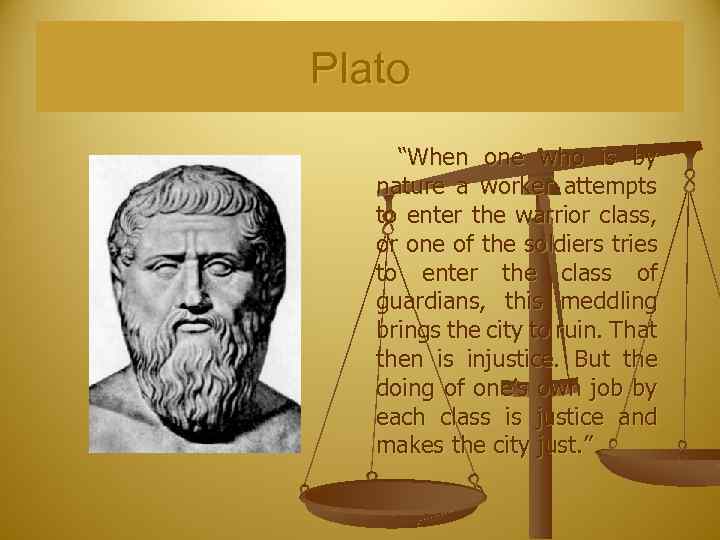
Plato “When one who is by nature a worker attempts to enter the warrior class, or one of the soldiers tries to enter the class of guardians, this meddling brings the city to ruin. That then is injustice. But the doing of one’s own job by each class is justice and makes the city just. ”
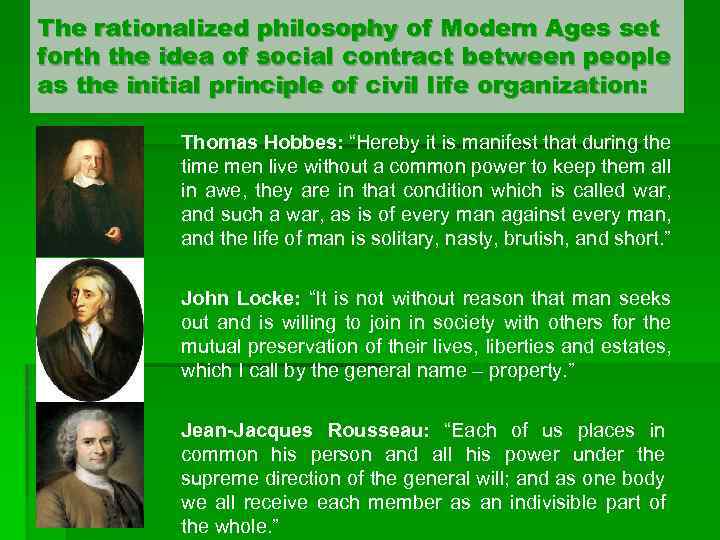
The rationalized philosophy of Modern Ages set forth the idea of social contract between people as the initial principle of civil life organization: Thomas Hobbes: “Hereby it is manifest that during the time men live without a common power to keep them all in awe, they are in that condition which is called war, and such a war, as is of every man against every man, and the life of man is solitary, nasty, brutish, and short. ” John Locke: “It is not without reason that man seeks out and is willing to join in society with others for the mutual preservation of their lives, liberties and estates, which I call by the general name – property. ” Jean-Jacques Rousseau: “Each of us places in common his person and all his power under the supreme direction of the general will; and as one body we all receive each member as an indivisible part of the whole. ”
In Modern Ages a naturalistic conception was spread. n n n Following this doctrine the type of society and the character of its development is determined by: climate and geographical position (Mechnikov, Kleuchevsky); racial, genetic characteristics of people (Social Darvinism: Th. Maltus, Goumhlovich, Racialanthropological school: Gobino); cosmic processes (Chizhevsky, Goumilev).
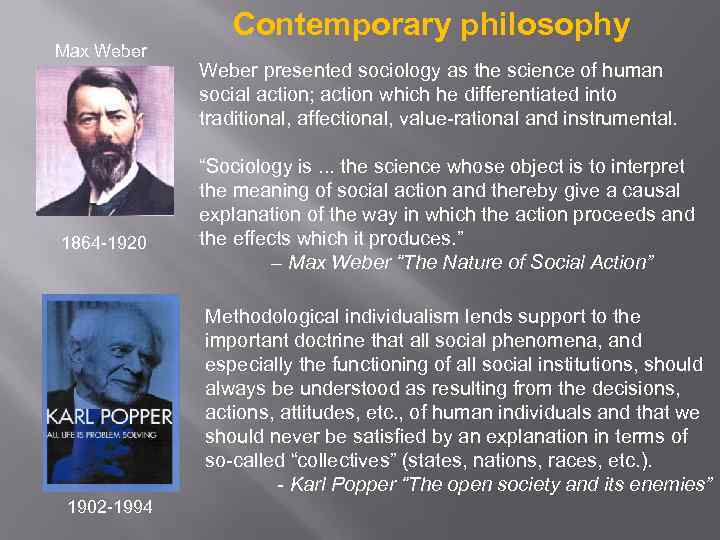
Max Weber 1864 -1920 Contemporary philosophy Weber presented sociology as the science of human social action; action which he differentiated into traditional, affectional, value-rational and instrumental. “Sociology is. . . the science whose object is to interpret the meaning of social action and thereby give a causal explanation of the way in which the action proceeds and the effects which it produces. ” – Max Weber “The Nature of Social Action” Methodological individualism lends support to the important doctrine that all social phenomena, and especially the functioning of all social institutions, should always be understood as resulting from the decisions, actions, attitudes, etc. , of human individuals and that we should never be satisfied by an explanation in terms of so-called “collectives” (states, nations, races, etc. ). - Karl Popper “The open society and its enemies” 1902 -1994
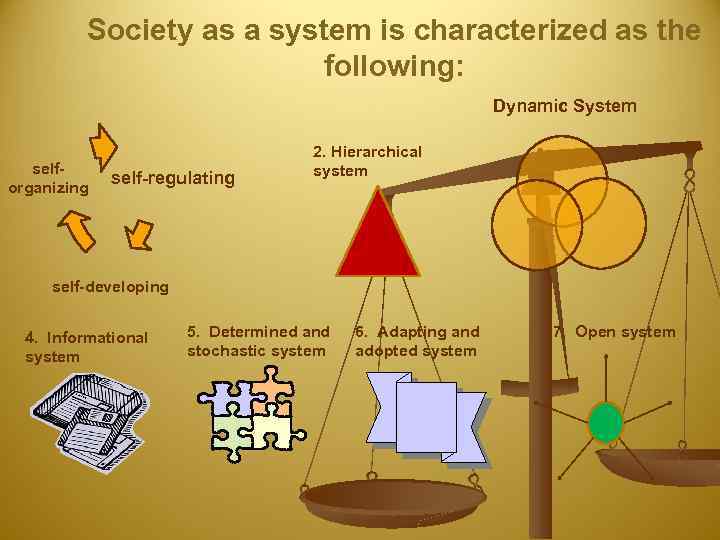
Society as a system is characterized as the following: Dynamic System selforganizing self-regulating 2. Hierarchical system self-developing 4. Informational system 5. Determined and stochastic system 6. Adapting and adopted system 7. Open system
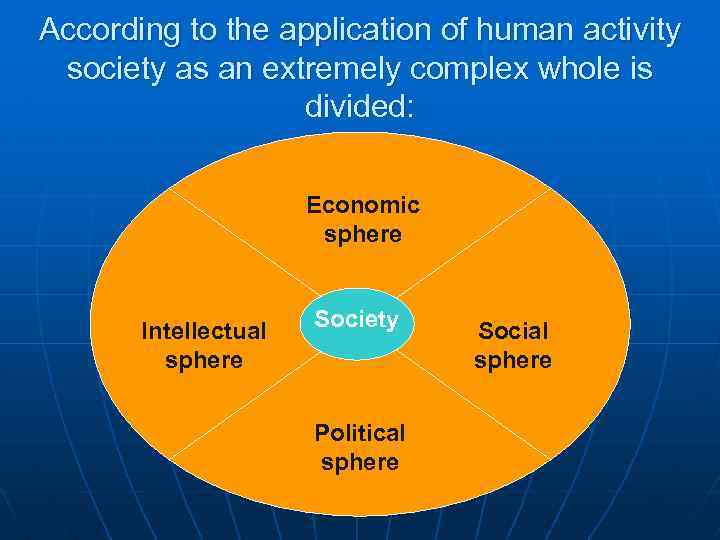
According to the application of human activity society as an extremely complex whole is divided: Economic sphere Intellectual sphere Society Political sphere Social sphere
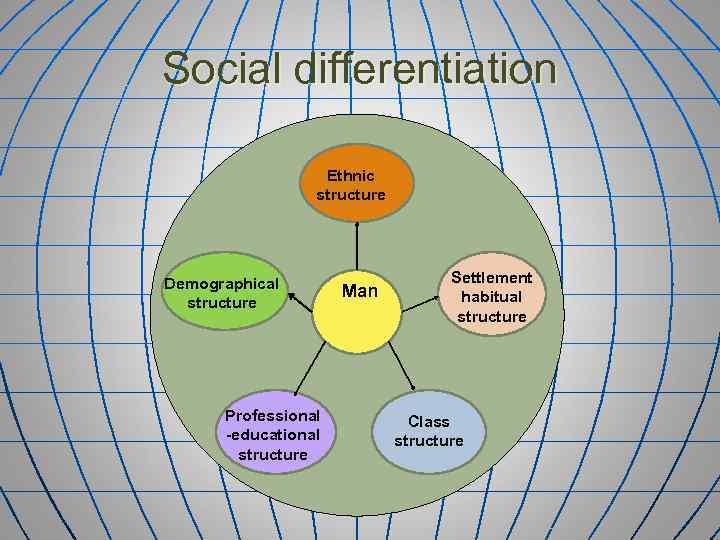
Social differentiation Ethnic structure Demographical structure Professional -educational structure Man Settlement habitual structure Class structure
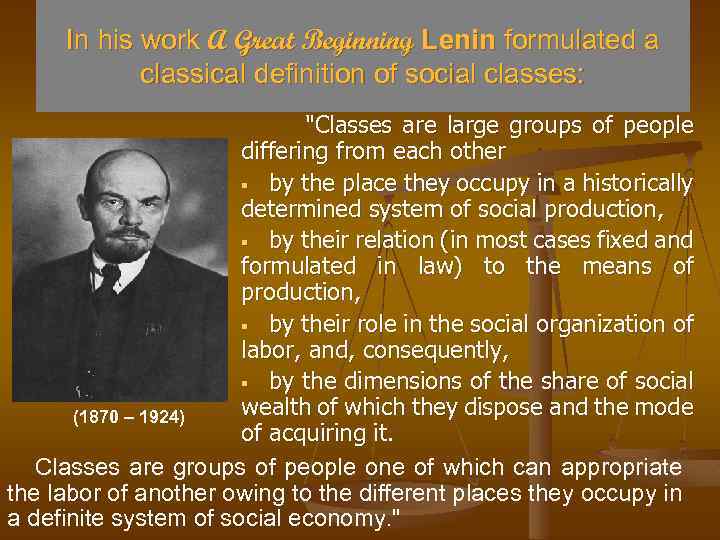
In his work A Great Beginning Lenin formulated a classical definition of social classes: "Classes are large groups of people differing from each other § by the place they occupy in a historically determined system of social production, § by their relation (in most cases fixed and formulated in law) to the means of production, § by their role in the social organization of labor, and, consequently, § by the dimensions of the share of social wealth of which they dispose and the mode (1870 – 1924) of acquiring it. Classes are groups of people one of which can appropriate the labor of another owing to the different places they occupy in a definite system of social economy. "
People is a social integrity characterized by common historical destiny and historical memory that reflects this destiny; by common faith, common idea and common historical perspective.
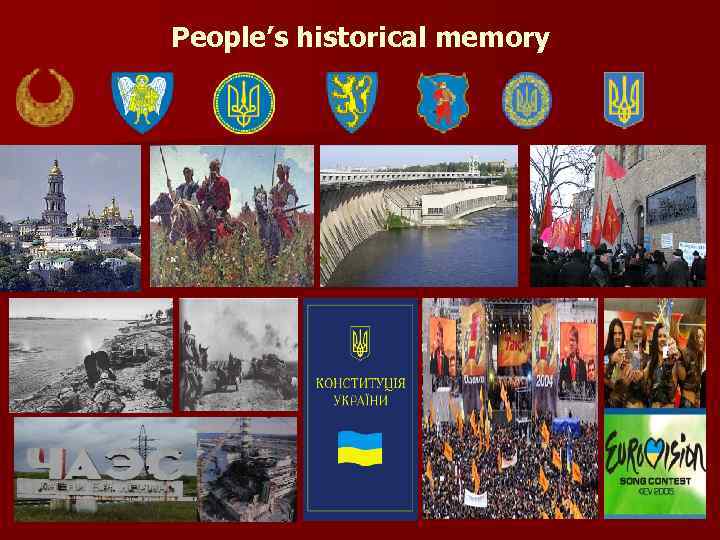
People’s historical memory
The development of world history In historical periodization of the social process there are several approaches: üformational, ücivilization, üwave, üaxial.
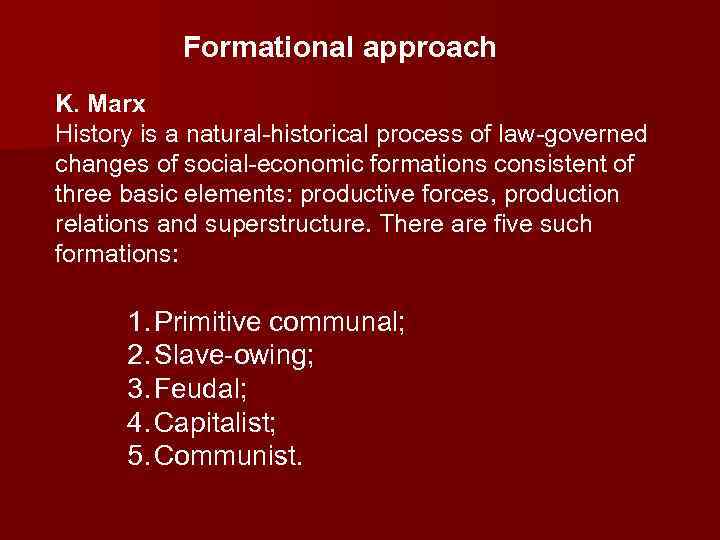
Formational approach K. Marx History is a natural-historical process of law-governed changes of social-economic formations consistent of three basic elements: productive forces, production relations and superstructure. There are five such formations: 1. Primitive communal; 2. Slave-owing; 3. Feudal; 4. Capitalist; 5. Communist.
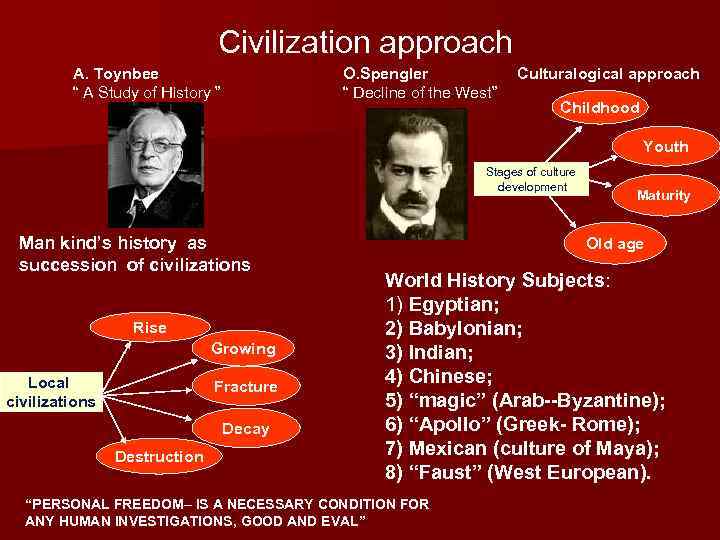
Civilization approach А. Тоynbee “ A Study of History ” O. Spengler “ Decline of the West” Culturalogical approach Childhood Youth Stages of culture development Man kind’s history as succession of civilizations Rise Growing Local civilizations Fracture Decay Destruction Maturity Old age World History Subjects: 1) Egyptian; 2) Babylonian; 3) Indian; 4) Chinese; 5) “magic” (Arab--Byzantine); 6) “Apollo” (Greek- Rome); 7) Mexican (culture of Maya); 8) “Faust” (West European). “PERSONAL FREEDOM– IS A NECESSARY CONDITION FOR ANY HUMAN INVESTIGATIONS, GOOD AND EVAL”
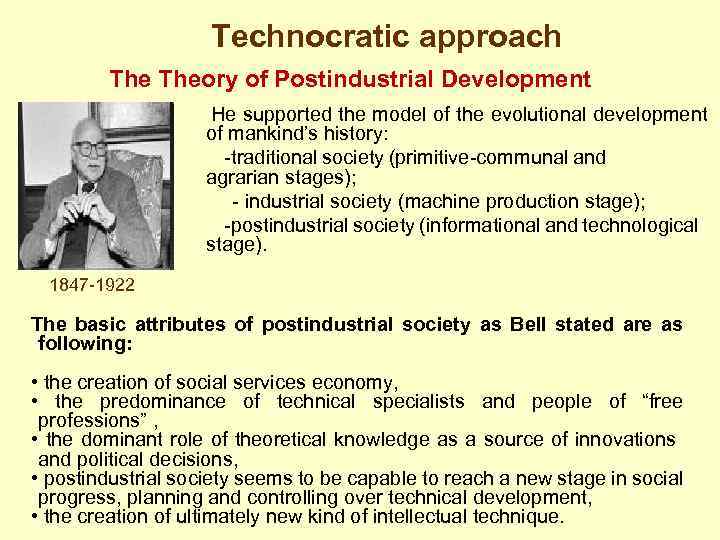
Technocratic approach Theory of Postindustrial Development Daniel Bell He supported the model of the evolutional development of mankind’s history: -traditional society (primitive-communal and agrarian stages); - industrial society (machine production stage); -postindustrial society (informational and technological stage). 1847 -1922 The basic attributes of postindustrial society as Bell stated are as following: • the creation of social services economy, • the predominance of technical specialists and people of “free professions” , • the dominant role of theoretical knowledge as a source of innovations and political decisions, • postindustrial society seems to be capable to reach a new stage in social progress, planning and controlling over technical development, • the creation of ultimately new kind of intellectual technique.
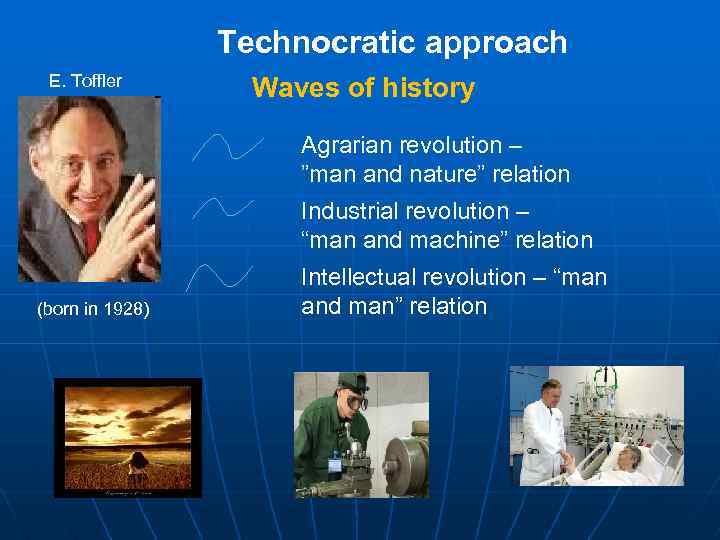
Technocratic approach Е. Toffler Waves of history Agrarian revolution – ”man and nature” relation Industrial revolution – “man and machine” relation (born in 1928) Intellectual revolution – “man and man” relation
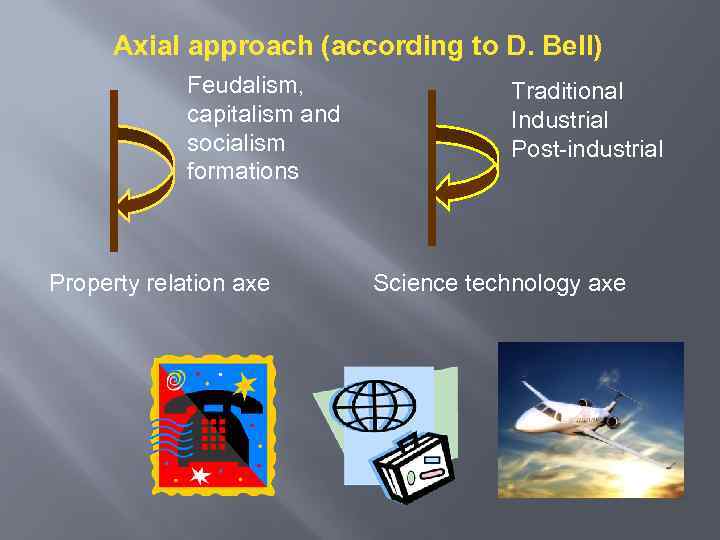
Axial approach (according to D. Bell) Feudalism, capitalism and socialism formations Property relation axe Traditional Industrial Post-industrial Science technology axe
Questions for express-control 1. What social discipline researches society as a whole, as an integral system? 2. Who founded the concept of “socioeconomic formation”? 3. What human relations are primary and determining in Marxist Philosophy? 4. Who suggested the notion of “postindustrial” society? 5. Civilization approach of studying history was shared by…?
The People (the problem of the concept) 1) usually only participants of a material production were referred to the people as a subject of history; 2) only social groups whose activity leads to a progressive development of a society were thought of as the people; 3) a barrier was erected between the people and the outstanding personalities who were absolutely opposed, as if people did not consist of persons.
Скачать презентацию Social philosophy the subject matter and the structure
SOCIAL PHILOSOPHY.ppt