 Скачать презентацию Social Perception Governed By Same Laws As Physical
8ae5d7c8905bd8576eef71ab35fe45b8.ppt
- Количество слайдов: 23



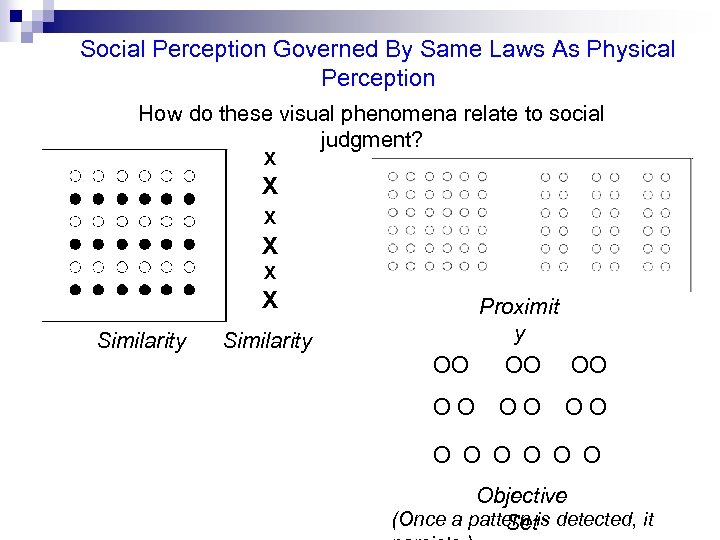
Social Perception Governed By Same Laws As Physical Perception How do these visual phenomena relate to social judgment? X X X Similarity Proximit y OO OO OO O O O Objective (Once a pattern is detected, it Set
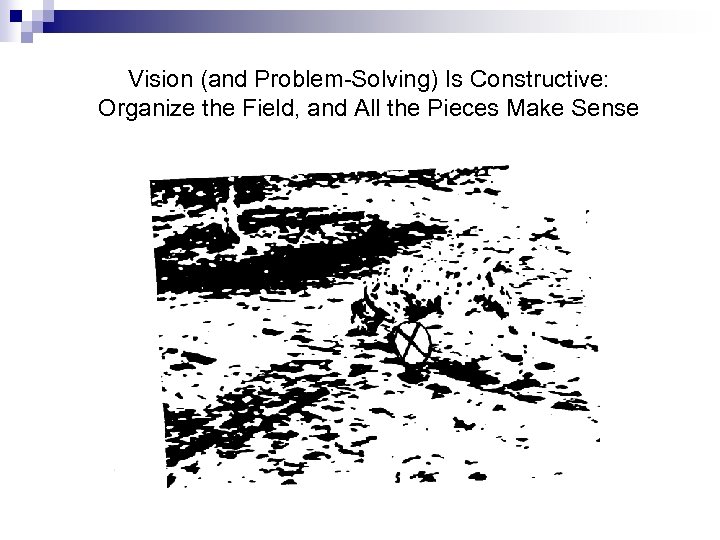
Vision (and Problem-Solving) Is Constructive: Organize the Field, and All the Pieces Make Sense
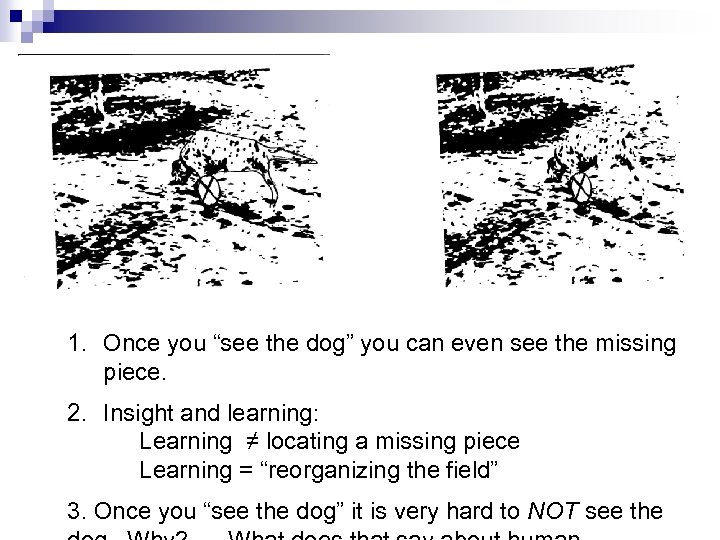
1. Once you “see the dog” you can even see the missing piece. 2. Insight and learning: Learning ≠ locating a missing piece Learning = “reorganizing the field” 3. Once you “see the dog” it is very hard to NOT see the
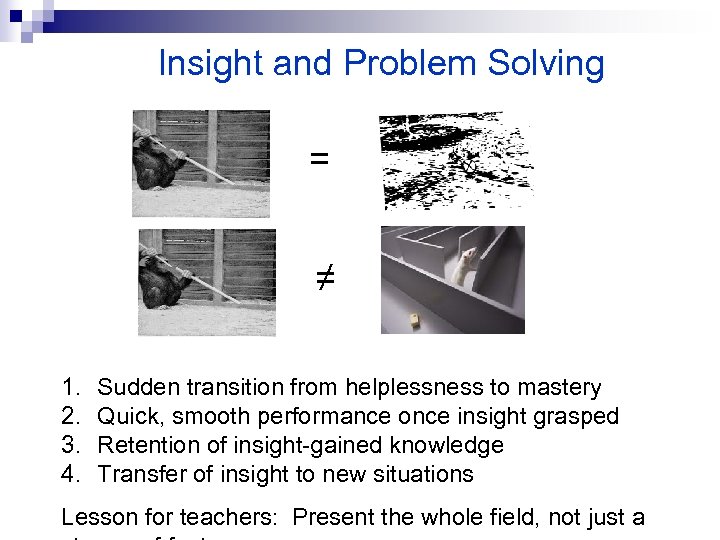
Insight and Problem Solving = ≠ 1. 2. 3. 4. Sudden transition from helplessness to mastery Quick, smooth performance once insight grasped Retention of insight-gained knowledge Transfer of insight to new situations Lesson for teachers: Present the whole field, not just a
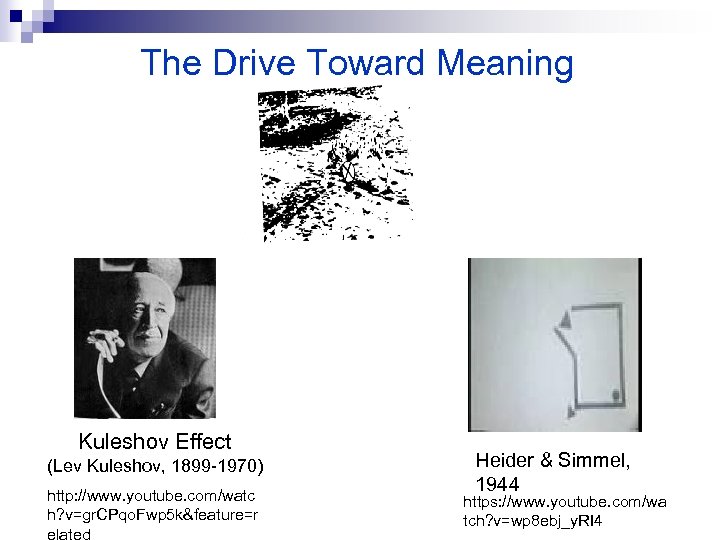
The Drive Toward Meaning Kuleshov Effect (Lev Kuleshov, 1899 -1970) http: //www. youtube. com/watc h? v=gr. CPqo. Fwp 5 k&feature=r elated Heider & Simmel, 1944 https: //www. youtube. com/wa tch? v=wp 8 ebj_y. RI 4
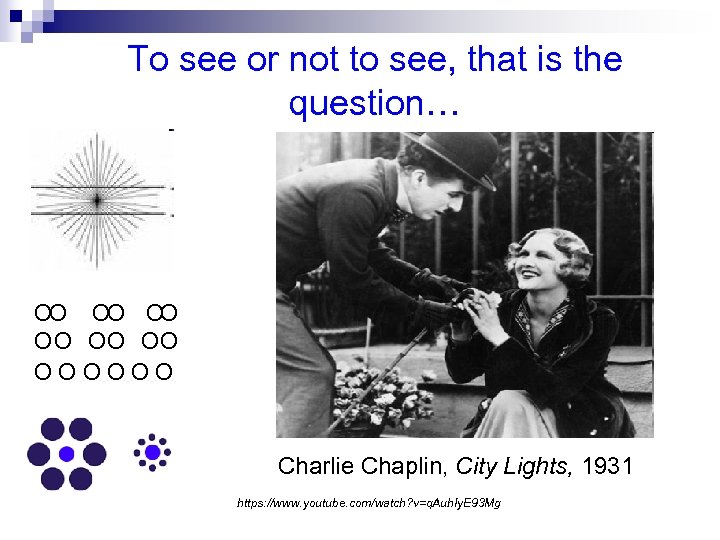
To see or not to see, that is the question… OO OOOOOO Charlie Chaplin, City Lights, 1931 https: //www. youtube. com/watch? v=q. Auh. Iy. E 93 Mg
Gestalt Psychology Discussion Questions 1. Gestaltists say that rat in maze looks random, but it's b/c rat can't see entire maze. The Gestaltists therefore saw problem from rat's point of view. How might this relate to social judgment? That is, how we judge the “odd” behaviors of others? 2. Our ability to organize things into meaningful wholes is clearly helpful. Is it ever unhelpful? How? 3. People see animals and faces in cloud formations, and religious figures in tortillas. Do Gestalt principles help explain this? 4. How might the Kuleshov effect relate to psychological problems, like paranoia? 5. Is the “self” a gestalt? Can’t people define themselves in terms of their “parts” (i. e. , interests, family, skills, etc. )? 6. Does the Gestalt notion that people see things purposefully rather than randomly relate to problems of social perception, like stereotypes or prejudice?
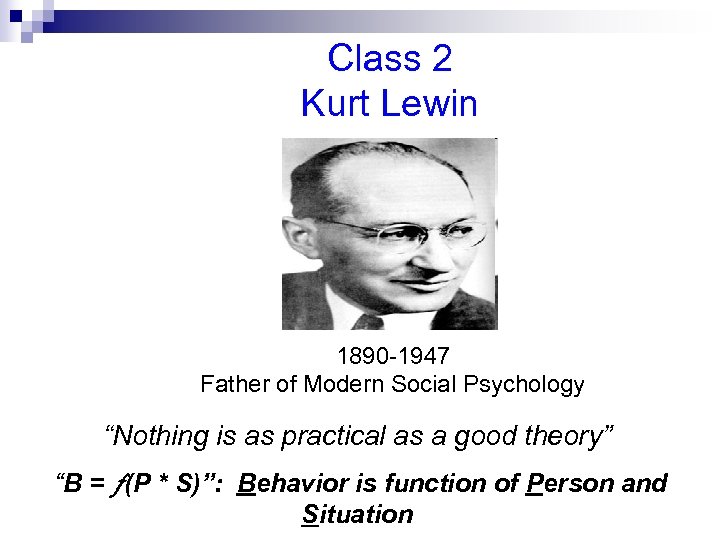
Class 2 Kurt Lewin 1890 -1947 Father of Modern Social Psychology “Nothing is as practical as a good theory” “B = (P * S)”: Behavior is function of Person and Situation
Lewin Biography Trained in classic Gestalt psych, but departs from it. Serves in German army during WW I. “Life space” influenced by infantryman experience. Immigrates to USA from Germany in 1932, flees Nazis Profound ideological connection to USA, democracy, and Zionism (creation of Israel). Planned to move the Research Center for Group Dynamics (now at U. Mich. ) to Israel before early death at age 57. Theorizing and some experiments reflect democratic ideals.
Lewin’s Contribution a. Life space: temporal and reality/irreality dimensions, can include uncons. proc. b. Channel factors gatekeepers c. Tension systems: Zeigarnic Effect Psychological Conflict d. Group dynamics, Leadership climate “democratic groups”
Lewin’s Attention to Every Day Events 1. How landscape appears to soldier, as he/she approaches front Life Space. 2. How to get Americans to change diets channel factors, gate keepers. 3. Waiter’s memory for un-paid bill tension systems, Zeigarnik Effect. 4. Workers’ appreciation of attention, WPA leadership styles Democratic vs. Authoritarian Climates.
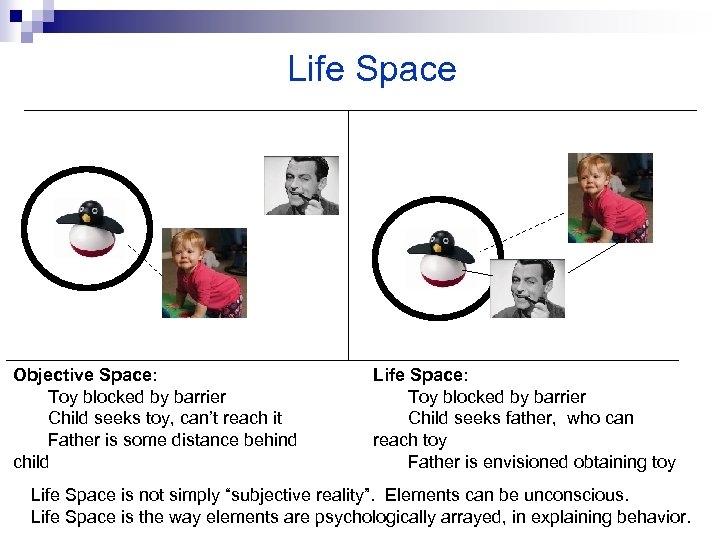
Life Space Objective Space: Toy blocked by barrier Child seeks toy, can’t reach it Father is some distance behind child Life Space: Toy blocked by barrier Child seeks father, who can reach toy Father is envisioned obtaining toy Life Space is not simply “subjective reality”. Elements can be unconscious. Life Space is the way elements are psychologically arrayed, in explaining behavior.
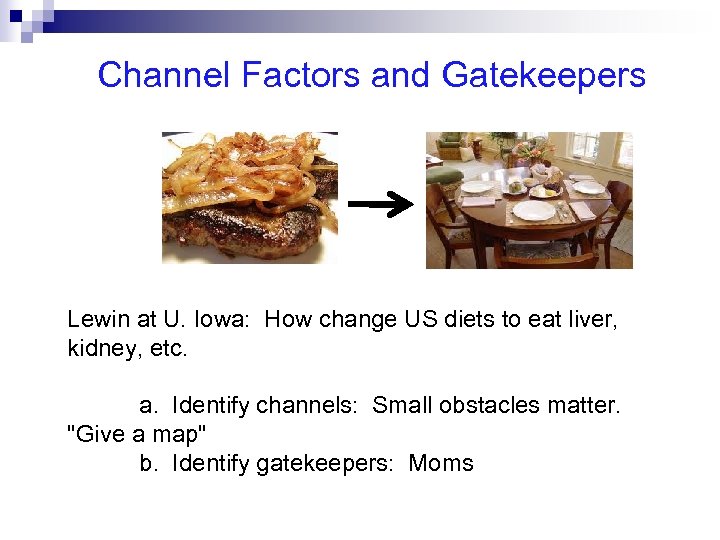
Channel Factors and Gatekeepers Lewin at U. Iowa: How change US diets to eat liver, kidney, etc. a. Identify channels: Small obstacles matter. "Give a map" b. Identify gatekeepers: Moms
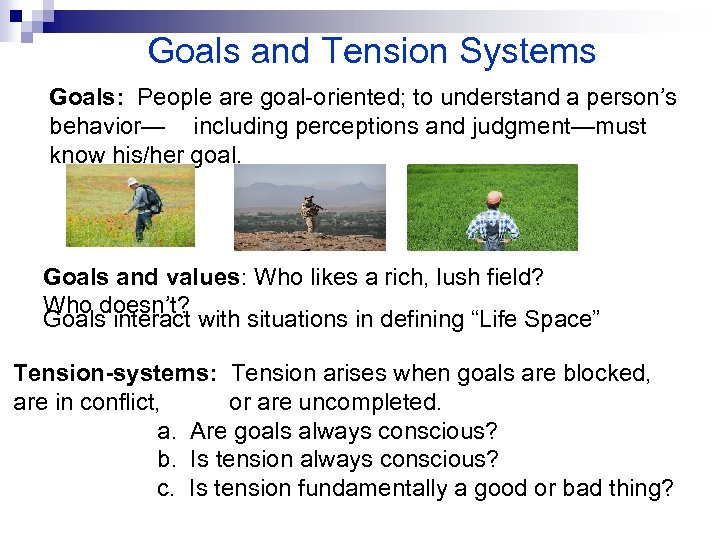
Goals and Tension Systems Goals: People are goal-oriented; to understand a person’s behavior— including perceptions and judgment—must know his/her goal. Goals and values: Who likes a rich, lush field? Who doesn’t? Goals interact with situations in defining “Life Space” Tension-systems: Tension arises when goals are blocked, are in conflict, or are uncompleted. a. Are goals always conscious? b. Is tension always conscious? c. Is tension fundamentally a good or bad thing?
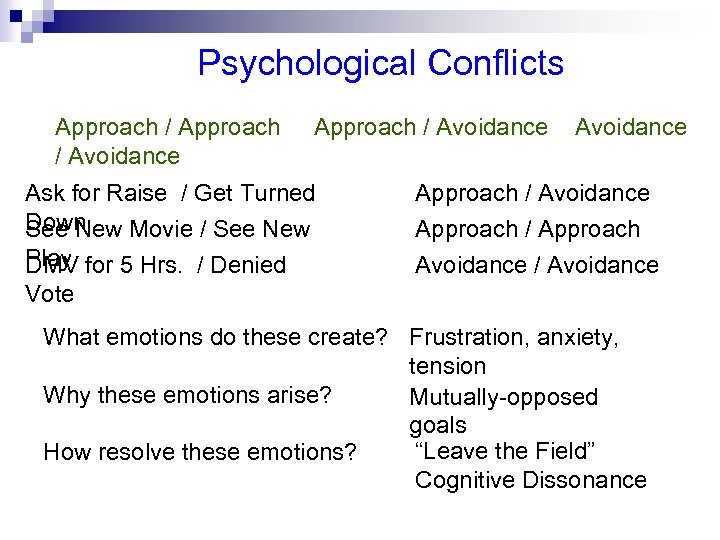
Psychological Conflicts Approach / Avoidance Ask for Raise / Get Turned Down See New Movie / See New Play for 5 Hrs. / Denied DMV Vote Avoidance Approach / Approach Avoidance / Avoidance What emotions do these create? Frustration, anxiety, tension Why these emotions arise? Mutually-opposed goals “Leave the Field” How resolve these emotions? Cognitive Dissonance
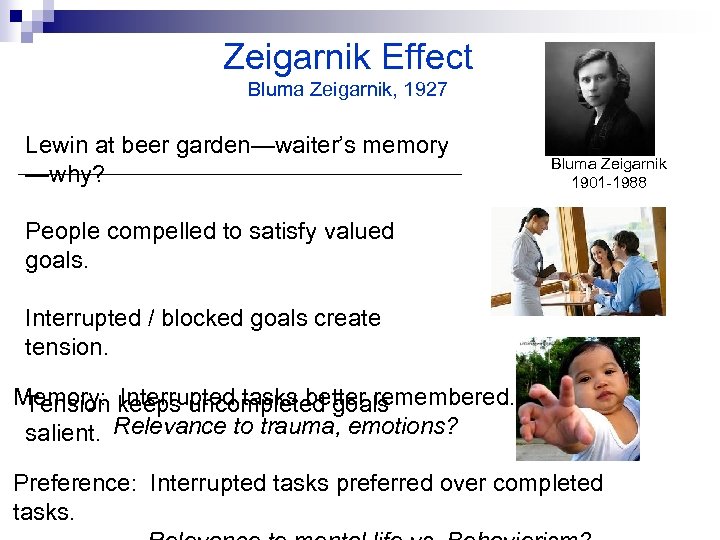
Zeigarnik Effect Bluma Zeigarnik, 1927 Lewin at beer garden—waiter’s memory —why? Bluma Zeigarnik 1901 -1988 People compelled to satisfy valued goals. Interrupted / blocked goals create tension. Memory: keeps uncompleted goals Tension Interrupted tasks better remembered. salient. Relevance to trauma, emotions? Preference: Interrupted tasks preferred over completed tasks.
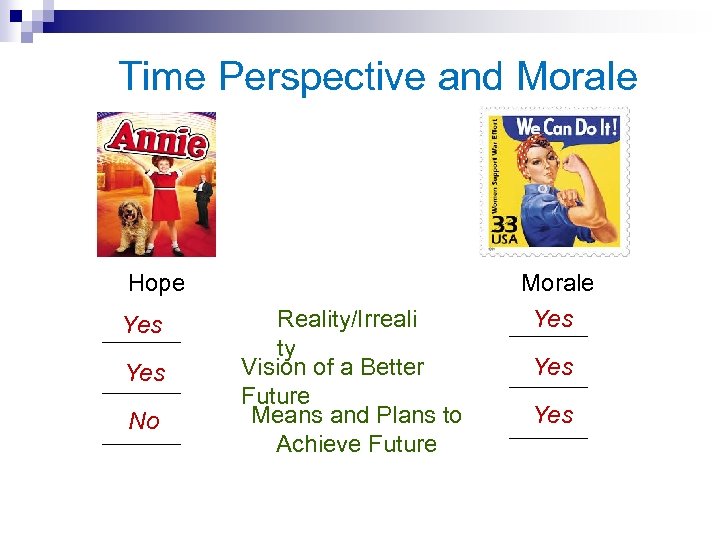
Time Perspective and Morale Hope Yes No Reality/Irreali ty Vision of a Better Future Means and Plans to Achieve Future Morale Yes Yes
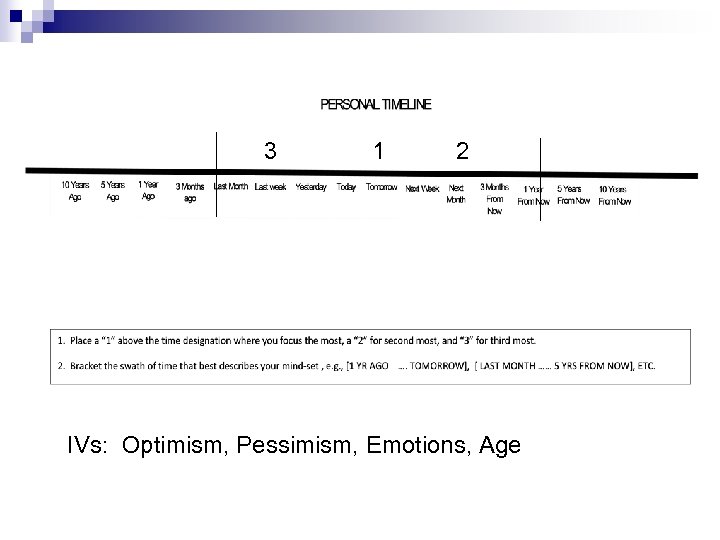
3 1 2 IVs: Optimism, Pessimism, Emotions, Age
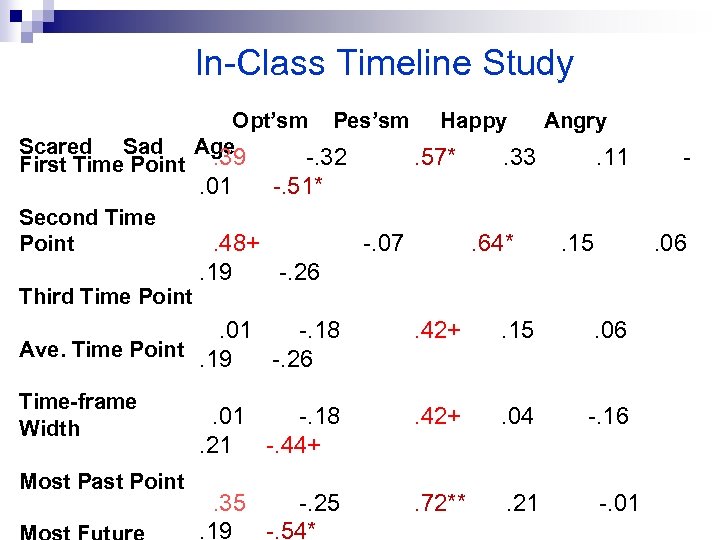
In-Class Timeline Study Scared Sad First Time Point Second Time Point Third Time Point Opt’sm Pes’sm Happy Angry Age. 39 -. 32. 57*. 33. 11 . 01 -. 51* . 48+. 19 -. 26 . 01 -. 18 Ave. Time Point. 19 -. 26 Time-frame Width Most Past Point - -. 07 . 64* . 15 . 06 . 42+ . 15 . 06 . 01 -. 18. 21 -. 44+ . 42+ . 04 -. 16 . 35 -. 25. 19 -. 54* . 72** . 21 -. 01
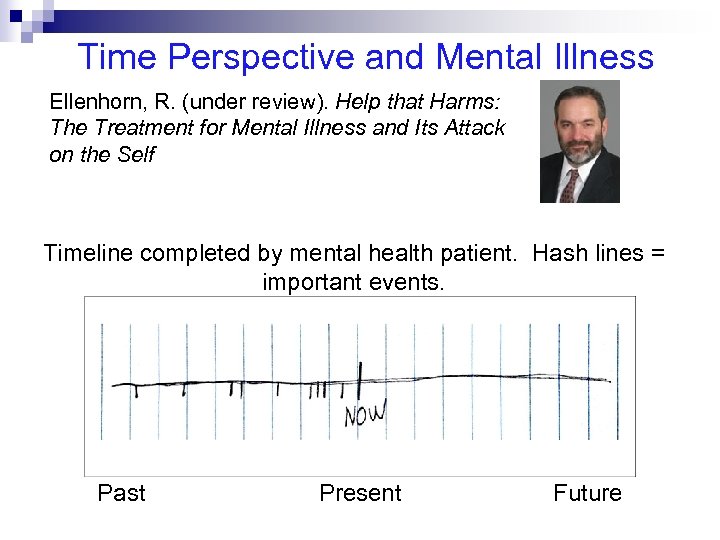
Time Perspective and Mental Illness Ellenhorn, R. (under review). Help that Harms: The Treatment for Mental Illness and Its Attack on the Self Timeline completed by mental health patient. Hash lines = important events. Past Present Future
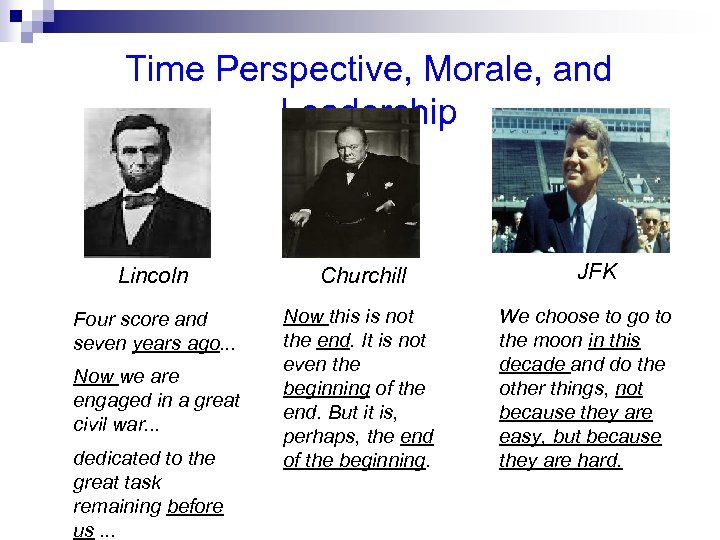
Time Perspective, Morale, and Leadership Lincoln Churchill Four score and seven years ago. . . Now this is not the end. It is not even the beginning of the end. But it is, perhaps, the end of the beginning. Now we are engaged in a great civil war. . . dedicated to the great task remaining before us. . . JFK We choose to go to the moon in this decade and do the other things, not because they are easy, but because they are hard.
Lewin's Empirical Humanism Social Perception: To understand people (and their behavior) you must: A. Understand the situation they are in. B. Understand the situation they see themselves as being in. "To substitute the for that world of the individual the world. . . of the physicist, or anybody else, is not to be objective, but wrong. " "Naive Psychology" pretty good. Is scientific psych. as smart as 3 yr old? Social psych: Need to determine proper size of observational unit. Too long obsessed with smallest possible unit.
Lewin Discussion Questions 1. Kurt Lewin said that people seek homeostasis—a state of equilibrium where tension is minimal. But that sounds boring. Most people seek tension, such as sports, romance, scary movies. How might Lewin explain this? 2. The Zeigarnik Effect says that uncompleted goals stay alive in memory. How might Zeig. Effect relate to intrusive memories/intrusive emotions? 3. Lewin observes that organized groups are more persistent, more motivated--but that fear spreads more quickly through them. Why? 4. Can observation and interpretation ever be kept separate? Can a person be trained to do keep them separate, as Lewin suggests? 5. Lewin says reduced morale "narrows" life space. What does this mean? What are examples? 6. "Realism is key to morale": Does this have any relevance to medical practice?
Скачать презентацию Social Perception Governed By Same Laws As Physical
8ae5d7c8905bd8576eef71ab35fe45b8.ppt