


 Скачать презентацию Social Media Concepts Applications and Research NCTU IIM
9352da5b43775de02ea507438427ebab.ppt
- Количество слайдов: 57
 Social Media: Concepts, Applications, and Research NCTU, IIM, IEBI Lab Prof. Yung-Ming Li Dr. Yung-Ming Li Institute of Information Management National Chiao Tung University, Taiwan 李永銘博士 交大資管所 Institute of Information Management, NCTU © 2009 IEBI Lab
 Agenda • • • Social Media and its Characteristics Social Media & Marketing Social Media & Education Managing Social Media Research in Social Media: Online Social Advertising Institute of Information Management, NCTU © 2009 IEBI Lab
 Social Media • What is Social Media? – New paradigm of message/news propagation – Disseminate information through social interactions (definition quoted from wikipedia) • From traditional media – News papers, TV programs, Static web content • To social media – Blog, Twitter, facebook, digg, plurk, tumblr, flickr… Institute of Information Management, NCTU © 2009 IEBI Lab
 Things that Boost Social Media • Better hardware/network infrastructure – Broad band, 3 g, notebooks, smart phones • New Tools for publishing content – Mediawiki, building your own wiki site – Blogspot, providing user-friendly blog system – You. Tube, distributing your video • RSS – Makes user-generated content more accessible. Institute of Information Management, NCTU © 2009 IEBI Lab
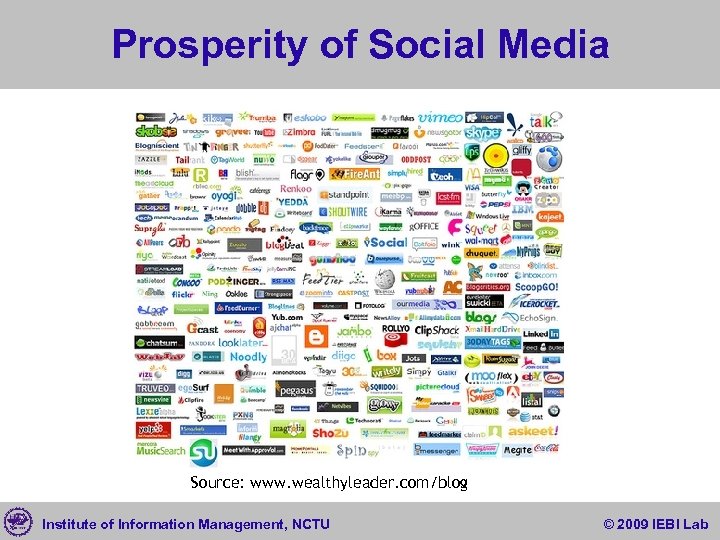 Prosperity of Social Media Source: www. wealthyleader. com/blog Institute of Information Management, NCTU © 2009 IEBI Lab
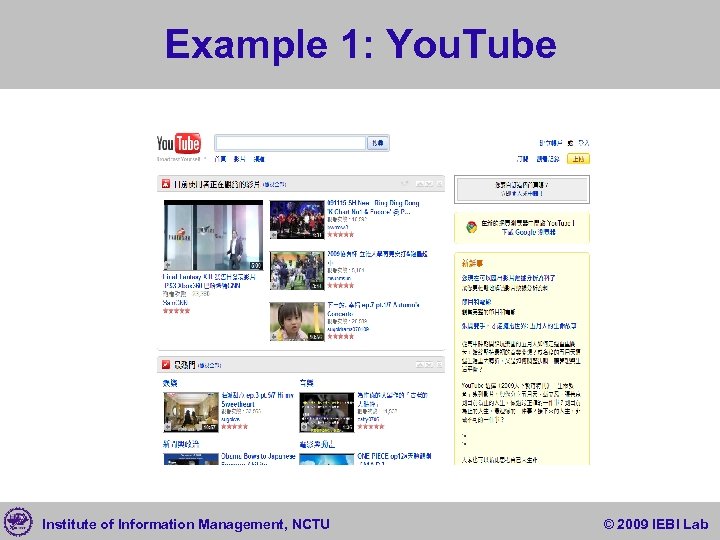 Example 1: You. Tube Institute of Information Management, NCTU © 2009 IEBI Lab
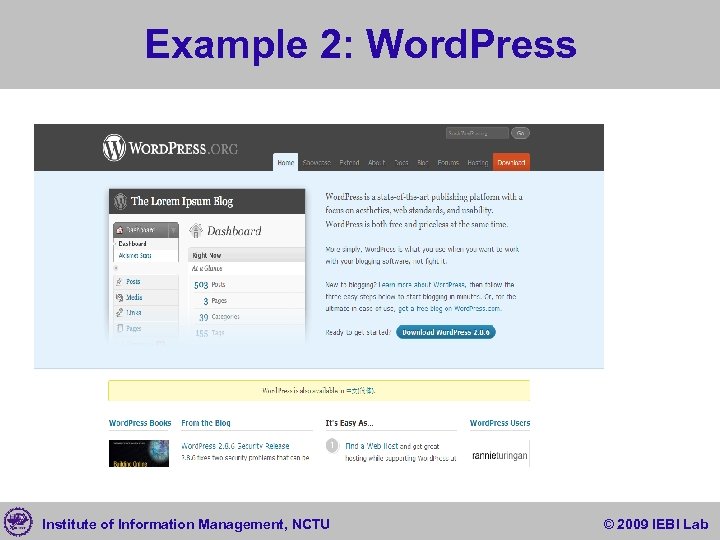 Example 2: Word. Press Institute of Information Management, NCTU © 2009 IEBI Lab
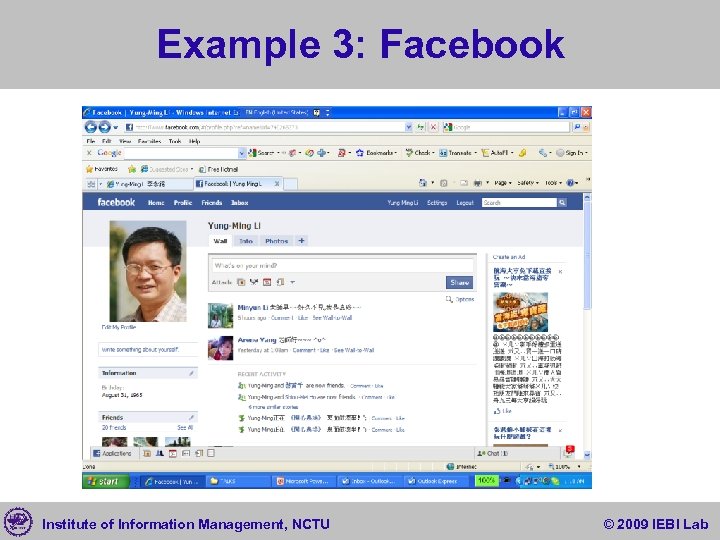 Example 3: Facebook Institute of Information Management, NCTU © 2009 IEBI Lab
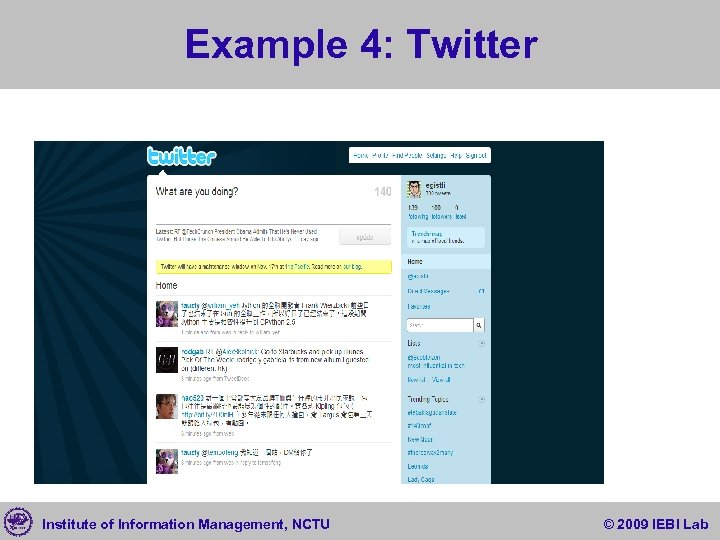 Example 4: Twitter Institute of Information Management, NCTU © 2009 IEBI Lab
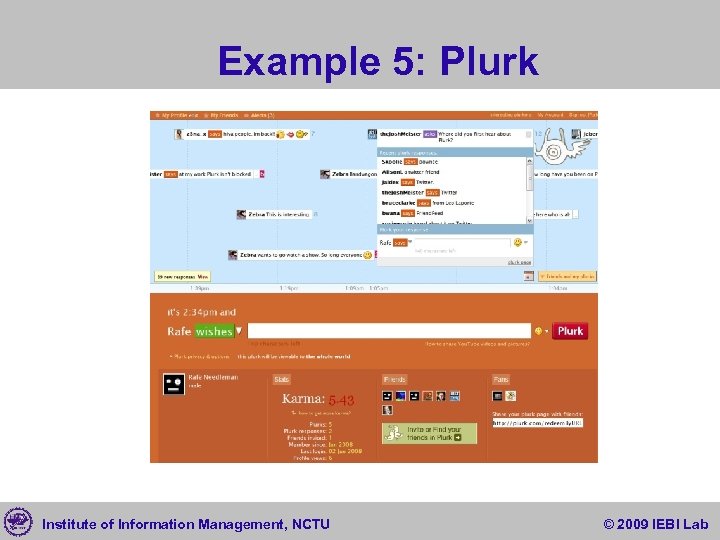 Example 5: Plurk Institute of Information Management, NCTU © 2009 IEBI Lab
 Characteristics of Social Media • Recency – Earlier report from content provider spreading around the world while accuracy should be concerned – e. g. Report of Michael Jackson’s Death on twitter, report of Earth Quake at Japan • Reach – Varying with types/features of content • Evolutionary Content – Content can be modified by the crowds • e. g. wikipedia – Modification and Annotation of blog entries are often seen due to comments after the entries got posted Institute of Information Management, NCTU © 2009 IEBI Lab
 Social interactions • Social networking – Make friends, follow • Blog – Comment, Trackback (URL citation) • Video, photos – Embed • Social Bookmarking • Groups/communities – Fans group of stars, politicians, athletes – Communities for specific topics • Information sharing – Retweet, Replurk, • All of above leads to more and stronger “Relations” – Social network analysis comes to help Institute of Information Management, NCTU © 2009 IEBI Lab
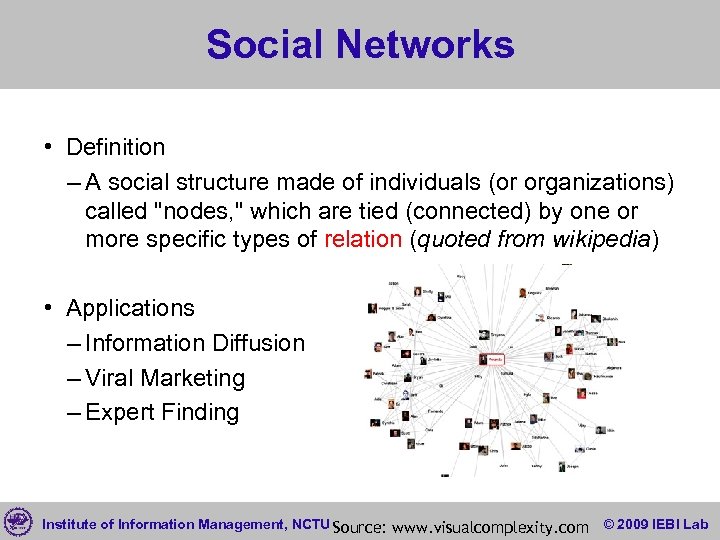 Social Networks • Definition – A social structure made of individuals (or organizations) called "nodes, " which are tied (connected) by one or more specific types of relation (quoted from wikipedia) • Applications – Information Diffusion – Viral Marketing – Expert Finding Institute of Information Management, NCTU Source: www. visualcomplexity. com © 2009 IEBI Lab
 Online social network • The nodes are the users who are connected through some form of online communication – Facebook. com • Users set up a profile page that includes a picture, name, gender, high school, hobbies and other interests. • The friendship network on Facebook. com is a nondirected graph. – Other website Adalbert Mayer (2009), Online social networks in economics, Decision Support Systems Institute of Information Management, NCTU © 2009 IEBI Lab
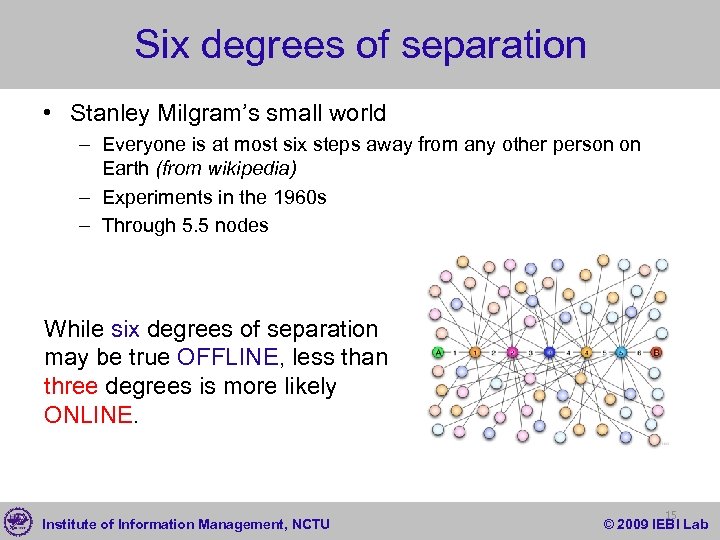 Six degrees of separation • Stanley Milgram’s small world – Everyone is at most six steps away from any other person on Earth (from wikipedia) – Experiments in the 1960 s – Through 5. 5 nodes While six degrees of separation may be true OFFLINE, less than three degrees is more likely ONLINE. Institute of Information Management, NCTU 15 © 2009 IEBI Lab
 Blog VS. Microblog Institute of Information Management, NCTU © 2009 IEBI Lab
 Blog • Web + log = Blog – 10 new words in 2004 – ‘‘a website that contains an online personal journal with reflections, comments, and often hyperlinks provided by the writer. ’’ – Easy for everyone to use Tanuja Singh, Liza Veron-Jackson, and Joe Cullinane(2008), Blogging: A new play in your marketing game plan, “Kelley School of Business, Indiana University. ” Ching-Yuan Huang, Chia-Jung Chou, and Pei-Ching Lin(2009), Involvement theory in constructing bloggers’ intention to purchase travel products, “Tourism Management” Institute of Information Management, NCTU © 2009 IEBI Lab
 What is Microblog? • A form of brief multimedia blogging – allows users to send brief text updates or micromedia such as photos or audio clips and publish them – to be viewed by anyone or by a restricted group which can be chosen by the user – Twitter, Plurk Wikipedia “Microblog” Institute of Information Management, NCTU © 2009 IEBI Lab
 Characteristics of Microblogging • Only allow short messages – less than 140 words • Easy to use – Just post what you want to say! • Interactivity – Like chat room Institute of Information Management, NCTU • Faster mode of communication – real time, update fast, spreads rapidly – Become information ripple • Exposure – public • High mobility – Combine with mobile device © 2009 IEBI Lab
 Where to use microblog? • Share information to your friends • Information filtering – By you friends • Online expert finding – Also by your friends • Be a bulletin board – information sharing publically • Tools to make friends – Six degrees of separation Institute of Information Management, NCTU © 2009 IEBI Lab
 Social Media & Marketing Institute of Information Management, NCTU © 2009 IEBI Lab
 Social Media’s Role for Business • A powerful tool – To trigger viral marketing • Or start point of a disaster – Dell’s incorrect priced products on its e-commerce platform in Taiwan • A new data source – To discover word-of-mouth information – Find out trendy topics, consumer expectations, opinions on products or brands Institute of Information Management, NCTU © 2009 IEBI Lab
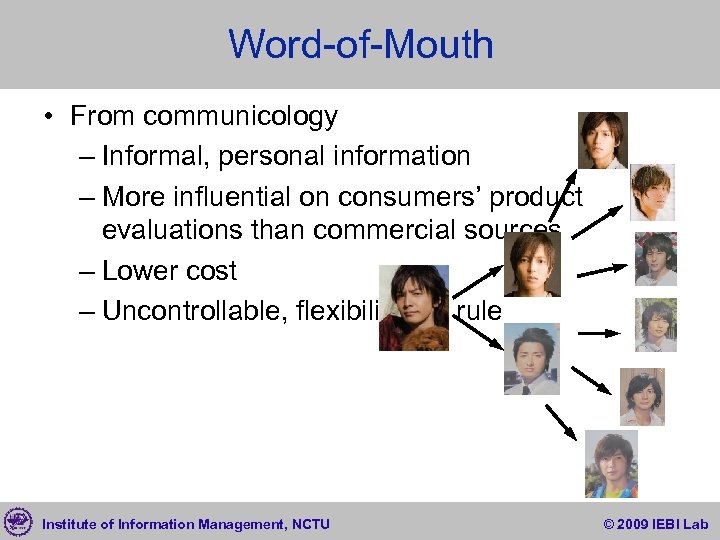 Word-of-Mouth • From communicology – Informal, personal information – More influential on consumers’ product evaluations than commercial sources – Lower cost – Uncontrollable, flexibility, no rule Institute of Information Management, NCTU © 2009 IEBI Lab
 Marketing yourself • Barack Obama – Grassroots campaign – Using Facebook , Twitter – Closer to the voters – Tight connection – Trying to attract the crowds, meanwhile pass his strong mission – Became the first using social media marketing himself – Became the First African American President of The US Institute of Information Management, NCTU © 2009 IEBI Lab
 Facebook • Burger King "Whopper Sacrifice“ – Delete 10 Facebook friends, get a free Whopper • Starbucks – Starbucks offered free pints to Facebook users. – Approaching 3, 000 Fans • National Buy a Newspaper Day – A Alaska newspaper reporter successfully called 30000 Facebook users to buy a newspaper in three weeks Institute of Information Management, NCTU © 2009 IEBI Lab
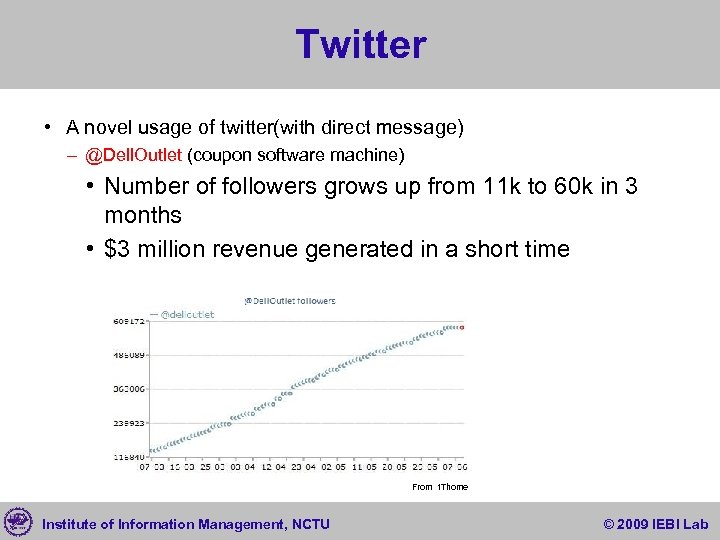 Twitter • A novel usage of twitter(with direct message) – @Dell. Outlet (coupon software machine) • Number of followers grows up from 11 k to 60 k in 3 months • $3 million revenue generated in a short time From i. Thome Institute of Information Management, NCTU © 2009 IEBI Lab
 Twitter (Cont’) • Kogi - a Korean BBQ buffet car business – Tweet their location of the buffet car (mobile information) – 15 k follower on twitter • Domino's – Two staff posted a video of messing up a sandwich on twitter and hurt Domino’s reputation Institute of Information Management, NCTU © 2009 IEBI Lab
 Institute of Information Management, NCTU © 2009 IEBI Lab
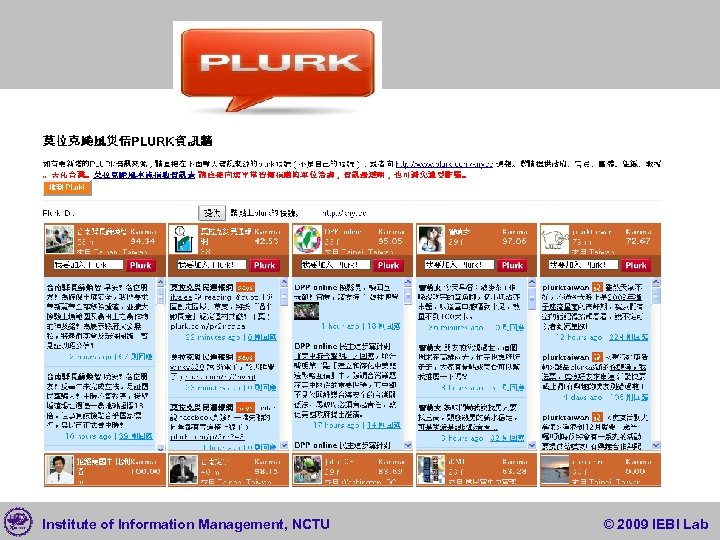
 Plurk • Goz Café (果子) – Meal got discounted responding to customer’s “karma” on plurk • KKBOX’s customer services – Utilizing search of plurk, discover customers’ needs • TV programs, e. g. 敗犬女王, 全民最大黨 – Publish news, content of the show and interact with audience • Politicians, e. g. 蘇貞昌、謝長廷 – Interacting with people and expressing their opinions Institute of Information Management, NCTU © 2009 IEBI Lab
 Social Media & Education - New paradigm of Classroom, Course, Assignment, Exam Institute of Information Management, NCTU © 2009 IEBI Lab
 Social Media & Education • Interactive Assignment – QA on twitter, conversation-like assignment • Knowledge sharing – post course-related tweets • Build classroom community – Let students have more interactions and know others well • Tips given on twitter – Make your tweets interesting to students • Learn more about others (teachers, students) – From tweets of your students, discover their life and inner parts Institute of Information Management, NCTU © 2009 IEBI Lab
 Social Media Monitoring • Why should social media being monitored? – For enterprises, it’s valuable to know how do people feel about their brands and products – For teachers, it’s good to know what do other teachers do and what is on students’ mind. • Objectives – Customer Relation Management • Discover troubles/problems and resolve them – Market Research • To know what feature is most wanted – Shaping the community and sphere • Know what your followers’, such as your students, opinion and lead them Institute of Information Management, NCTU © 2009 IEBI Lab
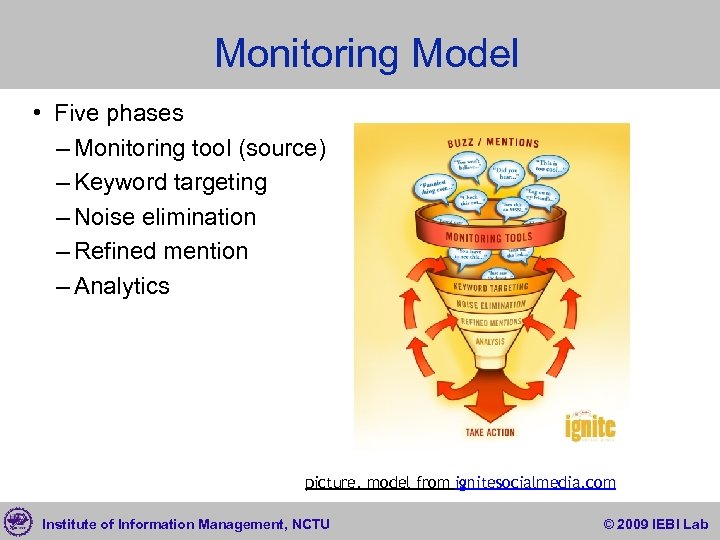 Monitoring Model • Five phases – Monitoring tool (source) – Keyword targeting – Noise elimination – Refined mention – Analytics picture, model from ignitesocialmedia. com Institute of Information Management, NCTU © 2009 IEBI Lab
 Tips in Utilizing Social Media • Consider registering multiple twitter account – Minimize noise to your followers • Keep nice and thankful in tweets – Use direct message to thank people who appreciate/retweet your tweets • Know timing of using direct message – For further question/discussion, using direct message to prevent being annoying to irrelevant followers • Consider being a hub – Retweet others’ valuable tweets • Control number of tweets per day – Not too much, not too less. About 3~5 in a day. Institute of Information Management, NCTU © 2009 IEBI Lab
 Social Media Research: Online Social Advertising Yung-Ming Li Nine-Jun Lien Institute of Information Management National Chiao Tung University, Taiwan Institute of Information Management, NCTU © 2009 IEBI Lab
 Background • The percentage of advertising income in total revenue of websites is continuously growing • Advertising on social networking sites (SNSs) are increasingly emerging – The Social Ads™ (Facebook) remind users the social actions of their friends as well as promote advertising subject – Advertisers shouldn't try to figure out how to advertise to people, but instead how to advertise between people (Social. Media. com) Institute of Information Management, NCTU 36 © 2009 IEBI Lab
 Research Problem • Objective – Conquer the overloaded advertising information problem (negative impression and low efficiency of ads) – In the research, we would like to improve the efficiency and Impression of Ads • Approach – Based on the social relation and preference , we design a social advertising system to support viral ads campaign – Discovery of influencers is the essential before further ads diffusion Institute of Information Management, NCTU 37 © 2009 IEBI Lab
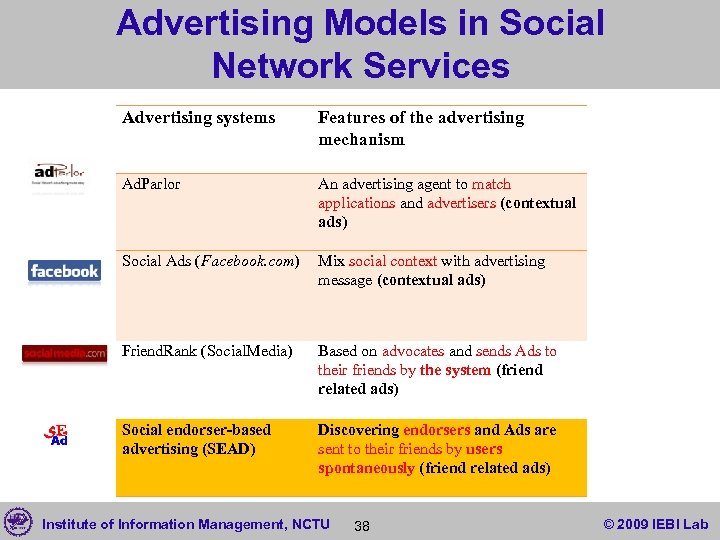 Advertising Models in Social Network Services Advertising systems Features of the advertising mechanism Ad. Parlor An advertising agent to match applications and advertisers (contextual ads) Social Ads (Facebook. com) Mix social context with advertising message (contextual ads) Friend. Rank (Social. Media) Based on advocates and sends Ads to their friends by the system (friend related ads) Social endorser-based advertising (SEAD) Discovering endorsers and Ads are sent to their friends by users spontaneously (friend related ads) Institute of Information Management, NCTU 38 © 2009 IEBI Lab
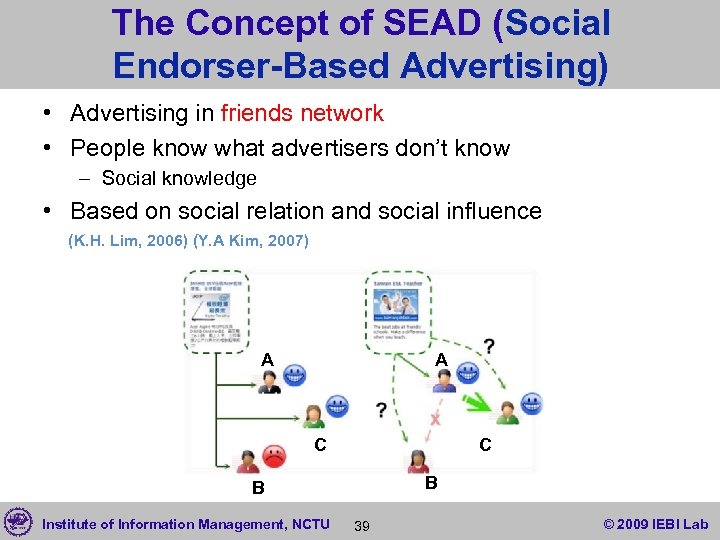 The Concept of SEAD (Social Endorser-Based Advertising) • Advertising in friends network • People know what advertisers don’t know – Social knowledge • Based on social relation and social influence (K. H. Lim, 2006) (Y. A Kim, 2007) A A C C B B Institute of Information Management, NCTU 39 © 2009 IEBI Lab
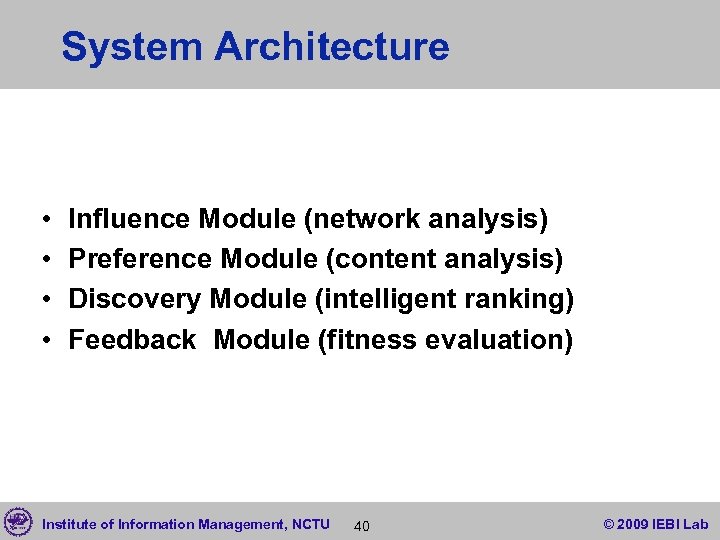 System Architecture • • Influence Module (network analysis) Preference Module (content analysis) Discovery Module (intelligent ranking) Feedback Module (fitness evaluation) Institute of Information Management, NCTU 40 © 2009 IEBI Lab
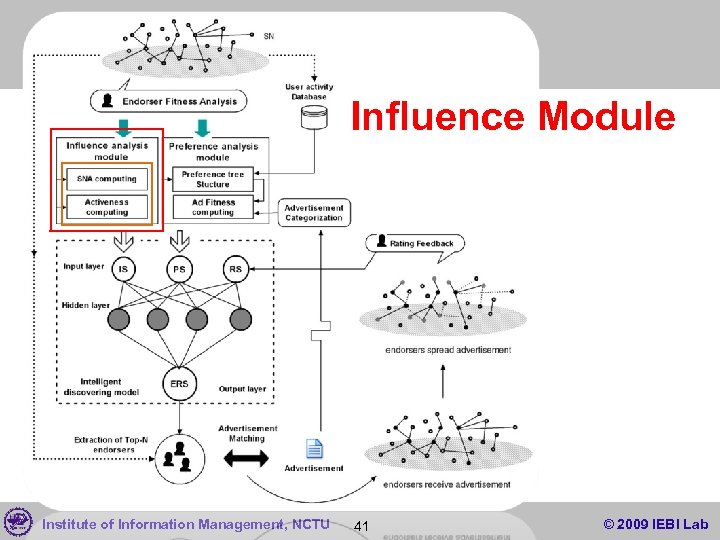 Influence Module Institute of Information Management, NCTU 41 © 2009 IEBI Lab
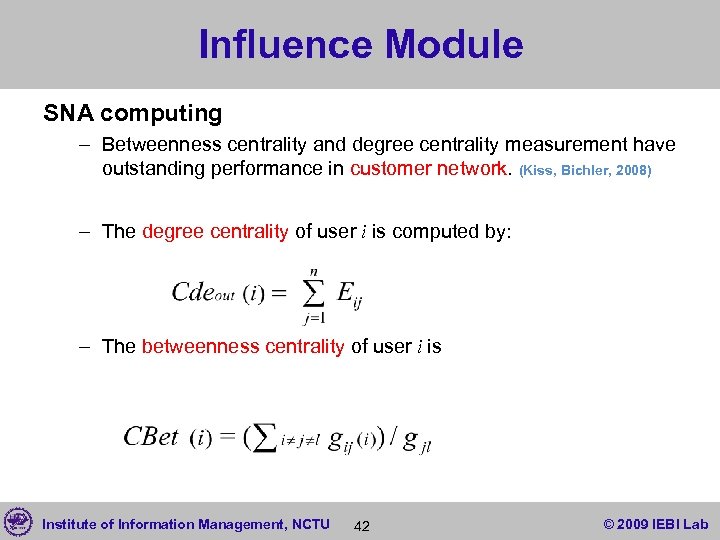 Influence Module SNA computing – Betweenness centrality and degree centrality measurement have outstanding performance in customer network. (Kiss, Bichler, 2008) – The degree centrality of user i is computed by: – The betweenness centrality of user i is Institute of Information Management, NCTU 42 © 2009 IEBI Lab
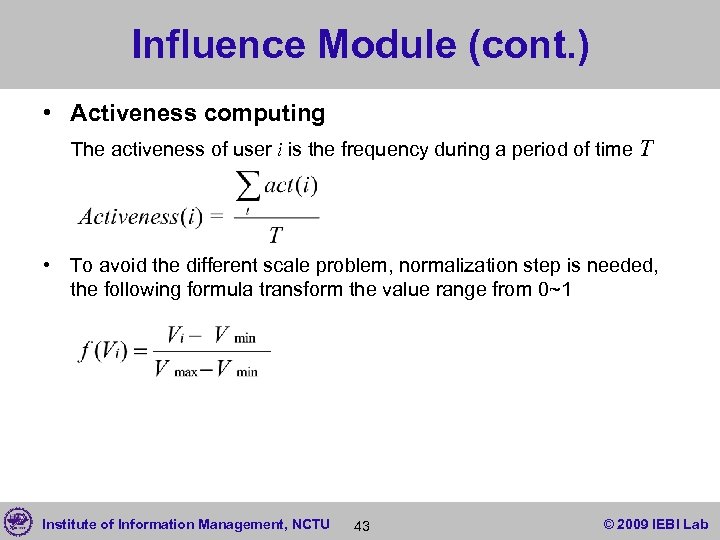 Influence Module (cont. ) • Activeness computing The activeness of user i is the frequency during a period of time T • To avoid the different scale problem, normalization step is needed, the following formula transform the value range from 0~1 Institute of Information Management, NCTU 43 © 2009 IEBI Lab
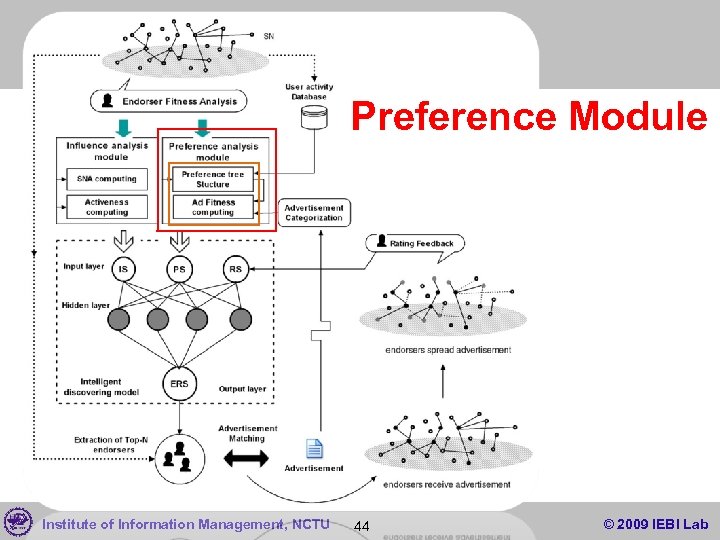 Preference Module Institute of Information Management, NCTU 44 © 2009 IEBI Lab
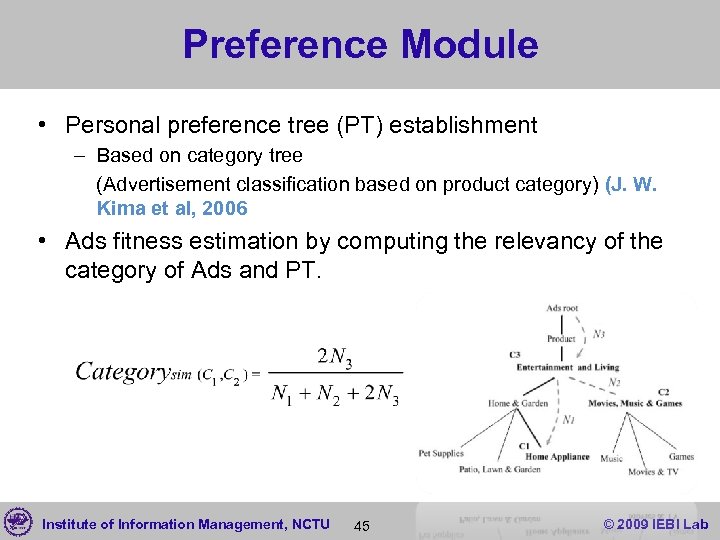 Preference Module • Personal preference tree (PT) establishment – Based on category tree (Advertisement classification based on product category) (J. W. Kima et al, 2006 • Ads fitness estimation by computing the relevancy of the category of Ads and PT. Institute of Information Management, NCTU 45 © 2009 IEBI Lab
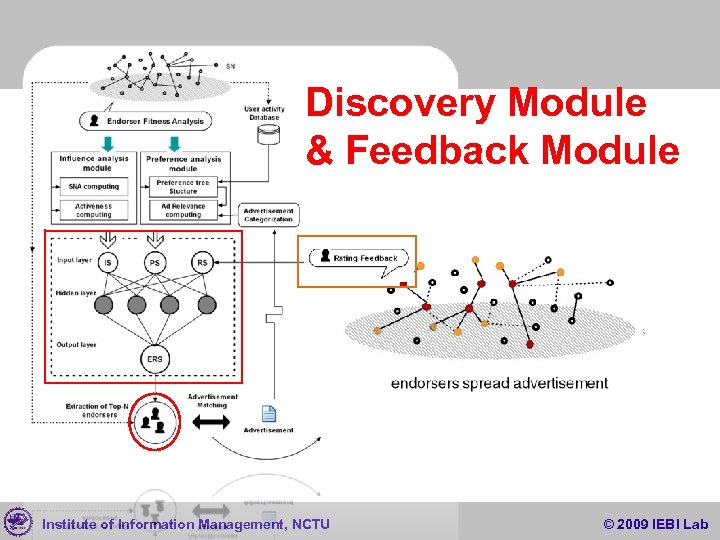 Discovery Module & Feedback Module Institute of Information Management, NCTU © 2009 IEBI Lab
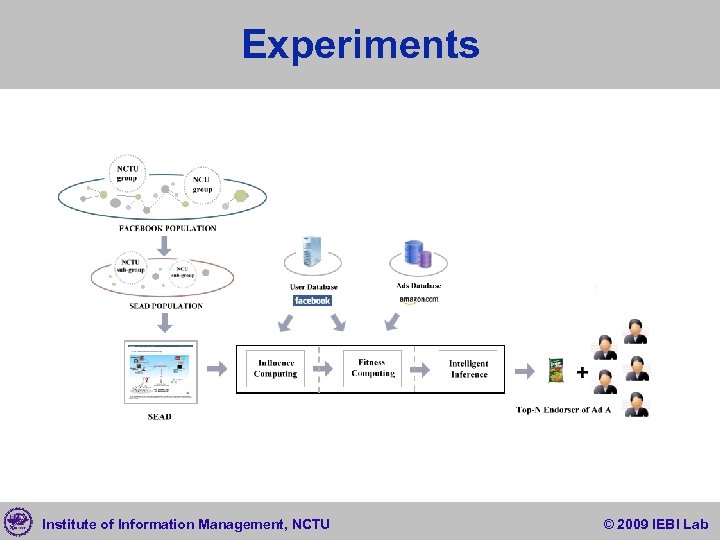 Experiments Institute of Information Management, NCTU © 2009 IEBI Lab
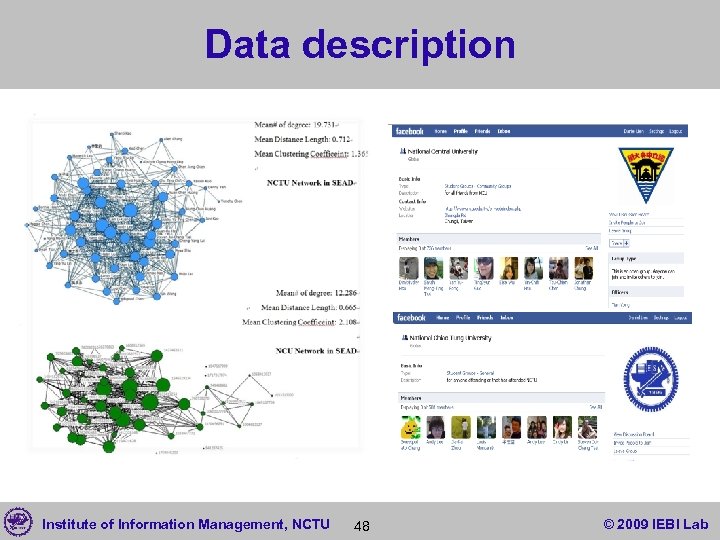 Data description Institute of Information Management, NCTU 48 © 2009 IEBI Lab
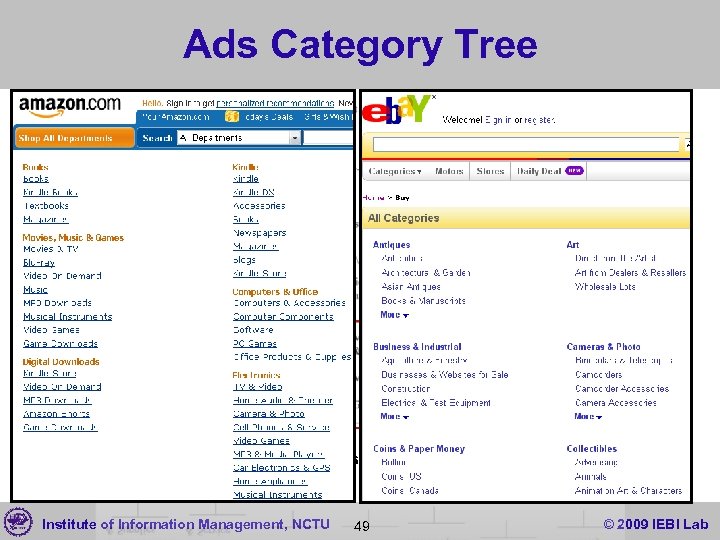 Ads Category Tree 21 Leaf categories in our testing sub-tree departments Institute of Information Management, NCTU 49 © 2009 IEBI Lab
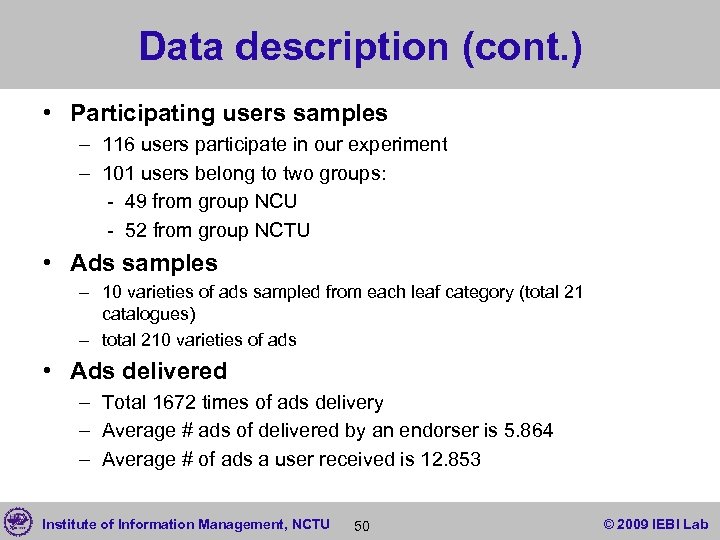 Data description (cont. ) • Participating users samples – 116 users participate in our experiment – 101 users belong to two groups: - 49 from group NCU - 52 from group NCTU • Ads samples – 10 varieties of ads sampled from each leaf category (total 21 catalogues) – total 210 varieties of ads • Ads delivered – Total 1672 times of ads delivery – Average # ads of delivered by an endorser is 5. 864 – Average # of ads a user received is 12. 853 Institute of Information Management, NCTU 50 © 2009 IEBI Lab
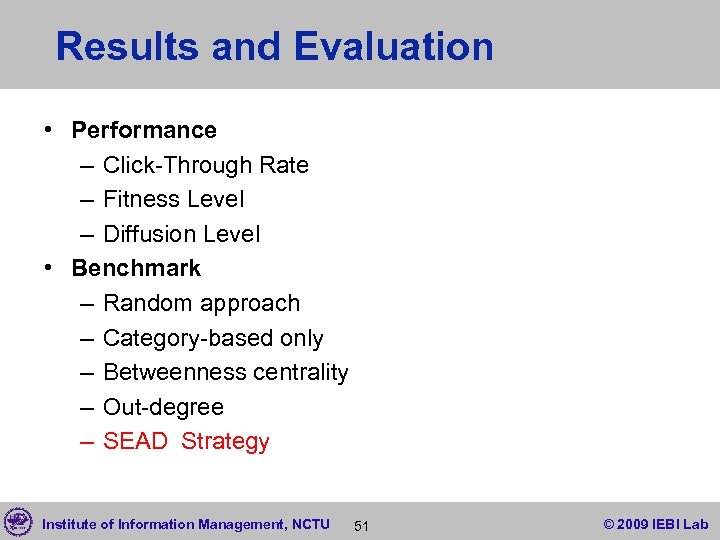 Results and Evaluation • Performance – Click-Through Rate – Fitness Level – Diffusion Level • Benchmark – Random approach – Category-based only – Betweenness centrality – Out-degree – SEAD Strategy Institute of Information Management, NCTU 51 © 2009 IEBI Lab
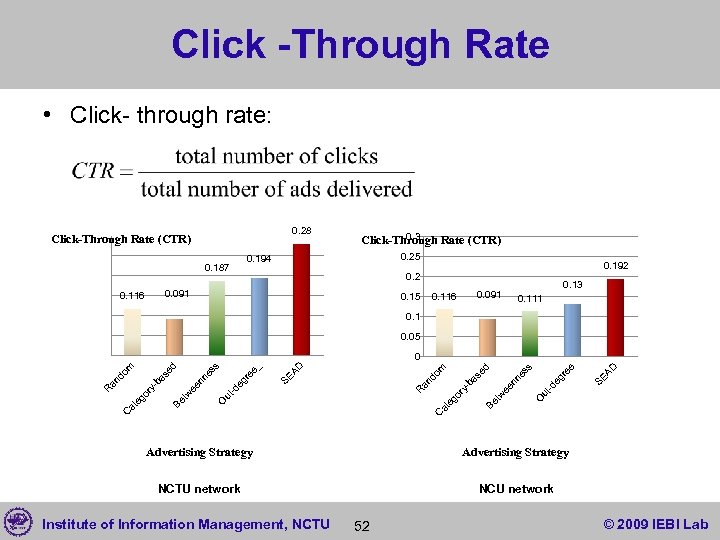 Click -Through Rate • Click- through rate: 0. 28 Click-Through Rate (CTR) 0. 3 Click-Through Rate (CTR) 0. 25 0. 194 0. 187 0. 091 0. 116 0. 192 0. 15 0. 091 0. 116 0. 13 0. 111 0. 05 AD eg r -d O ut SE ee s es C Be go at e ee nn -b ry R ut O tw as ed om AD -d an d eg r SE _ ee ss ne ee n tw Be C at e go ry R -b an d as ed om 0 Advertising Strategy NCTU network NCU network Institute of Information Management, NCTU 52 © 2009 IEBI Lab
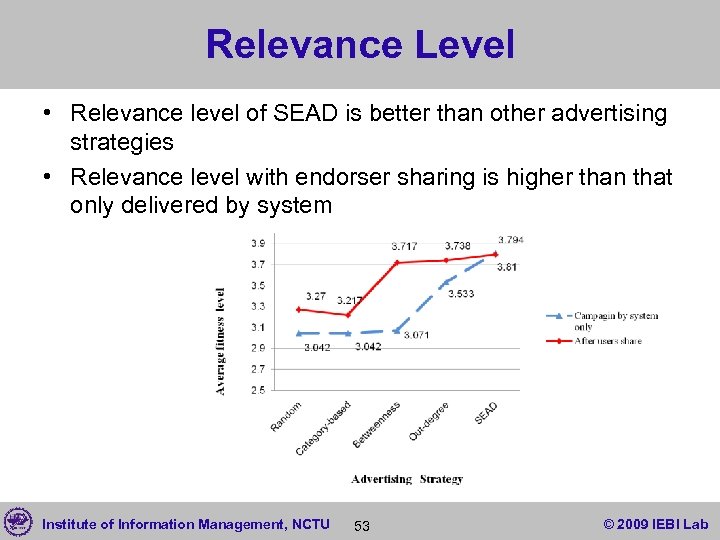 Relevance Level • Relevance level of SEAD is better than other advertising strategies • Relevance level with endorser sharing is higher than that only delivered by system Institute of Information Management, NCTU 53 © 2009 IEBI Lab
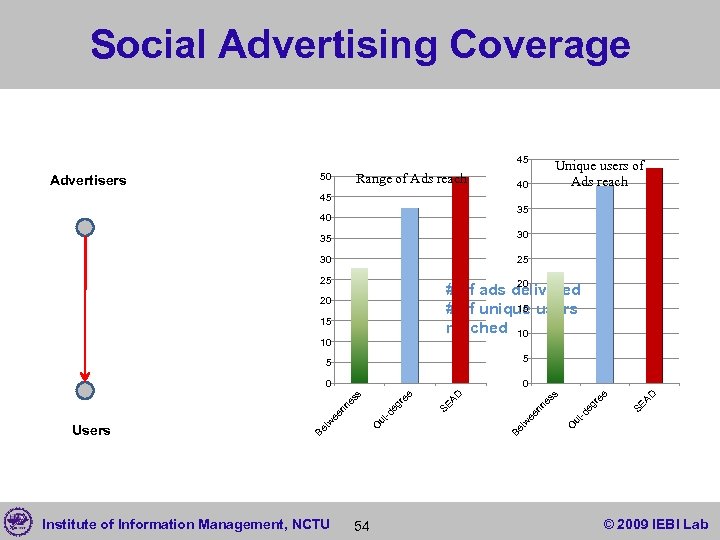 Social Advertising Coverage 45 Advertisers Range of Ads reach 50 Unique users of Ads reach 40 45 35 40 35 30 30 25 25 20 # of ads delivered 15 # of unique users reached 10 20 15 10 Institute of Information Management, NCTU SE eg r -d ut O Be tw ee nn es AD eg r -d ut O 54 SE ss ne ee n tw Be Users AD 0 s 0 ee 5 © 2009 IEBI Lab
 Summary • People has significant positive attitude to the ads based on their preference and recommended by their friends • We propose an innovative endorser discovering mechanism (SEAD)for social advertising implementation. • Our proposed SEAD advertising model includes influence (social network analysis) and preference (user preference analysis) modules • The proposed approach gives commerce opportunities by better effectiveness (click-through rate and fitness level) Institute of Information Management, NCTU 55 © 2009 IEBI Lab
 Future Work • Dynamic and continuous feedback systems to improve for social influence and preference analysis • The diffusion mechanism design (based discovered endorsers) to improve the ads effectiveness and coverage • The incentive mechanism design for social ads routing Institute of Information Management, NCTU 56 © 2009 IEBI Lab
 Thank you ! Institute of Information Management, NCTU 57 © 2009 IEBI Lab