


 Скачать презентацию Social Finance Landscape and Trends A product of
ec75f85b74434b2489bf85fc74fea0c7.ppt
- Количество слайдов: 36
 Social Finance Landscape and Trends A product of the SEEP Practitioner Innovations Communities
 Agenda a. Social Finance Market Overview b. Social Investment Instruments c. Social Investors and Expected returns d. Trends, Myths and How to Get Money e. Q&A
 Social Finance Market Overview
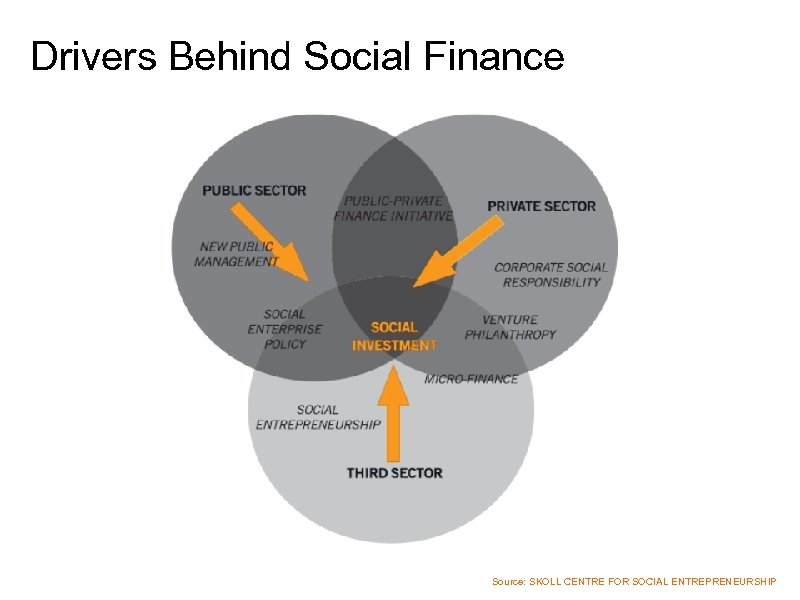 Drivers Behind Social Finance Source: SKOLL CENTRE FOR SOCIAL ENTREPRENEURSHIP
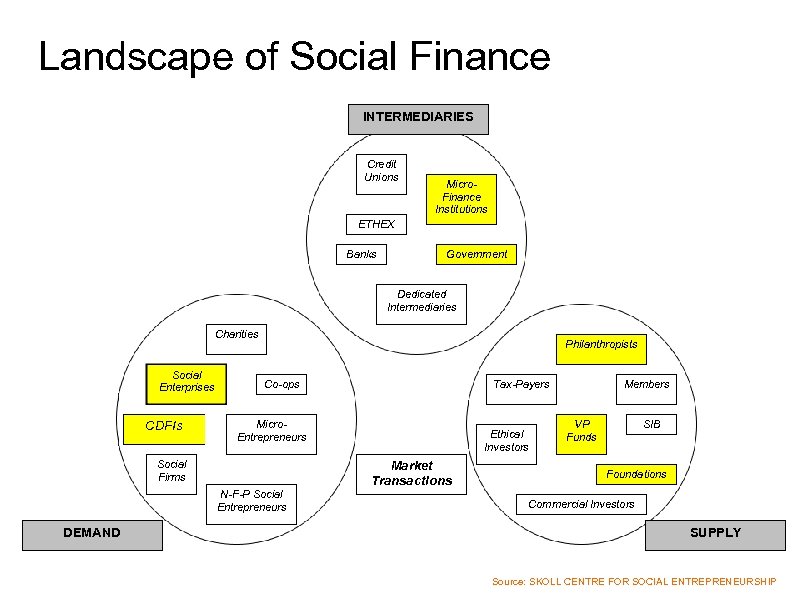 Landscape of Social Finance INTERMEDIARIES Credit Unions Micro. Finance Institutions ETHEX Banks Government Dedicated Intermediaries Charities Social Enterprises CDFIs Philanthropists Co-ops Micro. Entrepreneurs Social Firms Ethical Investors Market Transactions N-F-P Social Entrepreneurs DEMAND Tax-Payers Members VP Funds SIB Foundations Commercial Investors SUPPLY Source: SKOLL CENTRE FOR SOCIAL ENTREPRENEURSHIP
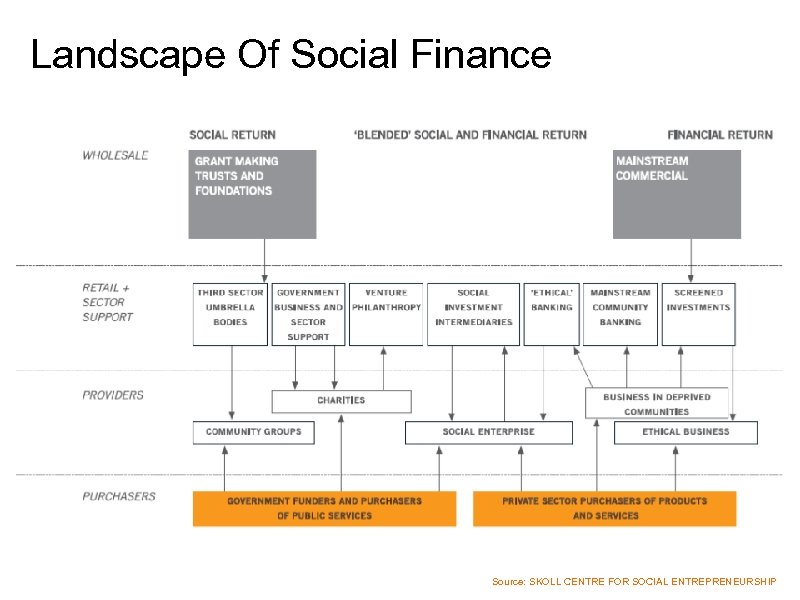 Landscape Of Social Finance Source: SKOLL CENTRE FOR SOCIAL ENTREPRENEURSHIP
 Social Investment Instruments
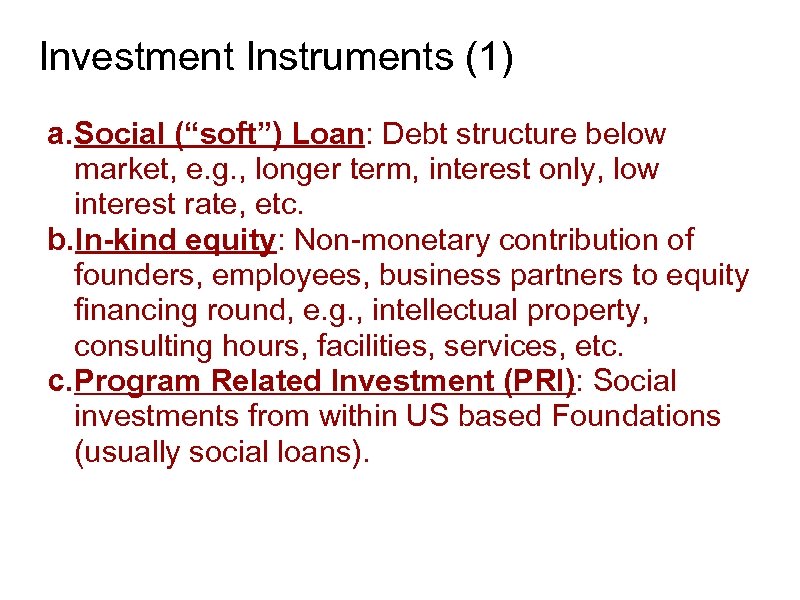 Investment Instruments (1) a. Social (“soft”) Loan: Debt structure below market, e. g. , longer term, interest only, low interest rate, etc. b. In-kind equity: Non-monetary contribution of founders, employees, business partners to equity financing round, e. g. , intellectual property, consulting hours, facilities, services, etc. c. Program Related Investment (PRI): Social investments from within US based Foundations (usually social loans).
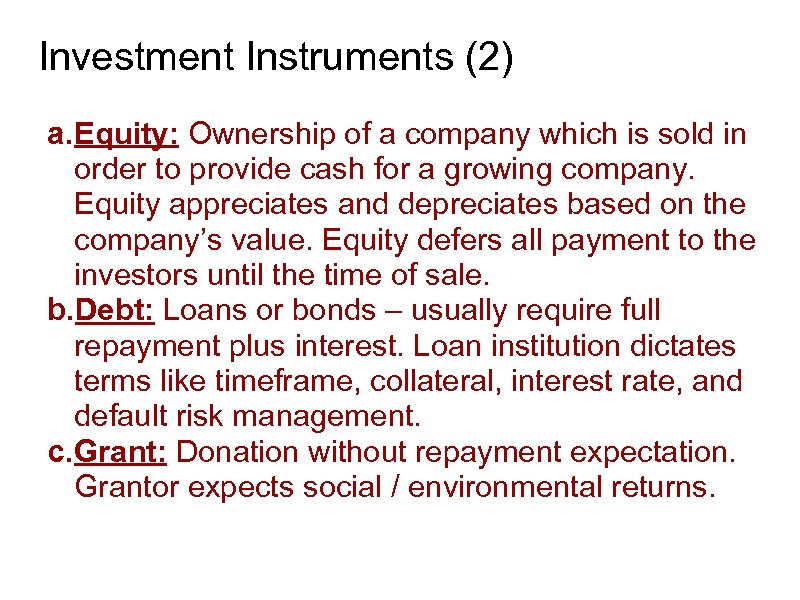 Investment Instruments (2) a. Equity: Ownership of a company which is sold in order to provide cash for a growing company. Equity appreciates and depreciates based on the company’s value. Equity defers all payment to the investors until the time of sale. b. Debt: Loans or bonds – usually require full repayment plus interest. Loan institution dictates terms like timeframe, collateral, interest rate, and default risk management. c. Grant: Donation without repayment expectation. Grantor expects social / environmental returns.
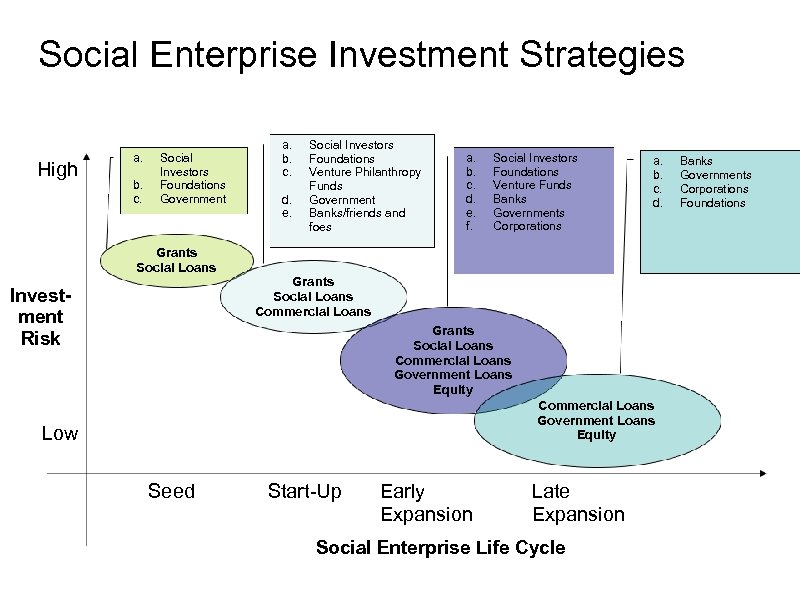 Social Enterprise Investment Strategies High a. b. c. Social Investors Foundations Government Grants Social Loans Investment Risk a. b. c. d. e. Social Investors Foundations Venture Philanthropy Funds Government Banks/friends and foes a. b. c. d. e. f. Social Investors Foundations Venture Funds Banks Governments Corporations a. b. c. d. Grants Social Loans Commercial Loans Government Loans Equity Low Seed Start-Up Early Expansion Late Expansion Social Enterprise Life Cycle Banks Governments Corporations Foundations
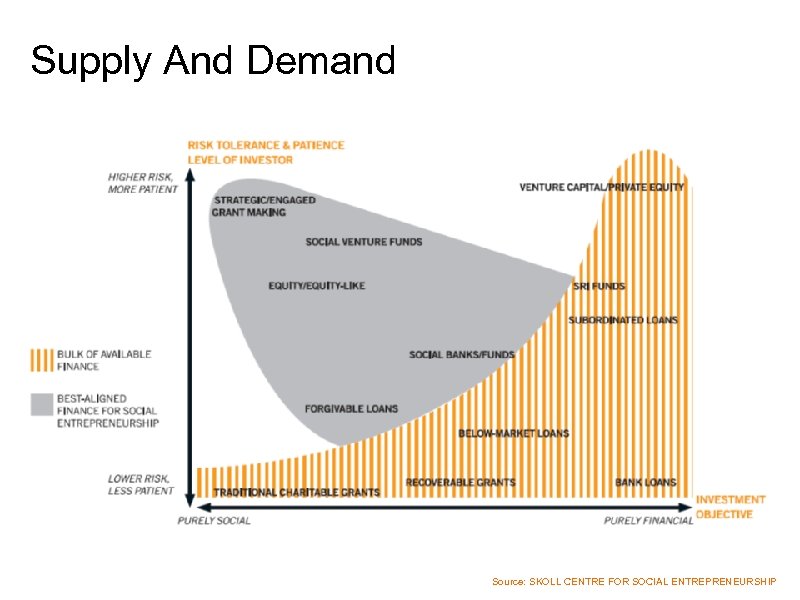 Supply And Demand Source: SKOLL CENTRE FOR SOCIAL ENTREPRENEURSHIP
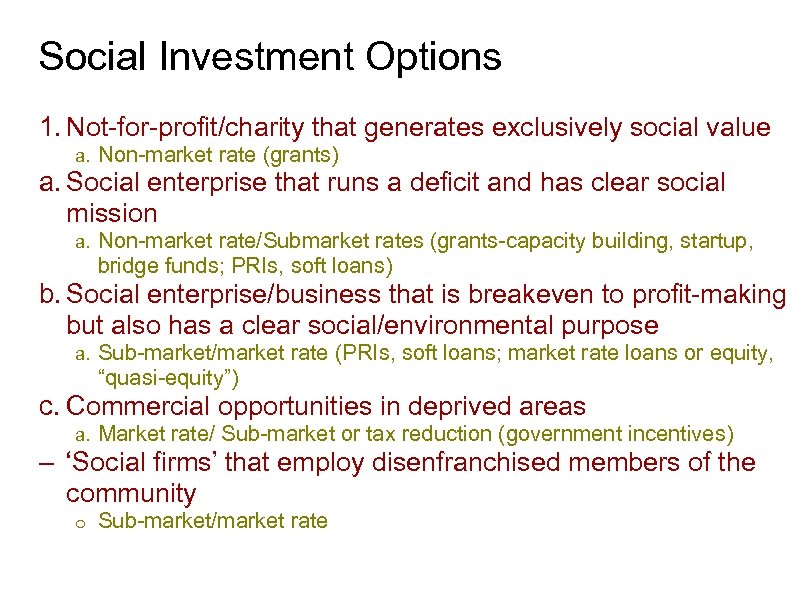 Social Investment Options 1. Not-for-profit/charity that generates exclusively social value a. Non-market rate (grants) a. Social enterprise that runs a deficit and has clear social mission a. Non-market rate/Submarket rates (grants-capacity building, startup, bridge funds; PRIs, soft loans) b. Social enterprise/business that is breakeven to profit-making but also has a clear social/environmental purpose a. Sub-market/market rate (PRIs, soft loans; market rate loans or equity, “quasi-equity”) c. Commercial opportunities in deprived areas a. Market rate/ Sub-market or tax reduction (government incentives) – ‘Social firms’ that employ disenfranchised members of the community o Sub-market/market rate
 Equity Risk a. Dilutes ownership b. Risks losing control over mission, decision making, and direction c. Can intensify pressure to make profit and/or change legal structure d. Fairly untested in social enterprise “Its never too early to fire the CEO. ” Eric Archambeau, VC and VP
 Social Investors and Expected Returns
 Investor Types a. Entrepreneurs: In-kind equity, equity b. “Angels” or social investors - individual investors: quasi-equity, grants, debt (patient) c. Foundations: Grants, Program Related Investments (PRI’s) d. Social Venture Capital: equity, debt e. Venture Philanthropists: Grants, PRIs a. Can be individuals or foundations f. Government: Grants and contracts g. Venture Funds: Equity and h. Banks: Debt, equity i. Corporations: equity, debt, cause-related sponsorship, partnership (brand market leverage/access), and inkind
 Not all Social Investors seek high returns a. Venture Philanthropy (VP) does not seek a return on financial capital all the time: mainstream VP operations all deploy grants as financial tools of choice. • In fact the vast bulk of VP activity from the US is based on non-returnable grants (Venture Philanthropy Partners, 2002) • PRIs often turn into covertable loans (grants) based on performance. For more information: Venture Philanthropy: The Evolution of High Engagement Philanthropy in Europe, Oxford Said School of Business, June 2006
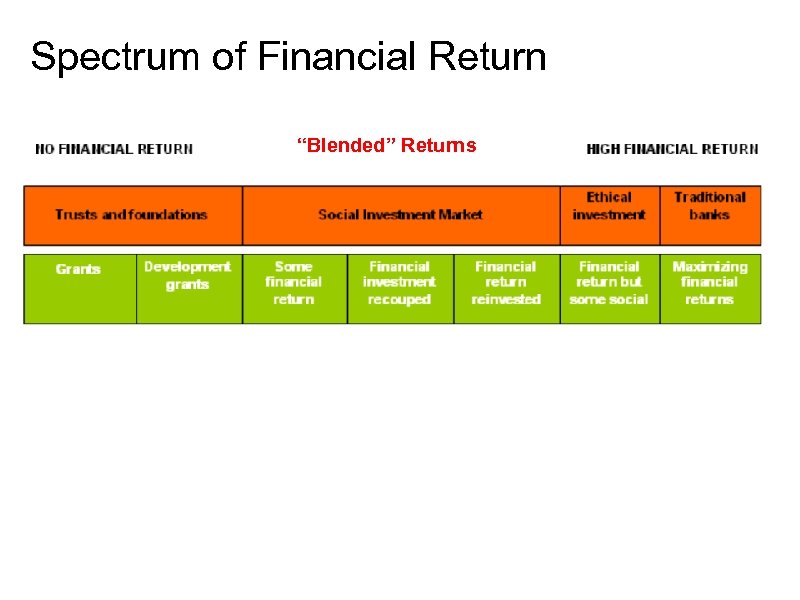 Spectrum of Financial Return “Blended” Returns
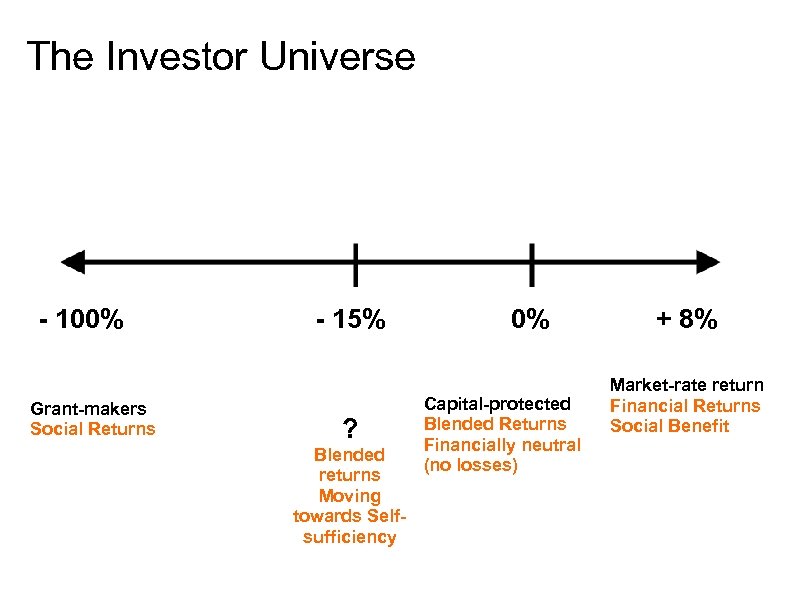 The Investor Universe - 100% Grant-makers Social Returns - 15% ? Blended returns Moving towards Selfsufficiency 0% Capital-protected Blended Returns Financially neutral (no losses) + 8% Market-rate return Financial Returns Social Benefit
 Trends, Myths and How to Get Money
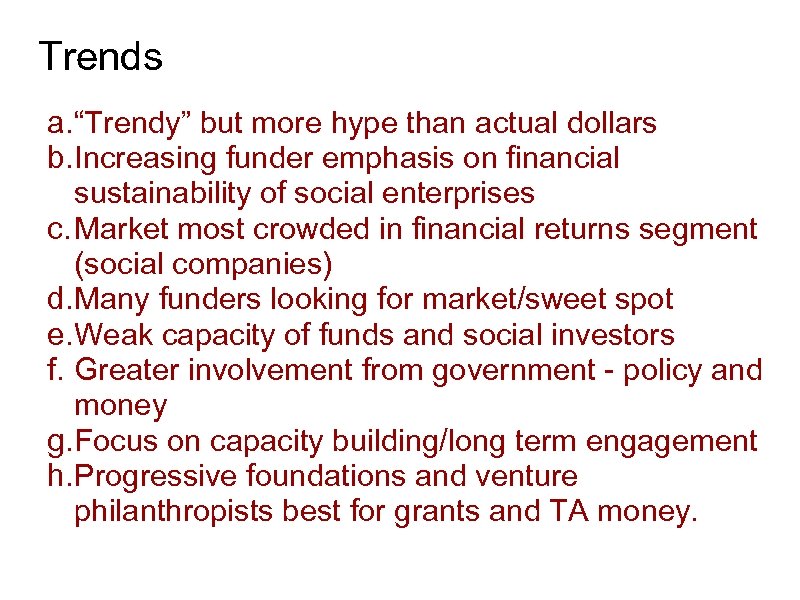 Trends a. “Trendy” but more hype than actual dollars b. Increasing funder emphasis on financial sustainability of social enterprises c. Market most crowded in financial returns segment (social companies) d. Many funders looking for market/sweet spot e. Weak capacity of funds and social investors f. Greater involvement from government - policy and money g. Focus on capacity building/long term engagement h. Progressive foundations and venture philanthropists best for grants and TA money.
 Social Enterprise Funding Among American entities focused on developing countries, over $US 900 Million is dedicated to funding social enterprise a. Does not include foundations’ grant making • Slightly over 10% of this money is seeking market return on investment, while the remainder looks at below-market rates of return • Other funders simply wish to instill business discipline into the nonprofit world Source: Keely Stevenson, Bamboo Finance
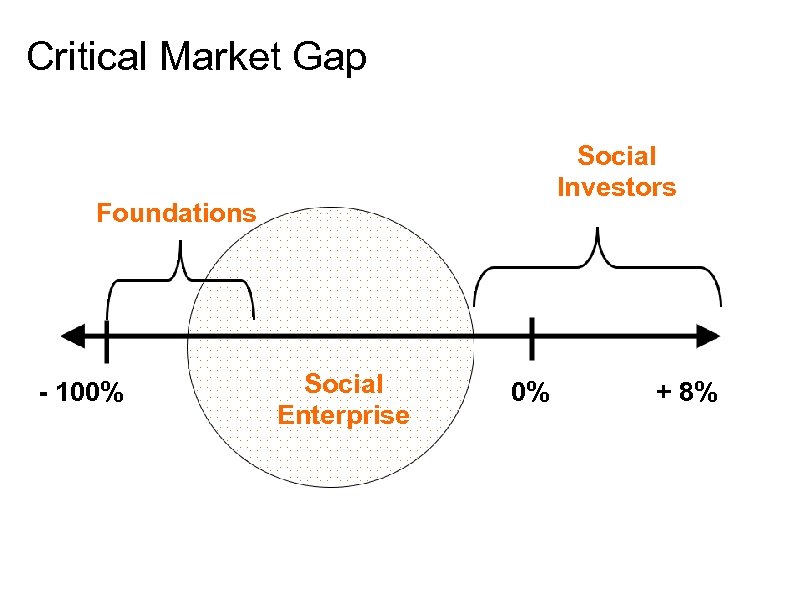 Critical Market Gap Social Investors Foundations - 100% Social - 15% Enterprise 0% + 8%
 Myths a. Clear target markets called “social investor” and “venture philanthropist” b. Tons of money for the taking c. Fewer barriers to access social investor money than traditional funding d. Social investors won’t be affected by financial crisis e. Uniform “rules of engagement” f. Less rigor/accountability
![Felicitas Von Peter, Active Philanthropy “The [social investors] we’re working with is very tricky,](https://present5.com/presentation/ec75f85b74434b2489bf85fc74fea0c7/image-24.jpg "Felicitas Von Peter, Active Philanthropy “The [social investors] we’re working with is very tricky,") Felicitas Von Peter, Active Philanthropy “The [social investors] we’re working with is very tricky, people don’t talk about money, philanthropy or any of their private activities with people outside their close peer group. And they are being hit on constantly from people who are only interested in their money, and are often “burned” by this experience. So we have made a commitment (which is the basis for our work) that we will never pitch to our clients, and only work reactively. ”
Felicitas Von Peter, Active Philanthropy “The [social investors] we’re working with is very tricky, people don’t talk about money, philanthropy or any of their private activities with people outside their close peer group. And they are being hit on constantly from people who are only interested in their money, and are often “burned” by this experience. So we have made a commitment (which is the basis for our work) that we will never pitch to our clients, and only work reactively. ”
 Geoff Muligan, Young Foundation “The truth is that despite the hype the real level of venture philanthropy is very small, pretty similar to traditional philanthropy, and not much involved in innovation and the fields we work in [health and education]. ”
 The Investors/Donors a. Limited experience b. Little history of originating/outreach c. Engaged approach d. “Unrestricted funds”… not so much e. Multi-year approach f. More risk averse than public image g. High accountability h. Rigorous due diligence i. A very thin pipeline between money and huge need
 Accessing Social Investments a. Process not an event b. New plan: must start with existing funders and stakeholders. c. Long-term process (research/cultivation) d. Relationship building with funders e. Steep learning curve: business plans, culture, terminology f. Old rules apply for new vehicles
 Appendices
 Spectrum Of Social Finance
 Policy and Social Investment – UK Example a. Futurebuilders (2005) fund worth £ 215 million to offer investment packages of grants/loans/technical support for organisations to bid for government service-delivery contracts b. Two pilot funds (2006), worth £ 200 k, for innovation in encouraging private sector investment in social enterprise c. £ 10 million fund for social enterprise (2006) in recognition of the need to stimulate growth
 Growing Popularity of Financial Sustainability a. A growing numbers of indicators highlight funder and nonprofit interest in financial sustainability and the role of earned income and social enterprise. a. Funders asking nonprofits to increase financial sustainability b. Managers and board recognizing the role of earned income and social enterprise in overall sustainability c. Research showing that earned income efforts lead to greater efficiencies and effectiveness within nonprofits d. A 600% increase in fee-generated income in the social service sector over the past 20 years From Funding Them to Fish: The Case for Supporting the Earned Income Activities of Nonprofits, Social Enterprise Alliance, 2003
 Earned Income: Funder Perspective Principal motivators for funding earned income projects were: 1. To maximize philanthropic investments a. 83% of funders wish to promote the sustainability and self-sufficiency of their grantees by diversifying income base. Especially to increase overall management and business capacity of the organization. 2. To build nonprofit capacity a. Growing numbers of funders are supporting required technical assistance and providing capacity building grants to support the entrepreneurial growth process. 3. To increase public awareness of the organization 4. To provide a platform for sharing “best practices” across sectors Growing funder interest in the social enterprise movement a. National funder organizations (GEO); Local giving circles of philanthropists (Social Venture Partners International) • Rockefeller Philanthropy Advisors: High engagement philanthropy and social enterprise • Financial Innovations Roundtable: Funding social enterprises * Social Investment Forum ** Funding them to Fish
 Earned Income: Nonprofit Perspective Nonprofit are pursuing earned income opportunities to achieve financial sustainability: (Social Investment Forum) a. Growing numbers of nonprofit associations are holding conference sessions on the subject of social enterprise • 655 nonprofits submitted proposals to the first Yale/Goldman Sachs business plan competition • 400 nonprofits submitted proposals to the first Social Stimulus business plan competition Program (“earned”) revenue now represents the single largest source of income for nonprofit corporations according to the IRS* Between 1982 and 2002 there was a 10 percent rise in the slice of nonprofits’ income that came from earned sources. (Kerlin and Pollak, Urban Institute, 2006)* *Source: FUNDING THEM TO FISH: The Case for Supporting the Earned Income Activities of Nonprofits
 Microfinance - the quintessential social enterprise a. Philanthropic foundations funding microfinance are mushrooming. Over 40 foundations have chosen microfinance as a key program area. • Purely commercially oriented funders are attracted by microfinance as an asset class: Citigroup, Deutsche Bank, TIAA-CREF, Morgan Stanley, and Société Générale • More large foundations entering the market Ford (since 1976) Bill and Melinda Gates Foundation (2005) § US$19 million to women's programs in West Africa (Feb 2008) o Mc. Knight Foundation (Africa) o Mastercard Foundation o Omidyar Network (Tufts University) o o CGAP 2008 Microfinance Funder Survey to release more data on microfinance fund flows (end 2008) http: //www. cgap. org/p/site/c/template. rc/1. 26. 1426
 Supply Side (UK)
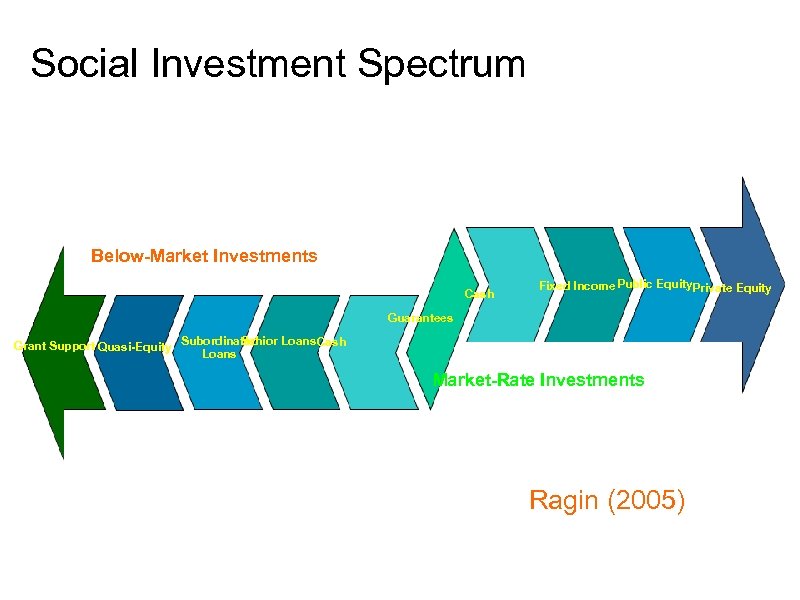 Social Investment Spectrum Below-Market Investments Cash Fixed Income Public Equity. Private Equity Guarantees Senior Loans. Cash Grant Support Quasi-Equity Subordinated Loans Market-Rate Investments Ragin (2005)