


 Скачать презентацию Social-Ethnic Challenges Old and new Immigration Aliyah
b97288d46218e9bda72bbd63c99ef14a.ppt
- Количество слайдов: 9
 Social-Ethnic Challenges Old and new
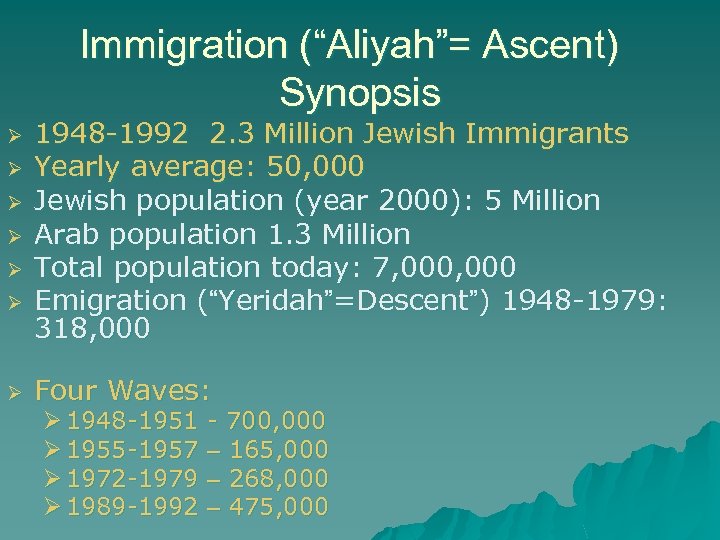 Immigration (“Aliyah”= Ascent) Synopsis Ø Ø Ø Ø 1948 -1992 2. 3 Million Jewish Immigrants Yearly average: 50, 000 Jewish population (year 2000): 5 Million Arab population 1. 3 Million Total population today: 7, 000 Emigration (“Yeridah”=Descent”) 1948 -1979: 318, 000 Four Waves: Ø 1948 -1951 Ø 1955 -1957 Ø 1972 -1979 Ø 1989 -1992 - 700, 000 – 165, 000 – 268, 000 – 475, 000
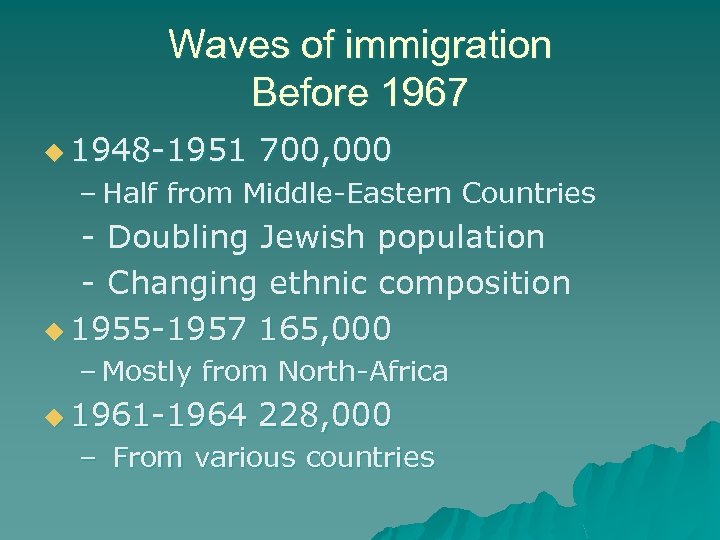 Waves of immigration Before 1967 u 1948 -1951 700, 000 – Half from Middle-Eastern Countries - Doubling Jewish population - Changing ethnic composition u 1955 -1957 165, 000 – Mostly from North-Africa u 1961 -1964 228, 000 – From various countries
 1967 -1977 turning point u 1967 Immigration responding to pull factors u Change in Immigration composition u Growing liberalism Pluralism u Growing rage against former authoritarianism u 1977 Throwing MAPAI as the symbol
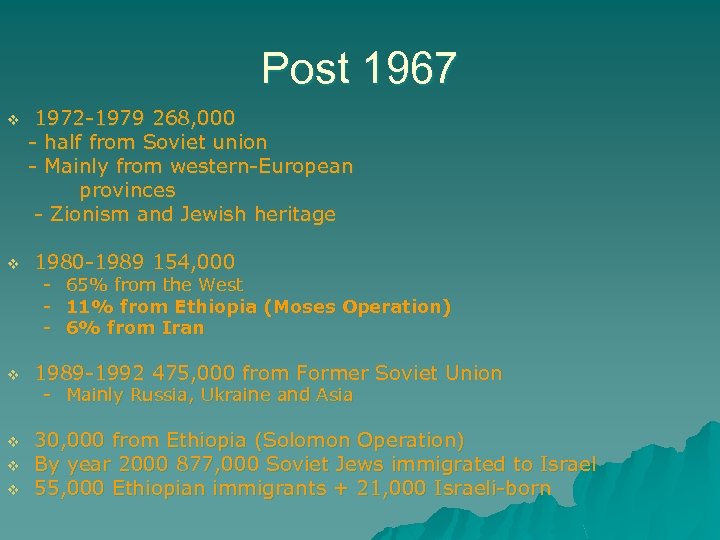 Post 1967 v 1972 -1979 268, 000 - half from Soviet union - Mainly from western-European provinces - Zionism and Jewish heritage v 1980 -1989 154, 000 v 1989 -1992 475, 000 from Former Soviet Union v 30, 000 from Ethiopia (Solomon Operation) By year 2000 877, 000 Soviet Jews immigrated to Israel 55, 000 Ethiopian immigrants + 21, 000 Israeli-born v v - 65% from the West - 11% from Ethiopia (Moses Operation) - 6% from Iran - Mainly Russia, Ukraine and Asia
 The State Continuing encouragement of immigration – the raison d'étre of the Jewish state u The profound role of the state and the JA in absorption u The transformation of government approach to absorption: u – Liberalization – Response to social criticism – New types of immigrants
 The challenge of former Oriental Olim u u u Success Growing involvement in government, army, bureaucracy Growing presentation in academia challenge u Growing culturalideological demands (Arab Jews; cultural legacy) u Envy and frustration in response to Russian immigration u Growing political selfawareness and social struggle (Keshet Mizrahit) Profound presentation in popular culture
 Political activity u Political parties as channels for social, political, economic integration u = continuing legacy u = crucial ingredient in Israeli democracy u Oriental religious (SHAS) u Russian secular party (Israel Ba’aliyah) u Crossing lines of Left and Right
 Change and New Challenges q The unique challenge and response to Ethiopian immigration q The struggle between old ideas of "new Jew" and post-modern cultural pluralism q Interaction between Political and social challenges – Arabs, peace, religion