


 Скачать презентацию Social Entrepreneurialism and Regulation in the European Hospital
dd0abebdf52d0e0269edf82d2674886d.ppt
- Количество слайдов: 26
 Social Entrepreneurialism and Regulation in the European Hospital Sector Richard B. Saltman Professor of Health Policy and Management Emory University Atlanta Research Director European Observatory on Health Care Systems Madrid 1
 Taking Stock I: Western Europe 15 years since Dekker Report in Netherlands (1987) 13 years since “Working for Patients” in UK (1989) 12 years since “Nitiotals Programmet” in Sweden (1990) 2
 Taking Stock II: Eastern Europe 14 years since “Leningrad Experiment” in Russia (1988) 12 years since Polish “Bismarck Proposal” (1990) 3
 Re-visiting Issues of Entrepreneurialism and Regulation: I. Definitions II. Current Experiences III. Future Challenges 4
 Definitions I: Entrepreneurialism “shifts economic resources out of an area of lower and into an area of higher productivity and greater yield” J. B. Say, circa 1800 5
 Definition II: Entrepreneurialism Entrepreneurs: Buy and sell commodities Are for profit Goal: personal wealth 6
 Definitions III: Social Entrepreneurialism “combines the passion of a social mission with the image of business like discipline, innovation and determination” A. R. Hunt, Wall Street Journal, 13 July 2000 7
 Definitions IV: Social Entrepreneurialism Social Entrepreneurs: Deal in social goods Are not for profit or publicly owned Goal: improved service to community 8
 Definitions V: Regulation is a means to achieve a desired objective rather than an end in itself 9
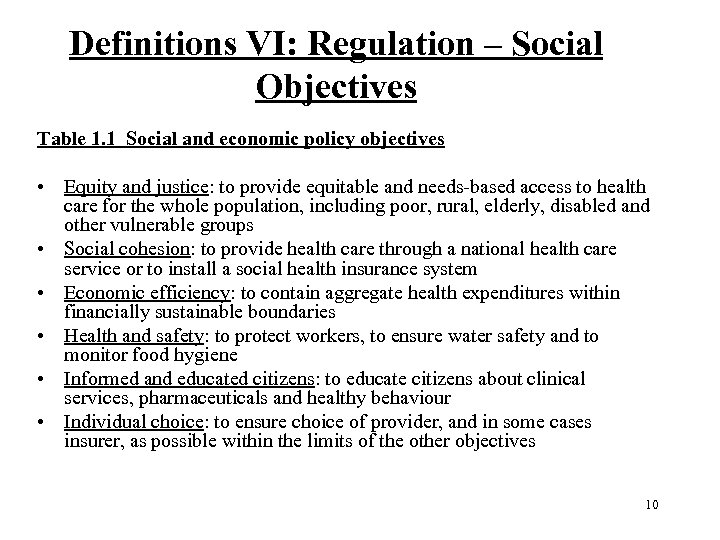 Definitions VI: Regulation – Social Objectives Table 1. 1 Social and economic policy objectives • Equity and justice: to provide equitable and needs based access to health care for the whole population, including poor, rural, elderly, disabled and other vulnerable groups • Social cohesion: to provide health care through a national health care service or to install a social health insurance system • Economic efficiency: to contain aggregate health expenditures within financially sustainable boundaries • Health and safety: to protect workers, to ensure water safety and to monitor food hygiene • Informed and educated citizens: to educate citizens about clinical services, pharmaceuticals and healthy behaviour • Individual choice: to ensure choice of provider, and in some cases insurer, as possible within the limits of the other objectives 10
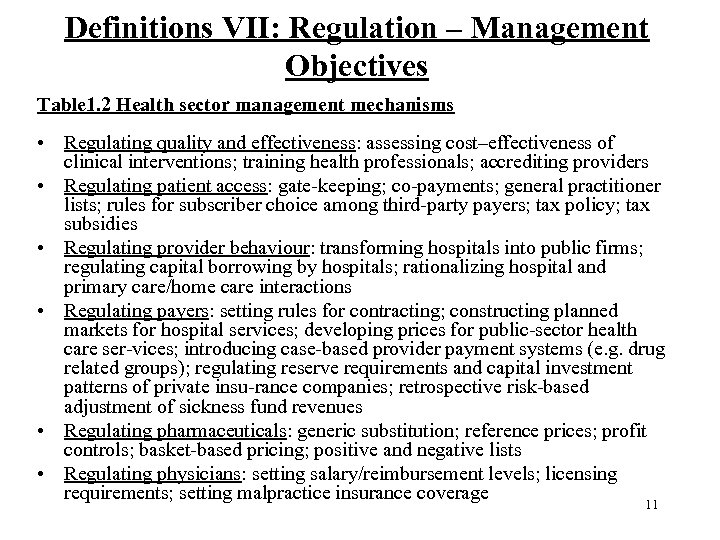 Definitions VII: Regulation – Management Objectives Table 1. 2 Health sector management mechanisms • Regulating quality and effectiveness: assessing cost–effectiveness of clinical interventions; training health professionals; accrediting providers • Regulating patient access: gate keeping; co payments; general practitioner lists; rules for subscriber choice among third party payers; tax policy; tax subsidies • Regulating provider behaviour: transforming hospitals into public firms; regulating capital borrowing by hospitals; rationalizing hospital and primary care/home care interactions • Regulating payers: setting rules for contracting; constructing planned markets for hospital services; developing prices for public sector health care ser vices; introducing case based provider payment systems (e. g. drug related groups); regulating reserve requirements and capital investment patterns of private insu rance companies; retrospective risk based adjustment of sickness fund revenues • Regulating pharmaceuticals: generic substitution; reference prices; profit controls; basket based pricing; positive and negative lists • Regulating physicians: setting salary/reimbursement levels; licensing requirements; setting malpractice insurance coverage 11
 II. Current Experience in European Hospital Sector 12
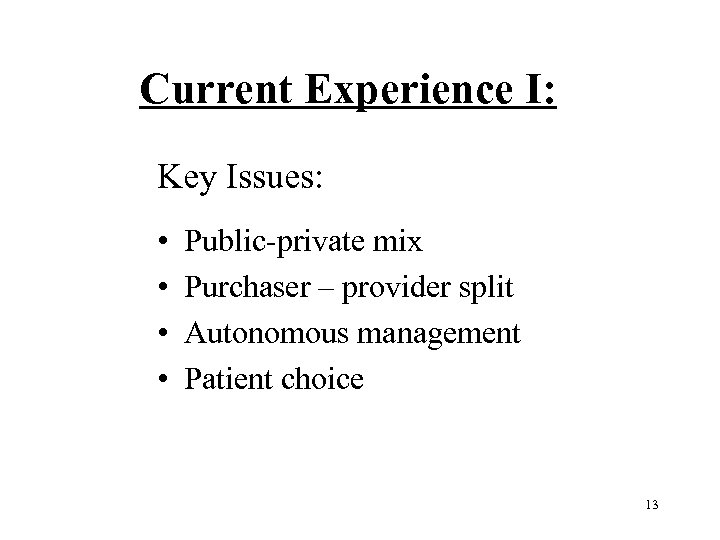 Current Experience I: Key Issues: • • Public private mix Purchaser – provider split Autonomous management Patient choice 13
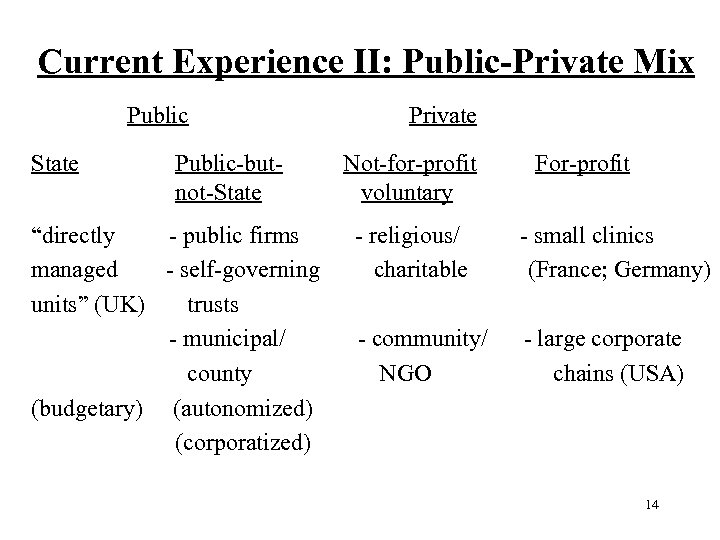 Current Experience II: Public-Private Mix Public State Public but not State “directly public firms managed self governing units” (UK) trusts municipal/ county (budgetary) (autonomized) (corporatized) Private Not for profit voluntary For profit religious/ charitable small clinics (France; Germany) community/ NGO large corporate chains (USA) 14
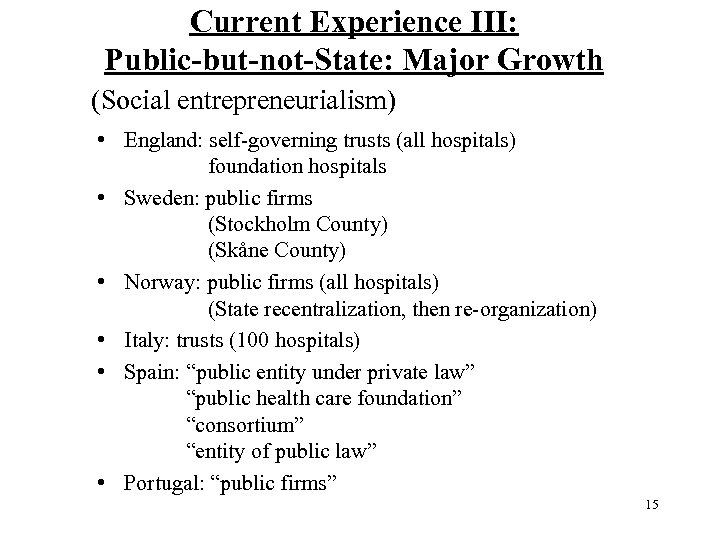 Current Experience III: Public-but-not-State: Major Growth (Social entrepreneurialism) • England: self governing trusts (all hospitals) foundation hospitals • Sweden: public firms (Stockholm County) (Skåne County) • Norway: public firms (all hospitals) (State recentralization, then re organization) • Italy: trusts (100 hospitals) • Spain: “public entity under private law” “public health care foundation” “consortium” “entity of public law” • Portugal: “public firms” 15
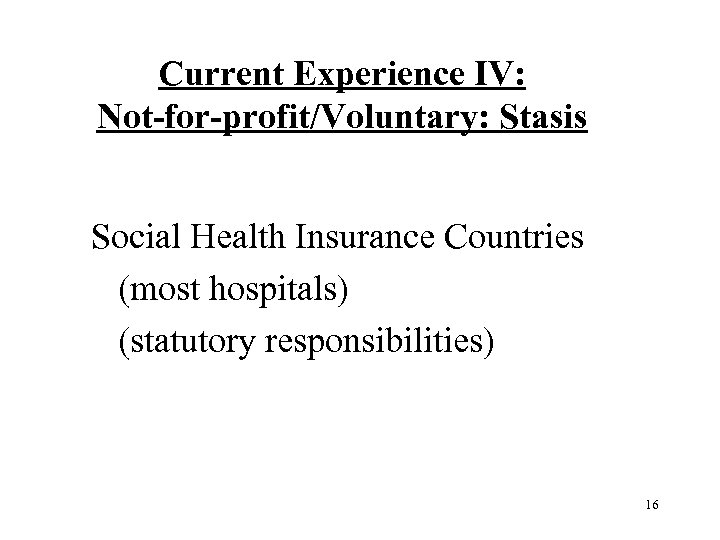 Current Experience IV: Not-for-profit/Voluntary: Stasis Social Health Insurance Countries (most hospitals) (statutory responsibilities) 16
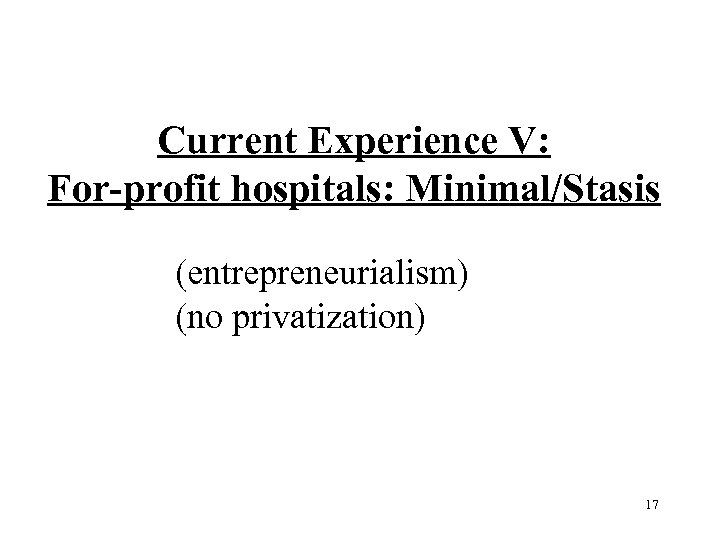 Current Experience V: For-profit hospitals: Minimal/Stasis (entrepreneurialism) (no privatization) 17
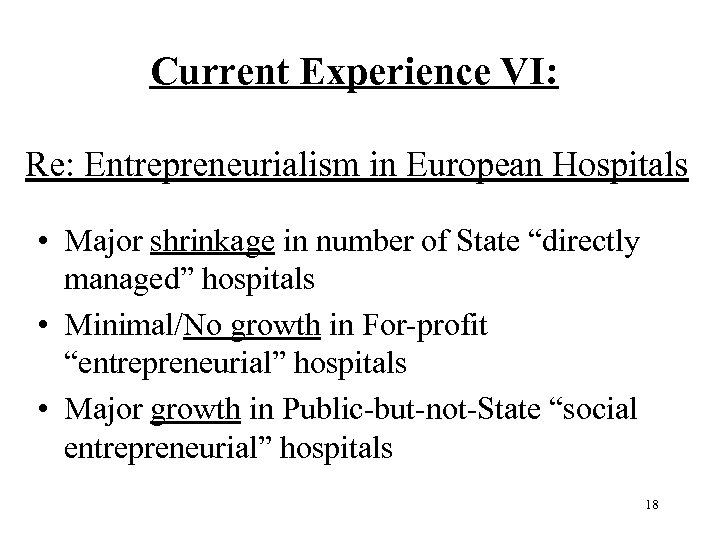 Current Experience VI: Re: Entrepreneurialism in European Hospitals • Major shrinkage in number of State “directly managed” hospitals • Minimal/No growth in For profit “entrepreneurial” hospitals • Major growth in Public but not State “social entrepreneurial” hospitals 18
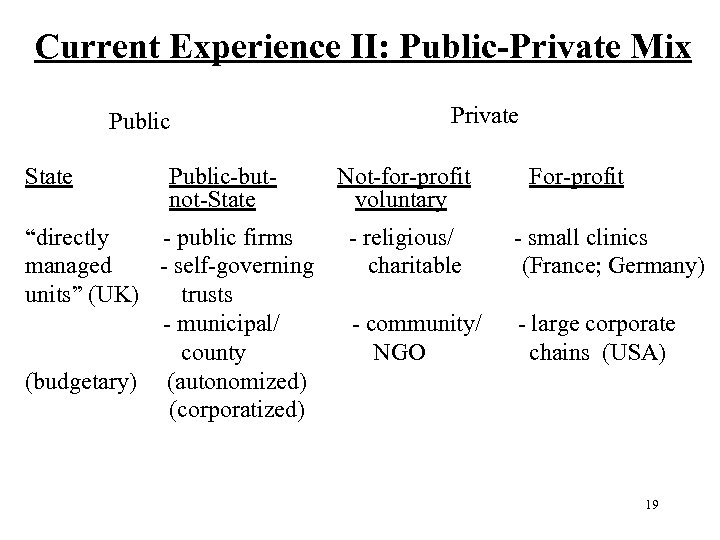 Current Experience II: Public-Private Mix Public State Public but not State “directly public firms managed self governing units” (UK) trusts municipal/ county (budgetary) (autonomized) (corporatized) Private Not for profit voluntary For profit religious/ charitable small clinics (France; Germany) community/ NGO large corporate chains (USA) 19
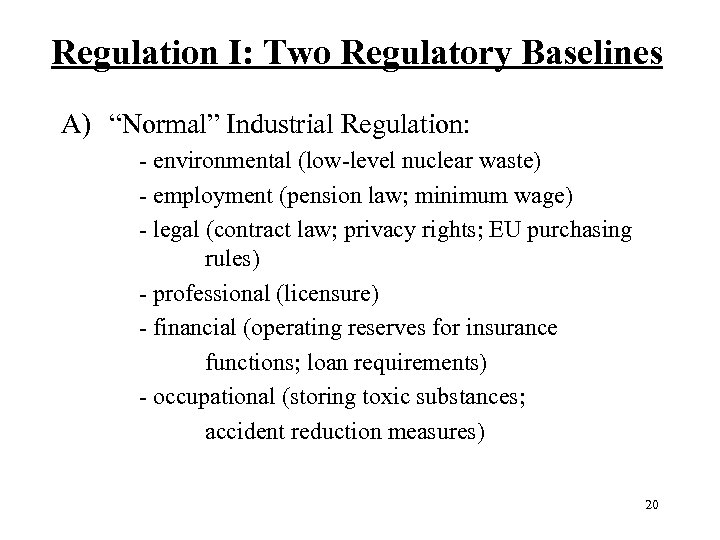 Regulation I: Two Regulatory Baselines A) “Normal” Industrial Regulation: environmental (low level nuclear waste) employment (pension law; minimum wage) legal (contract law; privacy rights; EU purchasing rules) professional (licensure) financial (operating reserves for insurance functions; loan requirements) occupational (storing toxic substances; accident reduction measures) 20
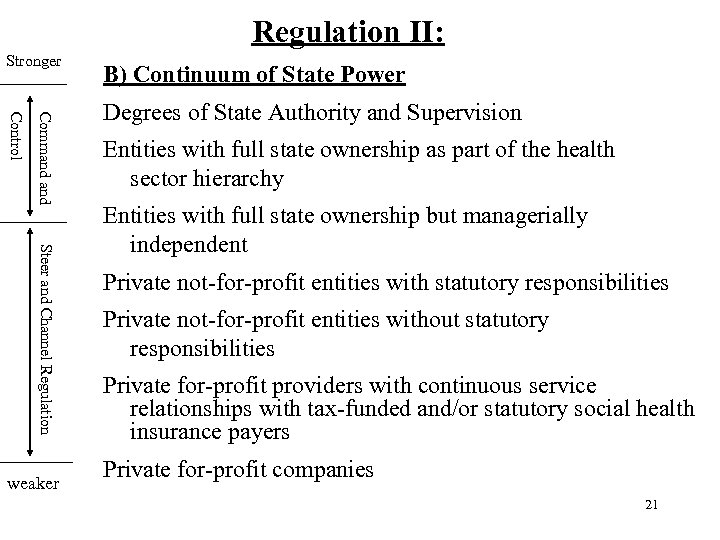 Regulation II: Stronger Command Control Steer and Channel Regulation weaker B) Continuum of State Power Degrees of State Authority and Supervision Entities with full state ownership as part of the health sector hierarchy Entities with full state ownership but managerially independent Private not for profit entities with statutory responsibilities Private not for profit entities without statutory responsibilities Private for profit providers with continuous service relationships with tax funded and/or statutory social health insurance payers Private for profit companies 21
 • Insert transparency 23 here 22
 • Insert transparency 24 here 23
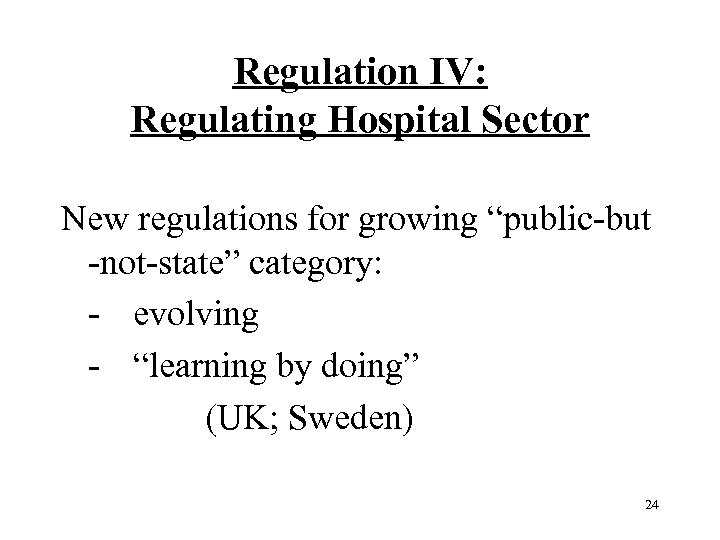 Regulation IV: Regulating Hospital Sector New regulations for growing “public but not state” category: evolving “learning by doing” (UK; Sweden) 24
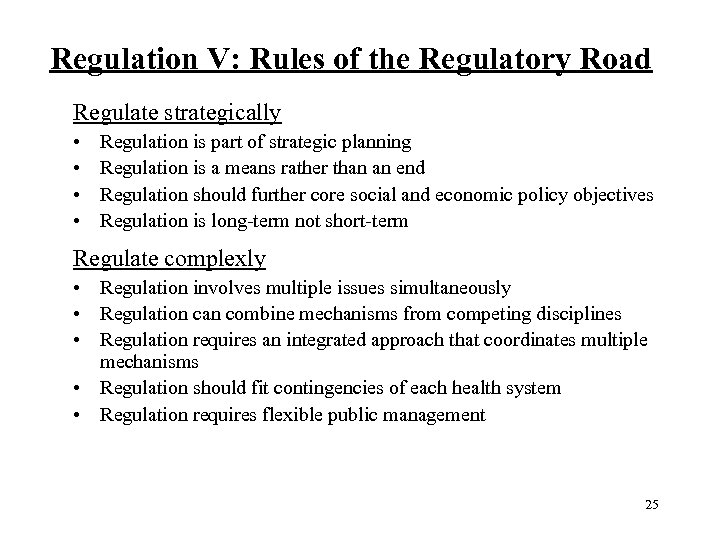 Regulation V: Rules of the Regulatory Road Regulate strategically • • Regulation is part of strategic planning Regulation is a means rather than an end Regulation should further core social and economic policy objectives Regulation is long term not short term Regulate complexly • Regulation involves multiple issues simultaneously • Regulation can combine mechanisms from competing disciplines • Regulation requires an integrated approach that coordinates multiple mechanisms • Regulation should fit contingencies of each health system • Regulation requires flexible public management 25
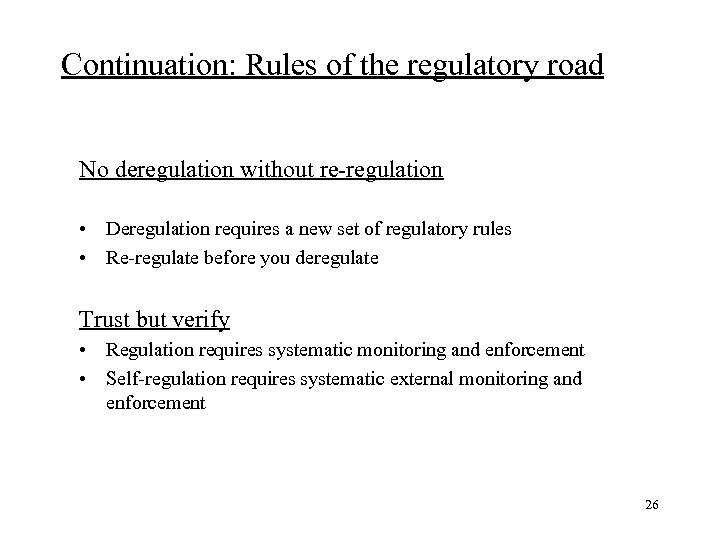 Continuation: Rules of the regulatory road No deregulation without re regulation • Deregulation requires a new set of regulatory rules • Re regulate before you deregulate Trust but verify • Regulation requires systematic monitoring and enforcement • Self regulation requires systematic external monitoring and enforcement 26