 Скачать презентацию SOCIAL DETERMINANTS OF HEALTH Dr AHMAD ATWAN Al-BATAINEH
e8436a9f8895a38f28a3fd0bd7f1fd01.ppt
- Количество слайдов: 73



SOCIAL DETERMINANTS OF HEALTH Dr. AHMAD ATWAN Al-BATAINEH The University of Jordan Department of Family and Community Medicine
Outline To identify major SDOH in Jordan, especially those responsible for poor health outcomes. Social determinants of health (SDOH), current situation in Jordan.
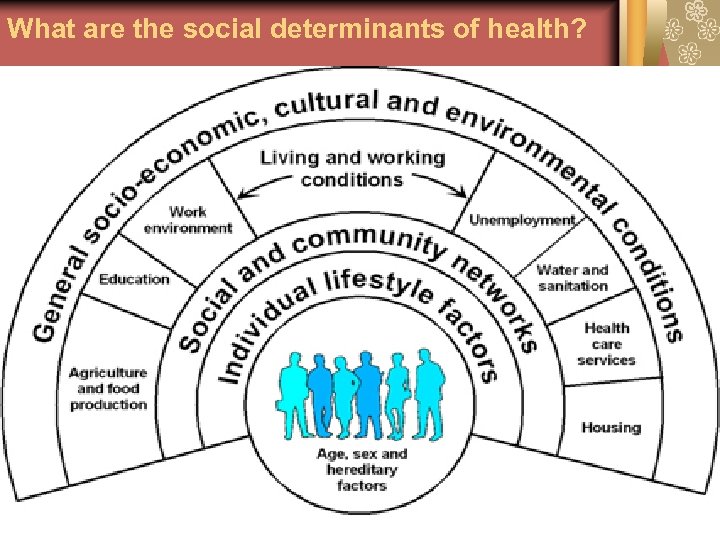
What are the social determinants of health?
International perspective “The social conditions in which people live and work can help create or destroy their health. Poverty, food insecurity, social exclusion and discrimination, poor housing, unhealthy early childhood conditions and low occupational status are important determinants of most diseases, deaths and health inequalities between and within countries”. World Health Organisation 2004
![Definitions Health Disparities: " a population where there is a significant disparity [difference] in](https://present5.com/presentation/e8436a9f8895a38f28a3fd0bd7f1fd01/image-5.jpg "Definitions Health Disparities: \" a population where there is a significant disparity [difference] in")
Definitions Health Disparities: " a population where there is a significant disparity [difference] in the overall rate of disease incidence, prevalence, morbidity, mortality, or survival rates in the population as compared to the health status of the general population”. Health Inequities: " Disparities in health [or health care] that are systemic and avoidable and considered unfair or unjust. ” Health equity: " the absence of systematic disparities in health between groups with different levels of underlying social advantage/disadvantage. ”
Social Determinants of Health Socioeconomic status Discrimination Housing Childhood social and economic exposures Food security Physical environment Culture Social support & capital Health care services Gender equality Working conditions Democratic participation
Social Determinants of Health Presence or absence of SDOH can be predicted by demographic characteristics SDOH interact with each other to determine health by: Influencing behaviors Predisposing to environmental risks Creating additional stress load Acting across the life span and generations
Importance of Social Determinants of Health Social determinants predict the greatest proportion of health status variance. Social determinants are “fundamental causes of disease”.
Social Determinants of Health “The primary determinants of disease are mainly economic and social, and therefore its remedies must also be economic and social. Medicine and politics cannot and should not be kept apart. ”
Social Gradient The effects on health of social processes follow the social gradient: the lower the socioeconomic position the more health is affected by the social determinants of health.
Education International evidence shows that those with higher levels of education live longer, have better health , and healthier lifestyles. Implications for policy – Tackling educational disadvantage can also lessen health inequalities.
Poverty and Health: Mechanisms Poverty can affect health in a number of ways: income provides the prerequisites for health, such as shelter, food, warmth, and the ability to participate in society. living in poverty can cause stress and anxiety which can damage people’s health. low income limits peoples’ choices and militates against desirable changes in behaviour.
Economic Inequality: Explanations Economically unequal societies have greater levels of poverty (individual poverty explanation). Economically unequal societies have greater hierarchy and weaker social cohesion (social comparison explanation). Economically unequal societies provide fewer social safety nets and social investment (neo-materialist explanation).
Economic Inequality and Health What matters in determining mortality and health in a society is less the overall wealth of that society and more how evenly wealth is distributed. The more equally wealth is distributed the better the health of that society. Inequality make people miserable long before it kills them.
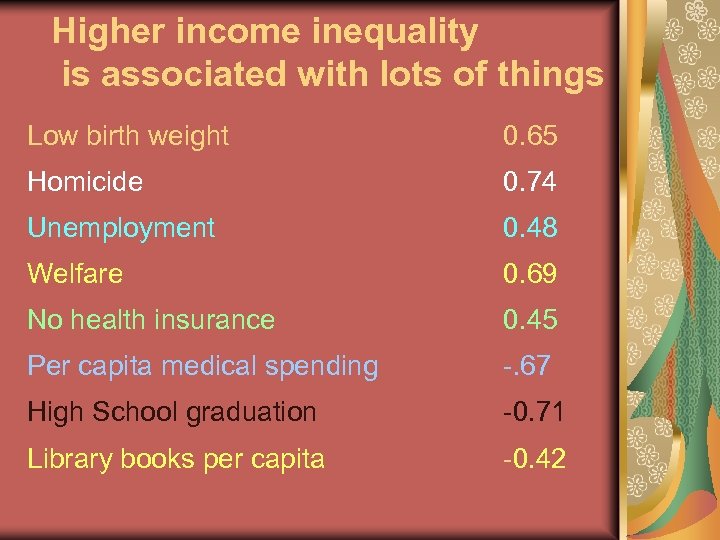
Higher income inequality is associated with lots of things Low birth weight 0. 65 Homicide 0. 74 Unemployment 0. 48 Welfare 0. 69 No health insurance 0. 45 Per capita medical spending -. 67 High School graduation -0. 71 Library books per capita -0. 42
Social Justice A virtue that, when achieved, results in equitable (fair) access and exposure to social, economic, and political resources, opportunities, burdens and their consequences.
Equitable access Geographical access – overcoming barriers of distance Economic access – overcoming barriers of cost Cultural and social access : Adequate, appropriate services No barriers for women, and disadvantaged groups Providers who deal with all patients/clients fairly, equally; according to their needs
Urbanization Residents of constantly expanding, unplanned housing areas, with poor access to health and social services and poor living conditions are likely to suffer disproportionately from poor health due to: Overcrowding Malnutrition Social stress
Environmental conditions In Jordan environmental conditions are social determinants of health as they affect social behavior and differentially affect the life chances of various social groups: Overall water scarcity in Jordan, for agriculture, domestic use etc.
Women and gender equity Discrimination and low status at all stages in the life cycle limit women’s contribution to the health and wellbeing of their family and community, as well as their own health Relevant issues include: Improving women’s access to health care Education/literacy for girls and women Employment and social protection for women Empowerment of women
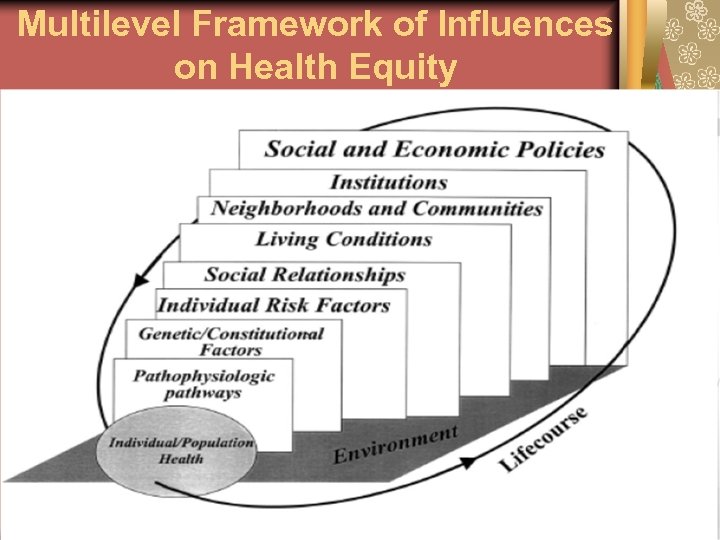
Multilevel Framework of Influences on Health Equity
Governmental Strategies “Increasing job opportunities, providing education and training for better jobs, investing in our schools, improving housing, integrating neighborhoods, giving people more control over their work-these are as much health strategies as diet, smoking, and exercise. ”
SDOH In Jordan Current Situation q. Socioeconomic Indicators: Jordan is a middle income country. Population: 5. 85 Millions. Population Growth Rate: 2. 2% GDP growth: 5. 6% in 2008 Annual per capita income: US$3, 425 Inflation Rate: 5. 7% in 2007; 14. 9% in 2008 Expenditure on health: about 9. 05 % of GDP (about US$260 person per year).
SDOH In Jordan Current Situation q Socioeconomic Indicators (Cont. ): Declining foreign grants and rising cost of imported oil. The economy's capacity for growth remains vulnerable to external shocks. The rate of growth is inadequate to resolve long-standing developmental challenges. Despite recent reductions, the stock of external debt remains high(21 $bn), 2015
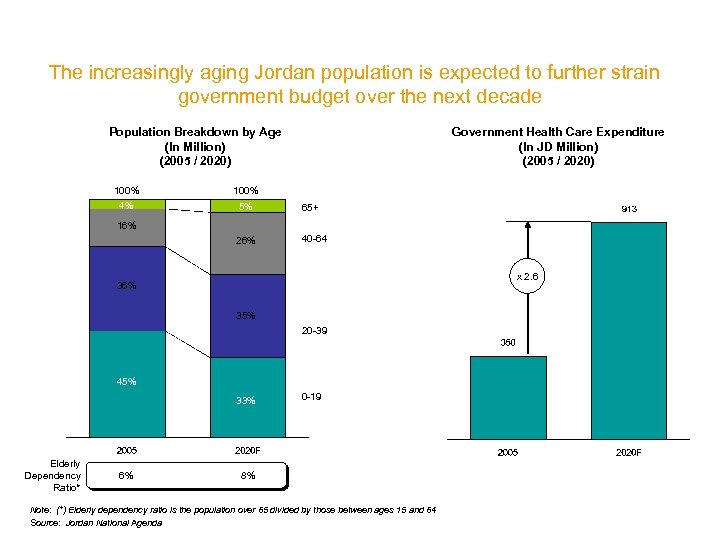
The increasingly aging Jordan population is expected to further strain government budget over the next decade Population Breakdown by Age (In Million) (2005 / 2020) 100% 4% Government Health Care Expenditure (In JD Million) (2005 / 2020) 100% 5% 65+ 26% 40 -64 16% x 2. 6 36% 35% 20 -39 45% 33% Elderly Dependency Ratio* 6% 0 -19 8% Note: (*) Elderly dependency ratio is the population over 65 divided by those between ages 15 and 64 Source: Jordan National Agenda
SDOH In Jordan Current Situation q. Socioeconomic Indicators (Cont. ): Unemployment rate: 12. 7% (170, 000 persons) - Higher rates in urban areas and among females. - Reached 93% in some remote poverty pockets. Discrepancy in job opportunities between the capital (Amman) and other areas. The poor are left with low paying jobs if any. Foreign labor( about 500, 000). Lowest wage regulation is often not respected by the private sector. Training efforts for the unemployed are limited.
SDOH In Jordan Current Situation q Socioeconomic Indicators (Cont. ): ØPoverty: 14. 0% according to the new poverty line (US$550 person per year). - It reached 34% in 13 out of 73 districts. - 19% in rural areas versus to 13% in urban areas.
SDOH In Jordan Current Situation q Social Security : All Jordanians enjoy the rights to social security including government and military personnel. The employer contributes 11% of salary and the employee contributes 5. 5 %. Types of social security insurance applied since 1990 are: Insurance against industrial accidents and occupational illness. Old-age, disability and death benefits.
SDOH In Jordan Current Situation q. Social Security (cont. ): Four types of social-security benefits provided in the law and not yet applied are: § Temporary incapacity due to sickness or maternity § Health insurance for worker and family § Family allowances § Unemployment insurance
SDOH In Jordan Current Situation q Education Free for all primary and secondary school students and compulsory until age 15. Enrollment rate is 92% and the annual drop rate is 1%. Adult illiteracy: 9% ( males: 5 %, females: 15%). Illiteracy among the poor 13%. Adult illiteracy in certain poverty pockets reached 46%. 7% of GDP is spent on education.
SDOH In Jordan Current Situation q. Equal rights for men and women: § All Jordanians are equal before the law, have the right to assume public office and the right to work. § Government educational and media efforts seek to overcome discriminatory traditions and customs. § Female empowerment and inclusion remain a challenge. § Honor crimes is still a social problem(16 -19 annually).
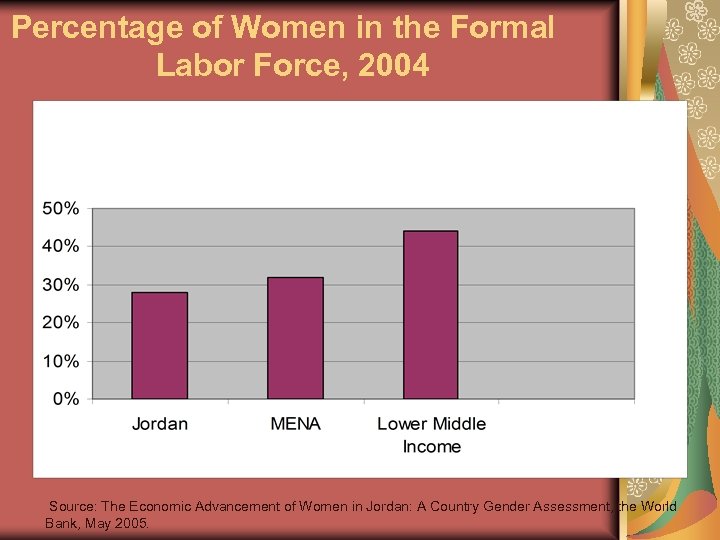
Percentage of Women in the Formal Labor Force, 2004 Source: The Economic Advancement of Women in Jordan: A Country Gender Assessment, the World Bank, May 2005.
SDOH In Jordan Current Situation q. Family: § Holds a strong position as the basic social unit. § Help and support given among relatives form an important part of the social security system and the safety net for the Jordanian population. § Transfers from relatives are cited as one of the three most important sources of income for the household.
SDOH In Jordan Current Situation q. Family and Child Protection: The Family Protection Department deals with more than 1, 100 cases of violence against women and children a year. Although the law prohibits children under the age of 16 from working, child workers, child vendors and child beggars are increasing due to deteriorating economic conditions. Around 27% of the working children have been sexually harassed by some of the older boys in their workplace.
SDOH In Jordan Current Situation q Housing : § Housing and sanitation amenities are widely available for the population as a whole. § Some areas and groups of people are much better served than others. § The government has been involved in efforts to provide low cost housing for the poor. § A national free housing project for needy citizens living in extreme poverty areas has been adopted recently.
SDOH In Jordan Current Situation q. Health Indicators: Life expectancy: 73 years(F: 74. 4 Ys; M: 71. 6 Ys). Healthy life (HALE): 59. 3 Ys for Females; 60. 7 for males. Crude death rate: 5 per 1000: the leading cause is cardiovascular followed by cancer. Infant mortality: 19 per 1, 000 Child mortality: 28 per 1000
SDOH In Jordan Current Situation q. Health Indicators (Cont. ): High rates of cardiovascular disease risk factors including diabetes, hypertension, obesity, and smoking. Immunization coverage is almost complete.
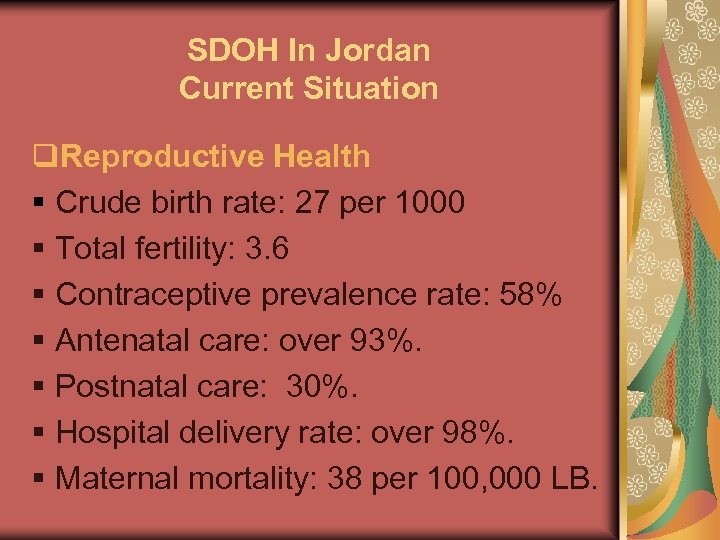
SDOH In Jordan Current Situation q. Reproductive Health § Crude birth rate: 27 per 1000 § Total fertility: 3. 6 § Contraceptive prevalence rate: 58% § Antenatal care: over 93%. § Postnatal care: 30%. § Hospital delivery rate: over 98%. § Maternal mortality: 38 per 100, 000 LB.
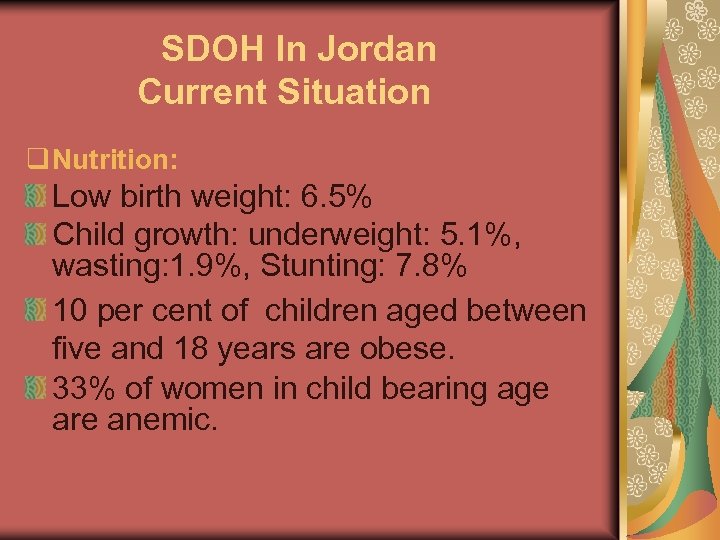
SDOH In Jordan Current Situation q Nutrition: Low birth weight: 6. 5% Child growth: underweight: 5. 1%, wasting: 1. 9%, Stunting: 7. 8% 10 per cent of children aged between five and 18 years are obese. 33% of women in child bearing age are anemic.
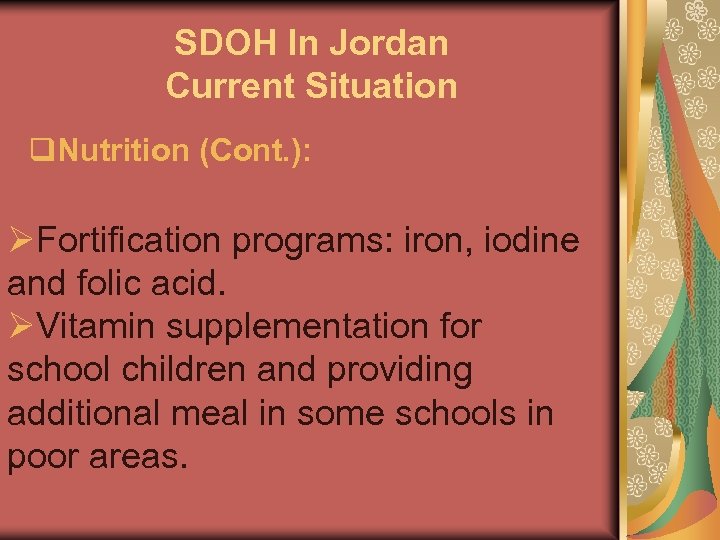
SDOH In Jordan Current Situation q. Nutrition (Cont. ): ØFortification programs: iron, iodine and folic acid. ØVitamin supplementation for school children and providing additional meal in some schools in poor areas.
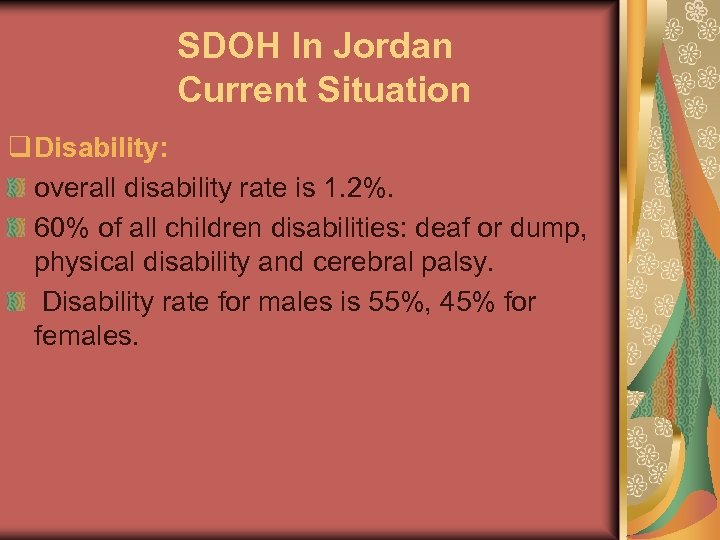
SDOH In Jordan Current Situation q Disability: overall disability rate is 1. 2%. 60% of all children disabilities: deaf or dump, physical disability and cerebral palsy. Disability rate for males is 55%, 45% for females.
SDOH In Jordan Current Situation q. Sanitary Environment Population with safe drinking water 98%. Adequate excreta disposal 60%. Presence of local health care 98%.
SDOH In Jordan Current Situation Environment: Shortage of water Supply and the lack of proper funding for the implementation of potential strategic solutions (Disi-Amman pipe, Red-Dead Sea Canal). Medical and hazardous waste disposal problems. Only 7. 8% is arable land. The desertification rate is increasing.
SDOH In Jordan Current Situation q. Health Insurance Overall health insurance rate: 70 -75%. Health insurance is problematic in rural areas and among the illiterate, the elderly, and women.
Health System Challenges Governance SDOH In Jordan Current Situation Lack of effective policy coordination among various stakeholders Uncontrolled Private Sector Limited public-private partnerships
Health System Challenges Efficiency SDOH In Jordan Current Situation Inefficient administrative and IT systems Sub-optimal procurement processes Un-coordinated planning for health care facilities geographical expansion and services
SDOH In Jordan Current Situation Health System Challenges Equity Access to health services is uneven across Governorates Low income population is not getting all the benefits of the Mo. H coverage scheme Mandatory coverage for employed population is not properly enforced Public funds are subsidizing some wealthy households income Around 25% of the population does not have full insurance coverage
SDOH In Jordan Current Situation Health System Challenges Funding Expenditure on health care is as high as some developed countries. Public health expenditure is likely to further increase over the next decades in light of an aging population
Health Equity in Jordan: Some Findings from the Jordan Healthcare Utilization and Expenditures Survey (JHUES)
Use of Outpatient Care n The uninsured and the elderly use fewer than average visits per year. ØThe uninsured use 20 percent fewer visits than the insured. ØThose over the age of 60 actually use fewer per capita visits annually than do those between the ages of 41 and 59. ØThe latter fact is particularly worrying, since the elderly are more likely than others to need health care.
Out of Pocket Expenditures on Outpatient Care n Females have higher average out of pocket expenses than males (JD 37, as against JD 28). n The elderly and the poor spend more out of pocket on outpatient care than others do. n Residents of urban regions spend roughly twice what rural residents spend. n Illiterate Jordanians spend twice as much as the most highly educated. n Uninsured Jordanians spend nearly twice as much per annum as do the insured.
Out of Pocket Expenditures on Outpatient Care q 75 percent of out of pocket expenditures on outpatient care for pharmaceuticals. This represents a burden to the population as a whole and to at-risk groups in particular.
Use of Inpatient Care n Overall, individuals in the sample used 78. 21 inpatient admissions per thousand population annually. n Use of hospital admissions is positively associated with gender age and income. ØFemales used more than 1. 5 times as many inpatient stays as males. ØThe elderly use many more hospital stays than the young—presumably due to increased medical need. ØUse of hospital stays also rises from the first through the fourth income quintile, but falls again in the fifth.
Use of Inpatient Care n Those with less than a basic education use many more inpatient care than others. n Females have more admissions than males (96 per 1000, as against 61)-due, almost certainly, to fertility. n Unemployed Jordanians use 118 visits per thousand, which is 1. 5 times the average. Ø This may be, largely, an effect of fertility because a majority of the unemployed are female. n Residents of rural areas use 1. 34 times as many visits as residents of cities
Out of Pocket Expenditures on Inpatient Care n Females pay three times as much as males— 11. 68, as against 4. 47. n Out of pocket expenditures are positively associated with age and income.
Health Insurance n The uninsured tend to be male, between 15 and 45 years of age, not highly educated, unemployed, and living in urban areas. n The uninsured tend to have both less than average access to outpatient care and higher than average out of pocket expenditures.
Populations At Risk of Deficient Access to Health Care or Severe Financial Burden n There are subpopulations in Jordan who appear to be left at risk of deficient access to health care. n The elderly are an example of this: they are a clear case where individuals have greater than average medical need, but lower than average use of outpatient care.
Populations At Risk of Deficient Access to Health Care or Severe Financial Burden n There is, equally, reason to believe that the system of health care in Jordan leaves some groups at risk of severe financial burden. n Some demographic groups have average expenditures on outpatient care that exceed 10 percent of household income. These include, for example, the elderly and the illiterate. n This is a potentially serious problem, particular in a middle-income country like Jordan.
Governmental measures to improve Health Equity q Poverty reduction strategy. q Financial assistance for the poor. (About one third only of the assistance goes to the poor) q Governmental loans for small projects. q Increasing the lowest wages from JD 110 JD 150.
Governmental measures to improve Health Equity q Free Meals to school children( cover all first to sixth grade schoolchildren in the country by the end of 2008). q Food and nutrition policy is being developed with a focus on poor people. q Housing projects for the poor. q Education loans for poor students. q Expanding Healthy Villages Project.
Governmental measures to improve Health Equity q. Health Insurance Free Health insurance for: § The poor. § School children and children under 6. § Senior citizens (143, 000 persons). § Pregnant women(49, 000 women). Universal coverage for cancer, hemodialysis, vaccination, thalassemia, and others.
Governmental measures to improve Health Equity q A National Plan of Action for Combating Child Labor in Jordan was adopted in 2001: Formulation of interventions for protection, removal of working children from hazardous occupations and their rehabilitation; Formulation of interventions for the prevention of school drop-out; Legislative reform (child abuse, rights of the child, education and labor laws), advocacy, and enforcement of laws; Poverty alleviation programs directed to the poor and unemployed.
Governmental measures to improve Health Equity q A National Plan of Action for Combating Child Labor in Jordan was adopted in 2001: Formulation of interventions for protection, removal of working children from hazardous occupations and their rehabilitation; Formulation of interventions for the prevention of school drop-out; Legislative reform (child abuse, rights of the child, education and labor laws), advocacy, and enforcement of laws; Poverty alleviation programs directed to the poor and unemployed.
Suggestions for action q Demography and Population Policies and interventions will be needed to reduce fertility rates, anticipate future retirement needs, and address issues that might impede efficient use of the new labor and human capital.
Suggestions for action q Economic: the need for structural reforms and fostering to promote private investment and employment generation. Equitable distribution of development and privatization gains. Effective , efficient and transparent management of public resources.
Suggestions for action q A pro poor taxing policy: - Improve the inefficient collection of taxes. - Reduce taxes on essential goods and increase it on luxury goods.
Suggestions for action q. Expand improve the umbrella for social security: - Insurance against unemployment. - Health insurance for all workers and retirees. - Restructure the financial assistance program (complementary income program).
Suggestions for action q. Education: - Improve the public school educational system. - Create equal opportunities for higher education - Expand financial assistance and student loans for the poor.
Suggestions for action q Nutrition Support for sustainable agriculture and food production methods that conserve natural resources and the environment. A stronger food culture for health, especially through school education, to foster people’s knowledge of food and nutrition.
Suggestions for action While overall literacy and health indicators are good, the profile of the poor clearly indicates that educational attainment directly impacts the incidence of poverty. It is important to continue investing in high quality health and education services so that the poor are able to benefit from economic growth and increased job opportunities.
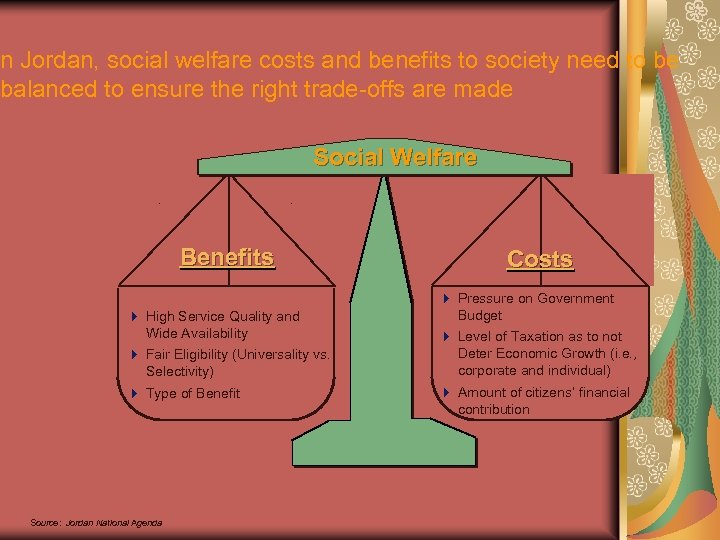
n Jordan, social welfare costs and benefits to society need to be balanced to ensure the right trade-offs are made Social Welfare Benefits 4 High Service Quality and Wide Availability 4 Fair Eligibility (Universality vs. Selectivity) 4 Type of Benefit Source: Jordan National Agenda Costs 4 Pressure on Government Budget 4 Level of Taxation as to not Deter Economic Growth (i. e. , corporate and individual) 4 Amount of citizens’ financial contribution
The Jordanian National Agenda: A Strategy for Social Welfare developed by a 27 -member committee through dialogues with hundreds of Jordanian citizens, is a 10 -year plan covering eight themes across the fields of political, institutional, economic, educational, and social reform. The Agenda includes measurable indicators for success and clear milestones linked to a clear timetable. Budgetary requirements to implement the Agenda are also integrated into the document, so that resources can be allocated to ensure the Agenda's enactment.
THANK YOU…
Скачать презентацию SOCIAL DETERMINANTS OF HEALTH Dr AHMAD ATWAN Al-BATAINEH
e8436a9f8895a38f28a3fd0bd7f1fd01.ppt