 Скачать презентацию Social Cognition Lecture 2 Attribution Theory deals
lecture_3_Soc_cogn_II__2017.pptx
- Количество слайдов: 88



Social Cognition Lecture 2
Attribution Theory deals with how the social perceiver uses information to arrive at causal explanations for events”
Attribution Theory Attribution theory, the approach that dominated social psychology in the 1970 s. Attribution theory is a bit of a misnomer, as the term actually encompasses multiple theories and studies focused on a common issue, namely, how people attribute the causes of events and behaviors. This theory and research derived principally from a single, influential book by Heider (1958) in which he attempted to describe ordinary people’s theories about the causes of behavior. His characterization of people as “naive scientists” is a good example of the phenomenological emphasis characteristic of both early social psychology and modern social cognition.
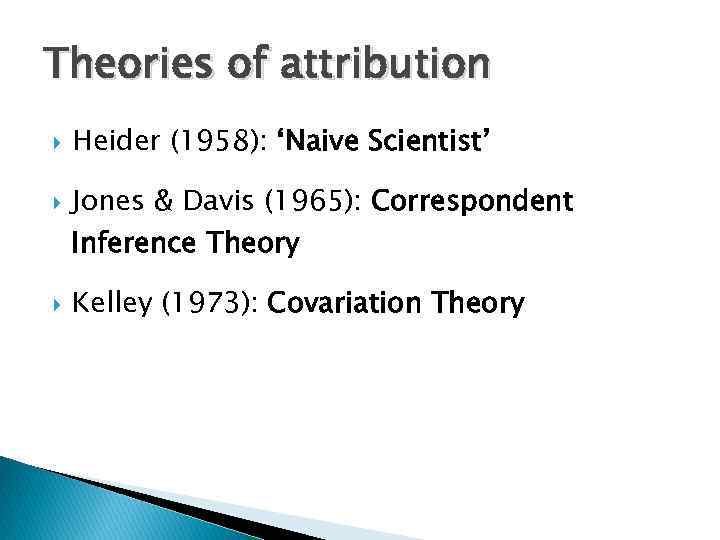
Theories of attribution Heider (1958): ‘Naive Scientist’ Jones & Davis (1965): Correspondent Inference Theory Kelley (1973): Covariation Theory

Errors & Biases Errors Fundamental Attribution Error Ultimate Attribution Error Biases Self-serving bias Negativity bias Optimistic Bias Confirmation Bias
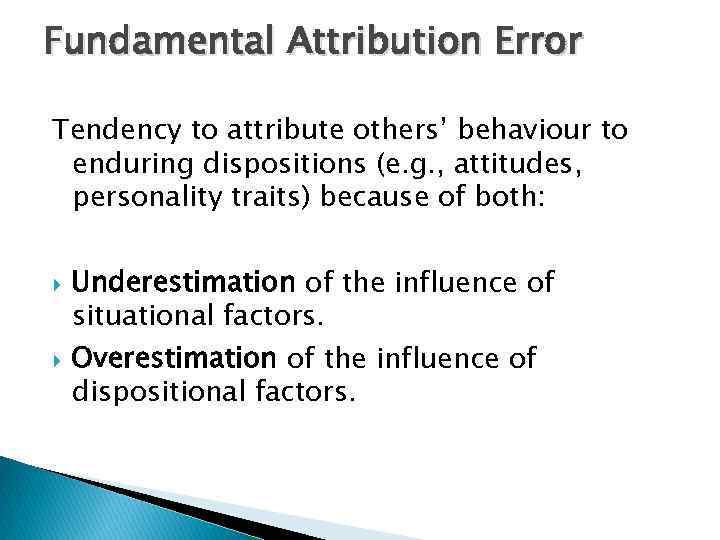
Fundamental Attribution Error Tendency to attribute others’ behaviour to enduring dispositions (e. g. , attitudes, personality traits) because of both: Underestimation of the influence of situational factors. Overestimation of the influence of dispositional factors.
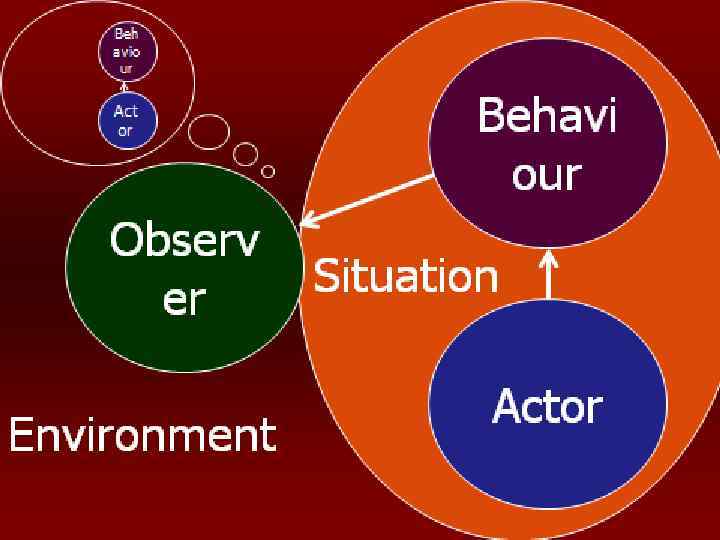
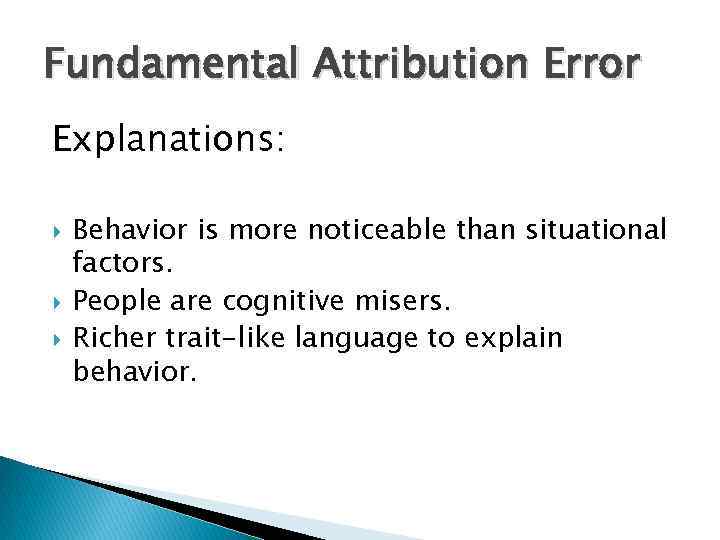
Fundamental Attribution Error Explanations: Behavior is more noticeable than situational factors. People are cognitive misers. Richer trait-like language to explain behavior.
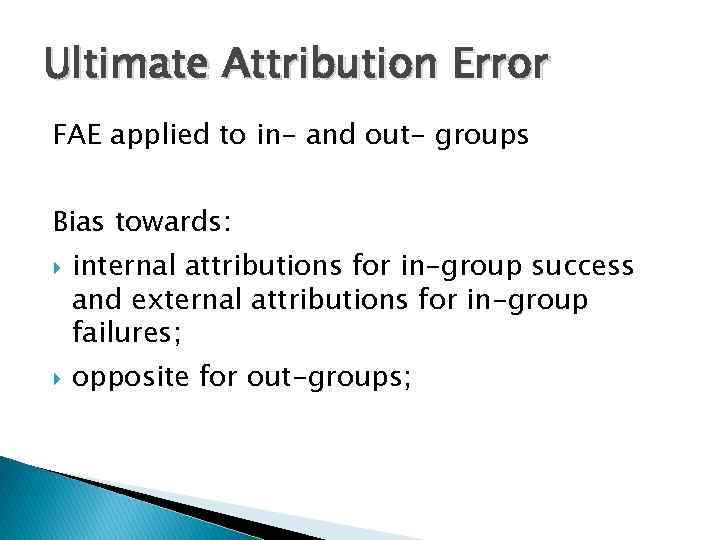
Ultimate Attribution Error FAE applied to in- and out- groups Bias towards: internal attributions for in-group success and external attributions for in-group failures; opposite for out-groups;
Actor/Observer Bias (Self-serving bias) There is a pervasive tendency for actors to attribute their actions to situational requirements, whereas observers tend to attribute the same actions to stable personal dispositions.
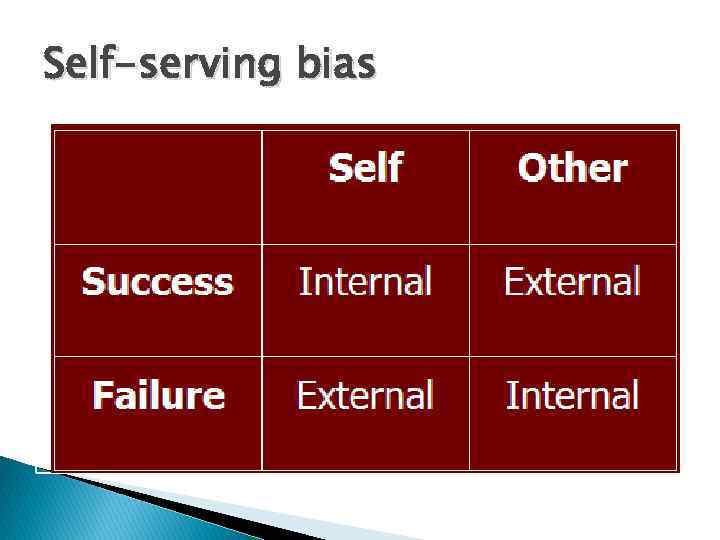
Self-serving bias Self Other Success Internal External Failure External Internal
Explanation of Self-serving bias Motivational: Self-esteem maintenance. Social: Self-presentation and impression formation.
NEGATIVITY BIAS We pay more attention to negative information than positive information (often deliberately, sometimes automatically).
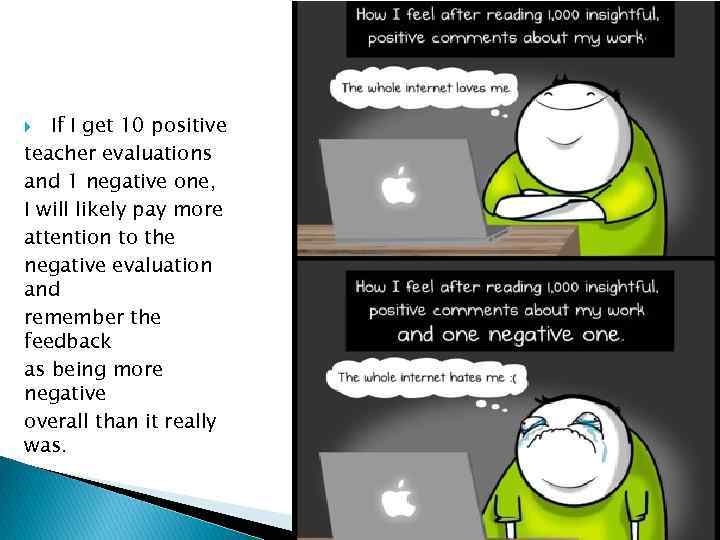
If I get 10 positive teacher evaluations and 1 negative one, I will likely pay more attention to the negative evaluation and remember the feedback as being more negative overall than it really was.
EXPLANATIONS OF NEGATIVITY BIAS Evolutionary Rationale Threats need to be dealt with ASAP
The Optimistic Bias Believing that bad things happen to other people and that you are more likely to experience positive events in life How often do you think about being unemployed someday?
The Optimistic Bias (continued) Do you think you will be in a car accident this weekend? Let’s hope not! The overconfidence barrier ◦ The belief that our own judgment or control is better or greater than it truly is
CONFIRMATION BIAS The tendency to test a proposition by searching for evidence that would support it.
CONFIRMATION BIAS The tendency to test a proposition by searching for evidence that would support it. ○ If you want to support a particular viewpoint/candidate/etc. , you look for material that supports this point of view and ignore material that does not.
CONFIRMATION BIAS The tendency to test a proposition by searching for evidence that would support it. ○ If you want to support a particular viewpoint/candidate/etc. , you look for material that supports this point of view and ignore material that does not. ○ People are more likely to readily accept information that supports what they want to be true, but critically scrutinize/discount information that contradicts them.
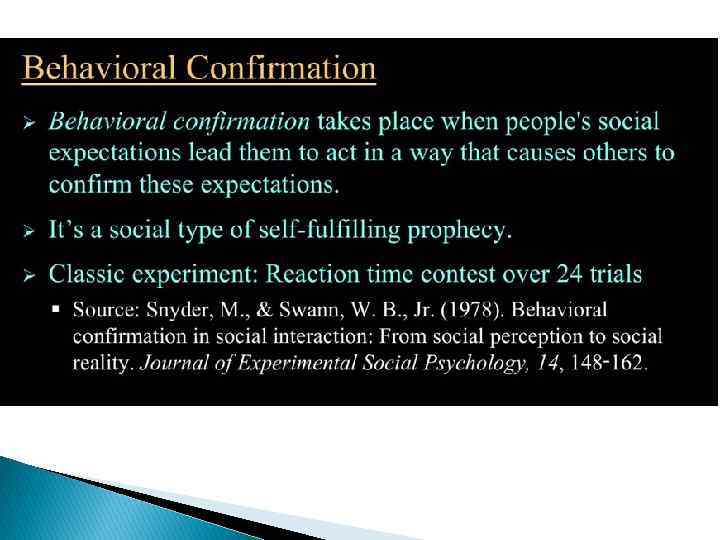
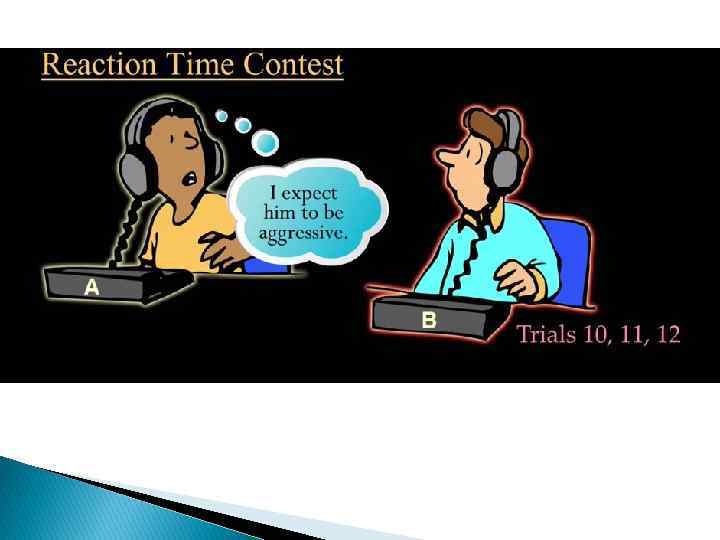
CONFIRMATION BIAS: PERSON PERCEPTION Snyder & Swann, 1978 ○ Introduced a person to the participants of the experiment ○ Had to ask questions to get to know him/her better.
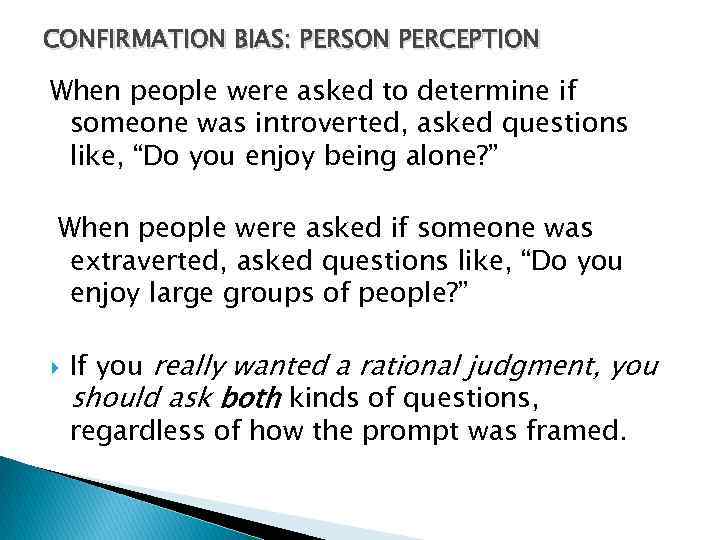
CONFIRMATION BIAS: PERSON PERCEPTION When people were asked to determine if someone was introverted, asked questions like, “Do you enjoy being alone? ” When people were asked if someone was extraverted, asked questions like, “Do you enjoy large groups of people? ” If you really wanted a rational judgment, you should ask both kinds of questions, regardless of how the prompt was framed.
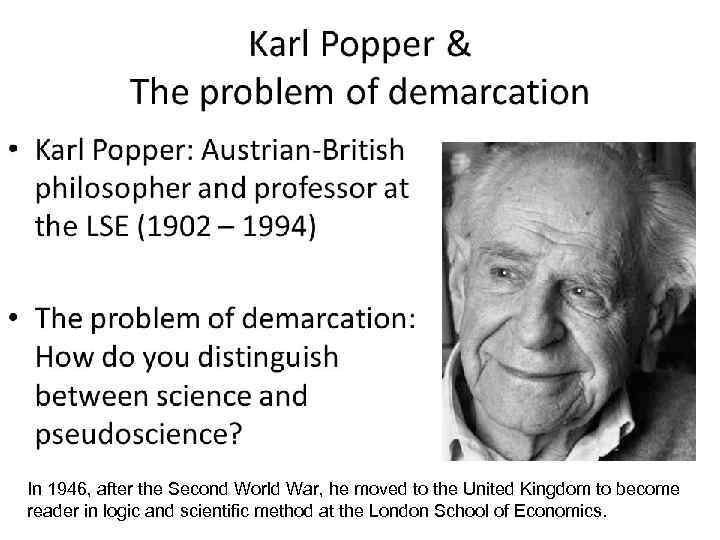
In 1946, after the Second World War, he moved to the United Kingdom to become reader in logic and scientific method at the London School of Economics.
Falsifibility
Falsifibility
CONFIRMATION BIAS: SCHEMAS AND MEMORY We remember schema-consistent information better than schema-inconsistent behavior. ● Because schemas influence attention, also influence memory. ● We remember stimuli that capture the most of our attention. Caveat: Behavior that is heavily schema-inconsistent will also be remembered very well (because it is surprising, which also captures attention).
INFLUENCE OF SCHEMAS Schemas Guide Attention ○ Attention is a limited resource. ○ We automatically allocate attention to relevant stimuli. ○ We are also very good at ignoring irrelevant stimuli. ○ What is relevant? What is irrelevant? ● That’s decided by your activated schemas. ○ Classic Examples: selective attention test, Invisible Gorilla (The Monkey Business Illusion)
CONFIRMATION BIAS: SCHEMAS INFLUENCE MEMORY Cohen, 1981 ● Participants watched video of a husband & wife having dinner. ● Half were told that the woman was a librarian, half a waitress. ● The video included an equal number of “events” that were consistent with either “librarian” or “waitress” stereotypes. ● Participants later took a test to see what they remembered. ○ Was the woman drinking wine or beer? ○ Did she receive a history book or a romance novel as a gift? People remember stereotype-consistent information much more than stereotype-inconsistent information
Causal Attribution Across Cultures Culture influence attribution processes. Social psychologists have widely studied the use of fundamental attribution error across different cultures. Researchers have today confirmed the fact that attribution errors including fundamental attribution errors, vary across culture and the major difference relates to the fact that whethere is individualist or collectivist culture.
Causal Attribution Across Cultures Individualist culture emphases the individual, and therefore, its members are predisposed to use individualist or dispositional attribution in terms of traits, attitudes, intentions, interest etc. In collectivist cultures, the emphasis is more context in which the groups and interindividual relationships are emphasized. As a consequence, members of collectivist culture are likely to include situational elements in their attribution.
Causal Attribution Across Cultures Singh et al. (2003) studied the role of culture in blame attribution. In a series of three cross-cultural experiments, they successfully demonstrated that in Western culture like the US and Europe, a person is considered blameworthy for not meeting an expectation. Participants from western culture blamed the individual more than the group, whereas participants from Eastern culture like China, India, Japan etc. blame group more than individual.
Causal Attribution Across Cultures Cross-cultural differences have been reported in the attribution of success and failure (Fry and Ghosh, 1980). They look matched groups of White Canadian and Asian-Indian Canadian children aged between 8 and 10 years. It was observed that the self-serving bias was present in White Canadian children, who attributed success to the internal factors like ability and efforts and failure to bad luck and other external factors. On the other hand Asian-Indian Canadian children attributed success more in terms of external factors like luck and failure mainly in terms of internal factors like lack of ability.
Self-Fulfilling Prophecies A self-fulfilling prophecy is a prediction that directly or indirectly causes itself to become true, by the very terms of the prophecy itself, due to positive feedback between belief and behavior.
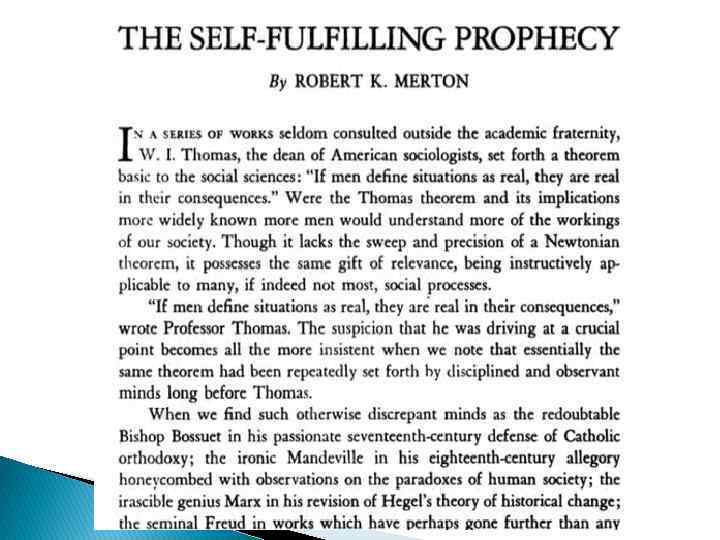
Self-Fulfilling Prophecies Although examples of such prophecies can be found in literature as far back as ancient Greece and ancient India, it is 20 th-century sociologist Robert K. Merton who is credited with coining the expression "self -fulfilling prophecy" and formalizing its structure and consequences. In his 1948 article Self-Fulfilling Prophecy, Merton defines it in the following terms:
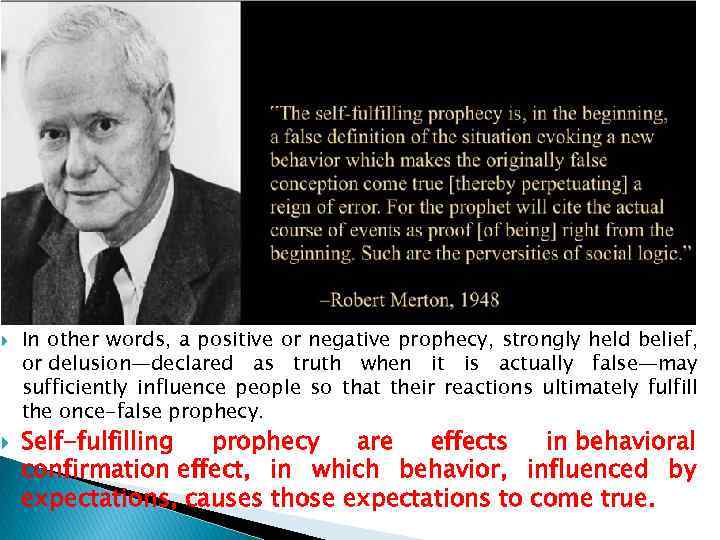
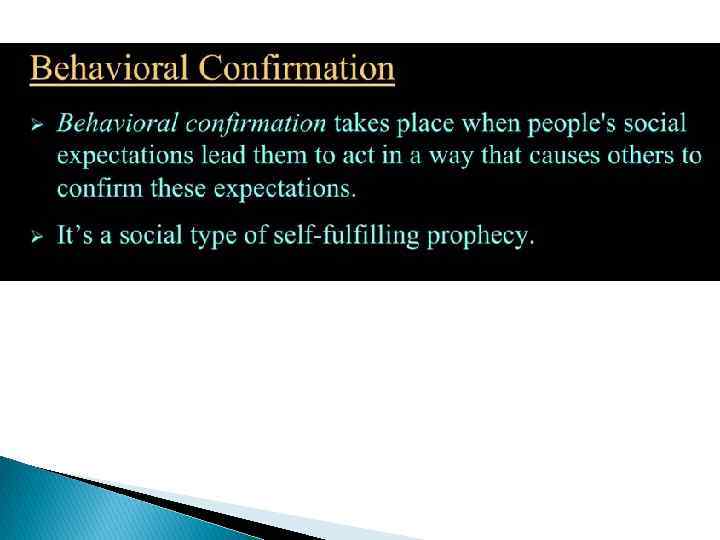
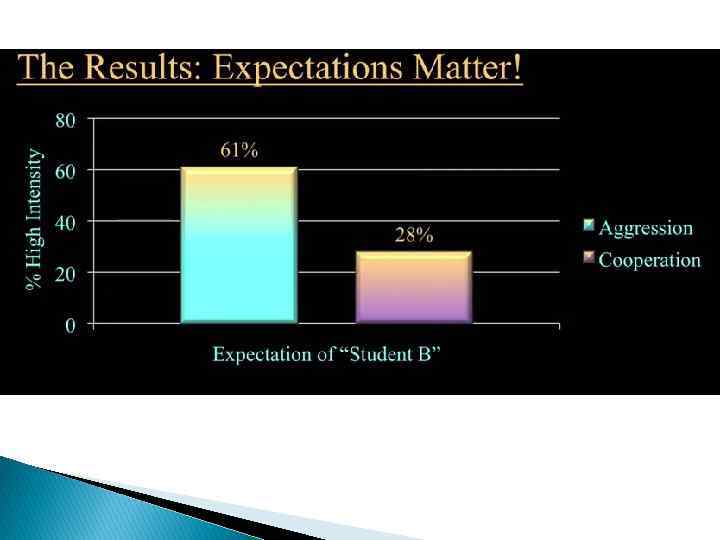
In other words, a positive or negative prophecy, strongly held belief, or delusion—declared as truth when it is actually false—may sufficiently influence people so that their reactions ultimately fulfill the once-false prophecy. Self-fulfilling prophecy are effects in behavioral confirmation effect, in which behavior, influenced by expectations, causes those expectations to come true.
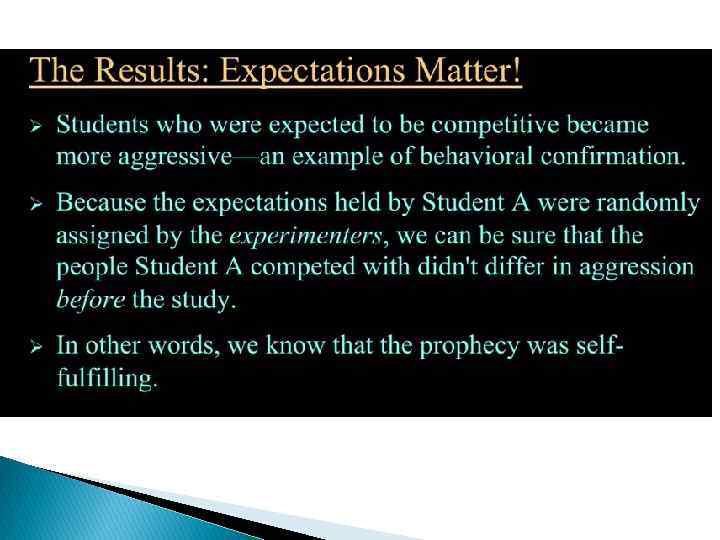
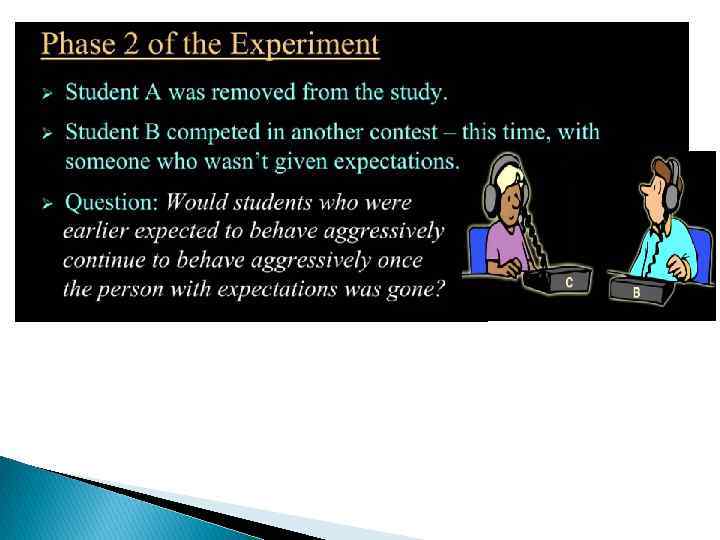
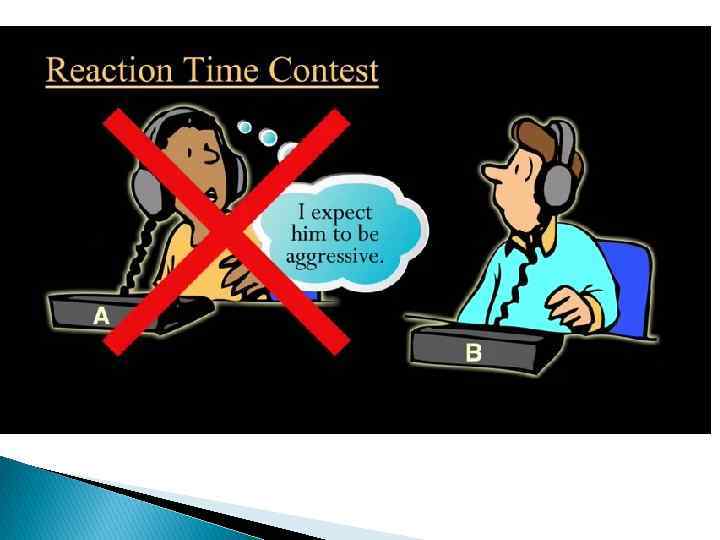
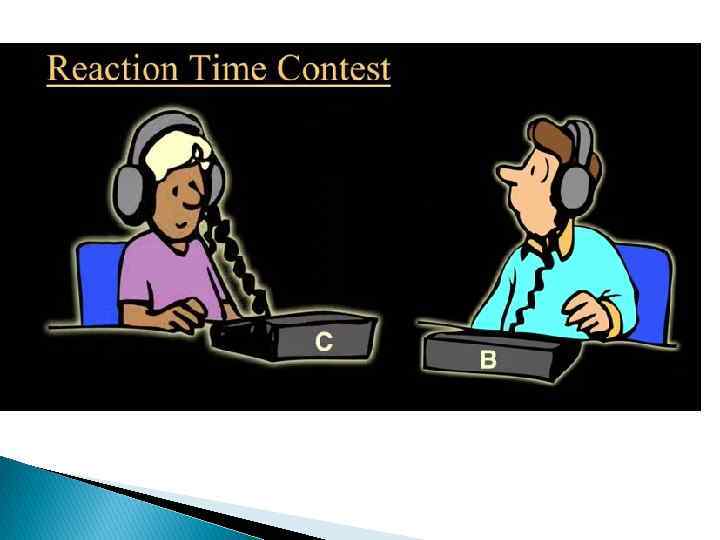
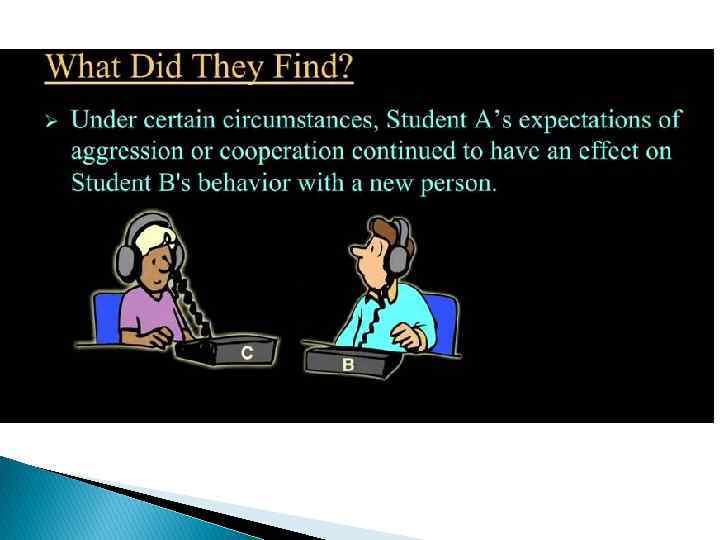
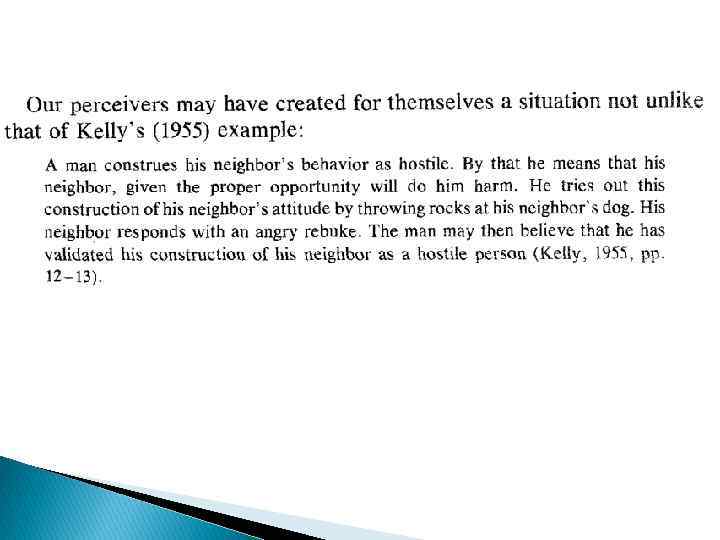

Making Schemas Come True: The Self-Fulfilling Prophecy Elementary school children administered a test Teachers told that certain students had scored so highly that they would be sure to “bloom” academically during the next year (“so-called “bloomers” assigned these labels at random) Administered an IO test at the end of the year
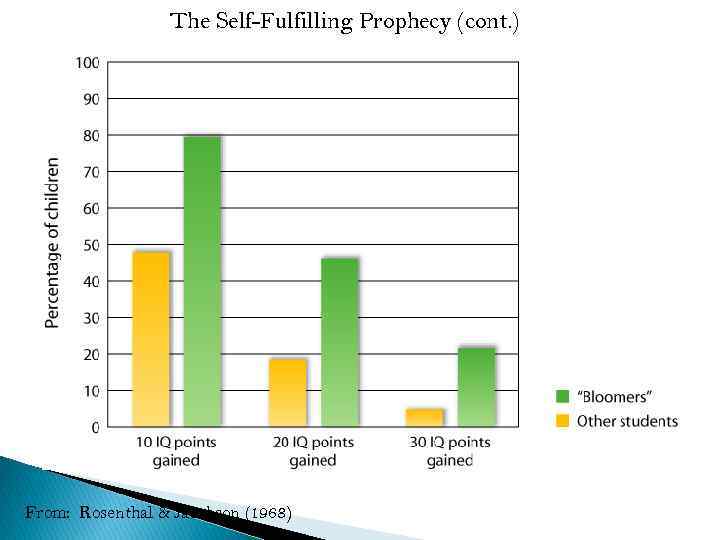
The Self-Fulfilling Prophecy (cont. ) From: Rosenthal & Jacobson (1968)
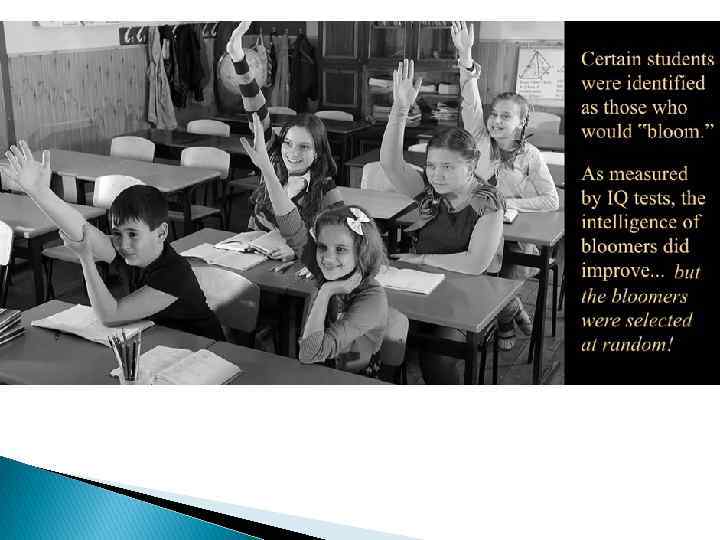
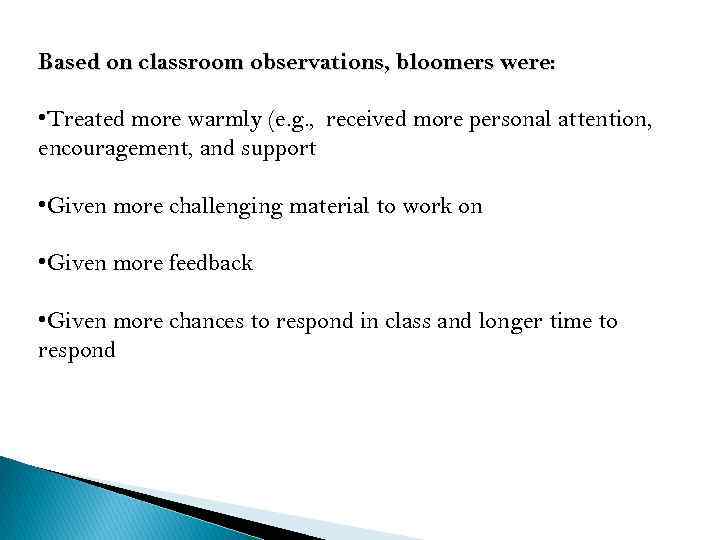
Based on classroom observations, bloomers were: • Treated more warmly (e. g. , received more personal attention, encouragement, and support • Given more challenging material to work on • Given more feedback • Given more chances to respond in class and longer time to respond
Self-Fulfilling Prophecies A person "becomes" the stereotype that is held about them Selective filtering ◦ Paying attention to sensory information that affirms a stereotype ◦ Filtering out sensory information that negates a stereotype
Heuristics: Mental shortcuts in social cognition
Heuristics are rules or principles that allow us to make social judgments more quickly and with reduced efforts.
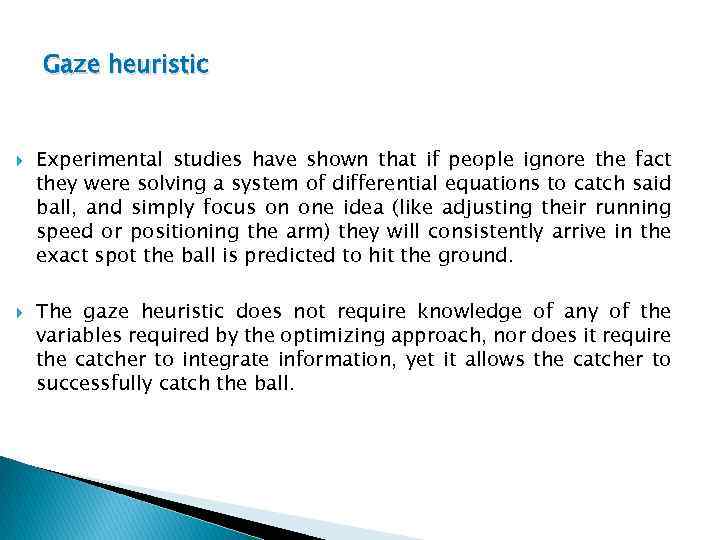
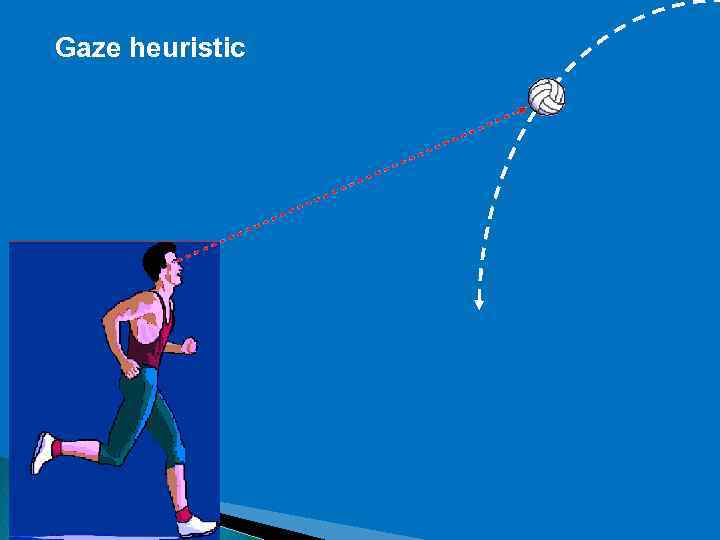
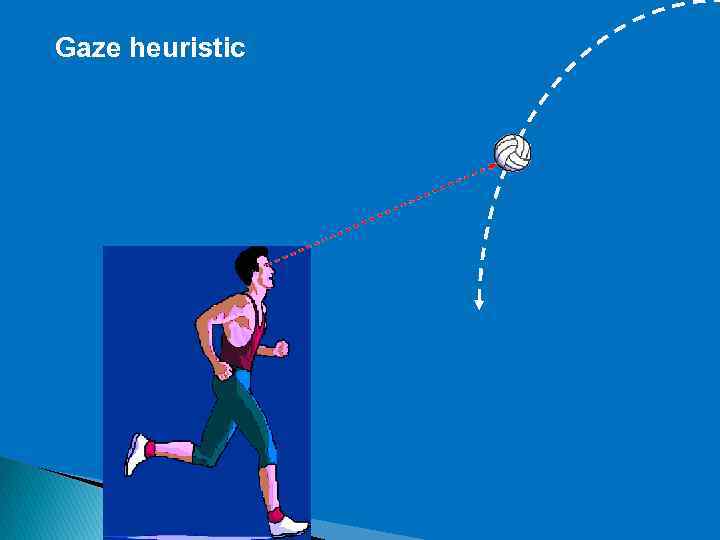
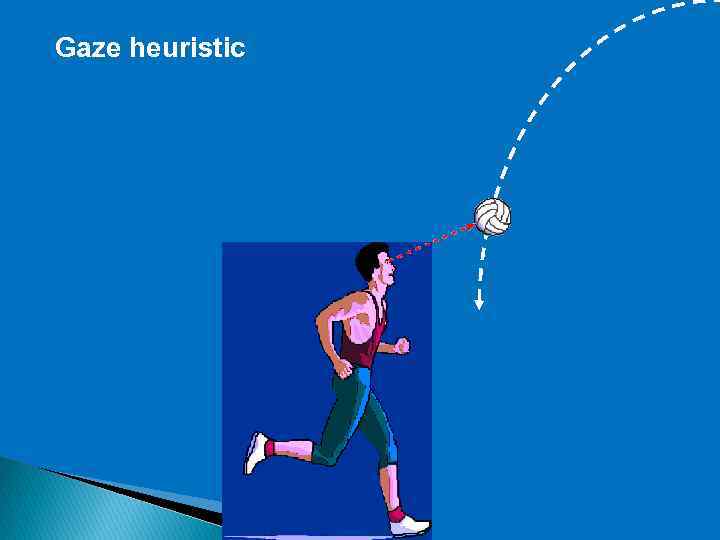
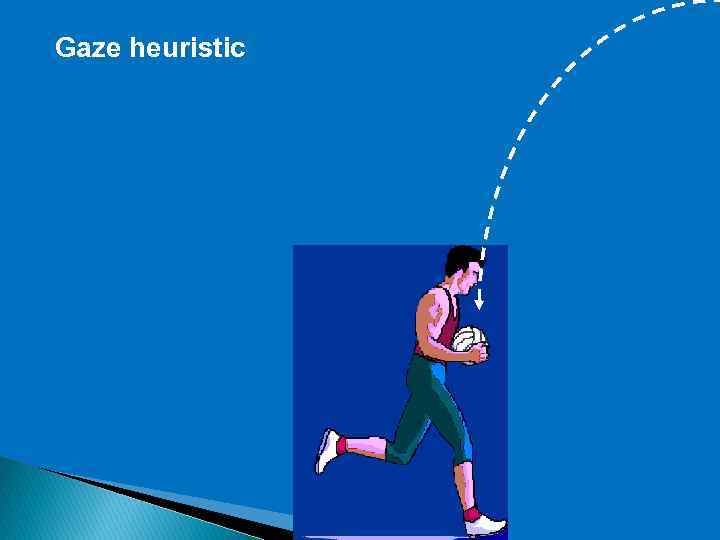
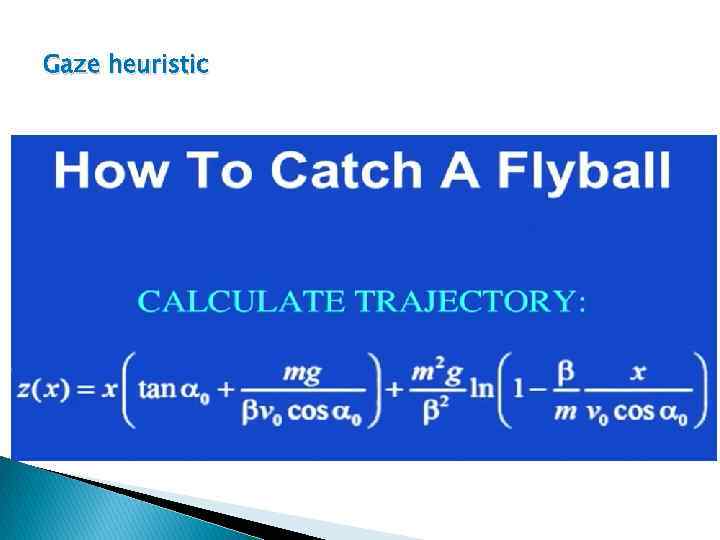
Gaze heuristic Experimental studies have shown that if people ignore the fact they were solving a system of differential equations to catch said ball, and simply focus on one idea (like adjusting their running speed or positioning the arm) they will consistently arrive in the exact spot the ball is predicted to hit the ground. The gaze heuristic does not require knowledge of any of the variables required by the optimizing approach, nor does it require the catcher to integrate information, yet it allows the catcher to successfully catch the ball.
Gaze heuristic
Gaze heuristic
Gaze heuristic
Gaze heuristic
Gaze heuristic
Gaze heuristic The gaze heuristic is a heuristic used in directing correct motion to achieve a goal using one main variable. An example of the gaze heuristic is catching a ball. The gaze heuristic is one example where humans and animals are able to process large amounts of information quickly and react, regardless of whether the information is consciously processed. At the most basic level, the gaze heuristic ignores all casual relevant variables to make quick reactions.
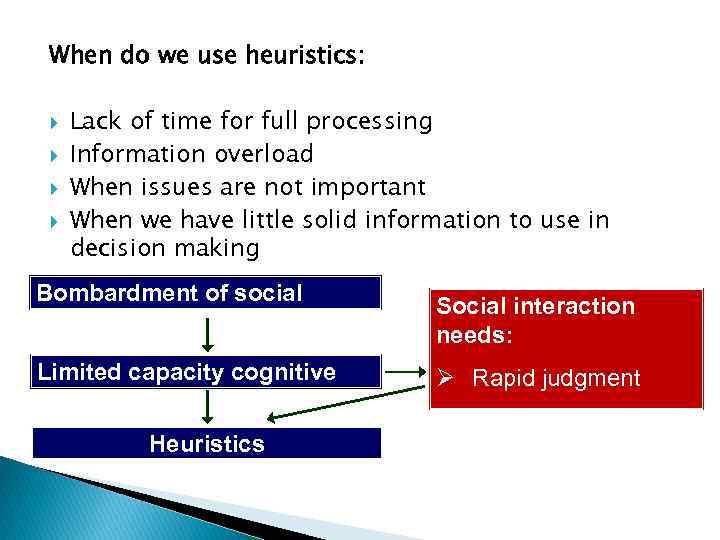
When do we use heuristics: Lack of time for full processing Information overload When issues are not important When we have little solid information to use in decision making Bombardment of social information Limited capacity cognitive system Heuristics Social interaction needs: Ø Rapid judgment Ø Reduced effort
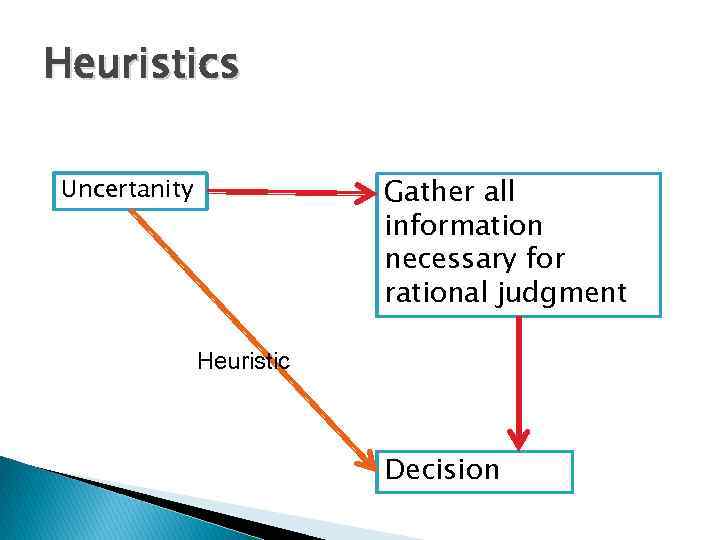
Heuristics Gather all information necessary for rational judgment Uncertanity Heuristic Decision
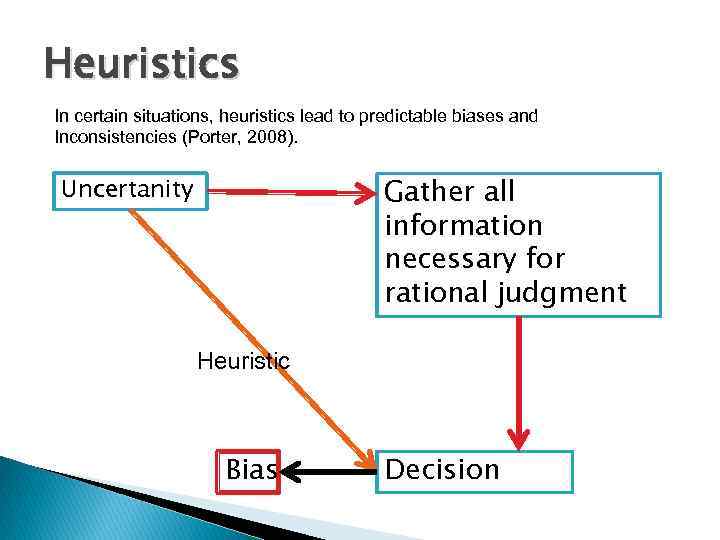
Heuristics In certain situations, heuristics lead to predictable biases and Inconsistencies (Porter, 2008). Gather all information necessary for rational judgment Uncertanity Heuristic Bias Decision
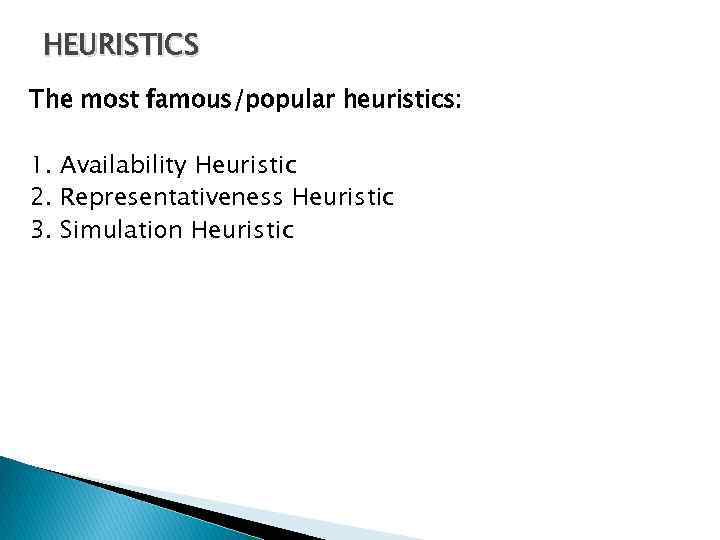
HEURISTICS The most famous/popular heuristics: 1. Availability Heuristic 2. Representativeness Heuristic 3. Simulation Heuristic
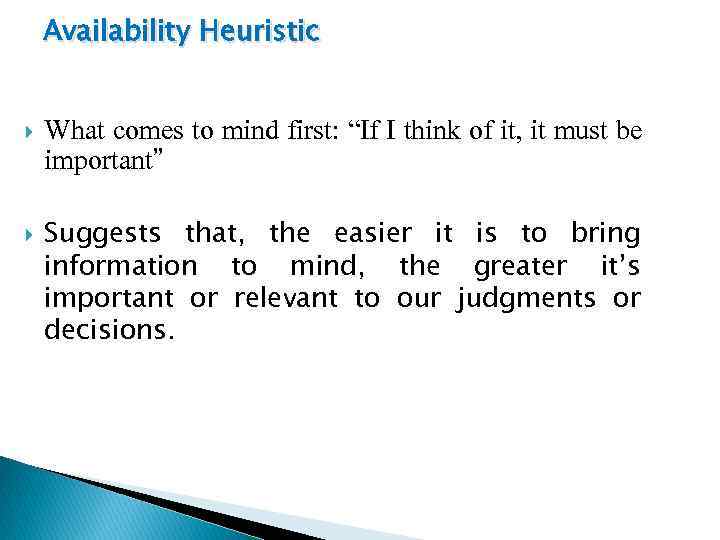
Availability Heuristic What comes to mind first: “If I think of it, it must be important” Suggests that, the easier it is to bring information to mind, the greater it’s important or relevant to our judgments or decisions.
Availability heuristic The availability heuristic is a phenomenon (which can result in a cognitive bias) in which people predict the frequency of an event, or a proportion within a population, based on how easily an example can be brought to mind.
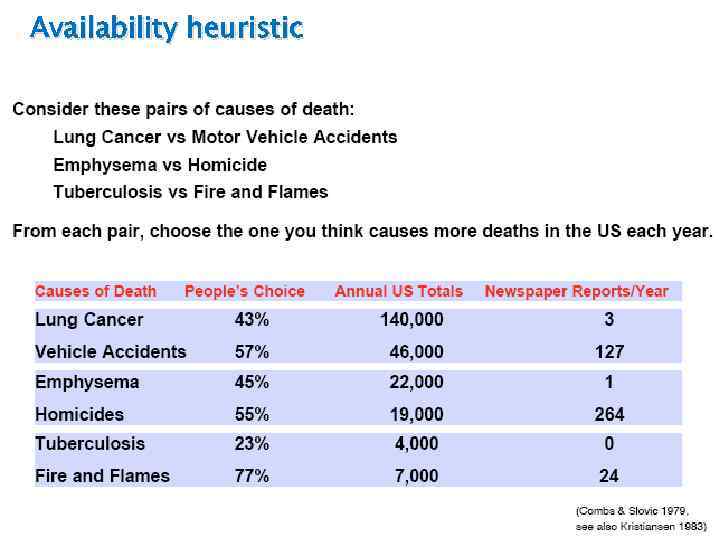
Availability heuristic
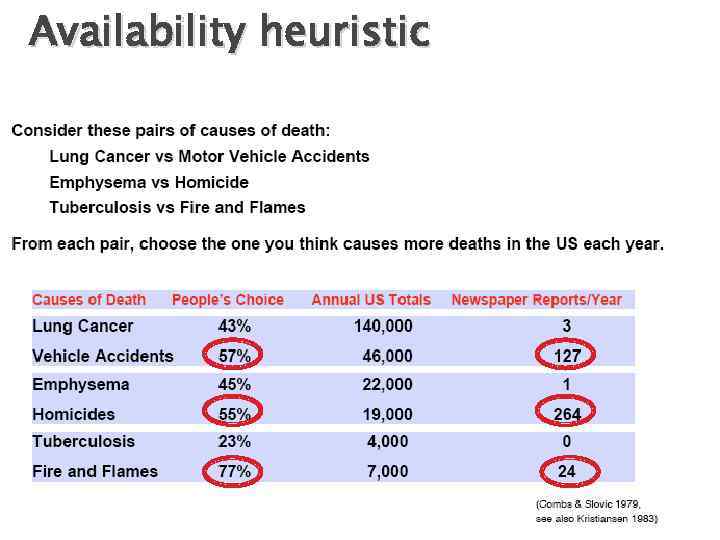
Availability heuristic

AVAILABILITY HEURISTIC ○ Group Projects ● Because you worked on your portion of a group project, it’s easy for you to recall exactly what you worked on ● Because you didn’t work on your partners’ portions, it’s not easy for you to recall exactly what they worked on Result: People tend to overestimate their own contributions to joint projects.

AVAILABILITY HEURISTIC Marriage & Chores (Ross & Sicoly, 1979) ● Married couples were asked to give the percentage of the household chores that they did ○ Not surprisingly. . . estimates added up to over 100% ○ Both husbands and wives tended to think that they did more of the chores!
Representativeness Heuristic : Judging by resemblance The tendency to judge frequency or likelihood of an event by the extent to which it “resembles” the typical case.
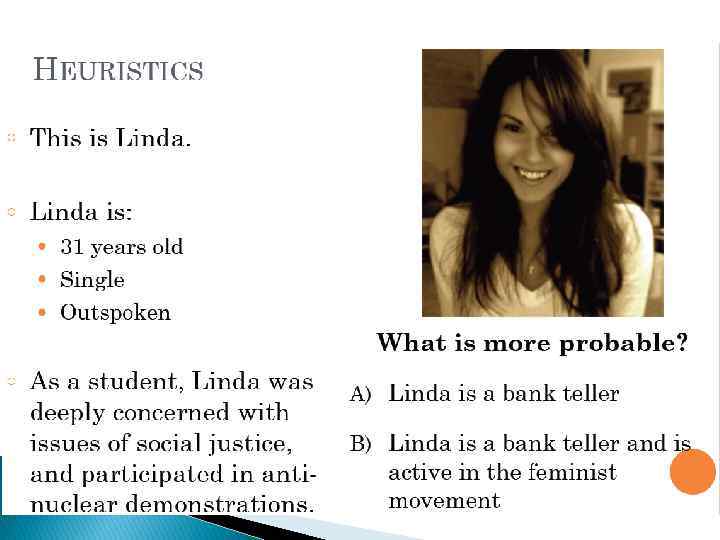
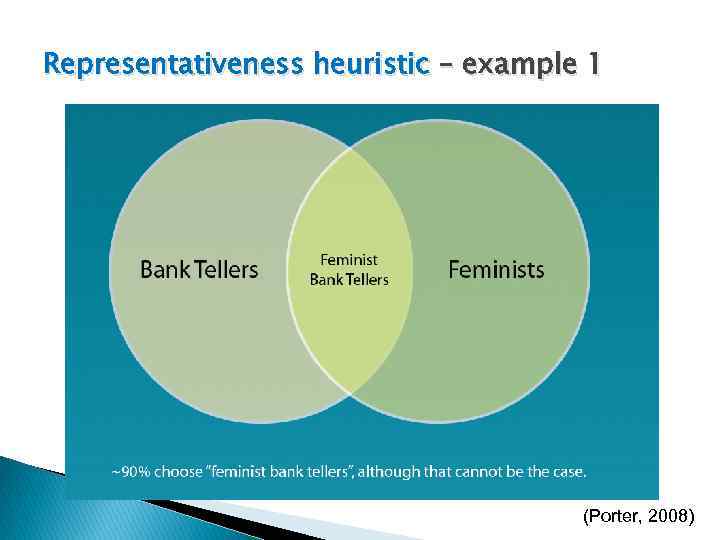
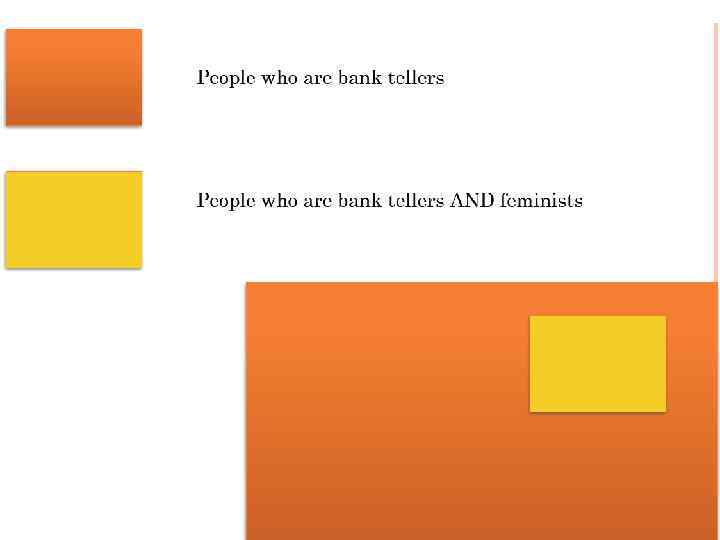
Representativeness heuristic – example 1 (Porter, 2008)
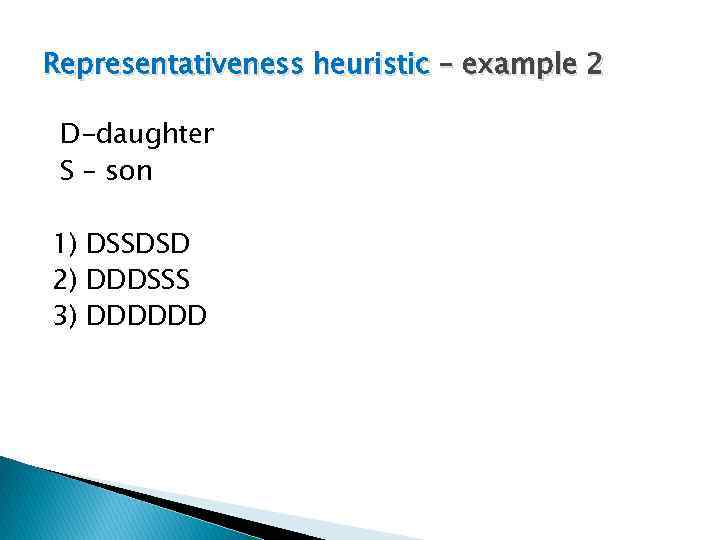
Representativeness heuristic – example 2 D-daughter S – son 1) DSSDSD 2) DDDSSS 3) DDDDDD
Simulation Heuristic A third kind of heuristic is the simulation heuristic, which is defined by the ease of mentally undoing an outcome. The tendency to judge the frequency or likelihood of an event by the ease with which you can imagine (or mentally simulate) an event.
Simulation Heuristic Example I. "Mr. Crane and Mr. Tees were scheduled to leave the airport on different flight sat the same time. They traveled from town in the same limousine, were caught in a traffic pm, and arrived at the airport thirty minutes after the scheduled departure of their flights. Mr. Crane is told his flight left on time. Mr. Tees is told that his fight was delayed and just left five minutes ago" (Kahneman & Tversky, 1982). Who is more upset? "The guy whose flight just left. " Right. Why? Because it seems easier to undo the bad outcome. That is, it is easier to imagine how things could have turned out so that they could have made the plane they missed by minutes, but harder to imagine how they could have made the plane that was missed by a wide margin
Simulation Heuristic So people mentally simulate the event. If it seems easer to undo, then it is more frustrating: It has more impact (also see Kahneman & Miller, 1986). .
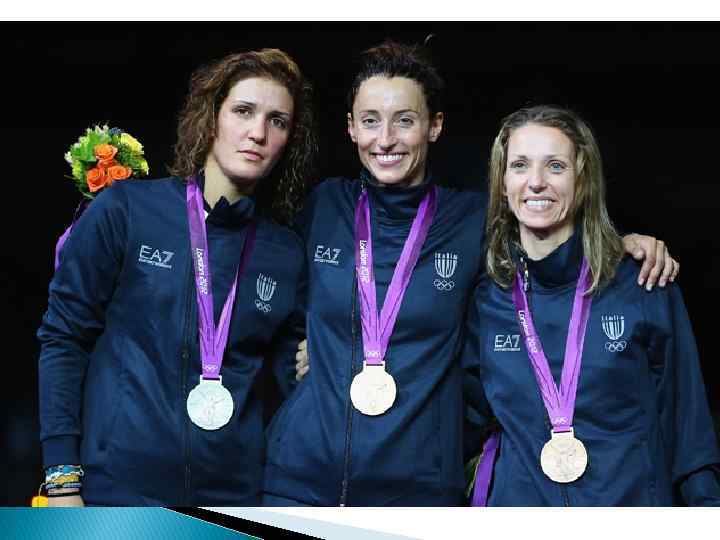
Simulation Heuristic Example II: In the Olympics, bronze medalists appear to be happier than silver medalists, because it is easier for a silver medalist to imagine being a gold medalist.



Counterfactual Thinking Imagining different outcomes for an event that has already occurred Is usually associated with bad (or negative) events Can be used to improve or worsen your mood
Counterfactual Thinking Upward counterfactuals ◦ “If only I had bet on the winning horse!" ◦ "If only I’d cooked the turkey at 350 instead of 400 degrees!" ◦ "I would have won if I’d bought the OTHER scratch-off lottery ticket!"
Counterfactual Thinking Downward counterfactuals ◦ "I got a C on the test, but at least it’s not a D!" ◦ "He won’t go out with me but at least he didn’t embarrass me in front of my friends. " ◦ "My team lost, but at least it was a close game and not a blowout!"
 Скачать презентацию Social Cognition Lecture 2 Attribution Theory deals
lecture_3_Soc_cogn_II__2017.pptx