


 Скачать презентацию Social and Cultural The Hong Kong Polytechnic University
a431a1df1f1941c2850191e159fa3f1b.ppt
- Количество слайдов: 70
 Social and Cultural The Hong Kong Polytechnic University 1
 What to learn • How engineering (projects) affects the social and cultural aspects • How society or culture change engineering • Social responsibilities • How engineering can help solving social issues The Hong Kong Polytechnic University
 Cultural and Social Dimension • Definition – what is cultural or social? • What is cultural – Relating to the culture, that is, the habits, traditions and beliefs of a society – Culture • The way of life, especially the general customs and beliefs of a particular group of people at a particular time • 飲食文化, Poly. U student culture • Because we now have refrigerator so icy mooncake is more popular The Hong Kong Polytechnic University
 Cultural and social • Social – Relating to society and living together in an organized way – Relating to activities in which you meet and spend time with other people and which happen during the time when you are not working – Now you use Face. Book instead of meeting your friends in person The Hong Kong Polytechnic University
 Social dimension • Social – related to society – It could be anything! • Housing • Waste treatment • Poverty, etc The Hong Kong Polytechnic University 5
 Social issues • • • Poverty – jobs Lack of housing Lack of water – environmental Pollution Drug and alcohol abuse Can these be changed by engineering and how? • These also related to sustainability! The Hong Kong Polytechnic University 6
 Cultural and Sociological Dimensions Engineering in a social context The Hong Kong Polytechnic University 7
 Engineering changes our surroundings • All changes to our surroundings affect us and the rest of the society we live in – and therefore will change society’s culture and social behavior – Any example based on Poly. U? • So all engineering advances and projects will affect the cultural and social aspects of our society The Hong Kong Polytechnic University
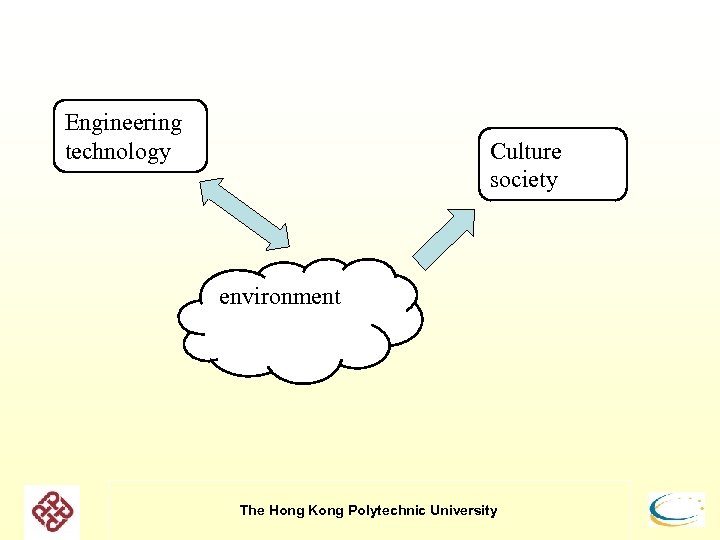 Engineering technology Culture society environment The Hong Kong Polytechnic University
 Surroundings change engineering • The type of society and its culture will also affect the engineering projects – Any example in Hong Kong? • High speed railway • MTR The Hong Kong Polytechnic University 10
 Engineering in a social context By its very nature engineering is closely related to society and human behavior. Every product or construction used by modern society are influenced by engineering design. Engineering design is a very powerful tool to make changes to environment, society and economies, and its application brings with it a great responsibility (with great power comes with great responsibilty) The Hong Kong Polytechnic University 11
 Engineering advances will affect the culture of our society • Very old example – Hong Kong changes from agricultural to industrial then financial society due to the advance in technology (agree/disagree? ) – Use of email instead of “writing letter” for communication, sending e-card, SMS, Whatsapp instead of a X’mas card – Download music instead of buying a CD (when was the last time you pay for the music in your cell phone? ) The Hong Kong Polytechnic University
 More examples • The MTR and road networks create many new “urban areas” which use to be remote areas • Spend holiday in other countries, or in China due to the advance in aviation/transportation technologies • Use octopus card instead of cash (culture or social? ) The Hong Kong Polytechnic University
 Culture changed by engineering • Give one example how the Chinese culture is changed by engineering The Hong Kong Polytechnic University
 How about society or cultural changes engineering? • • Any examples? How about “Tin Shui Wai” How about new cell phone design 塱原濕地 The Hong Kong Polytechnic University
 Engineering in a social context Many Engineering Institutions have established codes of practice and codes of ethics to guide members and inform the public at large. Engineering projects can be subject to controversy (爭議). Examples from different engineering disciplines include the development of chemical weapons, the High-speed railway, the design and use of Sports Utility Vehicles and the extraction of oil. In response, some western engineering companies have enacted serious Corporate and Social Responsibility policies. The Hong Kong Polytechnic University 16
 Engineering in a social context Engineering is a key driver of human development. Sub-Saharan Africa in particular has a very small engineering capacity which results in many African nations being unable to develop significant infrastructure without outside aid. The attainment of many of the Millennium Development Goals requires the achievement of adequate engineering capacity to develop infrastructure and sustainable technological development. The Hong Kong Polytechnic University 17
 We can end poverty 2015 http: //www. un. org/millenniumgoals/ The Hong Kong Polytechnic University 18
 Engineering in a social context All overseas development and relief NGOs make considerable use of engineers to apply solutions in disaster and development scenarios. A number of charitable organizations aim to use engineering directly for the good of mankind: Engineers Without Borders Engineers Against Poverty Registered Engineers for Disaster Relief Engineers for a Sustainable World Any similar organization in Hong Kong? The Hong Kong Polytechnic University 19
 Cultural presence of Engineering • In our culture – what is the general perception of engineering? • Engineering is a well respected profession ? • Yes/No? For example, in Canada it ranks as one of the public's most trusted professions. • What is the situation in Hong Kong/Chinese culture • Example – engineer is well respected? • Getting a “certified true copy” The Hong Kong Polytechnic University 20
 Certify a copy of a document • http: //www. hsbc. com. mo/1/PA_1_2_S 5/co ntent/website/misc/common-en/formdownload/en/pdf/Limited_Company_Estab lished_Overseas. pdf • http: //www. direct. gov. uk/en/Travel. And. Tran sport/Passports/Applicationinformation/DG _174151 The Hong Kong Polytechnic University 21
 Cultural presence of engineering • Sometimes engineering has been seen as a somewhat dry, uninteresting field in popular culture(commonly abbreviated as pop culture), can be defined as the sum of ideas, perspectives, attitudes, images and other phenomena that are deemed preferred per an informal consensus within the mainstream of a given culture(wikipedia)). The Hong Kong Polytechnic University 22
 Cultural presence of Engineering One difficulty in increasing public awareness of the profession is that average people, in the typical run of ordinary life, do not ever have any personal dealings with engineers, even though they benefit from their work every day. By contrast, it is common to visit a doctor/dentist at least once a year, the accountant at tax time, and, occasionally, even a lawyer. The Hong Kong Polytechnic University 23
 Personal dealing with engineers • Examples? When would you require the service of an engineer? I. Fixing your toilet/pumping? II. Fixing your TV, network, or computer? Do you respect whose “engineers” or do you regard them as “engineer”? The Hong Kong Polytechnic University 24
 Cultural presence of Engineering • In Western culture • This has not always been so - most British school children in the 1950 s were brought up with stirring tales of 'the Victorian Engineers', chief amongst whom were the Brunel, the Stephenson, Telford and their contemporaries. The Hong Kong Polytechnic University 25
 Cultural presence of Engineering Isambard Kingdom Brunel (1806 -1859)was best known for the creation of the Great Western Railway, a series of famous steamships, including the first propeller-driven transatlantic steamship, and numerous important bridges and tunnels. His designs revolutionised public transport and modern day engineering. George Stephenson (1781 – 1848) was an English civil engineer and mechanical engineer who built the first public railway line in the world to use steam locomotives and is known as the "Father of Railways". Thomas Telford (1757 - 1834) was a stonemason, architect and civil engineer and a noted road, bridge and canal builder. The Hong Kong Polytechnic University 26
 Cultural presence of Engineering • How about examples in the Chinese culture? ? – Are there any famous Chinese engineers? – 諸葛孔明 – 鲁班 (我国的土木 匠们都尊称他为祖师) The Hong Kong Polytechnic University
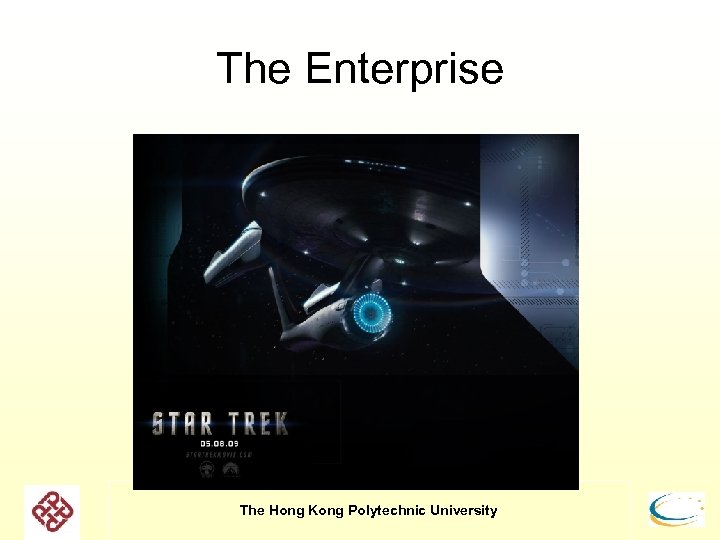
 Cultural presence of Engineering In science fiction engineers are often portrayed as highly knowledgeable and respectable individuals who understand the overwhelming future technologies. The Star Trek characters Montgomery Scott, Geordi La Forge, Miles O'Brien, B'Elanna Torres, and Charles Tucker III are famous examples. Most of the above are characters from Star Trek the Next Generation first shown in “September 28, 1987” Montgomery Scott – engineer from the original Star Trek TV series ( or the movie Star Trek release in 2009) Charles Tucker III – from the TV series Star Trek : Enterprise The Hong Kong Polytechnic University 28
 The Enterprise The Hong Kong Polytechnic University
 Image of an engineer in Chinese culture • Any TVB drama features an engineer as major characters? • Can you name an engineer (real or fictitious) • Is he an engineer? The Hong Kong Polytechnic University 30
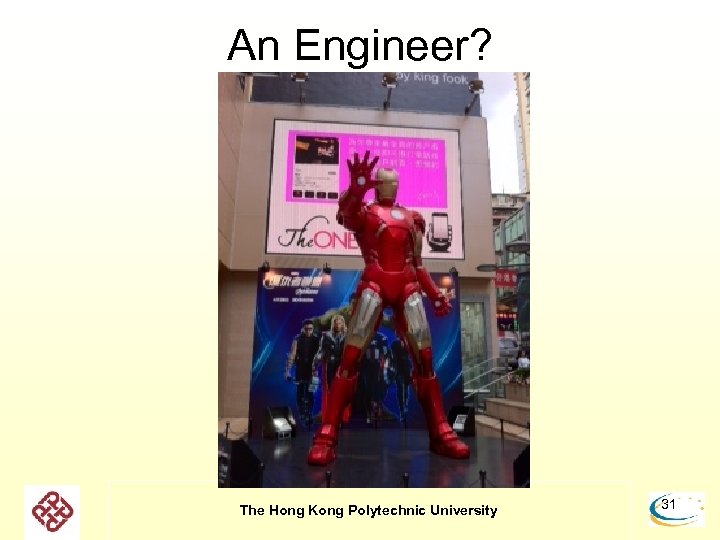 An Engineer? The Hong Kong Polytechnic University 31
 Cultural presence of Engineering • A new perspective of “Engineering” • “Why do so many terrorists have engineering degrees? ” but recently there is an article with such a title!!!! “engineers, in particular, were three to four times more likely to become violent terrorists than their peers in finance, medicine or the sciences” The Hong Kong Polytechnic University
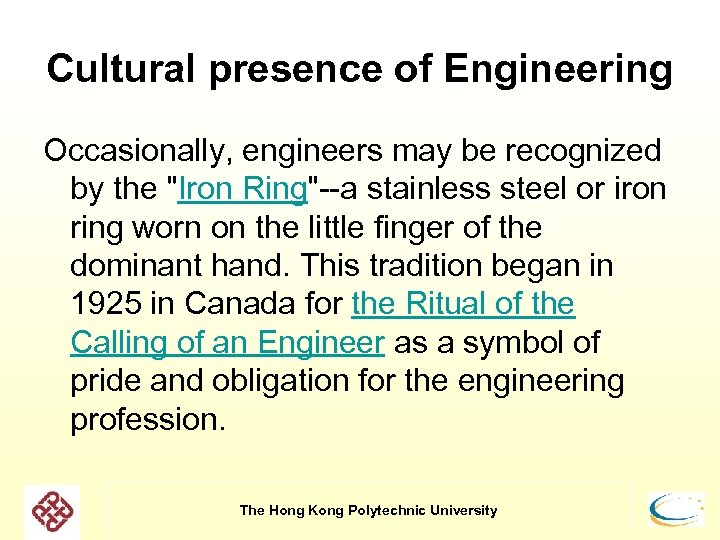 Cultural presence of Engineering Occasionally, engineers may be recognized by the "Iron Ring"--a stainless steel or iron ring worn on the little finger of the dominant hand. This tradition began in 1925 in Canada for the Ritual of the Calling of an Engineer as a symbol of pride and obligation for the engineering profession. The Hong Kong Polytechnic University
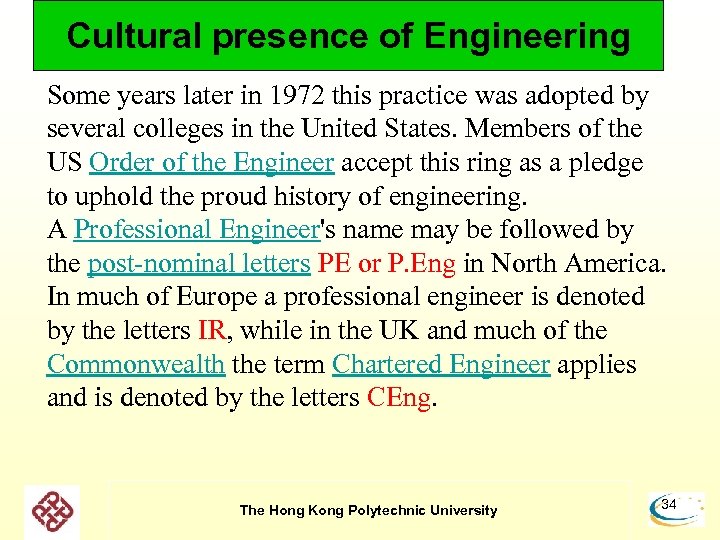 Cultural presence of Engineering Some years later in 1972 this practice was adopted by several colleges in the United States. Members of the US Order of the Engineer accept this ring as a pledge to uphold the proud history of engineering. A Professional Engineer's name may be followed by the post-nominal letters PE or P. Eng in North America. In much of Europe a professional engineer is denoted by the letters IR, while in the UK and much of the Commonwealth the term Chartered Engineer applies and is denoted by the letters CEng. The Hong Kong Polytechnic University 34
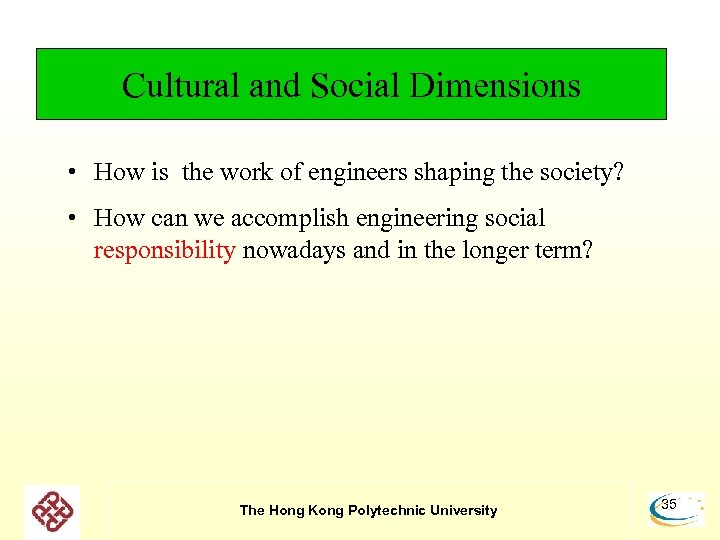 Cultural and Social Dimensions • How is the work of engineers shaping the society? • How can we accomplish engineering social responsibility nowadays and in the longer term? The Hong Kong Polytechnic University 35
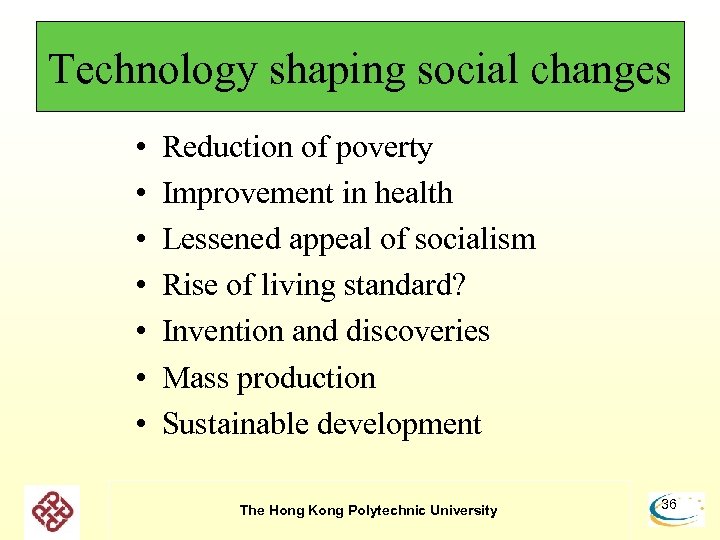 Technology shaping social changes • • Reduction of poverty Improvement in health Lessened appeal of socialism Rise of living standard? Invention and discoveries Mass production Sustainable development The Hong Kong Polytechnic University 36
 Engineering Social Responsibility • What do we mean by this? You have heard of corporate social responsibility (企 業社會責任) – that is how organisations take into account the economic, social and environmental impacts of the way they operate. – For example include “lunch break” with pay • As engineers, we can apply similar ‘precautionary principles’. The Hong Kong Polytechnic University 37
 Engineering Social Responsibility • There is an opportunity, and indeed a moral obligation, for us to set a standard of engineering design that benefits the environment in both the long and the shortterm. • There are major forces at play: climate change, water shortages and energy issues, all of which mean we must constantly think about the overall sustainability of our designs. The Hong Kong Polytechnic University 38
 A Response to Climate Change • In response to climate change, going carbon neutral is a way to reduce the impacts associated to the greenhouse gas (GHG) emissions created during the business or production cycle. • Given that climate change is a worldwide phenomenon, the concept of carbon neutrality is based on the principle that a GHG emissions reduction achieved elsewhere has the same positive effect as a reduction made locally. The Hong Kong Polytechnic University 39
 Why go carbon neutral? Motives to develop a robust corporate or product carbon-neutral strategy may be based on one or more of these elements: • Regulatory. By voluntarily measuring and assigning costs to carbon emissions, a company can prepare for a future carbonconstrained economy in which GHG emissions are regulated and/or taxed. The Hong Kong Polytechnic University 40
 Why go carbon neutral? • Financial. Effectively managing GHG emissions can help companies generate long-term value by cutting costs, reducing risk, and increasing revenues. Going carbon neutral can be a central part of this management strategy and can help to establish a framework for identifying and pursuing cost-effective emissions reduction and savings opportunities. The Hong Kong Polytechnic University 41
 Why go carbon neutral? • Marketing. Demonstrating environmental leadership on the corporate, product, or service level can create strong brand presence, increase customer loyalty, and appeal to new clients and the general public. First movers in the area of carbon neutrality are likely to gain an edge over business-as-usual competitors, particularly as environmental awareness and public opinion on climate change grows. The Hong Kong Polytechnic University 42
 Why go carbon neutral? • Corporate Social Responsibility. Neutralizing GHG emissions is a powerful way to show stakeholders (e. g. , customers, shareholders, community, nongovernmental organizations) that a company is taking responsibility for emissions and addressing climate change. By going carbon neutral, a firm can have a significant positive impact on world climate. The Hong Kong Polytechnic University 43
 Carbon offsets • When releasing GHG emissions into the atmosphere, a company can effectively neutralize their global warming impact by purchasing carbon offsets. • Offsets are emissions reductions achieved by projects elsewhere, such as energy efficiency investments, wind farms, or solar installations. By purchasing these reductions, a firm’s emissions levels and their net climate impact are reduced. The Hong Kong Polytechnic University 44
 Carbon offsets • Offset purchases will form the final component of a carbon neutral program, supplementing measures taken to reduce the organization carbon footprint, including those related to internal reduction and green power purchases. The Hong Kong Polytechnic University 45
 Examples of carbon offset program • Forestoration project – Maple Ridge, B. C. – Maple Ridge, British Columbia is the site of a forestoration project that aims to create a forest that will continue to be healthy beyond the lifespan of the current generation of trees, maximize the amount of CO 2 that can be sequestered (or absorbed), and emulate natural forest growth. The Hong Kong Polytechnic University 46
 Carbon offset program • Landfill Gas Recovery Project – Niagara Falls, Ontario – The landfill gas recovery project - located in Niagara Falls, Ontario - captures landfill gas from the East Quarry landfill and distributes it to a nearby plant that produces recycled content paper. The Hong Kong Polytechnic University 47
 A response to climate change Carbon Neutrality • Hence this term has been used to describe a variety of different policies, ranging from operational activities (e. g. running a Government department) to the planning of a new city. The Hong Kong Polytechnic University 48
 Case study • Sino-Singapore Tianjin Eco-City The Hong Kong Polytechnic University 49
 Project Milestones April 2007 November 2007 The Hong Kong Polytechnic University
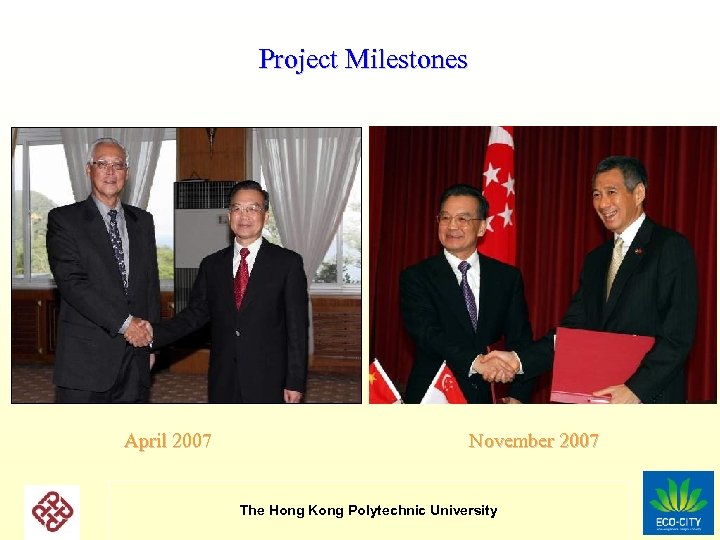
 Introduction • Sino-Singapore Tianjin Eco-city is the 2 nd flagship Government-to-Government project between Singapore and China after Suzhou Industrial Park. • The project was mooted by then Singapore Senior Minister Goh Chok Tong 吴作栋 and Chinese Premier Wen Jiabao in April 2007. • On 18 November 2007, Singapore Prime Minister Lee Hsien Loong 李显龙 and Chinese Premier Wen Jiabao signed a Framework Agreement for Singapore and China to jointly develop Sino-Singapore Tianjin Eco-city. The Hong Kong Polytechnic University 51
 Vision • The Tianjin Eco-city's vision is to be "A thriving city which is socially harmonious, environmentally-friendly and resourceefficient – a model for sustainable development". This vision is underpinned by the concepts of"Three Harmonies" and "Three Abilities". The Hong Kong Polytechnic University 52
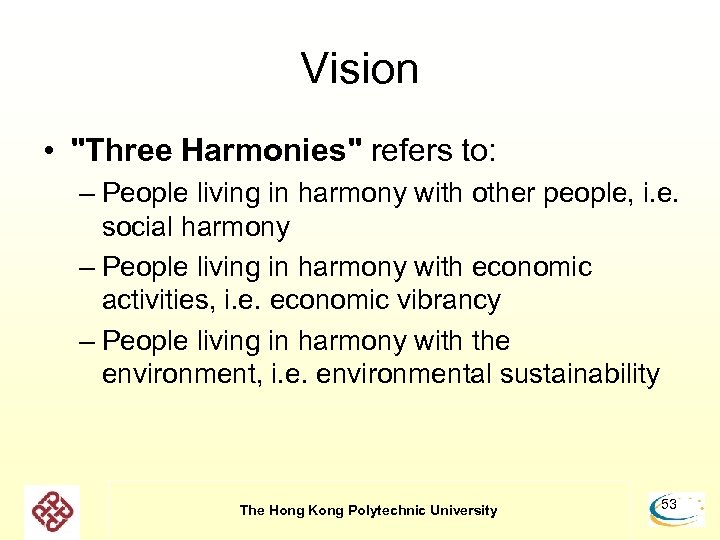 Vision • "Three Harmonies" refers to: – People living in harmony with other people, i. e. social harmony – People living in harmony with economic activities, i. e. economic vibrancy – People living in harmony with the environment, i. e. environmental sustainability The Hong Kong Polytechnic University 53
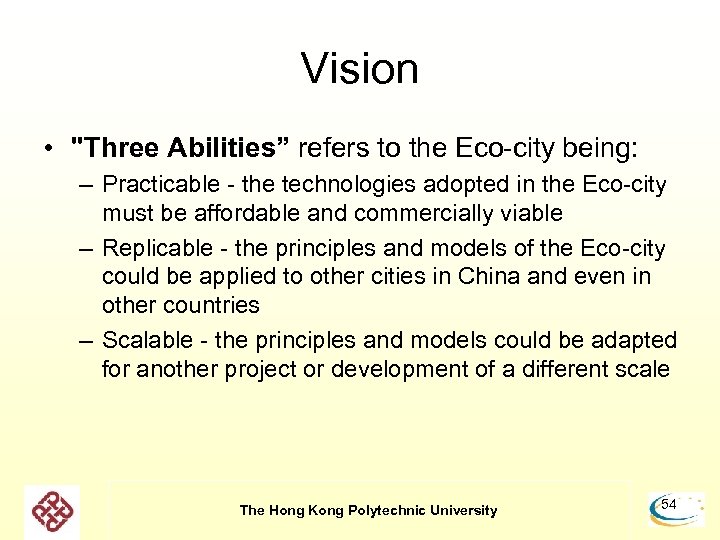 Vision • "Three Abilities” refers to the Eco-city being: – Practicable - the technologies adopted in the Eco-city must be affordable and commercially viable – Replicable - the principles and models of the Eco-city could be applied to other cities in China and even in other countries – Scalable - the principles and models could be adapted for another project or development of a different scale The Hong Kong Polytechnic University 54
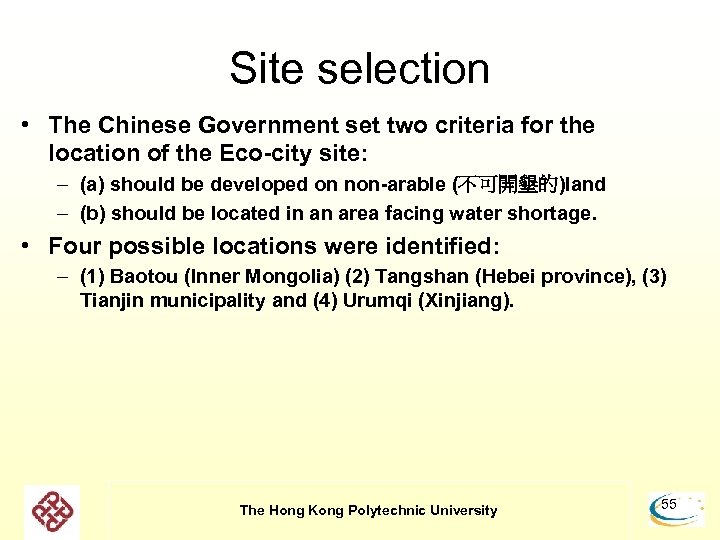 Site selection • The Chinese Government set two criteria for the location of the Eco-city site: – (a) should be developed on non-arable (不可開墾的)land – (b) should be located in an area facing water shortage. • Four possible locations were identified: – (1) Baotou (Inner Mongolia) (2) Tangshan (Hebei province), (3) Tianjin municipality and (4) Urumqi (Xinjiang). The Hong Kong Polytechnic University 55
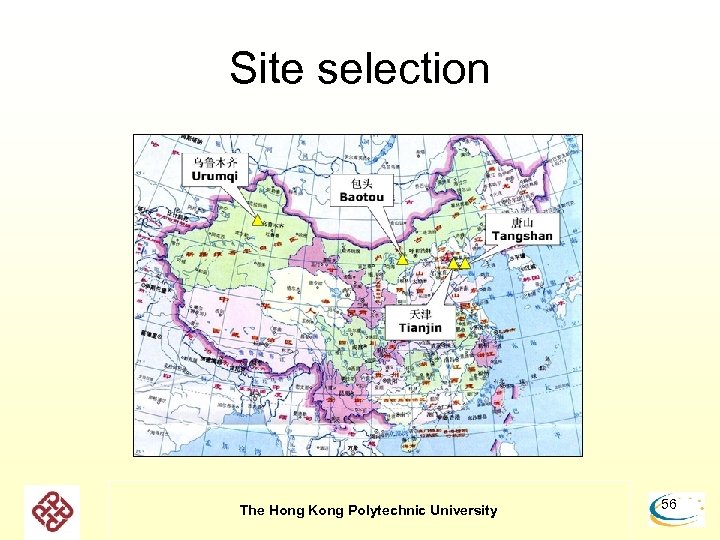 Site selection The Hong Kong Polytechnic University 56
 Location • The Eco-city site is located 40 km from Tianjin city centre and 150 km from Beijing city centre. • It is located within the Tianjin Binhai New Area – one of the fastest growing regions in China. Tianjin Binhai New Area is in turn located in the Bohai Bay region (which covers Beijing, Tianjin and part of Hebei Province), which has been identified as the next growth engine in China, after the Pearl River delta and Yangtze River delta. The Hong Kong Polytechnic University 57
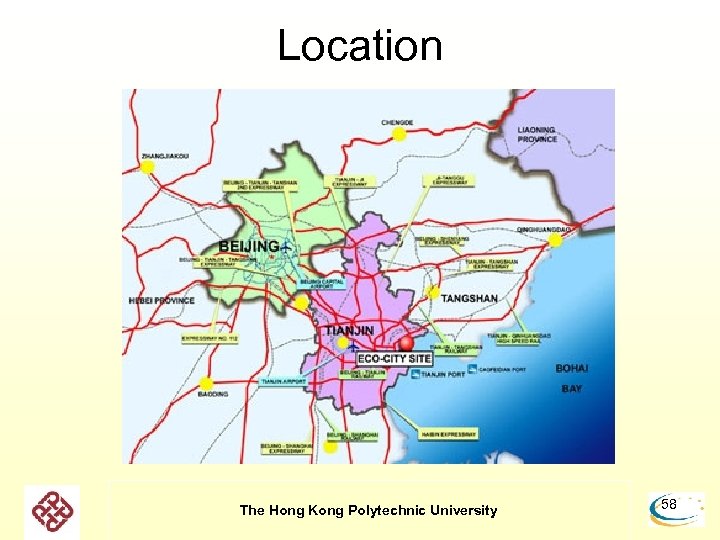 Location The Hong Kong Polytechnic University 58
 Development timeframe Tianjin Eco-city has a total land area of 30 sq. km. When fully completed in around 2020, it will have a population of 350, 000 residents. The start-up area is scheduled for completion by end 2013. Prior to the development of the Eco-city, the site comprised mainly saltpans, barren land polluted water-bodies, including a 2. 6 sq km large wastewater pond. The Hong Kong Polytechnic University 59
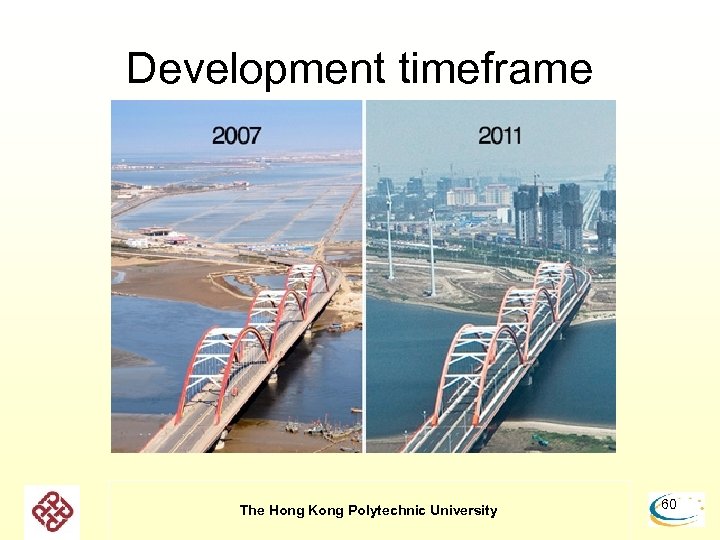 Development timeframe The Hong Kong Polytechnic University 60
 Master Plan • The Tianjin Eco-city's Master Plan spells out the approved uses of its land. The Plan attempts to strike a balance between competing needs, including the social, economic and environmental needs of the Eco-city. It was jointly developed by the China Academy of Urban Planning and Design, the Tianjin Urban Planning and Design Institute, and the Singapore planning team led by the Urban Redevelopment Authority. The Hong Kong Polytechnic University 61
 Master plan • Bohai Rim Region – citius, altius, fortius • Video • https: //www. youtube. com/watch? v=t. Pjq 37 Lhqg The Hong Kong Polytechnic University 62
 Other social issues • Poverty – Lack of access to safe water and sanitation – Lack of facilities for adequate health care – Lack of access to education opportunities – Shortage of adequate nutrition – Lack of adequately paid employment – Inadequate or expensive transport facilities – Limited or expensive power supplies The Hong Kong Polytechnic University 63
 Why poverty alleviation projects failed? • Lack of planning for ongoing operation and maintenance of the facilities • Limited attention to the development of a sense of ownership • Political interference and intervention • Allocation of funds to countries without a poverty alleviation of their own • Corruption, leading to ineffectiveness of investment The Hong Kong Polytechnic University 64
 Conditions necessary for sustainable reduction in poverty levels • The local community must be empowered by the decision making process • Local community must be involved in ongoing operation and maintenance • Government must be involved in the project • Projects should lead to economic growth • Involvement of local community will improve the chances of success The Hong Kong Polytechnic University 65
 Engineering solutions to poverty alleviation • Engineering solution – sustainable • Life-cycle engineering – operational and maintenance cost • Empowered engineering – involve local professional and technical staff • Appropriate engineering – consider various options that meet the engineering needs of the project and may adopt techniques of labour-based construction The Hong Kong Polytechnic University 66
 Case studies • Australian remote aboriginal communities – Water supply, sanitation, health, housing etc • South African roundabout HIV/AIDS initiative – A child’s playgroundabout bolted on top of an existing borehole • BP solar energy project, Philippines – Large scale implementation of solar power across rural communities The Hong Kong Polytechnic University 67
 Water, energy and climate change • Water and energy are linked – Essential to every aspect of life – Water can generate energy • Global energy and water demand are increasing – Demands increase with income • Water use and energy use impact and depend on ecosystems The Hong Kong Polytechnic University 68
 Water, energy and climate change • Climate change will affect availability and use of both water and energy • Technology, innovation, a sense of shared responsibility and political will are factors that bring real solutions as we strive to keep pace with increasing needs from a growing population The Hong Kong Polytechnic University 69
 After-class reading Further reading on engineering projects relating to climatic change, resources depletion, poverty mitigation, etc. are strongly recommended. Please refer to the work of the World Business Council on Sustainable Development on “Water, Energy and Climate change”. The Hong Kong Polytechnic University 70