


 Скачать презентацию SO YOU THINK YOU CAN ARGUE WHAT
So You Think You Can Argue.ppt
- Количество слайдов: 50
 SO YOU THINK YOU CAN ARGUE
 WHAT IS AN ARGUMENT?
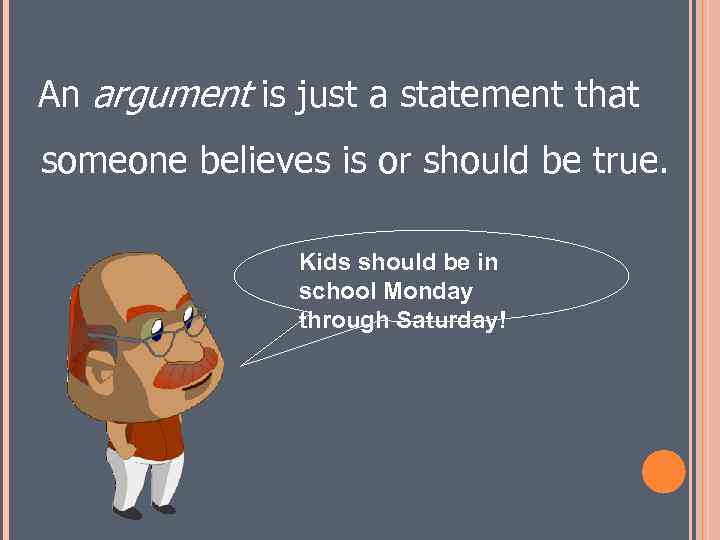 An argument is just a statement that someone believes is or should be true. Kids should be in school Monday through Saturday!
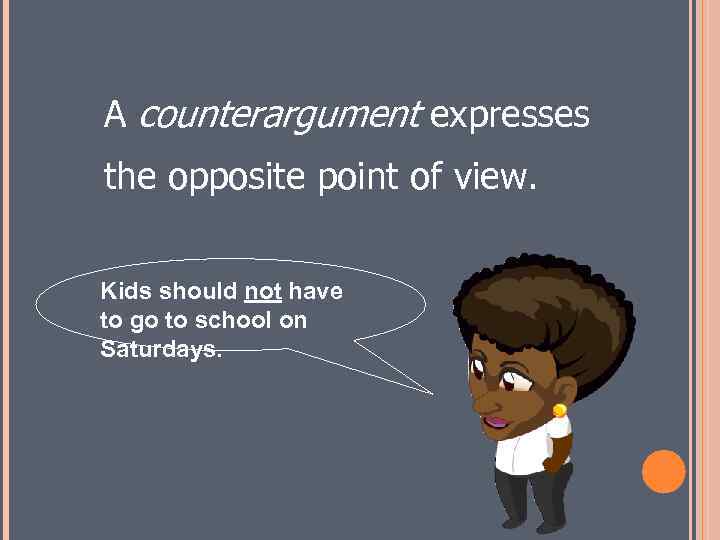 A counterargument expresses the opposite point of view. Kids should not have to go to school on Saturdays.
 “I NEED BACKUP!” A main argument all by itself is not very strong. Supporting arguments explain why the main argument is true.
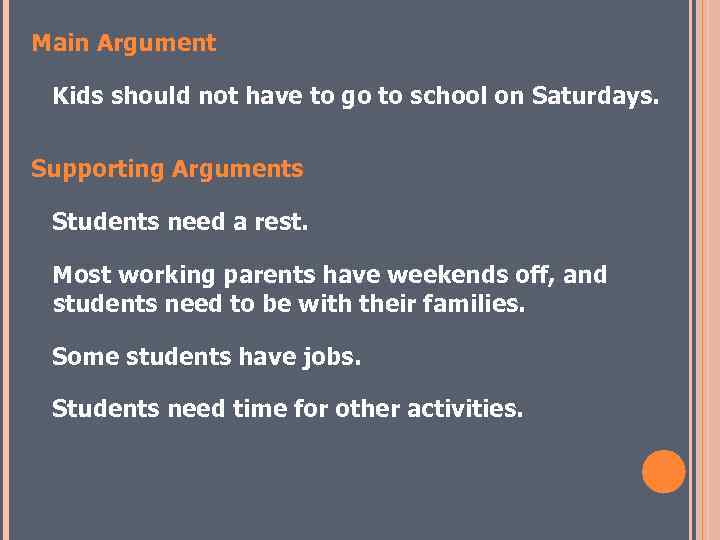 Main Argument Kids should not have to go to school on Saturdays. Supporting Arguments Students need a rest. Most working parents have weekends off, and students need to be with their families. Some students have jobs. Students need time for other activities.
 ARE YOU LABORING UNDER A MISCONCEPTION? ? Common myths about arguing
 COMMON MYTHS ABOUT ARGUING Myth An argument is just people yelling at each other. Reality Arguments can be very calm. An argument in writing is silent!
 COMMON MYTHS ABOUT ARGUING Myth You have to totally believe in what you are arguing. Reality Making an argument has nothing to do with how you feel. (Bet you can think of one reason why school should be on Saturdays…)
 COMMON MYTHS ABOUT ARGUING Myth Every argument has a right and wrong side. Reality Most of the time, the two sides of an argument are just different opinions. Neither side is really right or wrong.
 COMMON MYTHS ABOUT ARGUING Myth You can’t be good at arguing unless you can think fast on your feet. Reality A lot of great arguing takes place on paper, where you can take as much time as you need to think everything through.
 What word do you see inside the word “persuasive”? persuade ______________
 What does it mean to “persuade” someone? (A)To disturb someone about something (B)To sweat on someone (C)To convince someone that something is true (D)To cause someone to be confused about something
 TWO KINDS OF ARGUMENTS
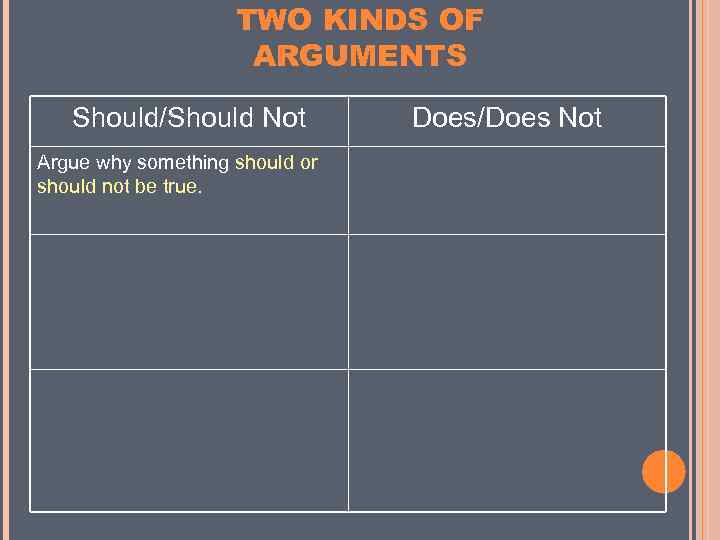 TWO KINDS OF ARGUMENTS Should/Should Not Argue why something should or should not be true. Does/Does Not
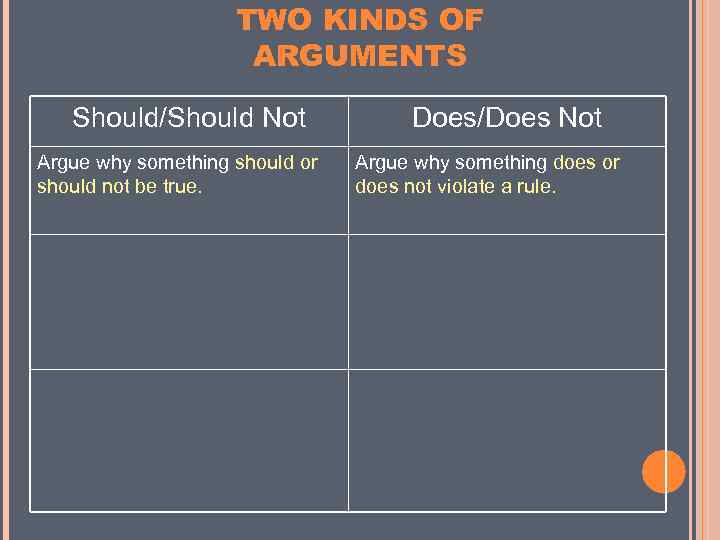 TWO KINDS OF ARGUMENTS Should/Should Not Argue why something should or should not be true. Does/Does Not Argue why something does or does not violate a rule.
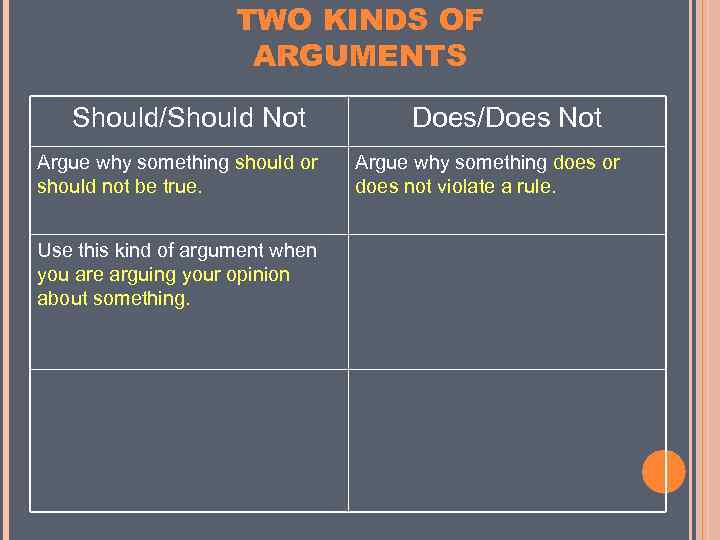 TWO KINDS OF ARGUMENTS Should/Should Not Argue why something should or should not be true. Use this kind of argument when you are arguing your opinion about something. Does/Does Not Argue why something does or does not violate a rule.
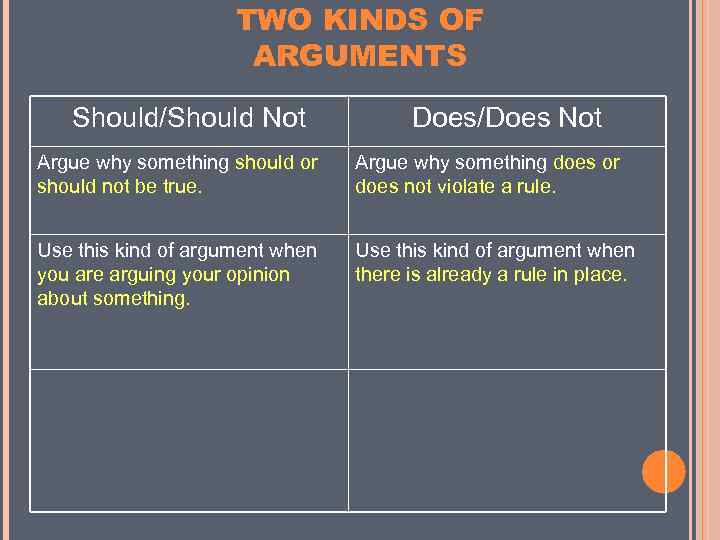 TWO KINDS OF ARGUMENTS Should/Should Not Does/Does Not Argue why something should or should not be true. Argue why something does or does not violate a rule. Use this kind of argument when you are arguing your opinion about something. Use this kind of argument when there is already a rule in place.
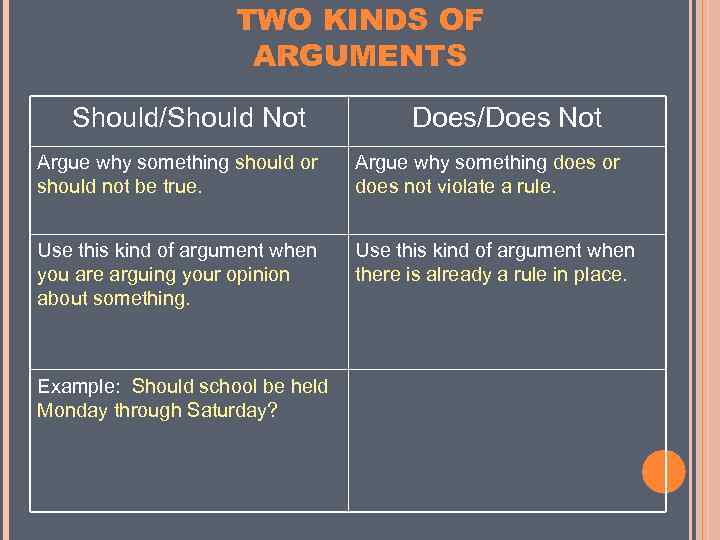 TWO KINDS OF ARGUMENTS Should/Should Not Does/Does Not Argue why something should or should not be true. Argue why something does or does not violate a rule. Use this kind of argument when you are arguing your opinion about something. Use this kind of argument when there is already a rule in place. Example: Should school be held Monday through Saturday?
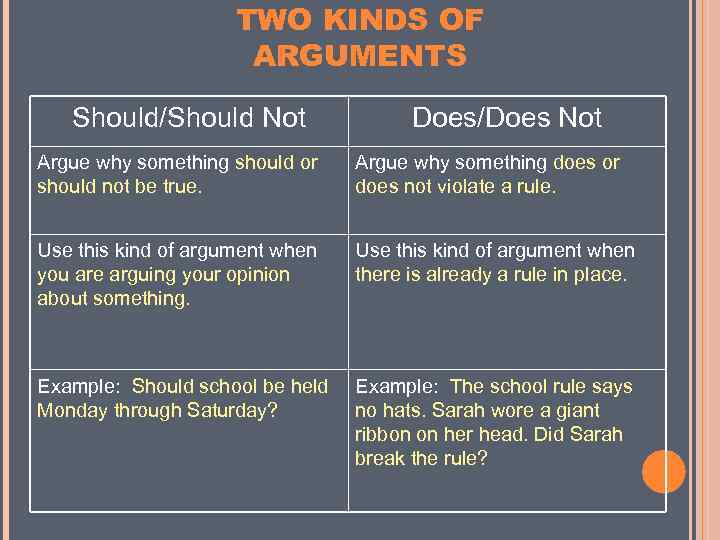 TWO KINDS OF ARGUMENTS Should/Should Not Does/Does Not Argue why something should or should not be true. Argue why something does or does not violate a rule. Use this kind of argument when you are arguing your opinion about something. Use this kind of argument when there is already a rule in place. Example: Should school be held Monday through Saturday? Example: The school rule says no hats. Sarah wore a giant ribbon on her head. Did Sarah break the rule?
 CREATING MAIN “DOES/DOES NOT” ARGUMENTS
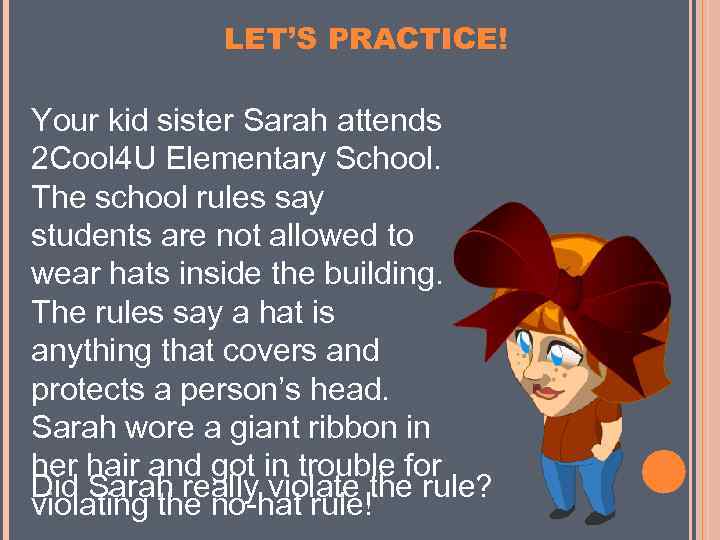 LET’S PRACTICE! Your kid sister Sarah attends 2 Cool 4 U Elementary School. The school rules say students are not allowed to wear hats inside the building. The rules say a hat is anything that covers and protects a person’s head. Sarah wore a giant ribbon in her hair and got in trouble for Did Sarah really violate the rule? violating the no-hat rule!
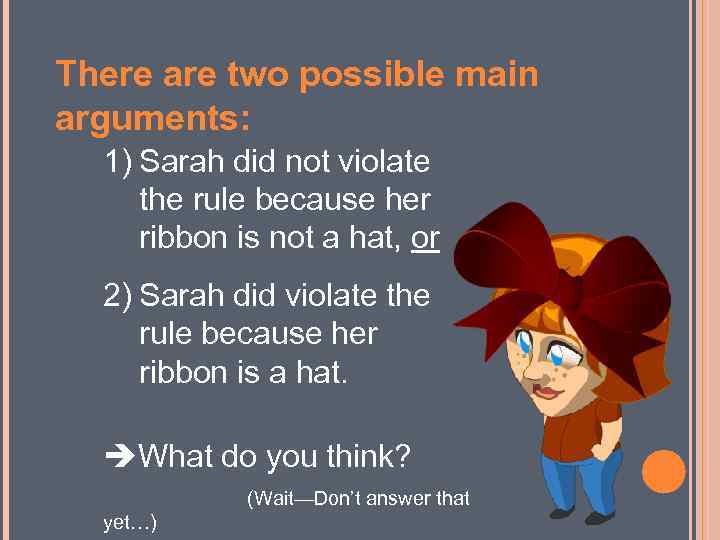 There are two possible main arguments: 1) Sarah did not violate the rule because her ribbon is not a hat, or 2) Sarah did violate the rule because her ribbon is a hat. èWhat do you think? (Wait—Don’t answer that yet…)
 HA! THAT WAS A TRICK QUESTION. Making arguments is a skill that you learn. “What you think” doesn’t really matter at all. You should be able to argue for both sides no matter which side you think is right.
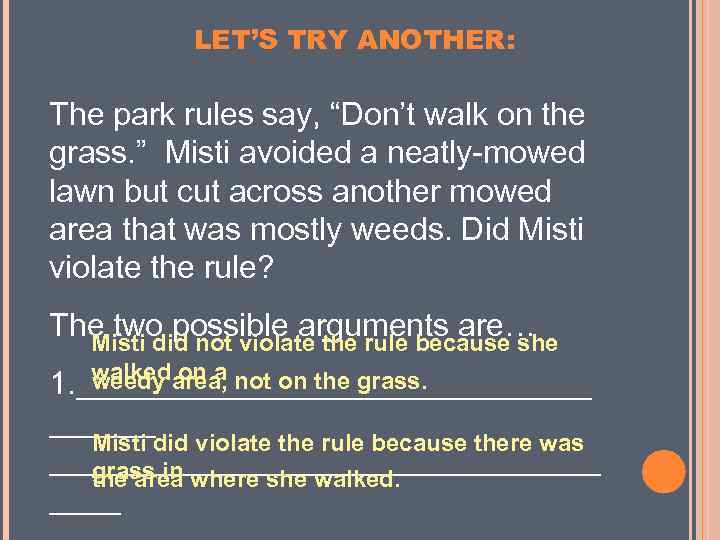 LET’S TRY ANOTHER: The park rules say, “Don’t walk on the grass. ” Misti avoided a neatly-mowed lawn but cut across another mowed area that was mostly weeds. Did Misti violate the rule? The two possible arguments are… Misti did not violate the rule because she walkedarea, not on the grass. weedy on a 1. _______________ Misti did violate the rule because there was ________________ grass in where she walked. the area ____
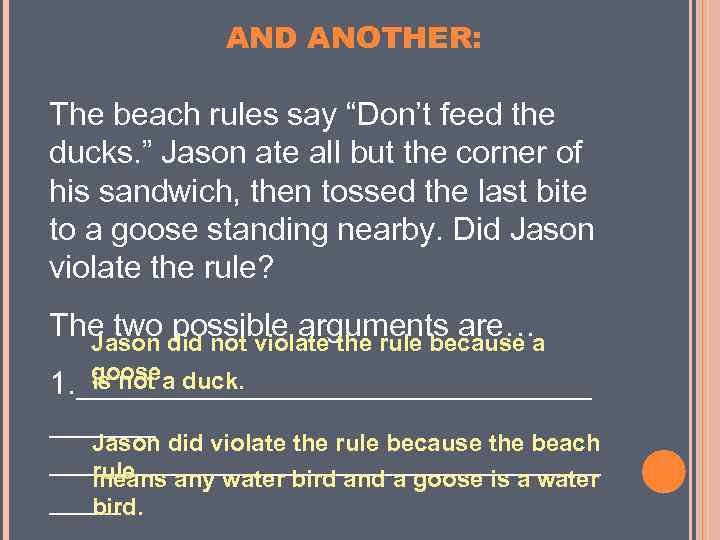 AND ANOTHER: The beach rules say “Don’t feed the ducks. ” Jason ate all but the corner of his sandwich, then tossed the last bite to a goose standing nearby. Did Jason violate the rule? The two did not violate the rule because a possible arguments are… Jason goosea duck. is not 1. _______________ Jason did violate the rule because the beach ________________ rule means any water bird and a goose is a water ____ bird.
 DEVELOPING SUPPORTING ARGUMENTS
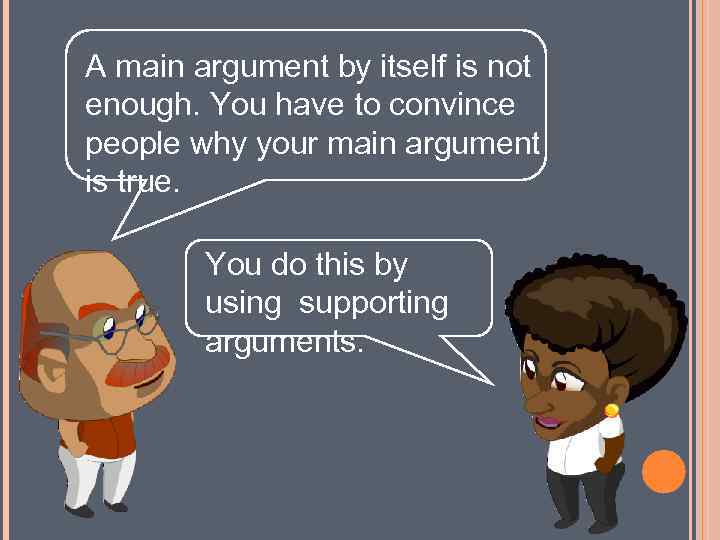 A main argument by itself is not enough. You have to convince people why your main argument is true. You do this by using supporting arguments.
 HAT OR NOT? Next, let’s look at some supporting arguments. You will decide which main argument each supporting argument supports. Ready?
 HAT OR NOT? School Rule: A hat is anything that covers and protects a person’s head. Supporting Argument #1: The ribbon is something on her head. (A) This argument supports the idea that Sarah did not violate the rule because her ribbon is not a hat. (B) This argument supports the idea that Sarah did violate the rule because her ribbon is a hat.
 HAT OR NOT? School Rule: A hat is anything that covers and protects a person’s head. Supporting Argument #2: The ribbon is too flimsy to protect Sarah’s head. argument supports the idea that Sarah (A) Thisnot violate the rule because her ribbon is did not a hat. (B) This argument supports the idea that Sarah did violate the rule because her ribbon is a hat.
 HAT OR NOT? School Rule: A hat is anything that covers and protects a person’s head. Supporting Argument #3: The ribbon does not cover all of Sarah’s head. argument supports the idea that Sarah (A) Thisnot violate the rule because her ribbon is did not a hat. (B) This argument supports the idea that Sarah did violate the rule because her ribbon is a hat.
 HAT OR NOT? School Rule: A hat is anything that covers and protects a person’s head. Supporting Argument #4: The ribbon could protect her head from rain or dust. (A) This argument supports the idea that Sarah did not violate the rule because her ribbon is not a hat. (B) This argument supports the idea that Sarah did violate the rule because her ribbon is a hat.
 HAT OR NOT? School Rule: A hat is anything that covers and protects a person’s head. Supporting Argument #5: The ribbon would not keep Sarah’s head warm. argument supports the idea that Sarah (A) Thisnot violate the rule because her ribbon is did not a hat. (B) This argument supports the idea that Sarah did violate the rule because her ribbon is a hat.
 HAT OR NOT? School Rule: A hat is anything that covers and protects a person’s head. Supporting Argument #6: The ribbon covers most of Sarah’s head. (A) This argument supports the idea that Sarah did not violate the rule because her ribbon is not a hat. (B) This argument supports the idea that Sarah did violate the rule because her ribbon is a hat.
 HAT OR NOT? School Rule: A hat is anything that covers and protects a person’s head. Supporting Argument #7: The ribbon could protect Sarah’s head from sunlight. (A) This argument supports the idea that Sarah did not violate the rule because her ribbon is not a hat. (B) This argument supports the idea that Sarah did violate the rule because her ribbon is a hat.
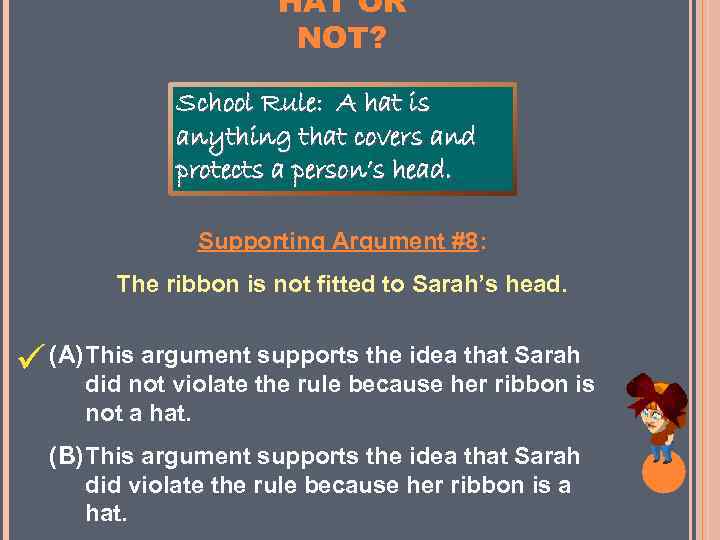 HAT OR NOT? School Rule: A hat is anything that covers and protects a person’s head. Supporting Argument #8: The ribbon is not fitted to Sarah’s head. argument supports the idea that Sarah (A) Thisnot violate the rule because her ribbon is did not a hat. (B) This argument supports the idea that Sarah did violate the rule because her ribbon is a hat.
 IF YOU’VE SEEN ONE ARGUMENT. . .
 … you have not seen them all! Some arguments are better than others. Look at the four arguments below. Which one do you think is the strongest? Weakest? The ribbon is too flimsy to protect Sarah’s head from anything. The ribbon does not cover all of Sarah’s head. The ribbon would not keep Sarah’s head warm. The ribbon is not fitted to Sarah’s head.
 MINI-QUIZ!
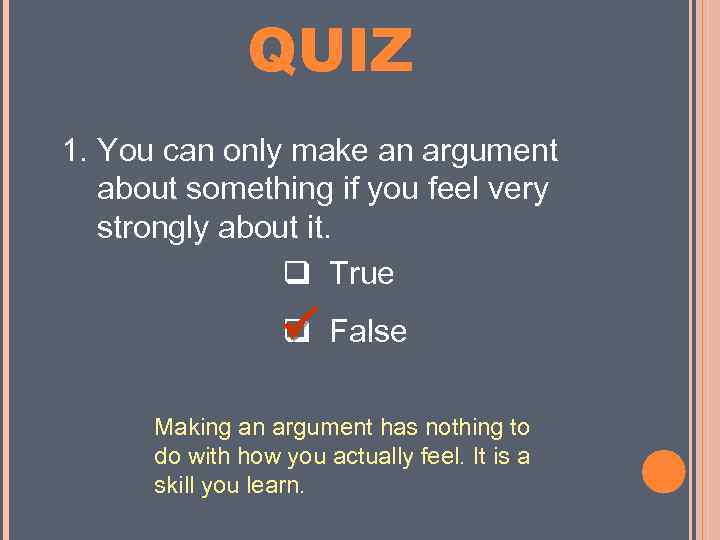 MINI QUIZ 1. You can only make an argument about something if you feel very strongly about it. True False Making an argument has nothing to do with how you actually feel. It is a skill you learn.
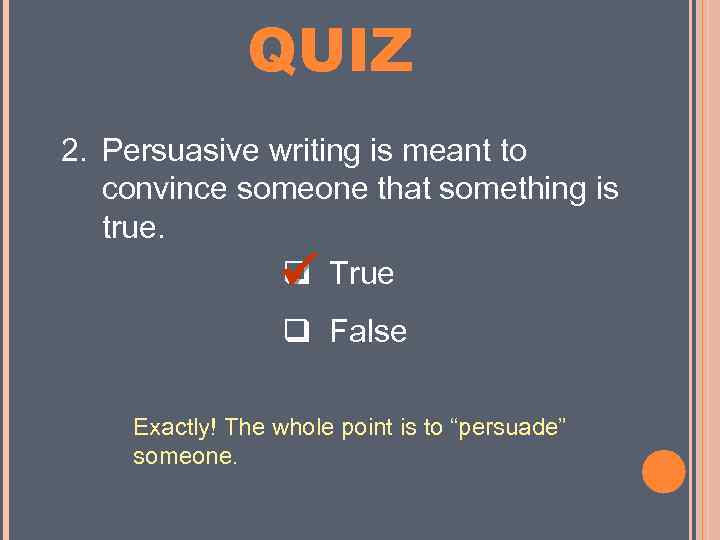 MINI QUIZ 2. Persuasive writing is meant to convince someone that something is true. True False Exactly! The whole point is to “persuade” someone.
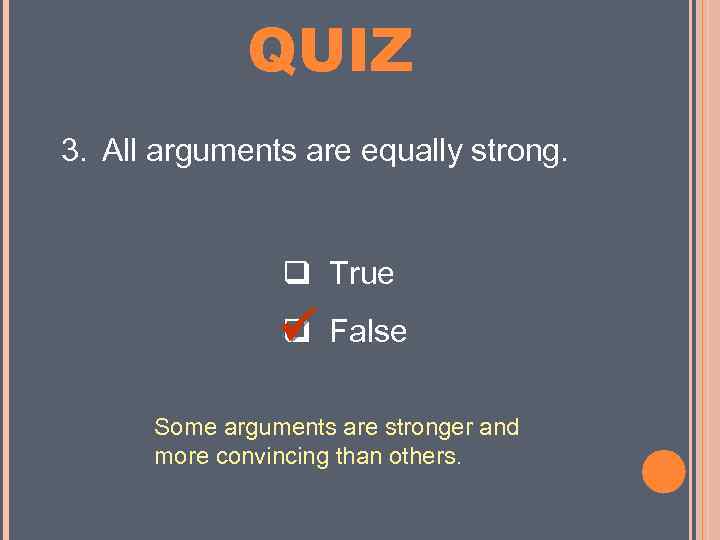 MINI QUIZ 3. All arguments are equally strong. True False Some arguments are stronger and more convincing than others.
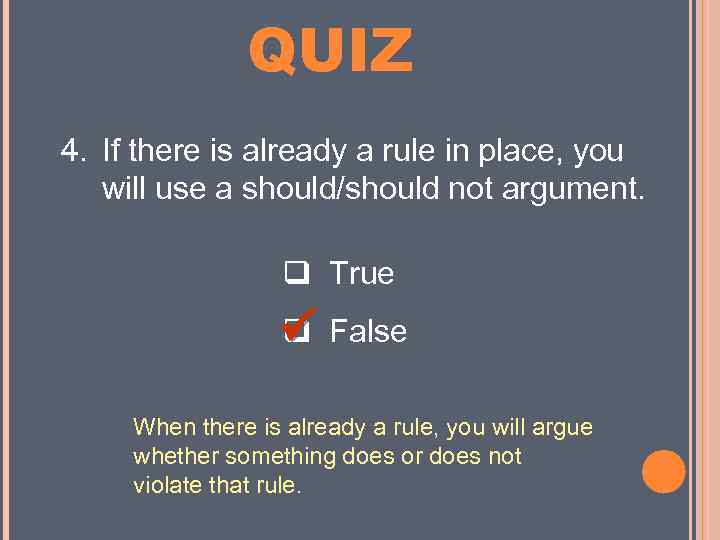 MINI QUIZ 4. If there is already a rule in place, you will use a should/should not argument. True False When there is already a rule, you will argue whether something does or does not violate that rule.
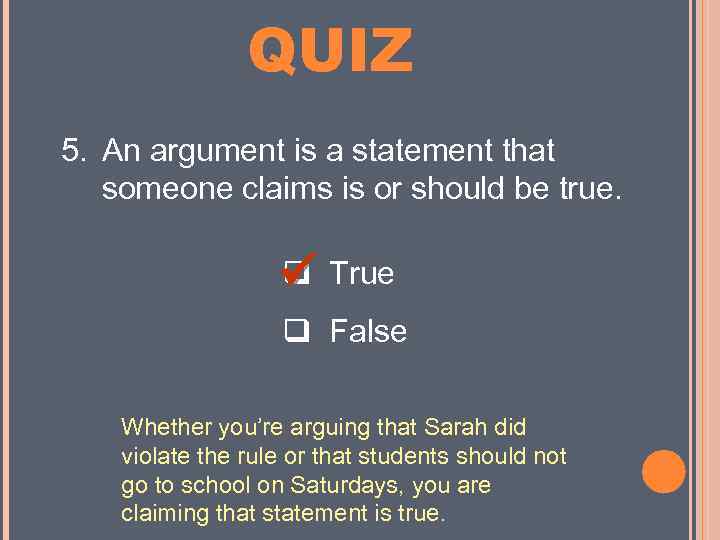 MINI QUIZ 5. An argument is a statement that someone claims is or should be true. True False Whether you’re arguing that Sarah did violate the rule or that students should not go to school on Saturdays, you are claiming that statement is true.
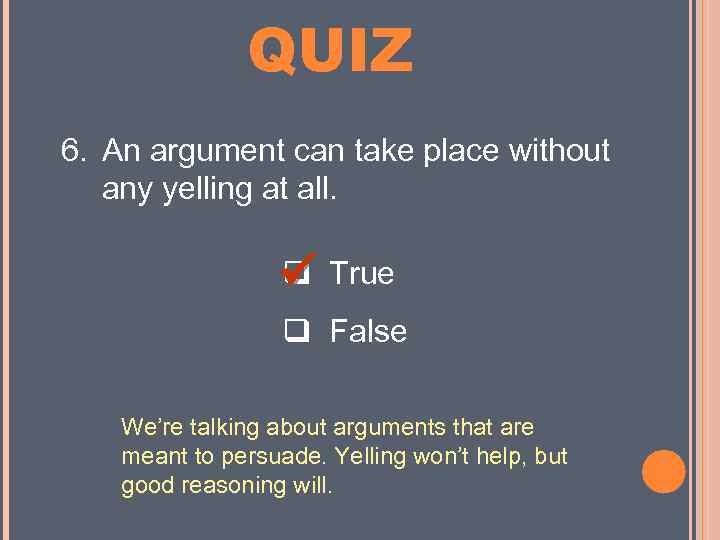 MINI QUIZ 6. An argument can take place without any yelling at all. True False We’re talking about arguments that are meant to persuade. Yelling won’t help, but good reasoning will.
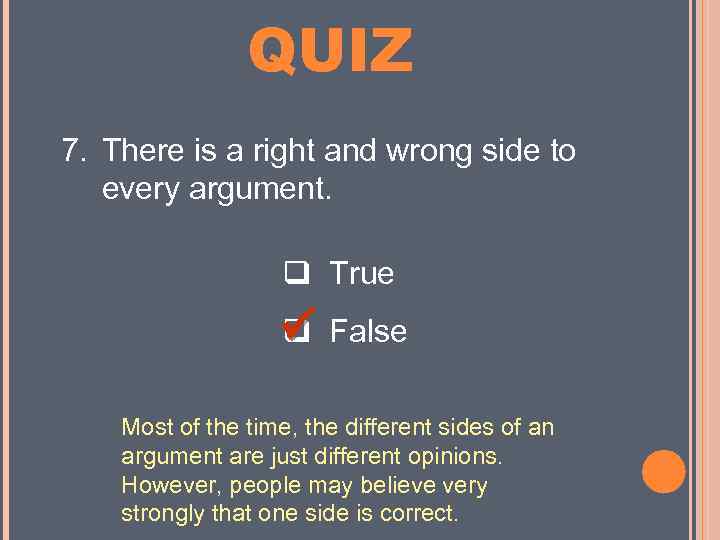 MINI QUIZ 7. There is a right and wrong side to every argument. True False Most of the time, the different sides of an argument are just different opinions. However, people may believe very strongly that one side is correct.
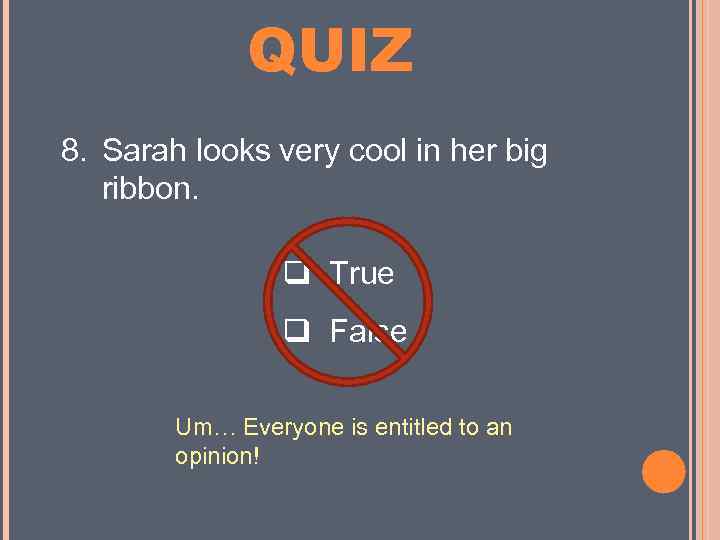 MINI QUIZ 8. Sarah looks very cool in her big ribbon. True False Um… Everyone is entitled to an opinion!
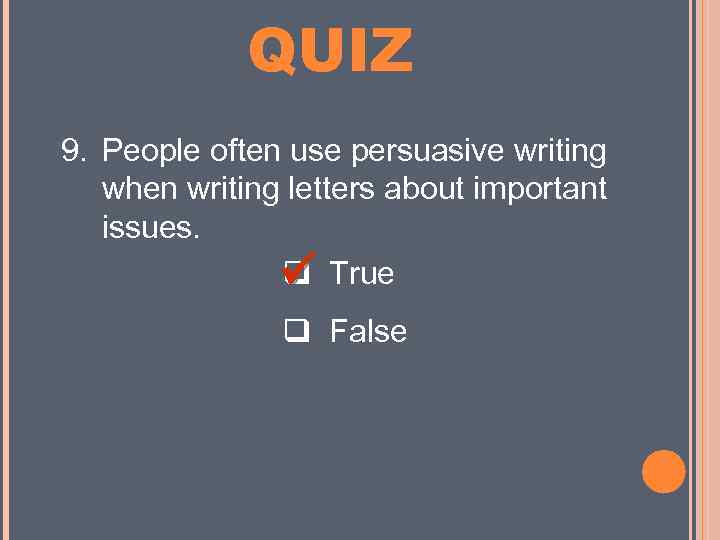 MINI QUIZ 9. People often use persuasive writing when writing letters about important issues. True False
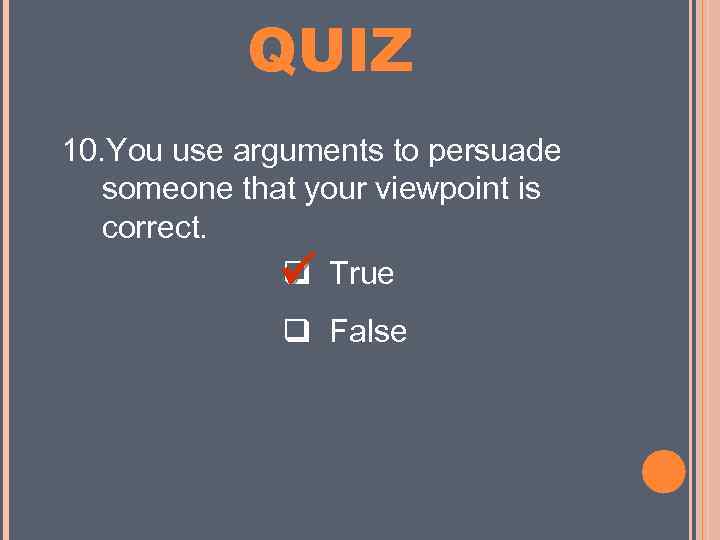 MINI QUIZ 10. You use arguments to persuade someone that your viewpoint is correct. True False