


 Скачать презентацию So the civil war is over NOW
9b196c404ccb3cb39bd763114ee6381c.ppt
- Количество слайдов: 36
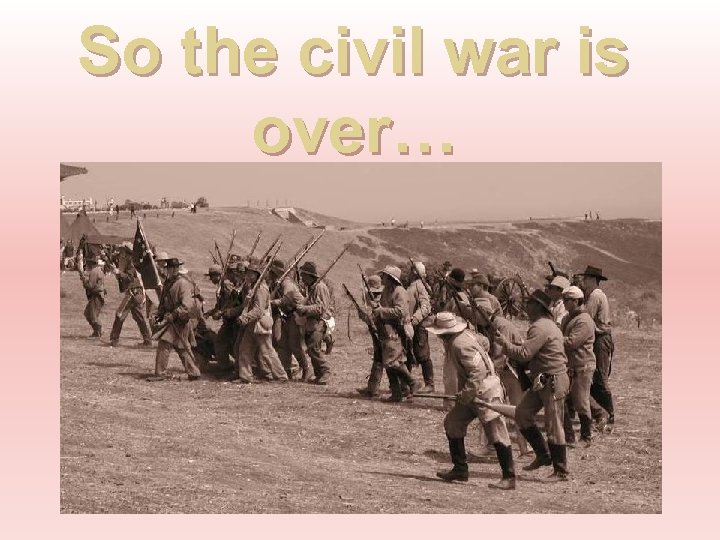 So the civil war is over…
 NOW WHAT? ? ?
 Reconstruction After The Civil War 1865 - 1877
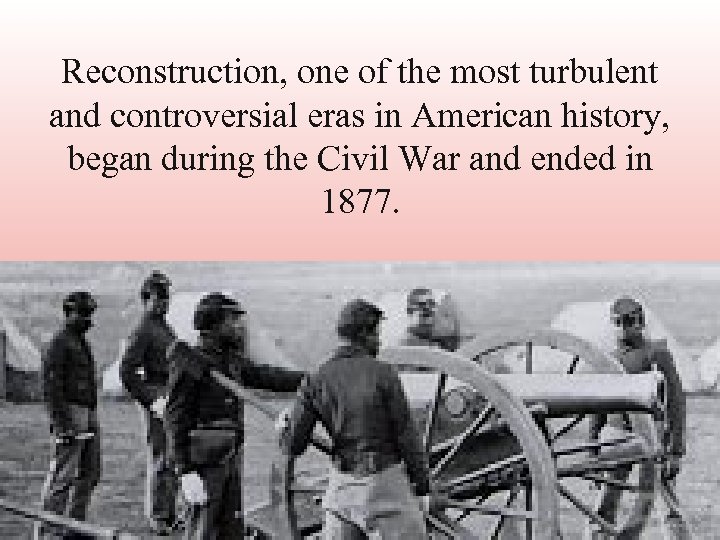 Reconstruction, one of the most turbulent and controversial eras in American history, began during the Civil War and ended in 1877.
 Just as the fate of slavery was central to the meaning of the Civil War, the divisive politics of Reconstruction altered the status the former slaves … in the reunited nation.
 The national debate over Reconstruction centered on three questions: 1. On what terms should the defeated Confederacy be reunited with the Union? 2. Who should establish these terms, Congress or the President? 3. What should be the place of the former slaves in the political life of the South?
 Lincoln’s Got a Plan! • A state could be readmitted when the number of men who had taken a loyalty oath to the Union equaled one tenth of the number of voters in the 1860 presidential election (“ten percent plan”)
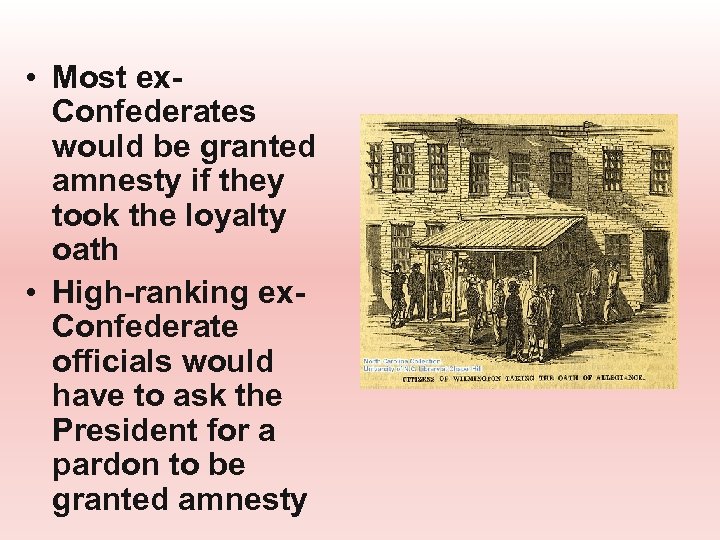 • Most ex. Confederates would be granted amnesty if they took the loyalty oath • High-ranking ex. Confederate officials would have to ask the President for a pardon to be granted amnesty
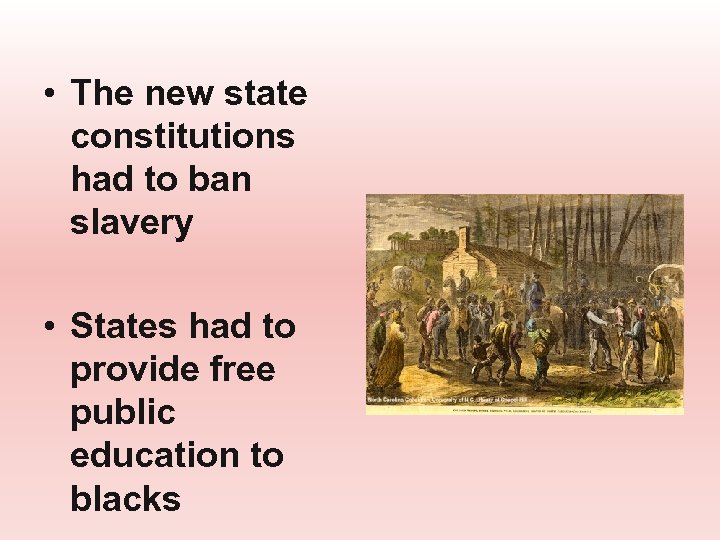 • The new state constitutions had to ban slavery • States had to provide free public education to blacks
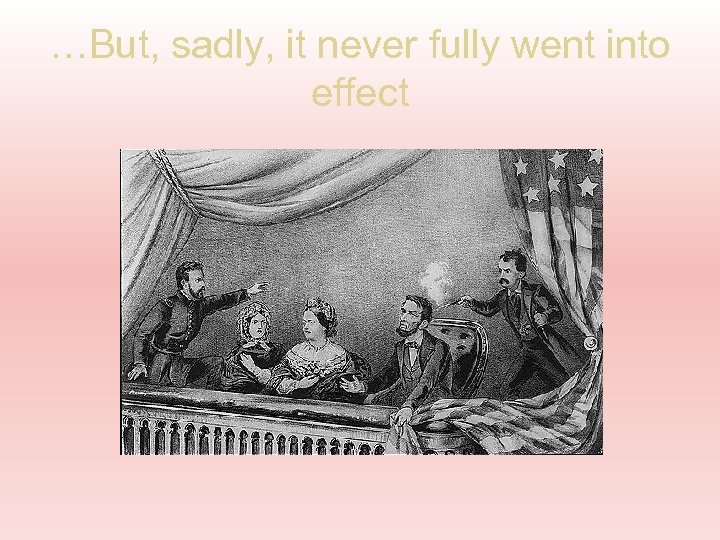 …But, sadly, it never fully went into effect
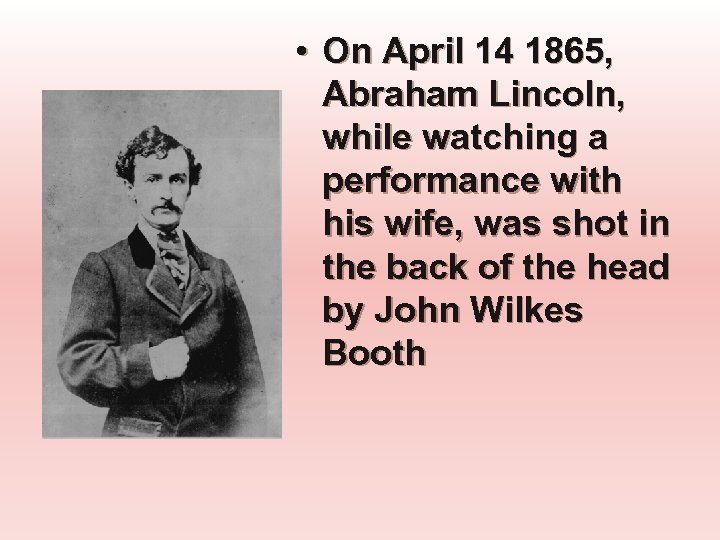 • On April 14 1865, Abraham Lincoln, while watching a performance with his wife, was shot in the back of the head by John Wilkes Booth
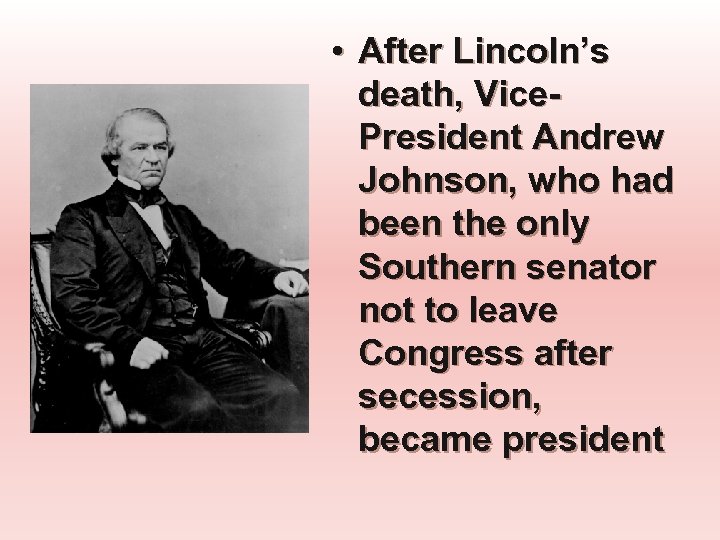 • After Lincoln’s death, Vice. President Andrew Johnson, who had been the only Southern senator not to leave Congress after secession, became president
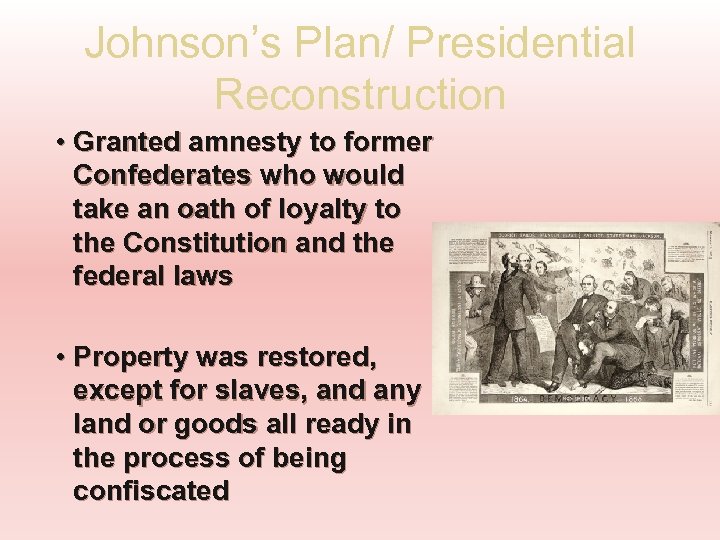 Johnson’s Plan/ Presidential Reconstruction • Granted amnesty to former Confederates who would take an oath of loyalty to the Constitution and the federal laws • Property was restored, except for slaves, and any land or goods all ready in the process of being confiscated
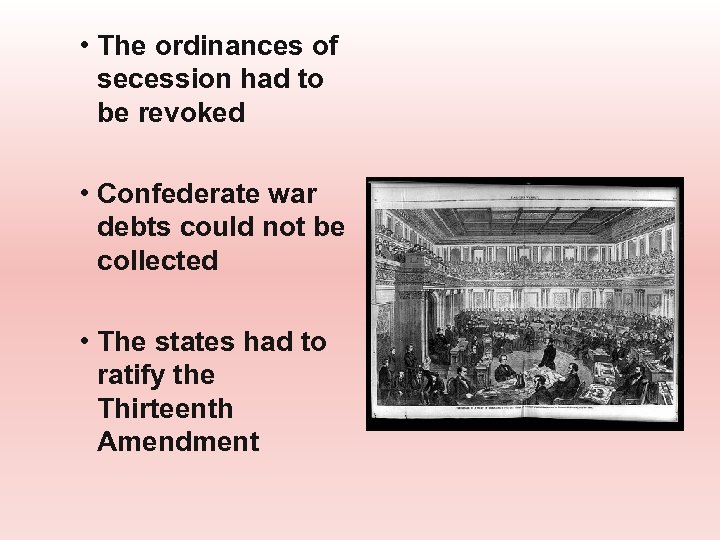 • The ordinances of secession had to be revoked • Confederate war debts could not be collected • The states had to ratify the Thirteenth Amendment
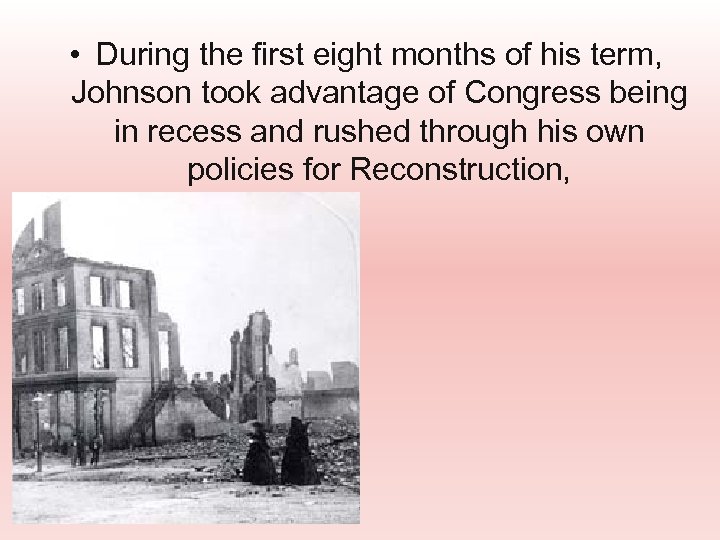 • During the first eight months of his term, Johnson took advantage of Congress being in recess and rushed through his own policies for Reconstruction,
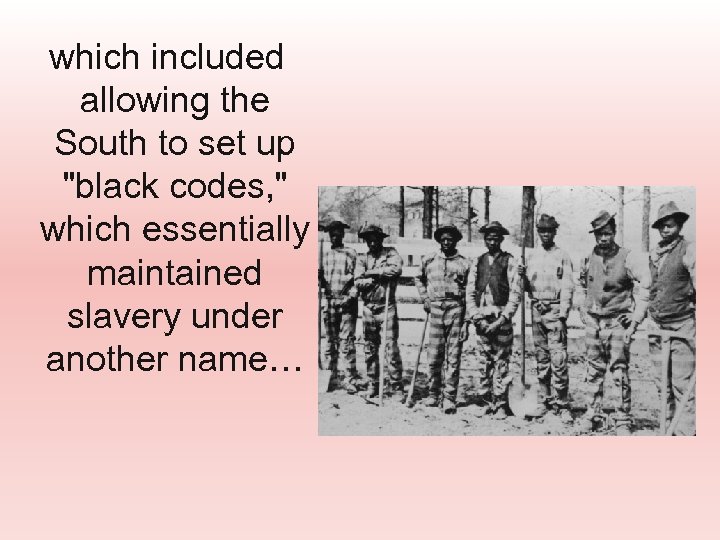 which included allowing the South to set up "black codes, " which essentially maintained slavery under another name…
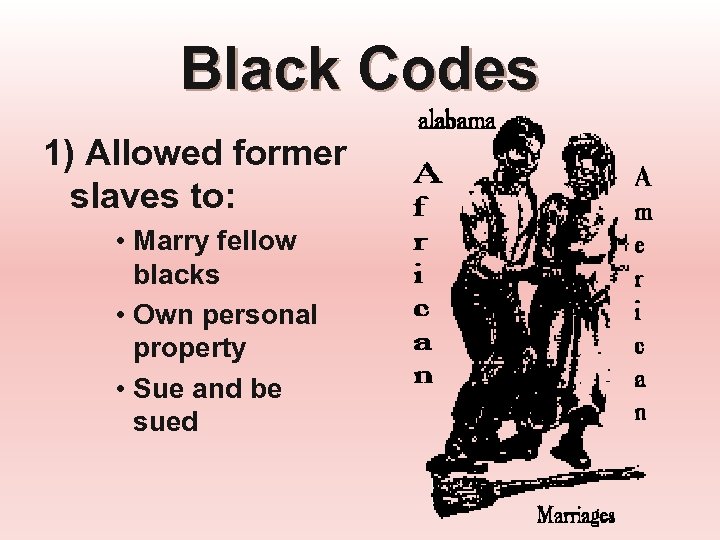 Black Codes 1) Allowed former slaves to: • Marry fellow blacks • Own personal property • Sue and be sued
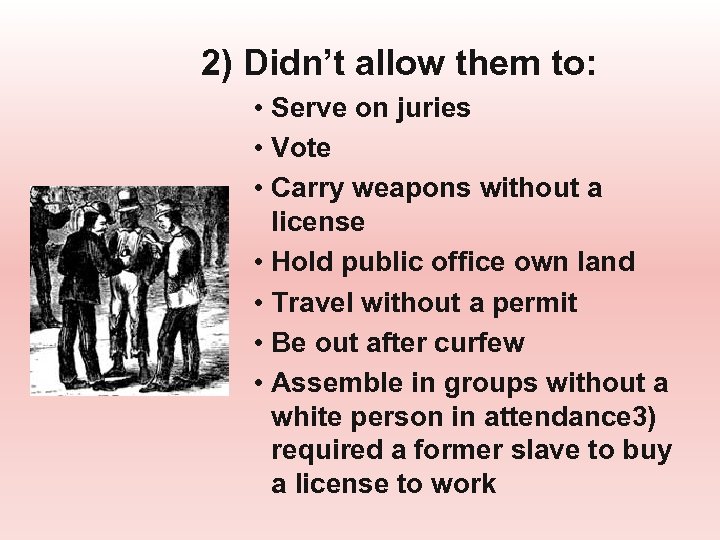 2) Didn’t allow them to: • Serve on juries • Vote • Carry weapons without a license • Hold public office own land • Travel without a permit • Be out after curfew • Assemble in groups without a white person in attendance 3) required a former slave to buy a license to work
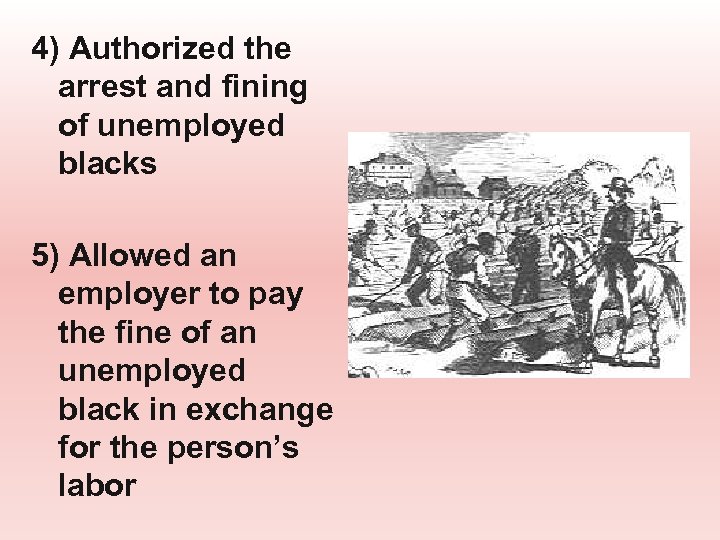 4) Authorized the arrest and fining of unemployed blacks 5) Allowed an employer to pay the fine of an unemployed black in exchange for the person’s labor
 Many Northerners became convinced that Johnson's policy, and the actions of the governments he established, threatened to reduce African Americans to a condition similar to slavery, while allowing former "rebels" to regain political power in the South.
 As a result, Congress overturned Johnson's program. Between 1866 and 1869, Congress enacted new laws and the Fourteenth and Fifteenth Amendments to the Constitution, guaranteeing blacks' civil rights and giving black men the right to vote.
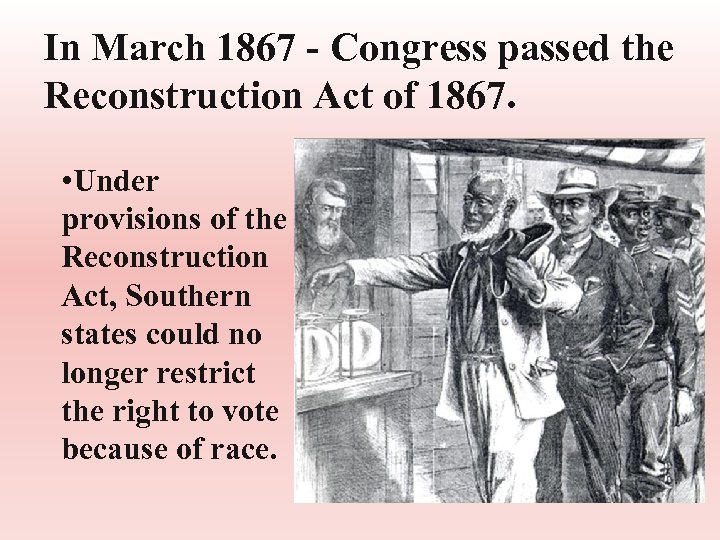 In March 1867 - Congress passed the Reconstruction Act of 1867. • Under provisions of the Reconstruction Act, Southern states could no longer restrict the right to vote because of race.
 • It also stated that the states of the former Confederacy would only be readmitted to Congress after they ratified the 14 th Amendment. • This led directly to the creation of new governments in the South elected by blacks as well as whites.
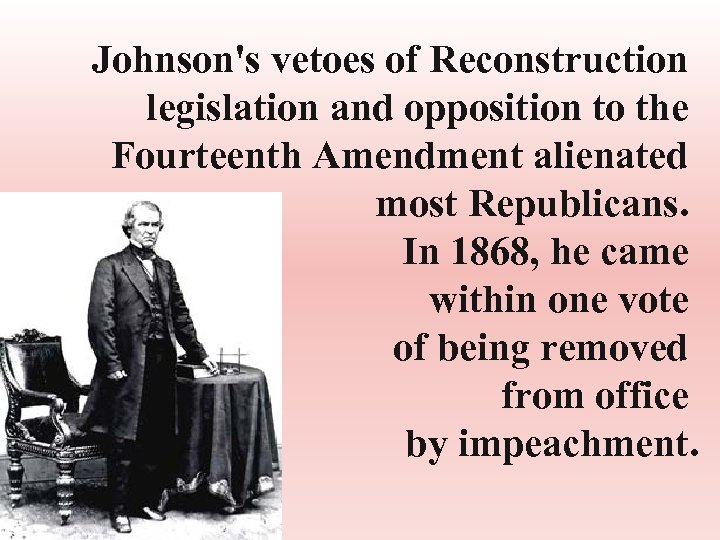 Johnson's vetoes of Reconstruction legislation and opposition to the Fourteenth Amendment alienated most Republicans. In 1868, he came within one vote of being removed from office by impeachment.
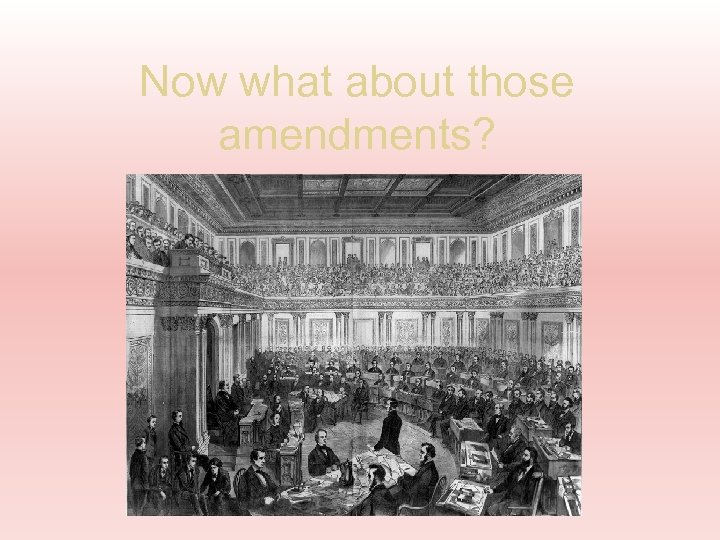 Now what about those amendments?
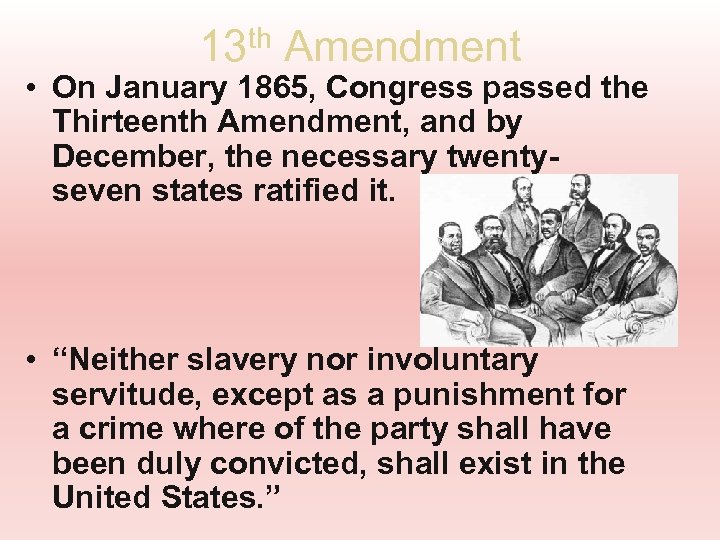 13 th Amendment • On January 1865, Congress passed the Thirteenth Amendment, and by December, the necessary twentyseven states ratified it. • “Neither slavery nor involuntary servitude, except as a punishment for a crime where of the party shall have been duly convicted, shall exist in the United States. ”
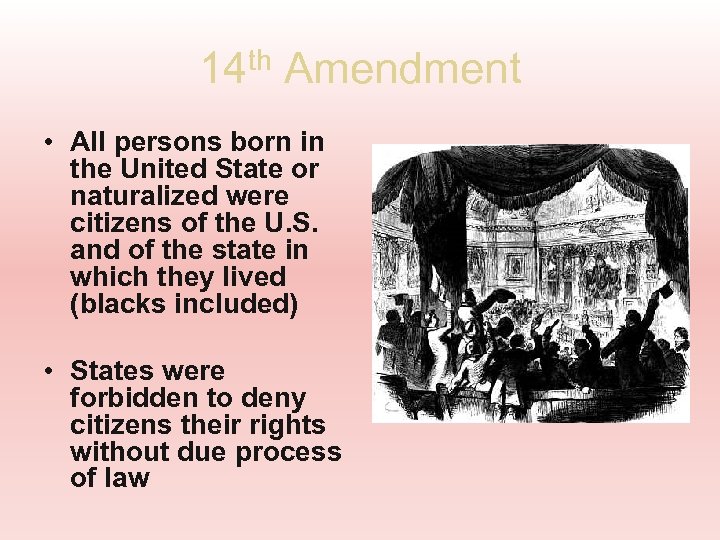 14 th Amendment • All persons born in the United State or naturalized were citizens of the U. S. and of the state in which they lived (blacks included) • States were forbidden to deny citizens their rights without due process of law
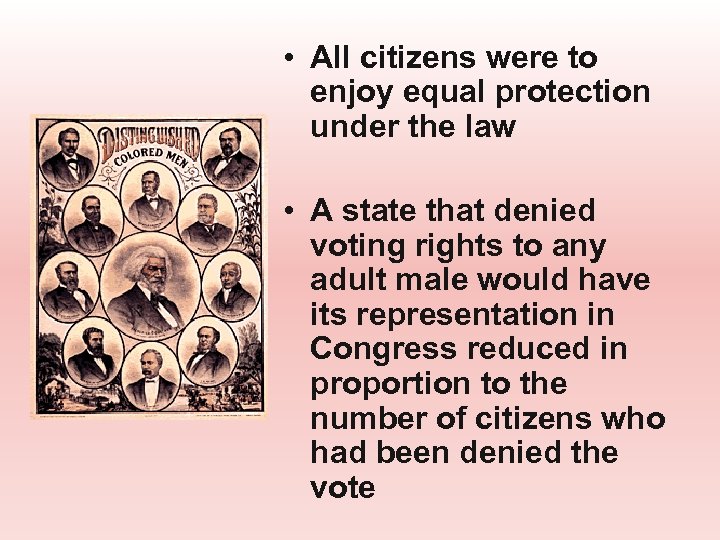 • All citizens were to enjoy equal protection under the law • A state that denied voting rights to any adult male would have its representation in Congress reduced in proportion to the number of citizens who had been denied the vote
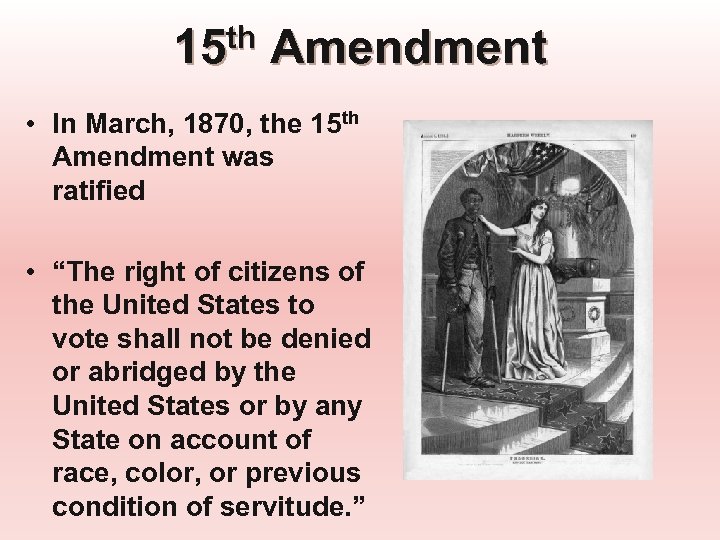 15 th Amendment • In March, 1870, the 15 th Amendment was ratified • “The right of citizens of the United States to vote shall not be denied or abridged by the United States or by any State on account of race, color, or previous condition of servitude. ”
 Free th Citizens 14 th 13 can th 15 Vote
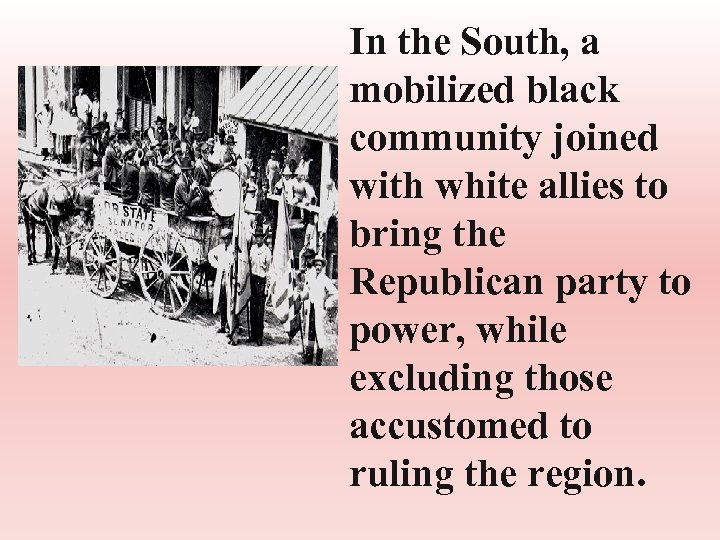 In the South, a mobilized black community joined with white allies to bring the Republican party to power, while excluding those accustomed to ruling the region.
 • The Reconstruction Act of 1867 also stipulated that former Confederate states hold conventions to draft new constitutions that granted former slaves the rights of citizenship. - Almost 300 African Americans, or 25 per cent of the total delegates, attended these conventions held in Southern states in 1868 -69…
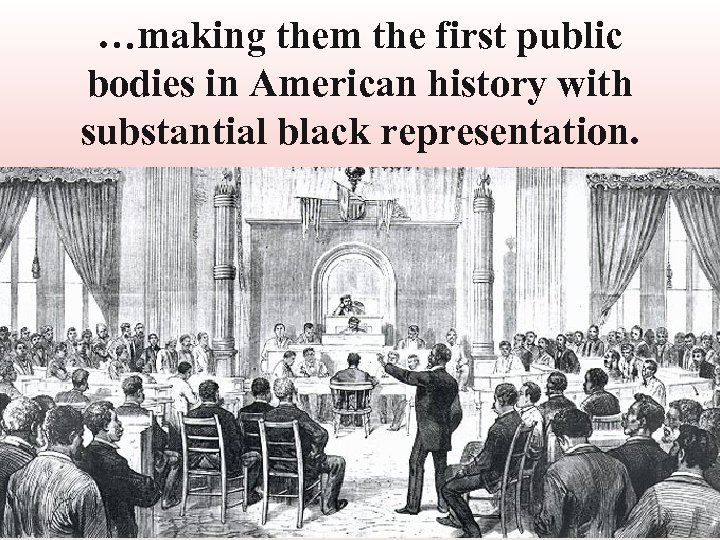 …making them the first public bodies in American history with substantial black representation.
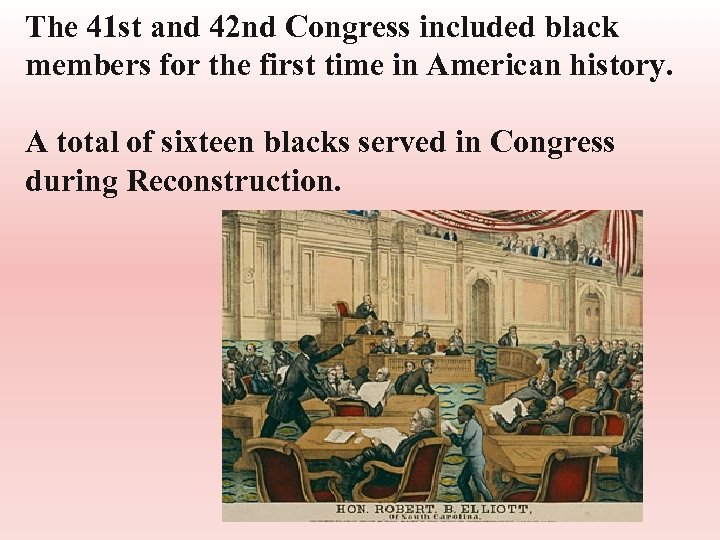 The 41 st and 42 nd Congress included black members for the first time in American history. A total of sixteen blacks served in Congress during Reconstruction.
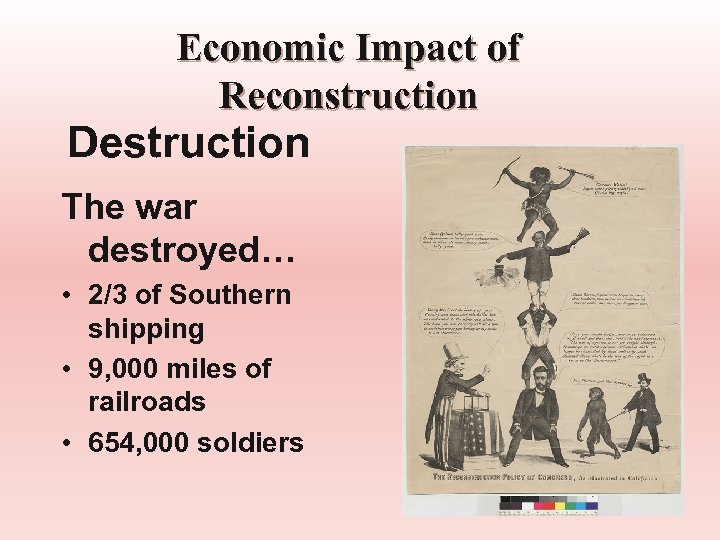 Economic Impact of Reconstruction Destruction The war destroyed… • 2/3 of Southern shipping • 9, 000 miles of railroads • 654, 000 soldiers
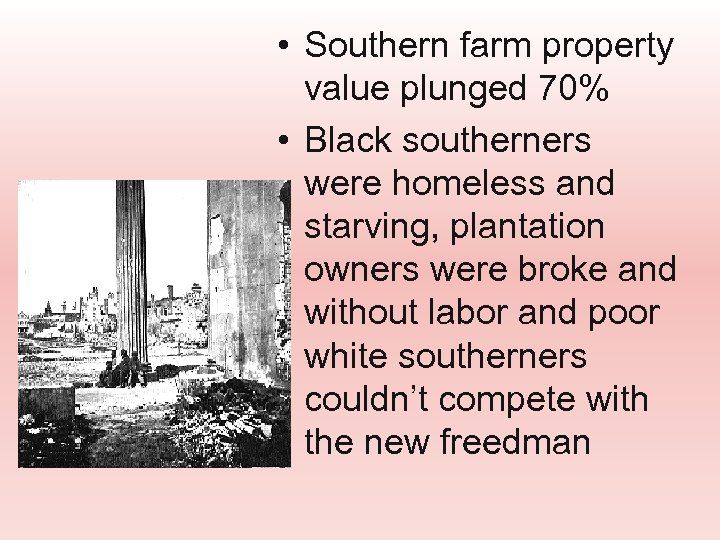 • Southern farm property value plunged 70% • Black southerners were homeless and starving, plantation owners were broke and without labor and poor white southerners couldn’t compete with the new freedman