


 Скачать презентацию SNST-USTC Status of design and strategy for CFETR
24c8c88e2eb7676b9f5f80f54b6ad09e.ppt
- Количество слайдов: 58
 SNST-USTC Status of design and strategy for CFETR Minyou Ye and CFETR Design Group School of Nuclear Science and Technology, USTC P. R. China Email: yemy@ustc. edu. cn, myye@ipp. ac. cn 26 -28 March 2013 Kyoto Japan
 SNST-USTC Content Introduction background opinion and consideration Progress on the concept design of CFETR Summary
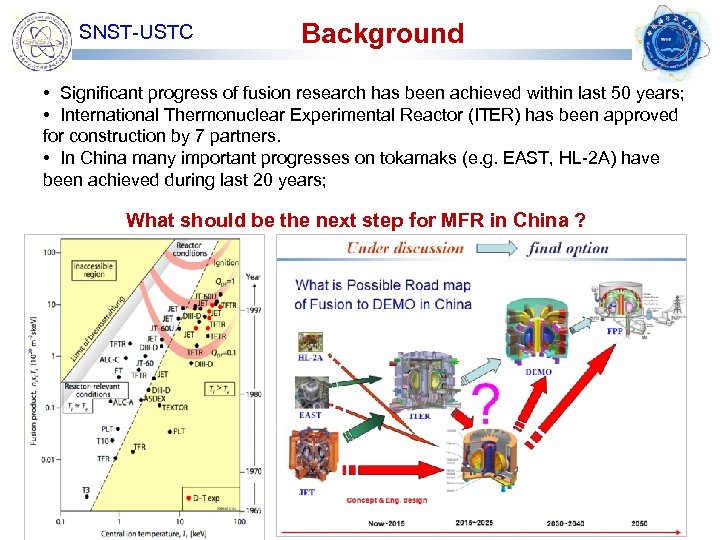 SNST-USTC Background • Significant progress of fusion research has been achieved within last 50 years; • International Thermonuclear Experimental Reactor (ITER) has been approved for construction by 7 partners. • In China many important progresses on tokamaks (e. g. EAST, HL-2 A) have been achieved during last 20 years; What should be the next step for MFR in China ?
 SNST-USTC • Background China is facing serious energy problem (energy shortage and environment pollution). Which will be even more serious in the near future; • Chinese government made the decision to join in ITER. The purpose is to promote the development of the fusion energy for ultimate use as early as possible; • Therefore the National Integration Design group for Magnetic Confinement Fusion Reactor has been founded in 2011 • The design activities of the Chinese Fusion Engineering Test Reactor (CFETR) as the next step are under way by the group.
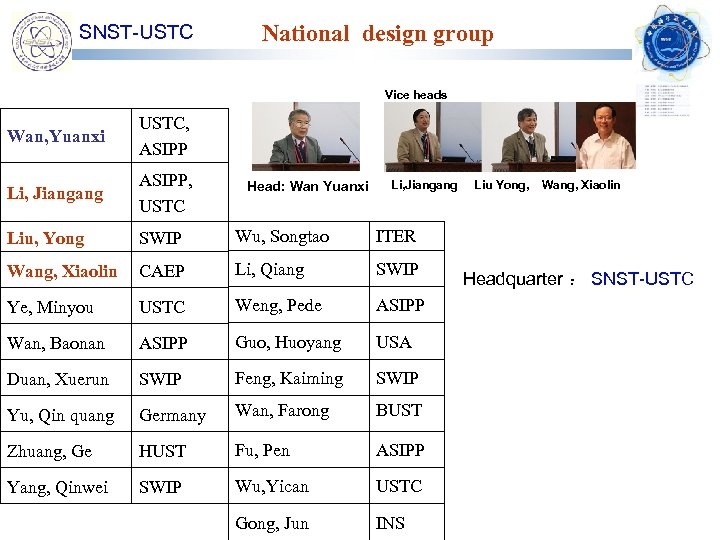 SNST-USTC National design group Vice heads Wan, Yuanxi USTC, ASIPP Li, Jiangang ASIPP, USTC Liu, Yong SWIP Wu, Songtao ITER Wang, Xiaolin CAEP Li, Qiang SWIP Ye, Minyou USTC Weng, Pede ASIPP Wan, Baonan ASIPP Guo, Huoyang USA Duan, Xuerun SWIP Feng, Kaiming SWIP Yu, Qin quang Germany Wan, Farong BUST Zhuang, Ge HUST Fu, Pen ASIPP Yang, Qinwei SWIP Wu, Yican USTC Gong, Jun INS Head: Wan Yuanxi Li, Jiangang Liu Yong, Wang, Xiaolin Headquarter : SNST-USTC
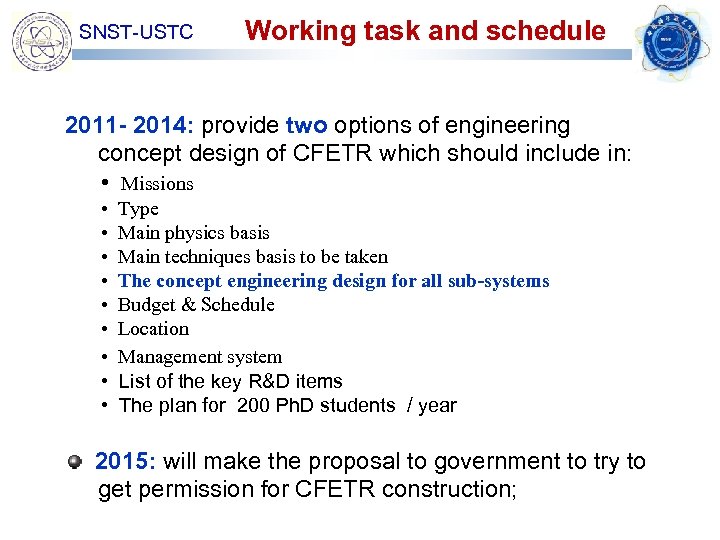 SNST-USTC Working task and schedule 2011 - 2014: provide two options of engineering concept design of CFETR which should include in: • Missions • • • Type Main physics basis Main techniques basis to be taken The concept engineering design for all sub-systems Budget & Schedule Location Management system List of the key R&D items The plan for 200 Ph. D students / year 2015: will make the proposal to government to try to get permission for CFETR construction;
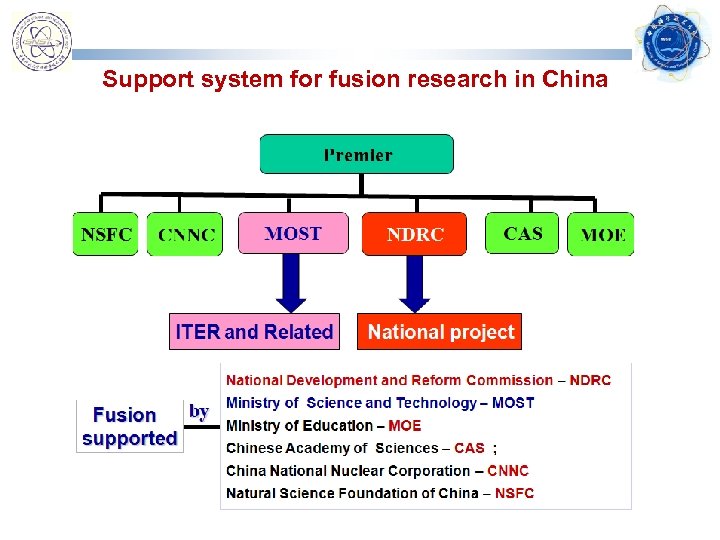 Support system for fusion research in China
 SNST-USTC Content Introduction background opinion and consideration Progress on the concept design of CFETR Summary
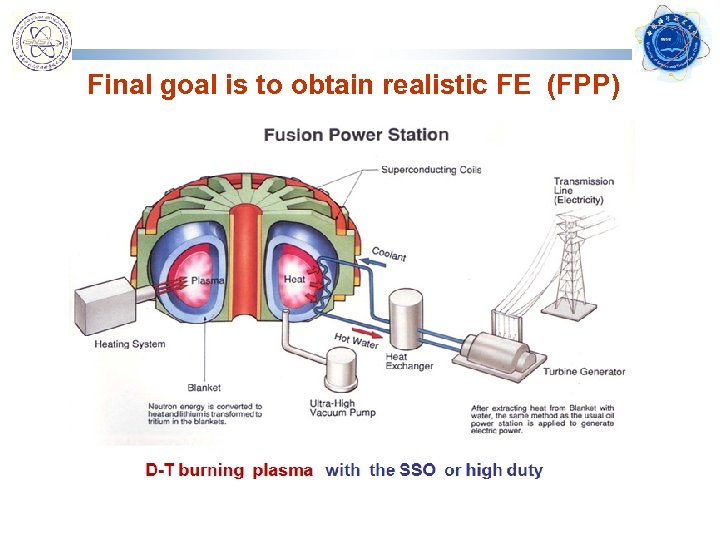 Final goal is to obtain realistic FE (FPP)
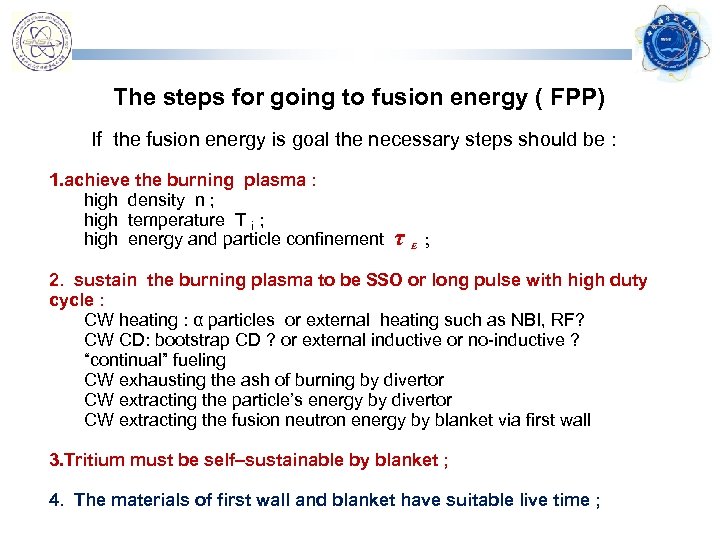 The steps for going to fusion energy ( FPP) If the fusion energy is goal the necessary steps should be : 1. achieve the burning plasma : high density n ; high temperature T i ; high energy and particle confinement τ E ; 2. sustain the burning plasma to be SSO or long pulse with high duty cycle : CW heating : α particles or external heating such as NBI, RF? CW CD: bootstrap CD ? or external inductive or no-inductive ? “continual” fueling CW exhausting the ash of burning by divertor CW extracting the particle’s energy by divertor CW extracting the fusion neutron energy by blanket via first wall 3. Tritium must be self–sustainable by blanket ; 4. The materials of first wall and blanket have suitable live time ;
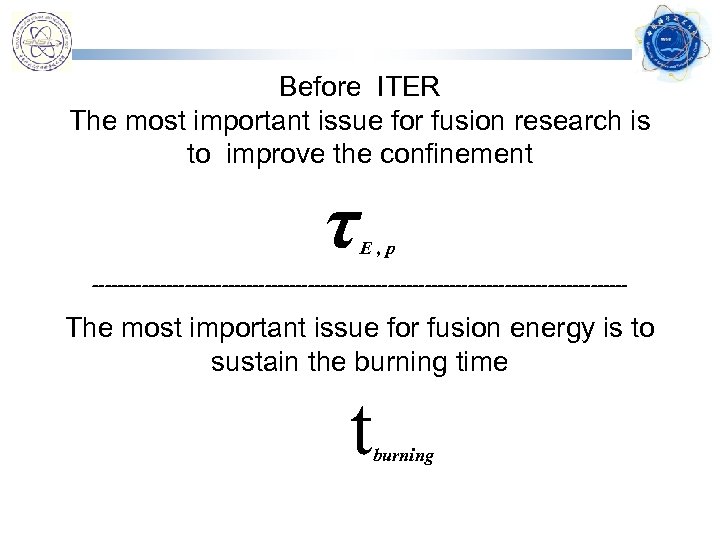 Before ITER The most important issue for fusion research is to improve the confinement τ E, p ------------------------------------------- The most important issue for fusion energy is to sustain the burning time t burning
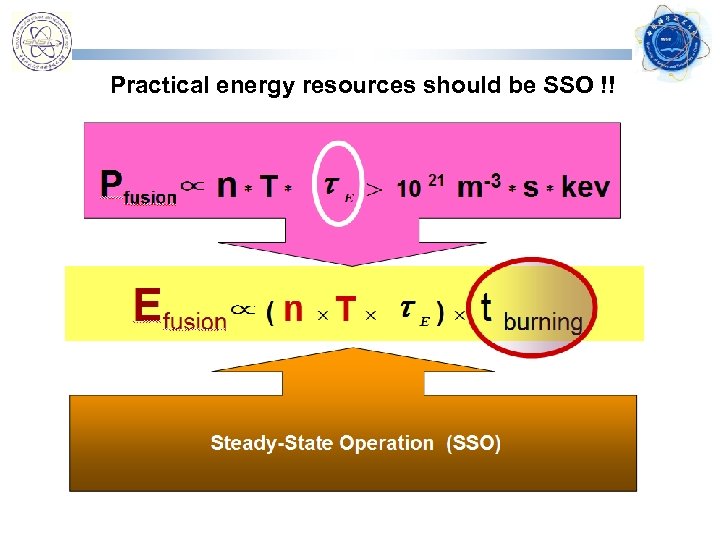 Practical energy resources should be SSO !!
 The long burning time for FE is a basic requirement t burning -------------------------------------------------------- Are there good physic and technology basis for SS burning plasma operation ? Answer is no !! And how to achieve ? ----------------------------------------------- How to achieve the T- self-sustain by Blanket ? What will be happened for key in-vessel components and related materials under high flux irradiation by 14 Me. V neutrons ?
 The scientific goals of ITER is the burning plasma device and its scientific goals are: • to produce a plasma dominated by -particle heating • produce a significant fusion power amplification factor (Q ≥ 10) in long-pulse operation (300 - 500 s) • aim to achieve steady-state operation of a tokamak (Q=5) • retain the possibility of exploring controlled ignition (Q≥ 30) • demonstrate integrated operation of technologies for a fusion power plant • test components required for a fusion power plant • test concepts for a tritium breeding module
 Gaps between ITER and FPP Even if ITER can make great contribution to long pulse or SSO burning plasma but it is mainly on physics and not on real fusion energy because of the real burning time during 14 year D-T operation is only about 4 %, which results in : 1. There is no enough fusion energy produced for utilization. 2. As the consequent the total neutron flux is not enough to demonstrate the real tritium breeding for tritium self sustainable by blanket. 3. No enough neutrons to do the material tests in high flux fusion neutron radioactive environments. 4. Therefore there only are shielding blankets for ITER. 5. Even if adding the TBM with addition budget but it is only concept testing for tritium breeding and not real self sustainable blanket and related material tests
 Conclusion: the engineering test reactor is necessary to be constructed parallel with or after ITER and before the fusion power plant (FPP). For this purpose the China Fusion Engineering Test Reactor (CFETR) is under discussion seriously for design and construction.
 Common understanding (1) The CFETR must be built before the FPP in China Ø ITER can be a good basis for CFETR both on SSO burning plasma physics and some technologies; Ø The goals of CFETR should be different with ITER and aim to the problems related with fusion energy Ø Both physic and technical basis of the CFETR should be more realistic when it is designed. Ø CFETR should not make over-promise, it just is a important engineering test reactor future DEMO or FPP for FE
 Common understanding (1) So mission must be realistic and sequence must be right !! Ø The cost for fusion energy , the multi application of blanket could be lower priority in compare with T selves- sustainable and heat conversion and extracted; Ø The divertor will be another key component for the success of future FPP- it will be the most important components related with the basic requirements for SSO both on physics and technologies.
 Content Introduction some background information opinion and consideration Progress on the concept design of CFETR Summary
 The mission and design goal of CFETR 1. A good complement to ITER; 2. Relay on the existing ITER physical and technical bases ; 3. Fusion power Pf = 50~ 200 MW; 4. Steady-state or long pulse operation (duty cycle ≥ 0. 3 - 0. 5); 5. Demonstration of full cycle of T self-sustained with TBR ≥ 1. 2; 6. Exploring options for DEMO blanket & divertor with an easily changeable capability by RH. CFETR will be the important facility to bridge from ITER to DEMO in China, which is necessary step to go to DEMO and then the fusion power plant.
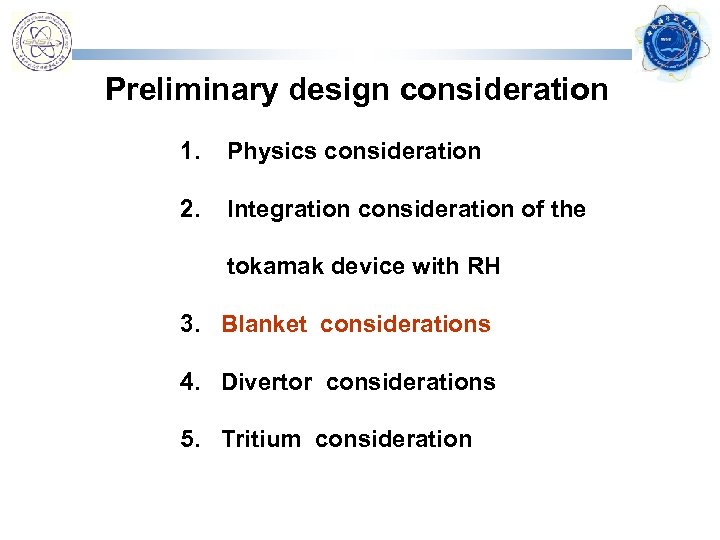
 Preliminary design consideration 1. Physics consideration 2. Integrated design consideration of the device with RH 3. Blanket considerations 4. Divertor considerations 5. Tritium consideration
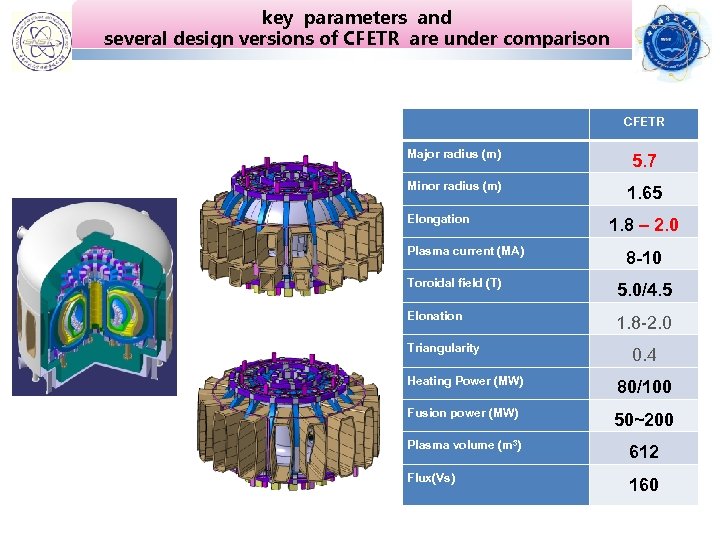
 Physics consideration • CFETR as a test reactor to achieve the fusion energy at reasonable fusion power level should have high reliability and availability. So the core plasma designs are based on relatively conservative physics and technology assumptions, such as operation far away from the stability limits and readily achievable performance; • A device of R=5. 7 m, a=1. 65 m in size with Bt=5 T and total H&CD source power of 80 MW (assumed efficiency 0. 8) with SN configuration could be projected based on a zero-dimensional system study using extrapolations of current physics, which are from the multi-iteration and optimization among plasma performance, blanket module and superconducting magnet requirements, etc. • Analysis of vertical stability control indicates that the basis configuration with an elongation kx=2. 0 can be reliably controlled using in-vessel coil similar to that used in EAST.
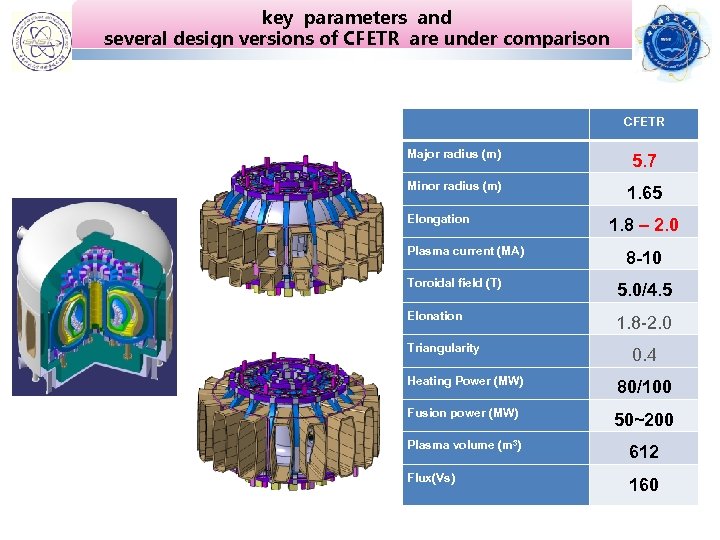 key parameters and several design versions of CFETR are under comparison CFETR Major radius (m) 5. 7 Minor radius (m) 1. 65 Elongation Plasma current (MA) 1. 8 – 2. 0 8 -10 Toroidal field (T) 5. 0/4. 5 Elonation 1. 8 -2. 0 Triangularity 0. 4 Heating Power (MW) 80/100 Fusion power (MW) 50~200 Plasma volume (m 3) 612 Flux(Vs) 160
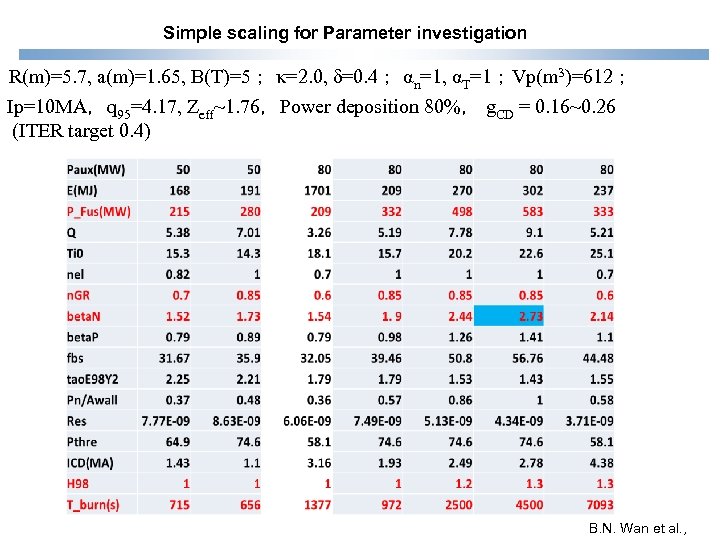 Simple scaling for Parameter investigation R(m)=5. 7, a(m)=1. 65, B(T)=5; κ=2. 0, δ=0. 4; αn=1, αT=1;Vp(m 3)=612; Ip=10 MA,q 95=4. 17, Zeff~1. 76,Power deposition 80%, g. CD = 0. 16~0. 26 (ITER target 0. 4) B. N. Wan et al. ,
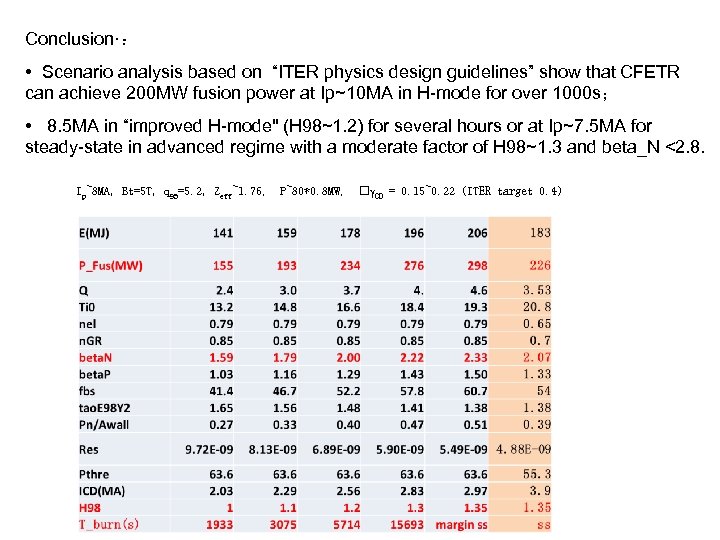 Conclusion·: • Scenario analysis based on “ITER physics design guidelines” show that CFETR can achieve 200 MW fusion power at Ip~10 MA in H-mode for over 1000 s; • 8. 5 MA in “improved H-mode" (H 98~1. 2) for several hours or at Ip~7. 5 MA for steady-state in advanced regime with a moderate factor of H 98~1. 3 and beta_N <2. 8. Ip~8 MA, Bt=5 T, q 95=5. 2, Zeff~1. 76, P~80*0. 8 MW, CD = 0. 15~0. 22 (ITER target 0. 4)
 key parameters and several design versions of CFETR are under comparison CFETR Major radius (m) 5. 7 Minor radius (m) 1. 65 Elongation Plasma current (MA) 1. 8 – 2. 0 8 -10 Toroidal field (T) 5. 0/4. 5 Elonation 1. 8 -2. 0 Triangularity 0. 4 Heating Power (MW) 80/100 Fusion power (MW) 50~200 Plasma volume (m 3) 612 Flux(Vs) 160
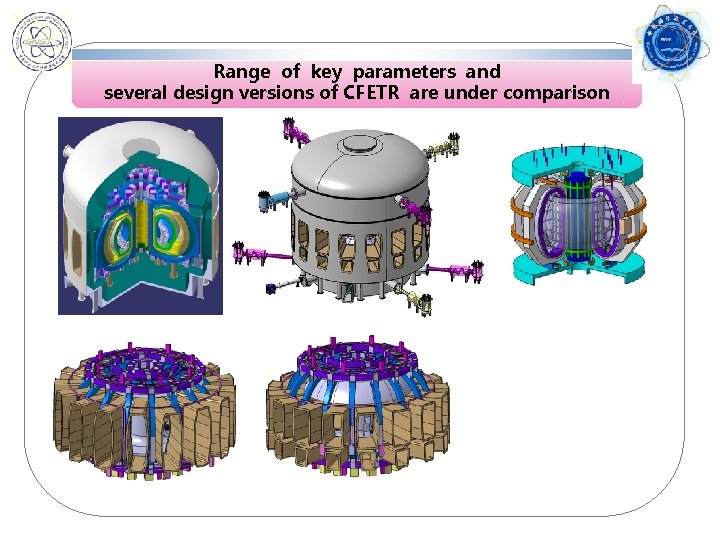 Range of key parameters and several design versions of CFETR are under comparison
 Preliminary design consideration 1. Physics consideration 2. Integration consideration of the tokamak device with RH 3. Blanket considerations 4. Divertor considerations 5. Tritium consideration
 The duty cycle of CFTER will be impacted by the principle of RH significantly
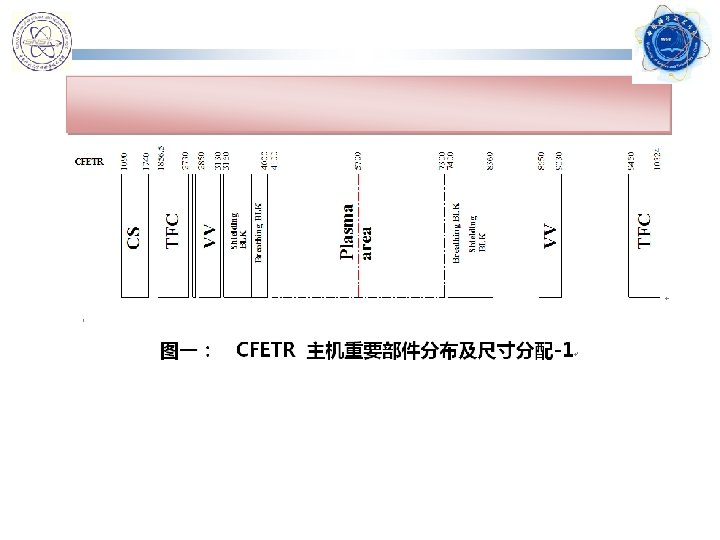
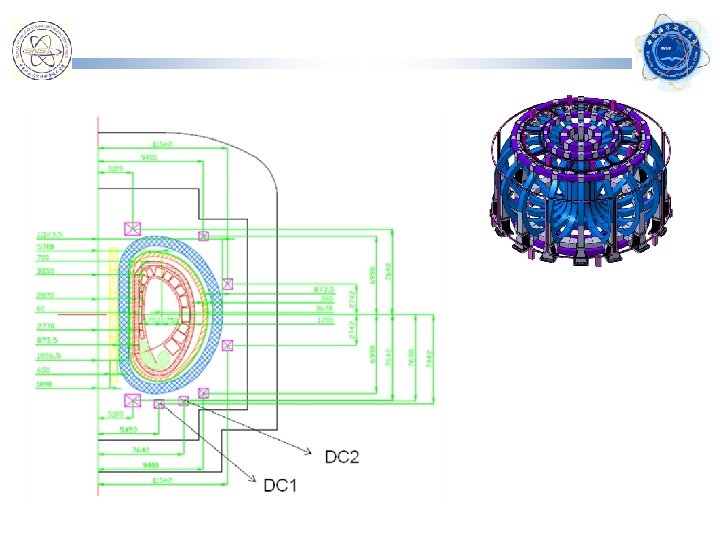
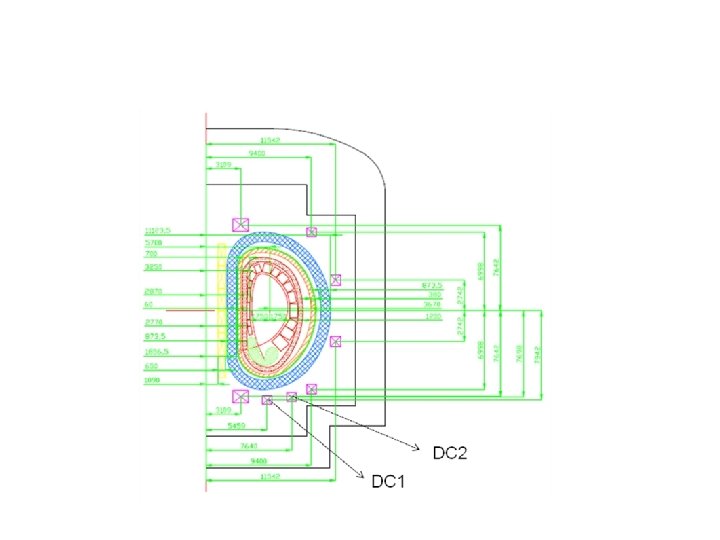
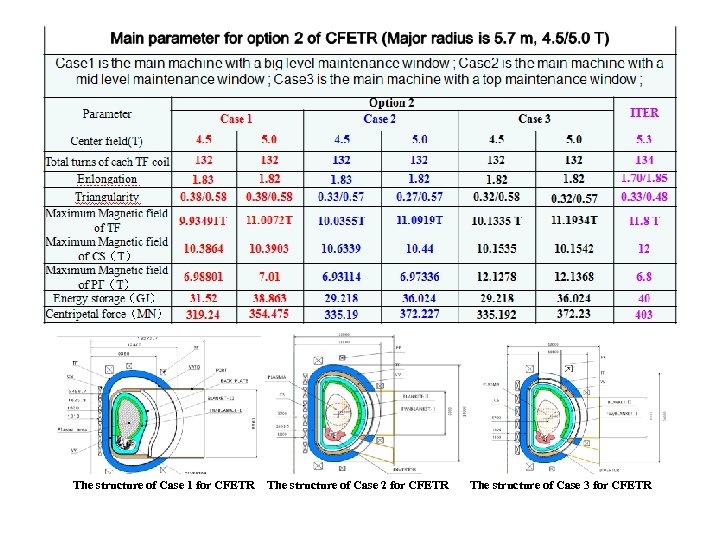 The structure of Case 1 for CFETR The structure of Case 2 for CFETR The structure of Case 3 for CFETR
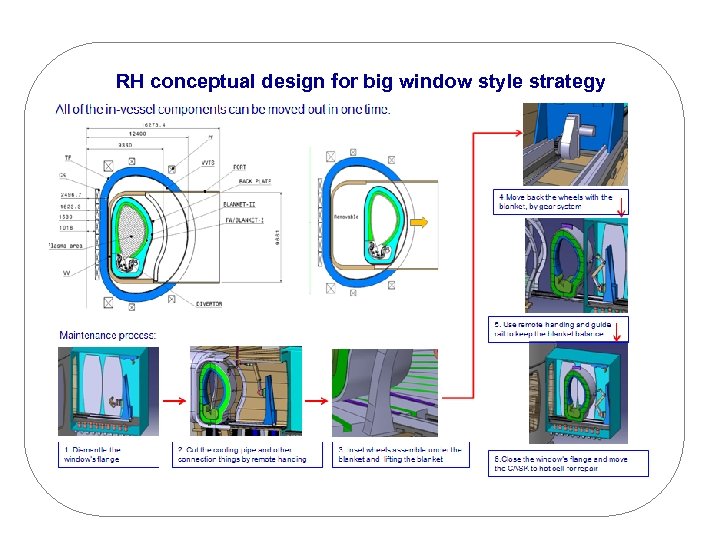 RH conceptual design for big window style strategy
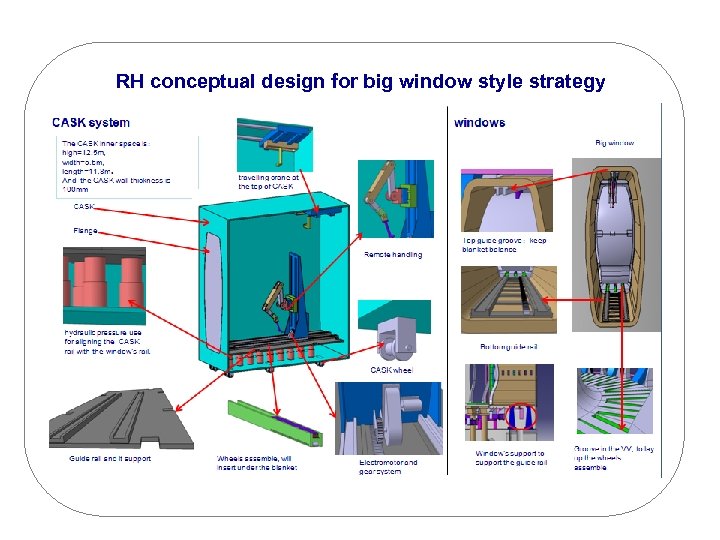 RH conceptual design for big window style strategy
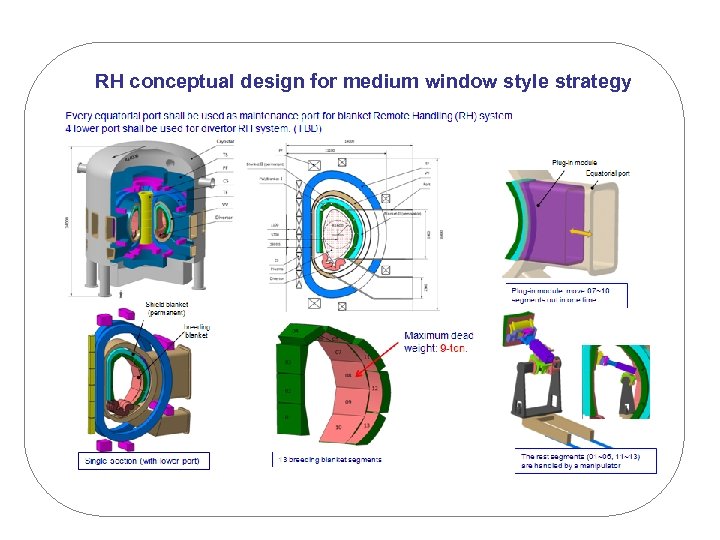 RH conceptual design for medium window style strategy
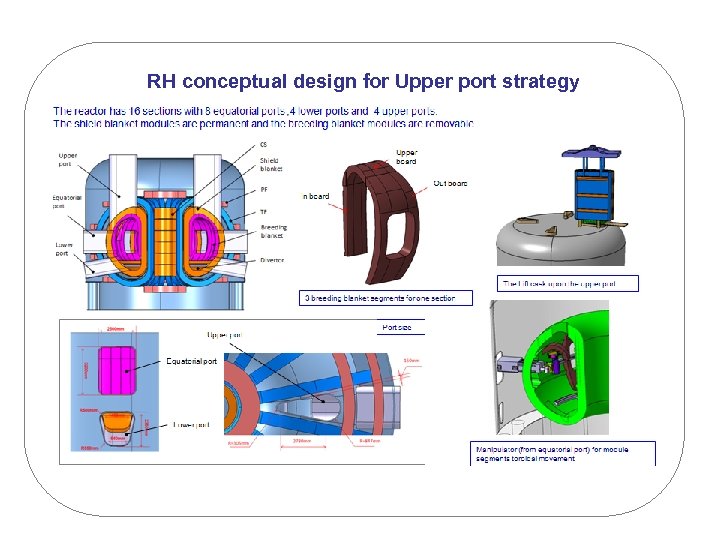 RH conceptual design for Upper port strategy
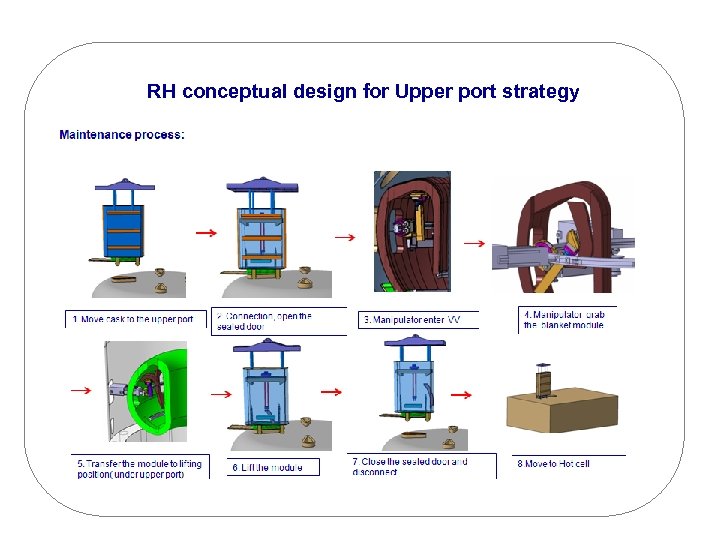 RH conceptual design for Upper port strategy
 Preliminary design consideration 1. Physics consideration 2. Integration consideration of the tokamak device with RH 3. Blanket considerations 4. Divertor considerations 5. Tritium consideration
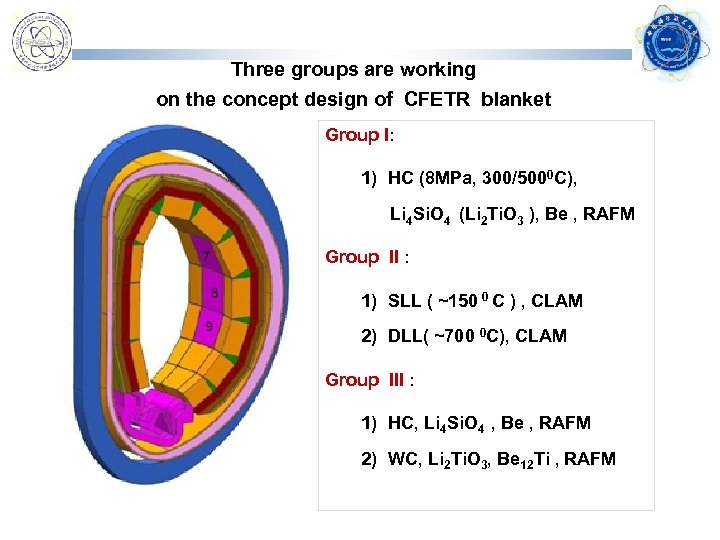 Three groups are working on the concept design of CFETR blanket Group I: 1) HC (8 MPa, 300/5000 C), Li 4 Si. O 4 (Li 2 Ti. O 3 ), Be , RAFM Group II : 1) SLL ( ~150 0 C ) , CLAM 2) DLL( ~700 0 C), CLAM Group III : 1) HC, Li 4 Si. O 4 , Be , RAFM 2) WC, Li 2 Ti. O 3, Be 12 Ti , RAFM
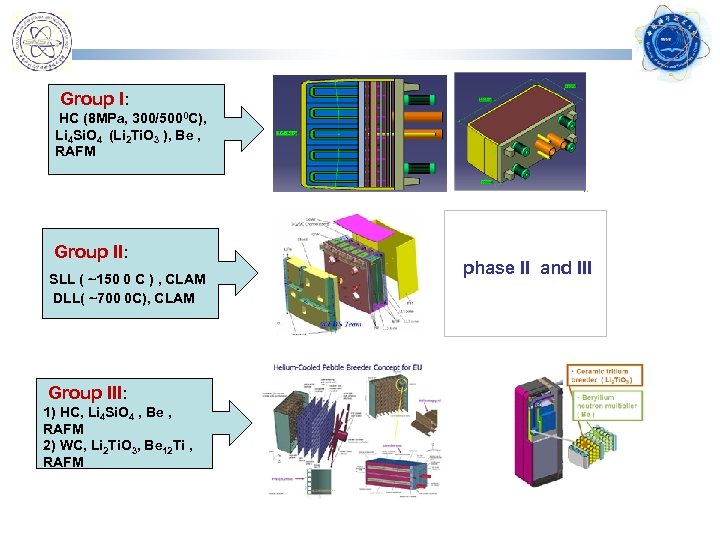 Group I: HC (8 MPa, 300/5000 C), Li 4 Si. O 4 (Li 2 Ti. O 3 ), Be , RAFM Group II: SLL ( ~150 0 C ) , CLAM DLL( ~700 0 C), CLAM Group III: 1) HC, Li 4 Si. O 4 , Be , RAFM 2) WC, Li 2 Ti. O 3, Be 12 Ti , RAFM phase II and III
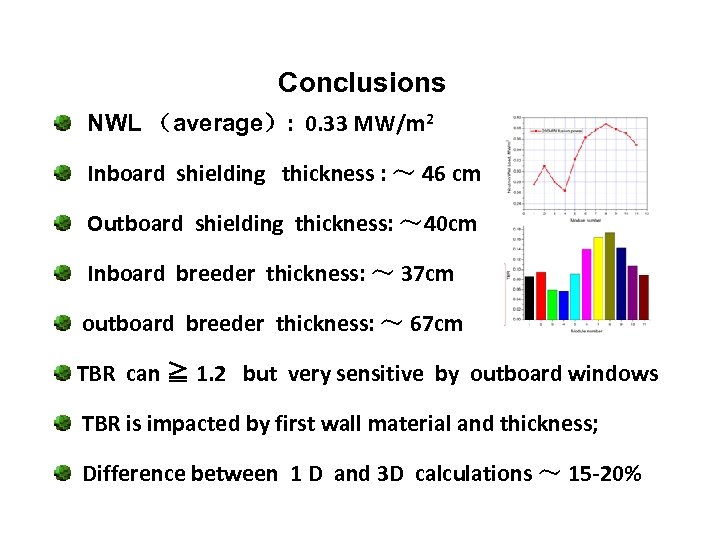 Conclusions NWL (average): 0. 33 MW/m 2 Inboard shielding thickness : ~ 46 cm Outboard shielding thickness: ~ 40 cm Inboard breeder thickness: ~ 37 cm outboard breeder thickness: ~ 67 cm TBR can ≧ 1. 2 but very sensitive by outboard windows TBR is impacted by first wall material and thickness; Difference between 1 D and 3 D calculations ~ 15 -20%
 Preliminary design consideration 1. Physics consideration 2. Integrated design consideration of the device with RH 3. Blanket considerations 4. Divertor considerations 5. Tritium consideration
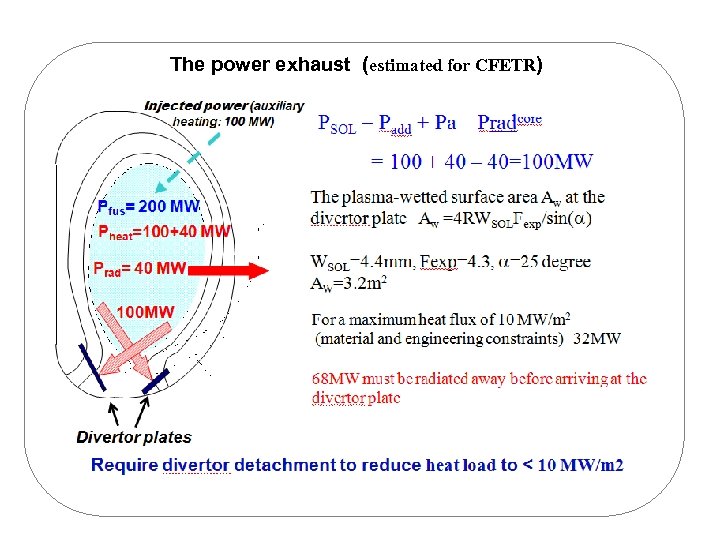
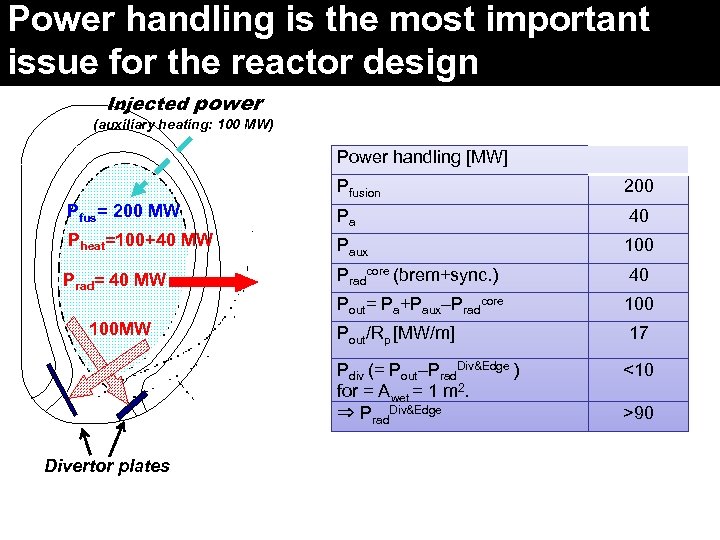
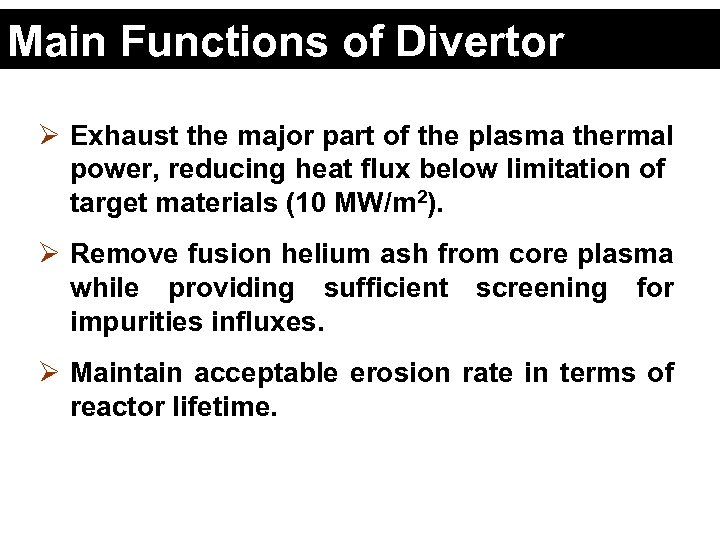 Main Functions of Divertor Ø Exhaust the major part of the plasma thermal power, reducing heat flux below limitation of target materials (10 MW/m 2). Ø Remove fusion helium ash from core plasma while providing sufficient screening for impurities influxes. Ø Maintain acceptable erosion rate in terms of reactor lifetime.
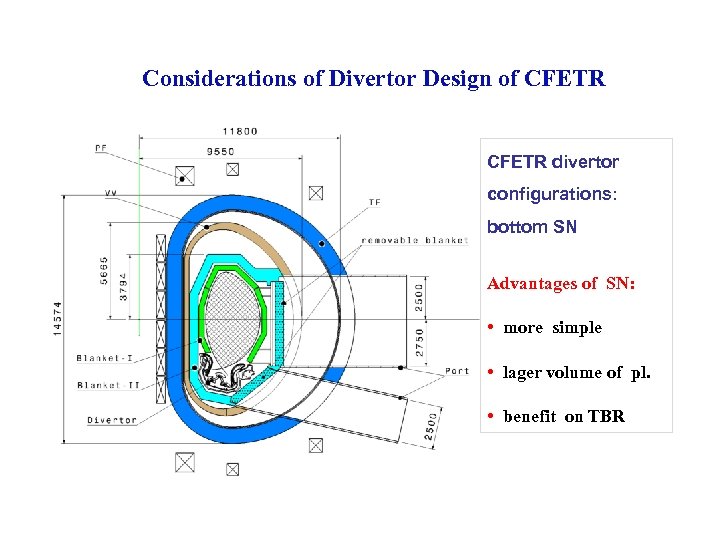 Considerations of Divertor Design of CFETR divertor configurations: bottom SN Advantages of SN: • more simple • lager volume of pl. • benefit on TBR
 Key issues for divertor design ITER-like divertor Advanced divertor
 The power exhaust (estimated for CFETR)
 Power handling is the most important issue for the reactor design Injected power (auxiliary heating: 100 MW) Power handling [MW] Pfusion 200 Pfus= 200 MW Pa 40 Pheat=100+40 MW Paux 100 Prad= 40 MW Pradcore (brem+sync. ) 40 Pout= Pa+Paux–Pradcore 100 Pout/Rp [MW/m] 17 Pdiv (= Pout–Prad. Div&Edge ) for = Awet = 1 m 2. ⇒ Prad. Div&Edge <10 100 MW Divertor plates >90
 Advanced Divertor Configurations New options: Super-X, Snowflake Advantages: • Increase wetted area to reduce peak heat flux • Increase L// to facilitate radiative divertor. Issues to be addressed: • Minimum number of PF coils • PF current and size • Restrictions of poloidal coil location
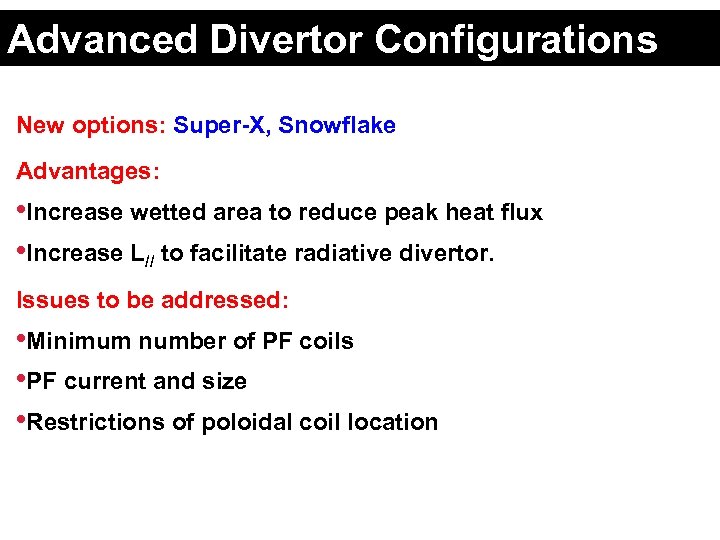
![Single null Ip [MA] 10 R[m] 5. 7 a[m] 1. 6 βp 1. 01](https://present5.com/presentation/24c8c88e2eb7676b9f5f80f54b6ad09e/image-50.jpg "Single null Ip [MA] 10 R[m] 5. 7 a[m] 1. 6 βp 1. 01") Single null Ip [MA] 10 R[m] 5. 7 a[m] 1. 6 βp 1. 01 ιi 1. 09 k 2. 0 δ 0. 4/0. 62 Rxpt [m] 4. 692 Zxpt[m] -3. 134
Single null Ip [MA] 10 R[m] 5. 7 a[m] 1. 6 βp 1. 01 ιi 1. 09 k 2. 0 δ 0. 4/0. 62 Rxpt [m] 4. 692 Zxpt[m] -3. 134
![Snowflake (LSN) Ip [MA] 10 R[m] 5. 7 a[m] 1. 59 βp 0. 80](https://present5.com/presentation/24c8c88e2eb7676b9f5f80f54b6ad09e/image-51.jpg "Snowflake (LSN) Ip [MA] 10 R[m] 5. 7 a[m] 1. 59 βp 0. 80") Snowflake (LSN) Ip [MA] 10 R[m] 5. 7 a[m] 1. 59 βp 0. 80 ιi 1. 09 k 2. 01 δ 0. 45/0. 67 Rxpt [m] 4. 637 Zxpt[m] -3. 129
Snowflake (LSN) Ip [MA] 10 R[m] 5. 7 a[m] 1. 59 βp 0. 80 ιi 1. 09 k 2. 01 δ 0. 45/0. 67 Rxpt [m] 4. 637 Zxpt[m] -3. 129
 Preliminary design consideration 1. Physics consideration 2. Integrated design consideration of the device with RH 3. Blanket considerations 4. Divertor considerations 5. Tritium consideration
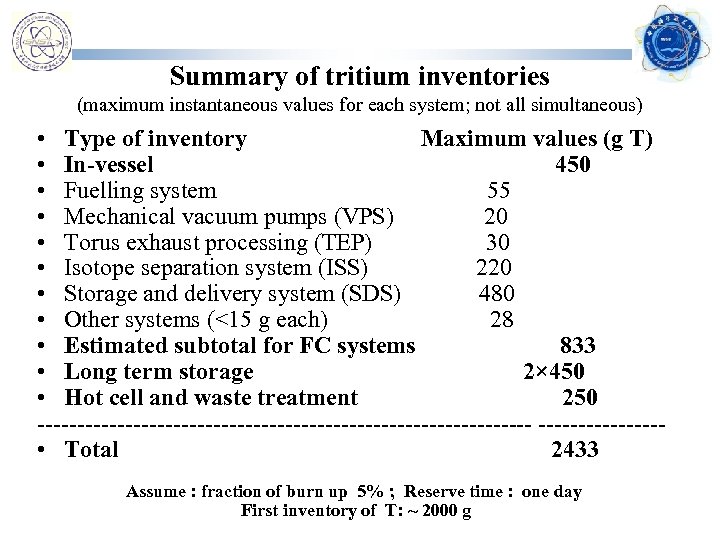 Summary of tritium inventories (maximum instantaneous values for each system; not all simultaneous) • Type of inventory Maximum values (g T) • In-vessel 450 • Fuelling system 55 • Mechanical vacuum pumps (VPS) 20 • Torus exhaust processing (TEP) 30 • Isotope separation system (ISS) 220 • Storage and delivery system (SDS) 480 • Other systems (<15 g each) 28 • Estimated subtotal for FC systems 833 • Long term storage 2× 450 • Hot cell and waste treatment 250 ------------------------------- • Total 2433 Assume : fraction of burn up 5% ; Reserve time : one day First inventory of T: ~ 2000 g
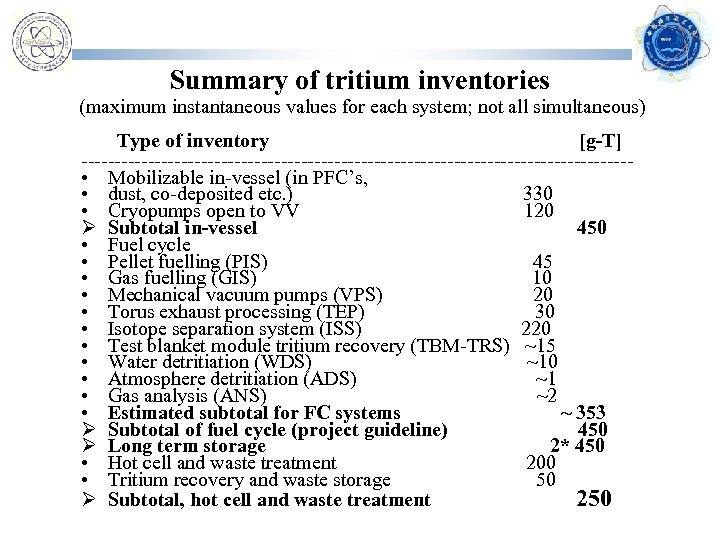 Summary of tritium inventories (maximum instantaneous values for each system; not all simultaneous) Type of inventory [g-T] ----------------------------------------- • Mobilizable in-vessel (in PFC’s, • dust, co-deposited etc. ) 330 • Cryopumps open to VV 120 Ø Subtotal in-vessel 450 • Fuel cycle • Pellet fuelling (PIS) 45 • Gas fuelling (GIS) 10 • Mechanical vacuum pumps (VPS) 20 • Torus exhaust processing (TEP) 30 • Isotope separation system (ISS) 220 • Test blanket module tritium recovery (TBM-TRS) ~15 • Water detritiation (WDS) ~10 • Atmosphere detritiation (ADS) ~1 • Gas analysis (ANS) ~2 • Estimated subtotal for FC systems ~ 353 Ø Subtotal of fuel cycle (project guideline) 450 Ø Long term storage 2* 450 • Hot cell and waste treatment 200 • Tritium recovery and waste storage 50 Ø Subtotal, hot cell and waste treatment 250
 Content Introduction some background information opinion and consideration Progress on the concept design of CFETR Summary
 Summary-1 1. SSO or long operation with high duty cycle of the burning plasma is the most important issues both for the physics and related technologies for MFE development: 2. Missions required for CFETR should be more realistic and aim to the most important challenges for FE; 3. CFETR should be a good complement to ITER and it will demonstrate the fusion energy with a minim Pf = 50~ 200 MW; long pulse or steady-state operation with duty cycle time ≥ 0. 3 ~ 0. 5; demonstrating the full cycle of T self-sufficiency with TBR ≥ 1. 2; relay on the existing ITER physical and technical bases ; exploring options for DEMO blanket & divertor with an easy changeable core by RH.
 Summary-2 4. The design choices of CFETR are still open; 5. The goal of CFETR design activities is to make a proposal at the end of 2014 to government to try to get permission for construction with the key R&D items for CFETR; CFETR will be the important facility to bridge from ITER to DEMO in China, which is necessary step to go to DEMO and then the fusion power plant FPP.
 Thanks for your attention !