


 Скачать презентацию SNS College of Engineering Department of Computer Science
3035d79720e48525e477b2eb78003316.ppt
- Количество слайдов: 68
 SNS College of Engineering Department of Computer Science and Engineering Heuristic and Meta Knowledge Presented By S. Yamuna AP/CSE
 What is the study of logic? • Logic is the study of making inferences – given a set of facts, we attempt to reach a true conclusion. • An example of informal logic is a courtroom setting where lawyers make a series of inferences hoping to convince a jury / judge. • Formal logic (symbolic logic) is a more rigorous approach to proving a conclusion to be true / false. Expert Systems 2
 Why is Logic Important • We use logic in our everyday lives – “should I buy this car”, “should I seek medical attention”. • People are not very good at reasoning because they often fail to separate word meanings with the reasoning process itself. • Semantics refers to the meanings we give to symbols. Expert Systems 3
 The Goal of Expert Systems • We need to be able to separate the actual meanings of words with the reasoning process itself. • We need to make inferences w/o relying on semantics. • We need to reach valid conclusions based on facts only. Expert Systems 4
 Knowledge vs. Expert Systems • Knowledge representation is key to the success of expert systems. • Expert systems are designed for knowledge representation based on rules of logic called inferences. • Knowledge affects the development, efficiency, speed, and maintenance of the system. Expert Systems 5
 Arguments in Logic • An argument refers to the formal way facts and rules of inferences are used to reach valid conclusions. • The process of reaching valid conclusions is referred to as logical reasoning. Expert Systems 6
 How is Knowledge Used? • Knowledge has many meanings – data, facts, information. • How do we use knowledge to reach conclusions or solve problems? • Heuristics refers to using experience to solve problems – using precedents. • Expert systems may have hundreds / thousands of micro-precedents to refer to. Expert Systems 7
 Epistemology • Epistemology is the formal study of knowledge. • Concerned with nature, structure, and origins of knowledge. Expert Systems 8
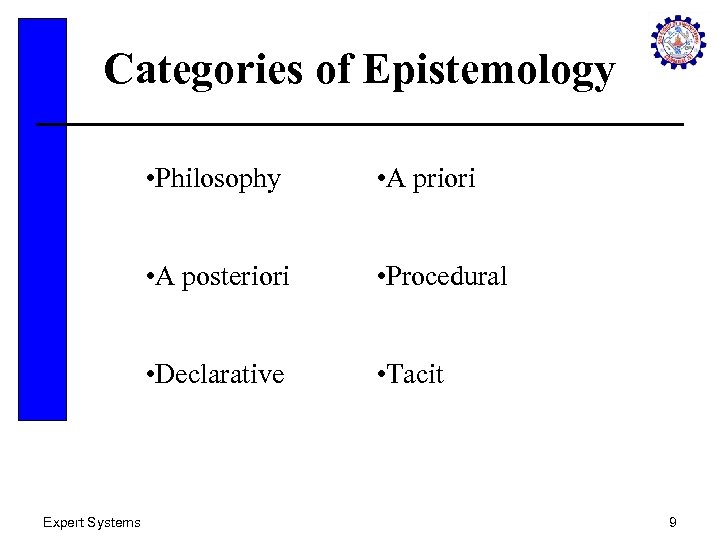 Categories of Epistemology • Philosophy • A posteriori • Procedural • Declarative Expert Systems • A priori • Tacit 9
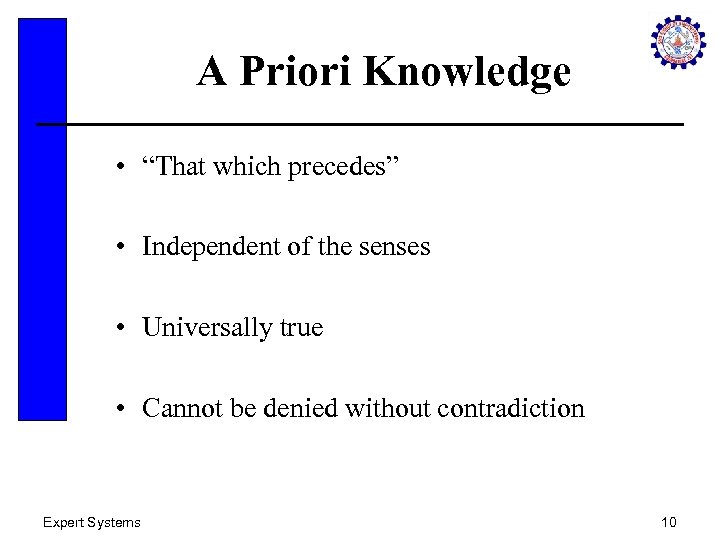 A Priori Knowledge • “That which precedes” • Independent of the senses • Universally true • Cannot be denied without contradiction Expert Systems 10
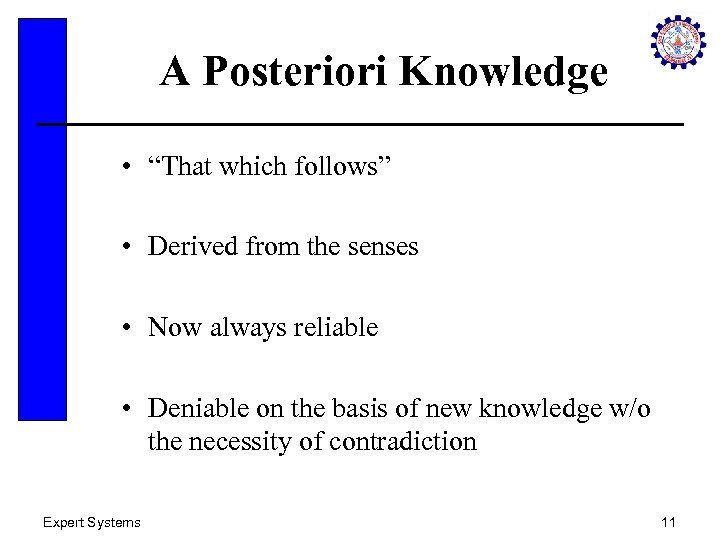 A Posteriori Knowledge • “That which follows” • Derived from the senses • Now always reliable • Deniable on the basis of new knowledge w/o the necessity of contradiction Expert Systems 11
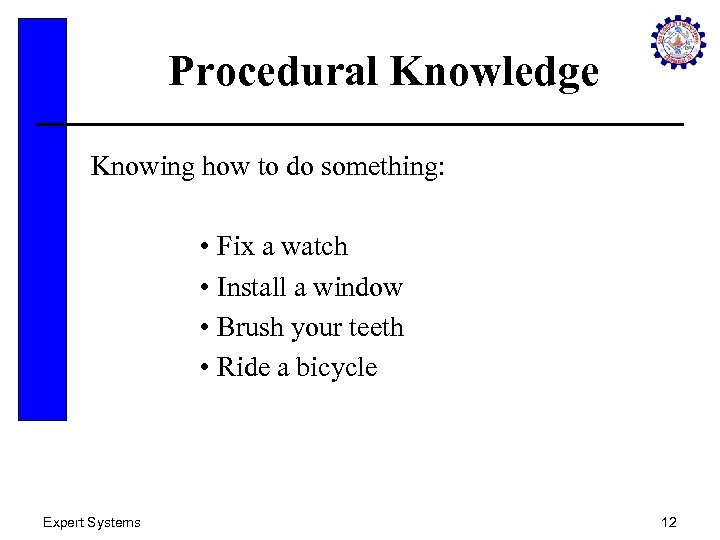 Procedural Knowledge Knowing how to do something: • Fix a watch • Install a window • Brush your teeth • Ride a bicycle Expert Systems 12
 Declarative Knowledge • Knowledge that something is true or false • Usually associated with declarative statements • E. g. , “Don’t touch that hot wire. ” Expert Systems 13
 Tacit Knowledge • Unconscious knowledge • Cannot be expressed by language • E. g. , knowing how to walk, breath, etc. Expert Systems 14
 Knowledge in Rule-Based Systems • Knowledge is part of a hierarchy. • Knowledge refers to rules that are activated by facts or other rules. • Activated rules produce new facts or conclusions. • Conclusions are the end-product of inferences when done according to formal rules. Expert Systems 15
 Expert Systems vs. Humans • Expert systems infer – reaching conclusions as the end product of a chain of steps called inferencing when done according to formal rules. • Humans reason Expert Systems 16
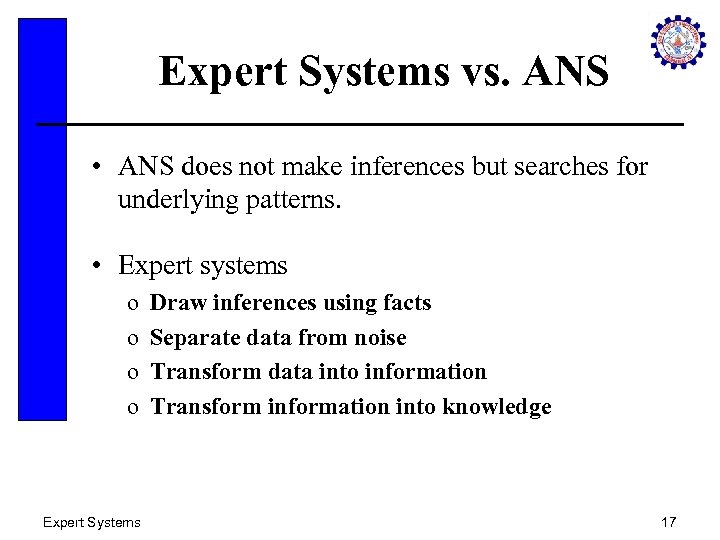 Expert Systems vs. ANS • ANS does not make inferences but searches for underlying patterns. • Expert systems o o Expert Systems Draw inferences using facts Separate data from noise Transform data into information Transform information into knowledge 17
 Metaknowledge • Metaknowledge is knowledge about knowledge and expertise. • Most successful expert systems are restricted to as small a domain as possible. • In an expert system, an ontology is the metaknowledge that describes everything known about the problem domain. • Wisdom is the metaknowledge of determining the best goals of life and how to obtain them. Expert Systems 18
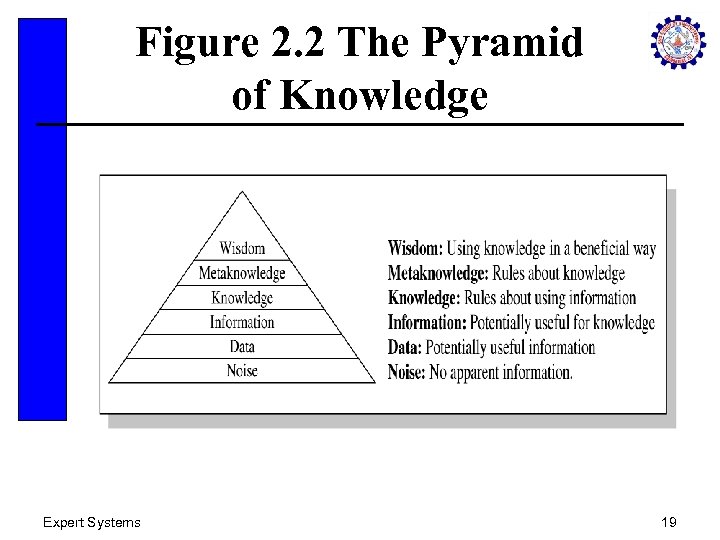 Figure 2. 2 The Pyramid of Knowledge Expert Systems 19
 Productions A number of knowledge-representation techniques have been devised: • Rules • Semantic nets • Frames • Scripts • Logic • Conceptual graphs Expert Systems 20
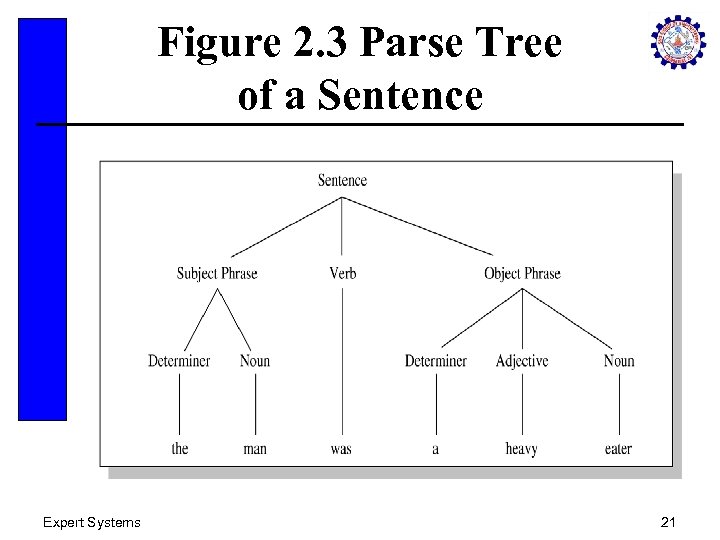 Figure 2. 3 Parse Tree of a Sentence Expert Systems 21
 Semantic Nets • A classic representation technique for propositional information • Propositions – a form of declarative knowledge, stating facts (true/false) • Propositions are called “atoms” – cannot be further subdivided. • Semantic nets consist of nodes (objects, concepts, situations) and arcs (relationships between them). Expert Systems 22
 Common Types of Links • IS-A – relates an instance or individual to a generic class • A-KIND-OF – relates generic nodes to generic nodes Expert Systems 23
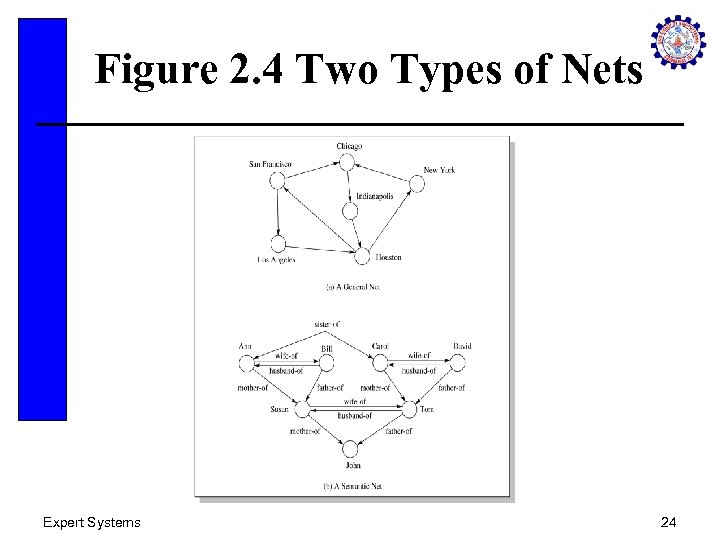 Figure 2. 4 Two Types of Nets Expert Systems 24
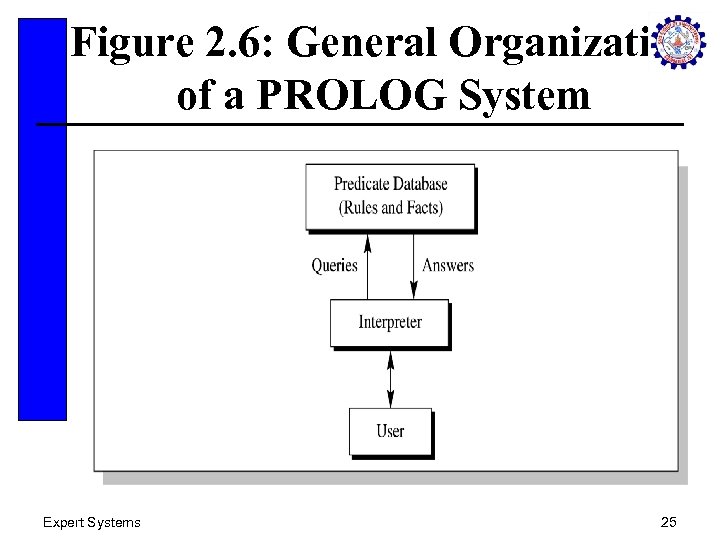 Figure 2. 6: General Organization of a PROLOG System Expert Systems 25
 PROLOG and Semantic Nets • In PROLOG, predicate expressions consist of the predicate name, followed by zero or more arguments enclosed in parentheses, separated by commas. • Example: mother(becky, heather) means that becky is the mother of heather Expert Systems 26
 PROLOG Continued • Programs consist of facts and rules in the general form of goals. • General form: p: - p 1, p 2, …, p. N p is called the rule’s head and the pi represents the subgoals • Example: spouse(x, y) : - wife(x, y) x is the spouse of y if x is the wife of y Expert Systems 27
 Object-Attribute-Value Triple • One problem with semantic nets is lack of standard definitions for link names (IS-A, AKO, etc. ). • The OAV triplet can be used to characterize all the knowledge in a semantic net. Expert Systems 28
 Problems with Semantic Nets • To represent definitive knowledge, the link and node names must be rigorously defined. • A solution to this is extensible markup language (XML) and ontologies. • Problems also include combinatorial explosion of searching nodes, inability to define knowledge the way logic can, and heuristic inadequacy. Expert Systems 29
 Schemata • Knowledge Structure – an ordered collection of knowledge – not just data. • Semantic Nets – are shallow knowledge structures – all knowledge is contained in nodes and links. • Schema is a more complex knowledge structure than a semantic net. • In a schema, a node is like a record which may contain data, records, and/or pointers to nodes. Expert Systems 30
 Frames • One type of schema is a frame (or script – timeordered sequence of frames). • Frames are useful for simulating commonsense knowledge. • Semantic nets provide 2 -dimensional knowledge; frames provide 3 -dimensional. • Frames represent related knowledge about narrow subjects having much default knowledge. Expert Systems 31
 Frames Continued • A frame is a group of slots and fillers that defines a stereotypical object that is used to represent generic / specific knowledge. • Commonsense knowledge is knowledge that is generally known. • Prototypes are objects possessing all typical characteristics of whatever is being modeled. • Problems with frames include allowing unrestrained alteration / cancellation of slots. Expert Systems 32
 Logic and Sets • Knowledge can also be represented by symbols of logic. • Logic is the study of rules of exact reasoning – inferring conclusions from premises. • Automated reasoning – logic programming in the context of expert systems. Expert Systems 33
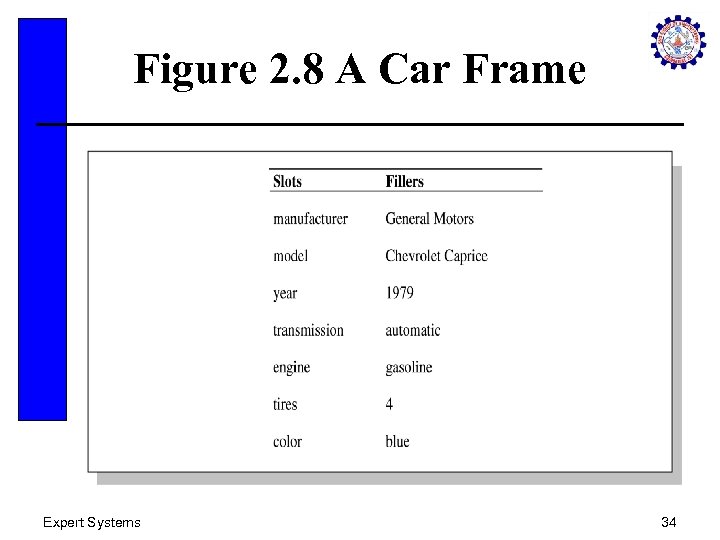 Figure 2. 8 A Car Frame Expert Systems 34
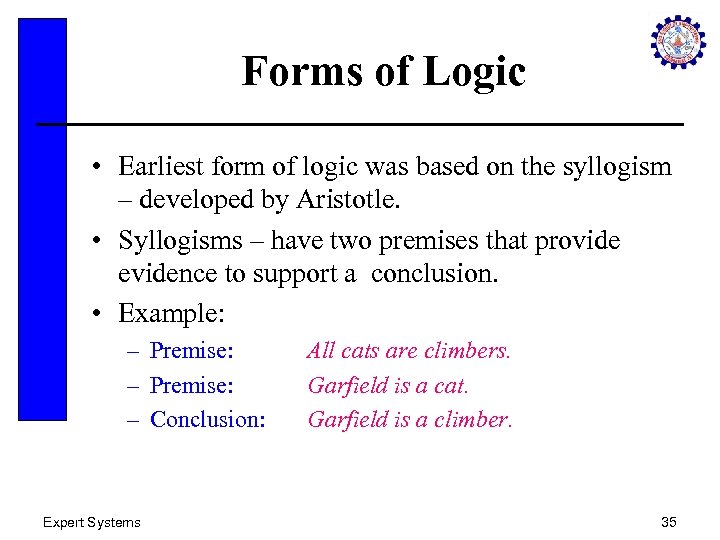 Forms of Logic • Earliest form of logic was based on the syllogism – developed by Aristotle. • Syllogisms – have two premises that provide evidence to support a conclusion. • Example: – Premise: – Conclusion: Expert Systems All cats are climbers. Garfield is a cat. Garfield is a climber. 35
 Venn Diagrams • Venn diagrams can be used to represent knowledge. • Universal set is the topic of discussion. • Subsets, proper subsets, intersection, union , contained in, and complement are all familiar terms related to sets. • An empty set (null set) has no elements. Expert Systems 36
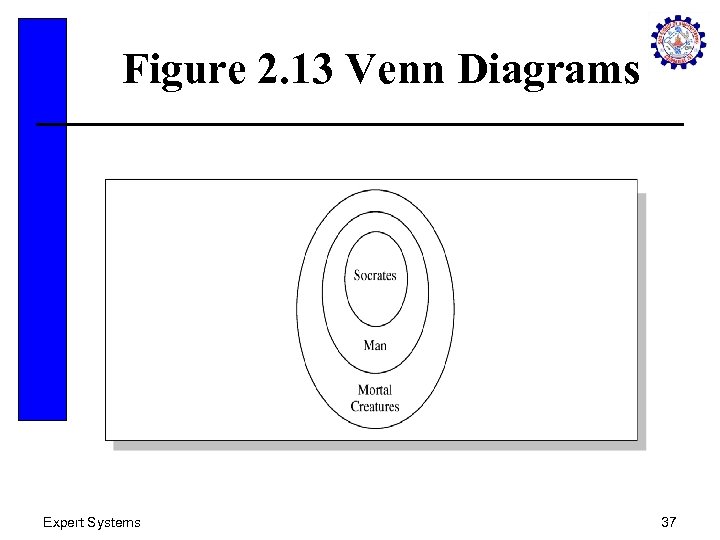 Figure 2. 13 Venn Diagrams Expert Systems 37
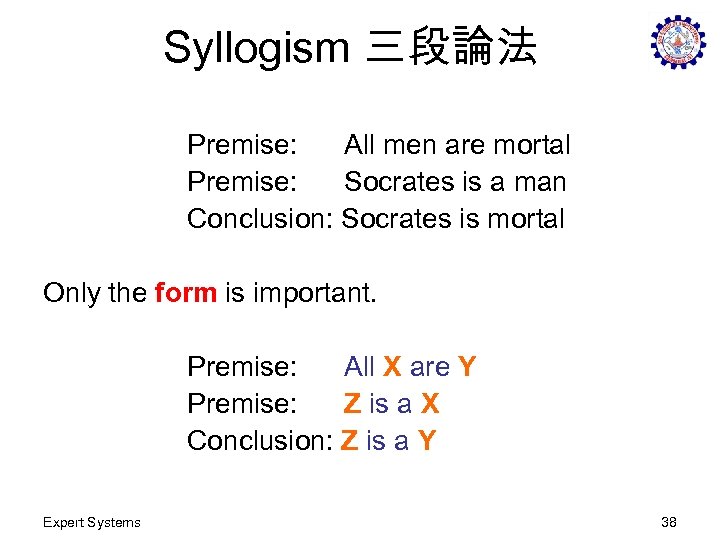 Syllogism 三段論法 Premise: All men are mortal Premise: Socrates is a man Conclusion: Socrates is mortal Only the form is important. Premise: All X are Y Premise: Z is a X Conclusion: Z is a Y Expert Systems 38
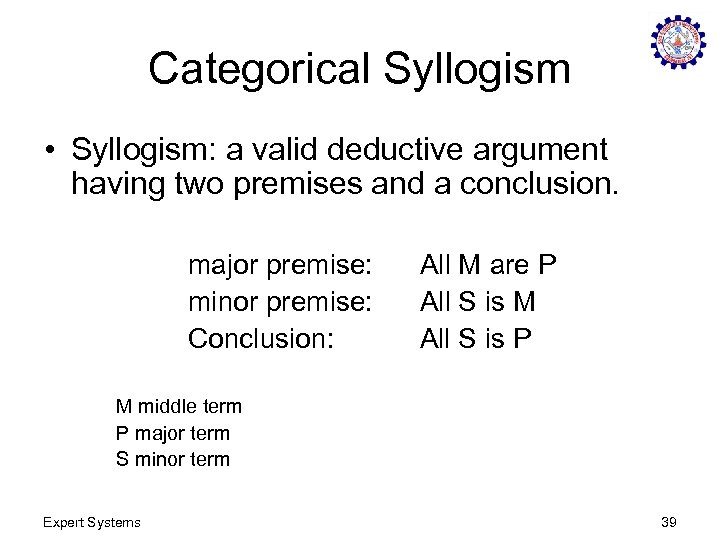 Categorical Syllogism • Syllogism: a valid deductive argument having two premises and a conclusion. major premise: minor premise: Conclusion: All M are P All S is M All S is P M middle term P major term S minor term Expert Systems 39
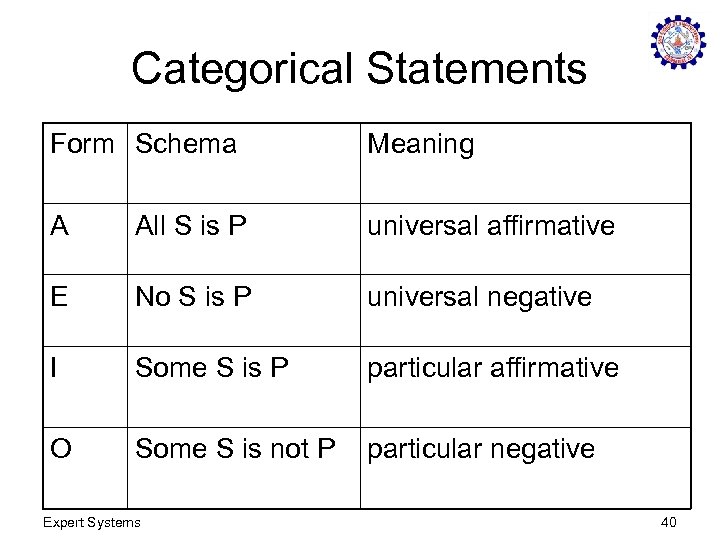 Categorical Statements Form Schema Meaning A All S is P universal affirmative E No S is P universal negative I Some S is P particular affirmative O Some S is not P particular negative Expert Systems 40
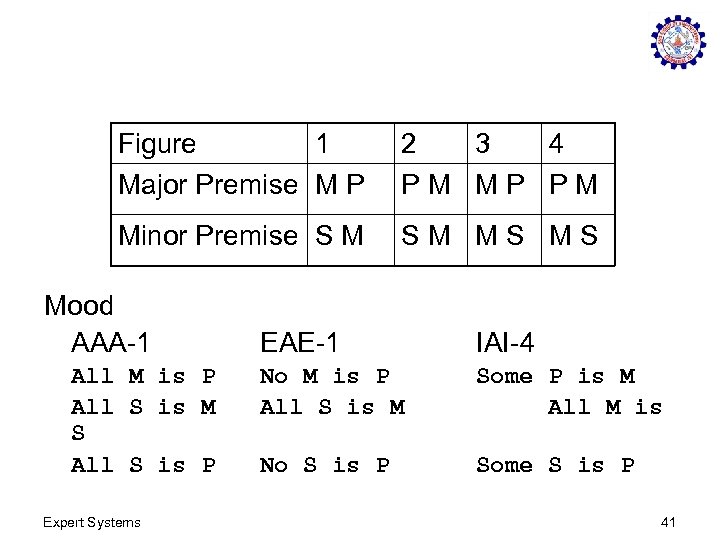 Figure 1 Major Premise M P 2 3 4 PM MP PM Minor Premise S M SM MS MS Mood AAA-1 All M is P All S is M S All S is P Expert Systems EAE-1 IAI-4 No M is P All S is M Some P is M All M is No S is P Some S is P 41
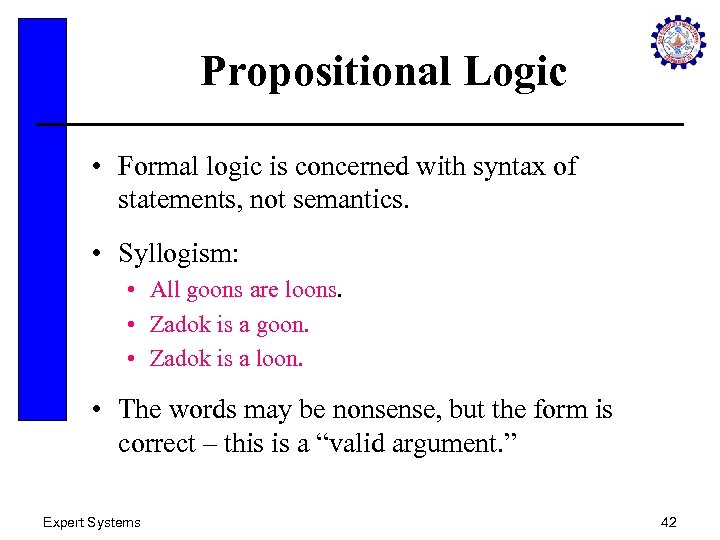 Propositional Logic • Formal logic is concerned with syntax of statements, not semantics. • Syllogism: • All goons are loons. • Zadok is a goon. • Zadok is a loon. • The words may be nonsense, but the form is correct – this is a “valid argument. ” Expert Systems 42
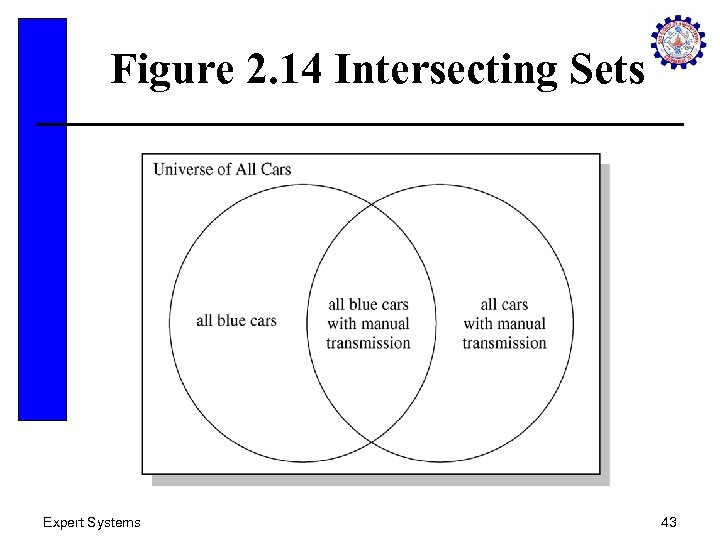 Figure 2. 14 Intersecting Sets Expert Systems 43
 Boolean Logic • Defines a set of axioms consisting of symbols to represent objects / classes. • Defines a set of algebraic expressions to manipulate those symbols. • Using axioms, theorems can be constructed. • A theorem can be proved by showing how it is derived from a set of axioms. Expert Systems 44
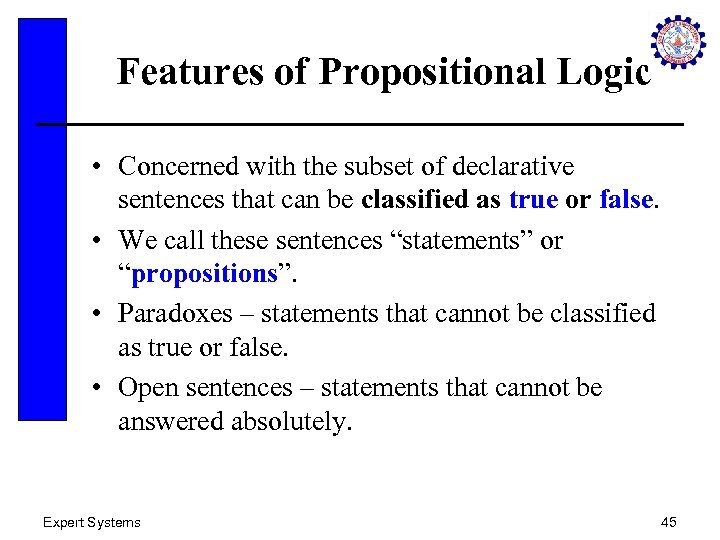 Features of Propositional Logic • Concerned with the subset of declarative sentences that can be classified as true or false. • We call these sentences “statements” or “propositions”. • Paradoxes – statements that cannot be classified as true or false. • Open sentences – statements that cannot be answered absolutely. Expert Systems 45
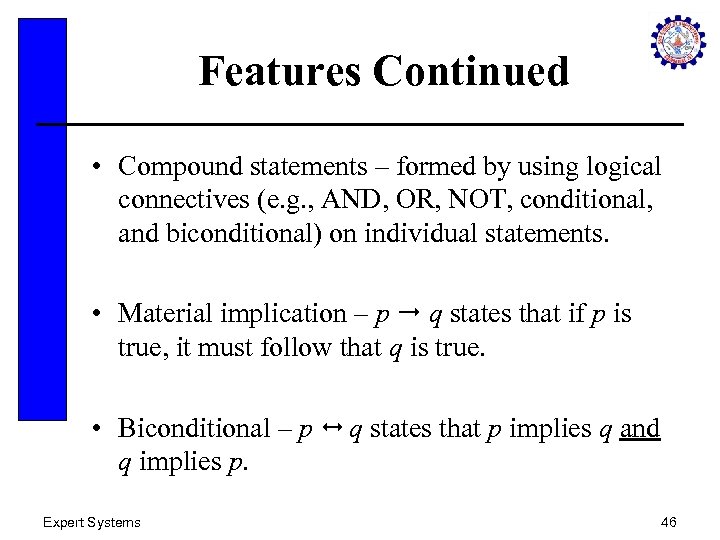 Features Continued • Compound statements – formed by using logical connectives (e. g. , AND, OR, NOT, conditional, and biconditional) on individual statements. • Material implication – p q states that if p is true, it must follow that q is true. • Biconditional – p q states that p implies q and q implies p. Expert Systems 46
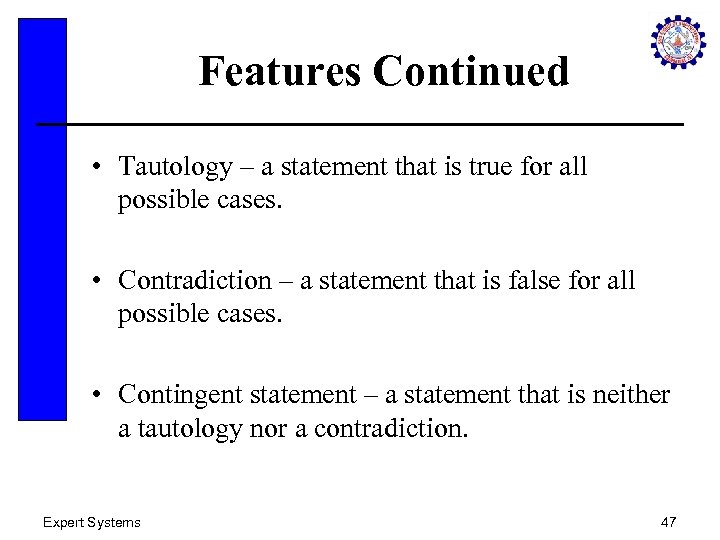 Features Continued • Tautology – a statement that is true for all possible cases. • Contradiction – a statement that is false for all possible cases. • Contingent statement – a statement that is neither a tautology nor a contradiction. Expert Systems 47
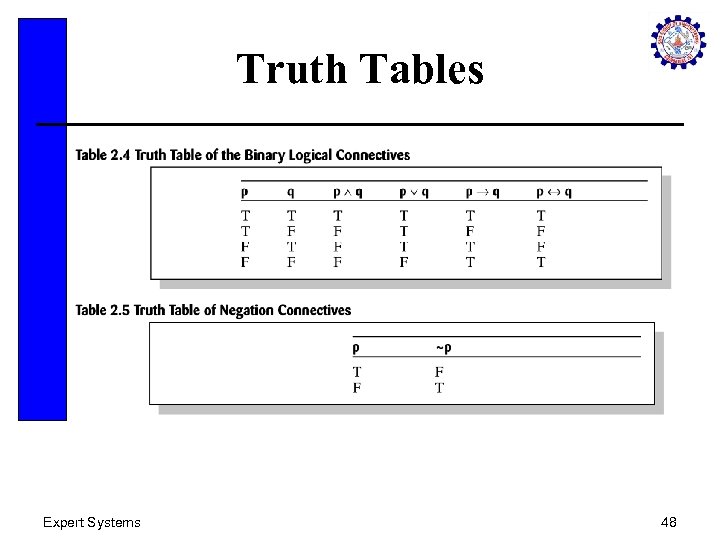 Truth Tables Expert Systems 48
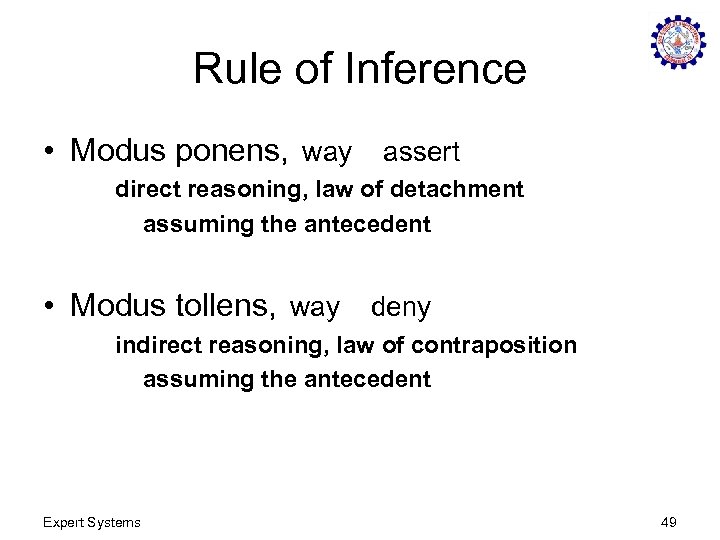 Rule of Inference • Modus ponens, way assert direct reasoning, law of detachment assuming the antecedent • Modus tollens, way deny indirect reasoning, law of contraposition assuming the antecedent Expert Systems 49
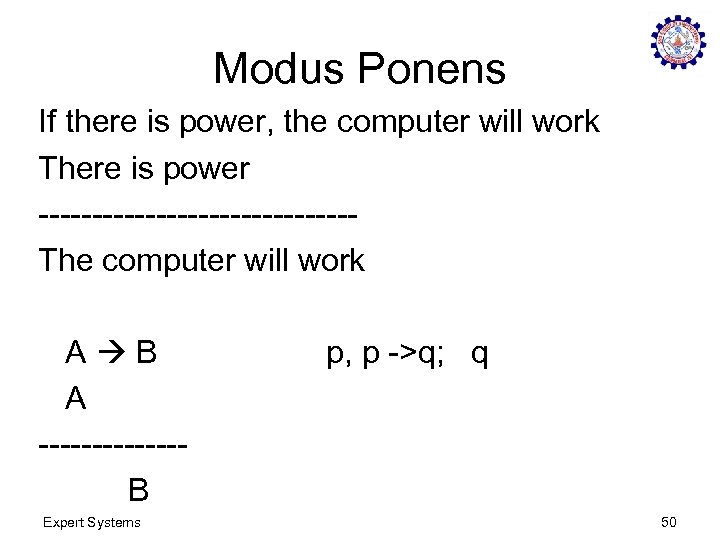 Modus Ponens If there is power, the computer will work There is power ---------------The computer will work A B A -------B Expert Systems p, p ->q; q 50
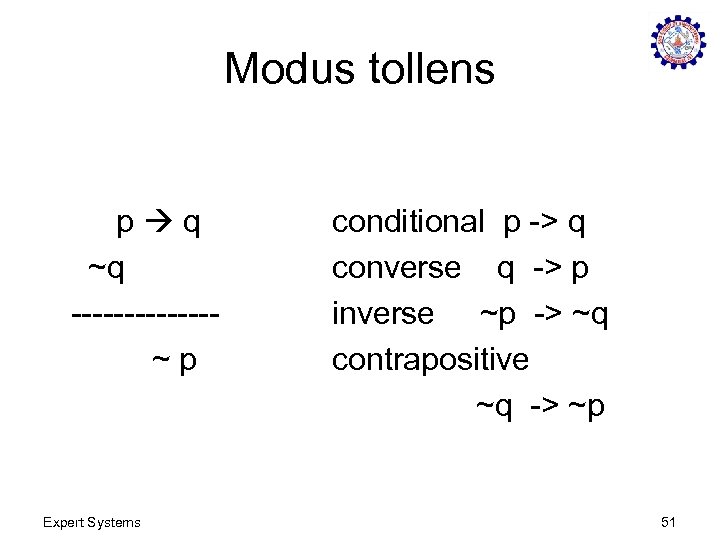 Modus tollens p q ~q -------~p Expert Systems conditional p -> q converse q -> p inverse ~p -> ~q contrapositive ~q -> ~p 51
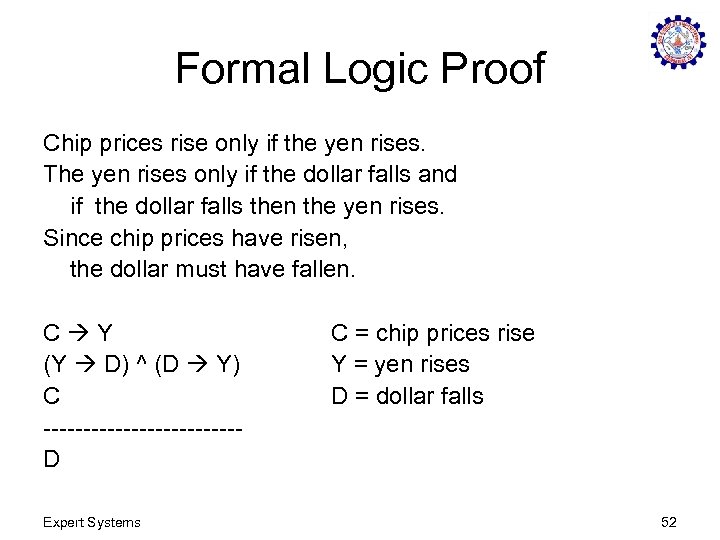 Formal Logic Proof Chip prices rise only if the yen rises. The yen rises only if the dollar falls and if the dollar falls then the yen rises. Since chip prices have risen, the dollar must have fallen. C Y (Y D) ^ (D Y) C ------------D Expert Systems C = chip prices rise Y = yen rises D = dollar falls 52
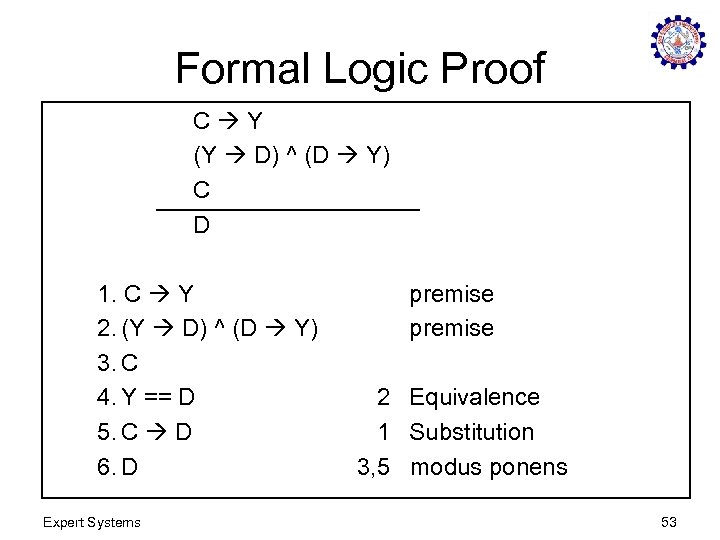 Formal Logic Proof C Y (Y D) ^ (D Y) C D 1. C Y 2. (Y D) ^ (D Y) 3. C 4. Y == D 5. C D 6. D Expert Systems premise 2 Equivalence 1 Substitution 3, 5 modus ponens 53
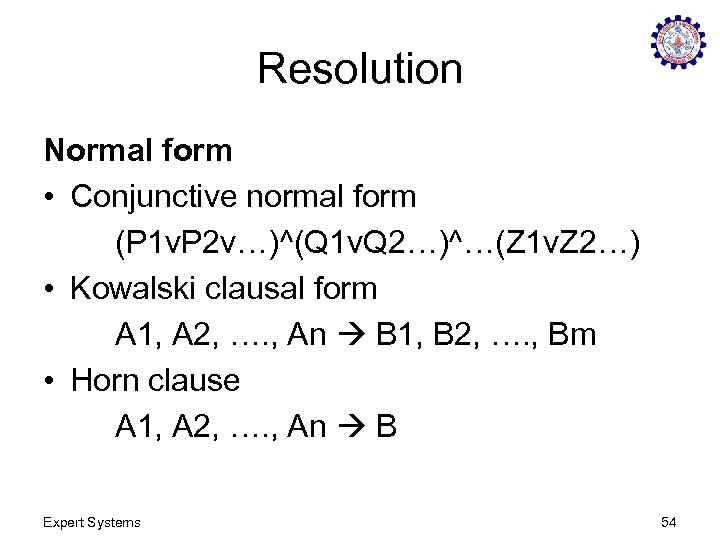 Resolution Normal form • Conjunctive normal form (P 1 v. P 2 v…)^(Q 1 v. Q 2…)^…(Z 1 v. Z 2…) • Kowalski clausal form A 1, A 2, …. , An B 1, B 2, …. , Bm • Horn clause A 1, A 2, …. , An B Expert Systems 54
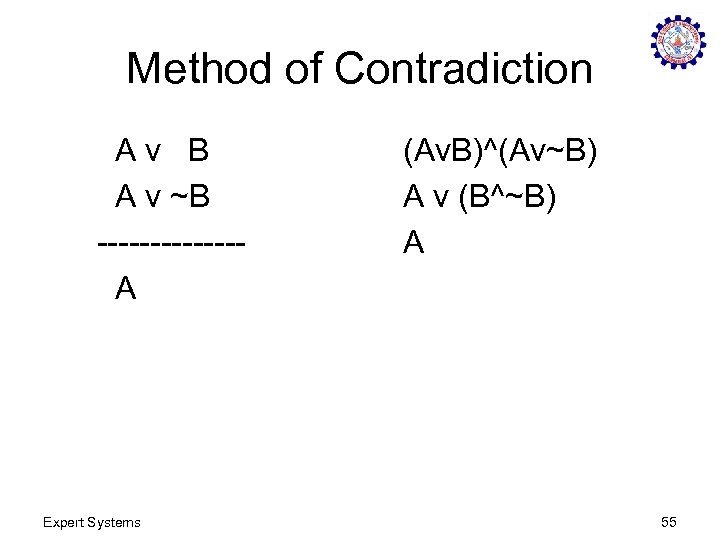 Method of Contradiction Av B A v ~B -------A Expert Systems (Av. B)^(Av~B) A v (B^~B) A 55
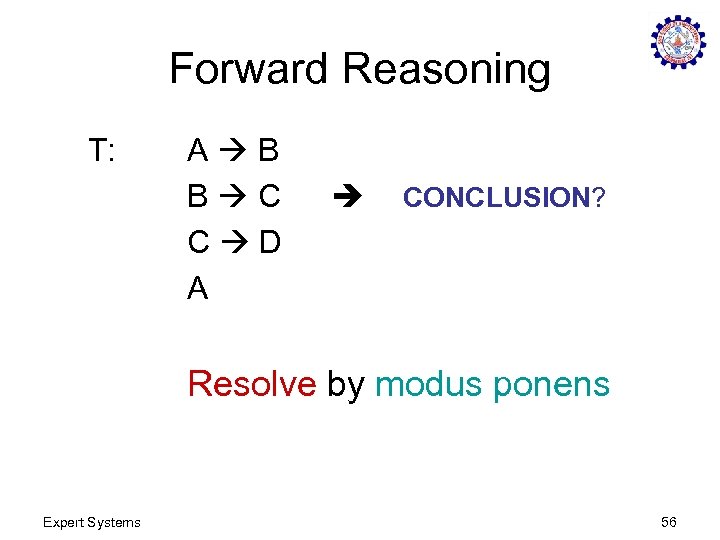 Forward Reasoning T: A B B C C D A CONCLUSION? Resolve by modus ponens Expert Systems 56
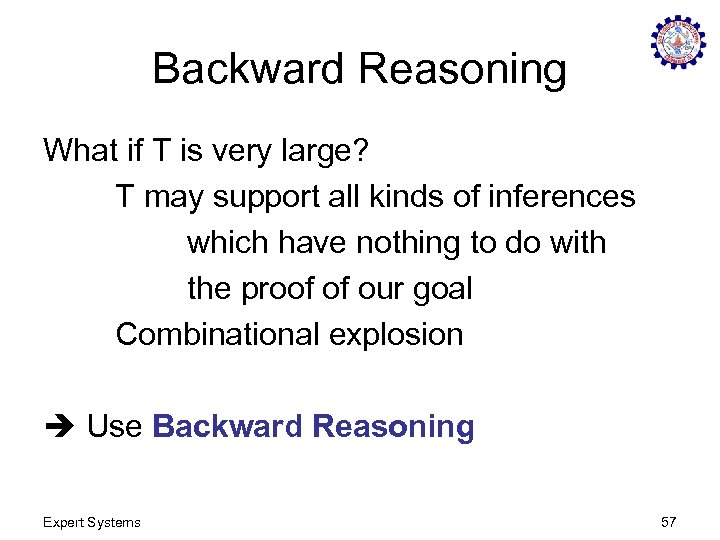 Backward Reasoning What if T is very large? T may support all kinds of inferences which have nothing to do with the proof of our goal Combinational explosion Use Backward Reasoning Expert Systems 57
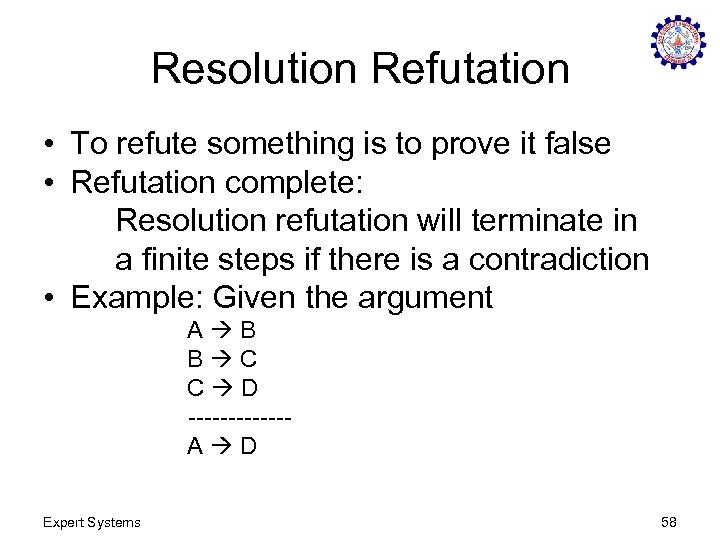 Resolution Refutation • To refute something is to prove it false • Refutation complete: Resolution refutation will terminate in a finite steps if there is a contradiction • Example: Given the argument A B B C C D ------A D Expert Systems 58
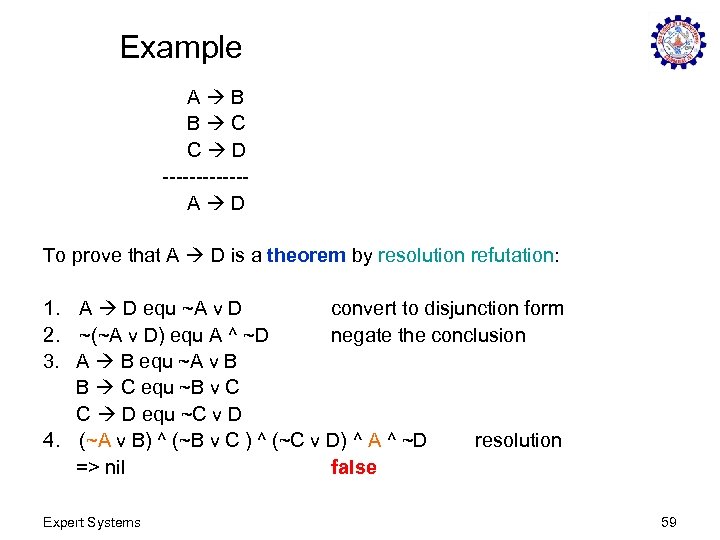 Example A B B C C D ------A D To prove that A D is a theorem by resolution refutation: 1. A D equ ~A v D convert to disjunction form 2. ~(~A v D) equ A ^ ~D negate the conclusion 3. A B equ ~A v B B C equ ~B v C C D equ ~C v D 4. (~A v B) ^ (~B v C ) ^ (~C v D) ^ A ^ ~D resolution => nil false Expert Systems 59
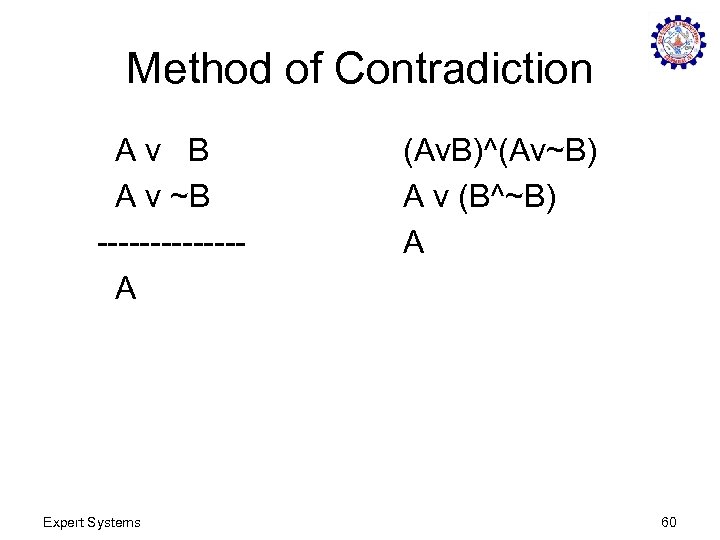 Method of Contradiction Av B A v ~B -------A Expert Systems (Av. B)^(Av~B) A v (B^~B) A 60
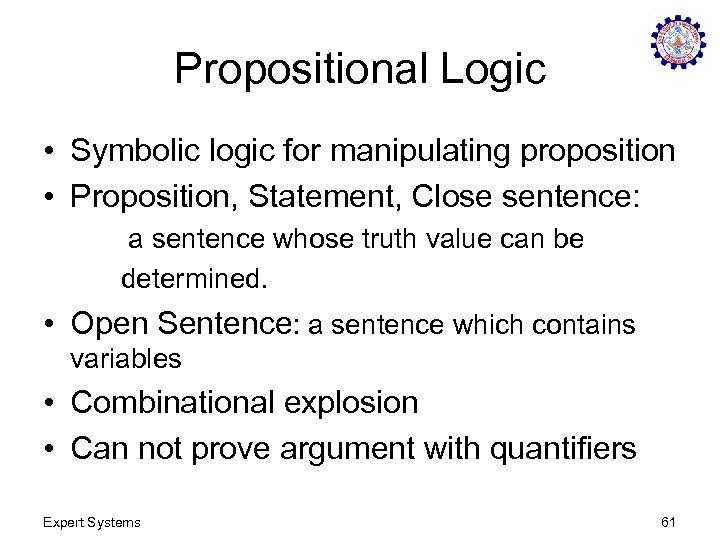 Propositional Logic • Symbolic logic for manipulating proposition • Proposition, Statement, Close sentence: a sentence whose truth value can be determined. • Open Sentence: a sentence which contains variables • Combinational explosion • Can not prove argument with quantifiers Expert Systems 61
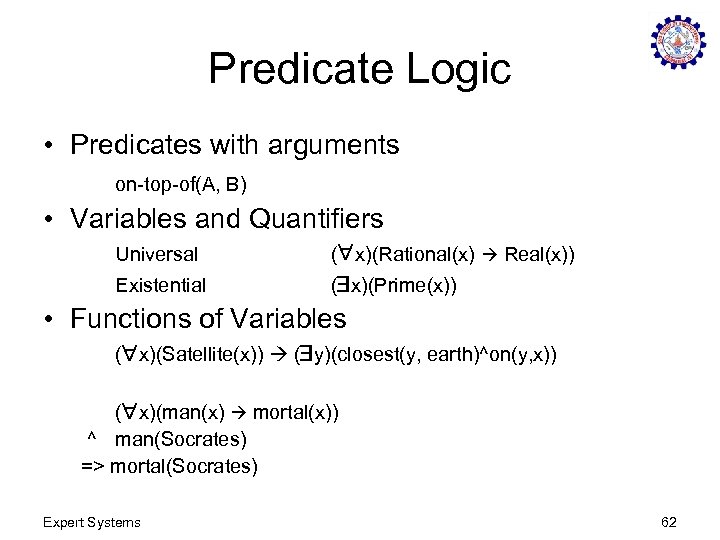 Predicate Logic • Predicates with arguments on-top-of(A, B) • Variables and Quantifiers Universal ( x)(Rational(x) Real(x)) Existential ( x)(Prime(x)) • Functions of Variables ( x)(Satellite(x)) ( y)(closest(y, earth)^on(y, x)) ( x)(man(x) mortal(x)) ^ man(Socrates) => mortal(Socrates) Expert Systems 62
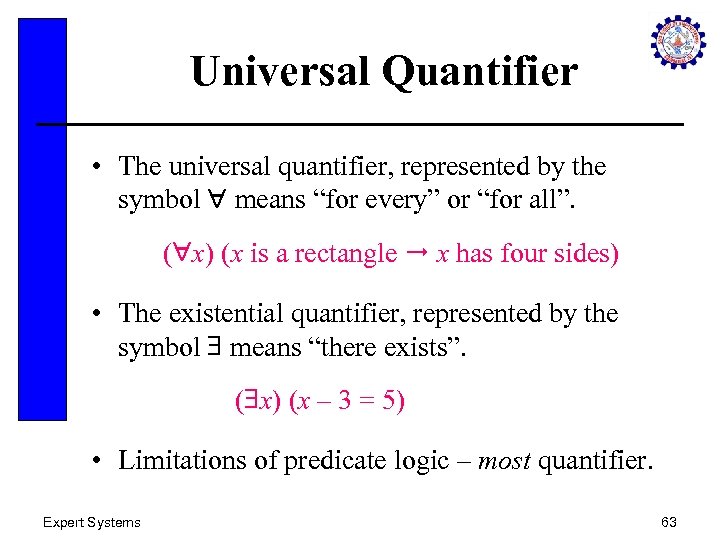 Universal Quantifier • The universal quantifier, represented by the symbol means “for every” or “for all”. ( x) (x is a rectangle x has four sides) • The existential quantifier, represented by the symbol means “there exists”. ( x) (x – 3 = 5) • Limitations of predicate logic – most quantifier. Expert Systems 63
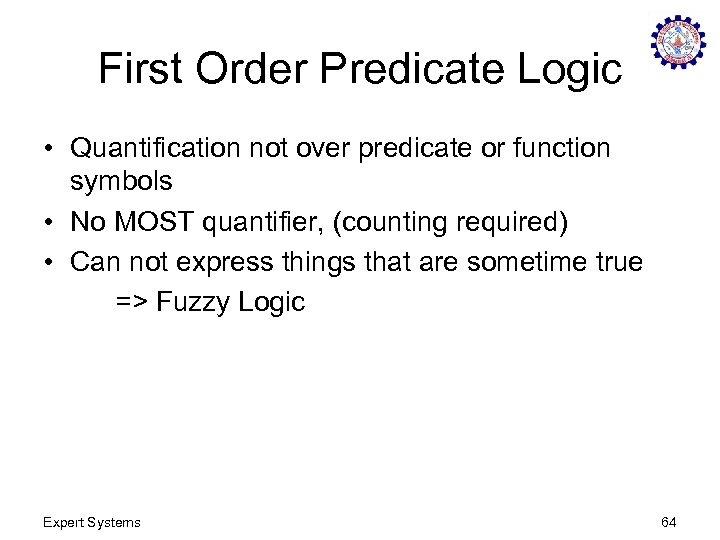 First Order Predicate Logic • Quantification not over predicate or function symbols • No MOST quantifier, (counting required) • Can not express things that are sometime true => Fuzzy Logic Expert Systems 64
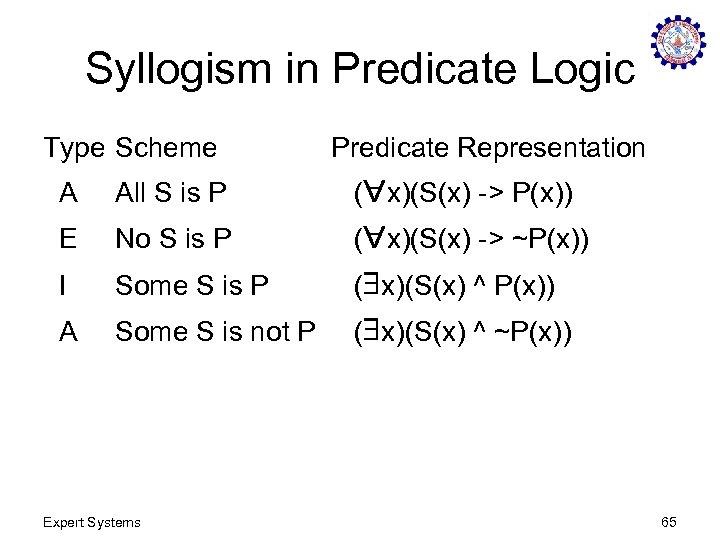 Syllogism in Predicate Logic Type Scheme Predicate Representation A All S is P ( x)(S(x) -> P(x)) E No S is P ( x)(S(x) -> ~P(x)) I Some S is P ( x)(S(x) ^ P(x)) A Some S is not P ( x)(S(x) ^ ~P(x)) Expert Systems 65
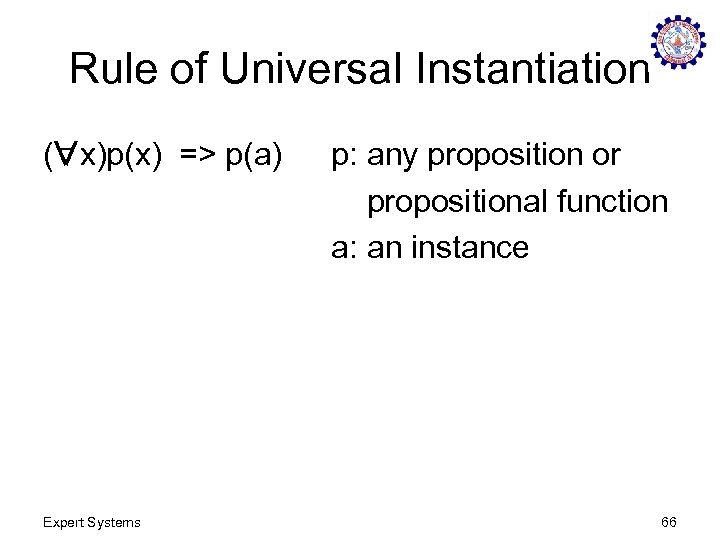 Rule of Universal Instantiation ( x)p(x) => p(a) Expert Systems p: any proposition or propositional function a: an instance 66
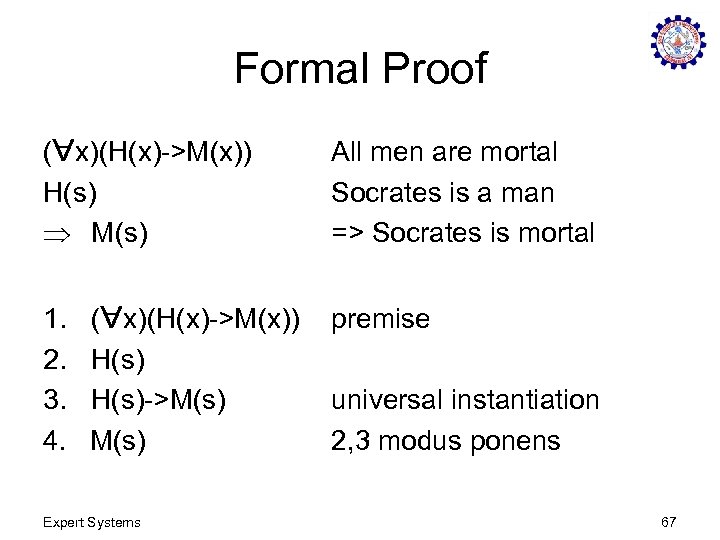 Formal Proof ( x)(H(x)->M(x)) H(s) Þ M(s) 1. 2. 3. 4. ( x)(H(x)->M(x)) H(s)->M(s) Expert Systems All men are mortal Socrates is a man => Socrates is mortal premise universal instantiation 2, 3 modus ponens 67
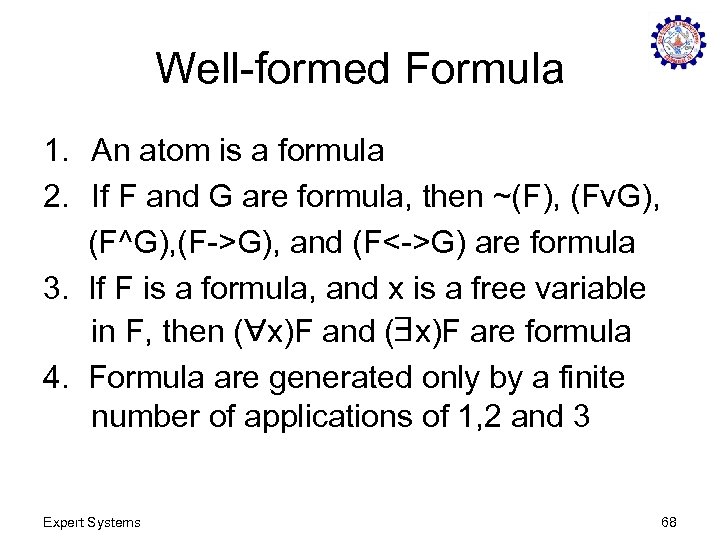 Well-formed Formula 1. An atom is a formula 2. If F and G are formula, then ~(F), (Fv. G), (F^G), (F->G), and (F<->G) are formula 3. If F is a formula, and x is a free variable in F, then ( x)F and ( x)F are formula 4. Formula are generated only by a finite number of applications of 1, 2 and 3 Expert Systems 68