


 Скачать презентацию Snowmaking Systems Snowmaking is an art Three
9c804423053b76303fd697f3056f4aea.ppt
- Количество слайдов: 19

![Snowmaking Systems “Snowmaking is an art. ” Three Types of Snowmaking Systems: ]Internal Mix](https://present5.com/presentation/9c804423053b76303fd697f3056f4aea/image-2.jpg "Snowmaking Systems “Snowmaking is an art. ” Three Types of Snowmaking Systems: ]Internal Mix") Snowmaking Systems “Snowmaking is an art. ” Three Types of Snowmaking Systems: ]Internal Mix ]External Mix Waterstick system ]Air/Water/Fan Air/water/fan snow gun
Snowmaking Systems “Snowmaking is an art. ” Three Types of Snowmaking Systems: ]Internal Mix ]External Mix Waterstick system ]Air/Water/Fan Air/water/fan snow gun
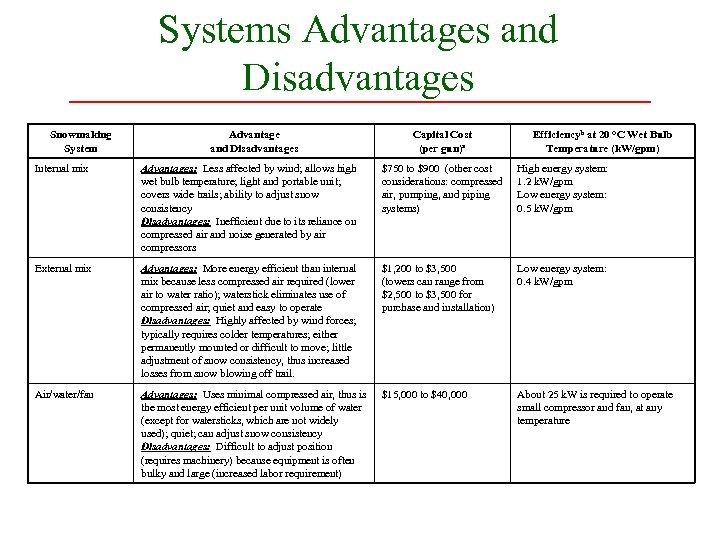 Systems Advantages and Disadvantages Snowmaking System Advantage and Disadvantages Capital Cost (per gun)a Efficiencyb at 20 °C Wet Bulb Temperature (k. W/gpm) Internal mix Advantages: Less affected by wind; allows high wet bulb temperature; light and portable unit; covers wide trails; ability to adjust snow consistency Disadvantages: Inefficient due to its reliance on compressed air and noise generated by air compressors $750 to $900 (other cost considerations: compressed air, pumping, and piping systems) High energy system: 1. 2 k. W/gpm Low energy system: 0. 5 k. W/gpm External mix Advantages: More energy efficient than internal mix because less compressed air required (lower air to water ratio); waterstick eliminates use of compressed air; quiet and easy to operate Disadvantages: Highly affected by wind forces; typically requires colder temperatures; either permanently mounted or difficult to move; little adjustment of snow consistency, thus increased losses from snow blowing off trail. $1, 200 to $3, 500 (towers can range from $2, 500 to $3, 500 for purchase and installation) Low energy system: 0. 4 k. W/gpm Air/water/fan Advantages: Uses minimal compressed air, thus is the most energy efficient per unit volume of water (except for watersticks, which are not widely used); quiet; can adjust snow consistency Disadvantages: Difficult to adjust position (requires machinery) because equipment is often bulky and large (increased labor requirement) $15, 000 to $40, 000 About 25 k. W is required to operate small compressor and fan, at any temperature
![Reservoirs Snowmaking requires large amounts of water Large water demand causes concerns of: ]Natural](https://present5.com/presentation/9c804423053b76303fd697f3056f4aea/image-4.jpg "Reservoirs Snowmaking requires large amounts of water Large water demand causes concerns of: ]Natural") Reservoirs Snowmaking requires large amounts of water Large water demand causes concerns of: ]Natural water supplies ]Negative impact of wildlife and habitat Reservoirs can help: Ø protect natural water resources Ø protect aquatic habitat Ø reduce energy consumption
Reservoirs Snowmaking requires large amounts of water Large water demand causes concerns of: ]Natural water supplies ]Negative impact of wildlife and habitat Reservoirs can help: Ø protect natural water resources Ø protect aquatic habitat Ø reduce energy consumption
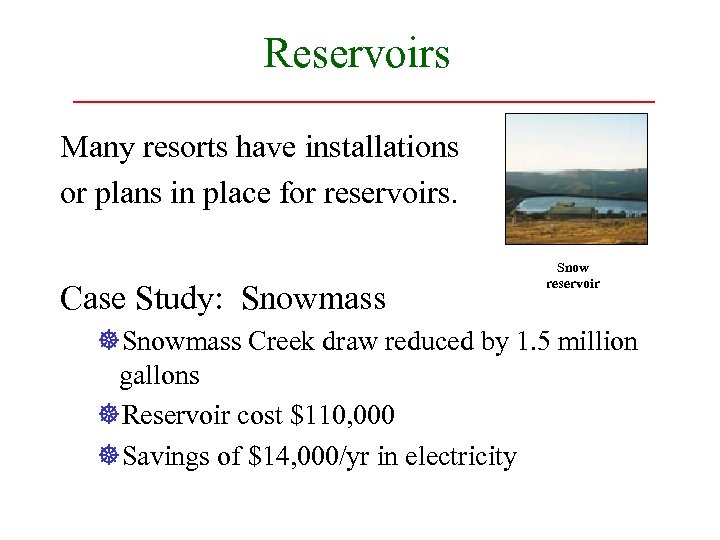 Reservoirs Many resorts have installations or plans in place for reservoirs. Case Study: Snowmass Snow reservoir ]Snowmass Creek draw reduced by 1. 5 million gallons ]Reservoir cost $110, 000 ]Savings of $14, 000/yr in electricity
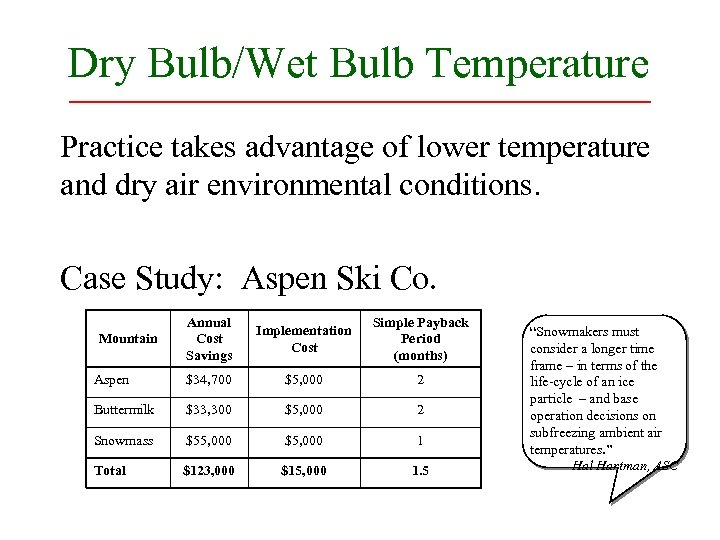 Dry Bulb/Wet Bulb Temperature Practice takes advantage of lower temperature and dry air environmental conditions. Case Study: Aspen Ski Co. Annual Cost Savings Implementation Cost Simple Payback Period (months) Aspen $34, 700 $5, 000 2 Buttermilk $33, 300 $5, 000 2 Snowmass $55, 000 $5, 000 1 Total $123, 000 $15, 000 1. 5 Mountain “Snowmakers must consider a longer time frame – in terms of the life-cycle of an ice particle – and base operation decisions on subfreezing ambient air temperatures. ” Hal Hartman, ASC
 Additives Definition: Substances that act as nucleators to increase the nucleation temperature at which water droplets begin to form ice particles. …similar to the formation of clouds
 Additives The decision to use additives depends on the purity of the water and the presence or lack of naturally occurring nucleators. If there is a sufficient number of naturally occurring impurities, additives can be excluded from the snowmaking process.
 Water Cooling Systems cool the water supplied for snowmaking. Cooler water minimizes losses and increases efficiency. In a nutshell… …the cooler the water, the less water is left unfrozen and the more snow is produced!
![Water Cooling Systems Case Study: Snowmass ]Ski area uses cooling tower for snowmaking ]Water](https://present5.com/presentation/9c804423053b76303fd697f3056f4aea/image-10.jpg "Water Cooling Systems Case Study: Snowmass ]Ski area uses cooling tower for snowmaking ]Water") Water Cooling Systems Case Study: Snowmass ]Ski area uses cooling tower for snowmaking ]Water temperatures dropped from 42 to 34°F ]Cost and energy savings negligible, but equipment allows for earlier start to season Water cooler
Water Cooling Systems Case Study: Snowmass ]Ski area uses cooling tower for snowmaking ]Water temperatures dropped from 42 to 34°F ]Cost and energy savings negligible, but equipment allows for earlier start to season Water cooler
 System Control Automation Automated snowmaking systems adjust to weather conditions to optimize efficiency and minimize snowmaking variability. Automated systems can… …montior (i. e. , flow rates, temperatures, etc. ) …control (i. e. , pressure, compressors, etc. ) …manage (i. e. , snowmaking process, equipment, etc. ) …report (i. e. , alarms in real-time) …trend (i. e. , historical data on operations)
![System Control Automation Case Study: Snowmass ]Systems primary benefit: adjust water flow acc’d to](https://present5.com/presentation/9c804423053b76303fd697f3056f4aea/image-12.jpg "System Control Automation Case Study: Snowmass ]Systems primary benefit: adjust water flow acc’d to") System Control Automation Case Study: Snowmass ]Systems primary benefit: adjust water flow acc’d to air temp ]4. 5 -6. 3 million gal. of water saved/year ]Water savings translates to $8, 700 – $12, 200/year Example: Mountain operation screen for snowmaking guns
System Control Automation Case Study: Snowmass ]Systems primary benefit: adjust water flow acc’d to air temp ]4. 5 -6. 3 million gal. of water saved/year ]Water savings translates to $8, 700 – $12, 200/year Example: Mountain operation screen for snowmaking guns
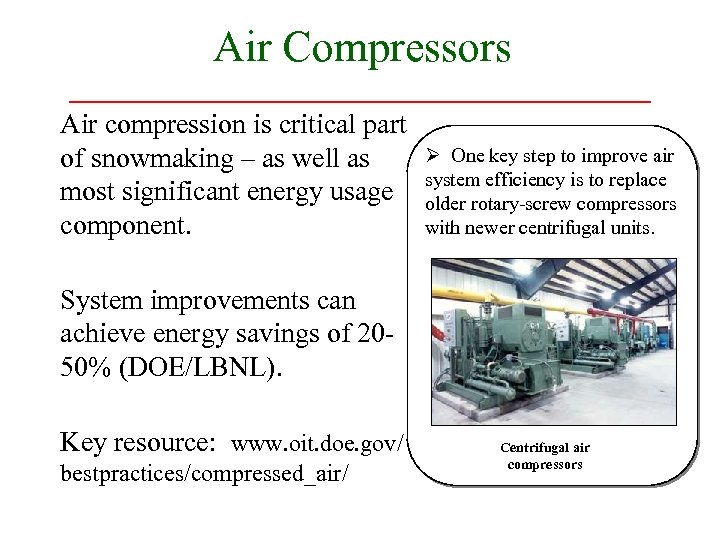 Air Compressors Air compression is critical part of snowmaking – as well as most significant energy usage component. Ø One key step to improve air system efficiency is to replace older rotary-screw compressors with newer centrifugal units. System improvements can achieve energy savings of 2050% (DOE/LBNL). Key resource: www. oit. doe. gov/ bestpractices/compressed_air/ Centrifugal air compressors
![Air Compressors Case Study: Breckenridge ]Four new centrifugal air compressors were installed to replace](https://present5.com/presentation/9c804423053b76303fd697f3056f4aea/image-14.jpg "Air Compressors Case Study: Breckenridge ]Four new centrifugal air compressors were installed to replace") Air Compressors Case Study: Breckenridge ]Four new centrifugal air compressors were installed to replace the existing rotary-screws ]The newer units eliminate oil use ]Including snow gun upgrades, energy savings of snowmaking system improvements yielded 1, 416 k. W/yr; 1, 214, 284 k. Wh/yr; and $36, 192/yr.
Air Compressors Case Study: Breckenridge ]Four new centrifugal air compressors were installed to replace the existing rotary-screws ]The newer units eliminate oil use ]Including snow gun upgrades, energy savings of snowmaking system improvements yielded 1, 416 k. W/yr; 1, 214, 284 k. Wh/yr; and $36, 192/yr.
![Air Leak Inspections Leaks are especially wasteful of energy. Recommended practices: ]Regular inspections to](https://present5.com/presentation/9c804423053b76303fd697f3056f4aea/image-15.jpg "Air Leak Inspections Leaks are especially wasteful of energy. Recommended practices: ]Regular inspections to") Air Leak Inspections Leaks are especially wasteful of energy. Recommended practices: ]Regular inspections to identify any air leaks ]Repair leaks in pipelines ]Shut all unused valves to prevent loss of air ]Repair all aboveground leaks at the hydrants ]Repair leaks in equipment, valves and fittings ]Target and replace corroded underground pipelines
Air Leak Inspections Leaks are especially wasteful of energy. Recommended practices: ]Regular inspections to identify any air leaks ]Repair leaks in pipelines ]Shut all unused valves to prevent loss of air ]Repair all aboveground leaks at the hydrants ]Repair leaks in equipment, valves and fittings ]Target and replace corroded underground pipelines
 Air Leak Inspections Case Study: Aspen
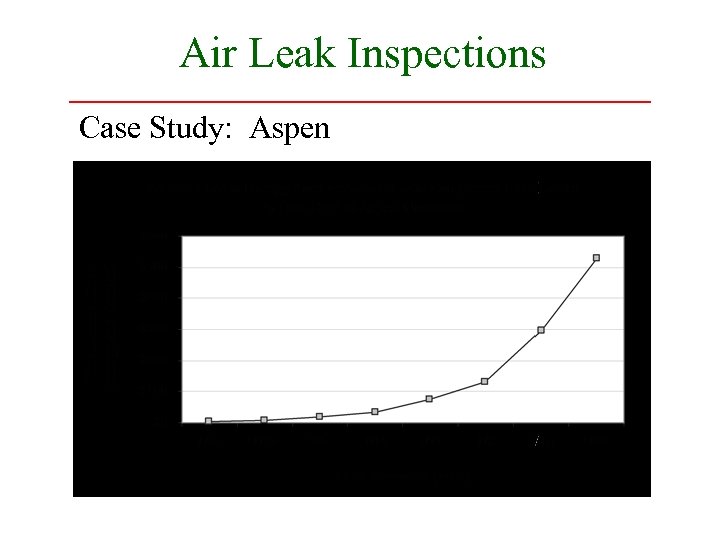
![Air Leak Inspections Case Study: Aspen ] System includes 6 compressors rated at about](https://present5.com/presentation/9c804423053b76303fd697f3056f4aea/image-17.jpg "Air Leak Inspections Case Study: Aspen ] System includes 6 compressors rated at about") Air Leak Inspections Case Study: Aspen ] System includes 6 compressors rated at about 1, 400 hp and operating 1, 100/yr ] Estimated 275 hp lost to leaks ] Results: • • Energy savings of 205, 200 k. Wh/yr Total demand savings 515 k. W/yr Total cost savings $8, 230 Estimated 3 year payback on $25, 000 implementation costs
Air Leak Inspections Case Study: Aspen ] System includes 6 compressors rated at about 1, 400 hp and operating 1, 100/yr ] Estimated 275 hp lost to leaks ] Results: • • Energy savings of 205, 200 k. Wh/yr Total demand savings 515 k. W/yr Total cost savings $8, 230 Estimated 3 year payback on $25, 000 implementation costs
![Water Leak Inspections Water leak causes: ] corroded underground pipes ] faulty piping and/or](https://present5.com/presentation/9c804423053b76303fd697f3056f4aea/image-18.jpg "Water Leak Inspections Water leak causes: ] corroded underground pipes ] faulty piping and/or") Water Leak Inspections Water leak causes: ] corroded underground pipes ] faulty piping and/or installation Impact and costs considerations: ] severity of the leak ] pumping system ] slope(s) topography ] materials for repair ] excavation ] revegetation What’s the big deal? Ø wasted water Ø lost pumping energy Ø snow melting
Water Leak Inspections Water leak causes: ] corroded underground pipes ] faulty piping and/or installation Impact and costs considerations: ] severity of the leak ] pumping system ] slope(s) topography ] materials for repair ] excavation ] revegetation What’s the big deal? Ø wasted water Ø lost pumping energy Ø snow melting
![Water Leak Inspections Case Study: Aspen ] Using a closed-loop test, a large leak](https://present5.com/presentation/9c804423053b76303fd697f3056f4aea/image-19.jpg "Water Leak Inspections Case Study: Aspen ] Using a closed-loop test, a large leak") Water Leak Inspections Case Study: Aspen ] Using a closed-loop test, a large leak found between primary and booster pumphouses ] Results: Item Estimated water savings Estimated water cost savings Estimated electricity cost savings Annual Savings 6, 600, 000 gal $12, 740 $820 Total Annual Cost Savings $13, 560 Implementation Cost $12, 000 Simple Payback Period 0. 9 year
Water Leak Inspections Case Study: Aspen ] Using a closed-loop test, a large leak found between primary and booster pumphouses ] Results: Item Estimated water savings Estimated water cost savings Estimated electricity cost savings Annual Savings 6, 600, 000 gal $12, 740 $820 Total Annual Cost Savings $13, 560 Implementation Cost $12, 000 Simple Payback Period 0. 9 year