


 Скачать презентацию SNOMED Clinical Terms Concepts and Descriptions Kent A
f4111ff8a2482ae0f1451bc8400c6f83.ppt
- Количество слайдов: 48
 SNOMED Clinical Terms: Concepts and Descriptions Kent A. Spackman, MD, Ph. D Oregon Health & Science University, Portland OR Chair, SNOMED International Editorial Board HL 7 UK London – November 2004
 Which concepts and which descriptions? • • • 2 What is SNOMED CT? What is it for? How can it be used? w Relationship to information models, patient data What is involved in developing & maintaining it? w Semantics w Design principles & logic foundation Opportunities for having input
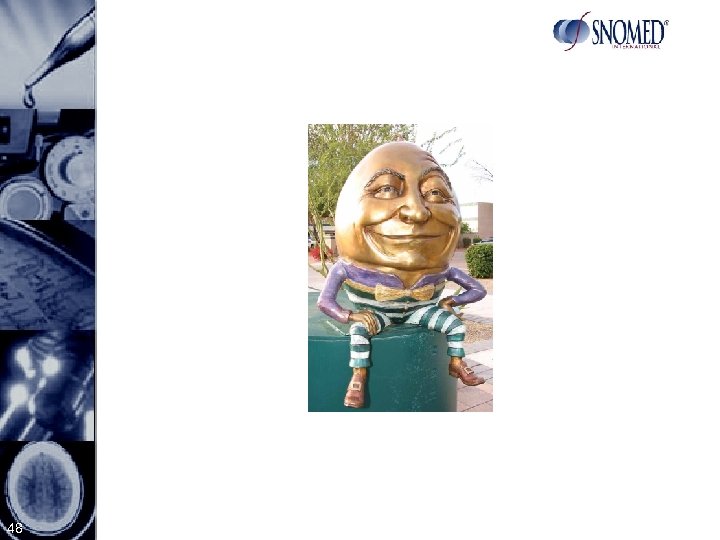
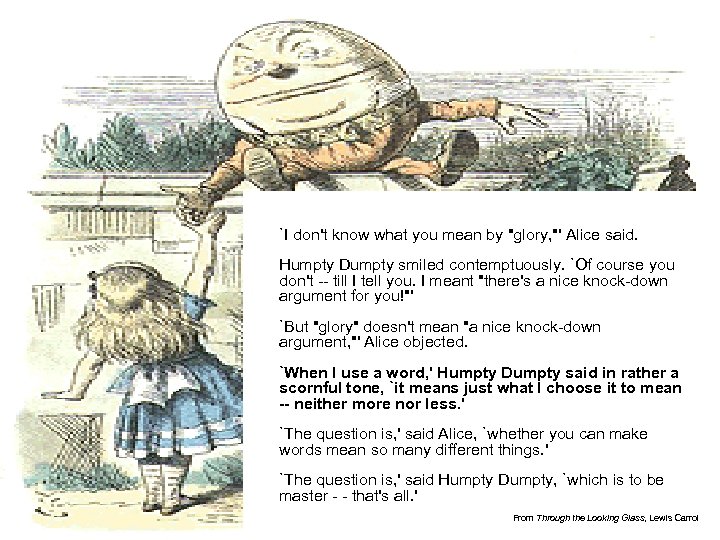 `I don't know what you mean by "glory, "' Alice said. Humpty Dumpty smiled contemptuously. `Of course you don't -- till I tell you. I meant "there's a nice knock-down argument for you!"' `But "glory" doesn't mean "a nice knock-down argument, "' Alice objected. `When I use a word, ' Humpty Dumpty said in rather a scornful tone, `it means just what I choose it to mean -- neither more nor less. ' `The question is, ' said Alice, `whether you can make words mean so many different things. ' `The question is, ' said Humpty Dumpty, `which is to be master - - that's all. ' 3 From Through the Looking Glass, Lewis Carrol
 What is it? • 4 “The Systematized Nomenclature of Medicine” No Med
 What is it? • • • 5 A reference terminology A clinical terminology w with reference and interface properties A CD containing a set of tables A set of codes with names A set of definitions “per genus et differentiam” A clinical terminology standard A knowledge base? A dictionary? An ontology? An application ontology?
 Formal Ontology? • • 6 SNOMED is not a formal ontology (but some parts of it are migrating in that direction) It is a reference terminology that is progressively more wellsupported by formal ontological principles w Includes terms and non-ontological assertions / ideas w I dislike the term “application ontology” – fish or fowl? Many of SNOMED’s design decisions are supported by formal ontological principles. w But… Many of SNOMED’s hierarchies are still “unprincipled” and incomplete. w Requires continued evolution and maturation
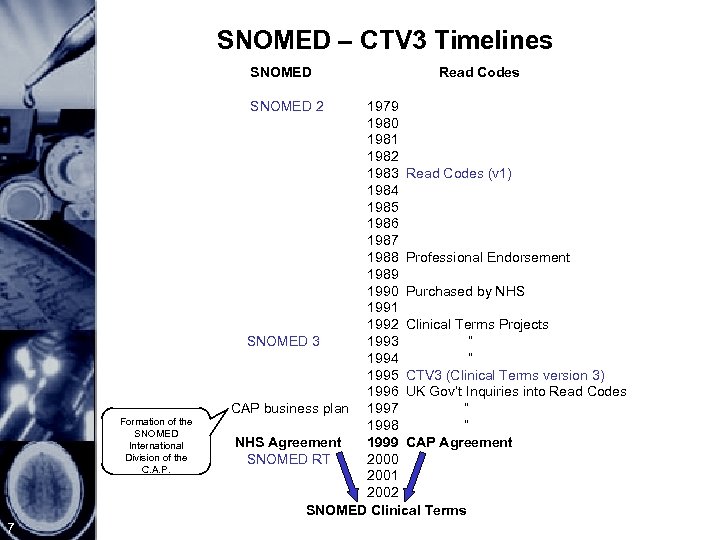 SNOMED – CTV 3 Timelines SNOMED 2 Formation of the SNOMED International Division of the C. A. P. 7 Read Codes 1979 1980 1981 1982 1983 Read Codes (v 1) 1984 1985 1986 1987 1988 Professional Endorsement 1989 1990 Purchased by NHS 1991 1992 Clinical Terms Projects SNOMED 3 1993 “ 1994 “ 1995 CTV 3 (Clinical Terms version 3) 1996 UK Gov’t Inquiries into Read Codes CAP business plan 1997 “ 1998 “ NHS Agreement 1999 CAP Agreement SNOMED RT 2000 2001 2002 SNOMED Clinical Terms
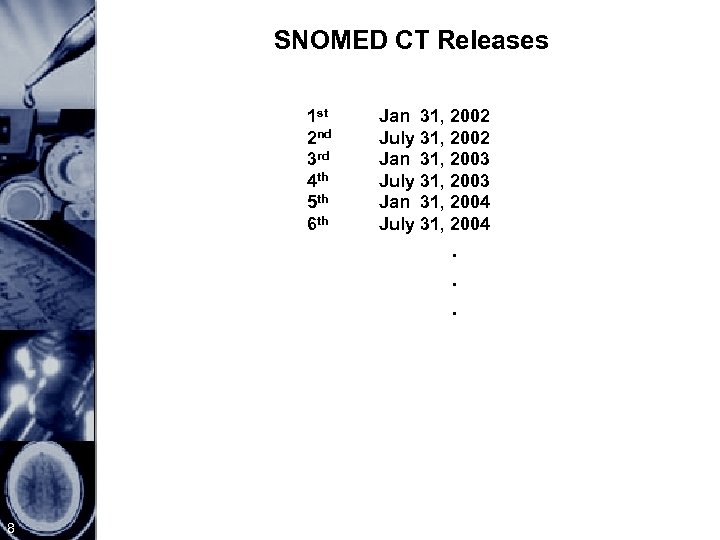 SNOMED CT Releases 1 st 2 nd 3 rd 4 th 5 th 6 th Jan 31, 2002 July 31, 2002 Jan 31, 2003 July 31, 2003 Jan 31, 2004 July 31, 2004 . . . 8
 Content, Content 9
 Emergence as a Standard: Recent Events • Government Actions – US and UK w w w 10 US National License ANSI – Terminology Distribution Structure Standard US NCVHS – HIPAA recommendation US Government CHI Initiative recommendation UMLS release UK NPf. IT adoption
 What does it do? • SNOMED CT is a terminological resource that can be implemented in software applications to represent clinically relevant information w In a “semantically structured” form that can be used by automated applications 11
 What is it for? • It is for building applications capable of: w Recording statements about the health and health care of individuals • In a way that permits retrieval according to the meaning of the statements, rather than just the words used w Retrieving individual cases and groups of cases • To enable more automated and sophisticated decision support, epidemiology, and research 12
 Successful use of SNOMED CT depends on: • • 13 Implementation in clinical records systems Which in turn requires (at least) a patient data model (information model)
 The simplest information model • Put all clinical data here __________ The simplest terminology model • Two values: • Yes • No Intermediate between these extremes there are many possible solutions! 14
 What about clinical decision support? 15
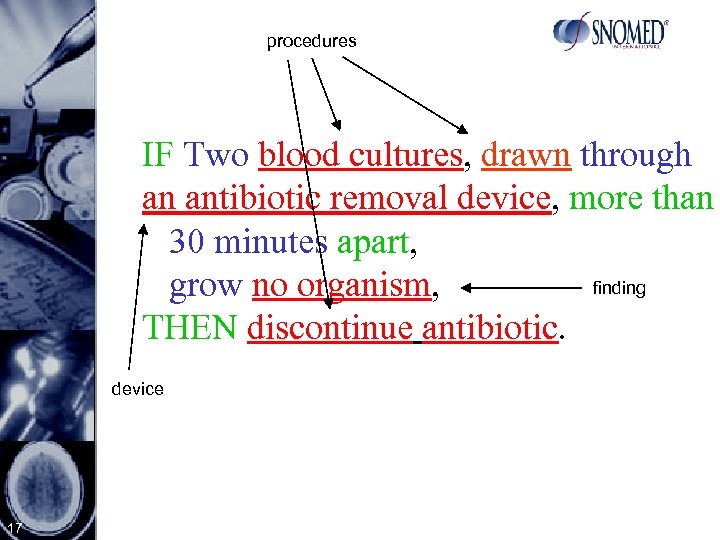
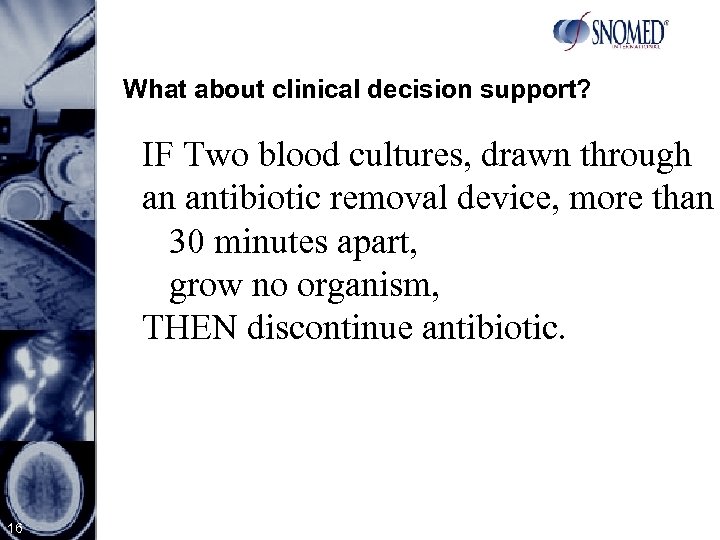 What about clinical decision support? IF Two blood cultures, drawn through an antibiotic removal device, more than 30 minutes apart, grow no organism, THEN discontinue antibiotic. 16
 procedures IF Two blood cultures, drawn through an antibiotic removal device, more than 30 minutes apart, finding grow no organism, THEN discontinue antibiotic. device 17
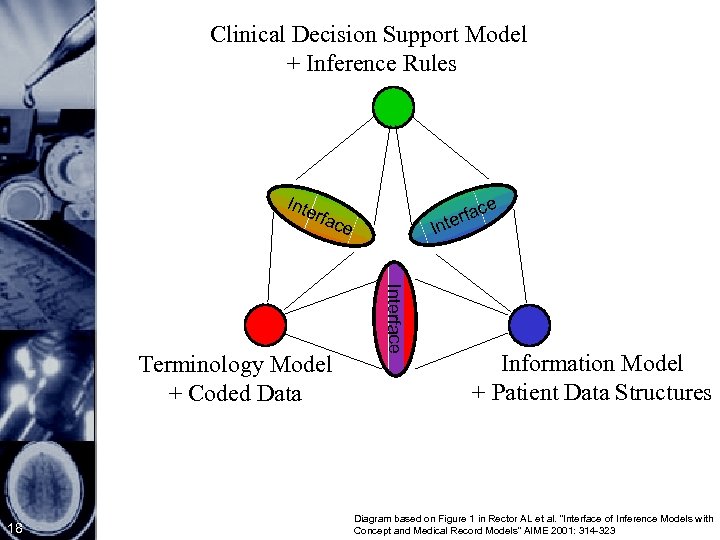 Clinical Decision Support Model + Inference Rules Inte e c erfa t rfac 18 In Interface Terminology Model + Coded Data e Information Model + Patient Data Structures Diagram based on Figure 1 in Rector AL et al. “Interface of Inference Models with Concept and Medical Record Models” AIME 2001: 314 -323
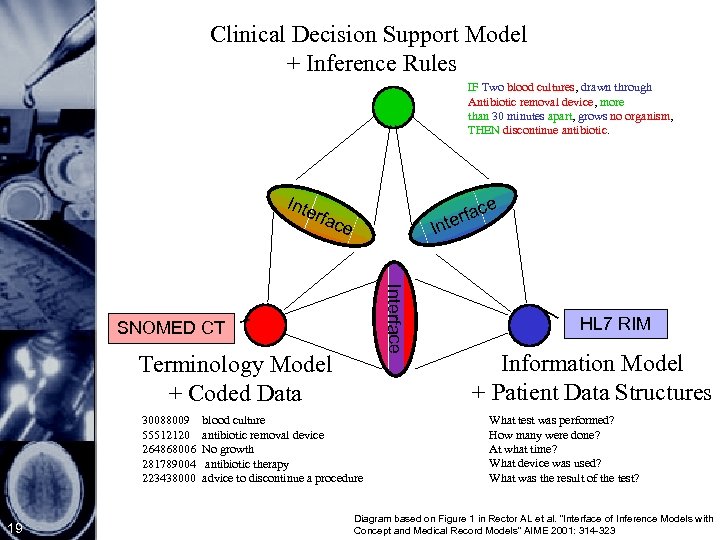 Clinical Decision Support Model + Inference Rules IF Two blood cultures, drawn through Antibiotic removal device, more than 30 minutes apart, grows no organism, THEN discontinue antibiotic. Inte e c erfa t rfac e In Interface SNOMED CT Terminology Model + Coded Data 30088009 55512120 264868006 281789004 223438000 19 blood culture antibiotic removal device No growth antibiotic therapy advice to discontinue a procedure HL 7 RIM Information Model + Patient Data Structures What test was performed? How many were done? At what time? What device was used? What was the result of the test? Diagram based on Figure 1 in Rector AL et al. “Interface of Inference Models with Concept and Medical Record Models” AIME 2001: 314 -323
 What is involved in creating and maintaining SNOMED CT? • Representation of meaning w Judgments of “same or different” w Representing clearly “what clinicians mean when they say …” 20
 It is notoriously difficult to tell what people mean just by what they say • • From “The Economist”, Charlemagne column, Sept 4, 2004 “Decoding a Euro-diplomat takes more than a dictionary” w “Up to a point” means “I agree in part”? Wrong, it means: • “No, not in the slightest” w “I hear what you say” means “He accepts my point of view”? Wrong, it means: • “I disagree and do not want to discuss it any further” w “With the greatest respect” means • “I think you are wrong, or a fool” w “By the way” or “incidentally” means “This is not very important”? Wrong, it means • “The primary purpose of our discussion is …” w “I’ll bear it in mind” “I’ll do nothing about it” w “Correct me if I’m wrong” “I’m right, don’t contradict me” 21
 Discerning and representing meaning of health terminology is difficult • What is juvenile rheumatoid arthritis? w Seropositive chronic idiopathic arthritis in child < 16 yrs ? w Any chronic arthritis in child < 16 yrs? w Is Adult-onset Still’s disease included? • Three different published terminology standards, all incompatible w JRA (juvenile rheumatoid arthritis) – US w JCA (juvenile chronic arthritis) – UK w JIA (juvenile idiopathic arthritis) – International 22
 Words alone are insufficient • • • 23 There are national, regional and local variations in meaning of words and phrases (even within the same language) Multiple meanings with the same “preferred name” Combining words gives something entirely different from the sum of the parts Ambiguous shorthand abbreviations are common The same phrase means different things to different specialists The same word or phrase means different things depending on what you are doing at the time Significant differences in meaning are often obscured through use of the same word Formal definitions are often at variance with common clinical usage A general name takes on a more specific meaning A manifestation is often used to name the disorder in which it occurs Successful communication relies on making ontological distinctions that are ignored by common phrasing
 What is “pudding”? • • • At dinner in Phoenix, Roger (from the UK) asked “Is anyone having pudding? ” To which I replied, “Do you mean dessert? ” And he said, “No, I mean pudding. ” ? Within the same language there are significant national, regional and local variations 24
 What is “scalp”? • • • scalp: the skin covering the cranium (Stedman’s) scalp: the soft tissue envelope of the cranial vault, consists of 5 layers: the skin, connective tissue, epicranial aponeurosis + occipitofrontalis muscle, loose areolar tissue, and pericranium. (Gardner, Gray & O’Rahilly, anatomy text) Epicranium (Stedman’s): the muscle, aponeurosis and skin covering the cranium It is quite clear SNOMED must have two different codes (two different Meanings) that bear the name “scalp” We say like Humpty Dumpty “When I use the word scalp, …” 25
 What is a “pyogenic granuloma? ” • • Pyogenic = pus forming Granuloma = a collection of inflammatory cells of a particular type • Pyogenic granuloma = a benign tumor of small blood vessels of the skin It is neither pyogenic nor a granuloma. • Combinations are frequently very different from the sum of their parts 26
 What is “general paresis”? • • General = affecting all skeletal muscles Paresis = weakness • GPI = a form of tertiary neurosyphilis characterized by generalized weakness Shorthand abbreviations are common 27
 What is “acute inflammation”? • To the GP, it is inflammation with an acute onset, characterised by redness, heat, swelling and pain. • To the pathologist, it is inflammation in which polymorphonuclear leukocytes predominate, as opposed to chronic inflammation, in which “mononuclear cells” (lymphocytes, plasma cells, monocytes, histiocytes) predominate. The same phrase can mean different things to different specialists 28
 What is the “fundus”? • When caring for a pregnant patient – • When examining the eyes – • When doing a gastroscopy – • When doing a cholecystectomy – What you are doing at the time changes the meaning of words 29
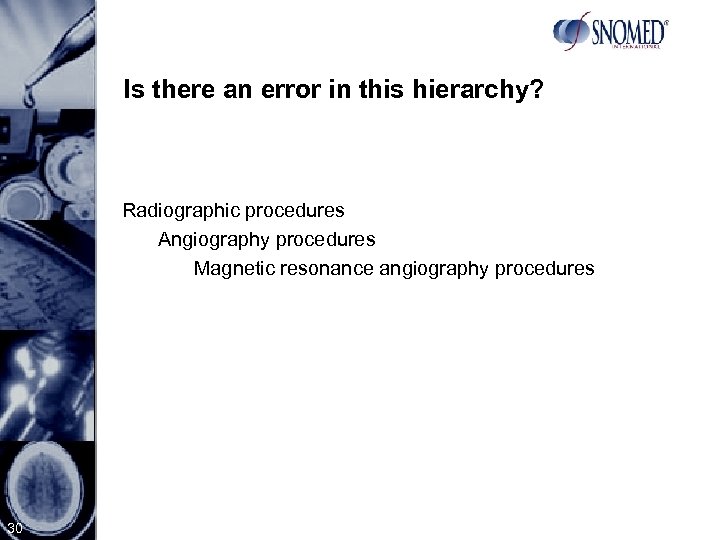 Is there an error in this hierarchy? Radiographic procedures Angiography procedures Magnetic resonance angiography procedures 30
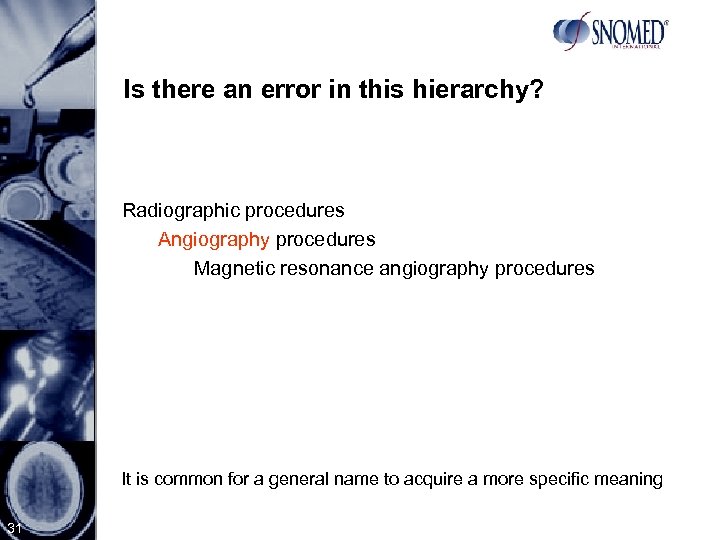 Is there an error in this hierarchy? Radiographic procedures Angiography procedures Magnetic resonance angiography procedures It is common for a general name to acquire a more specific meaning 31
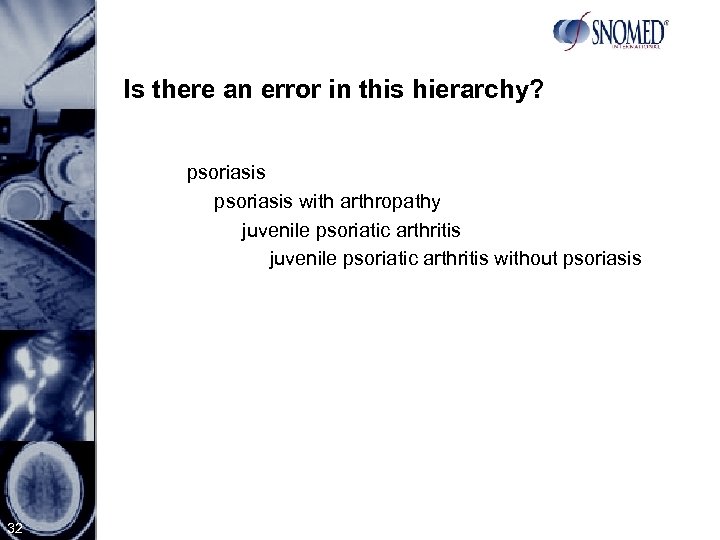 Is there an error in this hierarchy? psoriasis with arthropathy juvenile psoriatic arthritis without psoriasis 32
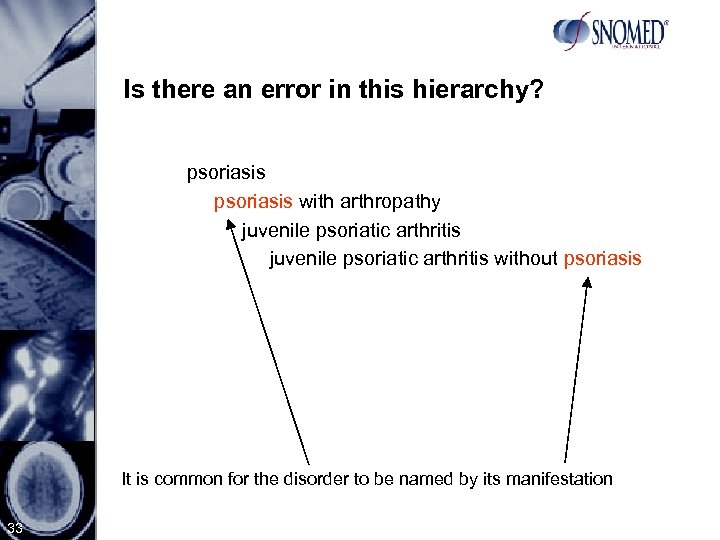 Is there an error in this hierarchy? psoriasis with arthropathy juvenile psoriatic arthritis without psoriasis It is common for the disorder to be named by its manifestation 33
 What is a “laceration”? • • Torn or jagged wound vs Accidental cut wound Perineal laceration during O-P delivery vs Laceration of thumb while using kitchen knife Subtle distinctions are often implicit 34
 What is the “leg”? • • 1) same as “lower limb” 2) just the part from the knee to the ankle w Stedman’s “the segment of the inferior limb between the knee and the ankle” w Dorland’s “that section of the lower limb between the knee and ankle” Some formal definitions are in conflict with ordinary usage 35
 What does “aspirin” mean? • • Some aspirin – the chemical ASA An aspirin – a tablet containing ASA Formal ontologists insist on a clean distinction between the individual and the matter or stuff of which it is made. 36
 How does SNOMED address these issues? • Careful representation of meaning w Evolutionary design w Formal description logic foundation w Consensus process • URU criteria: understandable, reproducible, useful 37
 We are not the language police 38
 Evolutionary Design • • • Evolution without pre-ordained design Accumulation of desirable features Heterogeneity of perspectives • Dealing with Scale w Participatory consensus-based approach • Involve the experts w Semantics-based concurrency control • Description logic underpinnings w Configuration management tools • Keith Campbell’s “Galapagos” tool set 39
 Description Logic Foundation • • • SNOMED is based on the description logic known as ELH w Conjunction w Existential restrictions w Role hierarchies Plus “role groups” (see 2002 AMIA paper) Plus role composition w So far, only one: direct-substance o has-activeingredient 40
 How large is large? • With 800, 000+ terms in SNOMED CT w if you spent 5 seconds looking at each one it would take you w 4 million seconds = 66, 666 minutes = 1, 111 hours w 138 work days if that’s all you did every day w 138/5 = almost 28 work weeks • • 41 At SNOMED we don’t just pretend to know about the problems of scale. That’s not saying we think we’ve solved them.
 Number of attributes (relationship types) in the SNOMED concept model 42
 Percentage of SNOMED CT concept codes that are “fully defined” 43 Eventually should reach ~70% or more of disorders, findings & procedures
 How long will it take? • That depends on what you want: w It is ready for use now. w If you wait for perfection you wait forever. w But tell us what needs the most urgent attention. 44
 SNOMED phases • • 45 1975 -1994 Roger Cote phase 1995 -1997 Kaiser CMT phase 1997 -1999 CAP phase – building SNOMED RT 1999 -2002 SNOMED – Read merge phase 2002 -2004 US/UK endorsement phase 2004 - adoption, use & maintenance phase The hardest part is still ahead
 There is opportunity to be involved • • • 46 Open working group meetings + on-line discussion forums Active working groups: w Concept model working group w Mapping working group w Content-area focused working groups • • Primary care Nursing Genomics Anesthesiology, pathology, dermatology, ophthalmology, … Upcoming in-person meeting dates: w Feb 2, 2005, S. California w June 14 -15, 2005, Chicago w Oct 5, 2005, London
 Concept Model Working Group issues: • • Context Negation Composition (“post-coordination”) Interface between concept model & information model w Specifically interface between SNOMED & HL 7 v 3 w Proposed work item (or possible SIG) with HL 7 vocab 47
 48
48