 Скачать презентацию SNOLAB Aksel Hallin NNN 08 Paris September 12
d26935c4c3e669cf84fbd0cab6beefd0.ppt
- Количество слайдов: 31



SNOLAB Aksel Hallin NNN 08, Paris September 12, 2008
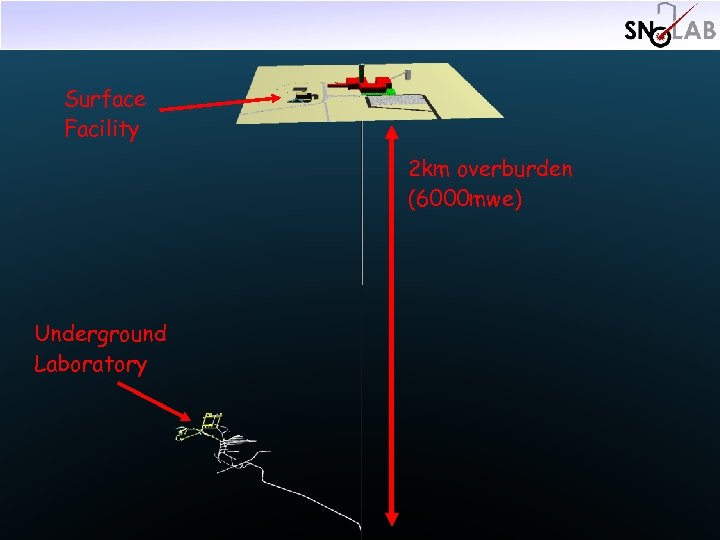
Surface Facility 2 km overburden (6000 mwe) Underground Laboratory
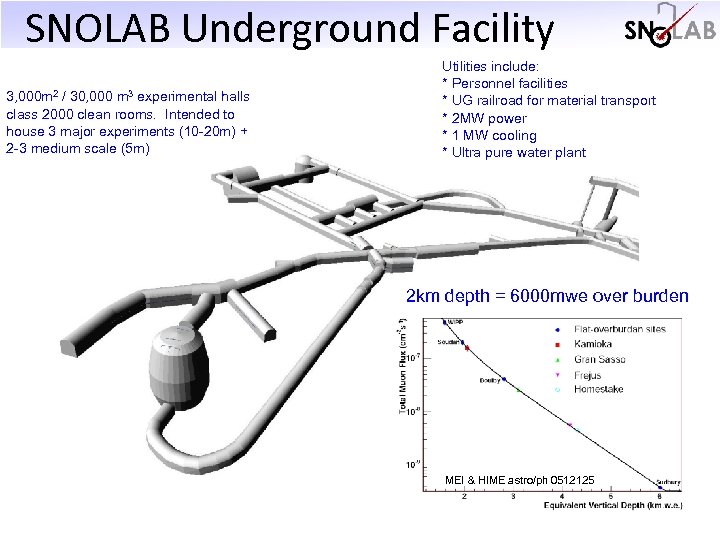
SNOLAB Underground Facility 3, 000 m 2 / 30, 000 m 3 experimental halls class 2000 clean rooms. Intended to house 3 major experiments (10 -20 m) + 2 -3 medium scale (5 m) Utilities include: * Personnel facilities * UG railroad for material transport * 2 MW power * 1 MW cooling * Ultra pure water plant 2 km depth = 6000 mwe over burden MEI & HIME astro/ph 0512125
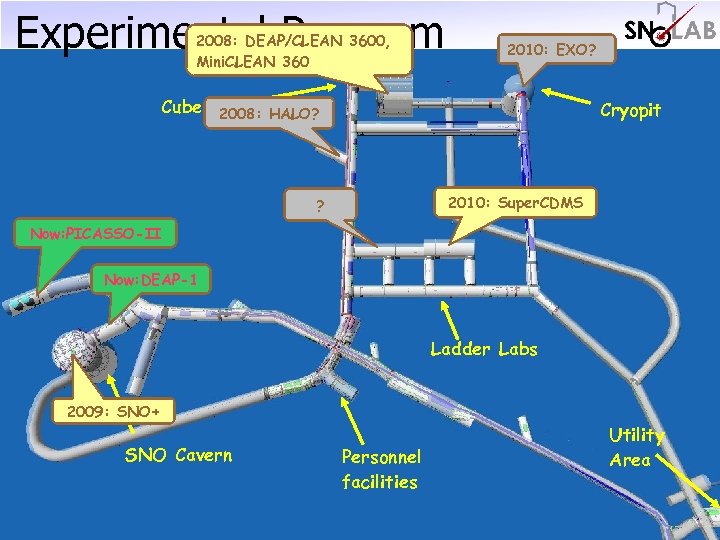
Experimental Program 2008: DEAP/CLEAN 3600, Mini. CLEAN 360 2010: EXO? Cube Hall HALO? 2008: Cryopit 2010: Super. CDMS ? Now: PICASSO-II Now: DEAP-1 Ladder Labs 2009: SNO+ SNO Cavern Personnel facilities Utility Area
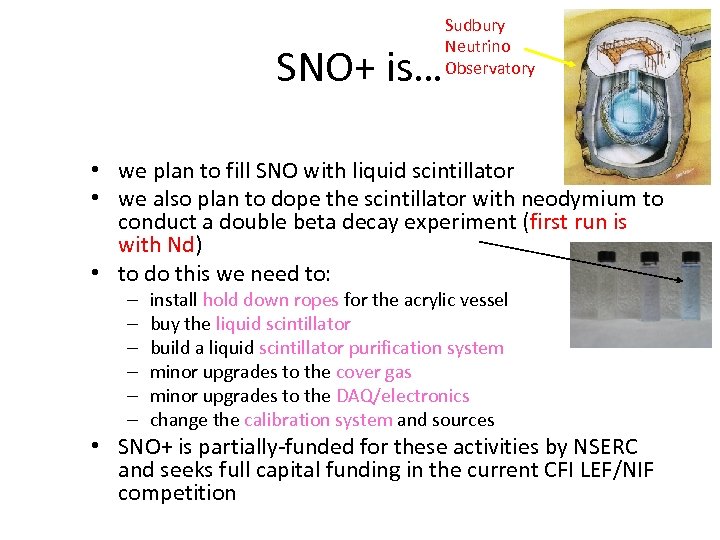
SNO+ is… Sudbury Neutrino Observatory • we plan to fill SNO with liquid scintillator • we also plan to dope the scintillator with neodymium to conduct a double beta decay experiment (first run is with Nd) • to do this we need to: – – – install hold down ropes for the acrylic vessel buy the liquid scintillator build a liquid scintillator purification system minor upgrades to the cover gas minor upgrades to the DAQ/electronics change the calibration system and sources • SNO+ is partially-funded for these activities by NSERC and seeks full capital funding in the current CFI LEF/NIF competition
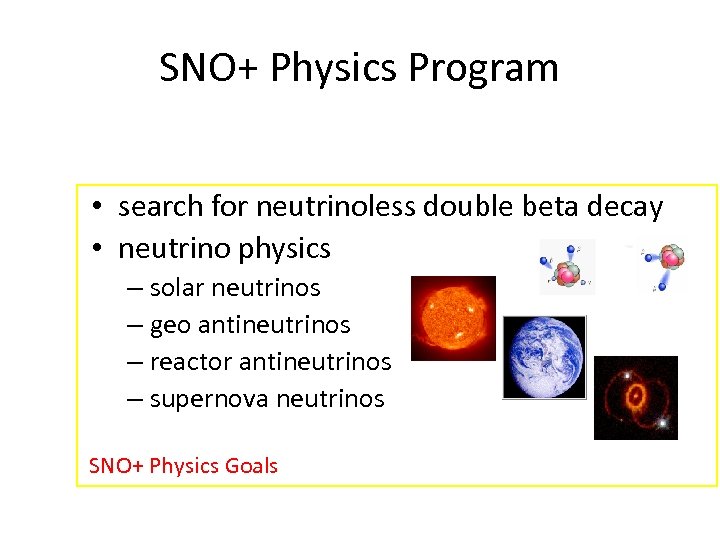
SNO+ Physics Program • search for neutrinoless double beta decay • neutrino physics – solar neutrinos – geo antineutrinos – reactor antineutrinos – supernova neutrinos SNO+ Physics Goals
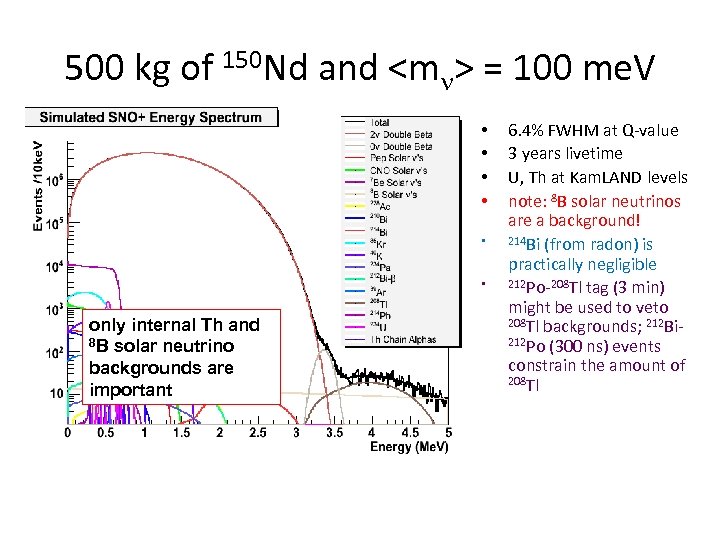
500 kg of 150 Nd and <mn> = 100 me. V • • • only internal Th and 8 B solar neutrino backgrounds are important 6. 4% FWHM at Q-value 3 years livetime U, Th at Kam. LAND levels note: 8 B solar neutrinos are a background! 214 Bi (from radon) is practically negligible 212 Po-208 Tl tag (3 min) might be used to veto 208 Tl backgrounds; 212 Bi 212 Po (300 ns) events constrain the amount of 208 Tl
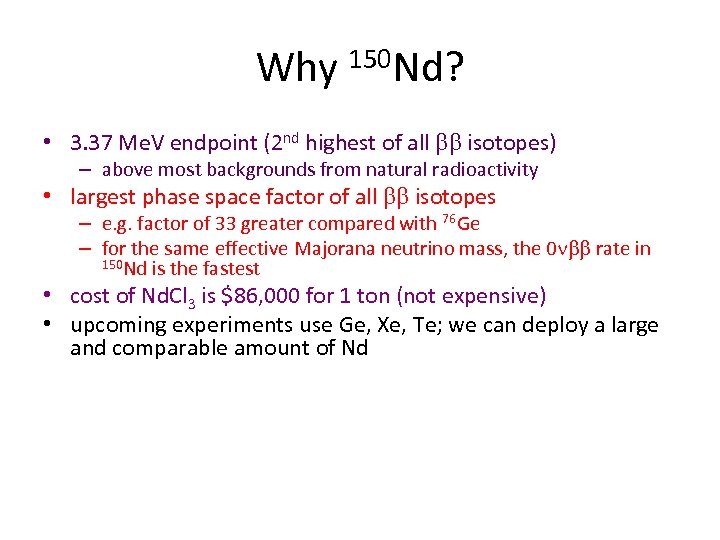
Why 150 Nd? • 3. 37 Me. V endpoint (2 nd highest of all bb isotopes) – above most backgrounds from natural radioactivity • largest phase space factor of all bb isotopes – e. g. factor of 33 greater compared with 76 Ge – for the same effective Majorana neutrino mass, the 0 nbb rate in 150 Nd is the fastest • cost of Nd. Cl 3 is $86, 000 for 1 ton (not expensive) • upcoming experiments use Ge, Xe, Te; we can deploy a large and comparable amount of Nd
![Neutrino Mass Sensitivity [me. V] With natural Nd SNO+ is sensitive to effective neutrino](https://present5.com/presentation/d26935c4c3e669cf84fbd0cab6beefd0/image-10.jpg "Neutrino Mass Sensitivity [me. V] With natural Nd SNO+ is sensitive to effective neutrino")
Neutrino Mass Sensitivity [me. V] With natural Nd SNO+ is sensitive to effective neutrino masses as low as 100 me. V. With 10 X enriched Nd our sensitivity extends to 40 me. V.
SNO+ pep Solar Neutrino Signal 3600 pep events/(kton·year), for electron recoils >0. 8 Me. V
Survival Probability for Solar Neutrinos: All Experimental Data Distilled figure from TAUP 2007 (pre-Borexino 2008)
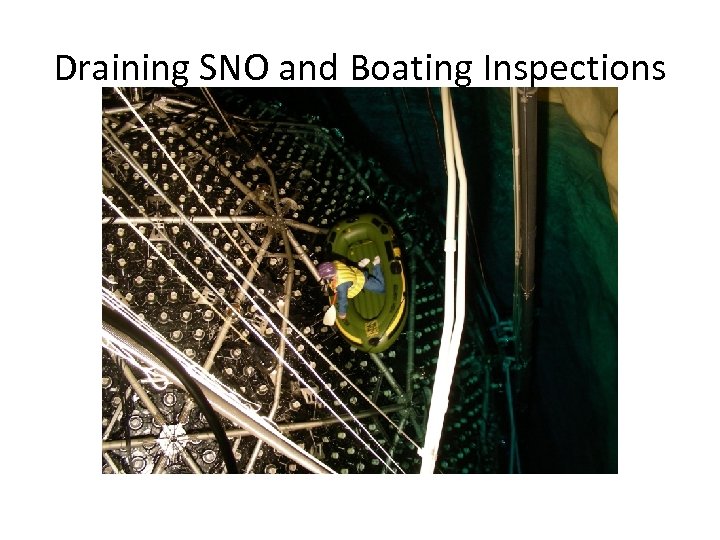
Draining SNO and Boating Inspections
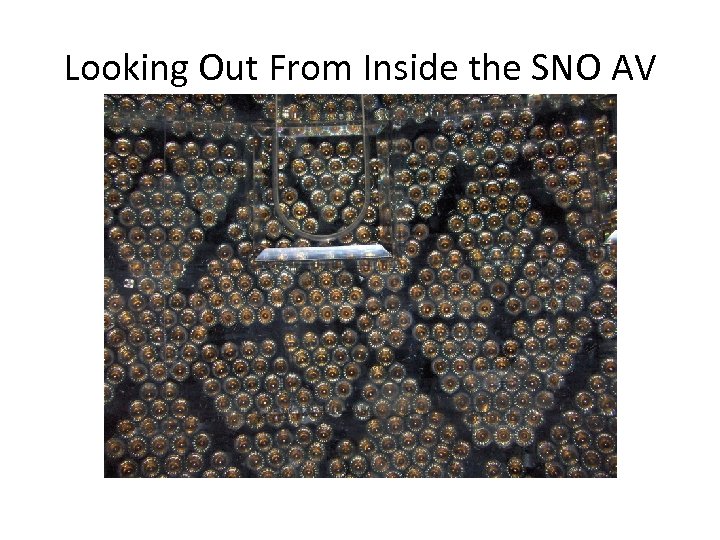
Looking Out From Inside the SNO AV
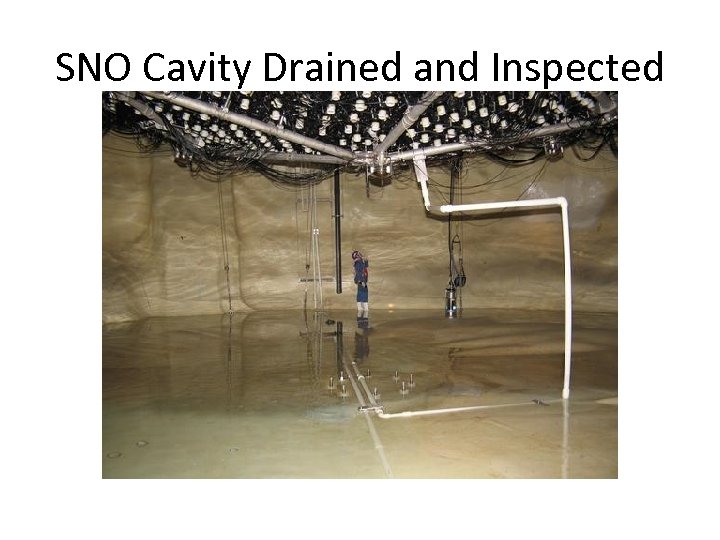
SNO Cavity Drained and Inspected
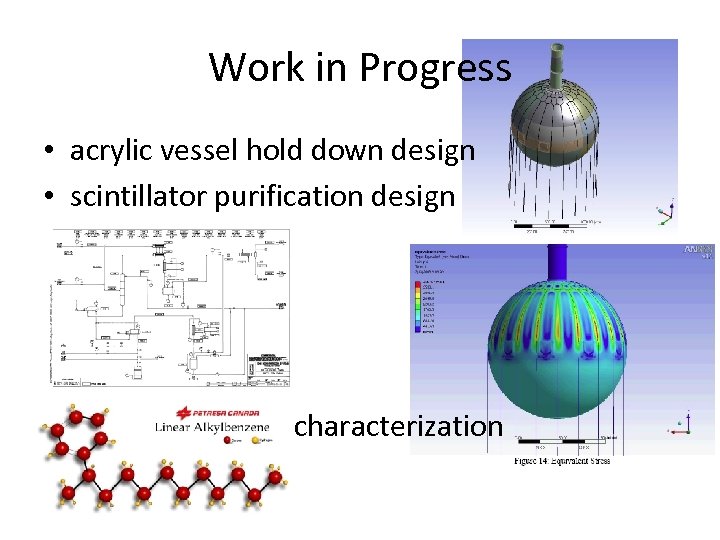
Work in Progress • acrylic vessel hold down design • scintillator purification design • liquid scintillator characterization
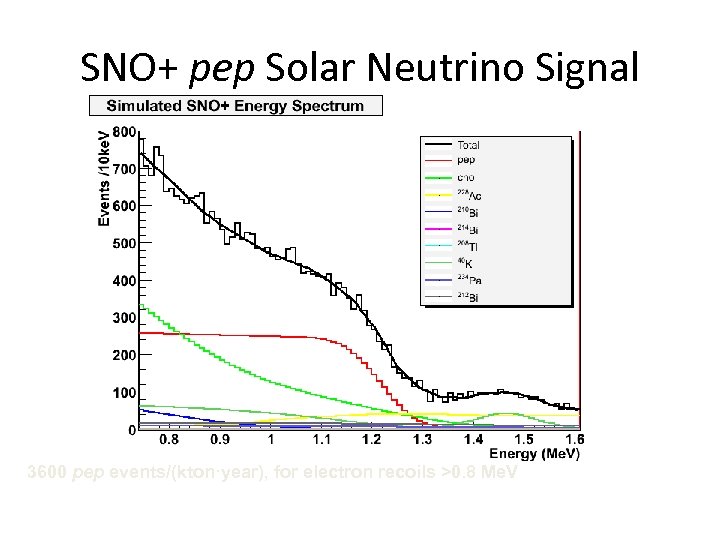
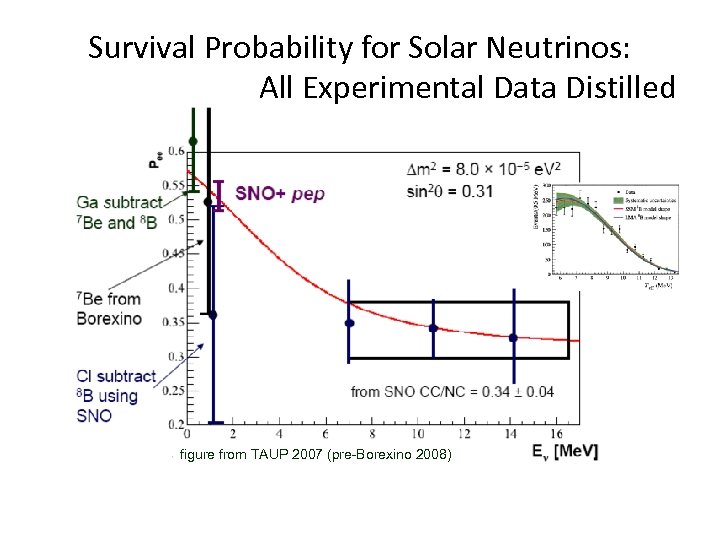
List of R&D Developments for SNO+ • developed the use of linear alkylbenzene as a solvent for large liquid scintillator detectors – high flash point, low toxicity, high light yield, long transmission length, inexpensive! • developed Nd-loaded liquid scintillator (using same technique as for In, Gd loading) • developed purification techniques to remove Ra, Th from Nd and Nd liquid scintillator • physics potential: pep and CNO solar neutrinos, geoneutrino continental crust probe, double beta with Nd in liquid scintillator
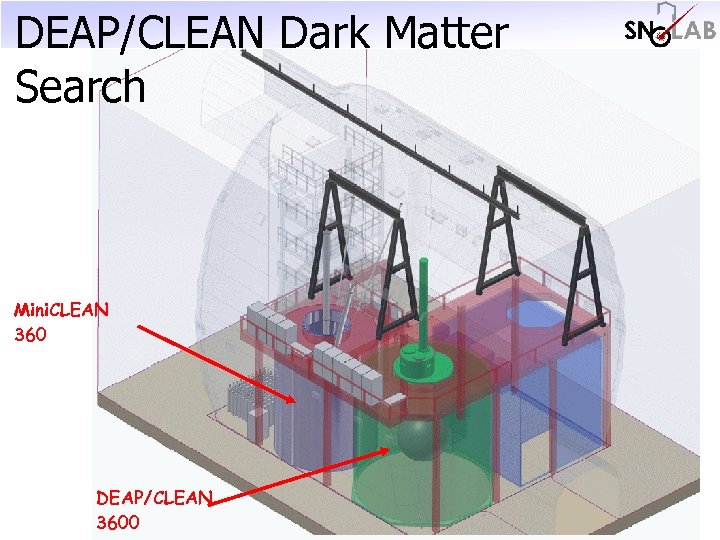
Top Access DEAP/CLEAN Dark Matter Search Mini. CLEAN 360 DEAP/CLEAN 3600
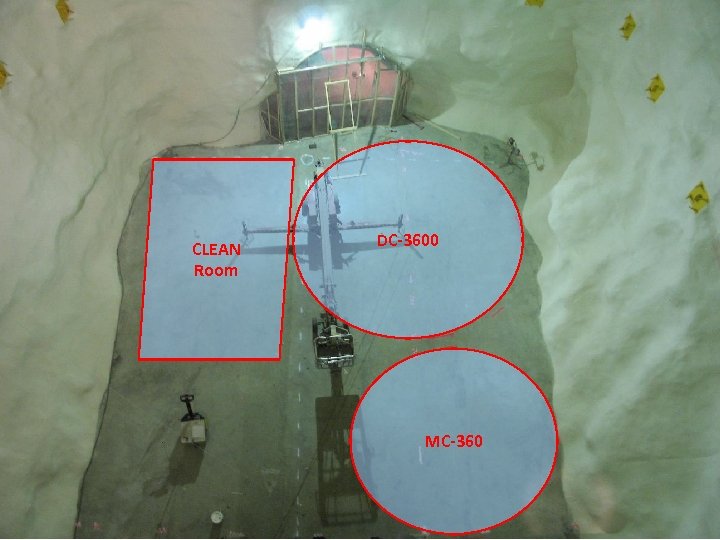
CLEAN Room DC-3600 MC-360
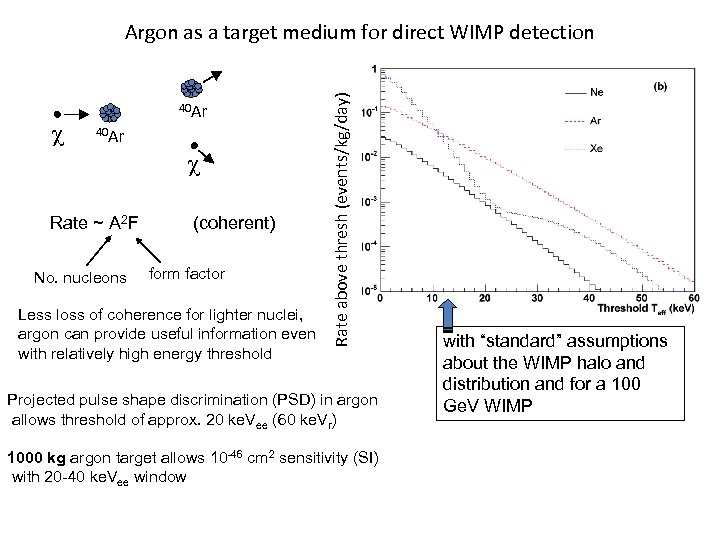
c 40 Ar c Rate ~ A 2 F No. nucleons (coherent) form factor Less loss of coherence for lighter nuclei, argon can provide useful information even with relatively high energy threshold Rate above thresh (events/kg/day) Argon as a target medium for direct WIMP detection Projected pulse shape discrimination (PSD) in argon allows threshold of approx. 20 ke. Vee (60 ke. Vr) 1000 kg argon target allows 10 -46 cm 2 sensitivity (SI) with 20 -40 ke. Vee window with “standard” assumptions about the WIMP halo and distribution and for a 100 Ge. V WIMP
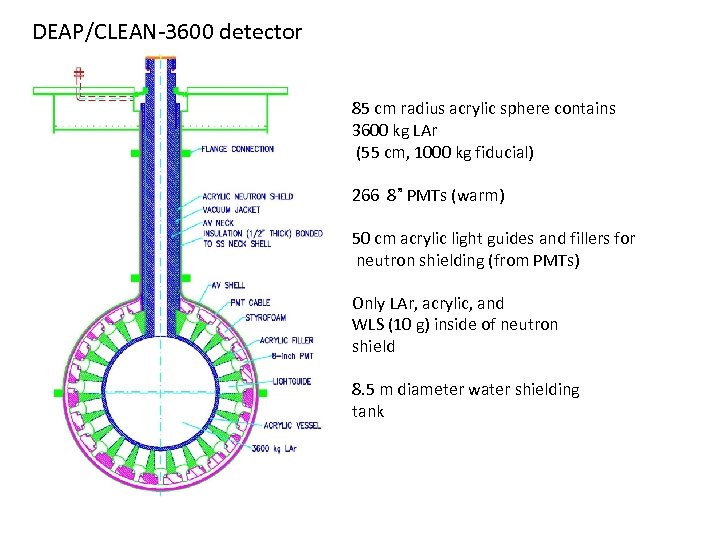
DEAP/CLEAN-3600 detector 85 cm radius acrylic sphere contains 3600 kg LAr (55 cm, 1000 kg fiducial) 266 8” PMTs (warm) 50 cm acrylic light guides and fillers for neutron shielding (from PMTs) Only LAr, acrylic, and WLS (10 g) inside of neutron shield 8. 5 m diameter water shielding tank
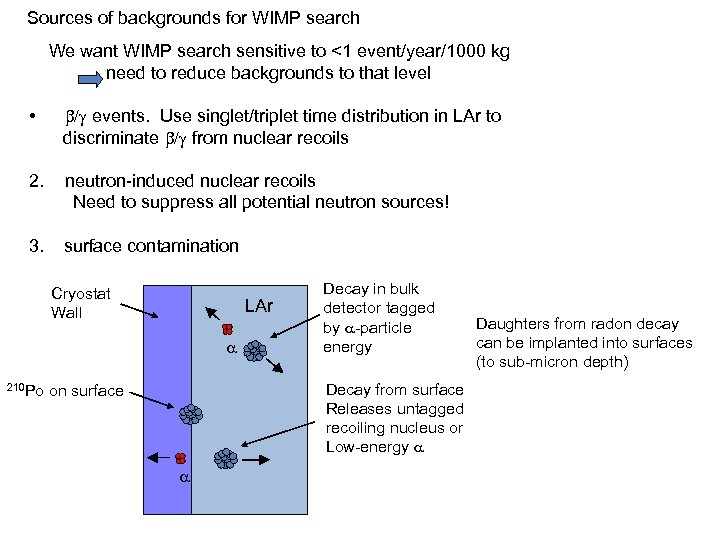
Sources of backgrounds for WIMP search We want WIMP search sensitive to <1 event/year/1000 kg need to reduce backgrounds to that level • b/g events. Use singlet/triplet time distribution in LAr to discriminate b/g from nuclear recoils 2. neutron-induced nuclear recoils Need to suppress all potential neutron sources! 3. surface contamination Cryostat Wall LAr 210 Po Decay in bulk detector tagged by -particle energy Decay from surface Releases untagged recoiling nucleus or Low-energy on surface Daughters from radon decay can be implanted into surfaces (to sub-micron depth)
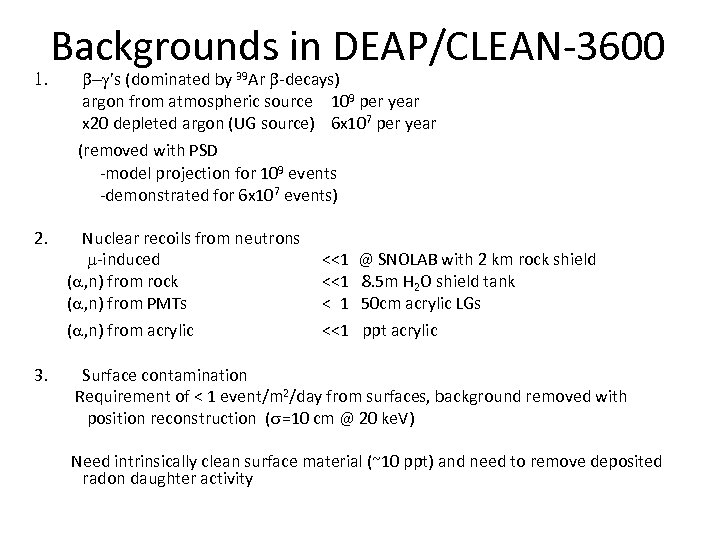
1. Backgrounds in DEAP/CLEAN-3600 b-g’s (dominated by 39 Ar b-decays) argon from atmospheric source 109 per year x 20 depleted argon (UG source) 6 x 10⁷ per year (removed with PSD -model projection for 109 events -demonstrated for 6 x 10⁷ events) 2. <<1 @ SNOLAB with 2 km rock shield <<1 8. 5 m H 2 O shield tank < 1 50 cm acrylic LGs ( , n) from acrylic 3. Nuclear recoils from neutrons m-induced ( , n) from rock ( , n) from PMTs <<1 ppt acrylic Surface contamination Requirement of < 1 event/m 2/day from surfaces, background removed with position reconstruction (s=10 cm @ 20 ke. V) Need intrinsically clean surface material (~10 ppt) and need to remove deposited radon daughter activity
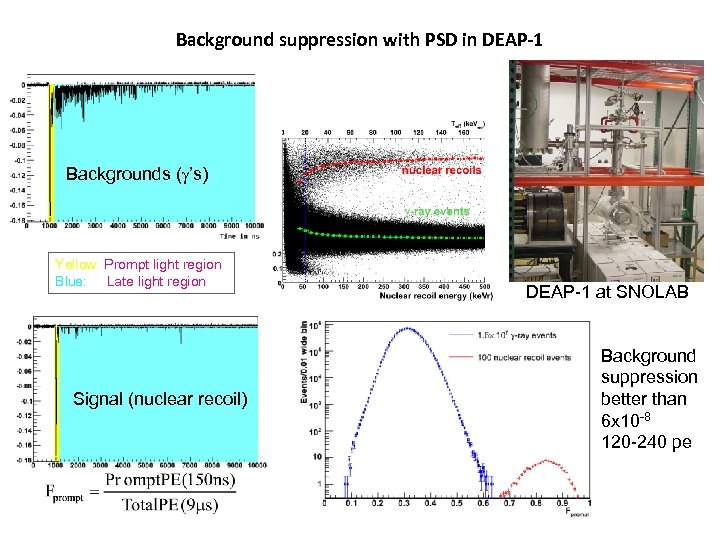
Background suppression with PSD in DEAP-1 Backgrounds (g’s) Yellow: Prompt light region Blue: Late light region Signal (nuclear recoil) DEAP-1 at SNOLAB Background suppression better than 6 x 10 -8 120 -240 pe
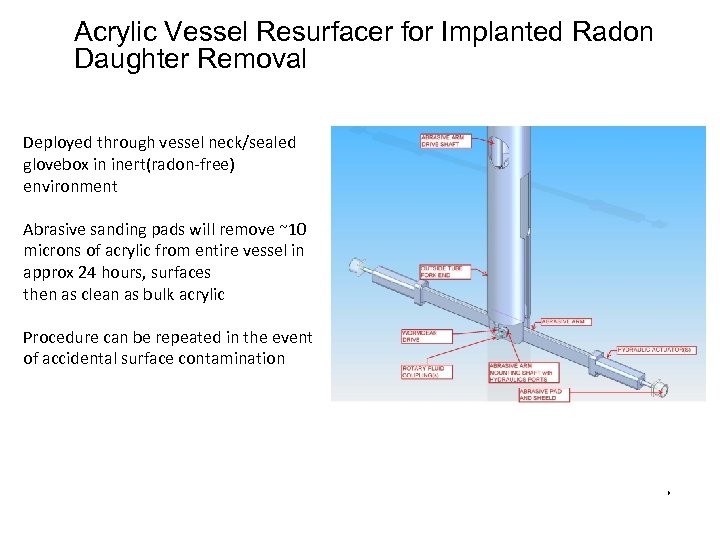
Acrylic Vessel Resurfacer for Implanted Radon Daughter Removal Deployed through vessel neck/sealed glovebox in inert(radon-free) environment Abrasive sanding pads will remove ~10 microns of acrylic from entire vessel in approx 24 hours, surfaces then as clean as bulk acrylic Procedure can be repeated in the event of accidental surface contamination *
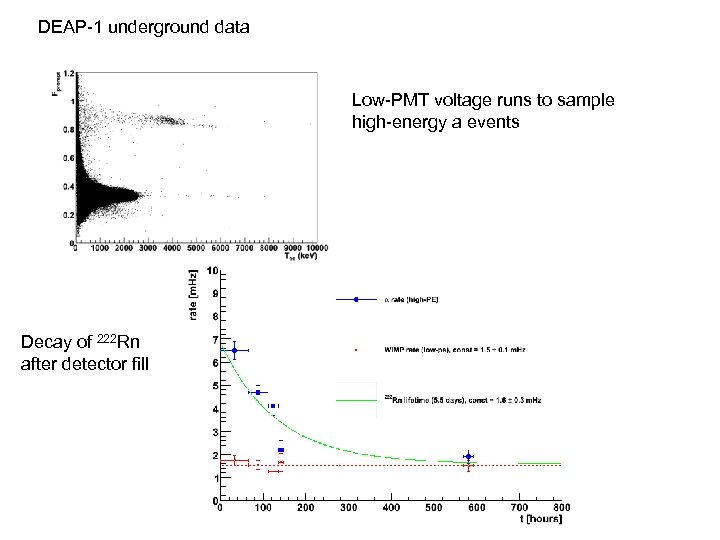
DEAP-1 underground data Low-PMT voltage runs to sample high-energy a events Decay of 222 Rn after detector fill
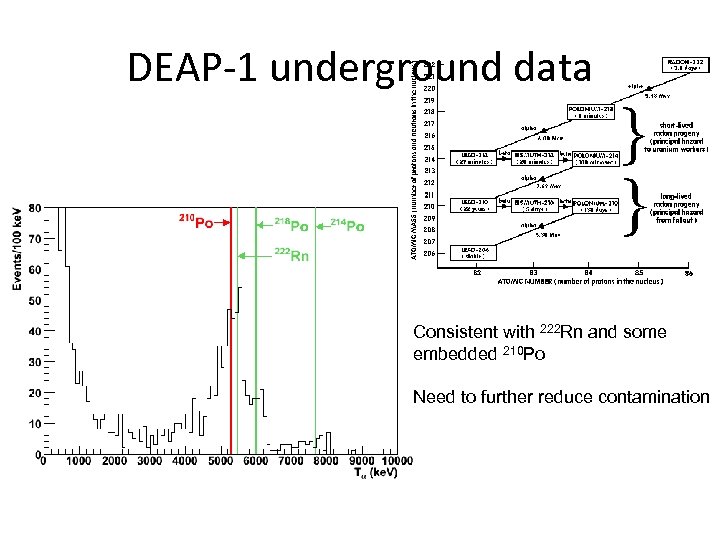
DEAP-1 underground data Consistent with 222 Rn and some embedded 210 Po Need to further reduce contamination
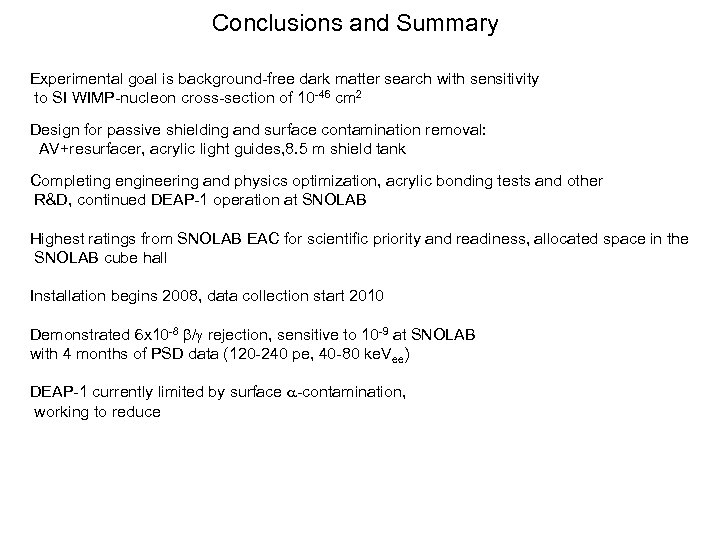
Conclusions and Summary Experimental goal is background-free dark matter search with sensitivity to SI WIMP-nucleon cross-section of 10 -46 cm 2 Design for passive shielding and surface contamination removal: AV+resurfacer, acrylic light guides, 8. 5 m shield tank Completing engineering and physics optimization, acrylic bonding tests and other R&D, continued DEAP-1 operation at SNOLAB Highest ratings from SNOLAB EAC for scientific priority and readiness, allocated space in the SNOLAB cube hall Installation begins 2008, data collection start 2010 Demonstrated 6 x 10 -8 b/g rejection, sensitive to 10 -9 at SNOLAB with 4 months of PSD data (120 -240 pe, 40 -80 ke. Vee) DEAP-1 currently limited by surface -contamination, working to reduce
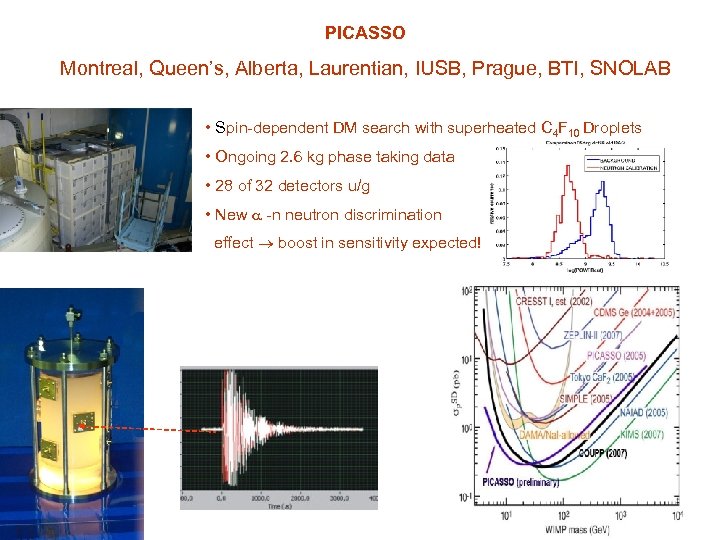
PICASSO Montreal, Queen’s, Alberta, Laurentian, IUSB, Prague, BTI, SNOLAB • Spin-dependent DM search with superheated C 4 F 10 Droplets • Ongoing 2. 6 kg phase taking data • 28 of 32 detectors u/g • New -n neutron discrimination effect boost in sensitivity expected!
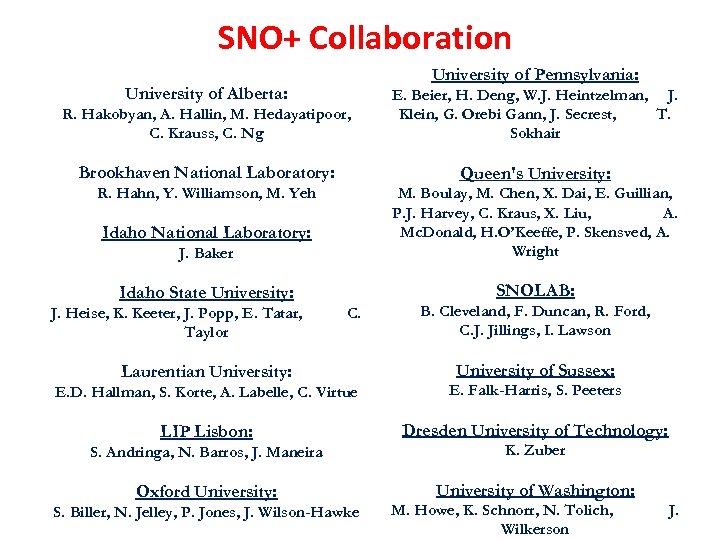
SNO+ Collaboration University of Pennsylvania: University of Alberta: R. Hakobyan, A. Hallin, M. Hedayatipoor, C. Krauss, C. Ng E. Beier, H. Deng, W. J. Heintzelman, J. Klein, G. Orebi Gann, J. Secrest, T. Sokhair Brookhaven National Laboratory: Queen's University: R. Hahn, Y. Williamson, M. Yeh J. Baker M. Boulay, M. Chen, X. Dai, E. Guillian, P. J. Harvey, C. Kraus, X. Liu, A. Mc. Donald, H. O’Keeffe, P. Skensved, A. Wright Idaho State University: SNOLAB: Idaho National Laboratory: J. Heise, K. Keeter, J. Popp, E. Tatar, Taylor C. Laurentian University: B. Cleveland, F. Duncan, R. Ford, C. J. Jillings, I. Lawson University of Sussex: E. D. Hallman, S. Korte, A. Labelle, C. Virtue E. Falk-Harris, S. Peeters LIP Lisbon: Dresden University of Technology: S. Andringa, N. Barros, J. Maneira K. Zuber Oxford University: University of Washington: S. Biller, N. Jelley, P. Jones, J. Wilson-Hawke M. Howe, K. Schnorr, N. Tolich, Wilkerson J.
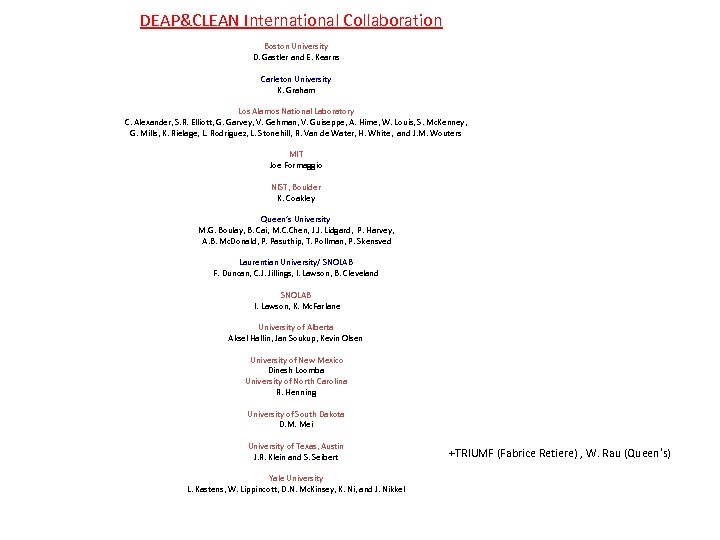
DEAP&CLEAN International Collaboration Boston University D. Gastler and E. Kearns Carleton University K. Graham Los Alamos National Laboratory C. Alexander, S. R. Elliott, G. Garvey, V. Gehman, V. Guiseppe, A. Hime, W. Louis, S. Mc. Kenney, G. Mills, K. Rielage, L. Rodriguez, L. Stonehill, R. Van de Water, H. White, and J. M. Wouters MIT Joe Formaggio NIST, Boulder K. Coakley Queen’s University M. G. Boulay, B. Cai, M. C. Chen, J. J. Lidgard, P. Harvey, A. B. Mc. Donald, P. Pasuthip, T. Pollman, P. Skensved Laurentian University/ SNOLAB F. Duncan, C. J. Jillings, I. Lawson, B. Cleveland SNOLAB I. Lawson, K. Mc. Farlane University of Alberta Aksel Hallin, Jan Soukup, Kevin Olsen University of New Mexico Dinesh Loomba University of North Carolina R. Henning University of South Dakota D. M. Mei University of Texas, Austin J. R. Klein and S. Seibert Yale University L. Kastens, W. Lippincott, D. N. Mc. Kinsey, K. Ni, and J. Nikkel +TRIUMF (Fabrice Retiere) , W. Rau (Queen’s)
Скачать презентацию SNOLAB Aksel Hallin NNN 08 Paris September 12
d26935c4c3e669cf84fbd0cab6beefd0.ppt