 Скачать презентацию SNO A detector for neutrinoless double beta decay
15a9ccd86032ffcc23247832691ab597.ppt
- Количество слайдов: 55



SNO+: A detector for neutrinoless double beta decay, low energy solar neutrinos, and geoneutrinos. Aksel Hallin June 13, 2008 1
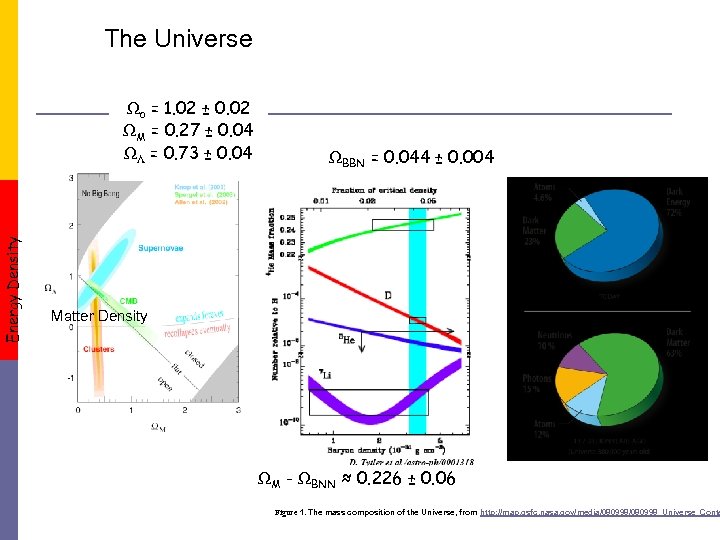
The Universe Energy Density o = 1. 02 ± 0. 02 M = 0. 27 ± 0. 04 L = 0. 73 ± 0. 04 BBN = 0. 044 ± 0. 004 Matter Density M - BNN ≈ 0. 226 ± 0. 06 Figure 1. The mass composition of the Universe, from http: //map. gsfc. nasa. gov/media/080998_Universe_Conte
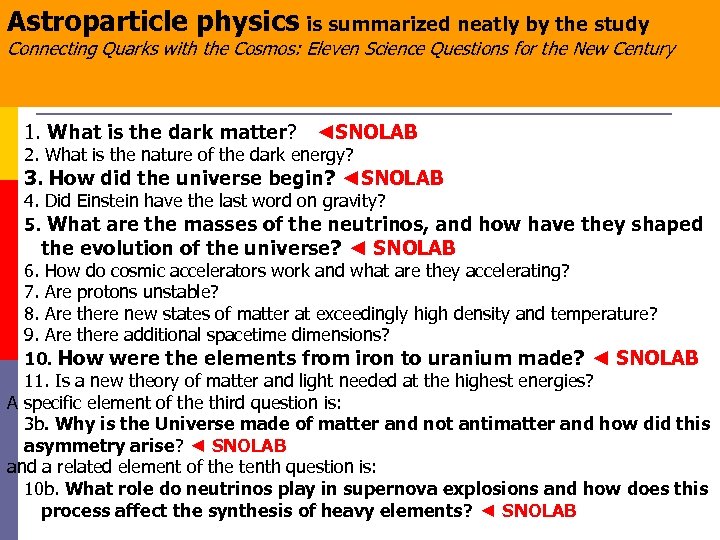
Astroparticle physics is summarized neatly by the study Connecting Quarks with the Cosmos: Eleven Science Questions for the New Century 1. What is the dark matter? ◄SNOLAB 2. What is the nature of the dark energy? 3. How did the universe begin? ◄SNOLAB 4. Did Einstein have the last word on gravity? 5. What are the masses of the neutrinos, and how have they shaped the evolution of the universe? ◄ SNOLAB 6. How do cosmic accelerators work and what are they accelerating? 7. Are protons unstable? 8. Are there new states of matter at exceedingly high density and temperature? 9. Are there additional spacetime dimensions? 10. How were the elements from iron to uranium made? ◄ SNOLAB 11. Is a new theory of matter and light needed at the highest energies? A specific element of the third question is: 3 b. Why is the Universe made of matter and not antimatter and how did this asymmetry arise? ◄ SNOLAB and a related element of the tenth question is: 10 b. What role do neutrinos play in supernova explosions and how does this process affect the synthesis of heavy elements? ◄ SNOLAB
Two main thrusts for SNOLAB science p What is the nature of Dark Matter? n p Direct dark matter searches What are the character and interactions of neutrinos, and how do they affect cosmology and astrophysics? n n Double beta decay (mass, are neutrinos their own antiparticles, leptogenesis? ) Solar neutrino interactions
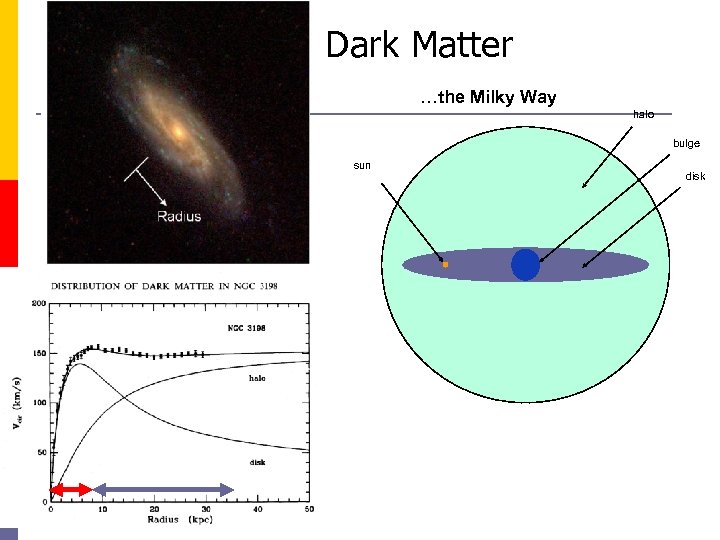
Dark Matter …the Milky Way halo bulge sun disk
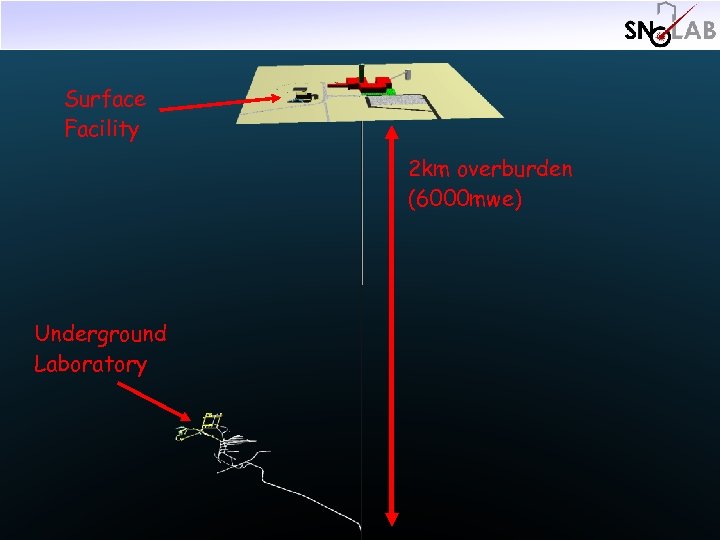
Surface Facility 2 km overburden (6000 mwe) Underground Laboratory
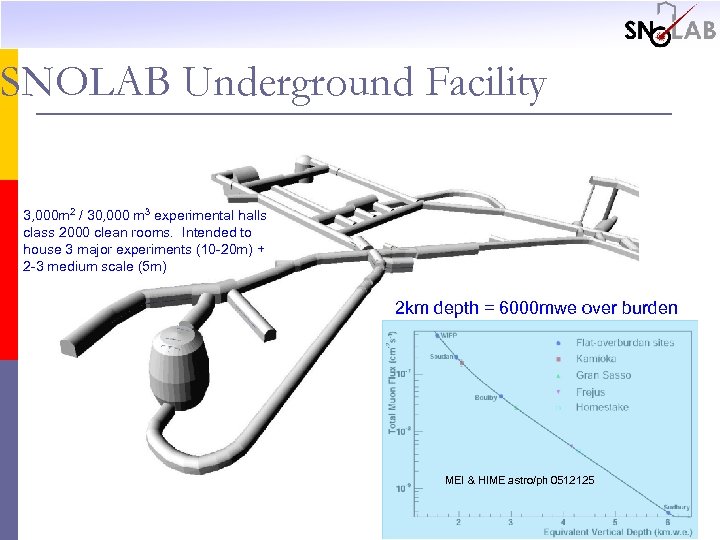
SNOLAB Underground Facility 3, 000 m 2 / 30, 000 m 3 experimental halls class 2000 clean rooms. Intended to house 3 major experiments (10 -20 m) + 2 -3 medium scale (5 m) 2 km depth = 6000 mwe over burden MEI & HIME astro/ph 0512125
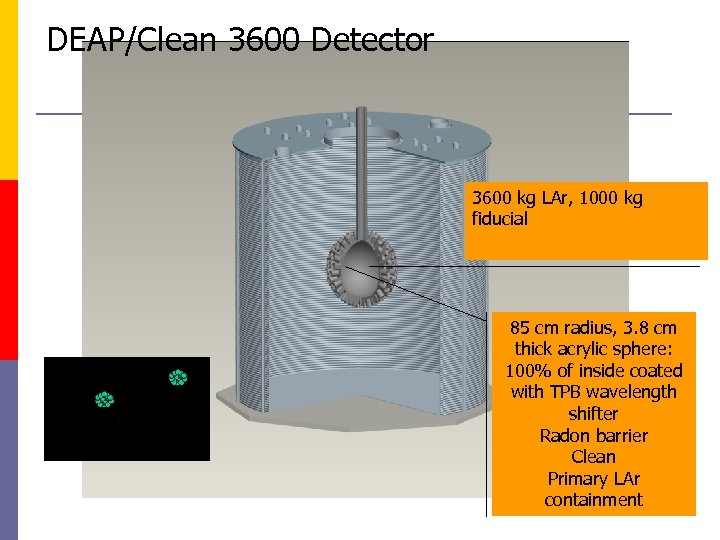
DEAP/Clean 3600 Detector 3600 kg LAr, 1000 kg fiducial 85 cm radius, 3. 8 cm thick acrylic sphere: 100% of inside coated with TPB wavelength shifter Radon barrier Clean Primary LAr containment
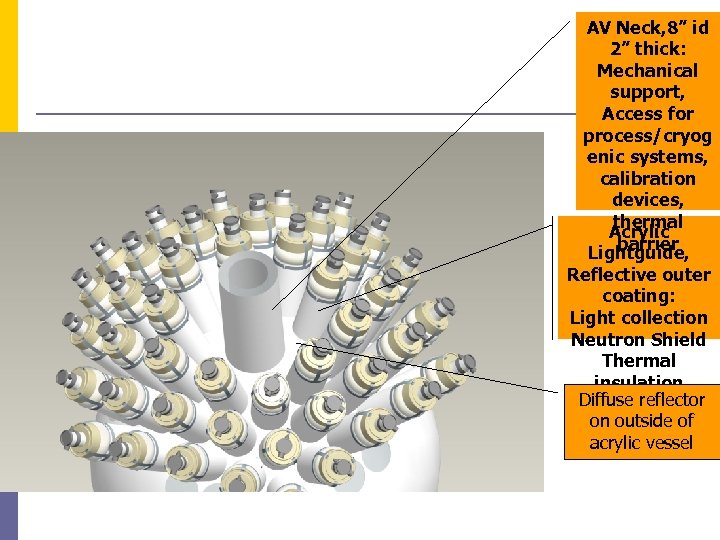
AV Neck, 8” id 2” thick: Mechanical support, Access for process/cryog enic systems, calibration devices, thermal Acrylic barrier Lightguide, Reflective outer coating: Light collection Neutron Shield Thermal insulation Diffuse reflector on outside of acrylic vessel
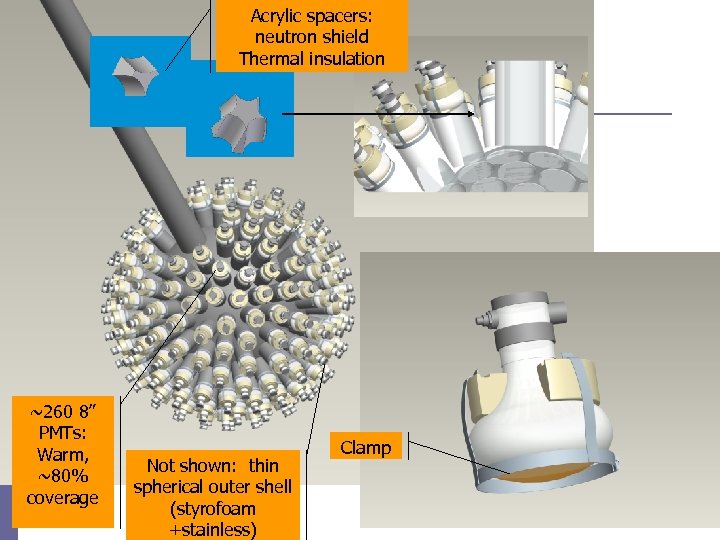
Acrylic spacers: neutron shield Thermal insulation ~260 8” PMTs: Warm, ~80% coverage Not shown: thin spherical outer shell (styrofoam +stainless) Clamp
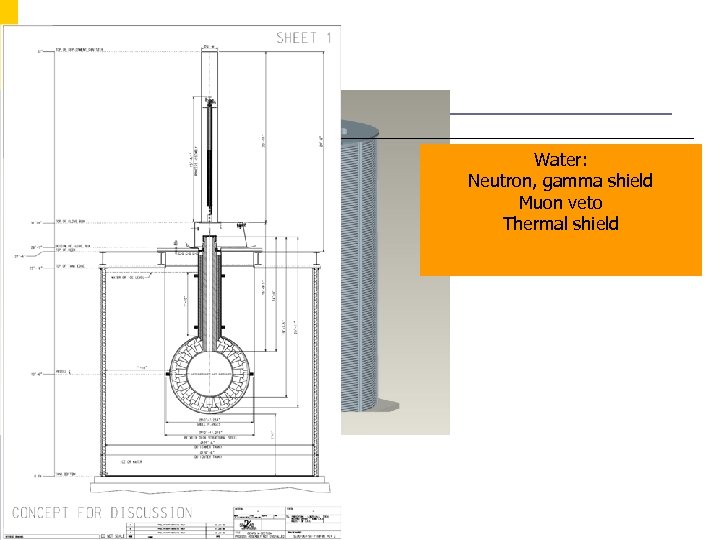
Water: Neutron, gamma shield Muon veto Thermal shield
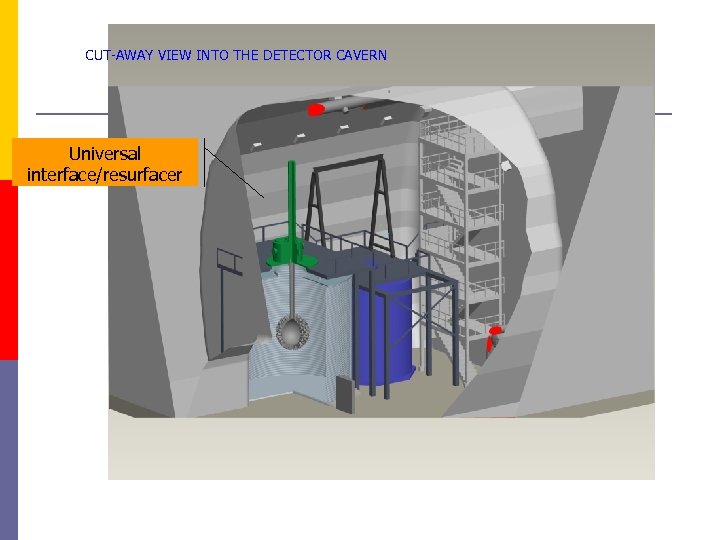
CUT-AWAY VIEW INTO THE DETECTOR CAVERN Universal interface/resurfacer
Backgrounds and the design Liquid circulation: to remove LAr contamination (no suspended particles > 8 microns) p Acrylic vessel: allows radon isolation, resurfacing (need factor of ~1000 over “normal surfaces”) p Large FV, large light collection, 100% TPB, reflector on AV: to remove remaining surface recoils and for PSD p Acrylic shield for neutrons p Water shield/veto for muons p
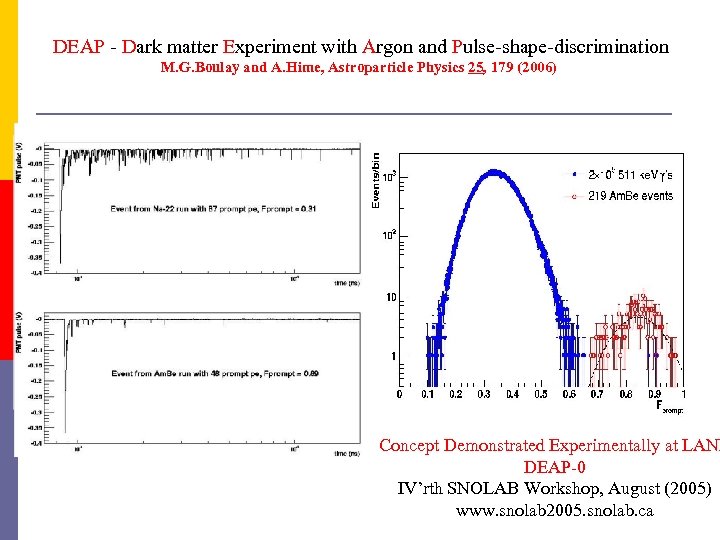
DEAP - Dark matter Experiment with Argon and Pulse-shape-discrimination M. G. Boulay and A. Hime, Astroparticle Physics 25, 179 (2006) 108 simulated e-’s Prompt/Singlet Light ( ~ 6 ns) I 1 / I 3 ~ 0. 3 I 1 / I 3 ~ 3. 0 Late/Triplet Light ( ~ 1. 6 s) 100 simulated WIMPs Concept Demonstrated Experimentally at LANL DEAP-0 IV’rth SNOLAB Workshop, August (2005) www. snolab 2005. snolab. ca
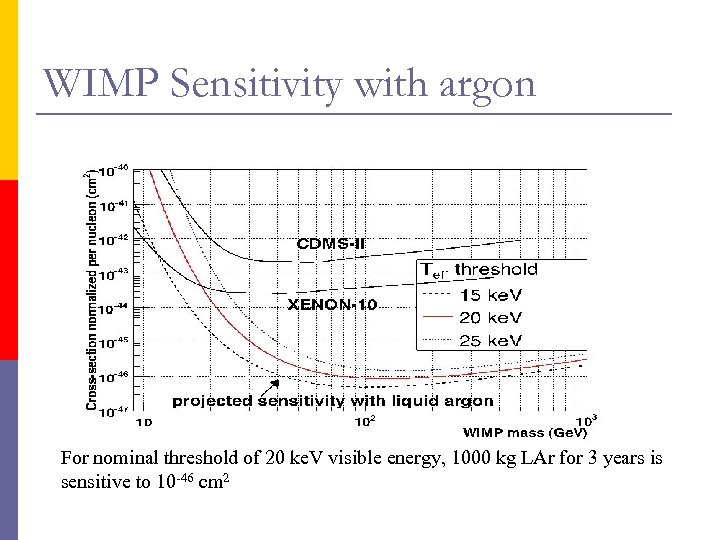
WIMP Sensitivity with argon For nominal threshold of 20 ke. V visible energy, 1000 kg LAr for 3 years is sensitive to 10 -46 cm 2
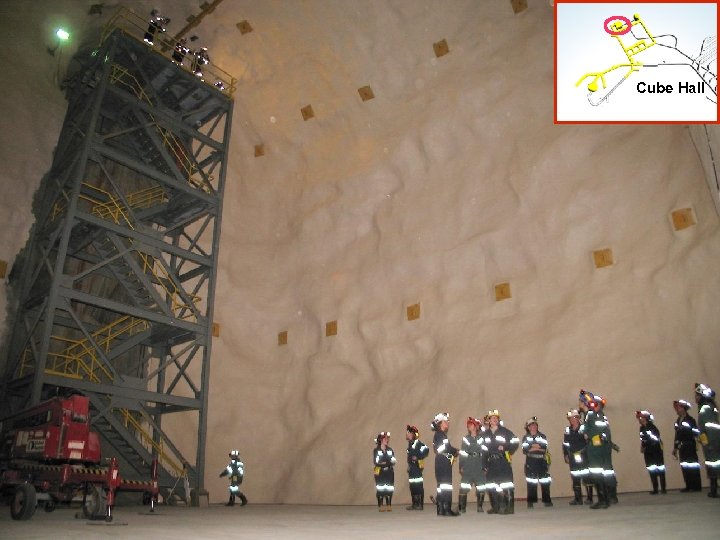
Cube Hall
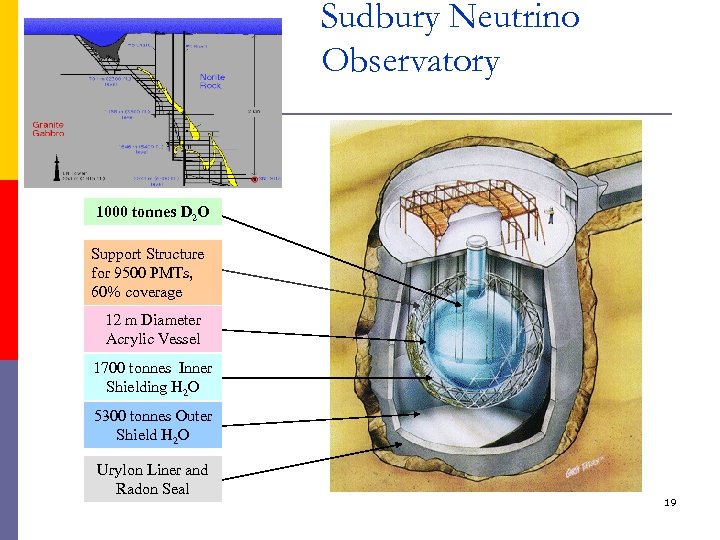
Sudbury Neutrino Observatory 1000 tonnes D 2 O Support Structure for 9500 PMTs, 60% coverage 12 m Diameter Acrylic Vessel 1700 tonnes Inner Shielding H 2 O 5300 tonnes Outer Shield H 2 O Urylon Liner and Radon Seal 19
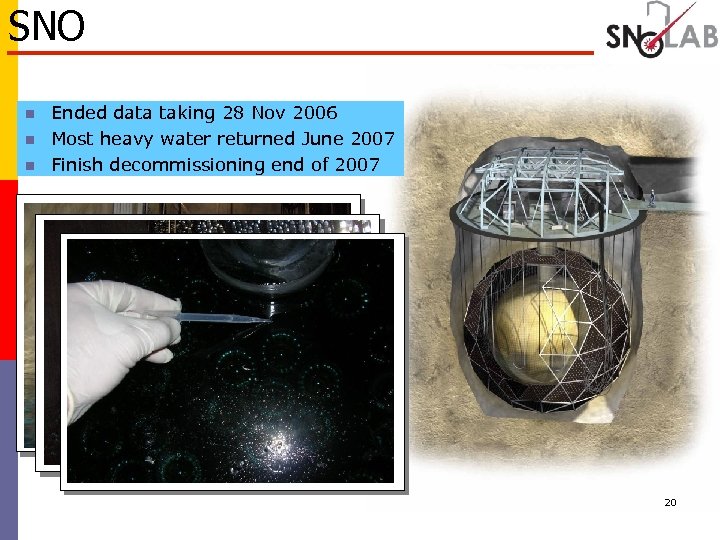
SNO n n n Ended data taking 28 Nov 2006 Most heavy water returned June 2007 Finish decommissioning end of 2007 20
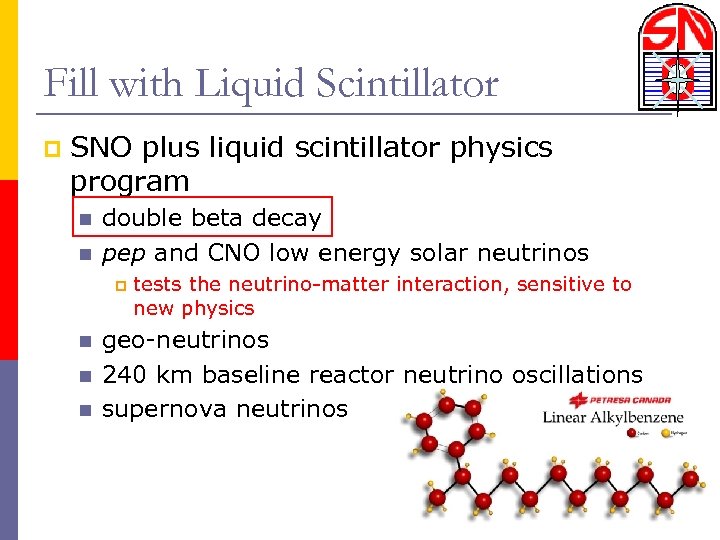
Fill with Liquid Scintillator p SNO plus liquid scintillator physics program n n double beta decay pep and CNO low energy solar neutrinos p n n n tests the neutrino-matter interaction, sensitive to new physics geo-neutrinos 240 km baseline reactor neutrino oscillations supernova neutrinos 21
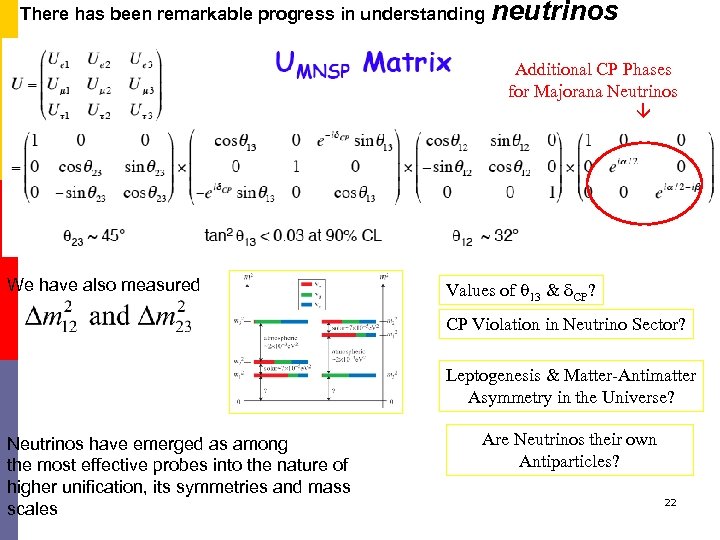
There has been remarkable progress in understanding neutrinos Additional CP Phases for Majorana Neutrinos We have also measured Values of 13 & CP? CP Violation in Neutrino Sector? Leptogenesis & Matter-Antimatter Asymmetry in the Universe? Neutrinos have emerged as among the most effective probes into the nature of higher unification, its symmetries and mass scales Are Neutrinos their own Antiparticles? 22
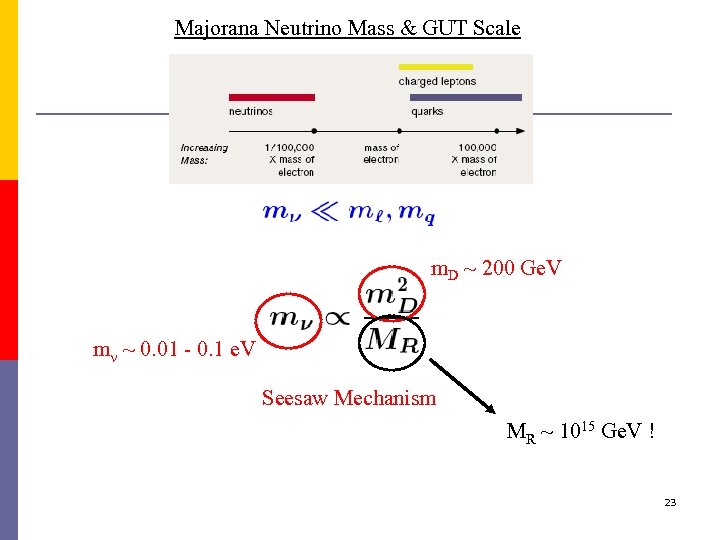
Majorana Neutrino Mass & GUT Scale m. D ~ 200 Ge. V m ~ 0. 01 - 0. 1 e. V Seesaw Mechanism MR ~ 1015 Ge. V ! 23
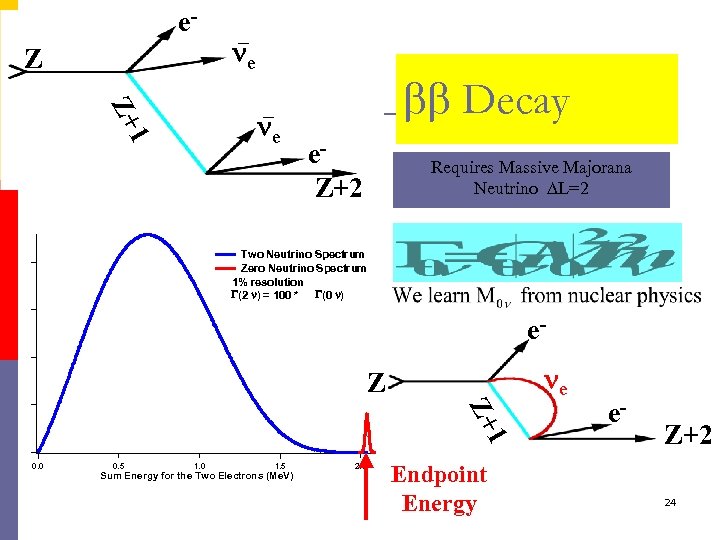
e. Z e 1 Z+ e bb Decay e. Z+2 Requires Massive Majorana Neutrino L=2 Two Neutrino Spectrum Zero Neutrino Spectrum 1% resolution G(2 ) = 100 * G(0 ) e e Z 1 Z+ 0. 0 0. 5 1. 0 1. 5 Sum Energy for the Two Electrons (Me. V) 2. 0 Endpoint Energy e- Z+2 24
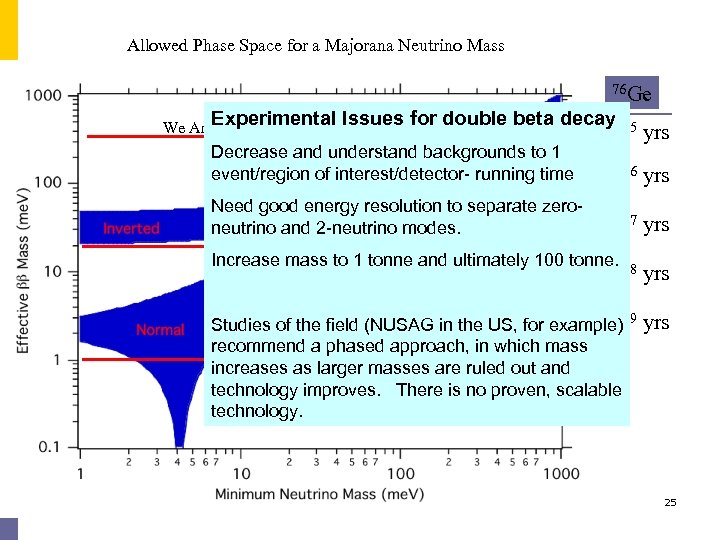
Allowed Phase Space for a Majorana Neutrino Mass 76 Ge We Are. Experimental Here Issues for double beta decay Decrease and understand backgrounds to 1 event/region of interest/detector- running time ~ 1025 yrs ~ 1026 yrs Need good energy resolution to separate zero~ neutrino and 2 -neutrino modes. Next Generation 1027 yrs Increase mass to 1 tonne and ultimately 100 tonne. 28 ~ 10 yrs ~ 10 Studies of the field (NUSAG in the US, for example)29 Future, recommend a phased approach, in which mass as necessary increases as larger masses are ruled out and technology improves. There is no proven, scalable technology. yrs 25
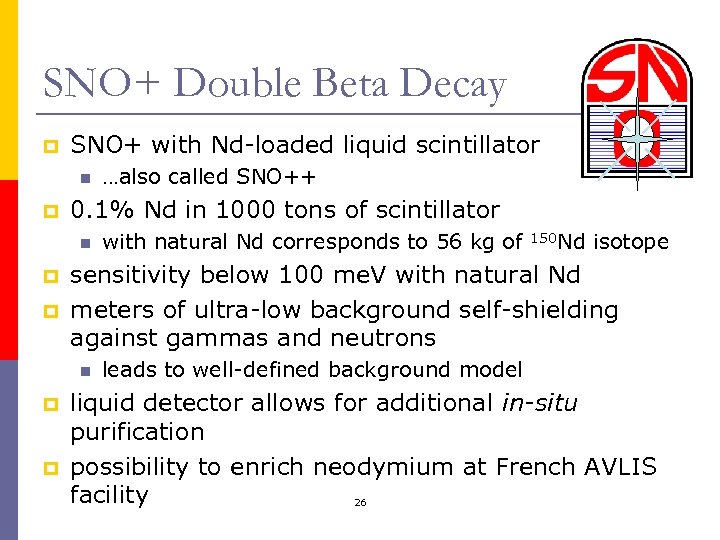
SNO+ Double Beta Decay p SNO+ with Nd-loaded liquid scintillator n p 0. 1% Nd in 1000 tons of scintillator n p p p with natural Nd corresponds to 56 kg of 150 Nd isotope sensitivity below 100 me. V with natural Nd meters of ultra-low background self-shielding against gammas and neutrons n p …also called SNO++ leads to well-defined background model liquid detector allows for additional in-situ purification possibility to enrich neodymium at French AVLIS facility 26
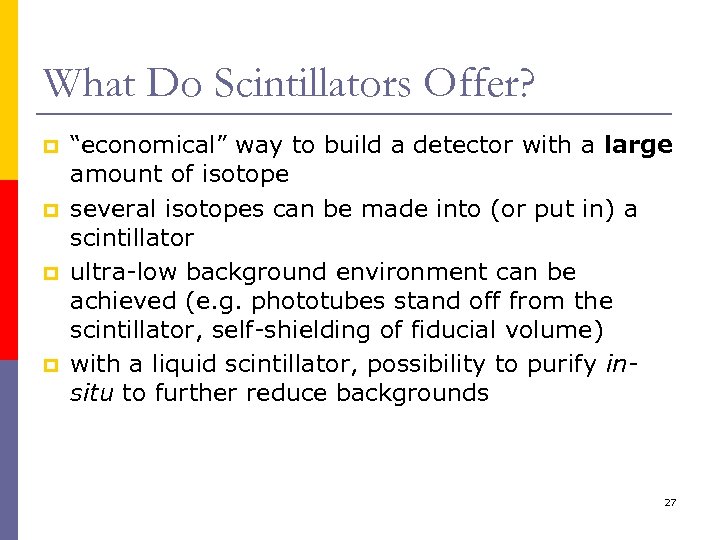
What Do Scintillators Offer? p p “economical” way to build a detector with a large amount of isotope several isotopes can be made into (or put in) a scintillator ultra-low background environment can be achieved (e. g. phototubes stand off from the scintillator, self-shielding of fiducial volume) with a liquid scintillator, possibility to purify insitu to further reduce backgrounds 27
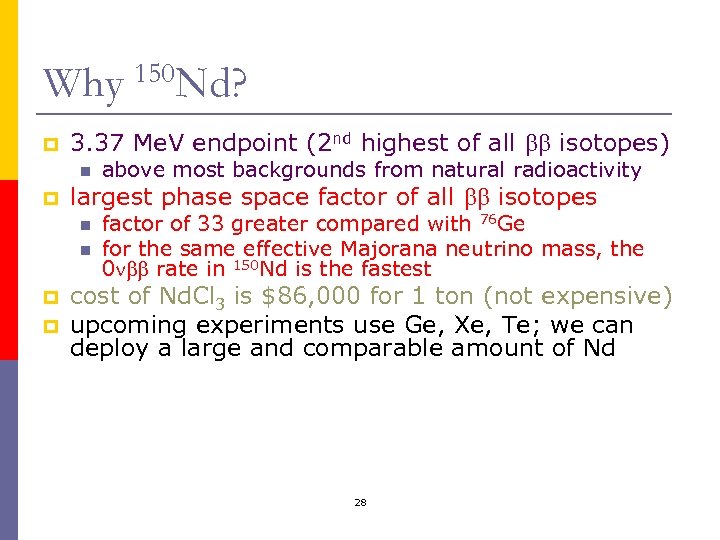
Why 150 Nd? p 3. 37 Me. V endpoint (2 nd highest of all bb isotopes) n p largest phase space factor of all bb isotopes n n p p above most backgrounds from natural radioactivity factor of 33 greater compared with 76 Ge for the same effective Majorana neutrino mass, the 0 bb rate in 150 Nd is the fastest cost of Nd. Cl 3 is $86, 000 for 1 ton (not expensive) upcoming experiments use Ge, Xe, Te; we can deploy a large and comparable amount of Nd 28
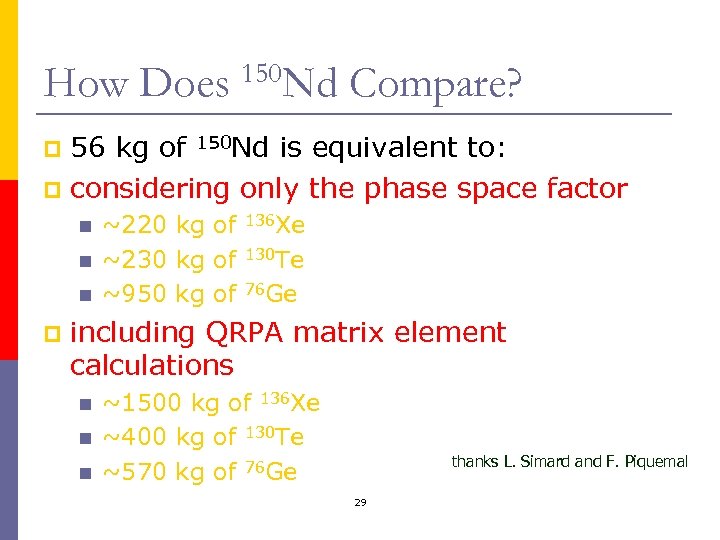
How Does 150 Nd Compare? 56 kg of 150 Nd is equivalent to: p considering only the phase space factor p n n n p ~220 kg of ~230 kg of ~950 kg of 136 Xe 130 Te 76 Ge including QRPA matrix element calculations n n n ~1500 kg of 136 Xe ~400 kg of 130 Te ~570 kg of 76 Ge thanks L. Simard and F. Piquemal 29
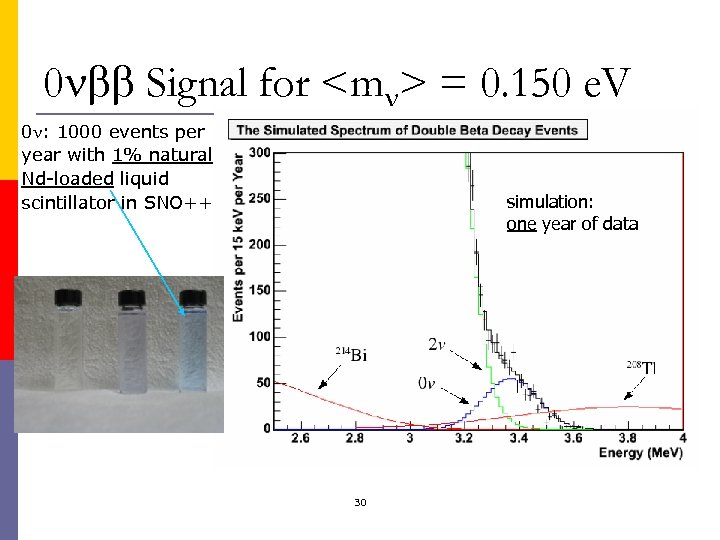
0 bb Signal for <m > = 0. 150 e. V 0 : 1000 events per year with 1% natural Nd-loaded liquid scintillator in SNO++ simulation: one year of data 30
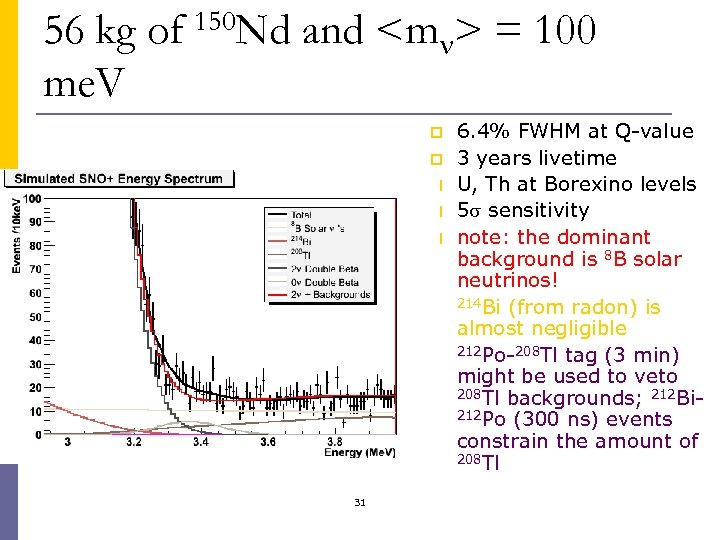
56 kg of 150 Nd and <m > = 100 me. V p p p p 31 6. 4% FWHM at Q-value 3 years livetime U, Th at Borexino levels 5 s sensitivity note: the dominant background is 8 B solar neutrinos! 214 Bi (from radon) is almost negligible 212 Po-208 Tl tag (3 min) might be used to veto 208 Tl backgrounds; 212 Bi 212 Po (300 ns) events constrain the amount of 208 Tl
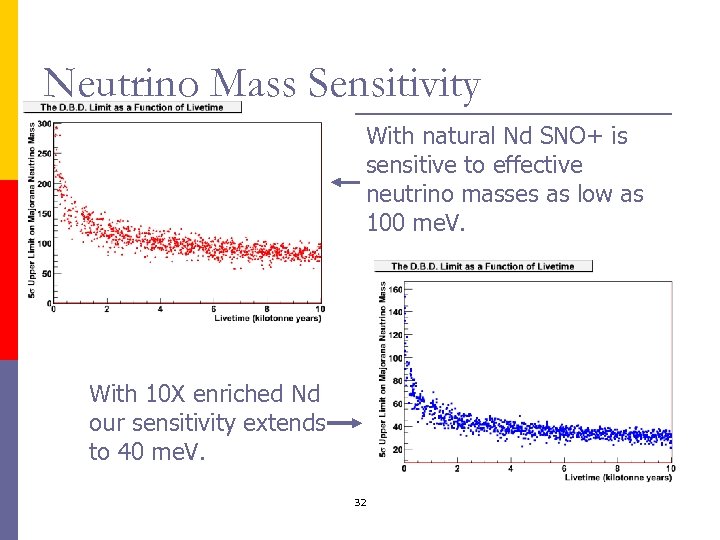
Neutrino Mass Sensitivity With natural Nd SNO+ is sensitive to effective neutrino masses as low as 100 me. V. With 10 X enriched Nd our sensitivity extends to 40 me. V. 32
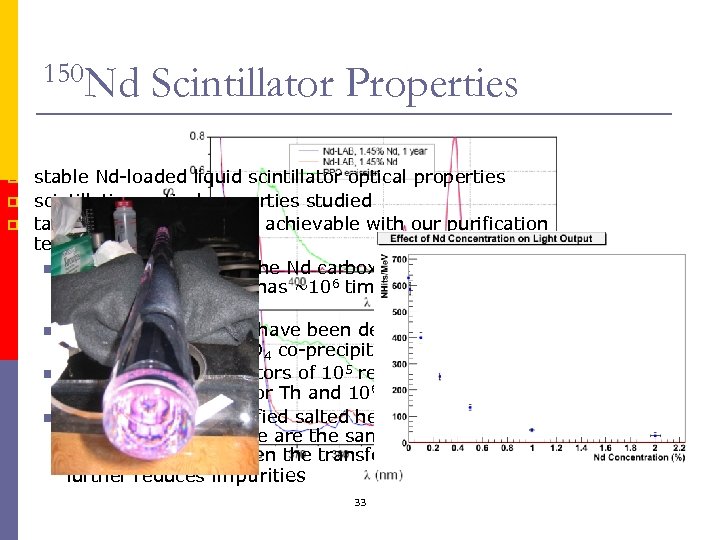
150 Nd p p p Scintillator Properties stable Nd-loaded liquid scintillator optical properties scintillation optical properties studied target background levels achievable with our purification techniques n Nd. Cl 3 used to make the Nd carboxylate that dissolves in the liquid scintillator has ~106 times more Th than our target level n purification methods have been developed at Queen’s using HZr. O and Ba. SO 4 co-precipitation n using spike tests, factors of 105 reduction per pass have been demonstrated for Th and 106 for Ra n remember: SNO purified salted heavy water down to ultra-low levels; these are the same techniques to first purify the Nd salt, then the transfer to the organic phase further reduces impurities 33
Nd-150 Consortium p Super. NEMO and SNO+, MOON and DCBA are supporting efforts to maintain an existing French AVLIS facility that is capable of making 100’s of kg of enriched Nd n a facility that enriched 204 kg of U (from 0. 7% to 2. 5%) in several hundred hours 34
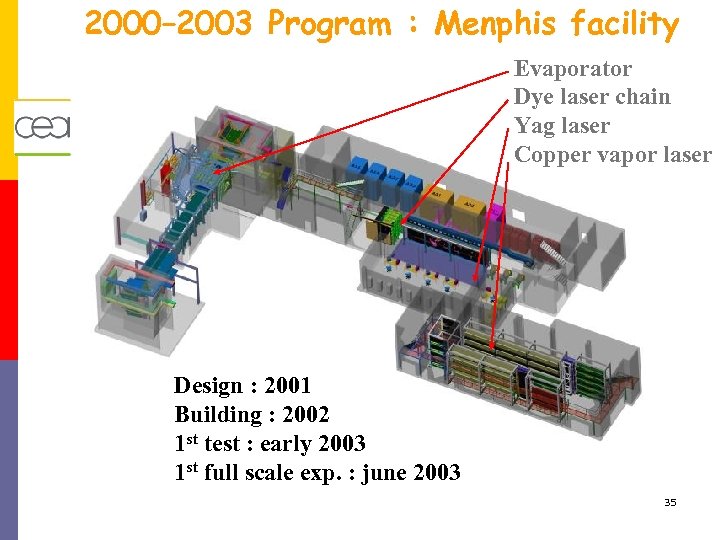
2000– 2003 Program : Menphis facility Evaporator Dye laser chain Yag laser Copper vapor laser Design : 2001 Building : 2002 1 st test : early 2003 1 st full scale exp. : june 2003 35
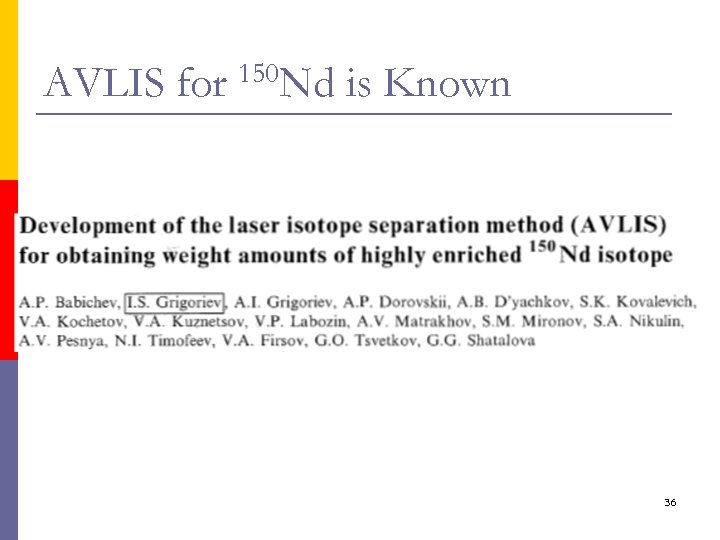
AVLIS for 150 Nd is Known 36
SNO+ Nd: Summary good sensitivity and very timely p homogeneous liquid, well defined background model p n n large volume gives self-shielding Q-value is above most backgrounds thus “insensitive” to internal radon backgrounds p thus insensitive to “external” backgrounds (2. 6 Me. V ) p Th, Ra purification techniques are effective p huge amounts of isotope, thus high statistics, can work for double beta decay search p n requires exquisite calibration and knowledge of detector response 37
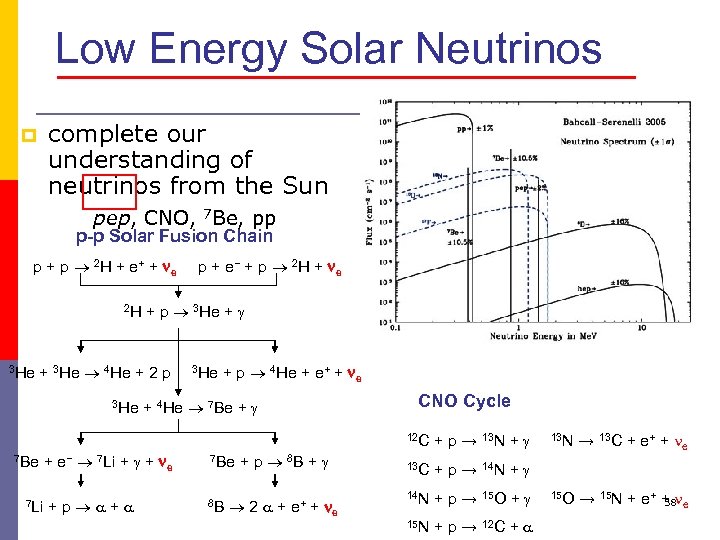
Low Energy Solar Neutrinos complete our understanding of neutrinos from the Sun p pep, CNO, 7 Be, pp p-p Solar Fusion Chain p + p 2 H + e + + e 2 H 3 He + p 3 He + + 3 He 4 He + 2 p 3 He p + e − + p 2 H + e 3 He + p 4 He + e+ + e CNO Cycle + 4 He 7 Be + 12 C 7 Be + e− 7 Li + + e 7 Li +p + 7 Be 8 B + p 8 B + 2 + e+ + e + p → 13 N + 13 C + p → 14 N + p → 15 O + 15 N + p → 12 C + 13 N → 13 C + e+ + e 15 O → 15 N + e+ + e 38
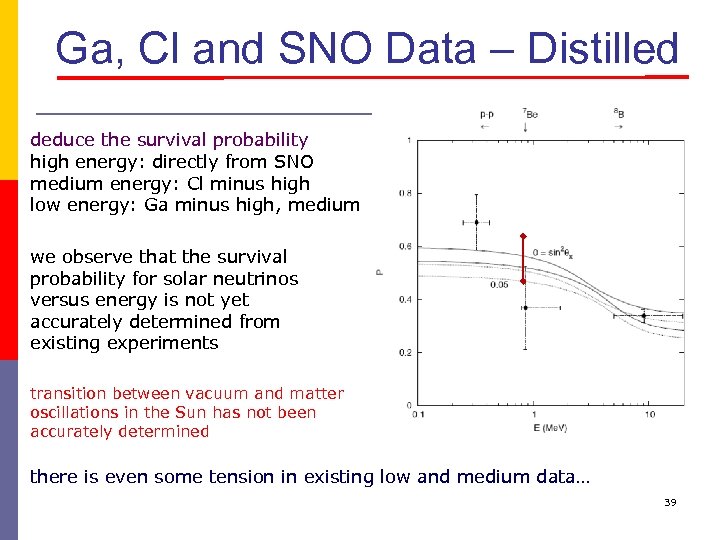
Ga, Cl and SNO Data – Distilled deduce the survival probability high energy: directly from SNO medium energy: Cl minus high low energy: Ga minus high, medium x is 13 we observe that the survival probability for solar neutrinos versus energy is not yet accurately determined from existing experiments transition between vacuum and matter oscillations in the Sun has not been accurately determined Barger, Marfatia, Whisnant, hep-ph/0501247 there is even some tension in existing low and medium data… 39
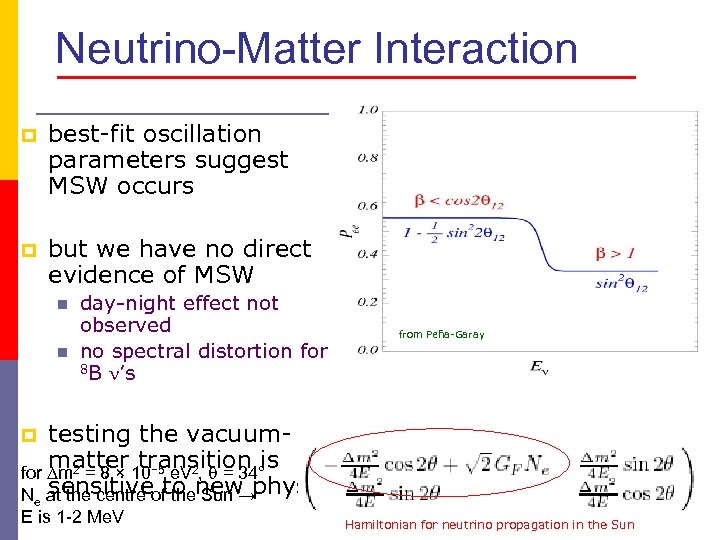
Neutrino-Matter Interaction p best-fit oscillation parameters suggest MSW occurs p but we have no direct evidence of MSW n n day-night effect not observed no spectral distortion for 8 B ’s from Peña-Garay testing the vacuummatter transition is for m 2 = 8 × 10− 5 e. V 2, = 34° sensitive to Sun → Ne at the centre of thenew physics p E is 1 -2 Me. V 40 Hamiltonian for neutrino propagation in the Sun
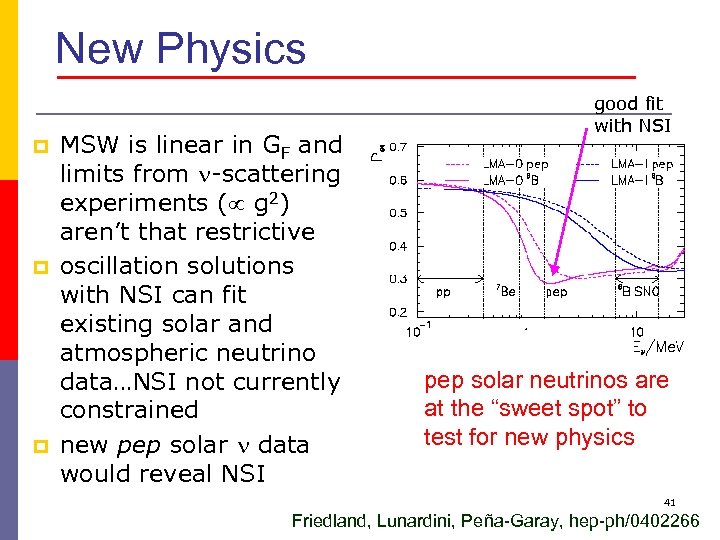
New Physics p p p MSW is linear in GF and limits from -scattering experiments ( g 2) aren’t that restrictive oscillation solutions with NSI can fit existing solar and atmospheric neutrino data…NSI not currently constrained new pep solar data would reveal NSI good fit with NSI pep solar neutrinos are at the “sweet spot” to test for new physics 41 Friedland, Lunardini, Peña-Garay, hep-ph/0402266
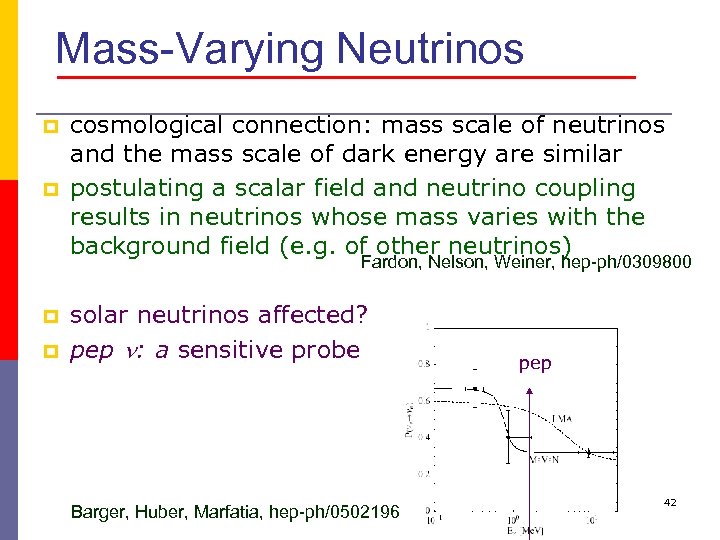
Mass-Varying Neutrinos p p cosmological connection: mass scale of neutrinos and the mass scale of dark energy are similar postulating a scalar field and neutrino coupling results in neutrinos whose mass varies with the background field (e. g. of other neutrinos) Fardon, Nelson, Weiner, hep-ph/0309800 p p solar neutrinos affected? pep n: a sensitive probe Barger, Huber, Marfatia, hep-ph/0502196 pep 42
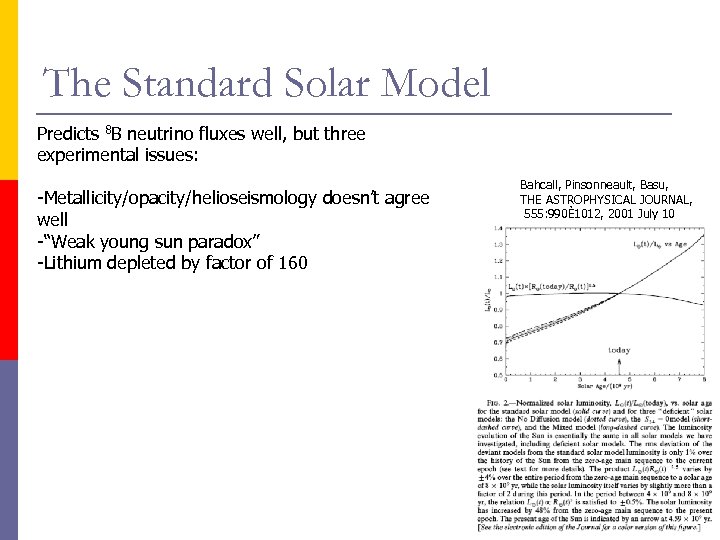
The Standard Solar Model Predicts 8 B neutrino fluxes well, but three experimental issues: -Metallicity/opacity/helioseismology doesn’t agree well -“Weak young sun paradox” -Lithium depleted by factor of 160 Bahcall, Pinsonneault, Basu, THE ASTROPHYSICAL JOURNAL, 555: 990È1012, 2001 July 10 43
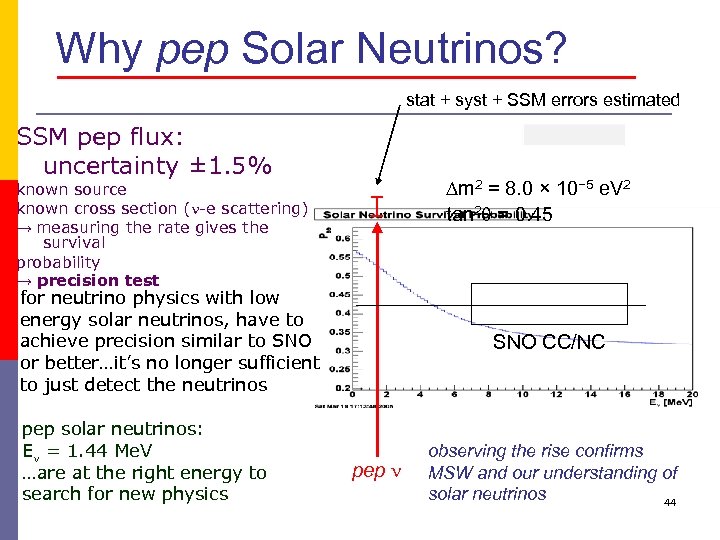
Why pep Solar Neutrinos? stat + syst + SSM errors estimated SSM pep flux: uncertainty ± 1. 5% m 2 = 8. 0 × 10− 5 e. V 2 tan 2 = 0. 45 known source known cross section ( -e scattering) → measuring the rate gives the survival probability → precision test for neutrino physics with low energy solar neutrinos, have to achieve precision similar to SNO or better…it’s no longer sufficient to just detect the neutrinos pep solar neutrinos: E = 1. 44 Me. V …are at the right energy to search for new physics SNO CC/NC pep observing the rise confirms MSW and our understanding of solar neutrinos 44
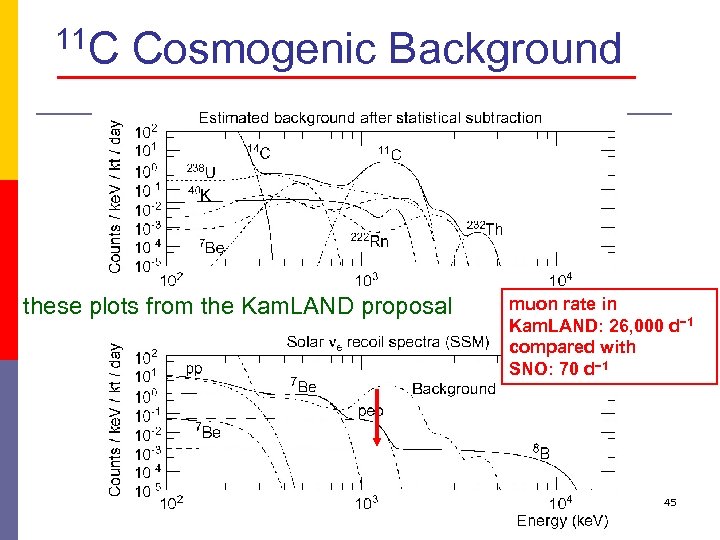
11 C Cosmogenic Background these plots from the Kam. LAND proposal muon rate in Kam. LAND: 26, 000 d− 1 compared with SNO: 70 d− 1 45
Requirements for a Liquid Scintillator pep Solar Detector p depth n p 11 C background good light output from the scintillator n p to reduce/eliminate studied the effect of varying the energy resolution; found not a steep dependence radiopurity n n control of Rn exposure because of 210 Bi eliminate 40 K internal contamination 46
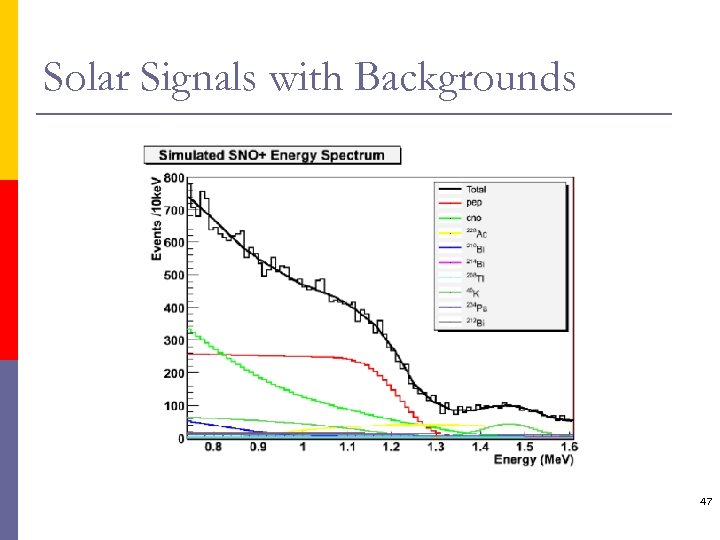
Solar Signals with Backgrounds 47
SNO+ Solar Neutrino Projected Capability p with backgrounds at Kam. LAND levels n n n U, Th achieved 210 Pb and 40 K post-purification Kam. LAND targets external backgrounds p p p calculated based upon SNO external activities fiducial volume 450 cm pep uncertainties n n <± 5% statistical (signal extraction from background) ± 3% systematic ± 1. 5% SSM e. g. it would be a measurement of the survival probability at 1. 44 Me. V of 0. 55 ± 0. 03 48
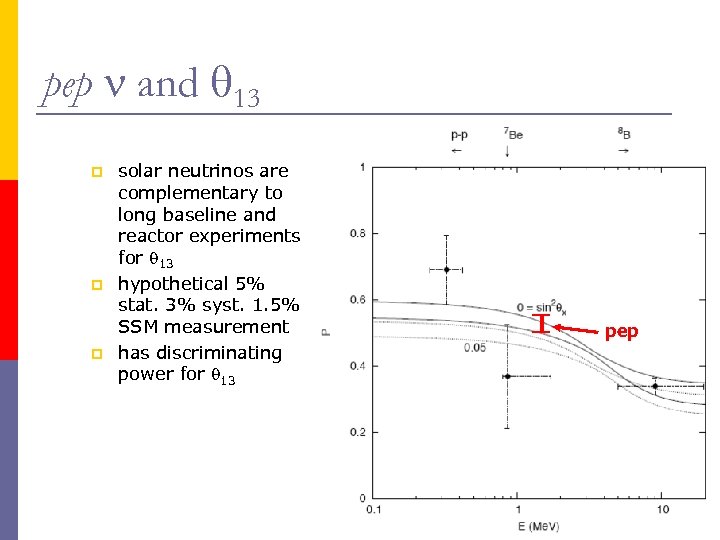
pep and 13 p p p solar neutrinos are complementary to long baseline and reactor experiments for 13 hypothetical 5% stat. 3% syst. 1. 5% SSM measurement has discriminating power for 13 pep 49
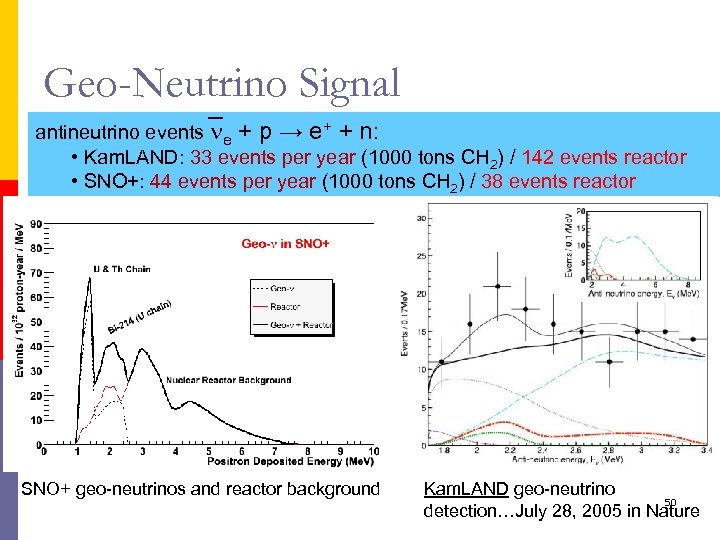
Geo-Neutrino Signal antineutrino events e + p → e+ + n: • Kam. LAND: 33 events per year (1000 tons CH 2) / 142 events reactor • SNO+: 44 events per year (1000 tons CH 2) / 38 events reactor Kam. LAND SNO+ geo-neutrinos and reactor background Kam. LAND geo-neutrino 50 detection…July 28, 2005 in Nature
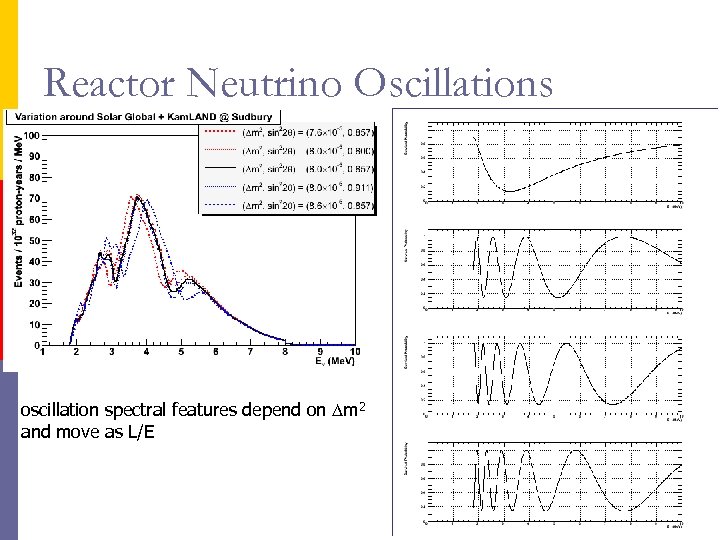
Reactor Neutrino Oscillations 50 km Bruce 240 km oscillation spectral features depend on m 2 and move as L/E Pickering 340 km Darlington 360 km 51
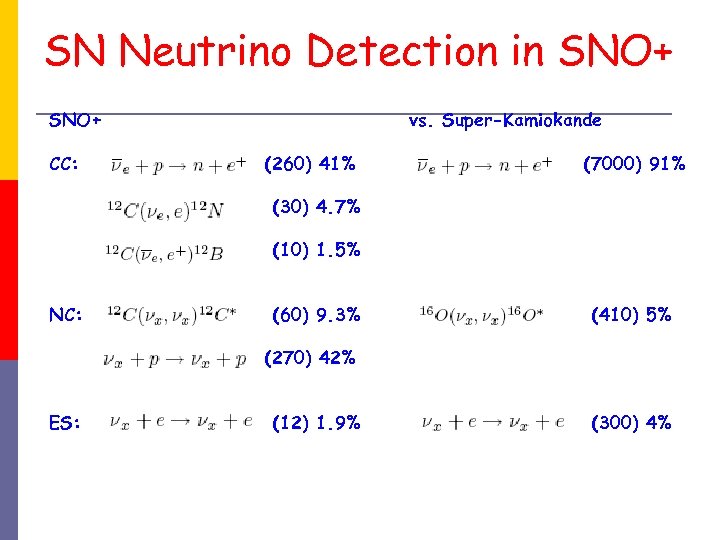
SN Neutrino Detection in SNO+ CC: vs. Super-Kamiokande (260) 41% (7000) 91% (30) 4. 7% (10) 1. 5% NC: (60) 9. 3% (410) 5% (270) 42% ES: (12) 1. 9% (300) 4%
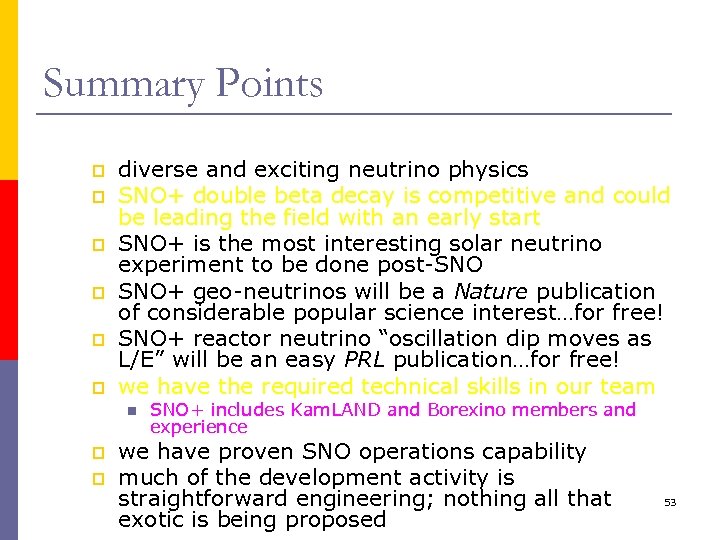
Summary Points p p p diverse and exciting neutrino physics SNO+ double beta decay is competitive and could be leading the field with an early start SNO+ is the most interesting solar neutrino experiment to be done post-SNO SNO+ geo-neutrinos will be a Nature publication of considerable popular science interest…for free! SNO+ reactor neutrino “oscillation dip moves as L/E” will be an easy PRL publication…for free! we have the required technical skills in our team n p p SNO+ includes Kam. LAND and Borexino members and experience we have proven SNO operations capability much of the development activity is straightforward engineering; nothing all that exotic is being proposed 53
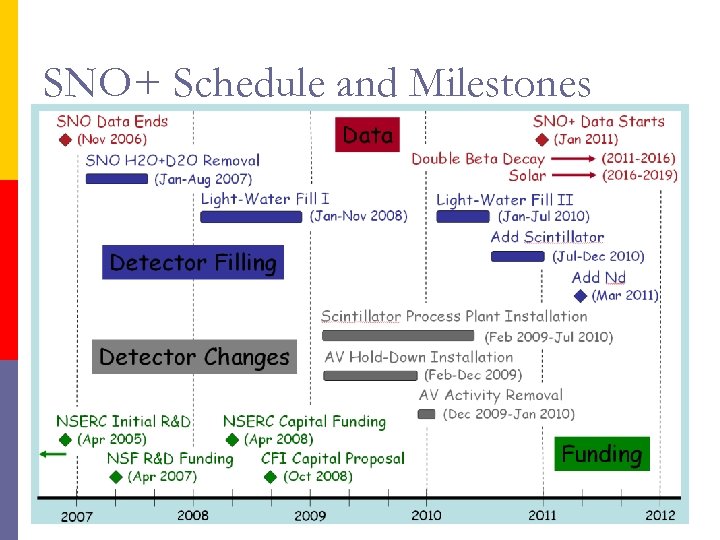
SNO+ Schedule and Milestones
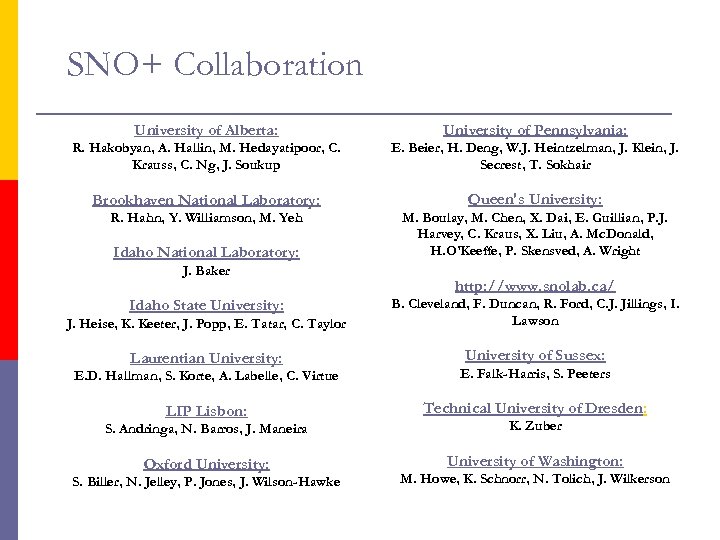
SNO+ Collaboration University of Alberta: University of Pennsylvania: R. Hakobyan, A. Hallin, M. Hedayatipoor, C. Krauss, C. Ng, J. Soukup E. Beier, H. Deng, W. J. Heintzelman, J. Klein, J. Secrest, T. Sokhair Brookhaven National Laboratory: Queen's University: R. Hahn, Y. Williamson, M. Yeh M. Boulay, M. Chen, X. Dai, E. Guillian, P. J. Harvey, C. Kraus, X. Liu, A. Mc. Donald, H. O’Keeffe, P. Skensved, A. Wright Idaho National Laboratory: J. Baker http: //www. snolab. ca/ J. Heise, K. Keeter, J. Popp, E. Tatar, C. Taylor B. Cleveland, F. Duncan, R. Ford, C. J. Jillings, I. Lawson Laurentian University: University of Sussex: Idaho State University: E. D. Hallman, S. Korte, A. Labelle, C. Virtue E. Falk-Harris, S. Peeters LIP Lisbon: Technical University of Dresden: S. Andringa, N. Barros, J. Maneira K. Zuber Oxford University: University of Washington: S. Biller, N. Jelley, P. Jones, J. Wilson-Hawke M. Howe, K. Schnorr, N. Tolich, J. Wilkerson
Скачать презентацию SNO A detector for neutrinoless double beta decay
15a9ccd86032ffcc23247832691ab597.ppt