


 Скачать презентацию Smoothing This dark art is why NLP is
04c224edc953d01185a96b3abc25ec31.ppt
- Количество слайдов: 54
 Smoothing This dark art is why NLP is taught in the engineering school. There are more principled smoothing methods, too. We’ll look next at log-linear models, which are a good and popular general technique. 600. 465 - Intro to NLP - J. Eisner But the traditional methods are easy to implement, run fast, and will give you intuitions about what you want from a smoothing method. 1
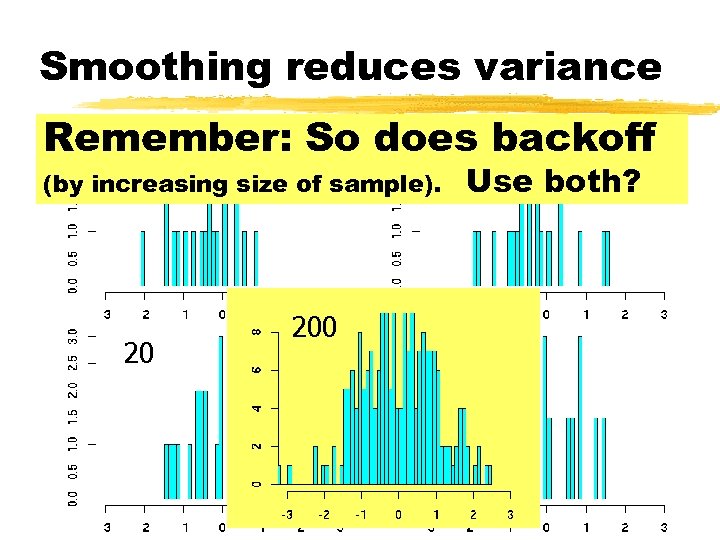
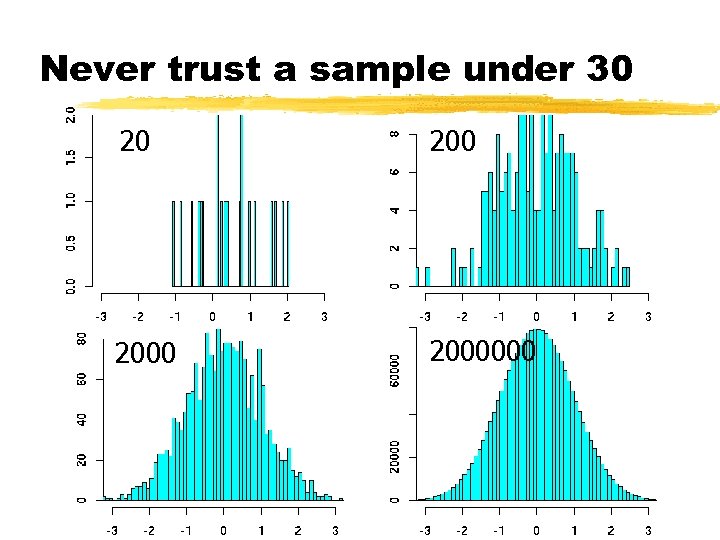 Never trust a sample under 30 20 2000000
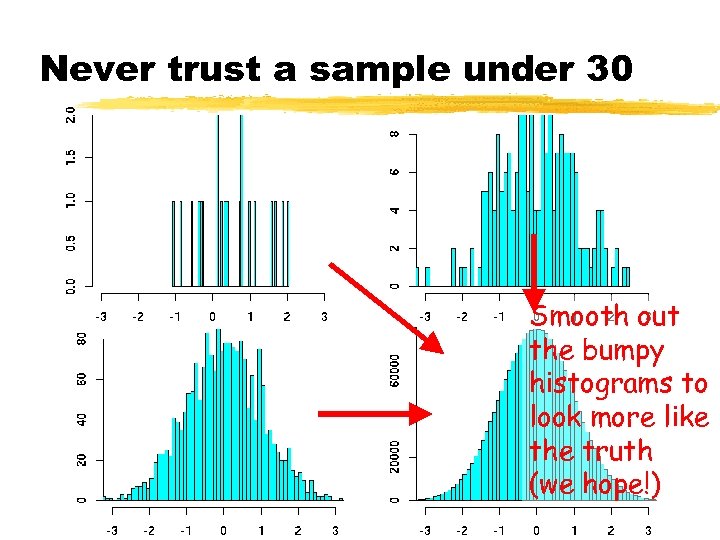 Never trust a sample under 30 Smooth out the bumpy histograms to look more like the truth (we hope!)
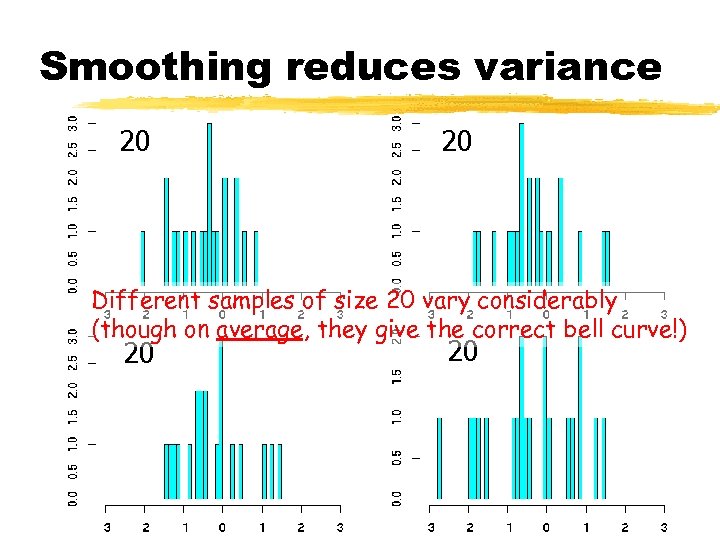 Smoothing reduces variance 20 20 Different samples of size 20 vary considerably (though on average, they give the correct bell curve!) 20 20
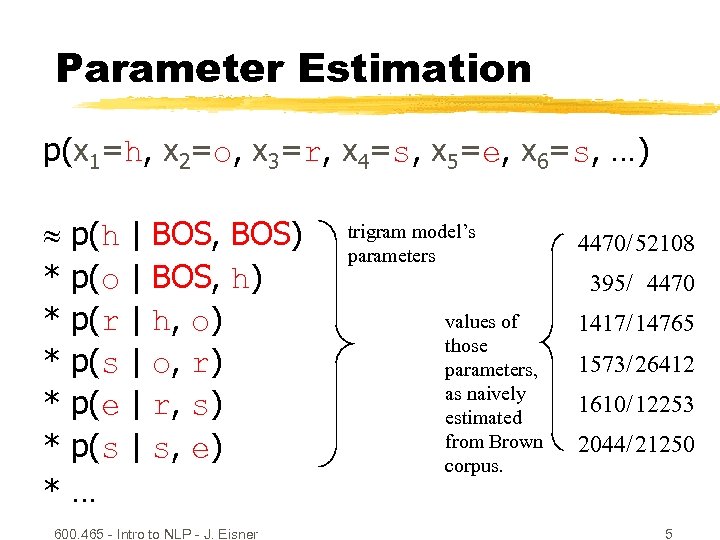 Parameter Estimation p(x 1=h, x 2=o, x 3=r, x 4=s, x 5=e, x 6=s, …) * * * p(h p(o p(r p(s p(e p(s … | | | BOS, BOS) BOS, h) h, o) o, r) r, s) s, e) 600. 465 - Intro to NLP - J. Eisner trigram model’s parameters 4470/ 52108 395/ 4470 values of those parameters, as naively estimated from Brown corpus. 1417/ 14765 1573/ 26412 1610/ 12253 2044/ 21250 5
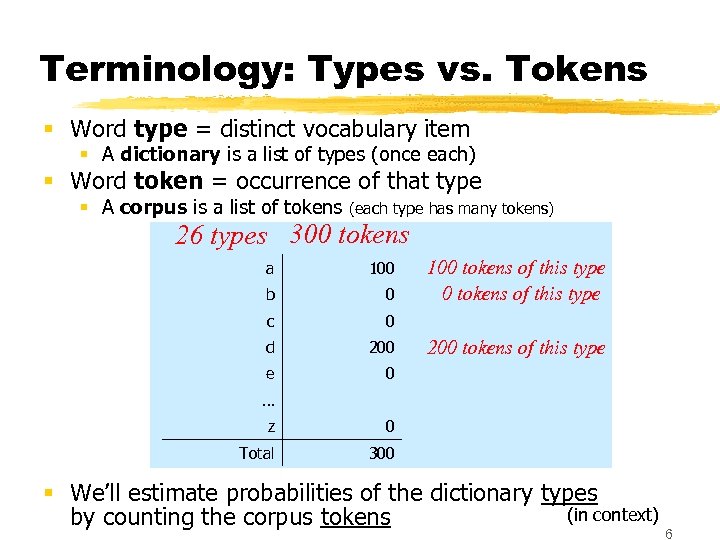 Terminology: Types vs. Tokens § Word type = distinct vocabulary item § A dictionary is a list of types (once each) § Word token = occurrence of that type § A corpus is a list of tokens (each type has many tokens) 26 types 300 tokens a 100 b 0 c 0 d 200 e 100 tokens of this type 0 200 tokens of this type … z 0 Total 300 § We’ll estimate probabilities of the dictionary types (in context) by counting the corpus tokens 6
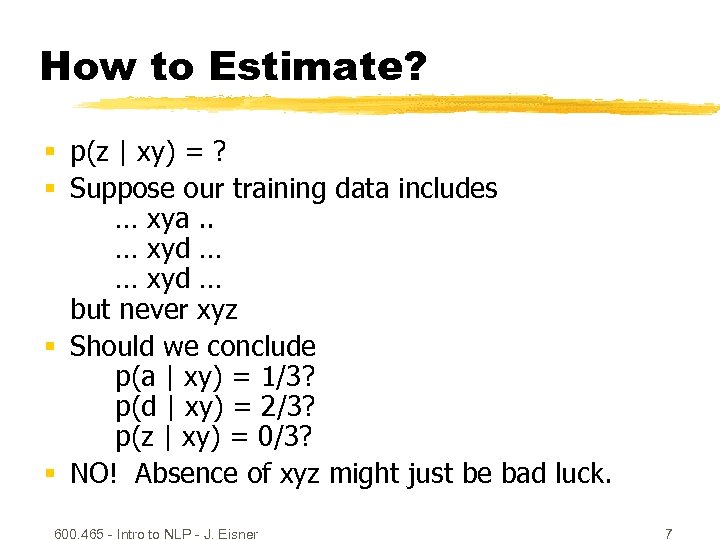 How to Estimate? § p(z | xy) = ? § Suppose our training data includes … xya. . … xyd … but never xyz § Should we conclude p(a | xy) = 1/3? p(d | xy) = 2/3? p(z | xy) = 0/3? § NO! Absence of xyz might just be bad luck. 600. 465 - Intro to NLP - J. Eisner 7
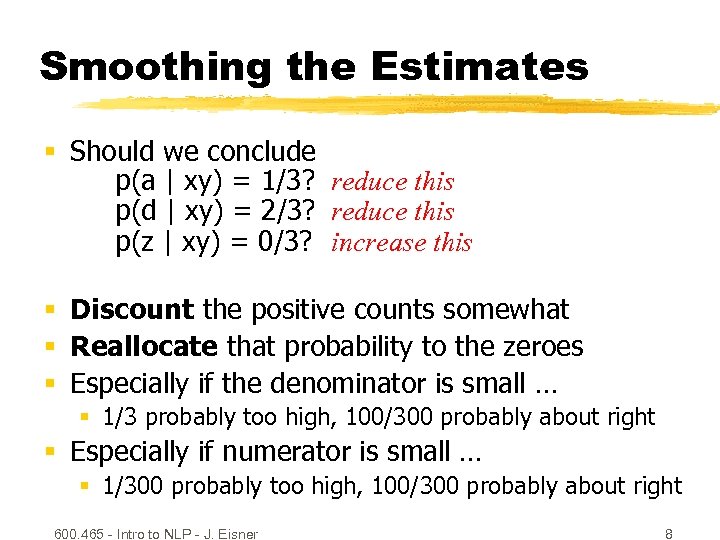 Smoothing the Estimates § Should we conclude p(a | xy) = 1/3? reduce this p(d | xy) = 2/3? reduce this p(z | xy) = 0/3? increase this § Discount the positive counts somewhat § Reallocate that probability to the zeroes § Especially if the denominator is small … § 1/3 probably too high, 100/300 probably about right § Especially if numerator is small … § 1/300 probably too high, 100/300 probably about right 600. 465 - Intro to NLP - J. Eisner 8
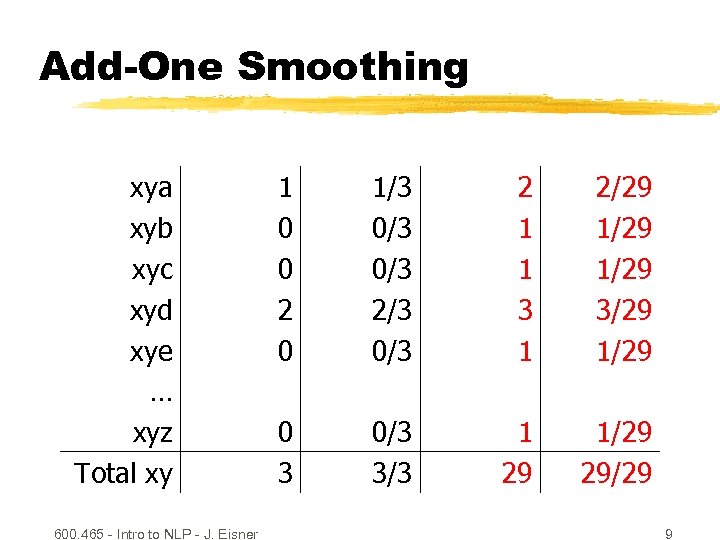 Add-One Smoothing xya xyb xyc xyd xye … xyz Total xy 600. 465 - Intro to NLP - J. Eisner 1 0 0 2 0 1/3 0/3 2/3 0/3 2 1 1 3 1 2/29 1/29 3/29 1/29 0 3 0/3 3/3 1 29 1/29 29/29 9
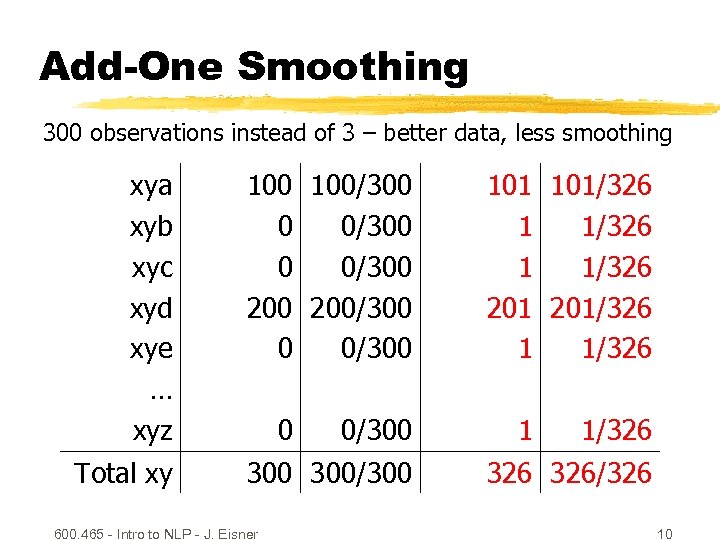 Add-One Smoothing 300 observations instead of 3 – better data, less smoothing xya xyb xyc xyd xye … xyz 100/300 0 0/300 200/300 0 0/300 Total xy 300/300 0 600. 465 - Intro to NLP - J. Eisner 0/300 101/326 1 1/326 201/326 1 1/326 326/326 10
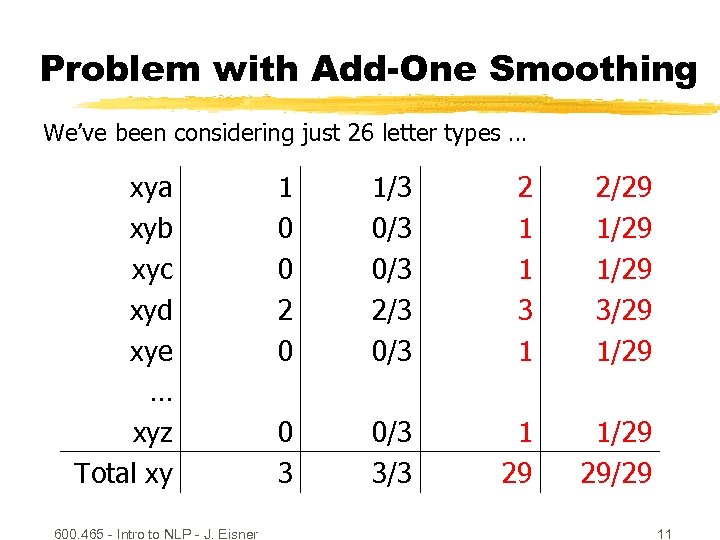 Problem with Add-One Smoothing We’ve been considering just 26 letter types … xya xyb xyc xyd xye … xyz Total xy 600. 465 - Intro to NLP - J. Eisner 1 0 0 2 0 1/3 0/3 2/3 0/3 2 1 1 3 1 2/29 1/29 3/29 1/29 0 3 0/3 3/3 1 29 1/29 29/29 11
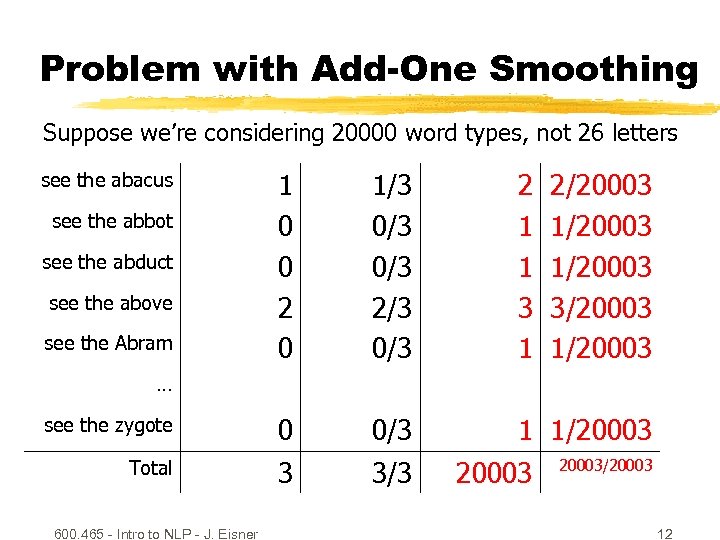 Problem with Add-One Smoothing Suppose we’re considering 20000 word types, not 26 letters 1 0 0 2 0 1/3 0/3 2/3 0/3 2 1 1 3 1 see the zygote 0 0/3 1 1/20003 Total 3 3/3 see the abacus see the abbot see the abduct see the above see the Abram 2/20003 1/20003 3/20003 1/20003 … 600. 465 - Intro to NLP - J. Eisner 20003/20003 12
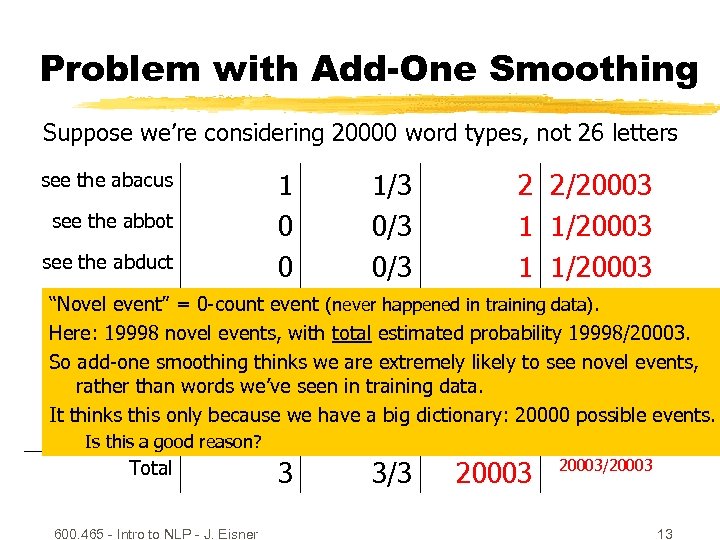 Problem with Add-One Smoothing Suppose we’re considering 20000 word types, not 26 letters 1 1/3 2 2/20003 see the abbot 0 0/3 1 1/20003 see the abduct 0 0/3 1 1/20003 see theevent” = 0 -count event (never happened in training 3/20003 “Novel above 2 2/3 3 data). Here: 19998 novel events, with total estimated probability 19998/20003. see the Abram 0 0/3 1 1/20003 So add-one smoothing thinks we are extremely likely to see novel events, see the abacus … rather than words we’ve seen in training data. It thinks this only because we have a big dictionary: 20000 possible events. see the zygote 0 0/3 1 1/20003 Is this a good reason? Total 600. 465 - Intro to NLP - J. Eisner 3 3/3 20003/20003 13
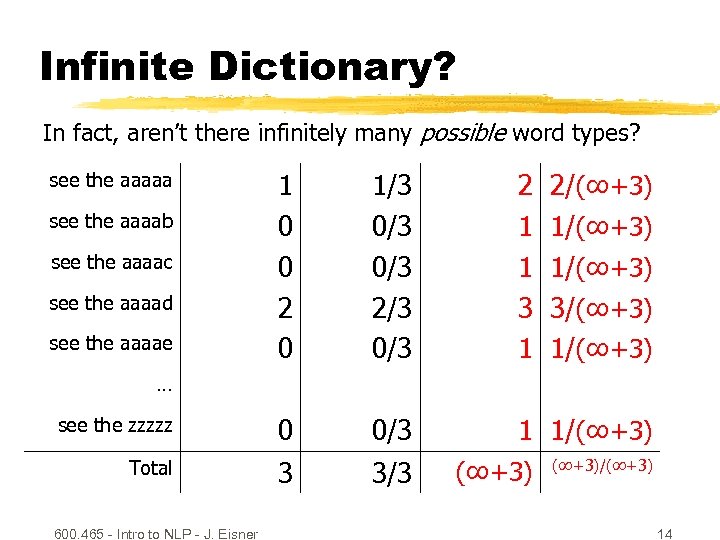 Infinite Dictionary? In fact, aren’t there infinitely many possible word types? 1 0 0 2 0 1/3 0/3 2/3 0/3 2 1 1 3 1 see the zzzzz 0 0/3 1 1/(∞+3) Total 3 3/3 see the aaaaa see the aaaab see the aaaac see the aaaad see the aaaae 2/(∞+3) 1/(∞+3) 3/(∞+3) 1/(∞+3) … 600. 465 - Intro to NLP - J. Eisner (∞+3)/(∞+3) 14
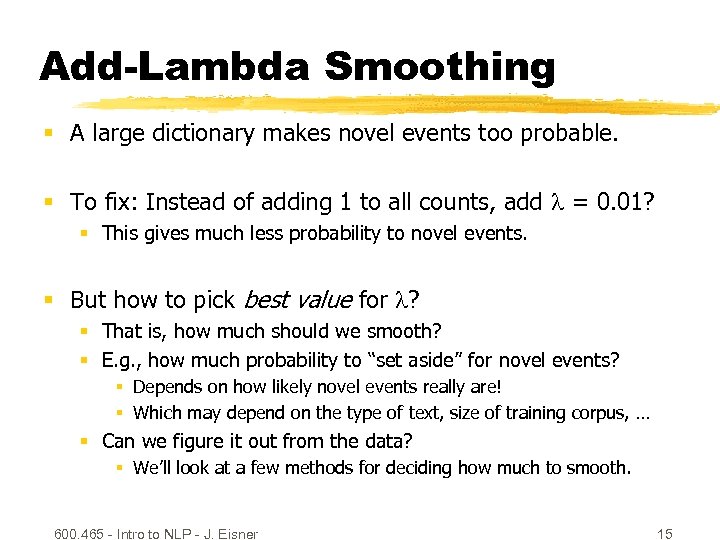 Add-Lambda Smoothing § A large dictionary makes novel events too probable. § To fix: Instead of adding 1 to all counts, add = 0. 01? § This gives much less probability to novel events. § But how to pick best value for ? § That is, how much should we smooth? § E. g. , how much probability to “set aside” for novel events? § Depends on how likely novel events really are! § Which may depend on the type of text, size of training corpus, … § Can we figure it out from the data? § We’ll look at a few methods for deciding how much to smooth. 600. 465 - Intro to NLP - J. Eisner 15
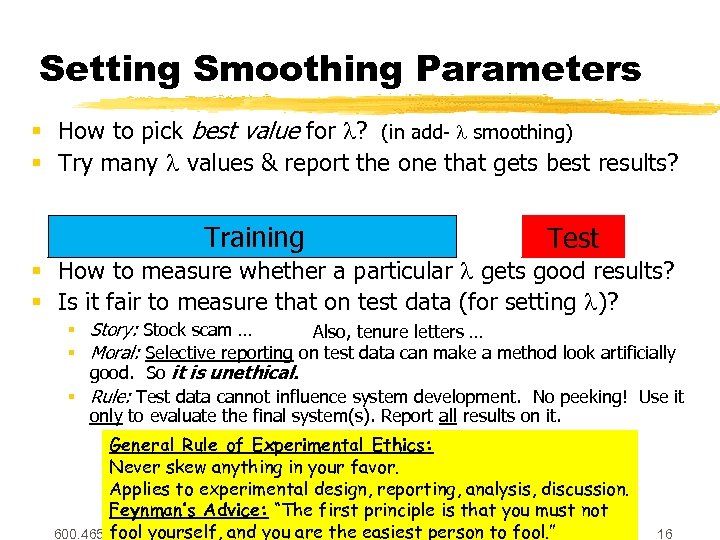 Setting Smoothing Parameters § How to pick best value for ? (in add- smoothing) § Try many values & report the one that gets best results? Training Test § How to measure whether a particular gets good results? § Is it fair to measure that on test data (for setting )? § Story: Stock scam … Also, tenure letters … § Moral: Selective reporting on test data can make a method look artificially good. So it is unethical. § Rule: Test data cannot influence system development. No peeking! Use it only to evaluate the final system(s). Report all results on it. General Rule of Experimental Ethics: Never skew anything in your favor. Applies to experimental design, reporting, analysis, discussion. Feynman’s Advice: “The first principle is that you must not fool to NLP - J. Eisner 600. 465 - Intro yourself, and you are the easiest person to fool. ” 16
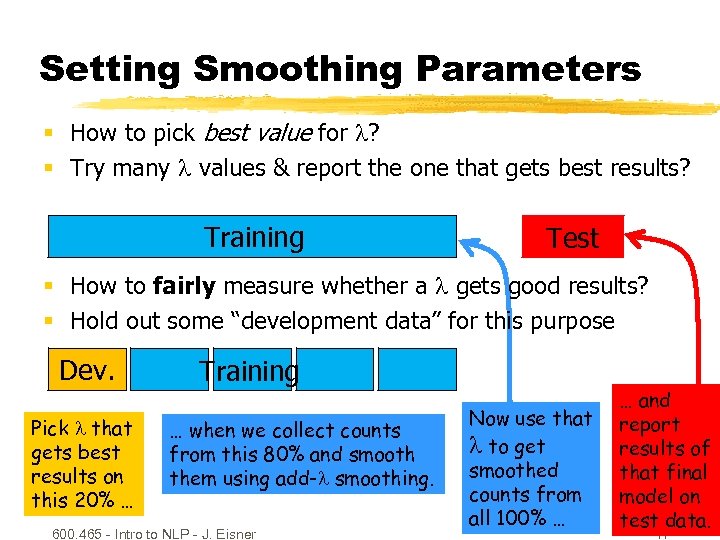 Setting Smoothing Parameters § How to pick best value for ? § Try many values & report the one that gets best results? Training Test § How to fairly measure whether a gets good results? § Hold out some “development data” for this purpose Dev. Pick that gets best results on this 20% … Training … when we collect counts from this 80% and smooth them using add- smoothing. 600. 465 - Intro to NLP - J. Eisner Now use that to get smoothed counts from all 100% … … and report results of that final model on test data. 17
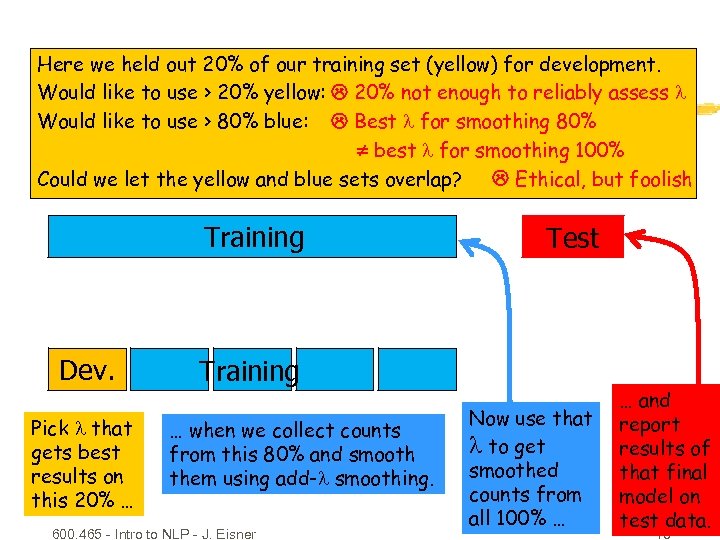 Setting Smoothing Parameters Here we held out 20% of our training set (yellow) for development. Would like to use > 20% yellow: 20% not enough to reliably assess Would like to use > 80% blue: Best for smoothing 80% best for smoothing 100% Could we let the yellow and blue sets overlap? Ethical, but foolish Training Dev. Pick that gets best results on this 20% … Test Training … when we collect counts from this 80% and smooth them using add- smoothing. 600. 465 - Intro to NLP - J. Eisner Now use that to get smoothed counts from all 100% … … and report results of that final model on test data. 18
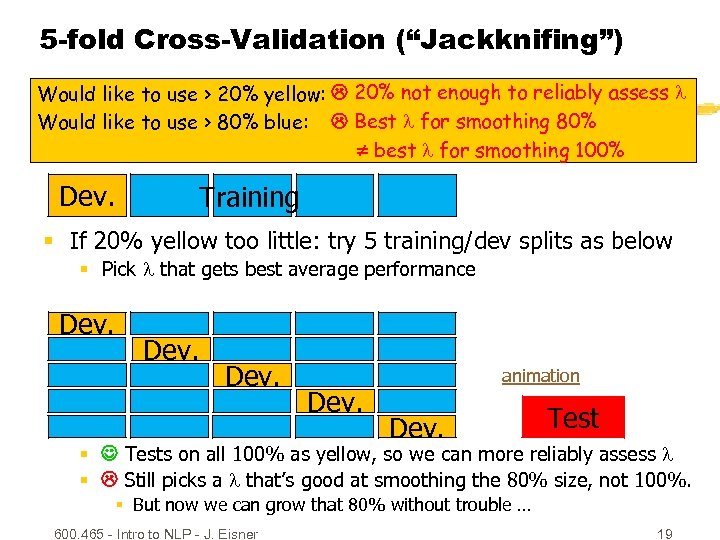 5 -fold Cross-Validation (“Jackknifing”) Would like to use > 20% yellow: 20% not enough to reliably assess Would like to use > 80% blue: Best for smoothing 80% § Old version: Train on 80%, test on 20% best for smoothing 100% Dev. Training § If 20% yellow too little: try 5 training/dev splits as below § Pick that gets best average performance Dev. animation Dev. Test § Tests on all 100% as yellow, so we can more reliably assess § Still picks a that’s good at smoothing the 80% size, not 100%. § But now we can grow that 80% without trouble … 600. 465 - Intro to NLP - J. Eisner 19
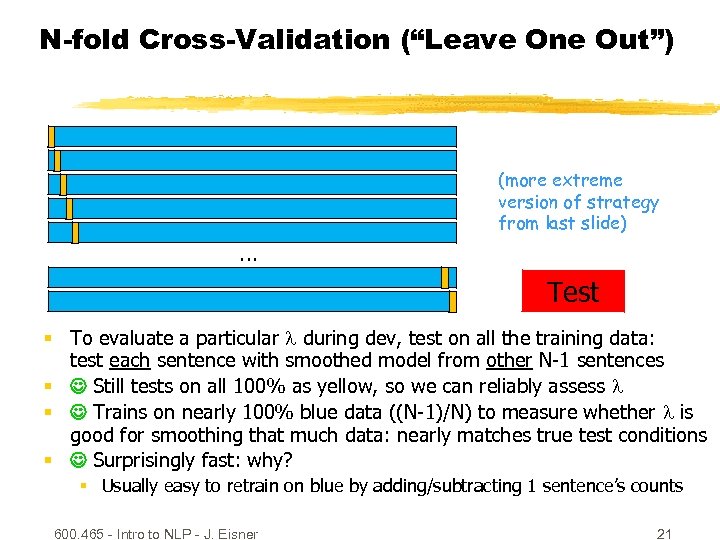 N-fold Cross-Validation (“Leave One Out”) (more extreme version of strategy from last slide) … Test § To evaluate a particular during dev, test on all the training data: test each sentence with smoothed model from other N-1 sentences § Still tests on all 100% as yellow, so we can reliably assess § Trains on nearly 100% blue data ((N-1)/N) to measure whether is good for smoothing that much data: nearly matches true test conditions § Surprisingly fast: why? § Usually easy to retrain on blue by adding/subtracting 1 sentence’s counts 600. 465 - Intro to NLP - J. Eisner 21
 Smoothing reduces variance 20 20 Remember: So does backoff (by increasing size of sample). 20 200 Use both? 20
 Use the backoff, Luke! § Why are we treating all novel events as the same? § p(zygote | see the) vs. p(baby | see the) § Unsmoothed probs: count(see the zygote) / count(see the) § Smoothed probs: (count(see the zygote) + 1) / (count(see the) + V) § What if count(see the zygote) = count(see the baby) = 0? § baby beats zygote as a unigram § the baby beats the zygote as a bigram § see the baby beats see the zygote ? (even if both have the same count, such as 0) § Backoff introduces bias, as usual: § Lower-order probabilities (unigram, bigram) aren’t quite what we want § But we do have enuf data to estimate them & they’re better than nothing. 600. 465 - Intro to NLP - J. Eisner 23
 Early idea: Model averaging § Jelinek-Mercer smoothing (“deleted interpolation”): § Use a weighted average of backed-off naïve models: paverage(z | xy) = 3 p(z | xy) + 2 p(z | y) + 1 p(z) where 3 + 2 + 1 = 1 and all are 0 § The weights can depend on the context xy § If we have “enough data” in context xy, can make 3 large. E. g. : § If count(xy) is high § If the entropy of z is low in the context xy § Learn the weights on held-out data w/ jackknifing § Different 3 when xy is observed 1 time, 2 times, 3 -5 times, … § We’ll see some better approaches shortly 600. 465 - Intro to NLP - J. Eisner 24
 More Ideas for Smoothing § Cross-validation is a general-purpose wrench for tweaking any constants in any system. § Here, the system will train the counts from blue data, but we use yellow data to tweak how much the system smooths them ( ) and how much it backs off for different kinds of contexts ( 3 etc. ) § Is there anything more specific to try in this case? § Remember, we’re trying to decide how much to smooth. § E. g. , how much probability to “set aside” for novel events? § Depends on how likely novel events really are … § Which may depend on the type of text, size of training corpus, … § Can we figure this out from the data?
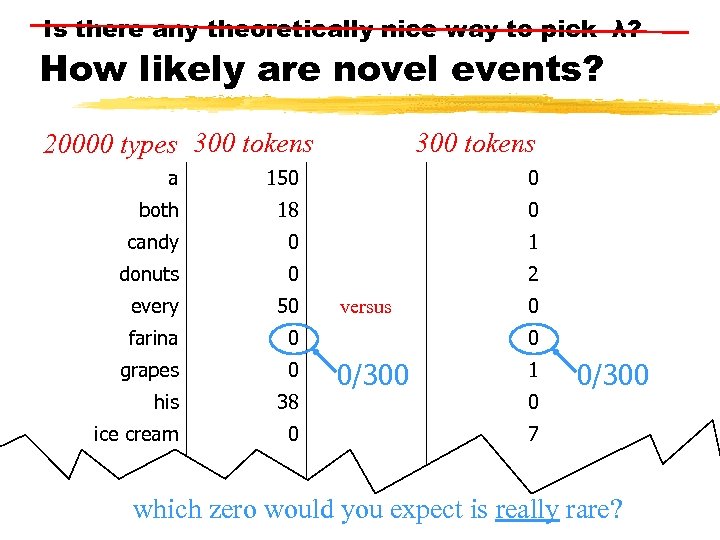 Is there any theoretically nice way to pick λ? How likely are novel events? 20000 types 300 tokens a 150 0 both 18 0 candy 0 1 donuts 0 2 every 50 farina 0 grapes 0 his 38 ice cream 0 versus 0 0 0/300 1 0 0/300 7 … which zero would you expect is really rare? 600. 465 - Intro to NLP - J. Eisner 26
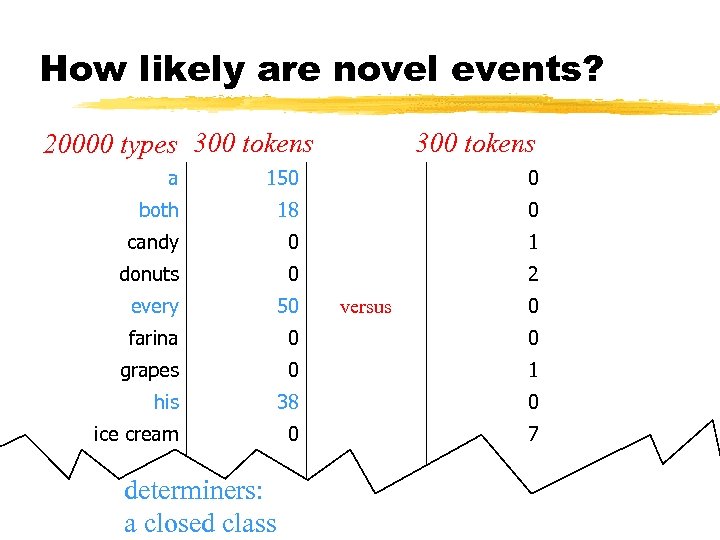 How likely are novel events? 20000 types 300 tokens a 150 0 both 18 0 candy 0 1 donuts 0 2 every 50 farina 0 0 grapes 0 1 his 38 0 ice cream 0 7 versus 0 … determiners: a to NLP - J. class 600. 465 - Introclosed Eisner 27
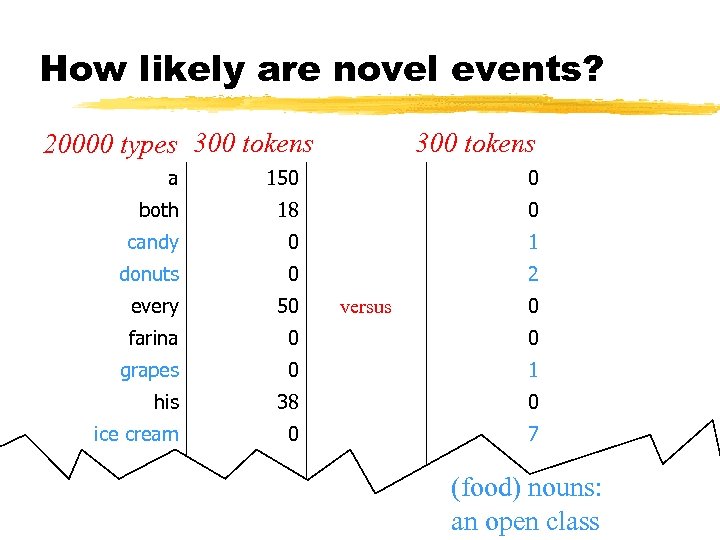 How likely are novel events? 20000 types 300 tokens a 150 0 both 18 0 candy 0 1 donuts 0 2 every 50 farina 0 0 grapes 0 1 his 38 0 ice cream 0 7 … 600. 465 - Intro to NLP - J. Eisner versus 0 (food) nouns: an open class 28
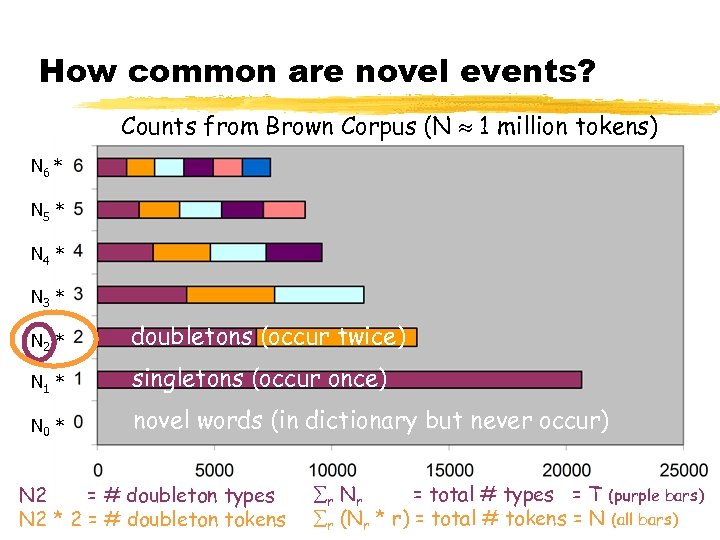 How common are novel events? Counts from Brown Corpus (N 1 million tokens) N 6 * N 5 * N 4 * N 3 * N 2 * doubletons (occur twice) N 1 * singletons (occur once) N 0 * novel words (in dictionary but never occur) N 2 = # doubleton types N 2 * 2 = # doubleton tokens r N r = total # types = T (purple bars) r (Nr * r) = total # tokens = N (all bars)
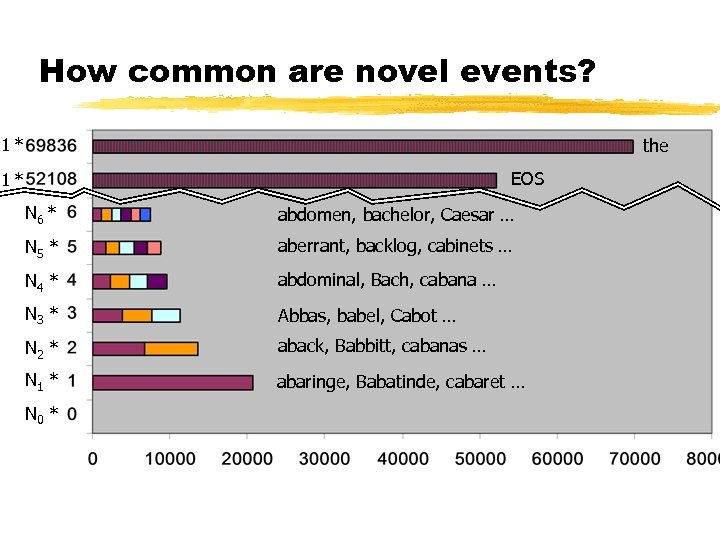 How common are novel events? 1* the EOS 1* N 6 * abdomen, bachelor, Caesar … N 5 * aberrant, backlog, cabinets … N 4 * abdominal, Bach, cabana … N 3 * Abbas, babel, Cabot … N 2 * aback, Babbitt, cabanas … N 1 * abaringe, Babatinde, cabaret … N 0 *
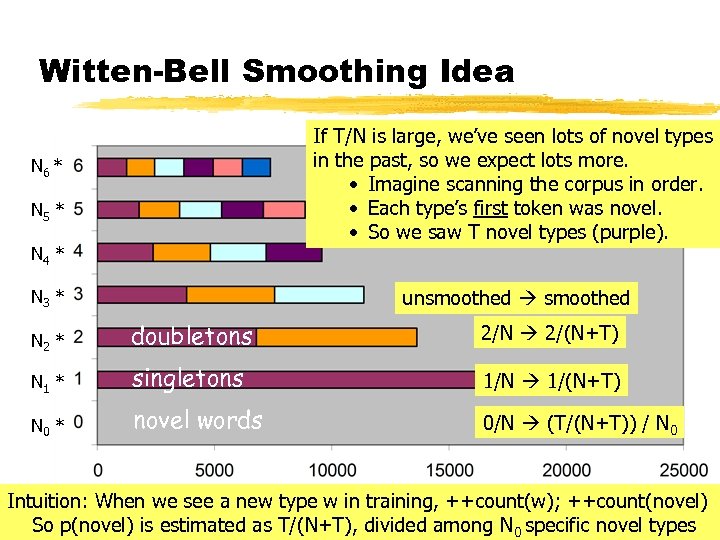 Witten-Bell Smoothing Idea If T/N is large, we’ve seen lots of novel types in the past, so we expect lots more. • Imagine scanning the corpus in order. • Each type’s first token was novel. • So we saw T novel types (purple). N 6 * N 5 * N 4 * N 3 * unsmoothed N 2 * doubletons 2/N 2/(N+T) N 1 * singletons 1/N 1/(N+T) N 0 * novel words 0/N (T/(N+T)) / N 0 Intuition: When we see a new type w in training, ++count(w); ++count(novel) So p(novel) is estimated as T/(N+T), divided among N 0 specific novel types
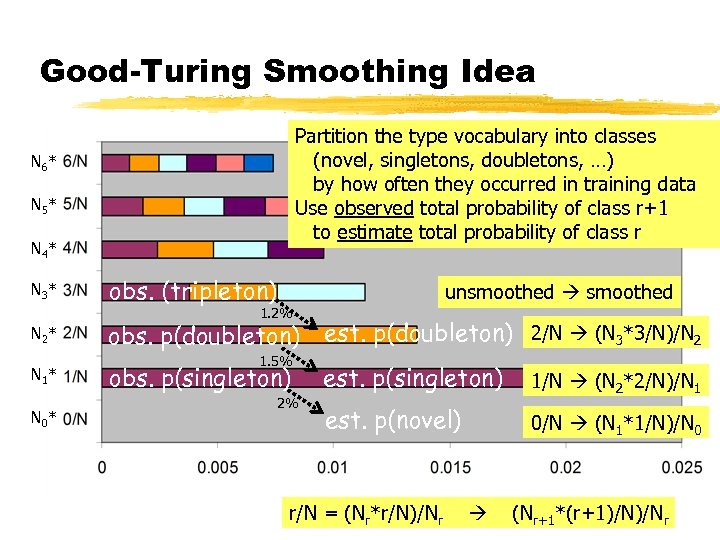 Good-Turing Smoothing Idea Partition the type vocabulary into classes (novel, singletons, doubletons, …) by how often they occurred in training data Use observed total probability of class r+1 to estimate total probability of class r N 6* N 5* N 4* N 3* obs. (tripleton) unsmoothed 1. 2% N 2* N 1* N 0* obs. p(doubleton) est. p(doubleton) 2/N (N 3*3/N)/N 2 1. 5% obs. p(singleton) 2% est. p(singleton) 1/N (N 2*2/N)/N 1 est. p(novel) 0/N (N 1*1/N)/N 0 r/N = (Nr*r/N)/Nr (Nr+1*(r+1)/N)/Nr
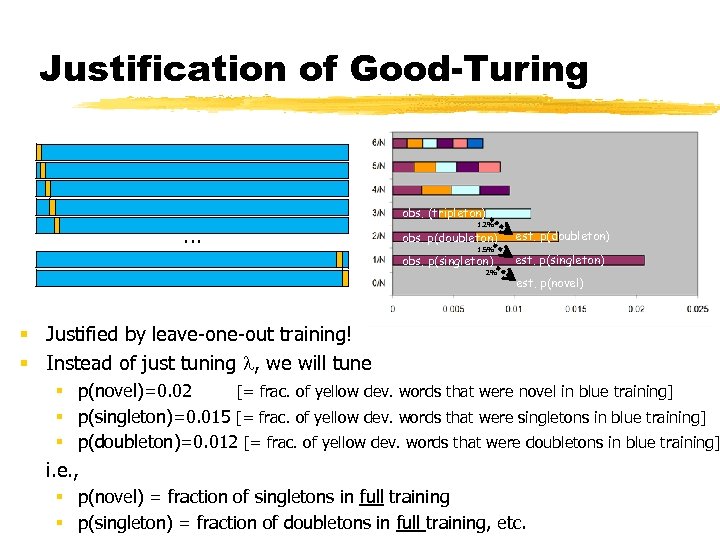 Justification of Good-Turing … obs. (tripleton) 1. 2% obs. p(doubleton) 1. 5% obs. p(singleton) 2% est. p(doubleton) est. p(singleton) est. p(novel) § Justified by leave-one-out training! § Instead of just tuning , we will tune § p(novel)=0. 02 [= frac. of yellow dev. words that were novel in blue training] § p(singleton)=0. 015 [= frac. of yellow dev. words that were singletons in blue training] § p(doubleton)=0. 012 [= frac. of yellow dev. words that were doubletons in blue training] i. e. , § p(novel) = fraction of singletons in full training § p(singleton) = fraction of doubletons in full training, etc.
 Witten-Bell Smoothing § Witten-Bell intuition: If we’ve seen a lot of different events, then new novel events are also likely. (Considers the type/token ratio. ) § Formerly covered on homework 3 § Good-Turing intuition: If we’ve seen a lot of singletons, then new novel events are also likely. § Very nice idea (but a bit tricky in practice) 600. 465 - Intro to NLP - J. Eisner 34
 Good-Turing Smoothing § Intuition: Can judge rate of novel events by rate of singletons. § Let Nr = # of word types with r training tokens § e. g. , N 0 = number of unobserved words § e. g. , N 1 = number of singletons § Let N = r Nr = total # of training tokens 600. 465 - Intro to NLP - J. Eisner 35
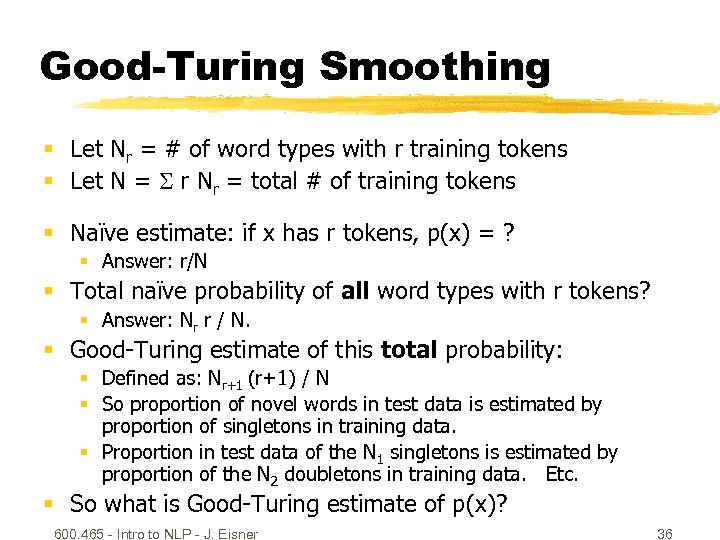 Good-Turing Smoothing § Let Nr = # of word types with r training tokens § Let N = r Nr = total # of training tokens § Naïve estimate: if x has r tokens, p(x) = ? § Answer: r/N § Total naïve probability of all word types with r tokens? § Answer: Nr r / N. § Good-Turing estimate of this total probability: § Defined as: Nr+1 (r+1) / N § So proportion of novel words in test data is estimated by proportion of singletons in training data. § Proportion in test data of the N 1 singletons is estimated by proportion of the N 2 doubletons in training data. Etc. § So what is Good-Turing estimate of p(x)? 600. 465 - Intro to NLP - J. Eisner 36
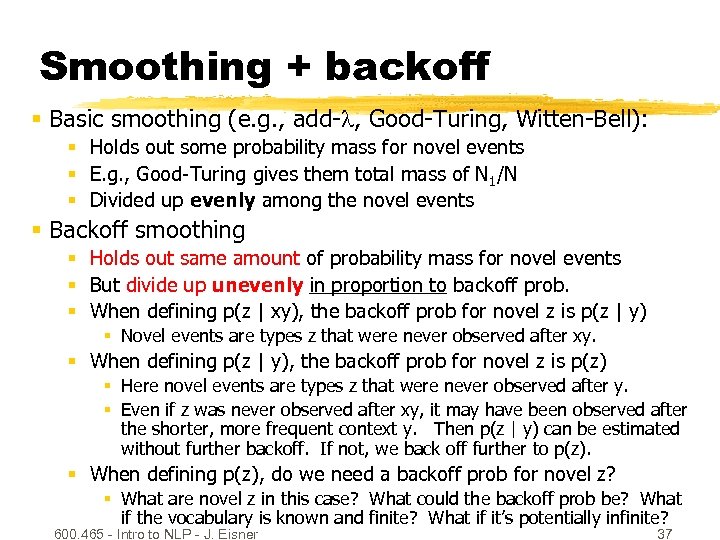 Smoothing + backoff § Basic smoothing (e. g. , add- , Good-Turing, Witten-Bell): § Holds out some probability mass for novel events § E. g. , Good-Turing gives them total mass of N 1/N § Divided up evenly among the novel events § Backoff smoothing § Holds out same amount of probability mass for novel events § But divide up unevenly in proportion to backoff prob. § When defining p(z | xy), the backoff prob for novel z is p(z | y) § Novel events are types z that were never observed after xy. § When defining p(z | y), the backoff prob for novel z is p(z) § Here novel events are types z that were never observed after y. § Even if z was never observed after xy, it may have been observed after the shorter, more frequent context y. Then p(z | y) can be estimated without further backoff. If not, we back off further to p(z). § When defining p(z), do we need a backoff prob for novel z? § What are novel z in this case? What could the backoff prob be? What if the vocabulary is known and finite? What if it’s potentially infinite? 600. 465 - Intro to NLP - J. Eisner 37
 Smoothing + backoff § Note: The best known backoff smoothing methods: § § modified Kneser-Ney (smart engineering) Witten-Bell + one small improvement (Carpenter 2005) hierarchical Pitman-Yor (clean Bayesian statistics) All are about equally good. § Note: § A given context like xy may be quite rare – perhaps we’ve only observed it a few times. § Then it may be hard for Good-Turing, Witten-Bell, etc. to accurately guess that context’s novel-event rate as required § We could try to make a better guess by aggregating xy with other contexts (all contexts? similar contexts? ). § This is another form of backoff. By contrast, basic Good-Turing, Witten-Bell, etc. were limited to a single implicit context. § Log-linear models accomplish this very naturally. 600. 465 - Intro to NLP - J. Eisner 38
 Smoothing This dark art is why NLP is taught in the engineering school. There are more principled smoothing methods, too. We’ll look next at log-linear models, which are a good and popular general technique. 600. 465 - Intro to NLP - J. Eisner 39
 Smoothing as Optimization There are more principled smoothing methods, too. We’ll look next at log-linear models, which are a good and popular general technique. 600. 465 - Intro to NLP - J. Eisner 40
 Conditional Modeling § Given a context x § Which outcomes y are likely in that context? § We need a conditional distribution p(y | x) § A black-box function that we call on x, y § p(Next. Word=y | Preceding. Words=x) § y is a unigram § x is an (n-1)-gram § p(Category=y | Text=x) § y {personal email, work email, spam email} § x * (it’s a string: the text of the email) § Remember: p can be any function over (x, y)! § Provided that p(y | x) 0, and y p(y | x) = 1 600. 465 - Intro to NLP - J. Eisner 41
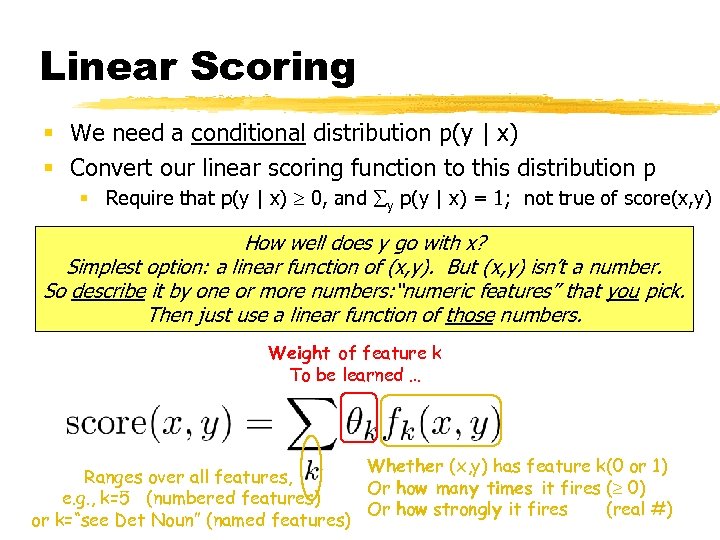 Linear Scoring § We need a conditional distribution p(y | x) § Convert our linear scoring function to this distribution p § Require that p(y | x) 0, and y p(y | x) = 1; not true of score(x, y) How well does y go with x? Simplest option: a linear function of (x, y). But (x, y) isn’t a number. So describe it by one or more numbers: “numeric features” that you pick. Then just use a linear function of those numbers. Weight of feature k To be learned … Whether (x, y) has feature k(0 or 1) Ranges over all features, Or how many times it fires ( 0) e. g. , k=5 (numbered features) Or how strongly it fires (real #) or k=“see Det Noun” (named features)
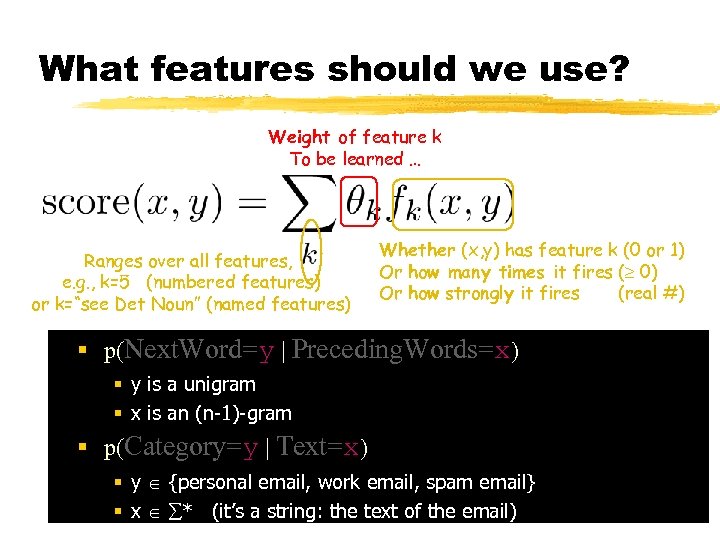 What features should we use? Weight of feature k To be learned … Ranges over all features, e. g. , k=5 (numbered features) or k=“see Det Noun” (named features) Whether (x, y) has feature k (0 or 1) Or how many times it fires ( 0) Or how strongly it fires (real #) § p(Next. Word=y | Preceding. Words=x) § y is a unigram § x is an (n-1)-gram § p(Category=y | Text=x) § y {personal email, work email, spam email} § x * (it’s a string: the text of the email)
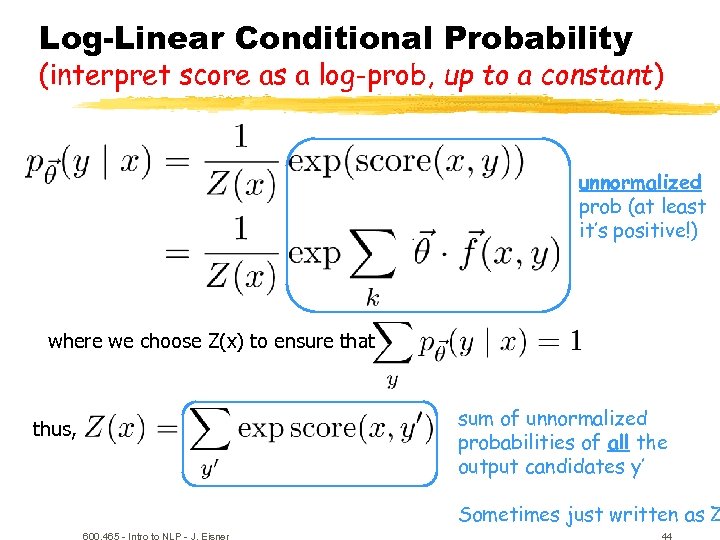 Log-Linear Conditional Probability (interpret score as a log-prob, up to a constant) unnormalized prob (at least it’s positive!) where we choose Z(x) to ensure that thus, sum of unnormalized probabilities of all the output candidates y’ Sometimes just written as Z
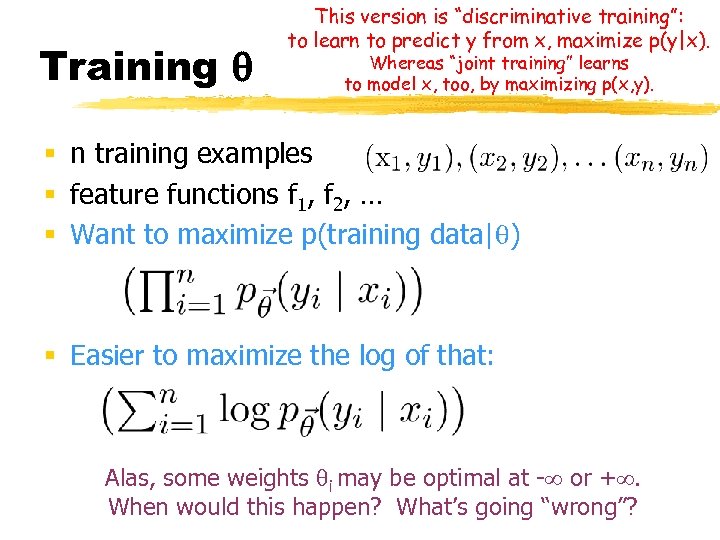 Training This version is “discriminative training”: to learn to predict y from x, maximize p(y|x). Whereas “joint training” learns to model x, too, by maximizing p(x, y). § n training examples § feature functions f 1, f 2, … § Want to maximize p(training data| ) § Easier to maximize the log of that: Alas, some weights i may be optimal at - or +. When would this happen? What’s going “wrong”?
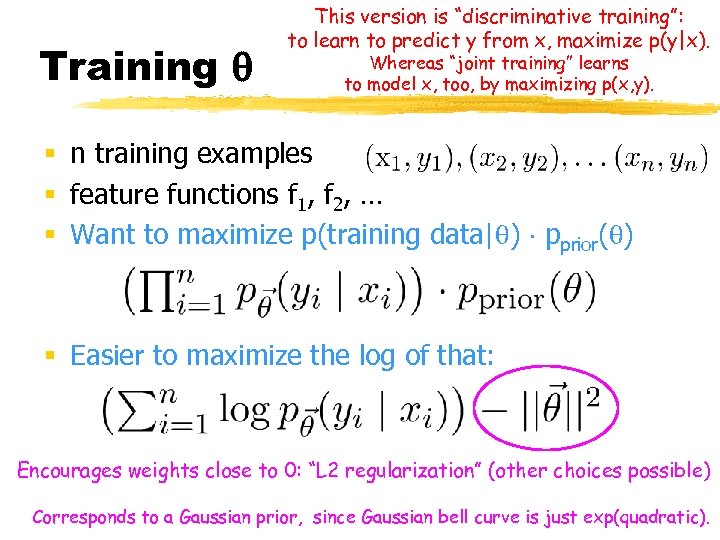 Training This version is “discriminative training”: to learn to predict y from x, maximize p(y|x). Whereas “joint training” learns to model x, too, by maximizing p(x, y). § n training examples § feature functions f 1, f 2, … § Want to maximize p(training data| ) pprior( ) § Easier to maximize the log of that: Encourages weights close to 0: “L 2 regularization” (other choices possible) Corresponds to a Gaussian prior, since Gaussian bell curve is just exp(quadratic).
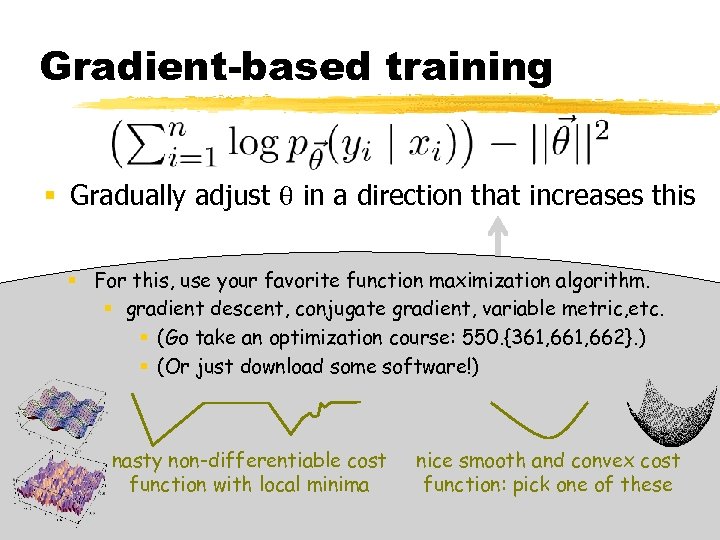 Gradient-based training § Gradually adjust in a direction that increases this § For this, use your favorite function maximization algorithm. § gradient descent, conjugate gradient, variable metric, etc. § (Go take an optimization course: 550. {361, 662}. ) § (Or just download some software!) nasty non-differentiable cost function with local minima nice smooth and convex cost function: pick one of these
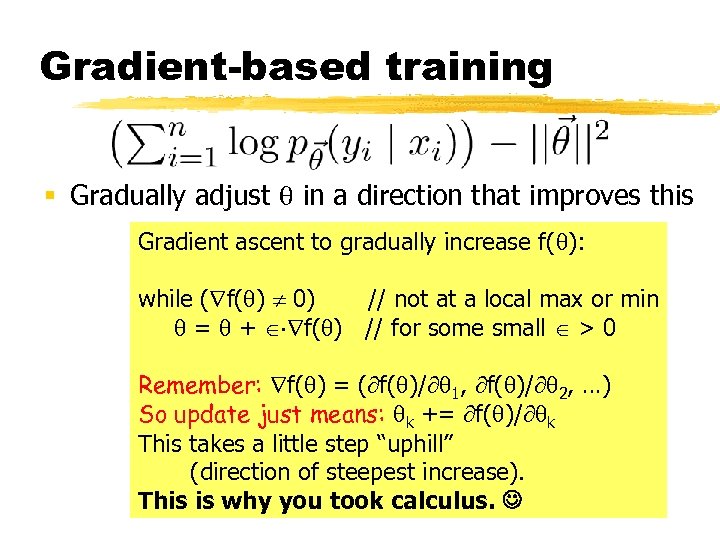 Gradient-based training § Gradually adjust in a direction that improves this Gradient ascent to gradually increase f( ): while ( f( ) 0) // not at a local max or min = + f( ) // for some small > 0 Remember: f( ) = ( f( )/ 1, f( )/ 2, …) So update just means: k += f( )/ k This takes a little step “uphill” (direction of steepest increase). This is why you took calculus.
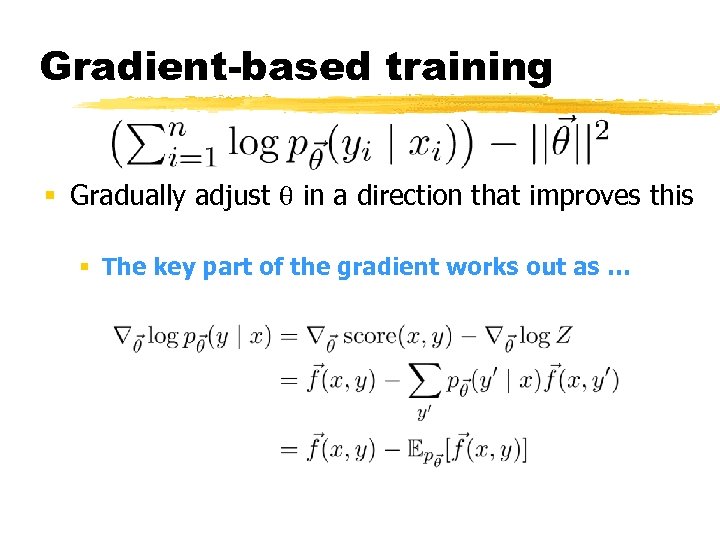 Gradient-based training § Gradually adjust in a direction that improves this § The key part of the gradient works out as …
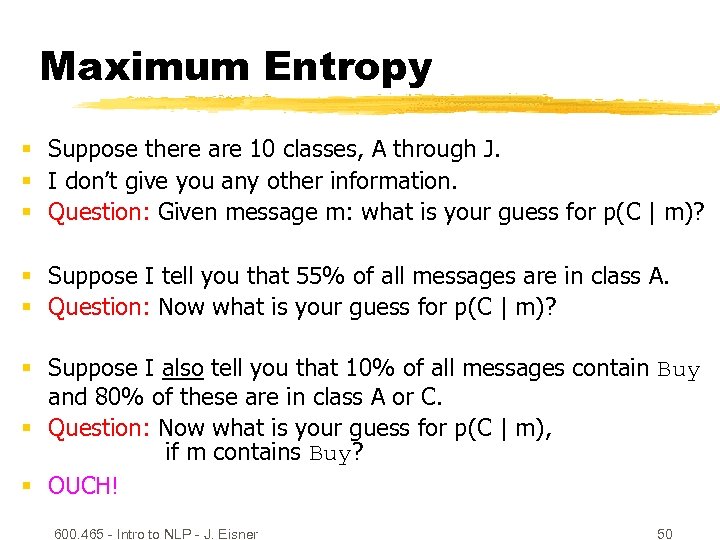 Maximum Entropy § Suppose there are 10 classes, A through J. § I don’t give you any other information. § Question: Given message m: what is your guess for p(C | m)? § Suppose I tell you that 55% of all messages are in class A. § Question: Now what is your guess for p(C | m)? § Suppose I also tell you that 10% of all messages contain Buy and 80% of these are in class A or C. § Question: Now what is your guess for p(C | m), if m contains Buy? § OUCH! 600. 465 - Intro to NLP - J. Eisner 50
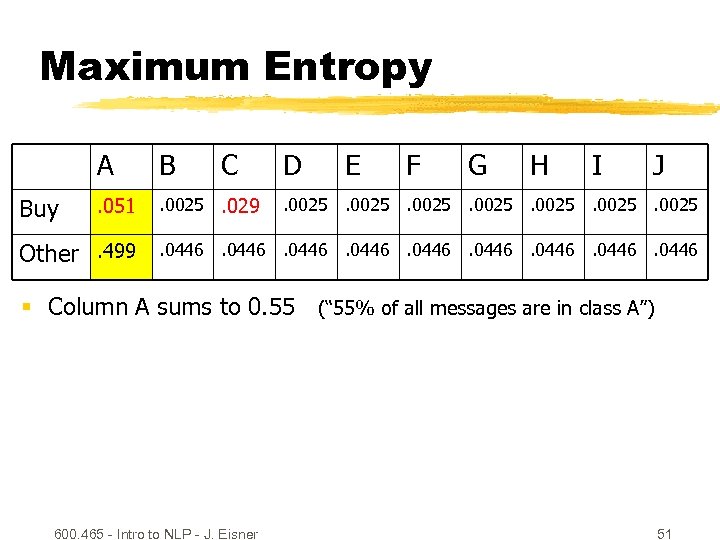 Maximum Entropy A Buy B . 051 . 0025. 029 Other. 499 C D E F G H I J . 0025 . 0446 § Column A sums to 0. 55 (“ 55% of all messages are in class A”) 600. 465 - Intro to NLP - J. Eisner 51
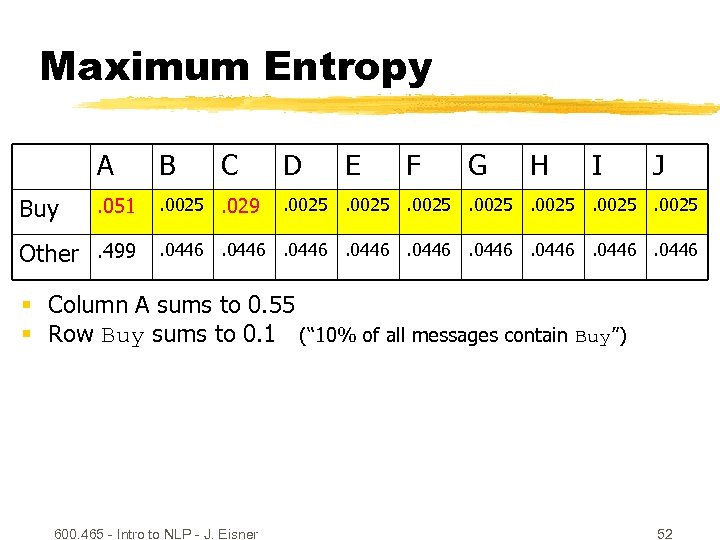 Maximum Entropy A Buy B . 051 . 0025. 029 Other. 499 C D E F G H I J . 0025 . 0446 § Column A sums to 0. 55 § Row Buy sums to 0. 1 (“ 10% of all messages contain Buy”) 600. 465 - Intro to NLP - J. Eisner 52
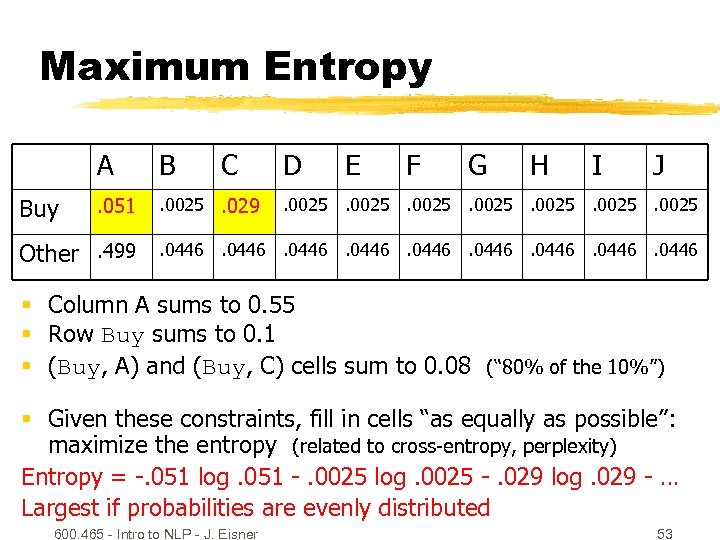 Maximum Entropy A Buy B . 051 . 0025. 029 Other. 499 C D E F G H I J . 0025 . 0446 § Column A sums to 0. 55 § Row Buy sums to 0. 1 § (Buy, A) and (Buy, C) cells sum to 0. 08 (“ 80% of the 10%”) § Given these constraints, fill in cells “as equally as possible”: maximize the entropy (related to cross-entropy, perplexity) Entropy = -. 051 log. 051 -. 0025 log. 0025 -. 029 log. 029 - … Largest if probabilities are evenly distributed 600. 465 - Intro to NLP - J. Eisner 53
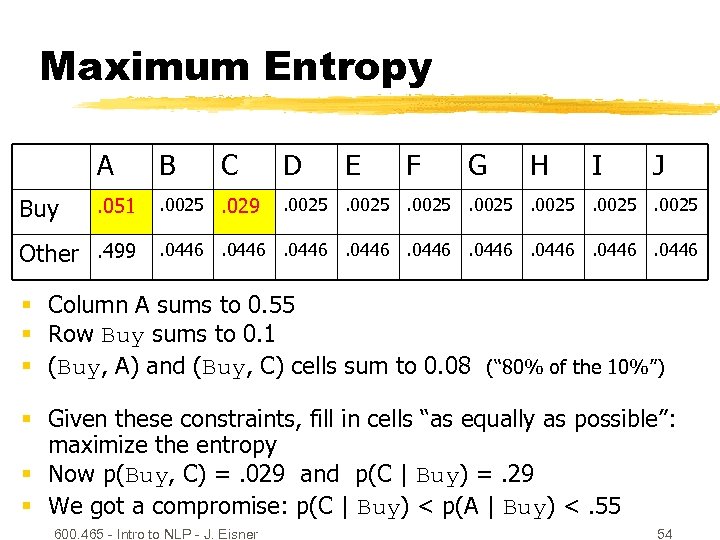 Maximum Entropy A Buy B . 051 . 0025. 029 Other. 499 C D E F G H I J . 0025 . 0446 § Column A sums to 0. 55 § Row Buy sums to 0. 1 § (Buy, A) and (Buy, C) cells sum to 0. 08 (“ 80% of the 10%”) § Given these constraints, fill in cells “as equally as possible”: maximize the entropy § Now p(Buy, C) =. 029 and p(C | Buy) =. 29 § We got a compromise: p(C | Buy) < p(A | Buy) <. 55 600. 465 - Intro to NLP - J. Eisner 54
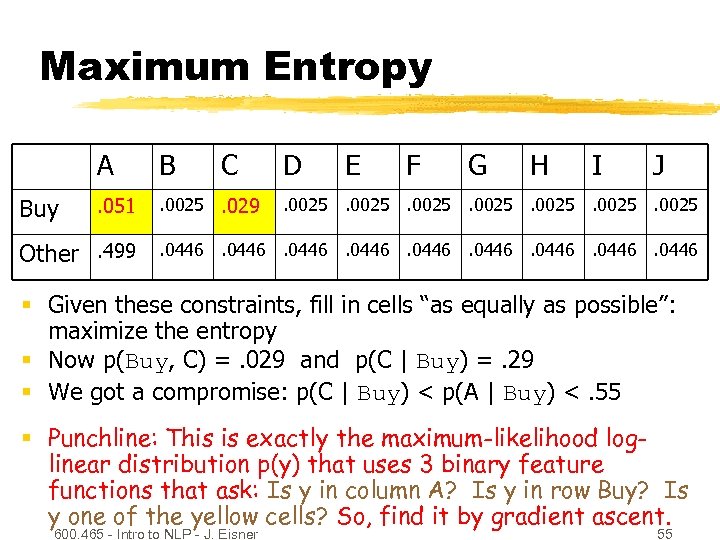 Maximum Entropy A Buy B . 051 . 0025. 029 Other. 499 C D E F G H I J . 0025 . 0446 § Given these constraints, fill in cells “as equally as possible”: maximize the entropy § Now p(Buy, C) =. 029 and p(C | Buy) =. 29 § We got a compromise: p(C | Buy) < p(A | Buy) <. 55 § Punchline: This is exactly the maximum-likelihood loglinear distribution p(y) that uses 3 binary feature functions that ask: Is y in column A? Is y in row Buy? Is y one of the yellow cells? So, find it by gradient ascent. 600. 465 - Intro to NLP - J. Eisner 55