


 Скачать презентацию Smoking Hazards Cessation Dr mousa Al-Omari Family
9d22a3ed53fe65f1a36257310edb97fa.ppt
- Количество слайдов: 41
 Smoking Hazards / Cessation Dr. mousa Al-Omari Family medicine JUST 1
 ﻗﺎﻝ ﺗﻌﺎﻟﻰ ” ﻭﻻ ﺗﻘﺘﻠﻮﺍ ﺃﻨﻔﺴﻜـــﻢ ” ﺻﺪﻕ ﺍﻟﻠﻪ ﺍﻟﻌﻈﻴــﻢ ﻗﺎﻝ ﺭﺳﻮﻝ ﺍﻟﻠﻪ )ﺹ( ” ﻻ ﺿـﺮﺭ ﻭﻻ ﺿـــﺮﺍﺭ“ 2
 Just made several imp. Contributions towards making JUST a University without smoking became the Motto in JUST. 3
 Cigarettes are not your friend – friends don’t kill you Smoking is considered to be the 5 th vital sign in medicine 4
 • Prevention is better than cure and cheaper too. • Anti-smoking momentum will ensure a more healthy • future and better quality of life for the people esp. the children and adolescents. Smoking cessation interventions are among the most cost-effective interventions in medicine. 5
 Smoking facts • Smoking is the single and most important preventable • • cause of morbidity and mortality worldwide. The costs from diseases related to smoking are immense in terms of human suffering, constrains on health services resources and lost employment. There is a linkage between smoking, drinking and illicit drug use. Smoking is associated with problems of poverty, unemployment and other kinds of deprivation. Smoking is more in social class V. 6
 Prevalence • The incidence of starting smoking rises rapidly from • • • age of 11 years, peak at age 17 -19 years and fall after age of 23 years. By age of 15 years 25% of children are regular smokers and by age of 19 years 30% of the population are smokers (half will die from smoking related illness) There are 1, 1 billion smokers which is about 1/3 of the world population age > 15 years. There is a decrease in tobacco use in developed countries and increase in developing countries. 7
 In Jordan: * Approximately 48% of males and 18% of females above 25 year are smoker (according to National Survey on morbidity & mortality). * 33% of students between 13 -15 years smoke (half of them would like to quite) in recent global youth tobacco survey. * 34% of Jordanian doctors are smoker. * There are Nine tobacco companies in Jordan. * Smokers spend 600 million dinners on cigarettes a year. * There are 4000 citizen suffer from cancer and one third of these cases are related to smoking. 8
 What makes smoking harmful? • Cigarette smoke contains over 4000 chemicals and a dozen gases. At least 400 toxic substances. • The main components are : a) Tar (substance that causes cancer). b) Nicotine (addictive) and raise cholesterol level. c) Carbon monoxide (reduces oxygen in the body). d) Components of the gas (causes COPD). • A drop of pure nicotine injected into the body would cause instant death in a few minutes. 9
 What is smoking? - Cigars - Cigarettes. - Pipes - Argilla • All types of smoking are harmful. • FDA has classified tobacco as a drug. • Amount of nicotine absorbed from tobacco smoke varies from 90% in those who inhale to 10% in those who do not. • Pipe and cigar smoker suffer much smaller risks than cigarette smoker probably because they inhale less. • Low-Tar cigarettes have no health benefits over regular product. 10
 Wrong beliefs • Many people think that cigarettes help them relax. • • • They don’t. Nicotine wears off quickly and this withdrawal makes you feel tense. Smoking calms the nicotine cravings. Coping with regular need to smoke can be very stressful. 11
 Health risks of smoking • Smoking accounts for 18% of all deaths and 30% of • • all cancer death. Smoking is the greatest health hazard mankind has ever faced. Smokers have 70% risk of CHD & it is the most correctable risk factor for CHD. Smoking is responsible for 80% of cases of COPD which is estimated to be the 3 rd leading cause for disability worldwide by year 2020. Smoking nearly affect every system in the body. 12
 • Risks are dose and duration dependent. • On average, cigarette smokers lose 7, 5 years of life. • Smoking can also increase the incidence and severity of • everyday complaints. Many people don’t realize that coughing, sneezing and shortness of breathe on exertion can be caused by their smoking habit. Smokers are more likely to have more time off school and work and be less fit. Smoking affects your looks (pale skin and more wrinkles) • The youngest people start, the greater the risks they face. 13
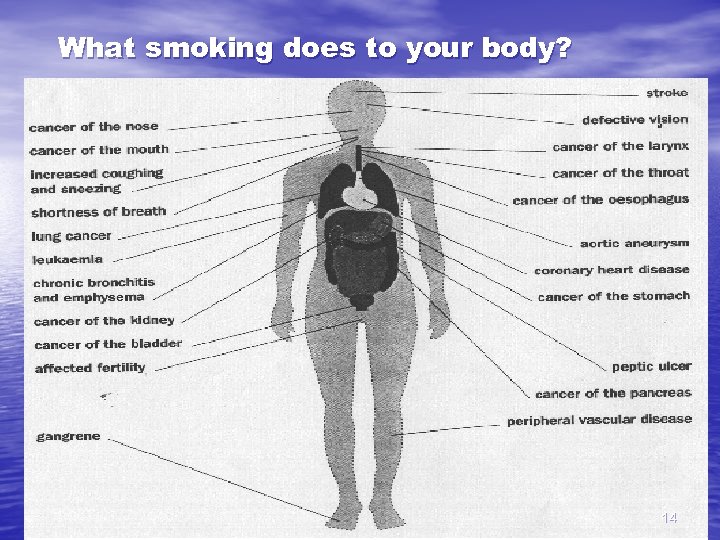 What smoking does to your body? 14
 Passive smoking Medical research has shown that adults exposed to passive smoking may experience the following: • Irritation to the eyes, nose and throat. • Headaches, dizziness and sickness. • Aggravation of asthma and allergies. • Increased risk of coronary heart disease. • A 10 -30% increased risk of lung cancer, for non-smokers who are exposed to passive smoking over long periods. 15
 Medical research has shown that babies and children exposed to passive smoking have: • A much higher risk of cot death than the children of non -smokers. • An increased risk of meningitis. • More chances ear infections and ‘glue ear’, which can lead to partial deafness and chronic ear disease. • More coughs, colds and wheezes. In addition, research has shown babies and children exposed to a smoky atmosphere are: • Twice as likely to have asthma attacks and chest infections. • More likely to need hospital care in their first year of life. • Off sick from school more often. 16
 Women who smoke increase their risk of the following: • Miscarriage and other problems during pregnancy. • Low birth weight and premature babies. • Stillbirth, and death of the baby in the first month of • • • the life. Menopause two to three years early. Heart attack and stroke, especially if they also use the combined oral contraceptive. Osteoporosis (brittle bone disease). 17
 The benefits of stopping smoking • Stopping smoking is the greatest single step a person • can take to improve their health but it is a difficult task. General health improves (tiredness & headache can be linked to smoking). Benefits to your body • Risk of CHD will reduce to half a year after quitting. • Cessation is the key to avoid disease progress in COPD and halt any decline of lung function. • Less risk of cancer developing. 18
 • • • Immediate improvement in breathing. Greater ability to cope with sudden exertion. Smoker’s cough decreases and phlegm in lungs reduced. Sense of taste and smell improves. Hair, skin and breath no longer smell of tobacco smoke. 19
 People quit smoking because 1) The terrible smell. 2) High Cost. 3) Increasing pressure from lack of fitness. 4) Family pressure. 5) Religious belief. 20
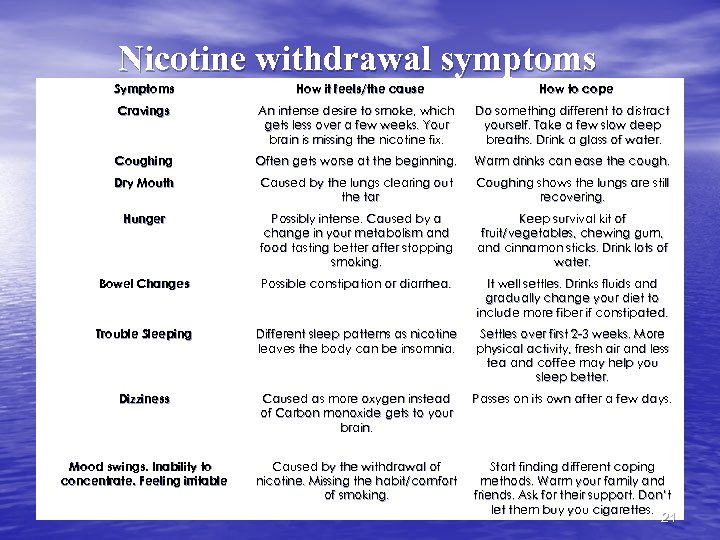 Nicotine withdrawal symptoms Symptoms How it feels/the cause How to cope Cravings An intense desire to smoke, which gets less over a few weeks. Your brain is missing the nicotine fix. Do something different to distract yourself. Take a few slow deep breaths. Drink a glass of water. Coughing Often gets worse at the beginning. Warm drinks can ease the cough. Dry Mouth Caused by the lungs clearing out the tar Coughing shows the lungs are still recovering. Hunger Possibly intense. Caused by a change in your metabolism and food tasting better after stopping smoking. Keep survival kit of fruit/vegetables, chewing gum, and cinnamon sticks. Drink lots of water. Bowel Changes Possible constipation or diarrhea. It well settles. Drinks fluids and gradually change your diet to include more fiber if constipated. Trouble Sleeping Different sleep patterns as nicotine leaves the body can be insomnia. Settles over first 2 -3 weeks. More physical activity, fresh air and less tea and coffee may help you sleep better. Dizziness Caused as more oxygen instead of Carbon monoxide gets to your brain. Passes on its own after a few days. Mood swings. Inability to concentrate. Feeling irritable Caused by the withdrawal of nicotine. Missing the habit/comfort of smoking. Start finding different coping methods. Warm your family and friends. Ask for their support. Don’t let them buy you cigarettes. 21
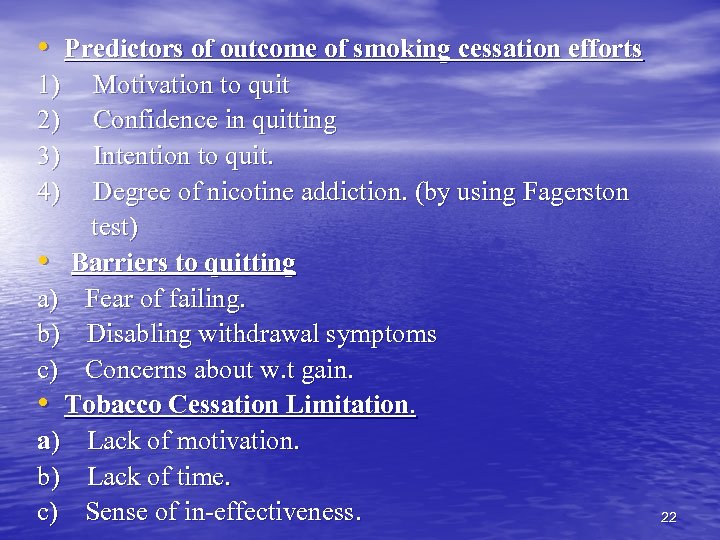 • Predictors of outcome of smoking cessation efforts 1) Motivation to quit 2) Confidence in quitting 3) Intention to quit. 4) Degree of nicotine addiction. (by using Fagerston test) • Barriers to quitting a) Fear of failing. b) Disabling withdrawal symptoms c) Concerns about w. t gain. • Tobacco Cessation Limitation. a) Lack of motivation. b) Lack of time. c) Sense of in-effectiveness. 22
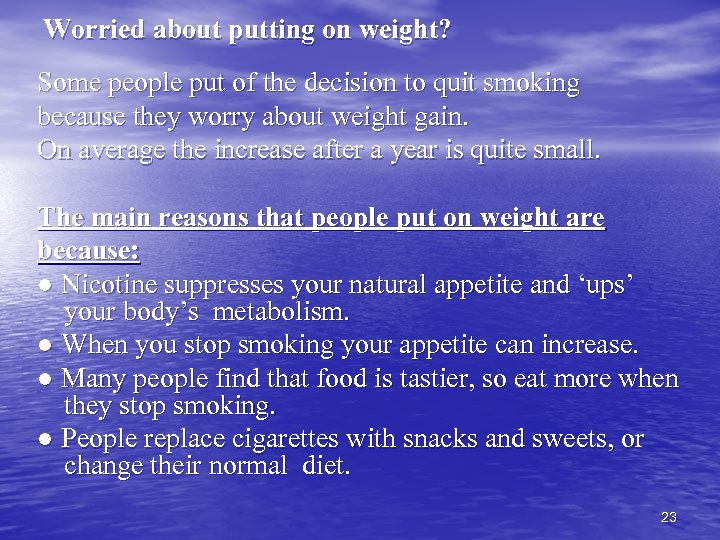 Worried about putting on weight? Some people put of the decision to quit smoking because they worry about weight gain. On average the increase after a year is quite small. The main reasons that people put on weight are because: ● Nicotine suppresses your natural appetite and ‘ups’ your body’s metabolism. ● When you stop smoking your appetite can increase. ● Many people find that food is tastier, so eat more when they stop smoking. ● People replace cigarettes with snacks and sweets, or change their normal diet. 23
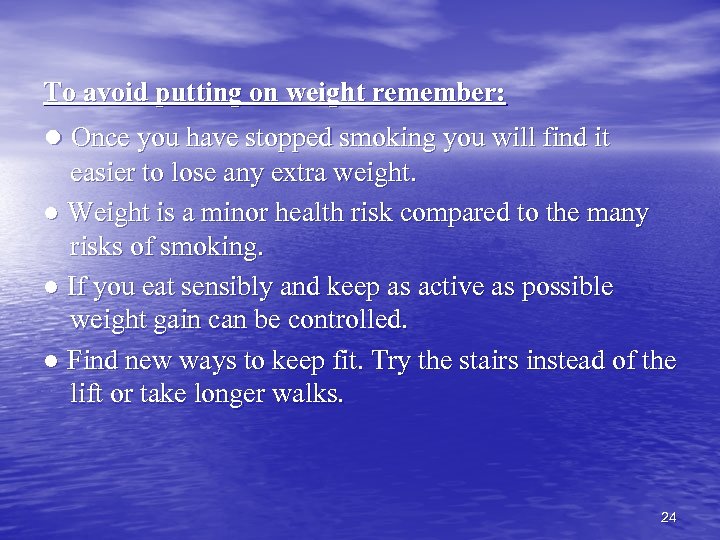 To avoid putting on weight remember: ● Once you have stopped smoking you will find it easier to lose any extra weight. ● Weight is a minor health risk compared to the many risks of smoking. ● If you eat sensibly and keep as active as possible weight gain can be controlled. ● Find new ways to keep fit. Try the stairs instead of the lift or take longer walks. 24
 Asking a patient about smoking * Be alert for sensitivity * Normalize enquiry * Understand the patient’s perspective * Separate information from the persuasive imperative * Avoid dangerous assumptions * Establish and maintain common ground * Keep confrontation in reserve * Leave the door open 25
 Quitting involves three sets of skills * Overcoming the physical dependence on nicotine * Dealing with the habit of smoking * Managing negative emotions e. g. boredom, anxiety, anger and depression 3 questions about smoking as an issue in the life * Do I care? Yes, smoking is a life issue for me * Will it work? Yes, quitting will improve my life * Can I do it? Yes, with a program I can quit 26
 Planning for the quit date On the day you stop smoking get ready to make changes in both the way you think and act. To improve temptations • Choose a stress-free quit date. • Not buy or curry any cigarettes. • Put away reminders like ashtrays, matches, lighters etc. • Avoid alcohol until you are sure it won’t weaken your resolve. 27
 To get support • Talk to a friend/relative about why stopping is important to you. • Talk to an ex-smoker. Find out how they stopped. If they can, you can too. • Team up with someone else for mutual support. 28
 To change your thoughts about smoking • Remember that ‘just one’ cigarette will undo all your hard work. • Remind yourself why you want to stop and the benefits to you. • Remember that you are the one incontrol. • Take each day as it comes. To cope with urges to smoke • Remember that craving pass quickly. • Stop and take some long, slow deep breaths. • Drink a glass of water very slowly. • Read through your ideas of ways to cope. . 29
 During the first week * Try taking a different way to work, college or the shops. * Keep busy; begin a project, or DIY job. * Go to non-smoking areas/venues. * Go to outside for some fresh air each day * Skills to participitate in are running, swimming & cycling 30
 Smoking cessation facts: • • • Two thirds of smokers say they want to quit. 41% of smokers try to quit smoking each year. Only 2 -3% succeed without Rx or support. Only about 2% of men use professional help to quit. Cessation rate one year after brief advice was 3 -13%. Cessation rate one year after intensive intervention was 19 -38%. The more the intensive the intervention the more likely it was to be effective. NRT double the rate of smoking cessation. Smoking is an addictive and treatable problem. 31
 * Stopping smoking is the best gift you can give yourself. * The most important thing a parent can do to keep their child healthy is to ensure they live in a smoke-free environment. * If giving up was easy, anyone could do it. * People who prepare to stop smoking are always the most successful. * New habits take time to become natural. Don’t expect to be able to change your life at once or be perfect the first time. * Be very proud of the tremendous thing you are achieving. Congratulate yourself. . 32
 * Relapse is common you didn’t fail – you just needed more time to succeed. * Do not feel guilty, people make mistakes. Don’t let one mistake undo all your hard work. * Ask a friend to stop with you and support each other. * The more past attempt to stop smoking the more likely to stop in the future. * Count the money you save. Spend it on yourself and family. * Most relapses occur in the first three months 33
 Smoking Cessation Services: 1. Specialist Smoking Cessation clinics. 2. Intermediate interventions. 3. Opportunistic/Brief interventions by all healthcare professionals as part of normal duties. 34
 National evidence-based guidelines recommend using the 5 As approach: 1. Ask patients about smoking 2. Advise all smoker to quit 3. Assess willingness to make a quit attempt 4. Assist those who want to quit 5. Arrange follow up visit with those trying to quit 35
 There is no single quit method that guarantees success. On average it takes 4 -5 attempts to give up and there a number of things that can help willpower. 1) NRT in the form of gum, skin patches or nasal spray 2) Zyban (bupropion) 3) Champix (vurenicline) 4) Behavior modification programmes 5) Alternative therapies such as acupuncture & hypnosis 36
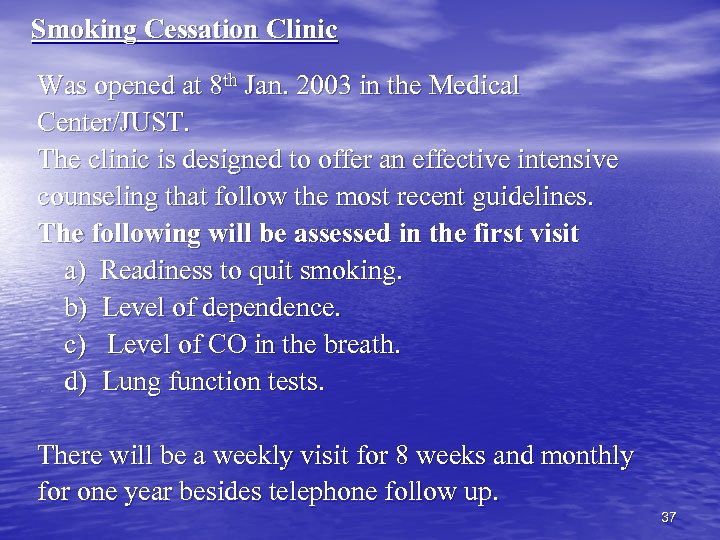 Smoking Cessation Clinic Was opened at 8 th Jan. 2003 in the Medical Center/JUST. The clinic is designed to offer an effective intensive counseling that follow the most recent guidelines. The following will be assessed in the first visit a) Readiness to quit smoking. b) Level of dependence. c) Level of CO in the breath. d) Lung function tests. There will be a weekly visit for 8 weeks and monthly for one year besides telephone follow up. 37
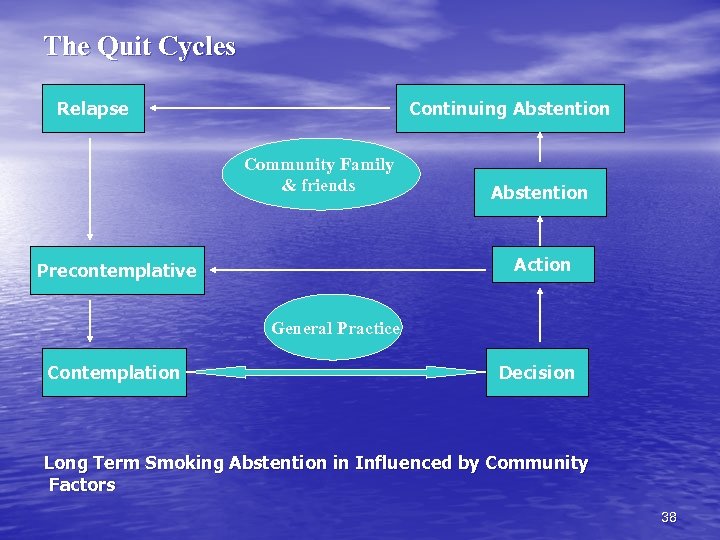 The Quit Cycles Relapse Continuing Abstention Community Family & friends Abstention Action Precontemplative General Practice Contemplation Decision Long Term Smoking Abstention in Influenced by Community Factors 38
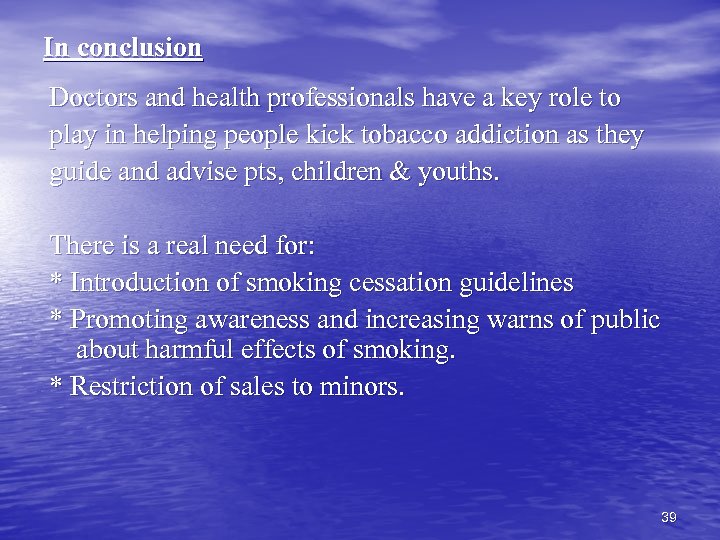 In conclusion Doctors and health professionals have a key role to play in helping people kick tobacco addiction as they guide and advise pts, children & youths. There is a real need for: * Introduction of smoking cessation guidelines * Promoting awareness and increasing warns of public about harmful effects of smoking. * Restriction of sales to minors. 39
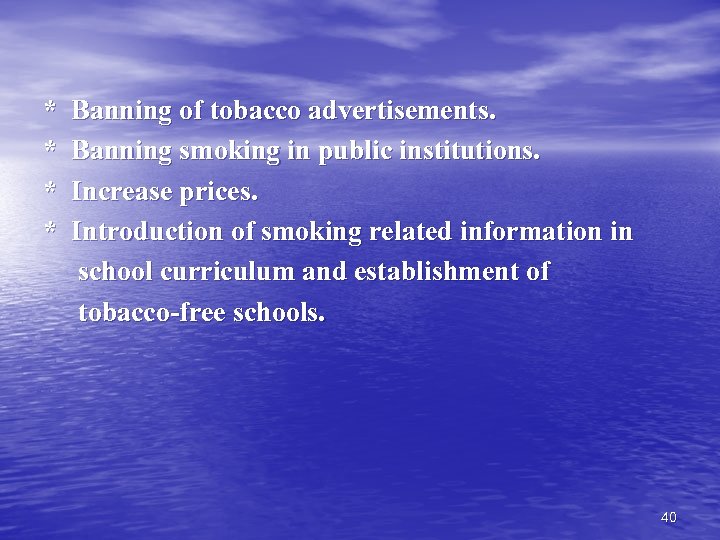 * Banning of tobacco advertisements. * Banning smoking in public institutions. * Increase prices. * Introduction of smoking related information in school curriculum and establishment of tobacco-free schools. 40
 41
41