


 Скачать презентацию Smoke-Free Homes Smoking Cessation TUS-CPS 2002 -2003
f3d6f5e5c3a4dce6e817ef46564de728.ppt
- Количество слайдов: 36
 Smoke-Free Homes & Smoking Cessation TUS-CPS 2002 -2003 overlap sample Karen Messer, Ph D Moores UCSD Cancer Center Messer TUS 2009
 Outline • Importance of TUS-CPS overlap sample • Background on recent US cessation trends • Population evidence on Smoke-Free Homes and smoking cessation – 2003 TUS cross-sectional results – 2002 -2003 TUS longitudinal results Messer TUS 2009 2
 Recent literature review Mills, Messer, Gilpin, Pierce AJPH in press What is the population-level evidence on the role of SFH’s? • 16 cross-sectional studies • Only a few large national surveys with detailed longitudinal data on tobacco use – Tobacco Use Supplement to the CPS – National Population Health Surveys of Canada – ITC four country survey (US, England, Canada, Australia) Messer TUS 2009 3
 Background • US successful cessation rates increased during the 80’s and 90’s – Especially in California – Especially among young adult smokers • Evidence for tobacco control programs as an effective means of increasing population cessation rates – Social Norms – Smoke-Free Homes – Reduced consumption levels Messer TUS 2009 4
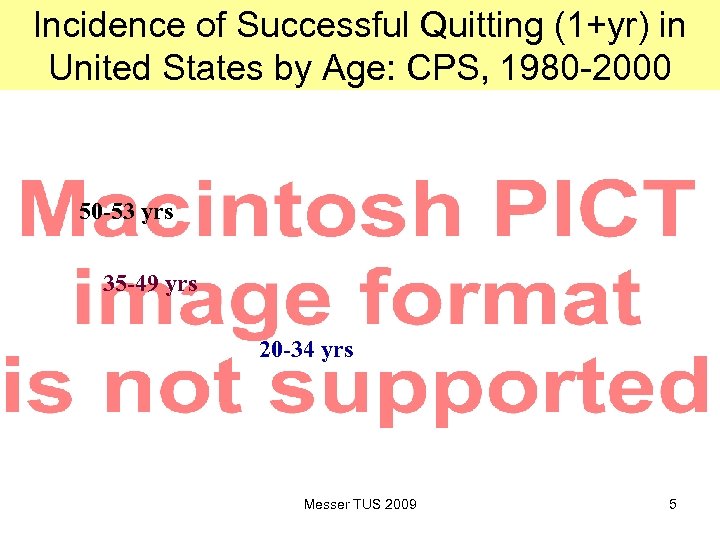 Incidence of Successful Quitting (1+yr) in United States by Age: CPS, 1980 -2000 50 -53 yrs 35 -49 yrs 20 -34 yrs Messer TUS 2009 5
 Average Annual Incidence of Successful Quitting (1+yr): 20 -34 yrs +48% +35% +41% Messer TUS 2009 6
 Research Questions • Did these trends continue into 2000’s? • Are young smokers now quitting at higher rates than older smokers? • Is the population ‘softening’, not ‘hardening’? • What is are the roles of social norms, pharmaceutical assistance? Messer TUS 2009 7
 Cross sectional evidence 2003 TUS-CPS We compared US cessation rates by age. • “Have you smoked at least 100 cigarettes in your lifetime? • “Do you now smoke cigarettes every day, some days, or not at all? ” • “How long has it been since you completely stopped smoking cigarettes? ” Messer TUS 2009 8
 Study population • Recent smokers – 100+ cigs lifetime – Smoked within one year • Dependent smokers – had smoked daily for at least 6 months • Adults ages 18 - 64 • N =31, 625 Messer TUS 2009 9
 MEASURES • Cessation: in the past 12 months – Have you ‘Seriously tried to quit’ – Quit for 1+ day – Quit for at least 6 months • Smoke-Free Home: – “No one is allowed to smoke anywhere inside your home” Messer TUS 2009 10
 MEASURES • Use of pharmaceutical aids on the most recent quit attempt – Gum, patch, nasal spray, lozenges, a prescription pill ( Zyban, buproprion. . ) • Addiction: – # of cigarettes /day (current smokers only) – Smoke the 1 st cig within 30 min of waking – Age first started smoking regularly Messer TUS 2009 11
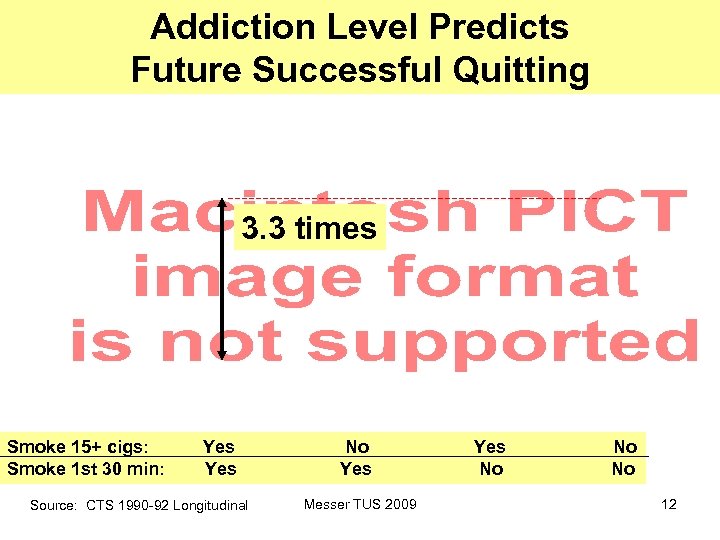 Addiction Level Predicts Future Successful Quitting 3. 3 times Smoke 15+ cigs: Smoke 1 st 30 min: Yes Source: CTS 1990 -92 Longitudinal No Yes Messer TUS 2009 Yes No No No 12
 MEASURES • Demographics – Age, gender, educational attainment, race/ethnicity • Household composition – Other smoker in the house? – Children under age 18 in the house? Messer TUS 2009 13
 RESULTS Messer TUS 2009
 Young adults quit MORE!! Messer TUS 2009 Messer et al, 2008 Data Source: 2003 TUS-CPS 15
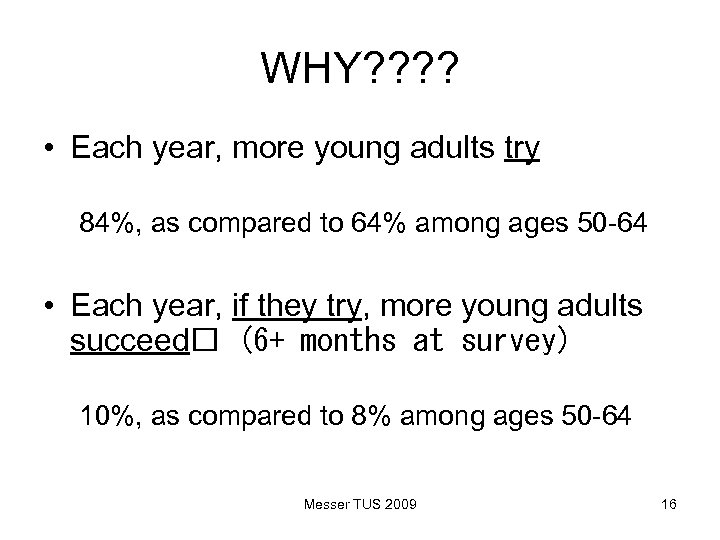 WHY? ? • Each year, more young adults try 84%, as compared to 64% among ages 50 -64 • Each year, if they try, more young adults succeed (6+ months at survey) 10%, as compared to 8% among ages 50 -64 Messer TUS 2009 16
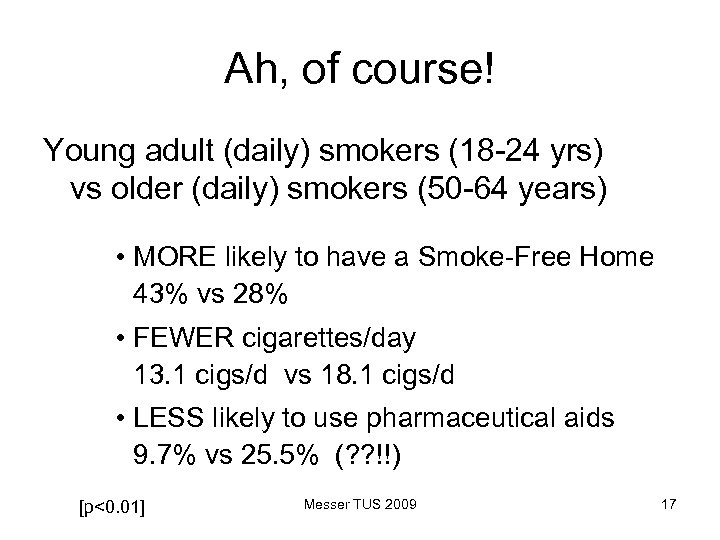 Ah, of course! Young adult (daily) smokers (18 -24 yrs) vs older (daily) smokers (50 -64 years) • MORE likely to have a Smoke-Free Home 43% vs 28% • FEWER cigarettes/day 13. 1 cigs/d vs 18. 1 cigs/d • LESS likely to use pharmaceutical aids 9. 7% vs 25. 5% (? ? !!) [p<0. 01] Messer TUS 2009 17
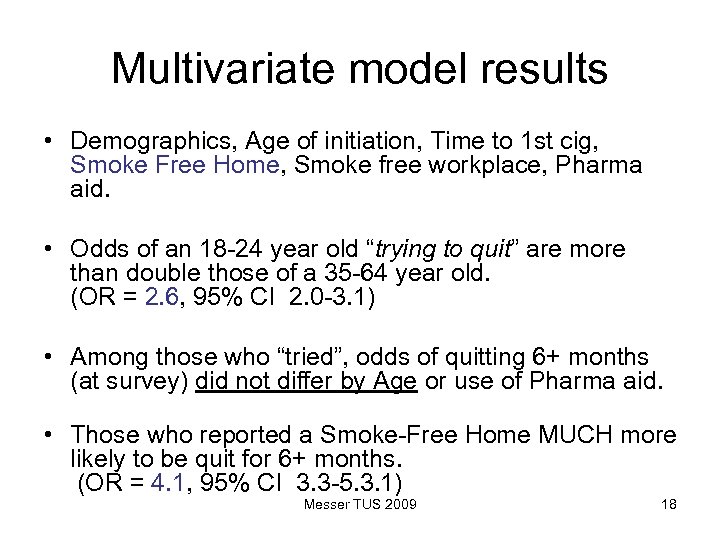 Multivariate model results • Demographics, Age of initiation, Time to 1 st cig, Smoke Free Home, Smoke free workplace, Pharma aid. • Odds of an 18 -24 year old “trying to quit” are more than double those of a 35 -64 year old. (OR = 2. 6, 95% CI 2. 0 -3. 1) • Among those who “tried”, odds of quitting 6+ months (at survey) did not differ by Age or use of Pharma aid. • Those who reported a Smoke-Free Home MUCH more likely to be quit for 6+ months. (OR = 4. 1, 95% CI 3. 3 -5. 3. 1) Messer TUS 2009 18
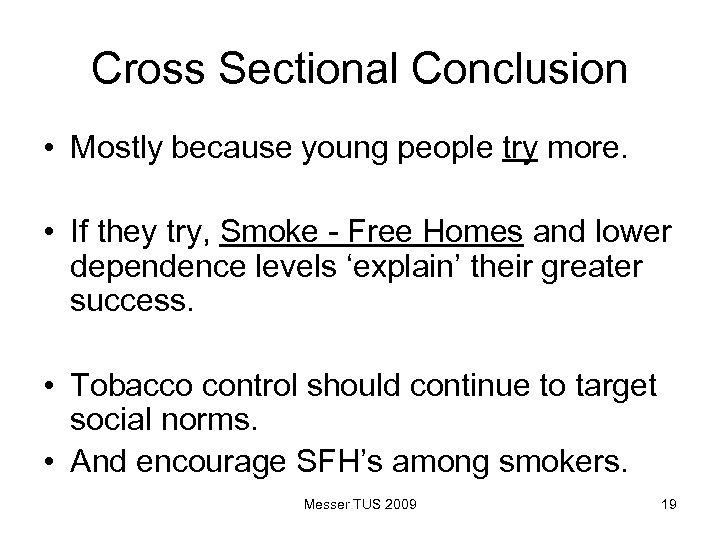 Cross Sectional Conclusion • Mostly because young people try more. • If they try, Smoke - Free Homes and lower dependence levels ‘explain’ their greater success. • Tobacco control should continue to target social norms. • And encourage SFH’s among smokers. Messer TUS 2009 19
 HOWEVER: Major Confounding Consumption level • Smokers who smoke less are more likely to report SFH’s • And also more likely to quit successfully (Can’t assess cigs/ day among abstinent smokers. ) Messer TUS 2009 20
 Smokers with SFH, 2002 TUS -CPS Messer TUS 2009 21
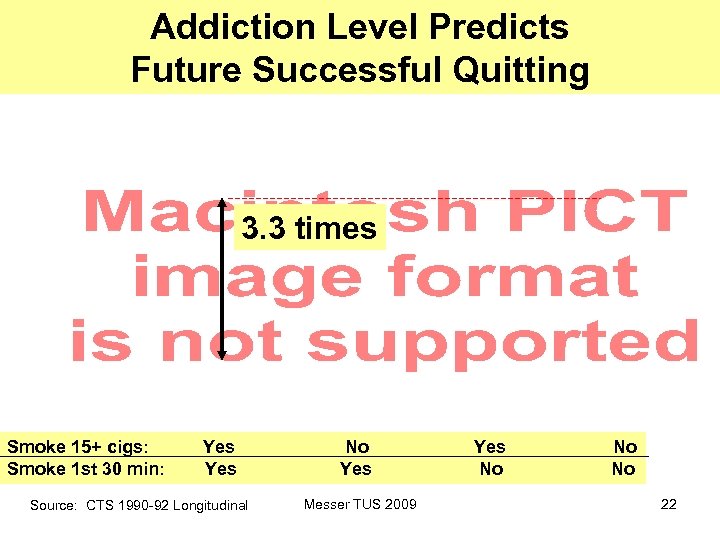 Addiction Level Predicts Future Successful Quitting 3. 3 times Smoke 15+ cigs: Smoke 1 st 30 min: Yes Source: CTS 1990 -92 Longitudinal No Yes Messer TUS 2009 Yes No No No 22
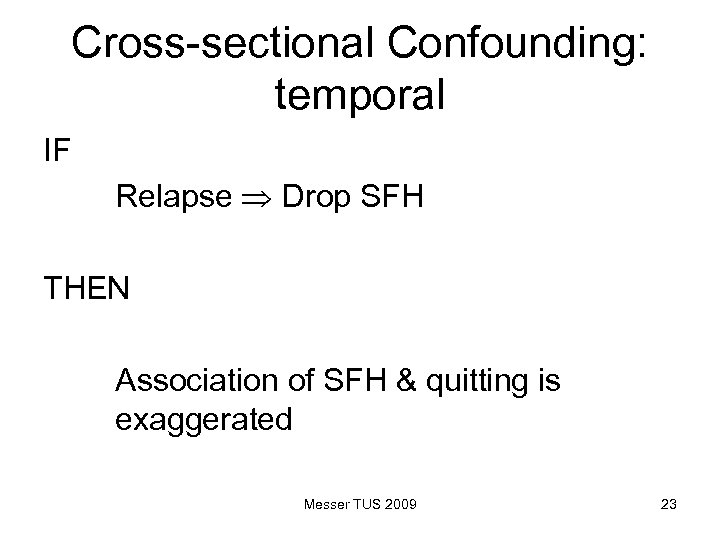 Cross-sectional Confounding: temporal IF Relapse Drop SFH THEN Association of SFH & quitting is exaggerated Messer TUS 2009 23
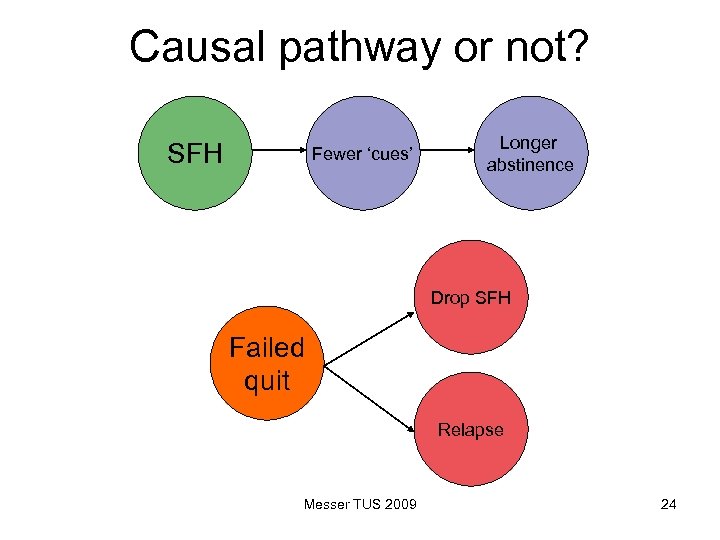 Causal pathway or not? SFH Fewer ‘cues’ Longer abstinence Drop SFH Failed quit Relapse Messer TUS 2009 24
 Longitudinal data are needed • At baseline: SFH vs no SFH • Compare cessation rates at follow-up – Among heavier smokers (SFH yes vs no) – Among lighter smokers (SFH yes vs no) Messer TUS 2009 25
 The TUS-CPS overlap sample • The CPS labor force survey uses a rotating panel design – In sample 4 consecutive months – Rested for 8 months – In sample 4 consecutive months • The 2003 TUS February sample overlapped the 2002 TUS February sample – 15, 846 respondents in both surveys – n = 2, 841 current smokers at baseline Messer TUS 2009 26
 • Compare 90+ day abstinence in 2003 • Stratified by 2002 consumption level Messer TUS 2009 27
 Quit rates x SFH x cigs/day Messer TUS 2009 28
 Percent 90+ days abstinent, 2003 Messer TUS 2009 29
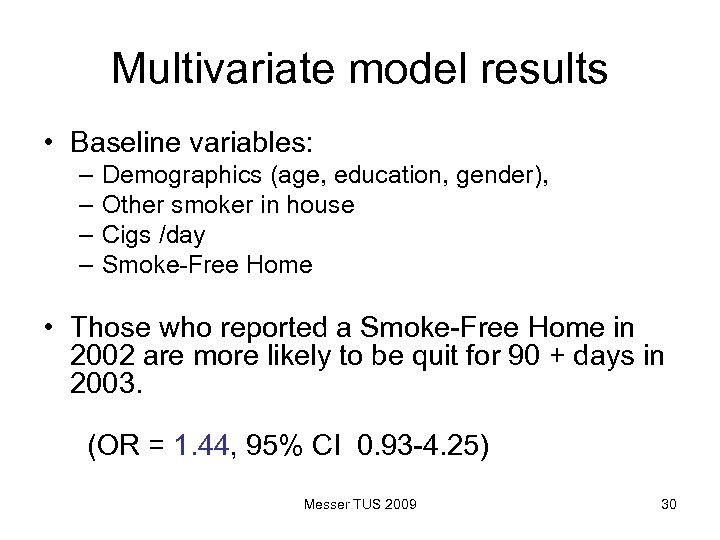 Multivariate model results • Baseline variables: – – Demographics (age, education, gender), Other smoker in house Cigs /day Smoke-Free Home • Those who reported a Smoke-Free Home in 2002 are more likely to be quit for 90 + days in 2003. (OR = 1. 44, 95% CI 0. 93 -4. 25) Messer TUS 2009 30
 Longitudinal Conclusion • Smokers living in a smoke-free home are more likely to quit successfully, – Even if they are heavier smokers (Or lighter smokers) – Even if they have fewer years of education Messer TUS 2009 31
 Overall Conclusion • Young adults quit at higher rates – Because they try more (social norms) – Because they have lighter consumption levels – Because they have more SFH’s • Smoke-Free Homes appear to be associated with greater cessation success and should be encouraged at the population level. Messer TUS 2009 32
 References and Collaborators • Messer, Mills, White, Pierce AJPM 2008 • Messer, Trinidad, Al. Delaimy, Pierce AJPH 2008 • Mills, Messer, Gilpin, Pierce, AJPH (in press) • Pierce, White, Messer NTR 2009 Messer TUS 2009 33
 Thank you. Messer TUS 2009
 Distribution of cigs/day, 2002 Messer TUS 2009 Among recent dependent smokers 35
 At baseline, fewer cigs/day more SFH Messer TUS 2009 36