


 Скачать презентацию SMMOA Supply Maintenance Monitoring Open Architecture TOSA Team
56a18907c80ef78b8210d81b97c138e4.ppt
- Количество слайдов: 46
 SMMOA Supply, Maintenance, Monitoring Open Architecture TOSA Team Presented by David Perrussel SMMOA Project Lead October 23, 2003
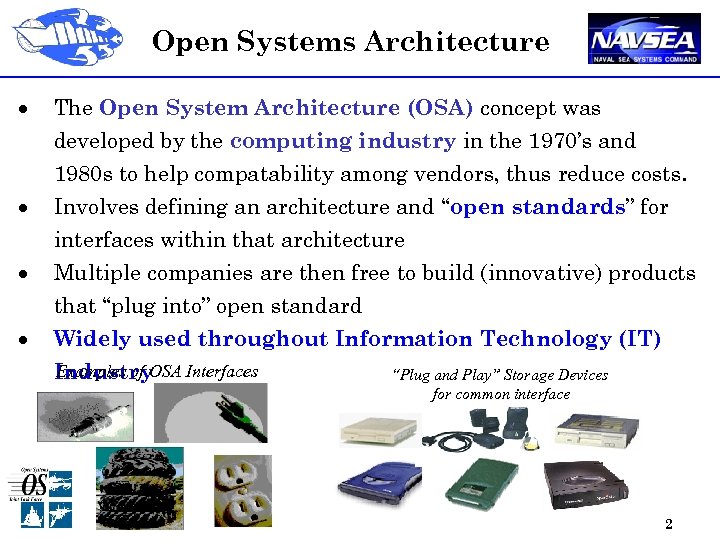 Open Systems Architecture · The Open System Architecture (OSA) concept was developed by the computing industry in the 1970’s and · · · 1980 s to help compatability among vendors, thus reduce costs. Involves defining an architecture and “open standards” for interfaces within that architecture Multiple companies are then free to build (innovative) products that “plug into” open standard Widely used throughout Information Technology (IT) Examples of Industry. OSA Interfaces “Plug and Play” Storage Devices for common interface 2
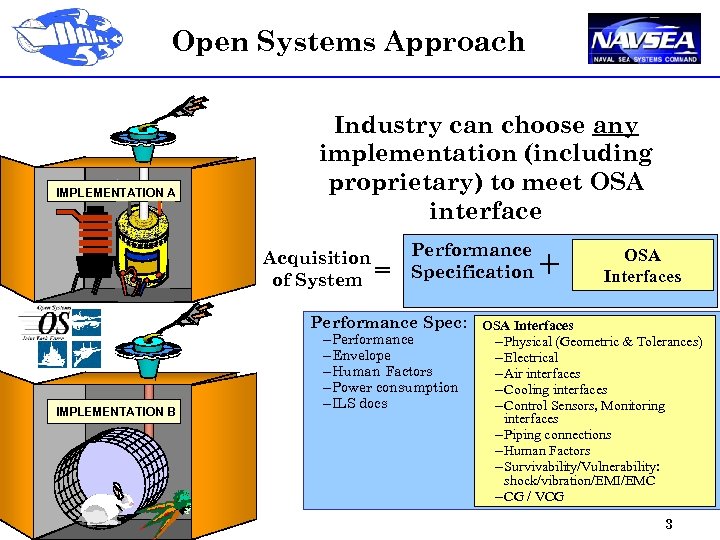 Open Systems Approach IMPLEMENTATION A Industry can choose any implementation (including proprietary) to meet OSA interface Acquisition of System = Performance Specification + OSA Interfaces Performance Spec: OSA Interfaces IMPLEMENTATION B -Performance -Envelope -Human Factors -Power consumption -ILS docs - Physical (Geometric & Tolerances) - Electrical - Air interfaces - Cooling interfaces - Control Sensors, Monitoring interfaces - Piping connections - Human Factors - Survivability/Vulnerability: shock/vibration/EMI/EMC - CG / VCG 3
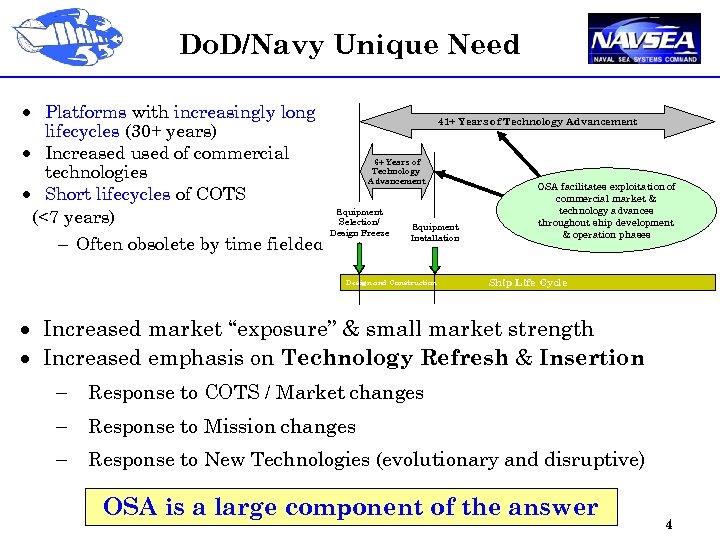 Do. D/Navy Unique Need · Platforms with increasingly long lifecycles (30+ years) · Increased used of commercial technologies · Short lifecycles of COTS (<7 years) – Often obsolete by time fielded 41+ Years of Technology Advancement 6+ Years of Technology Advancement Equipment Selection/ Design Freeze Equipment Installation Design and Construction OSA facilitates exploitation of commercial market & technology advances throughout ship development & operation phases Ship Life Cycle · Increased market “exposure” & small market strength · Increased emphasis on Technology Refresh & Insertion - Response to COTS / Market changes - Response to Mission changes - Response to New Technologies (evolutionary and disruptive) OSA is a large component of the answer 4
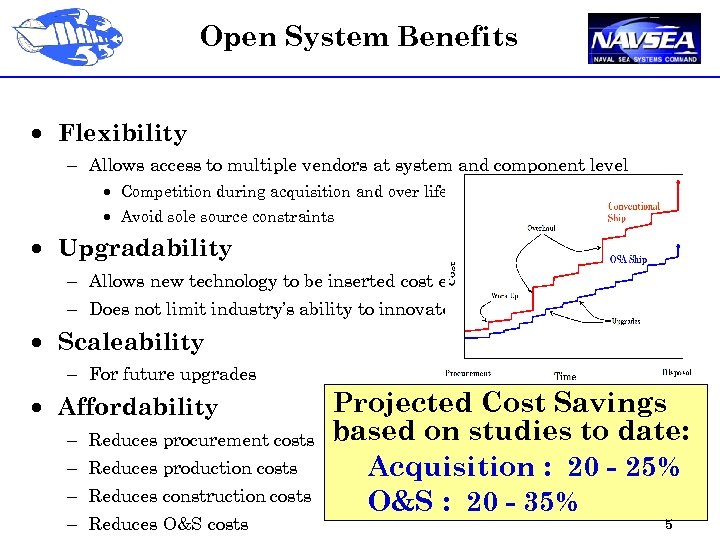 Open System Benefits · Flexibility - Allows access to multiple vendors at system and component level · Competition during acquisition and over lifecycle · Avoid sole source constraints · Upgradability - Allows new technology to be inserted cost effectively - Does not limit industry’s ability to innovate · Scaleability - For future upgrades · Affordability - Reduces procurement costs - Reduces production costs - Reduces construction costs - Reduces O&S costs Projected Cost Savings based on studies to date: Acquisition : 20 - 25% O&S : 20 - 35% 5
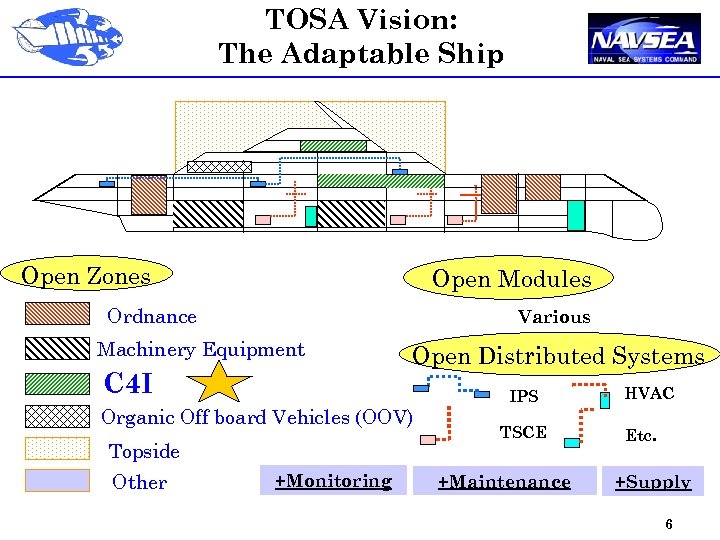 TOSA Vision: The Adaptable Ship 21 Open Zones Open Modules Ordnance Various Machinery Equipment C 4 I Open Distributed Systems Organic Off board Vehicles (OOV) Topside Other +Monitoring IPS TSCE +Maintenance HVAC Etc. +Supply 6
 Need for Supply, Maintenance and Monitoring Open Architecture · Increased operational readiness – particularly when optimal manning is specified (e. g. DDX). · Use Open Standards for better Interoperability and technology upgrade & refresh. · Optimal efficiency for shipboard maintenance and supply functions - Condition assessment - Condition-Based maintenance - Automation of supply functions (such as inventory and parts ordering) · Solutions must be acceptable to both system integrators and component manufacturers for new ships 7
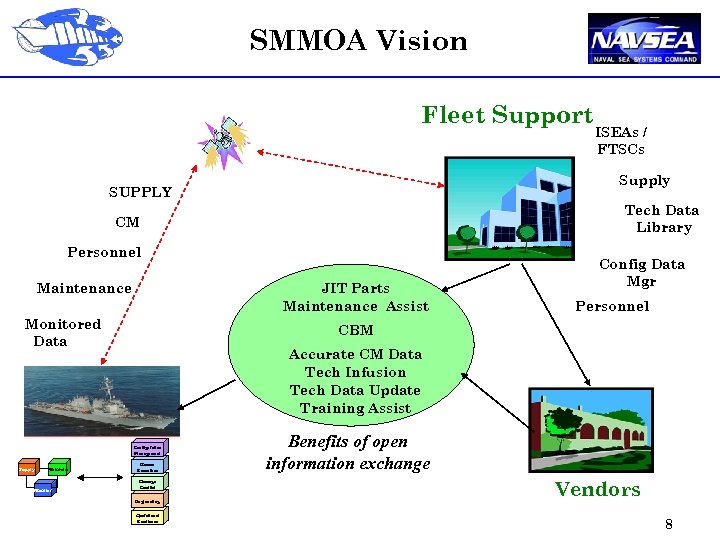 SMMOA Vision Fleet Support Supply SUPPLY Tech Data Library CM Personnel Maintenance JIT Parts Maintenance Assist Monitored Data Maintain Monitor Config Data Mgr Personnel CBM Accurate CM Data Tech Infusion Tech Data Update Training Assist Configuration Management Supply ISEAs / FTSCs Human Resources Damage Control Engineering Operational Readiness Benefits of open information exchange Vendors 8
 SMMOA Elements · TOSA has established the following elements as part of the SMMOA Focus Area Team: - Open Sensor/Network Interface (OSNI) Development - Open Material Condition Information (OMCI) Development [For Condition Based Maintenance] - Open Logistics Support Interface (OLSI) Development 9
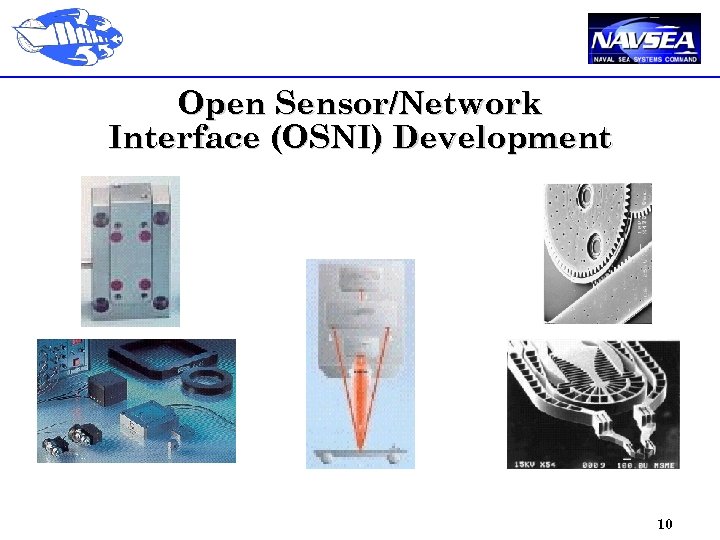 Open Sensor/Network Interface (OSNI) Development 10
 Automation and Open Architecture · Reduced/optimized manning requirement for future ship classes drives for increased automation. · Increased automation will require a significantly increased number of transducers installed aboard ship - Possibility of 25, 000 (or more) transducers on DD(x) class of ships - Levies unique requirements for future Naval platforms · Open architecture approach will be key to achieving vision of highly automated ship in a cost effective manner - Reduced installation costs - Allow for Technology Insertion / Upgrade - Allow for streamlined Maintenance & Supply 11
 OSNI Goals & Objectives · Explore various sensor-bus standards & interfaces · Perform Risk Mitigation on candidate sensor-bus standards · Help establish a set of Navy Open Architecture sensor-bus standards & interfaces · Work with Standards Bodies to develop Open Sensor. Bus Standards for both Industry and Navy · Promulgate the use of sensor-bus standards for Navy systems to shipyards, systems integrators and vendors 12
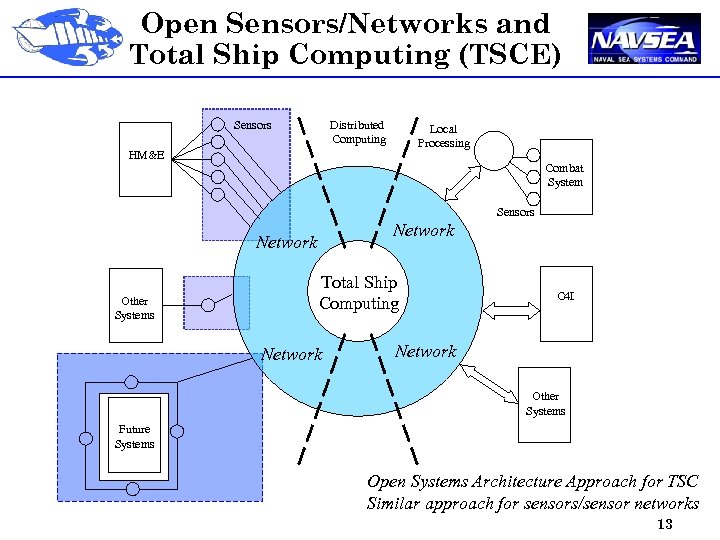 Open Sensors/Networks and Total Ship Computing (TSCE) Sensors Distributed Computing Local Processing HM&E Combat System Sensors Network Other Systems Total Ship Computing Network C 4 I Network Other Systems Future Systems Open Systems Architecture Approach for TSC Similar approach for sensors/sensor networks 13
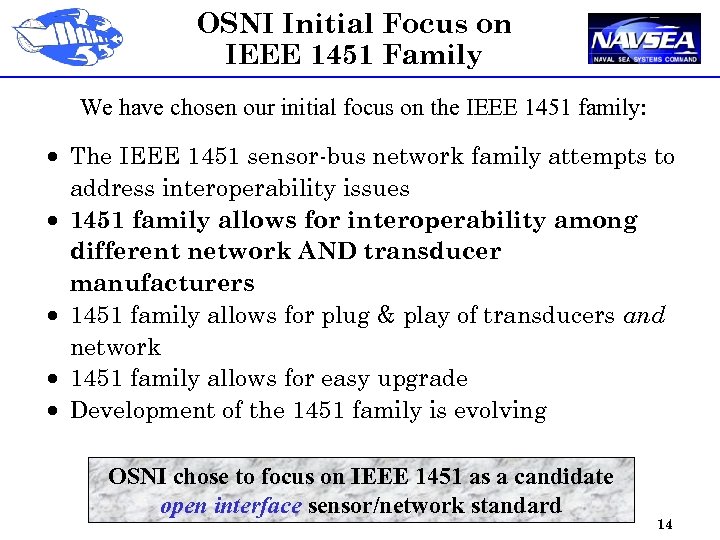 OSNI Initial Focus on IEEE 1451 Family We have chosen our initial focus on the IEEE 1451 family: · The IEEE 1451 sensor-bus network family attempts to address interoperability issues · 1451 family allows for interoperability among different network AND transducer manufacturers · 1451 family allows for plug & play of transducers and network · 1451 family allows for easy upgrade · Development of the 1451 family is evolving OSNI chose to focus on IEEE 1451 as a candidate open interface sensor/network standard 14
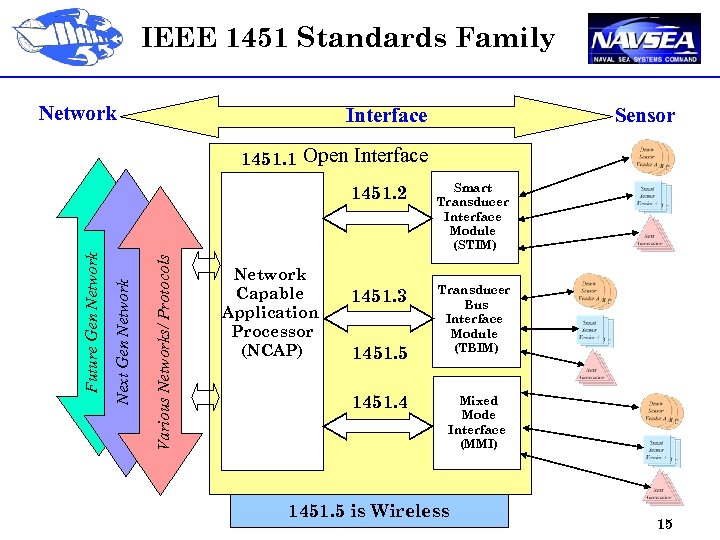 IEEE 1451 Standards Family Network Interface Sensor 1451. 1 Open Interface Various Networks/ Protocols Network Next Gen Network Future Gen Network 1451. 2 Network Capable Application Processor (NCAP) Smart Transducer Interface Module (STIM) 1451. 3 Transducer Bus Interface Module (TBIM) 1451. 5 1451. 4 Mixed Mode Interface (MMI) 1451. 5 is Wireless 15
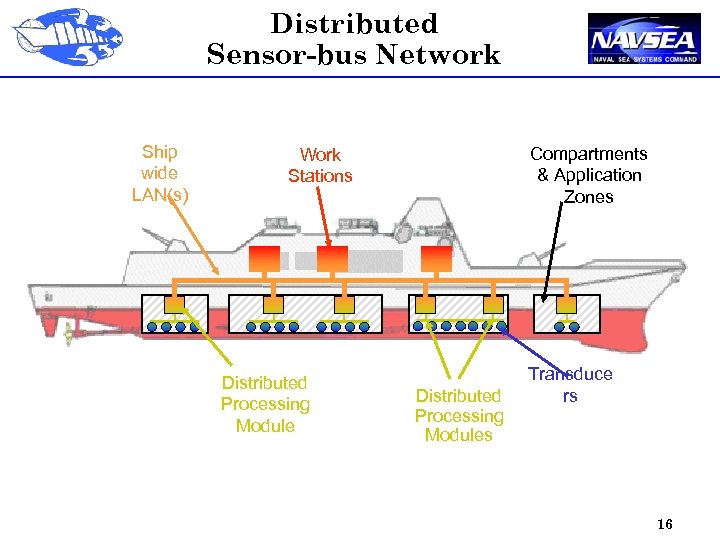 Distributed Sensor-bus Network Ship wide LAN(s) Compartments & Application Zones Work Stations Distributed Processing Modules Transduce rs 16
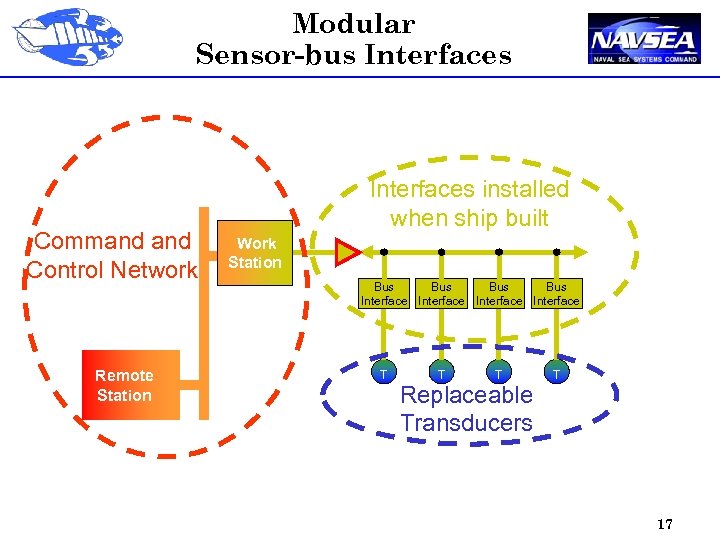 Modular Sensor-bus Interfaces Command Control Network Remote Station Interfaces installed when ship built Work Station Bus Bus Interface T T T Replaceable Transducers T 17
 Initial Risk Mitigation · Development of an Open Sensor/Network Interface Demonstrator - IEEE 1451. 3 (multi-drop bus) chosen for testing · Used an early draft of the standard (2001) - Examine and explore Navy needs and requirements · Tested a concept of additional backup features added to help address Navy specific issues · Help demonstrate the use of plug-and-play for sensor-bus networks - Adapted existing COTS parts and systems to simulate IEEE 1451. 3 network · Pressure & Temperature sensors · Encoder & Stepper motor actuators 18
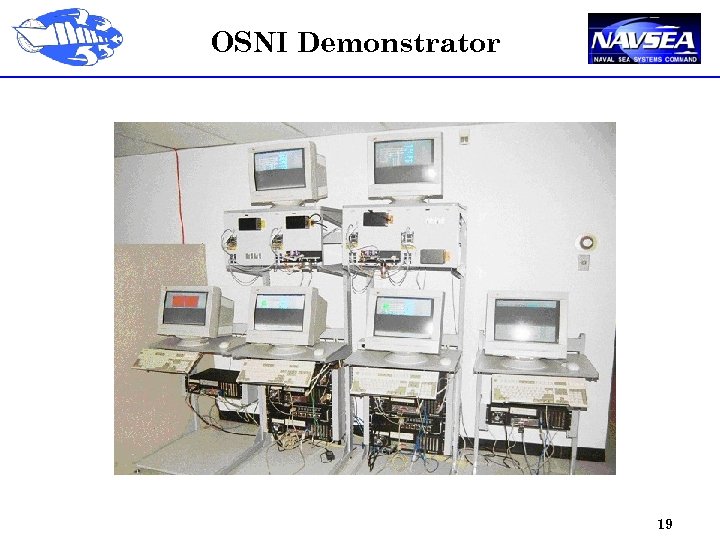 OSNI Demonstrator 19
 Open Material Condition Information (OMCI)
 OMCI Requirements · Need to reduce/optimize manning for DDX · Need to reduce maintenance man-hours · Requires more Sophisticated and Extensive Maintenance Applications · There are multiple Navy and commercial maintenance information interfaces · Maintenance developments including future Condition Based Maintenance (CBM) applications require: - Access to expanding commercial developments. - Interoperability between commercial CBM systems and maintenance information systems. - A Navy/commercial standard interface for maintenance applications. An Open Material Condition Information Standard is Required 21
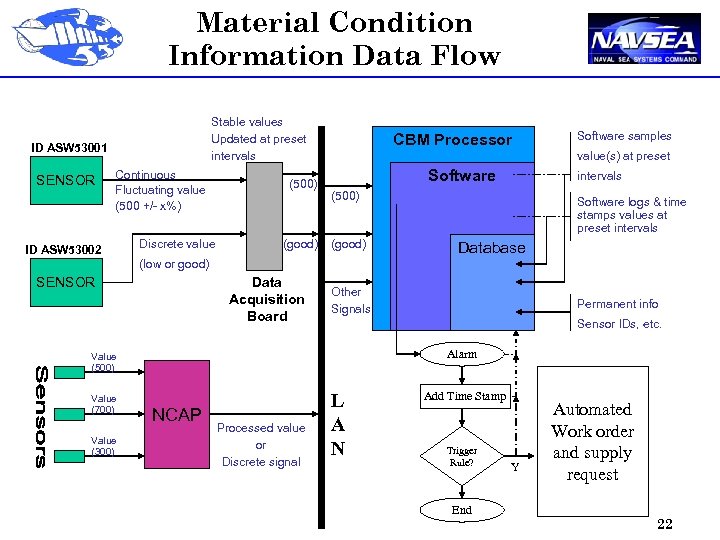 Material Condition Information Data Flow Stable values Updated at preset intervals ID ASW 53001 SENSOR Continuous Fluctuating value (500 +/- x%) ID ASW 53002 Discrete value (500) (good) CBM Processor Software samples value(s) at preset Software intervals (500) (good) Software logs & time stamps values at preset intervals Database (low or good) SENSOR Data Acquisition Board Other Signals Sensor IDs, etc. Alarm Value (500) Value (700) Value (300) Permanent info NCAP Processed value or Discrete signal L A N Add Time Stamp Trigger Rule? End Y Automated Work order and supply request 22
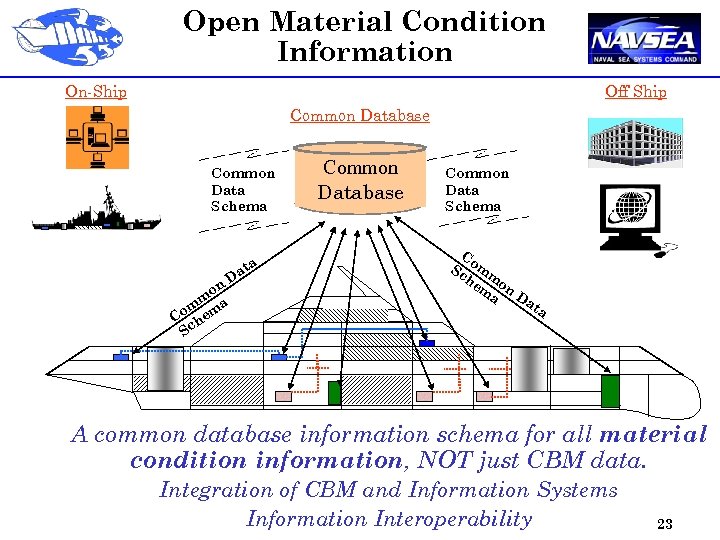 Open Material Condition Information On-Ship Off Ship Common Database Common Data Schema ta Da on m a om em C h Sc Common Database Common Data Schema Co Sc mm he o m n. D a a ta A common database information schema for all material condition information, NOT just CBM data. Integration of CBM and Information Systems Information Interoperability 23
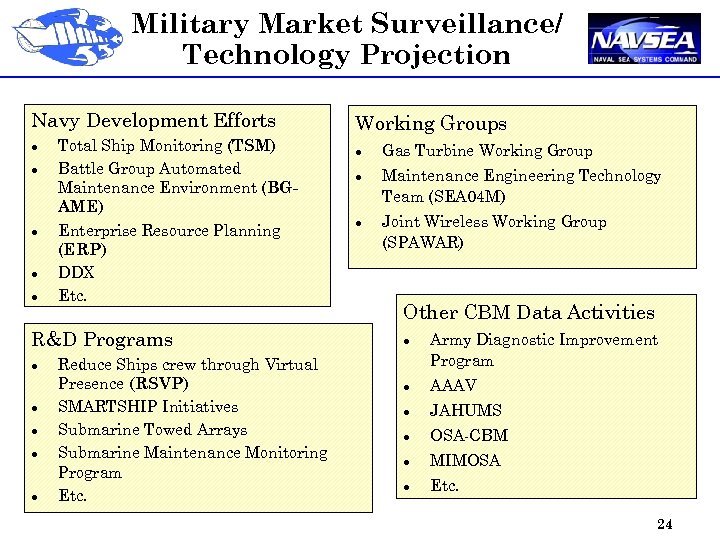 Military Market Surveillance/ Technology Projection Navy Development Efforts l l l Total Ship Monitoring (TSM) Battle Group Automated Maintenance Environment (BGAME) Enterprise Resource Planning (ERP) DDX Etc. R&D Programs l l l Reduce Ships crew through Virtual Presence (RSVP) SMARTSHIP Initiatives Submarine Towed Arrays Submarine Maintenance Monitoring Program Etc. Working Groups l l l Gas Turbine Working Group Maintenance Engineering Technology Team (SEA 04 M) Joint Wireless Working Group (SPAWAR) Other CBM Data Activities l Army Diagnostic Improvement Program l AAAV l JAHUMS l OSA-CBM l MIMOSA l Etc. 24
 MIMOSA l l l Maintenance Information Management Open Systems Alliance Consortium of 50+ system integration providers, component vendors and end-users MIMOSA addressing the interoperability deficiency in information integration and exchange. Developing open specifications for all material condition information, not just CBM MIMOSA goal to become an ISO Standard SMMOA Selected MIMOSA as a Candidate Navy OMCI Standard 25
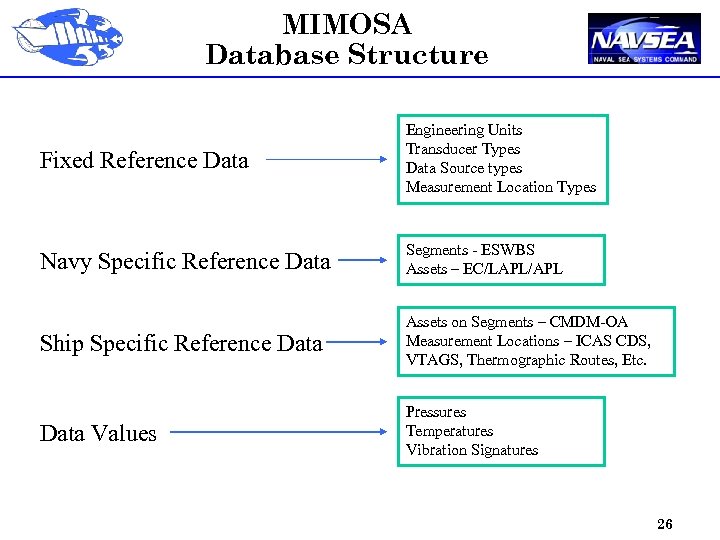 MIMOSA Database Structure Fixed Reference Data Engineering Units Transducer Types Data Source types Measurement Location Types Navy Specific Reference Data Segments - ESWBS Assets – EC/LAPL/APL Ship Specific Reference Data Assets on Segments – CMDM-OA Measurement Locations – ICAS CDS, VTAGS, Thermographic Routes, Etc. Data Values Pressures Temperatures Vibration Signatures 26
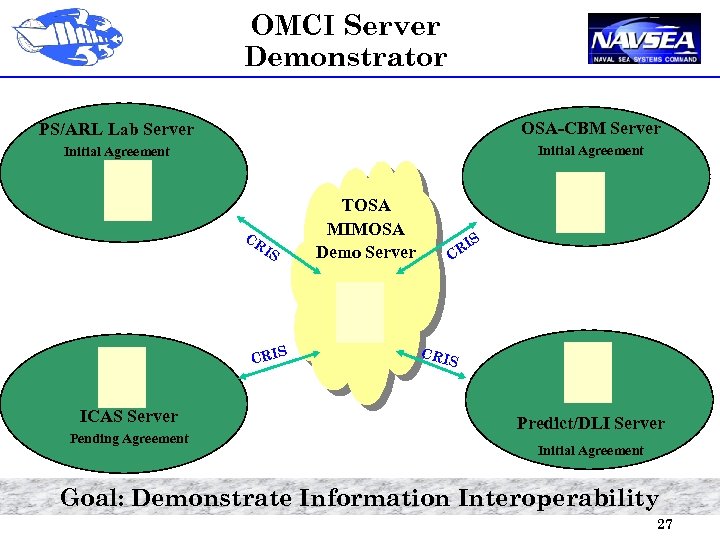 OMCI Server Demonstrator PS/ARL Lab Server OSA-CBM Server Initial Agreement TOSA MIMOSA Demo Server CR IS S CRI ICAS Server Pending Agreement S I CR CRI S Predict/DLI Server Initial Agreement Goal: Demonstrate Information Interoperability 27
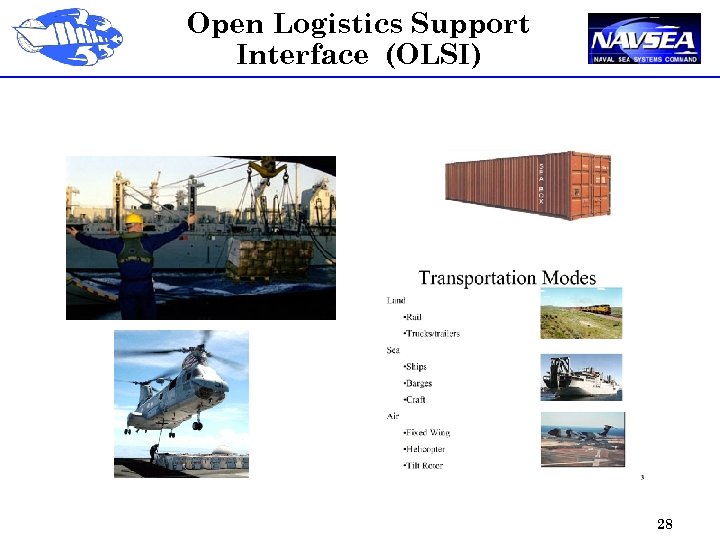 Open Logistics Support Interface (OLSI) 28
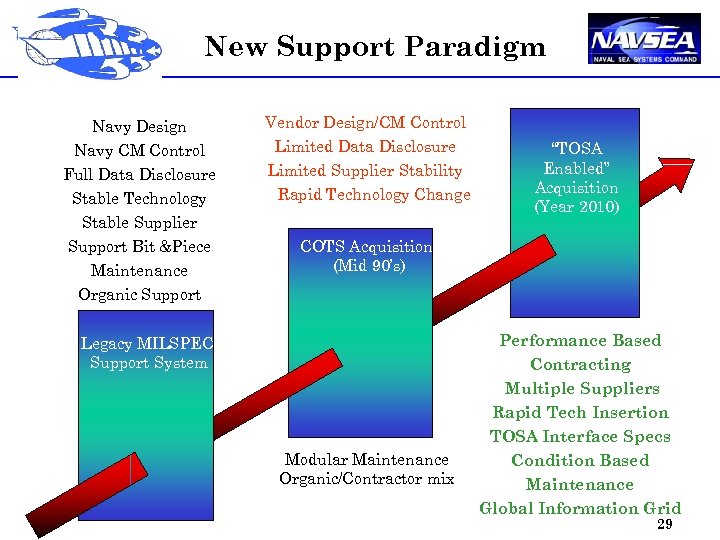 New Support Paradigm Navy Design Navy CM Control Vendor Design/CM Control Full Data Disclosure Stable Technology Stable Supplier Support Bit &Piece Maintenance Organic Support Limited Supplier Stability Rapid Technology Change Limited Data Disclosure “TOSA Enabled” Acquisition (Year 2010) COTS Acquisition (Mid 90’s) Legacy MILSPEC Support System Modular Maintenance Organic/Contractor mix Performance Based Contracting Multiple Suppliers Rapid Tech Insertion TOSA Interface Specs Condition Based Maintenance Global Information Grid 29
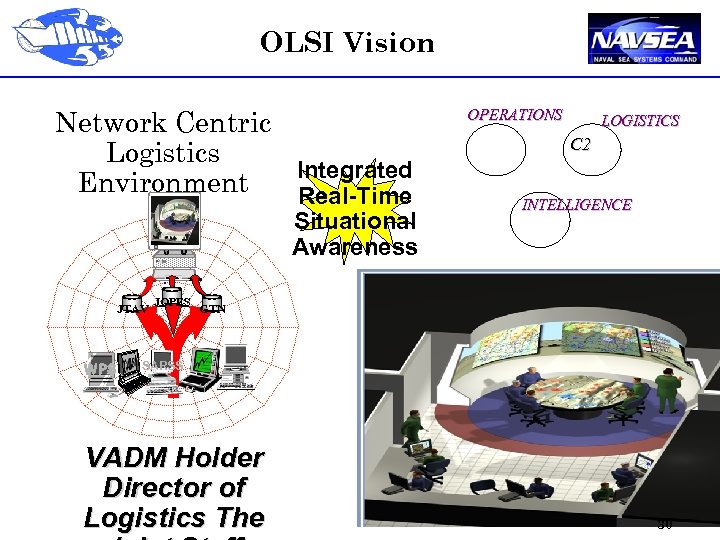 OLSI Vision Network Centric Logistics Integrated Environment Real-Time Situational Awareness OPERATIONS LOGISTICS C 2 INTELLIGENCE 6 JTAV WPS JOPES GTN SARSS VADM Holder Director of Logistics The 30
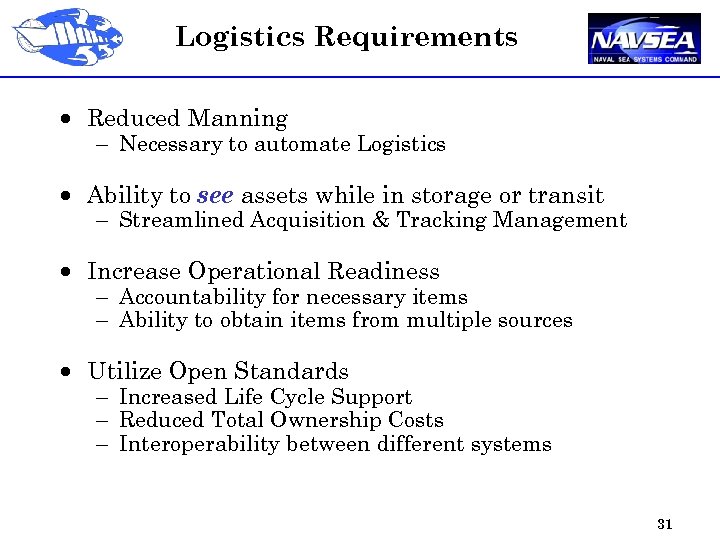 Logistics Requirements · Reduced Manning - Necessary to automate Logistics · Ability to see assets while in storage or transit - Streamlined Acquisition & Tracking Management · Increase Operational Readiness - Accountability for necessary items - Ability to obtain items from multiple sources · Utilize Open Standards - Increased Life Cycle Support - Reduced Total Ownership Costs - Interoperability between different systems 31
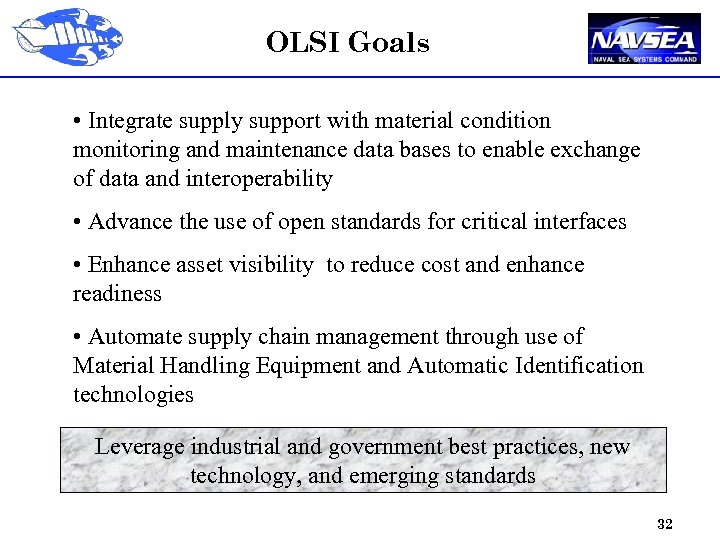 OLSI Goals • Integrate supply support with material condition monitoring and maintenance data bases to enable exchange of data and interoperability • Advance the use of open standards for critical interfaces • Enhance asset visibility to reduce cost and enhance readiness • Automate supply chain management through use of Material Handling Equipment and Automatic Identification technologies Leverage industrial and government best practices, new technology, and emerging standards 32
 Market Surveillance & Technology Projection · · · · · Universal Identification (UID) part marking Universal Identification Code Smart stores/smart shelves Radio Frequency Identification (RFID) Ultra Wide Band (UWB) Serial Number Tracking Data Matrix Symbology Contact Memory Buttons AIT networks Material handling equipment 33
 OLSI’s Use of Open Standards · Review and evaluate evolving standards for AIT, inventory management, MHE, storage & transportation · Become involved in standards development - Better interoperability between systems - Insure various Logistics systems communicate with each other · From hand-held bar-code readers & CMBs to databases to communications systems 34
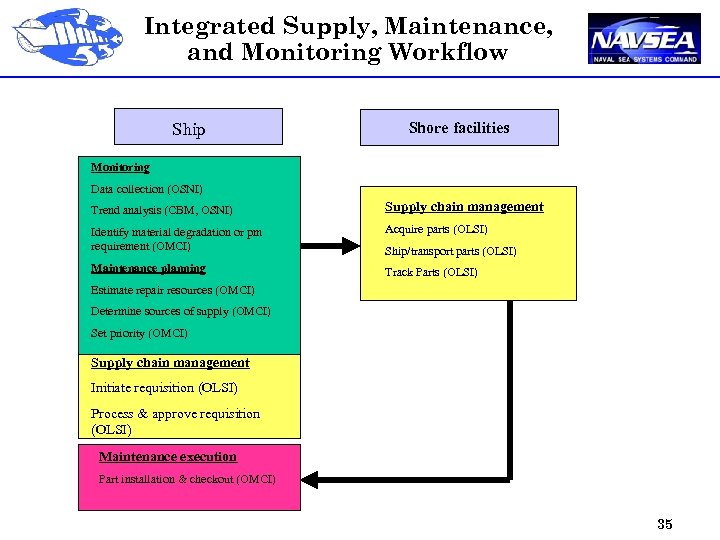 Integrated Supply, Maintenance, and Monitoring Workflow Ship Shore facilities Monitoring Data collection (OSNI) Trend analysis (CBM, OSNI) Supply chain management Identify material degradation or pm D requirement (OMCI) Acquire parts (OLSI) e t Maintenance planning e Estimate repair resources (OMCI) c t Determine sources of supply P (OMCI) Ship/transport parts (OLSI) Track Parts (OLSI) Set priority (OMCI) Supply chain management Initiate requisition (OLSI) Process & approve requisition (OLSI) Maintenance execution Part installation & checkout (OMCI) 35
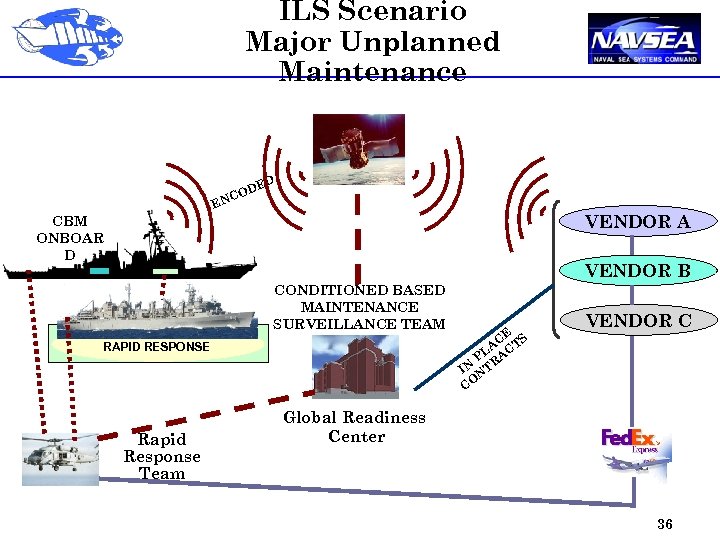 ILS Scenario Major Unplanned Maintenance DE CO D EN VENDOR A CBM ONBOAR D VENDOR B CONDITIONED BASED MAINTENANCE SURVEILLANCE TEAM RAPID RESPONSE Rapid Response Team E S AC CT PL A N TR I N CO VENDOR C Global Readiness Center 36
 Conclusion · SMMOA is a Prime Concern for Navy’s future - Future Manning requires better use of technology for monitoring, maintenance and supply - Open Standards should be developed/used for interfaces - Need risk mitigation on candidate Open Standards - Need to reach common Agreements & Strategies - Consensus set of Standards for SMMOA · Open Sensors, Databases and Supply & Logistics management - Promulgate these standards to Naval and Industry Systems Integration Teams 37
 Contact Information · SMMOA Contacts David Perrussel SMMOA Lead/OSNI Lead (540) 653 -6820 Perrussel. DB@nswc. navy. m il Sam Judge OLSI Lead (301) 227 -3673 Judge. SD@nswccd. navy. mil Win Royce OMCI Lead (301) 227 -7632 Royce. WW@nswccd. navy. mi l Jack Abbott TOSA IPT Lead/Blue. Sky DDX (301) 227 -7631 Abbott. JW@nswccd. navy. mi l 38
 Backup 39
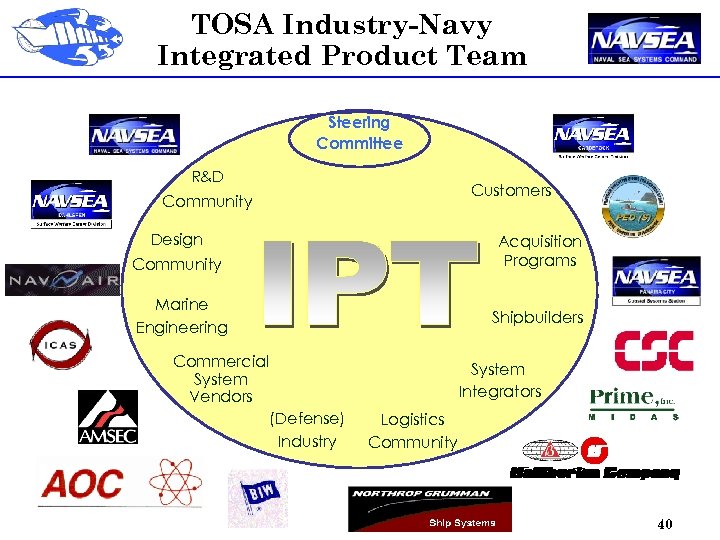 TOSA Industry-Navy Integrated Product Team Steering Committee R&D Customers Community Design Acquisition Programs Community Marine Engineering Shipbuilders Commercial System Vendors System Integrators (Defense) Industry Logistics Community 40
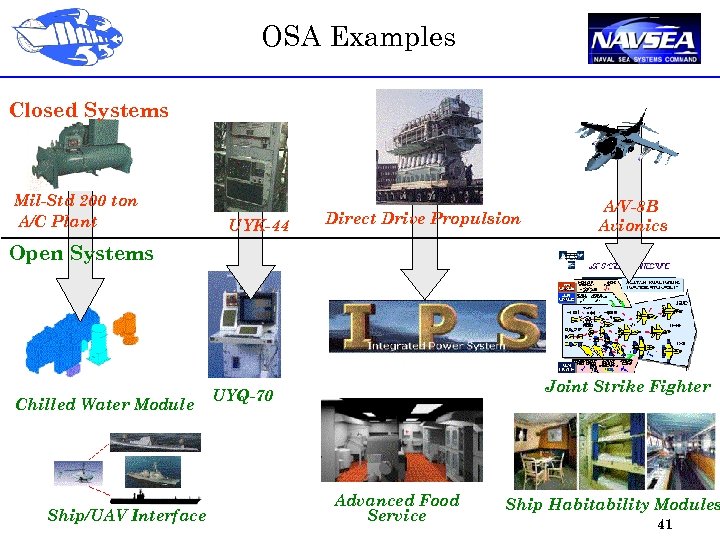 OSA Examples Closed Systems Mil-Std 200 ton A/C Plant UYK-44 Direct Drive Propulsion A/V-8 B Avionics Open Systems Chilled Water Module Ship/UAV Interface Joint Strike Fighter UYQ-70 Advanced Food Service Ship Habitability Modules 41
 Background/Initial Research • Began with a comprehensive market surveillance of CBM programs and projects – Identified key players and key programs in the CBM arena – Identified standards bodies and standards development work with potential TOSA implications • Established contacts/working relationships with key CBM programs, projects, and companies – – Commercial companies Navy R&D projects Other military service programs Universities involved in CBM 42
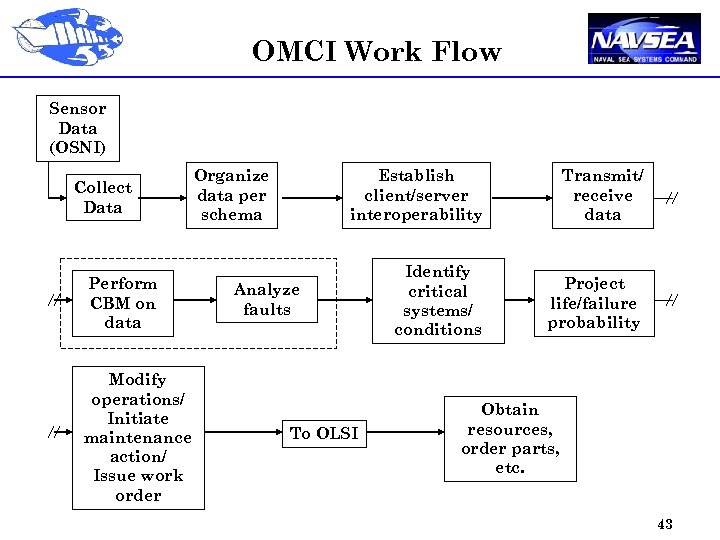 OMCI Work Flow Sensor Data (OSNI) Collect Data Perform CBM on data Modify operations/ Initiate maintenance action/ Issue work order Organize data per schema Establish client/server interoperability Transmit/ receive data Identify critical systems/ conditions Project life/failure probability Analyze faults To OLSI Obtain resources, order parts, etc. 43
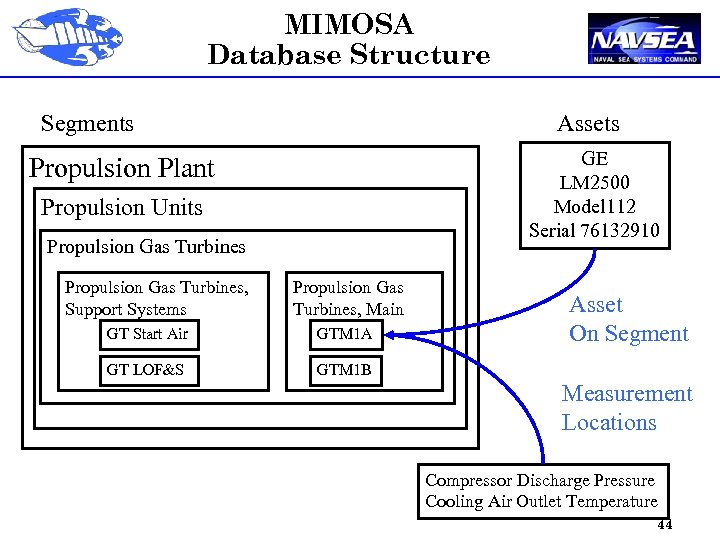 MIMOSA Database Structure Assets Segments GE LM 2500 Model 112 Serial 76132910 Propulsion Plant Propulsion Units Propulsion Gas Turbines, Support Systems Propulsion Gas Turbines, Main GT Start Air GTM 1 A GT LOF&S Asset On Segment GTM 1 B Measurement Locations Compressor Discharge Pressure Cooling Air Outlet Temperature 44
 MIMOSA Implementation Issues · MIMOSA is the gatekeeper for the fixed reference tables · We need a gatekeeper for the Navy specific reference tables · MIMOSA DB’s ship and shore have to be maintained as ship configuration changes · Application software is needed to simplify setup of the MIMOSA database · Hooking up real-time data acquisition to demo server - 1451 demonstrator PS ARL Predict DLI ICAS 45
 MIMOSA Interfaces · MIMOSA defines interfaces for the following “technologies” - Trend – static values (pressure or temperature and alarm values) - Dynamic – spectral values (vibration, ultrasonic, electric current) - Sample – fluid tests such as oil analysis or gas tests - BLOB (binary large objects) – graphic files (thermographic or digital camera images) - Diagnostic – text values (diagnostics and recommendations) - Reliability – FMEA information - Registry – asset management information - Work – work management information · MIMOSA Compliance is determined on a technology by technology basis 46